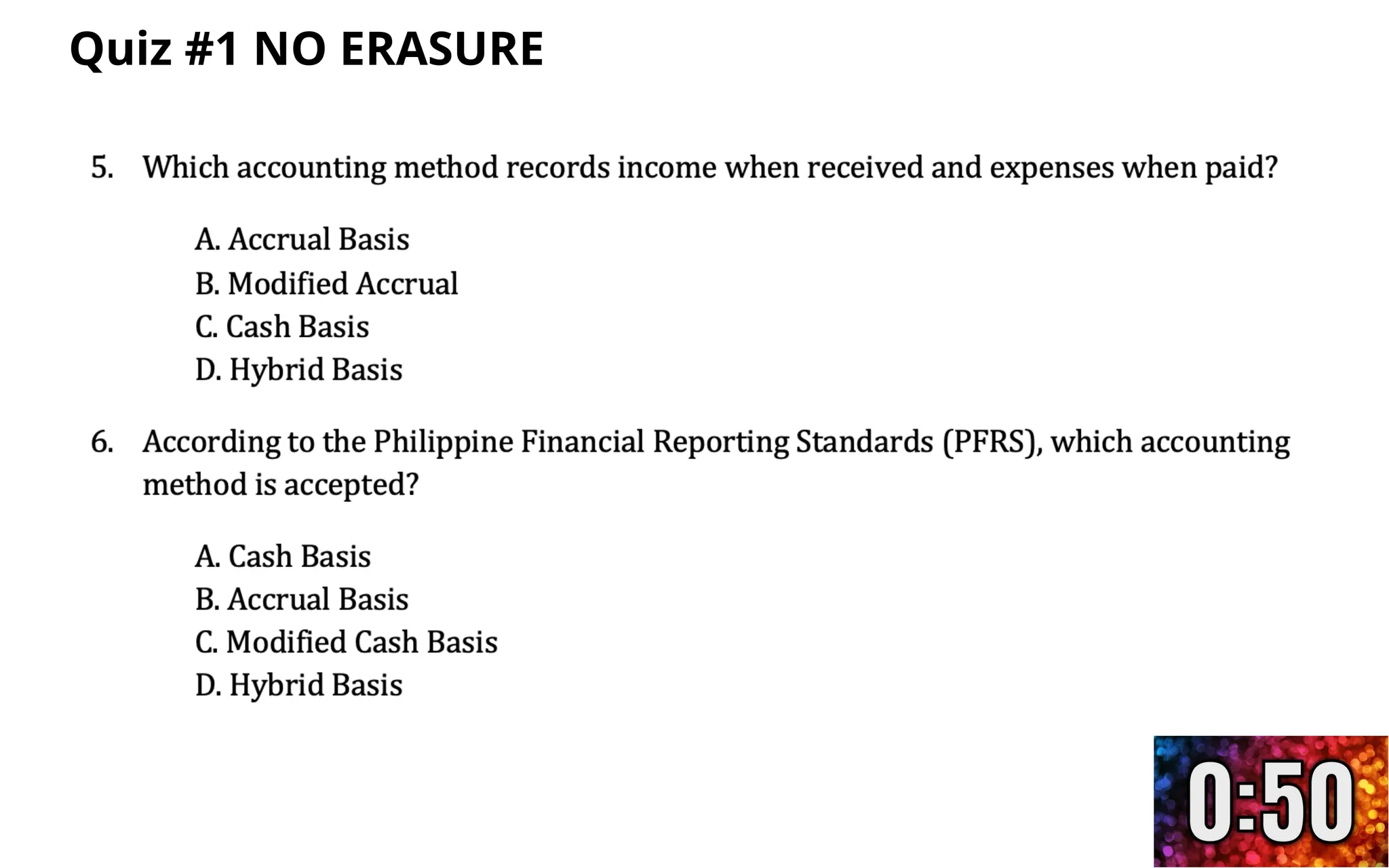
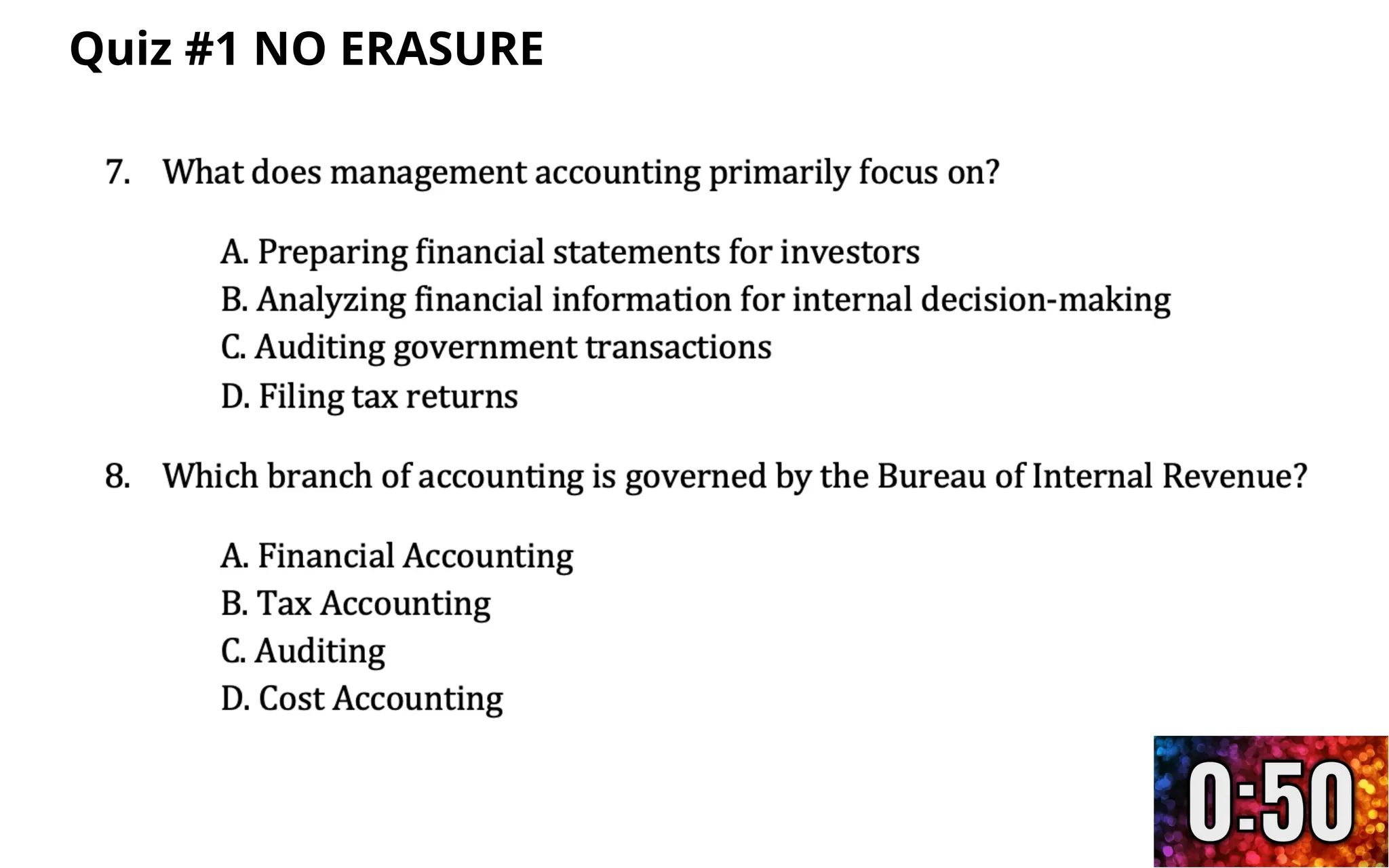
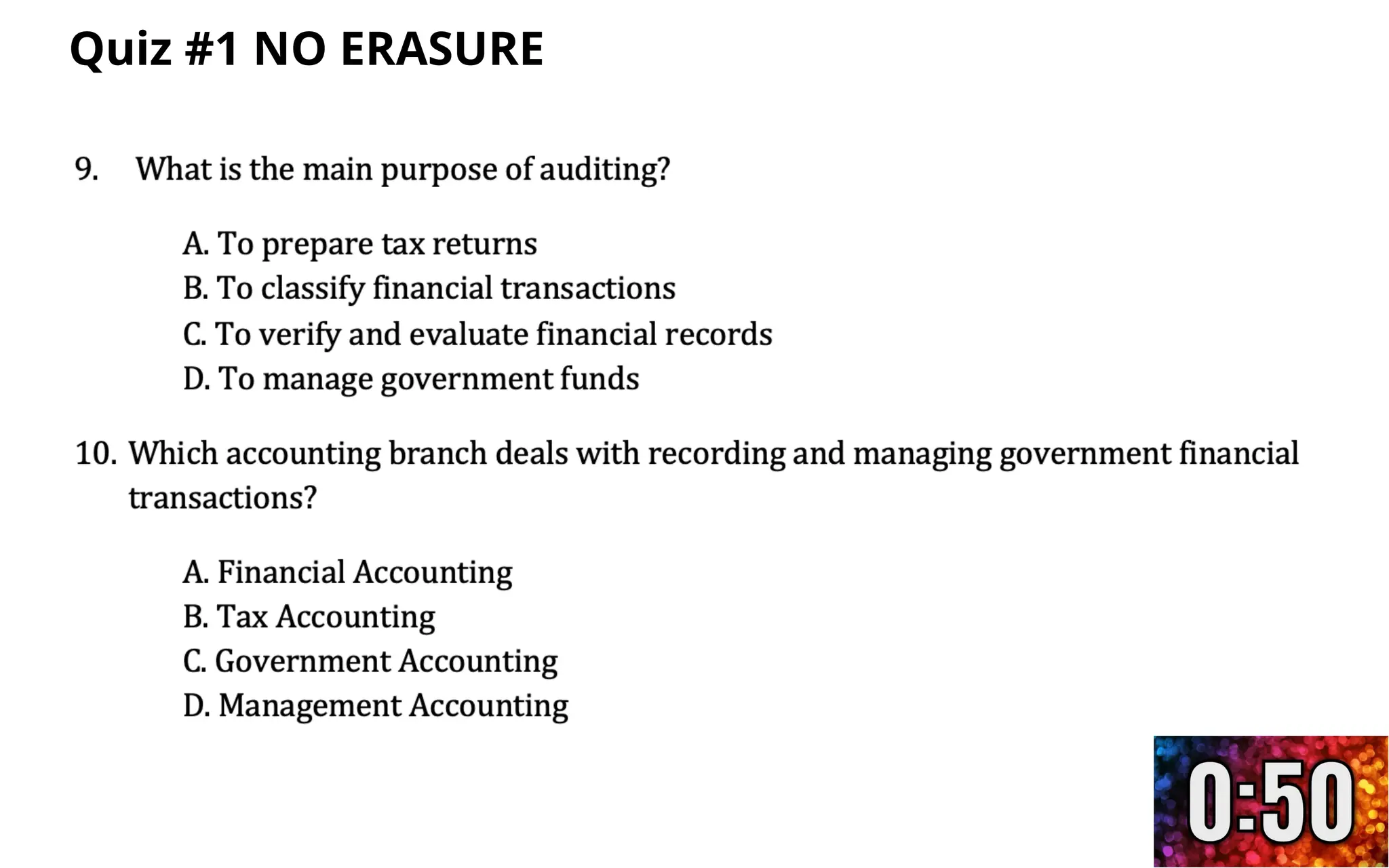
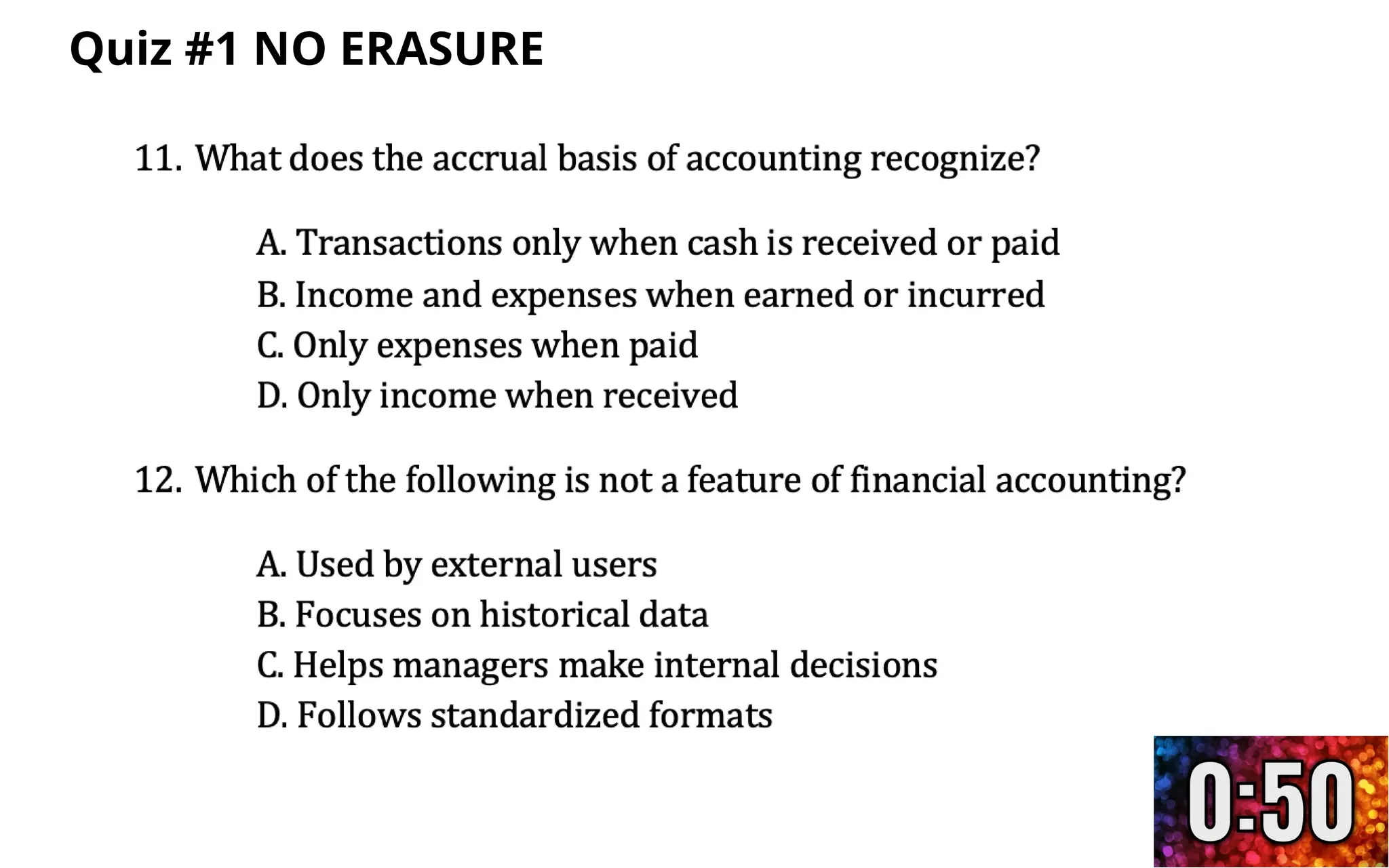
Q1
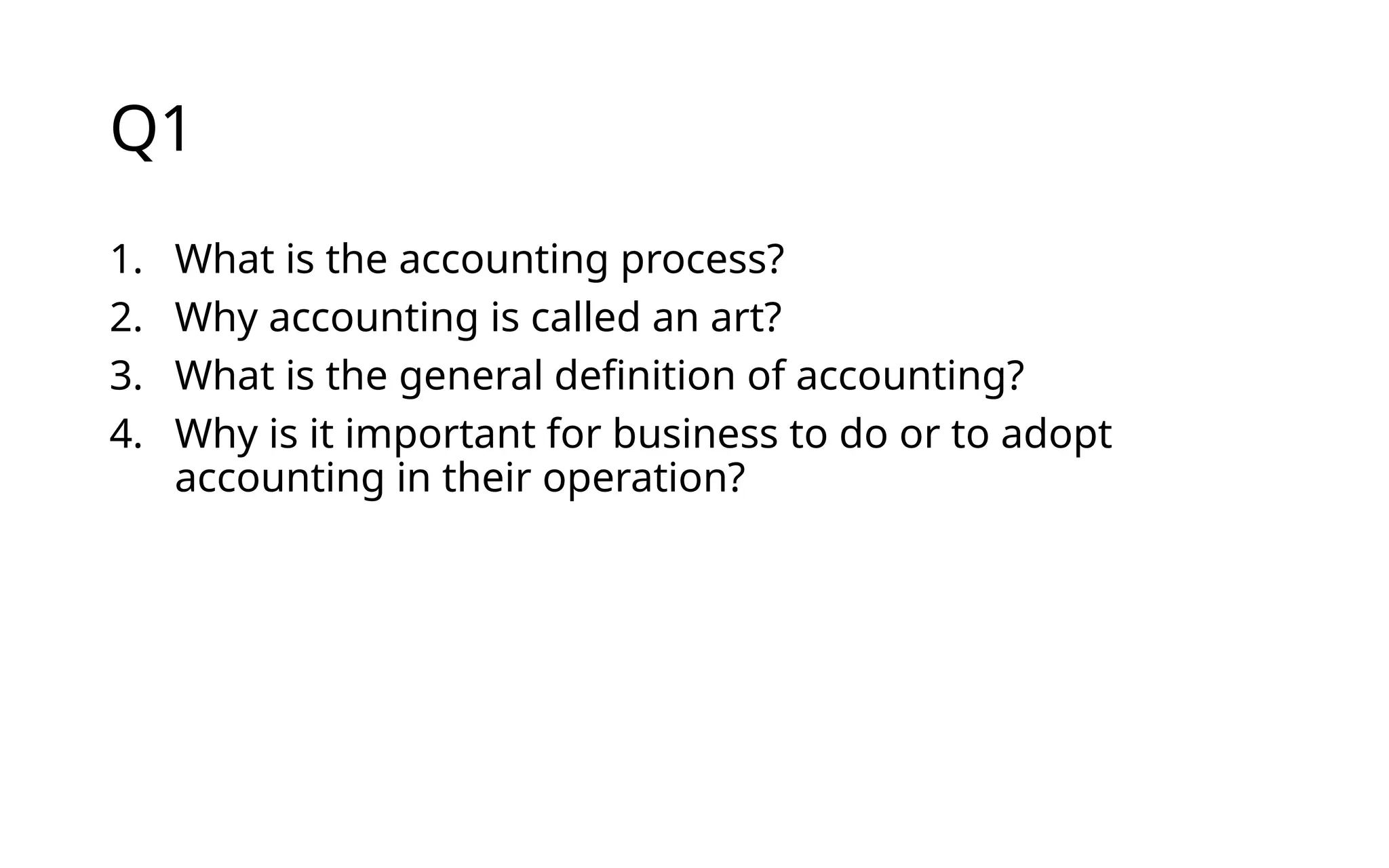
1. What isthe accounting process?
2. Why accounting is called an art?
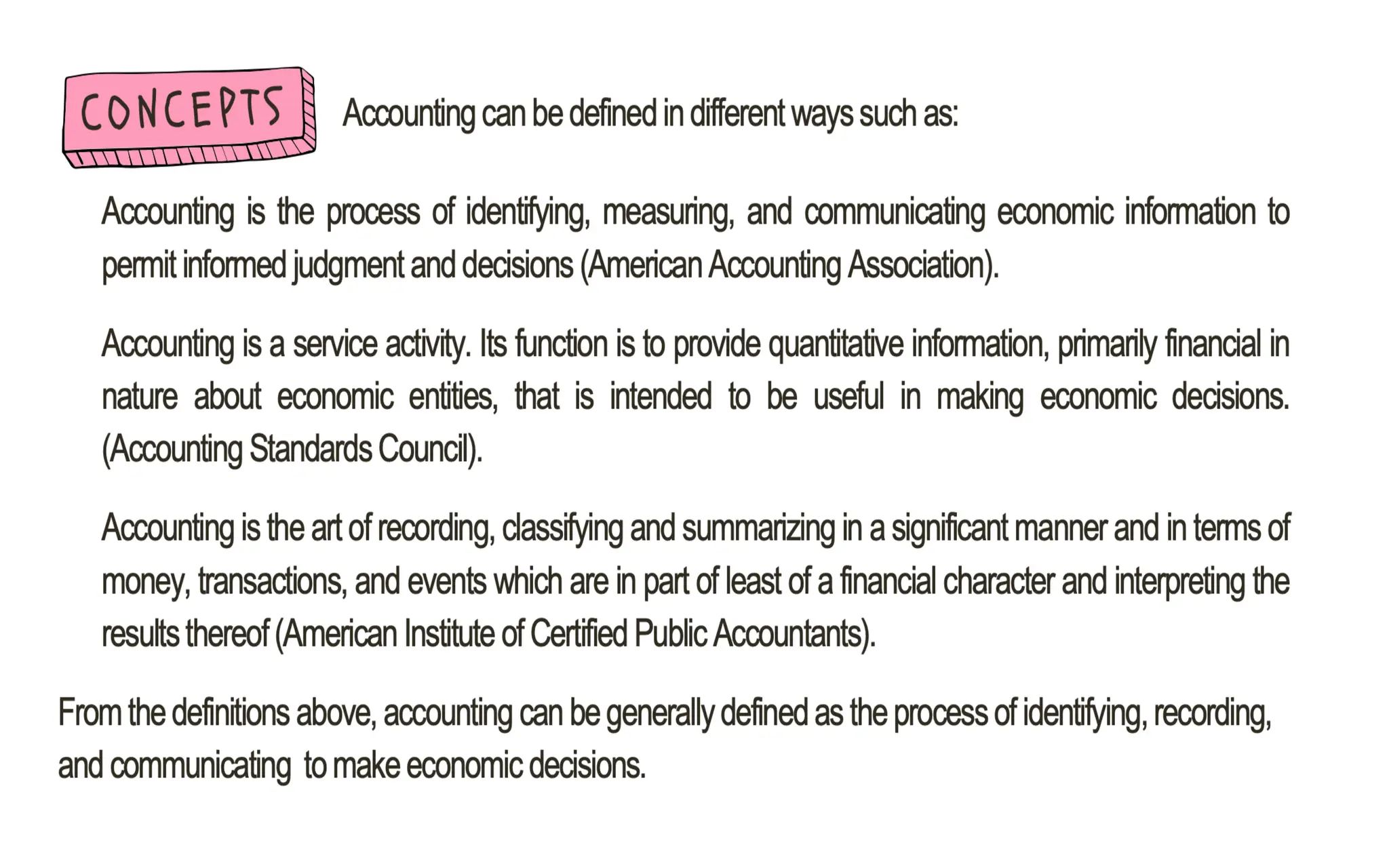
3. What is the general definition of accounting?
4. Why is it important for business to do or to adopt
accounting in their operation?
5.
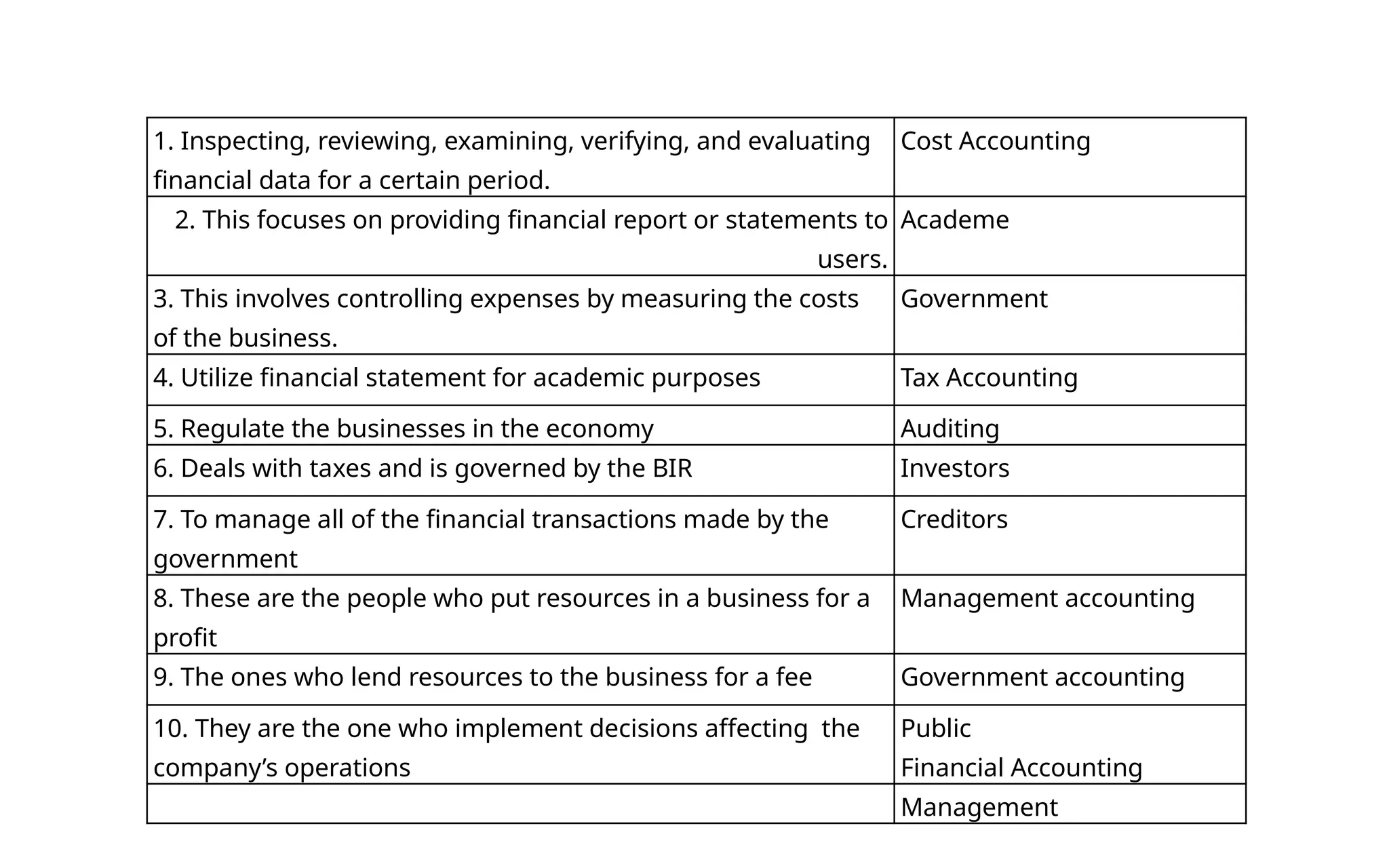
1. Inspecting, reviewing,examining, verifying, and evaluating
financial data for a certain period.
Cost Accounting
2. This focuses on providing financial report or statements to
users.
Academe
3. This involves controlling expenses by measuring the costs
of the business.
Government
4. Utilize financial statement for academic purposes Tax Accounting
5. Regulate the businesses in the economy Auditing
6. Deals with taxes and is governed by the BIR Investors
7. To manage all of the financial transactions made by the
government
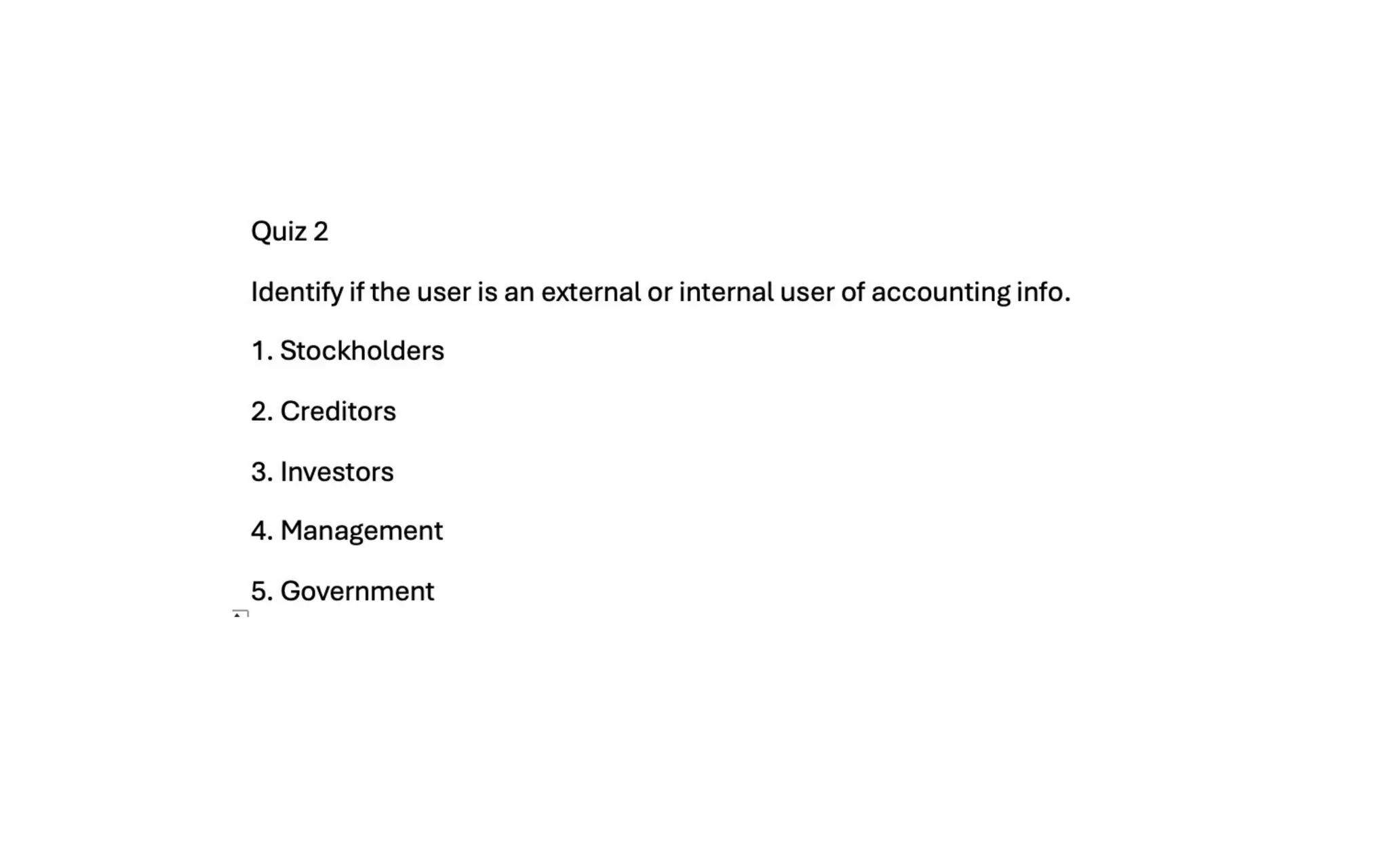
Creditors
8. These are the people who put resources in a business for a
profit
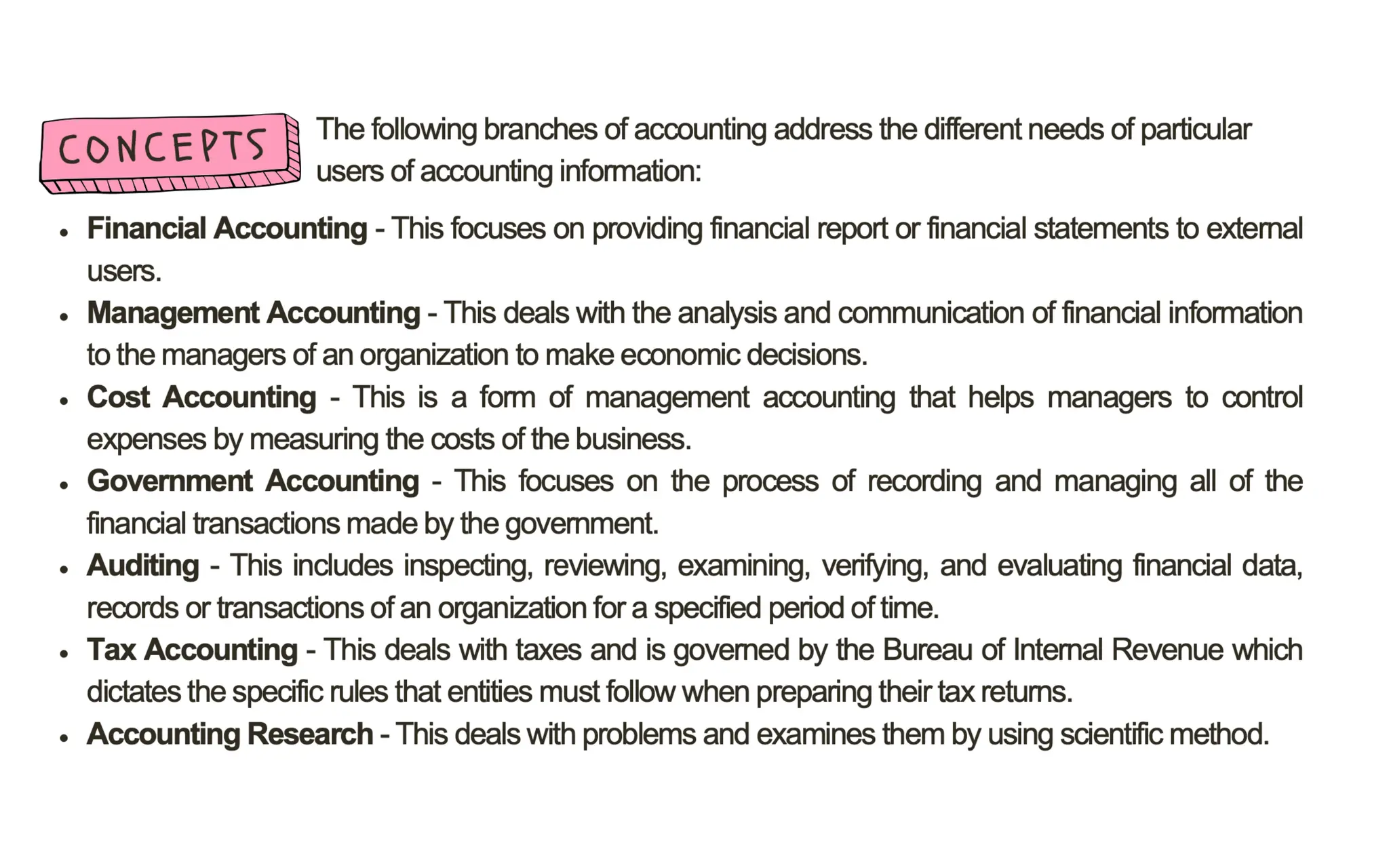
Management accounting
9. The ones who lend resources to the business for a fee Government accounting
10. They are the one who implement decisions affecting the
company’s operations
Public
Financial Accounting
Management
8.
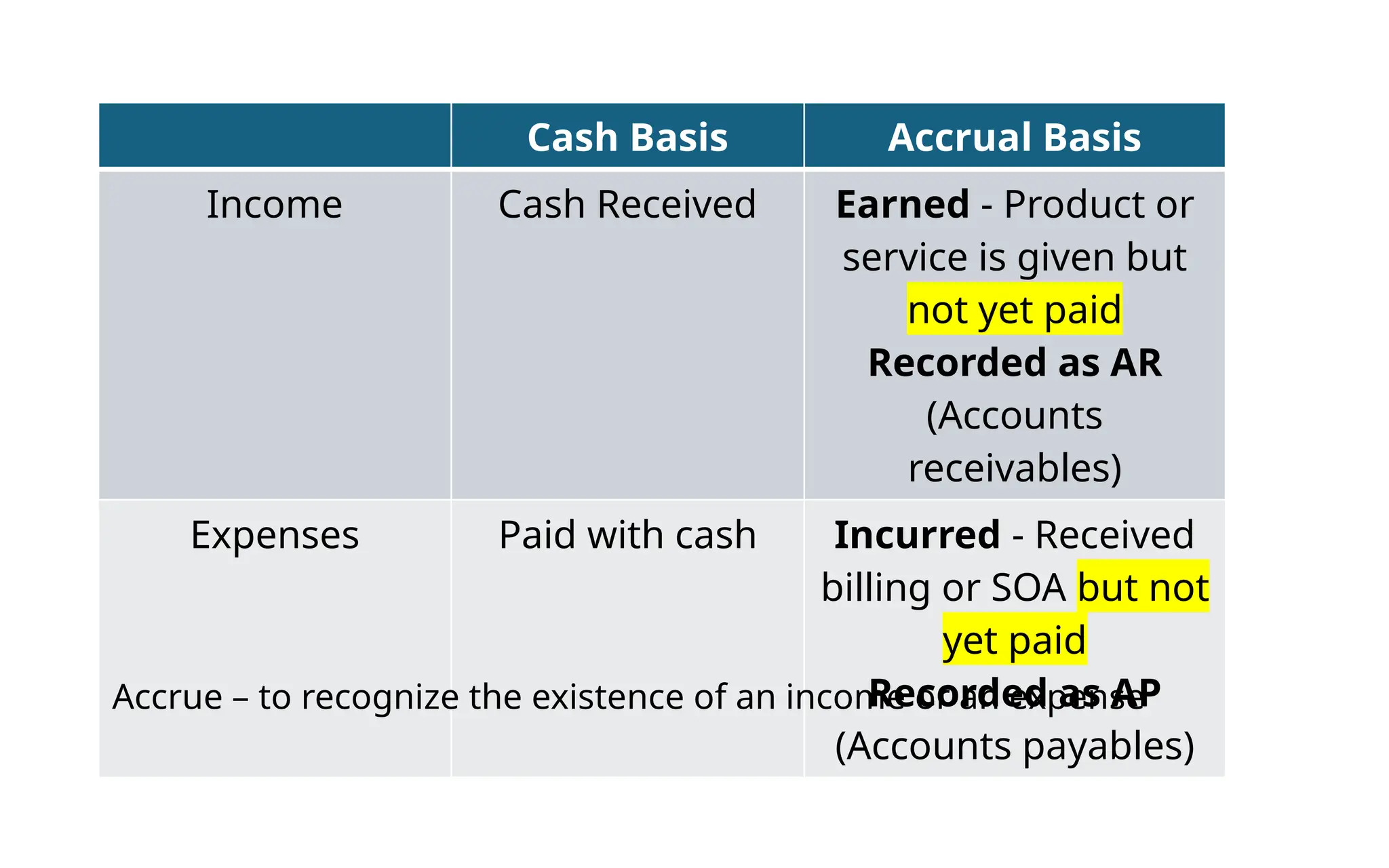
Cash Basis AccrualBasis
Income Cash Received Earned - Product or
service is given but
not yet paid
Recorded as AR
(Accounts
receivables)
Expenses Paid with cash Incurred - Received
billing or SOA but not
yet paid
Recorded as AP
(Accounts payables)
Accrue – to recognize the existence of an income or an expense
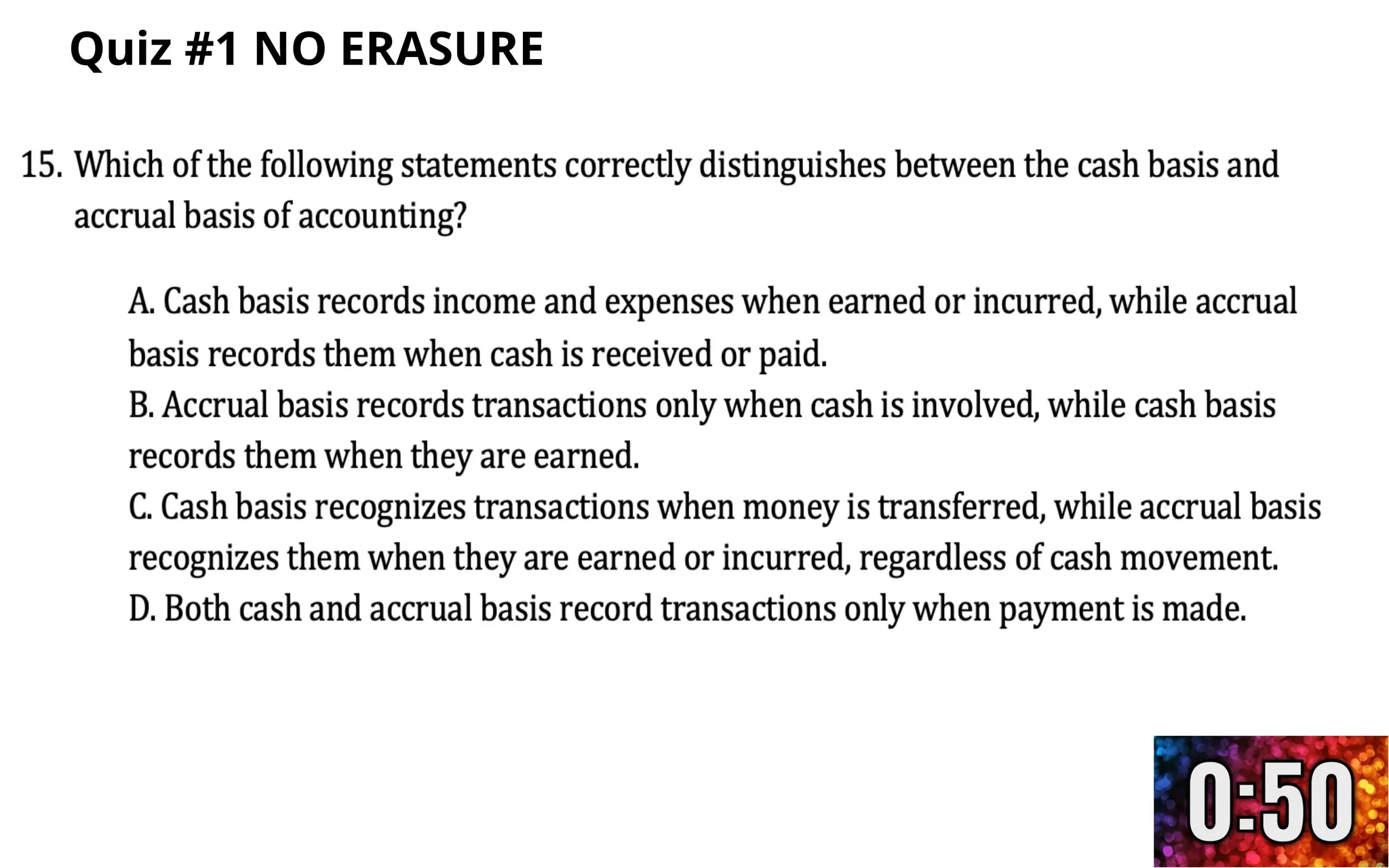
9.
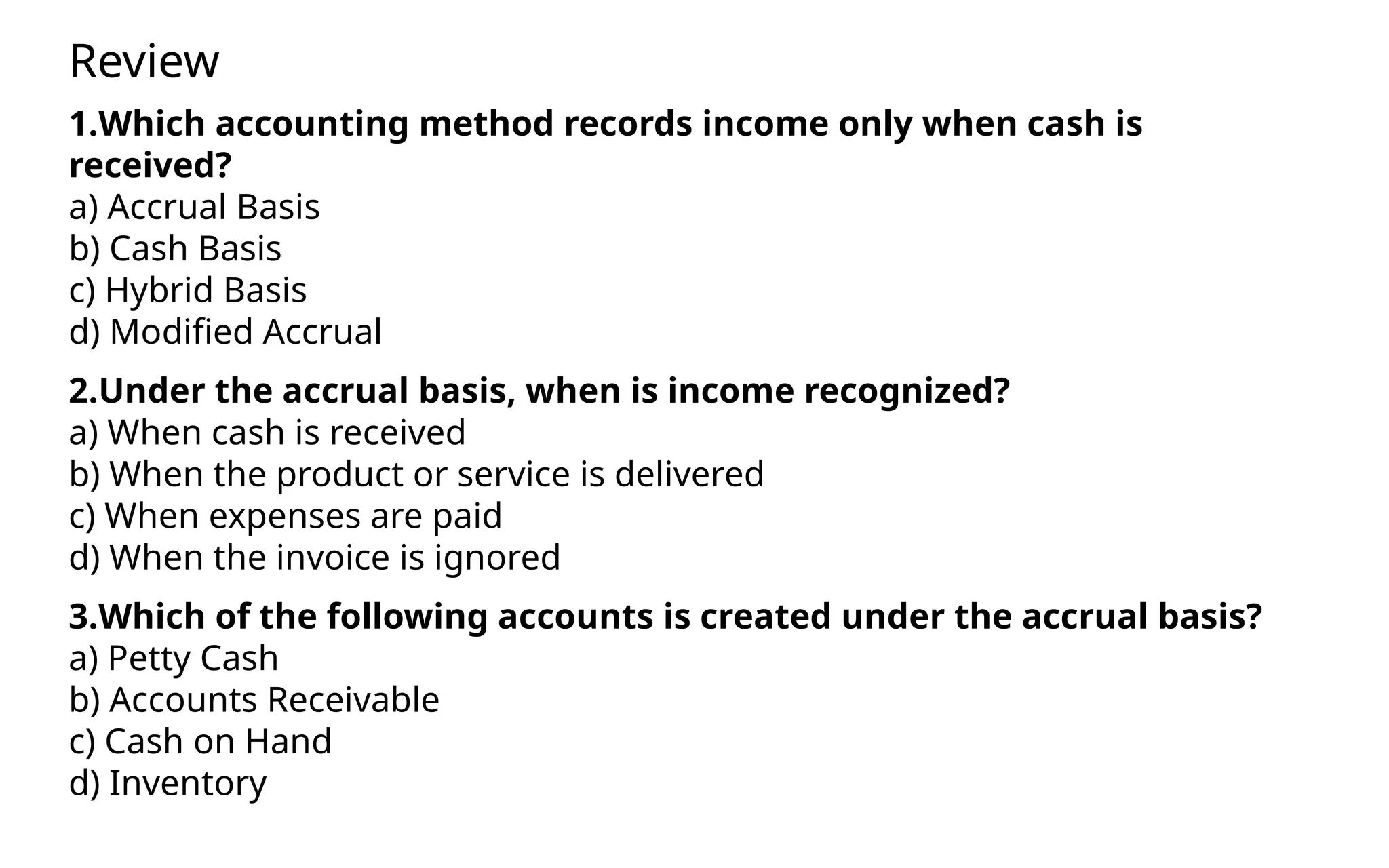
1.Which accounting methodrecords income only when cash is
received?
a) Accrual Basis
b) Cash Basis
c) Hybrid Basis
d) Modified Accrual
2.Under the accrual basis, when is income recognized?
a) When cash is received
b) When the product or service is delivered
c) When expenses are paid
d) When the invoice is ignored
3.Which of the following accounts is created under the accrual basis?
a) Petty Cash
b) Accounts Receivable
c) Cash on Hand
d) Inventory
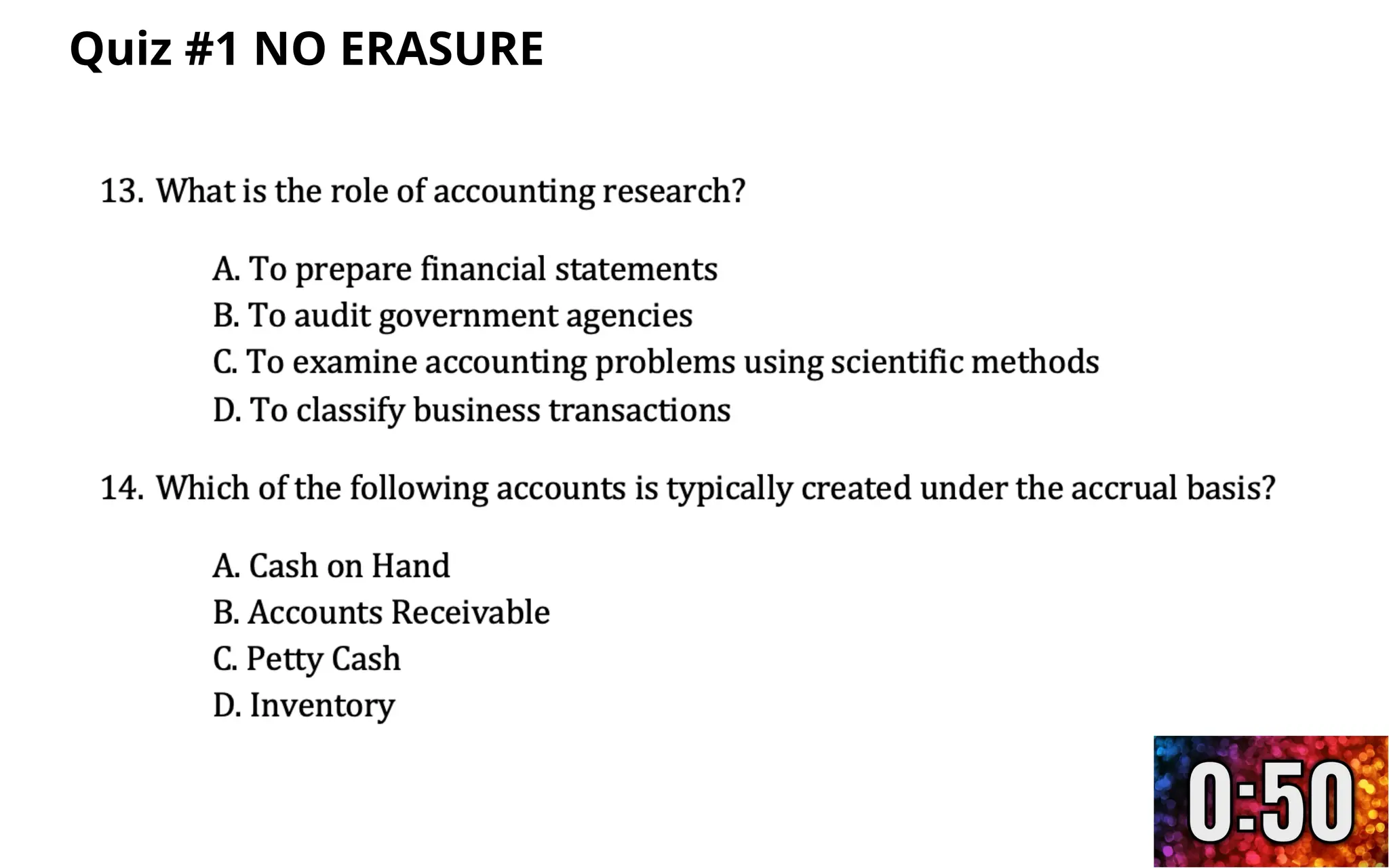
Review
10.
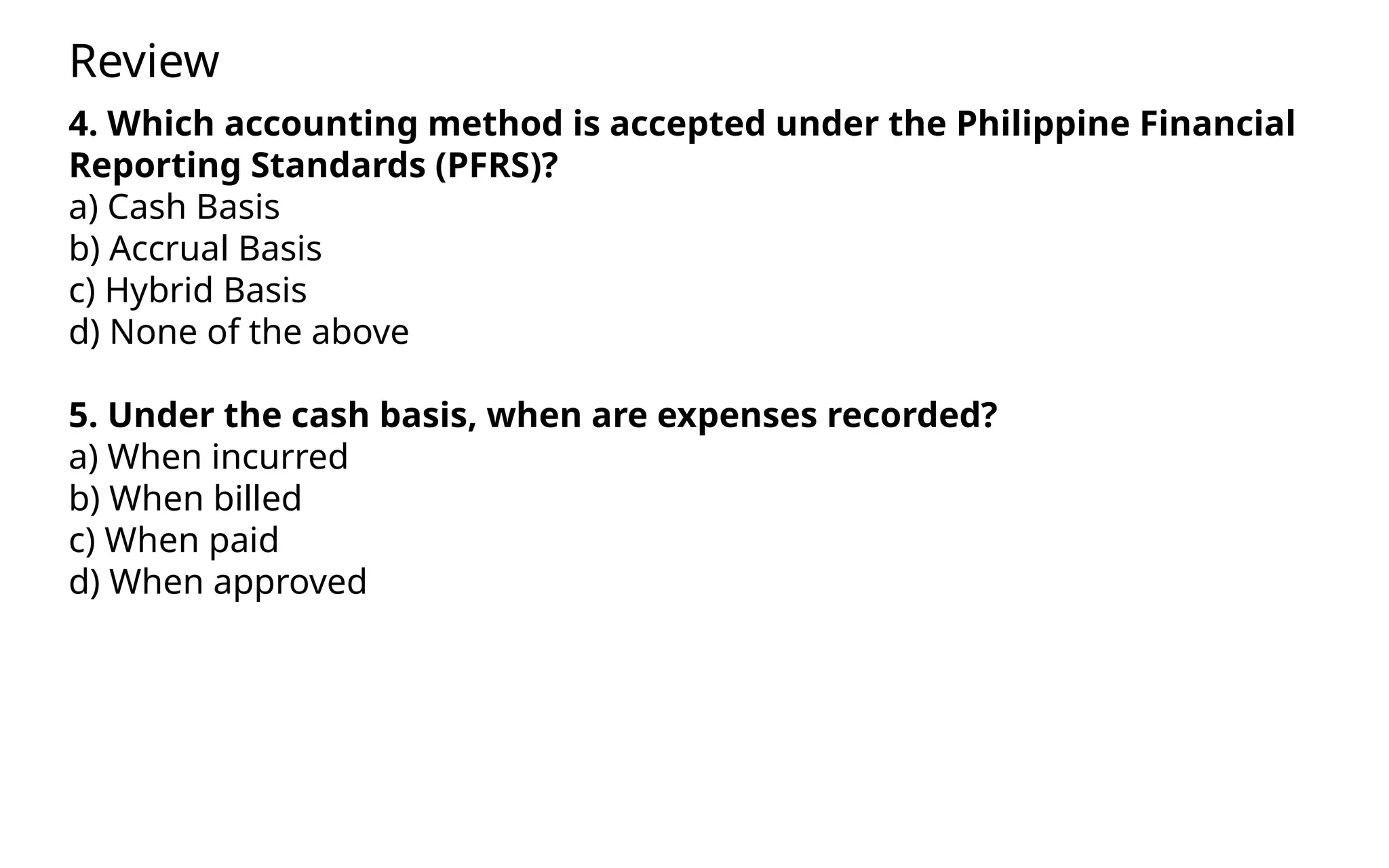
4. Which accountingmethod is accepted under the Philippine Financial
Reporting Standards (PFRS)?
a) Cash Basis
b) Accrual Basis
c) Hybrid Basis
d) None of the above
5. Under the cash basis, when are expenses recorded?
a) When incurred
b) When billed
c) When paid
d) When approved
Review
11.
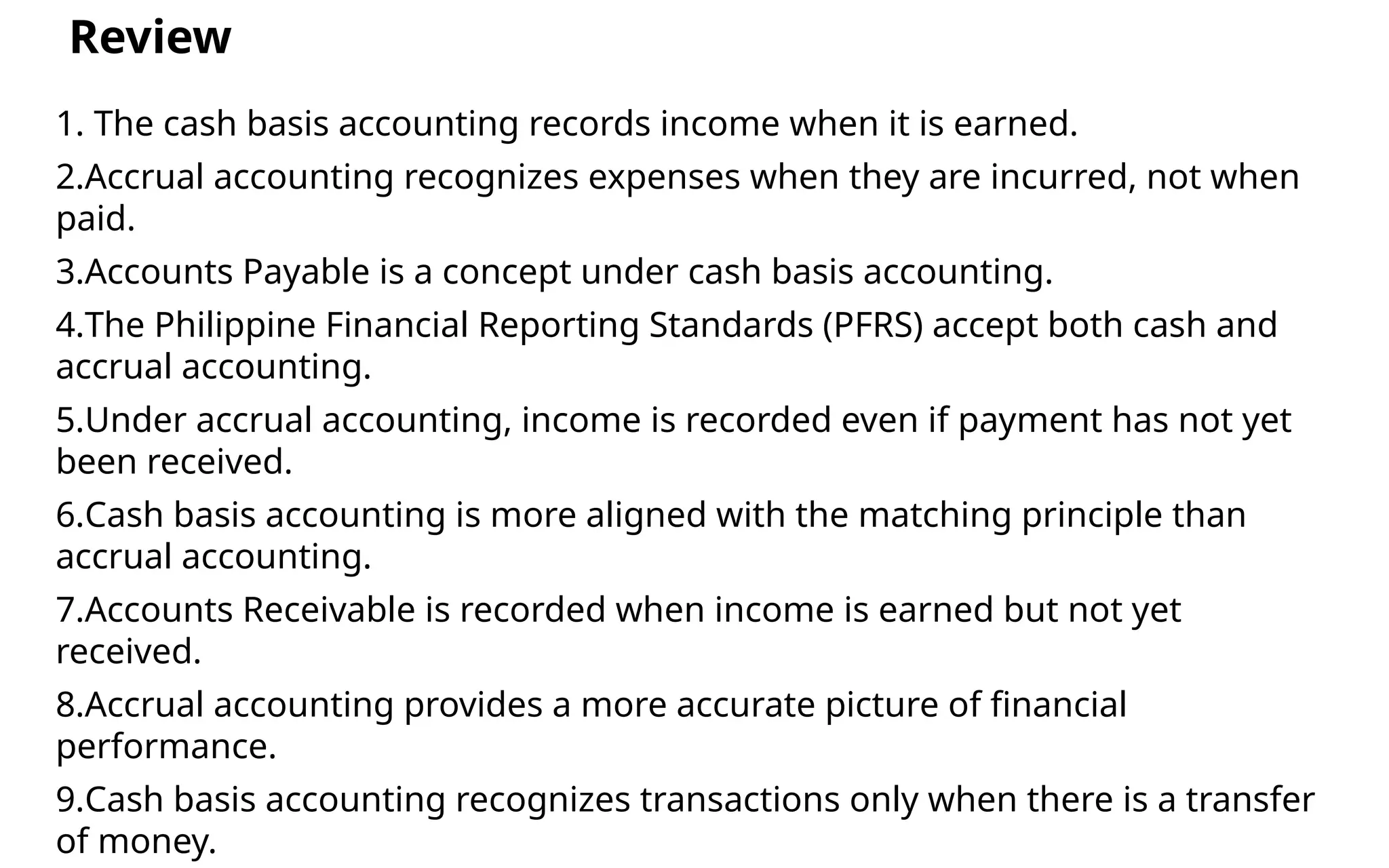
1. The cashbasis accounting records income when it is earned.
2.Accrual accounting recognizes expenses when they are incurred, not when
paid.
3.Accounts Payable is a concept under cash basis accounting.
4.The Philippine Financial Reporting Standards (PFRS) accept both cash and
accrual accounting.
5.Under accrual accounting, income is recorded even if payment has not yet
been received.
6.Cash basis accounting is more aligned with the matching principle than
accrual accounting.
7.Accounts Receivable is recorded when income is earned but not yet
received.
8.Accrual accounting provides a more accurate picture of financial
performance.
9.Cash basis accounting recognizes transactions only when there is a transfer
of money.
Review
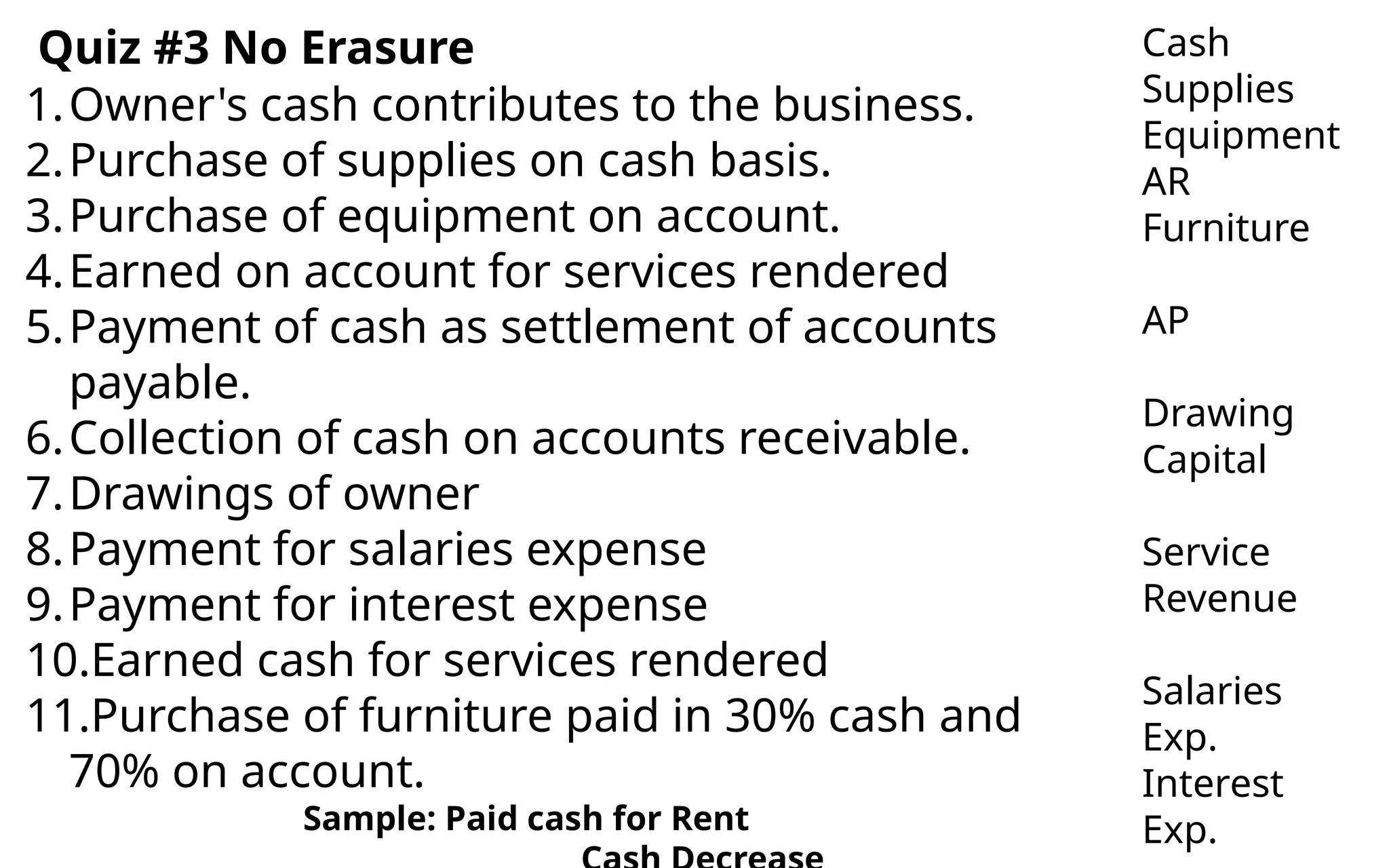
1.Owner's cash contributesto the business.
2.Purchase of supplies on cash basis.
3.Purchase of equipment on account.
4.Earned on account for services rendered
5.Payment of cash as settlement of accounts
payable.
6.Collection of cash on accounts receivable.
7.Drawings of owner
8.Payment for salaries expense
9.Payment for interest expense
10.Earned cash for services rendered
11.Purchase of furniture paid in 30% cash and
70% on account.
Sample: Paid cash for Rent
Cash
Supplies
Equipment
AR
Furniture
AP
Drawing
Capital
Service
Revenue
Salaries
Exp.
Interest
Exp.
Quiz #3 No Erasure
25.
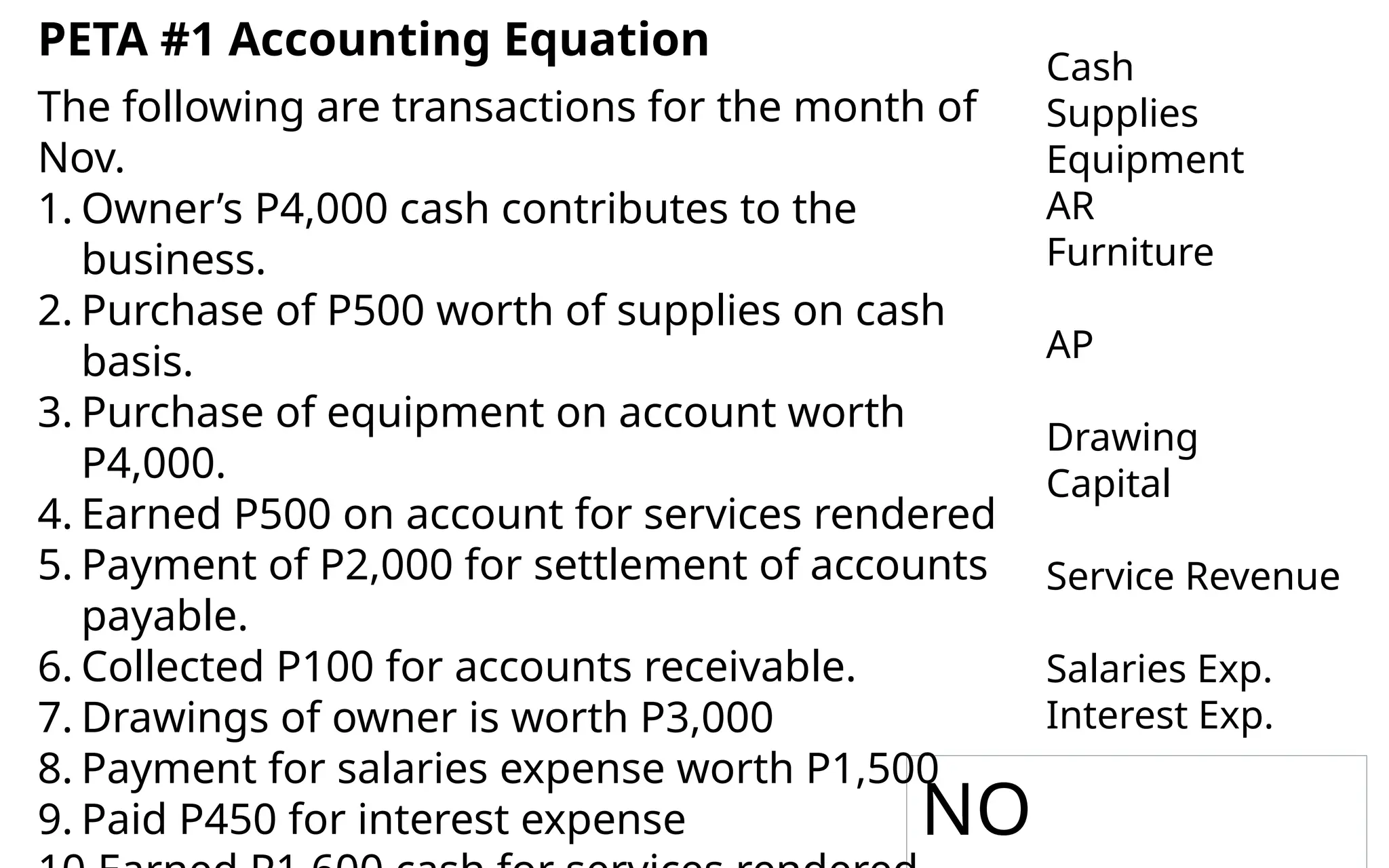
The following aretransactions for the month of
Nov.
1. Owner’s P4,000 cash contributes to the
business.
2. Purchase of P500 worth of supplies on cash
basis.
3. Purchase of equipment on account worth
P4,000.
4. Earned P500 on account for services rendered
5. Payment of P2,000 for settlement of accounts
payable.
6. Collected P100 for accounts receivable.
7. Drawings of owner is worth P3,000
8. Payment for salaries expense worth P1,500
9. Paid P450 for interest expense
Cash
Supplies
Equipment
AR
Furniture
AP
Drawing
Capital
Service Revenue
Salaries Exp.
Interest Exp.
NO
PETA #1 Accounting Equation
26.
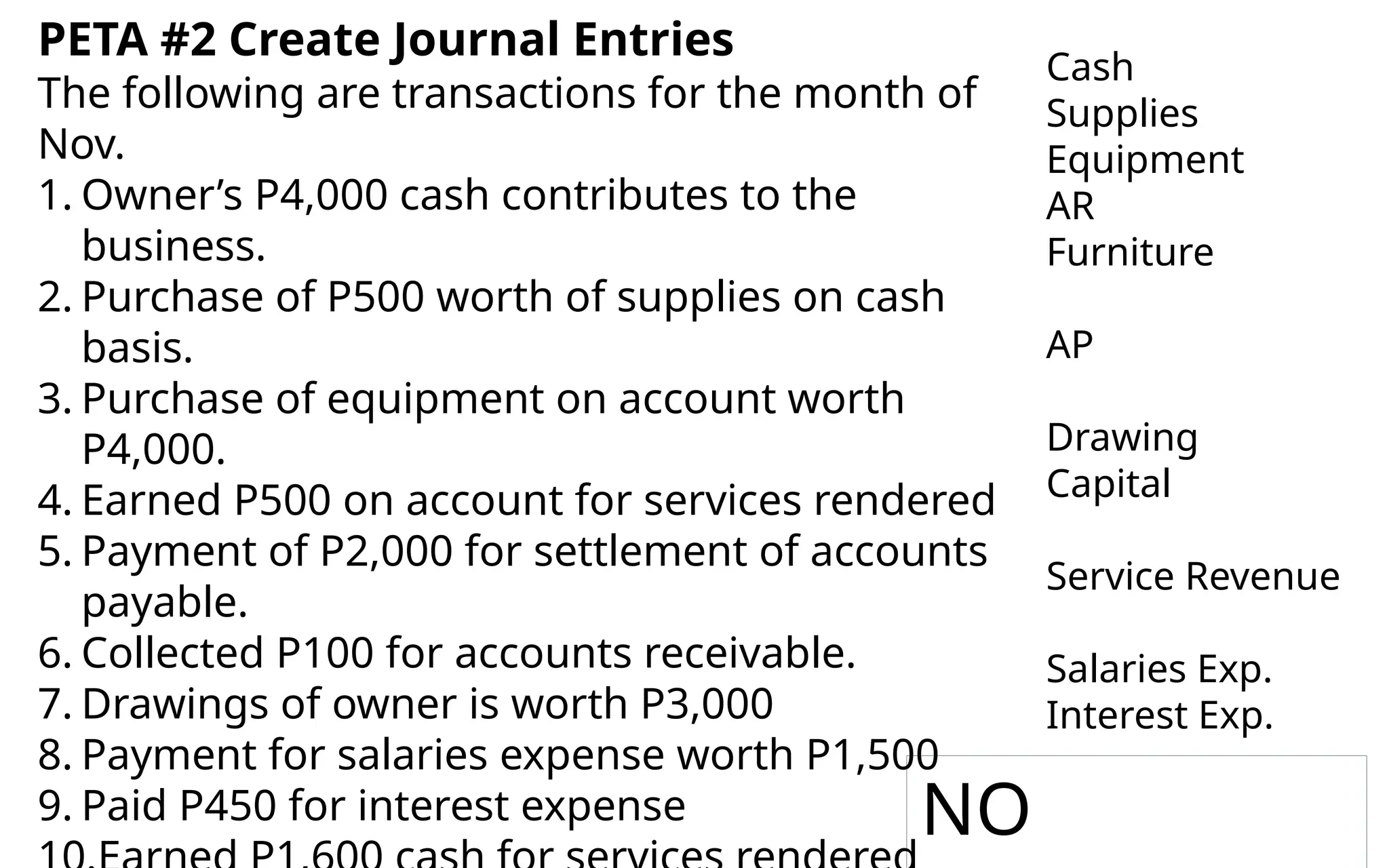
The following aretransactions for the month of
Nov.
1. Owner’s P4,000 cash contributes to the
business.
2. Purchase of P500 worth of supplies on cash
basis.
3. Purchase of equipment on account worth
P4,000.
4. Earned P500 on account for services rendered
5. Payment of P2,000 for settlement of accounts
payable.
6. Collected P100 for accounts receivable.
7. Drawings of owner is worth P3,000
8. Payment for salaries expense worth P1,500
9. Paid P450 for interest expense
Cash
Supplies
Equipment
AR
Furniture
AP
Drawing
Capital
Service Revenue
Salaries Exp.
Interest Exp.
NO
PETA #2 Create Journal Entries
27.
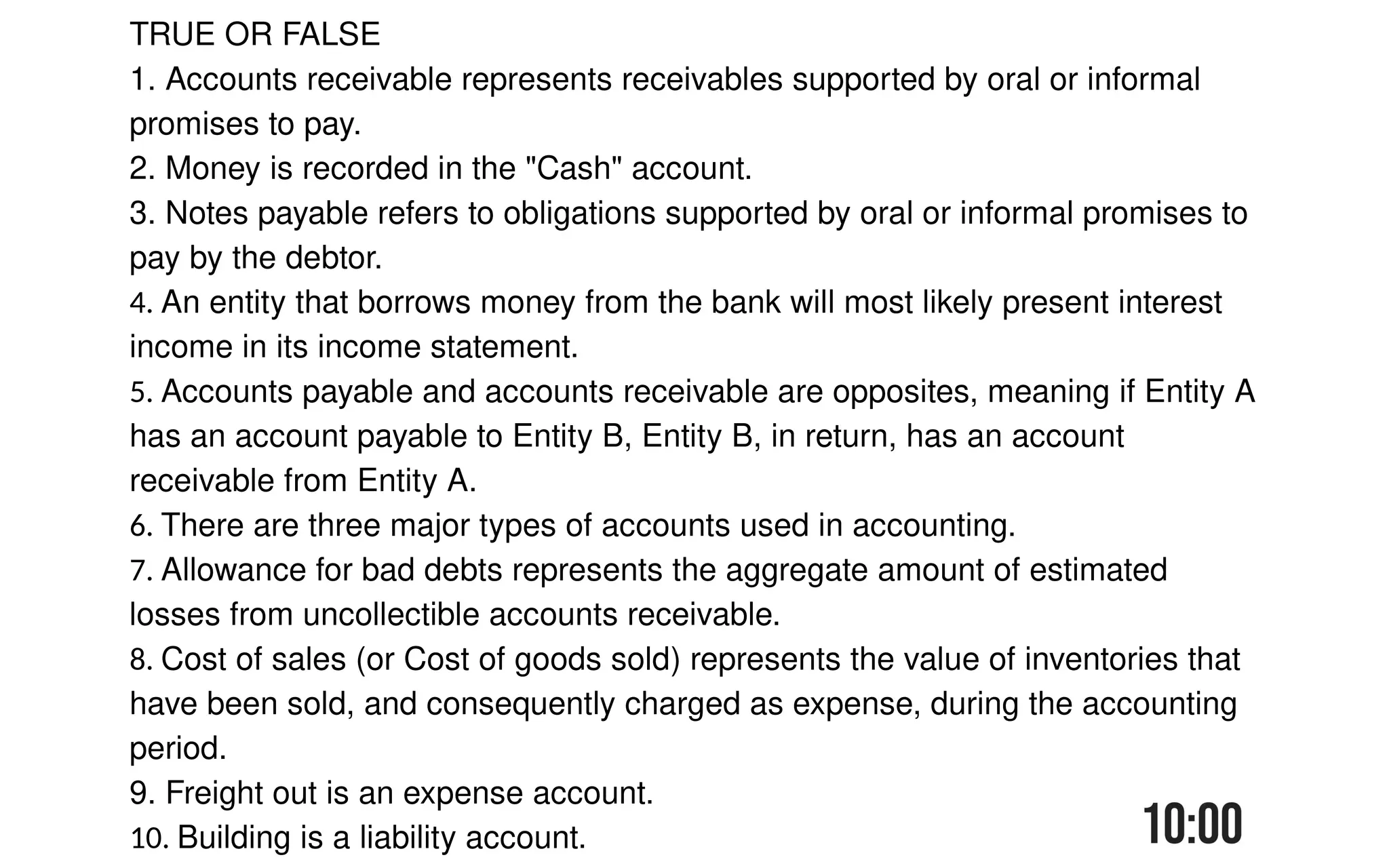
TRUE OR FALSE
1.Accounts receivable represents receivables supported by oral or informal
promises to pay.
2. Money is recorded in the "Cash" account.
3. Notes payable refers to obligations supported by oral or informal promises to
pay by the debtor.
4. An entity that borrows money from the bank will most likely present interest
income in its income statement.
5. Accounts payable and accounts receivable are opposites, meaning if Entity A
has an account payable to Entity B, Entity B, in return, has an account
receivable from Entity A.
6. There are three major types of accounts used in accounting.
7. Allowance for bad debts represents the aggregate amount of estimated
losses from uncollectible accounts receivable.
8. Cost of sales (or Cost of goods sold) represents the value of inventories that
have been sold, and consequently charged as expense, during the accounting
period.
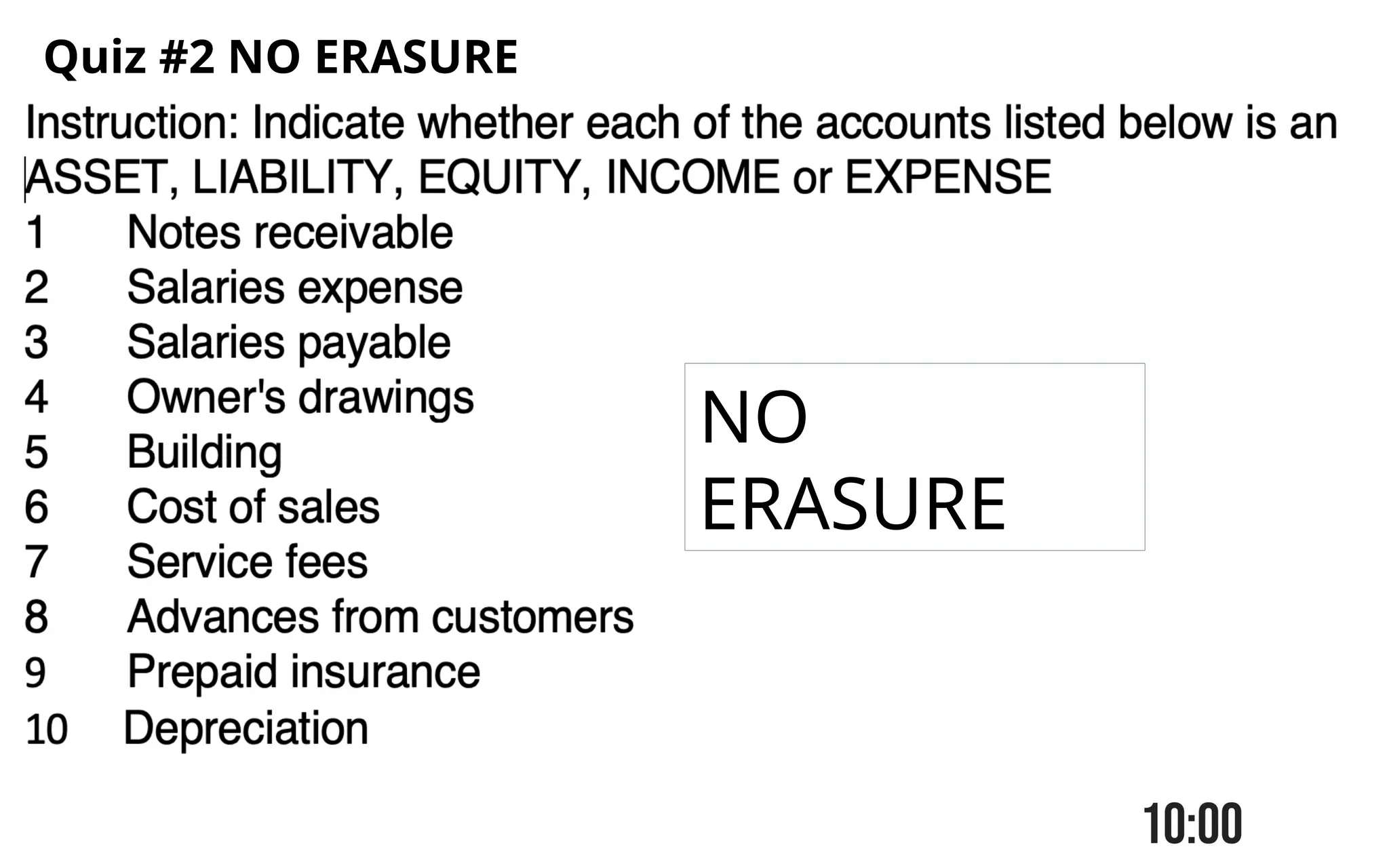
9. Freight out is an expense account.
10. Building is a liability account.
28.
Q2
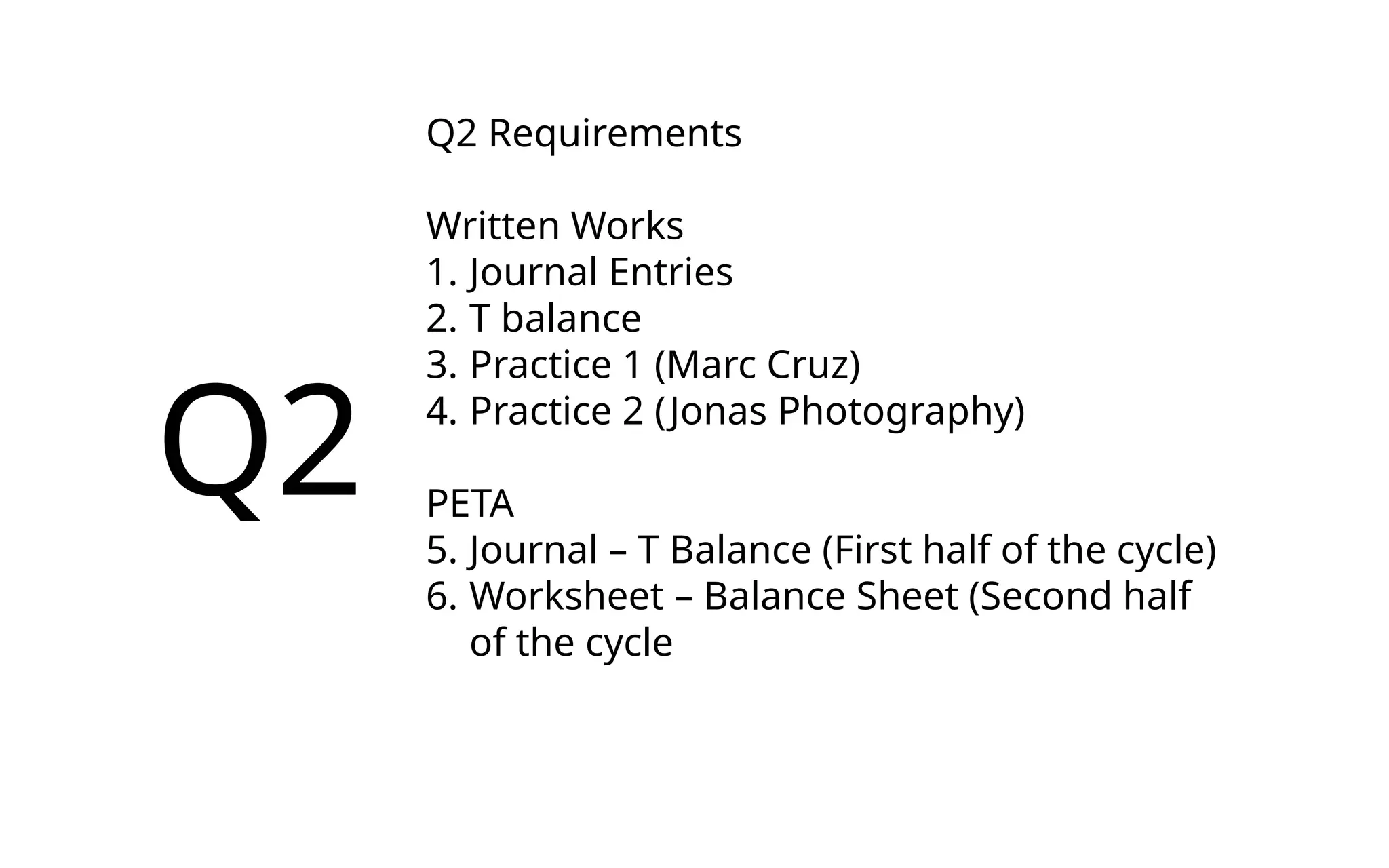
Q2 Requirements
Written Works
1.Journal Entries
2. T balance
3. Practice 1 (Marc Cruz)
4. Practice 2 (Jonas Photography)
PETA
5. Journal – T Balance (First half of the cycle)
6. Worksheet – Balance Sheet (Second half
of the cycle
29.
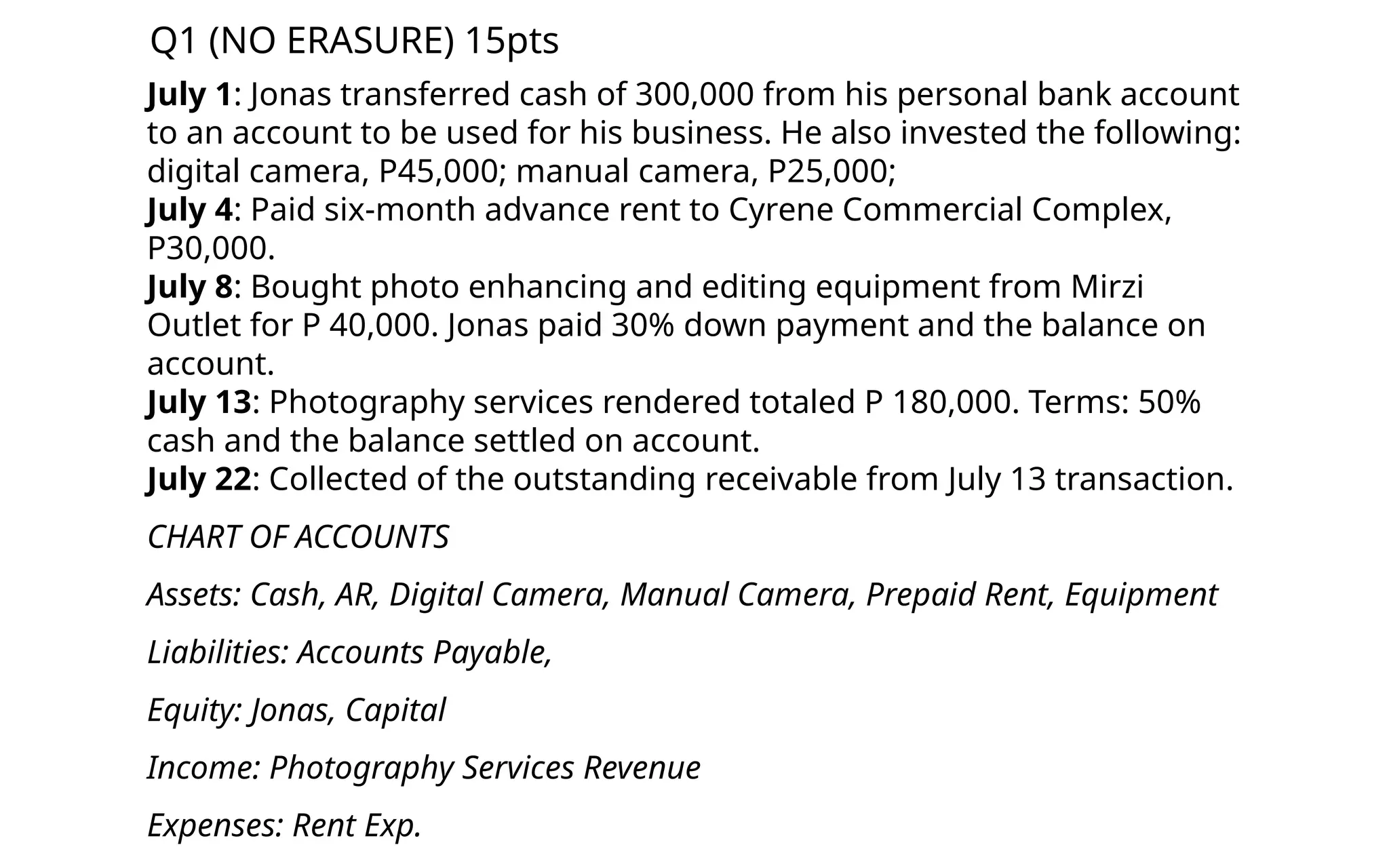
Q1 (NO ERASURE)15pts
July 1: Jonas transferred cash of 300,000 from his personal bank account
to an account to be used for his business. He also invested the following:
digital camera, P45,000; manual camera, P25,000;
July 4: Paid six-month advance rent to Cyrene Commercial Complex,
P30,000.
July 8: Bought photo enhancing and editing equipment from Mirzi
Outlet for P 40,000. Jonas paid 30% down payment and the balance on
account.
July 13: Photography services rendered totaled P 180,000. Terms: 50%
cash and the balance settled on account.
July 22: Collected of the outstanding receivable from July 13 transaction.
CHART OF ACCOUNTS
Assets: Cash, AR, Digital Camera, Manual Camera, Prepaid Rent, Equipment
Liabilities: Accounts Payable,
Equity: Jonas, Capital
Income: Photography Services Revenue
Expenses: Rent Exp.
31.
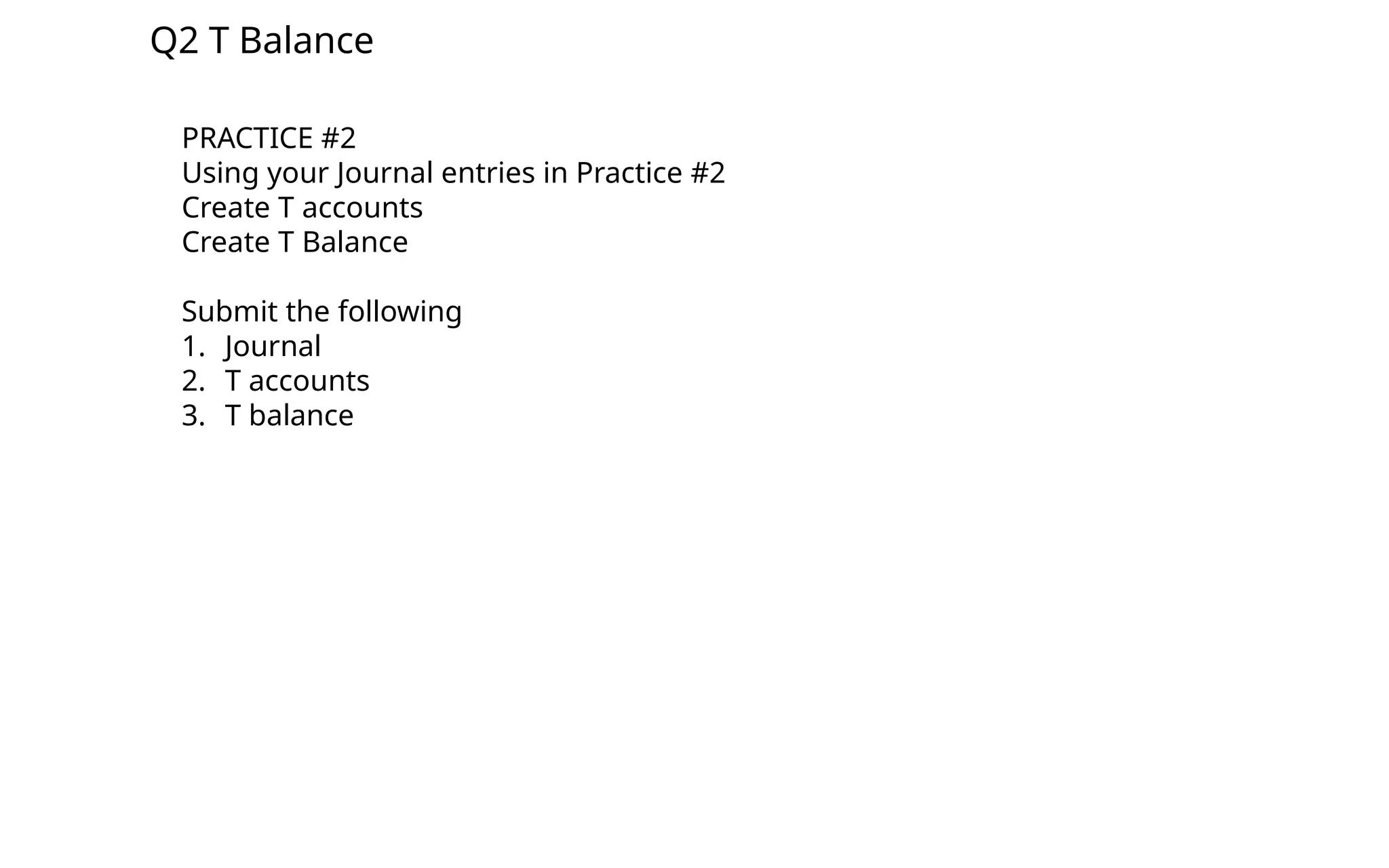
Q2 T Balance
PRACTICE#2
Using your Journal entries in Practice #2
Create T accounts
Create T Balance
Submit the following
1. Journal
2. T accounts
3. T balance
32.
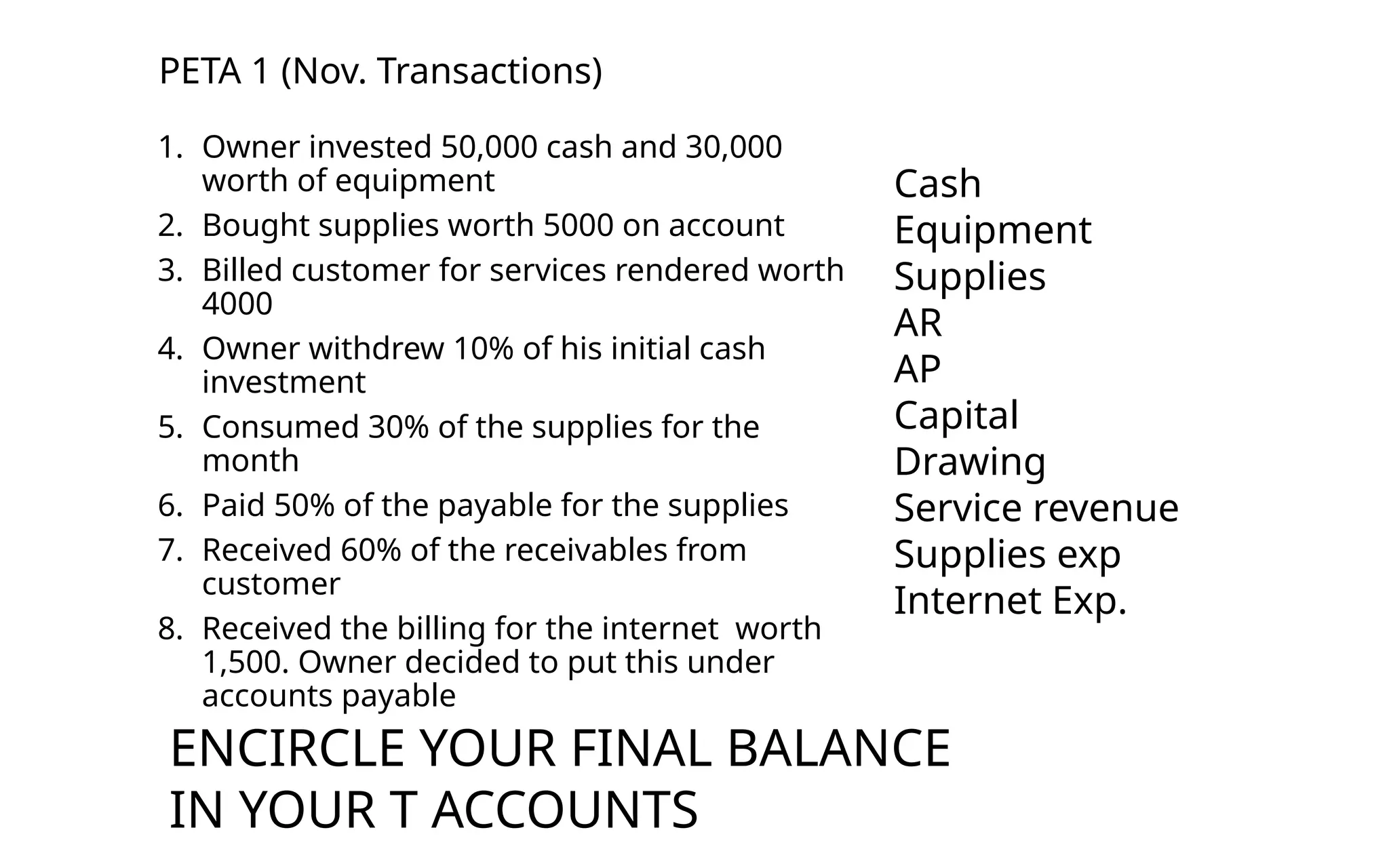
PETA 1 (Nov.Transactions)
1. Owner invested 50,000 cash and 30,000
worth of equipment
2. Bought supplies worth 5000 on account
3. Billed customer for services rendered worth
4000
4. Owner withdrew 10% of his initial cash
investment
5. Consumed 30% of the supplies for the
month
6. Paid 50% of the payable for the supplies
7. Received 60% of the receivables from
customer
8. Received the billing for the internet worth
1,500. Owner decided to put this under
accounts payable
Cash
Equipment
Supplies
AR
AP
Capital
Drawing
Service revenue
Supplies exp
Internet Exp.
ENCIRCLE YOUR FINAL BALANCE
IN YOUR T ACCOUNTS
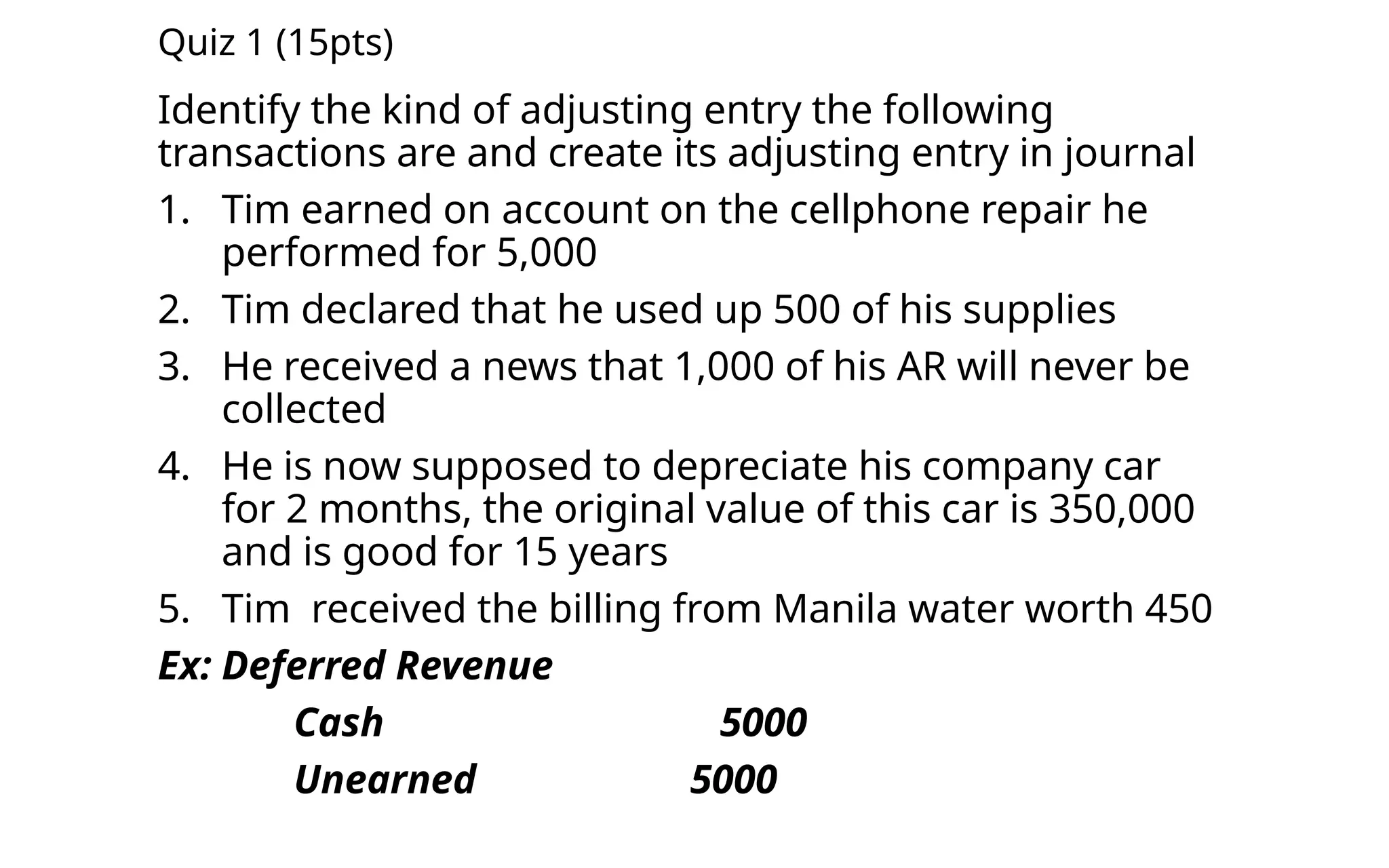
Quiz 1 (15pts)
Identifythe kind of adjusting entry the following
transactions are and create its adjusting entry in journal
1. Tim earned on account on the cellphone repair he
performed for 5,000
2. Tim declared that he used up 500 of his supplies
3. He received a news that 1,000 of his AR will never be
collected
4. He is now supposed to depreciate his company car
for 2 months, the original value of this car is 350,000
and is good for 15 years
5. Tim received the billing from Manila water worth 450
Ex: Deferred Revenue
Cash 5000
Unearned 5000
37.
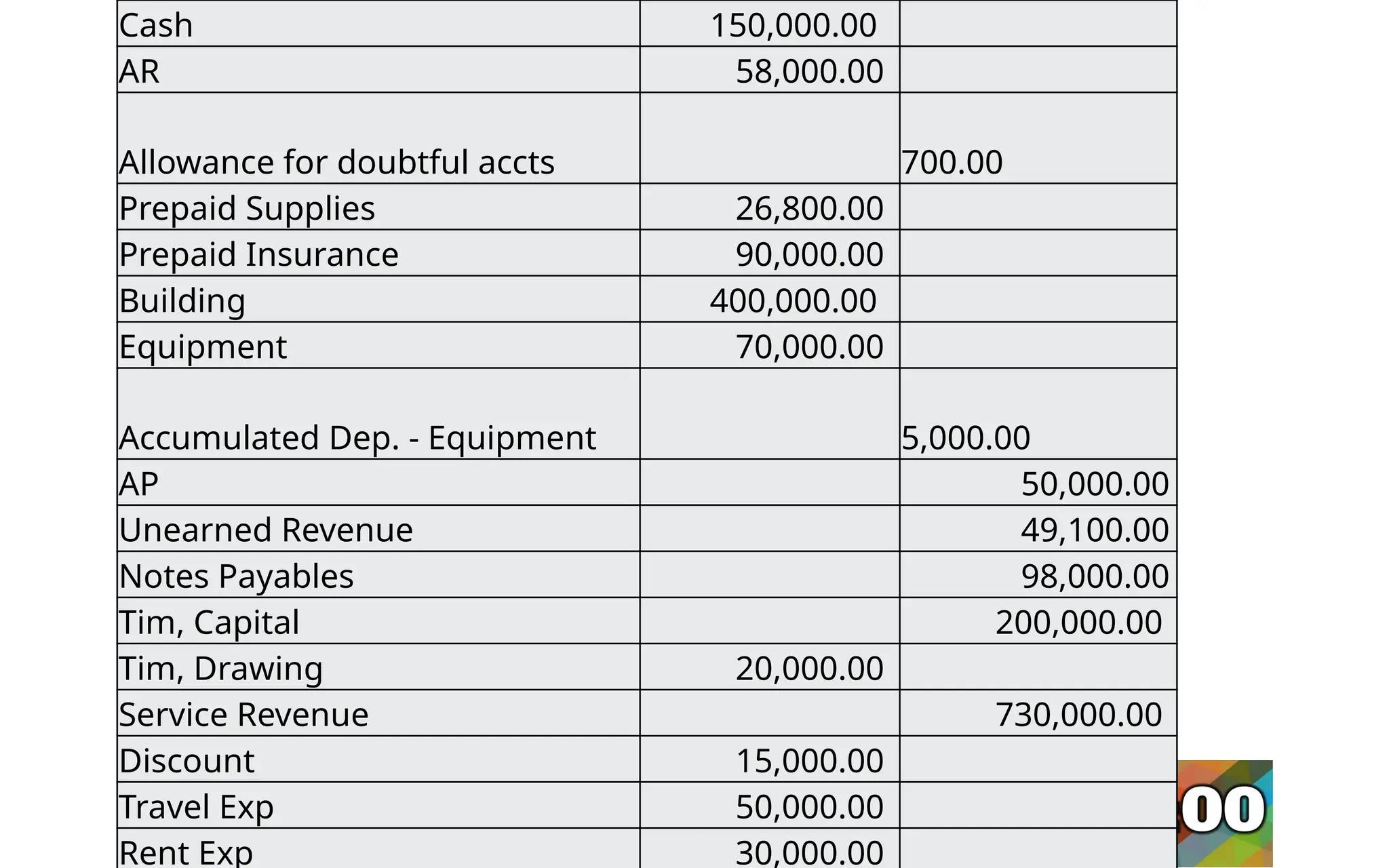
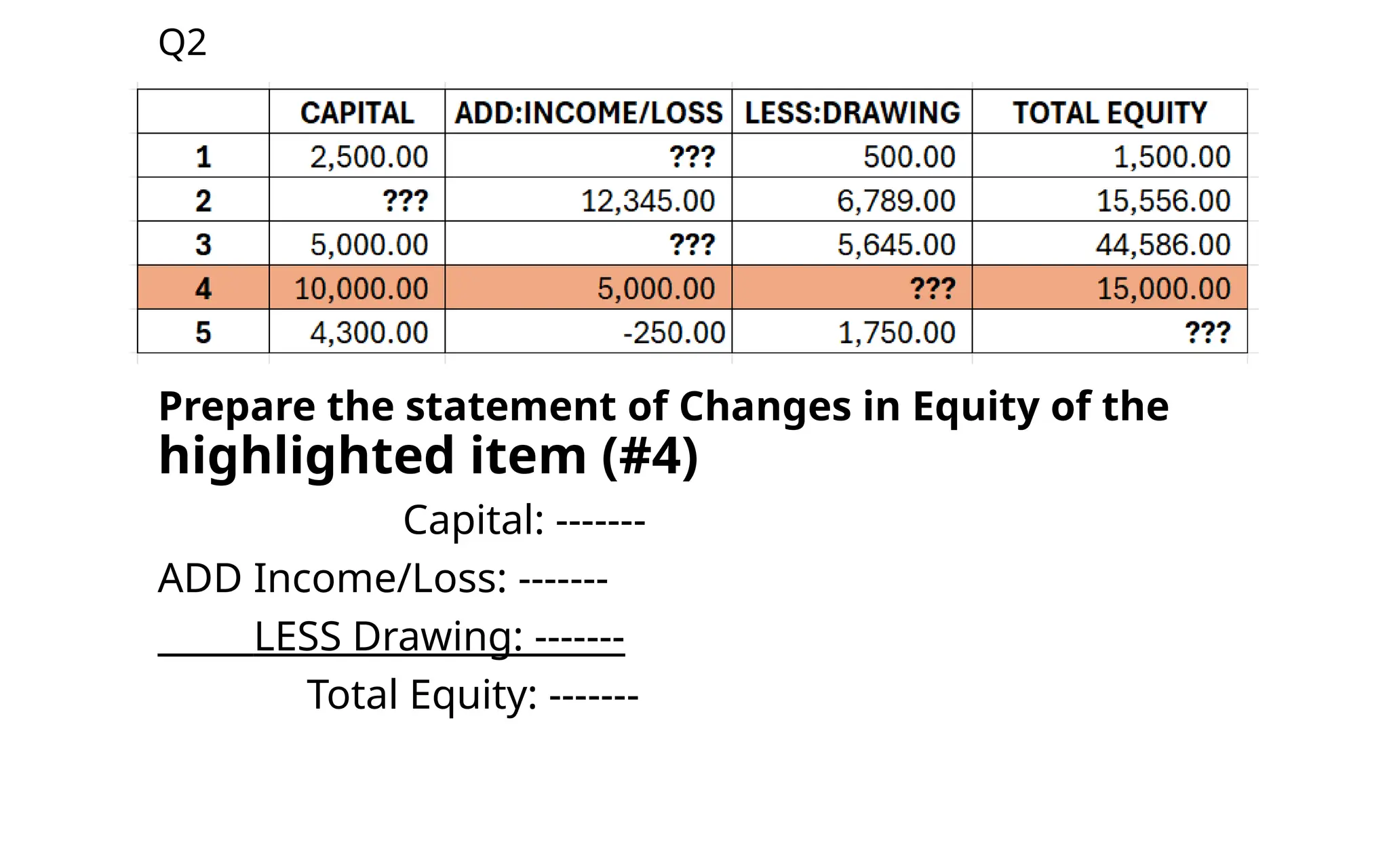
Q2
Prepare the statementof Changes in Equity of the
highlighted item (#4)
Capital: -------
ADD Income/Loss: -------
LESS Drawing: -------
Total Equity: -------
38.
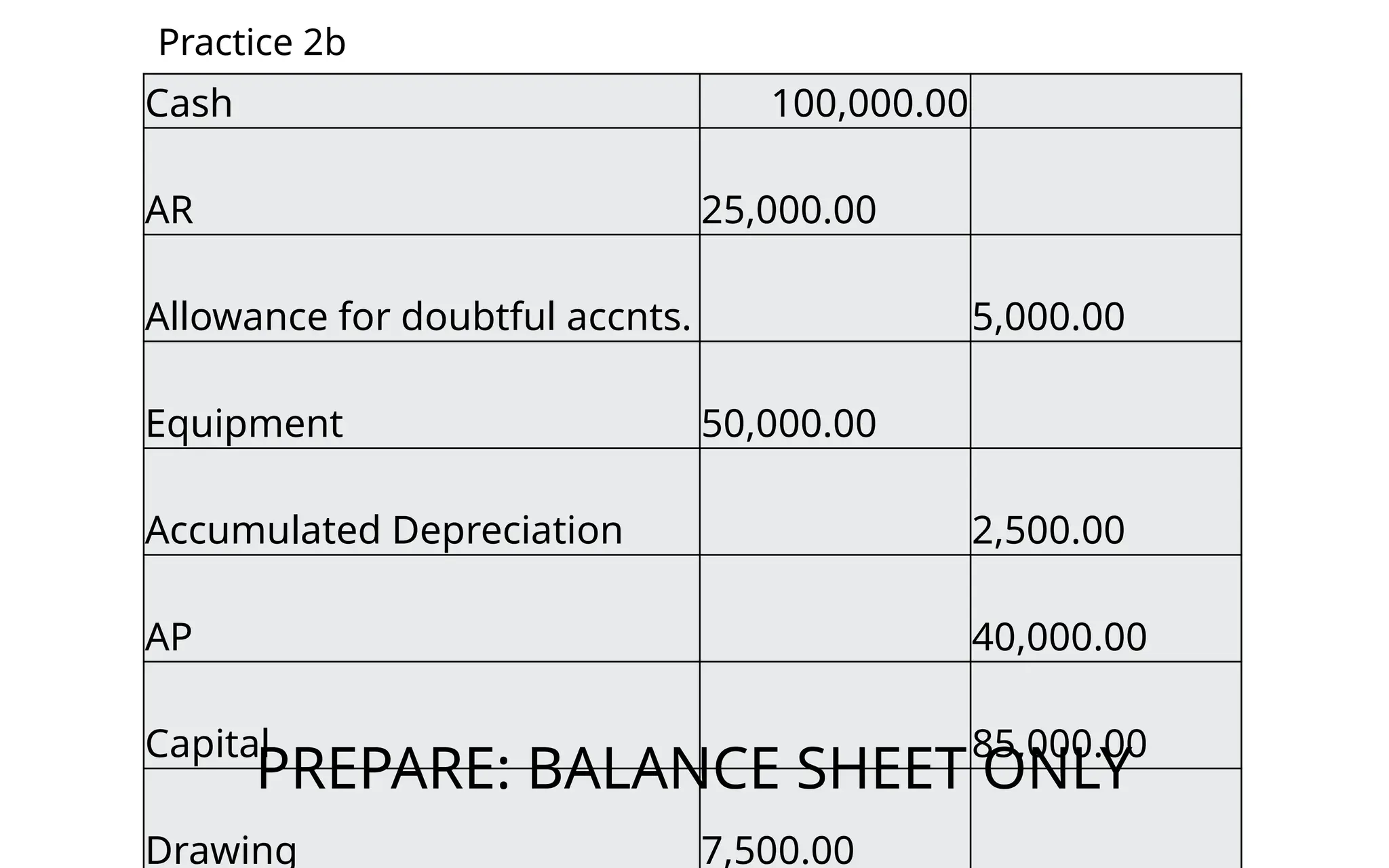
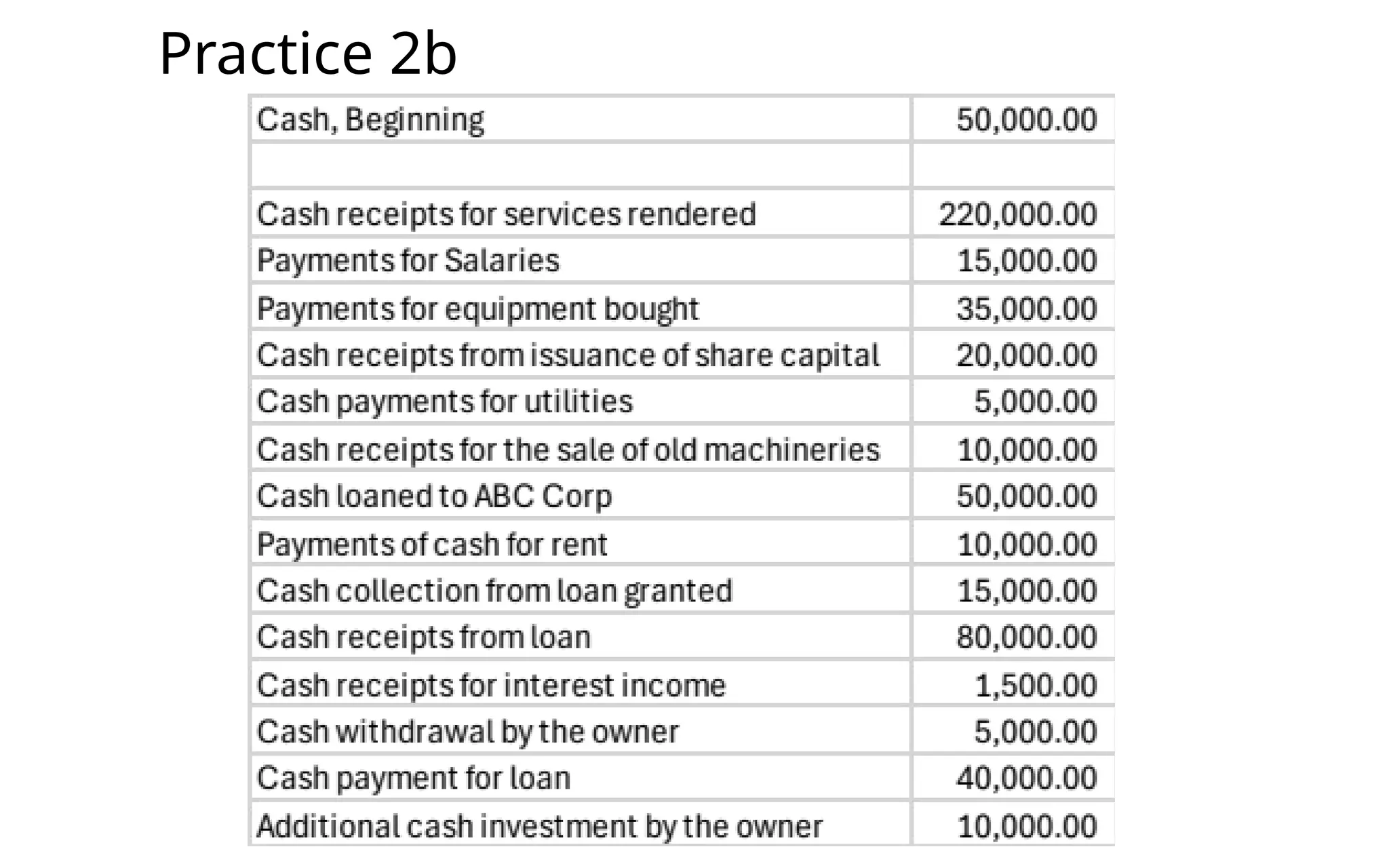
Practice 2b
Cash 100,000.00
AR25,000.00
Allowance for doubtful accnts. 5,000.00
Equipment 50,000.00
Accumulated Depreciation 2,500.00
AP 40,000.00
Capital 85,000.00
Drawing 7,500.00
PREPARE: BALANCE SHEET ONLY
39.
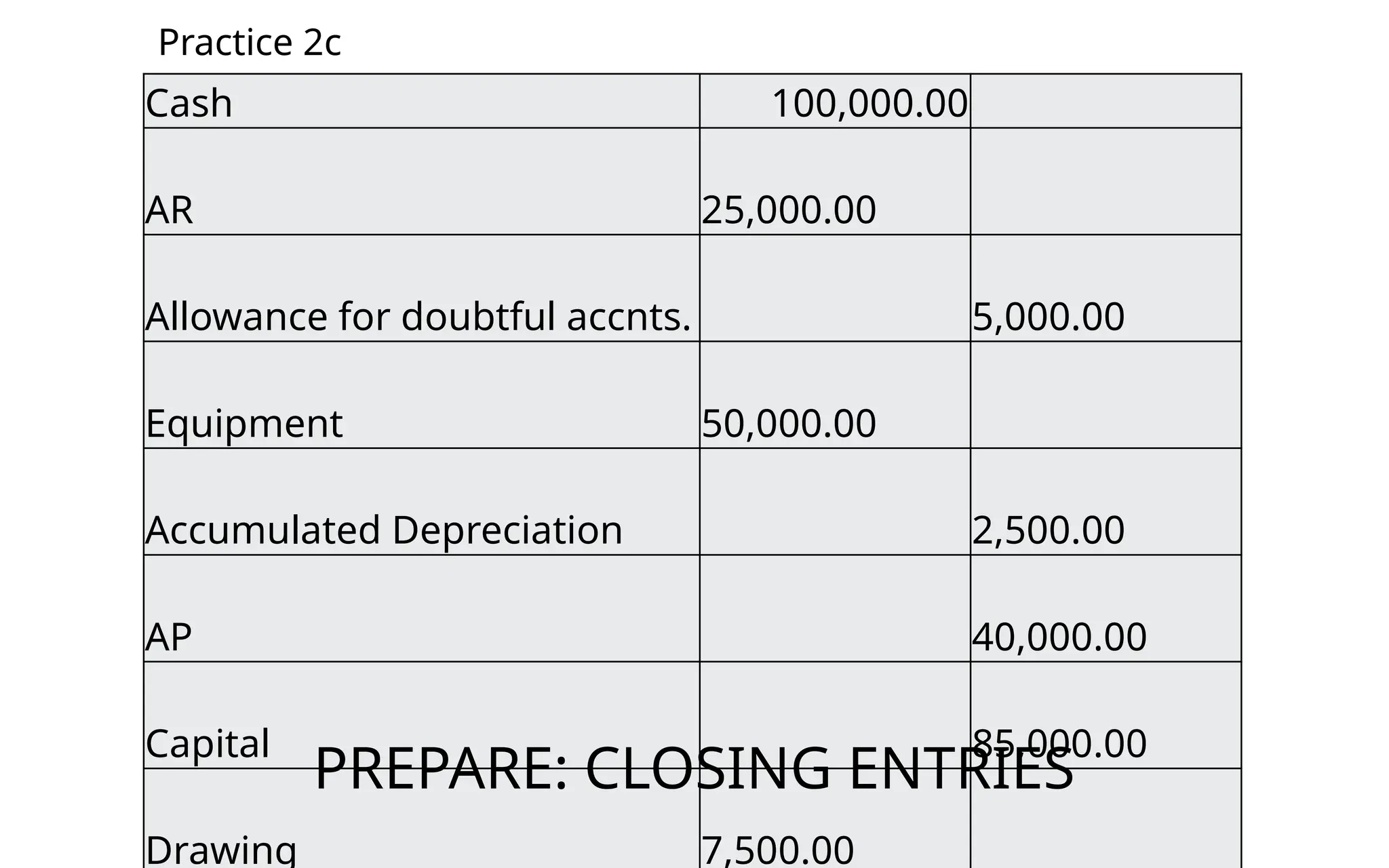
Practice 2c
Cash 100,000.00
AR25,000.00
Allowance for doubtful accnts. 5,000.00
Equipment 50,000.00
Accumulated Depreciation 2,500.00
AP 40,000.00
Capital 85,000.00
Drawing 7,500.00
PREPARE: CLOSING ENTRIES
40.
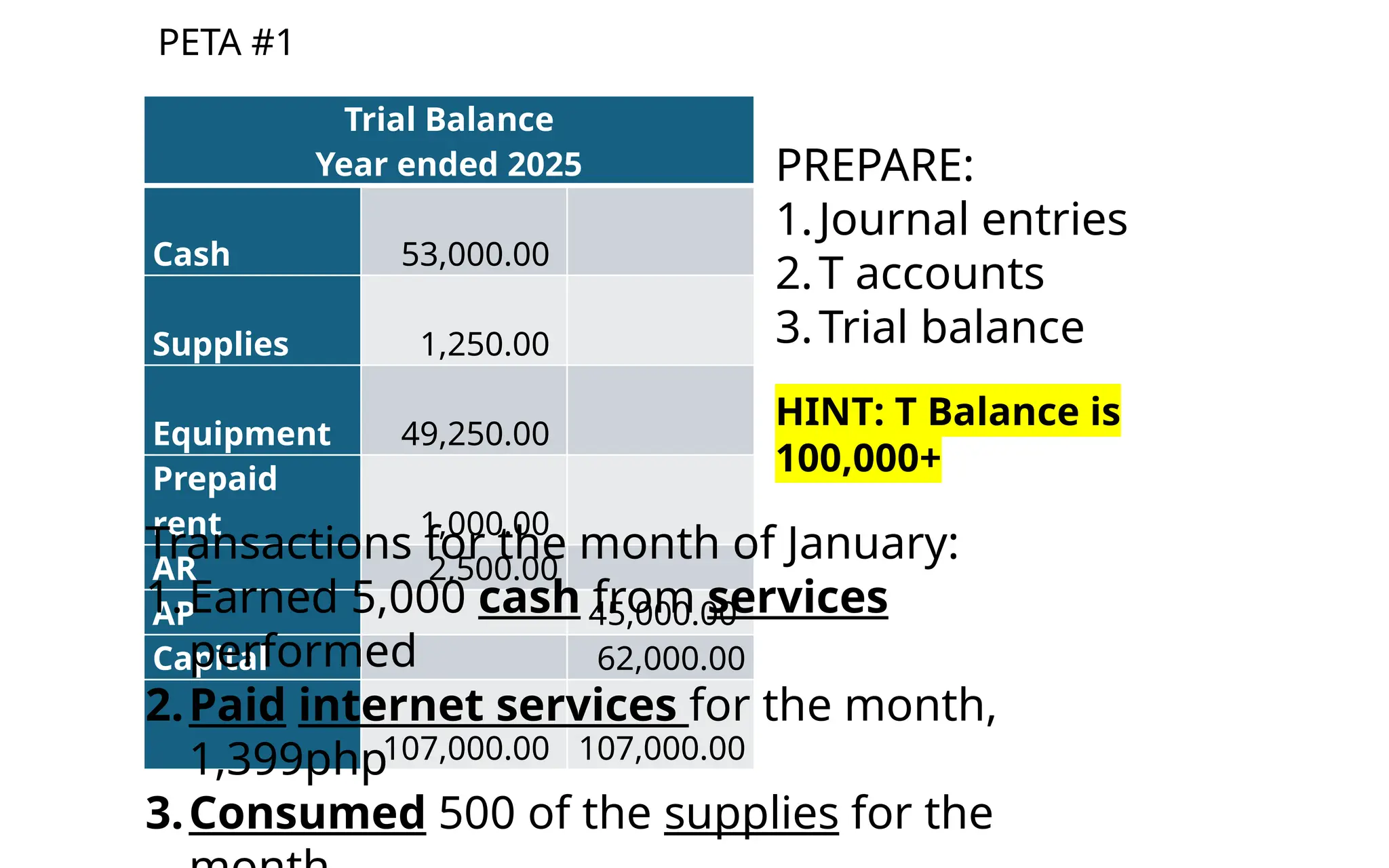
PETA #1
Trial Balance
Yearended 2025
Cash 53,000.00
Supplies 1,250.00
Equipment 49,250.00
Prepaid
rent 1,000.00
AR 2,500.00
AP 45,000.00
Capital 62,000.00
107,000.00 107,000.00
PREPARE:
1.Journal entries
2.T accounts
3.Trial balance
HINT: T Balance is
100,000+
Transactions for the month of January:
1.Earned 5,000 cash from services
performed
2.Paid internet services for the month,
1,399php
3.Consumed 500 of the supplies for the
41.
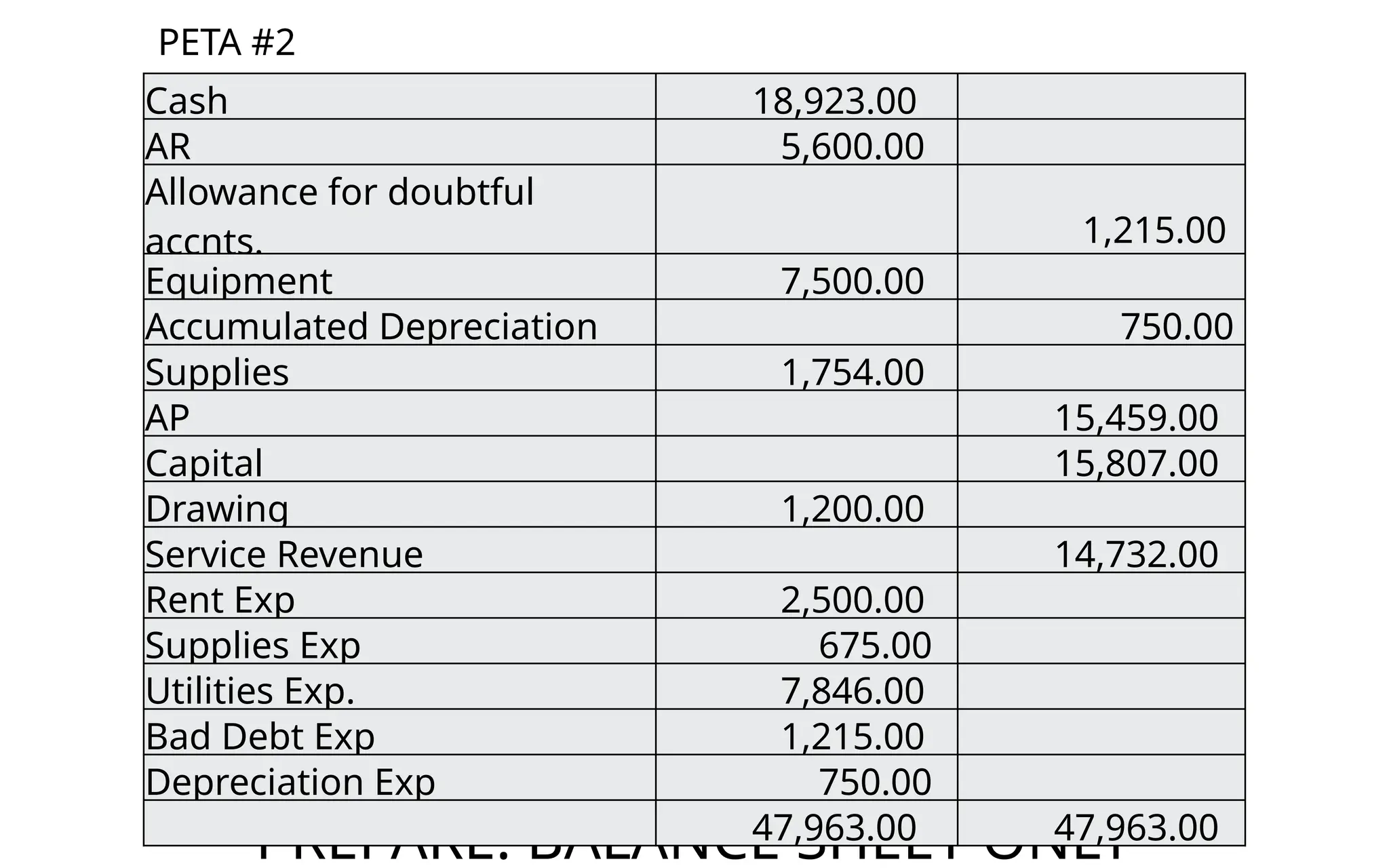
PETA #2
PREPARE: BALANCESHEET ONLY
Cash 18,923.00
AR 5,600.00
Allowance for doubtful
accnts. 1,215.00
Equipment 7,500.00
Accumulated Depreciation 750.00
Supplies 1,754.00
AP 15,459.00
Capital 15,807.00
Drawing 1,200.00
Service Revenue 14,732.00
Rent Exp 2,500.00
Supplies Exp 675.00
Utilities Exp. 7,846.00
Bad Debt Exp 1,215.00
Depreciation Exp 750.00
47,963.00 47,963.00
42.
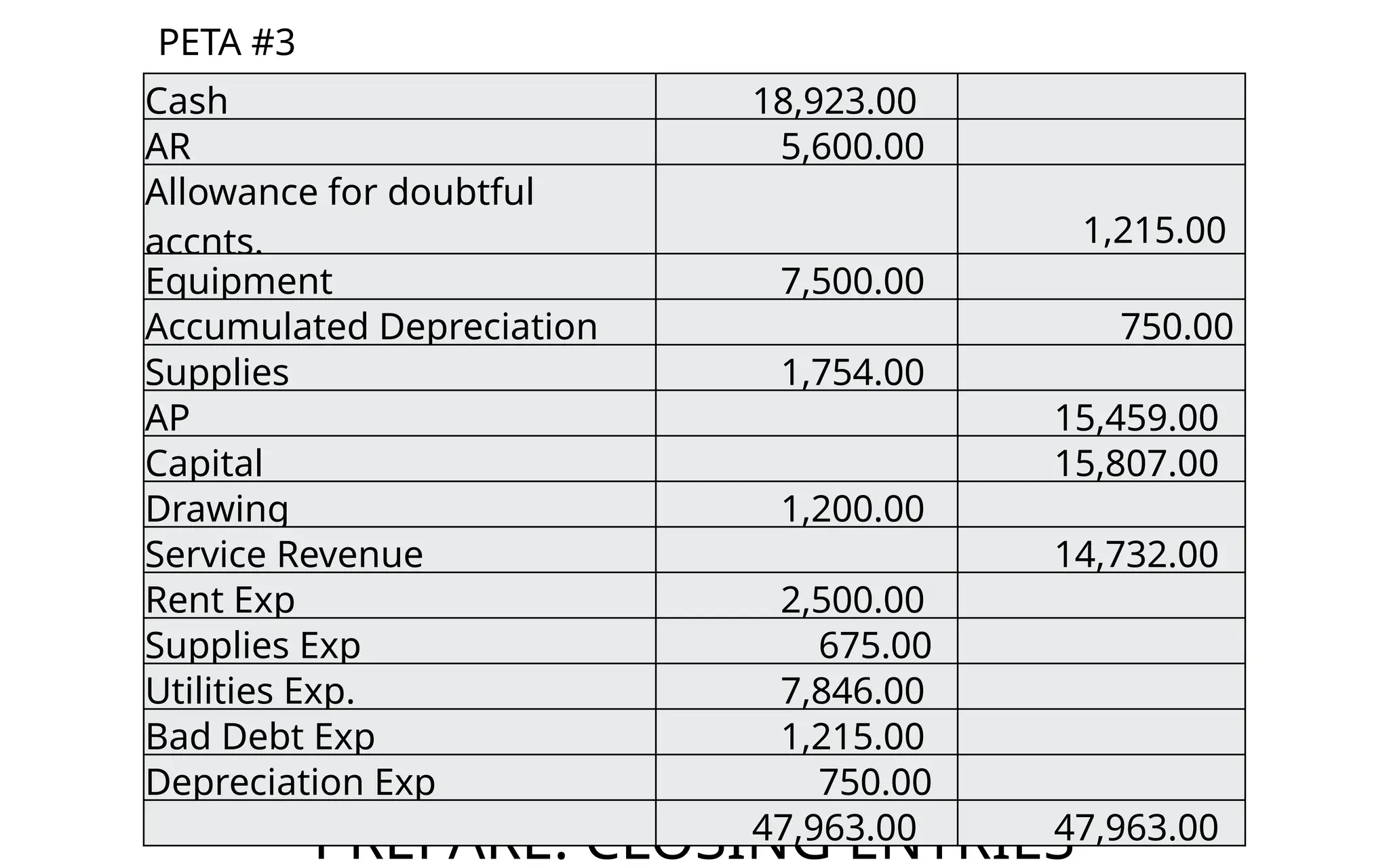
PETA #3
PREPARE: CLOSINGENTRIES
Cash 18,923.00
AR 5,600.00
Allowance for doubtful
accnts. 1,215.00
Equipment 7,500.00
Accumulated Depreciation 750.00
Supplies 1,754.00
AP 15,459.00
Capital 15,807.00
Drawing 1,200.00
Service Revenue 14,732.00
Rent Exp 2,500.00
Supplies Exp 675.00
Utilities Exp. 7,846.00
Bad Debt Exp 1,215.00
Depreciation Exp 750.00
47,963.00 47,963.00
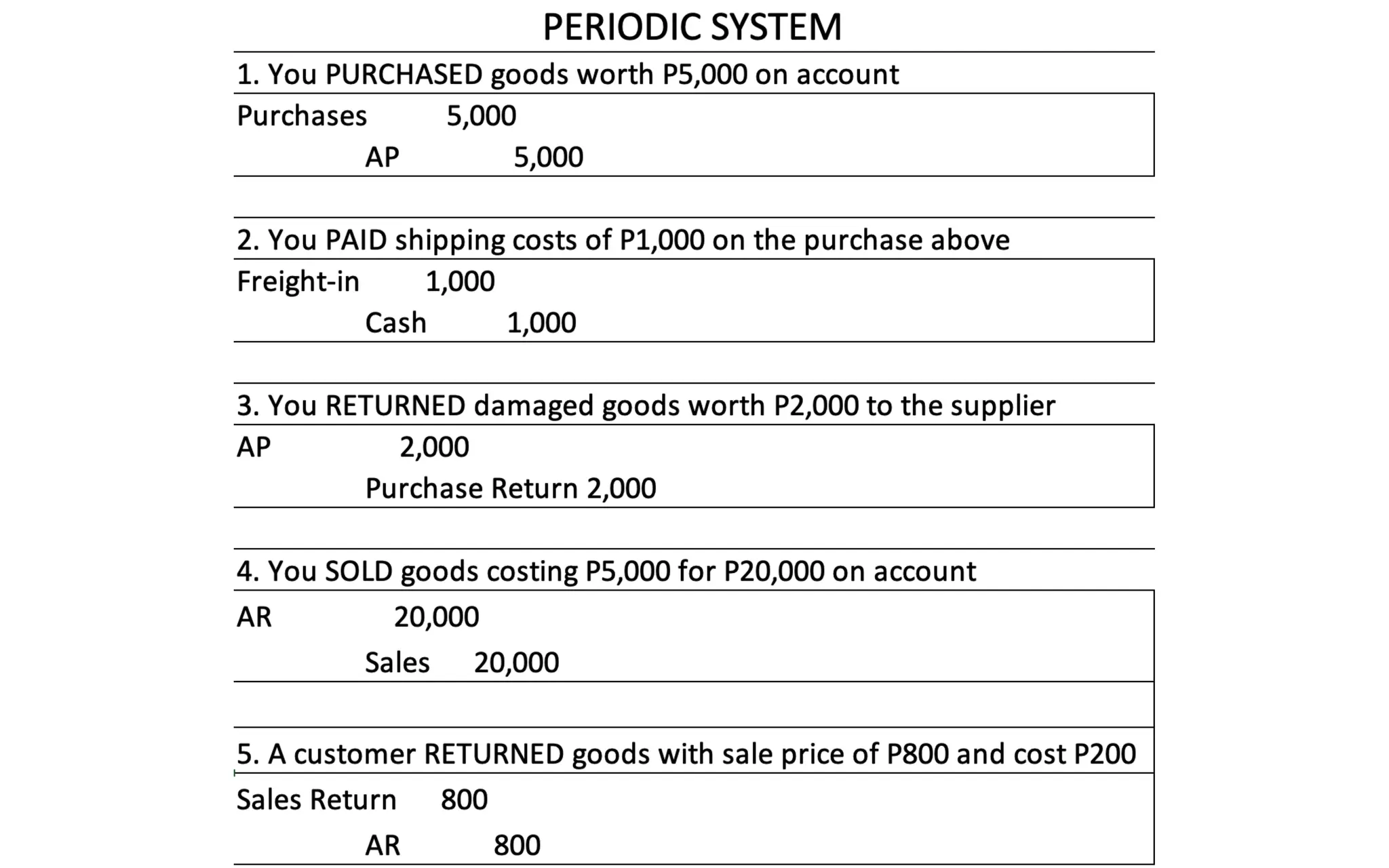
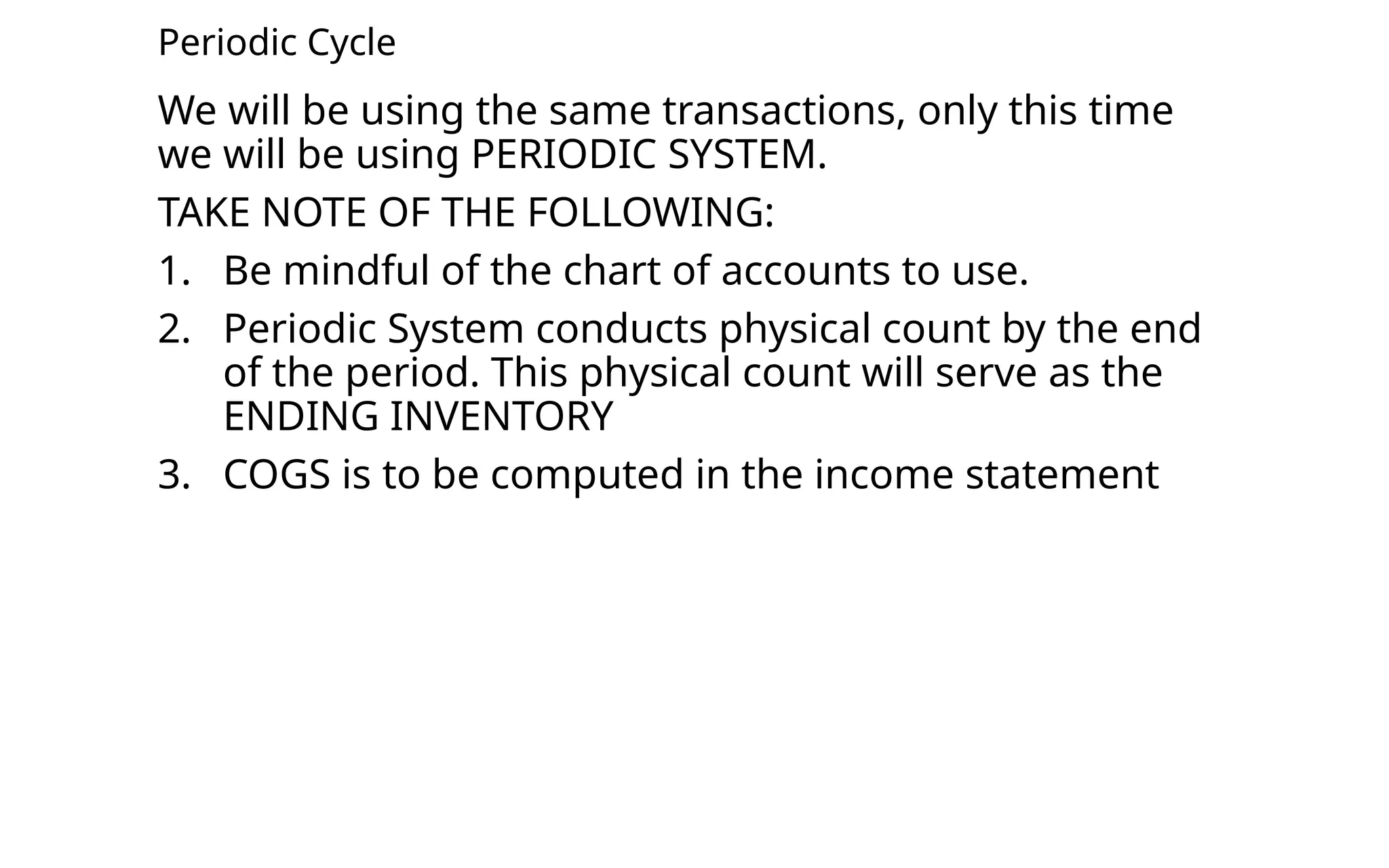
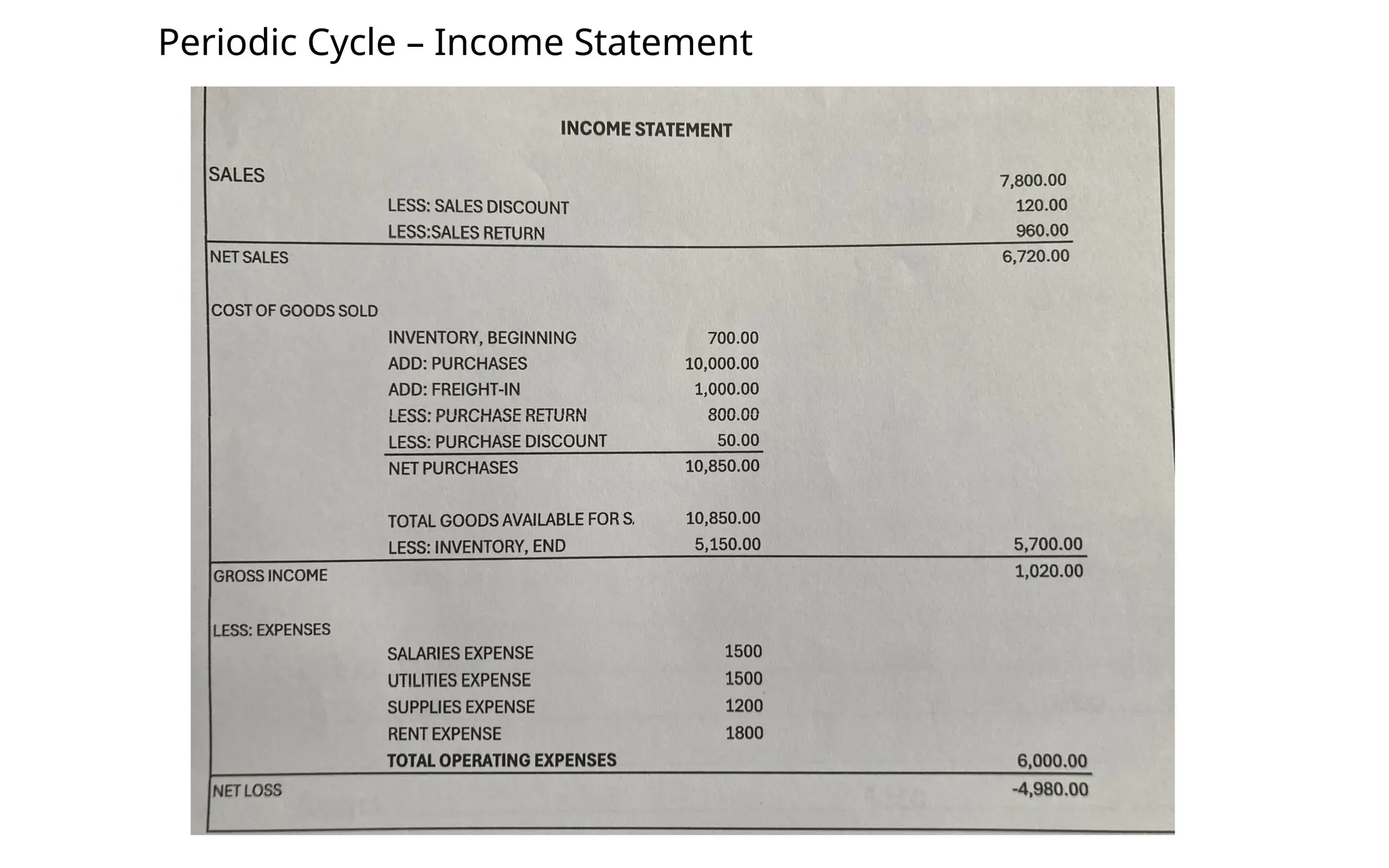
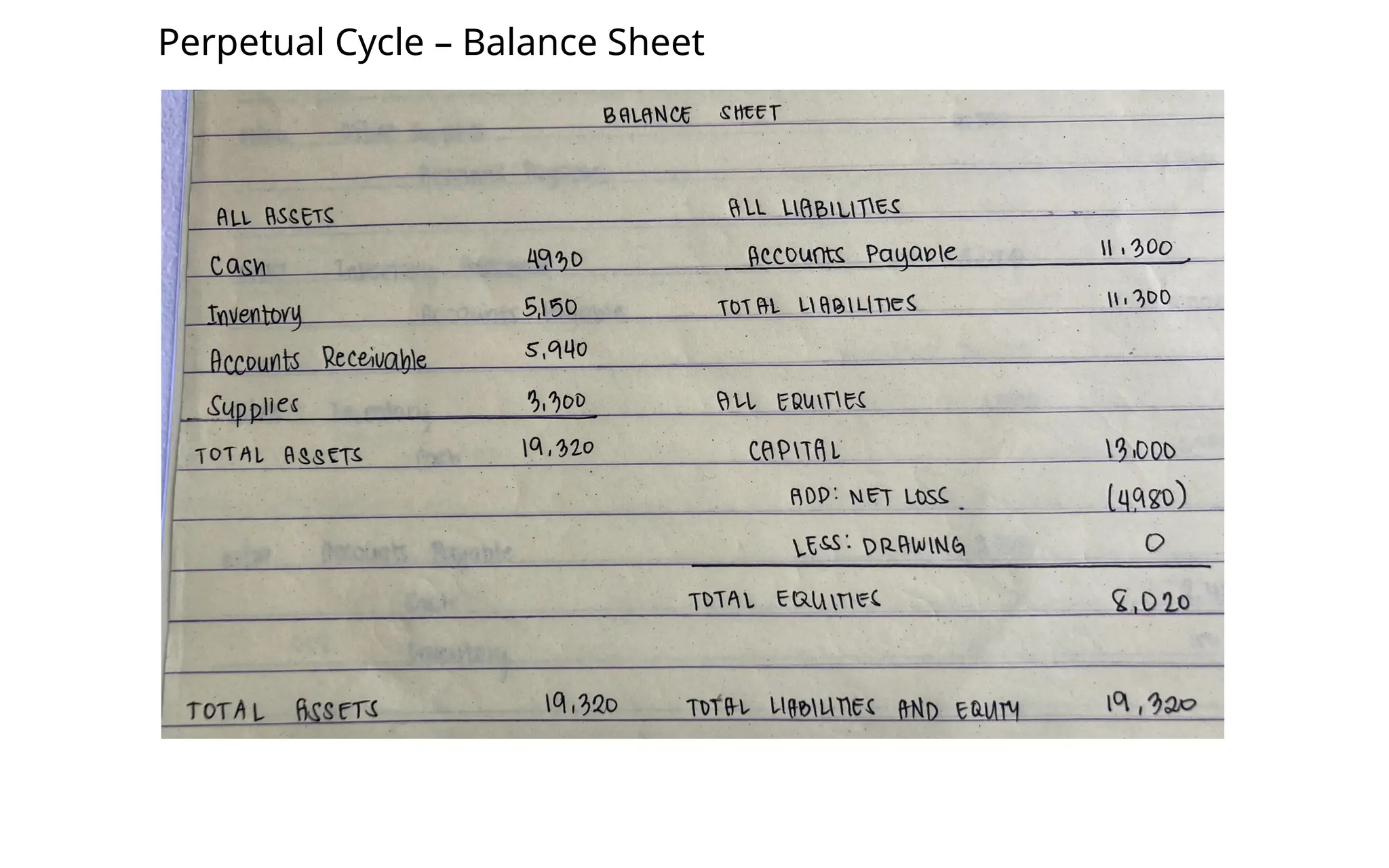
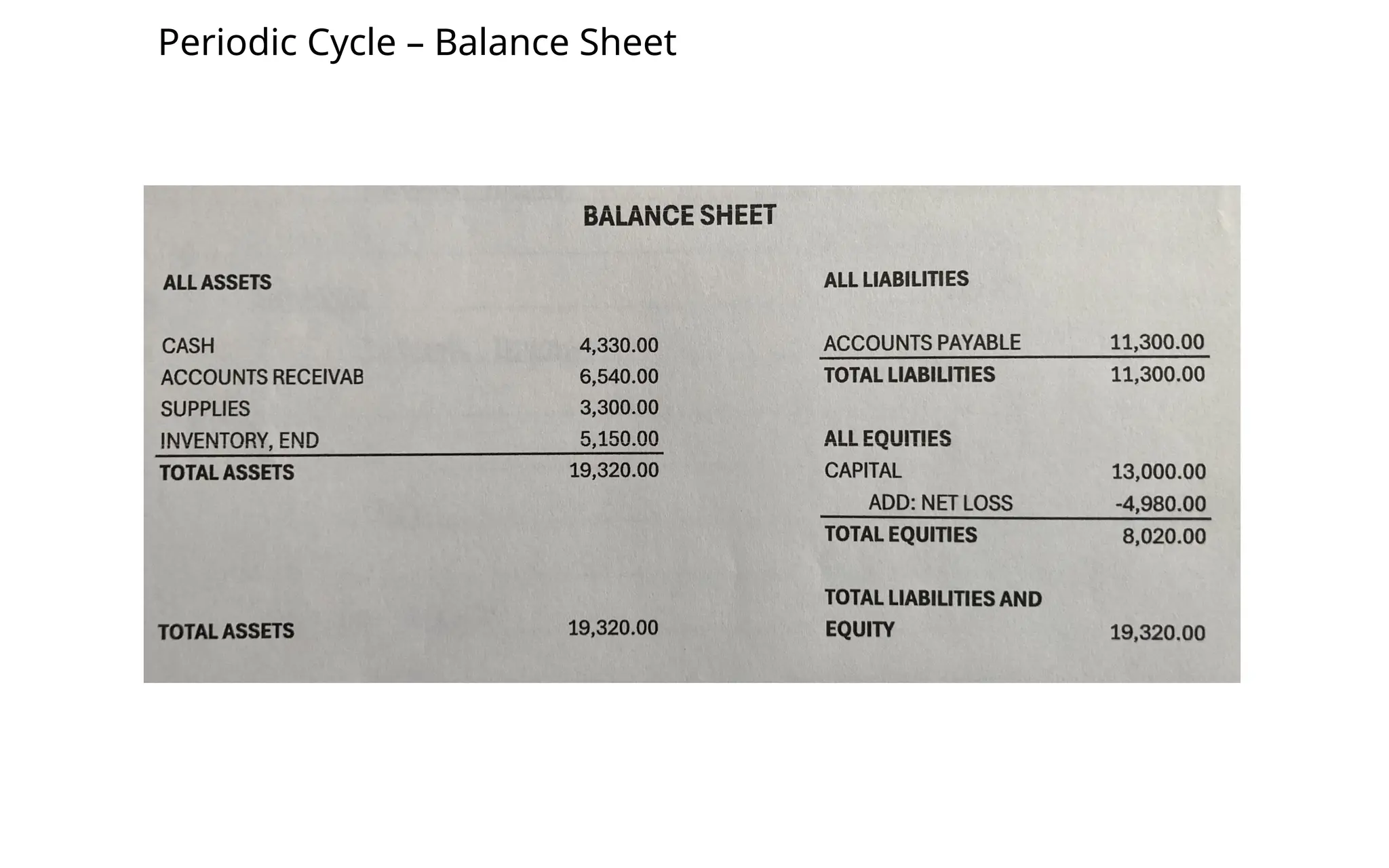
Periodic Cycle
We willbe using the same transactions, only this time
we will be using PERIODIC SYSTEM.
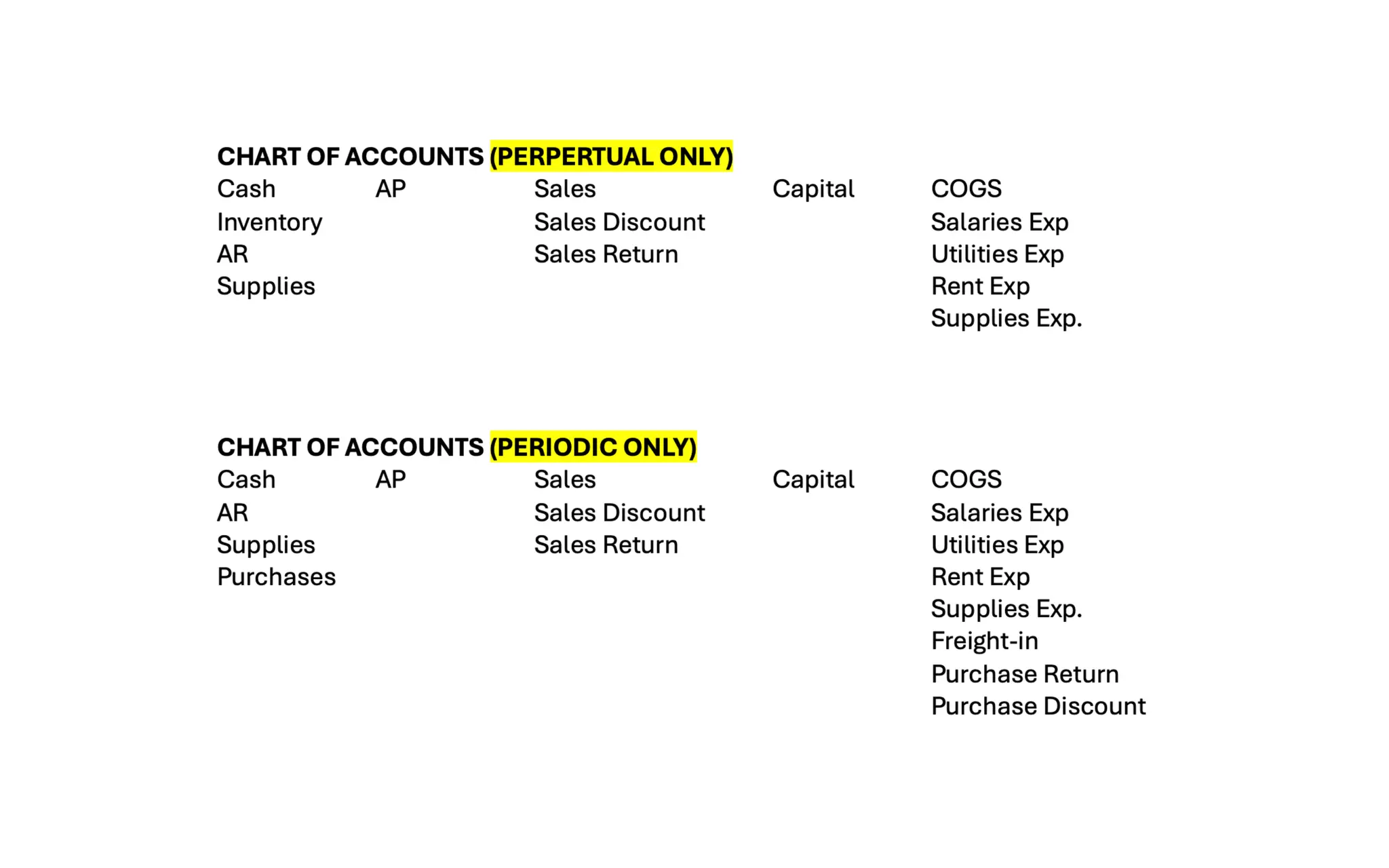
TAKE NOTE OF THE FOLLOWING:
1. Be mindful of the chart of accounts to use.
2. Periodic System conducts physical count by the end
of the period. This physical count will serve as the
ENDING INVENTORY
3. COGS is to be computed in the income statement
47.
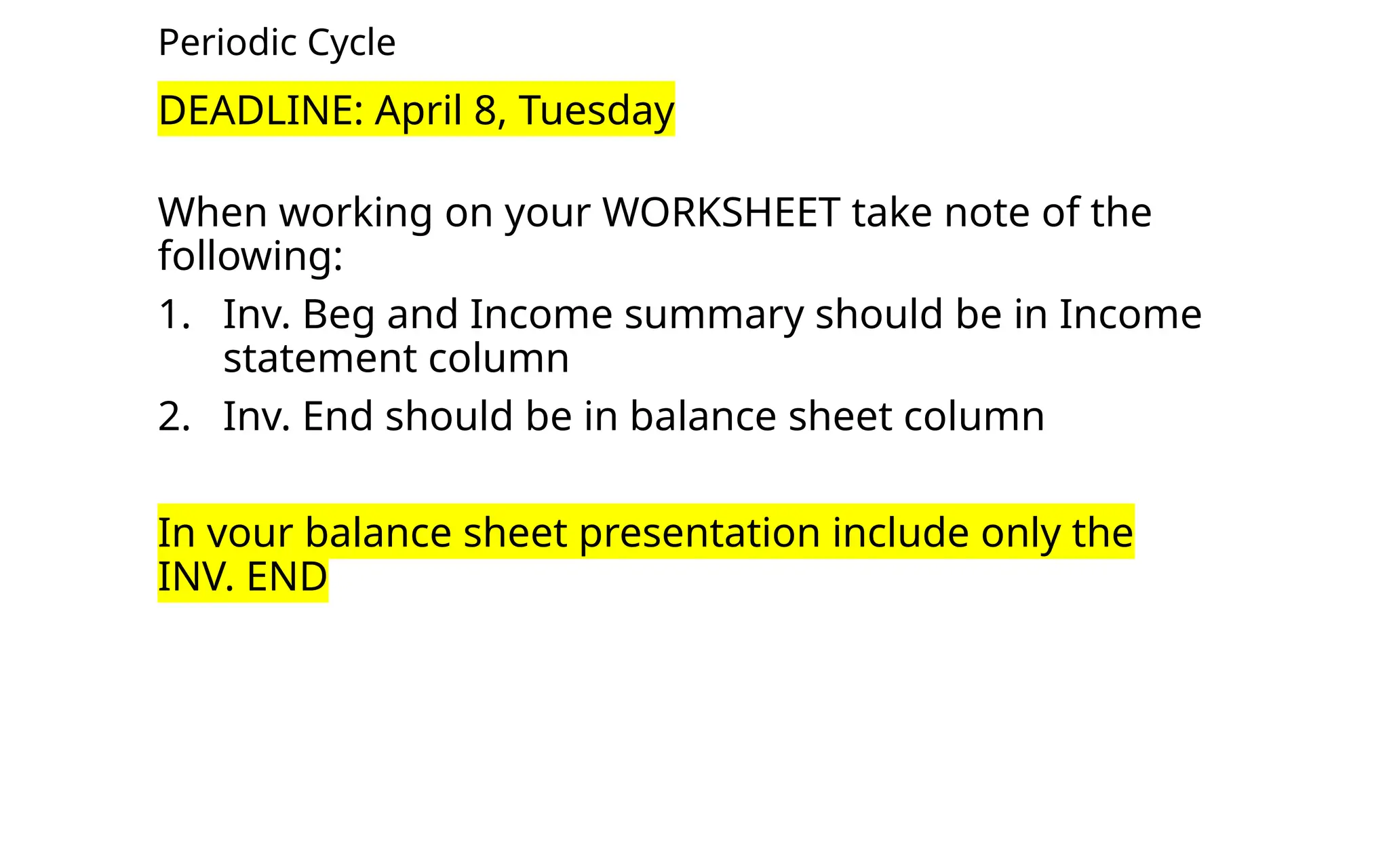
Periodic Cycle
DEADLINE: April8, Tuesday
When working on your WORKSHEET take note of the
following:
1. Inv. Beg and Income summary should be in Income
statement column
2. Inv. End should be in balance sheet column
In your balance sheet presentation include only the
INV. END
48.
Practice 2a
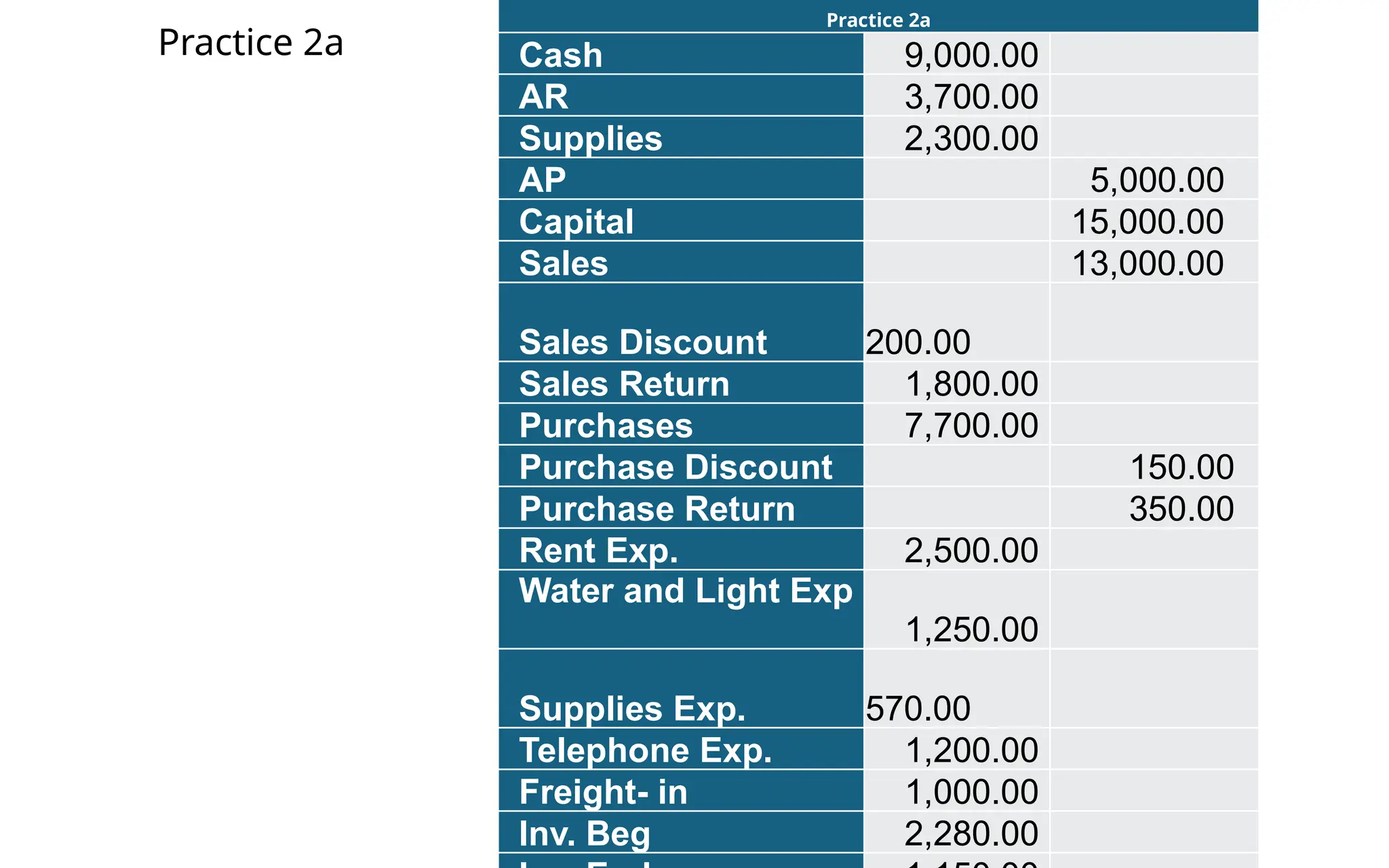
Practice 2a
Cash9,000.00
AR 3,700.00
Supplies 2,300.00
AP 5,000.00
Capital 15,000.00
Sales 13,000.00
Sales Discount 200.00
Sales Return 1,800.00
Purchases 7,700.00
Purchase Discount 150.00
Purchase Return 350.00
Rent Exp. 2,500.00
Water and Light Exp
1,250.00
Supplies Exp. 570.00
Telephone Exp. 1,200.00
Freight- in 1,000.00
Inv. Beg 2,280.00
50.
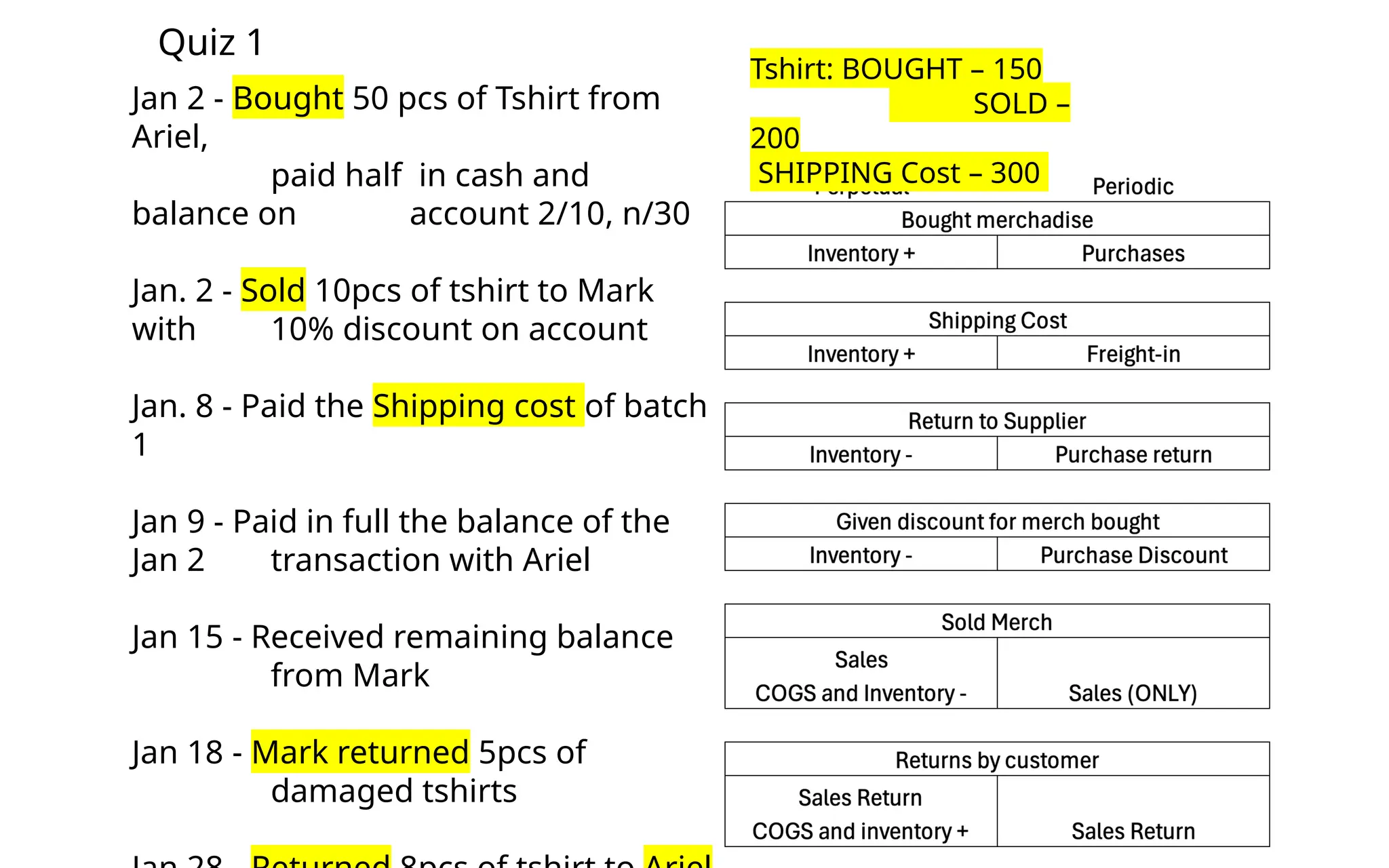
Quiz 1
Jan 2- Bought 50 pcs of Tshirt from
Ariel,
paid half in cash and
balance on account 2/10, n/30
Jan. 2 - Sold 10pcs of tshirt to Mark
with 10% discount on account
Jan. 8 - Paid the Shipping cost of batch
1
Jan 9 - Paid in full the balance of the
Jan 2 transaction with Ariel
Jan 15 - Received remaining balance
from Mark
Jan 18 - Mark returned 5pcs of
damaged tshirts
Tshirt: BOUGHT – 150
SOLD –
200
SHIPPING Cost – 300
51.
Periodic Cycle
DEADLINE: April8, Tuesday
When working on your WORKSHEET take note of the
following:
1. Inv. Beg and Income summary should be in Income
statement column
2. Inv. End should be in balance sheet column
In your balance sheet presentation include only the
INV. END
52.
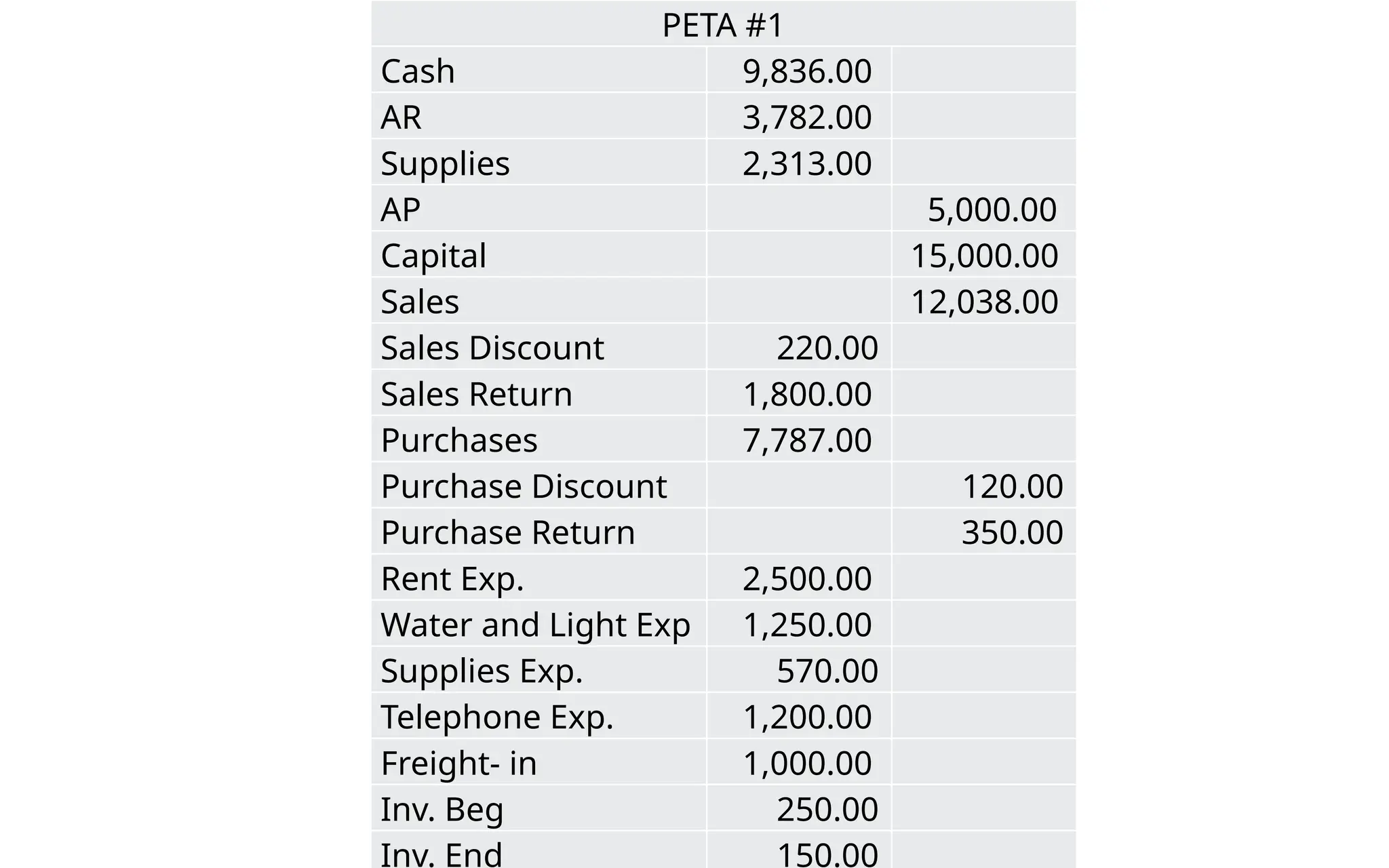
PETA #1
Cash 9,836.00
AR3,782.00
Supplies 2,313.00
AP 5,000.00
Capital 15,000.00
Sales 12,038.00
Sales Discount 220.00
Sales Return 1,800.00
Purchases 7,787.00
Purchase Discount 120.00
Purchase Return 350.00
Rent Exp. 2,500.00
Water and Light Exp 1,250.00
Supplies Exp. 570.00
Telephone Exp. 1,200.00
Freight- in 1,000.00
Inv. Beg 250.00
Inv. End 150.00
53.
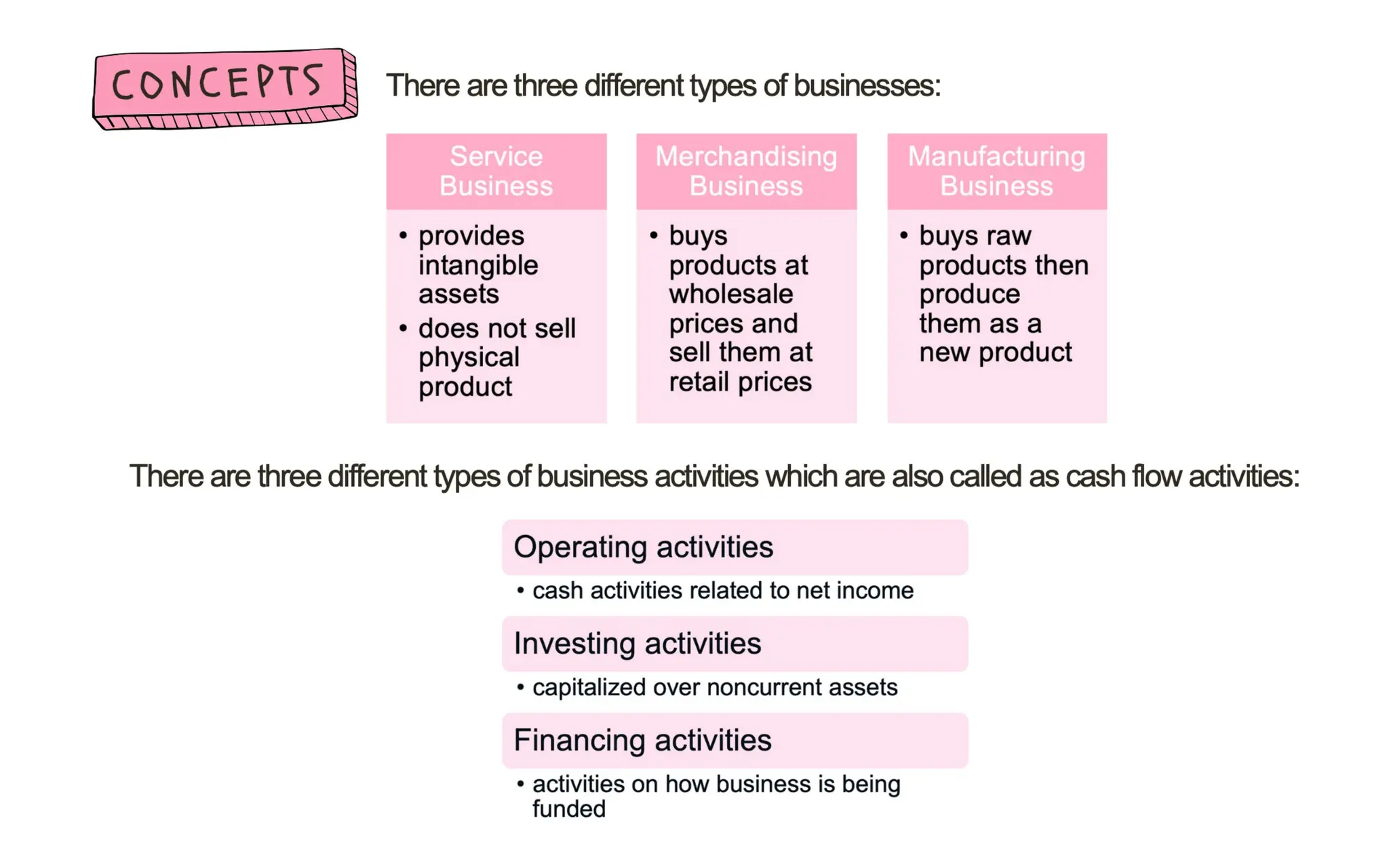
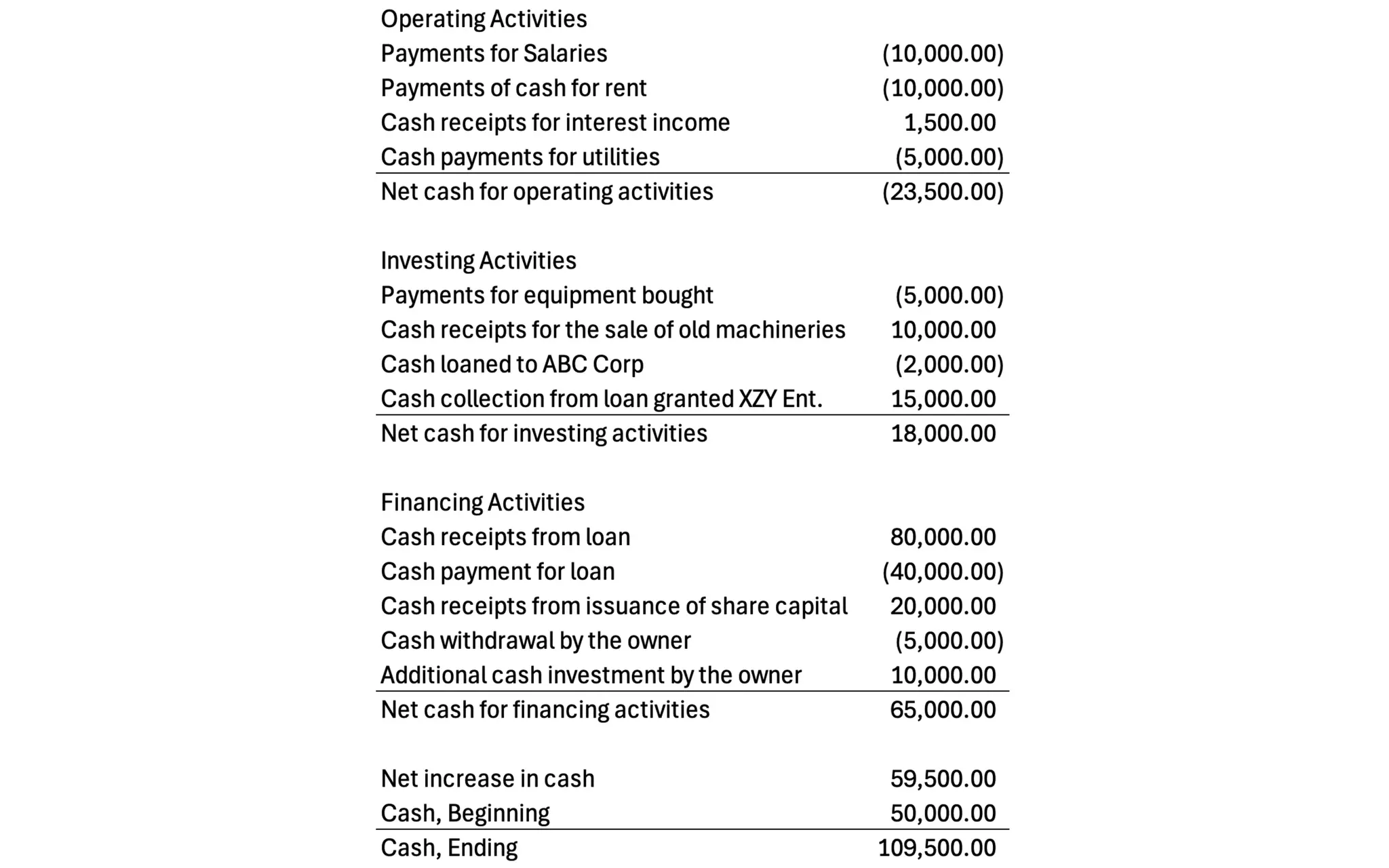
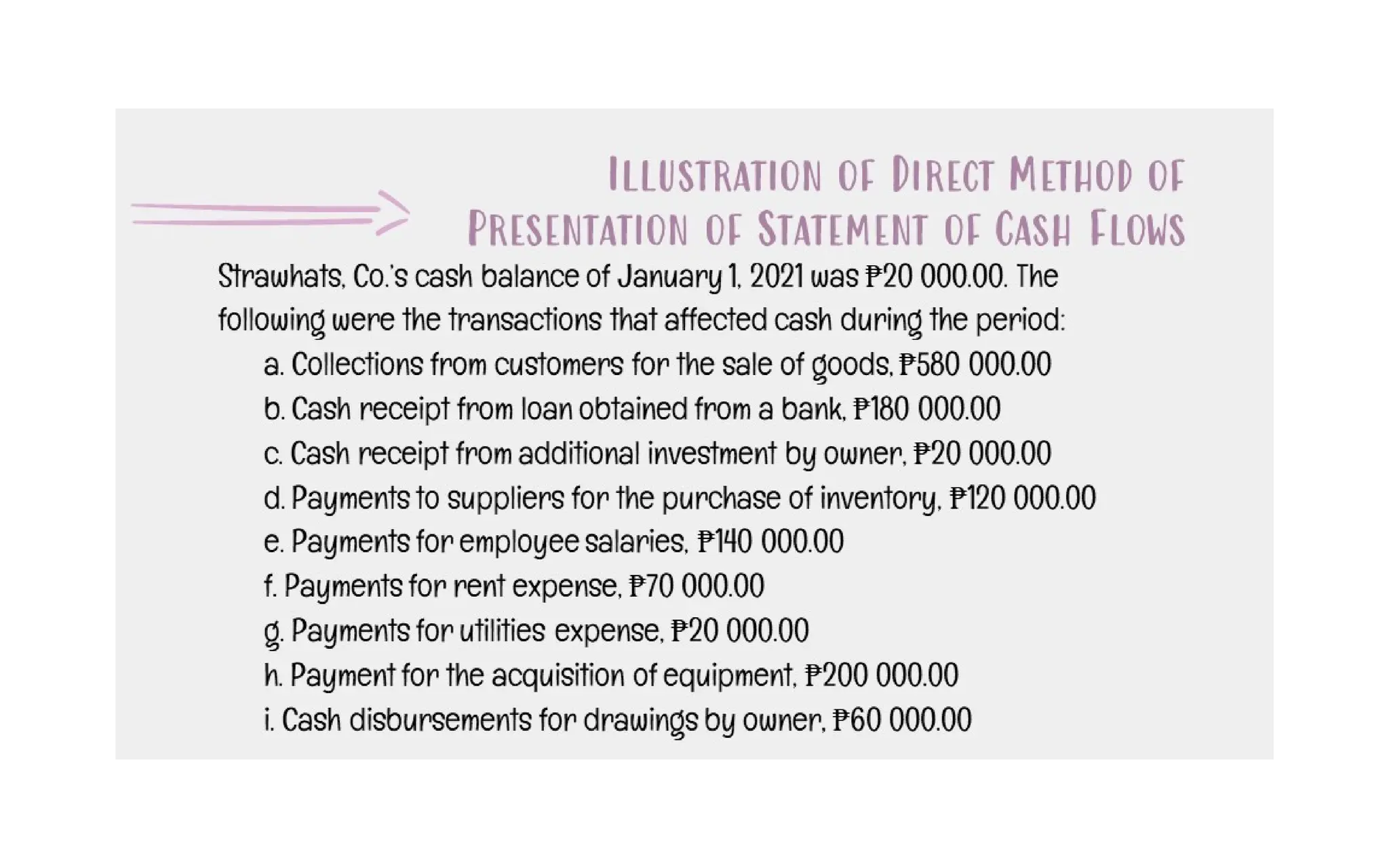
Statement of cashflow
The statement of cash flows is a financial statement that
shows the company's cash flows resulting from its
operating, investing, and financing activities during the
accounting period. It reports the company's cash receipts
and cash disbursements representing its cash inflow and
cash outflow.
54.
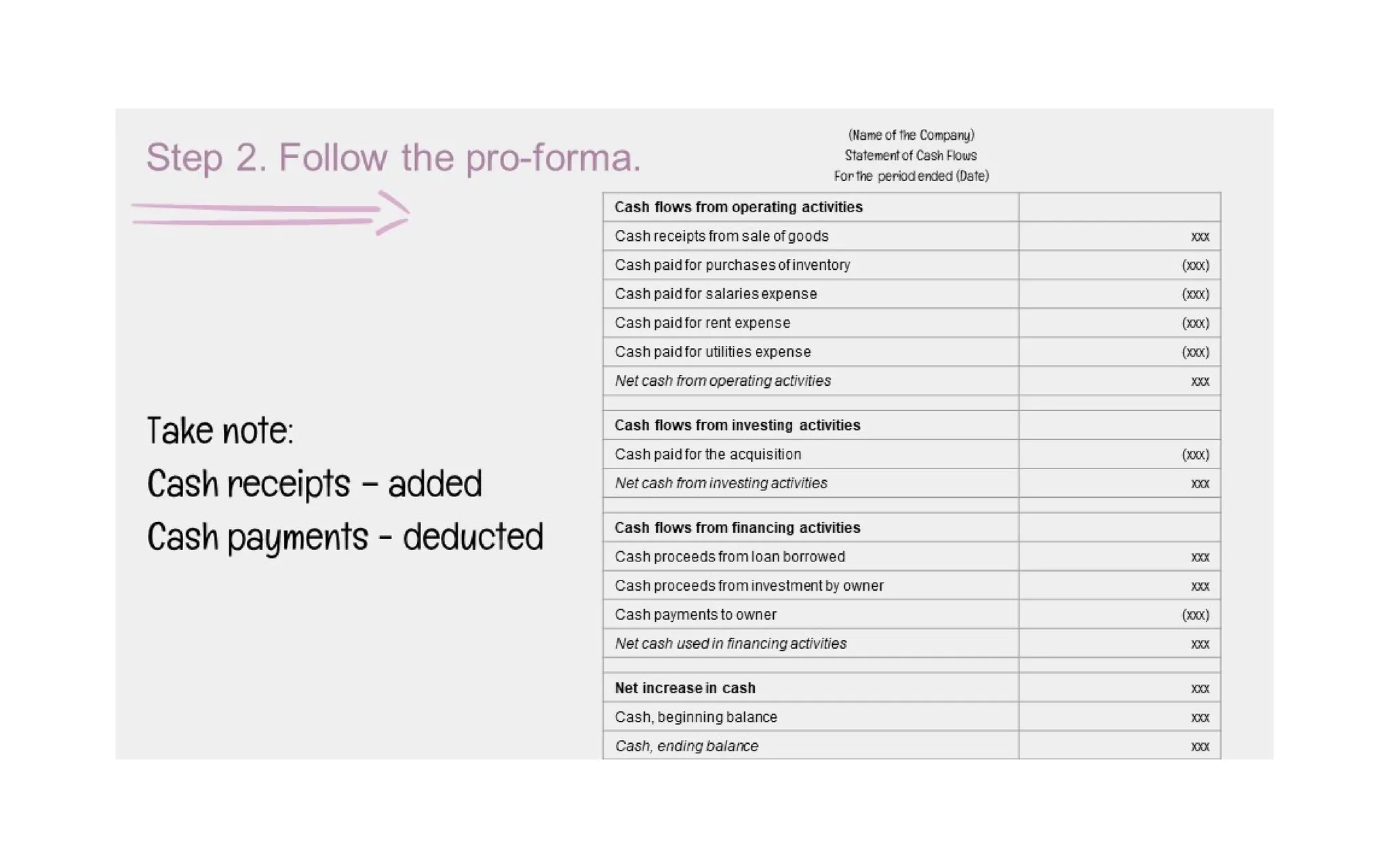
Cash Flows fromOperating Activities
Primarily this is related to revenue-producing activities.
Cash inflows are from revenues/income
Cash outflows are from expenses/expenditures
“Operating activities affect profit or loss”
55.
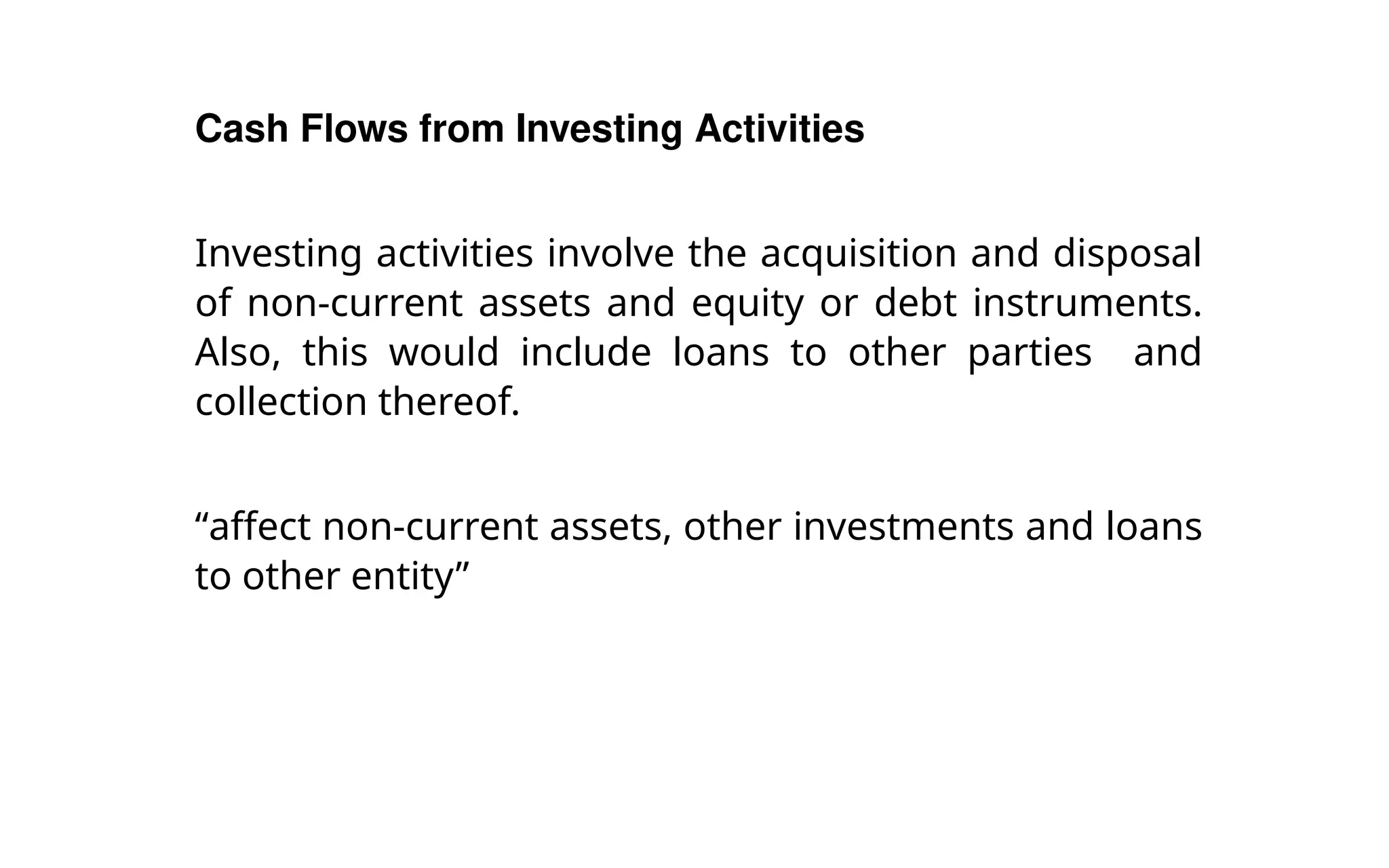
Cash Flows fromInvesting Activities
Investing activities involve the acquisition and disposal
of non-current assets and equity or debt instruments.
Also, this would include loans to other parties and
collection thereof.
“affect non-current assets, other investments and loans
to other entity”
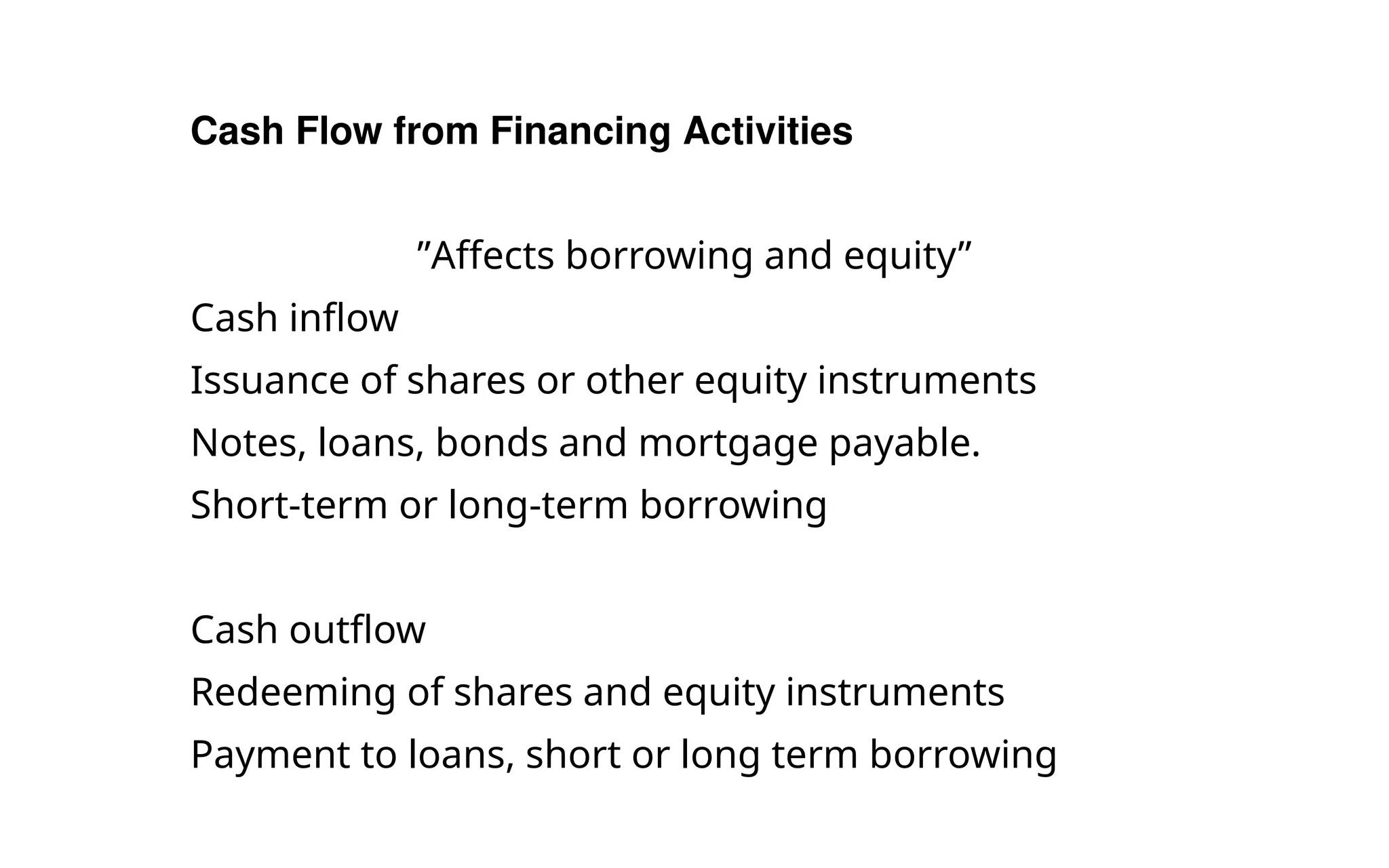
56.
Cash Flow fromFinancing Activities
”Affects borrowing and equity”
Cash inflow
Issuance of shares or other equity instruments
Notes, loans, bonds and mortgage payable.
Short-term or long-term borrowing
Cash outflow
Redeeming of shares and equity instruments
Payment to loans, short or long term borrowing
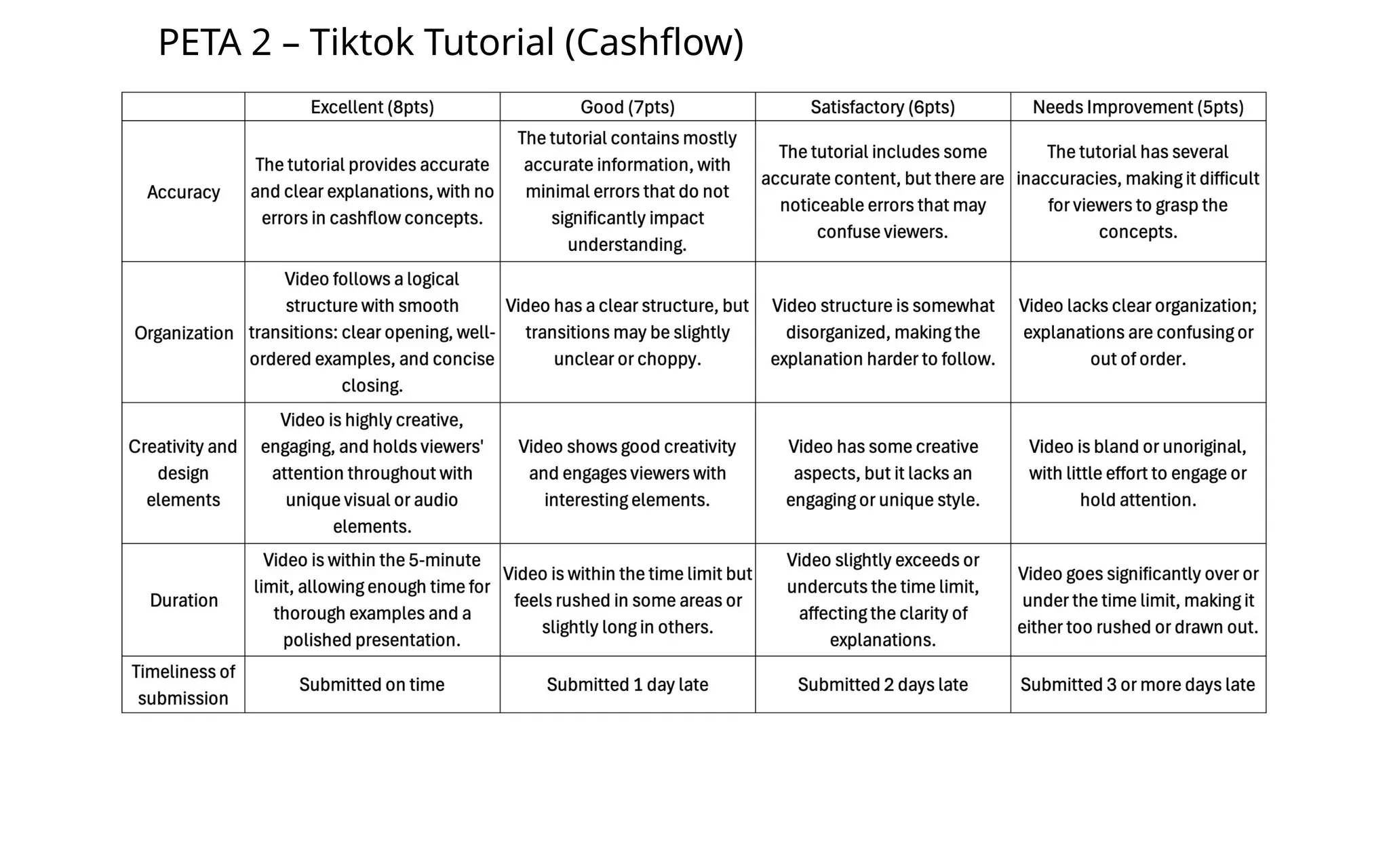
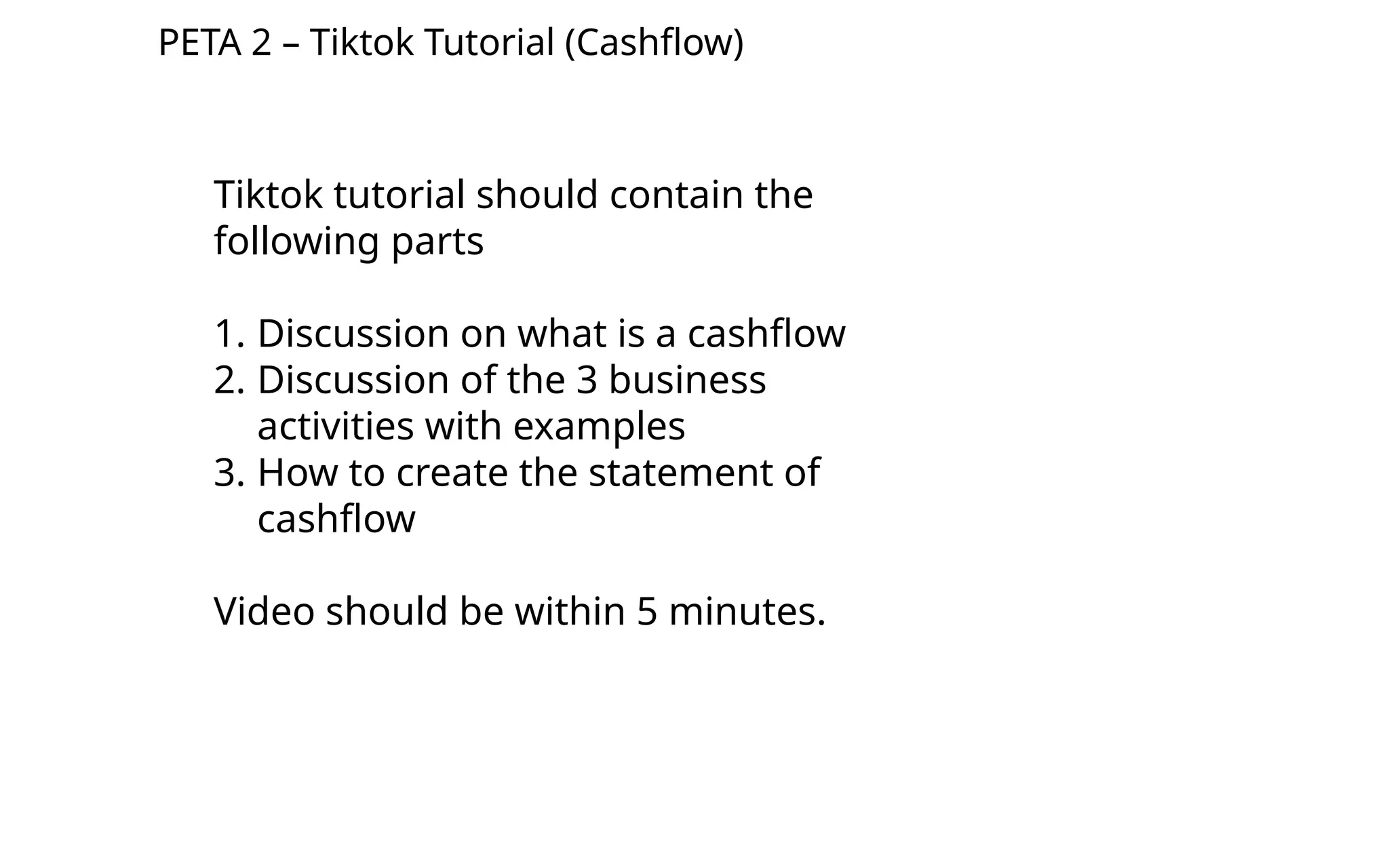
PETA 2 –Tiktok Tutorial (Cashflow)
Tiktok tutorial should contain the
following parts
1. Discussion on what is a cashflow
2. Discussion of the 3 business
activities with examples
3. How to create the statement of
cashflow
Video should be within 5 minutes.
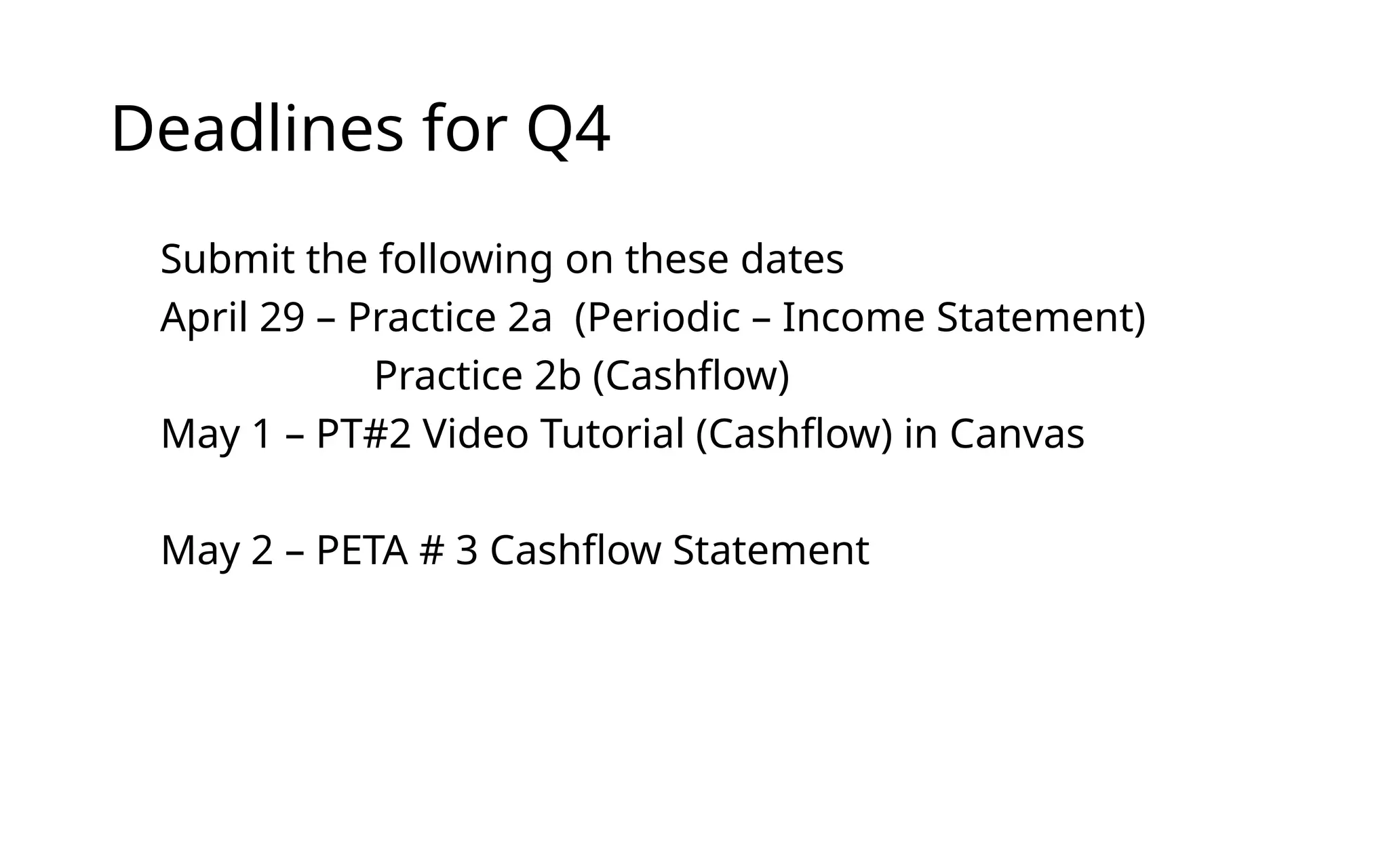
Deadlines for Q4
Submitthe following on these dates
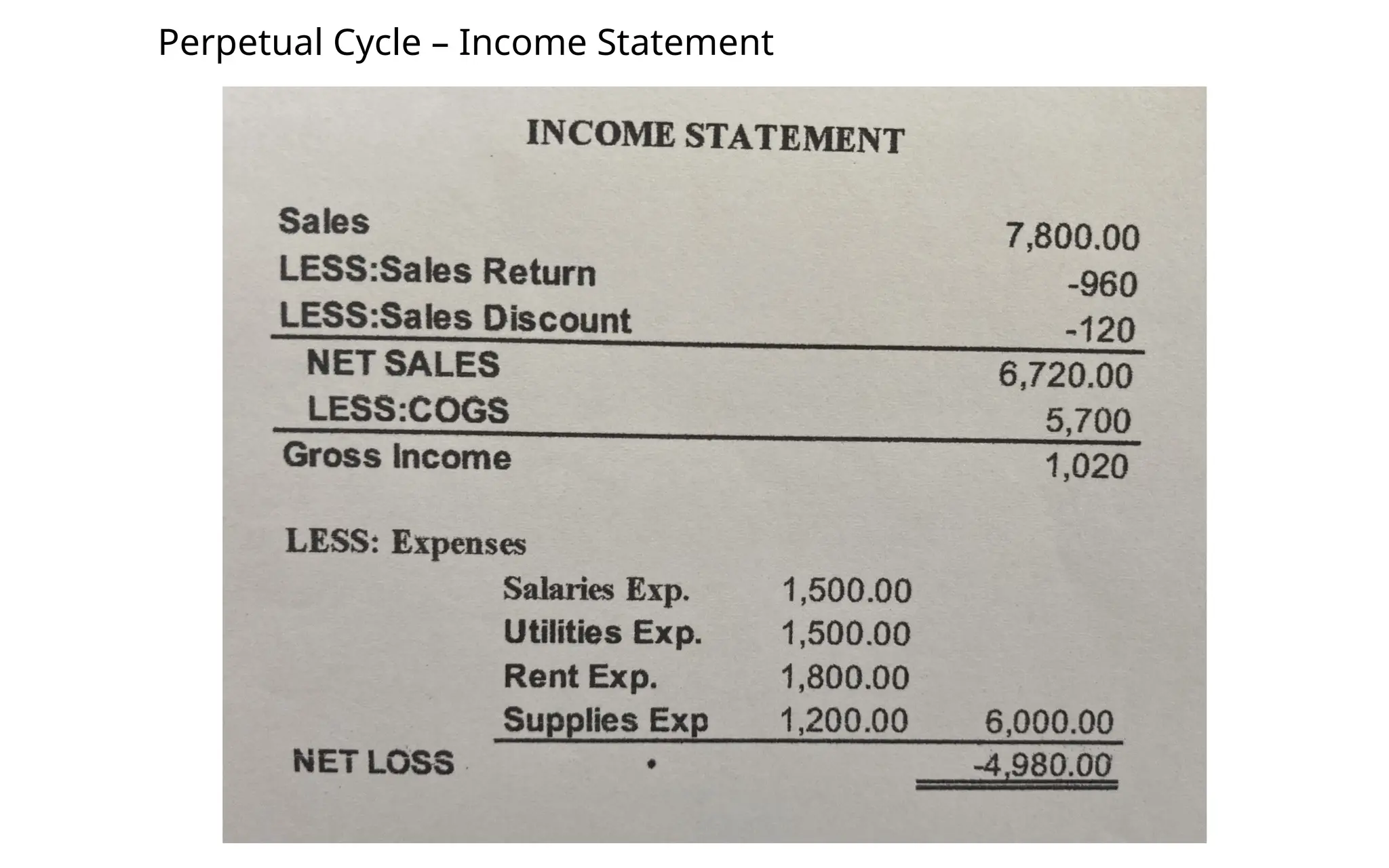
April 29 – Practice 2a (Periodic – Income Statement)
Practice 2b (Cashflow)
May 1 – PT#2 Video Tutorial (Cashflow) in Canvas
May 2 – PETA # 3 Cashflow Statement
69.
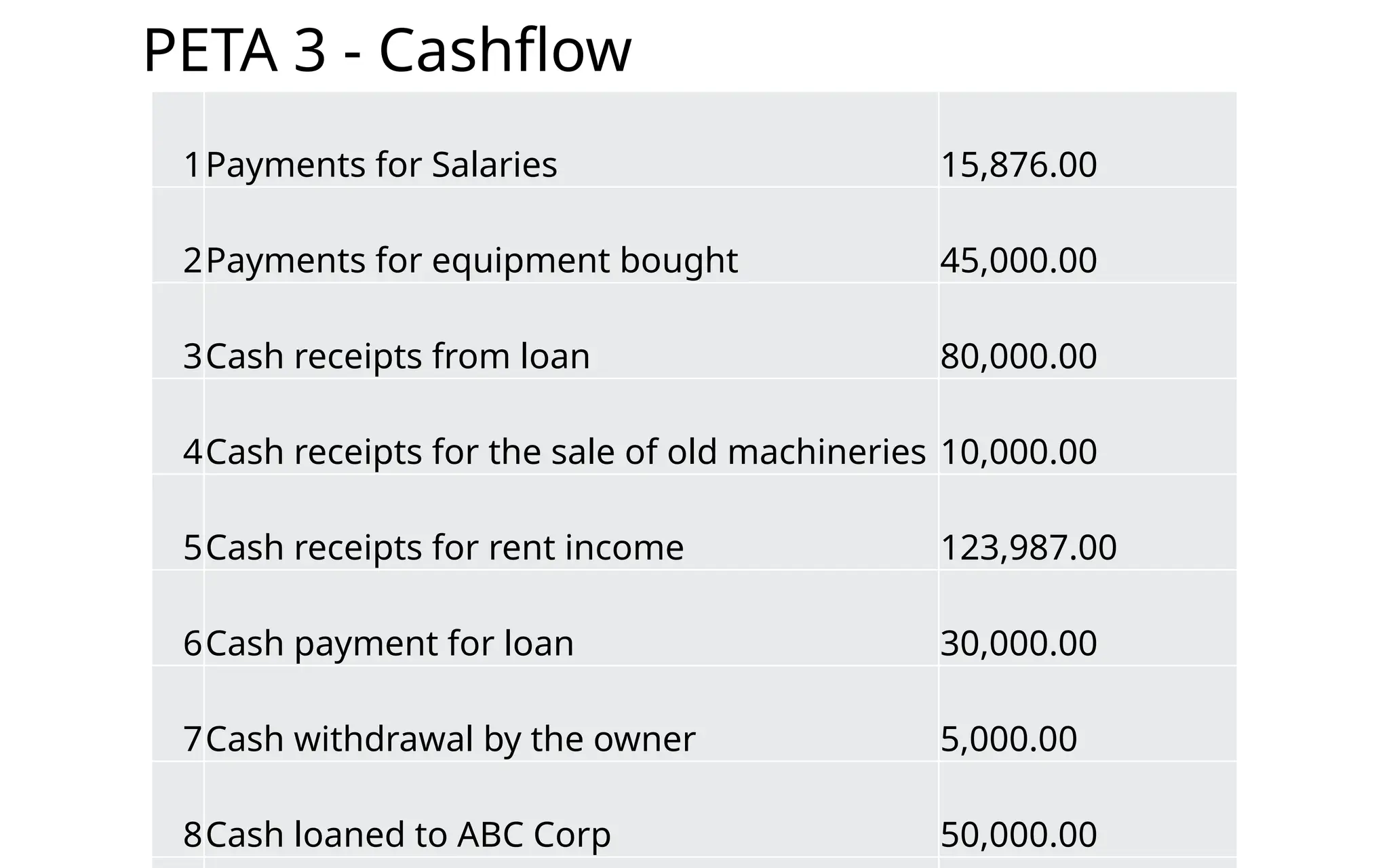
PETA 3 -Cashflow
1Payments for Salaries 15,876.00
2Payments for equipment bought 45,000.00
3Cash receipts from loan 80,000.00
4Cash receipts for the sale of old machineries 10,000.00
5Cash receipts for rent income 123,987.00
6Cash payment for loan 30,000.00
7Cash withdrawal by the owner 5,000.00
8Cash loaned to ABC Corp 50,000.00