Chapter 3:  Overview of Accounting  Analysis
The Importance of Accounting Analysis Accounting practices govern the types of disclosures made in the financial statements. Understanding accounting allows the business analyst to effectively use the financial information disclosed by companies.
Key Concepts in Chapter 3 Various factors influence the quality of accounting-based financial reports. Managers have some discretion in accounting choices used in financial reporting. Incentives for the management of financial reporting items must be considered by the analyst.
Accrual Accounting Financial reports are prepared using accrual accounting instead of cash accounting. IFRS defines the following financial statement elements: Revenues Expenses Assets Liabilities Equity
Management’s Responsibility for Reporting Financial Information Applying accounting principles is the responsibility of management, who has superior knowledge of a firm’s business. Incentives exist for management to distort accounting numbers in their favor. Contracts Reputation Mitigating effects of legal liability, auditing, public enforcement.
International Financial Reporting Standards (IFRS) The EU and other countries worldwide have relied on the IASB to set accounting standards (IFRS); many countries have endorsement procedures. IFRS allows for consistency in reporting between firms and over different time periods of the same firm. Uniform accounting standards minimize manager’s ability to manipulate financial statement information. Rigid accounting rules may be disfunctional; calls for principles-based accounting standards.
External Auditing of Financial Statements Required for publicly traded companies; within the EU also required for some private firms. Conducted according to standards: EU: minimum standards set by the 8 th  Directive (US: Sarbanes-Oxley Act) International Auditing Standards (US: GAAS) Auditing has its limitations; it is backed up by legal liability and public enforcement.
Public enforcement Most countries have public enforcement bodies to review compliance and take actions to correct noncompliance. Public enforcement cannot ensure full compliance because enforcement bodies work: Proactively on a sampling basis or On a complaint basis There is international diversity in enforcement quality; the CESR coordinates enforcement activities in the EU
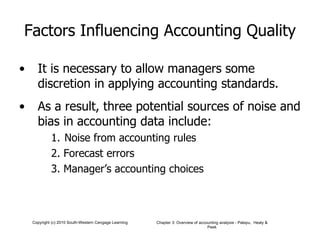
Factors Influencing Accounting Quality It is necessary to allow managers some discretion in applying accounting standards. As a result, three potential sources of noise and bias in accounting data include: Noise from accounting rules 2. Forecast errors 3. Manager’s accounting choices
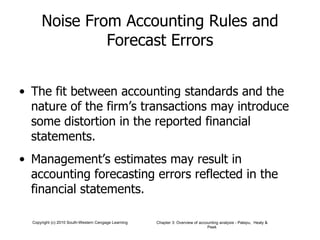
Noise From Accounting Rules and Forecast Errors The fit between accounting standards and the nature of the firm’s transactions may introduce some distortion in the reported financial statements. Management’s estimates may result in accounting forecasting errors reflected in the financial statements.
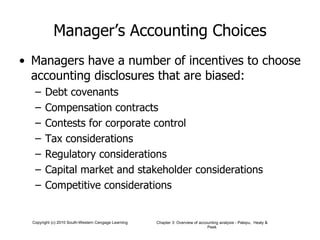
Manager’s Accounting Choices Managers have a number of incentives to choose accounting disclosures that are biased: Debt covenants Compensation contracts Contests for corporate control Tax considerations Regulatory considerations Capital market and stakeholder considerations Competitive considerations
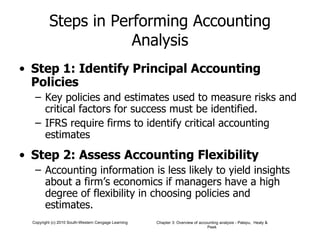
Steps in Performing Accounting Analysis Step 1: Identify Principal Accounting Policies Key policies and estimates used to measure risks and critical factors for success must be identified. IFRS require firms to identify critical accounting estimates Step 2: Assess Accounting Flexibility Accounting information is less likely to yield insights about a firm’s economics if managers have a high degree of flexibility in choosing policies and estimates.
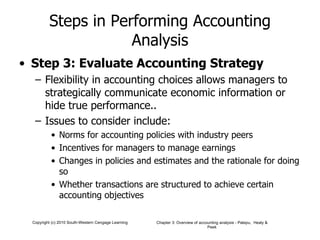
Steps in Performing Accounting Analysis Step 3: Evaluate Accounting Strategy Flexibility in accounting choices allows managers to strategically communicate economic information or hide true performance.. Issues to consider include: Norms for accounting policies with industry peers Incentives for managers to manage earnings Changes in policies and estimates and the rationale for doing so Whether transactions are structured to achieve certain accounting objectives
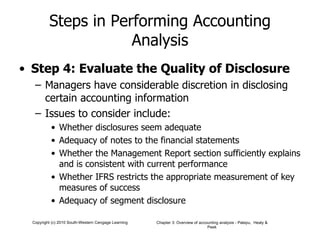
Steps in Performing Accounting Analysis Step 4: Evaluate the Quality of Disclosure Managers have considerable discretion in disclosing certain accounting information Issues to consider include: Whether disclosures seem adequate Adequacy of notes to the financial statements Whether the Management Report section sufficiently explains and is consistent with current performance Whether IFRS restricts the appropriate measurement of key measures of success Adequacy of segment disclosure
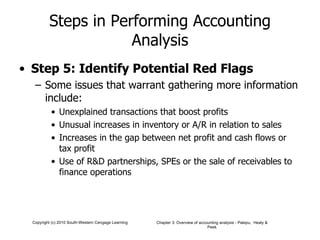
Steps in Performing Accounting Analysis Step 5: Identify Potential Red Flags Some issues that warrant gathering more information include: Unexplained transactions that boost profits Unusual increases in inventory or A/R in relation to sales Increases in the gap between net profit and cash flows or tax profit Use of R&D partnerships, SPEs or the sale of receivables to finance operations
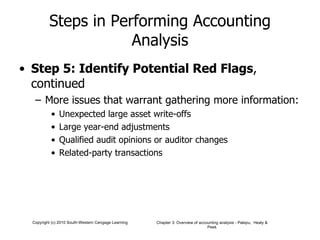
Steps in Performing Accounting Analysis Step 5: Identify Potential Red Flags , continued More issues that warrant gathering more information: Unexpected large asset write-offs Large year-end adjustments Qualified audit opinions or auditor changes Related-party transactions
Steps in Performing Accounting Analysis Step 6: Undo Accounting Distortions Use information from the cash flow statement and notes to the financial statements to (possibly imperfectly) undo distortions Continued in chapter 4
Accounting Analysis Pitfalls Conservative accounting may also be misleading. For example, historical cost and accounting for intangible assets Not all unusual accounting practices are questionable. Earnings management does not necessarily motivate some accounting phenomena that seem unusual Common standards  ≠ common practices
Concluding Comments Accounting analysis is an essential step in analyzing corporate financial reports. A methodology consisting of six steps in analyzing accounting data was presented in this chapter. Research suggests earnings management is not so pervasive as to make earnings data unreliable.

F6003Ch 03.php(1)

  • 1.
    Chapter 3: Overview of Accounting Analysis
  • 2.
    The Importance ofAccounting Analysis Accounting practices govern the types of disclosures made in the financial statements. Understanding accounting allows the business analyst to effectively use the financial information disclosed by companies.
  • 3.
    Key Concepts inChapter 3 Various factors influence the quality of accounting-based financial reports. Managers have some discretion in accounting choices used in financial reporting. Incentives for the management of financial reporting items must be considered by the analyst.
  • 4.
    Accrual Accounting Financialreports are prepared using accrual accounting instead of cash accounting. IFRS defines the following financial statement elements: Revenues Expenses Assets Liabilities Equity
  • 5.
    Management’s Responsibility forReporting Financial Information Applying accounting principles is the responsibility of management, who has superior knowledge of a firm’s business. Incentives exist for management to distort accounting numbers in their favor. Contracts Reputation Mitigating effects of legal liability, auditing, public enforcement.
  • 6.
    International Financial ReportingStandards (IFRS) The EU and other countries worldwide have relied on the IASB to set accounting standards (IFRS); many countries have endorsement procedures. IFRS allows for consistency in reporting between firms and over different time periods of the same firm. Uniform accounting standards minimize manager’s ability to manipulate financial statement information. Rigid accounting rules may be disfunctional; calls for principles-based accounting standards.
  • 7.
    External Auditing ofFinancial Statements Required for publicly traded companies; within the EU also required for some private firms. Conducted according to standards: EU: minimum standards set by the 8 th Directive (US: Sarbanes-Oxley Act) International Auditing Standards (US: GAAS) Auditing has its limitations; it is backed up by legal liability and public enforcement.
  • 8.
    Public enforcement Mostcountries have public enforcement bodies to review compliance and take actions to correct noncompliance. Public enforcement cannot ensure full compliance because enforcement bodies work: Proactively on a sampling basis or On a complaint basis There is international diversity in enforcement quality; the CESR coordinates enforcement activities in the EU
  • 9.
    Factors Influencing AccountingQuality It is necessary to allow managers some discretion in applying accounting standards. As a result, three potential sources of noise and bias in accounting data include: Noise from accounting rules 2. Forecast errors 3. Manager’s accounting choices
  • 10.
    Noise From AccountingRules and Forecast Errors The fit between accounting standards and the nature of the firm’s transactions may introduce some distortion in the reported financial statements. Management’s estimates may result in accounting forecasting errors reflected in the financial statements.
  • 11.
    Manager’s Accounting ChoicesManagers have a number of incentives to choose accounting disclosures that are biased: Debt covenants Compensation contracts Contests for corporate control Tax considerations Regulatory considerations Capital market and stakeholder considerations Competitive considerations
  • 12.
    Steps in PerformingAccounting Analysis Step 1: Identify Principal Accounting Policies Key policies and estimates used to measure risks and critical factors for success must be identified. IFRS require firms to identify critical accounting estimates Step 2: Assess Accounting Flexibility Accounting information is less likely to yield insights about a firm’s economics if managers have a high degree of flexibility in choosing policies and estimates.
  • 13.
    Steps in PerformingAccounting Analysis Step 3: Evaluate Accounting Strategy Flexibility in accounting choices allows managers to strategically communicate economic information or hide true performance.. Issues to consider include: Norms for accounting policies with industry peers Incentives for managers to manage earnings Changes in policies and estimates and the rationale for doing so Whether transactions are structured to achieve certain accounting objectives
  • 14.
    Steps in PerformingAccounting Analysis Step 4: Evaluate the Quality of Disclosure Managers have considerable discretion in disclosing certain accounting information Issues to consider include: Whether disclosures seem adequate Adequacy of notes to the financial statements Whether the Management Report section sufficiently explains and is consistent with current performance Whether IFRS restricts the appropriate measurement of key measures of success Adequacy of segment disclosure
  • 15.
    Steps in PerformingAccounting Analysis Step 5: Identify Potential Red Flags Some issues that warrant gathering more information include: Unexplained transactions that boost profits Unusual increases in inventory or A/R in relation to sales Increases in the gap between net profit and cash flows or tax profit Use of R&D partnerships, SPEs or the sale of receivables to finance operations
  • 16.
    Steps in PerformingAccounting Analysis Step 5: Identify Potential Red Flags , continued More issues that warrant gathering more information: Unexpected large asset write-offs Large year-end adjustments Qualified audit opinions or auditor changes Related-party transactions
  • 17.
    Steps in PerformingAccounting Analysis Step 6: Undo Accounting Distortions Use information from the cash flow statement and notes to the financial statements to (possibly imperfectly) undo distortions Continued in chapter 4
  • 18.
    Accounting Analysis PitfallsConservative accounting may also be misleading. For example, historical cost and accounting for intangible assets Not all unusual accounting practices are questionable. Earnings management does not necessarily motivate some accounting phenomena that seem unusual Common standards ≠ common practices
  • 19.
    Concluding Comments Accountinganalysis is an essential step in analyzing corporate financial reports. A methodology consisting of six steps in analyzing accounting data was presented in this chapter. Research suggests earnings management is not so pervasive as to make earnings data unreliable.