Jennifer Dehaney, Grade 8 DCDSB
Hillary Rogers, Grade 1 FI DCDSB
TEACHING FINANCIAL
LITERACYTHROUGH
PROJECT BASED
LEARNING
Agenda
■ 21st Century Students
■ Digital Fluency
■ Project Based Learning
■ Examples by Division
■ Resources
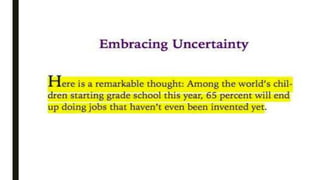
“Training
Kids for
jobs that
haven’t
been
invented
yet”
Digital fluency
Concrete
Digital fluency
ConcretevsAbstractAbstract
Project Based Learning
■ https://www.youtube.com/watch?v=LMCZvGesRz8
Building Conceptual Understanding in
the Primary classroom
ELKP
Building Competency through
fundraising and event planning
Junior
TacoTruck
Junior
Intermediate
Million Dollar Project
Intermediate
Congratulations!You have been given $1,000,000. As a part of this inheritance, you have been
given guidelines to follow for how to spend it. Make sure the follow the guidelines to the letter
so you don't hurt Grandma Irene's feelings.
YOU MUST:
1. Put at least $75,000 aside for college education. Research the cost of the education
for ONE year at your favorite university and then calculate it against how many years it will take
you to achieve your degree. Add in 10% to cover inflation, books and other expenses related to
education.
2. Purchase a home that is NO MORE than $300,000. Research various homes in locations that
you would like to live. Find the home that you feel is PERFECT for you and print out one page with
the specs from the home.
3.Take a family vacation. Use a travel agency to determine expenses for the total cost
including: hotel, airfare, meals, transportation, spending money, etc.
4. Purchase a vehicle. Using dealership sites, find a car or vehicle that is to your liking and
print out the one page with the specs for the car from the dealership.
5. Make one charitable donation. Remember that friends, family, and pets do not qualify as a
charity. Find a charity that means something to you and give them funds based on a project
they are working on.
You may NOT spend more than $1,000,000 but you want to spend as much of it as
possible. This project is developed to help you plan for your future and develop the math
skills that you have acquired and put them in a real-life situation by spending money within
a budget.
As part of this project you WILL NOT be required to pay taxes, closing costs or other fees.
Other rules for the Million Dollar Project:
1. All time used in class on the internet is to not be wasted. Make sure you are on
appropriate sites and using time wisely as you will be receiving a grade based on
participation and being on-task.
2.You may not purchase more than 2 of the same item.
3. Make sure to record all items that you purchase on the expense tracking sheet to total up
your expenses as you go along. YOU MAY NOT go over $1,000,000 from your budget and
you MAY NOT borrow money from a friend.
4. Each purchase that you make MUST have a check written out appropriately.Use the
model below to know how to write a check.You will not be able to write more than the 18
checks that you are given.
Cross Divisional: Math Night
Resources
Scoop it: Money Makes Sense
■ http://www.scoop.it/t/making-sense-of-money
Learning Money with Leo (RBC App,
primary)
■ http://www.rbcroyalbank.com/learning-money-with-
leo/index.html?ProspectID=E7D144BBBF4746508534D4876F78E0FF&BT_IP_Country=
Canada&BT_IP_Region=Manitoba&BT_IP_City=Winnipeg&BT_IP_Zip=R2C+0A1
Talk with your kids about money day (for
grade 7, presented by RBC)
■ http://talkwithourkidsaboutmoney.com/school-program/
The Mint (lesson plans, online games,
resources for parents)
■ http://www.themint.org/
EduGains (resources by grade)
■ http://www.edugains.ca/newsite/FinancialLit/elementaryresources/elementary.html
Inspire Financial Learning (OTF)
■ https://www.inspirefinanciallearning.ca/
A Sound Investment (Ministry Doc)
■ http://www.edu.gov.on.ca/eng/Financial_Literacy_Eng.pdf
Practical Money Skills Canada (lessons
and resources for educators)
■ https://practicalmoneyskills.ca/foreducators/
HighTech High (Video example of
Project Based Learning)
■ https://www.youtube.com/watch?v=cOVm7zBHJJY

# F2.10 - Teaching Financial Literacy Through Project Based Learning

  • 1.
    Jennifer Dehaney, Grade8 DCDSB Hillary Rogers, Grade 1 FI DCDSB TEACHING FINANCIAL LITERACYTHROUGH PROJECT BASED LEARNING
  • 3.
    Agenda ■ 21st CenturyStudents ■ Digital Fluency ■ Project Based Learning ■ Examples by Division ■ Resources
  • 6.
  • 9.
  • 10.
  • 11.
    Project Based Learning ■https://www.youtube.com/watch?v=LMCZvGesRz8
  • 12.
    Building Conceptual Understandingin the Primary classroom ELKP
  • 14.
    Building Competency through fundraisingand event planning Junior
  • 15.
  • 16.
  • 17.
  • 18.
    Congratulations!You have beengiven $1,000,000. As a part of this inheritance, you have been given guidelines to follow for how to spend it. Make sure the follow the guidelines to the letter so you don't hurt Grandma Irene's feelings. YOU MUST: 1. Put at least $75,000 aside for college education. Research the cost of the education for ONE year at your favorite university and then calculate it against how many years it will take you to achieve your degree. Add in 10% to cover inflation, books and other expenses related to education. 2. Purchase a home that is NO MORE than $300,000. Research various homes in locations that you would like to live. Find the home that you feel is PERFECT for you and print out one page with the specs from the home.
  • 19.
    3.Take a familyvacation. Use a travel agency to determine expenses for the total cost including: hotel, airfare, meals, transportation, spending money, etc. 4. Purchase a vehicle. Using dealership sites, find a car or vehicle that is to your liking and print out the one page with the specs for the car from the dealership. 5. Make one charitable donation. Remember that friends, family, and pets do not qualify as a charity. Find a charity that means something to you and give them funds based on a project they are working on. You may NOT spend more than $1,000,000 but you want to spend as much of it as possible. This project is developed to help you plan for your future and develop the math skills that you have acquired and put them in a real-life situation by spending money within a budget.
  • 20.
    As part ofthis project you WILL NOT be required to pay taxes, closing costs or other fees. Other rules for the Million Dollar Project: 1. All time used in class on the internet is to not be wasted. Make sure you are on appropriate sites and using time wisely as you will be receiving a grade based on participation and being on-task. 2.You may not purchase more than 2 of the same item. 3. Make sure to record all items that you purchase on the expense tracking sheet to total up your expenses as you go along. YOU MAY NOT go over $1,000,000 from your budget and you MAY NOT borrow money from a friend. 4. Each purchase that you make MUST have a check written out appropriately.Use the model below to know how to write a check.You will not be able to write more than the 18 checks that you are given.
  • 21.
  • 22.
  • 23.
    Scoop it: MoneyMakes Sense ■ http://www.scoop.it/t/making-sense-of-money
  • 24.
    Learning Money withLeo (RBC App, primary) ■ http://www.rbcroyalbank.com/learning-money-with- leo/index.html?ProspectID=E7D144BBBF4746508534D4876F78E0FF&BT_IP_Country= Canada&BT_IP_Region=Manitoba&BT_IP_City=Winnipeg&BT_IP_Zip=R2C+0A1
  • 25.
    Talk with yourkids about money day (for grade 7, presented by RBC) ■ http://talkwithourkidsaboutmoney.com/school-program/
  • 26.
    The Mint (lessonplans, online games, resources for parents) ■ http://www.themint.org/
  • 27.
    EduGains (resources bygrade) ■ http://www.edugains.ca/newsite/FinancialLit/elementaryresources/elementary.html
  • 28.
    Inspire Financial Learning(OTF) ■ https://www.inspirefinanciallearning.ca/
  • 29.
    A Sound Investment(Ministry Doc) ■ http://www.edu.gov.on.ca/eng/Financial_Literacy_Eng.pdf
  • 30.
    Practical Money SkillsCanada (lessons and resources for educators) ■ https://practicalmoneyskills.ca/foreducators/
  • 31.
    HighTech High (Videoexample of Project Based Learning) ■ https://www.youtube.com/watch?v=cOVm7zBHJJY

Editor's Notes

  • #3 Jenny
  • #8 Sal Khan – One World School House trainign kids for jobs that haven’t been invented yet
  • #11 i.e. gap right now with 18 year olds in cc debt cause not grasping abstract
  • #13 Not just understanding the mathematical value of the money, but what that means in the real world Hopefully transferable to later learning An early start in financial education is good, but the concept of money can be difficult for young children to grasp. It can be a few years before they understand earning, spending, and saving, let alone investing. There are early lessons that can help them learn the basics. 
  • #16 https://www.teacherspayteachers.com/Product/Run-A-Taco-Truck-A-Project-Based-Learning-Activity-PBL-2939135
  • #17 https://www.teacherspayteachers.com/Product/Run-A-Taco-Truck-A-Project-Based-Learning-Activity-PBL-2939135
  • #18 https://www.teacherspayteachers.com/Product/Run-A-Taco-Truck-A-Project-Based-Learning-Activity-PBL-2939135