Extending the Compatibility Notion for Abstract WS-BPEL ProcessesDieter KönigSimon MoserNiels LohmannKarsten WolfChristian StahlIBM Böblingen LaboratoryGermanyUniversity of RostockGermanyHumboldt-Universität zu BerlinGermanyUNIVERSITÄT ROSTOCK
WS-BPEL2Web Service Business Process Execution Languagespecifies a business process by orchestratingWeb servicesimplemented as Web service itselfprocess can be anexecutable Web servicesabstract processes ("business protocols")
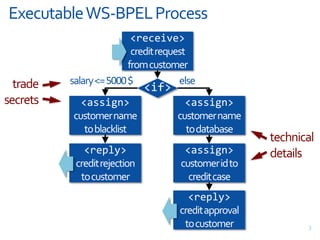
Executable WS-BPEL Process3<receive>credit request from customerelsesalary <= 5000 $tradesecrets<if><assign>customer name to blacklist<assign>customer name to databasetechnicaldetails<reply>credit rejection to customer<assign>customer id to credit case<reply>credit approval to customer
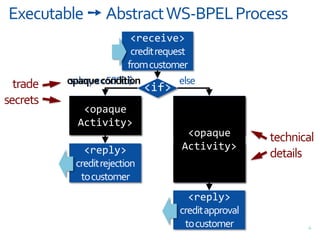
Executable ➙ Abstract WS-BPEL Process4<receive>credit request from customerelsesalary <= 5000 $opaque conditiontradesecrets<if><assign>customer name to blacklist<assign>customer name to database<opaqueActivity><opaqueActivity>technicaldetails<reply>credit rejection to customer<assign>customer id to credit case<reply>credit approval to customer
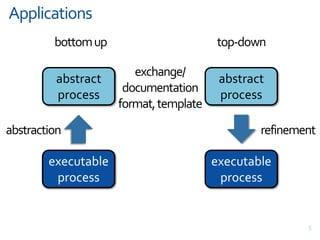
Applications5bottom uptop-downexchange/documentationformat, templateabstract processabstract processabstractionrefinementexecutable processexecutable process
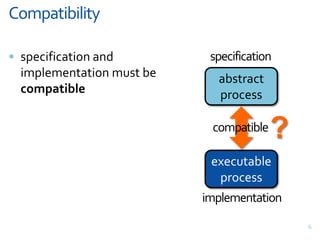
Compatibility6specification and implementation must be compatible
means to check/achieve compatibility:
computer-aided verification
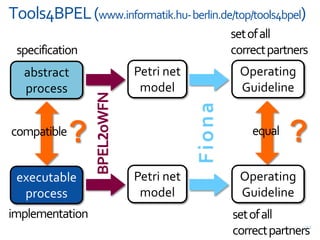
abstract profilesspecificationabstract process?compatibleexecutable processimplementation
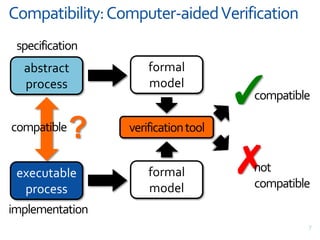
Compatibility: Computer-aided Verification7specificationformal modelabstract process✓compatible?verification toolcompatible✗notcompatibleformal modelexecutable processimplementation
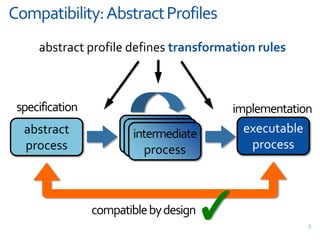
Compatibility: Abstract Profiles8abstract profile defines transformation rulesspecificationimplementationintermediate processexecutable processabstract processintermediate processintermediate process✓compatible by design
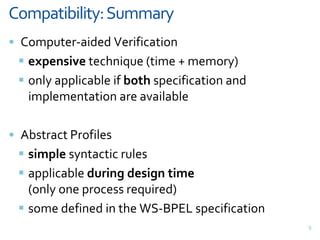
Compatibility: Summary9Computer-aided Verificationexpensive technique (time + memory)only applicable if both specification and implementation are availableAbstract Profilessimple syntactic rulesapplicable during design time(only one process required)some defined in the WS-BPEL specification
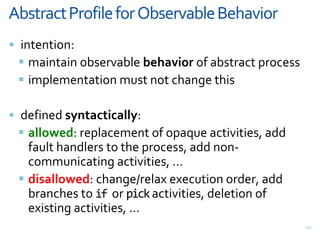
Abstract Profile for Observable Behavior 10intention:maintain observable behavior of abstract processimplementation must not change thisdefined syntactically:allowed: replacement of opaque activities, add fault handlers to the process, add non-communicating activities, …disallowed: change/relax execution order, add branches to if or pick activities, deletion of existing activities, …
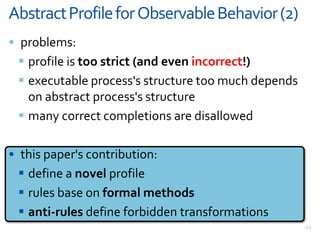
Abstract Profile for Observable Behavior (2) 11problems:profile is too strict (and even incorrect!)executable process's structure too much depends on abstract process's structuremany correct completions are disallowedthis paper's contribution:define a novel profilerules base on formal methodsanti-rules define forbidden transformations
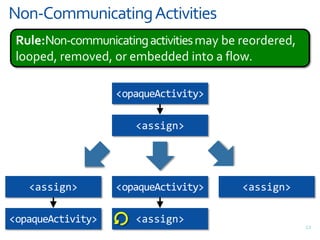
Non-Communicating Activities12Rule:Non-communicating activities may be reordered, looped, removed, or embedded into a flow. <opaqueActivity><assign><assign><opaqueActivity><assign><opaqueActivity><assign>
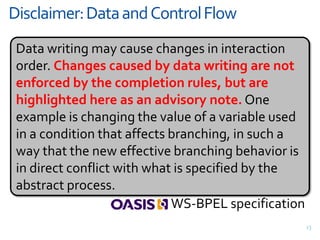
Disclaimer: Data and Control Flow13Data writing may cause changes in interaction order. Changes caused by data writing are not enforced by the completion rules, but are highlighted here as an advisory note. One example is changing the value of a variable used in a condition that affects branching, in such a way that the new effective branching behavior is in direct conflict with what is specified by the abstract process.WS-BPEL specification
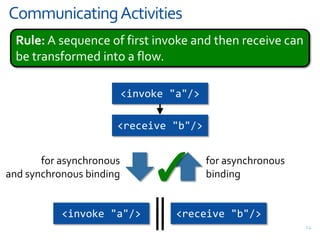
Communicating Activities14Rule: A sequence of first invoke and then receive can be transformed into a flow. <invoke "a"/><receive "b"/>✓for asynchronousbindingfor asynchronousand synchronous binding<receive "b"/><invoke "a"/>
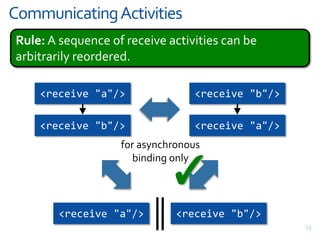
Communicating Activities15Rule: A sequence of receive activities can be arbitrarily reordered. <receive "a"/><receive "b"/><receive "b"/><receive "a"/>for asynchronousbinding only✓<receive "b"/><receive "a"/>
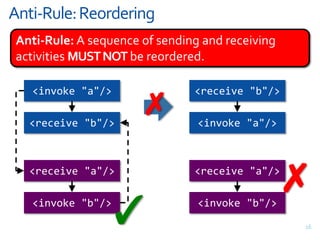
Anti-Rule: Reordering16Anti-Rule: A sequence of sending and receiving activities MUST NOT be reordered.<invoke "a"/><receive "b"/>✗<receive "b"/><invoke "a"/>✗<receive "a"/><receive "a"/>✓<invoke "b"/><invoke "b"/>
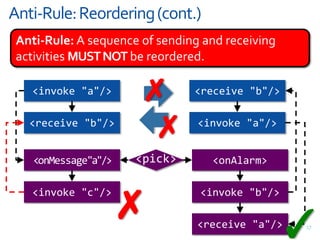
Anti-Rule: Reordering (cont.)17Anti-Rule: A sequence of sending and receiving activities MUST NOT be reordered.✗<invoke "a"/><receive "b"/>✗<receive "b"/><invoke "a"/><onMessage"a"/><onAlarm><pick>✗<invoke "c"/><invoke "b"/>✓<receive "a"/>
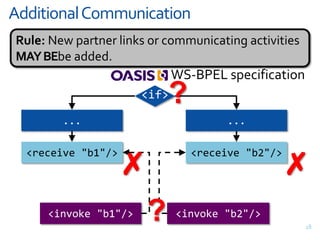
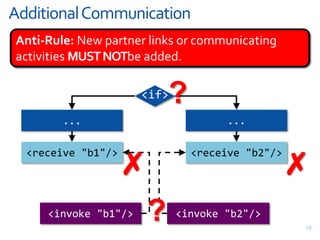
Additional Communication18Rule: New partner links or communicating activities MAY BEbe added.WS-BPEL specification?<if>......✗✗<receive "b1"/><receive "b2"/>?<invoke "b1"/><invoke "b2"/>

Extending the Compatibility Notion for Abstract WS-BPEL Processes

  • 1.
    Extending the CompatibilityNotion for Abstract WS-BPEL ProcessesDieter KönigSimon MoserNiels LohmannKarsten WolfChristian StahlIBM Böblingen LaboratoryGermanyUniversity of RostockGermanyHumboldt-Universität zu BerlinGermanyUNIVERSITÄT ROSTOCK
  • 2.
    WS-BPEL2Web Service BusinessProcess Execution Languagespecifies a business process by orchestratingWeb servicesimplemented as Web service itselfprocess can be anexecutable Web servicesabstract processes ("business protocols")
  • 3.
    Executable WS-BPEL Process3<receive>creditrequest from customerelsesalary <= 5000 $tradesecrets<if><assign>customer name to blacklist<assign>customer name to databasetechnicaldetails<reply>credit rejection to customer<assign>customer id to credit case<reply>credit approval to customer
  • 4.
    Executable ➙ AbstractWS-BPEL Process4<receive>credit request from customerelsesalary <= 5000 $opaque conditiontradesecrets<if><assign>customer name to blacklist<assign>customer name to database<opaqueActivity><opaqueActivity>technicaldetails<reply>credit rejection to customer<assign>customer id to credit case<reply>credit approval to customer
  • 5.
    Applications5bottom uptop-downexchange/documentationformat, templateabstractprocessabstract processabstractionrefinementexecutable processexecutable process
  • 6.
  • 7.
  • 8.
  • 9.
  • 10.
    Compatibility: Computer-aided Verification7specificationformalmodelabstract process✓compatible?verification toolcompatible✗notcompatibleformal modelexecutable processimplementation
  • 11.
    Compatibility: Abstract Profiles8abstractprofile defines transformation rulesspecificationimplementationintermediate processexecutable processabstract processintermediate processintermediate process✓compatible by design
  • 12.
    Compatibility: Summary9Computer-aided Verificationexpensivetechnique (time + memory)only applicable if both specification and implementation are availableAbstract Profilessimple syntactic rulesapplicable during design time(only one process required)some defined in the WS-BPEL specification
  • 13.
    Abstract Profile forObservable Behavior 10intention:maintain observable behavior of abstract processimplementation must not change thisdefined syntactically:allowed: replacement of opaque activities, add fault handlers to the process, add non-communicating activities, …disallowed: change/relax execution order, add branches to if or pick activities, deletion of existing activities, …
  • 14.
    Abstract Profile forObservable Behavior (2) 11problems:profile is too strict (and even incorrect!)executable process's structure too much depends on abstract process's structuremany correct completions are disallowedthis paper's contribution:define a novel profilerules base on formal methodsanti-rules define forbidden transformations
  • 15.
    Non-Communicating Activities12Rule:Non-communicating activitiesmay be reordered, looped, removed, or embedded into a flow. <opaqueActivity><assign><assign><opaqueActivity><assign><opaqueActivity><assign>
  • 16.
    Disclaimer: Data andControl Flow13Data writing may cause changes in interaction order. Changes caused by data writing are not enforced by the completion rules, but are highlighted here as an advisory note. One example is changing the value of a variable used in a condition that affects branching, in such a way that the new effective branching behavior is in direct conflict with what is specified by the abstract process.WS-BPEL specification
  • 17.
    Communicating Activities14Rule: Asequence of first invoke and then receive can be transformed into a flow. <invoke "a"/><receive "b"/>✓for asynchronousbindingfor asynchronousand synchronous binding<receive "b"/><invoke "a"/>
  • 18.
    Communicating Activities15Rule: Asequence of receive activities can be arbitrarily reordered. <receive "a"/><receive "b"/><receive "b"/><receive "a"/>for asynchronousbinding only✓<receive "b"/><receive "a"/>
  • 19.
    Anti-Rule: Reordering16Anti-Rule: Asequence of sending and receiving activities MUST NOT be reordered.<invoke "a"/><receive "b"/>✗<receive "b"/><invoke "a"/>✗<receive "a"/><receive "a"/>✓<invoke "b"/><invoke "b"/>
  • 20.
    Anti-Rule: Reordering (cont.)17Anti-Rule:A sequence of sending and receiving activities MUST NOT be reordered.✗<invoke "a"/><receive "b"/>✗<receive "b"/><invoke "a"/><onMessage"a"/><onAlarm><pick>✗<invoke "c"/><invoke "b"/>✓<receive "a"/>
  • 21.
    Additional Communication18Rule: Newpartner links or communicating activities MAY BEbe added.WS-BPEL specification?<if>......✗✗<receive "b1"/><receive "b2"/>?<invoke "b1"/><invoke "b2"/>

Editor's Notes

  • #3 DISCLAIMER: LONG INTRODUCTION, MOTIVATION
  • #4 ANIMATION! MOTIVATION: WANT TO TELL CUSTOMER HOW TO BEHAVE
  • #6 CONTRACTS, TEMPLATE FOR BEST PRACTICE
  • #11 THIS IS EXISTING WORK
  • #13 DANACH KOMMT DISCLAIMER WEGEN DATEN
  • #14 WE ARE TALKING ABOUT ABSTRACT BUSINESS PROTOCOLS
  • #17 DOES NOT MAINTAIN THE OBSERVABLE BEHAVIOR!
  • #21 OTHER RULES NON-LOCAL, MORE COMPLEX