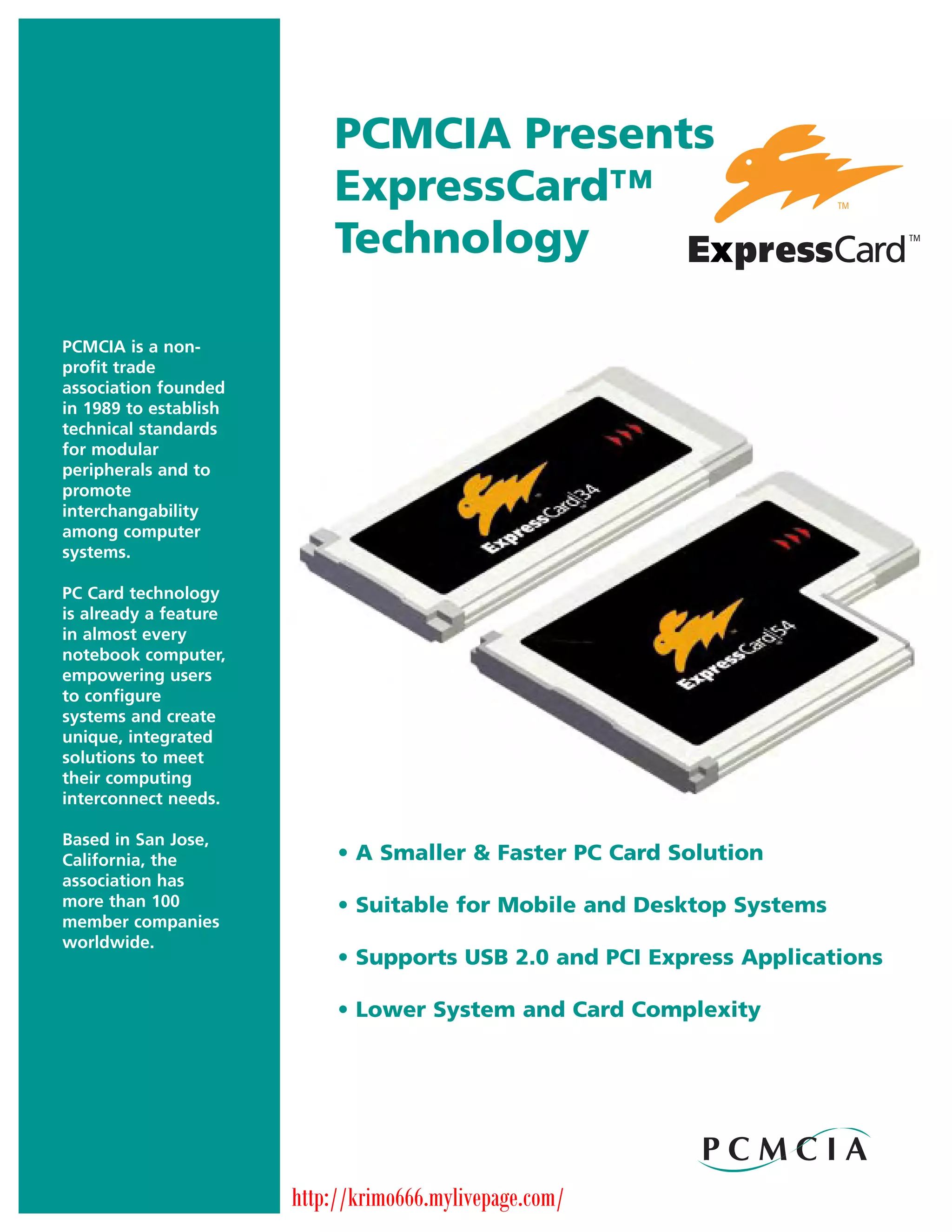
PCMCIA Presents
                           ExpressCard™
                           Technology

PCMCIA is a non-
profit trade
association founded
in 1989 to establish
technical standards
for modular
peripherals and to
promote
interchangability
among computer
systems.

PC Card technology
is already a feature
in almost every
notebook computer,
empowering users
to configure
systems and create
unique, integrated
solutions to meet
their computing
interconnect needs.

Based in San Jose,
California, the             • A Smaller & Faster PC Card Solution
association has
more than 100               • Suitable for Mobile and Desktop Systems
member companies
worldwide.
                            • Supports USB 2.0 and PCI Express Applications

                            • Lower System and Card Complexity


                       http://krimo666.mylivepage.com/
Introduction
PCMCIA developed the ExpressCard™ standard to
carry forward the benefits of ‘plug-in’ I/O cards to the
next generation of personal computing devices.
The standard was developed by a large number of
PCMCIA member companies including technology
leaders, system manufacturers, card manufacturers,
and representatives from all other parts of the PC Card
industry.


Module Sizes
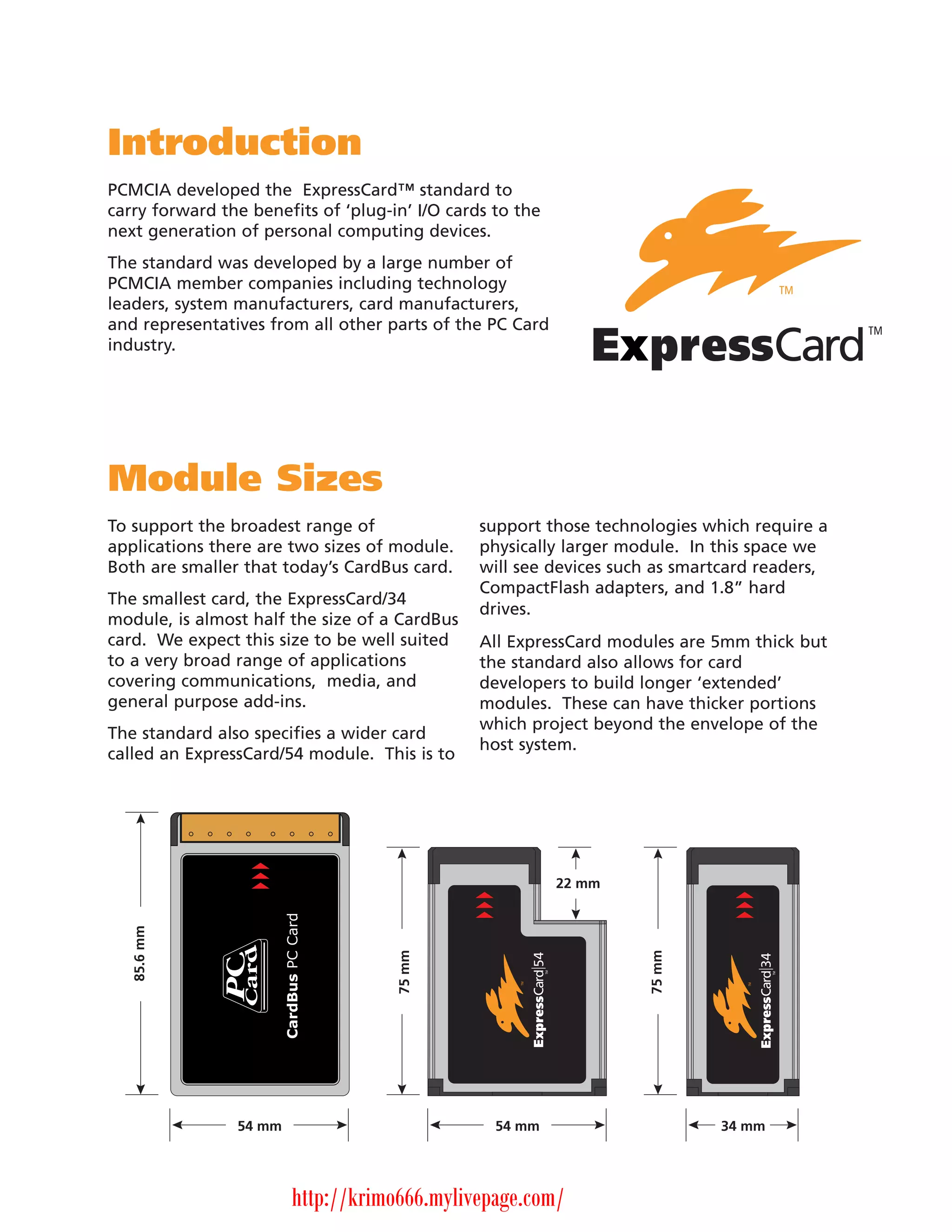
To support the broadest range of                  support those technologies which require a
applications there are two sizes of module.       physically larger module. In this space we
Both are smaller that today’s CardBus card.       will see devices such as smartcard readers,
                                                  CompactFlash adapters, and 1.8” hard
The smallest card, the ExpressCard/34
                                                  drives.
module, is almost half the size of a CardBus
card. We expect this size to be well suited       All ExpressCard modules are 5mm thick but
to a very broad range of applications             the standard also allows for card
covering communications, media, and               developers to build longer ‘extended’
general purpose add-ins.                          modules. These can have thicker portions
                                                  which project beyond the envelope of the
The standard also specifies a wider card
                                                  host system.
called an ExpressCard/54 module. This is to


                                                            22 mm
                        CardBus PC Card
   85.6 mm


                                          75 mm


                                                                       75 mm


                54 mm                               54 mm                      34 mm


                             http://krimo666.mylivepage.com/
http://krimo666.mylivepage.com/


Native Bus
Connections
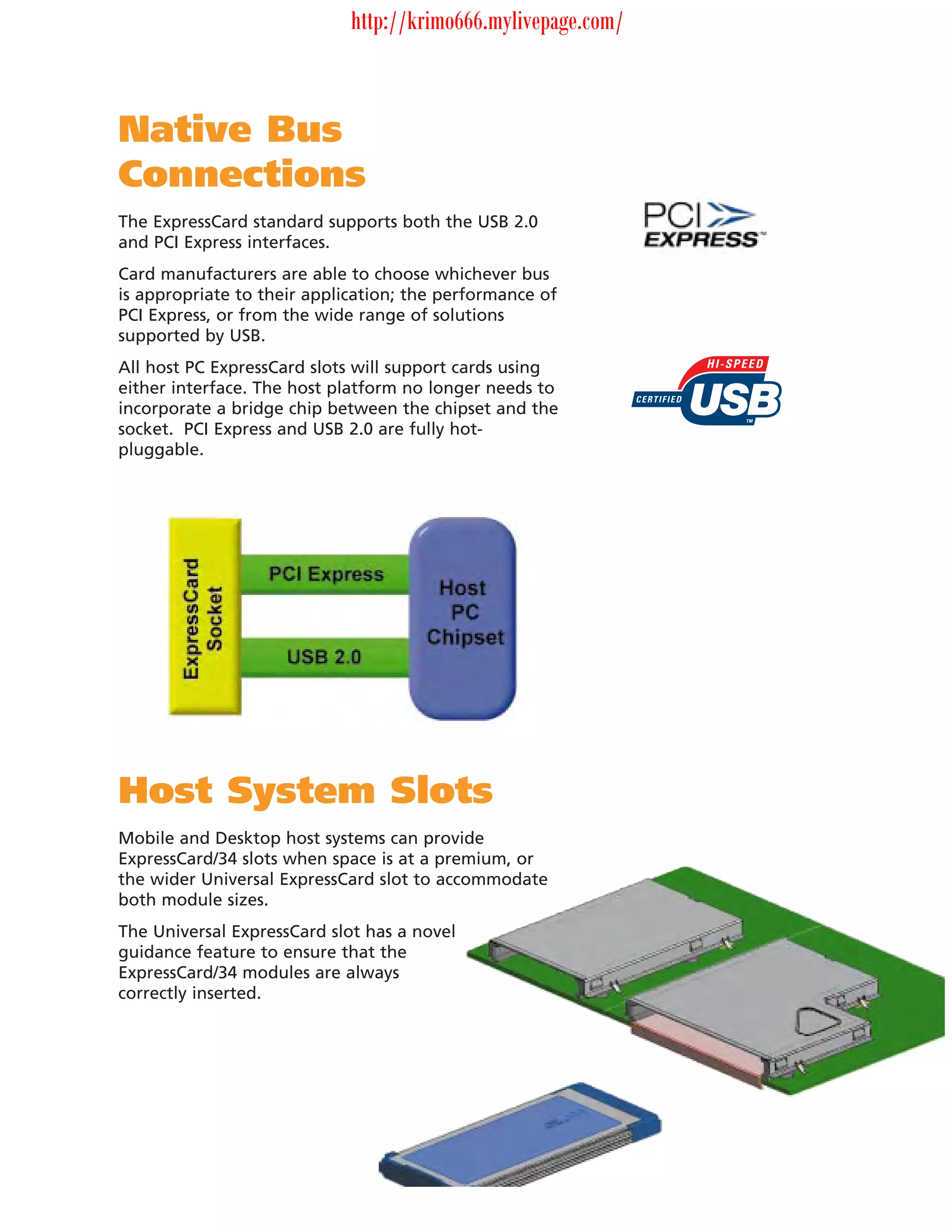
The ExpressCard standard supports both the USB 2.0
and PCI Express interfaces.
Card manufacturers are able to choose whichever bus
is appropriate to their application; the performance of
PCI Express, or from the wide range of solutions
supported by USB.
All host PC ExpressCard slots will support cards using
either interface. The host platform no longer needs to
incorporate a bridge chip between the chipset and the
socket. PCI Express and USB 2.0 are fully hot-
pluggable.


Host System Slots
Mobile and Desktop host systems can provide
ExpressCard/34 slots when space is at a premium, or
the wider Universal ExpressCard slot to accommodate
both module sizes.
The Universal ExpressCard slot has a novel
guidance feature to ensure that the
ExpressCard/34 modules are always
correctly inserted.
http://krimo666.mylivepage.com/

     PCMCIA Membership

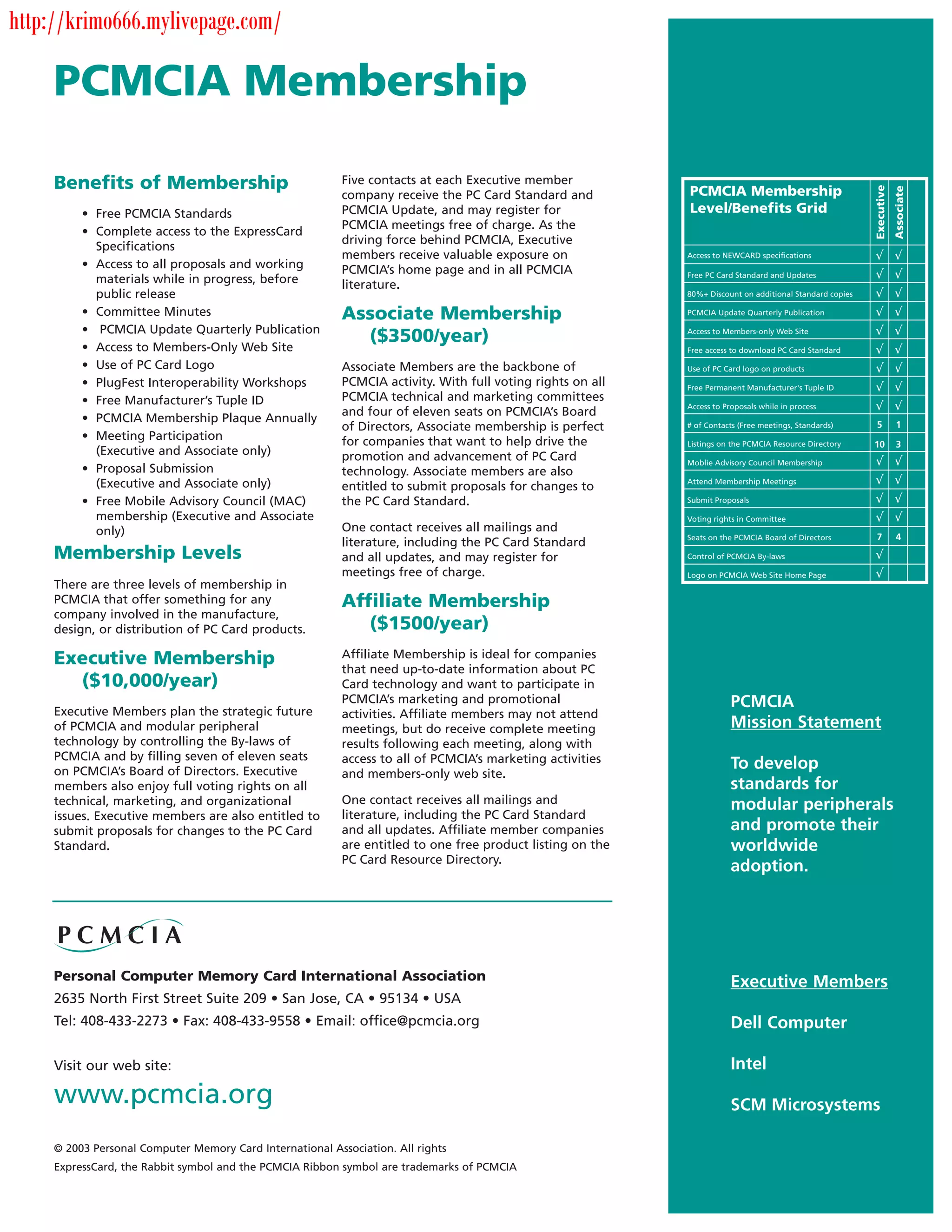
     Benefits of Membership                                Five contacts at each Executive member


                                                                                                                                                           Executive
                                                                                                             PCMCIA Membership


                                                                                                                                                                       Associate
                                                           company receive the PC Card Standard and
          • Free PCMCIA Standards                          PCMCIA Update, and may register for               Level/Benefits Grid
                                                           PCMCIA meetings free of charge. As the
          • Complete access to the ExpressCard
                                                           driving force behind PCMCIA, Executive
            Specifications
                                                           members receive valuable exposure on              Access to NEWCARD specifications
          • Access to all proposals and working            PCMCIA’s home page and in all PCMCIA              Free PC Card Standard and Updates
            materials while in progress, before            literature.
            public release                                                                                   80%+ Discount on additional Standard copies

          • Committee Minutes                              Associate Membership                              PCMCIA Update Quarterly Publication

          • PCMCIA Update Quarterly Publication
                                                             ($3500/year)                                    Access to Members-only Web Site

          • Access to Members-Only Web Site                                                                  Free access to download PC Card Standard

          • Use of PC Card Logo                            Associate Members are the backbone of             Use of PC Card logo on products
          • PlugFest Interoperability Workshops            PCMCIA activity. With full voting rights on all   Free Permanent Manufacturer's Tuple ID
          • Free Manufacturer’s Tuple ID                   PCMCIA technical and marketing committees
                                                                                                             Access to Proposals while in process
                                                           and four of eleven seats on PCMCIA’s Board
          • PCMCIA Membership Plaque Annually                                                                                                              5           1
                                                           of Directors, Associate membership is perfect     # of Contacts (Free meetings, Standards)
          • Meeting Participation                          for companies that want to help drive the         Listings on the PCMCIA Resource Directory     10          3
            (Executive and Associate only)                 promotion and advancement of PC Card              Moblie Advisory Council Membership
          • Proposal Submission                            technology. Associate members are also
            (Executive and Associate only)                 entitled to submit proposals for changes to       Attend Membership Meetings

          • Free Mobile Advisory Council (MAC)             the PC Card Standard.                             Submit Proposals

            membership (Executive and Associate                                                              Voting rights in Committee
            only)                                          One contact receives all mailings and
                                                                                                             Seats on the PCMCIA Board of Directors        7           4
                                                           literature, including the PC Card Standard
     Membership Levels                                     and all updates, and may register for             Control of PCMCIA By-laws

                                                           meetings free of charge.                          Logo on PCMCIA Web Site Home Page
     There are three levels of membership in
     PCMCIA that offer something for any                   Affiliate Membership
     company involved in the manufacture,
     design, or distribution of PC Card products.             ($1500/year)
     Executive Membership                                  Affiliate Membership is ideal for companies
                                                           that need up-to-date information about PC
       ($10,000/year)                                      Card technology and want to participate in
                                                           PCMCIA’s marketing and promotional                            PCMCIA
     Executive Members plan the strategic future           activities. Affiliate members may not attend
     of PCMCIA and modular peripheral                      meetings, but do receive complete meeting                     Mission Statement
     technology by controlling the By-laws of              results following each meeting, along with
     PCMCIA and by filling seven of eleven seats           access to all of PCMCIA’s marketing activities
     on PCMCIA’s Board of Directors. Executive
                                                                                                                         To develop
                                                           and members-only web site.
     members also enjoy full voting rights on all                                                                        standards for
     technical, marketing, and organizational              One contact receives all mailings and                         modular peripherals
     issues. Executive members are also entitled to        literature, including the PC Card Standard
     submit proposals for changes to the PC Card           and all updates. Affiliate member companies                   and promote their
     Standard.                                             are entitled to one free product listing on the               worldwide
                                                           PC Card Resource Directory.
                                                                                                                         adoption.


     Personal Computer Memory Card International Association                                                             Executive Members
     2635 North First Street Suite 209 • San Jose, CA • 95134 • USA
     Tel: 408-433-2273 • Fax: 408-433-9558 • Email: office@pcmcia.org                                                    Dell Computer

     Visit our web site:                                                                                                 Intel
     www.pcmcia.org                                                                                                      SCM Microsystems

     © 2003 Personal Computer Memory Card International Association. All rights
     ExpressCard, the Rabbit symbol and the PCMCIA Ribbon symbol are trademarks of PCMCIA
The ExpressCard™ Compliance Program
                                           A Brief Overview of the ExpressCard Compliance Program


                     The ExpressCard Compliance Program is
                     designed to give the consumer the
                     confidence that they can buy host systems               Compliance Checklist Coverage
                     or modules bearing the ExpressCard brand
                     knowing that they will work together. This                • End user ExpressCard products
                     improvement in the end user experience is                    - Modules
 expected to help grow the market for ExpressCard products by                     - Systems
 making it feasible for complete novices to add hardware
                                                                               • Components
 devices to their systems. The improvement is expected to be
 most apparent on Desktop PCs where adding hardware to the                        - Slot Power Switch
 system previously required opening the case to insert a board.                   - Connectors
 Establishing the reliability and predictability of products that              • Module/System manufacturers to use compliant connectors
 bear the ExpressCard brand is central to the expanded use of                    and power switches
 the technology.
                                                                                  - If not using existing components, manufacturers are
                                                                                    responsible for also testing those elements

Compliance Program Coverage
 Category          Coverage                                    Source
                                                                             Interoperability Events
 USB               Protocol and electrical elements need       USB-IF          • Participants are module and system manufacturers
 Interface         to meet the current USB 2.0 test                               - Connectors and Power controllers tested indirectly
                   standard                                                    • Modeled on similar events set up by USB IF
 PCI Express       Functional, protocol and electrical         PCI SIG            - Held in an "Embassy Suites" style hotel
 Interface         elements meet PCI Express 1.0a                                 - Module manufacturers visit each system manufacturer in turn
                                                                                    and complete a predefined set of tests
 Mechanical        Connector and card elements all need        Checklist
                   to meet the specified dimensions and                           - System manufacturers assigned a fixed location
                   tolerances                                                     - At end of event, PCMCIA correlates results to determine
                                                                                    pass/fail results
 Durability        Friction surfaces must allow for the        Checklist
                   number of insertion and removal                             • Two categories of testing
                   cycles defined in the Standard                                 - Interoperatility checklist: mandatory for compliance
                                                                                    submittals
 Power             Host and modules must perform with          Checklist
                                                                                  - Additional test coverage: does not affect compliance test
 Supply            supplies within range defined in the
                                                                                    results, but provides additional value to participants
                   Standard
 Power             Operating range of host slots and           Checklist
 Dissipation       modules must be within the thermal                        Interoperability Coverage
                   range specified in the Standard
                                                                               • Standard defines behavior for the following cases:
 Inter-            Establishing that modules work with         Interop            1. Initial module insertion
 operability       systems                                     Event
                                                                                  2. Graceful removal
 Regulatory        Not part of Compliance Program              N/A                3.   Hot insertion
 Applications Not part of Compliance Program                   N/A                4.   Surprise removal
                                                                                  5.   Cold insertion
                                                                                  6.   Sleep/suspend removal
Compliance Process                                                                7. Sleep/suspend insertion
 1. Complete self-administered checklist for product                              8. Hibernation removal
    - Designed to ensure product meets the ExpressCard Standard                   9. Hibernation insertion
    - Different checklists exist for different product categories              • Interoperability checklist intends to verify appropriate
                                                                                 behavior for a given module and system combination
 2. Attend an interoperability test event
    - To be scheduled about four times per year
    - Co-located with either PCI Express or USB event
                                                                                                                (over)
 3. Apply for license to use ExpressCard logo
    - Proof of successful checklist and interoperability testing
 4. Product entered into PCMCIA database and Comp. ID issued
    - Product may use the ExpressCard logo

 ExpressCard is a trademark of PCMCIA.
 * All product and company names herein may be trademarks of their registered owners.
 06/04v1


                                                http://krimo666.mylivepage.com/
Compliance Test Fixtures                                                     Third-Party Test Houses
 PCMCIA will make the following test fixtures available:                       • Some manufacturers may be unable to attend the
 1. Plug-in board for PCI Express desktop systems which                          interoperability events and/or be unable to self-certify
    provides a fully functional ExpressCard Slot                               • PCMCIA is working with commercial test houses to provide
    - Works in PCI Express CEM slot                                              a "Turnkey" solution for a fee
    - Supports both PCI Express and USB interfaces                                - Manufacturer provides test-house with a module or system
                                                                                  - Test house executes checklist and interoperablity tests
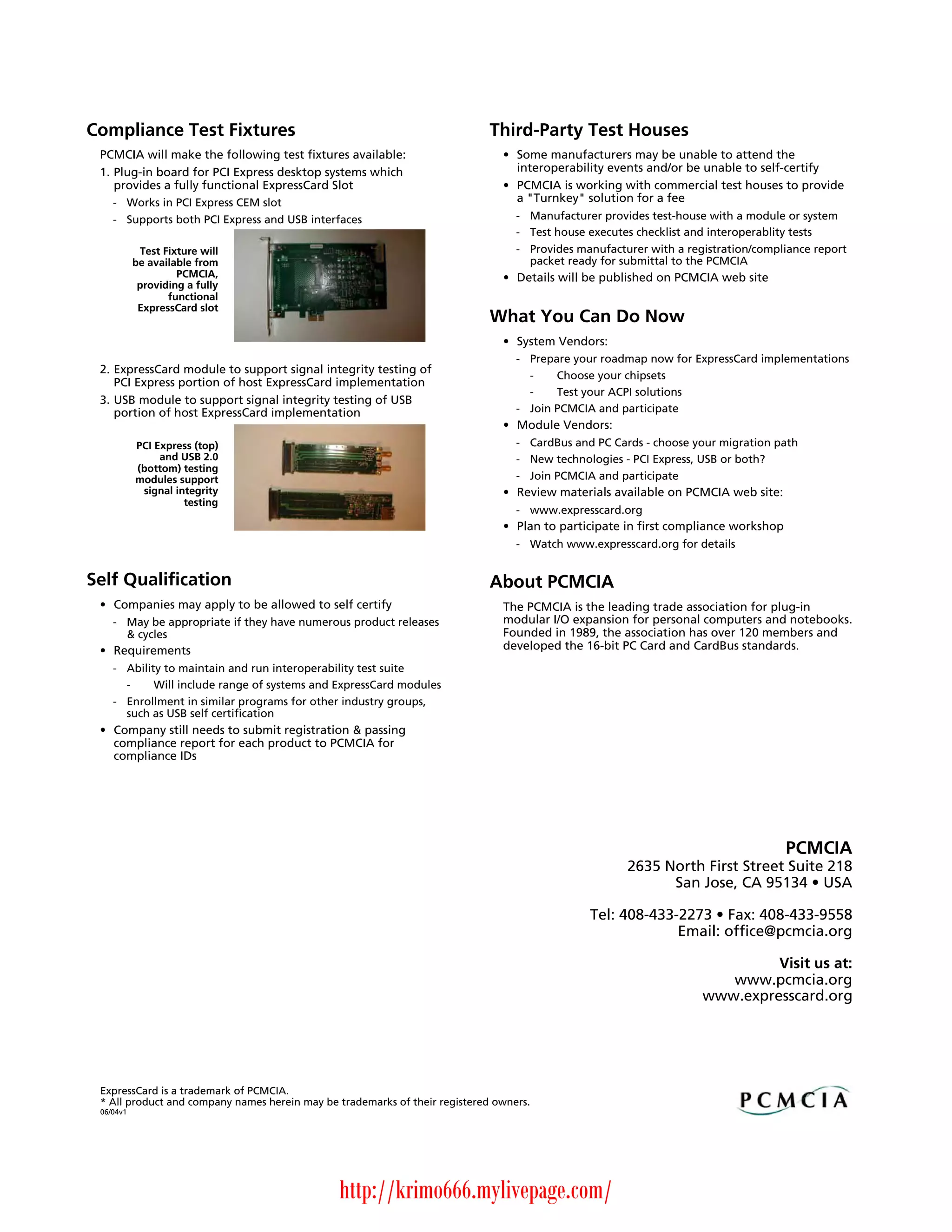
            Test Fixture will                                                     - Provides manufacturer with a registration/compliance report
           be available from                                                        packet ready for submittal to the PCMCIA
                    PCMCIA,                                                    • Details will be published on PCMCIA web site
            providing a fully
                  functional
            ExpressCard slot
                                                                             What You Can Do Now
                                                                               • System Vendors:
                                                                                  - Prepare your roadmap now for ExpressCard implementations
 2. ExpressCard module to support signal integrity testing of                       -    Choose your chipsets
    PCI Express portion of host ExpressCard implementation
                                                                                    -    Test your ACPI solutions
 3. USB module to support signal integrity testing of USB
    portion of host ExpressCard implementation                                    - Join PCMCIA and participate
                                                                               • Module Vendors:
           PCI Express (top)                                                      - CardBus and PC Cards - choose your migration path
                and USB 2.0                                                       - New technologies - PCI Express, USB or both?
           (bottom) testing
           modules support                                                        - Join PCMCIA and participate
            signal integrity                                                   • Review materials available on PCMCIA web site:
                     testing
                                                                                  - www.expresscard.org
                                                                               • Plan to participate in first compliance workshop
                                                                                  - Watch www.expresscard.org for details


Self Qualification                                                           About PCMCIA
 • Companies may apply to be allowed to self certify                           The PCMCIA is the leading trade association for plug-in
    - May be appropriate if they have numerous product releases                modular I/O expansion for personal computers and notebooks.
      & cycles                                                                 Founded in 1989, the association has over 120 members and
 • Requirements                                                                developed the 16-bit PC Card and CardBus standards.
    - Ability to maintain and run interoperability test suite
      -     Will include range of systems and ExpressCard modules
    - Enrollment in similar programs for other industry groups,
      such as USB self certification
 • Company still needs to submit registration & passing
   compliance report for each product to PCMCIA for
   compliance IDs


                                                                                                                                    PCMCIA
                                                                                                      2635 North First Street Suite 218
                                                                                                            San Jose, CA 95134 • USA

                                                                                               Tel: 408-433-2273 • Fax: 408-433-9558
                                                                                                            Email: office@pcmcia.org

                                                                                                                             Visit us at:
                                                                                                                       www.pcmcia.org
                                                                                                                    www.expresscard.org


 ExpressCard is a trademark of PCMCIA.
 * All product and company names herein may be trademarks of their registered owners.
 06/04v1


                                               http://krimo666.mylivepage.com/
ExpressCard™ Technology
                                                     The New Standard for High-Performance, Low-Cost I/O
                                                     Expansion for Desktop and Mobile Systems


                    The ExpressCard standard promises to
                    deliver high- performance, modular
                    expansion to desktop and notebook
                    computers at a lower cost and in a smaller
                    form factor. Consumers will be able to add
                    memory communications and security
 devices by simply inserting ExpressCard modules into their
 systems. The new standard supports sealed-box expandability
 in desktops and thinner notebook design.


Key Features
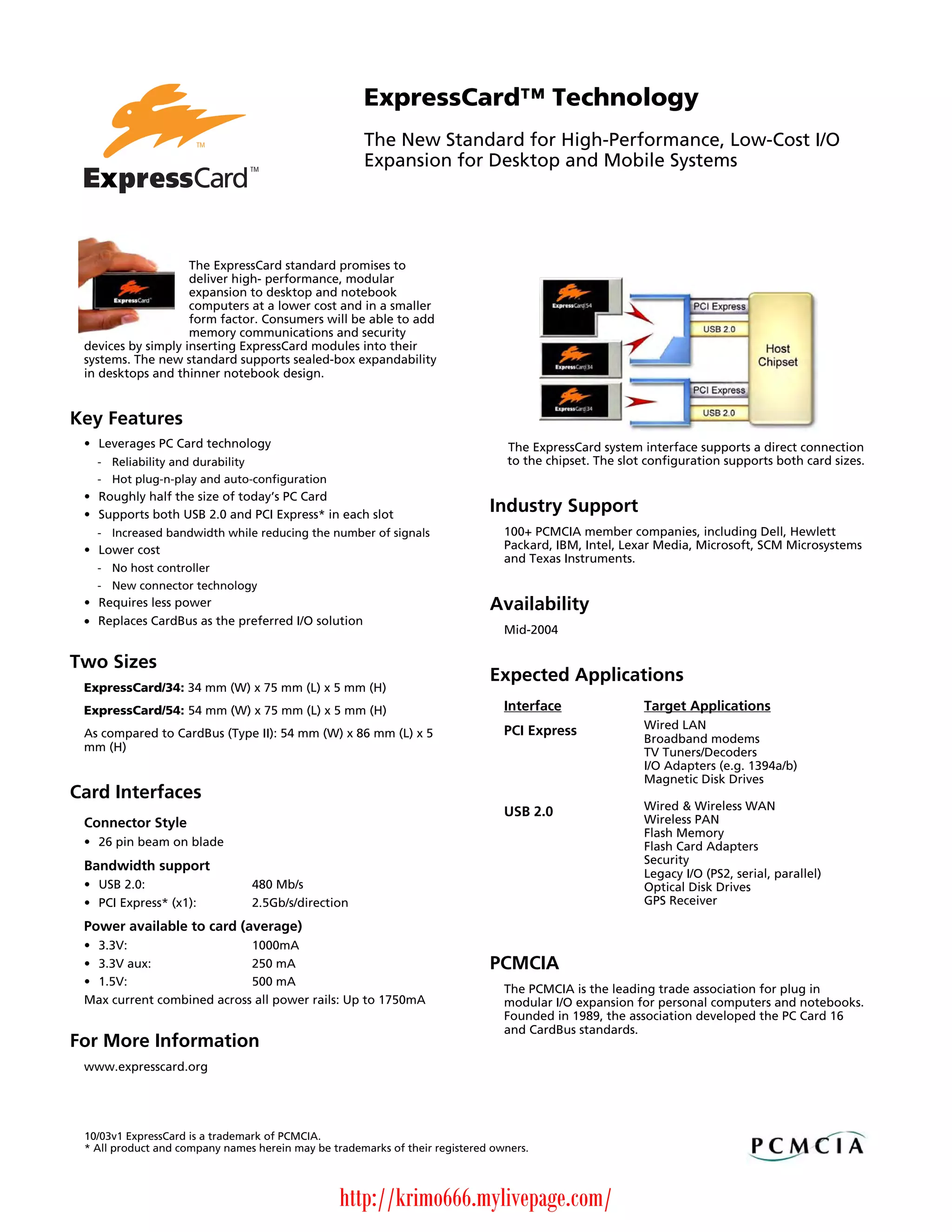
 • Leverages PC Card technology                                                 The ExpressCard system interface supports a direct connection
   - Reliability and durability                                                 to the chipset. The slot configuration supports both card sizes.
   - Hot plug-n-play and auto-configuration
 • Roughly half the size of today’s PC Card
 • Supports both USB 2.0 and PCI Express* in each slot
                                                                             Industry Support
   - Increased bandwidth while reducing the number of signals                   100+ PCMCIA member companies, including Dell, Hewlett
 • Lower cost                                                                   Packard, IBM, Intel, Lexar Media, Microsoft, SCM Microsystems
                                                                                and Texas Instruments.
   - No host controller
   - New connector technology
 • Requires less power                                                       Availability
 • Replaces CardBus as the preferred I/O solution
                                                                                Mid-2004

Two Sizes
                                                                             Expected Applications
 ExpressCard/34: 34 mm (W) x 75 mm (L) x 5 mm (H)
 ExpressCard/54: 54 mm (W) x 75 mm (L) x 5 mm (H)                               Interface               Target Applications
                                                                                PCI Express             Wired LAN
 As compared to CardBus (Type II): 54 mm (W) x 86 mm (L) x 5                                            Broadband modems
 mm (H)                                                                                                 TV Tuners/Decoders
                                                                                                        I/O Adapters (e.g. 1394a/b)
                                                                                                        Magnetic Disk Drives
Card Interfaces
                                                                                USB 2.0                 Wired & Wireless WAN
 Connector Style                                                                                        Wireless PAN
                                                                                                        Flash Memory
 • 26 pin beam on blade                                                                                 Flash Card Adapters
                                                                                                        Security
 Bandwidth support
                                                                                                        Legacy I/O (PS2, serial, parallel)
 • USB 2.0:                     480 Mb/s                                                                Optical Disk Drives
 • PCI Express* (x1):           2.5Gb/s/direction                                                       GPS Receiver

 Power available to card (average)
 • 3.3V:                    1000mA
 • 3.3V aux:                250 mA                                           PCMCIA
 • 1.5V:                    500 mA
                                                                                The PCMCIA is the leading trade association for plug in
 Max current combined across all power rails: Up to 1750mA                      modular I/O expansion for personal computers and notebooks.
                                                                                Founded in 1989, the association developed the PC Card 16
                                                                                and CardBus standards.
For More Information
 www.expresscard.org


 10/03v1 ExpressCard is a trademark of PCMCIA.
 * All product and company names herein may be trademarks of their registered owners.


                                                 http://krimo666.mylivepage.com/
The ExpressCard™ Standard – The Next Generation PC Card Technology
October 2003 – Copyright PCMCIA


In 2004 a new generation of PC platforms offering higher performance and
scalability will be launched. These improvements are due to the introduction
of PCI Express as a system bus. In support of this PCMCIA has introduced a
new standard for hot swappable system modules which it believes will replace
‘CardBus’ as the preferred solution for end user add-ins. This new E x p r e s s C a r d
technology is designed to allow a broader range of applications at a lower cost
than CardBus and has been embraced by both desktop and notebook system
manufacturers.


Introduction
The ExpressCard standard gives the user a very easy way to
add hardware or media to his system. The ExpressCard
module can be plugged in or removed at almost any time,
and unlike traditional add-in cards for desktop computers, it
does not require any tools. ExpressCard technology
provides desktop and mobile computer users a consistent,
easy, reliable and non-threatening way to connect devices
into their systems.


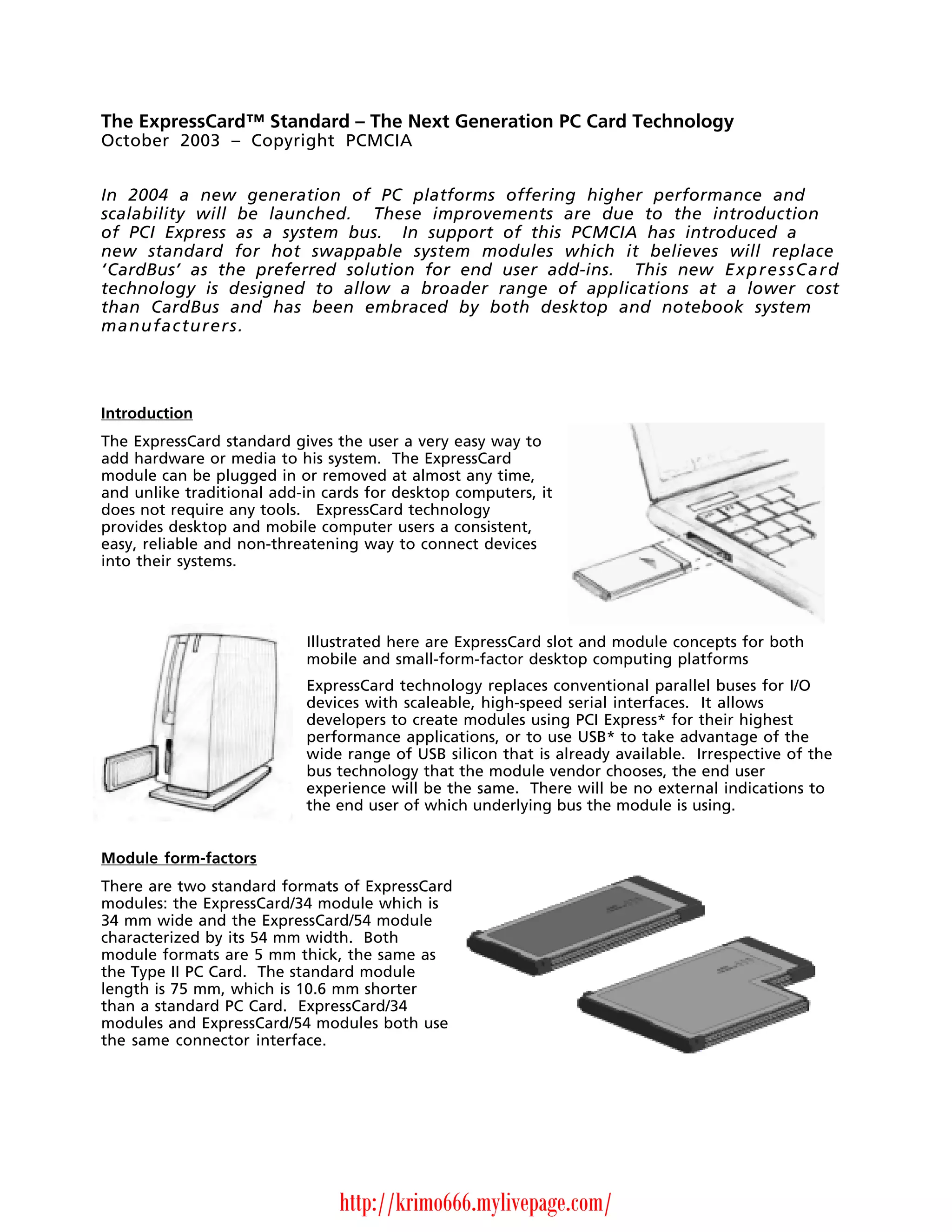
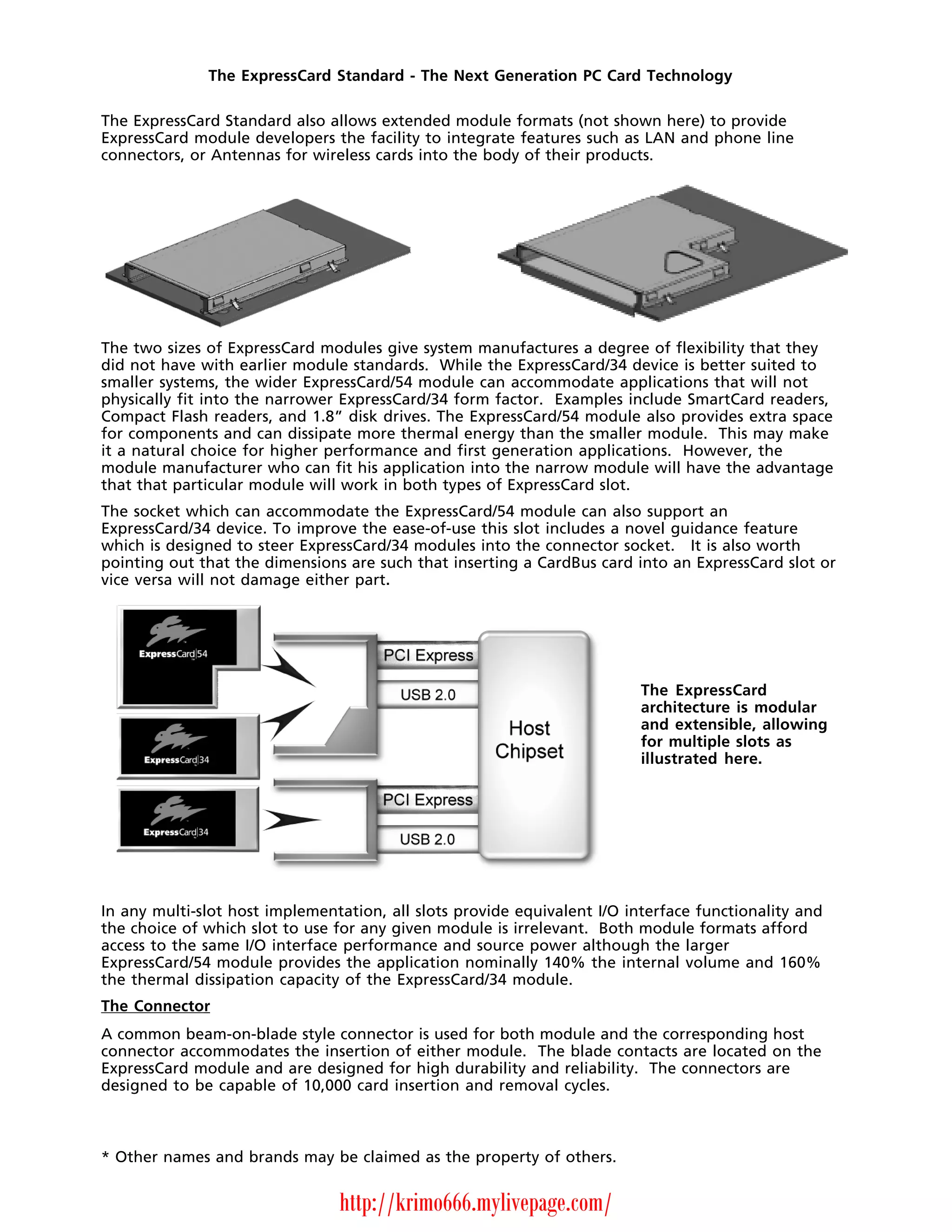
                           Illustrated here are ExpressCard slot and module concepts for both
                           mobile and small-form-factor desktop computing platforms
                           ExpressCard technology replaces conventional parallel buses for I/O
                           devices with scaleable, high-speed serial interfaces. It allows
                           developers to create modules using PCI Express* for their highest
                           performance applications, or to use USB* to take advantage of the
                           wide range of USB silicon that is already available. Irrespective of the
                           bus technology that the module vendor chooses, the end user
                           experience will be the same. There will be no external indications to
                           the end user of which underlying bus the module is using.


Module form-factors
There are two standard formats of ExpressCard
modules: the ExpressCard/34 module which is
34 mm wide and the ExpressCard/54 module
characterized by its 54 mm width. Both
module formats are 5 mm thick, the same as
the Type II PC Card. The standard module
length is 75 mm, which is 10.6 mm shorter
than a standard PC Card. ExpressCard/34
modules and ExpressCard/54 modules both use
the same connector interface.


                                http://krimo666.mylivepage.com/
The ExpressCard Standard - The Next Generation PC Card Technology

The ExpressCard Standard also allows extended module formats (not shown here) to provide
ExpressCard module developers the facility to integrate features such as LAN and phone line
connectors, or Antennas for wireless cards into the body of their products.


The two sizes of ExpressCard modules give system manufactures a degree of flexibility that they
did not have with earlier module standards. While the ExpressCard/34 device is better suited to
smaller systems, the wider ExpressCard/54 module can accommodate applications that will not
physically fit into the narrower ExpressCard/34 form factor. Examples include SmartCard readers,
Compact Flash readers, and 1.8” disk drives. The ExpressCard/54 module also provides extra space
for components and can dissipate more thermal energy than the smaller module. This may make
it a natural choice for higher performance and first generation applications. However, the
module manufacturer who can fit his application into the narrow module will have the advantage
that that particular module will work in both types of ExpressCard slot.
The socket which can accommodate the ExpressCard/54 module can also support an
ExpressCard/34 device. To improve the ease-of-use this slot includes a novel guidance feature
which is designed to steer ExpressCard/34 modules into the connector socket. It is also worth
pointing out that the dimensions are such that inserting a CardBus card into an ExpressCard slot or
vice versa will not damage either part.


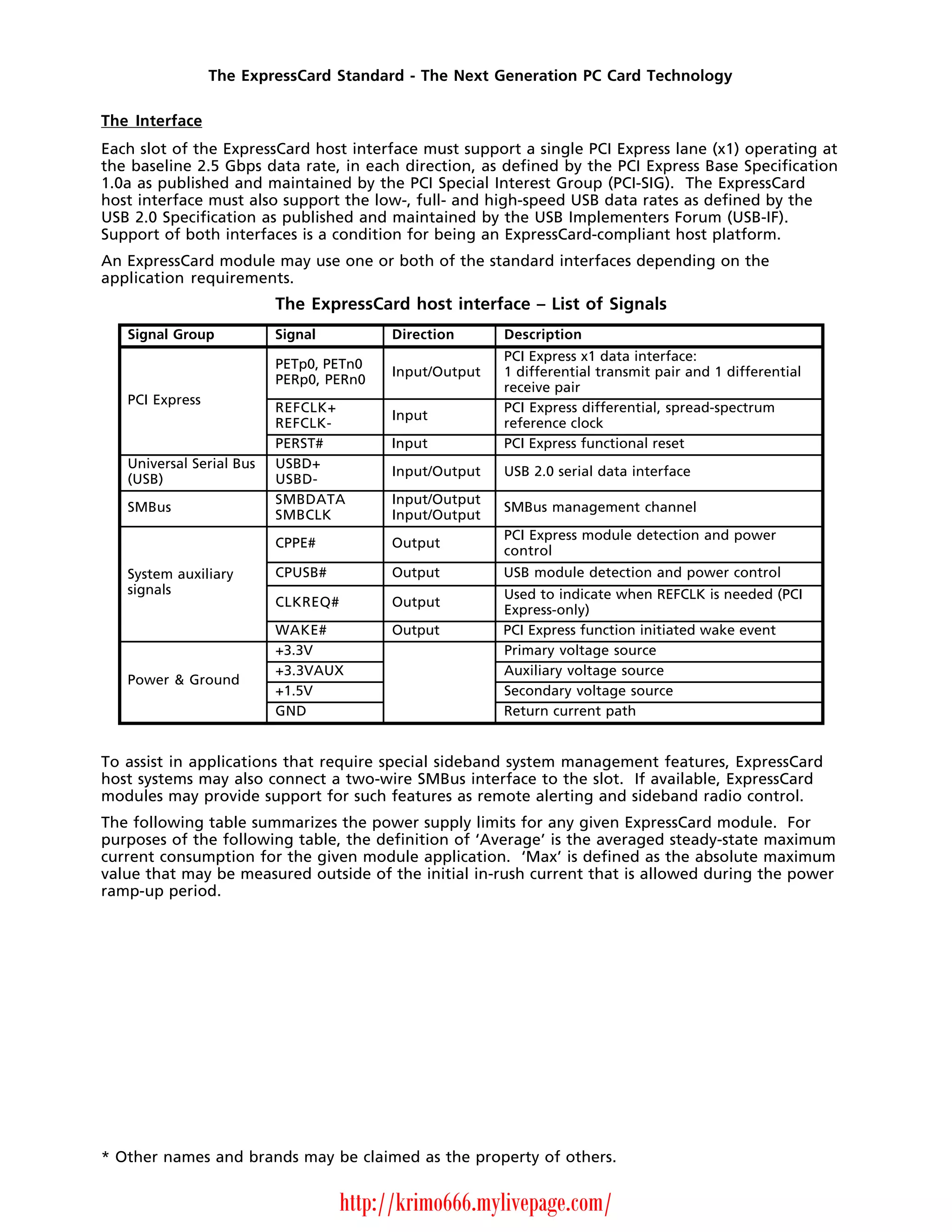
                                                                          The ExpressCard
                                                                          architecture is modular
                                                                          and extensible, allowing
                                                                          for multiple slots as
                                                                          illustrated here.


In any multi-slot host implementation, all slots provide equivalent I/O interface functionality and
the choice of which slot to use for any given module is irrelevant. Both module formats afford
access to the same I/O interface performance and source power although the larger
ExpressCard/54 module provides the application nominally 140% the internal volume and 160%
the thermal dissipation capacity of the ExpressCard/34 module.
The Connector
A common beam-on-blade style connector is used for both module and the corresponding host
connector accommodates the insertion of either module. The blade contacts are located on the
ExpressCard module and are designed for high durability and reliability. The connectors are
designed to be capable of 10,000 card insertion and removal cycles.


* Other names and brands may be claimed as the property of others.


                                http://krimo666.mylivepage.com/
The ExpressCard Standard - The Next Generation PC Card Technology

The Interface
Each slot of the ExpressCard host interface must support a single PCI Express lane (x1) operating at
the baseline 2.5 Gbps data rate, in each direction, as defined by the PCI Express Base Specification
1.0a as published and maintained by the PCI Special Interest Group (PCI-SIG). The ExpressCard
host interface must also support the low-, full- and high-speed USB data rates as defined by the
USB 2.0 Specification as published and maintained by the USB Implementers Forum (USB-IF).
Support of both interfaces is a condition for being an ExpressCard-compliant host platform.
An ExpressCard module may use one or both of the standard interfaces depending on the
application requirements.
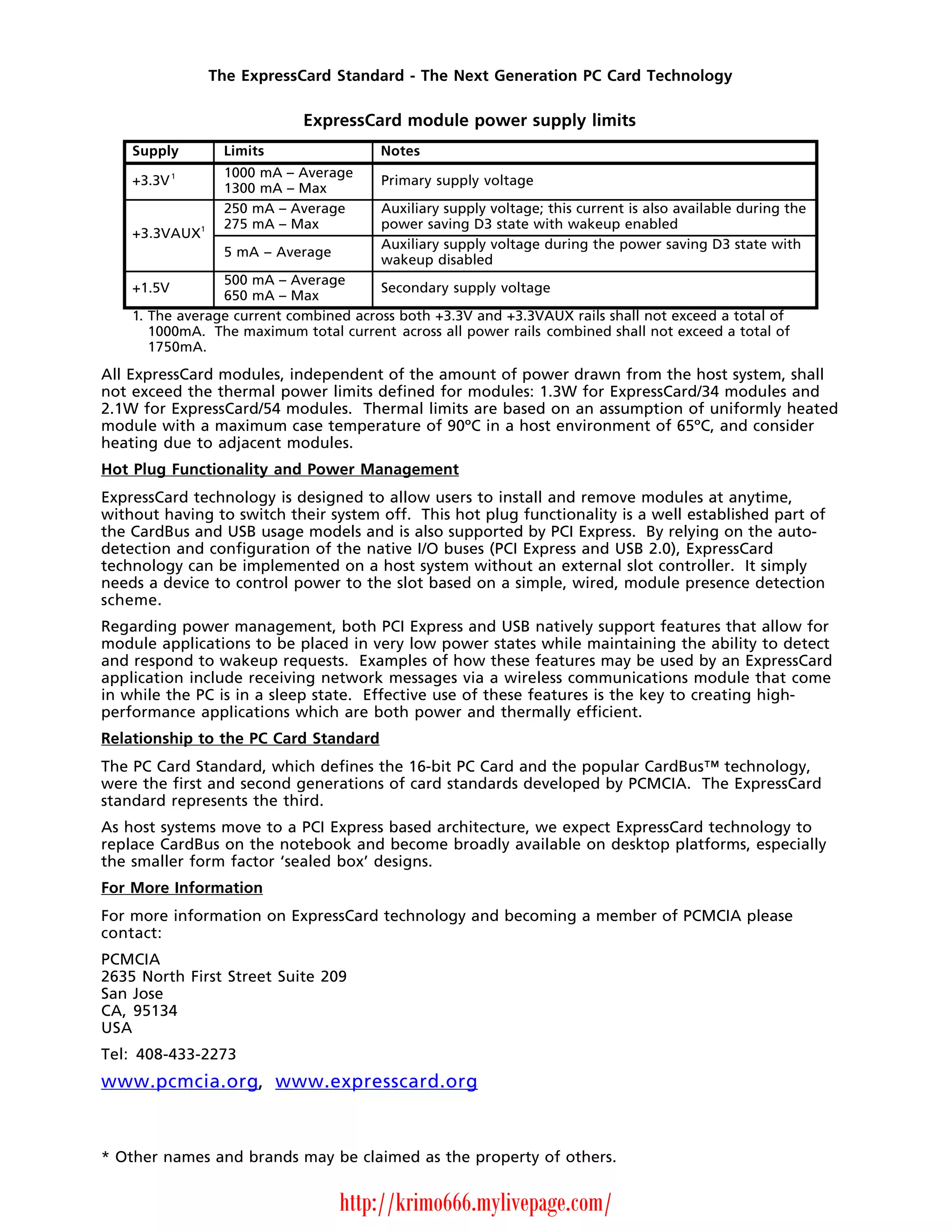
                          The ExpressCard host interface – List of Signals
   Signal Group           Signal         Direction      Description
                                                        PCI Express x1 data interface:
                          PETp0, PETn0
                                         Input/Output   1 differential transmit pair and 1 differential
                          PERp0, PERn0
                                                        receive pair
   PCI Express
                          REFCLK+                       PCI Express differential, spread-spectrum
                                         Input
                          REFCLK-                       reference clock
                          PERST#         Input          PCI Express functional reset
   Universal Serial Bus   USBD+
                                         Input/Output   USB 2.0 serial data interface
   (USB)                  USBD-
                          SMBDATA        Input/Output
   SMBus                                                SMBus management channel
                          SMBCLK         Input/Output
                                                        PCI Express module detection and power
                          CPPE#          Output
                                                        control
   System auxiliary       CPUSB#         Output         USB module detection and power control
   signals                                              Used to indicate when REFCLK is needed (PCI
                          CLKREQ#        Output
                                                        Express-only)
                          WAKE#          Output         PCI Express function initiated wake event
                          +3.3V                         Primary voltage source
                          +3.3VAUX                      Auxiliary voltage source
   Power & Ground
                          +1.5V                         Secondary voltage source
                          GND                           Return current path


To assist in applications that require special sideband system management features, ExpressCard
host systems may also connect a two-wire SMBus interface to the slot. If available, ExpressCard
modules may provide support for such features as remote alerting and sideband radio control.
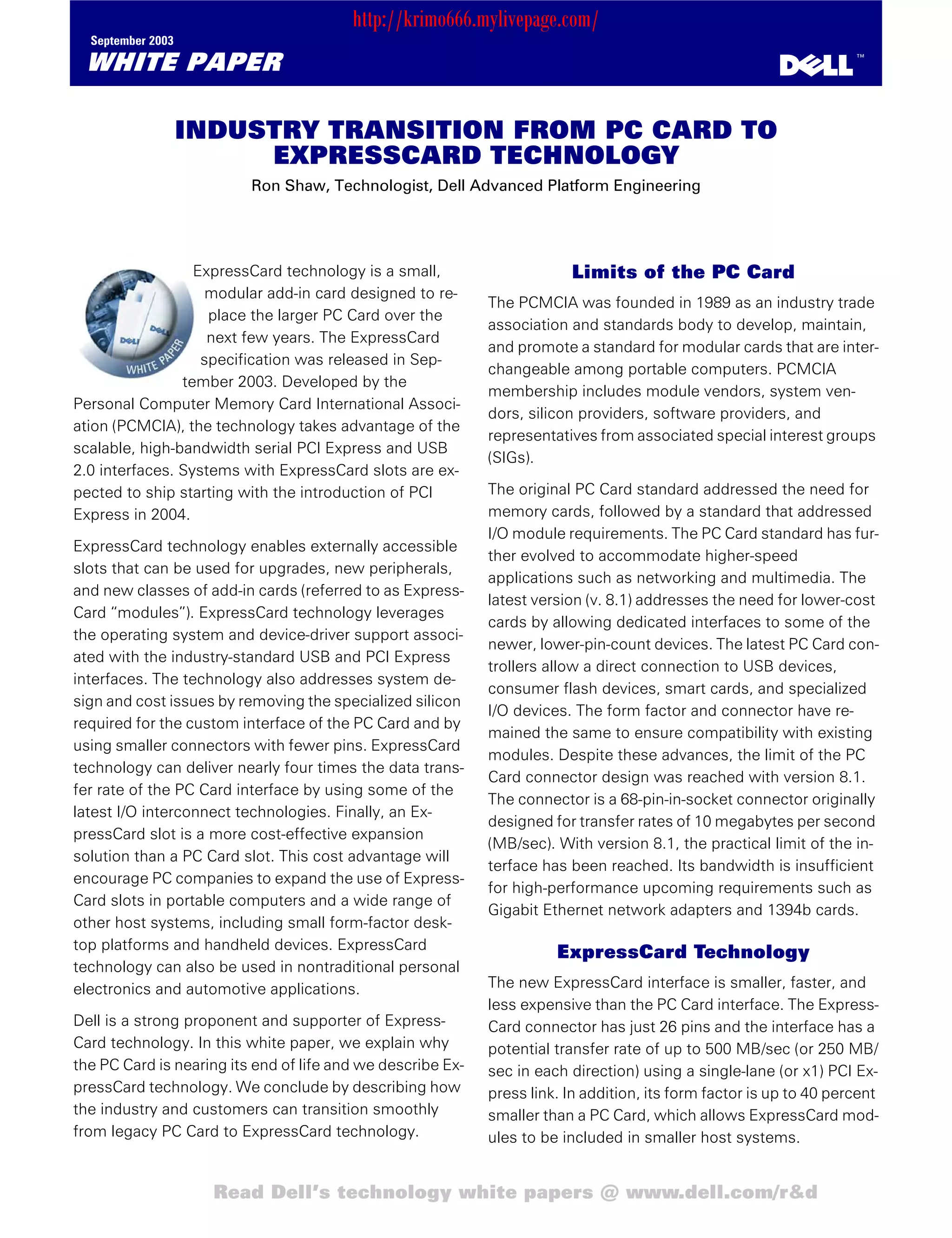
The following table summarizes the power supply limits for any given ExpressCard module. For
purposes of the following table, the definition of ‘Average’ is the averaged steady-state maximum
current consumption for the given module application. ‘Max’ is defined as the absolute maximum
value that may be measured outside of the initial in-rush current that is allowed during the power
ramp-up period.


* Other names and brands may be claimed as the property of others.


                                    http://krimo666.mylivepage.com/
The ExpressCard Standard - The Next Generation PC Card Technology

                               ExpressCard module power supply limits
    Supply           Limits               Notes
            1        1000 mA – Average
    +3.3V                                 Primary supply voltage
                     1300 mA – Max
                     250 mA – Average     Auxiliary supply voltage; this current is also available during the
                1    275 mA – Max         power saving D3 state with wakeup enabled
    +3.3VAUX
                                          Auxiliary supply voltage during the power saving D3 state with
                     5 mA – Average
                                          wakeup disabled
                 500 mA – Average
    +1.5V                               Secondary supply voltage
                 650 mA – Max
    1. The average current combined across both +3.3V and +3.3VAUX rails shall not exceed a total of
       1000mA. The maximum total current across all power rails combined shall not exceed a total of
       1750mA.

All ExpressCard modules, independent of the amount of power drawn from the host system, shall
not exceed the thermal power limits defined for modules: 1.3W for ExpressCard/34 modules and
2.1W for ExpressCard/54 modules. Thermal limits are based on an assumption of uniformly heated
module with a maximum case temperature of 90ºC in a host environment of 65ºC, and consider
heating due to adjacent modules.
Hot Plug Functionality and Power Management
ExpressCard technology is designed to allow users to install and remove modules at anytime,
without having to switch their system off. This hot plug functionality is a well established part of
the CardBus and USB usage models and is also supported by PCI Express. By relying on the auto-
detection and configuration of the native I/O buses (PCI Express and USB 2.0), ExpressCard
technology can be implemented on a host system without an external slot controller. It simply
needs a device to control power to the slot based on a simple, wired, module presence detection
scheme.
Regarding power management, both PCI Express and USB natively support features that allow for
module applications to be placed in very low power states while maintaining the ability to detect
and respond to wakeup requests. Examples of how these features may be used by an ExpressCard
application include receiving network messages via a wireless communications module that come
in while the PC is in a sleep state. Effective use of these features is the key to creating high-
performance applications which are both power and thermally efficient.
Relationship to the PC Card Standard
The PC Card Standard, which defines the 16-bit PC Card and the popular CardBus™ technology,
were the first and second generations of card standards developed by PCMCIA. The ExpressCard
standard represents the third.
As host systems move to a PCI Express based architecture, we expect ExpressCard technology to
replace CardBus on the notebook and become broadly available on desktop platforms, especially
the smaller form factor ‘sealed box’ designs.
For More Information
For more information on ExpressCard technology and becoming a member of PCMCIA please
contact:
PCMCIA
2635 North First Street Suite 209
San Jose
CA, 95134
USA
Tel: 408-433-2273
www.pcmcia.org, www.expresscard.org


* Other names and brands may be claimed as the property of others.


                                      http://krimo666.mylivepage.com/
http://krimo666.mylivepage.com/
  September 2003

 WHITE PAPER                                                                                                         ™


                   INDUSTRY TRANSITION FROM PC CARD TO
                        EXPRESSCARD TECHNOLOGY
                          Ron Shaw, Technologist, Dell Advanced Platform Engineering


                  ExpressCard technology is a small,                     Limits of the PC Card
                    modular add-in card designed to re-
                                                             The PCMCIA was founded in 1989 as an industry trade
                    place the larger PC Card over the
                                                             association and standards body to develop, maintain,
                    next few years. The ExpressCard
                                                             and promote a standard for modular cards that are inter-
                   specification was released in Sep-
                                                             changeable among portable computers. PCMCIA
                tember 2003. Developed by the
                                                             membership includes module vendors, system ven-
Personal Computer Memory Card International Associ-
                                                             dors, silicon providers, software providers, and
ation (PCMCIA), the technology takes advantage of the
                                                             representatives from associated special interest groups
scalable, high-bandwidth serial PCI Express and USB
                                                             (SIGs).
2.0 interfaces. Systems with ExpressCard slots are ex-
pected to ship starting with the introduction of PCI         The original PC Card standard addressed the need for
Express in 2004.                                             memory cards, followed by a standard that addressed
                                                             I/O module requirements. The PC Card standard has fur-
ExpressCard technology enables externally accessible
                                                             ther evolved to accommodate higher-speed
slots that can be used for upgrades, new peripherals,
                                                             applications such as networking and multimedia. The
and new classes of add-in cards (referred to as Express-
                                                             latest version (v. 8.1) addresses the need for lower-cost
Card “modules”). ExpressCard technology leverages
                                                             cards by allowing dedicated interfaces to some of the
the operating system and device-driver support associ-
                                                             newer, lower-pin-count devices. The latest PC Card con-
ated with the industry-standard USB and PCI Express
                                                             trollers allow a direct connection to USB devices,
interfaces. The technology also addresses system de-
                                                             consumer flash devices, smart cards, and specialized
sign and cost issues by removing the specialized silicon
                                                             I/O devices. The form factor and connector have re-
required for the custom interface of the PC Card and by
                                                             mained the same to ensure compatibility with existing
using smaller connectors with fewer pins. ExpressCard
                                                             modules. Despite these advances, the limit of the PC
technology can deliver nearly four times the data trans-
                                                             Card connector design was reached with version 8.1.
fer rate of the PC Card interface by using some of the
                                                             The connector is a 68-pin-in-socket connector originally
latest I/O interconnect technologies. Finally, an Ex-
                                                             designed for transfer rates of 10 megabytes per second
pressCard slot is a more cost-effective expansion
                                                             (MB/sec). With version 8.1, the practical limit of the in-
solution than a PC Card slot. This cost advantage will
                                                             terface has been reached. Its bandwidth is insufficient
encourage PC companies to expand the use of Express-
                                                             for high-performance upcoming requirements such as
Card slots in portable computers and a wide range of
                                                             Gigabit Ethernet network adapters and 1394b cards.
other host systems, including small form-factor desk-
top platforms and handheld devices. ExpressCard
                                                                       ExpressCard Technology
technology can also be used in nontraditional personal
electronics and automotive applications.                     The new ExpressCard interface is smaller, faster, and
                                                             less expensive than the PC Card interface. The Express-
Dell is a strong proponent and supporter of Express-         Card connector has just 26 pins and the interface has a
Card technology. In this white paper, we explain why         potential transfer rate of up to 500 MB/sec (or 250 MB/
the PC Card is nearing its end of life and we describe Ex-   sec in each direction) using a single-lane (or x1) PCI Ex-
pressCard technology. We conclude by describing how          press link. In addition, its form factor is up to 40 percent
the industry and customers can transition smoothly           smaller than a PC Card, which allows ExpressCard mod-
from legacy PC Card to ExpressCard technology.               ules to be included in smaller host systems.


                     Read Dell’s technology white papers @ www.dell.com/r&d
http://krimo666.mylivepage.com/
www.dell.com/r&d
                                                                          Industry Transition From PC Card to ExpressCard Technology


The PCMCIA developed the specification with support         There are three basic ways that ExpressCard slots can
from the PCI-SIG and the USB Implementers Forum             be implemented in a platform to accommodate these
(USB-IF). The ExpressCard specification uses the PCI        card sizes.
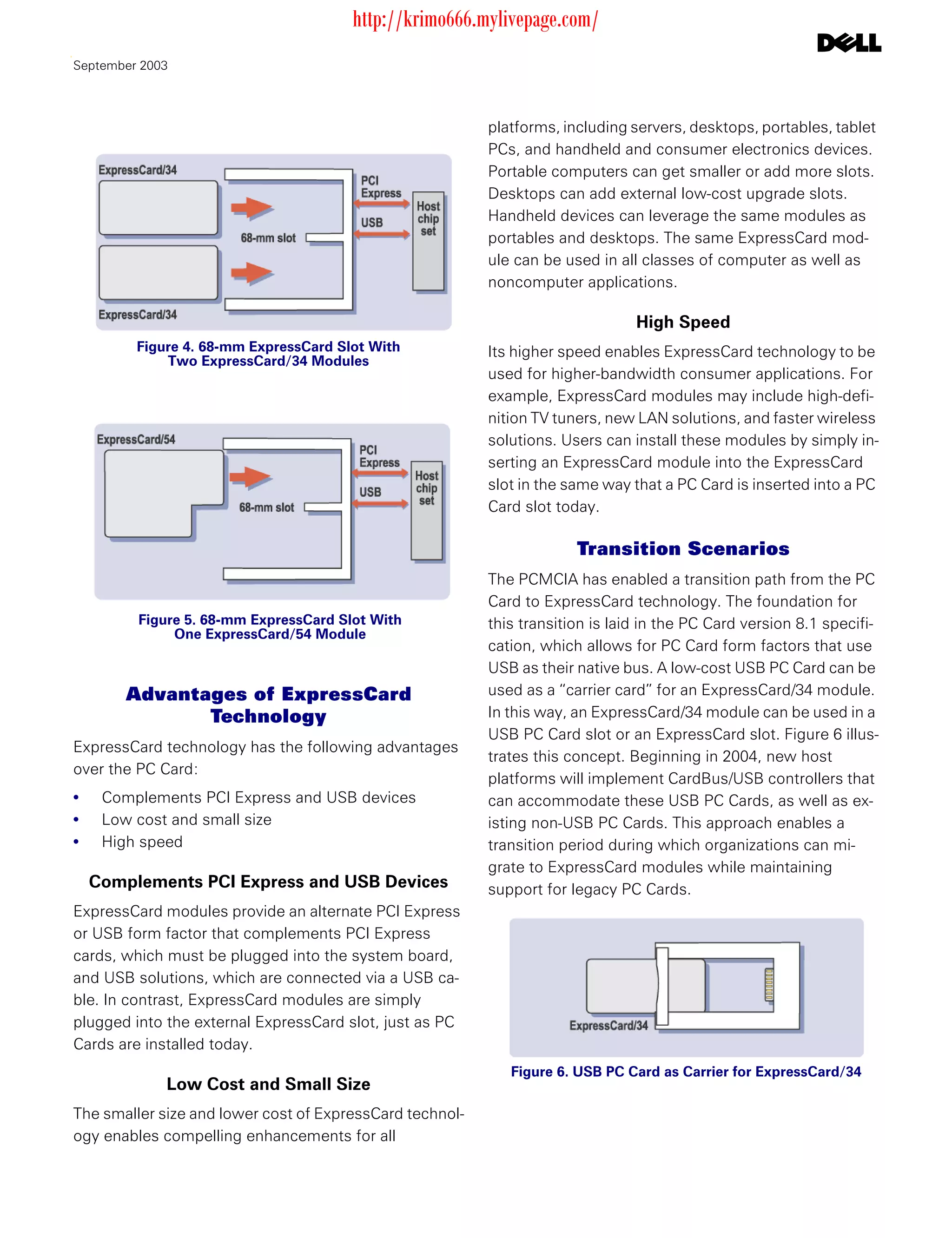
Express and USB I/O interconnect standards of the PCI-      •   One 34-mm slot — The 34-mm slot is the simplest
SIG and USB-IF. During its development, the PCI-SIG             host solution. Shown in Figure 2, this type of host
and USB-IF provided guidance and feedback to the                slot will only support ExpressCard/34 modules. The
PCMCIA. The resulting ExpressCard form factor lever-            advantage of this configuration is its compact size,
ages the knowledge base of these organizations and              and it will be common on small portable and hand-
many of their member companies. The PCMCIA, PCI-                held devices.
SIG, and USB-IF will also cooperate on ExpressCard cer-
tification. Each ExpressCard module will require
certification, and current plans are to leverage the PCI-
SIG and USB-IF certification programs. Leveraging the
PCI Express and USB specifications reduces the soft-
ware and silicon development effort required to
implement the technology. It also allowed the PCMCIA
to concentrate on developing the new form factor.
                                                                       Figure 2. 34-mm ExpressCard Slot
An ExpressCard module can be implemented using ei-
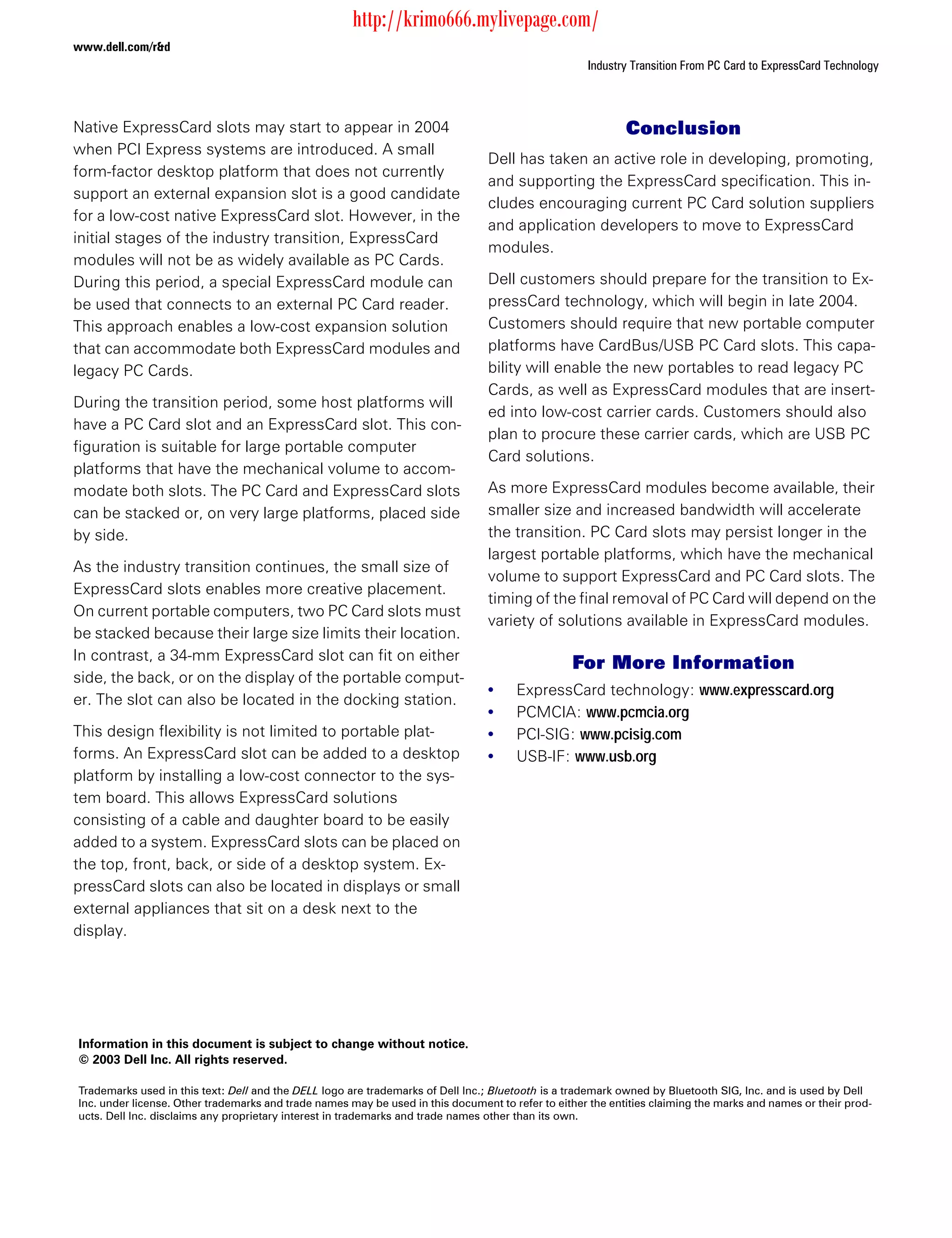
ther PCI Express or USB, depending on the bandwidth         •   One 54-mm slot — The 54-mm slot shown in Fig-
required. A USB ExpressCard module is suitable for              ure 3 accommodates both ExpressCard/34 and Ex-
lower-speed devices such as a Bluetooth™ wireless               pressCard/54 modules. The mechanical design
card or a consumer flash memory card. A PCI Express             requirements for an ExpressCard/54 implementa-
ExpressCard module is suitable for higher-bandwidth             tion are more expensive. Its larger size and higher
devices such as 1394b and Gigabit Ethernet cards. To            cost have a greater impact on smaller, low-cost
accommodate both types of cards, all ExpressCard                platforms where the benefit derived from support-
slots are required to support both the USB 2.0 and PCI          ing both card sizes must be weighed against form-
Express (x1 link) I/O interconnects.                            factor and cost penalties.

     ExpressCard Modules and Slots
There are two different ExpressCard module widths: 34
mm and 54 mm. These will be denoted on the module
with the name ExpressCard/54 for the wider modules
and either ExpressCard or ExpressCard/34 for the nar-
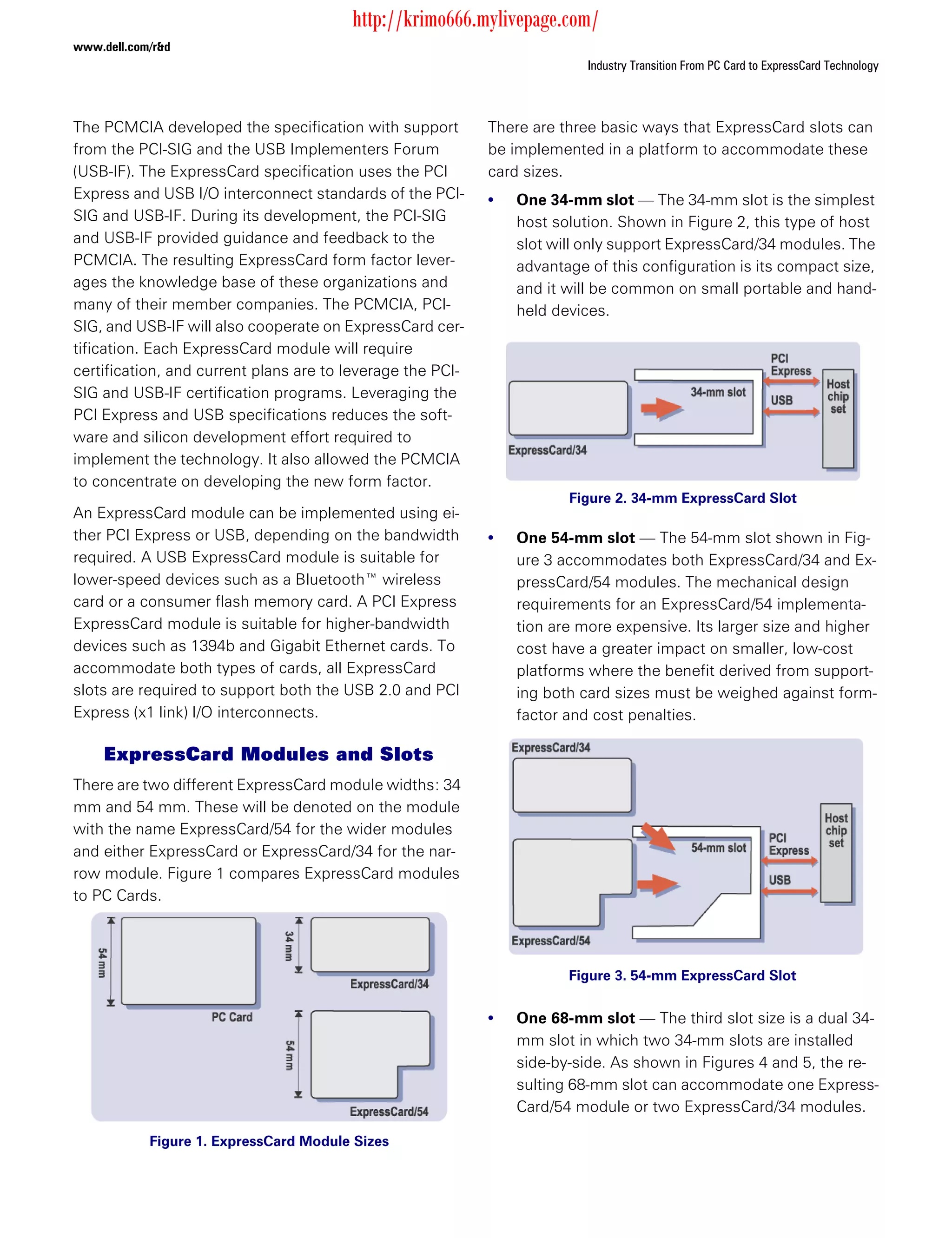
row module. Figure 1 compares ExpressCard modules
to PC Cards.


                                                                       Figure 3. 54-mm ExpressCard Slot


                                                            •   One 68-mm slot — The third slot size is a dual 34-
                                                                mm slot in which two 34-mm slots are installed
                                                                side-by-side. As shown in Figures 4 and 5, the re-
                                                                sulting 68-mm slot can accommodate one Express-
                                                                Card/54 module or two ExpressCard/34 modules.

            Figure 1. ExpressCard Module Sizes
http://krimo666.mylivepage.com/
September 2003


                                                          platforms, including servers, desktops, portables, tablet
                                                          PCs, and handheld and consumer electronics devices.
                                                          Portable computers can get smaller or add more slots.
                                                          Desktops can add external low-cost upgrade slots.
                                                          Handheld devices can leverage the same modules as
                                                          portables and desktops. The same ExpressCard mod-
                                                          ule can be used in all classes of computer as well as
                                                          noncomputer applications.

                                                                                High Speed
         Figure 4. 68-mm ExpressCard Slot With            Its higher speed enables ExpressCard technology to be
             Two ExpressCard/34 Modules
                                                          used for higher-bandwidth consumer applications. For
                                                          example, ExpressCard modules may include high-defi-
                                                          nition TV tuners, new LAN solutions, and faster wireless
                                                          solutions. Users can install these modules by simply in-
                                                          serting an ExpressCard module into the ExpressCard
                                                          slot in the same way that a PC Card is inserted into a PC
                                                          Card slot today.

                                                                       Transition Scenarios
                                                          The PCMCIA has enabled a transition path from the PC
                                                          Card to ExpressCard technology. The foundation for
         Figure 5. 68-mm ExpressCard Slot With            this transition is laid in the PC Card version 8.1 specifi-
              One ExpressCard/54 Module
                                                          cation, which allows for PC Card form factors that use
                                                          USB as their native bus. A low-cost USB PC Card can be
       Advantages of ExpressCard                          used as a “carrier card” for an ExpressCard/34 module.
              Technology                                  In this way, an ExpressCard/34 module can be used in a
                                                          USB PC Card slot or an ExpressCard slot. Figure 6 illus-
ExpressCard technology has the following advantages
                                                          trates this concept. Beginning in 2004, new host
over the PC Card:
                                                          platforms will implement CardBus/USB controllers that
•    Complements PCI Express and USB devices              can accommodate these USB PC Cards, as well as ex-
•    Low cost and small size                              isting non-USB PC Cards. This approach enables a
•    High speed                                           transition period during which organizations can mi-
                                                          grate to ExpressCard modules while maintaining
    Complements PCI Express and USB Devices               support for legacy PC Cards.
ExpressCard modules provide an alternate PCI Express
or USB form factor that complements PCI Express
cards, which must be plugged into the system board,
and USB solutions, which are connected via a USB ca-
ble. In contrast, ExpressCard modules are simply
plugged into the external ExpressCard slot, just as PC
Cards are installed today.
                                                             Figure 6. USB PC Card as Carrier for ExpressCard/34
             Low Cost and Small Size
The smaller size and lower cost of ExpressCard technol-
ogy enables compelling enhancements for all
http://krimo666.mylivepage.com/
www.dell.com/r&d
                                                                                                    Industry Transition From PC Card to ExpressCard Technology


Native ExpressCard slots may start to appear in 2004                                                        Conclusion
when PCI Express systems are introduced. A small
                                                                                 Dell has taken an active role in developing, promoting,
form-factor desktop platform that does not currently
                                                                                 and supporting the ExpressCard specification. This in-
support an external expansion slot is a good candidate
                                                                                 cludes encouraging current PC Card solution suppliers
for a low-cost native ExpressCard slot. However, in the
                                                                                 and application developers to move to ExpressCard
initial stages of the industry transition, ExpressCard
                                                                                 modules.
modules will not be as widely available as PC Cards.
During this period, a special ExpressCard module can                             Dell customers should prepare for the transition to Ex-
be used that connects to an external PC Card reader.                             pressCard technology, which will begin in late 2004.
This approach enables a low-cost expansion solution                              Customers should require that new portable computer
that can accommodate both ExpressCard modules and                                platforms have CardBus/USB PC Card slots. This capa-
legacy PC Cards.                                                                 bility will enable the new portables to read legacy PC
                                                                                 Cards, as well as ExpressCard modules that are insert-
During the transition period, some host platforms will
                                                                                 ed into low-cost carrier cards. Customers should also
have a PC Card slot and an ExpressCard slot. This con-
                                                                                 plan to procure these carrier cards, which are USB PC
figuration is suitable for large portable computer
                                                                                 Card solutions.
platforms that have the mechanical volume to accom-
modate both slots. The PC Card and ExpressCard slots                             As more ExpressCard modules become available, their
can be stacked or, on very large platforms, placed side                          smaller size and increased bandwidth will accelerate
by side.                                                                         the transition. PC Card slots may persist longer in the
                                                                                 largest portable platforms, which have the mechanical
As the industry transition continues, the small size of
                                                                                 volume to support ExpressCard and PC Card slots. The
ExpressCard slots enables more creative placement.
                                                                                 timing of the final removal of PC Card will depend on the
On current portable computers, two PC Card slots must
                                                                                 variety of solutions available in ExpressCard modules.
be stacked because their large size limits their location.
In contrast, a 34-mm ExpressCard slot can fit on either
                                                                                                 For More Information
side, the back, or on the display of the portable comput-
                                                                                 •    ExpressCard technology: www.expresscard.org
er. The slot can also be located in the docking station.
                                                                                 •    PCMCIA: www.pcmcia.org
This design flexibility is not limited to portable plat-                         •    PCI-SIG: www.pcisig.com
forms. An ExpressCard slot can be added to a desktop                             •    USB-IF: www.usb.org
platform by installing a low-cost connector to the sys-
tem board. This allows ExpressCard solutions
consisting of a cable and daughter board to be easily
added to a system. ExpressCard slots can be placed on
the top, front, back, or side of a desktop system. Ex-
pressCard slots can also be located in displays or small
external appliances that sit on a desk next to the
display.


Information in this document is subject to change without notice.
© 2003 Dell Inc. All rights reserved.

Trademarks used in this text: Dell and the DELL logo are trademarks of Dell Inc.; Bluetooth is a trademark owned by Bluetooth SIG, Inc. and is used by Dell
Inc. under license. Other trademarks and trade names may be used in this document to refer to either the entities claiming the marks and names or their prod-
ucts. Dell Inc. disclaims any proprietary interest in trademarks and trade names other than its own.

Express Card

  • 1.
    PCMCIA Presents ExpressCard™ Technology PCMCIA is a non- profit trade association founded in 1989 to establish technical standards for modular peripherals and to promote interchangability among computer systems. PC Card technology is already a feature in almost every notebook computer, empowering users to configure systems and create unique, integrated solutions to meet their computing interconnect needs. Based in San Jose, California, the • A Smaller & Faster PC Card Solution association has more than 100 • Suitable for Mobile and Desktop Systems member companies worldwide. • Supports USB 2.0 and PCI Express Applications • Lower System and Card Complexity http://krimo666.mylivepage.com/
  • 2.
    Introduction PCMCIA developed theExpressCard™ standard to carry forward the benefits of ‘plug-in’ I/O cards to the next generation of personal computing devices. The standard was developed by a large number of PCMCIA member companies including technology leaders, system manufacturers, card manufacturers, and representatives from all other parts of the PC Card industry. Module Sizes To support the broadest range of support those technologies which require a applications there are two sizes of module. physically larger module. In this space we Both are smaller that today’s CardBus card. will see devices such as smartcard readers, CompactFlash adapters, and 1.8” hard The smallest card, the ExpressCard/34 drives. module, is almost half the size of a CardBus card. We expect this size to be well suited All ExpressCard modules are 5mm thick but to a very broad range of applications the standard also allows for card covering communications, media, and developers to build longer ‘extended’ general purpose add-ins. modules. These can have thicker portions which project beyond the envelope of the The standard also specifies a wider card host system. called an ExpressCard/54 module. This is to 22 mm CardBus PC Card 85.6 mm 75 mm 75 mm 54 mm 54 mm 34 mm http://krimo666.mylivepage.com/
  • 3.
    http://krimo666.mylivepage.com/ Native Bus Connections The ExpressCardstandard supports both the USB 2.0 and PCI Express interfaces. Card manufacturers are able to choose whichever bus is appropriate to their application; the performance of PCI Express, or from the wide range of solutions supported by USB. All host PC ExpressCard slots will support cards using either interface. The host platform no longer needs to incorporate a bridge chip between the chipset and the socket. PCI Express and USB 2.0 are fully hot- pluggable. Host System Slots Mobile and Desktop host systems can provide ExpressCard/34 slots when space is at a premium, or the wider Universal ExpressCard slot to accommodate both module sizes. The Universal ExpressCard slot has a novel guidance feature to ensure that the ExpressCard/34 modules are always correctly inserted.
  • 4.
    http://krimo666.mylivepage.com/ PCMCIA Membership Benefits of Membership Five contacts at each Executive member Executive PCMCIA Membership Associate company receive the PC Card Standard and • Free PCMCIA Standards PCMCIA Update, and may register for Level/Benefits Grid PCMCIA meetings free of charge. As the • Complete access to the ExpressCard driving force behind PCMCIA, Executive Specifications members receive valuable exposure on Access to NEWCARD specifications • Access to all proposals and working PCMCIA’s home page and in all PCMCIA Free PC Card Standard and Updates materials while in progress, before literature. public release 80%+ Discount on additional Standard copies • Committee Minutes Associate Membership PCMCIA Update Quarterly Publication • PCMCIA Update Quarterly Publication ($3500/year) Access to Members-only Web Site • Access to Members-Only Web Site Free access to download PC Card Standard • Use of PC Card Logo Associate Members are the backbone of Use of PC Card logo on products • PlugFest Interoperability Workshops PCMCIA activity. With full voting rights on all Free Permanent Manufacturer's Tuple ID • Free Manufacturer’s Tuple ID PCMCIA technical and marketing committees Access to Proposals while in process and four of eleven seats on PCMCIA’s Board • PCMCIA Membership Plaque Annually 5 1 of Directors, Associate membership is perfect # of Contacts (Free meetings, Standards) • Meeting Participation for companies that want to help drive the Listings on the PCMCIA Resource Directory 10 3 (Executive and Associate only) promotion and advancement of PC Card Moblie Advisory Council Membership • Proposal Submission technology. Associate members are also (Executive and Associate only) entitled to submit proposals for changes to Attend Membership Meetings • Free Mobile Advisory Council (MAC) the PC Card Standard. Submit Proposals membership (Executive and Associate Voting rights in Committee only) One contact receives all mailings and Seats on the PCMCIA Board of Directors 7 4 literature, including the PC Card Standard Membership Levels and all updates, and may register for Control of PCMCIA By-laws meetings free of charge. Logo on PCMCIA Web Site Home Page There are three levels of membership in PCMCIA that offer something for any Affiliate Membership company involved in the manufacture, design, or distribution of PC Card products. ($1500/year) Executive Membership Affiliate Membership is ideal for companies that need up-to-date information about PC ($10,000/year) Card technology and want to participate in PCMCIA’s marketing and promotional PCMCIA Executive Members plan the strategic future activities. Affiliate members may not attend of PCMCIA and modular peripheral meetings, but do receive complete meeting Mission Statement technology by controlling the By-laws of results following each meeting, along with PCMCIA and by filling seven of eleven seats access to all of PCMCIA’s marketing activities on PCMCIA’s Board of Directors. Executive To develop and members-only web site. members also enjoy full voting rights on all standards for technical, marketing, and organizational One contact receives all mailings and modular peripherals issues. Executive members are also entitled to literature, including the PC Card Standard submit proposals for changes to the PC Card and all updates. Affiliate member companies and promote their Standard. are entitled to one free product listing on the worldwide PC Card Resource Directory. adoption. Personal Computer Memory Card International Association Executive Members 2635 North First Street Suite 209 • San Jose, CA • 95134 • USA Tel: 408-433-2273 • Fax: 408-433-9558 • Email: office@pcmcia.org Dell Computer Visit our web site: Intel www.pcmcia.org SCM Microsystems © 2003 Personal Computer Memory Card International Association. All rights ExpressCard, the Rabbit symbol and the PCMCIA Ribbon symbol are trademarks of PCMCIA
  • 5.
    The ExpressCard™ ComplianceProgram A Brief Overview of the ExpressCard Compliance Program The ExpressCard Compliance Program is designed to give the consumer the confidence that they can buy host systems Compliance Checklist Coverage or modules bearing the ExpressCard brand knowing that they will work together. This • End user ExpressCard products improvement in the end user experience is - Modules expected to help grow the market for ExpressCard products by - Systems making it feasible for complete novices to add hardware • Components devices to their systems. The improvement is expected to be most apparent on Desktop PCs where adding hardware to the - Slot Power Switch system previously required opening the case to insert a board. - Connectors Establishing the reliability and predictability of products that • Module/System manufacturers to use compliant connectors bear the ExpressCard brand is central to the expanded use of and power switches the technology. - If not using existing components, manufacturers are responsible for also testing those elements Compliance Program Coverage Category Coverage Source Interoperability Events USB Protocol and electrical elements need USB-IF • Participants are module and system manufacturers Interface to meet the current USB 2.0 test - Connectors and Power controllers tested indirectly standard • Modeled on similar events set up by USB IF PCI Express Functional, protocol and electrical PCI SIG - Held in an "Embassy Suites" style hotel Interface elements meet PCI Express 1.0a - Module manufacturers visit each system manufacturer in turn and complete a predefined set of tests Mechanical Connector and card elements all need Checklist to meet the specified dimensions and - System manufacturers assigned a fixed location tolerances - At end of event, PCMCIA correlates results to determine pass/fail results Durability Friction surfaces must allow for the Checklist number of insertion and removal • Two categories of testing cycles defined in the Standard - Interoperatility checklist: mandatory for compliance submittals Power Host and modules must perform with Checklist - Additional test coverage: does not affect compliance test Supply supplies within range defined in the results, but provides additional value to participants Standard Power Operating range of host slots and Checklist Dissipation modules must be within the thermal Interoperability Coverage range specified in the Standard • Standard defines behavior for the following cases: Inter- Establishing that modules work with Interop 1. Initial module insertion operability systems Event 2. Graceful removal Regulatory Not part of Compliance Program N/A 3. Hot insertion Applications Not part of Compliance Program N/A 4. Surprise removal 5. Cold insertion 6. Sleep/suspend removal Compliance Process 7. Sleep/suspend insertion 1. Complete self-administered checklist for product 8. Hibernation removal - Designed to ensure product meets the ExpressCard Standard 9. Hibernation insertion - Different checklists exist for different product categories • Interoperability checklist intends to verify appropriate behavior for a given module and system combination 2. Attend an interoperability test event - To be scheduled about four times per year - Co-located with either PCI Express or USB event (over) 3. Apply for license to use ExpressCard logo - Proof of successful checklist and interoperability testing 4. Product entered into PCMCIA database and Comp. ID issued - Product may use the ExpressCard logo ExpressCard is a trademark of PCMCIA. * All product and company names herein may be trademarks of their registered owners. 06/04v1 http://krimo666.mylivepage.com/
  • 6.
    Compliance Test Fixtures Third-Party Test Houses PCMCIA will make the following test fixtures available: • Some manufacturers may be unable to attend the 1. Plug-in board for PCI Express desktop systems which interoperability events and/or be unable to self-certify provides a fully functional ExpressCard Slot • PCMCIA is working with commercial test houses to provide - Works in PCI Express CEM slot a "Turnkey" solution for a fee - Supports both PCI Express and USB interfaces - Manufacturer provides test-house with a module or system - Test house executes checklist and interoperablity tests Test Fixture will - Provides manufacturer with a registration/compliance report be available from packet ready for submittal to the PCMCIA PCMCIA, • Details will be published on PCMCIA web site providing a fully functional ExpressCard slot What You Can Do Now • System Vendors: - Prepare your roadmap now for ExpressCard implementations 2. ExpressCard module to support signal integrity testing of - Choose your chipsets PCI Express portion of host ExpressCard implementation - Test your ACPI solutions 3. USB module to support signal integrity testing of USB portion of host ExpressCard implementation - Join PCMCIA and participate • Module Vendors: PCI Express (top) - CardBus and PC Cards - choose your migration path and USB 2.0 - New technologies - PCI Express, USB or both? (bottom) testing modules support - Join PCMCIA and participate signal integrity • Review materials available on PCMCIA web site: testing - www.expresscard.org • Plan to participate in first compliance workshop - Watch www.expresscard.org for details Self Qualification About PCMCIA • Companies may apply to be allowed to self certify The PCMCIA is the leading trade association for plug-in - May be appropriate if they have numerous product releases modular I/O expansion for personal computers and notebooks. & cycles Founded in 1989, the association has over 120 members and • Requirements developed the 16-bit PC Card and CardBus standards. - Ability to maintain and run interoperability test suite - Will include range of systems and ExpressCard modules - Enrollment in similar programs for other industry groups, such as USB self certification • Company still needs to submit registration & passing compliance report for each product to PCMCIA for compliance IDs PCMCIA 2635 North First Street Suite 218 San Jose, CA 95134 • USA Tel: 408-433-2273 • Fax: 408-433-9558 Email: office@pcmcia.org Visit us at: www.pcmcia.org www.expresscard.org ExpressCard is a trademark of PCMCIA. * All product and company names herein may be trademarks of their registered owners. 06/04v1 http://krimo666.mylivepage.com/
  • 7.
    ExpressCard™ Technology The New Standard for High-Performance, Low-Cost I/O Expansion for Desktop and Mobile Systems The ExpressCard standard promises to deliver high- performance, modular expansion to desktop and notebook computers at a lower cost and in a smaller form factor. Consumers will be able to add memory communications and security devices by simply inserting ExpressCard modules into their systems. The new standard supports sealed-box expandability in desktops and thinner notebook design. Key Features • Leverages PC Card technology The ExpressCard system interface supports a direct connection - Reliability and durability to the chipset. The slot configuration supports both card sizes. - Hot plug-n-play and auto-configuration • Roughly half the size of today’s PC Card • Supports both USB 2.0 and PCI Express* in each slot Industry Support - Increased bandwidth while reducing the number of signals 100+ PCMCIA member companies, including Dell, Hewlett • Lower cost Packard, IBM, Intel, Lexar Media, Microsoft, SCM Microsystems and Texas Instruments. - No host controller - New connector technology • Requires less power Availability • Replaces CardBus as the preferred I/O solution Mid-2004 Two Sizes Expected Applications ExpressCard/34: 34 mm (W) x 75 mm (L) x 5 mm (H) ExpressCard/54: 54 mm (W) x 75 mm (L) x 5 mm (H) Interface Target Applications PCI Express Wired LAN As compared to CardBus (Type II): 54 mm (W) x 86 mm (L) x 5 Broadband modems mm (H) TV Tuners/Decoders I/O Adapters (e.g. 1394a/b) Magnetic Disk Drives Card Interfaces USB 2.0 Wired & Wireless WAN Connector Style Wireless PAN Flash Memory • 26 pin beam on blade Flash Card Adapters Security Bandwidth support Legacy I/O (PS2, serial, parallel) • USB 2.0: 480 Mb/s Optical Disk Drives • PCI Express* (x1): 2.5Gb/s/direction GPS Receiver Power available to card (average) • 3.3V: 1000mA • 3.3V aux: 250 mA PCMCIA • 1.5V: 500 mA The PCMCIA is the leading trade association for plug in Max current combined across all power rails: Up to 1750mA modular I/O expansion for personal computers and notebooks. Founded in 1989, the association developed the PC Card 16 and CardBus standards. For More Information www.expresscard.org 10/03v1 ExpressCard is a trademark of PCMCIA. * All product and company names herein may be trademarks of their registered owners. http://krimo666.mylivepage.com/
  • 8.
    The ExpressCard™ Standard– The Next Generation PC Card Technology October 2003 – Copyright PCMCIA In 2004 a new generation of PC platforms offering higher performance and scalability will be launched. These improvements are due to the introduction of PCI Express as a system bus. In support of this PCMCIA has introduced a new standard for hot swappable system modules which it believes will replace ‘CardBus’ as the preferred solution for end user add-ins. This new E x p r e s s C a r d technology is designed to allow a broader range of applications at a lower cost than CardBus and has been embraced by both desktop and notebook system manufacturers. Introduction The ExpressCard standard gives the user a very easy way to add hardware or media to his system. The ExpressCard module can be plugged in or removed at almost any time, and unlike traditional add-in cards for desktop computers, it does not require any tools. ExpressCard technology provides desktop and mobile computer users a consistent, easy, reliable and non-threatening way to connect devices into their systems. Illustrated here are ExpressCard slot and module concepts for both mobile and small-form-factor desktop computing platforms ExpressCard technology replaces conventional parallel buses for I/O devices with scaleable, high-speed serial interfaces. It allows developers to create modules using PCI Express* for their highest performance applications, or to use USB* to take advantage of the wide range of USB silicon that is already available. Irrespective of the bus technology that the module vendor chooses, the end user experience will be the same. There will be no external indications to the end user of which underlying bus the module is using. Module form-factors There are two standard formats of ExpressCard modules: the ExpressCard/34 module which is 34 mm wide and the ExpressCard/54 module characterized by its 54 mm width. Both module formats are 5 mm thick, the same as the Type II PC Card. The standard module length is 75 mm, which is 10.6 mm shorter than a standard PC Card. ExpressCard/34 modules and ExpressCard/54 modules both use the same connector interface. http://krimo666.mylivepage.com/
  • 9.
    The ExpressCard Standard- The Next Generation PC Card Technology The ExpressCard Standard also allows extended module formats (not shown here) to provide ExpressCard module developers the facility to integrate features such as LAN and phone line connectors, or Antennas for wireless cards into the body of their products. The two sizes of ExpressCard modules give system manufactures a degree of flexibility that they did not have with earlier module standards. While the ExpressCard/34 device is better suited to smaller systems, the wider ExpressCard/54 module can accommodate applications that will not physically fit into the narrower ExpressCard/34 form factor. Examples include SmartCard readers, Compact Flash readers, and 1.8” disk drives. The ExpressCard/54 module also provides extra space for components and can dissipate more thermal energy than the smaller module. This may make it a natural choice for higher performance and first generation applications. However, the module manufacturer who can fit his application into the narrow module will have the advantage that that particular module will work in both types of ExpressCard slot. The socket which can accommodate the ExpressCard/54 module can also support an ExpressCard/34 device. To improve the ease-of-use this slot includes a novel guidance feature which is designed to steer ExpressCard/34 modules into the connector socket. It is also worth pointing out that the dimensions are such that inserting a CardBus card into an ExpressCard slot or vice versa will not damage either part. The ExpressCard architecture is modular and extensible, allowing for multiple slots as illustrated here. In any multi-slot host implementation, all slots provide equivalent I/O interface functionality and the choice of which slot to use for any given module is irrelevant. Both module formats afford access to the same I/O interface performance and source power although the larger ExpressCard/54 module provides the application nominally 140% the internal volume and 160% the thermal dissipation capacity of the ExpressCard/34 module. The Connector A common beam-on-blade style connector is used for both module and the corresponding host connector accommodates the insertion of either module. The blade contacts are located on the ExpressCard module and are designed for high durability and reliability. The connectors are designed to be capable of 10,000 card insertion and removal cycles. * Other names and brands may be claimed as the property of others. http://krimo666.mylivepage.com/
  • 10.
    The ExpressCard Standard- The Next Generation PC Card Technology The Interface Each slot of the ExpressCard host interface must support a single PCI Express lane (x1) operating at the baseline 2.5 Gbps data rate, in each direction, as defined by the PCI Express Base Specification 1.0a as published and maintained by the PCI Special Interest Group (PCI-SIG). The ExpressCard host interface must also support the low-, full- and high-speed USB data rates as defined by the USB 2.0 Specification as published and maintained by the USB Implementers Forum (USB-IF). Support of both interfaces is a condition for being an ExpressCard-compliant host platform. An ExpressCard module may use one or both of the standard interfaces depending on the application requirements. The ExpressCard host interface – List of Signals Signal Group Signal Direction Description PCI Express x1 data interface: PETp0, PETn0 Input/Output 1 differential transmit pair and 1 differential PERp0, PERn0 receive pair PCI Express REFCLK+ PCI Express differential, spread-spectrum Input REFCLK- reference clock PERST# Input PCI Express functional reset Universal Serial Bus USBD+ Input/Output USB 2.0 serial data interface (USB) USBD- SMBDATA Input/Output SMBus SMBus management channel SMBCLK Input/Output PCI Express module detection and power CPPE# Output control System auxiliary CPUSB# Output USB module detection and power control signals Used to indicate when REFCLK is needed (PCI CLKREQ# Output Express-only) WAKE# Output PCI Express function initiated wake event +3.3V Primary voltage source +3.3VAUX Auxiliary voltage source Power & Ground +1.5V Secondary voltage source GND Return current path To assist in applications that require special sideband system management features, ExpressCard host systems may also connect a two-wire SMBus interface to the slot. If available, ExpressCard modules may provide support for such features as remote alerting and sideband radio control. The following table summarizes the power supply limits for any given ExpressCard module. For purposes of the following table, the definition of ‘Average’ is the averaged steady-state maximum current consumption for the given module application. ‘Max’ is defined as the absolute maximum value that may be measured outside of the initial in-rush current that is allowed during the power ramp-up period. * Other names and brands may be claimed as the property of others. http://krimo666.mylivepage.com/
  • 11.
    The ExpressCard Standard- The Next Generation PC Card Technology ExpressCard module power supply limits Supply Limits Notes 1 1000 mA – Average +3.3V Primary supply voltage 1300 mA – Max 250 mA – Average Auxiliary supply voltage; this current is also available during the 1 275 mA – Max power saving D3 state with wakeup enabled +3.3VAUX Auxiliary supply voltage during the power saving D3 state with 5 mA – Average wakeup disabled 500 mA – Average +1.5V Secondary supply voltage 650 mA – Max 1. The average current combined across both +3.3V and +3.3VAUX rails shall not exceed a total of 1000mA. The maximum total current across all power rails combined shall not exceed a total of 1750mA. All ExpressCard modules, independent of the amount of power drawn from the host system, shall not exceed the thermal power limits defined for modules: 1.3W for ExpressCard/34 modules and 2.1W for ExpressCard/54 modules. Thermal limits are based on an assumption of uniformly heated module with a maximum case temperature of 90ºC in a host environment of 65ºC, and consider heating due to adjacent modules. Hot Plug Functionality and Power Management ExpressCard technology is designed to allow users to install and remove modules at anytime, without having to switch their system off. This hot plug functionality is a well established part of the CardBus and USB usage models and is also supported by PCI Express. By relying on the auto- detection and configuration of the native I/O buses (PCI Express and USB 2.0), ExpressCard technology can be implemented on a host system without an external slot controller. It simply needs a device to control power to the slot based on a simple, wired, module presence detection scheme. Regarding power management, both PCI Express and USB natively support features that allow for module applications to be placed in very low power states while maintaining the ability to detect and respond to wakeup requests. Examples of how these features may be used by an ExpressCard application include receiving network messages via a wireless communications module that come in while the PC is in a sleep state. Effective use of these features is the key to creating high- performance applications which are both power and thermally efficient. Relationship to the PC Card Standard The PC Card Standard, which defines the 16-bit PC Card and the popular CardBus™ technology, were the first and second generations of card standards developed by PCMCIA. The ExpressCard standard represents the third. As host systems move to a PCI Express based architecture, we expect ExpressCard technology to replace CardBus on the notebook and become broadly available on desktop platforms, especially the smaller form factor ‘sealed box’ designs. For More Information For more information on ExpressCard technology and becoming a member of PCMCIA please contact: PCMCIA 2635 North First Street Suite 209 San Jose CA, 95134 USA Tel: 408-433-2273 www.pcmcia.org, www.expresscard.org * Other names and brands may be claimed as the property of others. http://krimo666.mylivepage.com/
  • 12.
    http://krimo666.mylivepage.com/ September2003 WHITE PAPER ™ INDUSTRY TRANSITION FROM PC CARD TO EXPRESSCARD TECHNOLOGY Ron Shaw, Technologist, Dell Advanced Platform Engineering ExpressCard technology is a small, Limits of the PC Card modular add-in card designed to re- The PCMCIA was founded in 1989 as an industry trade place the larger PC Card over the association and standards body to develop, maintain, next few years. The ExpressCard and promote a standard for modular cards that are inter- specification was released in Sep- changeable among portable computers. PCMCIA tember 2003. Developed by the membership includes module vendors, system ven- Personal Computer Memory Card International Associ- dors, silicon providers, software providers, and ation (PCMCIA), the technology takes advantage of the representatives from associated special interest groups scalable, high-bandwidth serial PCI Express and USB (SIGs). 2.0 interfaces. Systems with ExpressCard slots are ex- pected to ship starting with the introduction of PCI The original PC Card standard addressed the need for Express in 2004. memory cards, followed by a standard that addressed I/O module requirements. The PC Card standard has fur- ExpressCard technology enables externally accessible ther evolved to accommodate higher-speed slots that can be used for upgrades, new peripherals, applications such as networking and multimedia. The and new classes of add-in cards (referred to as Express- latest version (v. 8.1) addresses the need for lower-cost Card “modules”). ExpressCard technology leverages cards by allowing dedicated interfaces to some of the the operating system and device-driver support associ- newer, lower-pin-count devices. The latest PC Card con- ated with the industry-standard USB and PCI Express trollers allow a direct connection to USB devices, interfaces. The technology also addresses system de- consumer flash devices, smart cards, and specialized sign and cost issues by removing the specialized silicon I/O devices. The form factor and connector have re- required for the custom interface of the PC Card and by mained the same to ensure compatibility with existing using smaller connectors with fewer pins. ExpressCard modules. Despite these advances, the limit of the PC technology can deliver nearly four times the data trans- Card connector design was reached with version 8.1. fer rate of the PC Card interface by using some of the The connector is a 68-pin-in-socket connector originally latest I/O interconnect technologies. Finally, an Ex- designed for transfer rates of 10 megabytes per second pressCard slot is a more cost-effective expansion (MB/sec). With version 8.1, the practical limit of the in- solution than a PC Card slot. This cost advantage will terface has been reached. Its bandwidth is insufficient encourage PC companies to expand the use of Express- for high-performance upcoming requirements such as Card slots in portable computers and a wide range of Gigabit Ethernet network adapters and 1394b cards. other host systems, including small form-factor desk- top platforms and handheld devices. ExpressCard ExpressCard Technology technology can also be used in nontraditional personal electronics and automotive applications. The new ExpressCard interface is smaller, faster, and less expensive than the PC Card interface. The Express- Dell is a strong proponent and supporter of Express- Card connector has just 26 pins and the interface has a Card technology. In this white paper, we explain why potential transfer rate of up to 500 MB/sec (or 250 MB/ the PC Card is nearing its end of life and we describe Ex- sec in each direction) using a single-lane (or x1) PCI Ex- pressCard technology. We conclude by describing how press link. In addition, its form factor is up to 40 percent the industry and customers can transition smoothly smaller than a PC Card, which allows ExpressCard mod- from legacy PC Card to ExpressCard technology. ules to be included in smaller host systems. Read Dell’s technology white papers @ www.dell.com/r&d
  • 13.
    http://krimo666.mylivepage.com/ www.dell.com/r&d Industry Transition From PC Card to ExpressCard Technology The PCMCIA developed the specification with support There are three basic ways that ExpressCard slots can from the PCI-SIG and the USB Implementers Forum be implemented in a platform to accommodate these (USB-IF). The ExpressCard specification uses the PCI card sizes. Express and USB I/O interconnect standards of the PCI- • One 34-mm slot — The 34-mm slot is the simplest SIG and USB-IF. During its development, the PCI-SIG host solution. Shown in Figure 2, this type of host and USB-IF provided guidance and feedback to the slot will only support ExpressCard/34 modules. The PCMCIA. The resulting ExpressCard form factor lever- advantage of this configuration is its compact size, ages the knowledge base of these organizations and and it will be common on small portable and hand- many of their member companies. The PCMCIA, PCI- held devices. SIG, and USB-IF will also cooperate on ExpressCard cer- tification. Each ExpressCard module will require certification, and current plans are to leverage the PCI- SIG and USB-IF certification programs. Leveraging the PCI Express and USB specifications reduces the soft- ware and silicon development effort required to implement the technology. It also allowed the PCMCIA to concentrate on developing the new form factor. Figure 2. 34-mm ExpressCard Slot An ExpressCard module can be implemented using ei- ther PCI Express or USB, depending on the bandwidth • One 54-mm slot — The 54-mm slot shown in Fig- required. A USB ExpressCard module is suitable for ure 3 accommodates both ExpressCard/34 and Ex- lower-speed devices such as a Bluetooth™ wireless pressCard/54 modules. The mechanical design card or a consumer flash memory card. A PCI Express requirements for an ExpressCard/54 implementa- ExpressCard module is suitable for higher-bandwidth tion are more expensive. Its larger size and higher devices such as 1394b and Gigabit Ethernet cards. To cost have a greater impact on smaller, low-cost accommodate both types of cards, all ExpressCard platforms where the benefit derived from support- slots are required to support both the USB 2.0 and PCI ing both card sizes must be weighed against form- Express (x1 link) I/O interconnects. factor and cost penalties. ExpressCard Modules and Slots There are two different ExpressCard module widths: 34 mm and 54 mm. These will be denoted on the module with the name ExpressCard/54 for the wider modules and either ExpressCard or ExpressCard/34 for the nar- row module. Figure 1 compares ExpressCard modules to PC Cards. Figure 3. 54-mm ExpressCard Slot • One 68-mm slot — The third slot size is a dual 34- mm slot in which two 34-mm slots are installed side-by-side. As shown in Figures 4 and 5, the re- sulting 68-mm slot can accommodate one Express- Card/54 module or two ExpressCard/34 modules. Figure 1. ExpressCard Module Sizes
  • 14.
    http://krimo666.mylivepage.com/ September 2003 platforms, including servers, desktops, portables, tablet PCs, and handheld and consumer electronics devices. Portable computers can get smaller or add more slots. Desktops can add external low-cost upgrade slots. Handheld devices can leverage the same modules as portables and desktops. The same ExpressCard mod- ule can be used in all classes of computer as well as noncomputer applications. High Speed Figure 4. 68-mm ExpressCard Slot With Its higher speed enables ExpressCard technology to be Two ExpressCard/34 Modules used for higher-bandwidth consumer applications. For example, ExpressCard modules may include high-defi- nition TV tuners, new LAN solutions, and faster wireless solutions. Users can install these modules by simply in- serting an ExpressCard module into the ExpressCard slot in the same way that a PC Card is inserted into a PC Card slot today. Transition Scenarios The PCMCIA has enabled a transition path from the PC Card to ExpressCard technology. The foundation for Figure 5. 68-mm ExpressCard Slot With this transition is laid in the PC Card version 8.1 specifi- One ExpressCard/54 Module cation, which allows for PC Card form factors that use USB as their native bus. A low-cost USB PC Card can be Advantages of ExpressCard used as a “carrier card” for an ExpressCard/34 module. Technology In this way, an ExpressCard/34 module can be used in a USB PC Card slot or an ExpressCard slot. Figure 6 illus- ExpressCard technology has the following advantages trates this concept. Beginning in 2004, new host over the PC Card: platforms will implement CardBus/USB controllers that • Complements PCI Express and USB devices can accommodate these USB PC Cards, as well as ex- • Low cost and small size isting non-USB PC Cards. This approach enables a • High speed transition period during which organizations can mi- grate to ExpressCard modules while maintaining Complements PCI Express and USB Devices support for legacy PC Cards. ExpressCard modules provide an alternate PCI Express or USB form factor that complements PCI Express cards, which must be plugged into the system board, and USB solutions, which are connected via a USB ca- ble. In contrast, ExpressCard modules are simply plugged into the external ExpressCard slot, just as PC Cards are installed today. Figure 6. USB PC Card as Carrier for ExpressCard/34 Low Cost and Small Size The smaller size and lower cost of ExpressCard technol- ogy enables compelling enhancements for all
  • 15.
    http://krimo666.mylivepage.com/ www.dell.com/r&d Industry Transition From PC Card to ExpressCard Technology Native ExpressCard slots may start to appear in 2004 Conclusion when PCI Express systems are introduced. A small Dell has taken an active role in developing, promoting, form-factor desktop platform that does not currently and supporting the ExpressCard specification. This in- support an external expansion slot is a good candidate cludes encouraging current PC Card solution suppliers for a low-cost native ExpressCard slot. However, in the and application developers to move to ExpressCard initial stages of the industry transition, ExpressCard modules. modules will not be as widely available as PC Cards. During this period, a special ExpressCard module can Dell customers should prepare for the transition to Ex- be used that connects to an external PC Card reader. pressCard technology, which will begin in late 2004. This approach enables a low-cost expansion solution Customers should require that new portable computer that can accommodate both ExpressCard modules and platforms have CardBus/USB PC Card slots. This capa- legacy PC Cards. bility will enable the new portables to read legacy PC Cards, as well as ExpressCard modules that are insert- During the transition period, some host platforms will ed into low-cost carrier cards. Customers should also have a PC Card slot and an ExpressCard slot. This con- plan to procure these carrier cards, which are USB PC figuration is suitable for large portable computer Card solutions. platforms that have the mechanical volume to accom- modate both slots. The PC Card and ExpressCard slots As more ExpressCard modules become available, their can be stacked or, on very large platforms, placed side smaller size and increased bandwidth will accelerate by side. the transition. PC Card slots may persist longer in the largest portable platforms, which have the mechanical As the industry transition continues, the small size of volume to support ExpressCard and PC Card slots. The ExpressCard slots enables more creative placement. timing of the final removal of PC Card will depend on the On current portable computers, two PC Card slots must variety of solutions available in ExpressCard modules. be stacked because their large size limits their location. In contrast, a 34-mm ExpressCard slot can fit on either For More Information side, the back, or on the display of the portable comput- • ExpressCard technology: www.expresscard.org er. The slot can also be located in the docking station. • PCMCIA: www.pcmcia.org This design flexibility is not limited to portable plat- • PCI-SIG: www.pcisig.com forms. An ExpressCard slot can be added to a desktop • USB-IF: www.usb.org platform by installing a low-cost connector to the sys- tem board. This allows ExpressCard solutions consisting of a cable and daughter board to be easily added to a system. ExpressCard slots can be placed on the top, front, back, or side of a desktop system. Ex- pressCard slots can also be located in displays or small external appliances that sit on a desk next to the display. Information in this document is subject to change without notice. © 2003 Dell Inc. All rights reserved. Trademarks used in this text: Dell and the DELL logo are trademarks of Dell Inc.; Bluetooth is a trademark owned by Bluetooth SIG, Inc. and is used by Dell Inc. under license. Other trademarks and trade names may be used in this document to refer to either the entities claiming the marks and names or their prod- ucts. Dell Inc. disclaims any proprietary interest in trademarks and trade names other than its own.