www.twosigma.com
Exploring the Urban – Rural Incarceration Divide:
Drivers of Local Jail Incarceration Rates in the U.S.
Rachael Weiss Riley
Two Sigma Data Clinic
Bloomberg Data for Good Exchange
September 24, 2017
Important Legal Information
September 24, 2017
The views expressed herein are not necessarily the views of Two Sigma Investments, LP or
any of its affiliates (collectively, “Two Sigma”). The information presented herein is only for
informational and educational purposes and is not an offer to sell or the solicitation of an
offer to buy any securities or other instruments. Additionally, the information is not
intended to provide, and should not be relied upon for investment, accounting, legal or tax
advice. Two Sigma makes no representations, express or implied, regarding the accuracy or
completeness of this information, and you accept all risks in relying on the above
information for any purpose whatsoever.
This presentation shall remain the property of Two Sigma and Two Sigma reserves the
right to require the return of this presentation at any time. Copyright © 2017 TWO SIGMA
INVESTMENTS, LP. All rights reserved.
2
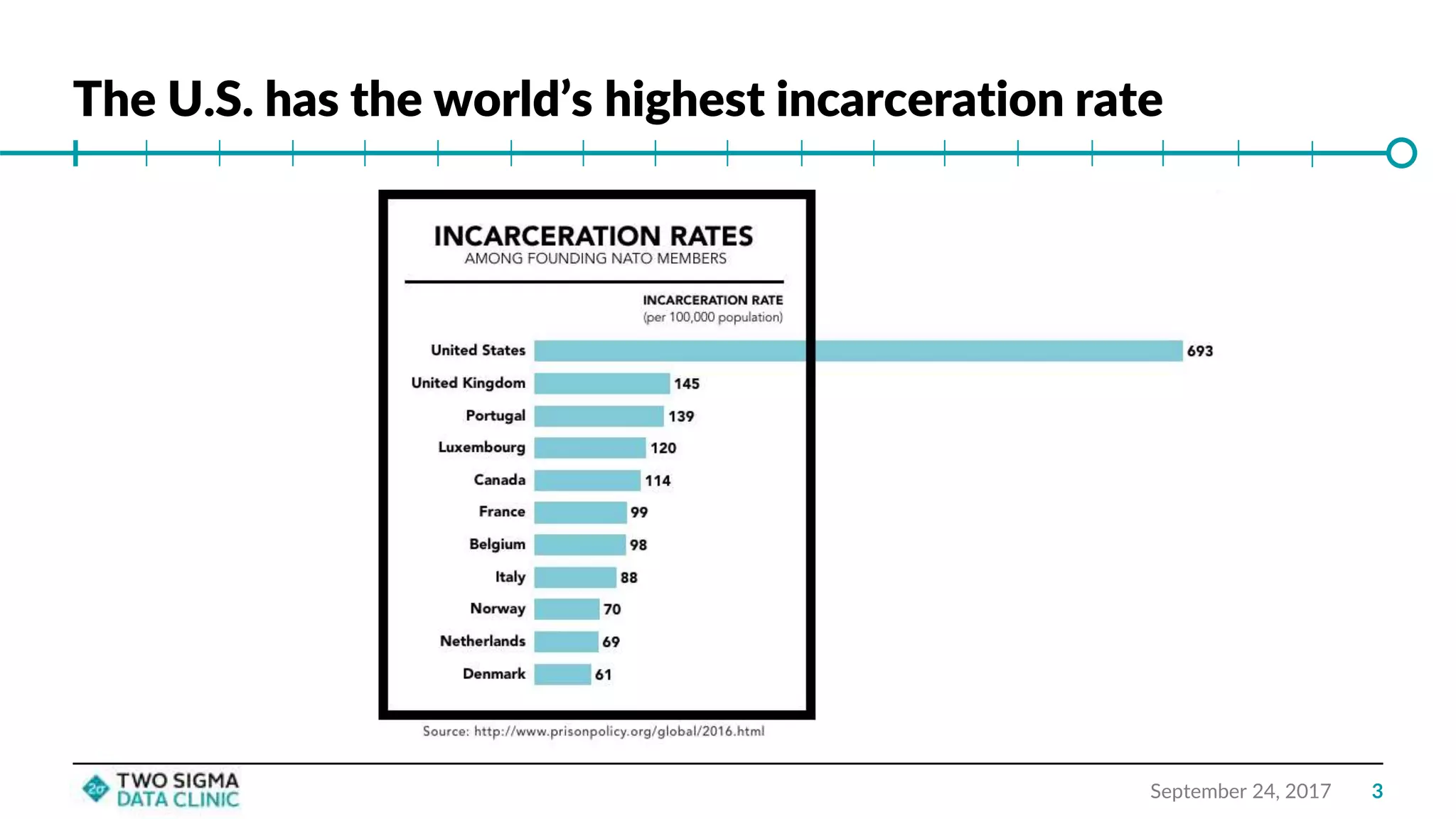
The U.S. has the world’s highest incarceration rate
September 24, 2017 3
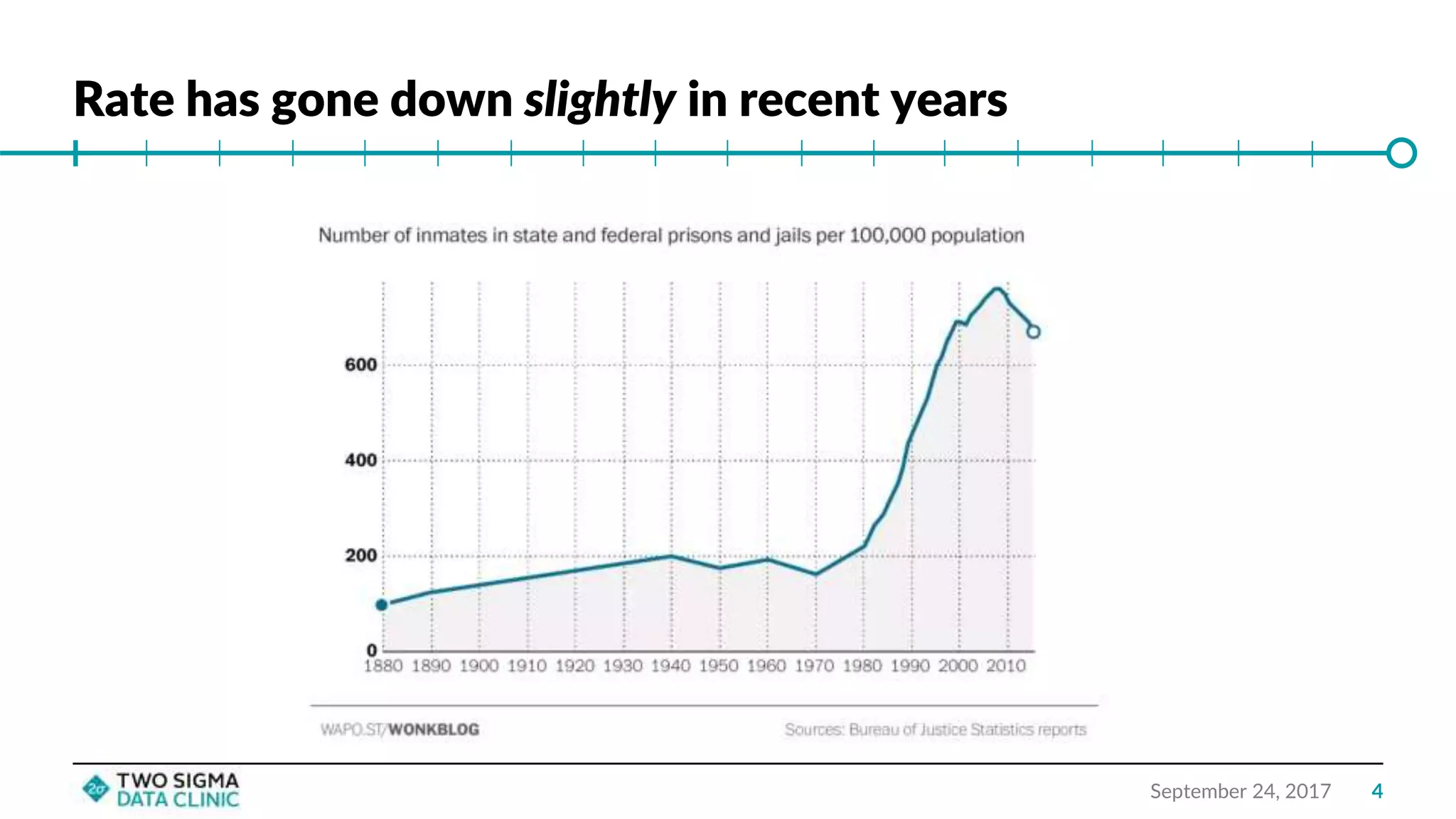
Rate has gone down slightly in recent years
September 24, 2017 4
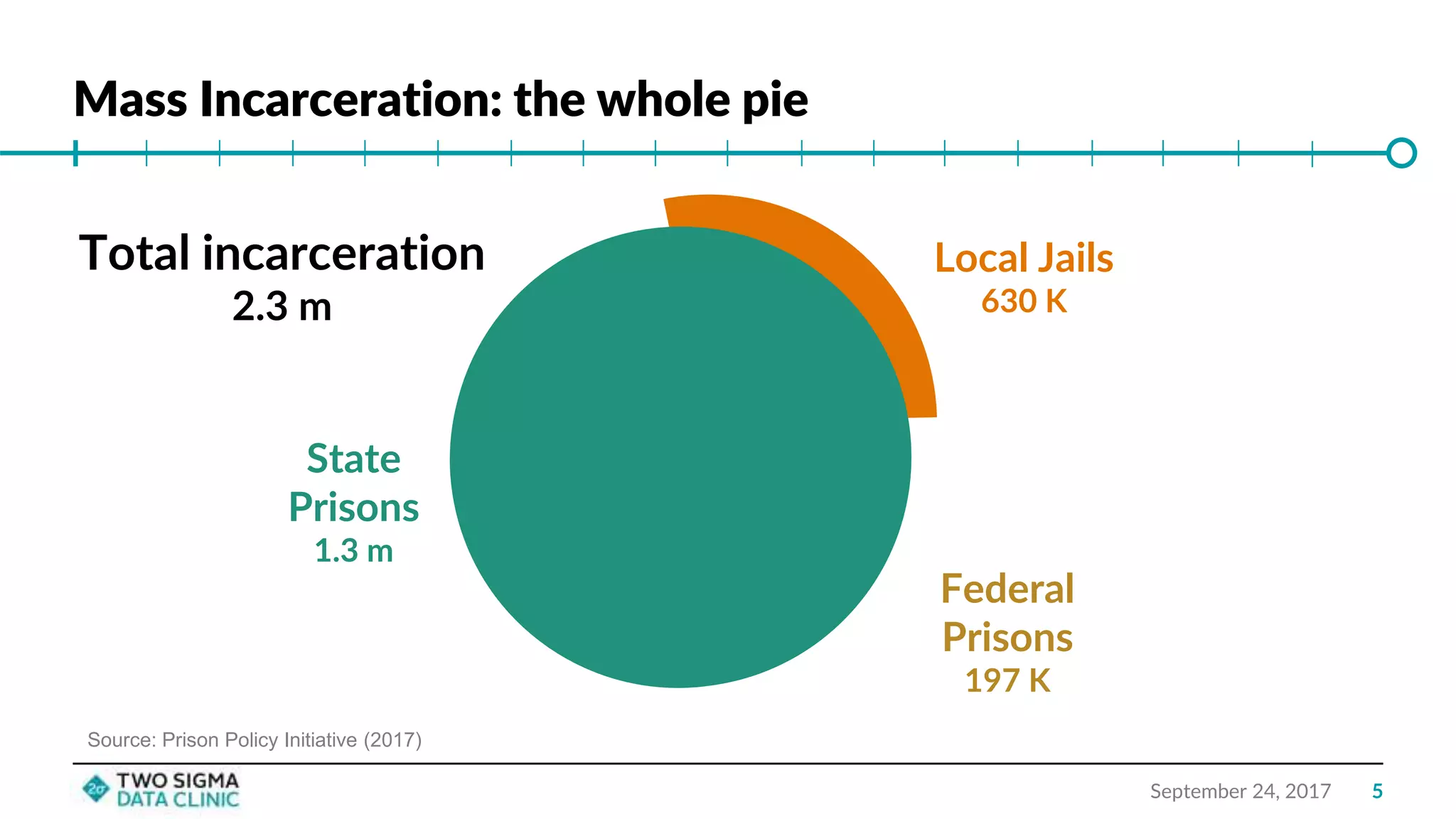
Mass Incarceration: the whole pie
5
State
Prisons
1.3 m
Federal
Prisons
197 K
Total incarceration
2.3 m
Local Jails
630 K
September 24, 2017
Source: Prison Policy Initiative (2017)
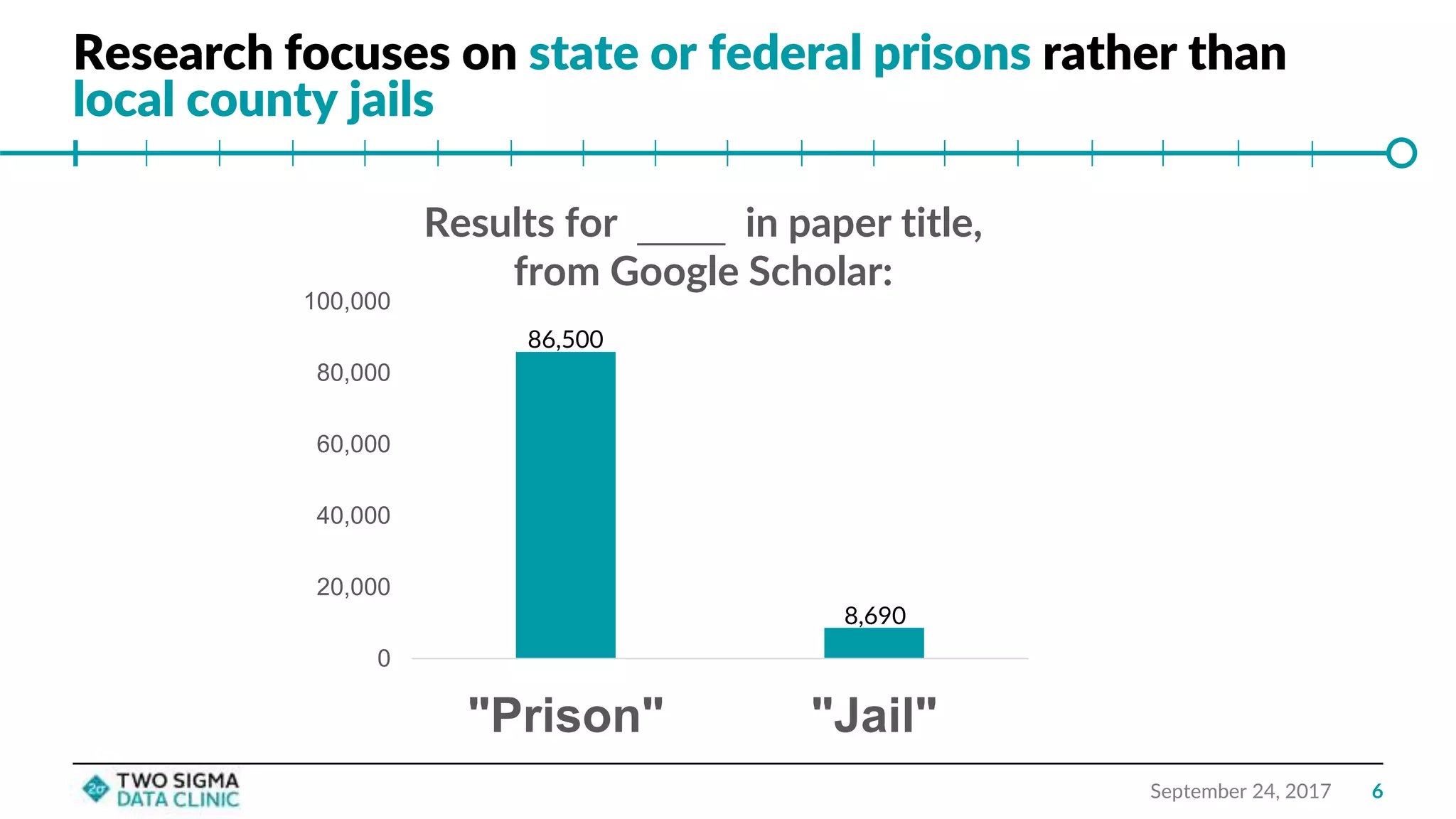
Research focuses on state or federal prisons rather than
local county jails
September 24, 2017
0
20,000
40,000
60,000
80,000
100,000
"Prison" "Jail"
Results for in paper title,
from Google Scholar:
6
86,500
8,690
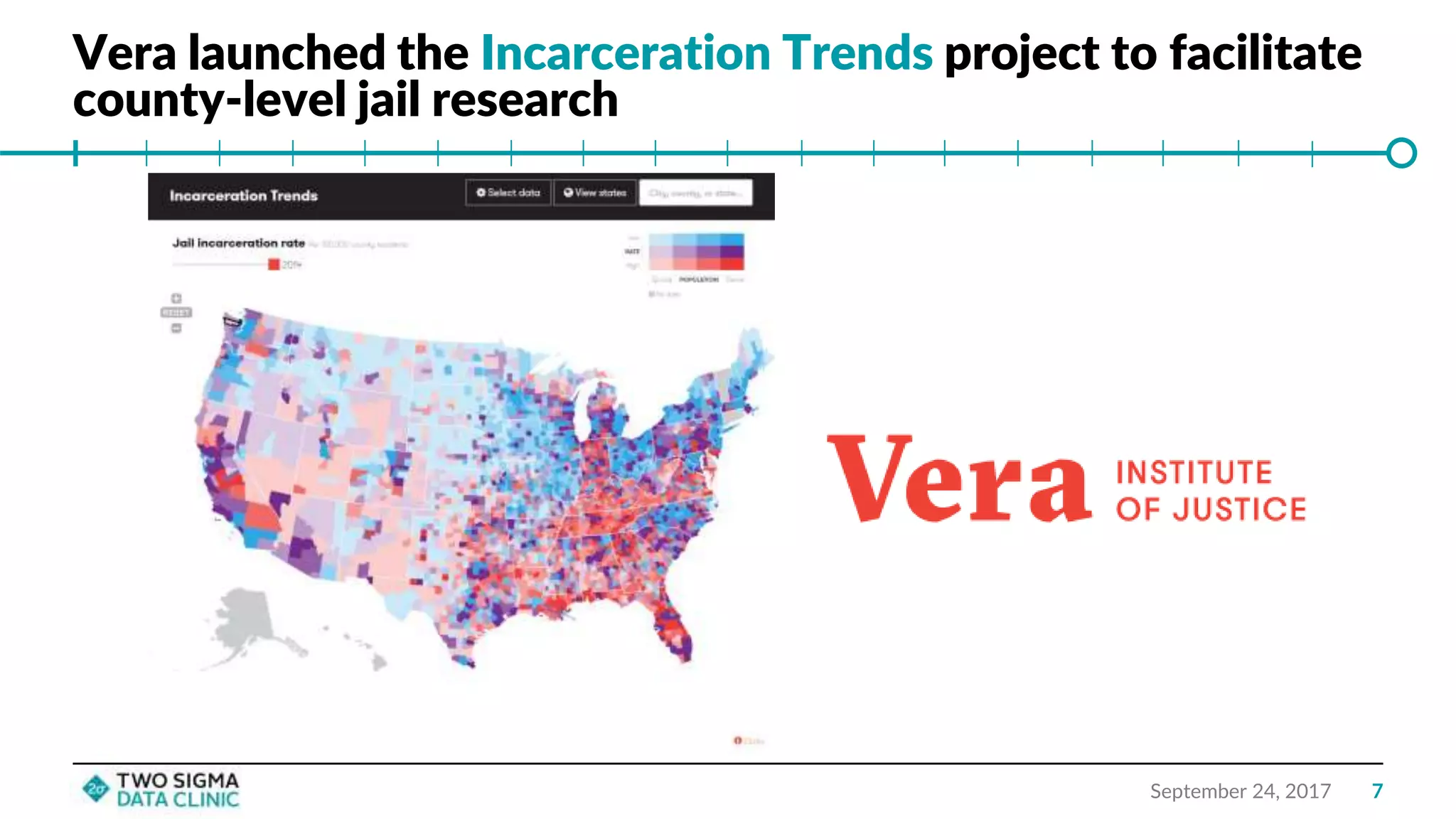
Vera launched the Incarceration Trends project to facilitate
county-level jail research
September 24, 2017 7
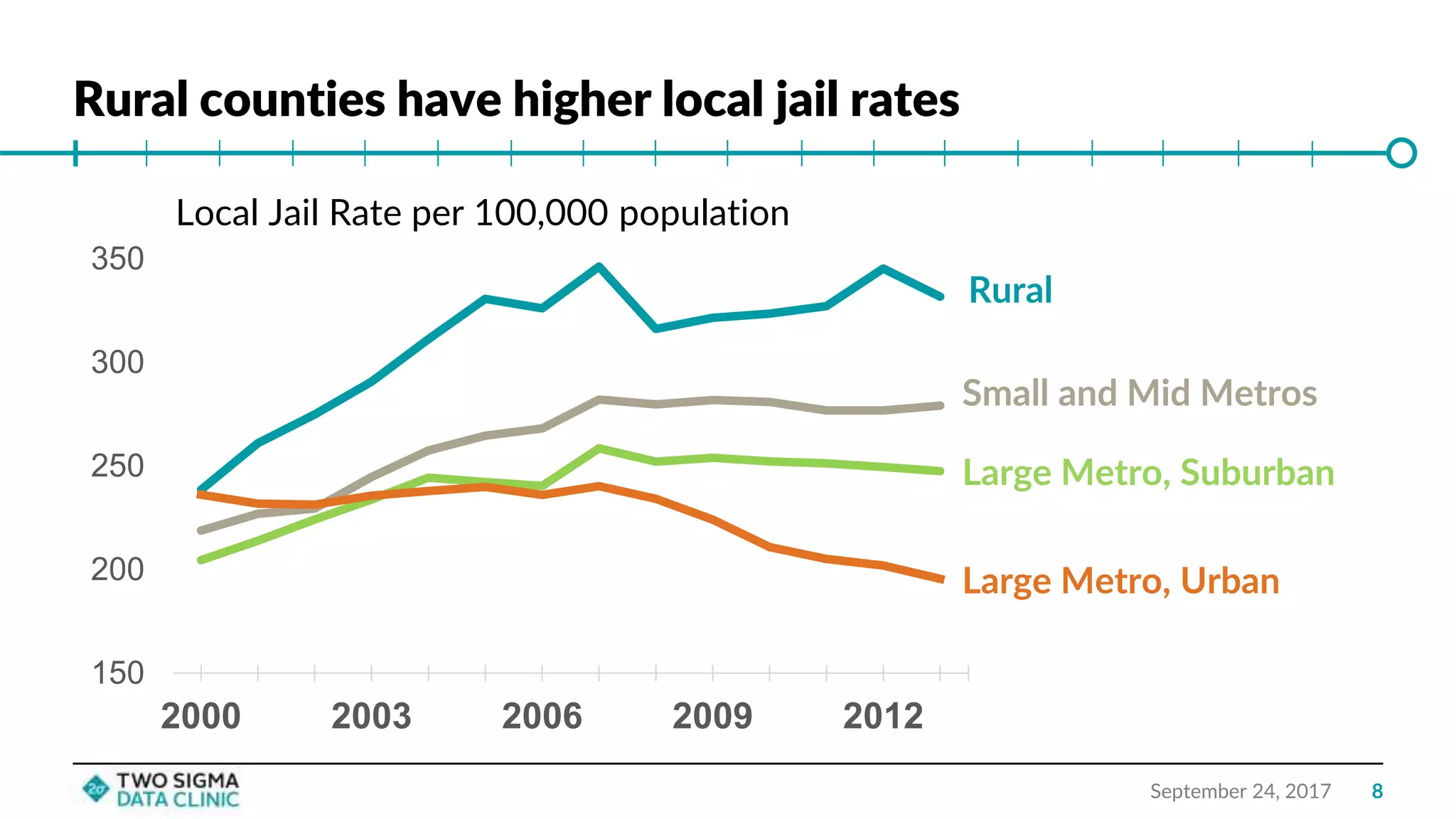
Rural counties have higher local jail rates
September 24, 2017
150
200
250
300
350
2000 2003 2006 2009 2012
Small and Mid Metros
Large Metro, Suburban
Large Metro, Urban
Rural
Local Jail Rate per 100,000 population
8
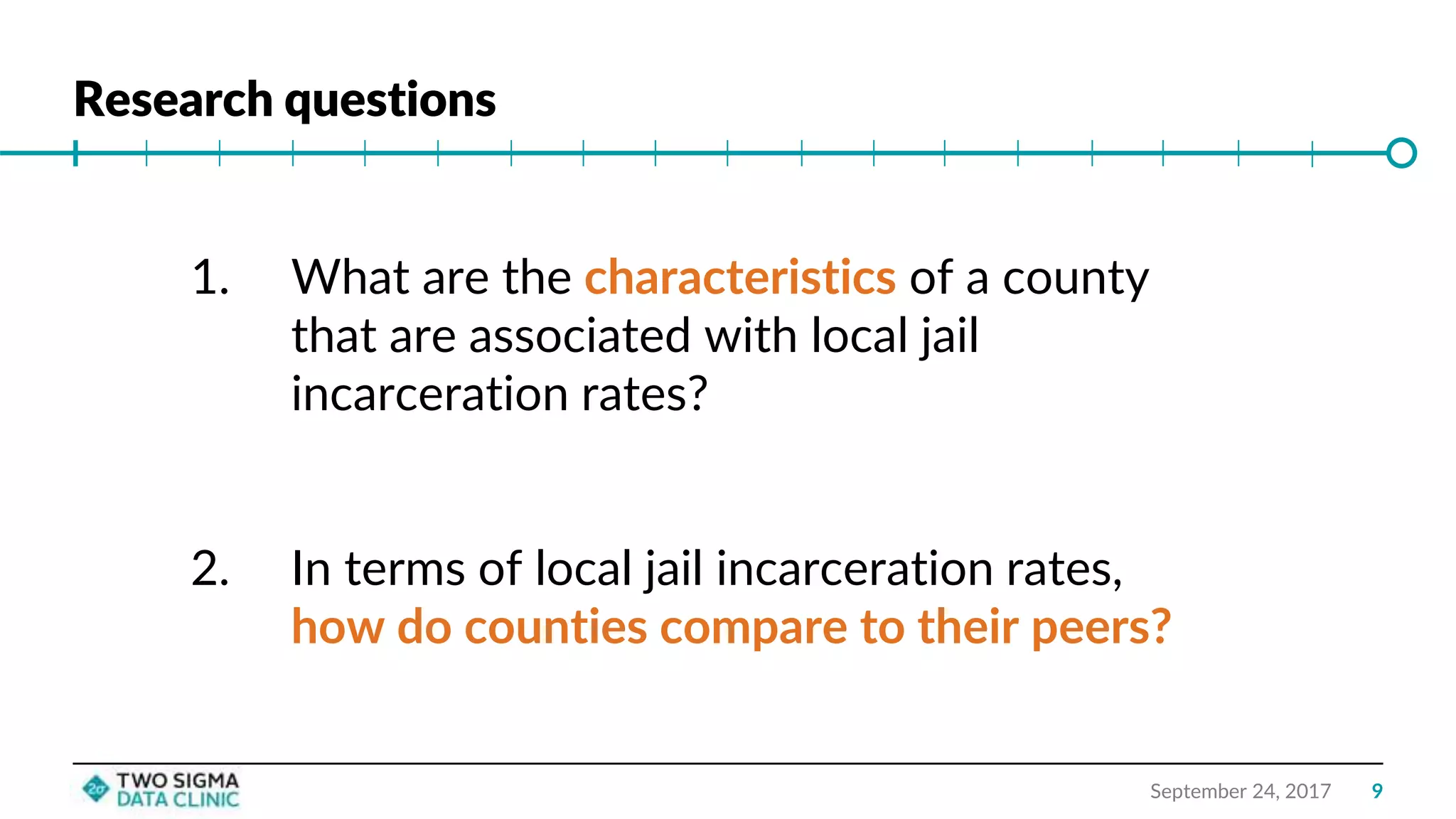
Research questions
September 24, 2017
1. What are the characteristics of a county
that are associated with local jail
incarceration rates?
2. In terms of local jail incarceration rates,
how do counties compare to their peers?
9
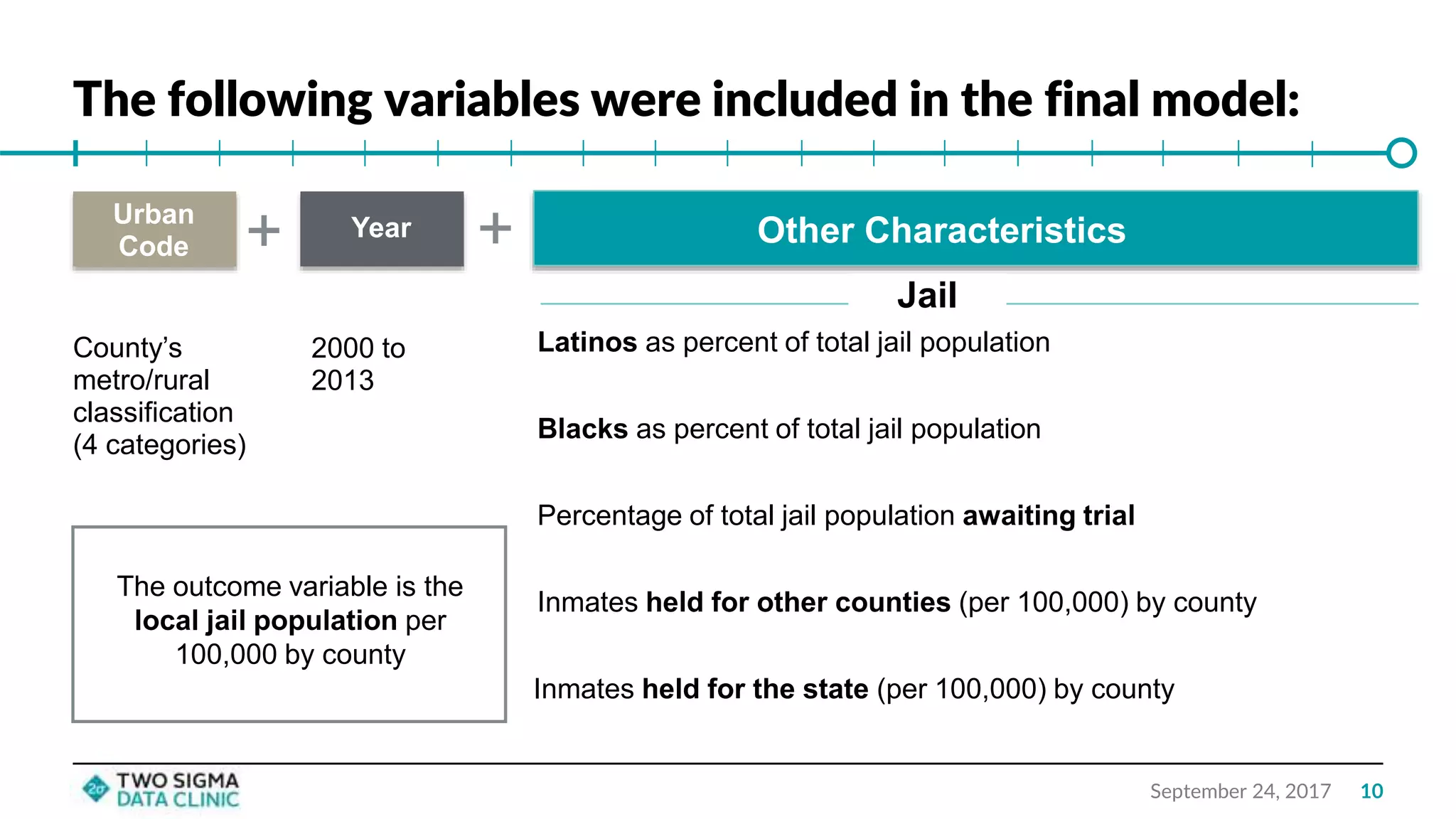
The following variables were included in the final model:
September 24, 2017
YearUrban
Code
County’s
metro/rural
classification
(4 categories)
2000 to
2013
+ + Other Characteristics
Latinos as percent of total jail population
Blacks as percent of total jail population
Percentage of total jail population awaiting trial
Inmates held for other counties (per 100,000) by county
Inmates held for the state (per 100,000) by county
Jail
The outcome variable is the
local jail population per
100,000 by county
10
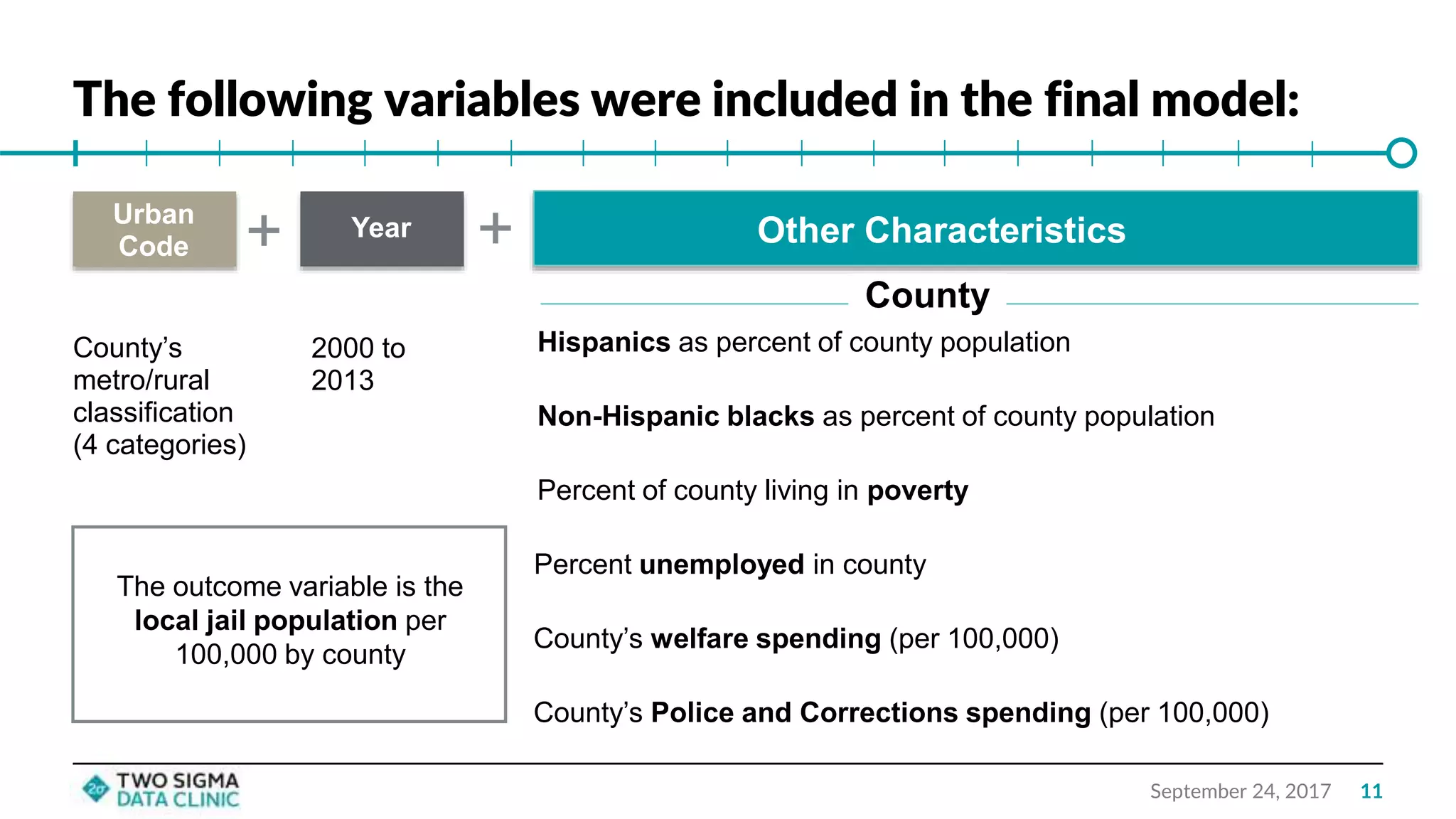
The following variables were included in the final model:
September 24, 2017
Urban
Code
Year
County’s
metro/rural
classification
(4 categories)
2000 to
2013
+ + Other Characteristics
Hispanics as percent of county population
Non-Hispanic blacks as percent of county population
Percent of county living in poverty
Percent unemployed in county
County’s welfare spending (per 100,000)
County
County’s Police and Corrections spending (per 100,000)
The outcome variable is the
local jail population per
100,000 by county
11
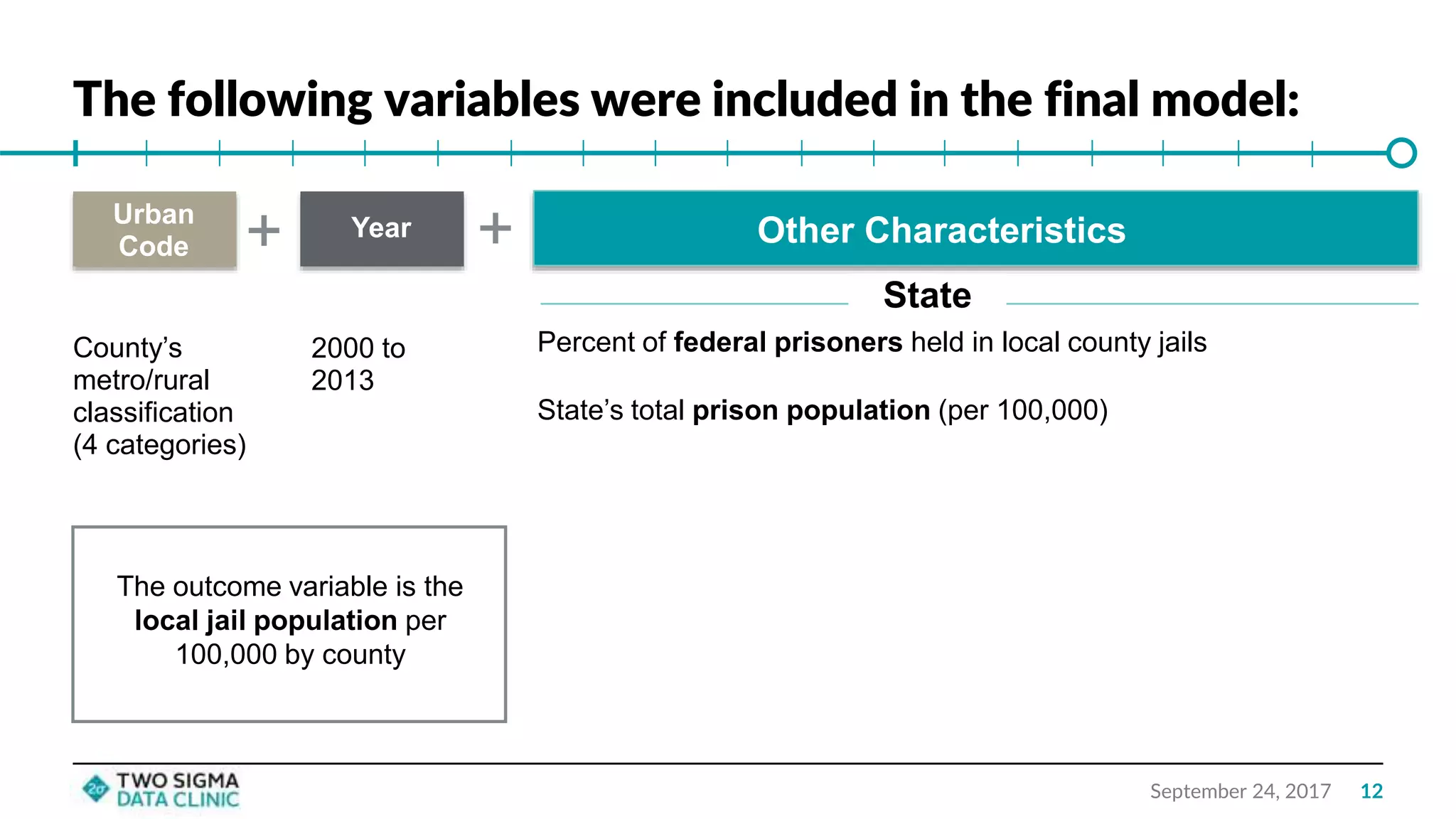
The following variables were included in the final model:
September 24, 2017
Urban
Code
Year
County’s
metro/rural
classification
(4 categories)
2000 to
2013
+ + Other Characteristics
Percent of federal prisoners held in local county jails
State’s total prison population (per 100,000)
State
The outcome variable is the
local jail population per
100,000 by county
12
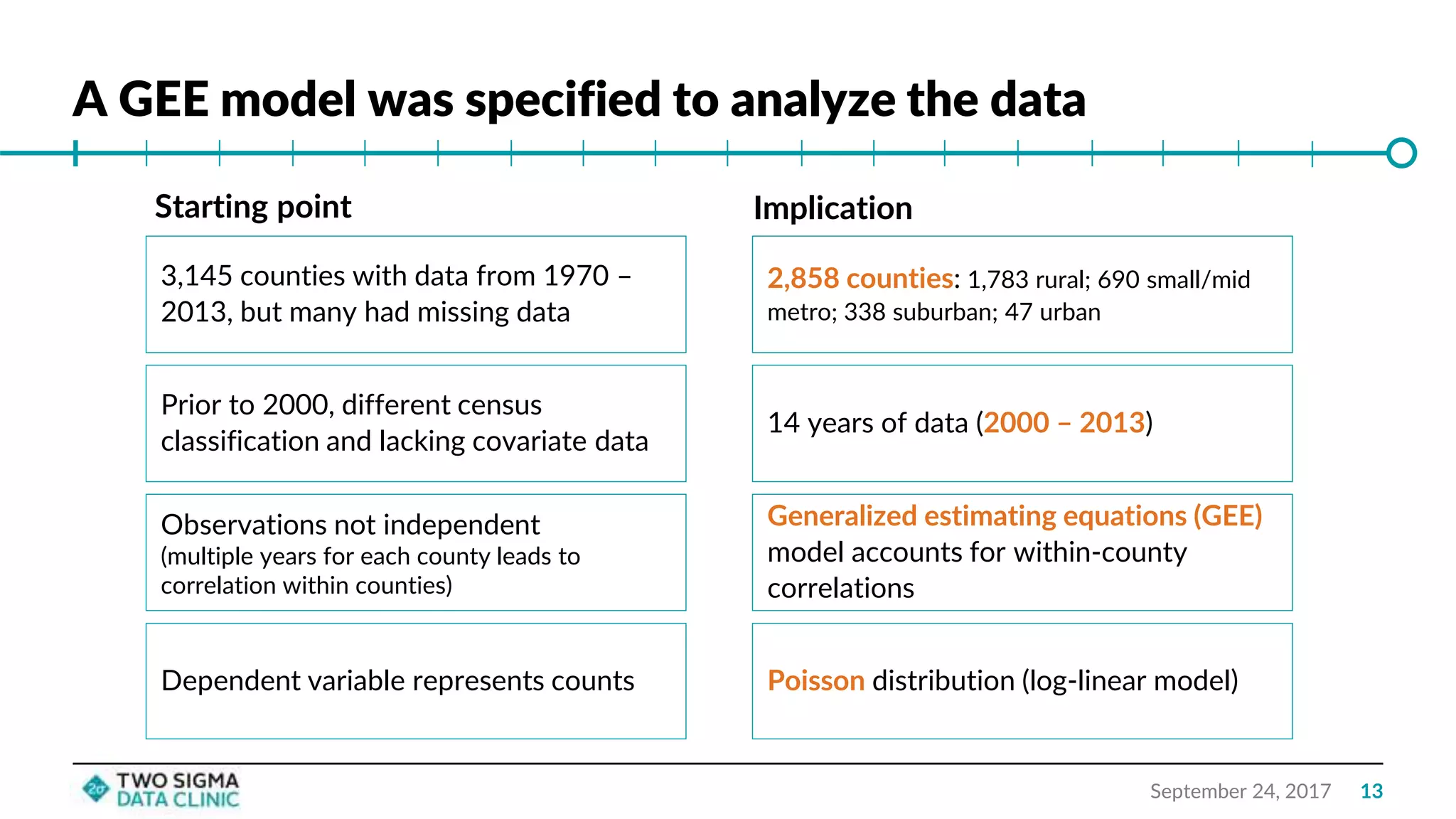
3,145 counties with data from 1970 –
2013, but many had missing data
2,858 counties: 1,783 rural; 690 small/mid
metro; 338 suburban; 47 urban
Dependent variable represents counts Poisson distribution (log-linear model)
Observations not independent
(multiple years for each county leads to
correlation within counties)
Generalized estimating equations (GEE)
model accounts for within-county
correlations
Prior to 2000, different census
classification and lacking covariate data
14 years of data (2000 – 2013)
September 24, 2017
A GEE model was specified to analyze the data
Starting point Implication
13
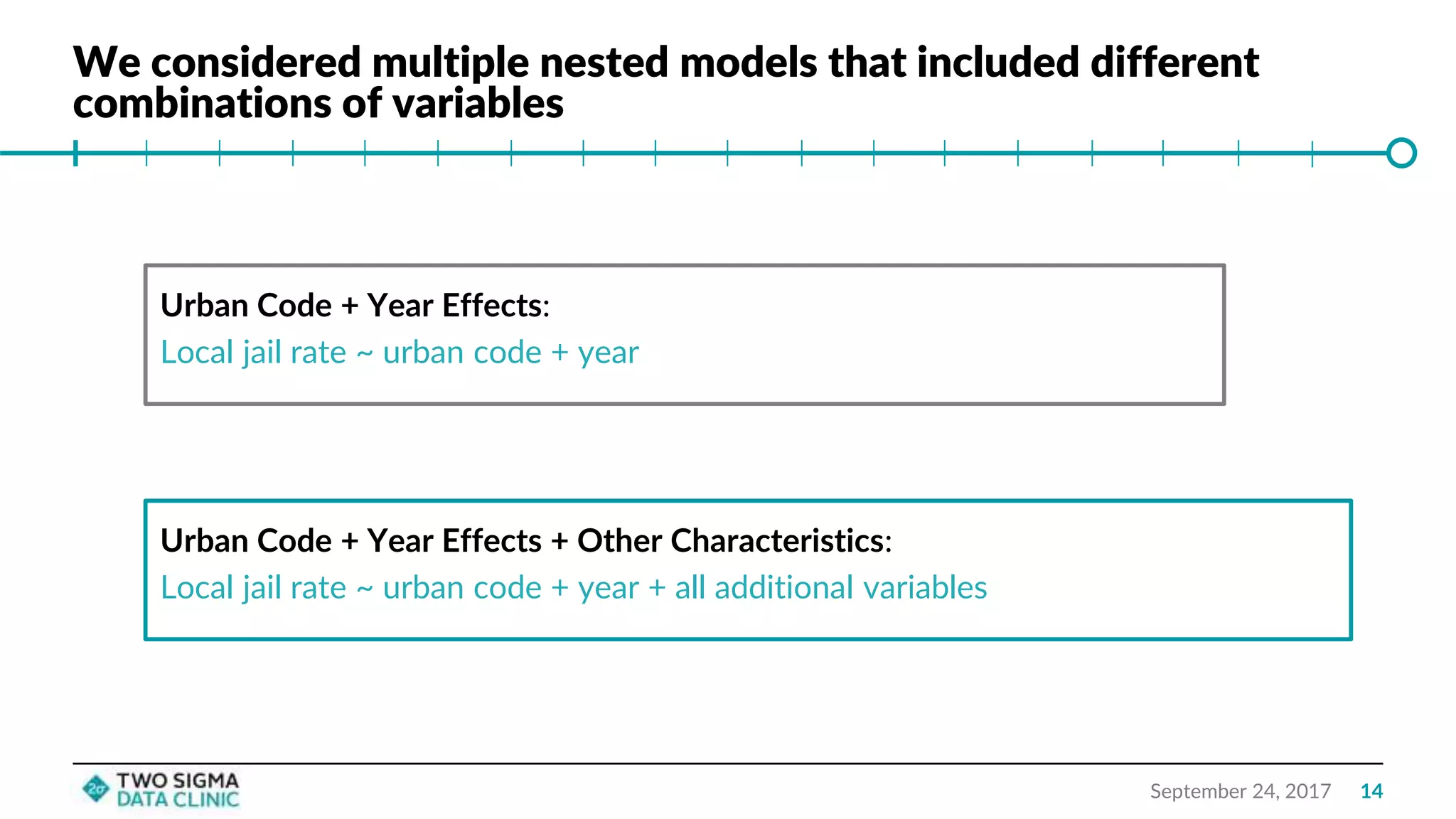
We considered multiple nested models that included different
combinations of variables
September 24, 2017
Urban Code + Year Effects:
Local jail rate ~ urban code + year
Urban Code + Year Effects + Other Characteristics:
Local jail rate ~ urban code + year + all additional variables
14
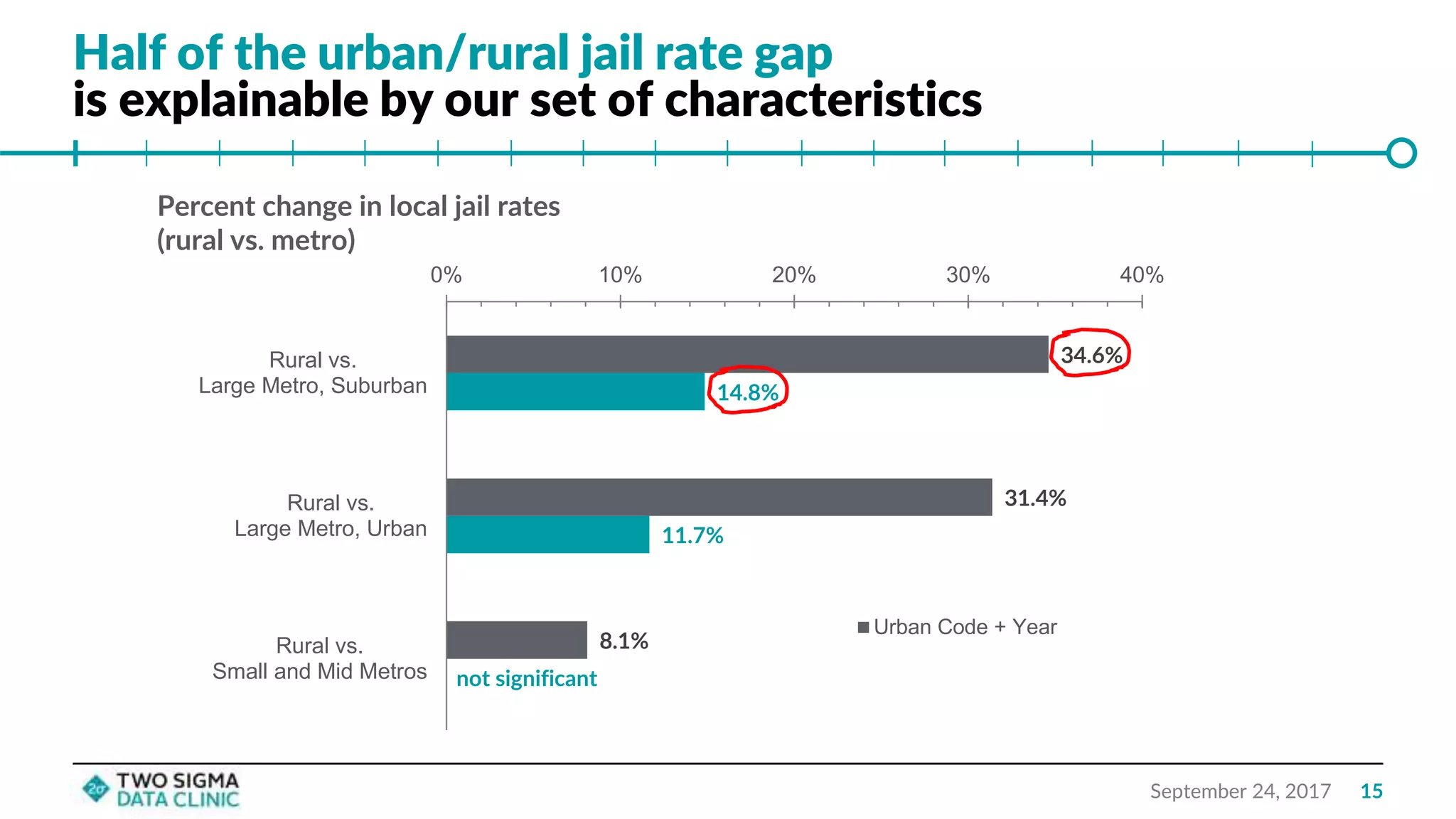
Half of the urban/rural jail rate gap
is explainable by our set of characteristics
September 24, 2017 15
34.6%
31.4%
8.1%
14.8%
11.7%
not significant
0% 10% 20% 30% 40%
Rural vs.
Large Metro, Suburban
Rural vs.
Large Metro, Urban
Rural vs.
Small and Mid Metros
Percent change in local jail rates
(rural vs. metro)
Urban Code + Year
Urban Code + Year + Other
Characteristics
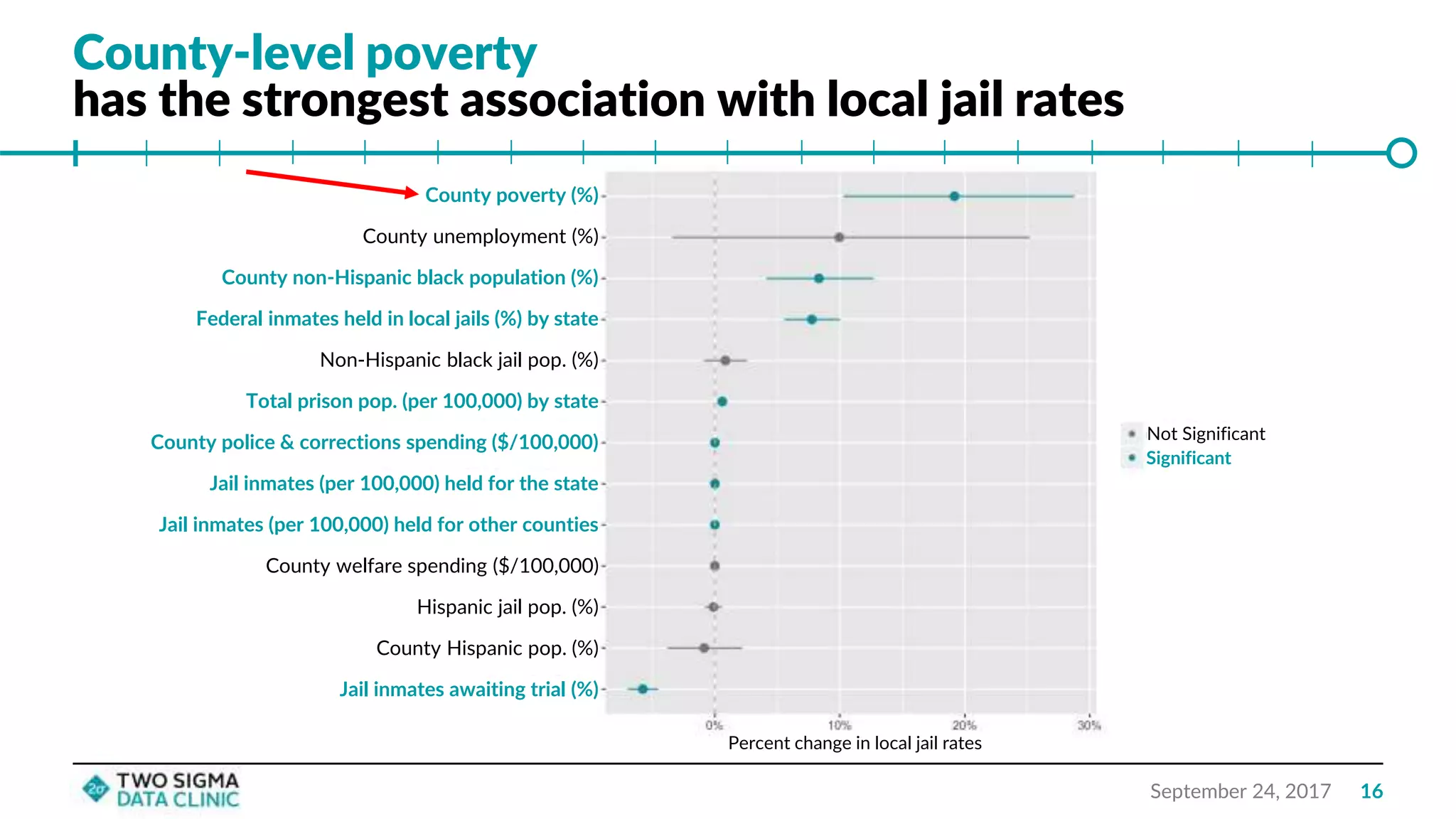
County-level poverty
has the strongest association with local jail rates
September 24, 2017
County poverty (%)
County unemployment (%)
Federal inmates held in local jails (%) by state
Non-Hispanic black jail pop. (%)
Total prison pop. (per 100,000) by state
Jail inmates (per 100,000) held for other counties
County welfare spending ($/100,000)
Hispanic jail pop. (%)
County Hispanic pop. (%)
Jail inmates awaiting trial (%)
County police & corrections spending ($/100,000) Not Significant
Significant
Jail inmates (per 100,000) held for the state
County non-Hispanic black population (%)
Percent change in local jail rates
16
How do counties compare to their peers?
September 24, 2017
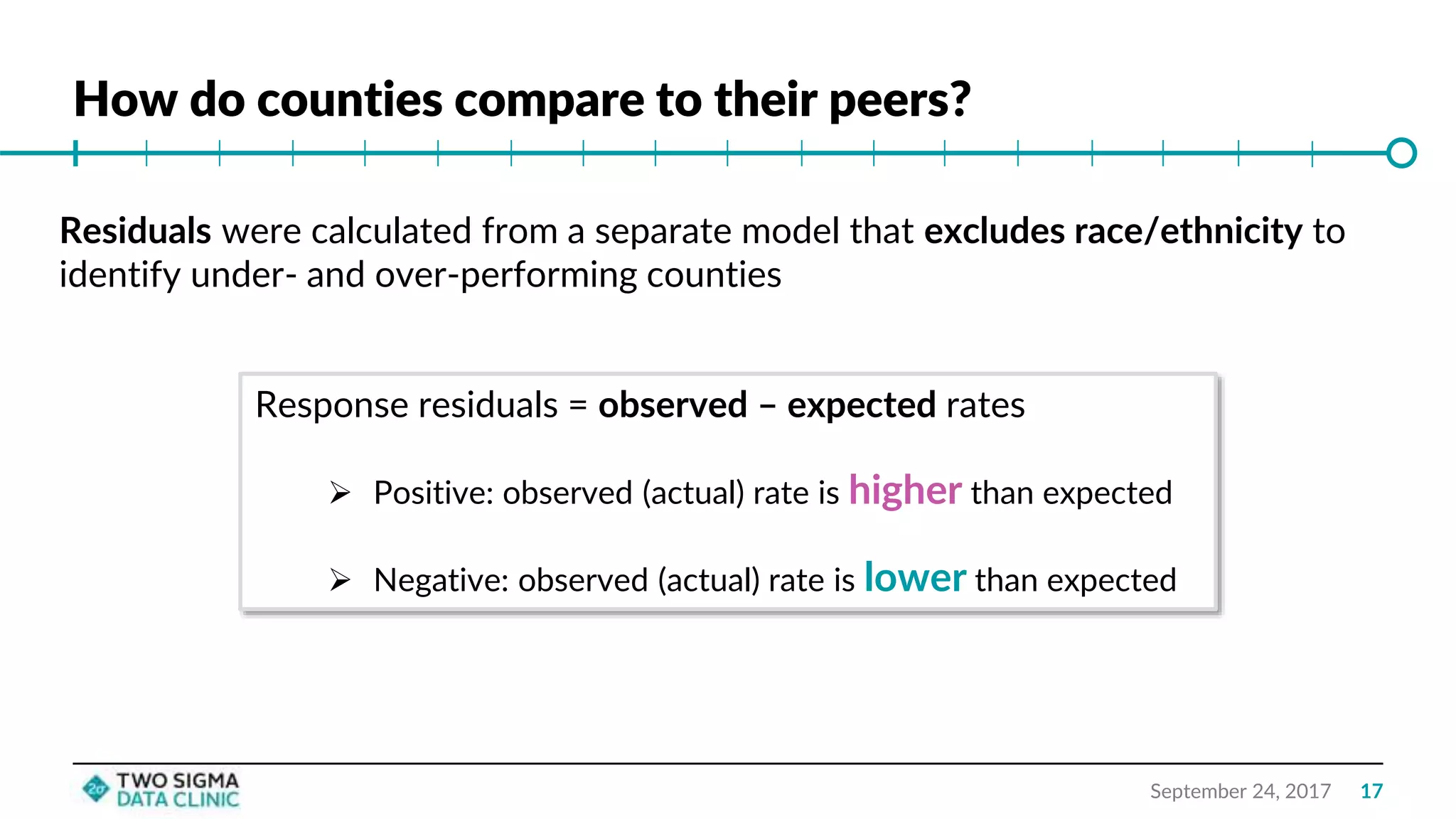
Response residuals = observed – expected rates
 Positive: observed (actual) rate is higher than expected
 Negative: observed (actual) rate is lower than expected
Residuals were calculated from a separate model that excludes race/ethnicity to
identify under- and over-performing counties
17
How do counties compare to their peers?
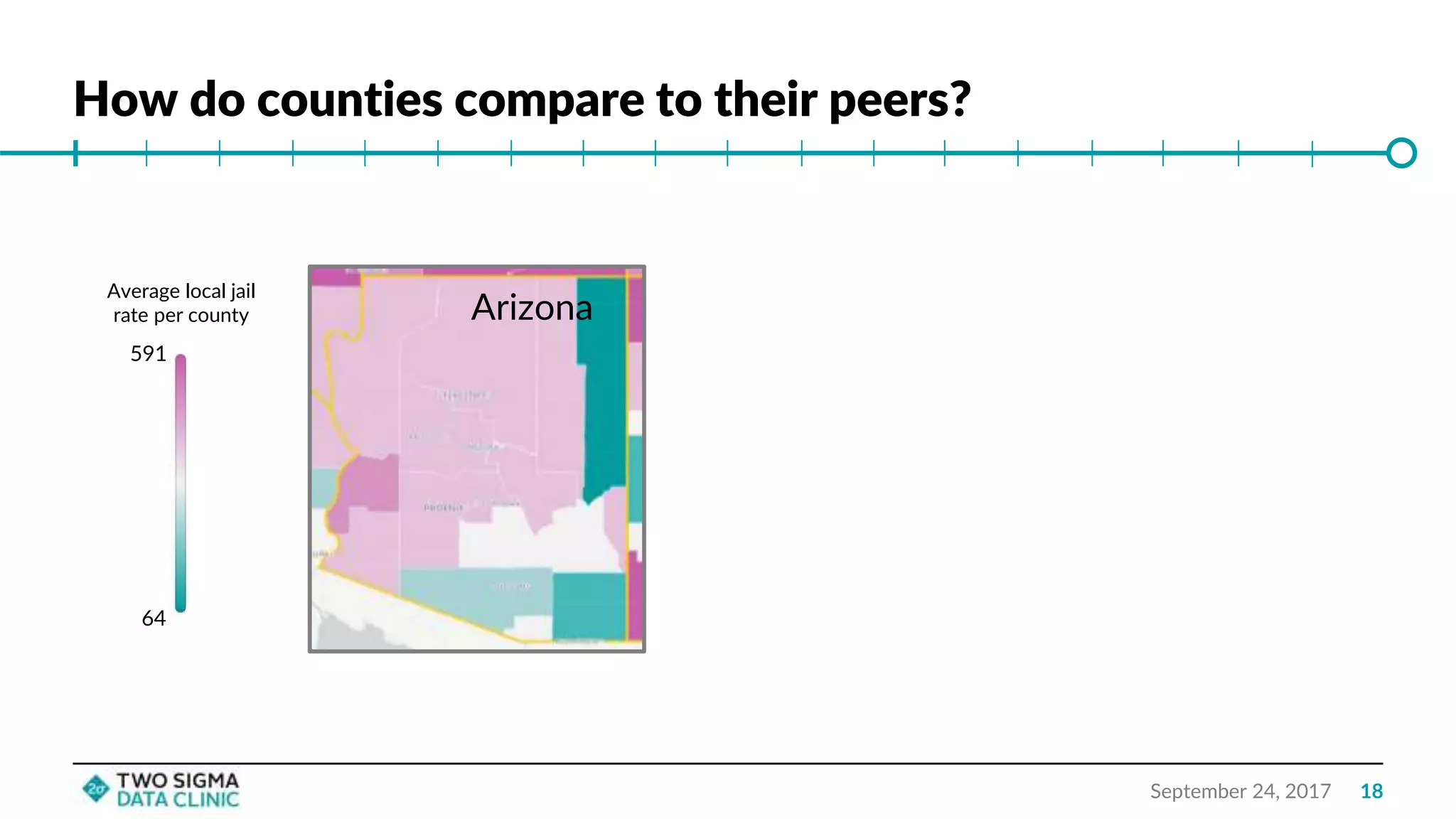
September 24, 2017 18
Arizona
591
64
Average local jail
rate per county
-122
152
Average residuals
per county
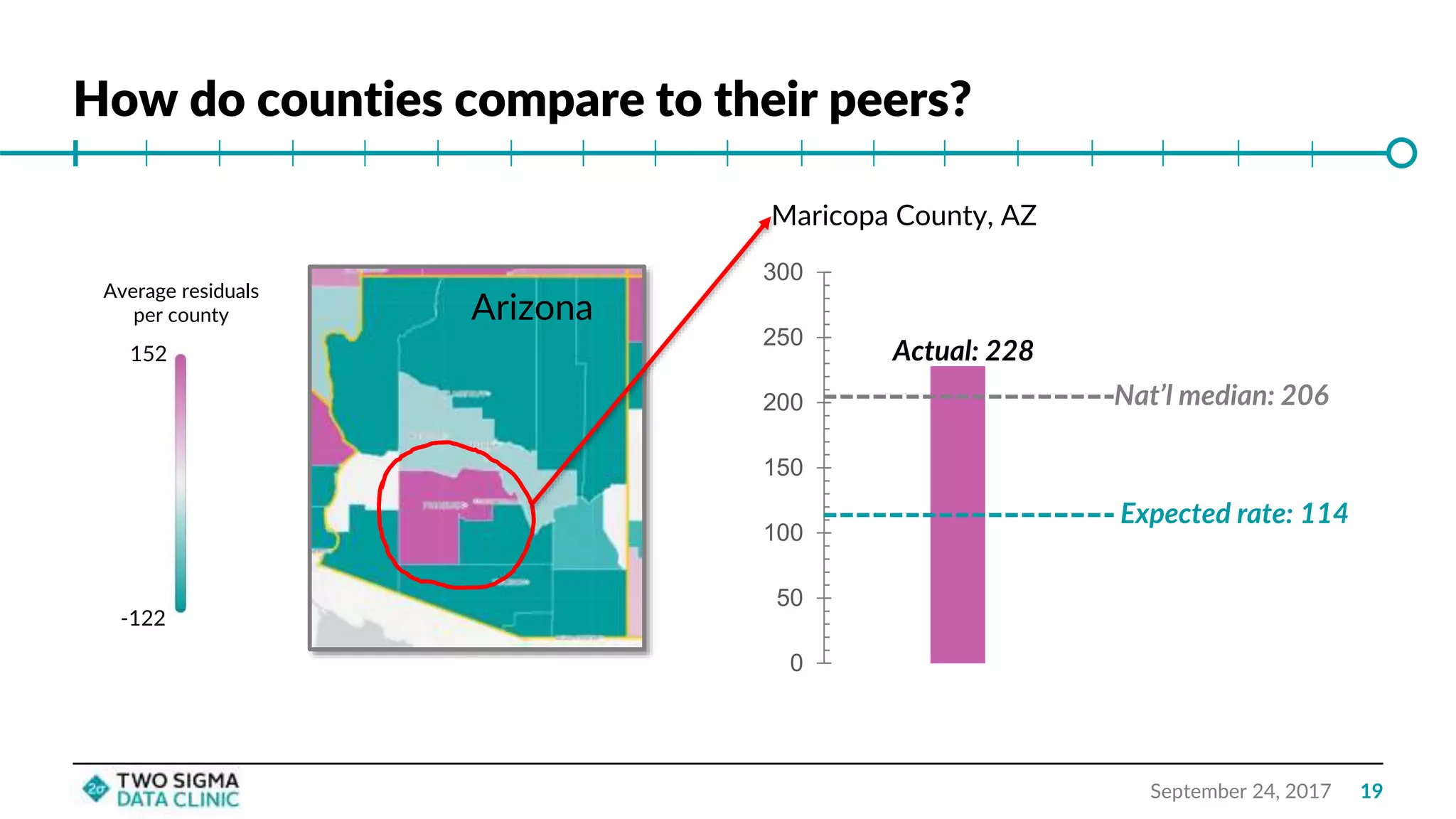
How do counties compare to their peers?
September 24, 2017 19
Arizona
Maricopa County, AZ
0
50
100
150
200
250
300
Actual: 228
Expected rate: 114
Nat’l median: 206
152
-122
Average residuals
per county
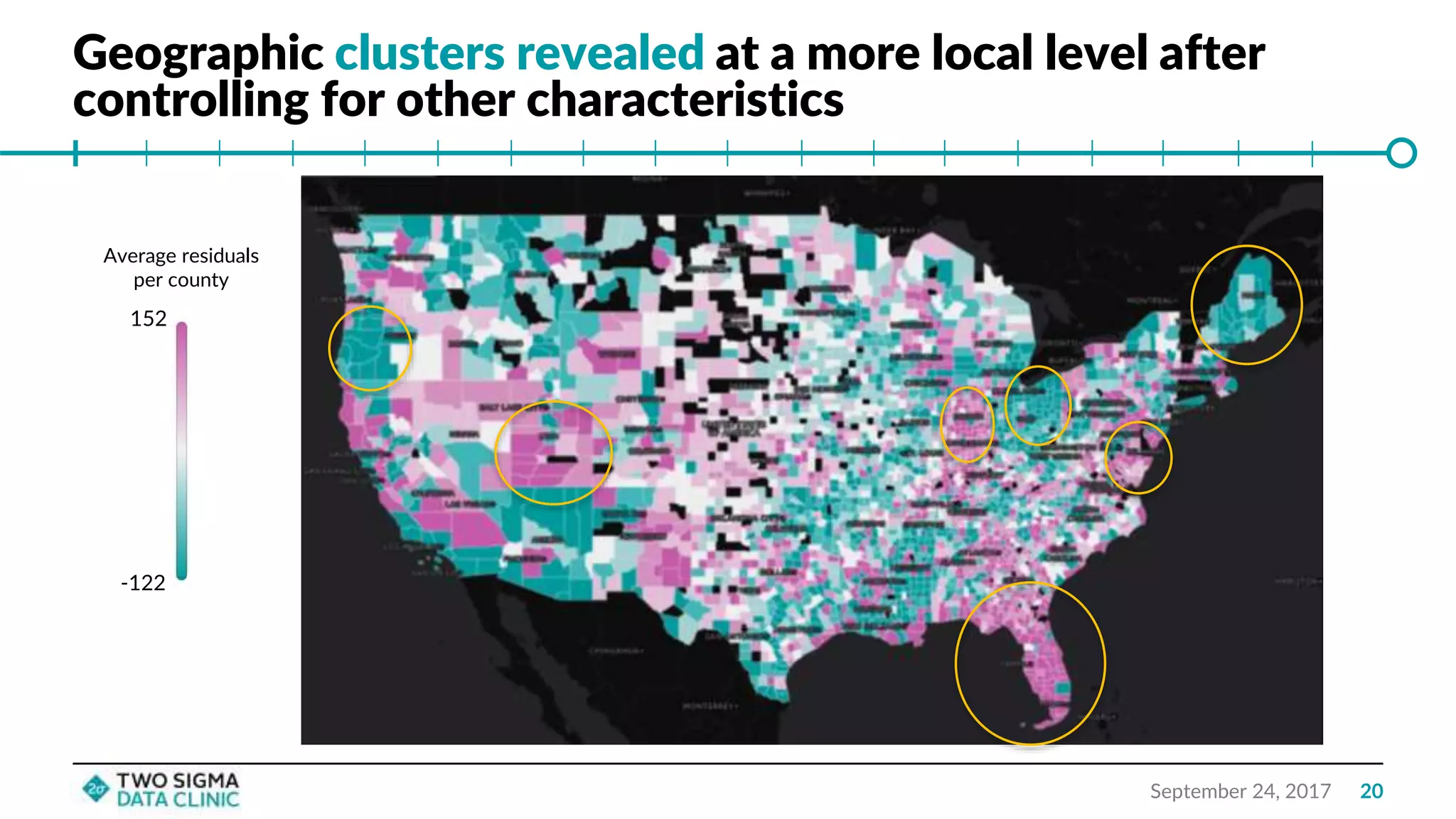
Geographic clusters revealed at a more local level after
controlling for other characteristics
September 24, 2017 20
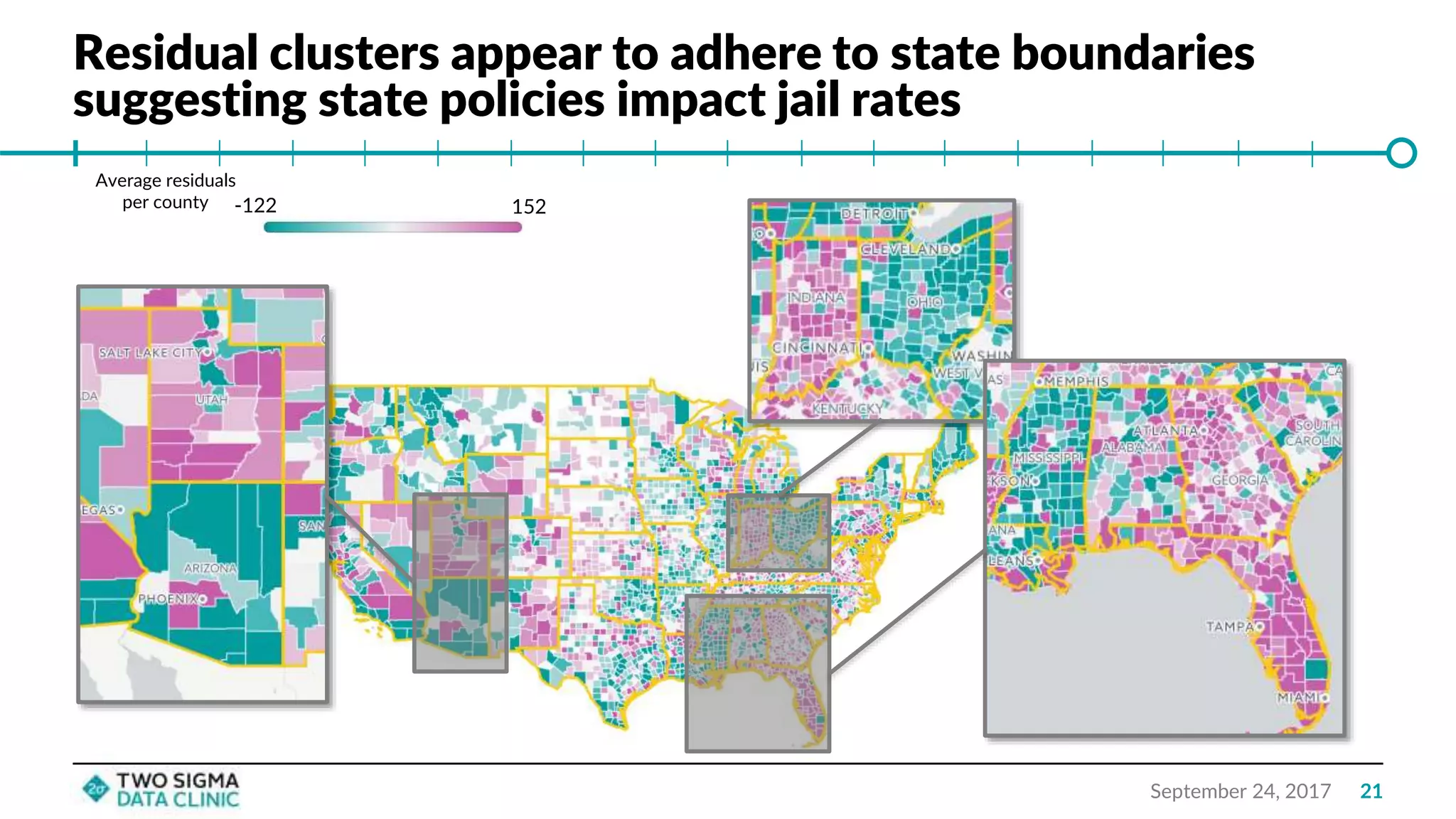
Residual clusters appear to adhere to state boundaries
suggesting state policies impact jail rates
September 24, 2017
Average residuals
per county -122 152
21
What we learned
September 24, 2017
 Half of the rural-urban divide can be explained by model covariates
 Poverty is important, more so than crime and arrest rates
 Residuals reveal local and state geographical clusters
 State policies may play an important role in local jail rates
22
Thank you
September 24, 2017
dataclinicinfo@twosigma.com
Co-authors:
Jacob Kang-Brown (Vera)
Chris Mulligan (Data Clinic)
Vinod Valsalam (Data Clinic)
Soumyo Chakraborty (Data Clinic)
Christian Henrichson (Vera)
Christine Zhang (Data Clinic)
23

Exploring the Urban – Rural Incarceration Divide: Drivers of Local Jail Incarceration Rates in the U.S.

  • 1.
    www.twosigma.com Exploring the Urban– Rural Incarceration Divide: Drivers of Local Jail Incarceration Rates in the U.S. Rachael Weiss Riley Two Sigma Data Clinic Bloomberg Data for Good Exchange September 24, 2017
  • 2.
    Important Legal Information September24, 2017 The views expressed herein are not necessarily the views of Two Sigma Investments, LP or any of its affiliates (collectively, “Two Sigma”). The information presented herein is only for informational and educational purposes and is not an offer to sell or the solicitation of an offer to buy any securities or other instruments. Additionally, the information is not intended to provide, and should not be relied upon for investment, accounting, legal or tax advice. Two Sigma makes no representations, express or implied, regarding the accuracy or completeness of this information, and you accept all risks in relying on the above information for any purpose whatsoever. This presentation shall remain the property of Two Sigma and Two Sigma reserves the right to require the return of this presentation at any time. Copyright © 2017 TWO SIGMA INVESTMENTS, LP. All rights reserved. 2
  • 3.
    The U.S. hasthe world’s highest incarceration rate September 24, 2017 3
  • 4.
    Rate has gonedown slightly in recent years September 24, 2017 4
  • 5.
    Mass Incarceration: thewhole pie 5 State Prisons 1.3 m Federal Prisons 197 K Total incarceration 2.3 m Local Jails 630 K September 24, 2017 Source: Prison Policy Initiative (2017)
  • 6.
    Research focuses onstate or federal prisons rather than local county jails September 24, 2017 0 20,000 40,000 60,000 80,000 100,000 "Prison" "Jail" Results for in paper title, from Google Scholar: 6 86,500 8,690
  • 7.
    Vera launched theIncarceration Trends project to facilitate county-level jail research September 24, 2017 7
  • 8.
    Rural counties havehigher local jail rates September 24, 2017 150 200 250 300 350 2000 2003 2006 2009 2012 Small and Mid Metros Large Metro, Suburban Large Metro, Urban Rural Local Jail Rate per 100,000 population 8
  • 9.
    Research questions September 24,2017 1. What are the characteristics of a county that are associated with local jail incarceration rates? 2. In terms of local jail incarceration rates, how do counties compare to their peers? 9
  • 10.
    The following variableswere included in the final model: September 24, 2017 YearUrban Code County’s metro/rural classification (4 categories) 2000 to 2013 + + Other Characteristics Latinos as percent of total jail population Blacks as percent of total jail population Percentage of total jail population awaiting trial Inmates held for other counties (per 100,000) by county Inmates held for the state (per 100,000) by county Jail The outcome variable is the local jail population per 100,000 by county 10
  • 11.
    The following variableswere included in the final model: September 24, 2017 Urban Code Year County’s metro/rural classification (4 categories) 2000 to 2013 + + Other Characteristics Hispanics as percent of county population Non-Hispanic blacks as percent of county population Percent of county living in poverty Percent unemployed in county County’s welfare spending (per 100,000) County County’s Police and Corrections spending (per 100,000) The outcome variable is the local jail population per 100,000 by county 11
  • 12.
    The following variableswere included in the final model: September 24, 2017 Urban Code Year County’s metro/rural classification (4 categories) 2000 to 2013 + + Other Characteristics Percent of federal prisoners held in local county jails State’s total prison population (per 100,000) State The outcome variable is the local jail population per 100,000 by county 12
  • 13.
    3,145 counties withdata from 1970 – 2013, but many had missing data 2,858 counties: 1,783 rural; 690 small/mid metro; 338 suburban; 47 urban Dependent variable represents counts Poisson distribution (log-linear model) Observations not independent (multiple years for each county leads to correlation within counties) Generalized estimating equations (GEE) model accounts for within-county correlations Prior to 2000, different census classification and lacking covariate data 14 years of data (2000 – 2013) September 24, 2017 A GEE model was specified to analyze the data Starting point Implication 13
  • 14.
    We considered multiplenested models that included different combinations of variables September 24, 2017 Urban Code + Year Effects: Local jail rate ~ urban code + year Urban Code + Year Effects + Other Characteristics: Local jail rate ~ urban code + year + all additional variables 14
  • 15.
    Half of theurban/rural jail rate gap is explainable by our set of characteristics September 24, 2017 15 34.6% 31.4% 8.1% 14.8% 11.7% not significant 0% 10% 20% 30% 40% Rural vs. Large Metro, Suburban Rural vs. Large Metro, Urban Rural vs. Small and Mid Metros Percent change in local jail rates (rural vs. metro) Urban Code + Year Urban Code + Year + Other Characteristics
  • 16.
    County-level poverty has thestrongest association with local jail rates September 24, 2017 County poverty (%) County unemployment (%) Federal inmates held in local jails (%) by state Non-Hispanic black jail pop. (%) Total prison pop. (per 100,000) by state Jail inmates (per 100,000) held for other counties County welfare spending ($/100,000) Hispanic jail pop. (%) County Hispanic pop. (%) Jail inmates awaiting trial (%) County police & corrections spending ($/100,000) Not Significant Significant Jail inmates (per 100,000) held for the state County non-Hispanic black population (%) Percent change in local jail rates 16
  • 17.
    How do countiescompare to their peers? September 24, 2017 Response residuals = observed – expected rates  Positive: observed (actual) rate is higher than expected  Negative: observed (actual) rate is lower than expected Residuals were calculated from a separate model that excludes race/ethnicity to identify under- and over-performing counties 17
  • 18.
    How do countiescompare to their peers? September 24, 2017 18 Arizona 591 64 Average local jail rate per county
  • 19.
    -122 152 Average residuals per county Howdo counties compare to their peers? September 24, 2017 19 Arizona Maricopa County, AZ 0 50 100 150 200 250 300 Actual: 228 Expected rate: 114 Nat’l median: 206
  • 20.
    152 -122 Average residuals per county Geographicclusters revealed at a more local level after controlling for other characteristics September 24, 2017 20
  • 21.
    Residual clusters appearto adhere to state boundaries suggesting state policies impact jail rates September 24, 2017 Average residuals per county -122 152 21
  • 22.
    What we learned September24, 2017  Half of the rural-urban divide can be explained by model covariates  Poverty is important, more so than crime and arrest rates  Residuals reveal local and state geographical clusters  State policies may play an important role in local jail rates 22
  • 23.
    Thank you September 24,2017 dataclinicinfo@twosigma.com Co-authors: Jacob Kang-Brown (Vera) Chris Mulligan (Data Clinic) Vinod Valsalam (Data Clinic) Soumyo Chakraborty (Data Clinic) Christian Henrichson (Vera) Christine Zhang (Data Clinic) 23