Exploring Music
Concert Paper Guidelines
Instructions
1) Choose. Pick a classical music concert from the list provided
on Blackboard. Sign up and buy tickets.
2) Research. Using reputable sources, learn about the composers
and music featured at the concert. I
recommend searching Google for program notes from major
orchestras.
3) Write. Write a typed, double-spaced, 2 -3 page research
paper, including properly formatted citations
using APA, MLA, or Chicago style. This must be done before
you attend the concert.
4) Cite. Cite your sources using in-text citations. Include a
works cited list with full citations using MLA,
APA, or Chicago. If you don’t know how to do this, read this.
5) Submit. Turn in your research paper under the “concerts” tab
in Blackboard 2 days before the concert
date. It will be checked for plagiarism.
6) Go. Plan ahead. Dress appropriately. Get to your concert on
time. If you’re late, you might not get in.
7) Listen. Use active listening during the concert. (See “at the
concert” below.)
8) Smile. Take a selfie or have someone take a picture of you
that clearly shows that you were at the
concert. In the lobby during intermission is a good time for this!
Save your ticket and program.
9) Interview. Talk to someone at the concert. Ask them why
they came and what they thought.
10) Write. Add a “part two” to your research paper. This second
part should be a typed, double-spaced, 2-3
page reaction paper to your concert. Talk about what you
thought, show off your active listening skills,
and include the results of your interview.
11) Add. Add your concert picture to the last page of your
paper. If you don’t have this, I can’t accept the
paper for credit. Staple your ticket to your paper.
12) Submit. Turn in a hard copy of your complete paper
(research part AND reaction part with picture and
ticket) in class on or before the due dates indicated.
At The Concert: Active Listening
Choose one piece from your concert to analyze. Identify the
meter, texture, and two other musical elements.
Reflect on the music. What emotions do you get from that
piece? Does it spark anything in your imagination?
Does it remind you of anything? What is it about the music that
creates those feelings and ideas?
Interview a fellow attendee after the show or during
intermission. Ask why they came and what they thought.
WARNING
DO NOT OVER-USE DIRECT QUOTATIONS. If your paper
has more than 50 words that are directly quoted, I will
return the paper to you, ungraded. Quotes can be useful, but you
have to know when and how to use them!
Blend your quotes within your narrative. Paraphrase when
appropriate. Read this.
DO NOT PLAGIARIZE. All sources, even if they are only
alluded to or paraphrased, must be cited.
http://guides.temple.edu/c.php?g=77953&p=528593
http://www.temple.edu/writingctr/support-for-
writers/documents/BecominganEffectiveWriterinCollege.pdf
http://www.bibme.org/citation-guide
http://infotrac.thomsonlearning.com/infowrite/res_quotations.ht
m
Grading Rubric
F
Student
D
student
C
student
B
student
A
student
Uses 1 source or
disreputable
sources. Sources
uncited.
Uses 1 or 2 sources,
which may be
questionable.
Sources citations
may have errors.
2 or 3 sources are
questionable. Some
sources may not be
cited properly.
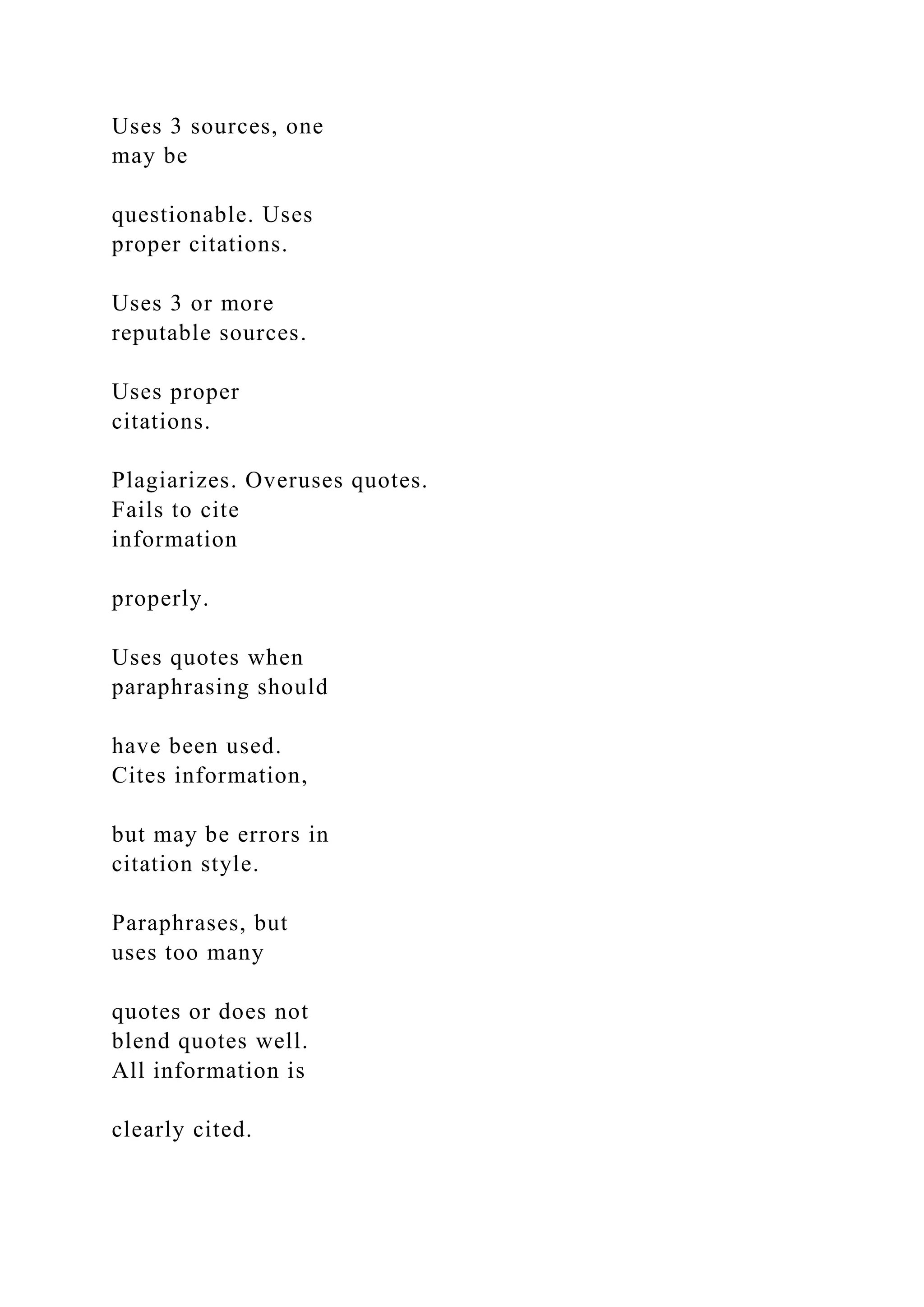
Uses 3 sources, one
may be
questionable. Uses
proper citations.
Uses 3 or more
reputable sources.
Uses proper
citations.
Plagiarizes. Overuses quotes.
Fails to cite
information
properly.
Uses quotes when
paraphrasing should
have been used.
Cites information,
but may be errors in
citation style.
Paraphrases, but
uses too many
quotes or does not
blend quotes well.
All information is
clearly cited.
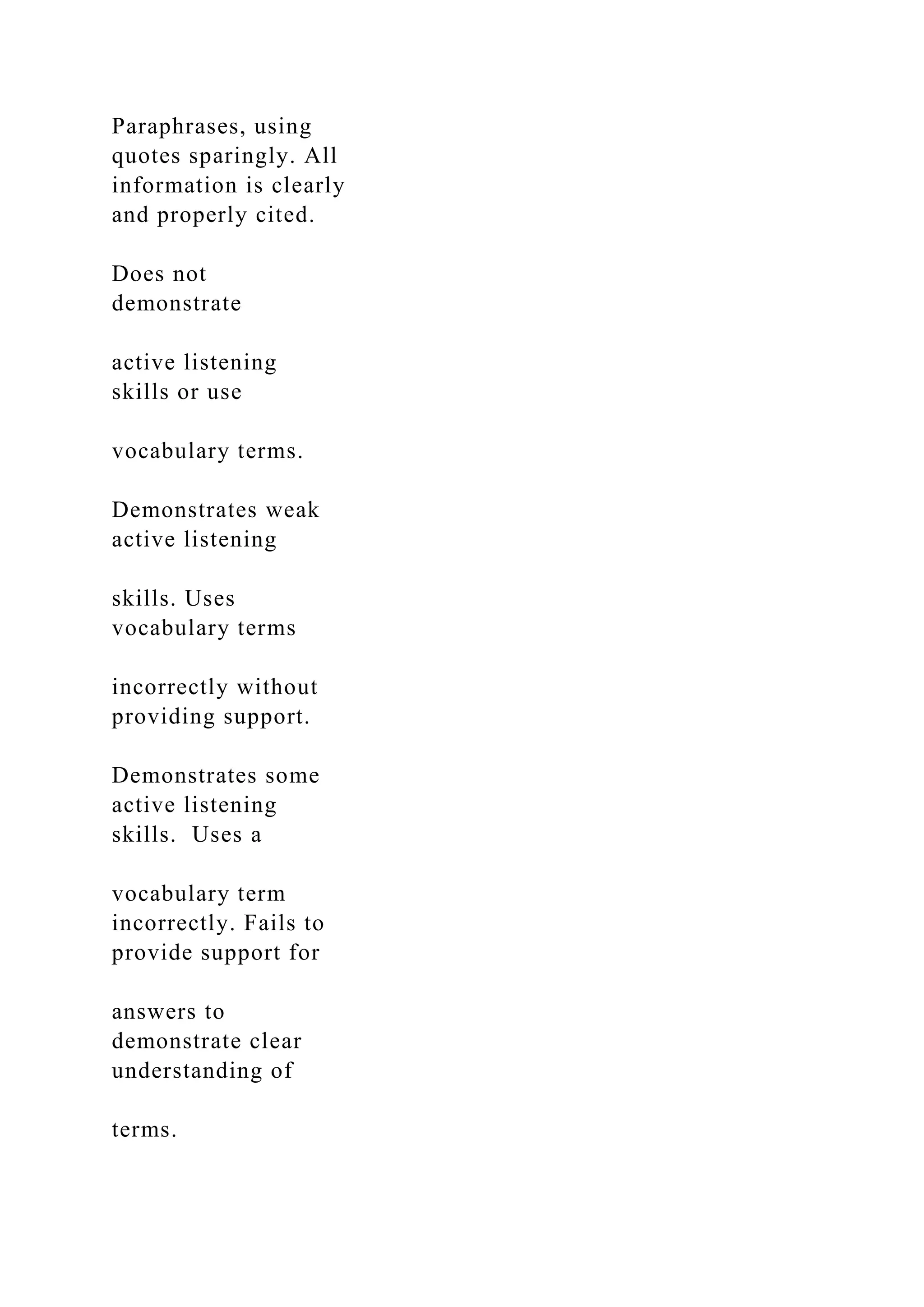
Paraphrases, using
quotes sparingly. All
information is clearly
and properly cited.
Does not
demonstrate
active listening
skills or use
vocabulary terms.
Demonstrates weak
active listening
skills. Uses
vocabulary terms
incorrectly without
providing support.
Demonstrates some
active listening
skills. Uses a
vocabulary term
incorrectly. Fails to
provide support for
answers to
demonstrate clear
understanding of
terms.
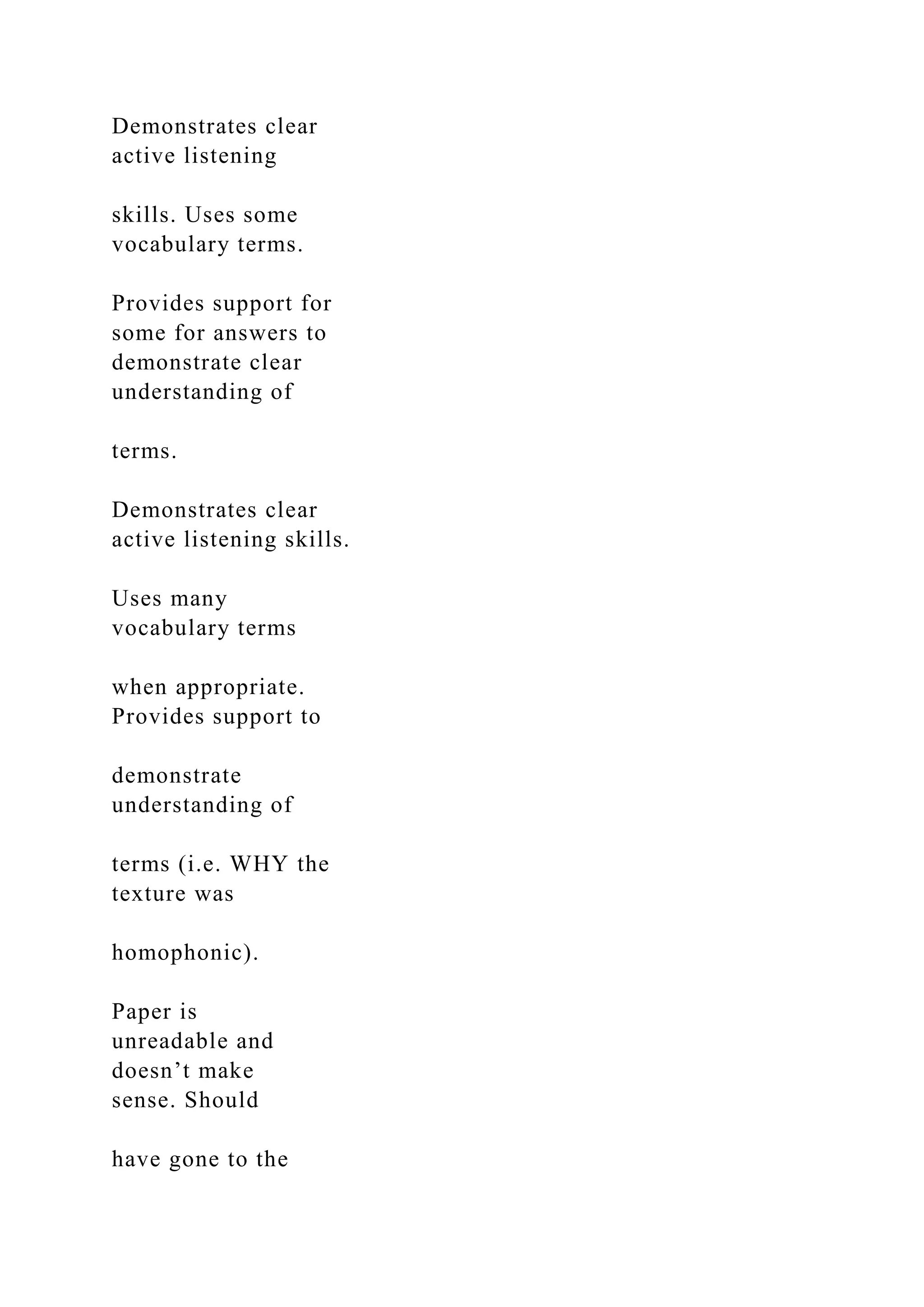
Demonstrates clear
active listening
skills. Uses some
vocabulary terms.
Provides support for
some for answers to
demonstrate clear
understanding of
terms.
Demonstrates clear
active listening skills.
Uses many
vocabulary terms
when appropriate.
Provides support to
demonstrate
understanding of
terms (i.e. WHY the
texture was
homophonic).
Paper is
unreadable and
doesn’t make
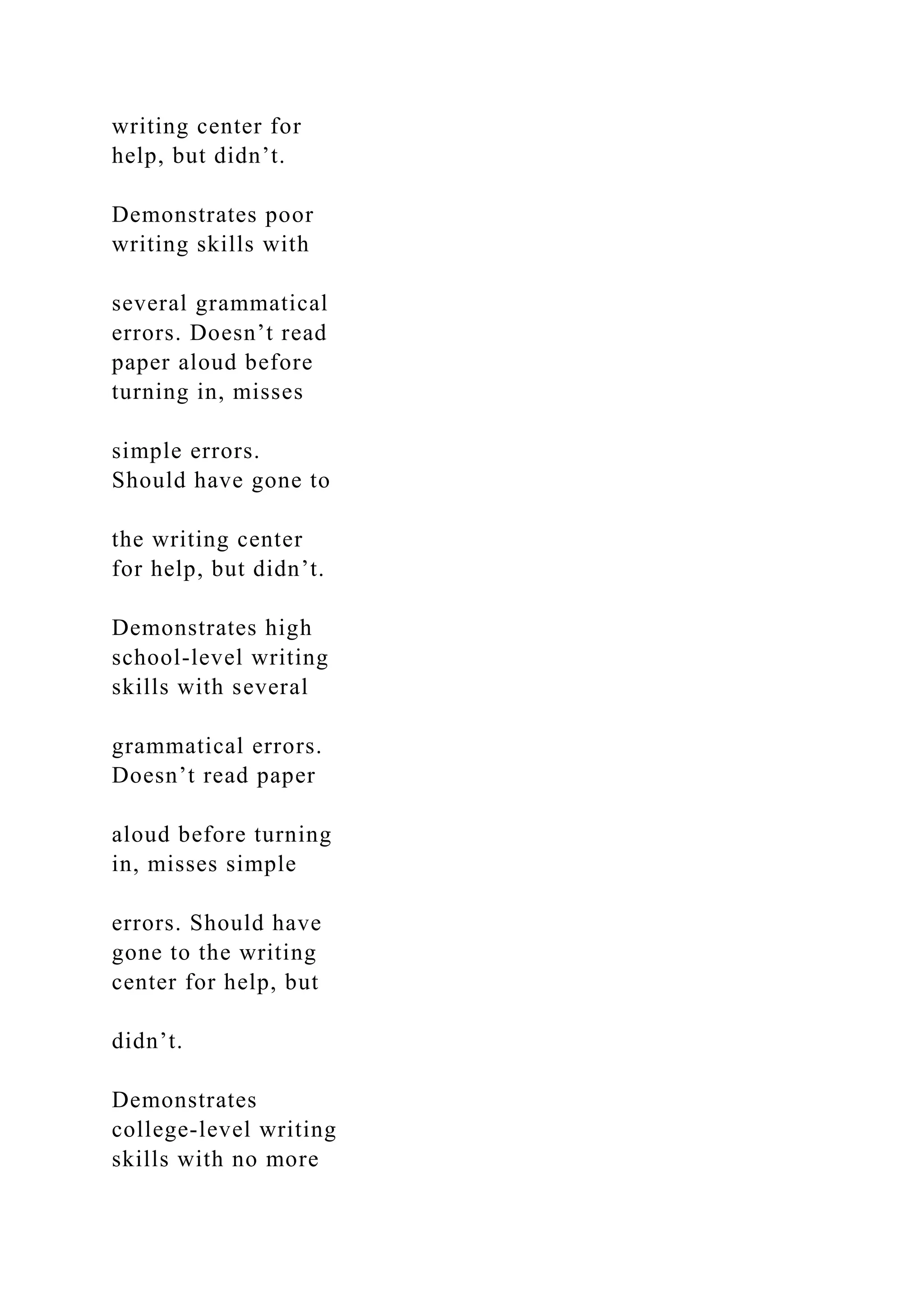
sense. Should
have gone to the
writing center for
help, but didn’t.
Demonstrates poor
writing skills with
several grammatical
errors. Doesn’t read
paper aloud before
turning in, misses
simple errors.
Should have gone to
the writing center
for help, but didn’t.
Demonstrates high
school-level writing
skills with several
grammatical errors.
Doesn’t read paper
aloud before turning
in, misses simple
errors. Should have
gone to the writing
center for help, but
didn’t.
Demonstrates
college-level writing
skills with no more
than 3-4
grammatical errors.
Proofreads, reads
paper aloud before
turning in. Goes to
the writing center
for help.
Demonstrates
college-level writing
skills with no more
than 1-2 grammatical
errors. Proofreads
carefully, reads paper
aloud before turning
in. Goes to the
writing center for
help if needed.
Turns in paper
more than 1 week
past the due date
or fails to turn in
either paper.
Forgets to submit
the research paper
before attending the
concert.
Turns in one or both
papers late.
Turns in papers on
time, but may have
forgotten to staple
or may have minor
formatting issues.
Turns in papers on
time or early and in
the correct format,
including a staple.
Didn’t take
picture.
Picture does not
prove student was
at the concert or
student expects
professor to view
picture on phone.
Forgets to put
picture on paper,
emails it after due
date.
Forgets to put
picture on paper,
emails it to
professor
immediately.
Includes concert
picture on the last
page of the paper as
instructed (black and
white is fine).
http://www.temple.edu/writingctr/index.asp

Exploring Music Concert Paper Guidelines Instructions.docx

  • 1.
    Exploring Music Concert PaperGuidelines Instructions 1) Choose. Pick a classical music concert from the list provided on Blackboard. Sign up and buy tickets. 2) Research. Using reputable sources, learn about the composers and music featured at the concert. I recommend searching Google for program notes from major orchestras. 3) Write. Write a typed, double-spaced, 2 -3 page research paper, including properly formatted citations using APA, MLA, or Chicago style. This must be done before you attend the concert. 4) Cite. Cite your sources using in-text citations. Include a works cited list with full citations using MLA, APA, or Chicago. If you don’t know how to do this, read this. 5) Submit. Turn in your research paper under the “concerts” tab in Blackboard 2 days before the concert date. It will be checked for plagiarism.
  • 2.
    6) Go. Planahead. Dress appropriately. Get to your concert on time. If you’re late, you might not get in. 7) Listen. Use active listening during the concert. (See “at the concert” below.) 8) Smile. Take a selfie or have someone take a picture of you that clearly shows that you were at the concert. In the lobby during intermission is a good time for this! Save your ticket and program. 9) Interview. Talk to someone at the concert. Ask them why they came and what they thought. 10) Write. Add a “part two” to your research paper. This second part should be a typed, double-spaced, 2-3 page reaction paper to your concert. Talk about what you thought, show off your active listening skills, and include the results of your interview. 11) Add. Add your concert picture to the last page of your paper. If you don’t have this, I can’t accept the paper for credit. Staple your ticket to your paper. 12) Submit. Turn in a hard copy of your complete paper (research part AND reaction part with picture and ticket) in class on or before the due dates indicated.
  • 3.
    At The Concert:Active Listening Choose one piece from your concert to analyze. Identify the meter, texture, and two other musical elements. Reflect on the music. What emotions do you get from that piece? Does it spark anything in your imagination? Does it remind you of anything? What is it about the music that creates those feelings and ideas? Interview a fellow attendee after the show or during intermission. Ask why they came and what they thought. WARNING DO NOT OVER-USE DIRECT QUOTATIONS. If your paper has more than 50 words that are directly quoted, I will return the paper to you, ungraded. Quotes can be useful, but you have to know when and how to use them! Blend your quotes within your narrative. Paraphrase when appropriate. Read this. DO NOT PLAGIARIZE. All sources, even if they are only alluded to or paraphrased, must be cited. http://guides.temple.edu/c.php?g=77953&p=528593 http://www.temple.edu/writingctr/support-for- writers/documents/BecominganEffectiveWriterinCollege.pdf http://www.bibme.org/citation-guide http://infotrac.thomsonlearning.com/infowrite/res_quotations.ht m
  • 4.
    Grading Rubric F Student D student C student B student A student Uses 1source or disreputable sources. Sources uncited. Uses 1 or 2 sources, which may be questionable. Sources citations may have errors. 2 or 3 sources are questionable. Some sources may not be cited properly.
  • 5.
    Uses 3 sources,one may be questionable. Uses proper citations. Uses 3 or more reputable sources. Uses proper citations. Plagiarizes. Overuses quotes. Fails to cite information properly. Uses quotes when paraphrasing should have been used. Cites information, but may be errors in citation style. Paraphrases, but uses too many quotes or does not blend quotes well. All information is clearly cited.
  • 6.
    Paraphrases, using quotes sparingly.All information is clearly and properly cited. Does not demonstrate active listening skills or use vocabulary terms. Demonstrates weak active listening skills. Uses vocabulary terms incorrectly without providing support. Demonstrates some active listening skills. Uses a vocabulary term incorrectly. Fails to provide support for answers to demonstrate clear understanding of terms.
  • 7.
    Demonstrates clear active listening skills.Uses some vocabulary terms. Provides support for some for answers to demonstrate clear understanding of terms. Demonstrates clear active listening skills. Uses many vocabulary terms when appropriate. Provides support to demonstrate understanding of terms (i.e. WHY the texture was homophonic). Paper is unreadable and doesn’t make sense. Should have gone to the
  • 8.
    writing center for help,but didn’t. Demonstrates poor writing skills with several grammatical errors. Doesn’t read paper aloud before turning in, misses simple errors. Should have gone to the writing center for help, but didn’t. Demonstrates high school-level writing skills with several grammatical errors. Doesn’t read paper aloud before turning in, misses simple errors. Should have gone to the writing center for help, but didn’t. Demonstrates college-level writing skills with no more
  • 9.
    than 3-4 grammatical errors. Proofreads,reads paper aloud before turning in. Goes to the writing center for help. Demonstrates college-level writing skills with no more than 1-2 grammatical errors. Proofreads carefully, reads paper aloud before turning in. Goes to the writing center for help if needed. Turns in paper more than 1 week past the due date or fails to turn in either paper. Forgets to submit the research paper
  • 10.
    before attending the concert. Turnsin one or both papers late. Turns in papers on time, but may have forgotten to staple or may have minor formatting issues. Turns in papers on time or early and in the correct format, including a staple. Didn’t take picture. Picture does not prove student was at the concert or student expects professor to view picture on phone. Forgets to put picture on paper, emails it after due date. Forgets to put picture on paper,
  • 11.
    emails it to professor immediately. Includesconcert picture on the last page of the paper as instructed (black and white is fine). http://www.temple.edu/writingctr/index.asp http://www.temple.edu/writingctr/index.asp http://www.temple.edu/writingctr/index.asp http://www.temple.edu/writingctr/index.asp http://www.temple.edu/writingctr/index.asp http://www.temple.edu/writingctr/index.asp http://www.temple.edu/writingctr/index.asp http://www.temple.edu/writingctr/index.asp http://www.temple.edu/writingctr/index.asp http://www.temple.edu/writingctr/index.asp http://www.temple.edu/writingctr/index.asp http://www.temple.edu/writingctr/index.asp http://www.temple.edu/writingctr/index.asp http://www.temple.edu/writingctr/index.asp