Explanation:
Master Honey is a franchise-style company that sells a variety
of products derived from raw honey harvested from both local
and international bee-farms, called apiaries. Our company was
established in 1988 by its founder, Sergio Saladrigas, back
when honey was a booming industry, and its business was
conducted based on quality rather than quantity. With this
philosophy in mind, Master Honey has created a culture of good
quality work with competitive pricing. Since its creation,
Master Honey has had a successful expansion throughout most
of Central and South-Florida in the form of two different types
of establishments for retail selling that have made the brand
differentiate itself from the competition:
For rather big retail space, Master Honey developed a
trademarked concept for a retail-store called “Honey Caves”.
Usually placed in malls and around touristic areas, Honey Caves
are stores of 1,000-1,500 squared feet that offer the whole
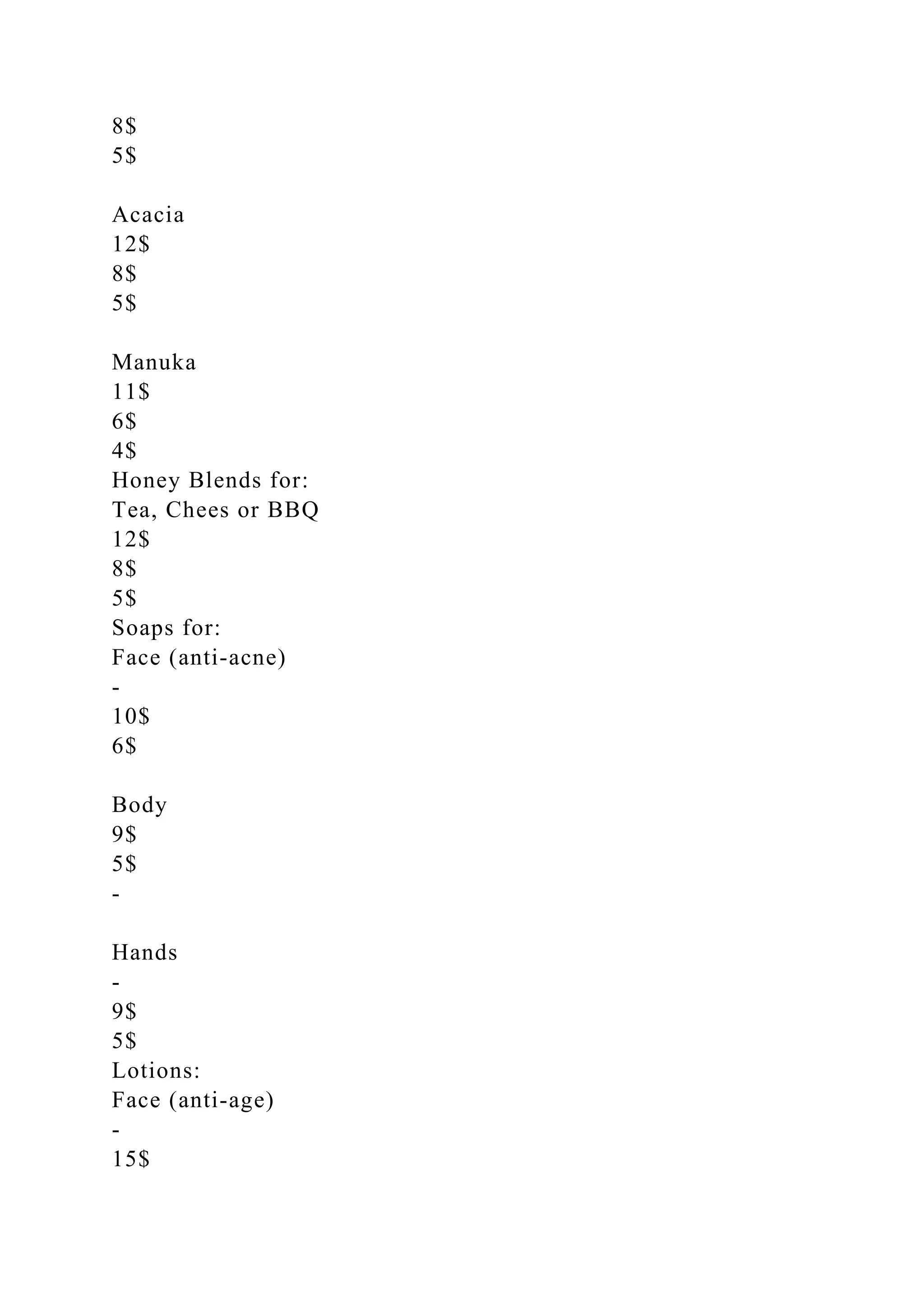
catalog of Mater Honey’s products. The product catalog
includes:
Products
Types
Large size
Medium size
Small size
Artisanal honey:
Local Honey:
Tupelo
9$
5$
3$
Orange blossom
8$
4$
2$
Red Pepper
7$
4$
2$
Golden Berry
7$
4$
2$
Wildflower
6$
3$
2$
International Honey:
Blue Gum
11$
6$
4$
Beech Wood
10$
5$
3$
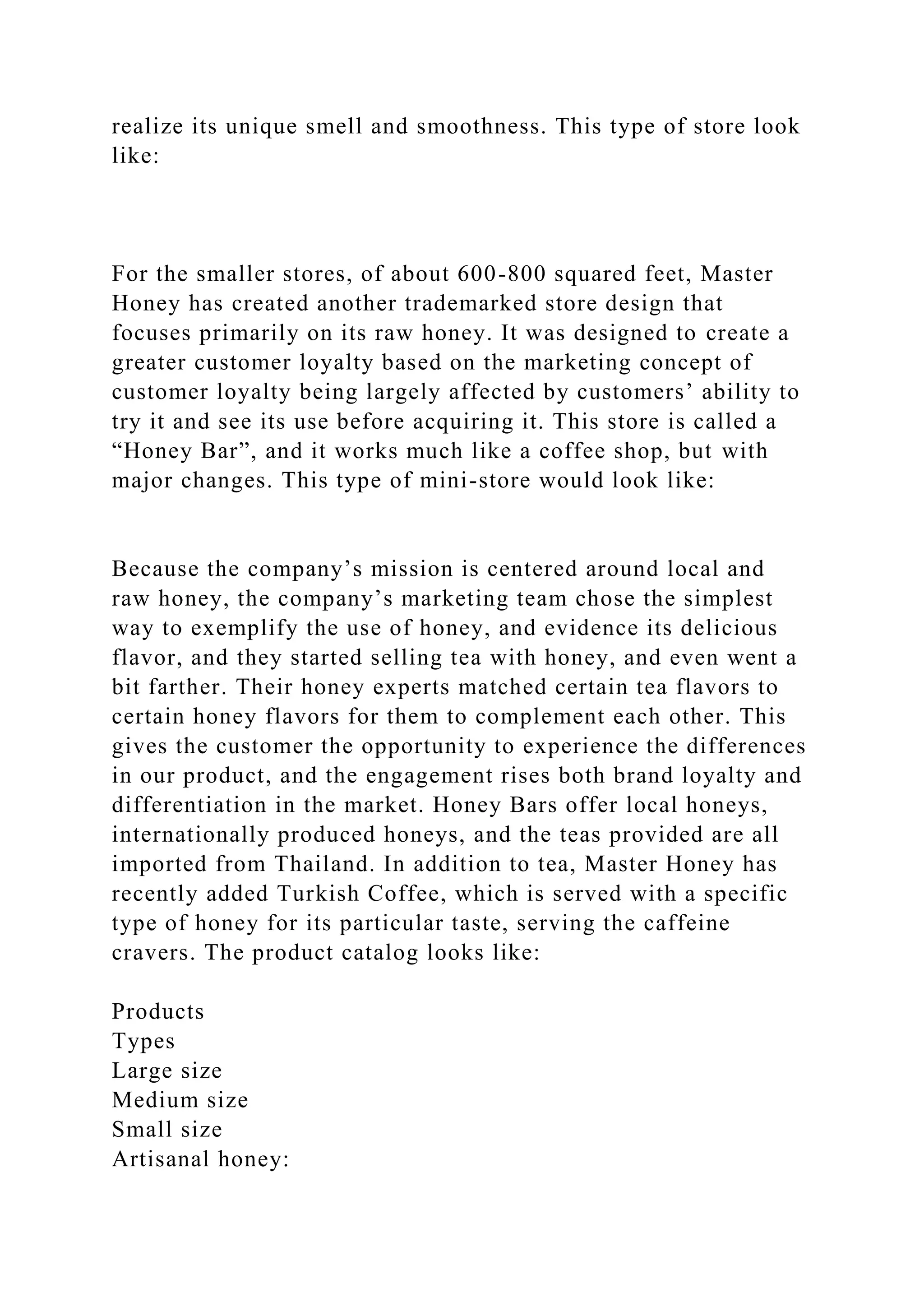
Acai
12$
8$
5$
Acacia
12$
8$
5$
Manuka
11$
6$
4$
Honey Blends for:
Tea, Chees or BBQ
12$
8$
5$
Soaps for:
Face (anti-acne)
-
10$
6$
Body
9$
5$
-
Hands
-
9$
5$
Lotions:
Face (anti-age)
-
15$
10$
Body
-
10$
7$
Other Products:
Shampoo
15$
11$
7$
Conditioner
15$
11$
7$
The honey caves have a specific and trademarked design that
makes customers feel “like a bee in a hive”. The temperature is
set at a low 72 degrees Fahrenheit with low light, and with a
constant and subtle bee sound. In addition, the shelves are
designed to look like a hive, with a series of hexagonally
shaped boxes that designed to be piled together. This gives the
shop managers freedom to change the setting of the store with
ease and freedom of choice. Furthermore, the stores offer
samples from all of our different products so the customers can
see, feel, smell and taste the quality that differentiates our
product. Also, every single one of our franchised Honey Caves
has a large table in the middle of the store in a hexagonal shape
displaying many large and artisanal-looking bottles that carry
all of the honey types that we offer (that way, if a certain type
of honey is not in store, it can still be shipped). The first bottle
on each line contains a pump from which the customer can serve
previously measured quantities in a small sample cup, and taste
the differences in flavor and texture among all honeys from
different flowers. The same technique is used with our soaps by
providing 3 to 7 sinks for our customers to try the soaps, and
realize its unique smell and smoothness. This type of store look
like:
For the smaller stores, of about 600-800 squared feet, Master
Honey has created another trademarked store design that
focuses primarily on its raw honey. It was designed to create a
greater customer loyalty based on the marketing concept of
customer loyalty being largely affected by customers’ ability to
try it and see its use before acquiring it. This store is called a
“Honey Bar”, and it works much like a coffee shop, but with
major changes. This type of mini-store would look like:
Because the company’s mission is centered around local and
raw honey, the company’s marketing team chose the simplest
way to exemplify the use of honey, and evidence its delicious
flavor, and they started selling tea with honey, and even went a
bit farther. Their honey experts matched certain tea flavors to
certain honey flavors for them to complement each other. This
gives the customer the opportunity to experience the differences
in our product, and the engagement rises both brand loyalty and
differentiation in the market. Honey Bars offer local honeys,
internationally produced honeys, and the teas provided are all
imported from Thailand. In addition to tea, Master Honey has
recently added Turkish Coffee, which is served with a specific
type of honey for its particular taste, serving the caffeine
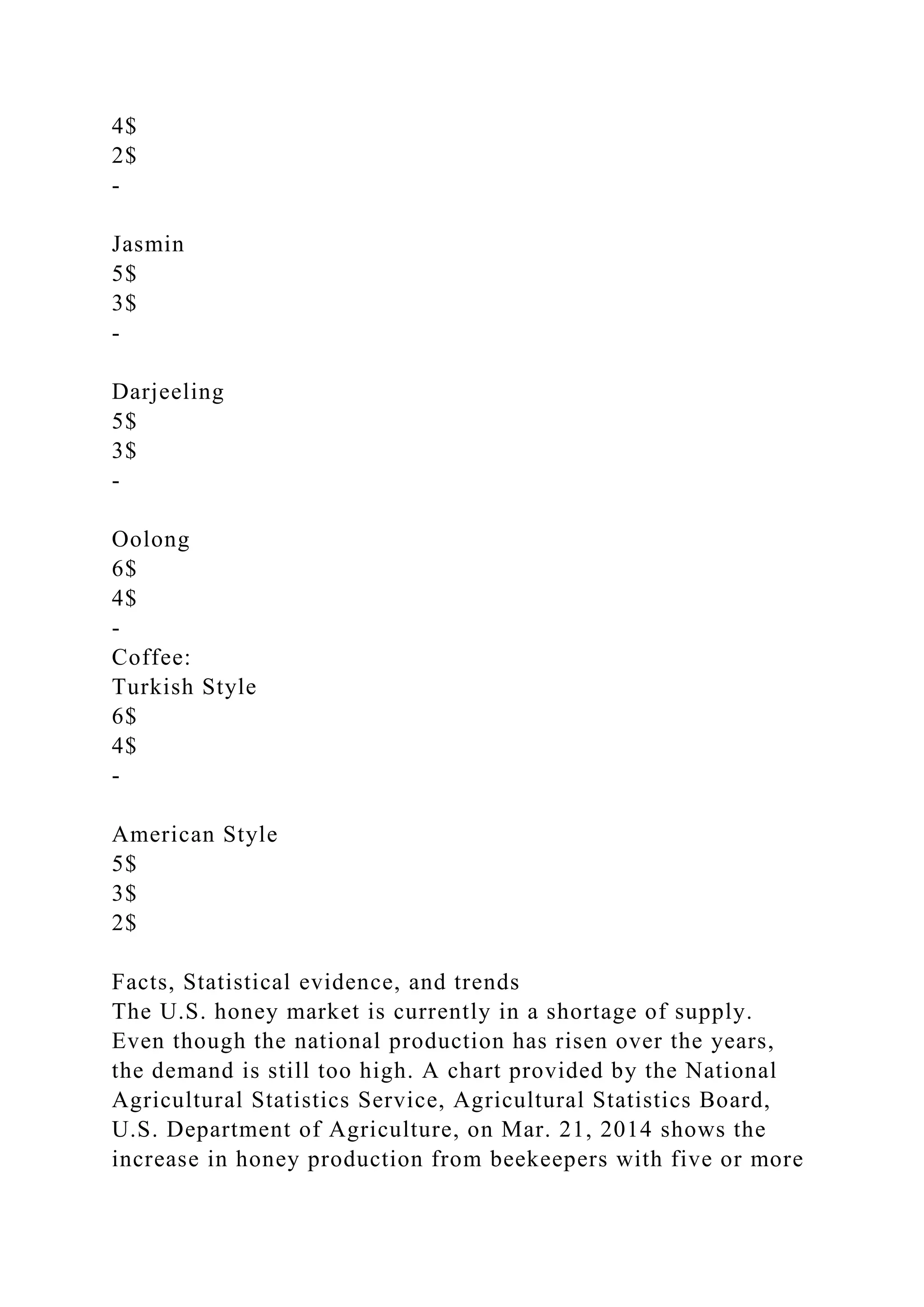
cravers. The product catalog looks like:
Products
Types
Large size
Medium size
Small size
Artisanal honey:
Local Honey:
Tupelo
9$
5$
3$
Orange blossom
8$
4$
2$
Wildflower
6$
3$
2$
International Honey:
Acai
12$
8$
5$
Acacia
12$
8$
5$
Honey Blend For:
Tea
12$
8$
5$
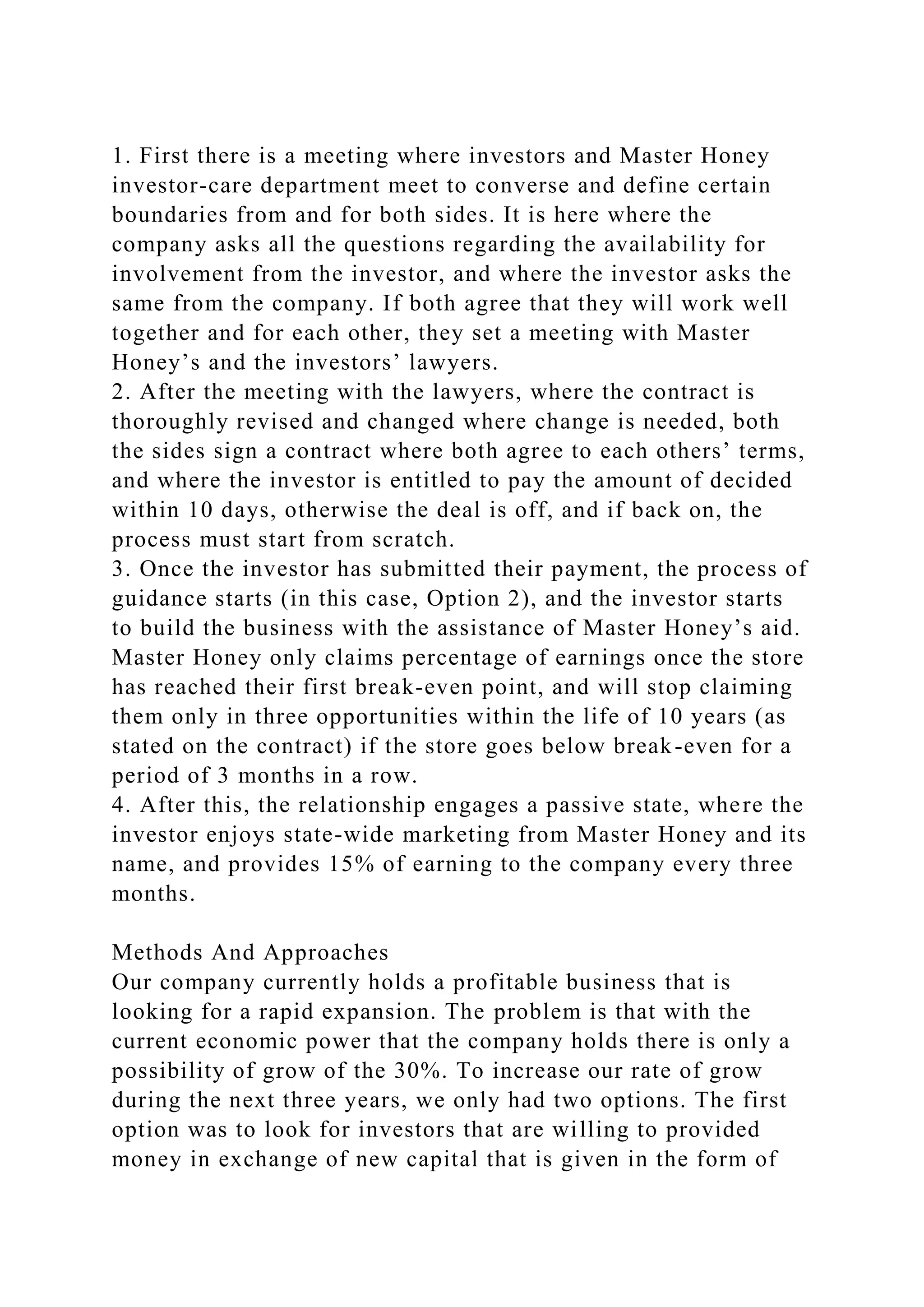
Cups of Teas:
Green, Black and Herbal
4$
2$
-
Jasmin
5$
3$
-
Darjeeling
5$
3$
-
Oolong
6$
4$
-
Coffee:
Turkish Style
6$
4$
-
American Style
5$
3$
2$
Facts, Statistical evidence, and trends
The U.S. honey market is currently in a shortage of supply.
Even though the national production has risen over the years,
the demand is still too high. A chart provided by the National
Agricultural Statistics Service, Agricultural Statistics Board,
U.S. Department of Agriculture, on Mar. 21, 2014 shows the
increase in honey production from beekeepers with five or more
colonies of 5% from 2012 to 2013, totaling 149 million pounds
of raw honey. However, demand for honey in the U.S. is much
higher, totaling 410 million pounds by 2010, according to the
USDA. Because of this shortage, the total amount of imported
honey total a surprising 61% of total honey consumption by
2010 in U.S. This has increased in the last couple of years, to
the point where the National Honey Board calculates that the
current consumption of honey is 2/3 to ¾ imported.
These numbers mean an incredible opportunity, and even more
when unified with the not-so-new trend of healthy products and
organic foods. The cost of building a retail store in malls in
South and Central Florida ranges from $150,000 to $350,000 for
a store of averaged 1,000 squared feet. This number, however,
can be regained within a year or less, as has been the case of
hundreds of our stores, particularly in the booming State of
Florida, who’s GDP has grown steadily over the last 10 years,
as well as a growing population of 23.5%, as provided by the
Florida Department of State. Because of this, based on our
experience and investigation, return on investment can reach as
high as 20% within the first three years, with a break-even point
arriving at the third to fifth month. Also, our research has
evidenced that the more time the store exists, the more success
it experience. This has been the case because of the local image
of the Master Honey’s, which is adopted more with time, adding
intangible strengths to the business. This shows the positive
effect on such a long-term investment.
Analysis of action
Master Honey has developed two different courses of action to
acquire and build on the franchise:
Option 1: with a payment of $600,000 (which can be given in
parts, specified upon negotiation), Master Honey assumes the
costs and processes of building on the franchise. Master Honey
decides the location in the selected city or county, the space
necessary, makes the pertinent changes to the store, negotiates
rent and/or purchase of the space, searches for employees, and
designs and delivers a local marketing campaign, assuming all
costs of it for the pre-opening of the store. After this, the store
owner is in charge of the management and marketing of the
store. Before signing, investors must sign the non-competition
agreement, and sign a compromise to manage the store. This is
an excellent option for investors who are looking to invest their
money in a beautiful concept of a store with almost-guaranteed
success, and that want to enjoy from the benefit of experience
and research that is behind Master Honey’s history.
Option 2: with a payment of $250,000 (which can be given in
parts, specified upon negotiation), Master Honey grants the
investor with the rights to establish the store, and provides with
a recommended guideline of actions for the opening of the store
based on a long history of experience, along with three levels of
budget required for three types of marketing campaigns.
Although Master Honey is not assuming leadership in the
process of building on the establishment, it is indeed available
for guidance and help in all aspects because, after all, the
investor’s success is Master Honey’s success.
For both options, Master Honey takes full responsibility on
calculating and providing the necessary supply to meet the
demand of the store, along with the shipping connections and
guarantees of delivery that characterize the company. In
addition, the investors will enjoy the limited legal liability that
comes with the company’s legal structure, if all guidelines are
followed as agreed and previously defined.
Pros and Cons
The most popular and recommended course of action for
investors is Option 2. The pros and cons of said option will be
explained thoroughly:
Pros
Cons
The investment needed to be granted the right of ownership is
significantly lower than Option 1, as well as the market’s
competition.
Since the investor has freedom, the responsibility of the store’s
success is much more on the investor’s side, whom may or may
not be prepared to take such challenges
The investor has all freedom to shape and place the store
wherever he or she pleases. Also, there are many aspects of the
store that can be subject to change, as specified on the contract.
Though the investor will enjoy of an excellent guidance
program, many practical decisions will fall on the investor, and
without close care, extra and unnecessary charges may appear,
or exist and stay hidden.
The guidance provided to the investors is remarkable. The
company is recognized for its excellent investor-care program.
This, among other reasons, is what has made the company the
most wanted franchise in the industry.
The time it might take the investor is usually significantly
longer than with Option 1. The experience behind long years of
work has made the practice something quick for Master Honey,
but it is not always the case with investors, and the time before
earning are visible is usually longer.
Because of the freedom of choice, the investor can choose
whatever marketing campaign or style they want. This could
significantly reduce the costs, or even improve the expected
earnings
Once the business is launched, guidance from Master Honey is
reduced, since it cannot assume the costs of forever providing
guidance to older businesses. Though many might see this as a
pro, some might consider this a con.
Procedures
The process to buy a franchise right from Master Honey as
become simple over the years, given that the investor agrees
with all of the company’s terms, and the company agrees with
the investors’.
1. First there is a meeting where investors and Master Honey
investor-care department meet to converse and define certain
boundaries from and for both sides. It is here where the
company asks all the questions regarding the availability for
involvement from the investor, and where the investor asks the
same from the company. If both agree that they will work well
together and for each other, they set a meeting with Master
Honey’s and the investors’ lawyers.
2. After the meeting with the lawyers, where the contract is
thoroughly revised and changed where change is needed, both
the sides sign a contract where both agree to each others’ terms,
and where the investor is entitled to pay the amount of decided
within 10 days, otherwise the deal is off, and if back on, the
process must start from scratch.
3. Once the investor has submitted their payment, the process of
guidance starts (in this case, Option 2), and the investor starts
to build the business with the assistance of Master Honey’s aid.
Master Honey only claims percentage of earnings once the store
has reached their first break-even point, and will stop claiming
them only in three opportunities within the life of 10 years (as
stated on the contract) if the store goes below break-even for a
period of 3 months in a row.
4. After this, the relationship engages a passive state, where the
investor enjoys state-wide marketing from Master Honey and its
name, and provides 15% of earning to the company every three
months.
Methods And Approaches
Our company currently holds a profitable business that is
looking for a rapid expansion. The problem is that with the
current economic power that the company holds there is only a
possibility of grow of the 30%. To increase our rate of grow
during the next three years, we only had two options. The first
option was to look for investors that are willing to provided
money in exchange of new capital that is given in the form of
one of our franchise store, or the second option that was to get a
loan from a bank. The approach that Master Honey took to solve
this problem was the most profitable and the most community
oriented one, because by offering an open ownership to
investor, not only are we helping the economy of the state in
which this stores are opening, but also we are supporting
entrepreneurs and other investors to have a different and stable
financial resource.
Criteria
The criteria that Master Honey used in order to find the best
solution to this problem was: looking for the less economical
risky option, look for the option that was more socially oriented
and the most flexible inversion that would allow the fastest
grow.

ExplanationMaster Honey is a franchise-style company that sel.docx

  • 1.
    Explanation: Master Honey isa franchise-style company that sells a variety of products derived from raw honey harvested from both local and international bee-farms, called apiaries. Our company was established in 1988 by its founder, Sergio Saladrigas, back when honey was a booming industry, and its business was conducted based on quality rather than quantity. With this philosophy in mind, Master Honey has created a culture of good quality work with competitive pricing. Since its creation, Master Honey has had a successful expansion throughout most of Central and South-Florida in the form of two different types of establishments for retail selling that have made the brand differentiate itself from the competition: For rather big retail space, Master Honey developed a trademarked concept for a retail-store called “Honey Caves”. Usually placed in malls and around touristic areas, Honey Caves are stores of 1,000-1,500 squared feet that offer the whole catalog of Mater Honey’s products. The product catalog includes: Products Types Large size Medium size Small size Artisanal honey: Local Honey: Tupelo
  • 2.
    9$ 5$ 3$ Orange blossom 8$ 4$ 2$ Red Pepper 7$ 4$ 2$ GoldenBerry 7$ 4$ 2$ Wildflower 6$ 3$ 2$ International Honey: Blue Gum 11$ 6$ 4$ Beech Wood 10$ 5$ 3$ Acai 12$
  • 3.
    8$ 5$ Acacia 12$ 8$ 5$ Manuka 11$ 6$ 4$ Honey Blends for: Tea,Chees or BBQ 12$ 8$ 5$ Soaps for: Face (anti-acne) - 10$ 6$ Body 9$ 5$ - Hands - 9$ 5$ Lotions: Face (anti-age) - 15$
  • 4.
    10$ Body - 10$ 7$ Other Products: Shampoo 15$ 11$ 7$ Conditioner 15$ 11$ 7$ The honeycaves have a specific and trademarked design that makes customers feel “like a bee in a hive”. The temperature is set at a low 72 degrees Fahrenheit with low light, and with a constant and subtle bee sound. In addition, the shelves are designed to look like a hive, with a series of hexagonally shaped boxes that designed to be piled together. This gives the shop managers freedom to change the setting of the store with ease and freedom of choice. Furthermore, the stores offer samples from all of our different products so the customers can see, feel, smell and taste the quality that differentiates our product. Also, every single one of our franchised Honey Caves has a large table in the middle of the store in a hexagonal shape displaying many large and artisanal-looking bottles that carry all of the honey types that we offer (that way, if a certain type of honey is not in store, it can still be shipped). The first bottle on each line contains a pump from which the customer can serve previously measured quantities in a small sample cup, and taste the differences in flavor and texture among all honeys from different flowers. The same technique is used with our soaps by providing 3 to 7 sinks for our customers to try the soaps, and
  • 5.
    realize its uniquesmell and smoothness. This type of store look like: For the smaller stores, of about 600-800 squared feet, Master Honey has created another trademarked store design that focuses primarily on its raw honey. It was designed to create a greater customer loyalty based on the marketing concept of customer loyalty being largely affected by customers’ ability to try it and see its use before acquiring it. This store is called a “Honey Bar”, and it works much like a coffee shop, but with major changes. This type of mini-store would look like: Because the company’s mission is centered around local and raw honey, the company’s marketing team chose the simplest way to exemplify the use of honey, and evidence its delicious flavor, and they started selling tea with honey, and even went a bit farther. Their honey experts matched certain tea flavors to certain honey flavors for them to complement each other. This gives the customer the opportunity to experience the differences in our product, and the engagement rises both brand loyalty and differentiation in the market. Honey Bars offer local honeys, internationally produced honeys, and the teas provided are all imported from Thailand. In addition to tea, Master Honey has recently added Turkish Coffee, which is served with a specific type of honey for its particular taste, serving the caffeine cravers. The product catalog looks like: Products Types Large size Medium size Small size Artisanal honey:
  • 6.
    Local Honey: Tupelo 9$ 5$ 3$ Orange blossom 8$ 4$ 2$ Wildflower 6$ 3$ 2$ InternationalHoney: Acai 12$ 8$ 5$ Acacia 12$ 8$ 5$ Honey Blend For: Tea 12$ 8$ 5$ Cups of Teas: Green, Black and Herbal
  • 7.
    4$ 2$ - Jasmin 5$ 3$ - Darjeeling 5$ 3$ - Oolong 6$ 4$ - Coffee: Turkish Style 6$ 4$ - American Style 5$ 3$ 2$ Facts,Statistical evidence, and trends The U.S. honey market is currently in a shortage of supply. Even though the national production has risen over the years, the demand is still too high. A chart provided by the National Agricultural Statistics Service, Agricultural Statistics Board, U.S. Department of Agriculture, on Mar. 21, 2014 shows the increase in honey production from beekeepers with five or more
  • 8.
    colonies of 5%from 2012 to 2013, totaling 149 million pounds of raw honey. However, demand for honey in the U.S. is much higher, totaling 410 million pounds by 2010, according to the USDA. Because of this shortage, the total amount of imported honey total a surprising 61% of total honey consumption by 2010 in U.S. This has increased in the last couple of years, to the point where the National Honey Board calculates that the current consumption of honey is 2/3 to ¾ imported. These numbers mean an incredible opportunity, and even more when unified with the not-so-new trend of healthy products and organic foods. The cost of building a retail store in malls in South and Central Florida ranges from $150,000 to $350,000 for a store of averaged 1,000 squared feet. This number, however, can be regained within a year or less, as has been the case of hundreds of our stores, particularly in the booming State of Florida, who’s GDP has grown steadily over the last 10 years, as well as a growing population of 23.5%, as provided by the Florida Department of State. Because of this, based on our experience and investigation, return on investment can reach as high as 20% within the first three years, with a break-even point arriving at the third to fifth month. Also, our research has evidenced that the more time the store exists, the more success it experience. This has been the case because of the local image of the Master Honey’s, which is adopted more with time, adding intangible strengths to the business. This shows the positive effect on such a long-term investment. Analysis of action Master Honey has developed two different courses of action to acquire and build on the franchise: Option 1: with a payment of $600,000 (which can be given in parts, specified upon negotiation), Master Honey assumes the costs and processes of building on the franchise. Master Honey decides the location in the selected city or county, the space necessary, makes the pertinent changes to the store, negotiates
  • 9.
    rent and/or purchaseof the space, searches for employees, and designs and delivers a local marketing campaign, assuming all costs of it for the pre-opening of the store. After this, the store owner is in charge of the management and marketing of the store. Before signing, investors must sign the non-competition agreement, and sign a compromise to manage the store. This is an excellent option for investors who are looking to invest their money in a beautiful concept of a store with almost-guaranteed success, and that want to enjoy from the benefit of experience and research that is behind Master Honey’s history. Option 2: with a payment of $250,000 (which can be given in parts, specified upon negotiation), Master Honey grants the investor with the rights to establish the store, and provides with a recommended guideline of actions for the opening of the store based on a long history of experience, along with three levels of budget required for three types of marketing campaigns. Although Master Honey is not assuming leadership in the process of building on the establishment, it is indeed available for guidance and help in all aspects because, after all, the investor’s success is Master Honey’s success. For both options, Master Honey takes full responsibility on calculating and providing the necessary supply to meet the demand of the store, along with the shipping connections and guarantees of delivery that characterize the company. In addition, the investors will enjoy the limited legal liability that comes with the company’s legal structure, if all guidelines are followed as agreed and previously defined. Pros and Cons The most popular and recommended course of action for investors is Option 2. The pros and cons of said option will be explained thoroughly: Pros Cons
  • 10.
    The investment neededto be granted the right of ownership is significantly lower than Option 1, as well as the market’s competition. Since the investor has freedom, the responsibility of the store’s success is much more on the investor’s side, whom may or may not be prepared to take such challenges The investor has all freedom to shape and place the store wherever he or she pleases. Also, there are many aspects of the store that can be subject to change, as specified on the contract. Though the investor will enjoy of an excellent guidance program, many practical decisions will fall on the investor, and without close care, extra and unnecessary charges may appear, or exist and stay hidden. The guidance provided to the investors is remarkable. The company is recognized for its excellent investor-care program. This, among other reasons, is what has made the company the most wanted franchise in the industry. The time it might take the investor is usually significantly longer than with Option 1. The experience behind long years of work has made the practice something quick for Master Honey, but it is not always the case with investors, and the time before earning are visible is usually longer. Because of the freedom of choice, the investor can choose whatever marketing campaign or style they want. This could significantly reduce the costs, or even improve the expected earnings Once the business is launched, guidance from Master Honey is reduced, since it cannot assume the costs of forever providing guidance to older businesses. Though many might see this as a pro, some might consider this a con. Procedures The process to buy a franchise right from Master Honey as become simple over the years, given that the investor agrees with all of the company’s terms, and the company agrees with the investors’.
  • 11.
    1. First thereis a meeting where investors and Master Honey investor-care department meet to converse and define certain boundaries from and for both sides. It is here where the company asks all the questions regarding the availability for involvement from the investor, and where the investor asks the same from the company. If both agree that they will work well together and for each other, they set a meeting with Master Honey’s and the investors’ lawyers. 2. After the meeting with the lawyers, where the contract is thoroughly revised and changed where change is needed, both the sides sign a contract where both agree to each others’ terms, and where the investor is entitled to pay the amount of decided within 10 days, otherwise the deal is off, and if back on, the process must start from scratch. 3. Once the investor has submitted their payment, the process of guidance starts (in this case, Option 2), and the investor starts to build the business with the assistance of Master Honey’s aid. Master Honey only claims percentage of earnings once the store has reached their first break-even point, and will stop claiming them only in three opportunities within the life of 10 years (as stated on the contract) if the store goes below break-even for a period of 3 months in a row. 4. After this, the relationship engages a passive state, where the investor enjoys state-wide marketing from Master Honey and its name, and provides 15% of earning to the company every three months. Methods And Approaches Our company currently holds a profitable business that is looking for a rapid expansion. The problem is that with the current economic power that the company holds there is only a possibility of grow of the 30%. To increase our rate of grow during the next three years, we only had two options. The first option was to look for investors that are willing to provided money in exchange of new capital that is given in the form of
  • 12.
    one of ourfranchise store, or the second option that was to get a loan from a bank. The approach that Master Honey took to solve this problem was the most profitable and the most community oriented one, because by offering an open ownership to investor, not only are we helping the economy of the state in which this stores are opening, but also we are supporting entrepreneurs and other investors to have a different and stable financial resource. Criteria The criteria that Master Honey used in order to find the best solution to this problem was: looking for the less economical risky option, look for the option that was more socially oriented and the most flexible inversion that would allow the fastest grow.