EXPLICIT AND IMPLICIT
CLAIMS IN A TEXT
CLAIM
• A claim is a logical conclusion based on information, evidence, and reasoning
that we know and have observed.
• Claims in texts are significant in supporting propositions or arguments.
EXPLICIT CLAIM VS. IMPLICIT CLAIM
EXPLICIT CLAIM
• An explicit claim is clearly and directly stated in the text which means that you
can easily point out the information in the passage.
• Expressed Clearly
Example:
The Daughter was sad, when her mother died.
IMPLICIT CLAIM
• Implicit claims are indirectly stated the statement.
• Used context clue for you to understand the statement.
Example:
Miles moved away from the dog.
TYPES OF CLAIMS
• Claim of Fact
• Claim of Value
• Claim of Policy
1. CLAIM OF FACT
• These are claims that are derived from actual information like definition, data,
history, or casual connection.
• A claim of fact must be verifiable. It shows explicit information.
Example:
COVID-19 is primarily spread from one person to person. You can become
infected by coming into close contact with a person who has COVID-19.
2. CLAIMS OF VALUE
• It is based on one’s subjective opinion, judgement, appraisals, and evaluations.
Example:
The basic keys to success are perseverance and discipline.
3. CLAIMS OF POLICY
• Specific and measurable actions that need to be done in order to address issues
or concerns presented in an argument or proposition.
• This must be verifiable and explicit.
• Claims of policy often use “should”, “must”, and “ought to”.
Example:
Parents should not only be aware of how their children are using social media, but
also understand the potential positive and negative impacts of social media use.
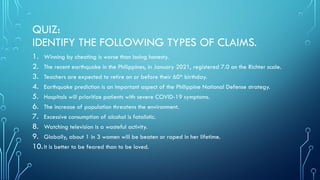
QUIZ:
IDENTIFY THE FOLLOWING TYPES OF CLAIMS.
1. Winning by cheating is worse than losing honesty.
2. The recent earthquake in the Philippines, in January 2021, registered 7.0 on the Richter scale.
3. Teachers are expected to retire on or before their 60th
birthday.
4. Earthquake prediction is an important aspect of the Philippine National Defense strategy.
5. Hospitals will prioritize patients with severe COVID-19 symptoms.
6. The increase of population threatens the environment.
7. Excessive consumption of alcohol is fatalistic.
8. Watching television is a wasteful activity.
9. Globally, about 1 in 3 women will be beaten or raped in her lifetime.
10.It is better to be feared than to be loved.
KEY TO CORRECTION
1. Claim of Value
2. Claim of Fact
3. Claim of Policy
4. Claim of Policy
5. Claim of Policy
6. Claim of Fact
7. Claim of Fact
8. Claim of Value
9. Claim of Value
10. Claim of Value
TASK:
Compose a paragraph or article about one
area of concern in the society (Education,
Health, Government, Information Technology)
and observe explicit and implicit claims on your
composition.

Explicit-and-implicit-claims-in-a-text_084946.pptx

  • 1.
  • 2.
    CLAIM • A claimis a logical conclusion based on information, evidence, and reasoning that we know and have observed. • Claims in texts are significant in supporting propositions or arguments.
  • 3.
    EXPLICIT CLAIM VS.IMPLICIT CLAIM
  • 4.
    EXPLICIT CLAIM • Anexplicit claim is clearly and directly stated in the text which means that you can easily point out the information in the passage. • Expressed Clearly Example: The Daughter was sad, when her mother died.
  • 5.
    IMPLICIT CLAIM • Implicitclaims are indirectly stated the statement. • Used context clue for you to understand the statement. Example: Miles moved away from the dog.
  • 6.
    TYPES OF CLAIMS •Claim of Fact • Claim of Value • Claim of Policy
  • 7.
    1. CLAIM OFFACT • These are claims that are derived from actual information like definition, data, history, or casual connection. • A claim of fact must be verifiable. It shows explicit information. Example: COVID-19 is primarily spread from one person to person. You can become infected by coming into close contact with a person who has COVID-19.
  • 8.
    2. CLAIMS OFVALUE • It is based on one’s subjective opinion, judgement, appraisals, and evaluations. Example: The basic keys to success are perseverance and discipline.
  • 9.
    3. CLAIMS OFPOLICY • Specific and measurable actions that need to be done in order to address issues or concerns presented in an argument or proposition. • This must be verifiable and explicit. • Claims of policy often use “should”, “must”, and “ought to”. Example: Parents should not only be aware of how their children are using social media, but also understand the potential positive and negative impacts of social media use.
  • 10.
    QUIZ: IDENTIFY THE FOLLOWINGTYPES OF CLAIMS. 1. Winning by cheating is worse than losing honesty. 2. The recent earthquake in the Philippines, in January 2021, registered 7.0 on the Richter scale. 3. Teachers are expected to retire on or before their 60th birthday. 4. Earthquake prediction is an important aspect of the Philippine National Defense strategy. 5. Hospitals will prioritize patients with severe COVID-19 symptoms. 6. The increase of population threatens the environment. 7. Excessive consumption of alcohol is fatalistic. 8. Watching television is a wasteful activity. 9. Globally, about 1 in 3 women will be beaten or raped in her lifetime. 10.It is better to be feared than to be loved.
  • 11.
    KEY TO CORRECTION 1.Claim of Value 2. Claim of Fact 3. Claim of Policy 4. Claim of Policy 5. Claim of Policy 6. Claim of Fact 7. Claim of Fact 8. Claim of Value 9. Claim of Value 10. Claim of Value
  • 12.
    TASK: Compose a paragraphor article about one area of concern in the society (Education, Health, Government, Information Technology) and observe explicit and implicit claims on your composition.