Exhibit Design
Davide Prete
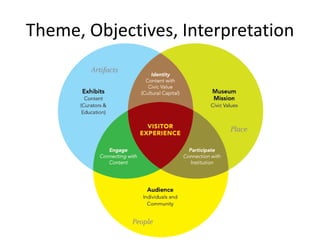
Theme, Objectives, Interpretation
Interpretation
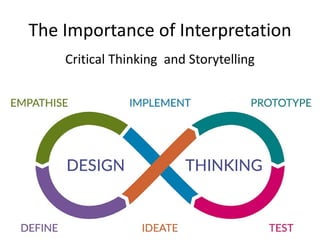
The Importance of Interpretation
Critical Thinking and Storytelling
Freeman Tilden's Principles
• 1. Relate to the visitor's experience.
• 2. Interpretation is revelation based upon
information.
• 3. Interpretation is an art form.
• 4. The chief aim of interpretation is provocation.
• 5. Interpretation should present a whole.
• 6. Interpretation for children should be different
from that of adults.
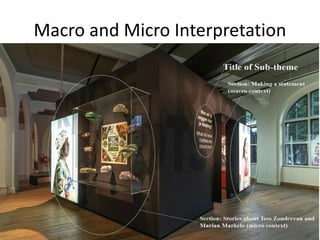
Macro and Micro Interpretation
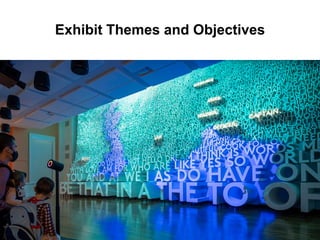
Exhibit Themes and Objectives
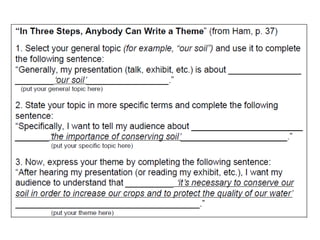
Why Develop a Theme?
• A strong exhibit has a theme.
• Meaningful interpretation has a theme.
• Themes organize and focus an exhibit and make it
meaningful to visitors.
• As Sam Ham states, “Exhibits that are designed first to
communicate a theme, and then to look attractive, will be
more effective than those that are designed solely to
look good”
• The bottom line is that “people”--your visitors—
“remember themes. They forget facts”
How to Develop a Theme
• Theme vs. Topic
• Unified Message
• Thesis Analogy
• Exclusion
• Distilling the Theme
• Guiding Design Decisions
• Streamlining Content
• ABCs of Exhibit Design
Good examples of Themes
• -“Native birds in this country are rapidly disappearing.”
• -“Studying how birds fly led to the invention of early airplanes.”
• -“Our children depend upon us to take care of their natural resources.”
• -“Preserving biodiversity is like having a life insurance policy.”
• -“Blue grass makes our water cleaner.”
• -“Careless spelunkers can upset a delicate balance of life.”
• -“Exploring caves is a sensuous experience.”
• -“Three main factors determine how geysers work.”
• -“Lincolnʼs life was often marred by tragedy.”
• -“To understand the Mayans, one must understand their fascination with the stars.”
• -“A tiny rare plant in Mexico saved the U.S. corn crop.”
• -“Most of what we know about the Universe comes from messages we read in light.”
• -“A healthy swamp—an example of a threatened ecosystem—provides many surprising
• benefits to humans.”
• -“What the artists portrayed about the West in these paintings is largely fiction, which
• had an impact on perpetuating myths about the West in other media.”
Poor examples of themes
• -“This exhibit is about the settlement of the
western United States.”
• -“Visitors will learn about molecular
structure, chemical reactions, and the
scientific process of analyzing unknown
substances.”
Exhibit Objectives
• What do you want the visitor to learn?
• Why would the visitor want to know this?
• How do you want the visitor to use this
information?
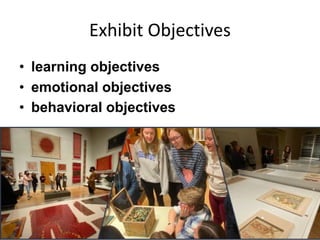
Exhibit Objectives
• learning objectives
• emotional objectives
• behavioral objectives
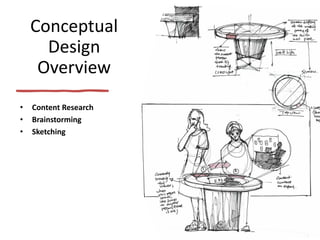
Conceptual
Design
Overview
• Content Research
• Brainstorming
• Sketching
Research
• Research in Depth
• Fieldwork and Participatory Research (Learning by
Doing)
• Photograph
• Film
• Collaborate
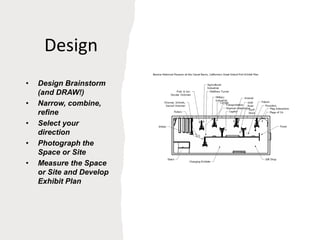
Design
• Design Brainstorm
(and DRAW!)
• Narrow, combine,
refine
• Select your
direction
• Photograph the
Space or Site
• Measure the Space
or Site and Develop
Exhibit Plan
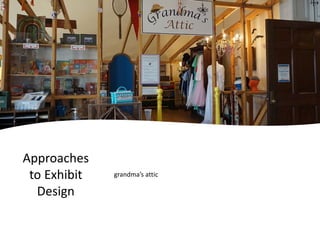
Approaches
to Exhibit
Design
grandma’s attic
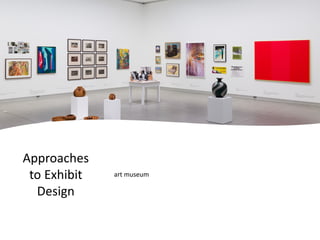
Approaches
to Exhibit
Design
art museum
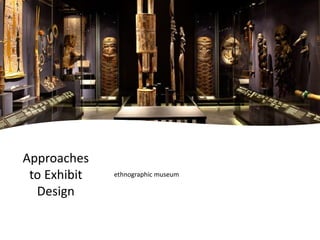
Approaches
to Exhibit
Design
ethnographic museum
Approaches
to Exhibit
Design
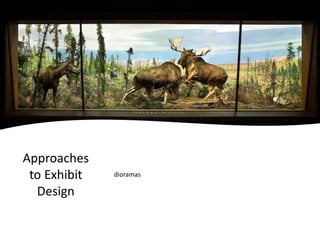
dioramas
Approaches
to Exhibit
Design
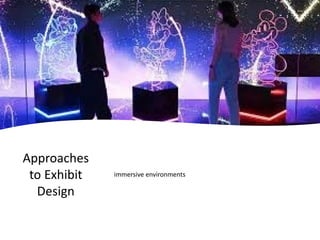
immersive environments
Approaches
to Exhibit
Design
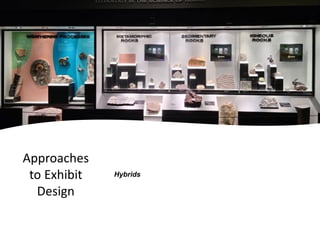
Hybrids
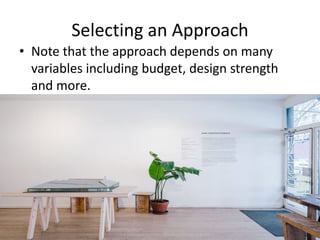
Selecting an Approach
• Note that the approach depends on many
variables including budget, design strength
and more.

Exhibition Design 1 from theme objective and interpretation to design

  • 1.
  • 2.
  • 3.
  • 4.
    The Importance ofInterpretation Critical Thinking and Storytelling
  • 5.
    Freeman Tilden's Principles •1. Relate to the visitor's experience. • 2. Interpretation is revelation based upon information. • 3. Interpretation is an art form. • 4. The chief aim of interpretation is provocation. • 5. Interpretation should present a whole. • 6. Interpretation for children should be different from that of adults.
  • 6.
    Macro and MicroInterpretation
  • 7.
  • 8.
    Why Develop aTheme? • A strong exhibit has a theme. • Meaningful interpretation has a theme. • Themes organize and focus an exhibit and make it meaningful to visitors. • As Sam Ham states, “Exhibits that are designed first to communicate a theme, and then to look attractive, will be more effective than those that are designed solely to look good” • The bottom line is that “people”--your visitors— “remember themes. They forget facts”
  • 9.
    How to Developa Theme • Theme vs. Topic • Unified Message • Thesis Analogy • Exclusion • Distilling the Theme • Guiding Design Decisions • Streamlining Content • ABCs of Exhibit Design
  • 11.
    Good examples ofThemes • -“Native birds in this country are rapidly disappearing.” • -“Studying how birds fly led to the invention of early airplanes.” • -“Our children depend upon us to take care of their natural resources.” • -“Preserving biodiversity is like having a life insurance policy.” • -“Blue grass makes our water cleaner.” • -“Careless spelunkers can upset a delicate balance of life.” • -“Exploring caves is a sensuous experience.” • -“Three main factors determine how geysers work.” • -“Lincolnʼs life was often marred by tragedy.” • -“To understand the Mayans, one must understand their fascination with the stars.” • -“A tiny rare plant in Mexico saved the U.S. corn crop.” • -“Most of what we know about the Universe comes from messages we read in light.” • -“A healthy swamp—an example of a threatened ecosystem—provides many surprising • benefits to humans.” • -“What the artists portrayed about the West in these paintings is largely fiction, which • had an impact on perpetuating myths about the West in other media.”
  • 12.
    Poor examples ofthemes • -“This exhibit is about the settlement of the western United States.” • -“Visitors will learn about molecular structure, chemical reactions, and the scientific process of analyzing unknown substances.”
  • 13.
    Exhibit Objectives • Whatdo you want the visitor to learn? • Why would the visitor want to know this? • How do you want the visitor to use this information?
  • 14.
    Exhibit Objectives • learningobjectives • emotional objectives • behavioral objectives
  • 15.
  • 16.
    Research • Research inDepth • Fieldwork and Participatory Research (Learning by Doing) • Photograph • Film • Collaborate
  • 17.
    Design • Design Brainstorm (andDRAW!) • Narrow, combine, refine • Select your direction • Photograph the Space or Site • Measure the Space or Site and Develop Exhibit Plan
  • 18.
  • 19.
  • 20.
  • 21.
  • 22.
  • 23.
  • 24.
    Selecting an Approach •Note that the approach depends on many variables including budget, design strength and more.