HDC Webinar Series
Introduced by Dwayne Spradlin, CEO, Health Data Consortium
Public Exchanges Go Live:
Early Competitive Dynamics and Strategic Implications
David Knott and Erica Hutchins Coe, McKinsey & Company
WORKING DRAFT
Last Modified 12/9/2013 10:08 AM Eastern Standard Time
Printed 11/20/2013 10:37 AM Eastern Standard Time
PROPRIETARY
Any use of this material without specific permission of McKinsey & Company is strictly prohibited
Exchanges go live: early
trends in competitor dynamics
Webinar document
McKinsey & Company | 3
McKinsey has conducted extensive research and client work on the impact
of big data in health care and other industries
▪ Traditionally, the healthcare industry has lagged behind other industries in the use of big
data—we believe that healthcare is now at a tipping point:
– Demand for better data (driven by ever greater calls for demonstrable value)
– Supply of relevant data at scale (claims, clinical data increasingly available)
– Enhancements in technical capabilities (ability to combine and mine data sets)
– Government catalyzing market change (liberating data sets, interoperability standards)
▪ Increased product, network, formulary, and pricing transparency brought about by public
exchanges will help accelerate the use and impact of big data in healthcare
▪ Public exchanges opened on October 1, 2013—we do not yet have access to broad
enrollment data from public exchanges…
▪ …However, we can draw initial insights from rate filing data that is now available for every
public exchange nationally
▪ Purpose of today’s conversation is to arm you with early insights to inform your strategies
and actions based on analysis of over 21,000 products offered in 50 states and DC
McKinsey & Company | 4
We have developed several proprietary tools to analyze competitor dynamics
on the new public exchanges
Post-reform landscape
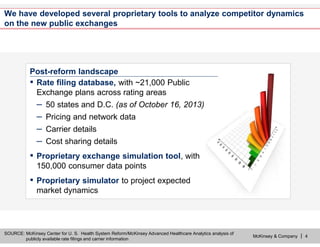
▪ Rate filing database, with ~21,000 Public
Exchange plans across rating areas
– 50 states and D.C. (as of October 16, 2013)
– Pricing and network data
– Carrier details
– Cost sharing details
▪ Proprietary exchange simulation tool, with
150,000 consumer data points
▪ Proprietary simulator to project expected
market dynamics
SOURCE: McKinsey Center for U. S. Health System Reform/McKinsey Advanced Healthcare Analytics analysis of
publicly available rate filings and carrier information
McKinsey & Company | 5
11 New entrants (~30% of all participants) have changed the
competitive landscape of the individual market
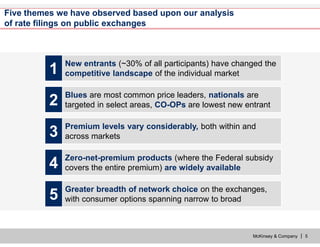
New entrants (~30% of all participants) have changed the
competitive landscape of the individual market
22 Blues are most common price leaders, nationals are
targeted in select areas, CO-OPs are lowest new entrant
Blues are most common price leaders, nationals are
targeted in select areas, CO-OPs are lowest new entrant
33 Premium levels vary considerably, both within and
across markets
Premium levels vary considerably, both within and
across markets
44 Zero-net-premium products (where the Federal subsidy
covers the entire premium) are widely available
Zero-net-premium products (where the Federal subsidy
covers the entire premium) are widely available
55 Greater breadth of network choice on the exchanges,
with consumer options spanning narrow to broad
Greater breadth of network choice on the exchanges,
with consumer options spanning narrow to broad
Five themes we have observed based upon our analysis
of rate filings on public exchanges
McKinsey & Company | 6
1 2012 and 2014 totals reflect counts of unique carriers within each state (e.g., a national carrier playing in several states is counted in each state it plays in)
2 "New" entrant defined as carriers participating in the individual market for the first time in a specific state
2014 On exchange2012
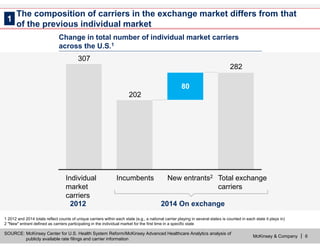
The composition of carriers in the exchange market differs from that
of the previous individual market
SOURCE: McKinsey Center for U.S. Health System Reform/McKinsey Advanced Healthcare Analytics analysis of
publicly available rate filings and carrier information
1
282
202
307
Individual
market
carriers
Incumbents Total exchange
carriers
New entrants2
80
Change in total number of individual market carriers
across the U.S.1
McKinsey & Company | 7
AL
AR
AZ
CA
CO
CT
FL
GA
IA
ID
IL IN
KS
KY
LA
MA
ME
MI
MN
MO
MS
MT
NC
ND
NE
NH
NM
NV
NY
OH
OK
OR
PA
SC
SD
TN
TX
UT
VA
VT
WA
WI
WV
WY
DC
DEMD
NJ RI
HI
AK
SOURCE: McKinsey Center for U.S. Health System Reform/McKinsey Advanced Healthcare Analytics analysis of
publicly available rate filings and carrier information
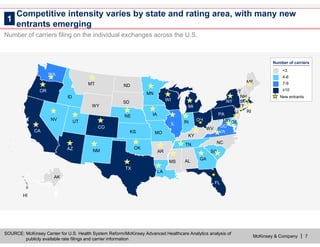
Number of carriers filing on the individual exchanges across the U.S.
Competitive intensity varies by state and rating area, with many new
entrants emerging
<3
4-6
7-9
≥10
Number of carriers
New entrants
1
McKinsey & Company | 8
1 Includes existing Medicaid and provider-based carriers currently offering individual insurance in the state where they have filed on exchange
2 Aetna / Coventry, Humana, Cigna, United 3 Reflects count of “unique carriers” within each state
Incumbents
SOURCE: McKinsey Center for U.S. Health System Reform/McKinsey Advanced Healthcare Analytics analysis of
publicly available rate filings and carrier information
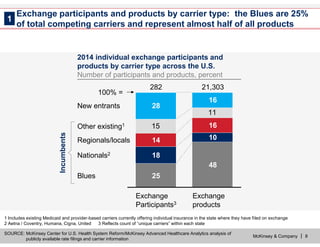
Exchange participants and products by carrier type: the Blues are 25%
of total competing carriers and represent almost half of all products
1
15
11
100% =
Blues
Nationals2
Regionals/locals
Other existing1
New entrants
Exchange
products
21,303
48
10
16
16
Exchange
Participants3
282
25
18
14
28
2014 individual exchange participants and
products by carrier type across the U.S.
Number of participants and products, percent
McKinsey & Company | 9
1 Includes provider-based Medicaid plans
SOURCE: McKinsey Center for U.S. Health System Reform/McKinsey Advanced Healthcare Analytics analysis of
publicly available rate filings and carrier information
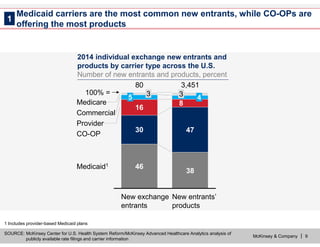
Medicaid carriers are the most common new entrants, while CO-OPs are
offering the most products
3100% =
Medicaid1
CO-OP
Provider
Commercial
Medicare
New entrants’
products
3,451
38
47
8
4
80
46
30
16
5 3
New exchange
entrants
1
2014 individual exchange new entrants and
products by carrier type across the U.S.
Number of new entrants and products, percent
McKinsey & Company | 10
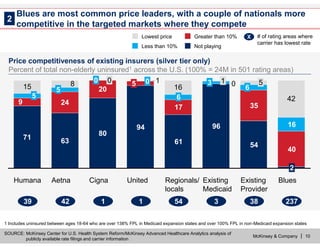
Blues are most common price leaders, with a couple of nationals more
competitive in the targeted markets where they compete
1 Includes uninsured between ages 18-64 who are over 138% FPL in Medicaid expansion states and over 100% FPL in non-Medicaid expansion states
SOURCE: McKinsey Center for U.S. Health System Reform/McKinsey Advanced Healthcare Analytics analysis of
publicly available rate filings and carrier information
15 16
42
018
Blues
2
40
16
Existing
Provider
54
35
6
5
Existing
Medicaid
96
3 1
Regionals/
locals
61
17
6
United
94
5 0
Cigna
80
20
0 0
Aetna
63
24
5
Humana
71
9
5
3939 2372374242 11 11 5454 33 3838
2
Not playing
Greater than 10%
Less than 10%
Lowest price XX # of rating areas where
carrier has lowest rate
Price competitiveness of existing insurers (silver tier only)
Percent of total non-elderly uninsured1 across the U.S. (100% = 24M in 501 rating areas)
McKinsey & Company | 11
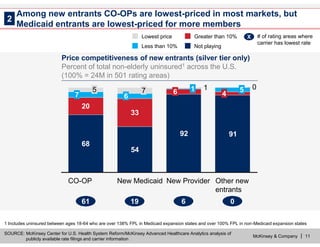
Among new entrants CO-OPs are lowest-priced in most markets, but
Medicaid entrants are lowest-priced for more members
1 Includes uninsured between ages 18-64 who are over 138% FPL in Medicaid expansion states and over 100% FPL in non-Medicaid expansion states
SOURCE: McKinsey Center for U.S. Health System Reform/McKinsey Advanced Healthcare Analytics analysis of
publicly available rate filings and carrier information
01
6
7
CO-OP
68
Other new
entrants
91
4
5
New Provider
92
6 1
New Medicaid
54
33
20
7
5
6161 1919 66 00
2
XX # of rating areas where
carrier has lowest rate
Not playing
Greater than 10%
Less than 10%
Lowest price
Price competitiveness of new entrants (silver tier only)
Percent of total non-elderly uninsured1 across the U.S.
(100% = 24M in 501 rating areas)
McKinsey & Company | 12
16 14 14
49
Gold
24M
43
43
Silver
24M
46
40
Bronze
24M
35
49
Premiums within
20% spread
Platinum
18M100% =
Premiums over
50% spread
Premiums within
20-50% spread
15
36
1 Price variation measured as difference between lowest and highest exchange product for a 40-year old single within each tier in each rating area
across the U.S.
2 Includes uninsured between ages 18-64 who are over 139% FPL in Medicaid expansion states and over 100% FPL in non-Medicaid expansion states
SOURCE: McKinsey Center for U.S. Health System Reform/McKinsey Advanced Healthcare Analytics analysis of
publicly available rate filings and carrier information
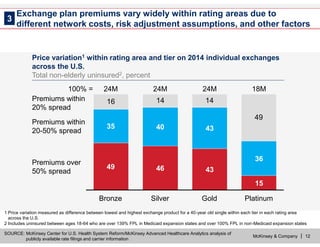
Exchange plan premiums vary widely within rating areas due to
different network costs, risk adjustment assumptions, and other factors
3
Price variation1 within rating area and tier on 2014 individual exchanges
across the U.S.
Total non-elderly uninsured2, percent
McKinsey & Company | 13
00
121
121 121 121
121
121
121
121
0
100
200
300
400
500
600
700
800
900
1,000
62
921
800
57
781
660
52
626
505
47
501
380
42
425
304
37
397
276
32
379
259
27
336
215
Age
SOURCE: McKinsey Center for U.S. Health System Reform/McKinsey Advanced Healthcare Analytics analysis of
publicly available rate filings and carrier information
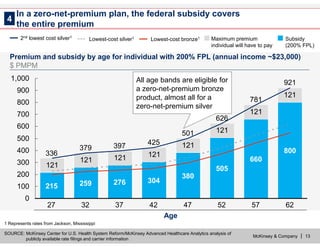
In a zero-net-premium plan, the federal subsidy covers
the entire premium
1 Represents rates from Jackson, Mississippi
4
All age bands are eligible for
a zero-net-premium bronze
product, almost all for a
zero-net-premium silver
Subsidy
(200% FPL)
Lowest-cost silver1 Lowest-cost bronze1 Maximum premium
individual will have to pay
2nd lowest cost silver1
Premium and subsidy by age for individual with 200% FPL (annual income ~$23,000)
$ PMPM
McKinsey & Company | 14
AL
AR
AZ
CA
CO
FL
GA
IA
ID
IL IN
KS
LA
MA
MI
MN
MO
MS
NC
ND
NE
NM
NY
OK
OR
SC
TN
TX
VA
VT
WA
WI
WV
WY
DC
DE
NJ RI
AK
HI
MDNV UT
MT
SD
KY
OH
PA
ME
NH
CT
SOURCE: McKinsey Center for U.S. Health System Reform/McKinsey Advanced Healthcare Analytics analysis of
publicly available rate filings and carrier information
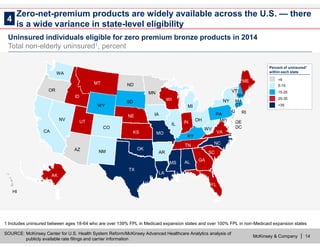
Zero-net-premium products are widely available across the U.S. — there
is a wide variance in state-level eligibility
<5
5-15
15-25
25-35
Percent of uninsured1
within each state
>35
1 Includes uninsured between ages 18-64 who are over 139% FPL in Medicaid expansion states and over 100% FPL in non-Medicaid expansion states
4
Uninsured individuals eligible for zero premium bronze products in 2014
Total non-elderly uninsured1, percent
McKinsey & Company | 15
For Example: ~ 40% of the uninsured in MO are eligible for zero-net-
premium bronze product compared with only 2% in NJ
4
100% =
MO
444K
60
40
GA
964K
65
35
FL
2,218K
68
32
CA
3,188K
87
13
MI
548K
90
10
NY
1,147K
94
6
NJ
647K
98
2
1 Includes uninsured between ages 18-64 who are over 139% FPL in Medicaid expansion states and over 100% FPL in non-Medicaid expansion states
SOURCE: McKinsey Center for U.S. Health System Reform/McKinsey Advanced Healthcare Analytics analysis of
publicly available rate filings and carrier information
YesYes
Not eligibleEligible
YesYes YesYes YesYes NoNo NoNo NoNo
Y/NY/N Medicaid expansion status in state
Eligibility for zero-net premium bronze product
Total non-elderly uninsured1, percent
McKinsey & Company | 16
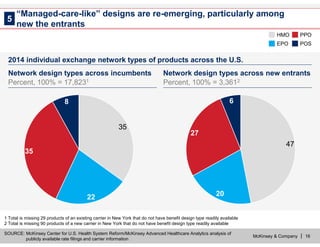
Network design types across incumbents
Percent, 100% = 17,8231
Network design types across new entrants
Percent, 100% = 3,3612
SOURCE: McKinsey Center for U.S. Health System Reform/McKinsey Advanced Healthcare Analytics analysis of
publicly available rate filings and carrier information
HMO PPO
EPO POS
35
8
35
22
47
6
27
20
1 Total is missing 29 products of an existing carrier in New York that do not have benefit design type readily available
2 Total is missing 90 products of a new carrier in New York that do not have benefit design type readily available
“Managed-care-like” designs are re-emerging, particularly among
new the entrants
5
2014 individual exchange network types of products across the U.S.
McKinsey & Company | 17
NetworkTaxes/
fees
Risk
adjust-
ment/
reinsurance
BenefitsMorbidityBenefit
trend
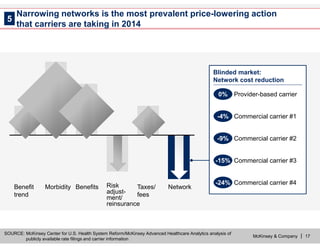
Blinded market:
Network cost reduction
Commercial carrier #4-24%-24%
Commercial carrier #3-15%-15%
Commercial carrier #2-9%-9%
Commercial carrier #1-4%-4%
Provider-based carrier0%0%
SOURCE: McKinsey Center for U.S. Health System Reform/McKinsey Advanced Healthcare Analytics analysis of
publicly available rate filings and carrier information
Narrowing networks is the most prevalent price-lowering action
that carriers are taking in 2014
5
McKinsey & Company | 18
1 Scope of analysis: 20 largest hospitals by number of licensed beds in Atlanta, Bridgeport, Dallas, Nashville, Houston, Salt Lake City, Miami, Tampa,
Louisville, Indianapolis, St. Louis, Los Angeles, San Jose, Pittsburgh, Denver, Philadelphia, Seattle, Chicago, Washington D.C., and Portland, ME
Broad networks: less than 30% of largest 20 hospitals are not participating, Narrow networks: 30-69% of largest 20 hospitals are not participating, Ultra-
narrow networks: at least 70% of largest 20 hospitals are not participating
SOURCE: McKinsey Center for U.S. Health System Reform/McKinsey Advanced Healthcare Analytics
analysis of publicly available rate filings and carrier information; AHA database
Data as of
11.15.2013
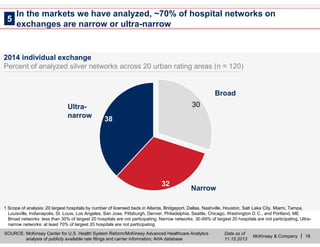
30
38
32
Broad
Narrow
Ultra-
narrow
2014 individual exchange
Percent of analyzed silver networks across 20 urban rating areas (n = 120)
5
In the markets we have analyzed, ~70% of hospital networks on
exchanges are narrow or ultra-narrow
McKinsey & Company | 19
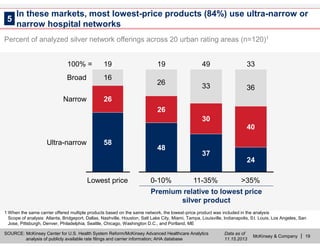
Percent of analyzed silver network offerings across 20 urban rating areas (n=120)1
1 When the same carrier offered multiple products based on the same network, the lowest-price product was included in the analysis
Scope of analysis: Atlanta, Bridgeport, Dallas, Nashville, Houston, Salt Lake City, Miami, Tampa, Louisville, Indianapolis, St. Louis, Los Angeles, San
Jose, Pittsburgh, Denver, Philadelphia, Seattle, Chicago, Washington D.C., and Portland, ME
SOURCE: McKinsey Center for U.S. Health System Reform/McKinsey Advanced Healthcare Analytics
analysis of publicly available rate filings and carrier information; AHA database
Data as of
11.15.2013
In these markets, most lowest-price products (84%) use ultra-narrow or
narrow hospital networks
5
26 33 36
0-10% >35%
33
24
40
11-35%
49
37
30
19
48
26
Lowest price
19
58
26
16
100% =
Ultra-narrow
Narrow
Broad
Premium relative to lowest price
silver product
McKinsey & Company | 20
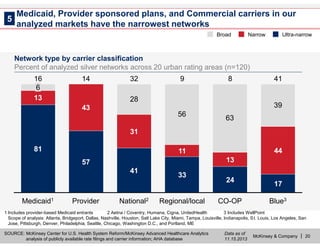
28
56
63
39
13
41
31
Provider
14
57
43
Medicaid1
16
81
6
Blue3
41
17
44
CO-OP
8
24
13
Regional/local
9
33
11
National2
32
Ultra-narrowNarrowBroad
5
SOURCE: McKinsey Center for U.S. Health System Reform/McKinsey Advanced Healthcare Analytics
analysis of publicly available rate filings and carrier information; AHA database
Data as of
11.15.2013
1 Includes provider-based Medicaid entrants 2 Aetna / Coventry, Humana, Cigna, UnitedHealth 3 Includes WellPoint
Scope of analysis: Atlanta, Bridgeport, Dallas, Nashville, Houston, Salt Lake City, Miami, Tampa, Louisville, Indianapolis, St. Louis, Los Angeles, San
Jose, Pittsburgh, Denver, Philadelphia, Seattle, Chicago, Washington D.C., and Portland, ME
Medicaid, Provider sponsored plans, and Commercial carriers in our
analyzed markets have the narrowest networks
Network type by carrier classification
Percent of analyzed silver networks across 20 urban rating areas (n=120)
McKinsey & Company | 21
Our rate filing analyses suggest a number of early observations regarding
the new public exchange space
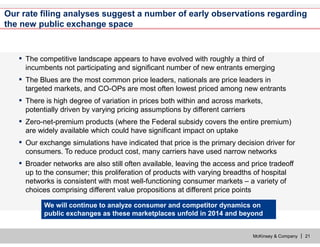
▪ The competitive landscape appears to have evolved with roughly a third of
incumbents not participating and significant number of new entrants emerging
▪ The Blues are the most common price leaders, nationals are price leaders in
targeted markets, and CO-OPs are most often lowest priced among new entrants
▪ There is high degree of variation in prices both within and across markets,
potentially driven by varying pricing assumptions by different carriers
▪ Zero-net-premium products (where the Federal subsidy covers the entire premium)
are widely available which could have significant impact on uptake
▪ Our exchange simulations have indicated that price is the primary decision driver for
consumers. To reduce product cost, many carriers have used narrow networks
▪ Broader networks are also still often available, leaving the access and price tradeoff
up to the consumer; this proliferation of products with varying breadths of hospital
networks is consistent with most well-functioning consumer markets – a variety of
choices comprising different value propositions at different price points
We will continue to analyze consumer and competitor dynamics on
public exchanges as these marketplaces unfold in 2014 and beyond
We will continue to analyze consumer and competitor dynamics on
public exchanges as these marketplaces unfold in 2014 and beyond

Exchanges go live: early trends in competitor dynamics

  • 1.
    HDC Webinar Series Introducedby Dwayne Spradlin, CEO, Health Data Consortium Public Exchanges Go Live: Early Competitive Dynamics and Strategic Implications David Knott and Erica Hutchins Coe, McKinsey & Company
  • 2.
    WORKING DRAFT Last Modified12/9/2013 10:08 AM Eastern Standard Time Printed 11/20/2013 10:37 AM Eastern Standard Time PROPRIETARY Any use of this material without specific permission of McKinsey & Company is strictly prohibited Exchanges go live: early trends in competitor dynamics Webinar document
  • 3.
    McKinsey & Company| 3 McKinsey has conducted extensive research and client work on the impact of big data in health care and other industries ▪ Traditionally, the healthcare industry has lagged behind other industries in the use of big data—we believe that healthcare is now at a tipping point: – Demand for better data (driven by ever greater calls for demonstrable value) – Supply of relevant data at scale (claims, clinical data increasingly available) – Enhancements in technical capabilities (ability to combine and mine data sets) – Government catalyzing market change (liberating data sets, interoperability standards) ▪ Increased product, network, formulary, and pricing transparency brought about by public exchanges will help accelerate the use and impact of big data in healthcare ▪ Public exchanges opened on October 1, 2013—we do not yet have access to broad enrollment data from public exchanges… ▪ …However, we can draw initial insights from rate filing data that is now available for every public exchange nationally ▪ Purpose of today’s conversation is to arm you with early insights to inform your strategies and actions based on analysis of over 21,000 products offered in 50 states and DC
  • 4.
    McKinsey & Company| 4 We have developed several proprietary tools to analyze competitor dynamics on the new public exchanges Post-reform landscape ▪ Rate filing database, with ~21,000 Public Exchange plans across rating areas – 50 states and D.C. (as of October 16, 2013) – Pricing and network data – Carrier details – Cost sharing details ▪ Proprietary exchange simulation tool, with 150,000 consumer data points ▪ Proprietary simulator to project expected market dynamics SOURCE: McKinsey Center for U. S. Health System Reform/McKinsey Advanced Healthcare Analytics analysis of publicly available rate filings and carrier information
  • 5.
    McKinsey & Company| 5 11 New entrants (~30% of all participants) have changed the competitive landscape of the individual market New entrants (~30% of all participants) have changed the competitive landscape of the individual market 22 Blues are most common price leaders, nationals are targeted in select areas, CO-OPs are lowest new entrant Blues are most common price leaders, nationals are targeted in select areas, CO-OPs are lowest new entrant 33 Premium levels vary considerably, both within and across markets Premium levels vary considerably, both within and across markets 44 Zero-net-premium products (where the Federal subsidy covers the entire premium) are widely available Zero-net-premium products (where the Federal subsidy covers the entire premium) are widely available 55 Greater breadth of network choice on the exchanges, with consumer options spanning narrow to broad Greater breadth of network choice on the exchanges, with consumer options spanning narrow to broad Five themes we have observed based upon our analysis of rate filings on public exchanges
  • 6.
    McKinsey & Company| 6 1 2012 and 2014 totals reflect counts of unique carriers within each state (e.g., a national carrier playing in several states is counted in each state it plays in) 2 "New" entrant defined as carriers participating in the individual market for the first time in a specific state 2014 On exchange2012 The composition of carriers in the exchange market differs from that of the previous individual market SOURCE: McKinsey Center for U.S. Health System Reform/McKinsey Advanced Healthcare Analytics analysis of publicly available rate filings and carrier information 1 282 202 307 Individual market carriers Incumbents Total exchange carriers New entrants2 80 Change in total number of individual market carriers across the U.S.1
  • 7.
    McKinsey & Company| 7 AL AR AZ CA CO CT FL GA IA ID IL IN KS KY LA MA ME MI MN MO MS MT NC ND NE NH NM NV NY OH OK OR PA SC SD TN TX UT VA VT WA WI WV WY DC DEMD NJ RI HI AK SOURCE: McKinsey Center for U.S. Health System Reform/McKinsey Advanced Healthcare Analytics analysis of publicly available rate filings and carrier information Number of carriers filing on the individual exchanges across the U.S. Competitive intensity varies by state and rating area, with many new entrants emerging <3 4-6 7-9 ≥10 Number of carriers New entrants 1
  • 8.
    McKinsey & Company| 8 1 Includes existing Medicaid and provider-based carriers currently offering individual insurance in the state where they have filed on exchange 2 Aetna / Coventry, Humana, Cigna, United 3 Reflects count of “unique carriers” within each state Incumbents SOURCE: McKinsey Center for U.S. Health System Reform/McKinsey Advanced Healthcare Analytics analysis of publicly available rate filings and carrier information Exchange participants and products by carrier type: the Blues are 25% of total competing carriers and represent almost half of all products 1 15 11 100% = Blues Nationals2 Regionals/locals Other existing1 New entrants Exchange products 21,303 48 10 16 16 Exchange Participants3 282 25 18 14 28 2014 individual exchange participants and products by carrier type across the U.S. Number of participants and products, percent
  • 9.
    McKinsey & Company| 9 1 Includes provider-based Medicaid plans SOURCE: McKinsey Center for U.S. Health System Reform/McKinsey Advanced Healthcare Analytics analysis of publicly available rate filings and carrier information Medicaid carriers are the most common new entrants, while CO-OPs are offering the most products 3100% = Medicaid1 CO-OP Provider Commercial Medicare New entrants’ products 3,451 38 47 8 4 80 46 30 16 5 3 New exchange entrants 1 2014 individual exchange new entrants and products by carrier type across the U.S. Number of new entrants and products, percent
  • 10.
    McKinsey & Company| 10 Blues are most common price leaders, with a couple of nationals more competitive in the targeted markets where they compete 1 Includes uninsured between ages 18-64 who are over 138% FPL in Medicaid expansion states and over 100% FPL in non-Medicaid expansion states SOURCE: McKinsey Center for U.S. Health System Reform/McKinsey Advanced Healthcare Analytics analysis of publicly available rate filings and carrier information 15 16 42 018 Blues 2 40 16 Existing Provider 54 35 6 5 Existing Medicaid 96 3 1 Regionals/ locals 61 17 6 United 94 5 0 Cigna 80 20 0 0 Aetna 63 24 5 Humana 71 9 5 3939 2372374242 11 11 5454 33 3838 2 Not playing Greater than 10% Less than 10% Lowest price XX # of rating areas where carrier has lowest rate Price competitiveness of existing insurers (silver tier only) Percent of total non-elderly uninsured1 across the U.S. (100% = 24M in 501 rating areas)
  • 11.
    McKinsey & Company| 11 Among new entrants CO-OPs are lowest-priced in most markets, but Medicaid entrants are lowest-priced for more members 1 Includes uninsured between ages 18-64 who are over 138% FPL in Medicaid expansion states and over 100% FPL in non-Medicaid expansion states SOURCE: McKinsey Center for U.S. Health System Reform/McKinsey Advanced Healthcare Analytics analysis of publicly available rate filings and carrier information 01 6 7 CO-OP 68 Other new entrants 91 4 5 New Provider 92 6 1 New Medicaid 54 33 20 7 5 6161 1919 66 00 2 XX # of rating areas where carrier has lowest rate Not playing Greater than 10% Less than 10% Lowest price Price competitiveness of new entrants (silver tier only) Percent of total non-elderly uninsured1 across the U.S. (100% = 24M in 501 rating areas)
  • 12.
    McKinsey & Company| 12 16 14 14 49 Gold 24M 43 43 Silver 24M 46 40 Bronze 24M 35 49 Premiums within 20% spread Platinum 18M100% = Premiums over 50% spread Premiums within 20-50% spread 15 36 1 Price variation measured as difference between lowest and highest exchange product for a 40-year old single within each tier in each rating area across the U.S. 2 Includes uninsured between ages 18-64 who are over 139% FPL in Medicaid expansion states and over 100% FPL in non-Medicaid expansion states SOURCE: McKinsey Center for U.S. Health System Reform/McKinsey Advanced Healthcare Analytics analysis of publicly available rate filings and carrier information Exchange plan premiums vary widely within rating areas due to different network costs, risk adjustment assumptions, and other factors 3 Price variation1 within rating area and tier on 2014 individual exchanges across the U.S. Total non-elderly uninsured2, percent
  • 13.
    McKinsey & Company| 13 00 121 121 121 121 121 121 121 121 0 100 200 300 400 500 600 700 800 900 1,000 62 921 800 57 781 660 52 626 505 47 501 380 42 425 304 37 397 276 32 379 259 27 336 215 Age SOURCE: McKinsey Center for U.S. Health System Reform/McKinsey Advanced Healthcare Analytics analysis of publicly available rate filings and carrier information In a zero-net-premium plan, the federal subsidy covers the entire premium 1 Represents rates from Jackson, Mississippi 4 All age bands are eligible for a zero-net-premium bronze product, almost all for a zero-net-premium silver Subsidy (200% FPL) Lowest-cost silver1 Lowest-cost bronze1 Maximum premium individual will have to pay 2nd lowest cost silver1 Premium and subsidy by age for individual with 200% FPL (annual income ~$23,000) $ PMPM
  • 14.
    McKinsey & Company| 14 AL AR AZ CA CO FL GA IA ID IL IN KS LA MA MI MN MO MS NC ND NE NM NY OK OR SC TN TX VA VT WA WI WV WY DC DE NJ RI AK HI MDNV UT MT SD KY OH PA ME NH CT SOURCE: McKinsey Center for U.S. Health System Reform/McKinsey Advanced Healthcare Analytics analysis of publicly available rate filings and carrier information Zero-net-premium products are widely available across the U.S. — there is a wide variance in state-level eligibility <5 5-15 15-25 25-35 Percent of uninsured1 within each state >35 1 Includes uninsured between ages 18-64 who are over 139% FPL in Medicaid expansion states and over 100% FPL in non-Medicaid expansion states 4 Uninsured individuals eligible for zero premium bronze products in 2014 Total non-elderly uninsured1, percent
  • 15.
    McKinsey & Company| 15 For Example: ~ 40% of the uninsured in MO are eligible for zero-net- premium bronze product compared with only 2% in NJ 4 100% = MO 444K 60 40 GA 964K 65 35 FL 2,218K 68 32 CA 3,188K 87 13 MI 548K 90 10 NY 1,147K 94 6 NJ 647K 98 2 1 Includes uninsured between ages 18-64 who are over 139% FPL in Medicaid expansion states and over 100% FPL in non-Medicaid expansion states SOURCE: McKinsey Center for U.S. Health System Reform/McKinsey Advanced Healthcare Analytics analysis of publicly available rate filings and carrier information YesYes Not eligibleEligible YesYes YesYes YesYes NoNo NoNo NoNo Y/NY/N Medicaid expansion status in state Eligibility for zero-net premium bronze product Total non-elderly uninsured1, percent
  • 16.
    McKinsey & Company| 16 Network design types across incumbents Percent, 100% = 17,8231 Network design types across new entrants Percent, 100% = 3,3612 SOURCE: McKinsey Center for U.S. Health System Reform/McKinsey Advanced Healthcare Analytics analysis of publicly available rate filings and carrier information HMO PPO EPO POS 35 8 35 22 47 6 27 20 1 Total is missing 29 products of an existing carrier in New York that do not have benefit design type readily available 2 Total is missing 90 products of a new carrier in New York that do not have benefit design type readily available “Managed-care-like” designs are re-emerging, particularly among new the entrants 5 2014 individual exchange network types of products across the U.S.
  • 17.
    McKinsey & Company| 17 NetworkTaxes/ fees Risk adjust- ment/ reinsurance BenefitsMorbidityBenefit trend Blinded market: Network cost reduction Commercial carrier #4-24%-24% Commercial carrier #3-15%-15% Commercial carrier #2-9%-9% Commercial carrier #1-4%-4% Provider-based carrier0%0% SOURCE: McKinsey Center for U.S. Health System Reform/McKinsey Advanced Healthcare Analytics analysis of publicly available rate filings and carrier information Narrowing networks is the most prevalent price-lowering action that carriers are taking in 2014 5
  • 18.
    McKinsey & Company| 18 1 Scope of analysis: 20 largest hospitals by number of licensed beds in Atlanta, Bridgeport, Dallas, Nashville, Houston, Salt Lake City, Miami, Tampa, Louisville, Indianapolis, St. Louis, Los Angeles, San Jose, Pittsburgh, Denver, Philadelphia, Seattle, Chicago, Washington D.C., and Portland, ME Broad networks: less than 30% of largest 20 hospitals are not participating, Narrow networks: 30-69% of largest 20 hospitals are not participating, Ultra- narrow networks: at least 70% of largest 20 hospitals are not participating SOURCE: McKinsey Center for U.S. Health System Reform/McKinsey Advanced Healthcare Analytics analysis of publicly available rate filings and carrier information; AHA database Data as of 11.15.2013 30 38 32 Broad Narrow Ultra- narrow 2014 individual exchange Percent of analyzed silver networks across 20 urban rating areas (n = 120) 5 In the markets we have analyzed, ~70% of hospital networks on exchanges are narrow or ultra-narrow
  • 19.
    McKinsey & Company| 19 Percent of analyzed silver network offerings across 20 urban rating areas (n=120)1 1 When the same carrier offered multiple products based on the same network, the lowest-price product was included in the analysis Scope of analysis: Atlanta, Bridgeport, Dallas, Nashville, Houston, Salt Lake City, Miami, Tampa, Louisville, Indianapolis, St. Louis, Los Angeles, San Jose, Pittsburgh, Denver, Philadelphia, Seattle, Chicago, Washington D.C., and Portland, ME SOURCE: McKinsey Center for U.S. Health System Reform/McKinsey Advanced Healthcare Analytics analysis of publicly available rate filings and carrier information; AHA database Data as of 11.15.2013 In these markets, most lowest-price products (84%) use ultra-narrow or narrow hospital networks 5 26 33 36 0-10% >35% 33 24 40 11-35% 49 37 30 19 48 26 Lowest price 19 58 26 16 100% = Ultra-narrow Narrow Broad Premium relative to lowest price silver product
  • 20.
    McKinsey & Company| 20 28 56 63 39 13 41 31 Provider 14 57 43 Medicaid1 16 81 6 Blue3 41 17 44 CO-OP 8 24 13 Regional/local 9 33 11 National2 32 Ultra-narrowNarrowBroad 5 SOURCE: McKinsey Center for U.S. Health System Reform/McKinsey Advanced Healthcare Analytics analysis of publicly available rate filings and carrier information; AHA database Data as of 11.15.2013 1 Includes provider-based Medicaid entrants 2 Aetna / Coventry, Humana, Cigna, UnitedHealth 3 Includes WellPoint Scope of analysis: Atlanta, Bridgeport, Dallas, Nashville, Houston, Salt Lake City, Miami, Tampa, Louisville, Indianapolis, St. Louis, Los Angeles, San Jose, Pittsburgh, Denver, Philadelphia, Seattle, Chicago, Washington D.C., and Portland, ME Medicaid, Provider sponsored plans, and Commercial carriers in our analyzed markets have the narrowest networks Network type by carrier classification Percent of analyzed silver networks across 20 urban rating areas (n=120)
  • 21.
    McKinsey & Company| 21 Our rate filing analyses suggest a number of early observations regarding the new public exchange space ▪ The competitive landscape appears to have evolved with roughly a third of incumbents not participating and significant number of new entrants emerging ▪ The Blues are the most common price leaders, nationals are price leaders in targeted markets, and CO-OPs are most often lowest priced among new entrants ▪ There is high degree of variation in prices both within and across markets, potentially driven by varying pricing assumptions by different carriers ▪ Zero-net-premium products (where the Federal subsidy covers the entire premium) are widely available which could have significant impact on uptake ▪ Our exchange simulations have indicated that price is the primary decision driver for consumers. To reduce product cost, many carriers have used narrow networks ▪ Broader networks are also still often available, leaving the access and price tradeoff up to the consumer; this proliferation of products with varying breadths of hospital networks is consistent with most well-functioning consumer markets – a variety of choices comprising different value propositions at different price points We will continue to analyze consumer and competitor dynamics on public exchanges as these marketplaces unfold in 2014 and beyond We will continue to analyze consumer and competitor dynamics on public exchanges as these marketplaces unfold in 2014 and beyond