Examples of Indices
A stock index is a statistical indicator that
measures changes within a securities market. It
is computed from the prices of selected stocks
(typically a weighted average). It is a tool used
by investors and financial managers to describe
the market and to compare the return on
specific investments.
Stock Index
The media refer to stock market indices daily, reporting on movements in the FTSE,
Dow Jones and others.
You have come across indices before which are used to measure different things:
e.g. Retail Price Index (RPI) and Consumer Price Index (CPI) both measure
Stock Market Indices
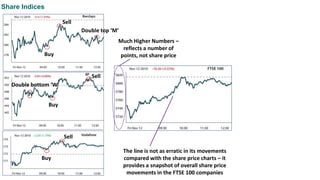
Buy
Sell
Buy
Sell
Buy
Sell
Double top ‘M’
Double bottom ‘W’
Much Higher Numbers –
reflects a number of
points, not share price
The line is not as erratic in its movements
compared with the share price charts – it
provides a snapshot of overall share price
movements in the FTSE 100 companies
Share Indices
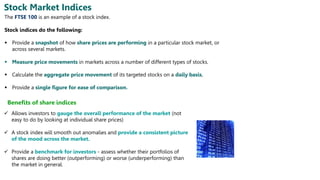
The FTSE 100 is an example of a stock index.
Stock indices do the following:
 Provide a snapshot of how share prices are performing in a particular stock market, or
across several markets.
 Measure price movements in markets across a number of different types of stocks.
 Calculate the aggregate price movement of its targeted stocks on a daily basis,
 Provide a single figure for ease of comparison.
Stock Market Indices
Benefits of share indices
 Allows investors to gauge the overall performance of the market (not
easy to do by looking at individual share prices)
 A stock index will smooth out anomalies and provide a consistent picture
of the mood across the market.
 Provide a benchmark for investors - assess whether their portfolios of
shares are doing better (outperforming) or worse (underperforming) than
the market in general.

example of stocks.pptx

  • 1.
  • 2.
    A stock indexis a statistical indicator that measures changes within a securities market. It is computed from the prices of selected stocks (typically a weighted average). It is a tool used by investors and financial managers to describe the market and to compare the return on specific investments. Stock Index
  • 3.
    The media referto stock market indices daily, reporting on movements in the FTSE, Dow Jones and others. You have come across indices before which are used to measure different things: e.g. Retail Price Index (RPI) and Consumer Price Index (CPI) both measure Stock Market Indices
  • 4.
    Buy Sell Buy Sell Buy Sell Double top ‘M’ Doublebottom ‘W’ Much Higher Numbers – reflects a number of points, not share price The line is not as erratic in its movements compared with the share price charts – it provides a snapshot of overall share price movements in the FTSE 100 companies Share Indices
  • 5.
    The FTSE 100is an example of a stock index. Stock indices do the following:  Provide a snapshot of how share prices are performing in a particular stock market, or across several markets.  Measure price movements in markets across a number of different types of stocks.  Calculate the aggregate price movement of its targeted stocks on a daily basis,  Provide a single figure for ease of comparison. Stock Market Indices Benefits of share indices  Allows investors to gauge the overall performance of the market (not easy to do by looking at individual share prices)  A stock index will smooth out anomalies and provide a consistent picture of the mood across the market.  Provide a benchmark for investors - assess whether their portfolios of shares are doing better (outperforming) or worse (underperforming) than the market in general.