RESEARCH PROPOSAL
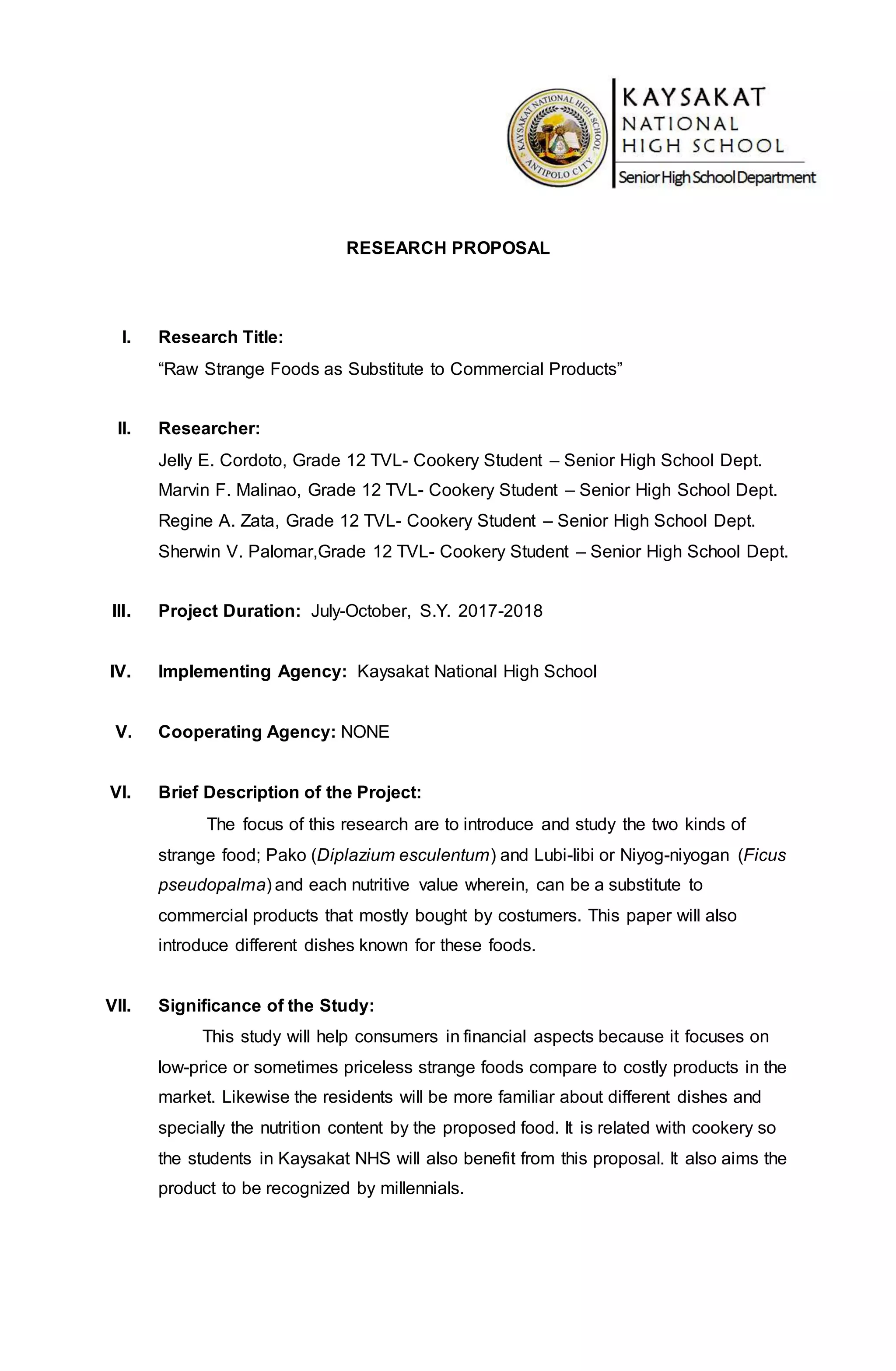
I. Research Title:
“Raw Strange Foods as Substitute to Commercial Products”
II. Researcher:
Jelly E. Cordoto, Grade 12 TVL- Cookery Student – Senior High School Dept.
Marvin F. Malinao, Grade 12 TVL- Cookery Student – Senior High School Dept.
Regine A. Zata, Grade 12 TVL- Cookery Student – Senior High School Dept.
Sherwin V. Palomar,Grade 12 TVL- Cookery Student – Senior High School Dept.
III. Project Duration: July-October, S.Y. 2017-2018
IV. Implementing Agency: Kaysakat National High School
V. Cooperating Agency: NONE
VI. Brief Description of the Project:
The focus of this research are to introduce and study the two kinds of
strange food; Pako (Diplazium esculentum) and Lubi-libi or Niyog-niyogan (Ficus
pseudopalma) and each nutritive value wherein, can be a substitute to
commercial products that mostly bought by costumers. This paper will also
introduce different dishes known for these foods.
VII. Significance of the Study:
This study will help consumers in financial aspects because it focuses on
low-price or sometimes priceless strange foods compare to costly products in the
market. Likewise the residents will be more familiar about different dishes and
specially the nutrition content by the proposed food. It is related with cookery so
the students in Kaysakat NHS will also benefit from this proposal. It also aims the
product to be recognized by millennials.
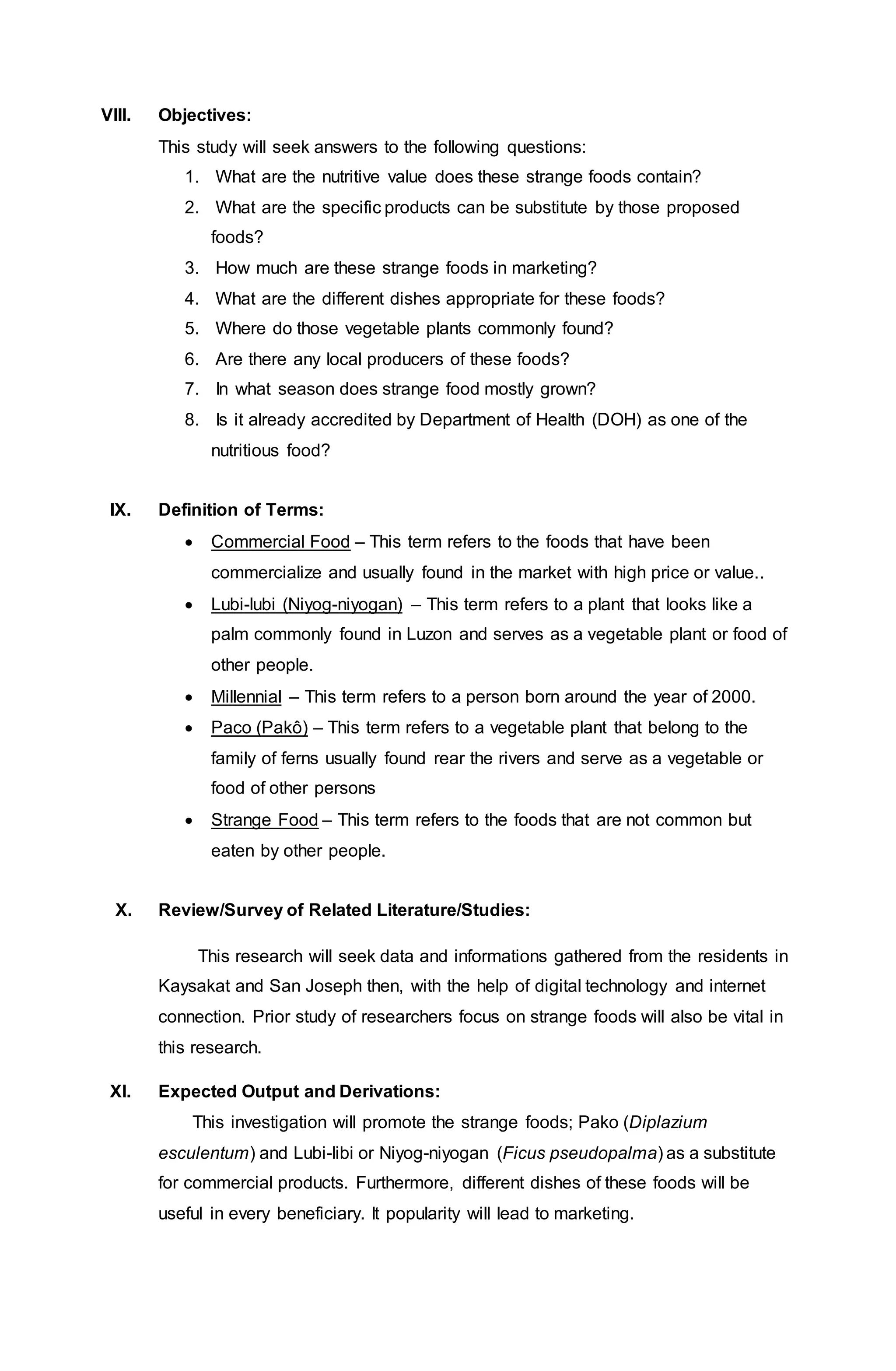
VIII. Objectives:
This study will seek answers to the following questions:
1. What are the nutritive value does these strange foods contain?
2. What are the specific products can be substitute by those proposed
foods?
3. How much are these strange foods in marketing?
4. What are the different dishes appropriate for these foods?
5. Where do those vegetable plants commonly found?
6. Are there any local producers of these foods?
7. In what season does strange food mostly grown?
8. Is it already accredited by Department of Health (DOH) as one of the
nutritious food?
IX. Definition of Terms:
 Commercial Food – This term refers to the foods that have been
commercialize and usually found in the market with high price or value..
 Lubi-lubi (Niyog-niyogan) – This term refers to a plant that looks like a
palm commonly found in Luzon and serves as a vegetable plant or food of
other people.
 Millennial – This term refers to a person born around the year of 2000.
 Paco (Pakô) – This term refers to a vegetable plant that belong to the
family of ferns usually found rear the rivers and serve as a vegetable or
food of other persons
 Strange Food – This term refers to the foods that are not common but
eaten by other people.
X. Review/Survey of Related Literature/Studies:
This research will seek data and informations gathered from the residents in
Kaysakat and San Joseph then, with the help of digital technology and internet
connection. Prior study of researchers focus on strange foods will also be vital in
this research.
XI. Expected Output and Derivations:
This investigation will promote the strange foods; Pako (Diplazium
esculentum) and Lubi-libi or Niyog-niyogan (Ficus pseudopalma) as a substitute
for commercial products. Furthermore, different dishes of these foods will be
useful in every beneficiary. It popularity will lead to marketing.
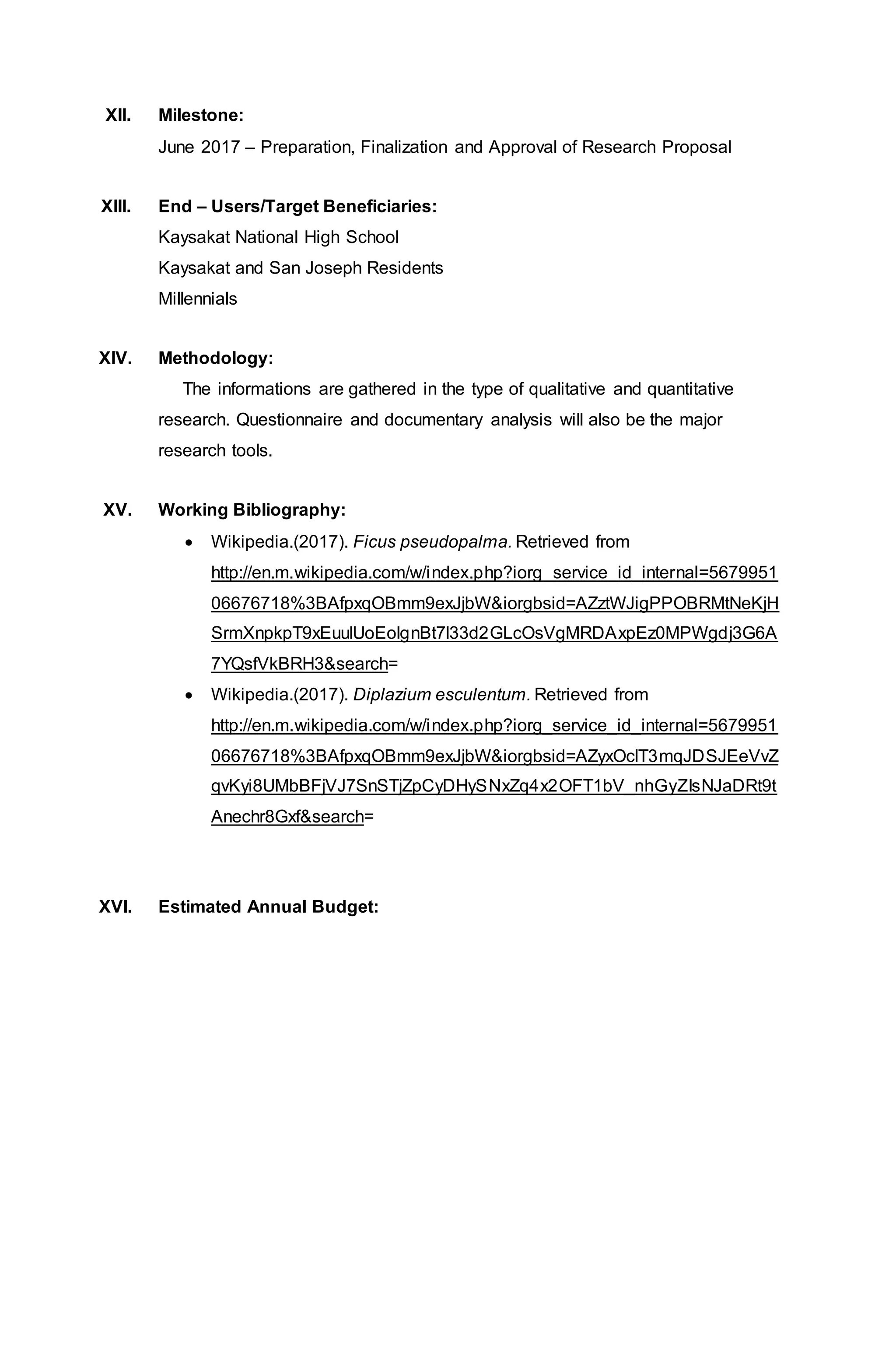
XII. Milestone:
June 2017 – Preparation, Finalization and Approval of Research Proposal
XIII. End – Users/Target Beneficiaries:
Kaysakat National High School
Kaysakat and San Joseph Residents
Millennials
XIV. Methodology:
The informations are gathered in the type of qualitative and quantitative
research. Questionnaire and documentary analysis will also be the major
research tools.
XV. Working Bibliography:
 Wikipedia.(2017). Ficus pseudopalma. Retrieved from
http://en.m.wikipedia.com/w/index.php?iorg_service_id_internal=5679951
06676718%3BAfpxqOBmm9exJjbW&iorgbsid=AZztWJigPPOBRMtNeKjH
SrmXnpkpT9xEuulUoEolgnBt7l33d2GLcOsVgMRDAxpEz0MPWgdj3G6A
7YQsfVkBRH3&search=
 Wikipedia.(2017). Diplazium esculentum. Retrieved from
http://en.m.wikipedia.com/w/index.php?iorg_service_id_internal=5679951
06676718%3BAfpxqOBmm9exJjbW&iorgbsid=AZyxOclT3mqJDSJEeVvZ
qvKyi8UMbBFjVJ7SnSTjZpCyDHySNxZq4x2OFT1bV_nhGyZIsNJaDRt9t
Anechr8Gxf&search=
XVI. Estimated Annual Budget:

Example of a Research proposal

  • 1.
    RESEARCH PROPOSAL I. ResearchTitle: “Raw Strange Foods as Substitute to Commercial Products” II. Researcher: Jelly E. Cordoto, Grade 12 TVL- Cookery Student – Senior High School Dept. Marvin F. Malinao, Grade 12 TVL- Cookery Student – Senior High School Dept. Regine A. Zata, Grade 12 TVL- Cookery Student – Senior High School Dept. Sherwin V. Palomar,Grade 12 TVL- Cookery Student – Senior High School Dept. III. Project Duration: July-October, S.Y. 2017-2018 IV. Implementing Agency: Kaysakat National High School V. Cooperating Agency: NONE VI. Brief Description of the Project: The focus of this research are to introduce and study the two kinds of strange food; Pako (Diplazium esculentum) and Lubi-libi or Niyog-niyogan (Ficus pseudopalma) and each nutritive value wherein, can be a substitute to commercial products that mostly bought by costumers. This paper will also introduce different dishes known for these foods. VII. Significance of the Study: This study will help consumers in financial aspects because it focuses on low-price or sometimes priceless strange foods compare to costly products in the market. Likewise the residents will be more familiar about different dishes and specially the nutrition content by the proposed food. It is related with cookery so the students in Kaysakat NHS will also benefit from this proposal. It also aims the product to be recognized by millennials.
  • 2.
    VIII. Objectives: This studywill seek answers to the following questions: 1. What are the nutritive value does these strange foods contain? 2. What are the specific products can be substitute by those proposed foods? 3. How much are these strange foods in marketing? 4. What are the different dishes appropriate for these foods? 5. Where do those vegetable plants commonly found? 6. Are there any local producers of these foods? 7. In what season does strange food mostly grown? 8. Is it already accredited by Department of Health (DOH) as one of the nutritious food? IX. Definition of Terms:  Commercial Food – This term refers to the foods that have been commercialize and usually found in the market with high price or value..  Lubi-lubi (Niyog-niyogan) – This term refers to a plant that looks like a palm commonly found in Luzon and serves as a vegetable plant or food of other people.  Millennial – This term refers to a person born around the year of 2000.  Paco (Pakô) – This term refers to a vegetable plant that belong to the family of ferns usually found rear the rivers and serve as a vegetable or food of other persons  Strange Food – This term refers to the foods that are not common but eaten by other people. X. Review/Survey of Related Literature/Studies: This research will seek data and informations gathered from the residents in Kaysakat and San Joseph then, with the help of digital technology and internet connection. Prior study of researchers focus on strange foods will also be vital in this research. XI. Expected Output and Derivations: This investigation will promote the strange foods; Pako (Diplazium esculentum) and Lubi-libi or Niyog-niyogan (Ficus pseudopalma) as a substitute for commercial products. Furthermore, different dishes of these foods will be useful in every beneficiary. It popularity will lead to marketing.
  • 3.
    XII. Milestone: June 2017– Preparation, Finalization and Approval of Research Proposal XIII. End – Users/Target Beneficiaries: Kaysakat National High School Kaysakat and San Joseph Residents Millennials XIV. Methodology: The informations are gathered in the type of qualitative and quantitative research. Questionnaire and documentary analysis will also be the major research tools. XV. Working Bibliography:  Wikipedia.(2017). Ficus pseudopalma. Retrieved from http://en.m.wikipedia.com/w/index.php?iorg_service_id_internal=5679951 06676718%3BAfpxqOBmm9exJjbW&iorgbsid=AZztWJigPPOBRMtNeKjH SrmXnpkpT9xEuulUoEolgnBt7l33d2GLcOsVgMRDAxpEz0MPWgdj3G6A 7YQsfVkBRH3&search=  Wikipedia.(2017). Diplazium esculentum. Retrieved from http://en.m.wikipedia.com/w/index.php?iorg_service_id_internal=5679951 06676718%3BAfpxqOBmm9exJjbW&iorgbsid=AZyxOclT3mqJDSJEeVvZ qvKyi8UMbBFjVJ7SnSTjZpCyDHySNxZq4x2OFT1bV_nhGyZIsNJaDRt9t Anechr8Gxf&search= XVI. Estimated Annual Budget: