Business Intelligence @ Eastern Washington University
Strategy and Resources
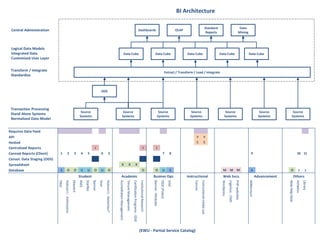
BI Architecture
(EWU - Partial Service Catalog)
Requires Data Feed
API Y Y
Hosted C C
Centralized Reports J J J
Canned Reports (Client) 1 2 3 4 5 6 2 7 8 9 10 11
Consol. Data Staging (ODS)
Spreadsheet X X X
Database S O O U U O U O O O U S M M M S O ? ?
TRIO
Hobson's-Admissions
Maxient
RMS
StarRez
Banner
Soar
Hobson's-Retention*
AccreditationManagement
TenureManagement
CertificationPrograms-EDIE
InstitutionalResearch
Banner-Modules
OSSI(Police)
AIM
Canvas
Instructionalmediause
Wordpress
Ingeniux-CMS
PHPwebsites
Millennium
WebHelpDesk
Athletics
Library
OthersStudent Busines OpsAcademic Instructional Web Svcs. Advancement
Dashboards OLAP
Standard
Reports
Data
Mining
Source
Systems
Source
Systems
Source
Systems
Source
Systems
Source
Systems
Extract / Transform / Load / Integrate
Source
Systems
Source
Systems
Transaction Processing
Stand Alone Systems
Normalized Data Model
Transform / Integrate
Standardize
Logical Data Models
Integrated Data
Customized User Layer
Data Cube Data Cube
Central Administration
Data Cube Data Cube Data Cube
ODS
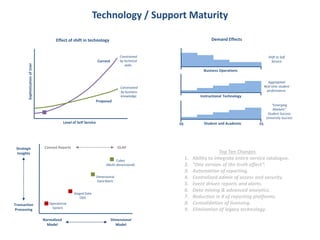
Technology / Support Maturity
Level of Self Service
SophisticationofUser
Current
Proposed
Effect of shift in technology Demand Effects
Business Operations
Instructional Technology
Student and Academic Y5Y0
Normalized
Model
Dimensional
Model
Canned Reports OLAP
Operational
System
Staged Data
ODS
Dimensional
Data Marts
Cubes
(Multi-dimensional)
Transaction
Processing
Strategic
Insights
Shift to Self
Service
Aggregated
Real time student
performance.
“Emerging
Markets”
Student Success
University Success
Constrained
by technical
skills.
Constrained
by business
knowledge.
Top Ten Changes
1. Ability to integrate entire service catalogue.
2. “One version of the truth effect”.
3. Automation of reporting.
4. Centralized admin of access and security.
5. Event driven reports and alerts.
6. Data mining & advanced analytics.
7. Reduction in # of reporting platforms.
8. Consolidation of licensing.
9. Elimination of legacy technology.
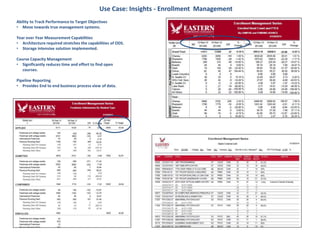
Use Case: Insights - Enrollment Management
Ability to Track Performance to Target Objectives
• Move towards true management systems.
Year over Year Measurement Capabilities
• Architecture required stretches the capabilities of ODS.
• Storage intensive solution implemented.
Course Capacity Management
• Significantly reduces time and effort to find open
courses.
Pipeline Reporting
• Provides End to end business process view of data.
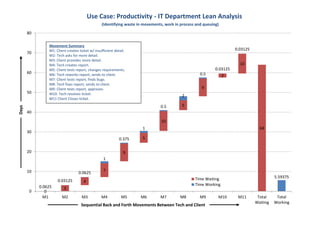
Use Case: Productivity - IT Department Lean Analysis
0
3
4
7
9
5
10
5
9
2
10
64
0.0625
0.03125
0.0625
1
0.375
1
0.5
2
0.5
0.03125
0.03125
5.59375
0
10
20
30
40
50
60
70
80
M1 M2 M3 M4 M5 M6 M7 M8 M9 M10 M11 Total
Waiting
Total
Working
Time Waiting
Time Working
Movement Summary
M1: Client creates ticket w/ insufficient detail.
M2: Tech asks for more detail.
M3: Client provides more detail.
M4: Tech creates report.
M5: Client tests report, changes requirements.
M6: Tech reworks report, sends to client.
M7: Client tests report, finds bugs.
M8: Tech fixes report, sends to client.
M9: Client tests report, approves.
M10: Tech resolves ticket.
M11 Client Closes ticket.
Days
Sequential Back and Forth Movements Between Tech and Client
(Identifying waste in movements, work in process and queuing)
Resources
• Dave Dean, Ph.D.
ddean@ewu.edu
509-359-2256
• http://www.educause.edu/ecar
• http://tdwi.org
• http://www.gartner.com/technology/core/products/research/topic
s/businessIntelligence.jsp
• Todd Hoffman
thoffman2@ewu.edu
509-359-2857

EWU BI Overview 2014_07-09

  • 1.
    Business Intelligence @Eastern Washington University Strategy and Resources
  • 2.
    BI Architecture (EWU -Partial Service Catalog) Requires Data Feed API Y Y Hosted C C Centralized Reports J J J Canned Reports (Client) 1 2 3 4 5 6 2 7 8 9 10 11 Consol. Data Staging (ODS) Spreadsheet X X X Database S O O U U O U O O O U S M M M S O ? ? TRIO Hobson's-Admissions Maxient RMS StarRez Banner Soar Hobson's-Retention* AccreditationManagement TenureManagement CertificationPrograms-EDIE InstitutionalResearch Banner-Modules OSSI(Police) AIM Canvas Instructionalmediause Wordpress Ingeniux-CMS PHPwebsites Millennium WebHelpDesk Athletics Library OthersStudent Busines OpsAcademic Instructional Web Svcs. Advancement Dashboards OLAP Standard Reports Data Mining Source Systems Source Systems Source Systems Source Systems Source Systems Extract / Transform / Load / Integrate Source Systems Source Systems Transaction Processing Stand Alone Systems Normalized Data Model Transform / Integrate Standardize Logical Data Models Integrated Data Customized User Layer Data Cube Data Cube Central Administration Data Cube Data Cube Data Cube ODS
  • 3.
    Technology / SupportMaturity Level of Self Service SophisticationofUser Current Proposed Effect of shift in technology Demand Effects Business Operations Instructional Technology Student and Academic Y5Y0 Normalized Model Dimensional Model Canned Reports OLAP Operational System Staged Data ODS Dimensional Data Marts Cubes (Multi-dimensional) Transaction Processing Strategic Insights Shift to Self Service Aggregated Real time student performance. “Emerging Markets” Student Success University Success Constrained by technical skills. Constrained by business knowledge. Top Ten Changes 1. Ability to integrate entire service catalogue. 2. “One version of the truth effect”. 3. Automation of reporting. 4. Centralized admin of access and security. 5. Event driven reports and alerts. 6. Data mining & advanced analytics. 7. Reduction in # of reporting platforms. 8. Consolidation of licensing. 9. Elimination of legacy technology.
  • 4.
    Use Case: Insights- Enrollment Management Ability to Track Performance to Target Objectives • Move towards true management systems. Year over Year Measurement Capabilities • Architecture required stretches the capabilities of ODS. • Storage intensive solution implemented. Course Capacity Management • Significantly reduces time and effort to find open courses. Pipeline Reporting • Provides End to end business process view of data.
  • 5.
    Use Case: Productivity- IT Department Lean Analysis 0 3 4 7 9 5 10 5 9 2 10 64 0.0625 0.03125 0.0625 1 0.375 1 0.5 2 0.5 0.03125 0.03125 5.59375 0 10 20 30 40 50 60 70 80 M1 M2 M3 M4 M5 M6 M7 M8 M9 M10 M11 Total Waiting Total Working Time Waiting Time Working Movement Summary M1: Client creates ticket w/ insufficient detail. M2: Tech asks for more detail. M3: Client provides more detail. M4: Tech creates report. M5: Client tests report, changes requirements. M6: Tech reworks report, sends to client. M7: Client tests report, finds bugs. M8: Tech fixes report, sends to client. M9: Client tests report, approves. M10: Tech resolves ticket. M11 Client Closes ticket. Days Sequential Back and Forth Movements Between Tech and Client (Identifying waste in movements, work in process and queuing)
  • 6.
    Resources • Dave Dean,Ph.D. ddean@ewu.edu 509-359-2256 • http://www.educause.edu/ecar • http://tdwi.org • http://www.gartner.com/technology/core/products/research/topic s/businessIntelligence.jsp • Todd Hoffman thoffman2@ewu.edu 509-359-2857