EWRT 30 Class 18
AGENDA
•Discussion:
•Red Wheelbarrow submissions
•Coming Attractions
• Terms 19-25
•Short Plays
 Poetry: up to 5 poems
 Fiction: 1 short story (up to 5,000 words), or up to 3
short-shorts
 Plays: 1 dramatic piece up to 5,000 words
 Creative Nonfiction: 1 piece up to 5,000 words
 Comics: 1 brief graphic story
Red
Wheelbarrow
Literary
Magazine
Editor: Ken Weisner
weisnerken@fhda.edu
http:/faculty.deanza.edu/
weisnerken/
How to submit your work
• Send an email with your name
and the title(s) of your work to
weisnerken@fhda.edu
• Attach your clean and edited
text in a word document.
• Leave your name and other
identifying information off of
your submission.
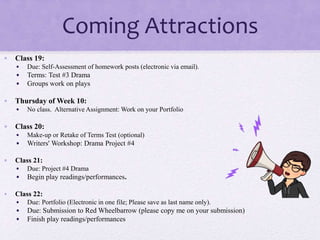
Coming Attractions
• Class 19:
• Due: Self-Assessment of homework posts (electronic via email).
• Terms: Test #3 Drama
• Groups work on plays
• Thursday of Week 10:
• No class. Alternative Assignment: Work on your Portfolio
• Class 20:
• Make-up or Retake of Terms Test (optional)
• Writers' Workshop: Drama Project #4
• Class 21:
• Due: Project #4 Drama
• Begin play readings/performances.
• Class 22:
• Due: Portfolio (Electronic in one file; Please save as last name only).
• Due: Submission to Red Wheelbarrow (please copy me on your submission)
• Finish play readings/performances
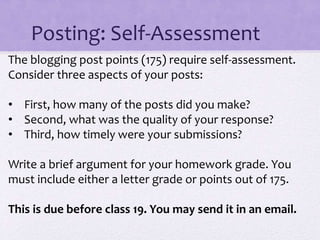
Posting: Self-Assessment
The blogging post points (175) require self-assessment.
Consider three aspects of your posts:
• First, how many of the posts did you make?
• Second, what was the quality of your response?
• Third, how timely were your submissions?
Write a brief argument for your homework grade. You
must include either a letter grade or points out of 175.
This is due before class 19. You may send it in an email.
Here is the Math!
• Your final grade will be figured this way: 175/16 points per post (10.93 points each)
minus 5.46 points for each late post (48 hours after the due time. There are no
points awarded for posts more than 48 hours late). Then, multiply the total times the
average grade percentage for the quality of your work.
Example
• Posts completed: 15 x 10.93 points = 163.95 points
• Late posts: 1 x 5.46 =5.46
• Subtract the smaller from the larger: 163.95- 5.46 = 158.49
• Quality of posts: A or 94% (Quality only exceeds 95% if you have positive
comments from me.)
• Multiply the total times the quality:158.49 x .94 = 148.98 or 149/175 points
Terms
Last Batch!
19. Allusion: A reference to well-known people, places, or events
from history, historical documents, literature, or myth, for
example.
20. Motive: A reason for a character’s thoughts or actions.
21. Gesture: The physical movement of a character during a play.
Gesture is used to reveal character, and may include facial
expressions as well as movements of other parts of an actor's
body. Sometimes a playwright will be very explicit about both
bodily and facial gestures, providing detailed instructions in the
play's stage directions.
19. Props: Articles or objects that appear on stage during a play. The
Christmas tree in A Doll's House and Laura's collection of glass
animals in The Glass Menagerie are examples.
23. Stage direction: A playwright's descriptive or interpretive
comments that provide readers (and actors) with information
about the dialogue, setting, and action of a play. Modern
playwrights, including Ibsen, Shaw, Miller, and Williams tend
to include substantial stage directions, while earlier
playwrights typically used them more sparsely, implicitly, or
not at all.
24. Staging: The spectacle a play presents in performance,
including the position of actors on stage, the scenic
background, the props and costumes, and the lighting and
sound effects.
25. Fourth wall: The imaginary wall of the box theater setting,
supposedly removed to allow the audience to see the action.
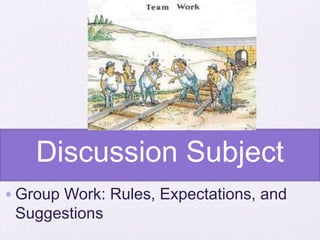
Discussion Subject
•Group Work: Rules, Expectations, and
Suggestions
Rules
• Everyone must contribute to the writing, though
everyone might not contribute equally.
• Everyone must play some part in the creation,
production, design, or delivery of the presentation.
• Everyone must be in class on both presentation days to
get full credit for the project.
• All presentations are due on Monday of finals week. I
must have a copy before class begins. We will use a
lottery to choose the order of
performances/productions.
Expectations
• All students will participate enthusiastically.
• Group members will establish realistic goals that
work for everyone.
• Group members will keep their agreements about
what they will accomplish in a given time.
• Group members will see me immediately if someone
in the group needs “encouragement” to manage a
share of the work.
Suggestions
• Set up an electronic collaboration system to minimize
scheduling problems.
• Appoint a note-taker within your group.
• Assign different members leadership jobs in different aspects of
the project: planning, coordinating, research, IT skills, writing
skills, presentation skills.
• Make a plan that assures your project is ready on time.
• Check video or computer needs ahead of time.
• Let me know well ahead of time if you need me to help you do
something.
Get into your
Groups and work!
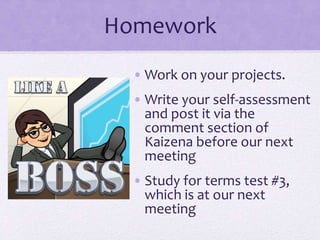
Homework
• Work on your projects.
• Write your self-assessment
and post it via the
comment section of
Kaizena before our next
meeting
• Study for terms test #3,
which is at our next
meeting

Ewrt 30 class 18

  • 1.
  • 2.
    AGENDA •Discussion: •Red Wheelbarrow submissions •ComingAttractions • Terms 19-25 •Short Plays
  • 3.
     Poetry: upto 5 poems  Fiction: 1 short story (up to 5,000 words), or up to 3 short-shorts  Plays: 1 dramatic piece up to 5,000 words  Creative Nonfiction: 1 piece up to 5,000 words  Comics: 1 brief graphic story Red Wheelbarrow Literary Magazine Editor: Ken Weisner weisnerken@fhda.edu http:/faculty.deanza.edu/ weisnerken/
  • 4.
    How to submityour work • Send an email with your name and the title(s) of your work to weisnerken@fhda.edu • Attach your clean and edited text in a word document. • Leave your name and other identifying information off of your submission.
  • 5.
    Coming Attractions • Class19: • Due: Self-Assessment of homework posts (electronic via email). • Terms: Test #3 Drama • Groups work on plays • Thursday of Week 10: • No class. Alternative Assignment: Work on your Portfolio • Class 20: • Make-up or Retake of Terms Test (optional) • Writers' Workshop: Drama Project #4 • Class 21: • Due: Project #4 Drama • Begin play readings/performances. • Class 22: • Due: Portfolio (Electronic in one file; Please save as last name only). • Due: Submission to Red Wheelbarrow (please copy me on your submission) • Finish play readings/performances
  • 6.
    Posting: Self-Assessment The bloggingpost points (175) require self-assessment. Consider three aspects of your posts: • First, how many of the posts did you make? • Second, what was the quality of your response? • Third, how timely were your submissions? Write a brief argument for your homework grade. You must include either a letter grade or points out of 175. This is due before class 19. You may send it in an email.
  • 7.
    Here is theMath! • Your final grade will be figured this way: 175/16 points per post (10.93 points each) minus 5.46 points for each late post (48 hours after the due time. There are no points awarded for posts more than 48 hours late). Then, multiply the total times the average grade percentage for the quality of your work. Example • Posts completed: 15 x 10.93 points = 163.95 points • Late posts: 1 x 5.46 =5.46 • Subtract the smaller from the larger: 163.95- 5.46 = 158.49 • Quality of posts: A or 94% (Quality only exceeds 95% if you have positive comments from me.) • Multiply the total times the quality:158.49 x .94 = 148.98 or 149/175 points
  • 8.
  • 9.
    19. Allusion: Areference to well-known people, places, or events from history, historical documents, literature, or myth, for example. 20. Motive: A reason for a character’s thoughts or actions. 21. Gesture: The physical movement of a character during a play. Gesture is used to reveal character, and may include facial expressions as well as movements of other parts of an actor's body. Sometimes a playwright will be very explicit about both bodily and facial gestures, providing detailed instructions in the play's stage directions. 19. Props: Articles or objects that appear on stage during a play. The Christmas tree in A Doll's House and Laura's collection of glass animals in The Glass Menagerie are examples.
  • 10.
    23. Stage direction:A playwright's descriptive or interpretive comments that provide readers (and actors) with information about the dialogue, setting, and action of a play. Modern playwrights, including Ibsen, Shaw, Miller, and Williams tend to include substantial stage directions, while earlier playwrights typically used them more sparsely, implicitly, or not at all. 24. Staging: The spectacle a play presents in performance, including the position of actors on stage, the scenic background, the props and costumes, and the lighting and sound effects. 25. Fourth wall: The imaginary wall of the box theater setting, supposedly removed to allow the audience to see the action.
  • 11.
    Discussion Subject •Group Work:Rules, Expectations, and Suggestions
  • 12.
    Rules • Everyone mustcontribute to the writing, though everyone might not contribute equally. • Everyone must play some part in the creation, production, design, or delivery of the presentation. • Everyone must be in class on both presentation days to get full credit for the project. • All presentations are due on Monday of finals week. I must have a copy before class begins. We will use a lottery to choose the order of performances/productions.
  • 13.
    Expectations • All studentswill participate enthusiastically. • Group members will establish realistic goals that work for everyone. • Group members will keep their agreements about what they will accomplish in a given time. • Group members will see me immediately if someone in the group needs “encouragement” to manage a share of the work.
  • 14.
    Suggestions • Set upan electronic collaboration system to minimize scheduling problems. • Appoint a note-taker within your group. • Assign different members leadership jobs in different aspects of the project: planning, coordinating, research, IT skills, writing skills, presentation skills. • Make a plan that assures your project is ready on time. • Check video or computer needs ahead of time. • Let me know well ahead of time if you need me to help you do something.
  • 15.
  • 16.
    Homework • Work onyour projects. • Write your self-assessment and post it via the comment section of Kaizena before our next meeting • Study for terms test #3, which is at our next meeting