EWRT 30 Class 18
AGENDA
•Discussion:
•Red Wheelbarrow submissions
•Coming Attractions
• Terms 19-25
•Short Plays
 Poetry: up to 5 poems
 Fiction: 1 short story (up to 5,000 words), or up to 3
short-shorts
 Plays: 1 dramatic piece up to 5,000 words
 Creative Nonfiction: 1 piece up to 5,000 words
 Comics: 1 brief graphic story
Red Wheelbarrow
Literary Magazine
Editor: Ken Weisner
weisnerken@fhda.edu
http:/faculty.deanza.edu/
weisnerken/
How to submit your work
• Send an email with your name
and the title(s) of your work to
weisnerken@fhda.edu
• Attach your clean and edited
text in a word document.
• Leave your name and other
identifying information off of
your submission.
Coming Attractions
• Class 19:
• Due: Self-Assessment of homework posts (electronic via email).
• Terms: Test #3 Drama
• Groups work on plays
• Class 20:
• Make-up or Retake of Terms Test (optional)
• Writers' Workshop: Drama Project #4
• Class 21:
• Due: Project #4 Drama
• Begin play readings/performances.
• Class 22:
• Due: Portfolio (Electronic in one file; Please save as last name only).
• Due: Submission to Red Wheelbarrow (please copy me on your submission)
• Finish play readings/performances
Posting: Self-Assessment
The blogging post points (200) require self-assessment.
Consider three aspects of your posts:
• First, how many of the posts did you make?
• Second, what was the quality of your response?
• Third, how timely were your submissions?
Write a brief argument for your homework grade. You
must include either a letter grade or points out of 200.
This is due before class 19. You may send it in an email.
Terms
Last Batch!
19. Allusion: A reference to well-known people, places, or events
from history, historical documents, literature, or myth, for
example.
20. Motive: A reason for a character’s thoughts or actions.
21. Gesture: The physical movement of a character during a play.
Gesture is used to reveal character, and may include facial
expressions as well as movements of other parts of an actor's
body. Sometimes a playwright will be very explicit about both
bodily and facial gestures, providing detailed instructions in the
play's stage directions.
19. Props: Articles or objects that appear on stage during a play. The
Christmas tree in A Doll's House and Laura's collection of glass
animals in The Glass Menagerie are examples.
23. Stage direction: A playwright's descriptive or interpretive
comments that provide readers (and actors) with information
about the dialogue, setting, and action of a play. Modern
playwrights, including Ibsen, Shaw, Miller, and Williams tend
to include substantial stage directions, while earlier
playwrights typically used them more sparsely, implicitly, or
not at all.
24. Staging: The spectacle a play presents in performance,
including the position of actors on stage, the scenic
background, the props and costumes, and the lighting and
sound effects.
25. Fourth wall: The imaginary wall of the box theater setting,
supposedly removed to allow the audience to see the action.
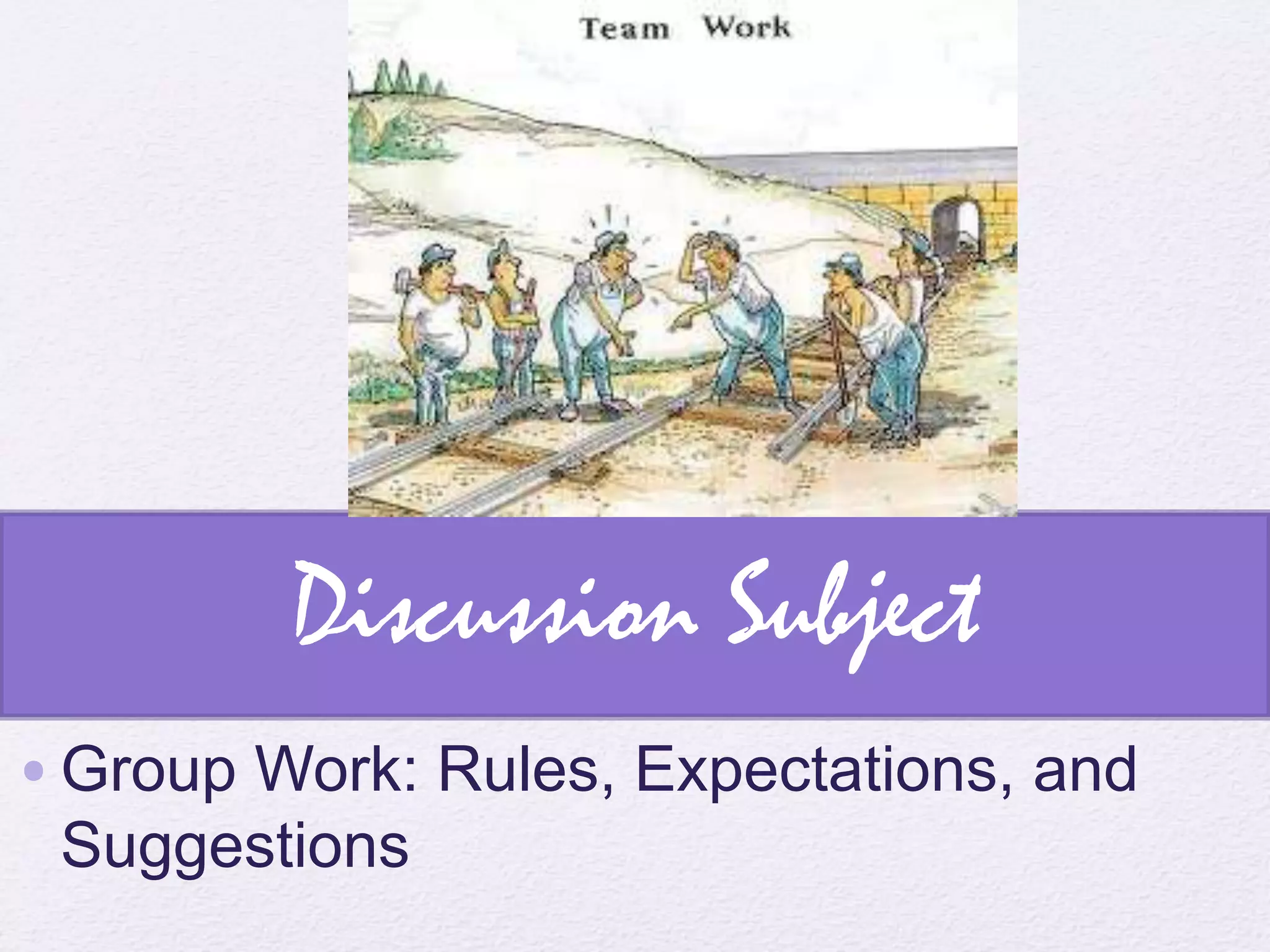
Discussion Subject
•Group Work: Rules, Expectations, and
Suggestions
Rules
• Everyone must contribute to the writing, though
everyone might not contribute equally.
• Everyone must play some part in the creation,
production, design, or delivery of the presentation.
• Everyone must be in class on both presentation days to
get full credit for the project.
• All presentations are due on Monday of finals week. I
must have a copy before class begins. We will use a
lottery to choose the order of
performances/productions.
Expectations
• All students will participate enthusiastically.
• Group members will establish realistic goals that
work for everyone.
• Group members will keep their agreements about
what they will accomplish in a given time.
• Group members will see me immediately if someone
in the group needs “encouragement” to manage a
share of the work.
Suggestions
• Set up an electronic collaboration system to minimize
scheduling problems.
• Appoint a note-taker within your group.
• Assign different members leadership jobs in different aspects of
the project: planning, coordinating, research, IT skills, writing
skills, presentation skills.
• Make a plan that assures your project is ready on time.
• Check video or computer needs ahead of time.
• Let me know well ahead of time if you need me to help you do
something.
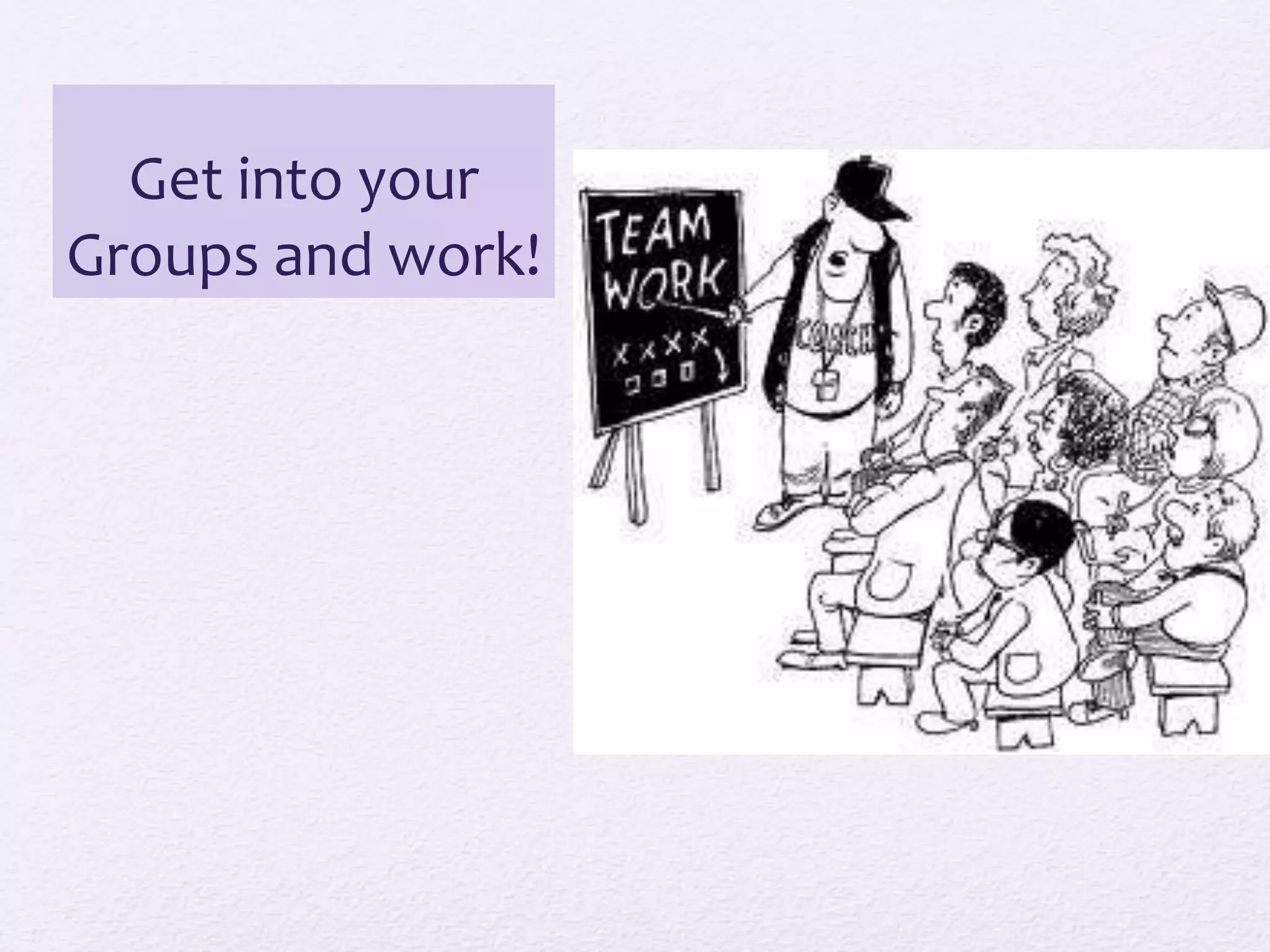
Get into your
Groups and work!
Homework
•Work on your projects.
•Write your self-
assessment and email it
to me.
•Study for terms test #3

Ewrt 30 class 18

  • 1.
  • 2.
    AGENDA •Discussion: •Red Wheelbarrow submissions •ComingAttractions • Terms 19-25 •Short Plays
  • 3.
     Poetry: upto 5 poems  Fiction: 1 short story (up to 5,000 words), or up to 3 short-shorts  Plays: 1 dramatic piece up to 5,000 words  Creative Nonfiction: 1 piece up to 5,000 words  Comics: 1 brief graphic story Red Wheelbarrow Literary Magazine Editor: Ken Weisner weisnerken@fhda.edu http:/faculty.deanza.edu/ weisnerken/
  • 4.
    How to submityour work • Send an email with your name and the title(s) of your work to weisnerken@fhda.edu • Attach your clean and edited text in a word document. • Leave your name and other identifying information off of your submission.
  • 5.
    Coming Attractions • Class19: • Due: Self-Assessment of homework posts (electronic via email). • Terms: Test #3 Drama • Groups work on plays • Class 20: • Make-up or Retake of Terms Test (optional) • Writers' Workshop: Drama Project #4 • Class 21: • Due: Project #4 Drama • Begin play readings/performances. • Class 22: • Due: Portfolio (Electronic in one file; Please save as last name only). • Due: Submission to Red Wheelbarrow (please copy me on your submission) • Finish play readings/performances
  • 6.
    Posting: Self-Assessment The bloggingpost points (200) require self-assessment. Consider three aspects of your posts: • First, how many of the posts did you make? • Second, what was the quality of your response? • Third, how timely were your submissions? Write a brief argument for your homework grade. You must include either a letter grade or points out of 200. This is due before class 19. You may send it in an email.
  • 7.
  • 8.
    19. Allusion: Areference to well-known people, places, or events from history, historical documents, literature, or myth, for example. 20. Motive: A reason for a character’s thoughts or actions. 21. Gesture: The physical movement of a character during a play. Gesture is used to reveal character, and may include facial expressions as well as movements of other parts of an actor's body. Sometimes a playwright will be very explicit about both bodily and facial gestures, providing detailed instructions in the play's stage directions. 19. Props: Articles or objects that appear on stage during a play. The Christmas tree in A Doll's House and Laura's collection of glass animals in The Glass Menagerie are examples.
  • 9.
    23. Stage direction:A playwright's descriptive or interpretive comments that provide readers (and actors) with information about the dialogue, setting, and action of a play. Modern playwrights, including Ibsen, Shaw, Miller, and Williams tend to include substantial stage directions, while earlier playwrights typically used them more sparsely, implicitly, or not at all. 24. Staging: The spectacle a play presents in performance, including the position of actors on stage, the scenic background, the props and costumes, and the lighting and sound effects. 25. Fourth wall: The imaginary wall of the box theater setting, supposedly removed to allow the audience to see the action.
  • 10.
    Discussion Subject •Group Work:Rules, Expectations, and Suggestions
  • 11.
    Rules • Everyone mustcontribute to the writing, though everyone might not contribute equally. • Everyone must play some part in the creation, production, design, or delivery of the presentation. • Everyone must be in class on both presentation days to get full credit for the project. • All presentations are due on Monday of finals week. I must have a copy before class begins. We will use a lottery to choose the order of performances/productions.
  • 12.
    Expectations • All studentswill participate enthusiastically. • Group members will establish realistic goals that work for everyone. • Group members will keep their agreements about what they will accomplish in a given time. • Group members will see me immediately if someone in the group needs “encouragement” to manage a share of the work.
  • 13.
    Suggestions • Set upan electronic collaboration system to minimize scheduling problems. • Appoint a note-taker within your group. • Assign different members leadership jobs in different aspects of the project: planning, coordinating, research, IT skills, writing skills, presentation skills. • Make a plan that assures your project is ready on time. • Check video or computer needs ahead of time. • Let me know well ahead of time if you need me to help you do something.
  • 14.
  • 15.
    Homework •Work on yourprojects. •Write your self- assessment and email it to me. •Study for terms test #3