Class 11
EWRT 2
Ambiguity in Writing
• Ambiguity occurs when the meaning of a word,
a phrase, or a sentence can have two possible
interpretations, and the reader cannot
determine from the sentence which is the
intended meaning. Sometimes, writers are
intentionally ambiguous because they want to
suggest multiple meanings; generally, though,
ambiguity just leads to confusion.
Words with Multiple
Meanings
• Ambiguity occurs because words have multiple meanings. For
example, sharp may describe a knife-edge, or it may refer to a
musical note. Other words have multiple meanings.
• Consider the sentence sentence, "he picked a date. Date here
may refer to a fruit, a day of the year, an appointment, a
romantic encounter, or the person with whom one goes to
dinner.
• Does this sentence mean he chose a day of the year, he made an
appointment, or he took a piece of fruit from the tree or from a
plate of food offerings?
• To resolve this kind of ambiguity, make sure the meaning of the
term is clear from the sentence: "He picked a date to hold the
meeting."
Structural or
Grammatical Ambiguity
• This type of ambiguity occurs when the reader can't determine the intended
meaning because the sentence contains two competing grammatical structures.
• For example: The sentence, "Talented women and men should apply for this
job," has two possible readings. First, the sentence can mean "[Talented
women] and men should apply for this job." In this case, the men need not be
talented to apply, but the women must be talented. Second, the sentence can
mean "[Talented women] and [talented men] should apply for this job. Both the
women and the men should be talented.
• Likewise the statement, "They can fish," has two possible meanings. First, "they
are able to fish," which can mean that they have the ability or the opportunity to
do so. Second, the statement can mean that they put fish into cans, a
manufacturing or storing process.
• To resolve structural/grammatical ambiguities, rephrase the sentence.
AGENDA
• Discussion: Machiavelli "The Qualities of the
Prince"
• Biography
• Rhetorical Strategies
• Questions for Critical Reading
• QHQ Discussion Vocabulary (Time Permitting)
• Essay #2: Choose your prompt (Time
Permitting)
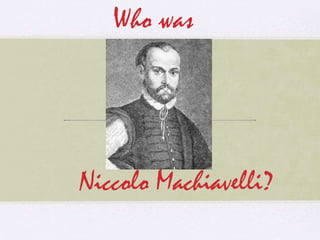
Niccolo Machiavelli?
Who was
Niccolo Machiavelli was born in Florence, Italy on May 3, 1469.
He is notable for his essays on politics, particularly his infamous treatise on
power entitled The Prince.
He came form a political family.
He held a privileged position
He had a wife and sixteen children.
In 1494 Machiavelli became a clerk at the chancery at Adrian.
Later, he became a secretary to the Council of Ten, which was the
governing body in charge of diplomacy and military organization for the
new Florentine republican government.
He observed the workings of foreign affairs firsthand.
He met with other political leaders to see how their countries were ruled.
He carried out several diplomatic missions to Germany, Spain, and other
Italian city-states.
In 1512 the Medici family regained power in Florence,
putting an end to republican rule. As a result, Machiavelli
was forced out of his job and temporarily imprisoned. He
returned to his country estate near San Casciano after his
release and wrote several books on politics, including, On
the Art of War, History of Florence, Discourses on Livy, and
The Prince, which was dedicated to Lorenzo de Medici in an
attempt to gain favor with the ruling family.
Machiavelli wrote a first version of
The Prince in 1513, but it was not
published until 1532—
five years after his death.
In your groups
• Discuss the rhetorical strategies of
Machiavelli.
• Discuss the “Questions for Critical
Thinking” on page 50. Find textual
support for your answers!
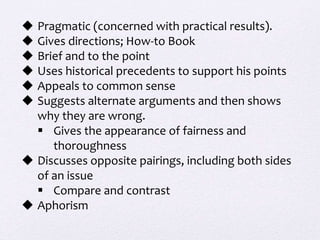
Which are the Rhetorical
Strategies of Machiavelli?
 Pragmatic (concerned with practical results).
 Gives directions; How-to Book
 Brief and to the point
 Uses historical precedents to support his points
 Appeals to common sense
 Suggests alternate arguments and then shows
why they are wrong.
 Gives the appearance of fairness and
thoroughness
 Discusses opposite pairings, including both sides
of an issue
 Compare and contrast
 Aphorism
Questions for
Critical Reading
Machiavelli “The Qualities of the Prince”
QHQs: What do you
think?
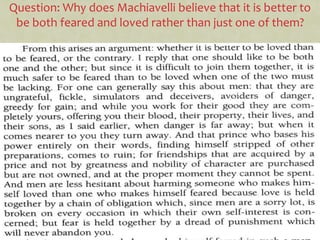
Question: Why does Machiavelli believe that it is better to
be both feared and loved rather than just one of them?
Exercise the Mind?
• Q: Why does Machiavelli say that the only way to exercise the mind of war he
must train by action and the mind?
• Q: Why does Machiavelli believe that it is necessary for a wise prince to “be a
fox in order to recognize the traps and a lion to frighten the wolves” ? (230).
• Q: Why does Machiavelli suggest the prince to exercise his mind, “But as for
the exercise of the mind, the prince must read histories and in them study
the deeds of great me; he must see how they conducted themselves in
wars” (223)? What relevance does that have to governing people?
• Q: In the opening part of “The Qualities of the Prince,” Machiavelli states
that it is important for the prince to learn about past heroes so that it would
exercise his mind, would learning about the past really help the prince?
Q: Why does Machiavelli insist a man fighting in war is not only a
man but a beast?
Q: Why does “being disarmed, [make] you despised” (38)?
Q: Since being disarmed is despised, what does being armed
make you?
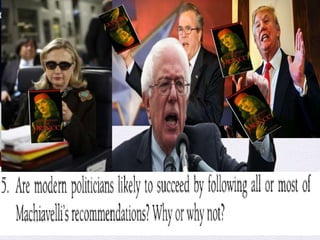
Q: If Machiavelli’s ideas are similar to modern times, then does
that mean that todays politicians should follow his ideas to gain
power and success?
Machiavelli and Military Might
If we take Machiavelli’s opinion about men as fact, that
men are “ungrateful, fickle, simulators and deceivers,
avoiders of danger, greedy for gain” (46,para 14,
Machiavelli), can we presume that modern democracy is
a flawed concept?
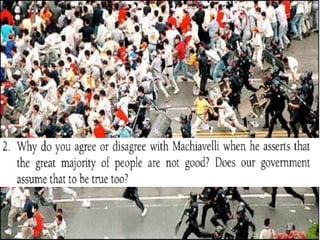
Q: If the majority of the people that Machiavelli claims
are indeed not good, then what does the government
have to do about this?
Machiavelli on the nature
of people
The Prince
Q: Why does Machiavelli insist that a prince should know how to be
“a great hypocrite and a liar” about his nature?
Q: Is it possible for a prince or a ruler not to have a subject despise
or have hatred towards them?
Question: Why does Machiavelli think that a manipulative princes is
more successful than a honorable prince?
Q: Machiavelli states that one key of avoiding being hated is to
“avoid considered changeable”, isn’t this contradicting itself ?
Machiavelli’s Rule
• Q: Are the tenets exercised by Machiavelli hindering or preserving
human civilization?
• Question: What would be Machiavelli’s ideal government?
• Q: Is honor vital to leadership?
• Q: What does Machiavelli mean when he says that “there are two
ways of fighting: one according to the laws, the other is force; the
first way is proper to man, the second to beasts” (48)?
• Q: Then how do you set a balance between communism and
liberalism?
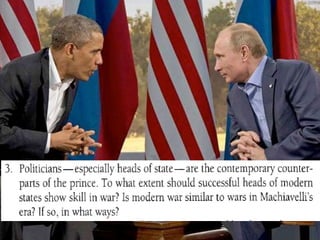
• Q: What kind of politician would Machiavelli be by today’s
standards?
Lao Tzu and Machiavelli
Q. How do Machiavelli’s teachings differ from Lao-Tzu’s
teachings?
Where does Machiavelli’s active view on war stand
against Lao-Tzu’s passive view in terms of success and
prosperity for both the people and the ruler?
Vocabulary
Exam 4: Class 12
At our next meeting!
• Ad hominem: "against the man"; attacking the arguer rather
than the argument or issue.
• Appeal to tradition: a proposal that something should continue
because it has traditionally existed or been done that way.
• Argument: a process of reasoning and advancing proof about
issues on which conflicting views may be held; also, a statement
or statements providing support for a claim.
• Authority: a respectable, reliable source of evidence.
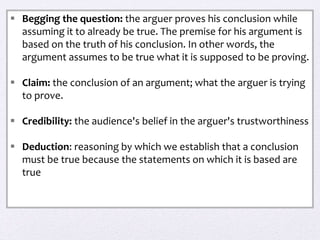
 Begging the question: the arguer proves his conclusion while
assuming it to already be true. The premise for his argument is
based on the truth of his conclusion. In other words, the
argument assumes to be true what it is supposed to be proving.
 Claim: the conclusion of an argument; what the arguer is trying
to prove.
 Credibility: the audience's belief in the arguer's trustworthiness
 Deduction: reasoning by which we establish that a conclusion
must be true because the statements on which it is based are
true
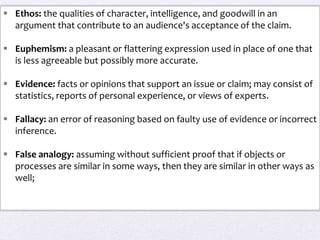
 Ethos: the qualities of character, intelligence, and goodwill in an
argument that contribute to an audience's acceptance of the claim.
 Euphemism: a pleasant or flattering expression used in place of one that
is less agreeable but possibly more accurate.
 Evidence: facts or opinions that support an issue or claim; may consist of
statistics, reports of personal experience, or views of experts.
 Fallacy: an error of reasoning based on faulty use of evidence or incorrect
inference.
 False analogy: assuming without sufficient proof that if objects or
processes are similar in some ways, then they are similar in other ways as
well;
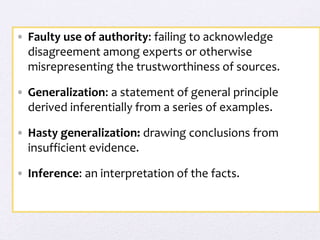
• Faulty use of authority: failing to acknowledge
disagreement among experts or otherwise
misrepresenting the trustworthiness of sources.
• Generalization: a statement of general principle
derived inferentially from a series of examples.
• Hasty generalization: drawing conclusions from
insufficient evidence.
• Inference: an interpretation of the facts.
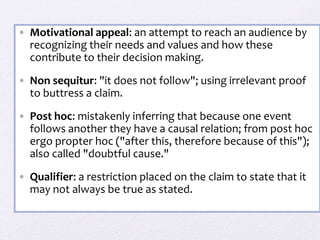
• Motivational appeal: an attempt to reach an audience by
recognizing their needs and values and how these
contribute to their decision making.
• Non sequitur: "it does not follow"; using irrelevant proof
to buttress a claim.
• Post hoc: mistakenly inferring that because one event
follows another they have a causal relation; from post hoc
ergo propter hoc ("after this, therefore because of this");
also called "doubtful cause."
• Qualifier: a restriction placed on the claim to state that it
may not always be true as stated.
• Refutation: an attack on an opposing view in order to
weaken it, invalidate it, or make it less credible.
• Slanting: selecting facts or words with connotations
that favor the arguer's bias and discredit alternatives.
• Slippery slope: predicting without justification that one
step in a process will lead unavoidably to a second,
generally undesirable step.
• Values: conceptions or ideas that act as standards for
judging what is right or wrong, worthwhile or
worthless, beautiful or ugly, good or bad.
Thinking about Essay #2
• Write an essay of at least 2 pages but not more than 3
pages in response to our readings.
• Lao Tzu: Suggestions for Writing: Pages 32-33
• Machiavelli: Suggestions for Writing: Pages 50-51
• Your essay should be formatted in MLA style.
• Pay attention to the details of the formatting.
Responding to A Prompt
• Take the prompt apart; briefly respond to each sub-question.
• The Thesis: Look at the brief answers you gave to the questions. Then,
work them into a short answer. Your thesis will likely be a combination of
answers to the most important or compelling of the questions.
• Write a brief directed summary as an introduction, and conclude it with
your thesis.
• Expand your list of answers to sub-questions into an outline.
• Find textual support for answers that will come from the text
• Put your evidence, explanation, and analysis into your outline
• Revise, edit, and format MLA style; make a works cited page
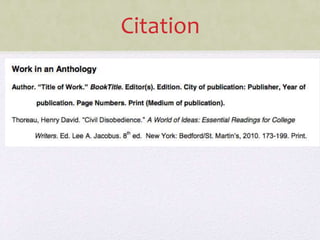
Citation
HOMEWORK
• Post #21: How can we apply the philosophy of Machiavelli
and/or Lao-Tzu to A Game of Thrones? Post textual evidence
(excerpts of text) from both sources to prove your points. Make
sure to include page numbers so we can follow along in class.
(Print and bring your post to class)
• Post #22 Essay #2 (2-3 pages: Due Friday before noon)
• Choose your topic from "Suggestions for Writing" pages 32-33,
prompts 1-6 or pages 50-51 prompts 1-5. Post your question and
the thesis.
• Study Vocabulary for exam #4: Next Class
• Bring A World of Ideas, printed versions of the text, or be able
to access them on your device—not your phone!

Ewrt 2 class 11 machiavelli

  • 1.
  • 2.
    Ambiguity in Writing •Ambiguity occurs when the meaning of a word, a phrase, or a sentence can have two possible interpretations, and the reader cannot determine from the sentence which is the intended meaning. Sometimes, writers are intentionally ambiguous because they want to suggest multiple meanings; generally, though, ambiguity just leads to confusion.
  • 3.
    Words with Multiple Meanings •Ambiguity occurs because words have multiple meanings. For example, sharp may describe a knife-edge, or it may refer to a musical note. Other words have multiple meanings. • Consider the sentence sentence, "he picked a date. Date here may refer to a fruit, a day of the year, an appointment, a romantic encounter, or the person with whom one goes to dinner. • Does this sentence mean he chose a day of the year, he made an appointment, or he took a piece of fruit from the tree or from a plate of food offerings? • To resolve this kind of ambiguity, make sure the meaning of the term is clear from the sentence: "He picked a date to hold the meeting."
  • 4.
    Structural or Grammatical Ambiguity •This type of ambiguity occurs when the reader can't determine the intended meaning because the sentence contains two competing grammatical structures. • For example: The sentence, "Talented women and men should apply for this job," has two possible readings. First, the sentence can mean "[Talented women] and men should apply for this job." In this case, the men need not be talented to apply, but the women must be talented. Second, the sentence can mean "[Talented women] and [talented men] should apply for this job. Both the women and the men should be talented. • Likewise the statement, "They can fish," has two possible meanings. First, "they are able to fish," which can mean that they have the ability or the opportunity to do so. Second, the statement can mean that they put fish into cans, a manufacturing or storing process. • To resolve structural/grammatical ambiguities, rephrase the sentence.
  • 5.
    AGENDA • Discussion: Machiavelli"The Qualities of the Prince" • Biography • Rhetorical Strategies • Questions for Critical Reading • QHQ Discussion Vocabulary (Time Permitting) • Essay #2: Choose your prompt (Time Permitting)
  • 6.
  • 7.
    Niccolo Machiavelli wasborn in Florence, Italy on May 3, 1469. He is notable for his essays on politics, particularly his infamous treatise on power entitled The Prince. He came form a political family. He held a privileged position He had a wife and sixteen children. In 1494 Machiavelli became a clerk at the chancery at Adrian. Later, he became a secretary to the Council of Ten, which was the governing body in charge of diplomacy and military organization for the new Florentine republican government. He observed the workings of foreign affairs firsthand. He met with other political leaders to see how their countries were ruled. He carried out several diplomatic missions to Germany, Spain, and other Italian city-states.
  • 8.
    In 1512 theMedici family regained power in Florence, putting an end to republican rule. As a result, Machiavelli was forced out of his job and temporarily imprisoned. He returned to his country estate near San Casciano after his release and wrote several books on politics, including, On the Art of War, History of Florence, Discourses on Livy, and The Prince, which was dedicated to Lorenzo de Medici in an attempt to gain favor with the ruling family. Machiavelli wrote a first version of The Prince in 1513, but it was not published until 1532— five years after his death.
  • 9.
    In your groups •Discuss the rhetorical strategies of Machiavelli. • Discuss the “Questions for Critical Thinking” on page 50. Find textual support for your answers!
  • 10.
    Which are theRhetorical Strategies of Machiavelli?
  • 11.
     Pragmatic (concernedwith practical results).  Gives directions; How-to Book  Brief and to the point  Uses historical precedents to support his points  Appeals to common sense  Suggests alternate arguments and then shows why they are wrong.  Gives the appearance of fairness and thoroughness  Discusses opposite pairings, including both sides of an issue  Compare and contrast  Aphorism
  • 12.
    Questions for Critical Reading Machiavelli“The Qualities of the Prince”
  • 18.
    QHQs: What doyou think?
  • 19.
    Question: Why doesMachiavelli believe that it is better to be both feared and loved rather than just one of them?
  • 20.
    Exercise the Mind? •Q: Why does Machiavelli say that the only way to exercise the mind of war he must train by action and the mind? • Q: Why does Machiavelli believe that it is necessary for a wise prince to “be a fox in order to recognize the traps and a lion to frighten the wolves” ? (230). • Q: Why does Machiavelli suggest the prince to exercise his mind, “But as for the exercise of the mind, the prince must read histories and in them study the deeds of great me; he must see how they conducted themselves in wars” (223)? What relevance does that have to governing people? • Q: In the opening part of “The Qualities of the Prince,” Machiavelli states that it is important for the prince to learn about past heroes so that it would exercise his mind, would learning about the past really help the prince?
  • 21.
    Q: Why doesMachiavelli insist a man fighting in war is not only a man but a beast? Q: Why does “being disarmed, [make] you despised” (38)? Q: Since being disarmed is despised, what does being armed make you? Q: If Machiavelli’s ideas are similar to modern times, then does that mean that todays politicians should follow his ideas to gain power and success? Machiavelli and Military Might
  • 22.
    If we takeMachiavelli’s opinion about men as fact, that men are “ungrateful, fickle, simulators and deceivers, avoiders of danger, greedy for gain” (46,para 14, Machiavelli), can we presume that modern democracy is a flawed concept? Q: If the majority of the people that Machiavelli claims are indeed not good, then what does the government have to do about this? Machiavelli on the nature of people
  • 23.
    The Prince Q: Whydoes Machiavelli insist that a prince should know how to be “a great hypocrite and a liar” about his nature? Q: Is it possible for a prince or a ruler not to have a subject despise or have hatred towards them? Question: Why does Machiavelli think that a manipulative princes is more successful than a honorable prince? Q: Machiavelli states that one key of avoiding being hated is to “avoid considered changeable”, isn’t this contradicting itself ?
  • 24.
    Machiavelli’s Rule • Q:Are the tenets exercised by Machiavelli hindering or preserving human civilization? • Question: What would be Machiavelli’s ideal government? • Q: Is honor vital to leadership? • Q: What does Machiavelli mean when he says that “there are two ways of fighting: one according to the laws, the other is force; the first way is proper to man, the second to beasts” (48)? • Q: Then how do you set a balance between communism and liberalism? • Q: What kind of politician would Machiavelli be by today’s standards?
  • 25.
    Lao Tzu andMachiavelli Q. How do Machiavelli’s teachings differ from Lao-Tzu’s teachings? Where does Machiavelli’s active view on war stand against Lao-Tzu’s passive view in terms of success and prosperity for both the people and the ruler?
  • 26.
    Vocabulary Exam 4: Class12 At our next meeting!
  • 27.
    • Ad hominem:"against the man"; attacking the arguer rather than the argument or issue. • Appeal to tradition: a proposal that something should continue because it has traditionally existed or been done that way. • Argument: a process of reasoning and advancing proof about issues on which conflicting views may be held; also, a statement or statements providing support for a claim. • Authority: a respectable, reliable source of evidence.
  • 28.
     Begging thequestion: the arguer proves his conclusion while assuming it to already be true. The premise for his argument is based on the truth of his conclusion. In other words, the argument assumes to be true what it is supposed to be proving.  Claim: the conclusion of an argument; what the arguer is trying to prove.  Credibility: the audience's belief in the arguer's trustworthiness  Deduction: reasoning by which we establish that a conclusion must be true because the statements on which it is based are true
  • 29.
     Ethos: thequalities of character, intelligence, and goodwill in an argument that contribute to an audience's acceptance of the claim.  Euphemism: a pleasant or flattering expression used in place of one that is less agreeable but possibly more accurate.  Evidence: facts or opinions that support an issue or claim; may consist of statistics, reports of personal experience, or views of experts.  Fallacy: an error of reasoning based on faulty use of evidence or incorrect inference.  False analogy: assuming without sufficient proof that if objects or processes are similar in some ways, then they are similar in other ways as well;
  • 30.
    • Faulty useof authority: failing to acknowledge disagreement among experts or otherwise misrepresenting the trustworthiness of sources. • Generalization: a statement of general principle derived inferentially from a series of examples. • Hasty generalization: drawing conclusions from insufficient evidence. • Inference: an interpretation of the facts.
  • 31.
    • Motivational appeal:an attempt to reach an audience by recognizing their needs and values and how these contribute to their decision making. • Non sequitur: "it does not follow"; using irrelevant proof to buttress a claim. • Post hoc: mistakenly inferring that because one event follows another they have a causal relation; from post hoc ergo propter hoc ("after this, therefore because of this"); also called "doubtful cause." • Qualifier: a restriction placed on the claim to state that it may not always be true as stated.
  • 32.
    • Refutation: anattack on an opposing view in order to weaken it, invalidate it, or make it less credible. • Slanting: selecting facts or words with connotations that favor the arguer's bias and discredit alternatives. • Slippery slope: predicting without justification that one step in a process will lead unavoidably to a second, generally undesirable step. • Values: conceptions or ideas that act as standards for judging what is right or wrong, worthwhile or worthless, beautiful or ugly, good or bad.
  • 33.
    Thinking about Essay#2 • Write an essay of at least 2 pages but not more than 3 pages in response to our readings. • Lao Tzu: Suggestions for Writing: Pages 32-33 • Machiavelli: Suggestions for Writing: Pages 50-51 • Your essay should be formatted in MLA style. • Pay attention to the details of the formatting.
  • 34.
    Responding to APrompt • Take the prompt apart; briefly respond to each sub-question. • The Thesis: Look at the brief answers you gave to the questions. Then, work them into a short answer. Your thesis will likely be a combination of answers to the most important or compelling of the questions. • Write a brief directed summary as an introduction, and conclude it with your thesis. • Expand your list of answers to sub-questions into an outline. • Find textual support for answers that will come from the text • Put your evidence, explanation, and analysis into your outline • Revise, edit, and format MLA style; make a works cited page
  • 35.
  • 36.
    HOMEWORK • Post #21:How can we apply the philosophy of Machiavelli and/or Lao-Tzu to A Game of Thrones? Post textual evidence (excerpts of text) from both sources to prove your points. Make sure to include page numbers so we can follow along in class. (Print and bring your post to class) • Post #22 Essay #2 (2-3 pages: Due Friday before noon) • Choose your topic from "Suggestions for Writing" pages 32-33, prompts 1-6 or pages 50-51 prompts 1-5. Post your question and the thesis. • Study Vocabulary for exam #4: Next Class • Bring A World of Ideas, printed versions of the text, or be able to access them on your device—not your phone!