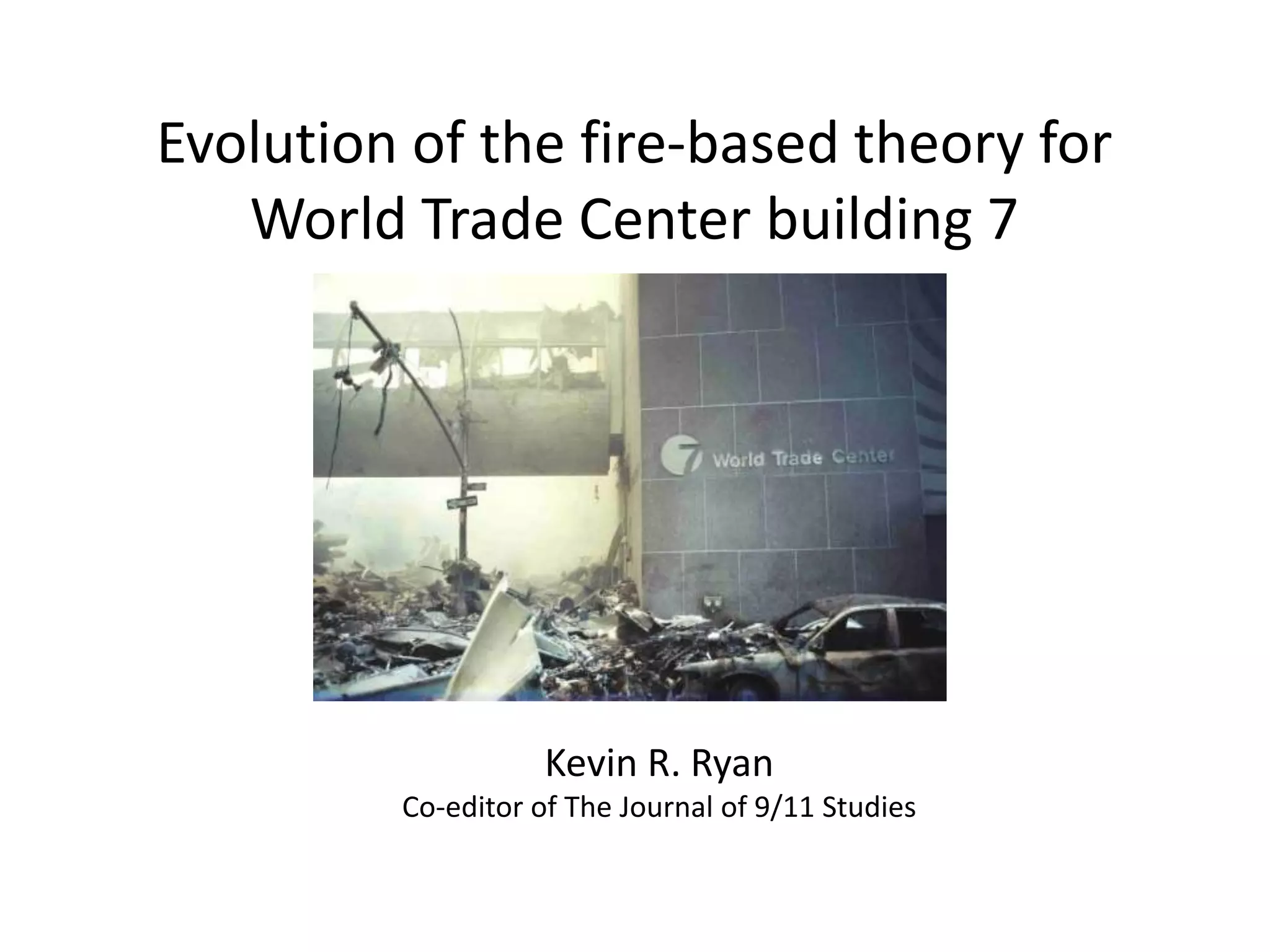
Evolution of the fire-based theory for World Trade Center building 7Kevin R. RyanCo-editor of The Journal of 9/11 Studies
7 pointsThe destruction of WTC 7 was unprecedentedThe steel evidence was destroyed or unexplainedNIST’s final theory followed years of failed hypotheses NIST’s final theory could not have been predictedNIST’s report is self-contradictory and contradicts other known factsNIST’s report is deceptiveNIST’s  final theory for collapse initiation is unscientific and false
The destruction of WTC 7 was unprecedented“The performance of WTC 7 is of significant interest because it appears the collapse was due primarily to fire, rather than any impact damage from the collapsing towers.”  FEMA BPAT report on WTC 7“This was the first known instance of the total collapse of a tall building primarily due to fires.”  NIST NCSTAR 1A, Executive SummaryOfficial reports on WTC 7:  FEMA BPAT report published May 2002
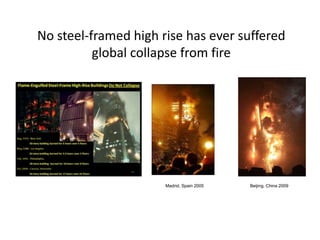
  NIST WTC 7 report published November 2008No steel-framed high rise has ever suffered global collapse from fireBeijing, China 2009Madrid, Spain 2005
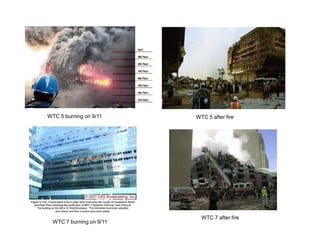
WTC 5 burning on 9/11WTC 5 after fireWTC 7 after fireWTC 7 burning on 9/11
Diesel fuel fires and transfer girders were blamed“Massive structural beams that functioned as a sort of bridge to hold up the 47-story skyscraper known as 7 World Trade Center were compromised in a disastrous blaze fed by diesel fuel, leading to the building's collapse on Sept. 11, investigators have concluded in a preliminary report.”  The New York Times, March 2002“Loss of structural integrity was likely a result of weakening caused by fires on the 5th to 7th floors. The specifics of the fires in WTC 7 and how they caused the building to collapse remain unknown at this time. Although the total diesel fuel on the premises contained massive potential energy, the best hypothesis has only a low probability of occurrence”  FEMA report on building 7“Investigators believe the fire was fed by tanks of diesel fuel."  Popular Mechanics, 2005"Our current working hypothesis is that this pressurized line was supplying fuel [to the fire] for a long period of time.“  Shyam Sunder, NIST’s leading spokesman in 2005
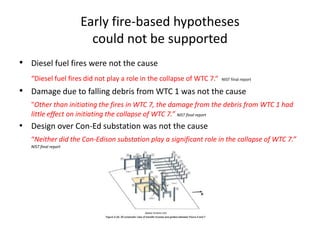
Early fire-based hypotheses could not be supported Diesel fuel fires were not the cause“Diesel fuel fires did not play a role in the collapse of WTC 7.“  NIST final reportDamage due to falling debris from WTC 1 was not the cause"Other than initiating the fires in WTC 7, the damage from the debris from WTC 1 had little effect on initiating the collapse of WTC 7.” NIST final reportDesign over Con-Ed substation was not the cause“Neither did the Con-Edison substation play a significant role in the collapse of WTC 7.” NIST final report
Where is the evidence for a fire-based theory?Most of the steel evidence was destroyedNIST says no WTC 7 steel samples were available, but they wereNIST gathered thousands of photos and videos from the public and kept them hidden for yearsThe fire resistance plan for WTC 7 required 2 to 3 hours of fire resistance for the steel componentsNIST performed no physical testing to test its WTC 7 theoryNIST’s final theory was entirely computer generated
Destruction of steel evidenceThe US House Committee on Science reported, in March 2002: "In the month that lapsed between the terrorist attacks and the deployment of the [FEMA] BPAT team, a significant amount of steel debris... was removed from the rubble pile, cut into smaller sections, and either melted at the recycling plant or shipped out of the U.S. Some of the critical pieces of steel…were gone before the first BPAT team member ever reached the site.“WTC 7 steel found by Professor Astaneh-AslNFPA 921: Fire and explosion investigations -“It is essential to prevent the destruction or removal of evidence…”
The deepest mystery - FEMA Appendix CThe New York Times reported on "perhaps the deepest mystery uncovered in the investigation.” This mystery referred to the extremely thinned pieces of steel, discovered by FEMA investigators, that were found to exhibit sulfidation and evidence of a eutectic formationthat could not be explained by any of the "fire-wise" professors."The severe corrosion and subsequent erosion of Samples 1 [WTC 7] and 2 are a very unusual event. No clear explanation for the source of the sulfur has been identified. The rate of corrosion is also unknown…  A detailed study into the mechanisms of this phenomenon is needed to determine what risk, if any, is presented to existing steel structures exposed to severe and long-burning fires.“  FEMA BPAT report on the WTC, Appendix C
Appendix C sample from WTC 7“A one inch [steel] column has been reduced to half-inch thickness. Its edges--which are curled like a paper scroll--have been thinned to almost razor sharpness. Gaping holes--some larger than a silver dollar—let light shine through a formerly solid steel flange. This Swiss cheese appearance shocked all of the fire-wise professors, who expected to see distortion and bending--but not holes.”WPI Transformations, Spring 2002
Where are the answers?The "detailed study" recommended by FEMA investigators was never doneNIST never mentioned any of this in its WTC 7 reportResearch by independent scientists has provided some answersExtremely high temperatures during the World Trade Center destruction	By: Steven E. Jones, et al, The Journal of 9/11 Studies, January 2008Fourteen Points of Agreement with Official Government Reports on the World Trade Center Destruction	By: Steven E. Jones, et al, The Open Journal of Civil Engineering, April 2008Environmental Anomalies at the WTC: Evidence for Energetic Materials	By: Kevin R. Ryan, et al, The Environmentalist, August 2008Active Thermitic Material Discovered in Dust from the 9/11 World Trade Center Catastrophe	By: Niels H. Harrit, et al The Open Chemical Physics Journal, April 2009
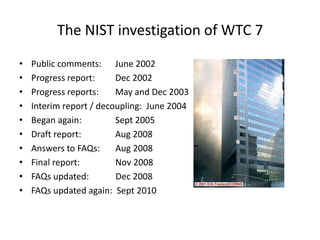
The NIST investigation of WTC 7Public comments:      	June 2002Progress report:       	Dec 2002Progress reports:       	May and Dec 2003Interim report / decoupling:  June 2004Began again:               	Sept 2005Draft report:               	Aug 2008Answers to FAQs:       Aug 2008Final report:                Nov 2008FAQs updated:            Dec 2008FAQs updated again:  Sept 2010
NIST’s objective seemed to changeThe specific objective of the NIST investigation for WTC 7 was to explain “why and how WTC 7 collapsed.”  NIST December 2002 progress reportLater, NIST said –	"The challenge was to determine if a fire-induced floor system failure could occur in WTC 7 under an ordinary building contents fire." NCSTAR 1-9, p 330
December 2003 updateInvestigators had obtained floor layouts, mechanical and electrical system specifications, shop drawings and connection details“Hypotheses have been postulated for the collapse of the 47-story WTC 7 building. NIST is analyzing these and other possible structural collapse sequences as part of its investigation.”“Detailed mappings for the fires, smoke, and the condition of the windows … is under way for WTC 7.”Interim Report on WTC 7 (Appendix L)NIST presented a “Working hypothesis…if it holds up upon further analysis”June 2004 interim reportand decoupling
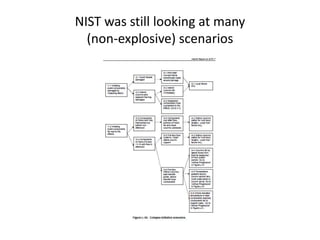
NIST was still looking at many (non-explosive) scenarios
NIST was stumped for years…"But truthfully, I don't really know. We've had trouble getting a handle on building No. 7.”  Shyam Sunder to New York Magazine in 2006 "The reason for the collapse of World Trade Center 7 is no longer a mystery“  Shyam Sunder in 2008, when WTC 7 report was unveiled"The public should really recognize the science is really behind what we have said,”	"The obvious stares you in the face.“  Shyam Sunder to Associated Press in 2008…then said it was obvious
NIST’s final reportsNIST NCSTAR 1A, Final Report on the Collapse of World Trade Center Building 7NIST NCSTAR 1-9, Structural Fire Response and Probable Collapse Sequence of WTC 7Volume 1Volume 2Found online at wtc.nist.gov
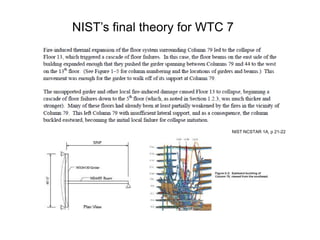
NIST’s final theory for WTC 7NIST NCSTAR 1A, p 21-22
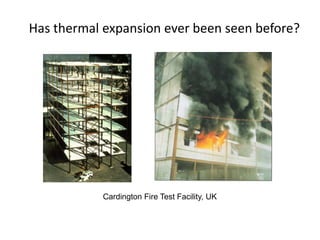
Has thermal expansion ever been seen before?Cardington Fire Test Facility, UK
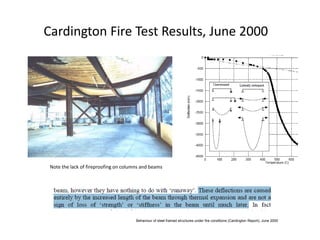
Cardington Fire Test Results, June 2000Note the lack of fireproofing on columns and beamsBehaviour of steel framed structures under fire conditions (Cardington Report), June 2000
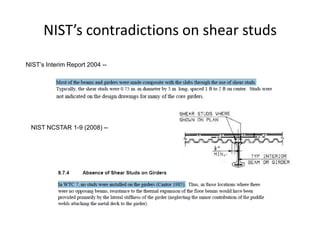
NIST’s contradictions on shear studsNIST’s Interim Report 2004 --NIST NCSTAR 1-9 (2008) --
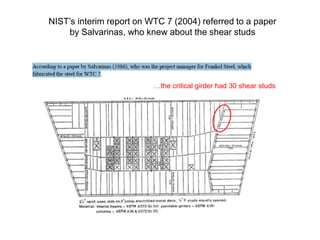
NIST’s interim report on WTC 7 (2004) referred to a paper by Salvarinas, who knew about the shear studs  …the critical girder had 30 shear studs
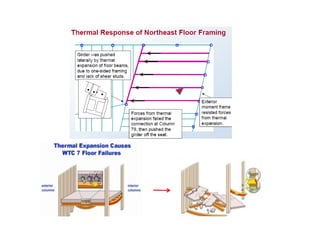
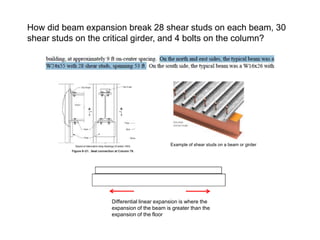
How did beam expansion break 28 shear studs on each beam, 30 shear studs on the critical girder, and 4 bolts on the column?Example of shear studs on a beam or girderDifferential linear expansion is where the expansion of the beam is greater than the expansion of the floor
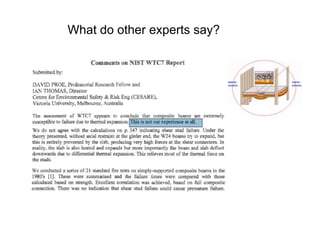
What do other experts say?
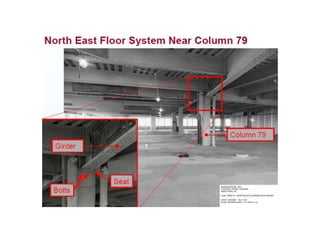
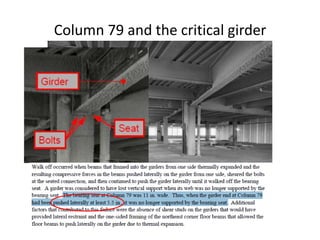
Column 79 and the critical girder
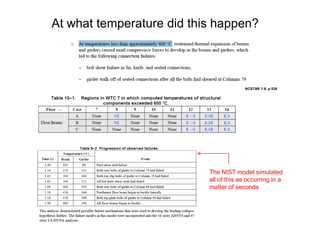
At what temperature did this happen?NCSTAR 1-9, p 536The NIST model simulated all of this as occurring in a matter of seconds
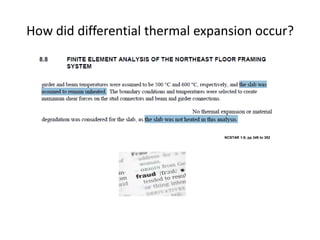
How did differential thermal expansion occur?NCSTAR 1-9, pp 349 to 352
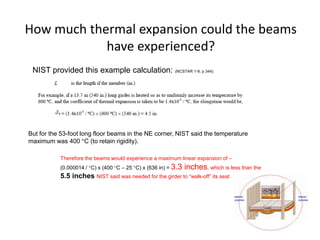
How much thermal expansion could the beams have experienced?NIST provided this example calculation: (NCSTAR 1-9, p 344)But for the 53-foot long floor beams in the NE corner, NIST said the temperature maximum was 400 C (to retain rigidity).Therefore the beams would experience a maximum linear expansion of –	(0.000014 / C) x (400 C – 25 C) x (636 in) = 3.3 inches, which is less than the	5.5 inches NIST said was needed for the girder to “walk-off” its seat
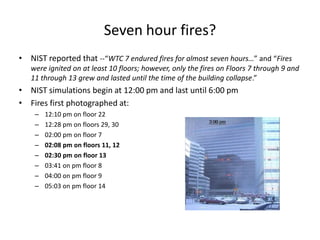
Seven hour fires?NIST reported that --“WTC 7 endured fires for almost seven hours…” and “Fires were ignited on at least 10 floors; however, only the fires on Floors 7 through 9 and 11 through 13 grew and lasted until the time of the building collapse.” NIST simulations begin at 12:00 pm and last until 6:00 pmFires first photographed at:12:10 pm on floor 2212:28 pm on floors 29, 3002:00 pm on floor 702:08 pm on floors 11, 1202:30 pm on floor 1303:41 on pm floor 804:00 on pm floor 905:03 on pm floor 14
How did the fires in WTC 7 start?“Since fires were observed on the ground surrounding WTC 7, it is possible that potential ignition sources might have entered WTC 7 through openings created in the south and west face of the building during the collapses of the towers.  NIST found no evidence to confirm this possibility, but the available data suggest that this was highly likely.”  NIST NCSTAR 1-9, page 194 “Most likely, the WTC 7 fires began as a result of the impact from the collapse of WTC 1 at about 10:29 a.m.” NCSTAR 1A, page 16, Section 2.3 	“Chapter 3 showed that there were no pathways for the flames and heat to pass from one floor to another, aside from the debris damaged area in the southwest of the building.” NCSTAR 1-9 Chapter 9, Section 9.1.1
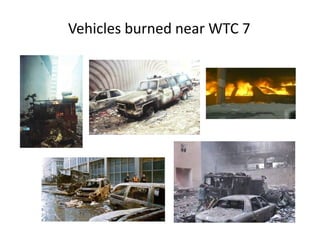
Vehicles burned near WTC 7
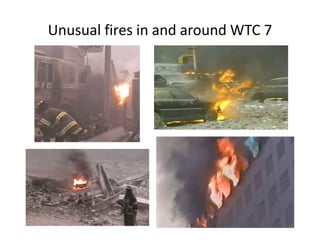
Unusual fires in and around WTC 7
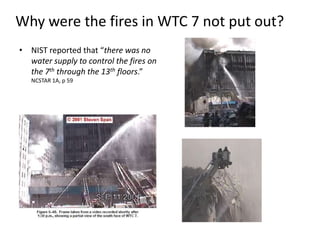
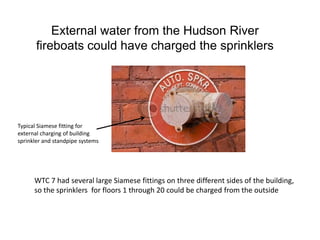
Why were the fires in WTC 7 not put out?NIST reported that “there was no water supply to control the fires on the 7th through the 13th floors.”  NCSTAR 1A, p 59External water from the Hudson River fireboats could have charged the sprinklersTypical Siamese fitting for external charging of building sprinkler and standpipe systemsWTC 7 had several large Siamese fittings on three different sides of the building, so the sprinklers  for floors 1 through 20 could be charged from the outside
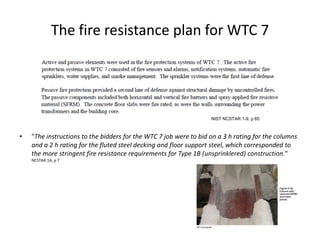
The fire resistance plan for WTC 7NIST NCSTAR 1-9, p 65"The instructions to the bidders for the WTC 7 job were to bid on a 3 h rating for the columns and a 2 h rating for the fluted steel decking and floor support steel, which corresponded to the more stringent fire resistance requirements for Type 1B (unsprinklered) construction."   NCSTAR 1A, p 7
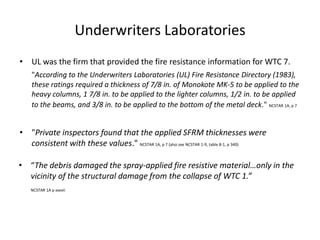
Underwriters LaboratoriesUL was the firm that provided the fire resistance information for WTC 7."According to the Underwriters Laboratories (UL) Fire Resistance Directory (1983), these ratings required a thickness of 7/8 in. of Monokote MK-5 to be applied to the heavy columns, 1 7/8 in. to be applied to the lighter columns, 1/2in. to be applied to the beams, and 3/8 in. to be applied to the bottom of the metal deck."NCSTAR 1A, p 7"Private inspectors found that the applied SFRM thicknesses were consistent with these values." NCSTAR 1A, p 7 (also see NCSTAR 1-9, table 8-1, p 340)“The debris damaged the spray-applied fire resistive material…only in the vicinity of the structural damage from the collapse of WTC 1.”  NCSTAR 1A p xxxvii
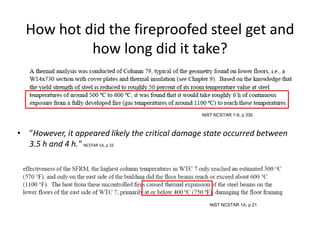
How hot did the fireproofed steel get and how long did it take?"However, it appeared likely the critical damage state occurred between 3.5 h and 4 h." NCSTAR 1A, p 32NIST NCSTAR 1-9, p 330NIST NCSTAR 1A, p 21
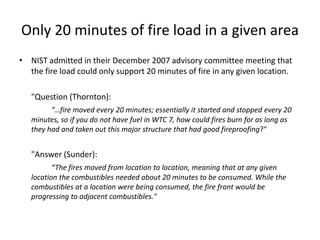
Only 20 minutes of fire load in a given area NIST admitted in their December 2007 advisory committee meeting that the fire load could only support 20 minutes of fire in any given location. 	"Question (Thornton): “…fire moved every 20 minutes; essentially it started and stopped every 20 minutes, so if you do not have fuel in WTC 7, how could fires burn for as long as they had and taken out this major structure that had good fireproofing?“	"Answer (Sunder): “The fires moved from location to location, meaning that at any given location the combustibles needed about 20 minutes to be consumed. While the combustibles at a location were being consumed, the fire front would be progressing to adjacent combustibles."
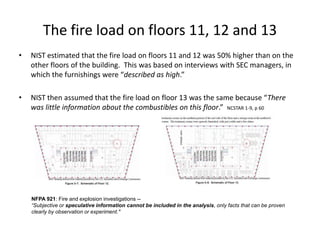
The fire load on floors 11, 12 and 13NIST estimated that the fire load on floors 11 and 12 was 50% higher than on the other floors of the building.  This was based on interviews with SEC managers, in which the furnishings were “described as high.”NIST then assumed that the fire load on floor 13 was the same because “There was little information about the combustibles on this floor.”  NCSTAR 1-9, p 60 NFPA 921: Fire and explosion investigations --  “Subjective or speculative information cannot be included in the analysis, only facts that can be proven clearly by observation or experiment."
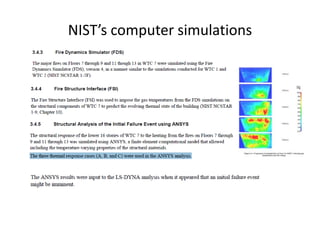
NIST’s computer simulations
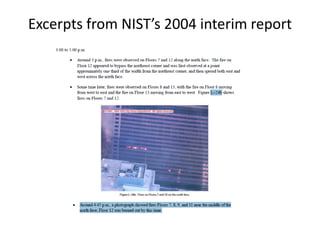
Excerpts from NIST’s 2004 interim report
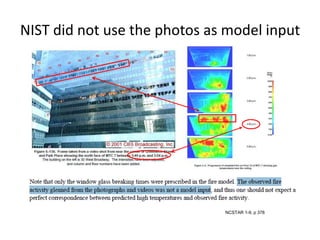
NIST did not use the photos as model inputNCSTAR 1-9, p 378
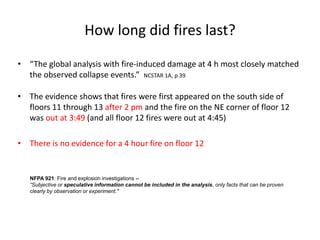
How long did fires last?“The global analysis with fire-induced damage at 4 h most closely matched the observed collapse events.”  NCSTAR 1A, p 39The evidence shows that fires were first appeared on the south side of floors 11 through 13 after 2 pm and the fire on the NE corner of floor 12 was out at 3:49 (and all floor 12 fires were out at 4:45)There is no evidence for a 4 hour fire on floor 12NFPA 921: Fire and explosion investigations --  “Subjective or speculative information cannot be included in the analysis, only facts that can be proven clearly by observation or experiment."
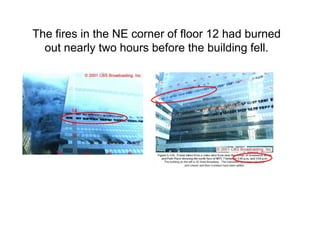
The fires in the NE corner of floor 12 had burned out nearly two hours before the building fell.
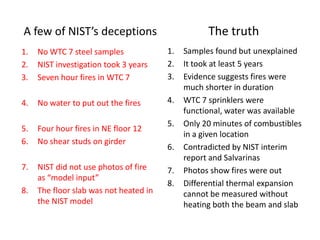
A few of NIST’s deceptionsThe truthSamples found but unexplainedIt took at least 5 yearsEvidence suggests fires were much shorter in durationWTC 7 sprinklers were functional, water was availableOnly 20 minutes of combustibles in a given locationContradicted by NIST interim report and SalvarinasPhotos show fires were outDifferential thermal expansion cannot be measured without heating both the beam and slabNo WTC 7 steel samplesNIST investigation took 3 yearsSeven hour fires in WTC 7No water to put out the firesFour hour fires in NE floor 12No shear studs on girderNIST did not use photos of fire as “model input”The floor slab was not heated in the NIST model
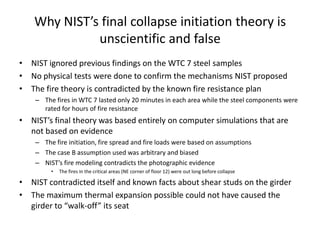
Why NIST’s final collapse initiation theory is unscientific and falseNIST ignored previous findings on the WTC 7 steel samplesNo physical tests were done to confirm the mechanisms NIST proposedThe fire theory is contradicted by the known fire resistance plan The fires in WTC 7 lasted only 20 minutes in each area while the steel components were rated for hours of fire resistanceNIST’s final theory was based entirely on computer simulations that are not based on evidenceThe fire initiation, fire spread and fire loads were based on assumptions The case B assumption used was arbitrary and biasedNIST’s fire modeling contradicts the photographic evidenceThe fires in the critical areas (NE corner of floor 12) were out long before collapse NIST contradicted itself and known facts about shear studs on the girderThe maximum thermal expansion possible could not have caused the girder to “walk-off” its seat
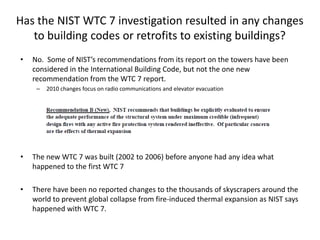
Has the NIST WTC 7 investigation resulted in any changes to building codes or retrofits to existing buildings?No.  Some of NIST’s recommendations from its report on the towers have been  considered in the International Building Code, but not the one new recommendation from the WTC 7 report.2010 changes focus on radio communications and elevator evacuationThe new WTC 7 was built (2002 to 2006) before anyone had any idea what happened to the first WTC 7There have been no reported changes to the thousands of skyscrapers around the world to prevent global collapse from fire-induced thermal expansion as NIST says happened with WTC 7.
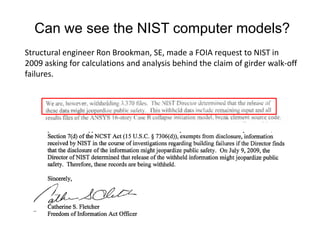
Can we see the NIST computer models?Structural engineer Ron Brookman, SE,made a FOIA request to NIST in 2009 asking for calculations and analysis behind the claim of girder walk-off failures.
Recap of 7 pointsThe destruction of WTC 7 was unprecedentedThe steel evidence was destroyed or unexplainedNIST’s final theory followed years of failed hypotheses NIST’s final theory could not have been predictedNIST’s report is self-contradictory and contradicts other known factsNIST’s report is deceptiveNIST’s  final theory for collapse initiation is unscientific and false
Evolution of the fire-based theory for WTC 7

Evolution of the fire-based theory for WTC 7

  • 1.
    Evolution of thefire-based theory for World Trade Center building 7Kevin R. RyanCo-editor of The Journal of 9/11 Studies
  • 2.
    7 pointsThe destructionof WTC 7 was unprecedentedThe steel evidence was destroyed or unexplainedNIST’s final theory followed years of failed hypotheses NIST’s final theory could not have been predictedNIST’s report is self-contradictory and contradicts other known factsNIST’s report is deceptiveNIST’s final theory for collapse initiation is unscientific and false
  • 3.
    The destruction ofWTC 7 was unprecedented“The performance of WTC 7 is of significant interest because it appears the collapse was due primarily to fire, rather than any impact damage from the collapsing towers.” FEMA BPAT report on WTC 7“This was the first known instance of the total collapse of a tall building primarily due to fires.” NIST NCSTAR 1A, Executive SummaryOfficial reports on WTC 7: FEMA BPAT report published May 2002
  • 4.
    NISTWTC 7 report published November 2008No steel-framed high rise has ever suffered global collapse from fireBeijing, China 2009Madrid, Spain 2005
  • 5.
    WTC 5 burningon 9/11WTC 5 after fireWTC 7 after fireWTC 7 burning on 9/11
  • 6.
    Diesel fuel firesand transfer girders were blamed“Massive structural beams that functioned as a sort of bridge to hold up the 47-story skyscraper known as 7 World Trade Center were compromised in a disastrous blaze fed by diesel fuel, leading to the building's collapse on Sept. 11, investigators have concluded in a preliminary report.” The New York Times, March 2002“Loss of structural integrity was likely a result of weakening caused by fires on the 5th to 7th floors. The specifics of the fires in WTC 7 and how they caused the building to collapse remain unknown at this time. Although the total diesel fuel on the premises contained massive potential energy, the best hypothesis has only a low probability of occurrence” FEMA report on building 7“Investigators believe the fire was fed by tanks of diesel fuel." Popular Mechanics, 2005"Our current working hypothesis is that this pressurized line was supplying fuel [to the fire] for a long period of time.“ Shyam Sunder, NIST’s leading spokesman in 2005
  • 7.
    Early fire-based hypothesescould not be supported Diesel fuel fires were not the cause“Diesel fuel fires did not play a role in the collapse of WTC 7.“ NIST final reportDamage due to falling debris from WTC 1 was not the cause"Other than initiating the fires in WTC 7, the damage from the debris from WTC 1 had little effect on initiating the collapse of WTC 7.” NIST final reportDesign over Con-Ed substation was not the cause“Neither did the Con-Edison substation play a significant role in the collapse of WTC 7.” NIST final report
  • 8.
    Where is theevidence for a fire-based theory?Most of the steel evidence was destroyedNIST says no WTC 7 steel samples were available, but they wereNIST gathered thousands of photos and videos from the public and kept them hidden for yearsThe fire resistance plan for WTC 7 required 2 to 3 hours of fire resistance for the steel componentsNIST performed no physical testing to test its WTC 7 theoryNIST’s final theory was entirely computer generated
  • 9.
    Destruction of steelevidenceThe US House Committee on Science reported, in March 2002: "In the month that lapsed between the terrorist attacks and the deployment of the [FEMA] BPAT team, a significant amount of steel debris... was removed from the rubble pile, cut into smaller sections, and either melted at the recycling plant or shipped out of the U.S. Some of the critical pieces of steel…were gone before the first BPAT team member ever reached the site.“WTC 7 steel found by Professor Astaneh-AslNFPA 921: Fire and explosion investigations -“It is essential to prevent the destruction or removal of evidence…”
  • 10.
    The deepest mystery- FEMA Appendix CThe New York Times reported on "perhaps the deepest mystery uncovered in the investigation.” This mystery referred to the extremely thinned pieces of steel, discovered by FEMA investigators, that were found to exhibit sulfidation and evidence of a eutectic formationthat could not be explained by any of the "fire-wise" professors."The severe corrosion and subsequent erosion of Samples 1 [WTC 7] and 2 are a very unusual event. No clear explanation for the source of the sulfur has been identified. The rate of corrosion is also unknown… A detailed study into the mechanisms of this phenomenon is needed to determine what risk, if any, is presented to existing steel structures exposed to severe and long-burning fires.“ FEMA BPAT report on the WTC, Appendix C
  • 11.
    Appendix C samplefrom WTC 7“A one inch [steel] column has been reduced to half-inch thickness. Its edges--which are curled like a paper scroll--have been thinned to almost razor sharpness. Gaping holes--some larger than a silver dollar—let light shine through a formerly solid steel flange. This Swiss cheese appearance shocked all of the fire-wise professors, who expected to see distortion and bending--but not holes.”WPI Transformations, Spring 2002
  • 12.
    Where are theanswers?The "detailed study" recommended by FEMA investigators was never doneNIST never mentioned any of this in its WTC 7 reportResearch by independent scientists has provided some answersExtremely high temperatures during the World Trade Center destruction By: Steven E. Jones, et al, The Journal of 9/11 Studies, January 2008Fourteen Points of Agreement with Official Government Reports on the World Trade Center Destruction By: Steven E. Jones, et al, The Open Journal of Civil Engineering, April 2008Environmental Anomalies at the WTC: Evidence for Energetic Materials By: Kevin R. Ryan, et al, The Environmentalist, August 2008Active Thermitic Material Discovered in Dust from the 9/11 World Trade Center Catastrophe By: Niels H. Harrit, et al The Open Chemical Physics Journal, April 2009
  • 13.
    The NIST investigationof WTC 7Public comments: June 2002Progress report: Dec 2002Progress reports: May and Dec 2003Interim report / decoupling: June 2004Began again: Sept 2005Draft report: Aug 2008Answers to FAQs: Aug 2008Final report: Nov 2008FAQs updated: Dec 2008FAQs updated again: Sept 2010
  • 14.
    NIST’s objective seemedto changeThe specific objective of the NIST investigation for WTC 7 was to explain “why and how WTC 7 collapsed.” NIST December 2002 progress reportLater, NIST said – "The challenge was to determine if a fire-induced floor system failure could occur in WTC 7 under an ordinary building contents fire." NCSTAR 1-9, p 330
  • 15.
    December 2003 updateInvestigatorshad obtained floor layouts, mechanical and electrical system specifications, shop drawings and connection details“Hypotheses have been postulated for the collapse of the 47-story WTC 7 building. NIST is analyzing these and other possible structural collapse sequences as part of its investigation.”“Detailed mappings for the fires, smoke, and the condition of the windows … is under way for WTC 7.”Interim Report on WTC 7 (Appendix L)NIST presented a “Working hypothesis…if it holds up upon further analysis”June 2004 interim reportand decoupling
  • 16.
    NIST was stilllooking at many (non-explosive) scenarios
  • 17.
    NIST was stumpedfor years…"But truthfully, I don't really know. We've had trouble getting a handle on building No. 7.” Shyam Sunder to New York Magazine in 2006 "The reason for the collapse of World Trade Center 7 is no longer a mystery“ Shyam Sunder in 2008, when WTC 7 report was unveiled"The public should really recognize the science is really behind what we have said,” "The obvious stares you in the face.“ Shyam Sunder to Associated Press in 2008…then said it was obvious
  • 18.
    NIST’s final reportsNISTNCSTAR 1A, Final Report on the Collapse of World Trade Center Building 7NIST NCSTAR 1-9, Structural Fire Response and Probable Collapse Sequence of WTC 7Volume 1Volume 2Found online at wtc.nist.gov
  • 19.
    NIST’s final theoryfor WTC 7NIST NCSTAR 1A, p 21-22
  • 20.
    Has thermal expansionever been seen before?Cardington Fire Test Facility, UK
  • 21.
    Cardington Fire TestResults, June 2000Note the lack of fireproofing on columns and beamsBehaviour of steel framed structures under fire conditions (Cardington Report), June 2000
  • 24.
    NIST’s contradictions onshear studsNIST’s Interim Report 2004 --NIST NCSTAR 1-9 (2008) --
  • 25.
    NIST’s interim reporton WTC 7 (2004) referred to a paper by Salvarinas, who knew about the shear studs …the critical girder had 30 shear studs
  • 26.
    How did beamexpansion break 28 shear studs on each beam, 30 shear studs on the critical girder, and 4 bolts on the column?Example of shear studs on a beam or girderDifferential linear expansion is where the expansion of the beam is greater than the expansion of the floor
  • 27.
    What do otherexperts say?
  • 28.
    Column 79 andthe critical girder
  • 29.
    At what temperaturedid this happen?NCSTAR 1-9, p 536The NIST model simulated all of this as occurring in a matter of seconds
  • 30.
    How did differentialthermal expansion occur?NCSTAR 1-9, pp 349 to 352
  • 31.
    How much thermalexpansion could the beams have experienced?NIST provided this example calculation: (NCSTAR 1-9, p 344)But for the 53-foot long floor beams in the NE corner, NIST said the temperature maximum was 400 C (to retain rigidity).Therefore the beams would experience a maximum linear expansion of – (0.000014 / C) x (400 C – 25 C) x (636 in) = 3.3 inches, which is less than the 5.5 inches NIST said was needed for the girder to “walk-off” its seat
  • 32.
    Seven hour fires?NISTreported that --“WTC 7 endured fires for almost seven hours…” and “Fires were ignited on at least 10 floors; however, only the fires on Floors 7 through 9 and 11 through 13 grew and lasted until the time of the building collapse.” NIST simulations begin at 12:00 pm and last until 6:00 pmFires first photographed at:12:10 pm on floor 2212:28 pm on floors 29, 3002:00 pm on floor 702:08 pm on floors 11, 1202:30 pm on floor 1303:41 on pm floor 804:00 on pm floor 905:03 on pm floor 14
  • 33.
    How did thefires in WTC 7 start?“Since fires were observed on the ground surrounding WTC 7, it is possible that potential ignition sources might have entered WTC 7 through openings created in the south and west face of the building during the collapses of the towers. NIST found no evidence to confirm this possibility, but the available data suggest that this was highly likely.” NIST NCSTAR 1-9, page 194 “Most likely, the WTC 7 fires began as a result of the impact from the collapse of WTC 1 at about 10:29 a.m.” NCSTAR 1A, page 16, Section 2.3 “Chapter 3 showed that there were no pathways for the flames and heat to pass from one floor to another, aside from the debris damaged area in the southwest of the building.” NCSTAR 1-9 Chapter 9, Section 9.1.1
  • 34.
  • 35.
    Unusual fires inand around WTC 7
  • 36.
    Why were thefires in WTC 7 not put out?NIST reported that “there was no water supply to control the fires on the 7th through the 13th floors.” NCSTAR 1A, p 59External water from the Hudson River fireboats could have charged the sprinklersTypical Siamese fitting for external charging of building sprinkler and standpipe systemsWTC 7 had several large Siamese fittings on three different sides of the building, so the sprinklers for floors 1 through 20 could be charged from the outside
  • 37.
    The fire resistanceplan for WTC 7NIST NCSTAR 1-9, p 65"The instructions to the bidders for the WTC 7 job were to bid on a 3 h rating for the columns and a 2 h rating for the fluted steel decking and floor support steel, which corresponded to the more stringent fire resistance requirements for Type 1B (unsprinklered) construction." NCSTAR 1A, p 7
  • 38.
    Underwriters LaboratoriesUL wasthe firm that provided the fire resistance information for WTC 7."According to the Underwriters Laboratories (UL) Fire Resistance Directory (1983), these ratings required a thickness of 7/8 in. of Monokote MK-5 to be applied to the heavy columns, 1 7/8 in. to be applied to the lighter columns, 1/2in. to be applied to the beams, and 3/8 in. to be applied to the bottom of the metal deck."NCSTAR 1A, p 7"Private inspectors found that the applied SFRM thicknesses were consistent with these values." NCSTAR 1A, p 7 (also see NCSTAR 1-9, table 8-1, p 340)“The debris damaged the spray-applied fire resistive material…only in the vicinity of the structural damage from the collapse of WTC 1.” NCSTAR 1A p xxxvii
  • 39.
    How hot didthe fireproofed steel get and how long did it take?"However, it appeared likely the critical damage state occurred between 3.5 h and 4 h." NCSTAR 1A, p 32NIST NCSTAR 1-9, p 330NIST NCSTAR 1A, p 21
  • 40.
    Only 20 minutesof fire load in a given area NIST admitted in their December 2007 advisory committee meeting that the fire load could only support 20 minutes of fire in any given location. "Question (Thornton): “…fire moved every 20 minutes; essentially it started and stopped every 20 minutes, so if you do not have fuel in WTC 7, how could fires burn for as long as they had and taken out this major structure that had good fireproofing?“ "Answer (Sunder): “The fires moved from location to location, meaning that at any given location the combustibles needed about 20 minutes to be consumed. While the combustibles at a location were being consumed, the fire front would be progressing to adjacent combustibles."
  • 41.
    The fire loadon floors 11, 12 and 13NIST estimated that the fire load on floors 11 and 12 was 50% higher than on the other floors of the building. This was based on interviews with SEC managers, in which the furnishings were “described as high.”NIST then assumed that the fire load on floor 13 was the same because “There was little information about the combustibles on this floor.” NCSTAR 1-9, p 60 NFPA 921: Fire and explosion investigations -- “Subjective or speculative information cannot be included in the analysis, only facts that can be proven clearly by observation or experiment."
  • 42.
  • 43.
    Excerpts from NIST’s2004 interim report
  • 44.
    NIST did notuse the photos as model inputNCSTAR 1-9, p 378
  • 45.
    How long didfires last?“The global analysis with fire-induced damage at 4 h most closely matched the observed collapse events.” NCSTAR 1A, p 39The evidence shows that fires were first appeared on the south side of floors 11 through 13 after 2 pm and the fire on the NE corner of floor 12 was out at 3:49 (and all floor 12 fires were out at 4:45)There is no evidence for a 4 hour fire on floor 12NFPA 921: Fire and explosion investigations -- “Subjective or speculative information cannot be included in the analysis, only facts that can be proven clearly by observation or experiment."
  • 46.
    The fires inthe NE corner of floor 12 had burned out nearly two hours before the building fell.
  • 47.
    A few ofNIST’s deceptionsThe truthSamples found but unexplainedIt took at least 5 yearsEvidence suggests fires were much shorter in durationWTC 7 sprinklers were functional, water was availableOnly 20 minutes of combustibles in a given locationContradicted by NIST interim report and SalvarinasPhotos show fires were outDifferential thermal expansion cannot be measured without heating both the beam and slabNo WTC 7 steel samplesNIST investigation took 3 yearsSeven hour fires in WTC 7No water to put out the firesFour hour fires in NE floor 12No shear studs on girderNIST did not use photos of fire as “model input”The floor slab was not heated in the NIST model
  • 48.
    Why NIST’s finalcollapse initiation theory is unscientific and falseNIST ignored previous findings on the WTC 7 steel samplesNo physical tests were done to confirm the mechanisms NIST proposedThe fire theory is contradicted by the known fire resistance plan The fires in WTC 7 lasted only 20 minutes in each area while the steel components were rated for hours of fire resistanceNIST’s final theory was based entirely on computer simulations that are not based on evidenceThe fire initiation, fire spread and fire loads were based on assumptions The case B assumption used was arbitrary and biasedNIST’s fire modeling contradicts the photographic evidenceThe fires in the critical areas (NE corner of floor 12) were out long before collapse NIST contradicted itself and known facts about shear studs on the girderThe maximum thermal expansion possible could not have caused the girder to “walk-off” its seat
  • 49.
    Has the NISTWTC 7 investigation resulted in any changes to building codes or retrofits to existing buildings?No. Some of NIST’s recommendations from its report on the towers have been considered in the International Building Code, but not the one new recommendation from the WTC 7 report.2010 changes focus on radio communications and elevator evacuationThe new WTC 7 was built (2002 to 2006) before anyone had any idea what happened to the first WTC 7There have been no reported changes to the thousands of skyscrapers around the world to prevent global collapse from fire-induced thermal expansion as NIST says happened with WTC 7.
  • 50.
    Can we seethe NIST computer models?Structural engineer Ron Brookman, SE,made a FOIA request to NIST in 2009 asking for calculations and analysis behind the claim of girder walk-off failures.
  • 51.
    Recap of 7pointsThe destruction of WTC 7 was unprecedentedThe steel evidence was destroyed or unexplainedNIST’s final theory followed years of failed hypotheses NIST’s final theory could not have been predictedNIST’s report is self-contradictory and contradicts other known factsNIST’s report is deceptiveNIST’s final theory for collapse initiation is unscientific and false