Data Warehousing/Mining
Data Warehouse Evolution
TIME
2000
1995
1990
1985
1980
1960 1975
Information-
Based
Management
Data
Revolution
“Middle
Ages”
“Prehistoric
Times”
Relational
Databases
PC’s and
Spreadsheets
End-user
Interfaces
1st DW
Article
DW
Confs.
Vendor DW
Frameworks
Company
DWs
“Building the
DW”
Inmon (1992)
Data Replication
Tools
Data Warehousing/Mining
What is a Data Warehouse?
A Practitioners Viewpoint
“A data warehouse is simply a single, complete,
and consistent store of data obtained from a
variety of sources and made available to end
users in a way they can understand and use it
in a business context.”
-- Barry Devlin, IBM Consultant
Data Warehousing/Mining
A Data Warehouse is...
 Stored collection of diverse data
– A solution to data integration problem
– Single repository of information
 Subject-oriented
– Organized by subject, not by application
– Used for analysis, data mining, etc.
 Optimized differently from transaction-
oriented db
 User interface aimed at executive
Data Warehousing/Mining
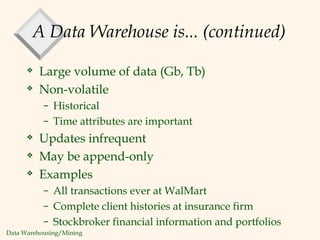
A Data Warehouse is... (continued)
 Large volume of data (Gb, Tb)
 Non-volatile
– Historical
– Time attributes are important
 Updates infrequent
 May be append-only
 Examples
– All transactions ever at WalMart
– Complete client histories at insurance firm
– Stockbroker financial information and portfolios
Data Warehousing/Mining
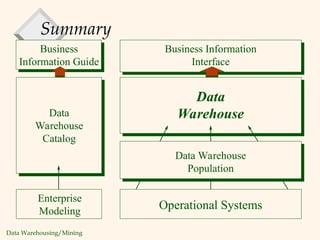
Summary
Operational Systems
Enterprise
Modeling
Business
Information Guide
Data
Warehouse
Catalog
Data Warehouse
Population
Data
Warehouse
Business Information
Interface
Data Warehousing/Mining
Warehouse is a Specialized DB
Standard DB
 Mostly updates
 Many small transactions
 Mb - Gb of data
 Current snapshot
 Index/hash on p.k.
 Raw data
 Thousands of users (e.g.,
clerical users)
Warehouse
 Mostly reads
 Queries are long and complex
 Gb - Tb of data
 History
 Lots of scans
 Summarized, reconciled data
 Hundreds of users (e.g.,
decision-makers, analysts)
Data Warehousing/Mining
Warehousing and Industry
 Warehousing is big business
– $2 billion in 1995
– $3.5 billion in early 1997
– Predicted: $8 billion in 1998 [Metagroup]
 WalMart has largest warehouse
– 900-CPU, 2,700 disk, 23 TB Teradata system
– ~7TB in warehouse
– 40-50GB per day
Data Warehousing/Mining
Types of Data
 Business Data - represents meaning
– Real-time data (ultimate source of all business data)
– Reconciled data
– Derived data
 Metadata - describes meaning
– Build-time metadata
– Control metadata
– Usage metadata
 Data as a product* - intrinsic meaning
– Produced and stored for its own intrinsic value
– e.g., the contents of a text-book
Data Warehousing/Mining
Data Warehouse Architectures:
Conceptual View
 Single-layer
– Every data element is stored once only
– Virtual warehouse
 Two-layer
– Real-time + derived data
– Most commonly used approach in
industry today
“Real-time data”
Operational
systems
Informational
systems
Derived Data
Real-time data
Operational
systems
Informational
systems
Data Warehousing/Mining 1
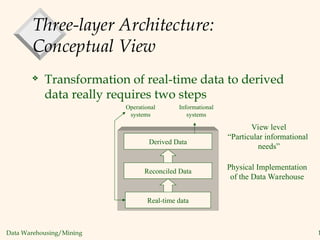
Three-layer Architecture:
Conceptual View
 Transformation of real-time data to derived
data really requires two steps
Derived Data
Real-time data
Operational
systems
Informational
systems
Reconciled Data
Physical Implementation
of the Data Warehouse
View level
“Particular informational
needs”

Evolution of Data Warehouse and Data mining

  • 1.
    Data Warehousing/Mining Data WarehouseEvolution TIME 2000 1995 1990 1985 1980 1960 1975 Information- Based Management Data Revolution “Middle Ages” “Prehistoric Times” Relational Databases PC’s and Spreadsheets End-user Interfaces 1st DW Article DW Confs. Vendor DW Frameworks Company DWs “Building the DW” Inmon (1992) Data Replication Tools
  • 2.
    Data Warehousing/Mining What isa Data Warehouse? A Practitioners Viewpoint “A data warehouse is simply a single, complete, and consistent store of data obtained from a variety of sources and made available to end users in a way they can understand and use it in a business context.” -- Barry Devlin, IBM Consultant
  • 3.
    Data Warehousing/Mining A DataWarehouse is...  Stored collection of diverse data – A solution to data integration problem – Single repository of information  Subject-oriented – Organized by subject, not by application – Used for analysis, data mining, etc.  Optimized differently from transaction- oriented db  User interface aimed at executive
  • 4.
    Data Warehousing/Mining A DataWarehouse is... (continued)  Large volume of data (Gb, Tb)  Non-volatile – Historical – Time attributes are important  Updates infrequent  May be append-only  Examples – All transactions ever at WalMart – Complete client histories at insurance firm – Stockbroker financial information and portfolios
  • 5.
    Data Warehousing/Mining Summary Operational Systems Enterprise Modeling Business InformationGuide Data Warehouse Catalog Data Warehouse Population Data Warehouse Business Information Interface
  • 6.
    Data Warehousing/Mining Warehouse isa Specialized DB Standard DB  Mostly updates  Many small transactions  Mb - Gb of data  Current snapshot  Index/hash on p.k.  Raw data  Thousands of users (e.g., clerical users) Warehouse  Mostly reads  Queries are long and complex  Gb - Tb of data  History  Lots of scans  Summarized, reconciled data  Hundreds of users (e.g., decision-makers, analysts)
  • 7.
    Data Warehousing/Mining Warehousing andIndustry  Warehousing is big business – $2 billion in 1995 – $3.5 billion in early 1997 – Predicted: $8 billion in 1998 [Metagroup]  WalMart has largest warehouse – 900-CPU, 2,700 disk, 23 TB Teradata system – ~7TB in warehouse – 40-50GB per day
  • 8.
    Data Warehousing/Mining Types ofData  Business Data - represents meaning – Real-time data (ultimate source of all business data) – Reconciled data – Derived data  Metadata - describes meaning – Build-time metadata – Control metadata – Usage metadata  Data as a product* - intrinsic meaning – Produced and stored for its own intrinsic value – e.g., the contents of a text-book
  • 9.
    Data Warehousing/Mining Data WarehouseArchitectures: Conceptual View  Single-layer – Every data element is stored once only – Virtual warehouse  Two-layer – Real-time + derived data – Most commonly used approach in industry today “Real-time data” Operational systems Informational systems Derived Data Real-time data Operational systems Informational systems
  • 10.
    Data Warehousing/Mining 1 Three-layerArchitecture: Conceptual View  Transformation of real-time data to derived data really requires two steps Derived Data Real-time data Operational systems Informational systems Reconciled Data Physical Implementation of the Data Warehouse View level “Particular informational needs”