4 . Predavanje  12 . 11 .20 10 EVOLUCIJSKA PSIHOLOGIJA
Domaća zadaća
Što smo ono rekli..? Grupni projekt ( do 3 člana ) Evolucijske teme i hipoteze vezane uz: ljubav seks orgazam  kompetitivnost spermija prevaru sustave parenja seksualnu orijentaciju estetiku/ljepotu/umjetnost religiju moralnost politiku mentalna oboljenja ekonomiju smijeh zijevanje poremećaje hranjenja specifične emocije i osjećaje
5 . Predavanje  19 . 11 .20 10 Seksualna selekcija i biološke odrednice privlačnosti
http://www.youtube.com/watch?v=D7JdhKwGy5o&feature=related
Spolno razmnožavanje Najpraktičniji način da se osigura kako svo potomstvo ne nasljeđuje štetne mutacije Prosjek:  1.6 – 3 štetnih mutacija po generaciji Potrebno eliminirati istom brzinom kojom se stvaraju Odbojnost incesta?
Odabir partnera Ako je cilj spolnog razmnožavanja osigurati da se barem dio potomaka zaštiti od štetnih mutacija bilo bi nepraktično nasumično birati partnera  Potrebno je birati partnera sa najmanjim brojem štetnih mutacija koji če potomcima pružiti najveću vjerojatnost preživljavanja .
Život je borba Mnogo mutacija je skriveno i ne utječe na ponašanje Neke osobine su pod većim utjecajem mutacija Paunov rep?
Udvaranje – o čemu se tu radi Promoviranje naših fizičkih i mentalnih karakteristika mogućim seksualnim partnerima  Tjelesni izgled, izraz lica, put, razina energije, specifične vještine Kreativnost, priče, riješavanje problema, socijalizacija, smisao za humor, empatija, vokabular
Indikatori fitnesa Biloške osobina evoluirale kako bi demonstrirale fitnes jedinke Fitnes se odnosi na sposobnost jedinke da preživi i uspješno se razmnožava U najveću ruku determinirana genetskom kvalitetom jedinke, koja se svodi na opterećnost mutacijama Poveznica seksualne selekcija i osjetilnih iskustava
Simetrija Jedna od najlakše procijenjivih komponenti fitnesa Dostupna iistraživačima i pripadncima vrste Vežna odrednica privlačnosti kod većine vrsta Moguće je kako su neke tjelesne karakteristiki evoluirale kao forma indikatora simetrije “ Razvojna stabilnost” Lek paradoks
Prosječna i simetrična lica
http:// www.faceresearch.org /demos/average
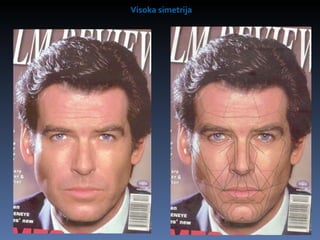
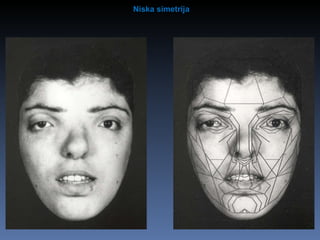
Tjelesna simetrija i Indikator razvojne stabilnosti usprkos pristutnosti okolinskih i genetskih izazova – indikator zdravlja i fertilnosti  Grammer  i  Thornhill, (1994):  I žene i muškarci sa simetričnim licima procijenjivani kao atraktivniji, dominantniji, zdraviji i više sexy  Muškarci sa simetričnim licima imaju više partnerica, ranije ulaze u seksualne odnose i imaju više potomaka  (Thornhill  i  Gangstad, 1994) Žene čiji su partneri simetričniji  doživljavaju više orgazama  (Thornhill et al., 1995)  Niska simetrija je povezana sa schizofrenijom  (Mellor 1992);  mentalnom retardacijom  (Naugler & Ludman 1996);  prematurnim rođenjem   (Livshits & Kobyliansky 1991)
Buss 2008  p 119
Simetrija lica i ljudske facijalne proporcije
Kros kulturalne percepcije ljepote Cunningham et al., (1995)  Pripadnicima različitih rasa na procijenu dane fotografije Azijata, Hispanaca, Crnaca i Bijelaca, procijenjenih unaprijed unutar rase Prosiječna korelacija između grupa – 0,93 Fizička atratiktivnost prediktivna za vjerojatnost braka i socioekonomski status partnera
Standards of beauty are consistent across ethnicities
Visoka simetrija
Visoka simetrija
Visoka simetrija
Visoka simetrija
Varijacijeu simetriji
Niska simetrija
Urođeni standardi ljepote? Langlois et al., (1990)  proučavao reakcije djece na lice različite privlačnosti   Djeca u starosti  2-3  mjeseca i  6-8  mjeseci prezenitrani sa unaprijed procijenjenim licima Obije grupe duže promatrale “ljepša” lica   Djeca se dulje igrala sa lutkama koje su posjedovale lijepa lica
“ Što žene žele?” – Sigmund Freud
Oba spola se genaralno slažu u osobinama koje traže kod partnera
Što muškarci žele ? Što žene žele ? Izgled 1.  Dobrota i razumjevanje 2.  Fizička atraktivnost 2.  Uzbudljiva ličnost 3.  Inteligencija 3.  Inteligencija 4.  Dobrota i razumjevanje 4.  Fizička atraktivnost 5.  Uzbudljiva ličnost 5.  Dobro zdravlje 6.  Dobro zdravlje 6.  Ambicioznost i poduzetnost 7.  Ambicioznost i poduzetnost 7.  Izgled 8.  Prilagodljivost 8.  Financijsku sigurnost 9.  Kreativnost 9.  Sposobnost zarađivanja 10.  Želju za djecom 10.  Prilagodljivost 11 .  Financisku sigurnost 11.  Želju za djecom 12.  Nevinost – Seksualnu restriktivnost 12.  Kreativnost 13.  Sposobnost zarađivanja 13.  Nevinost – Seksualnu restriktivnost
Osvr na ženske reproduktivne karatkteristike Sporiji reproduktivni tempo Apsolutnu sigurnost potomstva
Osnovne osobine relavantne kod ženskog odabira partnera Muške osobine relevantne za žene : Dobri geni /dobro zdravlje Pristup (potencijalni) resursima Visok ocijalni status Zaštita Voljnost ulaganja u dugotrajnu vezu Roditelji skloni ulaganju
Ženska evaluacaja potencijalnog partera katkad je...khm...komplicirana
Potraga za dobrim genima: imunološki sustav
Human Instinct: Immune system genes
Visina Povezana sa moći i statusom   Graziano et al., (1978)  Žene procijenjvale slike muškaraca za koje su vjerovale da su različitih visina Viši muškarci preferirani u odnosu na niske. Najpoželjnijim procjenjivani prosječno visoki   Pawlowski et al., (2000)  visina povezana sa vjerojatnošću braka Neženje su značajno niži od oženjenih muškaraca
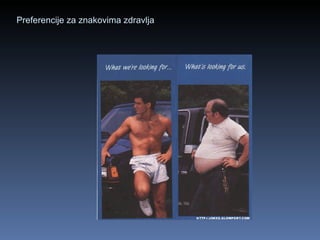
Omjer  bokovi – ramena   Horvarth (1979)  širina ramena prediktor muške atraktivnosti .  Maisey et al., (1999)  WCR  glavni faktor privlačnosti Muškarci sa torzom oblika izokrenutog trokuta procjenjivani atraktivnijima Povezano sa karakterisikama potrebnima za lov Velik trbuh procijenjivan kao izrazito odbojan
Preferencije za znakovima zdravlja
A osim gena, za što služe muškarci ? Hrana – posebice meso  Sklonište Zaštita od ostalih muškaraca Ulaganje u potomstvo Dakle, žene bi trebale razviti preferencije za : Dobre financijske izglee Stariji Socijalni status Vrijedni i poduzetni Imaju poštovanje ostalih muškaraca Druge žene ih smatraju privlačnima   (?)
Sposobnost ali i voljnost da podjeli resurse
http://www.youtube.com/watch?v=UtNXlqUnrL8&feature=channel
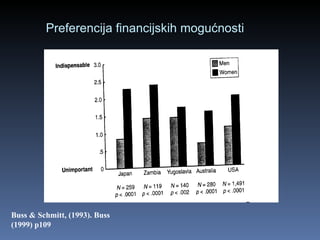
Dokazi U svim društvima žene cijene ekonomske resurse partnera više nego muškarci Trivers (1985)  oženjeni muškaci u godini imaju u projeku 50% više prihode od neoženjenih Buss (1989)  pokazao kako žene stavljakju dvostruko veću važnost na finacijsko stanje partnera Kenrick et al., (1990)  minimum prihvatljivog kapaciteta zarađivanjamora biti na oko 70% u usporedbi s prihodima ostalih muškaraca  See a problem there?
Kenrick et al., 1990
Preferencija financijskih mogućnosti Buss & Schmitt, (1993). Buss (1999) p109
SSSM (the “structural powerlessness hypothesis”) suggests wealthy / high status women should place  less  emphasis on status.  They don’t  they place even  more  emphasis on male status! Female medical students became  more selective  in their criteria in entering a sexual relationship.. ( Townsend, 1989)   Women are significantly more likely to end relationships with males who become unemployed ( Betzig, 1989 ).  Young males present a problem:  What will his future status be? Does he have “potential?” Clues:  education, ambitiousness and willingness to seek resources.
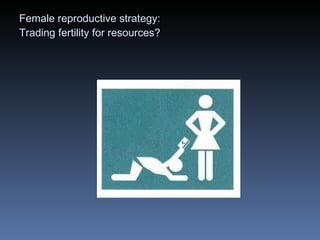
Female reproductive strategy: Trading fertility for resources ?


Preferecnije statusa Što je ona vidjela u njemu ? Što je on vidio u njoj ?
Do clothes make the man? Looked at the effects of status (signified by clothing), and attractiveness on female willingness to engage in romantic relationships. (Townsend & Levy, 1990)  Male targets were pre-rated for physical attraction and divided into two categories - handsome, and homely. The targets wore one of three costumes:  1. Blazer, shirt, designer tie, Rolex watch . Described as being doctors (high status).  2. Plain white shirt . Described as being teachers (medium status). 3. Uniform of a Burger King employee . Described as being trainee waiters (low status).
Zbog čega neke žene vole”zločeste dečke”
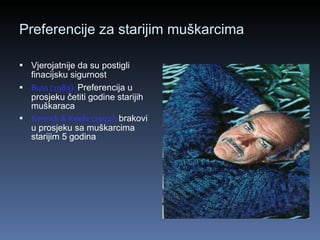
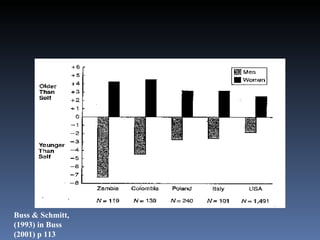
Preferencije za starijim muškarcima Vjerojatnije da su postigli finacijsku sigurnost   Buss (1989):   Preferencija u prosjeku četiti godine starijih muškaraca Kenrick & Keefe (1992):   brakovi u prosjeku sa muškarcima starijim 5 godina
 
Buss & Schmitt, (1993) in Buss (2001) p 113
.   Kenrick & Keefe, 1992, p81.
 
http://www.youtube.com/watch?v=FB1oMfs8nWY&feature=related
Nekoliko citata o moći, statusu i resursima “ Power is the ultimate aphrodisiac”. Henry Kissinger. “ If women didn’t exist, all the money in the world would have no meaning”. Aristotle Onassis. “ When you’re famous your love life diminishes. Your sex life grows”. Enrique Iglesias. “ I’m not a good-looking person. I’ve struggled to get girls for most of my life, and then, suddenly, I win the casual-sex lottery by getting famous”. Frank Skinner, musician. “ So what first attracted you to the millionaire Paul Daniels?” Mrs. Merton to Debbie McGee.
Socijalna dominantnost Žene preferiraju dmnantnije muškarce koji imaju moć nad svojim suvremenicima .  Dosupnost resira i veći status žene Sadella et al.,(1987)  videi pokazuju žene i muškarce u dominatnom i submisivnom ponašanju pred muškarcima i ženama Domiantno ponašanje povećalo je seksualnu privlačnost i želju za vezom u muškaraca. Procjene privlačnosti žena ostale su nepromjenjene.
Atletske sposobnosti
P roblem:  Nedostatak muškaraca koji bi zadovoljili sve njihove kriterije Annual Meeting of single, good-looking, emotionally-stable, financially-secure, intelligent men who would be a faithful husband, a good father, thinks she is “special,” and who is looking for long-term commitment…
http://www.youtube.com/watch?v=RlJw2_NnVLo&feature=channel
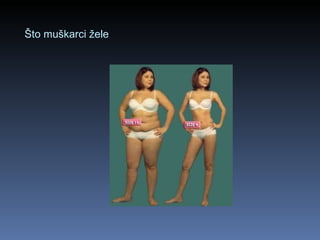
Što muškarci žele
Što muškarci žele
Što muškarci žele
 
 
Mozak kao odraz fitnesa http://www.youtube.com/watch?v=nS1tEnfkk6M
Mozak kao odraz fitnesa not the first to stumble upon the fact that complex behaviors make good fitness indicators. Songbirds Atenborough – video SEX
Mozak kao odraz fitnesa about humans is that our courtship behavior reveals so much more of our minds. Art reveals our visual aesthetics.  Conversation reveals our personality and intelligence. By opening up our brains as advertisements for our fitness, we discovered whole new classes of fitness indicators, like generosity and creativity.
Karakterstike seksualno slekcioniranih indikatora fitnesa sexually selected fitness indicators They do not help animals find food or avoid Predators They do not remove parasites or feed offspring. They look costly and useless They appear luxuriously superfluous, often resembling a pathological side-effect of something more useful and sensible But these in luxuriant excess.
Evolutionary Fitness and Physical Fitness biologists thought that most sexual ornaments were arbitrary. minority of biologists became skeptical about this view that most beauty is arbitrary.
Evoluirani kapitavlizam Veblen's  Theory of the Leisure Class  introduced the idea of "conspicuous consumption" in 1899. Veblen argued that in modern urban societies, where strangers come and go, people increasingly advertise their wealth by ornamenting themselves with costly luxuries. Where nobody knows anyone else's true wealth directly, conspicuous consumption is the only reliable signal of wealth. Sociologists and economists understood this logic immediately. Capitalist consumerism evolved in part as a set of wealth indicators.
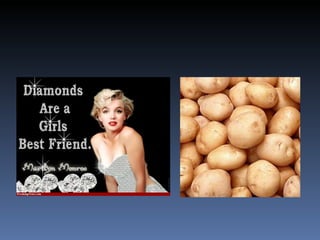
The Human Mind as a Set of Fitness Indicators Zahavi's handicap principle How could mate choice favor a costly, useless ornament over a cheaper, more beneficial ornament? (Why should a man give a woman a useless diamond engagement ring, when he could buy her a nice big potato, which she could at least eat?) Zahavi realized that the signaling system has to be self-policing. It has to include a range of sexual signals that differ in cost, and thus differ in affordability by individuals of different fitness, by virtue of which they honestly reveal their fitness. The handicap principle suggests that prodigious waste is a necessary feature of sexual courtship. Condition-dependence is equally useful at the high end of the fitness scale, for it enables one to tailor the amount one spends on fitness indicators to one's fitness level. This helps the extremely fit to distinguish themselves from the very fit. It spreads out the apparent differences between individuals so that their fitness is easier to judge.
The Human Mind as a Set of Fitness Indicators wastefulness of courtship is what makes it romantic. The wasteful dancing, the wasteful gift-giving, the wasteful conversation, the wasteful laughter, the wasteful foreplay, the wasteful adventures. From the viewpoint of "survival of the fittest," the waste looks mad and pointless and maladaptive. Human  ourtship even looks wasteful from the viewpoint of sexual selection for non-genetic benefits, because, as we shall see, the acts of love considered most romantic are often those that cost the giver the most, but that bring the smallest material benefits to the receiver. However, from the viewpoint of fitness indicator theory, this waste is the most efficient and reliable way to discover someone's fitness. Where you see conspicuous waste in nature, sexual choice has often been at work.
Život je borba Every sexual ornament in every sexually reproducing species Male humpback whales waste their energies with half-hour-long, hundred-decibel songs that they repeat all day long during the breeding season. Male humans waste their time and energy getting graduate degrees, writing books, playing sports, fighting other men, painting pictures, playing jazz, and founding religious cults. These may not be conscious sexual strategies, but the underlying motivations for "achievement" and "status"—even in preference to material sources—were probably shaped by sexual selection. (Of course, the wasteful displays that seemed attractive during courtship may no longer be valued if they persist after offspring arrive—there is a trade-off between parental responsibilities and conspicuous display.)
Indikatori fitnesa i adaptacije rules for recognizing mental adaptations . Fitness indicators violate all these criteria. If a mental trait evolved through sexual selection as a fitness indicator, it should show large differences between people. It evolved specifically to help sexual choice discriminate in favor of its possessor at the expense of sexual rivals. Fitness indicators can show high heritability because they tap into genetic variation in fitness, and fitness usually remains heritable. For fitness indicators to be reliable, they have to be wasteful, not efficient. They have to have high costs that make them look very inefficient compared with survival adaptations. Finally, fitness indicators cannot be totally modular and separate from other adaptations, because their whole point is to capture general features of an organism's health, fertility,
Život je borba 90 percent of our psychological adaptations evolved through standard natural selection and social selection to solve routine problems of surviving and living in groups. Evolutionary psychology has proven very good at analyzing these adaptations. My interest is in the psychological adaptations that are uniquely human, the 10 percent or so of the brain's capacities that are not shared with other apes. This is where we find puzzling abilities like creative intelligence and complex language that show these great individual differences, these ridiculously high heritabilities, and these absurd wastes of time, energy, and effort. To accept these abilities as legitimate biological adaptations worthy of study, evolutionary psychology must broaden its view of what an adaptation should look like.
Život je borba I think that the handicap principle casts a new light on the human brain. Our brains are only 2 percent of our body weight, but they consume 15 percent of our oxygen intake, 25 percent of our metabolic energy, and 40 percent of our blood glucose. these costs must have been balanced by some really large survival benefits, otherwise the brain could not have evolved to be so large and costly. But that survivalist argument holds only as long as one ignores sexual selection. The brain's costs are what make it a good fitness indicator. Sexual selection made our brains wasteful, if not wasted: it transformed a small, efficient ape-style brain into a huge, energyhungry handicap spewing out luxury behaviors like conversation, music, and art.
Are Fitness Indicators Immoral? Variation in fitness betrays our belief in human equality. The heritability of fitness violates our assumption that social and family environments shape most of human development. Loudly advertising one's fitness violates our values of humility, decorum, and tact. Sexual status hierarchies based on fitness violate our belief in egalitarian social organization. The idea that people sort themselves into sexual pairs by assessing each other's fitness violates our romantic ideal of personal compatibility. The conspicuous wastedemanded by the handicap principle violates our values offrugality, simplicity, and efficiency. The sexual choice mechanisms that judge individuals by their fitness indicators violate our belief that people should be judged by their character, not the quality of their genes. Finally, it seems nihilistic to propose that our capacities for language, art, and music evolved to proclaim just one message that has been repeated loudly and insistently for thousands of generations: "I am fit, my genes are good, mate with me." A mind evolved as a set of fitness indicators can sound like a fascist nightmare.
Život je borba Machiavellian intelligence theory, Richard Alexander's group warfare theory suggests that our minds evolved through genocidal violence, with larger-brained ancestors killing off smaller-brained competitors.
Courtship in the Pleistocene some ways we are better positioned to understand sexual selection than survival selection. The sexual challenges our ancestors faced were created by other members of their own species. Likewise today If our thoughts and feelings about sexual relationships are not too different from those of our ancestors, then our sexual challenges must not be too different. We get infatuated, we fall in love, we feel ecstatic, jealous, or heartbroken, we grow bored with some partners, and, if lucky, we develop a companionable attachment to the sexual partners with whom we raise children. We are attracted to beautiful faces and bodies, but also to a good sense of humor, a kind personality, a keen intelligence, and a high social status. If these sexual tastes are part of human nature that evolved gradually, our ancestors must have felt similarly to some degree. We should not automatically project modern social arrangements back into prehistory, but it is probably valid to project our individual emotions on to our ancestors.
Pleistocene and Holocene Pleistocene was a geological epoch uniquely important in human evolution, because it included the evolution of all, that is. distinctively human. At the beginning of the Pleistocene, 1.6 million years ago, our ancestors were still 180 THE MATING MIND relatively small-brained apes who walked upright and made just a few crude stone tools. They were almost certainly without language, music, art, or much creative intelligence. At the end of the Pleistocene, just 10,000 years ago, our ancestors were already modern humans, identical to us in bodily appearance, brain structure, and psychology. The evolution that shaped human nature all took place in the Pleistocene.
Pleistocene and Holocene Holocene includes all of recorded history. During the Holocene, humans spread around the planet, invented agriculture, money, and civilization, and grew from populations of a few million to a few billion. The Holocene has been historically crucial but evolutionarily unimportant. Ten thousand years is only four hundred human generations, probably not enough time to evolve many new psychological adaptations. But it is plenty of time for runaway sexual selection to make populations diverge a bit in some aspects of body shape, facial appearance, and psychological traits. It saw the emergence of inherited wealth, arranged marriages, hierarchical societies, patriarchy feminism, money, prostitution, monogamous marriage, harems, personal ads, telephones, contraception, and abortion.
Život je borba During the days, women would have gathered fruits, vegetables, tubers, berries, and nuts to feed themselves and their children. Men would have tried to show off by hunting game, usually unsuccessfully, returning home empty-handed to beg some yams from the more pragmatic womenfolk. Our ancestors probably did not have to work more than twenty or thirty hours a week to gather enough food to live. Nature was not red in tooth and claw. Usually, it was really boring. Predators would have tended to kill the very young, the very ill, the very old, and the very foolish. Most illnesses would have been due to poor condition brought on by starvation or injury. Our ancestors did not spend all their time worrying about survival problems. They were among the longest-lived species on the planet, which implies that their daily risk of death was minuscule. Like most great apes, they probably spent their time worrying about social and sexual problems.
Život je borba If individuals consistently appeared healthy, energetic, and well-fed, it was not because they were born rich. It must have been because they were good at foraging and good at making friends who took care of them during rough patches. To understand how sexual selection may have operated in the Pleistocene, we have to ask how sexual relationships and sexual choice may have worked.
Sexual Selection in Primates distribution of food in the environment determines the distribution of females, and the distribution of females determines the distribution of males. When food is so dispersed that females do best by foraging on their own, males disperse to pair up with the lone females. This gives rise to monogamous couples. It is a fairly rare pattern among primates, limited to gibbons, some lemurs, and some African and South American monkeys.
Sexual Selection in Primates When food comes in patches large enough for several females to share, they tend to band together in small groups to find the food, and to protect each other against predators, unwanted males, and competing female groups. As long as the female band is not too large, a single male can exclude other males from sexual access to the band, which thus becomes "his." This "harem system" of single-male polygyny is fairly common in primates, being found in hamadryas baboons, colobus monkeys, some langurs, and gorillas. The competition between males to guard the female groups creates very strong sexual selection pressures for male size, strength, aggressiveness, and large canine teeth.
Sexual Selection in Primates food comes in still larger patches, female groups can grow too large for any single male to defend them. The males must then form coalitions, resulting in a complex multi-male, multi-female group, as in some baboons, macaques, ring-tailed lemurs, howler monkeys, and chimpanzees. Our hominid ancestors probably lived in such groups, in which sexual selection gets more complicated. Sometimes, females in multi-male groups appear to use sperm-production ability as the main fitness indicator. A chimpanzee female might mate with every male in the group every time she becomes fertile. She lets their sperm fight it out in her reproductive tract, and the strongest swimmers with the best endurance will probably fertilize her egg.
Sexual Selection in Primates females to choose between males. If they favor dominant males, males evolve through sexual selection to compete intensely for social status by individual force or by forming coalitions. If females favor kind males, males evolve through sexual selection to groom females, protect their offspring, and guard them from other males.
Sexual Selection in Primates Female primates can exercise choice by joining groups that contain favored males, initiating sex with them during estrus, supporting them during conflicts, and developing long-term social relationships with them. Females can reject unfavored males by refusing to cooperate during copulation attempts, driving males away from the group, or leaving the group. But female mate choice criteria remain obscure for most primate species. In contrast to modern humans, female primates rarely favor males who can provide resources or paternal care of offspring. The sporadic male care that is observed, such as watching, carrying, and protecting infants, is better described as courtship effort than as paternal care. The male is unlikely to be the infant's father, but is simply trying to mate with the infant's mother by doing her a favor.
Sexual Selection in Primates three kinds of female preference have been reported in primates: preferences for high-ranking males capable of protecting females and offspring from other males; preferences for male "friends" that have groomed the female a lot and have been kind to her offspring preferences for new males from outside the group, perhaps to avoid genetic inbreeding.
Sexual Selection in Primates But when the costs of male sexual competition and courtship are high, males also have incentives to be choosy  When male mate choice becomes important, sexual selection affects females as well as males. In monogamous marmosets and tamarins, females compete to form pairs with quality males and drive off competing females.  In single-male harem systems, the dominant male's sperm can become a limiting resource for female reproduction, and high-ranking females prevent low-ranking females from mating through aggression and harassment.  In multi-male groups, females sometimes compete to form consortships and friendships with favored males. Such patterns of female competition suggest some degree of male mate choice.  When the costs of sexual competition and courtship are high, males have an incentive to be choosy about how they spread their sexual effort among the available females. Males compete much more intensely for females who show signs of fertility such as sexual maturity, estrus swellings, and presence of offspring
Sexual Selection in Primates chimpanzees and the bonobos, live in multi-male, multi-female groups in which sexual choice is dynamic, intense, and complicated. Under these relentlessly social conditions, reproductive success came to depend on social intelligence rather than brute strength. Both sexes compete, both sexes have dominance hierarchies, and both sexes form alliances. Sexual relationships develop over weeks and years rather than
Pleistocene Mating first sexual experiences soon after reaching sexual maturity. They would pass through a sequence of relationships of varying durations over the course of a lifetime. Some relationships might have lasted no more than a few days. Given that it takes an average of three months of regular copulation before conception, very short-term partnerships would probably not produce a child. Longer-term relationships would have been much more evolutionarily important because they were much more likely to produce offspring. Most children were probably born to couples who stayed together only a few years. Exclusive lifelong monogamy was practically unknown. The more standard pattern would have been "serial monogamy": a sequence of nearly exclusive sexualpartnerships that were socially recognized and jealously defended.
other, or one would happen to die. This is the pattern characteristic of most human hunter-gatherers, because they do not have the religious, legal, and property ties that reinforce ultralong- term monogamous marriages in civilized societies.
Some desirable males were probably able to attract more than one regular sexual partner. Their polygyny opened the possibility of runaway sexual selection For women, there were incentives to mate with males of higher fitness than their current partner. For men, there were incentives to mate with as many females as possible (if the current partner could stand it).
Female mate choice was powerful in prehistory. Although sexual harassment of females by males was probably common, females could retaliate by soliciting assistance from female friends, male partners, and relatives. Concealed ovulation reduced the male incentives for rape, and it usually protected women from conceiving the offspring of rapists. From an evolutionary point of view, it guarded their power of sexual choice.
The power of clan members to enforce good sexual behavior is often overlooked in discussions of human evolution. Once language evolved, sexual gossip would have been a deterrent against illicit affairs, sexual harassment, and reputation-destroying rape accusations. Nevertheless, the prevalence of rape in human prehistory is still subject to intense debate. The higher the actual prevalence was, the less important female mate choice would have been, and the weaker my sexual choice theory would become.
Consumerism turns the tables on ancestral patterns of human courtship. It makes courtship a commodity that can be bought and sold.
Many Pleistocene mothers probably had boyfriends. But each woman's boyfriend may not have been the father of any of her offspring. Or he may have been the father only of the most recent baby. Even so, his typical contribution to parenting is debatable. Males may have given some food to females and their offspring, and may have defended them from other men, but as we shall see, anthropologists now view much of this behavior more as courtship effort than paternal investment. Males could never be sure which offspring really carried their genes, whereas females could be certain. This uncertainty about paternity leads most male mammals to invest much more in pursuing new sexual opportunities than in taking care of their putative offspring. Male hominids, like males of other primate species, were probably marginal, admitted to the female group only on their forbearance. Herds of young bachelor males probably roamed around living their squalid, sexually frustrated lives, hoping they would eventually grow up enough for some group of women to take them in.
Život je borba Women consistently show preferences for tall, strong males in mate choice studies, but this may reflect a preference for good genes and high fitness, rather than a preference for a male capable of physical violence and intimidation that might get turned against her or her children. Interviews with contemporary hunter-gatherer women by anthropologists such as Marjorie Shostak reveal that these women view many men as more trouble than they're worth. If the men are hanging around, they usually eat more food than they provide, and demand more care than they give one's children. If they have very high fitness, then their good genes, good sex, and good conversation might compensate for their messiness and lethargy.
Život je borba , an intelligent mother or a boring mother. Sexual Female hominids must have juggled their courtship efforts with their mothering. The important variable was not whether a female already had children, but whether she was a cheerful mother or a careworn mother, a beautiful mother or an ugly mother competition between females was mostly sexual competition between mothers.
Život je borba This put male hominids in an unusual position: their courtship had to appeal not only to mothers but to their children.  made them better fathers than in almost any other male primate species.  Men bring children food, make them toys, teach them things, and play with them Their willingness to do this even for step-children could be viewed as a side-effect of a male adaptation for taking care of their own genetic offspring.  support and protection of step-children was the norm in the Pleistocene.
Život je borba step-fathers are all sweetness and light. Evolutionary psychologists Martin Daly and Margo Wilson have found that men in every culture are about a hundred times more likely to beat and kill their step-children than their genetic children. There are clear evolutionary reasons for that. When male lions and langur monkeys mate with a new female, they routinely try to kill all of her existing offspring. Those offspring do not carry the males' genes, so by killing them the males free the females to conceive their own offspring, who will carry their genes. The risk of infanticide by males is a big problem for many female primates.
Život je borba Individuals have no realistic hope of mating far above their own fitness level, or any willingness to mate below their fitness. The result will be that mated pairs will correlate highly for fitness. If height correlates with fitness, they will be of similar height. If intelligence correlates with fitness, they will be similarly bright. If facial attractiveness correlates with fitness, they will be similarly beautiful This is basically what we see in modern human couples: a fairly high degree of "assortative mating" for fitness indicators.
Život je borba Fitness matching also concentrates helpful mutations (which are much rarer) in high-fitness babies. If fitness matching' can explain ornamentation in monogamous birds, perhaps it can explain courtship abilities in relatively monogamous apes like us.
Brze procjene The question remains of how our ancestors actually made their sexual choices. Perhaps during large tribal gatherings, Contact between bands may have been tense and brief, with the threat of violent confrontation balanced against the possible benefits of trade, gossip, and the exchange of sexual partners. Selection would have favored a capacity for very fast decisions about which individuals were attractive enough to pursue. These snap judgments could have been based on information like physical appearance, bodily ornamentation, apparent social status, and public display behavior (such as sports, music, and story-telling). Our ability to judge the physical attractiveness of a human face in a seventh of a second is a legacy of selection for such fast decision-making.
Brze procjene males would scan for physically attractive females and pursue them, trying to establish consortships. This would be a major stage of male mate choice, subjecting females to intense sexual selection for immediate physical appeal. Once a male tried to approach a female to form a consortship, the first stage of female mate choice would be triggered. On the basis of his appearance and behavior, she would reject him (usually) or provisionally agree to continue interacting. This would impose sexual selection on males to create
Very Simple Rules Can Lead to Very Good Sexual Choices Fitness indicators themselves make sexual choice simple. pay attention to a few cues like height and facial appearance, and get a pretty good estimate of an individual's fitness. Each trait that we consider sexually attractive already summarizes a huge amount of information about an individual's genes, body, and mind.
Simple rules Gigerenzer's team has a lot of evidence that this very simple rule, which they call "Take the Best," makes decisions almost as good as the most sophisticated mathematical decision rules in almost every situation.
Brze iodluke muški ženski Insofar as men may be satisfied with certain minimal standards of physical appearance before their sexual interest is aroused, their sexual decision-making may appear faster—but only because physical appearance can be judged much faster than character. When it comes to making long-term sexual commitments based on traits that are more than skin deep, men may take even longer than women.
Jednoostavne odluke partner decide when to form a serious relationship The standard optimal search strategy is called the 37 percent rule. In our research on mate search strategies, colleague Peter Todd and I found that a rule we call "Try a Dozen" performs as well we get to know a number of opposite-sex friends during adolescence, fall in love at least once, remember that loved one very clearly, and tend to marry the next person who seems even more attractive. Each individual is "satisficing"- looking for someone who is pretty good and good enough, rather than the absolute best they could possibly find.
Univerzalne prefeence seek mates in good health because they are more likely to survive as partners and parents. They should seek mates capable of efficient cooperation and coordination, so they make an effective team. Since health and future cooperation cannot be assessed directly, they must be estimated using indicators such as energy level and kindness. Those indicators can evolve according to the same principles as fitness indicators. Usually, there is a lot of overlap between basic fitness and these other qualities.
Žensli odabir partnera i ne nasljedne perferece – status i bogatstvo sexual choice could sometimes put non-heritable qualities ahead of heritable fitness. If the environment is so demanding that a female simply cannot raise a child by herself, then she might favor an attentive, experienced father, even if he has a lower general fitness than a charming athletic genius who is hopelessly incompetent with babies. However, she might still prefer to have an affair with the genius and let the experienced father raise the resulting child. New DNA methods for establishing paternity have shown that this sort of eugenic cuckoldry is surprisingly common in birds previously thought to be monogamous, and in humans.
Život je borba material benefits that high-status men could offer women, and the fertility benefits that healthy young women could offer men. This has been a powerful research strategy for explaining many sex differences in human mating behavior. the material benefits simply bias evolution to favor fitness indicators that happen to deliver practical benefits in addition to information about mutation load.
Kroskulturalne preferece za statusom neslaganje David Buss has amassed a lot of evidence that human females across many cultures tend to prefer males who have high social status, good income, ambition, intelligence, and energy— contrary to the views of some cultural anthropologists, who assume that people vary capriciously in their sexual preferences across different cultures. He interpreted this as evidence that women evolved to prefer good providers who could support their families by acquiring and defending resources. I respect his data enormously, but disagree with his interpretation.
Ženski izbor But I would suggest it was much more important that intelligent men tended to produce intelligent, energetic children more likely to survive and reproduce, whether or not their father stayed around. In other words, I think that evolutionary psychology has put too much emphasis on male resources instead of male fitness in explaining women's sexual preferences.
Preferencija dobi miller men from agricultural, pastoral, and modern civilizations. In most cultures with recorded history, men were under social, legal, economic, and religious pressures to stay monogamously married for life. A woman's youth may not have been quite so crucial in the Pleistocene, as long as the woman was still reasonably fertile.
Preferencije dobi starije Other male primates tend to shun adolescent females without offspring, and prefer older, highranking females with offspring who have already demonstrated their fertility, survival ability, social intelligence, and mothering skills. There is strong evidence from evolutionary psychology that men in modern societies generally prefer the physical appearance of women around 20 years old to those who are older (or younger). But I have argued that this preference may have been amplified somewhat by the economic and religious pressures for monogamy since civilization arose, which makes finding a young bride crucial to a man's reproductive success.
Ljudsko tjelo Compared with other apes, we have ess hair on our bodies, more on our heads, whiter eyes, longer noses, fuller lips, more expressive faces, and more dextrous hands. In most species, sexual ornaments like long head hair, hairless skin, and full lips would have evolved only in males, because females would have been the choosy sex. Males have few incentives to reject any female mates. The fact that both human sexes evolved distinctive sexual ornaments shows that both female choice and male choice was important in human evolution. If both sexes were choosy about bodies, they might also have been choosy about minds. But we do know that our body's sexual ornaments are universal across human groups, so they must have evolved at least 60,000 years ago or so, Penises, clitorises, breasts, and beards are fascinating not only in their own right, but also for what they reveal about sexual selection among our ancestors.
Život je borba Men are taller and heavier on average than women, with more upper body strength, higher metabolic rates, more hair, deeper voices, and slightly larger brains. Men grow beards, and possess penises that are much longer, thicker, and more flexible than those of other primates.
Život je borba Women have enlarged breasts and buttocks, narrower waists, and a greater orgasmic capacity than other apes.
Život je borba Sexual selection has also made male bodies grow according to a higher-risk, higher-stakes strategy. For males there is a higher incidence of birth defects, more death in infancy, higher mortality at every age, earlier senescence, and greater variation in health, strength, body size, brain size, and intelligence. This risky, go-forbroke strategy suggests that sexual competition among males was often a winner-takes-all contest. It was better to take a big gamble on producing the most attractive image during a short peak, rather than aiming to create a mediocre impression over a long period of time.
Body Traits Evolved as Sexual Ornaments? body traits such as penises, breasts, buttocks, beards, head hair, and full lips show the hallmarks of sexual selection through mate choice. They are uniquely amplified in our species. Many of them show large sex differences. Mostly, they appear or enlarge only after puberty, and become more engorged with blood during sexual arousal. All around the world they are clearly valued as sexual signals, and are made more conspicuous through embellishment and make-up. They probably evolved partly as fitness indicators and partly as ornaments through runaway or sensory preferences.
Život je borba If a bodily trait is considered sexually attractive across a wide range of cultures and historical epochs, the trait was probably viewed that way during human evolution. The manifest sexual appeal of female breasts and buttocks, for example, seems subjectively obvious to all heterosexual male humans, and that obviousness is good evidence for these traits having arisen through male mate choice. Around the world, the same bodily traits tend to be emphasized with special clothing and ornamentation when individuals wish to appear attractive, the same traits are covered when they wish to avoid sexual harassment, and the same traits are mutilated as punishment for sexual offenses.
Život je borba Natural selection can account for some latitude trends, explaining why skins got lighter, noses got larger, and bodies got shorter and thicker as human populations migrated from equatorial zones to colder climates. However, latitude and climate cannot account for most of the subtler differences between populations. Most differences in eyes, hair, facial features, and the sizes of breasts, buttocks, and penis are more likely to be consequences of sexual choice focusing on different traits in different populations.
The Evolution of the Penis The traditional distinction between "primary" sexual traits (such as penises) and "secondary" sexual traits (such as beards) is misleading. Perhaps for reasons of Victorian propriety, Darwin wrote as if female choice applied only to the secondary sexual traits. But modern biologists view penises themselves as targets of sexual choice. Biologist William Eberhard has argued convincingly that male genitals in a wide range of species are shaped as much by female choice as by the demands of sperm delivery Adult male humans have the longest, thickest, and most flexible penises of any living primate. The penises of gorillas and orangutans average less than two inches when fully erect, and those of chimpanzees average only 3 inches. By contrast, the average human penis is over 5 inches when erect. The longest medically verified human penis was about 13 inches when erect, more than twice the average length.
Život je borba penis bone called the "baculum,“ human relies on an unusual system of vasocongestion. The penis fills with blood before copulation, like a blimp inflating before flight.
Penisi i sperma Didn't penises evolve just to deliver sperm? Sperm competition is certainly one of the most important forms of reproductive competition. If two males copulate with a female when she is fertile, their sperm are in competition. Only one, at best, will fertilize her egg. The male with the fastest, longest-lasting, most numerous sperm is more likely to pass on his good-sperm genes to his sons. Heritable differences in sperm quality and sperm delivery equipment will be under intense selection. Male humans show many adaptations for sperm competition, both physical and mental. For example, some studies have shown that when a woman returns home from a long trip, her partner tends to produce a much larger ejaculate than normal, as if to overwhelm any competitor's sperm that may have found its way into his unwatched partner's vagina.
Život je borba A thick penis might tend to keep a competitor's sperm inside a female rather than allowing it to wash out. A long penis tends to overshoot the cervical opening rather than meet it accurately. Many species adapted for heavy sperm competition evolve penises with scoopers, scrapers, suckers, and flagella for removing rival sperm. If sperm competition were the driving force behind penis evolution, males might have evolved scary-looking flagellated genitals. Men would copulate by inserting their equipment, instantly flooding the cervix with half a pint of semen, and then lying on top of the woman for the next three days to make sure no rivals have the chance to introduce competing sperm. I understand that such behavior is quite rare.
Život je borba Size Mattered penis evolved through female choice as a tactile stimulator no single sexually selected trait is a guarantee of satisfaction. Sexual selection works on the principle of all else being equal. Given two otherwise identical hominid males, if female hominids consistently preferred the one with the longer, thicker, more flexible penis to the one with the shorter, thinner, less flexible one, then the genes for large penises would have spread.
why upright walking gave females a better view of male genitals. When primate penises are selected for visual appearance, they evolve much more color, and females seem to consider them much more attractive. not appear to be especially well adapted for producing auditory, olfactory, or gustatory stimulation. That leaves the sense of touch as the medium for female choice.
Život je borba female choice in penis evolution is revealed in the way the penis is used during copulation. Biologist William Eberhard has argued that copulation is not the end of courtship, but rather its most intense phase. In most species, female choice does not end when a male penis first enters, but can continue until sperm actually reach a fertile egg. Eberhard calls this "copulatory courtship." Some female insects can store the sperm of several males for weeks and use it when they want to fertilize their eggs. Many female mammals (unconsciously) squeeze the ejaculate of some males back out after copulation—a process called "flowback"—as if rejecting sperm from males whose copulation is not up to their standard. In a human female with concealed ovulation, a male's sexual ability may influence whether she keeps copulating with him, and that will determine his likelihood of producing offspring with her.
Život je borba The duration and intensity of copulatory courtship in a species is a clue to the power of female choice . Copulatory courtship was probably especially important among hominids. Continuous sexual receptivity and concealed ovulation gave our female ancestors an unprecedented opportunity for testing males as sexual partners, while running a lower risk per copulation of unwanted pregnancy than any other primate did. Sex during menstruation, pregnancy, and breast-feeding would also have given ample opportunity for judging potential long-term lovers by their copulatory skills.
Život je borba Female hominids may not have preferred thicker, longer, more flexible penises per se. They may simply have liked orgasms, and larger penises led to better orgasms by permitting more varied, exciting, and intimate copulatory positions. This rather contradicts the view of the penis as a symbol of male domination. If we were a species in which males dominated the sexual system, we would have one-inch penises like dominant gorillas. The large male penis is a product of female choice in evolution. If it were not, males would never have bothered to evolve such a large, floppy, blood-hungry organ. Ancestral females made males evolve such penises because they liked them.
Život je borba If the penis really did evolve through female choice as a copulatory stimulator, then it should be considered not just a physical organ that reaches inside the body, but a psychological organ designed to reach inside the pleasure systems of another individual.
Život je borba homologous organ called the clitoris. "Homologous" means that both organs grow from the same kinds of cells in the fetus. Anatomically, the human clitoris has the same three-part columnar structure as the penis: a glans, a shaft, and bifurcating roots. The main differences are that the penis is much larger overall, its shaft protrudes much more from the pelvis, it keeps blood from flowing back out when aroused, and it has a tube down the axis for urine and semen. The human clitoris shows no apparent signs of having evolved directly through male mate choice. It is not especially large, brightly colored, specially shaped, or selectively displayed during courtship. By contrast, in spider monkeys the clitoris is almost as large as the penis, protruding nearly an inch. In hyenas, the female clitoris is larger than the male penis, and seems to play a role in female competition.
Život je borba inconspicuous design combined with its exquisite sensitivity suggests that the clitoris is important not as an object of male mate choice, but as a mechanism of female choice. It helps to select for males who provide pleasurable foreplay, copulation, and orgasms, and such discriminative power is just what we should expect from an organ of female choice.
Breasts This high level of milk production does not itself explain why female humans breasts are so much larger than those of other apes. Most primate females are quite flat-chested, even when producing milk. Milk output depends on the amount of active glandular tissue in the breast, not the volume of fat. Human breasts have an unusually high ratio of fat to glandular tissue. They do not seem to be optimized for milk production. Most experts on breast-feeding claim there is no correlation between breast size before pregnancy and milk production ability after birth (though I know of no good data on this point).
Život je borba breasts evolved as cues of sexual maturity allowed female choice to focus more on the penis, bipedalism may have allowed male choice to focus on female breasts as a maturity cue. Breasts also make good fitness indicators because they come in symmetric pairs. I mentioned earlier that many bodily ornaments in many species advertise an aspect of fitness called developmentalstability women with more symmetric breasts tend to be more fertile. Finally, breasts are pretty good indicators of fat reserves. In the  Pleistocene,not depositing too much fat on the  abdomen (as males tend to), females could avoid appearing pregnant already—a sure sign of not being fertile at the moment, which might inhibit male sexual attention. Breasts appear to have evolved as highly condition-dependent indicators of a woman's nutritional state. Most women who have tried dieting know that breast size is the first thing to shrinkwhen food intake is restricted.
Život je borba Beyond this increased muscularity in both sexes, females evolved larger deposits of fat on the buttocks, hips, and upper thighs. Like breasts, these probably evolved through male mate choice as indicators of youth, adequate fat, and perhaps developmental stability.
Život je borba Dev Singh has suggested that the female human distribution of fat evolved as an indicator of youth, health, and fertility. He found that men around the world generally prefer women who have a low "waist-to-hip ratio": a relatively narrow waist and relatively broad hips. Young, fertile women who are not pregnant have waist-to-hip ratios of around 0.7. This ratio would result from a waist circumference of 24 inches and a hip and buttock circumference of 36 inches, for example. Men almost always have a waist-to-hip ratio of at least 0.9, as do prepubescent girls and women past menopause.
Život je borba Starving, sickly women cannot maintain large breasts and buttocks. They need to burn up their fat reserves to stay alive, not keep them hanging around in the hope of attracting a mate. Because starving women tend to turn off ovulation, women without fleshy breasts and buttocks are usually women without fertility. Female longdistance runners, ballerinas, and anorexics who lose most of their body fat tend to have much smaller breasts and buttocks, and often stop menstruating and ovulating.
Bodies, Faces, People, and Brains informative about male mate choice and female mate choice. However, they are relatively minor contributors to physical attractiveness compared with the face, and with overall body height, proportions, and condition. Our lack of body hair, our long head hair, and our sex differences in musculature are also important signs of sexual choice.
Život je borba The head is a major target of sexual choice in both sexes. It is rich in fitness information because it is such a complicated piece of the body to grow, and so many things can go wrong. The front of the head has evolved a convoluted shape because evolution tends to pile sense organs up at the front of the body, where they are best placed to sample that part of the environment toward which we are headed, and from which signals can reach the brain quickly. This is why we have eyes, ears, noses, and tongues all huddled together, rather man spread around the body more evenly.
lice courtesy? Indeed, we pick the one part of the body where fitness differences are most manifest, and regard that as the seat of personhood. Where mutations show their effects most readily is where we direct our sexual judgment and social attention. A portrait of a human implies a representation of the face.
Život je borba
The Psychology of Mating: The Fundamental Problem “ Boys are made to squirt and girls are made to lay eggs. And if the truth be known, boys don't very much care what they squirt into.” – Gore Vidal Here lies the problem: Men want to maximize quantity; women, quality. "Quantity has a quality all its own.” – Stalin
For males, a question: Which woman is more attractive?
For females, a question: Which man is more attractive?
 
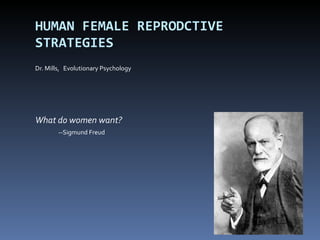
HUMAN FEMALE REPRODCTIVE STRATEGIES Dr. Mills,  Evolutionary Psychology What do women want?   --Sigmund Freud
Život je borba
Život je borba
Život je borba
Život je borba
Život je borba Unutar vrste Između vrsta Sa fizičkim uvjetima života We are a bundle of psychological adaptations that reflect the repeated problems faced by humans in the ancestral environment
“ Neprijateljske” sile prirode Adaptivni problemi  +  dugi period vremena  =  adaptacije 20 mil.god.  “ In the great battle of life …the structure of every organic being is related, in the most essential yet often hidden manner, to all other organic beings, with witch it comes into competition for food and residence, or from which it has to escape, or on which it preys” Darwin, 1859 Klima Vremenski uvjeti Nestašica hrane Toksini Bolesti Paraziti Predatori Drugi ljudi … .. Krzno Žlijezde znojnice Naslage sala Miris Temperatura Imunološki sustav Strah Teorija uma …
Hrana – pribavljanje i selekcija Primarni faktor koji ograničava  i uvjetuje ostale adaptacije Kako se domoći dovoljne količine hrane (kalorije) Kako osigurati sve potrebne nutrijente (kalcij, cink..) Kako se osigurati od konzumacije toksina
Zadaća Buss (2008) 99 – 103 Teme seminara Vikend?
Iduće predavanje Seksualna selekcija i biološke odrednice privlačnosti  Važnost procesa seksualne selekcije. Biološke determinante interpersonalne privlačnosti. Spolne razlike u odrednicama privlačnosti i indikatorima fitnesa. Lit: Miller (2001), poglavlje 6, str. 177-223  Miller (2001), poglavlje 4, str. 99-137

Evo 05 10 11

  • 1.
    4 . Predavanje 12 . 11 .20 10 EVOLUCIJSKA PSIHOLOGIJA
  • 2.
  • 3.
    Što smo onorekli..? Grupni projekt ( do 3 člana ) Evolucijske teme i hipoteze vezane uz: ljubav seks orgazam kompetitivnost spermija prevaru sustave parenja seksualnu orijentaciju estetiku/ljepotu/umjetnost religiju moralnost politiku mentalna oboljenja ekonomiju smijeh zijevanje poremećaje hranjenja specifične emocije i osjećaje
  • 4.
    5 . Predavanje 19 . 11 .20 10 Seksualna selekcija i biološke odrednice privlačnosti
  • 5.
  • 6.
    Spolno razmnožavanje Najpraktičnijinačin da se osigura kako svo potomstvo ne nasljeđuje štetne mutacije Prosjek: 1.6 – 3 štetnih mutacija po generaciji Potrebno eliminirati istom brzinom kojom se stvaraju Odbojnost incesta?
  • 7.
    Odabir partnera Akoje cilj spolnog razmnožavanja osigurati da se barem dio potomaka zaštiti od štetnih mutacija bilo bi nepraktično nasumično birati partnera Potrebno je birati partnera sa najmanjim brojem štetnih mutacija koji če potomcima pružiti najveću vjerojatnost preživljavanja .
  • 8.
    Život je borbaMnogo mutacija je skriveno i ne utječe na ponašanje Neke osobine su pod većim utjecajem mutacija Paunov rep?
  • 9.
    Udvaranje – očemu se tu radi Promoviranje naših fizičkih i mentalnih karakteristika mogućim seksualnim partnerima Tjelesni izgled, izraz lica, put, razina energije, specifične vještine Kreativnost, priče, riješavanje problema, socijalizacija, smisao za humor, empatija, vokabular
  • 10.
    Indikatori fitnesa Biloškeosobina evoluirale kako bi demonstrirale fitnes jedinke Fitnes se odnosi na sposobnost jedinke da preživi i uspješno se razmnožava U najveću ruku determinirana genetskom kvalitetom jedinke, koja se svodi na opterećnost mutacijama Poveznica seksualne selekcija i osjetilnih iskustava
  • 11.
    Simetrija Jedna odnajlakše procijenjivih komponenti fitnesa Dostupna iistraživačima i pripadncima vrste Vežna odrednica privlačnosti kod većine vrsta Moguće je kako su neke tjelesne karakteristiki evoluirale kao forma indikatora simetrije “ Razvojna stabilnost” Lek paradoks
  • 12.
  • 13.
  • 14.
    Tjelesna simetrija iIndikator razvojne stabilnosti usprkos pristutnosti okolinskih i genetskih izazova – indikator zdravlja i fertilnosti Grammer i Thornhill, (1994): I žene i muškarci sa simetričnim licima procijenjivani kao atraktivniji, dominantniji, zdraviji i više sexy Muškarci sa simetričnim licima imaju više partnerica, ranije ulaze u seksualne odnose i imaju više potomaka (Thornhill i Gangstad, 1994) Žene čiji su partneri simetričniji doživljavaju više orgazama (Thornhill et al., 1995) Niska simetrija je povezana sa schizofrenijom (Mellor 1992); mentalnom retardacijom (Naugler & Ludman 1996); prematurnim rođenjem (Livshits & Kobyliansky 1991)
  • 15.
  • 16.
    Simetrija lica iljudske facijalne proporcije
  • 17.
    Kros kulturalne percepcijeljepote Cunningham et al., (1995) Pripadnicima različitih rasa na procijenu dane fotografije Azijata, Hispanaca, Crnaca i Bijelaca, procijenjenih unaprijed unutar rase Prosiječna korelacija između grupa – 0,93 Fizička atratiktivnost prediktivna za vjerojatnost braka i socioekonomski status partnera
  • 18.
    Standards of beautyare consistent across ethnicities
  • 19.
  • 20.
  • 21.
  • 22.
  • 23.
  • 24.
  • 25.
    Urođeni standardi ljepote?Langlois et al., (1990) proučavao reakcije djece na lice različite privlačnosti Djeca u starosti 2-3 mjeseca i 6-8 mjeseci prezenitrani sa unaprijed procijenjenim licima Obije grupe duže promatrale “ljepša” lica Djeca se dulje igrala sa lutkama koje su posjedovale lijepa lica
  • 26.
    “ Što ženežele?” – Sigmund Freud
  • 27.
    Oba spola segenaralno slažu u osobinama koje traže kod partnera
  • 28.
    Što muškarci žele? Što žene žele ? Izgled 1. Dobrota i razumjevanje 2. Fizička atraktivnost 2. Uzbudljiva ličnost 3. Inteligencija 3. Inteligencija 4. Dobrota i razumjevanje 4. Fizička atraktivnost 5. Uzbudljiva ličnost 5. Dobro zdravlje 6. Dobro zdravlje 6. Ambicioznost i poduzetnost 7. Ambicioznost i poduzetnost 7. Izgled 8. Prilagodljivost 8. Financijsku sigurnost 9. Kreativnost 9. Sposobnost zarađivanja 10. Želju za djecom 10. Prilagodljivost 11 . Financisku sigurnost 11. Želju za djecom 12. Nevinost – Seksualnu restriktivnost 12. Kreativnost 13. Sposobnost zarađivanja 13. Nevinost – Seksualnu restriktivnost
  • 29.
    Osvr na ženskereproduktivne karatkteristike Sporiji reproduktivni tempo Apsolutnu sigurnost potomstva
  • 30.
    Osnovne osobine relavantnekod ženskog odabira partnera Muške osobine relevantne za žene : Dobri geni /dobro zdravlje Pristup (potencijalni) resursima Visok ocijalni status Zaštita Voljnost ulaganja u dugotrajnu vezu Roditelji skloni ulaganju
  • 31.
    Ženska evaluacaja potencijalnogpartera katkad je...khm...komplicirana
  • 32.
    Potraga za dobrimgenima: imunološki sustav
  • 33.
  • 34.
    Visina Povezana samoći i statusom Graziano et al., (1978) Žene procijenjvale slike muškaraca za koje su vjerovale da su različitih visina Viši muškarci preferirani u odnosu na niske. Najpoželjnijim procjenjivani prosječno visoki Pawlowski et al., (2000) visina povezana sa vjerojatnošću braka Neženje su značajno niži od oženjenih muškaraca
  • 35.
    Omjer bokovi– ramena Horvarth (1979) širina ramena prediktor muške atraktivnosti . Maisey et al., (1999) WCR glavni faktor privlačnosti Muškarci sa torzom oblika izokrenutog trokuta procjenjivani atraktivnijima Povezano sa karakterisikama potrebnima za lov Velik trbuh procijenjivan kao izrazito odbojan
  • 36.
  • 37.
    A osim gena,za što služe muškarci ? Hrana – posebice meso Sklonište Zaštita od ostalih muškaraca Ulaganje u potomstvo Dakle, žene bi trebale razviti preferencije za : Dobre financijske izglee Stariji Socijalni status Vrijedni i poduzetni Imaju poštovanje ostalih muškaraca Druge žene ih smatraju privlačnima (?)
  • 38.
    Sposobnost ali ivoljnost da podjeli resurse
  • 39.
  • 40.
    Dokazi U svimdruštvima žene cijene ekonomske resurse partnera više nego muškarci Trivers (1985) oženjeni muškaci u godini imaju u projeku 50% više prihode od neoženjenih Buss (1989) pokazao kako žene stavljakju dvostruko veću važnost na finacijsko stanje partnera Kenrick et al., (1990) minimum prihvatljivog kapaciteta zarađivanjamora biti na oko 70% u usporedbi s prihodima ostalih muškaraca See a problem there?
  • 41.
  • 42.
    Preferencija financijskih mogućnostiBuss & Schmitt, (1993). Buss (1999) p109
  • 43.
    SSSM (the “structuralpowerlessness hypothesis”) suggests wealthy / high status women should place less emphasis on status. They don’t they place even more emphasis on male status! Female medical students became more selective in their criteria in entering a sexual relationship.. ( Townsend, 1989) Women are significantly more likely to end relationships with males who become unemployed ( Betzig, 1989 ). Young males present a problem: What will his future status be? Does he have “potential?” Clues: education, ambitiousness and willingness to seek resources.
  • 44.
    Female reproductive strategy:Trading fertility for resources ?
  • 45.
  • 46.
  • 47.
  • 48.
    Preferecnije statusa Štoje ona vidjela u njemu ? Što je on vidio u njoj ?
  • 49.
    Do clothes makethe man? Looked at the effects of status (signified by clothing), and attractiveness on female willingness to engage in romantic relationships. (Townsend & Levy, 1990) Male targets were pre-rated for physical attraction and divided into two categories - handsome, and homely. The targets wore one of three costumes: 1. Blazer, shirt, designer tie, Rolex watch . Described as being doctors (high status). 2. Plain white shirt . Described as being teachers (medium status). 3. Uniform of a Burger King employee . Described as being trainee waiters (low status).
  • 50.
    Zbog čega nekežene vole”zločeste dečke”
  • 51.
    Preferencije za starijimmuškarcima Vjerojatnije da su postigli finacijsku sigurnost Buss (1989): Preferencija u prosjeku četiti godine starijih muškaraca Kenrick & Keefe (1992): brakovi u prosjeku sa muškarcima starijim 5 godina
  • 52.
  • 53.
    Buss & Schmitt,(1993) in Buss (2001) p 113
  • 54.
    . Kenrick & Keefe, 1992, p81.
  • 55.
  • 56.
  • 57.
    Nekoliko citata omoći, statusu i resursima “ Power is the ultimate aphrodisiac”. Henry Kissinger. “ If women didn’t exist, all the money in the world would have no meaning”. Aristotle Onassis. “ When you’re famous your love life diminishes. Your sex life grows”. Enrique Iglesias. “ I’m not a good-looking person. I’ve struggled to get girls for most of my life, and then, suddenly, I win the casual-sex lottery by getting famous”. Frank Skinner, musician. “ So what first attracted you to the millionaire Paul Daniels?” Mrs. Merton to Debbie McGee.
  • 58.
    Socijalna dominantnost Ženepreferiraju dmnantnije muškarce koji imaju moć nad svojim suvremenicima . Dosupnost resira i veći status žene Sadella et al.,(1987) videi pokazuju žene i muškarce u dominatnom i submisivnom ponašanju pred muškarcima i ženama Domiantno ponašanje povećalo je seksualnu privlačnost i želju za vezom u muškaraca. Procjene privlačnosti žena ostale su nepromjenjene.
  • 59.
  • 60.
    P roblem: Nedostatak muškaraca koji bi zadovoljili sve njihove kriterije Annual Meeting of single, good-looking, emotionally-stable, financially-secure, intelligent men who would be a faithful husband, a good father, thinks she is “special,” and who is looking for long-term commitment…
  • 61.
  • 62.
  • 63.
  • 64.
  • 65.
  • 66.
  • 67.
    Mozak kao odrazfitnesa http://www.youtube.com/watch?v=nS1tEnfkk6M
  • 68.
    Mozak kao odrazfitnesa not the first to stumble upon the fact that complex behaviors make good fitness indicators. Songbirds Atenborough – video SEX
  • 69.
    Mozak kao odrazfitnesa about humans is that our courtship behavior reveals so much more of our minds. Art reveals our visual aesthetics. Conversation reveals our personality and intelligence. By opening up our brains as advertisements for our fitness, we discovered whole new classes of fitness indicators, like generosity and creativity.
  • 70.
    Karakterstike seksualno slekcioniranihindikatora fitnesa sexually selected fitness indicators They do not help animals find food or avoid Predators They do not remove parasites or feed offspring. They look costly and useless They appear luxuriously superfluous, often resembling a pathological side-effect of something more useful and sensible But these in luxuriant excess.
  • 71.
    Evolutionary Fitness andPhysical Fitness biologists thought that most sexual ornaments were arbitrary. minority of biologists became skeptical about this view that most beauty is arbitrary.
  • 72.
    Evoluirani kapitavlizam Veblen's Theory of the Leisure Class introduced the idea of "conspicuous consumption" in 1899. Veblen argued that in modern urban societies, where strangers come and go, people increasingly advertise their wealth by ornamenting themselves with costly luxuries. Where nobody knows anyone else's true wealth directly, conspicuous consumption is the only reliable signal of wealth. Sociologists and economists understood this logic immediately. Capitalist consumerism evolved in part as a set of wealth indicators.
  • 73.
    The Human Mindas a Set of Fitness Indicators Zahavi's handicap principle How could mate choice favor a costly, useless ornament over a cheaper, more beneficial ornament? (Why should a man give a woman a useless diamond engagement ring, when he could buy her a nice big potato, which she could at least eat?) Zahavi realized that the signaling system has to be self-policing. It has to include a range of sexual signals that differ in cost, and thus differ in affordability by individuals of different fitness, by virtue of which they honestly reveal their fitness. The handicap principle suggests that prodigious waste is a necessary feature of sexual courtship. Condition-dependence is equally useful at the high end of the fitness scale, for it enables one to tailor the amount one spends on fitness indicators to one's fitness level. This helps the extremely fit to distinguish themselves from the very fit. It spreads out the apparent differences between individuals so that their fitness is easier to judge.
  • 74.
    The Human Mindas a Set of Fitness Indicators wastefulness of courtship is what makes it romantic. The wasteful dancing, the wasteful gift-giving, the wasteful conversation, the wasteful laughter, the wasteful foreplay, the wasteful adventures. From the viewpoint of "survival of the fittest," the waste looks mad and pointless and maladaptive. Human ourtship even looks wasteful from the viewpoint of sexual selection for non-genetic benefits, because, as we shall see, the acts of love considered most romantic are often those that cost the giver the most, but that bring the smallest material benefits to the receiver. However, from the viewpoint of fitness indicator theory, this waste is the most efficient and reliable way to discover someone's fitness. Where you see conspicuous waste in nature, sexual choice has often been at work.
  • 75.
    Život je borbaEvery sexual ornament in every sexually reproducing species Male humpback whales waste their energies with half-hour-long, hundred-decibel songs that they repeat all day long during the breeding season. Male humans waste their time and energy getting graduate degrees, writing books, playing sports, fighting other men, painting pictures, playing jazz, and founding religious cults. These may not be conscious sexual strategies, but the underlying motivations for "achievement" and "status"—even in preference to material sources—were probably shaped by sexual selection. (Of course, the wasteful displays that seemed attractive during courtship may no longer be valued if they persist after offspring arrive—there is a trade-off between parental responsibilities and conspicuous display.)
  • 76.
    Indikatori fitnesa iadaptacije rules for recognizing mental adaptations . Fitness indicators violate all these criteria. If a mental trait evolved through sexual selection as a fitness indicator, it should show large differences between people. It evolved specifically to help sexual choice discriminate in favor of its possessor at the expense of sexual rivals. Fitness indicators can show high heritability because they tap into genetic variation in fitness, and fitness usually remains heritable. For fitness indicators to be reliable, they have to be wasteful, not efficient. They have to have high costs that make them look very inefficient compared with survival adaptations. Finally, fitness indicators cannot be totally modular and separate from other adaptations, because their whole point is to capture general features of an organism's health, fertility,
  • 77.
    Život je borba90 percent of our psychological adaptations evolved through standard natural selection and social selection to solve routine problems of surviving and living in groups. Evolutionary psychology has proven very good at analyzing these adaptations. My interest is in the psychological adaptations that are uniquely human, the 10 percent or so of the brain's capacities that are not shared with other apes. This is where we find puzzling abilities like creative intelligence and complex language that show these great individual differences, these ridiculously high heritabilities, and these absurd wastes of time, energy, and effort. To accept these abilities as legitimate biological adaptations worthy of study, evolutionary psychology must broaden its view of what an adaptation should look like.
  • 78.
    Život je borbaI think that the handicap principle casts a new light on the human brain. Our brains are only 2 percent of our body weight, but they consume 15 percent of our oxygen intake, 25 percent of our metabolic energy, and 40 percent of our blood glucose. these costs must have been balanced by some really large survival benefits, otherwise the brain could not have evolved to be so large and costly. But that survivalist argument holds only as long as one ignores sexual selection. The brain's costs are what make it a good fitness indicator. Sexual selection made our brains wasteful, if not wasted: it transformed a small, efficient ape-style brain into a huge, energyhungry handicap spewing out luxury behaviors like conversation, music, and art.
  • 79.
    Are Fitness IndicatorsImmoral? Variation in fitness betrays our belief in human equality. The heritability of fitness violates our assumption that social and family environments shape most of human development. Loudly advertising one's fitness violates our values of humility, decorum, and tact. Sexual status hierarchies based on fitness violate our belief in egalitarian social organization. The idea that people sort themselves into sexual pairs by assessing each other's fitness violates our romantic ideal of personal compatibility. The conspicuous wastedemanded by the handicap principle violates our values offrugality, simplicity, and efficiency. The sexual choice mechanisms that judge individuals by their fitness indicators violate our belief that people should be judged by their character, not the quality of their genes. Finally, it seems nihilistic to propose that our capacities for language, art, and music evolved to proclaim just one message that has been repeated loudly and insistently for thousands of generations: "I am fit, my genes are good, mate with me." A mind evolved as a set of fitness indicators can sound like a fascist nightmare.
  • 80.
    Život je borbaMachiavellian intelligence theory, Richard Alexander's group warfare theory suggests that our minds evolved through genocidal violence, with larger-brained ancestors killing off smaller-brained competitors.
  • 81.
    Courtship in thePleistocene some ways we are better positioned to understand sexual selection than survival selection. The sexual challenges our ancestors faced were created by other members of their own species. Likewise today If our thoughts and feelings about sexual relationships are not too different from those of our ancestors, then our sexual challenges must not be too different. We get infatuated, we fall in love, we feel ecstatic, jealous, or heartbroken, we grow bored with some partners, and, if lucky, we develop a companionable attachment to the sexual partners with whom we raise children. We are attracted to beautiful faces and bodies, but also to a good sense of humor, a kind personality, a keen intelligence, and a high social status. If these sexual tastes are part of human nature that evolved gradually, our ancestors must have felt similarly to some degree. We should not automatically project modern social arrangements back into prehistory, but it is probably valid to project our individual emotions on to our ancestors.
  • 82.
    Pleistocene and HolocenePleistocene was a geological epoch uniquely important in human evolution, because it included the evolution of all, that is. distinctively human. At the beginning of the Pleistocene, 1.6 million years ago, our ancestors were still 180 THE MATING MIND relatively small-brained apes who walked upright and made just a few crude stone tools. They were almost certainly without language, music, art, or much creative intelligence. At the end of the Pleistocene, just 10,000 years ago, our ancestors were already modern humans, identical to us in bodily appearance, brain structure, and psychology. The evolution that shaped human nature all took place in the Pleistocene.
  • 83.
    Pleistocene and HoloceneHolocene includes all of recorded history. During the Holocene, humans spread around the planet, invented agriculture, money, and civilization, and grew from populations of a few million to a few billion. The Holocene has been historically crucial but evolutionarily unimportant. Ten thousand years is only four hundred human generations, probably not enough time to evolve many new psychological adaptations. But it is plenty of time for runaway sexual selection to make populations diverge a bit in some aspects of body shape, facial appearance, and psychological traits. It saw the emergence of inherited wealth, arranged marriages, hierarchical societies, patriarchy feminism, money, prostitution, monogamous marriage, harems, personal ads, telephones, contraception, and abortion.
  • 84.
    Život je borbaDuring the days, women would have gathered fruits, vegetables, tubers, berries, and nuts to feed themselves and their children. Men would have tried to show off by hunting game, usually unsuccessfully, returning home empty-handed to beg some yams from the more pragmatic womenfolk. Our ancestors probably did not have to work more than twenty or thirty hours a week to gather enough food to live. Nature was not red in tooth and claw. Usually, it was really boring. Predators would have tended to kill the very young, the very ill, the very old, and the very foolish. Most illnesses would have been due to poor condition brought on by starvation or injury. Our ancestors did not spend all their time worrying about survival problems. They were among the longest-lived species on the planet, which implies that their daily risk of death was minuscule. Like most great apes, they probably spent their time worrying about social and sexual problems.
  • 85.
    Život je borbaIf individuals consistently appeared healthy, energetic, and well-fed, it was not because they were born rich. It must have been because they were good at foraging and good at making friends who took care of them during rough patches. To understand how sexual selection may have operated in the Pleistocene, we have to ask how sexual relationships and sexual choice may have worked.
  • 86.
    Sexual Selection inPrimates distribution of food in the environment determines the distribution of females, and the distribution of females determines the distribution of males. When food is so dispersed that females do best by foraging on their own, males disperse to pair up with the lone females. This gives rise to monogamous couples. It is a fairly rare pattern among primates, limited to gibbons, some lemurs, and some African and South American monkeys.
  • 87.
    Sexual Selection inPrimates When food comes in patches large enough for several females to share, they tend to band together in small groups to find the food, and to protect each other against predators, unwanted males, and competing female groups. As long as the female band is not too large, a single male can exclude other males from sexual access to the band, which thus becomes "his." This "harem system" of single-male polygyny is fairly common in primates, being found in hamadryas baboons, colobus monkeys, some langurs, and gorillas. The competition between males to guard the female groups creates very strong sexual selection pressures for male size, strength, aggressiveness, and large canine teeth.
  • 88.
    Sexual Selection inPrimates food comes in still larger patches, female groups can grow too large for any single male to defend them. The males must then form coalitions, resulting in a complex multi-male, multi-female group, as in some baboons, macaques, ring-tailed lemurs, howler monkeys, and chimpanzees. Our hominid ancestors probably lived in such groups, in which sexual selection gets more complicated. Sometimes, females in multi-male groups appear to use sperm-production ability as the main fitness indicator. A chimpanzee female might mate with every male in the group every time she becomes fertile. She lets their sperm fight it out in her reproductive tract, and the strongest swimmers with the best endurance will probably fertilize her egg.
  • 89.
    Sexual Selection inPrimates females to choose between males. If they favor dominant males, males evolve through sexual selection to compete intensely for social status by individual force or by forming coalitions. If females favor kind males, males evolve through sexual selection to groom females, protect their offspring, and guard them from other males.
  • 90.
    Sexual Selection inPrimates Female primates can exercise choice by joining groups that contain favored males, initiating sex with them during estrus, supporting them during conflicts, and developing long-term social relationships with them. Females can reject unfavored males by refusing to cooperate during copulation attempts, driving males away from the group, or leaving the group. But female mate choice criteria remain obscure for most primate species. In contrast to modern humans, female primates rarely favor males who can provide resources or paternal care of offspring. The sporadic male care that is observed, such as watching, carrying, and protecting infants, is better described as courtship effort than as paternal care. The male is unlikely to be the infant's father, but is simply trying to mate with the infant's mother by doing her a favor.
  • 91.
    Sexual Selection inPrimates three kinds of female preference have been reported in primates: preferences for high-ranking males capable of protecting females and offspring from other males; preferences for male "friends" that have groomed the female a lot and have been kind to her offspring preferences for new males from outside the group, perhaps to avoid genetic inbreeding.
  • 92.
    Sexual Selection inPrimates But when the costs of male sexual competition and courtship are high, males also have incentives to be choosy When male mate choice becomes important, sexual selection affects females as well as males. In monogamous marmosets and tamarins, females compete to form pairs with quality males and drive off competing females. In single-male harem systems, the dominant male's sperm can become a limiting resource for female reproduction, and high-ranking females prevent low-ranking females from mating through aggression and harassment. In multi-male groups, females sometimes compete to form consortships and friendships with favored males. Such patterns of female competition suggest some degree of male mate choice. When the costs of sexual competition and courtship are high, males have an incentive to be choosy about how they spread their sexual effort among the available females. Males compete much more intensely for females who show signs of fertility such as sexual maturity, estrus swellings, and presence of offspring
  • 93.
    Sexual Selection inPrimates chimpanzees and the bonobos, live in multi-male, multi-female groups in which sexual choice is dynamic, intense, and complicated. Under these relentlessly social conditions, reproductive success came to depend on social intelligence rather than brute strength. Both sexes compete, both sexes have dominance hierarchies, and both sexes form alliances. Sexual relationships develop over weeks and years rather than
  • 94.
    Pleistocene Mating firstsexual experiences soon after reaching sexual maturity. They would pass through a sequence of relationships of varying durations over the course of a lifetime. Some relationships might have lasted no more than a few days. Given that it takes an average of three months of regular copulation before conception, very short-term partnerships would probably not produce a child. Longer-term relationships would have been much more evolutionarily important because they were much more likely to produce offspring. Most children were probably born to couples who stayed together only a few years. Exclusive lifelong monogamy was practically unknown. The more standard pattern would have been "serial monogamy": a sequence of nearly exclusive sexualpartnerships that were socially recognized and jealously defended.
  • 95.
    other, or onewould happen to die. This is the pattern characteristic of most human hunter-gatherers, because they do not have the religious, legal, and property ties that reinforce ultralong- term monogamous marriages in civilized societies.
  • 96.
    Some desirable maleswere probably able to attract more than one regular sexual partner. Their polygyny opened the possibility of runaway sexual selection For women, there were incentives to mate with males of higher fitness than their current partner. For men, there were incentives to mate with as many females as possible (if the current partner could stand it).
  • 97.
    Female mate choicewas powerful in prehistory. Although sexual harassment of females by males was probably common, females could retaliate by soliciting assistance from female friends, male partners, and relatives. Concealed ovulation reduced the male incentives for rape, and it usually protected women from conceiving the offspring of rapists. From an evolutionary point of view, it guarded their power of sexual choice.
  • 98.
    The power ofclan members to enforce good sexual behavior is often overlooked in discussions of human evolution. Once language evolved, sexual gossip would have been a deterrent against illicit affairs, sexual harassment, and reputation-destroying rape accusations. Nevertheless, the prevalence of rape in human prehistory is still subject to intense debate. The higher the actual prevalence was, the less important female mate choice would have been, and the weaker my sexual choice theory would become.
  • 99.
    Consumerism turns thetables on ancestral patterns of human courtship. It makes courtship a commodity that can be bought and sold.
  • 100.
    Many Pleistocene mothersprobably had boyfriends. But each woman's boyfriend may not have been the father of any of her offspring. Or he may have been the father only of the most recent baby. Even so, his typical contribution to parenting is debatable. Males may have given some food to females and their offspring, and may have defended them from other men, but as we shall see, anthropologists now view much of this behavior more as courtship effort than paternal investment. Males could never be sure which offspring really carried their genes, whereas females could be certain. This uncertainty about paternity leads most male mammals to invest much more in pursuing new sexual opportunities than in taking care of their putative offspring. Male hominids, like males of other primate species, were probably marginal, admitted to the female group only on their forbearance. Herds of young bachelor males probably roamed around living their squalid, sexually frustrated lives, hoping they would eventually grow up enough for some group of women to take them in.
  • 101.
    Život je borbaWomen consistently show preferences for tall, strong males in mate choice studies, but this may reflect a preference for good genes and high fitness, rather than a preference for a male capable of physical violence and intimidation that might get turned against her or her children. Interviews with contemporary hunter-gatherer women by anthropologists such as Marjorie Shostak reveal that these women view many men as more trouble than they're worth. If the men are hanging around, they usually eat more food than they provide, and demand more care than they give one's children. If they have very high fitness, then their good genes, good sex, and good conversation might compensate for their messiness and lethargy.
  • 102.
    Život je borba, an intelligent mother or a boring mother. Sexual Female hominids must have juggled their courtship efforts with their mothering. The important variable was not whether a female already had children, but whether she was a cheerful mother or a careworn mother, a beautiful mother or an ugly mother competition between females was mostly sexual competition between mothers.
  • 103.
    Život je borbaThis put male hominids in an unusual position: their courtship had to appeal not only to mothers but to their children. made them better fathers than in almost any other male primate species. Men bring children food, make them toys, teach them things, and play with them Their willingness to do this even for step-children could be viewed as a side-effect of a male adaptation for taking care of their own genetic offspring. support and protection of step-children was the norm in the Pleistocene.
  • 104.
    Život je borbastep-fathers are all sweetness and light. Evolutionary psychologists Martin Daly and Margo Wilson have found that men in every culture are about a hundred times more likely to beat and kill their step-children than their genetic children. There are clear evolutionary reasons for that. When male lions and langur monkeys mate with a new female, they routinely try to kill all of her existing offspring. Those offspring do not carry the males' genes, so by killing them the males free the females to conceive their own offspring, who will carry their genes. The risk of infanticide by males is a big problem for many female primates.
  • 105.
    Život je borbaIndividuals have no realistic hope of mating far above their own fitness level, or any willingness to mate below their fitness. The result will be that mated pairs will correlate highly for fitness. If height correlates with fitness, they will be of similar height. If intelligence correlates with fitness, they will be similarly bright. If facial attractiveness correlates with fitness, they will be similarly beautiful This is basically what we see in modern human couples: a fairly high degree of "assortative mating" for fitness indicators.
  • 106.
    Život je borbaFitness matching also concentrates helpful mutations (which are much rarer) in high-fitness babies. If fitness matching' can explain ornamentation in monogamous birds, perhaps it can explain courtship abilities in relatively monogamous apes like us.
  • 107.
    Brze procjene Thequestion remains of how our ancestors actually made their sexual choices. Perhaps during large tribal gatherings, Contact between bands may have been tense and brief, with the threat of violent confrontation balanced against the possible benefits of trade, gossip, and the exchange of sexual partners. Selection would have favored a capacity for very fast decisions about which individuals were attractive enough to pursue. These snap judgments could have been based on information like physical appearance, bodily ornamentation, apparent social status, and public display behavior (such as sports, music, and story-telling). Our ability to judge the physical attractiveness of a human face in a seventh of a second is a legacy of selection for such fast decision-making.
  • 108.
    Brze procjene maleswould scan for physically attractive females and pursue them, trying to establish consortships. This would be a major stage of male mate choice, subjecting females to intense sexual selection for immediate physical appeal. Once a male tried to approach a female to form a consortship, the first stage of female mate choice would be triggered. On the basis of his appearance and behavior, she would reject him (usually) or provisionally agree to continue interacting. This would impose sexual selection on males to create
  • 109.
    Very Simple RulesCan Lead to Very Good Sexual Choices Fitness indicators themselves make sexual choice simple. pay attention to a few cues like height and facial appearance, and get a pretty good estimate of an individual's fitness. Each trait that we consider sexually attractive already summarizes a huge amount of information about an individual's genes, body, and mind.
  • 110.
    Simple rules Gigerenzer'steam has a lot of evidence that this very simple rule, which they call "Take the Best," makes decisions almost as good as the most sophisticated mathematical decision rules in almost every situation.
  • 111.
    Brze iodluke muškiženski Insofar as men may be satisfied with certain minimal standards of physical appearance before their sexual interest is aroused, their sexual decision-making may appear faster—but only because physical appearance can be judged much faster than character. When it comes to making long-term sexual commitments based on traits that are more than skin deep, men may take even longer than women.
  • 112.
    Jednoostavne odluke partnerdecide when to form a serious relationship The standard optimal search strategy is called the 37 percent rule. In our research on mate search strategies, colleague Peter Todd and I found that a rule we call "Try a Dozen" performs as well we get to know a number of opposite-sex friends during adolescence, fall in love at least once, remember that loved one very clearly, and tend to marry the next person who seems even more attractive. Each individual is "satisficing"- looking for someone who is pretty good and good enough, rather than the absolute best they could possibly find.
  • 113.
    Univerzalne prefeence seekmates in good health because they are more likely to survive as partners and parents. They should seek mates capable of efficient cooperation and coordination, so they make an effective team. Since health and future cooperation cannot be assessed directly, they must be estimated using indicators such as energy level and kindness. Those indicators can evolve according to the same principles as fitness indicators. Usually, there is a lot of overlap between basic fitness and these other qualities.
  • 114.
    Žensli odabir partnerai ne nasljedne perferece – status i bogatstvo sexual choice could sometimes put non-heritable qualities ahead of heritable fitness. If the environment is so demanding that a female simply cannot raise a child by herself, then she might favor an attentive, experienced father, even if he has a lower general fitness than a charming athletic genius who is hopelessly incompetent with babies. However, she might still prefer to have an affair with the genius and let the experienced father raise the resulting child. New DNA methods for establishing paternity have shown that this sort of eugenic cuckoldry is surprisingly common in birds previously thought to be monogamous, and in humans.
  • 115.
    Život je borbamaterial benefits that high-status men could offer women, and the fertility benefits that healthy young women could offer men. This has been a powerful research strategy for explaining many sex differences in human mating behavior. the material benefits simply bias evolution to favor fitness indicators that happen to deliver practical benefits in addition to information about mutation load.
  • 116.
    Kroskulturalne preferece zastatusom neslaganje David Buss has amassed a lot of evidence that human females across many cultures tend to prefer males who have high social status, good income, ambition, intelligence, and energy— contrary to the views of some cultural anthropologists, who assume that people vary capriciously in their sexual preferences across different cultures. He interpreted this as evidence that women evolved to prefer good providers who could support their families by acquiring and defending resources. I respect his data enormously, but disagree with his interpretation.
  • 117.
    Ženski izbor ButI would suggest it was much more important that intelligent men tended to produce intelligent, energetic children more likely to survive and reproduce, whether or not their father stayed around. In other words, I think that evolutionary psychology has put too much emphasis on male resources instead of male fitness in explaining women's sexual preferences.
  • 118.
    Preferencija dobi millermen from agricultural, pastoral, and modern civilizations. In most cultures with recorded history, men were under social, legal, economic, and religious pressures to stay monogamously married for life. A woman's youth may not have been quite so crucial in the Pleistocene, as long as the woman was still reasonably fertile.
  • 119.
    Preferencije dobi starijeOther male primates tend to shun adolescent females without offspring, and prefer older, highranking females with offspring who have already demonstrated their fertility, survival ability, social intelligence, and mothering skills. There is strong evidence from evolutionary psychology that men in modern societies generally prefer the physical appearance of women around 20 years old to those who are older (or younger). But I have argued that this preference may have been amplified somewhat by the economic and religious pressures for monogamy since civilization arose, which makes finding a young bride crucial to a man's reproductive success.
  • 120.
    Ljudsko tjelo Comparedwith other apes, we have ess hair on our bodies, more on our heads, whiter eyes, longer noses, fuller lips, more expressive faces, and more dextrous hands. In most species, sexual ornaments like long head hair, hairless skin, and full lips would have evolved only in males, because females would have been the choosy sex. Males have few incentives to reject any female mates. The fact that both human sexes evolved distinctive sexual ornaments shows that both female choice and male choice was important in human evolution. If both sexes were choosy about bodies, they might also have been choosy about minds. But we do know that our body's sexual ornaments are universal across human groups, so they must have evolved at least 60,000 years ago or so, Penises, clitorises, breasts, and beards are fascinating not only in their own right, but also for what they reveal about sexual selection among our ancestors.
  • 121.
    Život je borbaMen are taller and heavier on average than women, with more upper body strength, higher metabolic rates, more hair, deeper voices, and slightly larger brains. Men grow beards, and possess penises that are much longer, thicker, and more flexible than those of other primates.
  • 122.
    Život je borbaWomen have enlarged breasts and buttocks, narrower waists, and a greater orgasmic capacity than other apes.
  • 123.
    Život je borbaSexual selection has also made male bodies grow according to a higher-risk, higher-stakes strategy. For males there is a higher incidence of birth defects, more death in infancy, higher mortality at every age, earlier senescence, and greater variation in health, strength, body size, brain size, and intelligence. This risky, go-forbroke strategy suggests that sexual competition among males was often a winner-takes-all contest. It was better to take a big gamble on producing the most attractive image during a short peak, rather than aiming to create a mediocre impression over a long period of time.
  • 124.
    Body Traits Evolvedas Sexual Ornaments? body traits such as penises, breasts, buttocks, beards, head hair, and full lips show the hallmarks of sexual selection through mate choice. They are uniquely amplified in our species. Many of them show large sex differences. Mostly, they appear or enlarge only after puberty, and become more engorged with blood during sexual arousal. All around the world they are clearly valued as sexual signals, and are made more conspicuous through embellishment and make-up. They probably evolved partly as fitness indicators and partly as ornaments through runaway or sensory preferences.
  • 125.
    Život je borbaIf a bodily trait is considered sexually attractive across a wide range of cultures and historical epochs, the trait was probably viewed that way during human evolution. The manifest sexual appeal of female breasts and buttocks, for example, seems subjectively obvious to all heterosexual male humans, and that obviousness is good evidence for these traits having arisen through male mate choice. Around the world, the same bodily traits tend to be emphasized with special clothing and ornamentation when individuals wish to appear attractive, the same traits are covered when they wish to avoid sexual harassment, and the same traits are mutilated as punishment for sexual offenses.
  • 126.
    Život je borbaNatural selection can account for some latitude trends, explaining why skins got lighter, noses got larger, and bodies got shorter and thicker as human populations migrated from equatorial zones to colder climates. However, latitude and climate cannot account for most of the subtler differences between populations. Most differences in eyes, hair, facial features, and the sizes of breasts, buttocks, and penis are more likely to be consequences of sexual choice focusing on different traits in different populations.
  • 127.
    The Evolution ofthe Penis The traditional distinction between "primary" sexual traits (such as penises) and "secondary" sexual traits (such as beards) is misleading. Perhaps for reasons of Victorian propriety, Darwin wrote as if female choice applied only to the secondary sexual traits. But modern biologists view penises themselves as targets of sexual choice. Biologist William Eberhard has argued convincingly that male genitals in a wide range of species are shaped as much by female choice as by the demands of sperm delivery Adult male humans have the longest, thickest, and most flexible penises of any living primate. The penises of gorillas and orangutans average less than two inches when fully erect, and those of chimpanzees average only 3 inches. By contrast, the average human penis is over 5 inches when erect. The longest medically verified human penis was about 13 inches when erect, more than twice the average length.
  • 128.
    Život je borbapenis bone called the "baculum,“ human relies on an unusual system of vasocongestion. The penis fills with blood before copulation, like a blimp inflating before flight.
  • 129.
    Penisi i spermaDidn't penises evolve just to deliver sperm? Sperm competition is certainly one of the most important forms of reproductive competition. If two males copulate with a female when she is fertile, their sperm are in competition. Only one, at best, will fertilize her egg. The male with the fastest, longest-lasting, most numerous sperm is more likely to pass on his good-sperm genes to his sons. Heritable differences in sperm quality and sperm delivery equipment will be under intense selection. Male humans show many adaptations for sperm competition, both physical and mental. For example, some studies have shown that when a woman returns home from a long trip, her partner tends to produce a much larger ejaculate than normal, as if to overwhelm any competitor's sperm that may have found its way into his unwatched partner's vagina.
  • 130.
    Život je borbaA thick penis might tend to keep a competitor's sperm inside a female rather than allowing it to wash out. A long penis tends to overshoot the cervical opening rather than meet it accurately. Many species adapted for heavy sperm competition evolve penises with scoopers, scrapers, suckers, and flagella for removing rival sperm. If sperm competition were the driving force behind penis evolution, males might have evolved scary-looking flagellated genitals. Men would copulate by inserting their equipment, instantly flooding the cervix with half a pint of semen, and then lying on top of the woman for the next three days to make sure no rivals have the chance to introduce competing sperm. I understand that such behavior is quite rare.
  • 131.
    Život je borbaSize Mattered penis evolved through female choice as a tactile stimulator no single sexually selected trait is a guarantee of satisfaction. Sexual selection works on the principle of all else being equal. Given two otherwise identical hominid males, if female hominids consistently preferred the one with the longer, thicker, more flexible penis to the one with the shorter, thinner, less flexible one, then the genes for large penises would have spread.
  • 132.
    why upright walkinggave females a better view of male genitals. When primate penises are selected for visual appearance, they evolve much more color, and females seem to consider them much more attractive. not appear to be especially well adapted for producing auditory, olfactory, or gustatory stimulation. That leaves the sense of touch as the medium for female choice.
  • 133.
    Život je borbafemale choice in penis evolution is revealed in the way the penis is used during copulation. Biologist William Eberhard has argued that copulation is not the end of courtship, but rather its most intense phase. In most species, female choice does not end when a male penis first enters, but can continue until sperm actually reach a fertile egg. Eberhard calls this "copulatory courtship." Some female insects can store the sperm of several males for weeks and use it when they want to fertilize their eggs. Many female mammals (unconsciously) squeeze the ejaculate of some males back out after copulation—a process called "flowback"—as if rejecting sperm from males whose copulation is not up to their standard. In a human female with concealed ovulation, a male's sexual ability may influence whether she keeps copulating with him, and that will determine his likelihood of producing offspring with her.
  • 134.
    Život je borbaThe duration and intensity of copulatory courtship in a species is a clue to the power of female choice . Copulatory courtship was probably especially important among hominids. Continuous sexual receptivity and concealed ovulation gave our female ancestors an unprecedented opportunity for testing males as sexual partners, while running a lower risk per copulation of unwanted pregnancy than any other primate did. Sex during menstruation, pregnancy, and breast-feeding would also have given ample opportunity for judging potential long-term lovers by their copulatory skills.
  • 135.
    Život je borbaFemale hominids may not have preferred thicker, longer, more flexible penises per se. They may simply have liked orgasms, and larger penises led to better orgasms by permitting more varied, exciting, and intimate copulatory positions. This rather contradicts the view of the penis as a symbol of male domination. If we were a species in which males dominated the sexual system, we would have one-inch penises like dominant gorillas. The large male penis is a product of female choice in evolution. If it were not, males would never have bothered to evolve such a large, floppy, blood-hungry organ. Ancestral females made males evolve such penises because they liked them.
  • 136.
    Život je borbaIf the penis really did evolve through female choice as a copulatory stimulator, then it should be considered not just a physical organ that reaches inside the body, but a psychological organ designed to reach inside the pleasure systems of another individual.
  • 137.
    Život je borbahomologous organ called the clitoris. "Homologous" means that both organs grow from the same kinds of cells in the fetus. Anatomically, the human clitoris has the same three-part columnar structure as the penis: a glans, a shaft, and bifurcating roots. The main differences are that the penis is much larger overall, its shaft protrudes much more from the pelvis, it keeps blood from flowing back out when aroused, and it has a tube down the axis for urine and semen. The human clitoris shows no apparent signs of having evolved directly through male mate choice. It is not especially large, brightly colored, specially shaped, or selectively displayed during courtship. By contrast, in spider monkeys the clitoris is almost as large as the penis, protruding nearly an inch. In hyenas, the female clitoris is larger than the male penis, and seems to play a role in female competition.
  • 138.
    Život je borbainconspicuous design combined with its exquisite sensitivity suggests that the clitoris is important not as an object of male mate choice, but as a mechanism of female choice. It helps to select for males who provide pleasurable foreplay, copulation, and orgasms, and such discriminative power is just what we should expect from an organ of female choice.
  • 139.
    Breasts This highlevel of milk production does not itself explain why female humans breasts are so much larger than those of other apes. Most primate females are quite flat-chested, even when producing milk. Milk output depends on the amount of active glandular tissue in the breast, not the volume of fat. Human breasts have an unusually high ratio of fat to glandular tissue. They do not seem to be optimized for milk production. Most experts on breast-feeding claim there is no correlation between breast size before pregnancy and milk production ability after birth (though I know of no good data on this point).
  • 140.
    Život je borbabreasts evolved as cues of sexual maturity allowed female choice to focus more on the penis, bipedalism may have allowed male choice to focus on female breasts as a maturity cue. Breasts also make good fitness indicators because they come in symmetric pairs. I mentioned earlier that many bodily ornaments in many species advertise an aspect of fitness called developmentalstability women with more symmetric breasts tend to be more fertile. Finally, breasts are pretty good indicators of fat reserves. In the Pleistocene,not depositing too much fat on the abdomen (as males tend to), females could avoid appearing pregnant already—a sure sign of not being fertile at the moment, which might inhibit male sexual attention. Breasts appear to have evolved as highly condition-dependent indicators of a woman's nutritional state. Most women who have tried dieting know that breast size is the first thing to shrinkwhen food intake is restricted.
  • 141.
    Život je borbaBeyond this increased muscularity in both sexes, females evolved larger deposits of fat on the buttocks, hips, and upper thighs. Like breasts, these probably evolved through male mate choice as indicators of youth, adequate fat, and perhaps developmental stability.
  • 142.
    Život je borbaDev Singh has suggested that the female human distribution of fat evolved as an indicator of youth, health, and fertility. He found that men around the world generally prefer women who have a low "waist-to-hip ratio": a relatively narrow waist and relatively broad hips. Young, fertile women who are not pregnant have waist-to-hip ratios of around 0.7. This ratio would result from a waist circumference of 24 inches and a hip and buttock circumference of 36 inches, for example. Men almost always have a waist-to-hip ratio of at least 0.9, as do prepubescent girls and women past menopause.
  • 143.
    Život je borbaStarving, sickly women cannot maintain large breasts and buttocks. They need to burn up their fat reserves to stay alive, not keep them hanging around in the hope of attracting a mate. Because starving women tend to turn off ovulation, women without fleshy breasts and buttocks are usually women without fertility. Female longdistance runners, ballerinas, and anorexics who lose most of their body fat tend to have much smaller breasts and buttocks, and often stop menstruating and ovulating.
  • 144.
    Bodies, Faces, People,and Brains informative about male mate choice and female mate choice. However, they are relatively minor contributors to physical attractiveness compared with the face, and with overall body height, proportions, and condition. Our lack of body hair, our long head hair, and our sex differences in musculature are also important signs of sexual choice.
  • 145.
    Život je borbaThe head is a major target of sexual choice in both sexes. It is rich in fitness information because it is such a complicated piece of the body to grow, and so many things can go wrong. The front of the head has evolved a convoluted shape because evolution tends to pile sense organs up at the front of the body, where they are best placed to sample that part of the environment toward which we are headed, and from which signals can reach the brain quickly. This is why we have eyes, ears, noses, and tongues all huddled together, rather man spread around the body more evenly.
  • 146.
    lice courtesy? Indeed,we pick the one part of the body where fitness differences are most manifest, and regard that as the seat of personhood. Where mutations show their effects most readily is where we direct our sexual judgment and social attention. A portrait of a human implies a representation of the face.
  • 147.
  • 148.
    The Psychology ofMating: The Fundamental Problem “ Boys are made to squirt and girls are made to lay eggs. And if the truth be known, boys don't very much care what they squirt into.” – Gore Vidal Here lies the problem: Men want to maximize quantity; women, quality. "Quantity has a quality all its own.” – Stalin
  • 149.
    For males, aquestion: Which woman is more attractive?
  • 150.
    For females, aquestion: Which man is more attractive?
  • 151.
  • 152.
    HUMAN FEMALE REPRODCTIVESTRATEGIES Dr. Mills, Evolutionary Psychology What do women want? --Sigmund Freud
  • 153.
  • 154.
  • 155.
  • 156.
  • 157.
    Život je borbaUnutar vrste Između vrsta Sa fizičkim uvjetima života We are a bundle of psychological adaptations that reflect the repeated problems faced by humans in the ancestral environment
  • 158.
    “ Neprijateljske” sileprirode Adaptivni problemi + dugi period vremena = adaptacije 20 mil.god. “ In the great battle of life …the structure of every organic being is related, in the most essential yet often hidden manner, to all other organic beings, with witch it comes into competition for food and residence, or from which it has to escape, or on which it preys” Darwin, 1859 Klima Vremenski uvjeti Nestašica hrane Toksini Bolesti Paraziti Predatori Drugi ljudi … .. Krzno Žlijezde znojnice Naslage sala Miris Temperatura Imunološki sustav Strah Teorija uma …
  • 159.
    Hrana – pribavljanjei selekcija Primarni faktor koji ograničava i uvjetuje ostale adaptacije Kako se domoći dovoljne količine hrane (kalorije) Kako osigurati sve potrebne nutrijente (kalcij, cink..) Kako se osigurati od konzumacije toksina
  • 160.
    Zadaća Buss (2008)99 – 103 Teme seminara Vikend?
  • 161.
    Iduće predavanje Seksualnaselekcija i biološke odrednice privlačnosti Važnost procesa seksualne selekcije. Biološke determinante interpersonalne privlačnosti. Spolne razlike u odrednicama privlačnosti i indikatorima fitnesa. Lit: Miller (2001), poglavlje 6, str. 177-223 Miller (2001), poglavlje 4, str. 99-137

Editor's Notes

  • #28 Now let’s discuss those that differ from men…
  • #30 Slide 14: Parental Investment Theory So, when there are many males searching for relatively few receptive females, competition among males for sexual access to females is inevitable.
  • #49 social status is a universal cue to control of resources more food, more territory, better health care
  • #150 Physical features—smooth, clear, unblemished skin, lustrous hair, good microcirculation (b) behavioral features--graceful gait, high energy level (c) reputation Make-up, cosmetic surgery modern ways to compensate for ancient fact Harrison Ford attractive to females even though he is much older
  • #152 Transition to polygamy