Data & Outcomes Evaluation Form (One Goal per Sheet)
Name of Organization: Eastern Virginia Medical School Reporting Period 6/1/2011-05/30/2012
Project: Expanding EVMS Care for Western Tidewater Patients Description of Individuals/Groups Served (age, gender,
race/ethnic origin, geographic location, insurance status):
Uninsured residents of western tidewater area
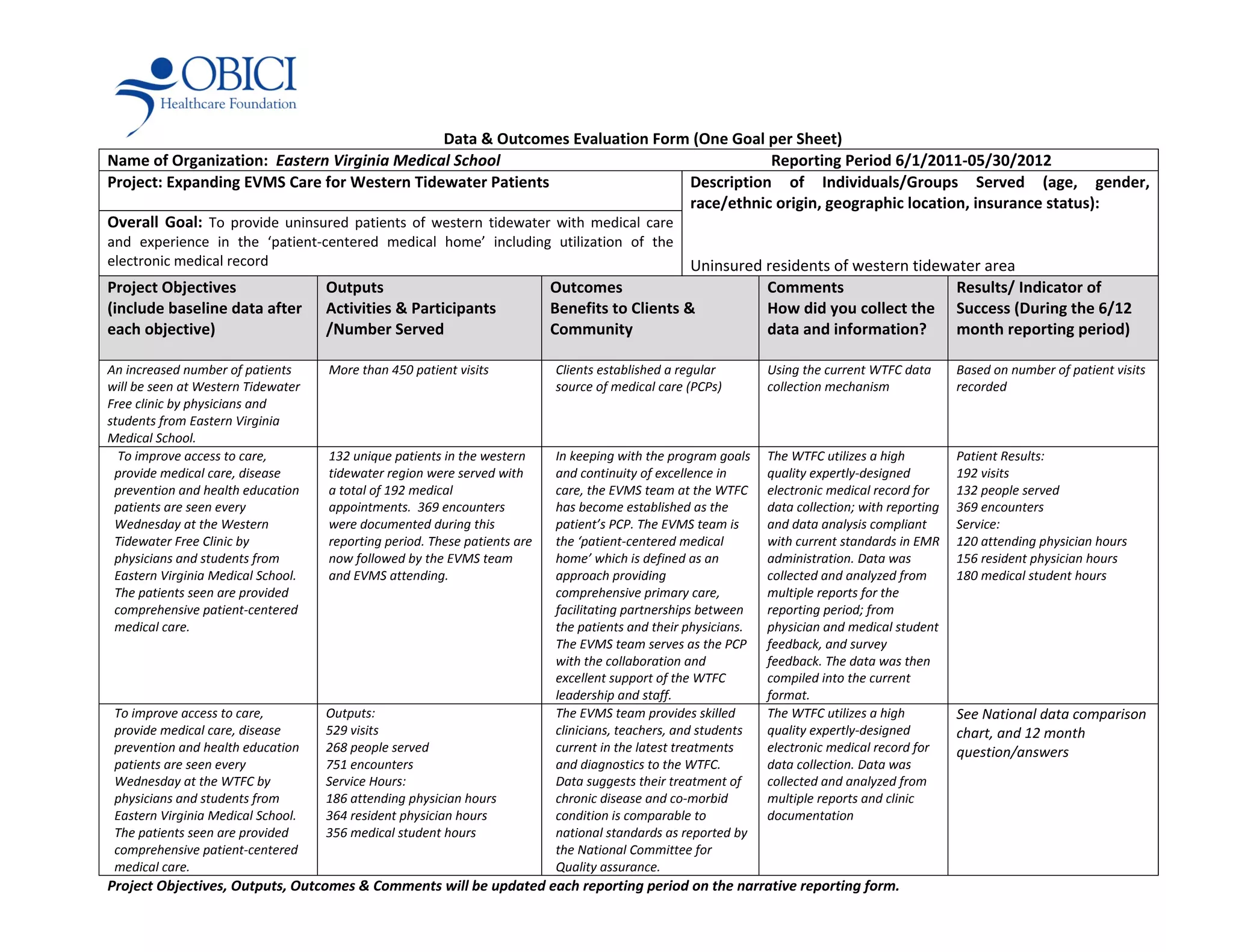
Overall Goal: To provide uninsured patients of western tidewater with medical care
and experience in the ‘patient-centered medical home’ including utilization of the
electronic medical record
Project Objectives
(include baseline data after
each objective)
Outputs
Activities & Participants
/Number Served
Outcomes
Benefits to Clients &
Community
Comments
How did you collect the
data and information?
Results/ Indicator of
Success (During the 6/12
month reporting period)
An increased number of patients
will be seen at Western Tidewater
Free clinic by physicians and
students from Eastern Virginia
Medical School.
More than 450 patient visits Clients established a regular
source of medical care (PCPs)
Using the current WTFC data
collection mechanism
Based on number of patient visits
recorded
To improve access to care,
provide medical care, disease
prevention and health education
patients are seen every
Wednesday at the Western
Tidewater Free Clinic by
physicians and students from
Eastern Virginia Medical School.
The patients seen are provided
comprehensive patient-centered
medical care.
132 unique patients in the western
tidewater region were served with
a total of 192 medical
appointments. 369 encounters
were documented during this
reporting period. These patients are
now followed by the EVMS team
and EVMS attending.
In keeping with the program goals
and continuity of excellence in
care, the EVMS team at the WTFC
has become established as the
patient’s PCP. The EVMS team is
the ‘patient-centered medical
home’ which is defined as an
approach providing
comprehensive primary care,
facilitating partnerships between
the patients and their physicians.
The EVMS team serves as the PCP
with the collaboration and
excellent support of the WTFC
leadership and staff.
The WTFC utilizes a high
quality expertly-designed
electronic medical record for
data collection; with reporting
and data analysis compliant
with current standards in EMR
administration. Data was
collected and analyzed from
multiple reports for the
reporting period; from
physician and medical student
feedback, and survey
feedback. The data was then
compiled into the current
format.
Patient Results:
192 visits
132 people served
369 encounters
Service:
120 attending physician hours
156 resident physician hours
180 medical student hours
To improve access to care,
provide medical care, disease
prevention and health education
patients are seen every
Wednesday at the WTFC by
physicians and students from
Eastern Virginia Medical School.
The patients seen are provided
comprehensive patient-centered
medical care.
Outputs:
529 visits
268 people served
751 encounters
Service Hours:
186 attending physician hours
364 resident physician hours
356 medical student hours
The EVMS team provides skilled
clinicians, teachers, and students
current in the latest treatments
and diagnostics to the WTFC.
Data suggests their treatment of
chronic disease and co-morbid
condition is comparable to
national standards as reported by
the National Committee for
Quality assurance.
The WTFC utilizes a high
quality expertly-designed
electronic medical record for
data collection. Data was
collected and analyzed from
multiple reports and clinic
documentation
See National data comparison
chart, and 12 month
question/answers
Project Objectives, Outputs, Outcomes & Comments will be updated each reporting period on the narrative reporting form.
Data & Outcomes Evaluation Form (One Goal per Sheet)
Name of Organization: Eastern Virginia Medical School
Project: Expanding EVMS Care for Western Tidewater Patients Description of Individuals/Groups Served (age, gender,
race/ethnic origin, geographic location, insurance status):
Uninsured residents of western tidewater area
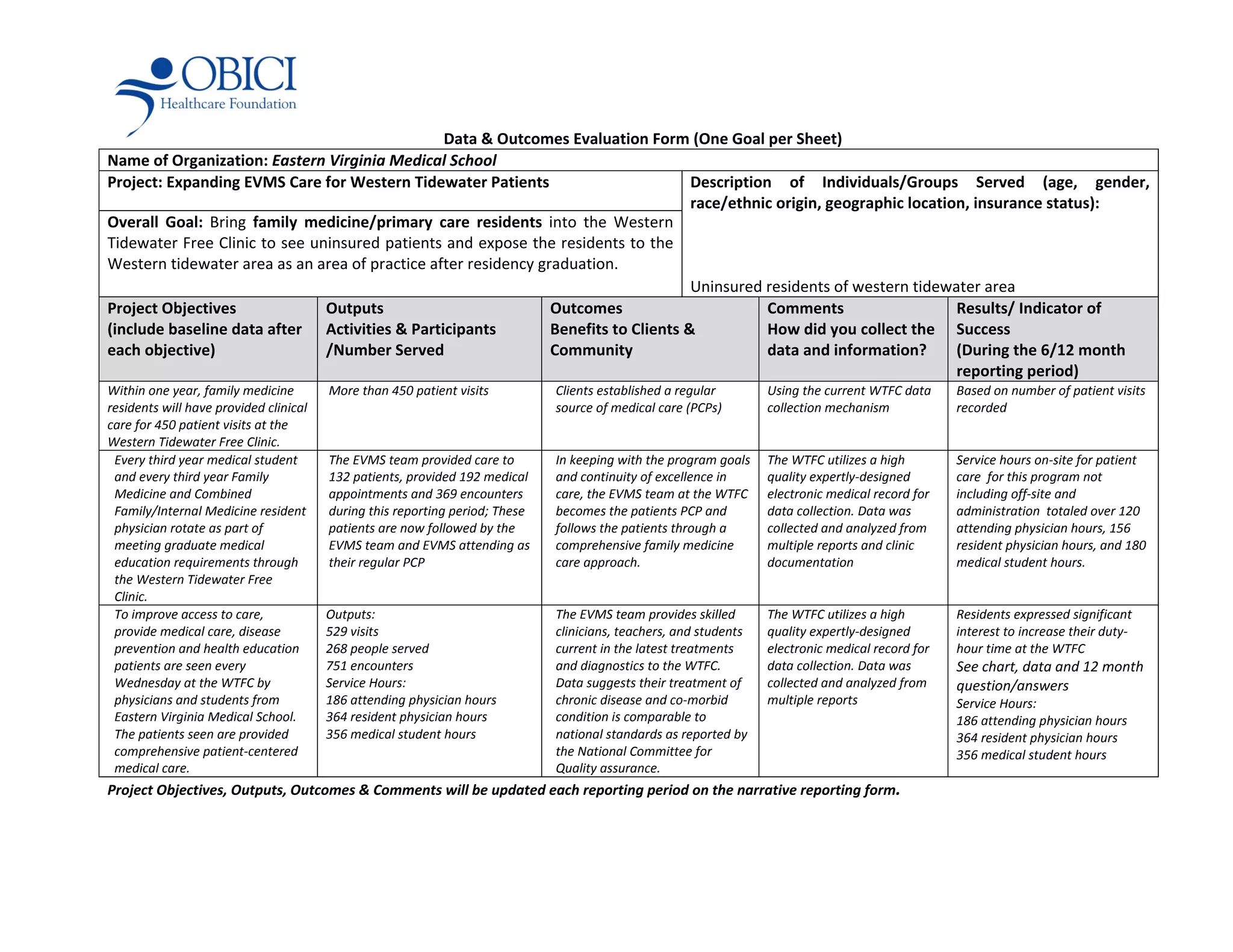
Overall Goal: Bring family medicine/primary care residents into the Western
Tidewater Free Clinic to see uninsured patients and expose the residents to the
Western tidewater area as an area of practice after residency graduation.
Project Objectives
(include baseline data after
each objective)
Outputs
Activities & Participants
/Number Served
Outcomes
Benefits to Clients &
Community
Comments
How did you collect the
data and information?
Results/ Indicator of
Success
(During the 6/12 month
reporting period)
Within one year, family medicine
residents will have provided clinical
care for 450 patient visits at the
Western Tidewater Free Clinic.
More than 450 patient visits Clients established a regular
source of medical care (PCPs)
Using the current WTFC data
collection mechanism
Based on number of patient visits
recorded
Every third year medical student
and every third year Family
Medicine and Combined
Family/Internal Medicine resident
physician rotate as part of
meeting graduate medical
education requirements through
the Western Tidewater Free
Clinic.
The EVMS team provided care to
132 patients, provided 192 medical
appointments and 369 encounters
during this reporting period; These
patients are now followed by the
EVMS team and EVMS attending as
their regular PCP
In keeping with the program goals
and continuity of excellence in
care, the EVMS team at the WTFC
becomes the patients PCP and
follows the patients through a
comprehensive family medicine
care approach.
The WTFC utilizes a high
quality expertly-designed
electronic medical record for
data collection. Data was
collected and analyzed from
multiple reports and clinic
documentation
Service hours on-site for patient
care for this program not
including off-site and
administration totaled over 120
attending physician hours, 156
resident physician hours, and 180
medical student hours.
To improve access to care,
provide medical care, disease
prevention and health education
patients are seen every
Wednesday at the WTFC by
physicians and students from
Eastern Virginia Medical School.
The patients seen are provided
comprehensive patient-centered
medical care.
Outputs:
529 visits
268 people served
751 encounters
Service Hours:
186 attending physician hours
364 resident physician hours
356 medical student hours
The EVMS team provides skilled
clinicians, teachers, and students
current in the latest treatments
and diagnostics to the WTFC.
Data suggests their treatment of
chronic disease and co-morbid
condition is comparable to
national standards as reported by
the National Committee for
Quality assurance.
The WTFC utilizes a high
quality expertly-designed
electronic medical record for
data collection. Data was
collected and analyzed from
multiple reports
Residents expressed significant
interest to increase their duty-
hour time at the WTFC
See chart, data and 12 month
question/answers
Service Hours:
186 attending physician hours
364 resident physician hours
356 medical student hours
Project Objectives, Outputs, Outcomes & Comments will be updated each reporting period on the narrative reporting form.
Data & Outcomes Evaluation Form (One Goal per Sheet)
Name of Organization: Eastern Virginia Medical School
Project: Expanding EVMS Care for Western Tidewater Patients Description of Individuals/Groups Served (age, gender, race/ethnic
origin, geographic location, insurance status):
Uninsured residents of western tidewater area
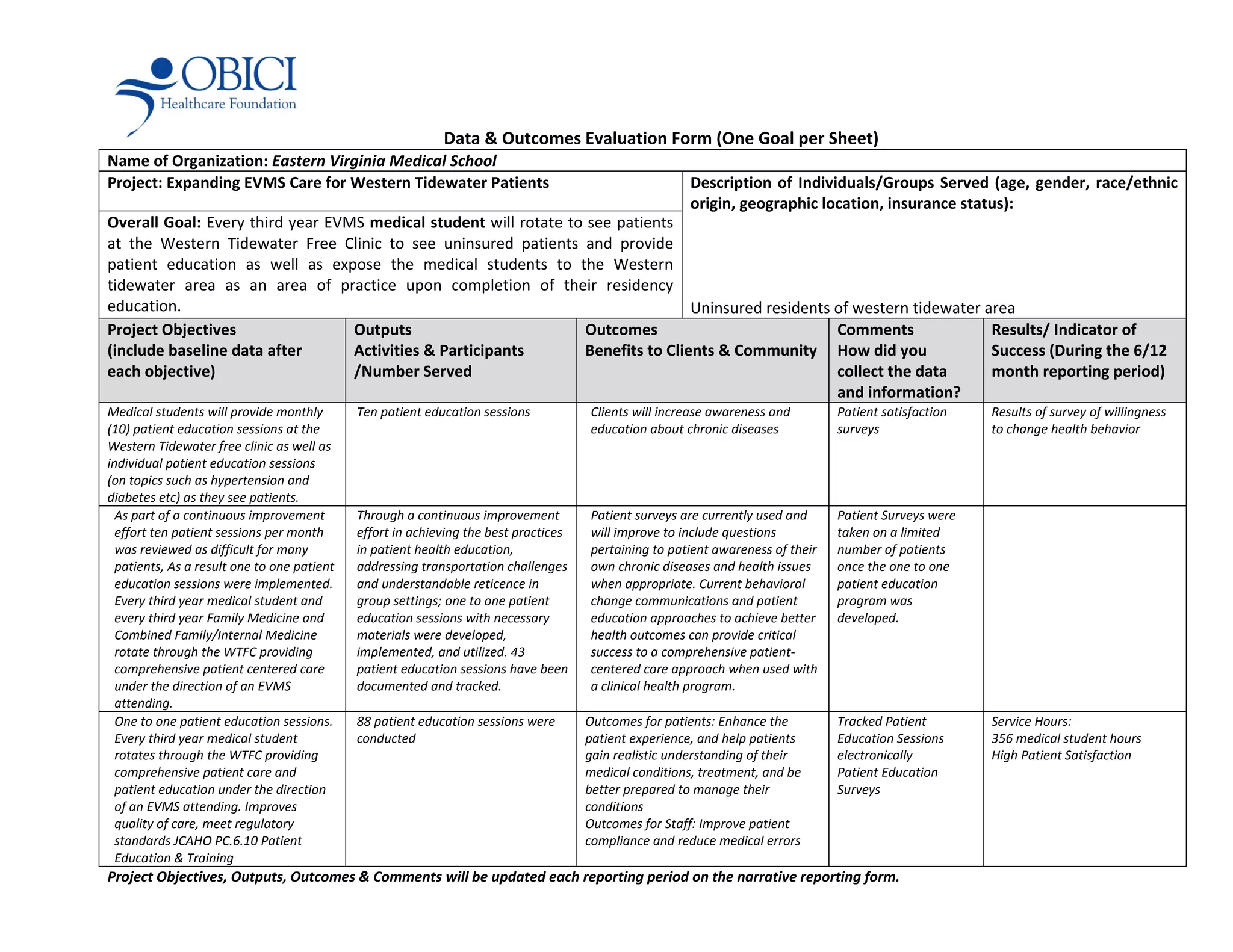
Overall Goal: Every third year EVMS medical student will rotate to see patients
at the Western Tidewater Free Clinic to see uninsured patients and provide
patient education as well as expose the medical students to the Western
tidewater area as an area of practice upon completion of their residency
education.
Project Objectives
(include baseline data after
each objective)
Outputs
Activities & Participants
/Number Served
Outcomes
Benefits to Clients & Community
Comments
How did you
collect the data
and information?
Results/ Indicator of
Success (During the 6/12
month reporting period)
Medical students will provide monthly
(10) patient education sessions at the
Western Tidewater free clinic as well as
individual patient education sessions
(on topics such as hypertension and
diabetes etc) as they see patients.
Ten patient education sessions Clients will increase awareness and
education about chronic diseases
Patient satisfaction
surveys
Results of survey of willingness
to change health behavior
As part of a continuous improvement
effort ten patient sessions per month
was reviewed as difficult for many
patients, As a result one to one patient
education sessions were implemented.
Every third year medical student and
every third year Family Medicine and
Combined Family/Internal Medicine
rotate through the WTFC providing
comprehensive patient centered care
under the direction of an EVMS
attending.
Through a continuous improvement
effort in achieving the best practices
in patient health education,
addressing transportation challenges
and understandable reticence in
group settings; one to one patient
education sessions with necessary
materials were developed,
implemented, and utilized. 43
patient education sessions have been
documented and tracked.
Patient surveys are currently used and
will improve to include questions
pertaining to patient awareness of their
own chronic diseases and health issues
when appropriate. Current behavioral
change communications and patient
education approaches to achieve better
health outcomes can provide critical
success to a comprehensive patient-
centered care approach when used with
a clinical health program.
Patient Surveys were
taken on a limited
number of patients
once the one to one
patient education
program was
developed.
One to one patient education sessions.
Every third year medical student
rotates through the WTFC providing
comprehensive patient care and
patient education under the direction
of an EVMS attending. Improves
quality of care, meet regulatory
standards JCAHO PC.6.10 Patient
Education & Training
88 patient education sessions were
conducted
Outcomes for patients: Enhance the
patient experience, and help patients
gain realistic understanding of their
medical conditions, treatment, and be
better prepared to manage their
conditions
Outcomes for Staff: Improve patient
compliance and reduce medical errors
Tracked Patient
Education Sessions
electronically
Patient Education
Surveys
Service Hours:
356 medical student hours
High Patient Satisfaction
Project Objectives, Outputs, Outcomes & Comments will be updated each reporting period on the narrative reporting form.
4 of 4

EVMS8FinalDataandOutcomesEvaluationfinal

  • 1.
    Data & OutcomesEvaluation Form (One Goal per Sheet) Name of Organization: Eastern Virginia Medical School Reporting Period 6/1/2011-05/30/2012 Project: Expanding EVMS Care for Western Tidewater Patients Description of Individuals/Groups Served (age, gender, race/ethnic origin, geographic location, insurance status): Uninsured residents of western tidewater area Overall Goal: To provide uninsured patients of western tidewater with medical care and experience in the ‘patient-centered medical home’ including utilization of the electronic medical record Project Objectives (include baseline data after each objective) Outputs Activities & Participants /Number Served Outcomes Benefits to Clients & Community Comments How did you collect the data and information? Results/ Indicator of Success (During the 6/12 month reporting period) An increased number of patients will be seen at Western Tidewater Free clinic by physicians and students from Eastern Virginia Medical School. More than 450 patient visits Clients established a regular source of medical care (PCPs) Using the current WTFC data collection mechanism Based on number of patient visits recorded To improve access to care, provide medical care, disease prevention and health education patients are seen every Wednesday at the Western Tidewater Free Clinic by physicians and students from Eastern Virginia Medical School. The patients seen are provided comprehensive patient-centered medical care. 132 unique patients in the western tidewater region were served with a total of 192 medical appointments. 369 encounters were documented during this reporting period. These patients are now followed by the EVMS team and EVMS attending. In keeping with the program goals and continuity of excellence in care, the EVMS team at the WTFC has become established as the patient’s PCP. The EVMS team is the ‘patient-centered medical home’ which is defined as an approach providing comprehensive primary care, facilitating partnerships between the patients and their physicians. The EVMS team serves as the PCP with the collaboration and excellent support of the WTFC leadership and staff. The WTFC utilizes a high quality expertly-designed electronic medical record for data collection; with reporting and data analysis compliant with current standards in EMR administration. Data was collected and analyzed from multiple reports for the reporting period; from physician and medical student feedback, and survey feedback. The data was then compiled into the current format. Patient Results: 192 visits 132 people served 369 encounters Service: 120 attending physician hours 156 resident physician hours 180 medical student hours To improve access to care, provide medical care, disease prevention and health education patients are seen every Wednesday at the WTFC by physicians and students from Eastern Virginia Medical School. The patients seen are provided comprehensive patient-centered medical care. Outputs: 529 visits 268 people served 751 encounters Service Hours: 186 attending physician hours 364 resident physician hours 356 medical student hours The EVMS team provides skilled clinicians, teachers, and students current in the latest treatments and diagnostics to the WTFC. Data suggests their treatment of chronic disease and co-morbid condition is comparable to national standards as reported by the National Committee for Quality assurance. The WTFC utilizes a high quality expertly-designed electronic medical record for data collection. Data was collected and analyzed from multiple reports and clinic documentation See National data comparison chart, and 12 month question/answers Project Objectives, Outputs, Outcomes & Comments will be updated each reporting period on the narrative reporting form.
  • 2.
    Data & OutcomesEvaluation Form (One Goal per Sheet) Name of Organization: Eastern Virginia Medical School Project: Expanding EVMS Care for Western Tidewater Patients Description of Individuals/Groups Served (age, gender, race/ethnic origin, geographic location, insurance status): Uninsured residents of western tidewater area Overall Goal: Bring family medicine/primary care residents into the Western Tidewater Free Clinic to see uninsured patients and expose the residents to the Western tidewater area as an area of practice after residency graduation. Project Objectives (include baseline data after each objective) Outputs Activities & Participants /Number Served Outcomes Benefits to Clients & Community Comments How did you collect the data and information? Results/ Indicator of Success (During the 6/12 month reporting period) Within one year, family medicine residents will have provided clinical care for 450 patient visits at the Western Tidewater Free Clinic. More than 450 patient visits Clients established a regular source of medical care (PCPs) Using the current WTFC data collection mechanism Based on number of patient visits recorded Every third year medical student and every third year Family Medicine and Combined Family/Internal Medicine resident physician rotate as part of meeting graduate medical education requirements through the Western Tidewater Free Clinic. The EVMS team provided care to 132 patients, provided 192 medical appointments and 369 encounters during this reporting period; These patients are now followed by the EVMS team and EVMS attending as their regular PCP In keeping with the program goals and continuity of excellence in care, the EVMS team at the WTFC becomes the patients PCP and follows the patients through a comprehensive family medicine care approach. The WTFC utilizes a high quality expertly-designed electronic medical record for data collection. Data was collected and analyzed from multiple reports and clinic documentation Service hours on-site for patient care for this program not including off-site and administration totaled over 120 attending physician hours, 156 resident physician hours, and 180 medical student hours. To improve access to care, provide medical care, disease prevention and health education patients are seen every Wednesday at the WTFC by physicians and students from Eastern Virginia Medical School. The patients seen are provided comprehensive patient-centered medical care. Outputs: 529 visits 268 people served 751 encounters Service Hours: 186 attending physician hours 364 resident physician hours 356 medical student hours The EVMS team provides skilled clinicians, teachers, and students current in the latest treatments and diagnostics to the WTFC. Data suggests their treatment of chronic disease and co-morbid condition is comparable to national standards as reported by the National Committee for Quality assurance. The WTFC utilizes a high quality expertly-designed electronic medical record for data collection. Data was collected and analyzed from multiple reports Residents expressed significant interest to increase their duty- hour time at the WTFC See chart, data and 12 month question/answers Service Hours: 186 attending physician hours 364 resident physician hours 356 medical student hours Project Objectives, Outputs, Outcomes & Comments will be updated each reporting period on the narrative reporting form.
  • 3.
    Data & OutcomesEvaluation Form (One Goal per Sheet) Name of Organization: Eastern Virginia Medical School Project: Expanding EVMS Care for Western Tidewater Patients Description of Individuals/Groups Served (age, gender, race/ethnic origin, geographic location, insurance status): Uninsured residents of western tidewater area Overall Goal: Every third year EVMS medical student will rotate to see patients at the Western Tidewater Free Clinic to see uninsured patients and provide patient education as well as expose the medical students to the Western tidewater area as an area of practice upon completion of their residency education. Project Objectives (include baseline data after each objective) Outputs Activities & Participants /Number Served Outcomes Benefits to Clients & Community Comments How did you collect the data and information? Results/ Indicator of Success (During the 6/12 month reporting period) Medical students will provide monthly (10) patient education sessions at the Western Tidewater free clinic as well as individual patient education sessions (on topics such as hypertension and diabetes etc) as they see patients. Ten patient education sessions Clients will increase awareness and education about chronic diseases Patient satisfaction surveys Results of survey of willingness to change health behavior As part of a continuous improvement effort ten patient sessions per month was reviewed as difficult for many patients, As a result one to one patient education sessions were implemented. Every third year medical student and every third year Family Medicine and Combined Family/Internal Medicine rotate through the WTFC providing comprehensive patient centered care under the direction of an EVMS attending. Through a continuous improvement effort in achieving the best practices in patient health education, addressing transportation challenges and understandable reticence in group settings; one to one patient education sessions with necessary materials were developed, implemented, and utilized. 43 patient education sessions have been documented and tracked. Patient surveys are currently used and will improve to include questions pertaining to patient awareness of their own chronic diseases and health issues when appropriate. Current behavioral change communications and patient education approaches to achieve better health outcomes can provide critical success to a comprehensive patient- centered care approach when used with a clinical health program. Patient Surveys were taken on a limited number of patients once the one to one patient education program was developed. One to one patient education sessions. Every third year medical student rotates through the WTFC providing comprehensive patient care and patient education under the direction of an EVMS attending. Improves quality of care, meet regulatory standards JCAHO PC.6.10 Patient Education & Training 88 patient education sessions were conducted Outcomes for patients: Enhance the patient experience, and help patients gain realistic understanding of their medical conditions, treatment, and be better prepared to manage their conditions Outcomes for Staff: Improve patient compliance and reduce medical errors Tracked Patient Education Sessions electronically Patient Education Surveys Service Hours: 356 medical student hours High Patient Satisfaction Project Objectives, Outputs, Outcomes & Comments will be updated each reporting period on the narrative reporting form.
  • 4.