In what ways does your media
product use, develop or
challenge forms and
conventions of real media
products?

Ameenah Javed
Main Objective
Our A2 coursework required us:
- Create an opening 5 minute for a TV documentary of an
issues of our choice.
- Create 2 additional ancillary task; a radio trailer and
double page spread magazine article, this was to
advertise our documentary.
TV Documentary Style

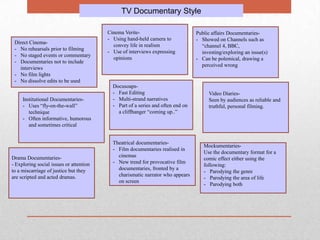
Direct Cinema- No rehearsals prior to filming
- No staged events or commentary
- Documentaries not to include
interviews
- No film lights
- No dissolve edits to be used

Institutional Documentaries- Uses “fly-on-the-wall”
technique
- Often informative, humorous
and sometimes critical

Drama Documentaries- Exploring social issues or attention
to a miscarriage of justice but they
are scripted and acted dramas.

Cinema Verite- Using hand-held camera to
convey life in realism
- Use of interviews expressing
opinions

Docusoaps- Fast Editing
- Multi-strand narratives
- Part of a series and often end on
a cliffhanger “coming up..”

Theatrical documentaries- Film documentaries realised in
cinemas
- New trend for provocative film
documentaries, fronted by a
charismatic narrator who appears
on screen

Public affairs Documentaries- Showed on Channels such as
“channel 4, BBC,
investing/exploring an issue(s)
- Can be polemical, drawing a
perceived wrong

Video DiariesSeen by audiences as reliable and
truthful, personal filming.

MockumentariesUse the documentary format for a
comic effect either using the
following:
- Parodying the genre
- Parodying the area of life
- Parodying both
Our TV Documentary Style
Looking at the different styles of documentaries; the most suitable style our documentary would fall
under the public affair category. Our documentary included a variety of different techniques, we could
say we moulded the different styles together to create one. As we included personal home footage, and
external clips for entertainment, maintaining our audiences focus.
To help create ideas when creating our own documentary we thoroughly researched into many
documentaries were I was then able to recognise the main codes and conventions. One documentary
which I liked was Morgan Spurlock’s “Supersize Me”. Where I was able to capture different types of
conventions used in order to create a successful documentary, techniques such as, voice overs, title
sequence, interviews with experts, home footage, different camera shots and so on.
Also researching into our personal issue, As we decided to take on the issue of “violent video games”
Naming our documentary “Banned Theft Auto”
We mainly targeted our research on expert gamers or gamers on youtube, problems causing an after
effect when playing a violent video game. Youtube was definitely our best friend with this.
Background footage
When looking at a variety of documentaries, such as Morgan Spurlock with “supersize
me” and a clip that we found on youtube called “gaming invasion, I found how effective
cut away shots are, as an audience this helps me engage in what issue the presentor is
trying to reach across, giving a sense of realism. We followed this convention as we
used varies of shots relevant background footage to address the subject further.
In Morgan Spurlocks documentary the type of background footage he included was the
most popular fast food restaurants in American, such as Macdonald’s, he talks about
how popular Macdonalds is with the American cultural, showing cut away shots of the
American Citizens, then switching to a global map, pin pointing the amount of
Macdonald restaurants there are.
As for our documentary, an example we did to portray the convention was the cut away
with the youtube clips. When Ciara, former psychology teacher talks about how violent
video games can affect the behaviour of a young teenager, we cut away to a clip of a
boy ranging out because his mother took away his games, with Ciara still expressing her
view over the clip.
Interviews
Documentaries and new reports we watched, all had the same codes and conventions
included in an interview, following the rule of thirds, where comfortable the interviewee
will sit in the corner right or left side, having the shot as a medium close up, and when the
interviewee talking, instead of looking directly into the camera instead addressing the
interviewer. Also seconds into the interview a professional caption would appear at the
bottom of the camera shot, informing the viewer who they are and what relation they have.
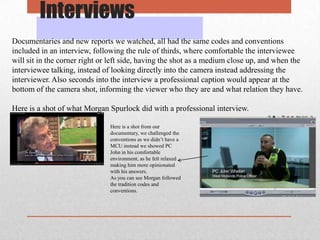
Here is a shot of what Morgan Spurlock did with a professional interview.
Here is a shot from our
documentary, we challenged the
conventions as we didn’t have a
MCU instead we showed PC
John in his comfortable
environment, as he felt relaxed
making him more opinionated
with his answers.
As you can see Morgan followed
the tradition codes and
conventions.
Voiceover
In our own research we did beside the classroom research; studying
Morgan Spurlock’s documentary, one of the documentaries we as a
group looked at was called “Video Game Invasion”, where they
included an onscreen narrator. The screen presenter is Tony Hawk
who is a professional skater and also game enthusiast.
We as a group challenged this code and convention and went against the on-screen presenter, instead we
used a voice-over in our documentary. Usually documentaries include on-screen presenters as they feel
it's more effective, but having a voice-over we felt as a group that its more engaging as an audience
focusing more on what its showing, we went against just so our documentary would be different from
others. In “Video Game Invasion the music is playing in the background as well as the voiceover talking,
as a group we acted upon this idea and included it in our documentary as it contrasts nicely along with the
documentary. We challenged many documentaries as their voiceover began as soon as the documentary
began as “video game invasion” did so. Whereas with our documentary we decided to first capture our
audience, starting with background footage, short clips making it a little crazy grabbing their attention and
then showing our title sequence, then beginning the voice-over building suspense engaging the audience
in.
Fact and figures
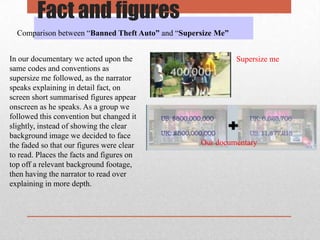
Comparison between “Banned Theft Auto” and “Supersize Me”
In our documentary we acted upon the
same codes and conventions as
supersize me followed, as the narrator
speaks explaining in detail fact, on
screen short summarised figures appear
onscreen as he speaks. As a group we
followed this convention but changed it
slightly, instead of showing the clear
background image we decided to face
the faded so that our figures were clear
to read. Places the facts and figures on
top off a relevant background footage,
then having the narrator to read over
explaining in more depth.

Supersize me

Our documentary
Radio Trailer
How we followed the Codes and conventions- Included a voice over
We had a voiceover to speak near the end of our radio trailer, briefly telling the audience the time and
place of the program.
- Music
The music we included in our radio trailer was the same as what we had in our documentary, as it suited
our choice of topic also the music was very attention grabbing, making the listen stay tuned.
- Time/ Date
It was important for our radio trailer to include the date and time when our documentary is to be aired.
So the viewer knows when they will be able to view the documentary and find out more about our issue.
- Appropriate time length
Our radio trailer had to be short and snappy! So personally we found this quite tricky as we included
only the exciting snippets from our documentary and included it, we achieved this as our radio trailer
was around 30 seconds, following the typical codes and conventions. As we were advertising, the radio
trailer had to sound exciting and keep the audience's attention for 30 seconds
Challenging the Codes and Conventions:
Abstract Introduction
Our opening radio trailer is completely different to any other one, we completely challenged the typical
codes and conventions of the beginning of the trailer, we wanted it to straight away alert the audience,
also making it stand out from any other radio trailers.
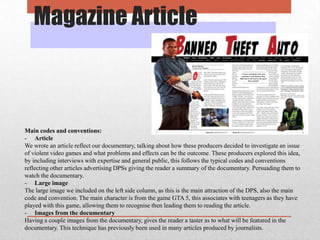
Magazine Article

Main codes and conventions:
- Article
We wrote an article reflect our documentary, talking about how these producers decided to investigate an issue
of violent video games and what problems and effects can be the outcome. These producers explored this idea,
by including interviews with expertise and general public, this follows the typical codes and conventions
reflecting other articles advertising DPSs giving the reader a summary of the documentary. Persuading them to
watch the documentary.
- Large image
The large image we included on the left side column, as this is the main attraction of the DPS, also the main
code and convention. The main character is from the game GTA 5, this associates with teenagers as they have
played with this game, allowing them to recognise then leading them to reading the article.
- Images from the documentary
Having a couple images from the documentary, gives the reader a taster as to what will be featured in the
documentary. This technique has previously been used in many articles produced by journalists.

Evaluation question 5

  • 1.
    In what waysdoes your media product use, develop or challenge forms and conventions of real media products? Ameenah Javed
  • 2.
    Main Objective Our A2coursework required us: - Create an opening 5 minute for a TV documentary of an issues of our choice. - Create 2 additional ancillary task; a radio trailer and double page spread magazine article, this was to advertise our documentary.
  • 3.
    TV Documentary Style DirectCinema- No rehearsals prior to filming - No staged events or commentary - Documentaries not to include interviews - No film lights - No dissolve edits to be used Institutional Documentaries- Uses “fly-on-the-wall” technique - Often informative, humorous and sometimes critical Drama Documentaries- Exploring social issues or attention to a miscarriage of justice but they are scripted and acted dramas. Cinema Verite- Using hand-held camera to convey life in realism - Use of interviews expressing opinions Docusoaps- Fast Editing - Multi-strand narratives - Part of a series and often end on a cliffhanger “coming up..” Theatrical documentaries- Film documentaries realised in cinemas - New trend for provocative film documentaries, fronted by a charismatic narrator who appears on screen Public affairs Documentaries- Showed on Channels such as “channel 4, BBC, investing/exploring an issue(s) - Can be polemical, drawing a perceived wrong Video DiariesSeen by audiences as reliable and truthful, personal filming. MockumentariesUse the documentary format for a comic effect either using the following: - Parodying the genre - Parodying the area of life - Parodying both
  • 4.
    Our TV DocumentaryStyle Looking at the different styles of documentaries; the most suitable style our documentary would fall under the public affair category. Our documentary included a variety of different techniques, we could say we moulded the different styles together to create one. As we included personal home footage, and external clips for entertainment, maintaining our audiences focus. To help create ideas when creating our own documentary we thoroughly researched into many documentaries were I was then able to recognise the main codes and conventions. One documentary which I liked was Morgan Spurlock’s “Supersize Me”. Where I was able to capture different types of conventions used in order to create a successful documentary, techniques such as, voice overs, title sequence, interviews with experts, home footage, different camera shots and so on. Also researching into our personal issue, As we decided to take on the issue of “violent video games” Naming our documentary “Banned Theft Auto” We mainly targeted our research on expert gamers or gamers on youtube, problems causing an after effect when playing a violent video game. Youtube was definitely our best friend with this.
  • 5.
    Background footage When lookingat a variety of documentaries, such as Morgan Spurlock with “supersize me” and a clip that we found on youtube called “gaming invasion, I found how effective cut away shots are, as an audience this helps me engage in what issue the presentor is trying to reach across, giving a sense of realism. We followed this convention as we used varies of shots relevant background footage to address the subject further. In Morgan Spurlocks documentary the type of background footage he included was the most popular fast food restaurants in American, such as Macdonald’s, he talks about how popular Macdonalds is with the American cultural, showing cut away shots of the American Citizens, then switching to a global map, pin pointing the amount of Macdonald restaurants there are. As for our documentary, an example we did to portray the convention was the cut away with the youtube clips. When Ciara, former psychology teacher talks about how violent video games can affect the behaviour of a young teenager, we cut away to a clip of a boy ranging out because his mother took away his games, with Ciara still expressing her view over the clip.
  • 6.
    Interviews Documentaries and newreports we watched, all had the same codes and conventions included in an interview, following the rule of thirds, where comfortable the interviewee will sit in the corner right or left side, having the shot as a medium close up, and when the interviewee talking, instead of looking directly into the camera instead addressing the interviewer. Also seconds into the interview a professional caption would appear at the bottom of the camera shot, informing the viewer who they are and what relation they have. Here is a shot of what Morgan Spurlock did with a professional interview. Here is a shot from our documentary, we challenged the conventions as we didn’t have a MCU instead we showed PC John in his comfortable environment, as he felt relaxed making him more opinionated with his answers. As you can see Morgan followed the tradition codes and conventions.
  • 7.
    Voiceover In our ownresearch we did beside the classroom research; studying Morgan Spurlock’s documentary, one of the documentaries we as a group looked at was called “Video Game Invasion”, where they included an onscreen narrator. The screen presenter is Tony Hawk who is a professional skater and also game enthusiast. We as a group challenged this code and convention and went against the on-screen presenter, instead we used a voice-over in our documentary. Usually documentaries include on-screen presenters as they feel it's more effective, but having a voice-over we felt as a group that its more engaging as an audience focusing more on what its showing, we went against just so our documentary would be different from others. In “Video Game Invasion the music is playing in the background as well as the voiceover talking, as a group we acted upon this idea and included it in our documentary as it contrasts nicely along with the documentary. We challenged many documentaries as their voiceover began as soon as the documentary began as “video game invasion” did so. Whereas with our documentary we decided to first capture our audience, starting with background footage, short clips making it a little crazy grabbing their attention and then showing our title sequence, then beginning the voice-over building suspense engaging the audience in.
  • 8.
    Fact and figures Comparisonbetween “Banned Theft Auto” and “Supersize Me” In our documentary we acted upon the same codes and conventions as supersize me followed, as the narrator speaks explaining in detail fact, on screen short summarised figures appear onscreen as he speaks. As a group we followed this convention but changed it slightly, instead of showing the clear background image we decided to face the faded so that our figures were clear to read. Places the facts and figures on top off a relevant background footage, then having the narrator to read over explaining in more depth. Supersize me Our documentary
  • 9.
    Radio Trailer How wefollowed the Codes and conventions- Included a voice over We had a voiceover to speak near the end of our radio trailer, briefly telling the audience the time and place of the program. - Music The music we included in our radio trailer was the same as what we had in our documentary, as it suited our choice of topic also the music was very attention grabbing, making the listen stay tuned. - Time/ Date It was important for our radio trailer to include the date and time when our documentary is to be aired. So the viewer knows when they will be able to view the documentary and find out more about our issue. - Appropriate time length Our radio trailer had to be short and snappy! So personally we found this quite tricky as we included only the exciting snippets from our documentary and included it, we achieved this as our radio trailer was around 30 seconds, following the typical codes and conventions. As we were advertising, the radio trailer had to sound exciting and keep the audience's attention for 30 seconds Challenging the Codes and Conventions: Abstract Introduction Our opening radio trailer is completely different to any other one, we completely challenged the typical codes and conventions of the beginning of the trailer, we wanted it to straight away alert the audience, also making it stand out from any other radio trailers.
  • 10.
    Magazine Article Main codesand conventions: - Article We wrote an article reflect our documentary, talking about how these producers decided to investigate an issue of violent video games and what problems and effects can be the outcome. These producers explored this idea, by including interviews with expertise and general public, this follows the typical codes and conventions reflecting other articles advertising DPSs giving the reader a summary of the documentary. Persuading them to watch the documentary. - Large image The large image we included on the left side column, as this is the main attraction of the DPS, also the main code and convention. The main character is from the game GTA 5, this associates with teenagers as they have played with this game, allowing them to recognise then leading them to reading the article. - Images from the documentary Having a couple images from the documentary, gives the reader a taster as to what will be featured in the documentary. This technique has previously been used in many articles produced by journalists.