IN WHAT WAYS DO YOUR PRODUCTS USE,
DEVELOP OR CHALLENGE FORMS AND
CONVENTIONS OF REAL MEDIA PRODUCTS?
Question 1
Techniques and Styles of Music Videos
One of the main techniques in music videos refers to the way the video is edited – cutting accordingly to the beat
allows the audience to engage with the video, directing their attention to the most important parts of the
video. When planning my video, I planned the length of each shot accordingly to the song, so each transition is
made on the change of beat. This meant slower and faster paced scenes, depending on where the song was. In my
rough cut, many of the scenes were longer, which made the video long winded, so in the final cut, I added more
cuts to the beat, making the scenes shorter.
Even though not many Latin R&B
music videos include animation, I
thought it would be fitting to my
video if I added animation in the
studio shots, in order to make the
video more interesting and fast
paced. Examples of similar effects
include 'This is what you came for'
by Rihanna and Calvin Harris, 'Party
Monster' by The Weeknd, and 'I
can't Feel My Face' The Weeknd
When it comes to R&B music videos, I noticed a
pattern in studio videos, where performers
dance and sing in front of colour background.
Examples of this include Chris Brown -
Questions and Drake – Hotline Bling. This is
why in my video, the studio scenes are a big
part, which I achieved through studio lights ng
gel filters.
While R&B videos are usually
narrative driven, like Nelly -
Dilemma and ARASH – Pure Love,
latin videos focus more on
performance like Lariss – Dale
Papi, J Balvin - Safari and Shakira -
Chantaje. As my song was product
of both genres, I decided to
combine both narrative and
performance styles in my video, in
order to both portray a soryline
and establish a connection with
the audience.
Theories on Music Videos
Goodwin's theory on Music Videos can be applied to my video, as I made sure
to split the video in different parts of the story, according to the song, made
sure my artist stood out as a star and conveyed a story in the video (also known
as Goodwin's Thought Through Beat'). The connection between the song and
the visuals was illustrative, as the visuals reflected on what the performer was
singing about. In the technical aspect of Goodwin's theory, my video fit its
genre through colour scheme and pacing, as it had a pink hue to it and
significantly short shots. In the star image aspect, however, my video lacked the
conventions expected, as my artist wasn't portraying a prominent 'star image'.
'Oh but my heart is in
Havana'
'He didn't walk up with
that How ya doin' '
My video both conveys and challenges Laura Mulvey's Male Gaze, as it portrays
women in many different ways. A way in which it develops The Male Gaze is that
the video starts with a pan up on the girls which isn't necessarily of their bodies, but
simulates the usual introduction of women as objects in the media. The video also
shows the main character wearing revealing clothes and portrays a message that
women should wait for the man to text first, as the character starts texting the boy,
but then deletes it. However, the video also refutes The Male Gaze theory, as the
main character is a confident woman and she is a 'Hero', according to Propp's
characters, while the boy is 'The Prize' this challenges pre-established gender
stereotypes.
The video reinforces Barthes' five codes theory, as it uses the enigma
code to make the video more memorable for the audience and create
a sense of mystery to leave the audience to interpret the video in their
own way. The enigma code is evident at the end of the video, where
suddenly the guy is seen with the girl's friend.
I used Dyer's Star Theory to create my artist, according to my target
audience, portraying my artist as a fashionable figure with similar interests
and sense of humor to them (portrayed in the 'This is Caleo' Video which was
inspired by Kehlani's Website). In addition, I also created a synergy across my
products, by relating everything to fire – Caleo means flame in latin, and so
does Flamma (which is the name of the album and the tour), the video has
fire in it, the digipak has only red in the pictures and orange and yellow as
additional colours, and the website is in red, while the background on the
pages is black screen with flames coming from both sides.
Genre Conventions - VideoColour Schemes and Lighting:
In my research I founf that most R&B and latin music videos have a
very specific hue to them, as well as having both low key and high
key lighting throughout the video, keeping the same colour tone. For
example, Rihanna's video for 'Work' is split into two separate music
videos for the same song, which are mostly distinctive through their
colour scheme and lighting – the first one has low-key lighting and a
yellow tone, while the second one has high key lighting and a pink
hue. Other examples of similar colour grading technique are J Balvin
– Tranquila and Sean Paul, David Guetta and Becky G – Mad Love,
Following these conventions, I added a pink hue and high contrast to
my video, as well as red spotlights on the dancing couple, which
symbolised love, affection and fitted the fact that the artist was a
female.
Dancing
While not many RnB Music videos by female artists have dancing in
them, this is not the case for Latin videos. Videos such as J Balvin –
Safari and Luis Fonsi and Demi Lovato – Enchame La Culpa have
some dance elements (having the women in the video dancing), but
in videos by female Latin R&B artists, dance is a big feature. Jennifer
Lopez is known to dance in her videos, such as Back it Up and Booty.
As dance is a huge element in my video, it is safe to say that it
reflects on the conventions of this genre. The duet with the boy fits
the narrative and expands on it.
Locations:
RnB music videos usually show the artist in everyday locations, in
order to show them as an ordinary person (Alicia Keys – Fallin').
Latin videos, however usually feature holiday locations and
parties, which is why I combined both in my video. It includes
shots of the main character (Bella) and the boy (Aaron) at a party
on a mysterious location, as well as Bella with her friends in a
shopping centre. This reflects on the 'casual' feel of RnB videos,
where the character has a conversation with the people
surrounding them ad explains the narrative, making the video
more personal. An example for this is Craig David's '7 Days'
Makeup and Costumes:
When it came to the shopping Centre scenes, I let my cast where something they
would wear when shopping, as the setting was casual. However, their costumes
clashed with mine, as we went for different looks, which clashed with the
conventions of RnB music videos. Another way in which the costumes in the
video challenged the conventions of Latin RnB music videos is that the main
character's costume, hair and makeup were fairly simple, rather than the usual
made up look most stars go for.
Genre Conventions - Website
In my Website research, I noticed that every artist website
has six main tabs – Home, Shop, News,, Tour, Music and
Gallery, so I added them to my website as well, in order of
importance, along with the social media tab on top and a
shopping cart, so the audience can make direct purchases
from the website. In all of the websites I looked at, I noticed a specific colour
scheme running throughout – in Kehlani's website, it was in
pink, Rihanna was in yellow and The Weeknd was in black. As I
had already related my artist to red and pink tones, I decided to
enhance the theme and base the website on a black and red
colour scheme, with the tour page changing from yellow to red
(to simulate flames) as the audience scrolls through.
Every artist website had a music page, where the audience
would be able to download and listen to their music. In
order to do the same, I used the WIX Music tool and added
the edit of the song I made when I was planning the music
video.
Following the merchandise conventions for every
artist website, I added different colours and sizes to
each item I put in the shop
Genre Conventions - Website
Kehlani's website had an introductory video of her as an artist, which is
conventional for RnB artists, as it lets the audience know them on a more
personal level. This gave me the idea to do something similar, where I
portray my artist as a quirky, funny, ordinary girl.
It is typical for artist websites to post Behind The Scenes videos and Sneak
Peeks of the music videos coming out in order to keep the audience
checking the website and building up the tension
To promote the artist and the video coming out, I created a dance
competition for the fans for tour tickets, along with a lyric
video/preview of the song when the song was released.
Similar to the Weeknd and Rihanna's websites announcing their clothing lines, I decided to
create an announcement about a project with a healthy lifestyle magazine – SHAPE Magazi
During my research, I noticed that every website had a bio page or a
segment about the artist, so I added a bio segment on the home page, which
quickly summarised who she is and how she got to where she is, along with a
picture of her performing.
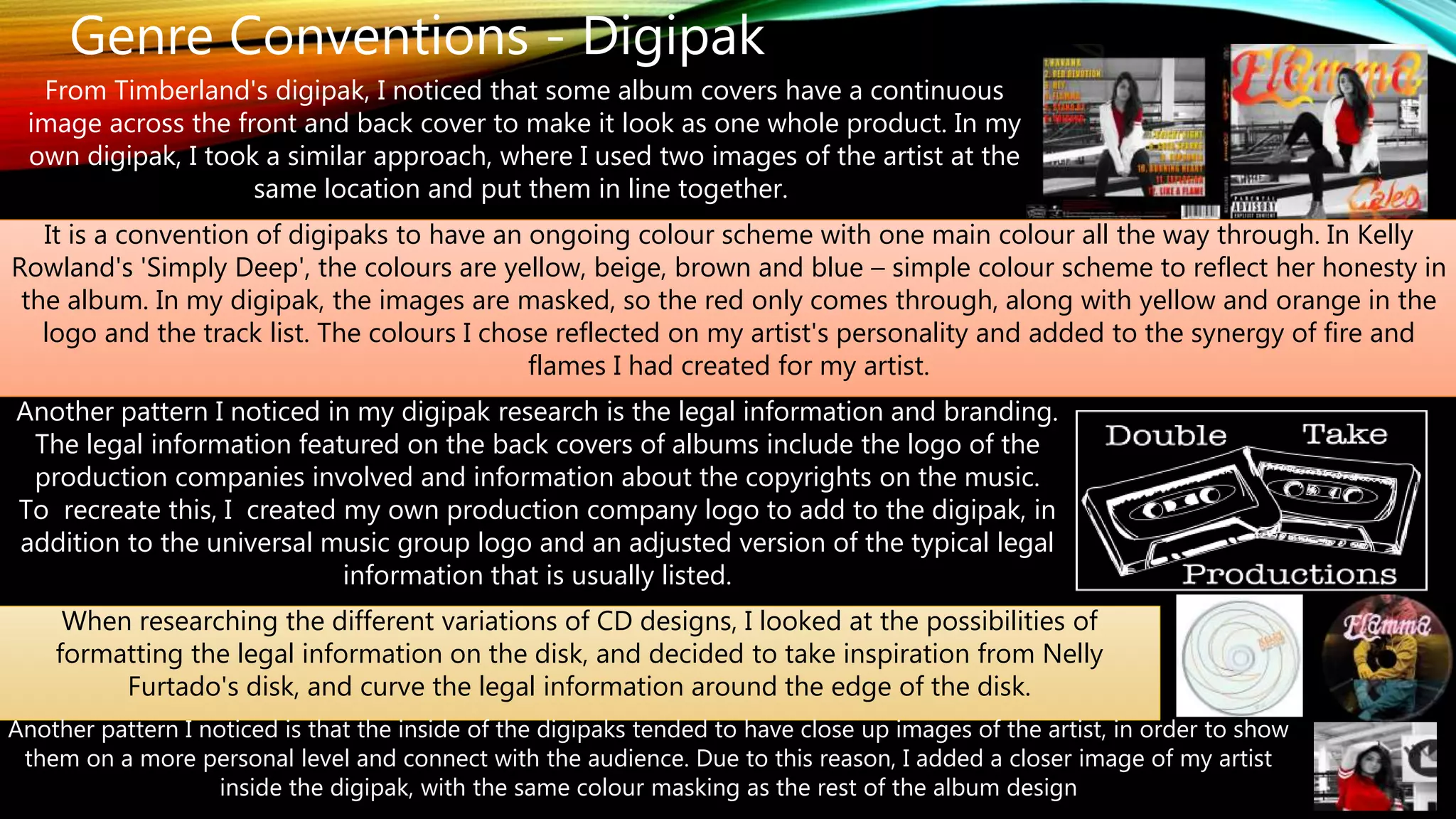
Genre Conventions - Digipak
From Timberland's digipak, I noticed that some album covers have a continuous
image across the front and back cover to make it look as one whole product. In my
own digipak, I took a similar approach, where I used two images of the artist at the
same location and put them in line together.
It is a convention of digipaks to have an ongoing colour scheme with one main colour all the way through. In Kelly
Rowland's 'Simply Deep', the colours are yellow, beige, brown and blue – simple colour scheme to reflect her honesty in
the album. In my digipak, the images are masked, so the red only comes through, along with yellow and orange in the
logo and the track list. The colours I chose reflected on my artist's personality and added to the synergy of fire and
flames I had created for my artist.
Another pattern I noticed in my digipak research is the legal information and branding.
The legal information featured on the back covers of albums include the logo of the
production companies involved and information about the copyrights on the music.
To recreate this, I created my own production company logo to add to the digipak, in
addition to the universal music group logo and an adjusted version of the typical legal
information that is usually listed.
When researching the different variations of CD designs, I looked at the possibilities of
formatting the legal information on the disk, and decided to take inspiration from Nelly
Furtado's disk, and curve the legal information around the edge of the disk.
Another pattern I noticed is that the inside of the digipaks tended to have close up images of the artist, in order to show
them on a more personal level and connect with the audience. Due to this reason, I added a closer image of my artist
inside the digipak, with the same colour masking as the rest of the album design

Evaluation Question 1

  • 1.
    IN WHAT WAYSDO YOUR PRODUCTS USE, DEVELOP OR CHALLENGE FORMS AND CONVENTIONS OF REAL MEDIA PRODUCTS? Question 1
  • 2.
    Techniques and Stylesof Music Videos One of the main techniques in music videos refers to the way the video is edited – cutting accordingly to the beat allows the audience to engage with the video, directing their attention to the most important parts of the video. When planning my video, I planned the length of each shot accordingly to the song, so each transition is made on the change of beat. This meant slower and faster paced scenes, depending on where the song was. In my rough cut, many of the scenes were longer, which made the video long winded, so in the final cut, I added more cuts to the beat, making the scenes shorter. Even though not many Latin R&B music videos include animation, I thought it would be fitting to my video if I added animation in the studio shots, in order to make the video more interesting and fast paced. Examples of similar effects include 'This is what you came for' by Rihanna and Calvin Harris, 'Party Monster' by The Weeknd, and 'I can't Feel My Face' The Weeknd When it comes to R&B music videos, I noticed a pattern in studio videos, where performers dance and sing in front of colour background. Examples of this include Chris Brown - Questions and Drake – Hotline Bling. This is why in my video, the studio scenes are a big part, which I achieved through studio lights ng gel filters. While R&B videos are usually narrative driven, like Nelly - Dilemma and ARASH – Pure Love, latin videos focus more on performance like Lariss – Dale Papi, J Balvin - Safari and Shakira - Chantaje. As my song was product of both genres, I decided to combine both narrative and performance styles in my video, in order to both portray a soryline and establish a connection with the audience.
  • 3.
    Theories on MusicVideos Goodwin's theory on Music Videos can be applied to my video, as I made sure to split the video in different parts of the story, according to the song, made sure my artist stood out as a star and conveyed a story in the video (also known as Goodwin's Thought Through Beat'). The connection between the song and the visuals was illustrative, as the visuals reflected on what the performer was singing about. In the technical aspect of Goodwin's theory, my video fit its genre through colour scheme and pacing, as it had a pink hue to it and significantly short shots. In the star image aspect, however, my video lacked the conventions expected, as my artist wasn't portraying a prominent 'star image'. 'Oh but my heart is in Havana' 'He didn't walk up with that How ya doin' ' My video both conveys and challenges Laura Mulvey's Male Gaze, as it portrays women in many different ways. A way in which it develops The Male Gaze is that the video starts with a pan up on the girls which isn't necessarily of their bodies, but simulates the usual introduction of women as objects in the media. The video also shows the main character wearing revealing clothes and portrays a message that women should wait for the man to text first, as the character starts texting the boy, but then deletes it. However, the video also refutes The Male Gaze theory, as the main character is a confident woman and she is a 'Hero', according to Propp's characters, while the boy is 'The Prize' this challenges pre-established gender stereotypes. The video reinforces Barthes' five codes theory, as it uses the enigma code to make the video more memorable for the audience and create a sense of mystery to leave the audience to interpret the video in their own way. The enigma code is evident at the end of the video, where suddenly the guy is seen with the girl's friend. I used Dyer's Star Theory to create my artist, according to my target audience, portraying my artist as a fashionable figure with similar interests and sense of humor to them (portrayed in the 'This is Caleo' Video which was inspired by Kehlani's Website). In addition, I also created a synergy across my products, by relating everything to fire – Caleo means flame in latin, and so does Flamma (which is the name of the album and the tour), the video has fire in it, the digipak has only red in the pictures and orange and yellow as additional colours, and the website is in red, while the background on the pages is black screen with flames coming from both sides.
  • 4.
    Genre Conventions -VideoColour Schemes and Lighting: In my research I founf that most R&B and latin music videos have a very specific hue to them, as well as having both low key and high key lighting throughout the video, keeping the same colour tone. For example, Rihanna's video for 'Work' is split into two separate music videos for the same song, which are mostly distinctive through their colour scheme and lighting – the first one has low-key lighting and a yellow tone, while the second one has high key lighting and a pink hue. Other examples of similar colour grading technique are J Balvin – Tranquila and Sean Paul, David Guetta and Becky G – Mad Love, Following these conventions, I added a pink hue and high contrast to my video, as well as red spotlights on the dancing couple, which symbolised love, affection and fitted the fact that the artist was a female. Dancing While not many RnB Music videos by female artists have dancing in them, this is not the case for Latin videos. Videos such as J Balvin – Safari and Luis Fonsi and Demi Lovato – Enchame La Culpa have some dance elements (having the women in the video dancing), but in videos by female Latin R&B artists, dance is a big feature. Jennifer Lopez is known to dance in her videos, such as Back it Up and Booty. As dance is a huge element in my video, it is safe to say that it reflects on the conventions of this genre. The duet with the boy fits the narrative and expands on it. Locations: RnB music videos usually show the artist in everyday locations, in order to show them as an ordinary person (Alicia Keys – Fallin'). Latin videos, however usually feature holiday locations and parties, which is why I combined both in my video. It includes shots of the main character (Bella) and the boy (Aaron) at a party on a mysterious location, as well as Bella with her friends in a shopping centre. This reflects on the 'casual' feel of RnB videos, where the character has a conversation with the people surrounding them ad explains the narrative, making the video more personal. An example for this is Craig David's '7 Days' Makeup and Costumes: When it came to the shopping Centre scenes, I let my cast where something they would wear when shopping, as the setting was casual. However, their costumes clashed with mine, as we went for different looks, which clashed with the conventions of RnB music videos. Another way in which the costumes in the video challenged the conventions of Latin RnB music videos is that the main character's costume, hair and makeup were fairly simple, rather than the usual made up look most stars go for.
  • 5.
    Genre Conventions -Website In my Website research, I noticed that every artist website has six main tabs – Home, Shop, News,, Tour, Music and Gallery, so I added them to my website as well, in order of importance, along with the social media tab on top and a shopping cart, so the audience can make direct purchases from the website. In all of the websites I looked at, I noticed a specific colour scheme running throughout – in Kehlani's website, it was in pink, Rihanna was in yellow and The Weeknd was in black. As I had already related my artist to red and pink tones, I decided to enhance the theme and base the website on a black and red colour scheme, with the tour page changing from yellow to red (to simulate flames) as the audience scrolls through. Every artist website had a music page, where the audience would be able to download and listen to their music. In order to do the same, I used the WIX Music tool and added the edit of the song I made when I was planning the music video. Following the merchandise conventions for every artist website, I added different colours and sizes to each item I put in the shop
  • 6.
    Genre Conventions -Website Kehlani's website had an introductory video of her as an artist, which is conventional for RnB artists, as it lets the audience know them on a more personal level. This gave me the idea to do something similar, where I portray my artist as a quirky, funny, ordinary girl. It is typical for artist websites to post Behind The Scenes videos and Sneak Peeks of the music videos coming out in order to keep the audience checking the website and building up the tension To promote the artist and the video coming out, I created a dance competition for the fans for tour tickets, along with a lyric video/preview of the song when the song was released. Similar to the Weeknd and Rihanna's websites announcing their clothing lines, I decided to create an announcement about a project with a healthy lifestyle magazine – SHAPE Magazi During my research, I noticed that every website had a bio page or a segment about the artist, so I added a bio segment on the home page, which quickly summarised who she is and how she got to where she is, along with a picture of her performing.
  • 7.
    Genre Conventions -Digipak From Timberland's digipak, I noticed that some album covers have a continuous image across the front and back cover to make it look as one whole product. In my own digipak, I took a similar approach, where I used two images of the artist at the same location and put them in line together. It is a convention of digipaks to have an ongoing colour scheme with one main colour all the way through. In Kelly Rowland's 'Simply Deep', the colours are yellow, beige, brown and blue – simple colour scheme to reflect her honesty in the album. In my digipak, the images are masked, so the red only comes through, along with yellow and orange in the logo and the track list. The colours I chose reflected on my artist's personality and added to the synergy of fire and flames I had created for my artist. Another pattern I noticed in my digipak research is the legal information and branding. The legal information featured on the back covers of albums include the logo of the production companies involved and information about the copyrights on the music. To recreate this, I created my own production company logo to add to the digipak, in addition to the universal music group logo and an adjusted version of the typical legal information that is usually listed. When researching the different variations of CD designs, I looked at the possibilities of formatting the legal information on the disk, and decided to take inspiration from Nelly Furtado's disk, and curve the legal information around the edge of the disk. Another pattern I noticed is that the inside of the digipaks tended to have close up images of the artist, in order to show them on a more personal level and connect with the audience. Due to this reason, I added a closer image of my artist inside the digipak, with the same colour masking as the rest of the album design