Evaluation 1
Jay Lambert
Horror Genre
According to the stereotypical conventions, horror films usually include:
- An isolated location and enclosed mise-en-scene (The Blair Witch Project set in a
forest)
- Body Horror (Saw is a prime example, focusing around special effect gore)
- Eerie music (The Exorcist eerie piano music 'Tubular bells')
- Low-key lighting
- Pathetic fallacy (rain, lighting, cloudy etc.)
- Close-ups
- Collision cutting
Location
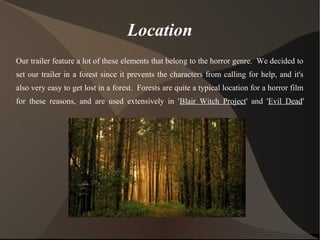
Our trailer feature a lot of these elements that belong to the horror genre. We decided to
set our trailer in a forest since it prevents the characters from calling for help, and it's
also very easy to get lost in a forest. Forests are quite a typical location for a horror film
for these reasons, and are used extensively in 'Blair Witch Project' and 'Evil Dead'
Characters
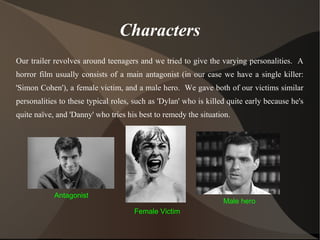
Our trailer revolves around teenagers and we tried to give the varying personalities. A
horror film usually consists of a main antagonist (in our case we have a single killer:
'Simon Cohen'), a female victim, and a male hero. We gave both of our victims similar
personalities to these typical roles, such as 'Dylan' who is killed quite early because he's
quite naïve, and 'Danny' who tries his best to remedy the situation.
Antagonist
Female Victim
Male hero
Cinematography
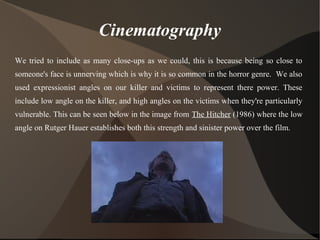
We tried to include as many close-ups as we could, this is because being so close to
someone's face is unnerving which is why it is so common in the horror genre. We also
used expressionist angles on our killer and victims to represent there power. These
include low angle on the killer, and high angles on the victims when they're particularly
vulnerable. This can be seen below in the image from The Hitcher (1986) where the low
angle on Rutger Hauer establishes both this strength and sinister power over the film.
Sound
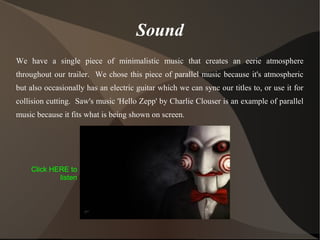
We have a single piece of minimalistic music that creates an eerie atmosphere
throughout our trailer. We chose this piece of parallel music because it's atmospheric
but also occasionally has an electric guitar which we can sync our titles to, or use it for
collision cutting. Saw's music 'Hello Zepp' by Charlie Clouser is an example of parallel
music because it fits what is being shown on screen.
Click HERE to
listen
Editing
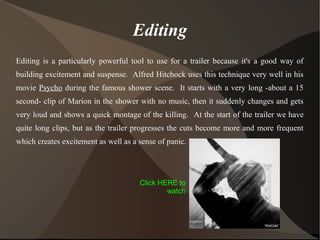
Editing is a particularly powerful tool to use for a trailer because it's a good way of
building excitement and suspense. Alfred Hitchock uses this technique very well in his
movie Psycho during the famous shower scene. It starts with a very long -about a 15
second- clip of Marion in the shower with no music, then it suddenly changes and gets
very loud and shows a quick montage of the killing. At the start of the trailer we have
quite long clips, but as the trailer progresses the cuts become more and more frequent
which creates excitement as well as a sense of panic.
Click HERE to
watch
Pacing
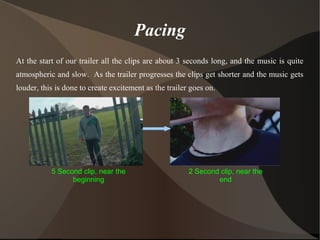
At the start of our trailer all the clips are about 3 seconds long, and the music is quite
atmospheric and slow. As the trailer progresses the clips get shorter and the music gets
louder, this is done to create excitement as the trailer goes on.
5 Second clip, near the
beginning
2 Second clip, near the
end
Pacing
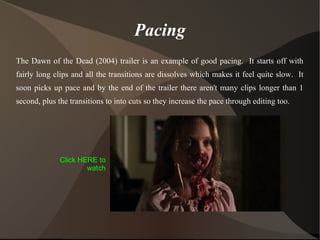
The Dawn of the Dead (2004) trailer is an example of good pacing. It starts off with
fairly long clips and all the transitions are dissolves which makes it feel quite slow. It
soon picks up pace and by the end of the trailer there aren't many clips longer than 1
second, plus the transitions to into cuts so they increase the pace through editing too.
Click HERE to
watch
Collision Cutting
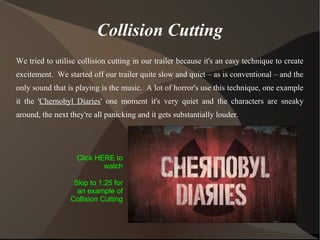
We tried to utilise collision cutting in our trailer because it's an easy technique to create
excitement. We started off our trailer quite slow and quiet – as is conventional – and the
only sound that is playing is the music. A lot of horror's use this technique, one example
it the 'Chernobyl Diaries' one moment it's very quiet and the characters are sneaky
around, the next they're all panicking and it gets substantially louder.
Click HERE to
watch
Skip to 1:25 for
an example of
Collision Cutting
Collision Cutting
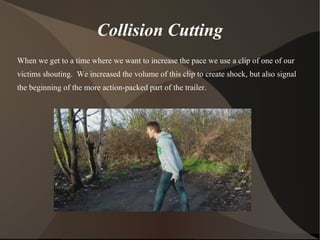
When we get to a time where we want to increase the pace we use a clip of one of our
victims shouting. We increased the volume of this clip to create shock, but also signal
the beginning of the more action-packed part of the trailer.

Evaluation part 1

  • 1.
  • 2.
    Horror Genre According tothe stereotypical conventions, horror films usually include: - An isolated location and enclosed mise-en-scene (The Blair Witch Project set in a forest) - Body Horror (Saw is a prime example, focusing around special effect gore) - Eerie music (The Exorcist eerie piano music 'Tubular bells') - Low-key lighting - Pathetic fallacy (rain, lighting, cloudy etc.) - Close-ups - Collision cutting
  • 3.
    Location Our trailer featurea lot of these elements that belong to the horror genre. We decided to set our trailer in a forest since it prevents the characters from calling for help, and it's also very easy to get lost in a forest. Forests are quite a typical location for a horror film for these reasons, and are used extensively in 'Blair Witch Project' and 'Evil Dead'
  • 4.
    Characters Our trailer revolvesaround teenagers and we tried to give the varying personalities. A horror film usually consists of a main antagonist (in our case we have a single killer: 'Simon Cohen'), a female victim, and a male hero. We gave both of our victims similar personalities to these typical roles, such as 'Dylan' who is killed quite early because he's quite naïve, and 'Danny' who tries his best to remedy the situation. Antagonist Female Victim Male hero
  • 5.
    Cinematography We tried toinclude as many close-ups as we could, this is because being so close to someone's face is unnerving which is why it is so common in the horror genre. We also used expressionist angles on our killer and victims to represent there power. These include low angle on the killer, and high angles on the victims when they're particularly vulnerable. This can be seen below in the image from The Hitcher (1986) where the low angle on Rutger Hauer establishes both this strength and sinister power over the film.
  • 6.
    Sound We have asingle piece of minimalistic music that creates an eerie atmosphere throughout our trailer. We chose this piece of parallel music because it's atmospheric but also occasionally has an electric guitar which we can sync our titles to, or use it for collision cutting. Saw's music 'Hello Zepp' by Charlie Clouser is an example of parallel music because it fits what is being shown on screen. Click HERE to listen
  • 7.
    Editing Editing is aparticularly powerful tool to use for a trailer because it's a good way of building excitement and suspense. Alfred Hitchock uses this technique very well in his movie Psycho during the famous shower scene. It starts with a very long -about a 15 second- clip of Marion in the shower with no music, then it suddenly changes and gets very loud and shows a quick montage of the killing. At the start of the trailer we have quite long clips, but as the trailer progresses the cuts become more and more frequent which creates excitement as well as a sense of panic. Click HERE to watch
  • 8.
    Pacing At the startof our trailer all the clips are about 3 seconds long, and the music is quite atmospheric and slow. As the trailer progresses the clips get shorter and the music gets louder, this is done to create excitement as the trailer goes on. 5 Second clip, near the beginning 2 Second clip, near the end
  • 9.
    Pacing The Dawn ofthe Dead (2004) trailer is an example of good pacing. It starts off with fairly long clips and all the transitions are dissolves which makes it feel quite slow. It soon picks up pace and by the end of the trailer there aren't many clips longer than 1 second, plus the transitions to into cuts so they increase the pace through editing too. Click HERE to watch
  • 10.
    Collision Cutting We triedto utilise collision cutting in our trailer because it's an easy technique to create excitement. We started off our trailer quite slow and quiet – as is conventional – and the only sound that is playing is the music. A lot of horror's use this technique, one example it the 'Chernobyl Diaries' one moment it's very quiet and the characters are sneaky around, the next they're all panicking and it gets substantially louder. Click HERE to watch Skip to 1:25 for an example of Collision Cutting
  • 11.
    Collision Cutting When weget to a time where we want to increase the pace we use a clip of one of our victims shouting. We increased the volume of this clip to create shock, but also signal the beginning of the more action-packed part of the trailer.