Learning with Web Quest as an Online learning Environment
Department of
Instructional and Learning Technologies
College of Education
Sultan Qaboos University
Submitted by:
Khalsa AL-Brashdi
68692
Date
2009-05-10
1. Introduction
Since the concept of an inquiry-oriented Web Quest activity was first introduced in
1995, this educational strategy has been the focus of professional development
workshops and preservice teacher preparation courses as an example of the effective
integration of technology in education.
Web Quests were introduced by Bernie Dodge (1995) as “an inquiry oriented activity
in which some or all of the information that learners interact with comes from resources
on the Internet, optionally supplemented with video conferencing” (Abbit, J., & Ophus,
J., 2008).
However, there has been some debate concerning the value and longevity of this
strategy; Web Quests. Maddux and Cummings (2004) described Web Quests as “an
innovation at risk of suffering the fate of all educational fads” that is highly praised
initially, widely implemented without support of research and evaluation. Therefore,
studies concerning this issue have been initialized to investigate the impact of using Web
Quest. The impacts of Web Quests on teaching and learning described in the literature
could be grouped into three general categories:
1. Attitudes and perceptions of learners.
2. Impacts on learning content and skills.
3. Investigations of the cognitive requirements of Web Quests.
However, for the purpose of this study we will concern more in the first tow
categories; attitudes and perceptions of learners and impacts on learning content and
skills.
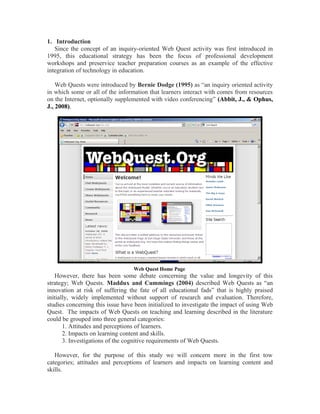
Web Quest Home Page
Many of the studies compiled included an evaluation of the impacts of the Web Quests
on the attitudes and perceptions of learners. While several studies identified attitudes and
perceptions that were generally positive towards Web Quests (Carroll, Legg, & Taylor,
2003; Fox, 1999; Gaskill, McNulty, & Brooks, 2006; Santavenere, 2003), the most
notable research identified impacts on motivation, clarification of information, benefits of
collaboration, and perceptions of technology skills (MacGregor, S. Kim & Lou, Yiping,
2004).
In addition to motivation, three studies also suggest the Web Quests have an impact on
the students perceptions related to the structure of the activity itself. Web Quests are
often touted as providing a sound structure and scaffold for learning. (Tsai, 2006), in
addition to investigating motivation, also identified a connection between Web Quests
and the ability of students to identify contextual clues and main ideas in readings within
the context of English as a Foreign Language (EFL) course. Tsai found the structure of
the Web Quest activity served as an advanced organizing mechanism for preparing
students in an EFL to complete readings (MacGregor, S. Kim & Lou, Yiping, 2004).
As is the case with any instructional strategy, method, or model, one primary concern
of research and evaluation efforts is to better understand the impacts of these methods
specifically on learning and achievement. Though it has been noted that there is a lack of
this type of research with regards to Web Quests (Milson, 2001, 2002; Strickland,
2005), the research that has been reported does not reveal many notable advantages of
this instructional method. From here, the purpose of this study was born; to investigate
the effect of Web Quest on students learning and achievement.
2. Purpose and Questions:
According to the previous exploring of the literature we can say that this study aim to
investigate users' attitudes towards web quest and to explore the impact of web quests
on their learning. Therefore, the questions of this study are:
1. How Web Quest users' perceive Web Quest as a learning environment?
2. What is the impact of Web Quest learning environment on their learning and
achievement?
3. Research Design
3.1. Sample:
A total of 10 teachers who use English as a foreign language from Abo Bilal AL-
Tamimi School (a school in AL-Sharqia region in Oman) have participated in this
study. The researcher has chosen them randomly just to exclude any bias related to
the sample selection. These entire teachers are male teachers; they are knowledgeable
enough in terms of computer skills and dealing with internet resources. However,
they are different in terms of learning styles and abilities.
3.2. Procedure:
After deciding on the study and exploring the literature of web quests, the
researcher has decide on the questions that she will try to answer by this study.
Then the followings steps have been conducted:
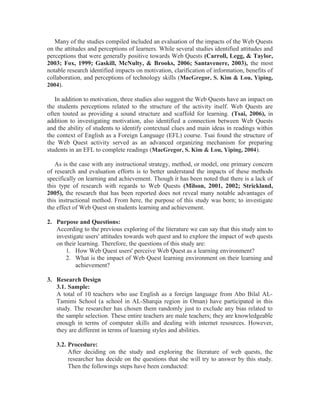
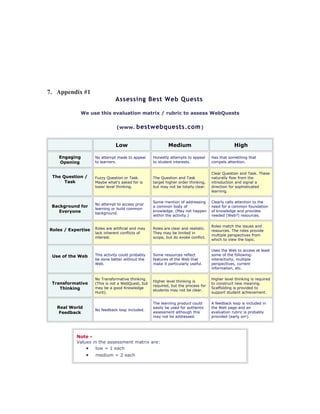
1. She searched the web quest database to choose a web quest to work on.
To do so she has used the evaluation matrix / rubric to assess Web Quests
developed Tom March, 2009. (See Appendix #1)
As the web quest entitled "An introductory Web Quest for in-service EFL
teachers" has gain acceptable points (about 20 points) she decided to
work on.
2. After that the researcher has selected the study sample randomly, as
mentioned before and has explained the study for them; purpose,
procedure and what they suppose to do.
3. Then, all the participants were given the web quest URL and have been
asked to enter the address and do the quest.
After doing the web quest, they have been asked to fill the survey
provided by the researcher (See
http://www.surveyconsole.com/console/TakeSurvey?id=570078)
4. Finally the researcher has gathered the survey results and started to
analyze and discuss them.
Home Page of the selected Web Quest
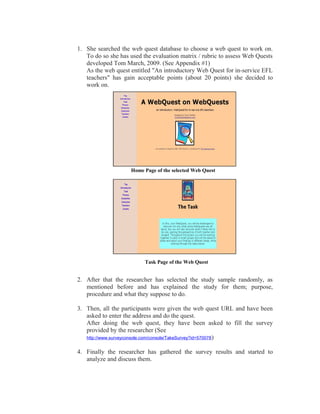
Task Page of the Web Quest
4. Results:
4.1. For the first question: How Web Quest users' perceive Web Quest as a learning
environment?
N Statements Agree (%)
1 Is this Web Quest attractive enough? 60%
2 Would you like to do another Web Quest? 80%
3
Do you feel that you learned something from this Web
Quest?
92%
4 Will you invent your friends to access this web Quest? 88%
5 Do you agree that Web Quest is an innovation? 79%
6 Do you think that Web Quest is a good online tool? 87%
7 Would you like use Web Quest with your students? 95%
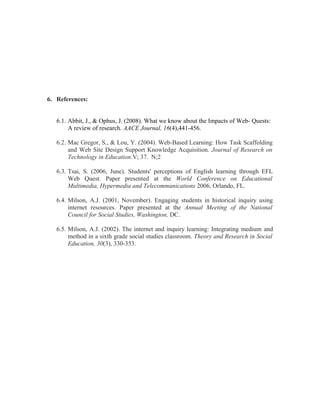
4.2. For the second question: What is the impact of Web Quest learning
environment on their learning and achievement?
N Statements Agree (%)
Does this Web Quest provide you with:
1 A student-centered environment. 98%
2 A structured environment for research. 95%
3 A help to develop computer skills 87%
4 A chance to work at your own pace. 91%
5 A chance to make maximum use of study time. 96%
6 A help to focus on the task. 92%
7 A chance to increase your motivation 78%
Does this Web Quest suffer from:
8 Content too easy. 10%
9 Content too challenging. 12%
1
0
Confusing/unclear.
6%
1
1
Too time-consuming.
7%
1
2
Inactive links.
0%
1
3
Technical difficulties. 1%
1
4
I didn't have enough computer skills.
1%
5. Discussions:
We can notice that most users have positive attitude towards the web quest that they
have used, maybe because most of them are using web quests for the first time; they did
not deal with it before. However, they feel that even it is a good way to be used by
instructors it is not attractive enough, maybe because the Web Quest that the researcher
has used was very simple in appearance. From this point, we can use these findings to try
to make Web Quests technology more attractive.
About the impact of Web Quest on learning, most users have agreed that Web Quest
helped them to be self learners and it provided them with the opportunity to search and
seek knowledge. However, they feel that it was not motivated enough maybe because
they were been asked to work individually most of the time. Therefore, considering
cooperation and group work will be more effective in such situations.
Last but not least, this study was conducted with only 10 users, which is very small
sample to judge on such issue. However, the researcher was facing some difficulties in
finding enough participants. Also, she has worked on only one Web Quest. Therefore, it
is recommended to conduct studies that have big enough sample and use more than one
example of Web Quests.
Web Quests are really a very useful technology if it had been used by the correct way
and for the correct audience.
6. References:
6.1. Abbit, J., & Ophus, J. (2008). What we know about the Impacts of Web- Quests:
A review of research. AACE Journal, 16(4),441-456.
6.2. Mac Gregor, S., & Lou, Y. (2004). Web-Based Learning: How Task Scaffolding
and Web Site Design Support Knowledge Acquisition. Journal of Research on
Technology in Education.V; 37. N;2
6.3. Tsai, S. (2006, June). Students' perceptions of English learning through EFL
Web Quest. Paper presented at the World Conference on Educational
Multimedia, Hypermedia and Telecommunications 2006, Orlando, FL.
6.4. Milson, A.J. (2001, November). Engaging students in historical inquiry using
internet resources. Paper presented at the Annual Meeting of the National
Council for Social Studies, Washington, DC.
6.5. Milson, A.J. (2002). The internet and inquiry learning: Integrating medium and
method in a sixth grade social studies classroom. Theory and Research in Social
Education, 30(3), 330-353.
7. Appendix #1
Assessing Best Web Quests
We use this evaluation matrix / rubric to assess WebQuests
(www. bestwebquests.com)
Low Medium High
Engaging
Opening
No attempt made to appeal
to learners.
Honestly attempts to appeal
to student interests.
Has that something that
compels attention.
The Question /
Task
Fuzzy Question or Task.
Maybe what's asked for is
lower level thinking.
The Question and Task
target higher order thinking,
but may not be totally clear.
Clear Question and Task. These
naturally flow from the
introduction and signal a
direction for sophisticated
learning.
Background for
Everyone
No attempt to access prior
learning or build common
background.
Some mention of addressing
a common body of
knowledge. (May not happen
within the activity.)
Clearly calls attention to the
need for a common foundation
of knowledge and provides
needed (Web?) resources.
Roles / Expertise Roles are artificial and may
lack inherent conflicts of
interest.
Roles are clear and realistic.
They may be limited in
scope, but do evoke conflict.
Roles match the issues and
resources. The roles provide
multiple perspectives from
which to view the topic.
Use of the Web This activity could probably
be done better without the
Web.
Some resources reflect
features of the Web that
make it particularly useful.
Uses the Web to access at least
some of the following:
interactivity, multiple
perspectives, current
information, etc.
Transformative
Thinking
No Transformative thinking.
(This is not a WebQuest, but
may be a good Knowledge
Hunt).
Higher level thinking is
required, but the process for
students may not be clear.
Higher level thinking is required
to construct new meaning.
Scaffolding is provided to
support student achievement.
Real World
Feedback
No feedback loop included.
The learning product could
easily be used for authentic
assessment although this
may not be addressed.
A feedback loop is included in
the Web page and an
evaluation rubric is probably
provided (early on!).
Note -
Values in the assessment matrix are:
• low = 1 each
• medium = 2 each
• high = 3 each
12 - 15 = 16 - 19 =
20 - 24 =
• high = 3 each
12 - 15 = 16 - 19 =
20 - 24 =

Evaluating Learning with Web Quest

  • 1.
    Learning with WebQuest as an Online learning Environment Department of Instructional and Learning Technologies College of Education Sultan Qaboos University Submitted by: Khalsa AL-Brashdi 68692 Date 2009-05-10
  • 2.
    1. Introduction Since theconcept of an inquiry-oriented Web Quest activity was first introduced in 1995, this educational strategy has been the focus of professional development workshops and preservice teacher preparation courses as an example of the effective integration of technology in education. Web Quests were introduced by Bernie Dodge (1995) as “an inquiry oriented activity in which some or all of the information that learners interact with comes from resources on the Internet, optionally supplemented with video conferencing” (Abbit, J., & Ophus, J., 2008). However, there has been some debate concerning the value and longevity of this strategy; Web Quests. Maddux and Cummings (2004) described Web Quests as “an innovation at risk of suffering the fate of all educational fads” that is highly praised initially, widely implemented without support of research and evaluation. Therefore, studies concerning this issue have been initialized to investigate the impact of using Web Quest. The impacts of Web Quests on teaching and learning described in the literature could be grouped into three general categories: 1. Attitudes and perceptions of learners. 2. Impacts on learning content and skills. 3. Investigations of the cognitive requirements of Web Quests. However, for the purpose of this study we will concern more in the first tow categories; attitudes and perceptions of learners and impacts on learning content and skills. Web Quest Home Page
  • 3.
    Many of thestudies compiled included an evaluation of the impacts of the Web Quests on the attitudes and perceptions of learners. While several studies identified attitudes and perceptions that were generally positive towards Web Quests (Carroll, Legg, & Taylor, 2003; Fox, 1999; Gaskill, McNulty, & Brooks, 2006; Santavenere, 2003), the most notable research identified impacts on motivation, clarification of information, benefits of collaboration, and perceptions of technology skills (MacGregor, S. Kim & Lou, Yiping, 2004). In addition to motivation, three studies also suggest the Web Quests have an impact on the students perceptions related to the structure of the activity itself. Web Quests are often touted as providing a sound structure and scaffold for learning. (Tsai, 2006), in addition to investigating motivation, also identified a connection between Web Quests and the ability of students to identify contextual clues and main ideas in readings within the context of English as a Foreign Language (EFL) course. Tsai found the structure of the Web Quest activity served as an advanced organizing mechanism for preparing students in an EFL to complete readings (MacGregor, S. Kim & Lou, Yiping, 2004). As is the case with any instructional strategy, method, or model, one primary concern of research and evaluation efforts is to better understand the impacts of these methods specifically on learning and achievement. Though it has been noted that there is a lack of this type of research with regards to Web Quests (Milson, 2001, 2002; Strickland, 2005), the research that has been reported does not reveal many notable advantages of this instructional method. From here, the purpose of this study was born; to investigate the effect of Web Quest on students learning and achievement. 2. Purpose and Questions: According to the previous exploring of the literature we can say that this study aim to investigate users' attitudes towards web quest and to explore the impact of web quests on their learning. Therefore, the questions of this study are: 1. How Web Quest users' perceive Web Quest as a learning environment? 2. What is the impact of Web Quest learning environment on their learning and achievement? 3. Research Design 3.1. Sample: A total of 10 teachers who use English as a foreign language from Abo Bilal AL- Tamimi School (a school in AL-Sharqia region in Oman) have participated in this study. The researcher has chosen them randomly just to exclude any bias related to the sample selection. These entire teachers are male teachers; they are knowledgeable enough in terms of computer skills and dealing with internet resources. However, they are different in terms of learning styles and abilities. 3.2. Procedure: After deciding on the study and exploring the literature of web quests, the researcher has decide on the questions that she will try to answer by this study. Then the followings steps have been conducted:
  • 4.
    1. She searchedthe web quest database to choose a web quest to work on. To do so she has used the evaluation matrix / rubric to assess Web Quests developed Tom March, 2009. (See Appendix #1) As the web quest entitled "An introductory Web Quest for in-service EFL teachers" has gain acceptable points (about 20 points) she decided to work on. 2. After that the researcher has selected the study sample randomly, as mentioned before and has explained the study for them; purpose, procedure and what they suppose to do. 3. Then, all the participants were given the web quest URL and have been asked to enter the address and do the quest. After doing the web quest, they have been asked to fill the survey provided by the researcher (See http://www.surveyconsole.com/console/TakeSurvey?id=570078) 4. Finally the researcher has gathered the survey results and started to analyze and discuss them. Home Page of the selected Web Quest Task Page of the Web Quest
  • 5.
    4. Results: 4.1. Forthe first question: How Web Quest users' perceive Web Quest as a learning environment? N Statements Agree (%) 1 Is this Web Quest attractive enough? 60% 2 Would you like to do another Web Quest? 80% 3 Do you feel that you learned something from this Web Quest? 92% 4 Will you invent your friends to access this web Quest? 88% 5 Do you agree that Web Quest is an innovation? 79% 6 Do you think that Web Quest is a good online tool? 87% 7 Would you like use Web Quest with your students? 95% 4.2. For the second question: What is the impact of Web Quest learning environment on their learning and achievement? N Statements Agree (%) Does this Web Quest provide you with: 1 A student-centered environment. 98% 2 A structured environment for research. 95% 3 A help to develop computer skills 87% 4 A chance to work at your own pace. 91% 5 A chance to make maximum use of study time. 96% 6 A help to focus on the task. 92% 7 A chance to increase your motivation 78% Does this Web Quest suffer from: 8 Content too easy. 10% 9 Content too challenging. 12% 1 0 Confusing/unclear. 6% 1 1 Too time-consuming. 7% 1 2 Inactive links. 0% 1 3 Technical difficulties. 1% 1 4 I didn't have enough computer skills. 1% 5. Discussions:
  • 6.
    We can noticethat most users have positive attitude towards the web quest that they have used, maybe because most of them are using web quests for the first time; they did not deal with it before. However, they feel that even it is a good way to be used by instructors it is not attractive enough, maybe because the Web Quest that the researcher has used was very simple in appearance. From this point, we can use these findings to try to make Web Quests technology more attractive. About the impact of Web Quest on learning, most users have agreed that Web Quest helped them to be self learners and it provided them with the opportunity to search and seek knowledge. However, they feel that it was not motivated enough maybe because they were been asked to work individually most of the time. Therefore, considering cooperation and group work will be more effective in such situations. Last but not least, this study was conducted with only 10 users, which is very small sample to judge on such issue. However, the researcher was facing some difficulties in finding enough participants. Also, she has worked on only one Web Quest. Therefore, it is recommended to conduct studies that have big enough sample and use more than one example of Web Quests. Web Quests are really a very useful technology if it had been used by the correct way and for the correct audience.
  • 7.
    6. References: 6.1. Abbit,J., & Ophus, J. (2008). What we know about the Impacts of Web- Quests: A review of research. AACE Journal, 16(4),441-456. 6.2. Mac Gregor, S., & Lou, Y. (2004). Web-Based Learning: How Task Scaffolding and Web Site Design Support Knowledge Acquisition. Journal of Research on Technology in Education.V; 37. N;2 6.3. Tsai, S. (2006, June). Students' perceptions of English learning through EFL Web Quest. Paper presented at the World Conference on Educational Multimedia, Hypermedia and Telecommunications 2006, Orlando, FL. 6.4. Milson, A.J. (2001, November). Engaging students in historical inquiry using internet resources. Paper presented at the Annual Meeting of the National Council for Social Studies, Washington, DC. 6.5. Milson, A.J. (2002). The internet and inquiry learning: Integrating medium and method in a sixth grade social studies classroom. Theory and Research in Social Education, 30(3), 330-353.
  • 8.
    7. Appendix #1 AssessingBest Web Quests We use this evaluation matrix / rubric to assess WebQuests (www. bestwebquests.com) Low Medium High Engaging Opening No attempt made to appeal to learners. Honestly attempts to appeal to student interests. Has that something that compels attention. The Question / Task Fuzzy Question or Task. Maybe what's asked for is lower level thinking. The Question and Task target higher order thinking, but may not be totally clear. Clear Question and Task. These naturally flow from the introduction and signal a direction for sophisticated learning. Background for Everyone No attempt to access prior learning or build common background. Some mention of addressing a common body of knowledge. (May not happen within the activity.) Clearly calls attention to the need for a common foundation of knowledge and provides needed (Web?) resources. Roles / Expertise Roles are artificial and may lack inherent conflicts of interest. Roles are clear and realistic. They may be limited in scope, but do evoke conflict. Roles match the issues and resources. The roles provide multiple perspectives from which to view the topic. Use of the Web This activity could probably be done better without the Web. Some resources reflect features of the Web that make it particularly useful. Uses the Web to access at least some of the following: interactivity, multiple perspectives, current information, etc. Transformative Thinking No Transformative thinking. (This is not a WebQuest, but may be a good Knowledge Hunt). Higher level thinking is required, but the process for students may not be clear. Higher level thinking is required to construct new meaning. Scaffolding is provided to support student achievement. Real World Feedback No feedback loop included. The learning product could easily be used for authentic assessment although this may not be addressed. A feedback loop is included in the Web page and an evaluation rubric is probably provided (early on!). Note - Values in the assessment matrix are: • low = 1 each • medium = 2 each
  • 9.
    • high =3 each 12 - 15 = 16 - 19 = 20 - 24 =
  • 10.
    • high =3 each 12 - 15 = 16 - 19 = 20 - 24 =