#Ev-Ent-Anglement 1
Noise Seminar
Utrecht University
August, 2014
To Perform a Theory of Feminist Digital Praxis:
Cutting through the Noise of the Digital Self
To Cut
A “causal procedure and act of decision”
Sarah Kember and Joanna Zylinska
Life After New Media (MIT Press: 2012)
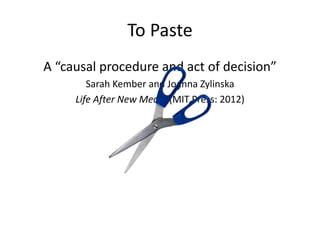
To Paste
A “causal procedure and act of decision”
Sarah Kember and Joanna Zylinska
Life After New Media (MIT Press: 2012)
To Cut
“Cuts are part of the phenomena they help
produce.”
Karen Barad
Meeting the Universe Halfway
Loop!
Loop …
“Can the loop be a new narrative form appropriated
for the computer age?”
“It is relevant to recall that the loop gave birth not
only to cinema but also to computer programing.
Programming involved altering the linear flow of
data through control structures such as ‘if/then’
and ‘repeat/while.’”
Lev Manovich, The Language of New Media (MIT: 2001)
Assemblage
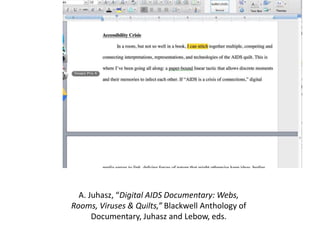
A. Juhasz, “Digital AIDS Documentary: Webs,
Rooms, Viruses & Quilts,” Blackwell Anthology of
Documentary, Juhasz and Lebow, eds.
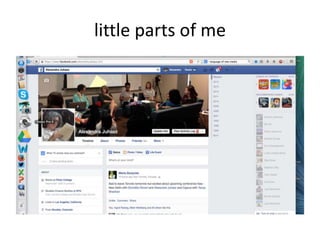
little parts of me
just for the man
fragments of myself
Cut myself back together with
Knowledge/context/analysis
Depth/community/politics
#Ev-ent-anglement
Imperatives 1-3
• To Cut well:
#cut/paste+bleed
• To Break Past Binaries:
#create/assemble+seep
• To Use Objects that Matter:
#find/link+entangle
Your Script
As I talk, please #cut/paste+bleed into the #ev-ent-anglement from the archive of yourself.
Go to http://ev-ent-anglement.com and watch the ev-ent-anglement unfold.
Better yet, build yourself in:
Find or make images, links, words, video or gifs that express your responses, connections, ideas, and questions.
Everything you paste needs this hashtag to be seen: #ev-ent-anglement
• On Twitter: #ev-ent-anglement
• On Instagram: #ev-ent-anglement
• On YouTube: Eve Entanglement: youtube.com/channel/UCpwZbMp3VFT5i2qlTYVgbFA
Feel free to share #emotion-al-entaglements.
Or pieces of your #em-body.
Gone full circle, mark the #ev-ent-loop.
Remember, you’ll be distracted. But the “talk” isn’t going anywhere.
Please try to entangle at minimum twice during the “talk.”
To Cut Well
The photographic act, both as “technique” and
“ethical imperative,” serves as “an active practice of
cutting through the flow of mediation.”
“Time is indivisible, continuous and unknowable, at
least to the intellect. In order to ‘know’ it, we must
… cut.”
Kember and Zylinska
“What does it mean to cut well?”
Today’s #ev-ent-anglement:
links a distinctly feminist armature to Kember
and Zylinska’s more minimal or abstract
framework of
“photography as a form of differentiation and
life making”
K & Z’s Imperative
“to get outside oneself and to be technical, that
is, to bring things forth, to create, is perhaps
also an ethical injunction to create well, even if
not a condition of ethical behavior.”
Cut, Link & Assemble!
#Cut/Paste+Bleed
Please refer to your script.
I request that you join the #ev-ent-anglement at
least twice during this “talk.”
I hope we might “do media studies” in a form that is
not only analysis but is “simultaneously critical and
creative.” (K & Z, xvii)
Editing
“straddles the line between art and craft”
Valerie Orpen, Film Editing: The Art of the Expressive
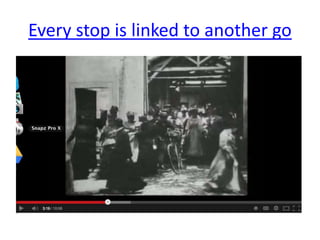
The first advertising silent film
Lumiere Brothers (1896): Washing Up
Every stop is linked to another go
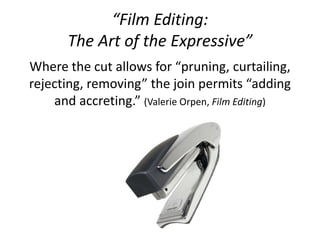
“Film Editing:
The Art of the Expressive”
Where the cut allows for “pruning, curtailing,
rejecting, removing” the join permits “adding
and accreting.” (Valerie Orpen, Film Editing)
The art of cinema is in the shot …
To Edit
“gives the director an almost limitless freedom
of movement once he can split up action into
small, manageable units” while also conveying
“a sense of time to the spectator.”
The Technique of Film Editing, Karel Reisz and Gavin Millar
Dialectical Montage
“We have now only to mention a large number of
other dialectics that are quite difficult to categorize:
those concerning dialogue, the style of acting, the
decor, make-up, and costumes—everything, in
short, relating to the explicit content of images and
sounds. For structures almost always seem to occur
in dialectical form—that is to say, a structure
necessarily evolves within a parameter defined by
one or more pairs of clearly delineated poles.”
Noel Burch: Theory of Film Practice
This dissonance, this formal affront, this
attack on spatio-temporal coherence
“hypermediacy … the collage of effect of media
forms and styles” (K & Z, 8)
"Your Nostalgia Is Killing Me" (2013), a poster designed for
posterVIRUS by Vincent Chevalier and Ian Bradley-Perrin
Spatial Montage
“The avant-garde strategy of collage reemerged
as the ‘cut-and-paste’ command, the most basic
operation one can perform on digital data.”
Lev Manovich
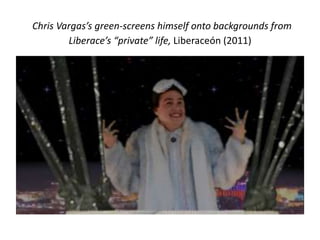
Chris Vargas’s green-screens himself onto backgrounds from
Liberace’s “private” life, Liberaceón (2011)
“The Cut-Up Method of Brion Gysin”
“Cut ups are for everyone. Anybody can make
cut ups. It is experimental in the sense of being
something to do.”
William S. Burroughs
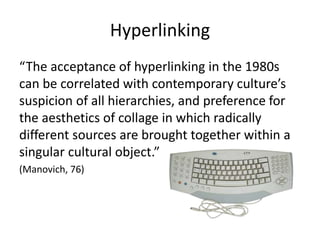
Hyperlinking
“The acceptance of hyperlinking in the 1980s
can be correlated with contemporary culture’s
suspicion of all hierarchies, and preference for
the aesthetics of collage in which radically
different sources are brought together within a
singular cultural object.”
(Manovich, 76)
“All writing is in fact cut-ups”
Burroughs
Circles & Lines
Man with a Movie Camera
Women with her Editing Scissors
The Fall of the Romanov Dynasty
(Esfir Shub, 1927)
Cutting
Ab-jecting
“Repelling, rejecting; repelling itself, rejecting
itself. Ab-jecting.”
Julia Kristeva, 1980
Link Me
“As a substance that flows from the bodily
depths out, menstrual blood is carefully
managed, concealed, contained and increasingly
suppressed through the use of hormonal
contraceptives. We can read the management of
this flow of blood as a means of working on the
body’s boundaries, that is, of demarcating the
body’s inside from its outside.”
Emilia Sanabria, “The Body Inside Out: Menstrual
Management and Gynaecological Practices in Brazil”
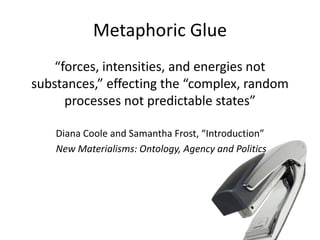
Metaphoric Glue
“forces, intensities, and energies not
substances,” effecting the “complex, random
processes not predictable states”
Diana Coole and Samantha Frost, “Introduction”
New Materialisms: Ontology, Agency and Politics
#Ev-ent-anglement, Imperative 4
“What kind of politics could embrace partial,
contradictory, permanently unclosed
constructions of personal and collective selves
and still be faithful, effective—and, ironically,
socialist-feminist?”
Donna Haraway, “A Cyborg Manifesto”
“An argument for pleasure in the confusion of boundaries and
for responsibility in their construction,” Donna Haraway
For #Ev-ent-anglement 1
We cut/paste+bleed binaries
Art/Craft
Long take/Montage
On/Off screen
Invisible/Visible
Dull matter/Vibrant life
Loop/Line
Hierarchy/Flat
Politics/Feelings
Past/Present
Present/Future
Cut up/Happening
Time/Space
Virality/Duration
Critique/Create
Intra-action
“There is no ‘between’ as such, human and non-
human organisms and machines emerge only
through their mutual co-constitution.”
Karen Barad
Loops & Lines
“A line both divides things and creates spaces
that we can imagine we can be ‘in.’”
“Collectives seem to have ‘lines’ in the sense of
being modes of following: to inhabit a collective
might mean to follow a line.”
Sara Ahmed, Queer Phenomenology
Circles and Loops
The circle of consciousness-raising and the videos it inspired directly contest
the patriarchal, linear project of industrial production with its predictable
plots (and products). In First Day FSW, 1980, that year’s body of students
introduce themselves to each other, and us, by passing the camera around the
circle. “Julie James. I am seed. I am heart. I am healing. I am power. I am
smooth. I am alive. I am dark red. I am pulsing. I am magic. I am clearing. I am
self.” And so on. After the tape ends with the group joining together in a
rousing class portrait culminating with a chant, “Feminist Studio Workshop,
1979-80,” and a loud “YEAH!” a quick fade to black bumps us against an
unanticipated snippet of yet another circle. We accidentally fall into the last
five minutes of a consciousness-raising meeting of a group of deaf women
(perhaps the other tape was taped over this), who speak together (we hear
through an interpreter while they sign) about the role of affection in their
lives, and end their meeting (and tape) with a group (circle) hug.
Juhasz, “Views of the Feminist Archive”
Circles and Loops, Looped
“The loop and the sequential progression, do
not have to be considered mutually exclusive. A
computer program progresses from start to end
by executing a series of loops.”
Lev Manovich
photos
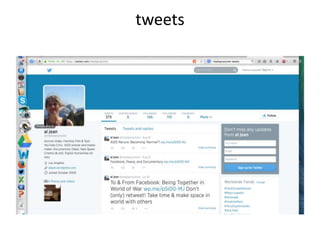
tweets
Blog posts
videos
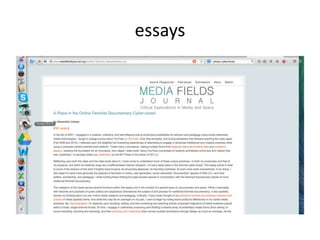
essays
purchases
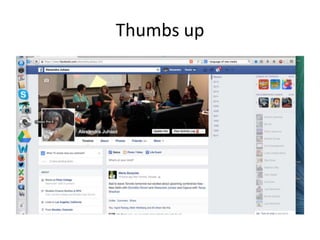
Thumbs up
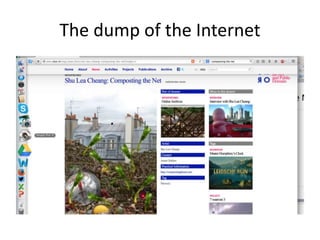
“Composting the Net”
Shu Lea Cheang, 2012
The dump of the Internet
#Ev-ent-anglement, Directive 5,
Cut Our Feminist Objects Well
“Evoke the possibility of doing justice to and
with objects of study.”
“The disciplinarity of Women’s and Gender
Studies proceeds precisely from its formalization
of the political as the value that differentiates it
from traditional fields of study.”
Robyn Wiegman, Object Lessons
Obscure Feminist Archive
The Watermelon Woman (Cheryl Dunye, 1995)
Beyond Self-Expression
“once such self-visualization and expression is
widely available, how do we strategize our
activism around the new forms, links, and
actions that said expression takes up? And, most
critically, what else might be needed beyond
speaking and spreading our ideas through
digital realist representations?”
Juhasz, “Ceding the Activist Digital Documentary,” in Nash,
Hight and Summerhayes, eds., New Documentary Ecologies
Cut into Art
Lowly bits of evidence—like our tweets, reposts,
thumbs up, photographs, and cat gifs—do not
become a digital documentary, do not have
enough meaning—until they are edited, by a
documentarian, and thereby organized into an
argument; until they are aestheticized by being
made into art.
Juhasz, “Ceding the Digital Documentary”
Conclusion
• In what ways can digital practices participate
in the distribution of affects and feelings as a
strategy of resistance and subversion?
• How can emotions, once shared, facilitate
political action, recognition, and dialogue, and
bring about social change?
Conclusion, Again
For now and into the future, I am committed to
experimenting with #ev-ent-anglements, made
by cutting/pasting+bleeding ourselves, co-
produced with purpose and commitment, in
shared spaces and times both on and off line.
Together, today, and always also later on the
Internet, we might make things that could
inspire change, but might themselves be the
thing that is change in the making.

Ev ent-anglement with pix

  • 1.
  • 2.
    To Perform aTheory of Feminist Digital Praxis: Cutting through the Noise of the Digital Self
  • 3.
    To Cut A “causalprocedure and act of decision” Sarah Kember and Joanna Zylinska Life After New Media (MIT Press: 2012)
  • 4.
    To Paste A “causalprocedure and act of decision” Sarah Kember and Joanna Zylinska Life After New Media (MIT Press: 2012)
  • 5.
    To Cut “Cuts arepart of the phenomena they help produce.” Karen Barad Meeting the Universe Halfway
  • 6.
  • 7.
    Loop … “Can theloop be a new narrative form appropriated for the computer age?” “It is relevant to recall that the loop gave birth not only to cinema but also to computer programing. Programming involved altering the linear flow of data through control structures such as ‘if/then’ and ‘repeat/while.’” Lev Manovich, The Language of New Media (MIT: 2001)
  • 8.
  • 9.
    A. Juhasz, “DigitalAIDS Documentary: Webs, Rooms, Viruses & Quilts,” Blackwell Anthology of Documentary, Juhasz and Lebow, eds.
  • 10.
  • 11.
  • 12.
  • 13.
    Cut myself backtogether with Knowledge/context/analysis Depth/community/politics
  • 14.
    #Ev-ent-anglement Imperatives 1-3 • ToCut well: #cut/paste+bleed • To Break Past Binaries: #create/assemble+seep • To Use Objects that Matter: #find/link+entangle
  • 15.
    Your Script As Italk, please #cut/paste+bleed into the #ev-ent-anglement from the archive of yourself. Go to http://ev-ent-anglement.com and watch the ev-ent-anglement unfold. Better yet, build yourself in: Find or make images, links, words, video or gifs that express your responses, connections, ideas, and questions. Everything you paste needs this hashtag to be seen: #ev-ent-anglement • On Twitter: #ev-ent-anglement • On Instagram: #ev-ent-anglement • On YouTube: Eve Entanglement: youtube.com/channel/UCpwZbMp3VFT5i2qlTYVgbFA Feel free to share #emotion-al-entaglements. Or pieces of your #em-body. Gone full circle, mark the #ev-ent-loop. Remember, you’ll be distracted. But the “talk” isn’t going anywhere. Please try to entangle at minimum twice during the “talk.”
  • 16.
    To Cut Well Thephotographic act, both as “technique” and “ethical imperative,” serves as “an active practice of cutting through the flow of mediation.” “Time is indivisible, continuous and unknowable, at least to the intellect. In order to ‘know’ it, we must … cut.” Kember and Zylinska
  • 17.
    “What does itmean to cut well?” Today’s #ev-ent-anglement: links a distinctly feminist armature to Kember and Zylinska’s more minimal or abstract framework of “photography as a form of differentiation and life making”
  • 18.
    K & Z’sImperative “to get outside oneself and to be technical, that is, to bring things forth, to create, is perhaps also an ethical injunction to create well, even if not a condition of ethical behavior.”
  • 19.
    Cut, Link &Assemble!
  • 20.
    #Cut/Paste+Bleed Please refer toyour script. I request that you join the #ev-ent-anglement at least twice during this “talk.” I hope we might “do media studies” in a form that is not only analysis but is “simultaneously critical and creative.” (K & Z, xvii)
  • 21.
    Editing “straddles the linebetween art and craft” Valerie Orpen, Film Editing: The Art of the Expressive
  • 22.
    The first advertisingsilent film Lumiere Brothers (1896): Washing Up
  • 23.
    Every stop islinked to another go
  • 24.
    “Film Editing: The Artof the Expressive” Where the cut allows for “pruning, curtailing, rejecting, removing” the join permits “adding and accreting.” (Valerie Orpen, Film Editing)
  • 25.
    The art ofcinema is in the shot …
  • 26.
    To Edit “gives thedirector an almost limitless freedom of movement once he can split up action into small, manageable units” while also conveying “a sense of time to the spectator.” The Technique of Film Editing, Karel Reisz and Gavin Millar
  • 27.
    Dialectical Montage “We havenow only to mention a large number of other dialectics that are quite difficult to categorize: those concerning dialogue, the style of acting, the decor, make-up, and costumes—everything, in short, relating to the explicit content of images and sounds. For structures almost always seem to occur in dialectical form—that is to say, a structure necessarily evolves within a parameter defined by one or more pairs of clearly delineated poles.” Noel Burch: Theory of Film Practice
  • 28.
    This dissonance, thisformal affront, this attack on spatio-temporal coherence “hypermediacy … the collage of effect of media forms and styles” (K & Z, 8)
  • 29.
    "Your Nostalgia IsKilling Me" (2013), a poster designed for posterVIRUS by Vincent Chevalier and Ian Bradley-Perrin
  • 30.
    Spatial Montage “The avant-gardestrategy of collage reemerged as the ‘cut-and-paste’ command, the most basic operation one can perform on digital data.” Lev Manovich
  • 31.
    Chris Vargas’s green-screenshimself onto backgrounds from Liberace’s “private” life, Liberaceón (2011)
  • 32.
    “The Cut-Up Methodof Brion Gysin” “Cut ups are for everyone. Anybody can make cut ups. It is experimental in the sense of being something to do.” William S. Burroughs
  • 33.
    Hyperlinking “The acceptance ofhyperlinking in the 1980s can be correlated with contemporary culture’s suspicion of all hierarchies, and preference for the aesthetics of collage in which radically different sources are brought together within a singular cultural object.” (Manovich, 76)
  • 34.
    “All writing isin fact cut-ups” Burroughs
  • 35.
  • 36.
    Man with aMovie Camera Women with her Editing Scissors
  • 37.
    The Fall ofthe Romanov Dynasty (Esfir Shub, 1927)
  • 38.
  • 39.
    Ab-jecting “Repelling, rejecting; repellingitself, rejecting itself. Ab-jecting.” Julia Kristeva, 1980
  • 40.
    Link Me “As asubstance that flows from the bodily depths out, menstrual blood is carefully managed, concealed, contained and increasingly suppressed through the use of hormonal contraceptives. We can read the management of this flow of blood as a means of working on the body’s boundaries, that is, of demarcating the body’s inside from its outside.” Emilia Sanabria, “The Body Inside Out: Menstrual Management and Gynaecological Practices in Brazil”
  • 41.
    Metaphoric Glue “forces, intensities,and energies not substances,” effecting the “complex, random processes not predictable states” Diana Coole and Samantha Frost, “Introduction” New Materialisms: Ontology, Agency and Politics
  • 42.
    #Ev-ent-anglement, Imperative 4 “Whatkind of politics could embrace partial, contradictory, permanently unclosed constructions of personal and collective selves and still be faithful, effective—and, ironically, socialist-feminist?” Donna Haraway, “A Cyborg Manifesto”
  • 43.
    “An argument forpleasure in the confusion of boundaries and for responsibility in their construction,” Donna Haraway
  • 44.
    For #Ev-ent-anglement 1 Wecut/paste+bleed binaries Art/Craft Long take/Montage On/Off screen Invisible/Visible Dull matter/Vibrant life Loop/Line Hierarchy/Flat Politics/Feelings Past/Present Present/Future Cut up/Happening Time/Space Virality/Duration Critique/Create
  • 45.
    Intra-action “There is no‘between’ as such, human and non- human organisms and machines emerge only through their mutual co-constitution.” Karen Barad
  • 46.
    Loops & Lines “Aline both divides things and creates spaces that we can imagine we can be ‘in.’” “Collectives seem to have ‘lines’ in the sense of being modes of following: to inhabit a collective might mean to follow a line.” Sara Ahmed, Queer Phenomenology
  • 47.
    Circles and Loops Thecircle of consciousness-raising and the videos it inspired directly contest the patriarchal, linear project of industrial production with its predictable plots (and products). In First Day FSW, 1980, that year’s body of students introduce themselves to each other, and us, by passing the camera around the circle. “Julie James. I am seed. I am heart. I am healing. I am power. I am smooth. I am alive. I am dark red. I am pulsing. I am magic. I am clearing. I am self.” And so on. After the tape ends with the group joining together in a rousing class portrait culminating with a chant, “Feminist Studio Workshop, 1979-80,” and a loud “YEAH!” a quick fade to black bumps us against an unanticipated snippet of yet another circle. We accidentally fall into the last five minutes of a consciousness-raising meeting of a group of deaf women (perhaps the other tape was taped over this), who speak together (we hear through an interpreter while they sign) about the role of affection in their lives, and end their meeting (and tape) with a group (circle) hug. Juhasz, “Views of the Feminist Archive”
  • 48.
    Circles and Loops,Looped “The loop and the sequential progression, do not have to be considered mutually exclusive. A computer program progresses from start to end by executing a series of loops.” Lev Manovich
  • 49.
  • 50.
  • 51.
  • 52.
  • 53.
  • 54.
  • 55.
  • 56.
  • 57.
    The dump ofthe Internet
  • 58.
    #Ev-ent-anglement, Directive 5, CutOur Feminist Objects Well “Evoke the possibility of doing justice to and with objects of study.” “The disciplinarity of Women’s and Gender Studies proceeds precisely from its formalization of the political as the value that differentiates it from traditional fields of study.” Robyn Wiegman, Object Lessons
  • 59.
    Obscure Feminist Archive TheWatermelon Woman (Cheryl Dunye, 1995)
  • 60.
    Beyond Self-Expression “once suchself-visualization and expression is widely available, how do we strategize our activism around the new forms, links, and actions that said expression takes up? And, most critically, what else might be needed beyond speaking and spreading our ideas through digital realist representations?” Juhasz, “Ceding the Activist Digital Documentary,” in Nash, Hight and Summerhayes, eds., New Documentary Ecologies
  • 61.
    Cut into Art Lowlybits of evidence—like our tweets, reposts, thumbs up, photographs, and cat gifs—do not become a digital documentary, do not have enough meaning—until they are edited, by a documentarian, and thereby organized into an argument; until they are aestheticized by being made into art. Juhasz, “Ceding the Digital Documentary”
  • 62.
    Conclusion • In whatways can digital practices participate in the distribution of affects and feelings as a strategy of resistance and subversion? • How can emotions, once shared, facilitate political action, recognition, and dialogue, and bring about social change?
  • 63.
    Conclusion, Again For nowand into the future, I am committed to experimenting with #ev-ent-anglements, made by cutting/pasting+bleeding ourselves, co- produced with purpose and commitment, in shared spaces and times both on and off line. Together, today, and always also later on the Internet, we might make things that could inspire change, but might themselves be the thing that is change in the making.