3rd Grade
Module 1
Lesson 2
Eureka Math
At the request of elementary teachers, a team of Bethel & Sumner
educators met as a committee to create Eureka slideshow presentations.
These presentations are not meant as a script, nor are they required to be
used. Please customize as needed. Thank you to the many educators who
contributed to this project!
Directions for customizing presentations are available on the next slide.
Customize this Slideshow
Reflecting your Teaching Style and Learning Needs of Your
Students
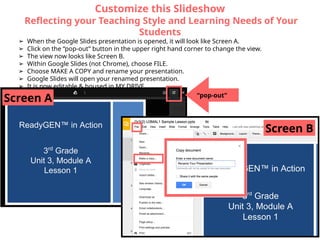
➢ When the Google Slides presentation is opened, it will look like Screen A.
➢ Click on the “pop-out” button in the upper right hand corner to change the view.
➢ The view now looks like Screen B.
➢ Within Google Slides (not Chrome), choose FILE.
➢ Choose MAKE A COPY and rename your presentation.
➢ Google Slides will open your renamed presentation.
➢ It is now editable & housed in MY DRIVE.
Screen A “pop-out”
Screen B
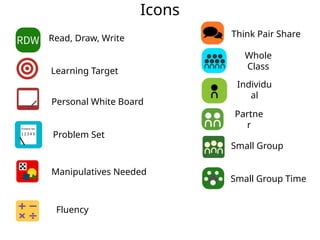
Icons
Read, Draw, Write
Learning Target
Think Pair Share
Individu
al
Partne
r
Whole
Class
Small Group Time
Small Group
Personal White Board
Problem Set
Manipulatives Needed
Fluency
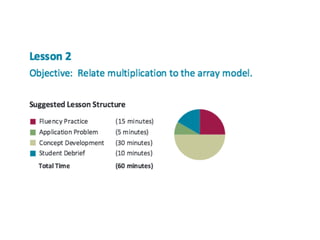
I can relate multiplication to the array model.
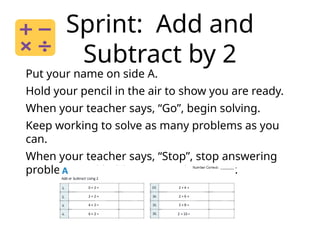
Sprint: Add and
Subtract by 2
Put your name on side A.
Hold your pencil in the air to show you are ready.
When your teacher says, “Go”, begin solving.
Keep working to solve as many problems as you
can.
When your teacher says, “Stop”, stop answering
problems and hold your pencil in the air.
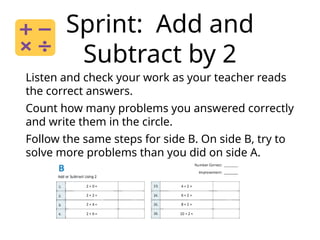
Sprint: Add and
Subtract by 2
Listen and check your work as your teacher reads
the correct answers.
Count how many problems you answered correctly
and write them in the circle.
Follow the same steps for side B. On side B, try to
solve more problems than you did on side A.
Group Counting
Let’s count to 18 forward and backward. I want
you to whisper, whisper and then speak the
numbers.
Watch my fingers to know whether or not to count
up or count down. A closed hand means to stop.
Count up Count down
Group Counting
Let’s count to 18 forward and backward again.
This time, think of every number instead of
whispering.
Group Counting
What did we just count by? Turn and talk to
your partner.
Group Counting
Let’s count by threes
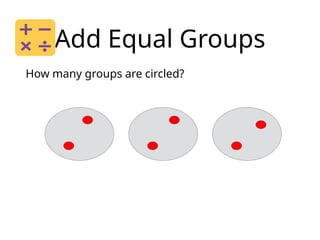
Add Equal Groups
How many groups are circled?
Add to Multiply
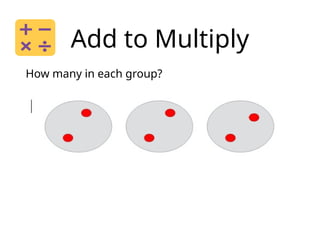
How many in each group?
Add to Multiply
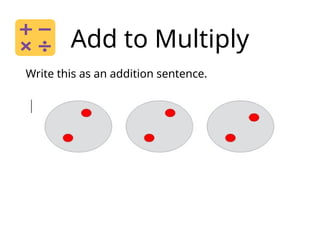
Write this as an addition sentence.
Add to Multiply
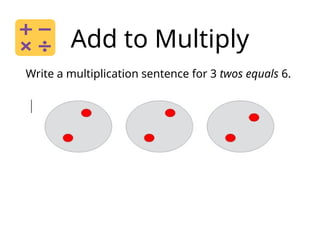
Write a multiplication sentence for 3 twos equals 6.
Add to Multiply
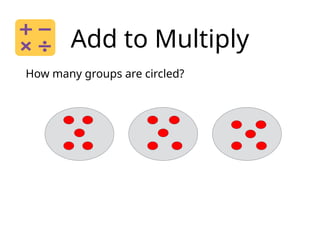
How many groups are circled?
Add to Multiply
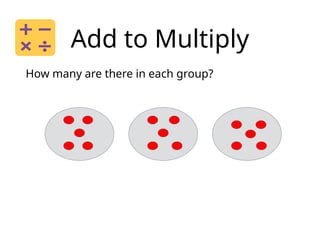
How many are there in each group?
Add to Multiply
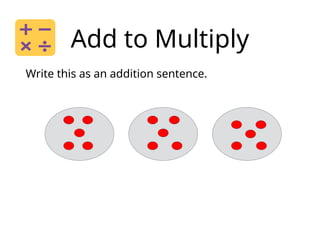
Write this as an addition sentence.
Add to Multiply
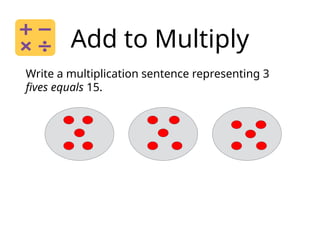
Write a multiplication sentence representing 3
fives equals 15.
Application Problem
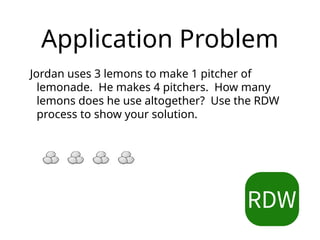
Jordan uses 3 lemons to make 1 pitcher of
lemonade. He makes 4 pitchers. How many
lemons does he use altogether? Use the RDW
process to show your solution.
Relate equal
groups to arrays
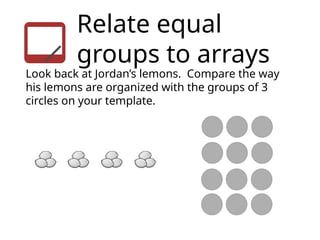
Look back at Jordan’s lemons. Compare the way
his lemons are organized with the groups of 3
circles on your template.
Relate equal
groups to arrays
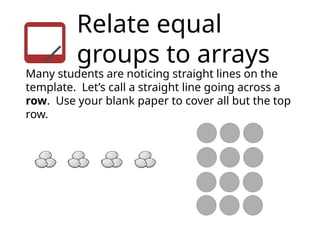
Many students are noticing straight lines on the
template. Let’s call a straight line going across a
row. Use your blank paper to cover all but the top
row.
Relate equal
groups to arrays
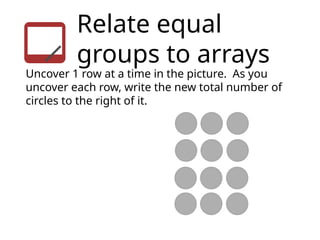
Uncover 1 row at a time in the picture. As you
uncover each row, write the new total number of
circles to the right of it.
Relate equal
groups to arrays
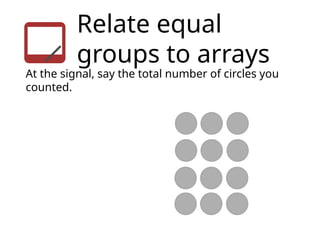
At the signal, say the total number of circles you
counted.
Relate equal
groups to arrays
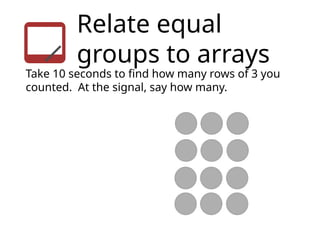
Take 10 seconds to find how many rows of 3 you
counted. At the signal, say how many.
Relate equal
groups to arrays
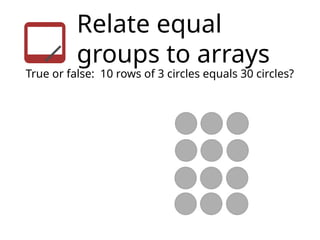
True or false: 10 rows of 3 circles equals 30 circles?
Relate equal
groups to arrays
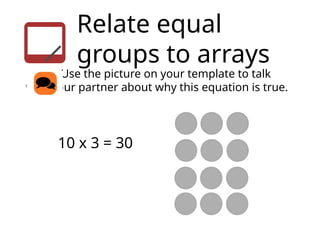
Use the picture on your template to talk
with your partner about why this equation is true.
10 x 3 = 30
Relate equal
groups to arrays
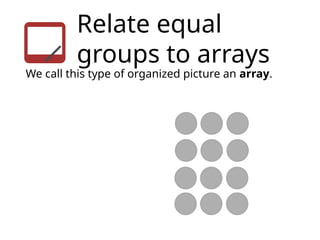
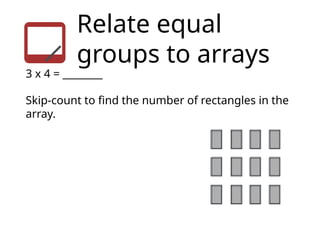
We call this type of organized picture an array.
Relate equal
groups to arrays
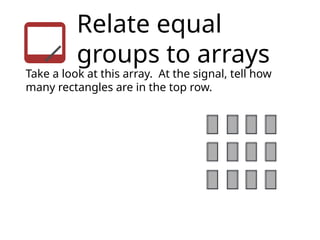
Take a look at this array. At the signal, tell how
many rectangles are in the top row.
Relate equal
groups to arrays
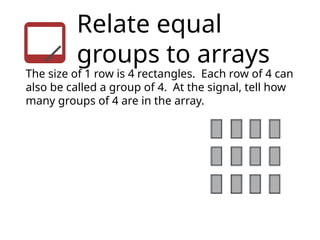
The size of 1 row is 4 rectangles. Each row of 4 can
also be called a group of 4. At the signal, tell how
many groups of 4 are in the array.
Relate equal
groups to arrays
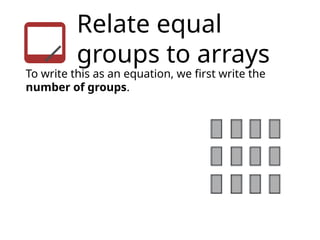
To write this as an equation, we first write the
number of groups.
Relate equal
groups to arrays
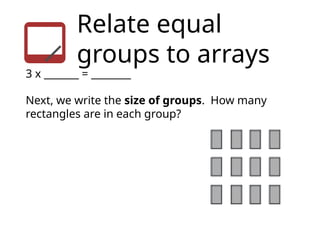
3 x _______ = ________
Next, we write the size of groups. How many
rectangles are in each group?
Relate equal
groups to arrays
3 x 4 = ________
Skip-count to find the number of rectangles in the
array.
Relate equal
groups to arrays
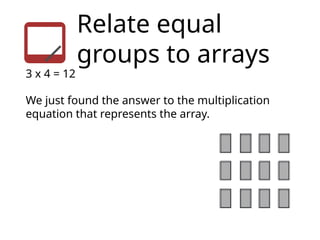
3 x 4 = 12
We just found the answer to the multiplication
equation that represents the array.
Redraw equal
groups as
arrays
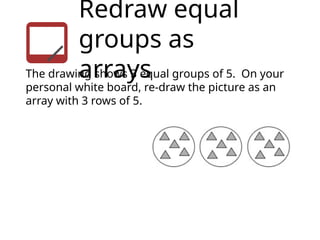
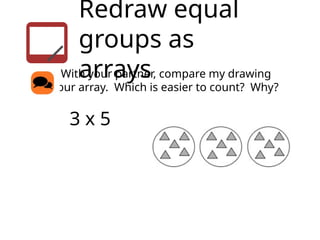
The drawing shows 3 equal groups of 5. On your
personal white board, re-draw the picture as an
array with 3 rows of 5.
Redraw equal
groups as
arrays
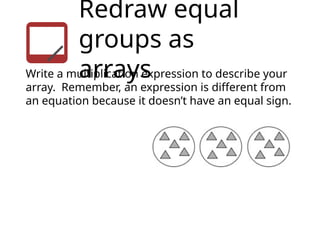
Write a multiplication expression to describe your
array. Remember, an expression is different from
an equation because it doesn’t have an equal sign.
Redraw equal
groups as
arrays
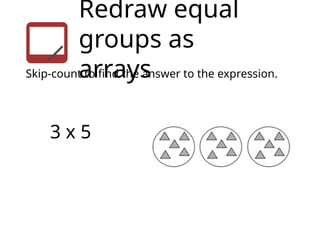
Skip-count to find the answer to the expression.
3 x 5
Redraw equal
groups as
arrays
With your partner, compare my drawing
with your array. Which is easier to count? Why?
3 x 5
Problem Set
Debrief
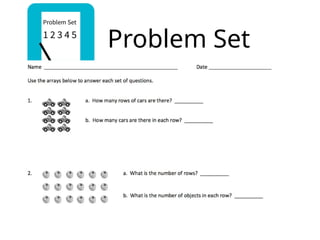
In Problems 5 and 6, how do the arrays represent
equal groups?
Compare Problems 5 and 7.
Compare equal groups in scattered configurations
and arrays.
Review new vocabulary: row, array, number of
groups, and size of groups.
Notice arrays around the room and possible think
of arrays in real world situations.
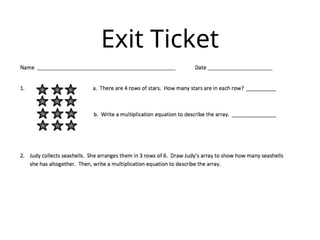
Exit Ticket

Eureka Grade 3 Module 1 - Lesson 2 Slides.pptx

  • 1.
    3rd Grade Module 1 Lesson2 Eureka Math At the request of elementary teachers, a team of Bethel & Sumner educators met as a committee to create Eureka slideshow presentations. These presentations are not meant as a script, nor are they required to be used. Please customize as needed. Thank you to the many educators who contributed to this project! Directions for customizing presentations are available on the next slide.
  • 2.
    Customize this Slideshow Reflectingyour Teaching Style and Learning Needs of Your Students ➢ When the Google Slides presentation is opened, it will look like Screen A. ➢ Click on the “pop-out” button in the upper right hand corner to change the view. ➢ The view now looks like Screen B. ➢ Within Google Slides (not Chrome), choose FILE. ➢ Choose MAKE A COPY and rename your presentation. ➢ Google Slides will open your renamed presentation. ➢ It is now editable & housed in MY DRIVE. Screen A “pop-out” Screen B
  • 3.
    Icons Read, Draw, Write LearningTarget Think Pair Share Individu al Partne r Whole Class Small Group Time Small Group Personal White Board Problem Set Manipulatives Needed Fluency
  • 5.
    I can relatemultiplication to the array model.
  • 6.
    Sprint: Add and Subtractby 2 Put your name on side A. Hold your pencil in the air to show you are ready. When your teacher says, “Go”, begin solving. Keep working to solve as many problems as you can. When your teacher says, “Stop”, stop answering problems and hold your pencil in the air.
  • 7.
    Sprint: Add and Subtractby 2 Listen and check your work as your teacher reads the correct answers. Count how many problems you answered correctly and write them in the circle. Follow the same steps for side B. On side B, try to solve more problems than you did on side A.
  • 8.
    Group Counting Let’s countto 18 forward and backward. I want you to whisper, whisper and then speak the numbers. Watch my fingers to know whether or not to count up or count down. A closed hand means to stop. Count up Count down
  • 9.
    Group Counting Let’s countto 18 forward and backward again. This time, think of every number instead of whispering.
  • 10.
    Group Counting What didwe just count by? Turn and talk to your partner.
  • 11.
  • 12.
    Add Equal Groups Howmany groups are circled?
  • 13.
    Add to Multiply Howmany in each group?
  • 14.
    Add to Multiply Writethis as an addition sentence.
  • 15.
    Add to Multiply Writea multiplication sentence for 3 twos equals 6.
  • 16.
    Add to Multiply Howmany groups are circled?
  • 17.
    Add to Multiply Howmany are there in each group?
  • 18.
    Add to Multiply Writethis as an addition sentence.
  • 19.
    Add to Multiply Writea multiplication sentence representing 3 fives equals 15.
  • 20.
    Application Problem Jordan uses3 lemons to make 1 pitcher of lemonade. He makes 4 pitchers. How many lemons does he use altogether? Use the RDW process to show your solution.
  • 21.
    Relate equal groups toarrays Look back at Jordan’s lemons. Compare the way his lemons are organized with the groups of 3 circles on your template.
  • 22.
    Relate equal groups toarrays Many students are noticing straight lines on the template. Let’s call a straight line going across a row. Use your blank paper to cover all but the top row.
  • 23.
    Relate equal groups toarrays Uncover 1 row at a time in the picture. As you uncover each row, write the new total number of circles to the right of it.
  • 24.
    Relate equal groups toarrays At the signal, say the total number of circles you counted.
  • 25.
    Relate equal groups toarrays Take 10 seconds to find how many rows of 3 you counted. At the signal, say how many.
  • 26.
    Relate equal groups toarrays True or false: 10 rows of 3 circles equals 30 circles?
  • 27.
    Relate equal groups toarrays Use the picture on your template to talk with your partner about why this equation is true. 10 x 3 = 30
  • 28.
    Relate equal groups toarrays We call this type of organized picture an array.
  • 29.
    Relate equal groups toarrays Take a look at this array. At the signal, tell how many rectangles are in the top row.
  • 30.
    Relate equal groups toarrays The size of 1 row is 4 rectangles. Each row of 4 can also be called a group of 4. At the signal, tell how many groups of 4 are in the array.
  • 31.
    Relate equal groups toarrays To write this as an equation, we first write the number of groups.
  • 32.
    Relate equal groups toarrays 3 x _______ = ________ Next, we write the size of groups. How many rectangles are in each group?
  • 33.
    Relate equal groups toarrays 3 x 4 = ________ Skip-count to find the number of rectangles in the array.
  • 34.
    Relate equal groups toarrays 3 x 4 = 12 We just found the answer to the multiplication equation that represents the array.
  • 35.
    Redraw equal groups as arrays Thedrawing shows 3 equal groups of 5. On your personal white board, re-draw the picture as an array with 3 rows of 5.
  • 36.
    Redraw equal groups as arrays Writea multiplication expression to describe your array. Remember, an expression is different from an equation because it doesn’t have an equal sign.
  • 37.
    Redraw equal groups as arrays Skip-countto find the answer to the expression. 3 x 5
  • 38.
    Redraw equal groups as arrays Withyour partner, compare my drawing with your array. Which is easier to count? Why? 3 x 5
  • 39.
  • 40.
    Debrief In Problems 5and 6, how do the arrays represent equal groups? Compare Problems 5 and 7. Compare equal groups in scattered configurations and arrays. Review new vocabulary: row, array, number of groups, and size of groups. Notice arrays around the room and possible think of arrays in real world situations.
  • 41.

Editor's Notes

  • #1 Presentation Project ReadyGEN Template
  • #2 This slideshow presentation is in VIEW ONLY. In order to edit the presentation and make it your own, you’ll need to MAKE A COPY. Follow the directions on the slide to MAKE A COPY that will be housed in MY DRIVE and that you’ll be able to edit.
  • #4 Suggested timing for each component of the lesson. We recommend teaching each component. When you customize this lesson, you may need to adjust the timing and/or content of the components to align more closely with the Mid- and/or End-of-Module Assessments (Backward Planning), meet the needs of your students, or fit time constraints.
  • #5 Lesson learning objective stated as an “I can” statement. Teachers, feel free to customize this to fit your class needs, make more student-friendly, etc.
  • #6 Fluency purposes: 1. Maintenance - Staying sharp on previously learned skills. 2. Preparation - Targeted practice for the current lesson 3. Anticipation - Skills that ensure that students will be ready for the in-depth work of upcoming lessons
  • #7 Fluency purposes: 1. Maintenance - Staying sharp on previously learned skills. 2. Preparation - Targeted practice for the current lesson 3. Anticipation - Skills that ensure that students will be ready for the in-depth work of upcoming lessons
  • #8 Note: Basic skip-counting skills from Grade 2 shift focus in this Grade 3 activity. Group counting lays a foundation for interpreting multiplication as repeated addition. When students count groups in this activity, they add and subtract groups of three when counting up and down.
  • #11 Direct students to count forward and backward to 18, periodically changing directions. Emphasize the 9 to 12 transition.
  • #12 This activity reviews Lesson 1. Students directly relate repeated addition to multiplication. They interpret products as the number of equal groups times the number of objects in each group.
  • #19 Continue with possible sequence: 5 groups of 10 and 3 groups of 4
  • #20 Note: Present the image 4 groups of 3 lemons with the word problem as a scaffold. This problem reviews multiplying equal groups from Lesson 1. It also leads into today’s Concept Development in which students relate multiplication to the array model.
  • #21 Student’s templates should be vertical
  • #22 Student’s templates should be vertical
  • #23 Student’s templates should be vertical
  • #24 Student’s templates should be vertical
  • #25 Student’s templates should be vertical
  • #26 Student’s templates should be vertical
  • #27 Student’s templates should be vertical
  • #28 Student’s templates should be vertical
  • #29 Student’s templates should be vertical
  • #30 Student’s templates should be vertical
  • #31 Student’s templates should be vertical
  • #32 Student’s templates should be vertical
  • #33 Student’s templates should be vertical
  • #34 Show an array of 2 rows of 6 and repeat the array.
  • #39 Consider assigning students Must Do problems and May Do problems. Problem sets can also be differentiated by assigning different problems to different students, depending on their understanding of the concept of the lesson. Items in the problems set move from less complex to more complex, and mirror the homework for that lesson.
  • #40 You may choose any combination of the questions below to lead the discussion.