Parul mudgil
photographer
Shaurya
sharma
Charmaine
Data
collector
Pooja papneja
photographer
Astha kacker
Group leader
Editor and compiler
Anoushka
Data collector
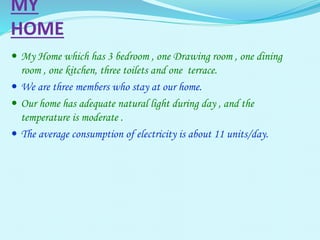
MY
HOME
 My Home which has 3 bedroom , one Drawing room , one dining
room , one kitchen, three toilets and one terrace.
 We are three members who stay at our home.
 Our home has adequate natural light during day , and the
temperature is moderate .
 The average consumption of electricity is about 11 units/day.
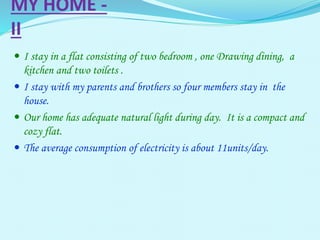
MY HOME -
II
 I stay in a flat consisting of two bedroom , one Drawing dining, a
kitchen and two toilets .
 I stay with my parents and brothers so four members stay in the
house.
 Our home has adequate natural light during day. It is a compact and
cozy flat.
 The average consumption of electricity is about 11units/day.
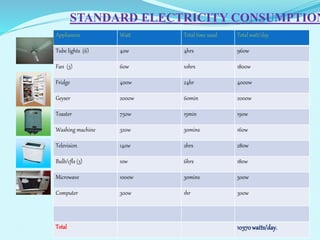
Appliances Watt Total time used Total watt/day
Tube lights (6) 40w 4hrs 960w
Fan (3) 60w 10hrs 1800w
Fridge 400w 24hr 4000w
Geyser 2000w 60min 2000w
Toaster 750w 15min 190w
Washing machine 320w 30mins 160w
Television 140w 2hrs 280w
Bulb/cfls (3) 10w 6hrs 180w
Microwave 1000w 30mins 500w
Computer 300w 1hr 300w
Total 10370watts/day.
STANDARD ELECTRICITY CONSUMPTION
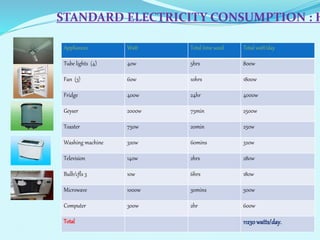
Appliances Watt Total time used Total watt/day
Tube lights (4) 40w 5hrs 800w
Fan (3) 60w 10hrs 1800w
Fridge 400w 24hr 4000w
Geyser 2000w 75min 2500w
Toaster 750w 20min 250w
Washing machine 320w 60mins 320w
Television 140w 2hrs 280w
Bulb/cfls 3 10w 6hrs 180w
Microwave 1000w 30mins 500w
Computer 300w 2hr 600w
Total 11230watts/day.
STANDARD ELECTRICITY CONSUMPTION : H
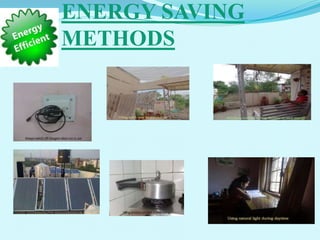
ENERGY SAVING
METHODS
Small Initiative Great
Results
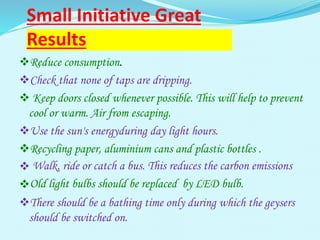
Reduce consumption.
Check that none of taps are dripping.
 Keep doors closed whenever possible. This will help to prevent
cool or warm. Air from escaping.
Use the sun's energyduring day light hours.
Recycling paper, aluminium cans and plastic bottles .
 Walk, ride or catch a bus. This reduces the carbon emissions
Old light bulbs should be replaced by LED bulb.
There should be a bathing time only during which the geysers
should be switched on.
Small Initiative Great
Results
Decrease the hot water temperature.
Use front loading washing Machine.
Tumble dryers use up a huge amount of energy.
Reuse water coming out of the tap that would drain
otherwise.
Utensils should be covered to avoid wastage of gas.
Small Initiative Great
Results
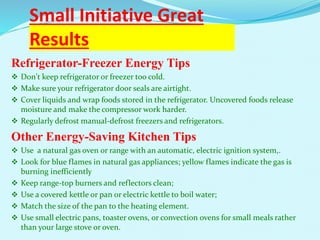
Refrigerator-Freezer Energy Tips
 Don't keep refrigerator or freezer too cold.
 Make sure your refrigerator door seals are airtight.
 Cover liquids and wrap foods stored in the refrigerator. Uncovered foods release
moisture and make the compressor work harder.
 Regularly defrost manual-defrost freezers and refrigerators.
Other Energy-Saving Kitchen Tips
 Use a natural gas oven or range with an automatic, electric ignition system,.
 Look for blue flames in natural gas appliances; yellow flames indicate the gas is
burning inefficiently
 Keep range-top burners and reflectors clean;
 Use a covered kettle or pan or electric kettle to boil water;
 Match the size of the pan to the heating element.
 Use small electric pans, toaster ovens, or convection ovens for small meals rather
than your large stove or oven.
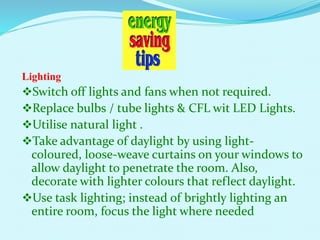
Lighting
Switch off lights and fans when not required.
Replace bulbs / tube lights & CFL wit LED Lights.
Utilise natural light .
Take advantage of daylight by using light-
coloured, loose-weave curtains on your windows to
allow daylight to penetrate the room. Also,
decorate with lighter colours that reflect daylight.
Use task lighting; instead of brightly lighting an
entire room, focus the light where needed
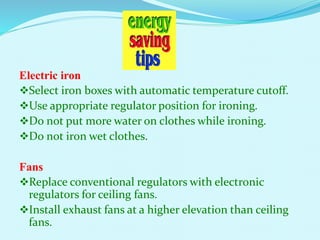
Electric iron
Select iron boxes with automatic temperature cutoff.
Use appropriate regulator position for ironing.
Do not put more water on clothes while ironing.
Do not iron wet clothes.
Fans
Replace conventional regulators with electronic
regulators for ceiling fans.
Install exhaust fans at a higher elevation than ceiling
fans.
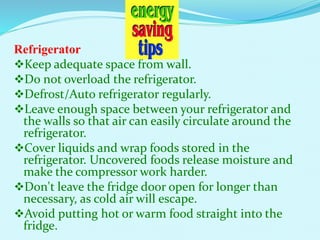
Refrigerator
Keep adequate space from wall.
Do not overload the refrigerator.
Defrost/Auto refrigerator regularly.
Leave enough space between your refrigerator and
the walls so that air can easily circulate around the
refrigerator.
Cover liquids and wrap foods stored in the
refrigerator. Uncovered foods release moisture and
make the compressor work harder.
Don't leave the fridge door open for longer than
necessary, as cold air will escape.
Avoid putting hot or warm food straight into the
fridge.
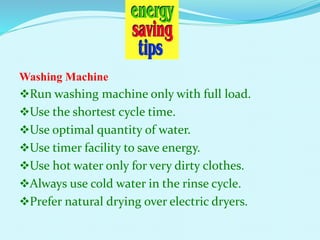
Washing Machine
Run washing machine only with full load.
Use the shortest cycle time.
Use optimal quantity of water.
Use timer facility to save energy.
Use hot water only for very dirty clothes.
Always use cold water in the rinse cycle.
Prefer natural drying over electric dryers.
Geyser
 Reduce thermostat setting from 60º to 50º C.
 Use Solar Water Heater - a good replacement for an electric water
heater.
Mixers
 Avoid dry grinding in your food processors (mixers and grinders) as it
takes longer time than liquid grinding.
Microwave Ovens
 Reduce energy consumption by 50 % compared to conventional electric
/ gas stoves.
 Do not bake large food items.
 Don't open the oven door too often to check food condition as each
opening leads to a temperature drop of 25º C
Electric Stove
Turn off electric stoves several minutes before the specified
cooking time.
Use flat-bottomed pans that make full contact with the
cooking coil.
Gas Stove
Remember that a blue flame means gas stove is operating
efficiently.
Yellowish flame is an indicator that the burner needs
cleaning.
Use pressure cookers as much as possible.
Bring items taken out of refrigerators (like vegetable, milk,
Air Conditioning
 Ensure proper sealing of doors and windows.
 Clean AC filter every month.
 Prefer air conditioners having automatic temperature cut off.
 Leave enough space between your air conditioner and the walls to allow
better air circulation.
 A roof garden can reduce the load on Air Conditioner.
 Set your thermostat as high as comfortably possible in the summer. The
less difference between the indoor and outdoor temperatures, the lower
will be energy consumption.
 Don't place lamps or TV sets near your air-conditioning thermostat. The
thermostat senses heat from these appliances, which can cause the air
conditioner to run longer than necessary.
 Plant trees or shrubs to shade air-conditioning units but not to block the
airflow. A unit operating in the shade uses as much as 10% less electricity
than the same one operating in the sun.
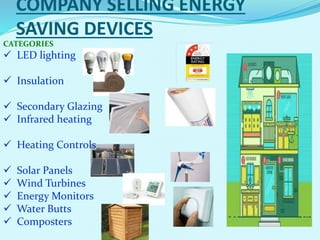
COMPANY SELLING ENERGY
SAVING DEVICES
CATEGORIES
 LED lighting
 Insulation
 Secondary Glazing
 Infrared heating
 Heating Controls
 Solar Panels
 Wind Turbines
 Energy Monitors
 Water Butts
 Composters
Energy saved on use of the power saving
methods as enumerated above
In the two houses is
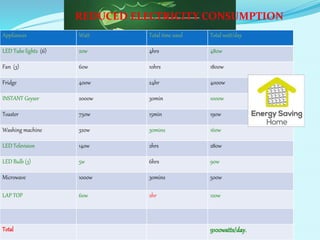
Appliances Watt Total time used Total watt/day
LED Tube lights (6) 20w 4hrs 480w
Fan (3) 60w 10hrs 1800w
Fridge 400w 24hr 4000w
INSTANT Geyser 2000w 30min 1000w
Toaster 750w 15min 190w
Washing machine 320w 30mins 160w
LED Television 140w 2hrs 280w
LED Bulb (3) 5w 6hrs 90w
Microwave 1000w 30mins 500w
LAP TOP 60w 2hr 120w
Total 9100watts/day.
REDUCED ELECTRICITY CONSUMPTION
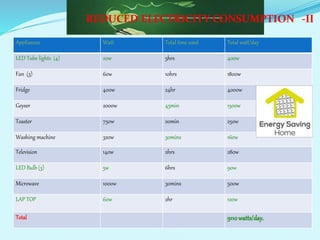
Appliances Watt Total time used Total watt/day
LED Tube lights (4) 20w 5hrs 400w
Fan (3) 60w 10hrs 1800w
Fridge 400w 24hr 4000w
Geyser 2000w 45min 1500w
Toaster 750w 20min 250w
Washing machine 320w 30mins 160w
Television 140w 2hrs 280w
LED Bulb (3) 5w 6hrs 90w
Microwave 1000w 30mins 500w
LAP TOP 60w 2hr 120w
Total 9110watts/day.
REDUCED ELECTRICITY CONSUMPTION -II
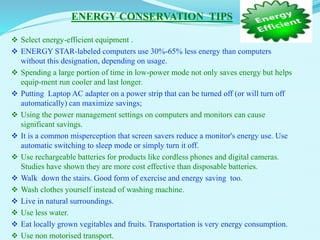
ENERGY CONSERVATION TIPS
 Select energy-efficient equipment .
 ENERGY STAR-labeled computers use 30%-65% less energy than computers
without this designation, depending on usage.
 Spending a large portion of time in low-power mode not only saves energy but helps
equip-ment run cooler and last longer.
 Putting Laptop AC adapter on a power strip that can be turned off (or will turn off
automatically) can maximize savings;
 Using the power management settings on computers and monitors can cause
significant savings.
 It is a common misperception that screen savers reduce a monitor's energy use. Use
automatic switching to sleep mode or simply turn it off.
 Use rechargeable batteries for products like cordless phones and digital cameras.
Studies have shown they are more cost effective than disposable batteries.
 Walk down the stairs. Good form of exercise and energy saving too.
 Wash clothes yourself instead of washing machine.
 Live in natural surroundings.
 Use less water.
 Eat locally grown vegitables and fruits. Transportation is very energy consumption.
 Use non motorised transport.
Eumind energy at home

Eumind energy at home

  • 1.
  • 2.
    MY HOME  My Homewhich has 3 bedroom , one Drawing room , one dining room , one kitchen, three toilets and one terrace.  We are three members who stay at our home.  Our home has adequate natural light during day , and the temperature is moderate .  The average consumption of electricity is about 11 units/day.
  • 3.
    MY HOME - II I stay in a flat consisting of two bedroom , one Drawing dining, a kitchen and two toilets .  I stay with my parents and brothers so four members stay in the house.  Our home has adequate natural light during day. It is a compact and cozy flat.  The average consumption of electricity is about 11units/day.
  • 4.
    Appliances Watt Totaltime used Total watt/day Tube lights (6) 40w 4hrs 960w Fan (3) 60w 10hrs 1800w Fridge 400w 24hr 4000w Geyser 2000w 60min 2000w Toaster 750w 15min 190w Washing machine 320w 30mins 160w Television 140w 2hrs 280w Bulb/cfls (3) 10w 6hrs 180w Microwave 1000w 30mins 500w Computer 300w 1hr 300w Total 10370watts/day. STANDARD ELECTRICITY CONSUMPTION
  • 5.
    Appliances Watt Totaltime used Total watt/day Tube lights (4) 40w 5hrs 800w Fan (3) 60w 10hrs 1800w Fridge 400w 24hr 4000w Geyser 2000w 75min 2500w Toaster 750w 20min 250w Washing machine 320w 60mins 320w Television 140w 2hrs 280w Bulb/cfls 3 10w 6hrs 180w Microwave 1000w 30mins 500w Computer 300w 2hr 600w Total 11230watts/day. STANDARD ELECTRICITY CONSUMPTION : H
  • 6.
  • 7.
    Small Initiative Great Results Reduceconsumption. Check that none of taps are dripping.  Keep doors closed whenever possible. This will help to prevent cool or warm. Air from escaping. Use the sun's energyduring day light hours. Recycling paper, aluminium cans and plastic bottles .  Walk, ride or catch a bus. This reduces the carbon emissions Old light bulbs should be replaced by LED bulb. There should be a bathing time only during which the geysers should be switched on.
  • 8.
    Small Initiative Great Results Decreasethe hot water temperature. Use front loading washing Machine. Tumble dryers use up a huge amount of energy. Reuse water coming out of the tap that would drain otherwise. Utensils should be covered to avoid wastage of gas.
  • 9.
    Small Initiative Great Results Refrigerator-FreezerEnergy Tips  Don't keep refrigerator or freezer too cold.  Make sure your refrigerator door seals are airtight.  Cover liquids and wrap foods stored in the refrigerator. Uncovered foods release moisture and make the compressor work harder.  Regularly defrost manual-defrost freezers and refrigerators. Other Energy-Saving Kitchen Tips  Use a natural gas oven or range with an automatic, electric ignition system,.  Look for blue flames in natural gas appliances; yellow flames indicate the gas is burning inefficiently  Keep range-top burners and reflectors clean;  Use a covered kettle or pan or electric kettle to boil water;  Match the size of the pan to the heating element.  Use small electric pans, toaster ovens, or convection ovens for small meals rather than your large stove or oven.
  • 10.
    Lighting Switch off lightsand fans when not required. Replace bulbs / tube lights & CFL wit LED Lights. Utilise natural light . Take advantage of daylight by using light- coloured, loose-weave curtains on your windows to allow daylight to penetrate the room. Also, decorate with lighter colours that reflect daylight. Use task lighting; instead of brightly lighting an entire room, focus the light where needed
  • 11.
    Electric iron Select ironboxes with automatic temperature cutoff. Use appropriate regulator position for ironing. Do not put more water on clothes while ironing. Do not iron wet clothes. Fans Replace conventional regulators with electronic regulators for ceiling fans. Install exhaust fans at a higher elevation than ceiling fans.
  • 12.
    Refrigerator Keep adequate spacefrom wall. Do not overload the refrigerator. Defrost/Auto refrigerator regularly. Leave enough space between your refrigerator and the walls so that air can easily circulate around the refrigerator. Cover liquids and wrap foods stored in the refrigerator. Uncovered foods release moisture and make the compressor work harder. Don't leave the fridge door open for longer than necessary, as cold air will escape. Avoid putting hot or warm food straight into the fridge.
  • 13.
    Washing Machine Run washingmachine only with full load. Use the shortest cycle time. Use optimal quantity of water. Use timer facility to save energy. Use hot water only for very dirty clothes. Always use cold water in the rinse cycle. Prefer natural drying over electric dryers.
  • 14.
    Geyser  Reduce thermostatsetting from 60º to 50º C.  Use Solar Water Heater - a good replacement for an electric water heater. Mixers  Avoid dry grinding in your food processors (mixers and grinders) as it takes longer time than liquid grinding. Microwave Ovens  Reduce energy consumption by 50 % compared to conventional electric / gas stoves.  Do not bake large food items.  Don't open the oven door too often to check food condition as each opening leads to a temperature drop of 25º C
  • 15.
    Electric Stove Turn offelectric stoves several minutes before the specified cooking time. Use flat-bottomed pans that make full contact with the cooking coil. Gas Stove Remember that a blue flame means gas stove is operating efficiently. Yellowish flame is an indicator that the burner needs cleaning. Use pressure cookers as much as possible. Bring items taken out of refrigerators (like vegetable, milk,
  • 16.
    Air Conditioning  Ensureproper sealing of doors and windows.  Clean AC filter every month.  Prefer air conditioners having automatic temperature cut off.  Leave enough space between your air conditioner and the walls to allow better air circulation.  A roof garden can reduce the load on Air Conditioner.  Set your thermostat as high as comfortably possible in the summer. The less difference between the indoor and outdoor temperatures, the lower will be energy consumption.  Don't place lamps or TV sets near your air-conditioning thermostat. The thermostat senses heat from these appliances, which can cause the air conditioner to run longer than necessary.  Plant trees or shrubs to shade air-conditioning units but not to block the airflow. A unit operating in the shade uses as much as 10% less electricity than the same one operating in the sun.
  • 17.
    COMPANY SELLING ENERGY SAVINGDEVICES CATEGORIES  LED lighting  Insulation  Secondary Glazing  Infrared heating  Heating Controls  Solar Panels  Wind Turbines  Energy Monitors  Water Butts  Composters
  • 18.
    Energy saved onuse of the power saving methods as enumerated above In the two houses is
  • 19.
    Appliances Watt Totaltime used Total watt/day LED Tube lights (6) 20w 4hrs 480w Fan (3) 60w 10hrs 1800w Fridge 400w 24hr 4000w INSTANT Geyser 2000w 30min 1000w Toaster 750w 15min 190w Washing machine 320w 30mins 160w LED Television 140w 2hrs 280w LED Bulb (3) 5w 6hrs 90w Microwave 1000w 30mins 500w LAP TOP 60w 2hr 120w Total 9100watts/day. REDUCED ELECTRICITY CONSUMPTION
  • 20.
    Appliances Watt Totaltime used Total watt/day LED Tube lights (4) 20w 5hrs 400w Fan (3) 60w 10hrs 1800w Fridge 400w 24hr 4000w Geyser 2000w 45min 1500w Toaster 750w 20min 250w Washing machine 320w 30mins 160w Television 140w 2hrs 280w LED Bulb (3) 5w 6hrs 90w Microwave 1000w 30mins 500w LAP TOP 60w 2hr 120w Total 9110watts/day. REDUCED ELECTRICITY CONSUMPTION -II
  • 21.
    ENERGY CONSERVATION TIPS Select energy-efficient equipment .  ENERGY STAR-labeled computers use 30%-65% less energy than computers without this designation, depending on usage.  Spending a large portion of time in low-power mode not only saves energy but helps equip-ment run cooler and last longer.  Putting Laptop AC adapter on a power strip that can be turned off (or will turn off automatically) can maximize savings;  Using the power management settings on computers and monitors can cause significant savings.  It is a common misperception that screen savers reduce a monitor's energy use. Use automatic switching to sleep mode or simply turn it off.  Use rechargeable batteries for products like cordless phones and digital cameras. Studies have shown they are more cost effective than disposable batteries.  Walk down the stairs. Good form of exercise and energy saving too.  Wash clothes yourself instead of washing machine.  Live in natural surroundings.  Use less water.  Eat locally grown vegitables and fruits. Transportation is very energy consumption.  Use non motorised transport.