Vital Wave Consulting
      Field Teams
                                                   eTransform Africa:
Latin America
 Argentina
 Brazil
                                           Financial Services Sector
 Chile
 Costa Rica
 Dominican Republic
 Mexico                      The World Bank | African Development Bank | African Union
 Peru


Asia
 India

                                                                         PEER REVIEW WORKSHOP
 China
 Cambodia
 Uzbekistan


Eastern Europe
 Estonia
                                                                   Johannesburg, South Africa
 Ukraine


Africa                                                                           June 28, 2011
 Egypt
 South Africa
 Nigeria
 Kenya
                                              Brooke Partridge
                                                                 CEO
Middle East
 United Arab Emirates                            Brendan Smith
                                       Director of Consulting Services
United States                                    Scott Stefanski
 California (Headquarters)                                 Consultant
Chapter 2: Landscape Analysis
          Summary


                                © 2011 Vital Wave ConsultingTM
              1                 Proprietary and Confidential:
                                Do not copy or distribute.
Contents


    • Purpose and focus of assignment
    • Approach of assignment
    • Overarching trends in ICT development relevant to Africa’s financial
      sector
    • Challenges to financial sector development in Africa
.
    • Opportunities for ICT developments to address financial sector
      challenges
    • Progress of African nations in ICT (Network Readiness Index- NRI)
    • State of financial sector development in Africa assessed by financial
      inclusion indices


                                                             © 2011 Vital Wave ConsultingTM
                                        2                    Proprietary and Confidential:
                                                             Do not copy or distribute.
Landscape Purpose & Focus

    Purpose:
.   Overview of challenges to financial sector development in Africa and
    role for ICT, with notable attention to objective of financial inclusion


    Approach:
    1. Compile primary ICT developments relevant to Africa’s financial
       sector development
    2. Examine and assemble challenges to Africa’s financial sector
.      development
    3. Analyze where ICT developments meet identified financial sector
       development challenges
    4. Analyze state of financial inclusion & ICT in Africa and opportunities
       for investment

                                                               © 2011 Vital Wave ConsultingTM
                                        3                      Proprietary and Confidential:
                                                               Do not copy or distribute.
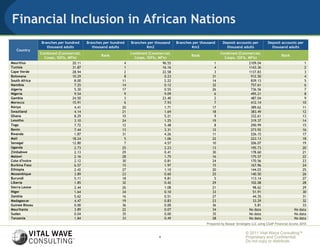
Financial Inclusion in African Nations
                Branches per hundred    Branches per hundred   Branches per thousand      Branches per thousand     Deposit accounts per          Deposit accounts per
                   thousand adults         thousand adults             Km2                        Km2                 thousand adults               thousand adults
   Country
                Combined (Commercial,                          Combined (Commercial,                              Combined (Commercial,
                                               Rank                                               Rank                                                     Rank
                  Coops, SSFIs, MFIs)                            Coops, SSFIs, MFIs)                                Coops, SSFIs, MFIs)
Mauritius                       20.11                      4                      96.55                       1                       2109.04                             1
Tunisia                         31.87                      1                      16.16                       4                       1143.36                             2
Cape Verde                      28.94                      2                      22.58                       3                       1137.83                             3
Botswana                        10.29                      8                       0.23                      31                        912.50                             4
South Africa                     8.00                     11                       2.22                      14                        839.13                             5
Namibia                          7.25                     14                       0.12                      32                        757.61                             6
Algeria                          5.30                     17                       0.55                      26                        736.56                             7
Nigeria                          9.54                      9                       9.09                       6                        495.21                             8
Gambia                          24.50                      3                      23.40                       2                        487.04                             9
Morocco                         15.91                      6                       7.93                       7                        412.14                            10
Kenya                            4.41                     20                       1.71                      17                        389.62                            11
Swaziland                        4.14                     21                       1.69                      18                        383.49                            12
Ghana                            8.29                     10                       5.21                       9                        332.61                            13
Lesotho                          3.10                     24                       1.25                      19                        319.37                            14
Togo                             7.72                     12                       5.48                       8                        290.99                            15
Benin                            7.44                     13                       3.31                      12                        273.92                            16
Rwanda                           1.87                     31                       4.26                      11                        226.15                            17
Mali                            18.24                      5                       1.06                      22                        223.13                            18
Senegal                         12.80                      7                       4.57                      10                        206.07                            19
Uganda                           2.73                     25                       2.23                      13                        195.73                            20
Zimbabwe                         2.13                     29                       0.41                      30                        178.60                            21
Malawi                           2.16                     28                       1.75                      16                        175.57                            22
Cote d'Ivoire                    2.12                     30                       0.81                      24                        170.56                            23
Burkina Faso                     6.57                     15                       1.97                      15                        167.96                            24
Ethiopia                         2.42                     27                       1.10                      20                        144.03                            25
Mozambique                       3.89                     23                       0.60                      25                        140.50                            26
Burundi                          5.11                     18                       9.81                       5                        113.14                            27
Liberia                          1.85                     32                       0.42                      29                        102.08                            28
Sierra Leone                     2.44                     26                       1.08                      21                         98.62                            29
Niger                            1.64                     34                       0.10                      33                         51.91                            30
Zambia                           5.62                     16                       0.51                      27                         44.35                            31
Madagascar                       4.47                     19                       0.83                      23                         33.29                            32
Guinee Bissau                    0.00                     36                       0.00                      36                          5.81                            33
Mauritania                       3.89                     22                       0.07                      34                       No data                       No data
Sudan                            0.04                     35                       0.00                      35                       No data                       No data
Tanzania                         1.84                     33                       0.49                      28                       No data                       No data
                                                                                                          Prepared by Bazaar Strategies LLC using CGAP Financial Access 2010

                                                                                                                                   © 2011 Vital Wave ConsultingTM
                                                                              4                                                    Proprietary and Confidential:
                                                                                                                                   Do not copy or distribute.
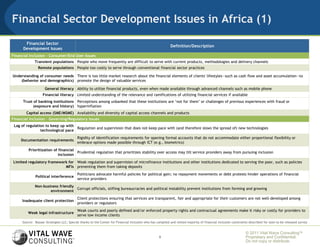
Financial Sector Development Issues in Africa (1)
       Financial Sector
                                                                                                           Definition/Description
      Development Issues
Financial Inclusion – Consumer/End User Issues
              Transient populations People who move frequently are difficult to serve with current products, methodologies and delivery channels
                Remote populations People too costly to serve through conventional financial sector practices

Understanding of consumer needs There is too little market research about the financial elements of clients' lifestyles—such as cash flow and asset accumulation—to
    (behavior and demographics) promote the design of valuable services

                     General literacy Ability to utilize financial products, even when made available through advanced channels such as mobile phone
                   Financial literacy Limited understanding of the relevance and ramifications of utilizing financial services if available
      Trust of banking institutions Perceptions among unbanked that these institutions are ‘not for them’ or challenges of previous experiences with fraud or
            (exposure and history) hyperinflation
        Capital access (SME/MSME) Availability and diversity of capital access channels and products
Financial Inclusion – Governing/Regulatory Issues
 Lag of regulation to keep up with
                                   Regulation and supervision that does not keep pace with (and therefore slows the spread of) new technologies
                technological pace
                                           Rigidity of identification requirements for opening formal accounts that do not accommodate either proportional flexibility or
     Documentation requirements
                                           embrace options made possible through ICT (e.g., biometrics)
          Prioritization of financial
                                      Prudential regulation that prioritizes stability over access may tilt service providers away from pursuing inclusion
                            inclusion
Limited regulatory framework for Weak regulation and supervision of microfinance institutions and other institutions dedicated to serving the poor, such as policies
                           MFIs preventing them from taking deposits
                                           Politicians advocate harmful policies for political gain; no repayment movements or debt protests hinder operations of financial
              Political interference
                                           service providers
              Non-business friendly
                                    Corrupt officials, stifling bureaucracies and political instability prevent institutions from forming and growing
                      environment
                                           Client protections ensuring that services are transparent, fair and appropriate for their customers are not well-developed among
     Inadequate client protection
                                           providers or regulators
                                           Weak courts and poorly defined and/or enforced property rights and contractual agreements make it risky or costly for providers to
         Weak legal infrastructure
                                           serve low income clients
      Source: Bazaar Strategies LLC; Special thanks to the Center for Financial Inclusion who has compiled and vetted majority of financial inclusion constraints described for soon to be released survey


                                                                                                                                                               © 2011 Vital Wave ConsultingTM
                                                                                                    5                                                          Proprietary and Confidential:
                                                                                                                                                               Do not copy or distribute.
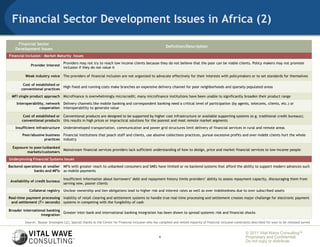
Financial Sector Development Issues in Africa (2)

     Financial Sector
                                                                                                         Definition/Description
    Development Issues
Financial Inclusion – Market Maturity Issues
                                   Providers may not try to reach low income clients because they do not believe that the poor can be viable clients. Policy makers may not promote
             Provider interest
                                   inclusion if they do not value it

          Weak industry voice The providers of financial inclusion are not organized to advocate effectively for their interests with policymakers or to set standards for themselves

        Cost of established or
                               High fixed and running costs make branches an expensive delivery channel for poor neighborhoods and sparsely populated areas
       conventional practices
  MFI single product approach Microfinance is overwhelmingly microcredit; many microfinance institutions have been unable to significantly broaden their product range
    Interoperability, network Delivery channels like mobile banking and correspondent banking need a critical level of participation (by agents, telecoms, clients, etc.) or
                  cooperation interoperability to generate value

        Cost of established or Conventional products are designed to be supported by higher cost infrastructure or available supporting systems (e.g. traditional credit bureaus);
       conventional products this results in high prices or impractical solutions for the poorest and most remote market segments
    Insufficient infrastructure Underdeveloped transportation, communication and power grid structures limit delivery of financial services in rural and remote areas
        Poor/abusive business Financial institutions that poach staff and clients, use abusive collections practices, pursue excessive profits and over-indebt clients hurt the whole
                    practices industry

  Exposure to poor/unbanked
                            Mainstream financial services providers lack sufficient understanding of how to design, price and market financial services to low-income people
          markets/customers
Underpinning Financial Systems Issues
Backend operations at smaller MFIs with greater reach to unbanked consumers and SMEs have limited or no backend systems that afford the ability to support modern advances such
              banks and MFIs as mobile payments

                                   Insufficient information about borrowers’ debt and repayment history limits providers’ ability to assess repayment capacity, discouraging them from
 Availability of credit bureaus
                                   serving new, poorer clients
            Collateral registry Unclear ownership and lien obligations lead to higher risk and interest rates as well as over indebtedness due to over subscribed assets
Real-time payment processing Inability of retail clearing and settlement systems to handle true real-time processing and settlement creates major challenge for electronic payment
 and settlement (T+ seconds) systems in competing with the fungibility of cash

Broader international banking
                              Greater inter-bank and international banking integration has been shown to spread systemic risk and financial shocks
                  integration

         Source: Bazaar Strategies LLC; Special thanks to the Center for Financial Inclusion who has compiled and vetted majority of financial inclusion constraints described for soon to be released survey


                                                                                                                                                                © 2011 Vital Wave ConsultingTM
                                                                                                     6                                                          Proprietary and Confidential:
                                                                                                                                                                Do not copy or distribute.
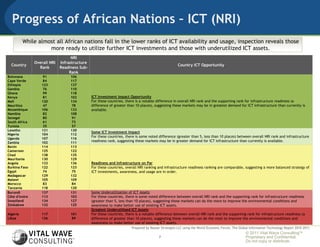
Progress of African Nations – ICT (NRI)
          While almost all African nations fall in the lower ranks of ICT availability and usage, inspection reveals those
                    more ready to utilize further ICT investments and those with underutilized ICT assets.
                                    NRI
                Overall NRI   Infrastructure
  Country                                                                                            Country ICT Opportunity
                  Rank        Readiness Sub-
                                   Rank
Botswana           91              106
Cape Verde         84              117
Ethiopia           123             137
Gambia             76              110
Ghana              99              118
Kenya              81              102         ICT Investment Impact Opportunity
Mali               120             134         For these countries, there is a notable difference in overall NRI rank and the supporting rank for infrastructure readiness (a
Mauritius          47              78          difference of greater than 10 places), suggesting these markets may be in greatest demand for ICT infrastructure than currently is
Mozambique         106             133         available.
Namibia            82              108
Senegal            80              91
South Africa       61              73
Tunisia            35              57
Lesotho            121             130
                                               Some ICT Investment Impact
Nigeria            104             112
                                               For these countries, there is some noted difference (greater than 5, less than 10 places) between overall NRI rank and infrastructure
Uganda             107             116
Zambia             102             111
                                               readiness rank, suggesting these markets may be in greater demand for ICT infrastructure than currently is available.
Benin              114             113
Cameroon           125             122
Chad               138             135
Mauritania         130             129
Angola             133             136         Readiness and Infrastructure on Par
Burkina Faso       122             123         For these countries, overall NRI ranking and infrastructure readiness ranking are comparable, suggesting a more balanced strategy of
Egypt              74              75          ICT investments, awareness, and usage are in order.
Madagascar         129             132
Malawi             105             109
Morocco            83              84
Tanzania           118             120
Burundi            137             131         Some Underutilization of ICT Assets
Côte d'Ivoire      113             103         For these countries, there is some noted difference between overall NRI rank and the supporting rank for infrastructure readiness
Swaziland          134             127         (greater than 5, less than 10 places), suggesting these markets can do the more to improve the environmental conditions and
Zimbabwe           132             125         awareness to make better use of existing ICT assets.
                                               Greatest Underutilized ICT Assets
Algeria            117             101         For these countries, there is a notable difference between overall NRI rank and the supporting rank for infrastructure readiness (a
Libya              126             89          difference of greater than 10 places), suggesting these markets can do the most to improve the environmental conditions and
                                               awareness to make better use of existing ICT assets.
                                                                       Prepared by Bazaar Strategies LLC using the World Economic Forum, The Global Information Technology Report 2010-2011.
                                                                                                                                                 © 2011 Vital Wave ConsultingTM
                                                                                        7                                                        Proprietary and Confidential:
                                                                                                                                                 Do not copy or distribute.
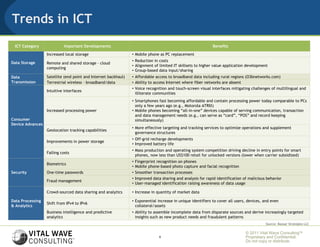
Trends in ICT
 ICT Category               Important Developments                                                             Benefits

                  Increased local storage                       • Mobile phone as PC replacement
                                                                • Reduction in costs
Data Storage      Remote and shared storage – cloud
                                                                • Alignment of limited IT skillsets to higher value application development
                  computing
                                                                • Group-based data input/sharing
Data              Satellite (end point and Internet backhaul)   • Affordable access to broadband data including rural regions (O3bnetworks.com)
Transmission      Terrestrial wireless – broadband/data         • Ability to access Internet where fiber networks are absent
                                                                • Voice recognition and touch-screen visual interfaces mitigating challenges of multilingual and
                  Intuitive interfaces
                                                                  illiterate communities
                                                                • Smartphones fast becoming affordable and contain processing power today comparable to PCs
                                                                  only a few years ago (e.g., Motorola ATRIX)
                  Increased processing power                    • Mobile phones becoming “all-in-one” devices capable of serving communication, transaction
                                                                  and data management needs (e.g., can serve as “card”, “POS” and record keeping
Consumer                                                          simultaneously)
Device Advances
                                                                • More effective targeting and tracking services to optimize operations and supplement
                  Geolocation tracking capabilities
                                                                  governance structures
                                                                • Off-grid recharge developments
                  Improvements in power storage
                                                                • Improved battery life
                                                                • Mass production and operating system competition driving decline in entry points for smart
                  Falling costs
                                                                  phones, now less than US$100 retail for unlocked versions (lower when carrier subsidized)
                                                                •   Fingerprint recognition on phones
                  Biometrics
                                                                •   Mobile phone-based photo capture and facial recognition
Security          One-time passwords                            •   Smoother transaction processes
                                                                •   Improved data sharing and analysis for rapid identification of malicious behavior
                  Fraud management
                                                                •   User-managed identification raising awareness of data usage

                  Crowd-sourced data sharing and analytics      • Increase in quantity of market data

Data Processing                                                 • Exponential increase in unique identifiers to cover all users, devices, and even
                  Shift from IPv4 to IPv6
& Analytics                                                       collateral/assets
                  Business intelligence and predictive          • Ability to assemble incomplete data from disparate sources and derive increasingly targeted
                  analytics                                       insights such as new product needs and fraudulent patterns
                                                                                                                                            Source: Bazaar Strategies LLC

                                                                                                                                 © 2011 Vital Wave ConsultingTM
                                                                                 8                                               Proprietary and Confidential:
                                                                                                                                 Do not copy or distribute.
Chapter 3: Challenges & Opportunities
             Summary


                                 © 2011 Vital Wave ConsultingTM
                  9              Proprietary and Confidential:
                                 Do not copy or distribute.
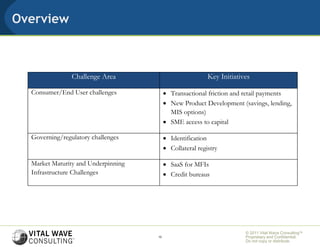
Overview


                  Challenge Area                             Key Initiatives

    Consumer/End User challenges             Transactional friction and retail payments
                                             New Product Development (savings, lending,
                                              MIS options)
                                             SME access to capital

    Governing/regulatory challenges          Identification
                                             Collateral registry

    Market Maturity and Underpinning         SaaS for MFIs
    Infrastructure Challenges                Credit bureaus


                                                                          © 2011 Vital Wave ConsultingTM
                                       10                                 Proprietary and Confidential:
                                                                          Do not copy or distribute.
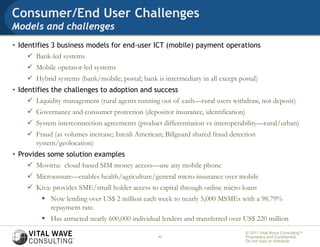
Consumer/End User Challenges
Models and challenges
• Identifies 3 business models for end-user ICT (mobile) payment operations
      Bank-led systems
     Mobile operator-led systems
     Hybrid systems (bank/mobile; postal; bank is intermediary in all except postal)
• Identifies the challenges to adoption and success
      Liquidity management (rural agents running out of cash—rural users withdraw, not deposit)
     Governance and consumer protection (depositor insurance, identification)
     System interconnection agreements (product differentiation vs interoperability—rural/urban)
     Fraud (as volumes increase; Isreali American; Billguard shared fraud detection
      system/geolocation)
• Provides some solution examples
      Movirtu: cloud-based SIM money access—use any mobile phone
     Microensure—enables health/agriculture/general micro-insurance over mobile
     Kiva: provides SME/small holder access to capital through online micro-loans
          Now lending over US$ 2 million each week to nearly 5,000 MSMEs with a 98.79%
           repayment rate.
          Has attracted nearly 600,000 individual lenders and transferred over US$ 220 million
                                                                                 © 2011 Vital Wave ConsultingTM
                                                  11                             Proprietary and Confidential:
                                                                                 Do not copy or distribute.
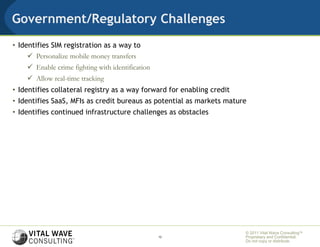
Government/Regulatory Challenges
• Identifies SIM registration as a way to
      Personalize mobile money transfers
     Enable crime fighting with identification
     Allow real-time tracking
• Identifies collateral registry as a way forward for enabling credit
• Identifies SaaS, MFIs as credit bureaus as potential as markets mature
• Identifies continued infrastructure challenges as obstacles


                                                                        © 2011 Vital Wave ConsultingTM
                                                  12                    Proprietary and Confidential:
                                                                        Do not copy or distribute.
Thank You

eTransform Africa: Financial Services Sector

  • 1.
    Vital Wave Consulting Field Teams eTransform Africa: Latin America Argentina Brazil Financial Services Sector Chile Costa Rica Dominican Republic Mexico The World Bank | African Development Bank | African Union Peru Asia India PEER REVIEW WORKSHOP China Cambodia Uzbekistan Eastern Europe Estonia Johannesburg, South Africa Ukraine Africa June 28, 2011 Egypt South Africa Nigeria Kenya Brooke Partridge CEO Middle East United Arab Emirates Brendan Smith Director of Consulting Services United States Scott Stefanski California (Headquarters) Consultant
  • 2.
    Chapter 2: LandscapeAnalysis Summary © 2011 Vital Wave ConsultingTM 1 Proprietary and Confidential: Do not copy or distribute.
  • 3.
    Contents • Purpose and focus of assignment • Approach of assignment • Overarching trends in ICT development relevant to Africa’s financial sector • Challenges to financial sector development in Africa . • Opportunities for ICT developments to address financial sector challenges • Progress of African nations in ICT (Network Readiness Index- NRI) • State of financial sector development in Africa assessed by financial inclusion indices © 2011 Vital Wave ConsultingTM 2 Proprietary and Confidential: Do not copy or distribute.
  • 4.
    Landscape Purpose &Focus Purpose: . Overview of challenges to financial sector development in Africa and role for ICT, with notable attention to objective of financial inclusion Approach: 1. Compile primary ICT developments relevant to Africa’s financial sector development 2. Examine and assemble challenges to Africa’s financial sector . development 3. Analyze where ICT developments meet identified financial sector development challenges 4. Analyze state of financial inclusion & ICT in Africa and opportunities for investment © 2011 Vital Wave ConsultingTM 3 Proprietary and Confidential: Do not copy or distribute.
  • 5.
    Financial Inclusion inAfrican Nations Branches per hundred Branches per hundred Branches per thousand Branches per thousand Deposit accounts per Deposit accounts per thousand adults thousand adults Km2 Km2 thousand adults thousand adults Country Combined (Commercial, Combined (Commercial, Combined (Commercial, Rank Rank Rank Coops, SSFIs, MFIs) Coops, SSFIs, MFIs) Coops, SSFIs, MFIs) Mauritius 20.11 4 96.55 1 2109.04 1 Tunisia 31.87 1 16.16 4 1143.36 2 Cape Verde 28.94 2 22.58 3 1137.83 3 Botswana 10.29 8 0.23 31 912.50 4 South Africa 8.00 11 2.22 14 839.13 5 Namibia 7.25 14 0.12 32 757.61 6 Algeria 5.30 17 0.55 26 736.56 7 Nigeria 9.54 9 9.09 6 495.21 8 Gambia 24.50 3 23.40 2 487.04 9 Morocco 15.91 6 7.93 7 412.14 10 Kenya 4.41 20 1.71 17 389.62 11 Swaziland 4.14 21 1.69 18 383.49 12 Ghana 8.29 10 5.21 9 332.61 13 Lesotho 3.10 24 1.25 19 319.37 14 Togo 7.72 12 5.48 8 290.99 15 Benin 7.44 13 3.31 12 273.92 16 Rwanda 1.87 31 4.26 11 226.15 17 Mali 18.24 5 1.06 22 223.13 18 Senegal 12.80 7 4.57 10 206.07 19 Uganda 2.73 25 2.23 13 195.73 20 Zimbabwe 2.13 29 0.41 30 178.60 21 Malawi 2.16 28 1.75 16 175.57 22 Cote d'Ivoire 2.12 30 0.81 24 170.56 23 Burkina Faso 6.57 15 1.97 15 167.96 24 Ethiopia 2.42 27 1.10 20 144.03 25 Mozambique 3.89 23 0.60 25 140.50 26 Burundi 5.11 18 9.81 5 113.14 27 Liberia 1.85 32 0.42 29 102.08 28 Sierra Leone 2.44 26 1.08 21 98.62 29 Niger 1.64 34 0.10 33 51.91 30 Zambia 5.62 16 0.51 27 44.35 31 Madagascar 4.47 19 0.83 23 33.29 32 Guinee Bissau 0.00 36 0.00 36 5.81 33 Mauritania 3.89 22 0.07 34 No data No data Sudan 0.04 35 0.00 35 No data No data Tanzania 1.84 33 0.49 28 No data No data Prepared by Bazaar Strategies LLC using CGAP Financial Access 2010 © 2011 Vital Wave ConsultingTM 4 Proprietary and Confidential: Do not copy or distribute.
  • 6.
    Financial Sector DevelopmentIssues in Africa (1) Financial Sector Definition/Description Development Issues Financial Inclusion – Consumer/End User Issues Transient populations People who move frequently are difficult to serve with current products, methodologies and delivery channels Remote populations People too costly to serve through conventional financial sector practices Understanding of consumer needs There is too little market research about the financial elements of clients' lifestyles—such as cash flow and asset accumulation—to (behavior and demographics) promote the design of valuable services General literacy Ability to utilize financial products, even when made available through advanced channels such as mobile phone Financial literacy Limited understanding of the relevance and ramifications of utilizing financial services if available Trust of banking institutions Perceptions among unbanked that these institutions are ‘not for them’ or challenges of previous experiences with fraud or (exposure and history) hyperinflation Capital access (SME/MSME) Availability and diversity of capital access channels and products Financial Inclusion – Governing/Regulatory Issues Lag of regulation to keep up with Regulation and supervision that does not keep pace with (and therefore slows the spread of) new technologies technological pace Rigidity of identification requirements for opening formal accounts that do not accommodate either proportional flexibility or Documentation requirements embrace options made possible through ICT (e.g., biometrics) Prioritization of financial Prudential regulation that prioritizes stability over access may tilt service providers away from pursuing inclusion inclusion Limited regulatory framework for Weak regulation and supervision of microfinance institutions and other institutions dedicated to serving the poor, such as policies MFIs preventing them from taking deposits Politicians advocate harmful policies for political gain; no repayment movements or debt protests hinder operations of financial Political interference service providers Non-business friendly Corrupt officials, stifling bureaucracies and political instability prevent institutions from forming and growing environment Client protections ensuring that services are transparent, fair and appropriate for their customers are not well-developed among Inadequate client protection providers or regulators Weak courts and poorly defined and/or enforced property rights and contractual agreements make it risky or costly for providers to Weak legal infrastructure serve low income clients Source: Bazaar Strategies LLC; Special thanks to the Center for Financial Inclusion who has compiled and vetted majority of financial inclusion constraints described for soon to be released survey © 2011 Vital Wave ConsultingTM 5 Proprietary and Confidential: Do not copy or distribute.
  • 7.
    Financial Sector DevelopmentIssues in Africa (2) Financial Sector Definition/Description Development Issues Financial Inclusion – Market Maturity Issues Providers may not try to reach low income clients because they do not believe that the poor can be viable clients. Policy makers may not promote Provider interest inclusion if they do not value it Weak industry voice The providers of financial inclusion are not organized to advocate effectively for their interests with policymakers or to set standards for themselves Cost of established or High fixed and running costs make branches an expensive delivery channel for poor neighborhoods and sparsely populated areas conventional practices MFI single product approach Microfinance is overwhelmingly microcredit; many microfinance institutions have been unable to significantly broaden their product range Interoperability, network Delivery channels like mobile banking and correspondent banking need a critical level of participation (by agents, telecoms, clients, etc.) or cooperation interoperability to generate value Cost of established or Conventional products are designed to be supported by higher cost infrastructure or available supporting systems (e.g. traditional credit bureaus); conventional products this results in high prices or impractical solutions for the poorest and most remote market segments Insufficient infrastructure Underdeveloped transportation, communication and power grid structures limit delivery of financial services in rural and remote areas Poor/abusive business Financial institutions that poach staff and clients, use abusive collections practices, pursue excessive profits and over-indebt clients hurt the whole practices industry Exposure to poor/unbanked Mainstream financial services providers lack sufficient understanding of how to design, price and market financial services to low-income people markets/customers Underpinning Financial Systems Issues Backend operations at smaller MFIs with greater reach to unbanked consumers and SMEs have limited or no backend systems that afford the ability to support modern advances such banks and MFIs as mobile payments Insufficient information about borrowers’ debt and repayment history limits providers’ ability to assess repayment capacity, discouraging them from Availability of credit bureaus serving new, poorer clients Collateral registry Unclear ownership and lien obligations lead to higher risk and interest rates as well as over indebtedness due to over subscribed assets Real-time payment processing Inability of retail clearing and settlement systems to handle true real-time processing and settlement creates major challenge for electronic payment and settlement (T+ seconds) systems in competing with the fungibility of cash Broader international banking Greater inter-bank and international banking integration has been shown to spread systemic risk and financial shocks integration Source: Bazaar Strategies LLC; Special thanks to the Center for Financial Inclusion who has compiled and vetted majority of financial inclusion constraints described for soon to be released survey © 2011 Vital Wave ConsultingTM 6 Proprietary and Confidential: Do not copy or distribute.
  • 8.
    Progress of AfricanNations – ICT (NRI) While almost all African nations fall in the lower ranks of ICT availability and usage, inspection reveals those more ready to utilize further ICT investments and those with underutilized ICT assets. NRI Overall NRI Infrastructure Country Country ICT Opportunity Rank Readiness Sub- Rank Botswana 91 106 Cape Verde 84 117 Ethiopia 123 137 Gambia 76 110 Ghana 99 118 Kenya 81 102 ICT Investment Impact Opportunity Mali 120 134 For these countries, there is a notable difference in overall NRI rank and the supporting rank for infrastructure readiness (a Mauritius 47 78 difference of greater than 10 places), suggesting these markets may be in greatest demand for ICT infrastructure than currently is Mozambique 106 133 available. Namibia 82 108 Senegal 80 91 South Africa 61 73 Tunisia 35 57 Lesotho 121 130 Some ICT Investment Impact Nigeria 104 112 For these countries, there is some noted difference (greater than 5, less than 10 places) between overall NRI rank and infrastructure Uganda 107 116 Zambia 102 111 readiness rank, suggesting these markets may be in greater demand for ICT infrastructure than currently is available. Benin 114 113 Cameroon 125 122 Chad 138 135 Mauritania 130 129 Angola 133 136 Readiness and Infrastructure on Par Burkina Faso 122 123 For these countries, overall NRI ranking and infrastructure readiness ranking are comparable, suggesting a more balanced strategy of Egypt 74 75 ICT investments, awareness, and usage are in order. Madagascar 129 132 Malawi 105 109 Morocco 83 84 Tanzania 118 120 Burundi 137 131 Some Underutilization of ICT Assets Côte d'Ivoire 113 103 For these countries, there is some noted difference between overall NRI rank and the supporting rank for infrastructure readiness Swaziland 134 127 (greater than 5, less than 10 places), suggesting these markets can do the more to improve the environmental conditions and Zimbabwe 132 125 awareness to make better use of existing ICT assets. Greatest Underutilized ICT Assets Algeria 117 101 For these countries, there is a notable difference between overall NRI rank and the supporting rank for infrastructure readiness (a Libya 126 89 difference of greater than 10 places), suggesting these markets can do the most to improve the environmental conditions and awareness to make better use of existing ICT assets. Prepared by Bazaar Strategies LLC using the World Economic Forum, The Global Information Technology Report 2010-2011. © 2011 Vital Wave ConsultingTM 7 Proprietary and Confidential: Do not copy or distribute.
  • 9.
    Trends in ICT ICT Category Important Developments Benefits Increased local storage • Mobile phone as PC replacement • Reduction in costs Data Storage Remote and shared storage – cloud • Alignment of limited IT skillsets to higher value application development computing • Group-based data input/sharing Data Satellite (end point and Internet backhaul) • Affordable access to broadband data including rural regions (O3bnetworks.com) Transmission Terrestrial wireless – broadband/data • Ability to access Internet where fiber networks are absent • Voice recognition and touch-screen visual interfaces mitigating challenges of multilingual and Intuitive interfaces illiterate communities • Smartphones fast becoming affordable and contain processing power today comparable to PCs only a few years ago (e.g., Motorola ATRIX) Increased processing power • Mobile phones becoming “all-in-one” devices capable of serving communication, transaction and data management needs (e.g., can serve as “card”, “POS” and record keeping Consumer simultaneously) Device Advances • More effective targeting and tracking services to optimize operations and supplement Geolocation tracking capabilities governance structures • Off-grid recharge developments Improvements in power storage • Improved battery life • Mass production and operating system competition driving decline in entry points for smart Falling costs phones, now less than US$100 retail for unlocked versions (lower when carrier subsidized) • Fingerprint recognition on phones Biometrics • Mobile phone-based photo capture and facial recognition Security One-time passwords • Smoother transaction processes • Improved data sharing and analysis for rapid identification of malicious behavior Fraud management • User-managed identification raising awareness of data usage Crowd-sourced data sharing and analytics • Increase in quantity of market data Data Processing • Exponential increase in unique identifiers to cover all users, devices, and even Shift from IPv4 to IPv6 & Analytics collateral/assets Business intelligence and predictive • Ability to assemble incomplete data from disparate sources and derive increasingly targeted analytics insights such as new product needs and fraudulent patterns Source: Bazaar Strategies LLC © 2011 Vital Wave ConsultingTM 8 Proprietary and Confidential: Do not copy or distribute.
  • 10.
    Chapter 3: Challenges& Opportunities Summary © 2011 Vital Wave ConsultingTM 9 Proprietary and Confidential: Do not copy or distribute.
  • 11.
    Overview Challenge Area Key Initiatives Consumer/End User challenges  Transactional friction and retail payments  New Product Development (savings, lending, MIS options)  SME access to capital Governing/regulatory challenges  Identification  Collateral registry Market Maturity and Underpinning  SaaS for MFIs Infrastructure Challenges  Credit bureaus   © 2011 Vital Wave ConsultingTM 10 Proprietary and Confidential: Do not copy or distribute.
  • 12.
    Consumer/End User Challenges Modelsand challenges • Identifies 3 business models for end-user ICT (mobile) payment operations  Bank-led systems  Mobile operator-led systems  Hybrid systems (bank/mobile; postal; bank is intermediary in all except postal) • Identifies the challenges to adoption and success  Liquidity management (rural agents running out of cash—rural users withdraw, not deposit)  Governance and consumer protection (depositor insurance, identification)  System interconnection agreements (product differentiation vs interoperability—rural/urban)  Fraud (as volumes increase; Isreali American; Billguard shared fraud detection system/geolocation) • Provides some solution examples  Movirtu: cloud-based SIM money access—use any mobile phone  Microensure—enables health/agriculture/general micro-insurance over mobile  Kiva: provides SME/small holder access to capital through online micro-loans  Now lending over US$ 2 million each week to nearly 5,000 MSMEs with a 98.79% repayment rate.  Has attracted nearly 600,000 individual lenders and transferred over US$ 220 million © 2011 Vital Wave ConsultingTM 11 Proprietary and Confidential: Do not copy or distribute.
  • 13.
    Government/Regulatory Challenges • IdentifiesSIM registration as a way to  Personalize mobile money transfers  Enable crime fighting with identification  Allow real-time tracking • Identifies collateral registry as a way forward for enabling credit • Identifies SaaS, MFIs as credit bureaus as potential as markets mature • Identifies continued infrastructure challenges as obstacles © 2011 Vital Wave ConsultingTM 12 Proprietary and Confidential: Do not copy or distribute.
  • 14.