15-Arid-4058
15-Arid-4056
15-Arid-4053
MEMBERS
Created By : MuhammadYasir
What is Ethics ?
What is Ethics in Islam?
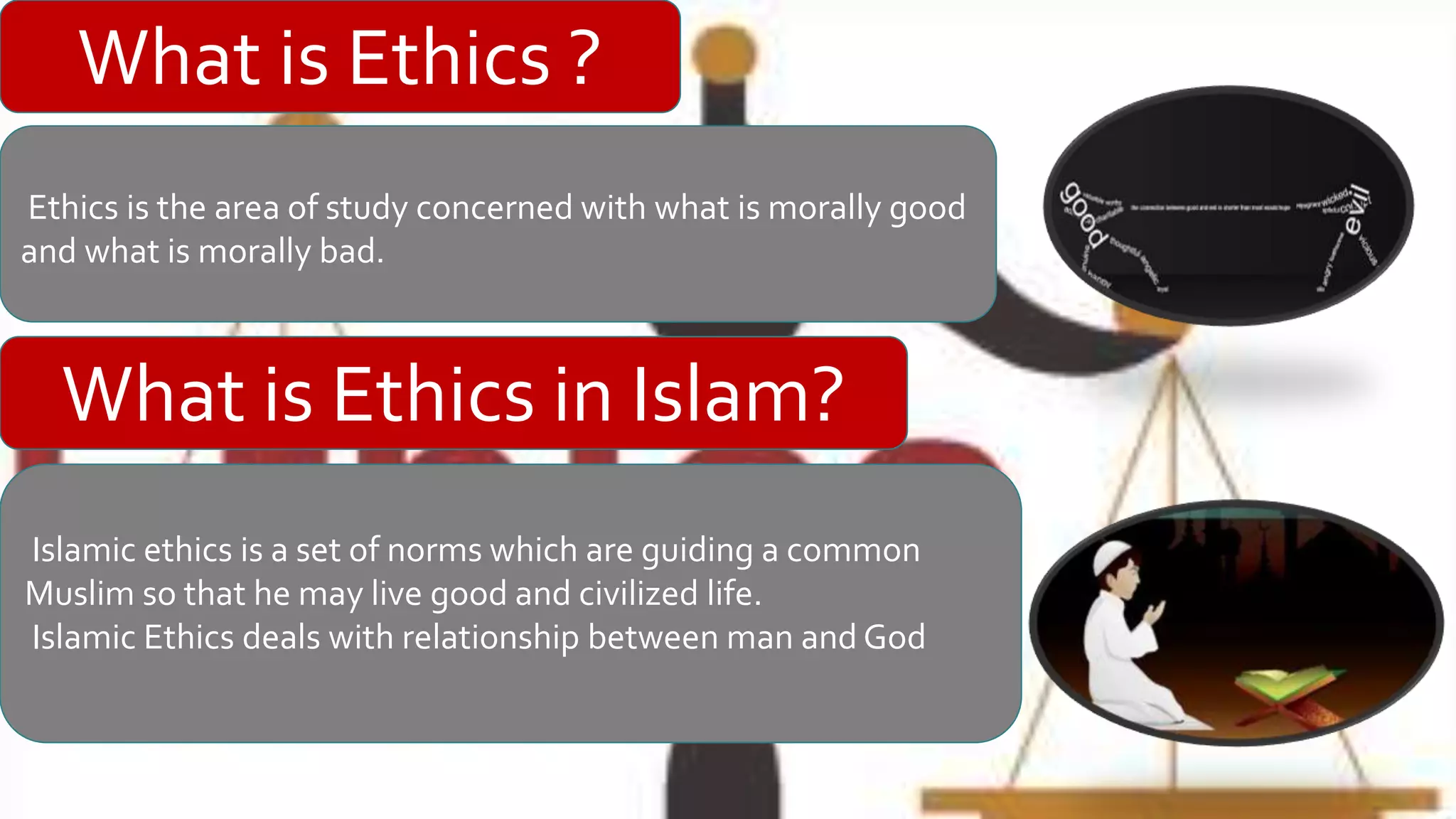
Ethics is the area of study concerned with what is morally good
and what is morally bad.
Islamic ethics is a set of norms which are guiding a common
Muslim so that he may live good and civilized life.
Islamic Ethics deals with relationship between man and God
‫مومنو‬‫ں‬‫می‬‫ں‬‫س‬ ‫سب‬‫ے‬‫ک‬‫وال‬ ‫ایمان‬‫امل‬‫ے‬‫و‬‫ہ‬‫ہ‬‫ی‬‫ں‬‫اخالق‬‫جو‬
‫می‬‫ں‬‫س‬ ‫سب‬‫ے‬‫اچ‬‫ھےہ‬‫و‬‫ں‬‫۔‬
‫می‬ ‫عمل‬ ‫میزان‬‫ں‬(‫ک‬ ‫آدمی‬‫ے‬)‫اچ‬‫ھے‬‫س‬ ‫اخالق‬‫ے‬‫ب‬ ‫اور‬‫وزنی‬‫ھ‬‫ری‬ ‫ا‬
‫ن‬ ‫چیز‬‫کوئی‬‫ہ‬‫ہ‬‫گئ‬ ‫و‬‫۔‬ ( ‫ک‬ ‫قیامت‬‫ے‬‫دن‬ )
PARENTS DUTIESTOWARDS CHILDREN:
First of all parents should give right to
life to their children.1
Give a nice and appropriate name to
them.2
Give them a good education, training
and discipline.3
PARENTS DUTIESTOWARDS CHILDREN:
Maintain equality and justice between
their children.
.
4
Showing love and sympathy towards
children.
.
.
5
Parents should teach their children all about Islam
an show them how to worship Allah with no
compulsion or force.
.
6
PARENTS DUTIESTOWARDS CHILDREN:
Marrying them when they are old
enough to get marry.7
They should give them a proper share in
their property .
.
8
Provide children food, clothes and shelter .
Financially support your children .9
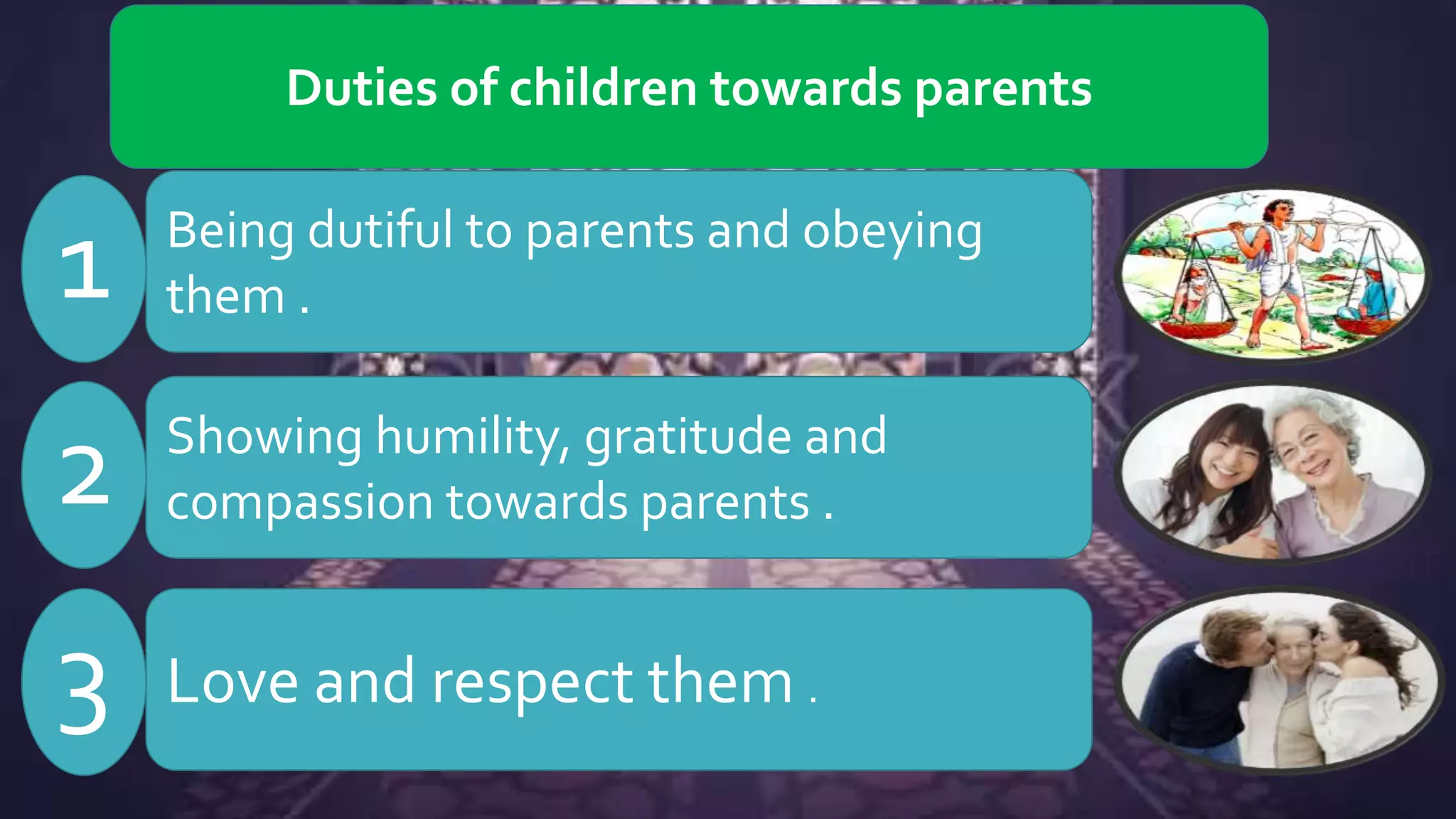
Duties of children towards parents
Being dutiful to parents and obeying
them .1
Showing humility, gratitude and
compassion towards parents .
.
2
Love and respect them .3
Duties of children towards parents
Do not marry without their consent/
permission.4
Do not quarrel with them.5
Do not call them by their names, nor walk in
front of them or sit down alongside with
them.
6
Parent Respect According to Quran and
Sunnah
ACTIVITY
BUSINESS ETHICS
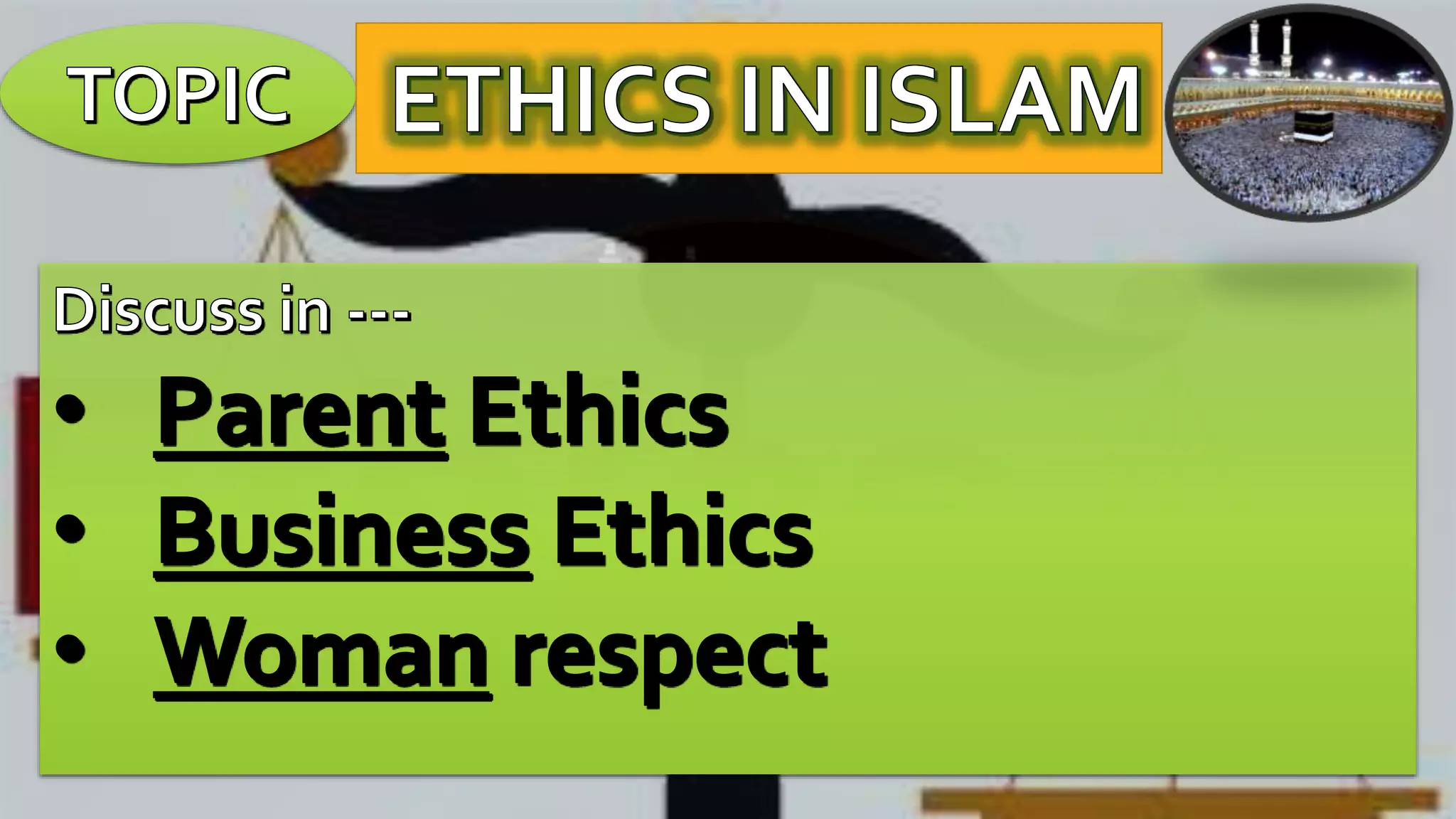
TOPIC
Business ethics in Islam is a very immense term.
The Holy book Quran and Sunnah of our beloved
Prophet Hazrat Muhammad (SAW) provides us the
open invitation to make our vision clear about
business ethics in Islam.
Islam provides us the full fledged ethics of business.
Business ethics are the moral values that guide the way
of making decisions for business.
Every professional who conducts a business always
needs a
Guideline.
Rules.
Principles.
The Holy Quran Says:
“You are the best nation that has been raised
up for mankind; you enjoin right conducts,
forbid evil and believe in Allah”.
The Prophet (SAW) says:
‘‘I have been sent for the purpose of perfecting good
morals”.
He presented in front of us how to be a successful
Muslim trader.
He had a remarkable reputation in dealing.
Our beloved Prophet (SAW) always emphasized on fair
dealings in business with the customers. He said:
“God shows mercy to a person who is kindly when he
sells, when he buys and when he makes a claim”.
Ethics in Islam forWomen
TOPIC
Abstract:
 Islam gave true and due rights to women 1400 years ago when there was ignorance and
darkness. Islam uplifted the status of the women in a society.
 .In Islam spiritually both men and women are equal
 There are certain non-Islamic religions like Christianity that put the blame only on mother
"Eve" (Alaihis Salaam), who forced Adam to eat the forbidden fruits in Jannah and according to
Christianity all human beings are born in sins because of Mother Havva. But Quran put the
of eating forbidden fruits equally on man and woman, on Adam as well as on Havva.
 Islam gave economic rights to women 1400 years ago, 1300 years before the Western world.
 The first times the Western world gave rights to married women to own or dis-own the
without the permission of her husband in 1870 in England.
How the women treated before Islam.
 In Babylonian civilization, if man committed murder then instead of punishing him, his wife was sentenced to
death.
 When we read the history of Greeks, Greeks considered a woman a cause of evil and infortune in the society.
A man is even permitted to kill his wife. In Egyptian civilization, they considered women a sign of a devil
 In Arab civilization, very often when female child was born, she was buried alive.
 In some parts of the Eastern Europe and in India, if husband was died, his wife either killed or burn alive
together with the dead body of her husband.
 India and all European countries during the dark ages, women were treated worse than slaves. They were not
regarded as human beings but as sort of sub-species between humans and animals.
The spiritual Rights of Women
 in Islam spiritually both men and women are equal. It is duty of all men and women to seek the
pleasure of Allah and get Jannah. Allah says in Surrah Al-Nisa verse 124.
 So Quran says respect to your parents especially to your mother because she gives birth to you with
pains and sorrows.
 “The Prophet (PBUH) said: “The woman who dies in pregnancy or childbirth is a martyr”.
 There are certain non-Islamic religions like Christianity that put the blame only on mother Havva
(Alaihis Salaam), who forced Adam to eat the forbidden fruits in Jannah and according to Christianity
all human beings are born in sins because of Mother Havva.
 But you cannot find any single verse in Quran which could blame only on Havva. Quran put the blame
of eating forbidden fruits equally on man and woman, on Adam as well as on Havva. And if we read
Surrah Al-A'raf verse 19-27, Allah said both of them made mistake.
 Both of them repented and both of them were forgiven. There is no single verse exclusively in
Quran which says that mother Havva is responsible for such a big sin.
The political Rights of women:
 This means believing men and believing women are supporters of one another not only
socially but also politically.
 Women have also obligation to spread the message of Allah and His Prophet (PBUH).
 ). They have also obligation to struggle for making Islamic societies and Islamic
governments.
 Dear brothers and sisters, woman can also take parts in law making.
 . There are few societies in the world where the ordinary citizen can confront with the ruler
face to face and challenge his policies.
 But in pure and true Islamic societies, rulers of the time were always open and accessible.
The economic rights of women:
 Islam gave economic rights to women 1400 years ago, 1300 years before the Western world.
 . In Islam, any adult women whether married or un-married, she was allowed to own or dis-own
her property without the permission of anyone else.
 the first times the Western world gave rights to married women to own or dis-own the property
without the permission of her husband in 1870 in England under the "special married women property
act".
 . In Islam, a woman is financially well secured. Before she is married, it is duty of her father and
brother and after she is married, its duty of her husband and son to look after her financially, lodging,
clothing, and boarding everything.
 It is duty of the man in the house to earn for living.
 . Islam has put financial burden on the shoulders of a man.
 she can work as long as it is within the preview of Islamic Sharia.
 She maintains the hijab and can adopt many noble professions e.g. teaching and medicine,
 In Islam, Mahr (Dowry) is compulsory for a man to give it to woman.
Educational Rights of Women:
 The first guidance revealed by Allah to all of human kind "It was Iqra",
 ". Prophet (PBUH) said, "It is obligatory on every Muslim to acquire knowledge".
 The Prophet (PBUH) specially told the parents to educate their children specially their daughters.
 Parents give Islamic education compulsory to their daughters.
 Ayesha (R-ha) was also expert in mathematics; many sahaba came to her.
 Ayesha (R-ha) taught 100s of scholars. She was scholars of the scholars.
Ethics in islam

Ethics in islam

  • 2.
  • 4.
    What is Ethics? What is Ethics in Islam? Ethics is the area of study concerned with what is morally good and what is morally bad. Islamic ethics is a set of norms which are guiding a common Muslim so that he may live good and civilized life. Islamic Ethics deals with relationship between man and God
  • 5.
    ‫مومنو‬‫ں‬‫می‬‫ں‬‫س‬ ‫سب‬‫ے‬‫ک‬‫وال‬ ‫ایمان‬‫امل‬‫ے‬‫و‬‫ہ‬‫ہ‬‫ی‬‫ں‬‫اخالق‬‫جو‬ ‫می‬‫ں‬‫س‬‫سب‬‫ے‬‫اچ‬‫ھےہ‬‫و‬‫ں‬‫۔‬ ‫می‬ ‫عمل‬ ‫میزان‬‫ں‬(‫ک‬ ‫آدمی‬‫ے‬)‫اچ‬‫ھے‬‫س‬ ‫اخالق‬‫ے‬‫ب‬ ‫اور‬‫وزنی‬‫ھ‬‫ری‬ ‫ا‬ ‫ن‬ ‫چیز‬‫کوئی‬‫ہ‬‫ہ‬‫گئ‬ ‫و‬‫۔‬ ( ‫ک‬ ‫قیامت‬‫ے‬‫دن‬ )
  • 6.
    PARENTS DUTIESTOWARDS CHILDREN: Firstof all parents should give right to life to their children.1 Give a nice and appropriate name to them.2 Give them a good education, training and discipline.3
  • 7.
    PARENTS DUTIESTOWARDS CHILDREN: Maintainequality and justice between their children. . 4 Showing love and sympathy towards children. . . 5 Parents should teach their children all about Islam an show them how to worship Allah with no compulsion or force. . 6
  • 8.
    PARENTS DUTIESTOWARDS CHILDREN: Marryingthem when they are old enough to get marry.7 They should give them a proper share in their property . . 8 Provide children food, clothes and shelter . Financially support your children .9
  • 9.
    Duties of childrentowards parents Being dutiful to parents and obeying them .1 Showing humility, gratitude and compassion towards parents . . 2 Love and respect them .3
  • 10.
    Duties of childrentowards parents Do not marry without their consent/ permission.4 Do not quarrel with them.5 Do not call them by their names, nor walk in front of them or sit down alongside with them. 6
  • 11.
    Parent Respect Accordingto Quran and Sunnah
  • 12.
  • 13.
  • 14.
    Business ethics inIslam is a very immense term. The Holy book Quran and Sunnah of our beloved Prophet Hazrat Muhammad (SAW) provides us the open invitation to make our vision clear about business ethics in Islam. Islam provides us the full fledged ethics of business.
  • 15.
    Business ethics arethe moral values that guide the way of making decisions for business. Every professional who conducts a business always needs a Guideline. Rules. Principles.
  • 16.
    The Holy QuranSays: “You are the best nation that has been raised up for mankind; you enjoin right conducts, forbid evil and believe in Allah”.
  • 17.
    The Prophet (SAW)says: ‘‘I have been sent for the purpose of perfecting good morals”. He presented in front of us how to be a successful Muslim trader. He had a remarkable reputation in dealing. Our beloved Prophet (SAW) always emphasized on fair dealings in business with the customers. He said: “God shows mercy to a person who is kindly when he sells, when he buys and when he makes a claim”.
  • 18.
    Ethics in IslamforWomen TOPIC
  • 19.
    Abstract:  Islam gavetrue and due rights to women 1400 years ago when there was ignorance and darkness. Islam uplifted the status of the women in a society.  .In Islam spiritually both men and women are equal  There are certain non-Islamic religions like Christianity that put the blame only on mother "Eve" (Alaihis Salaam), who forced Adam to eat the forbidden fruits in Jannah and according to Christianity all human beings are born in sins because of Mother Havva. But Quran put the of eating forbidden fruits equally on man and woman, on Adam as well as on Havva.  Islam gave economic rights to women 1400 years ago, 1300 years before the Western world.  The first times the Western world gave rights to married women to own or dis-own the without the permission of her husband in 1870 in England.
  • 20.
    How the womentreated before Islam.  In Babylonian civilization, if man committed murder then instead of punishing him, his wife was sentenced to death.  When we read the history of Greeks, Greeks considered a woman a cause of evil and infortune in the society. A man is even permitted to kill his wife. In Egyptian civilization, they considered women a sign of a devil  In Arab civilization, very often when female child was born, she was buried alive.  In some parts of the Eastern Europe and in India, if husband was died, his wife either killed or burn alive together with the dead body of her husband.  India and all European countries during the dark ages, women were treated worse than slaves. They were not regarded as human beings but as sort of sub-species between humans and animals.
  • 21.
    The spiritual Rightsof Women  in Islam spiritually both men and women are equal. It is duty of all men and women to seek the pleasure of Allah and get Jannah. Allah says in Surrah Al-Nisa verse 124.  So Quran says respect to your parents especially to your mother because she gives birth to you with pains and sorrows.  “The Prophet (PBUH) said: “The woman who dies in pregnancy or childbirth is a martyr”.  There are certain non-Islamic religions like Christianity that put the blame only on mother Havva (Alaihis Salaam), who forced Adam to eat the forbidden fruits in Jannah and according to Christianity all human beings are born in sins because of Mother Havva.  But you cannot find any single verse in Quran which could blame only on Havva. Quran put the blame of eating forbidden fruits equally on man and woman, on Adam as well as on Havva. And if we read Surrah Al-A'raf verse 19-27, Allah said both of them made mistake.  Both of them repented and both of them were forgiven. There is no single verse exclusively in Quran which says that mother Havva is responsible for such a big sin.
  • 22.
    The political Rightsof women:  This means believing men and believing women are supporters of one another not only socially but also politically.  Women have also obligation to spread the message of Allah and His Prophet (PBUH).  ). They have also obligation to struggle for making Islamic societies and Islamic governments.  Dear brothers and sisters, woman can also take parts in law making.  . There are few societies in the world where the ordinary citizen can confront with the ruler face to face and challenge his policies.  But in pure and true Islamic societies, rulers of the time were always open and accessible.
  • 23.
    The economic rightsof women:  Islam gave economic rights to women 1400 years ago, 1300 years before the Western world.  . In Islam, any adult women whether married or un-married, she was allowed to own or dis-own her property without the permission of anyone else.  the first times the Western world gave rights to married women to own or dis-own the property without the permission of her husband in 1870 in England under the "special married women property act".  . In Islam, a woman is financially well secured. Before she is married, it is duty of her father and brother and after she is married, its duty of her husband and son to look after her financially, lodging, clothing, and boarding everything.  It is duty of the man in the house to earn for living.  . Islam has put financial burden on the shoulders of a man.  she can work as long as it is within the preview of Islamic Sharia.  She maintains the hijab and can adopt many noble professions e.g. teaching and medicine,  In Islam, Mahr (Dowry) is compulsory for a man to give it to woman.
  • 24.
    Educational Rights ofWomen:  The first guidance revealed by Allah to all of human kind "It was Iqra",  ". Prophet (PBUH) said, "It is obligatory on every Muslim to acquire knowledge".  The Prophet (PBUH) specially told the parents to educate their children specially their daughters.  Parents give Islamic education compulsory to their daughters.  Ayesha (R-ha) was also expert in mathematics; many sahaba came to her.  Ayesha (R-ha) taught 100s of scholars. She was scholars of the scholars.

Editor's Notes

  • #15 immense : huge Full-Fledged: completely