ETHICAL DECISION
MAKING PROCESS
PRESENTED BY
ANANDU K P
What Is Ethics ?
An area of study that deals with ideas
about what is good and what is bad
behaviour; A branch of philosophy dealing
with what is morally right or wrong.
When faced with a difficult ethical dilemma
we need ethical decision making ability to
resolve it.
An ethical dilemma is complex situation
where ethical principals or values are in
conflict.
It helps to determine the right course of
action or the right thing to do and also
enables one to analyse whether another’s
“Ethical decision making is the cognitive
process that consider various ethical
principles, rules, and virtues or
maintenance of relationship to guide or
judge individual or group decisions or
intended actions”
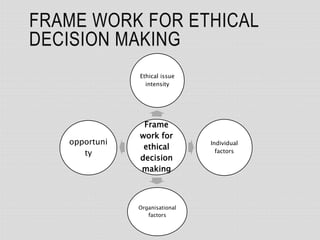
FRAME WORK FOR ETHICAL
DECISION MAKING
Frame
work for
ethical
decision
making
Ethical issue
intensity
Individual
factors
Organisational
factors
opportuni
ty
1. Ethical issue intensity
•Ethical issue intensity can be defined as
the relevance or importance of an ethical
issue in the eyes of individual , work
group and organisation.
•Ethical issue intensity will reflects on the
individual or group that faces the ethical
decision making process.
2. Individual factors
•Age
•Gender
•Education or Work Experience
•Nationality
3. Organisational factors
•The organisation’s values often have
greater influence on decisions than a
person’s own values.
•The more ethical employees perceive an
organisation’s culture to be the less
likely they are to make unethical
decision.
4. Opportunity
Opportunity describes the conditions in
an organisation that limit or permit
ethical or unethical behaviour.
EthicalDecisionMakingProcess
Identify The Ethical
Problem
Collect The Relevant
Information
Evaluate The
Information
Act Or Implement
Make A Decision
Consider
Alternatives
Review Action
ETHICAL DECISION MAKING
PROCESS
1.Identify the ethical problem
The decision maker must be able to
determine if there is a possible violation
of an important ethical principle, societal
law or organisational standard or policy.
2.Collect relevant information
The decision maker should seek to
gather as much information as possible
about which rights are being forsaken
and to what degree.
3.Evaluate the information
Ones the information's has been collected,
the decisions makers must apply some
types of standard or assessment criterion to
evaluate the situation.
4.Consider the alternatives
The decision maker needs to generate a set
of possible action alternatives such as :
• Confronting another persons action
• Seeking a higher authority
• Stepping in and changing the direction of
what is happening
5.Make a decision
The decision maker selects a course of
action that is supported by all the ethics
theories or other evaluation criteria used
in the decision making process.
6.Act or implement
The decision maker find out or select
the methods for implement the decision.
7.Review the action
Ones the action has been taken and the
results are known, the decision maker
should review the consequences of
action.
If the optimal resolution to the problem
is not achieved the decision maker may
need to modify the actions being taken
or return to the beginning of decision
making process.
THANK
YOU

Ethical decision making process

  • 1.
  • 2.
    What Is Ethics? An area of study that deals with ideas about what is good and what is bad behaviour; A branch of philosophy dealing with what is morally right or wrong.
  • 3.
    When faced witha difficult ethical dilemma we need ethical decision making ability to resolve it. An ethical dilemma is complex situation where ethical principals or values are in conflict. It helps to determine the right course of action or the right thing to do and also enables one to analyse whether another’s
  • 4.
    “Ethical decision makingis the cognitive process that consider various ethical principles, rules, and virtues or maintenance of relationship to guide or judge individual or group decisions or intended actions”
  • 5.
    FRAME WORK FORETHICAL DECISION MAKING Frame work for ethical decision making Ethical issue intensity Individual factors Organisational factors opportuni ty
  • 6.
    1. Ethical issueintensity •Ethical issue intensity can be defined as the relevance or importance of an ethical issue in the eyes of individual , work group and organisation. •Ethical issue intensity will reflects on the individual or group that faces the ethical decision making process.
  • 7.
    2. Individual factors •Age •Gender •Educationor Work Experience •Nationality
  • 8.
    3. Organisational factors •Theorganisation’s values often have greater influence on decisions than a person’s own values. •The more ethical employees perceive an organisation’s culture to be the less likely they are to make unethical decision.
  • 9.
    4. Opportunity Opportunity describesthe conditions in an organisation that limit or permit ethical or unethical behaviour.
  • 10.
    EthicalDecisionMakingProcess Identify The Ethical Problem CollectThe Relevant Information Evaluate The Information Act Or Implement Make A Decision Consider Alternatives Review Action ETHICAL DECISION MAKING PROCESS
  • 11.
    1.Identify the ethicalproblem The decision maker must be able to determine if there is a possible violation of an important ethical principle, societal law or organisational standard or policy. 2.Collect relevant information The decision maker should seek to gather as much information as possible about which rights are being forsaken and to what degree.
  • 12.
    3.Evaluate the information Onesthe information's has been collected, the decisions makers must apply some types of standard or assessment criterion to evaluate the situation. 4.Consider the alternatives The decision maker needs to generate a set of possible action alternatives such as : • Confronting another persons action • Seeking a higher authority • Stepping in and changing the direction of what is happening
  • 13.
    5.Make a decision Thedecision maker selects a course of action that is supported by all the ethics theories or other evaluation criteria used in the decision making process. 6.Act or implement The decision maker find out or select the methods for implement the decision.
  • 14.
    7.Review the action Onesthe action has been taken and the results are known, the decision maker should review the consequences of action. If the optimal resolution to the problem is not achieved the decision maker may need to modify the actions being taken or return to the beginning of decision making process.
  • 15.