You are a senior officer at an intelligence agency working for the internal security of the
nation. You find out that a junior officer has been a victim of honey trapping through social
media. In all of this, his phone was hacked and confidential files were leaked.
The entire department has come together and wants you to take strict action against that
officer for his behavior. That junior officer is highly skilled and a valuable asset for the
organisation. He is also very close to you as you have mentored him throughout and he also
respects you a lot. Moreover, any action against him might attract media attention and bring
a bad repute to the organisation at large.
(A) What are the ethical issues involved and the options available to you in such a situation?
(B) Also, suggest a course of action you would like to follow.
Case Study: National Security and Honey Trapping
Solution
Facts of the case
Stakeholders involved
 Junior officer honey trapped.
 Confidential information leaked.
 Department wants strict action.
 Officer is highly skilled and valuable
asset.
 Close personal relations with him.
 Media attention might bring bad repute to
the organization.
 Junior officer
 Intelligence organization
 Self (senior officer)
 Media
 Civil society organizations
 Government
 Ethical issues involved
•Human emotions: Officers, despite being trained to adhere to confidentiality norms, are
tricked by spies for gaining sensitive information. This shows the vulnerability of human
emotions which can be a risk to national security.
•Breach of trust: Such incidents erode people’s trust on intelligence agencies for
upholding national security.
•Empathy towards colleagues: Close personal relations with the junior officer and his
meritocracy might hinder taking strict action against him.
•Media scrutiny: Risk of defamation of officers before proper investigation.
Options available
1. Taking Strict action against Junior officers
Merits:
• Adhering professional duty
• Upholding national security as supreme
Demerits:
• Loss of valuable asset to the organization.
• May bring bad repute to the organization.
2. Giving warning without any strict punishment.
Merits:
• Upholding the morale of the officer.
• Opportunity to expose other incidences of honey trapping.
Demerits:
• Setting wrong precedent for the future.
• Risk of further information leakage.
 Option (1) seems to be the suitable choice as national security and professional ethics
precede personal relations and empathy with the junior officer.
 Course of action
•Following Standard Operating Procedures (SOP) and forming an investigation team for fact finding.
Estimating the impact of the information leak should be the utmost priority.
•Temporarily suspending the junior officer and taking into custody all his digital media access.
•Reporting to higher authorities so that suitable action can be initiated at an appropriate level. Taking help
from cyber security expert team to identify any other similar cases.
•Addressing media so as to handle the case with integrity and professional ethics considering the sensitivity
of the issue.
•Taking long term measures like organizing training camps regarding honey trapping and cyber security for
officers posted at high risk areas.
 Conclusion
•As per Hindu mythology, Shri Krishna advised Arjuna that one should not escape his ‘dharma’. Arjuna’s
duty is to be a warrior and to do what is right and just, even if it means fighting with his own brothers.
•Similarly, the duty of the senior officer is to take the right decision even if it means punishing the most
talented mentee. National security and people’s trust in the organization should be the foremost priority of
any officer.
Case Study : Mob Lynching
You are posted as an additional superintendent of police in a district. The incidents of lynching
over the rumours of child lifting have increased in the state in past few months.
Recently, one such incident took place at the Government hospital, where two brothers who had
taken their nephew to a doctor for treatment were misjudged and attacked by the mob over
suspicion of child lifting.
The police rushed to the spot after receiving the information and rescued the brothers. However,
one of them was declared dead on arrival at the hospital. The deceased person was as a young
leader and potential candidate for the upcoming Panchayat elections.
The locals from the nearby village along with the relatives of the deceased person are protesting
and accusing police of negligence. They are claiming the incident as a planned political murder and
demanding for arrest of the rival candidate who has strong political backing.
(a) Identify the stakeholders and various dimensions of the crisis involved in the issue.
(b) What would be the course of action taken by you to manage the situation as an additional
superintendent of police? Suggest the measures to deal with the incident lynching. (200 words)
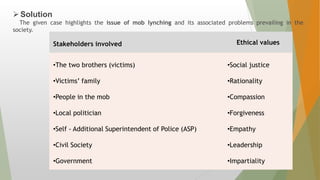
Solution
The given case highlights the issue of mob lynching and its associated problems prevailing in the
society.
Stakeholders involved Ethical values
•The two brothers (victims)
•Victims’ family
•People in the mob
•Local politician
•Self - Additional Superintendent of Police (ASP)
•Civil Society
•Government
•Social justice
•Rationality
•Compassion
•Forgiveness
•Empathy
•Leadership
•Impartiality
 Dimensions of the crisis
 Ethical dimensions
• Denial of justice: Entire families get devastated by the loss of lives of their loved ones. No monetary
amount can compensate for the sorrow and grief of their loss.
• Lack of moral conundrums: People following unhealthy herd mentality to adopt violent
means without giving a rational thought about the possibility of the accused being innocent.
• Impacting moral fabric of society: Mob lynching perpetrates a feeling of vengeance and hatred in
the society.
 Legal dimensions:
• Child lifting: It is the duty of the Police to prevent such crimes in the first place, so that there is no
need for the public to take law in their hands.
• Mob lynching: Absence of a strong national legislation encourages mob lynching. It is a governance
failure not to take strict action against the perpetrators.
• Possibility of political vendetta: The victim’s family alleging political conspiracy suggests the level of
unethicality of politics even at the grassroots level.
S.No. COA Reason
1 • Providing medical support to the
survivor.
• Preventing loss of life should be of
utmost priority.
• Humanity must guide all formal
procedures.
2 • Persuading locals not to protest and
cooperate in the investigation
• Locals must be taken into confidence
about the fairness of the
investigation.
• It is the duty of the ASP to ensure that
people do not turn violent.
3 • Forming a team to investigate the
case.
• Knowing and understanding of the
facts would help in pursuing the case
further.
• It gives an opportunity to identify any
political conspiracy.
4 • Taking strict action against
wrongdoers.
• People involved must be identified
and held accountable for the
lynching.
5 • Increasing vigilance to prevent
further violence.
• Regular monitoring of the local area is
needed to ensure there is no further
violence.
 Course of action
 Measures to deal with the crisis
•Providing legal justice: By ensuring that those guilty must be punished. People involved must face
trial in a court of law.
•Rehabilitation of lynching victims’ family: Taking confidence building measures to regain trust of
victims on the government and justice delivery system.
•Awareness generation: People must be sensitised about compassion and respect for human lives as
inalienable attributes of Indian society.
“We need to adhere to the Gandhian idea of Ahimsa which involves showing love to mankind and all
living beings.”
•Long term measures like framing laws on the lines of ‘The Rajasthan Protection from Lynching
Bill, 2019’ should be enacted to create deterrence towards such crimes.
•Addressing child lifting issue: Police must increase vigilance by taking the help of local level
intelligence gathering and identifying criminal rackets involved in such crimes.
The Ebola outbreak in Nigeria has affected thousands of people in a short span of time and
infected many others. There is no vaccine or treatment available to cure the disease. You are
the head of the health department of one of the countries that have been severely hit by the
epidemic. While there is no treatment currently available for the disease, an experimental
drug is being used in some other country. This drug has shown positive results and
consequently some of the patients have also managed to recover from the disease.
However, it is not yet clear whether the relief came due to the drug alone, or otherwise.
Given the high mortality rate of the disease and its rapid spread, other countries affected by
this disease have already given a go-ahead for the mass production of this experimental
drug. But some health experts are sceptical about the efficacy of the drug and have even
warned against its use as it may result in some deadly side-effects.
1.Bring out and discuss the above case.
2.What would you do in the above situation? Give reasons.
Case Study : Ebola Outbreak and Experimental Drugs
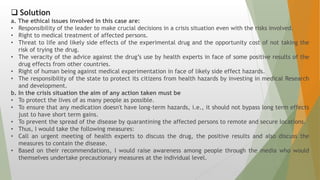
 Solution
a. The ethical issues involved in this case are:
• Responsibility of the leader to make crucial decisions in a crisis situation even with the risks involved.
• Right to medical treatment of affected persons.
• Threat to life and likely side effects of the experimental drug and the opportunity cost of not taking the
risk of trying the drug.
• The veracity of the advice against the drug’s use by health experts in face of some positive results of the
drug effects from other countries.
• Right of human being against medical experimentation in face of likely side effect hazards.
• The responsibility of the state to protect its citizens from health hazards by investing in medical Research
and development.
b. In the crisis situation the aim of any action taken must be
• To protect the lives of as many people as possible.
• To ensure that any medication doesn't have long-term hazards, i.e., it should not bypass long term effects
just to have short term gains.
• To prevent the spread of the disease by quarantining the affected persons to remote and secure locations.
• Thus, I would take the following measures:
• Call an urgent meeting of health experts to discuss the drug, the positive results and also discuss the
measures to contain the disease.
• Based on their recommendations, I would raise awareness among people through the media who would
themselves undertake precautionary measures at the individual level.
• I would consult if the drug can be tested on patients in their terminal stage
while also taking the consent of their family and giving financial compensation
in case of death. Thus, I would try to get the drug tested. In case of positive
results, I would ask doctors to administer the drug gradually and record all the
symptoms. In case of any harmful symptom, I will stop its use.
• Meanwhile, I would send a health expert team to the other country where the
drug tested positive to study and verify how it worked.
• In case of drug failing at experimenting stage, my efforts would be directed to
check the spread of disease while ensuring all medical support to affected
patients.

Ethical Case study

  • 2.
    You are asenior officer at an intelligence agency working for the internal security of the nation. You find out that a junior officer has been a victim of honey trapping through social media. In all of this, his phone was hacked and confidential files were leaked. The entire department has come together and wants you to take strict action against that officer for his behavior. That junior officer is highly skilled and a valuable asset for the organisation. He is also very close to you as you have mentored him throughout and he also respects you a lot. Moreover, any action against him might attract media attention and bring a bad repute to the organisation at large. (A) What are the ethical issues involved and the options available to you in such a situation? (B) Also, suggest a course of action you would like to follow. Case Study: National Security and Honey Trapping
  • 3.
    Solution Facts of thecase Stakeholders involved  Junior officer honey trapped.  Confidential information leaked.  Department wants strict action.  Officer is highly skilled and valuable asset.  Close personal relations with him.  Media attention might bring bad repute to the organization.  Junior officer  Intelligence organization  Self (senior officer)  Media  Civil society organizations  Government
  • 5.
     Ethical issuesinvolved •Human emotions: Officers, despite being trained to adhere to confidentiality norms, are tricked by spies for gaining sensitive information. This shows the vulnerability of human emotions which can be a risk to national security. •Breach of trust: Such incidents erode people’s trust on intelligence agencies for upholding national security. •Empathy towards colleagues: Close personal relations with the junior officer and his meritocracy might hinder taking strict action against him. •Media scrutiny: Risk of defamation of officers before proper investigation.
  • 6.
    Options available 1. TakingStrict action against Junior officers Merits: • Adhering professional duty • Upholding national security as supreme Demerits: • Loss of valuable asset to the organization. • May bring bad repute to the organization. 2. Giving warning without any strict punishment. Merits: • Upholding the morale of the officer. • Opportunity to expose other incidences of honey trapping. Demerits: • Setting wrong precedent for the future. • Risk of further information leakage.  Option (1) seems to be the suitable choice as national security and professional ethics precede personal relations and empathy with the junior officer.
  • 7.
     Course ofaction •Following Standard Operating Procedures (SOP) and forming an investigation team for fact finding. Estimating the impact of the information leak should be the utmost priority. •Temporarily suspending the junior officer and taking into custody all his digital media access. •Reporting to higher authorities so that suitable action can be initiated at an appropriate level. Taking help from cyber security expert team to identify any other similar cases. •Addressing media so as to handle the case with integrity and professional ethics considering the sensitivity of the issue. •Taking long term measures like organizing training camps regarding honey trapping and cyber security for officers posted at high risk areas.  Conclusion •As per Hindu mythology, Shri Krishna advised Arjuna that one should not escape his ‘dharma’. Arjuna’s duty is to be a warrior and to do what is right and just, even if it means fighting with his own brothers. •Similarly, the duty of the senior officer is to take the right decision even if it means punishing the most talented mentee. National security and people’s trust in the organization should be the foremost priority of any officer.
  • 8.
    Case Study :Mob Lynching You are posted as an additional superintendent of police in a district. The incidents of lynching over the rumours of child lifting have increased in the state in past few months. Recently, one such incident took place at the Government hospital, where two brothers who had taken their nephew to a doctor for treatment were misjudged and attacked by the mob over suspicion of child lifting. The police rushed to the spot after receiving the information and rescued the brothers. However, one of them was declared dead on arrival at the hospital. The deceased person was as a young leader and potential candidate for the upcoming Panchayat elections. The locals from the nearby village along with the relatives of the deceased person are protesting and accusing police of negligence. They are claiming the incident as a planned political murder and demanding for arrest of the rival candidate who has strong political backing. (a) Identify the stakeholders and various dimensions of the crisis involved in the issue. (b) What would be the course of action taken by you to manage the situation as an additional superintendent of police? Suggest the measures to deal with the incident lynching. (200 words)
  • 9.
    Solution The given casehighlights the issue of mob lynching and its associated problems prevailing in the society. Stakeholders involved Ethical values •The two brothers (victims) •Victims’ family •People in the mob •Local politician •Self - Additional Superintendent of Police (ASP) •Civil Society •Government •Social justice •Rationality •Compassion •Forgiveness •Empathy •Leadership •Impartiality
  • 10.
     Dimensions ofthe crisis  Ethical dimensions • Denial of justice: Entire families get devastated by the loss of lives of their loved ones. No monetary amount can compensate for the sorrow and grief of their loss. • Lack of moral conundrums: People following unhealthy herd mentality to adopt violent means without giving a rational thought about the possibility of the accused being innocent. • Impacting moral fabric of society: Mob lynching perpetrates a feeling of vengeance and hatred in the society.  Legal dimensions: • Child lifting: It is the duty of the Police to prevent such crimes in the first place, so that there is no need for the public to take law in their hands. • Mob lynching: Absence of a strong national legislation encourages mob lynching. It is a governance failure not to take strict action against the perpetrators. • Possibility of political vendetta: The victim’s family alleging political conspiracy suggests the level of unethicality of politics even at the grassroots level.
  • 11.
    S.No. COA Reason 1• Providing medical support to the survivor. • Preventing loss of life should be of utmost priority. • Humanity must guide all formal procedures. 2 • Persuading locals not to protest and cooperate in the investigation • Locals must be taken into confidence about the fairness of the investigation. • It is the duty of the ASP to ensure that people do not turn violent. 3 • Forming a team to investigate the case. • Knowing and understanding of the facts would help in pursuing the case further. • It gives an opportunity to identify any political conspiracy. 4 • Taking strict action against wrongdoers. • People involved must be identified and held accountable for the lynching. 5 • Increasing vigilance to prevent further violence. • Regular monitoring of the local area is needed to ensure there is no further violence.  Course of action
  • 12.
     Measures todeal with the crisis •Providing legal justice: By ensuring that those guilty must be punished. People involved must face trial in a court of law. •Rehabilitation of lynching victims’ family: Taking confidence building measures to regain trust of victims on the government and justice delivery system. •Awareness generation: People must be sensitised about compassion and respect for human lives as inalienable attributes of Indian society. “We need to adhere to the Gandhian idea of Ahimsa which involves showing love to mankind and all living beings.” •Long term measures like framing laws on the lines of ‘The Rajasthan Protection from Lynching Bill, 2019’ should be enacted to create deterrence towards such crimes. •Addressing child lifting issue: Police must increase vigilance by taking the help of local level intelligence gathering and identifying criminal rackets involved in such crimes.
  • 13.
    The Ebola outbreakin Nigeria has affected thousands of people in a short span of time and infected many others. There is no vaccine or treatment available to cure the disease. You are the head of the health department of one of the countries that have been severely hit by the epidemic. While there is no treatment currently available for the disease, an experimental drug is being used in some other country. This drug has shown positive results and consequently some of the patients have also managed to recover from the disease. However, it is not yet clear whether the relief came due to the drug alone, or otherwise. Given the high mortality rate of the disease and its rapid spread, other countries affected by this disease have already given a go-ahead for the mass production of this experimental drug. But some health experts are sceptical about the efficacy of the drug and have even warned against its use as it may result in some deadly side-effects. 1.Bring out and discuss the above case. 2.What would you do in the above situation? Give reasons. Case Study : Ebola Outbreak and Experimental Drugs
  • 14.
     Solution a. Theethical issues involved in this case are: • Responsibility of the leader to make crucial decisions in a crisis situation even with the risks involved. • Right to medical treatment of affected persons. • Threat to life and likely side effects of the experimental drug and the opportunity cost of not taking the risk of trying the drug. • The veracity of the advice against the drug’s use by health experts in face of some positive results of the drug effects from other countries. • Right of human being against medical experimentation in face of likely side effect hazards. • The responsibility of the state to protect its citizens from health hazards by investing in medical Research and development. b. In the crisis situation the aim of any action taken must be • To protect the lives of as many people as possible. • To ensure that any medication doesn't have long-term hazards, i.e., it should not bypass long term effects just to have short term gains. • To prevent the spread of the disease by quarantining the affected persons to remote and secure locations. • Thus, I would take the following measures: • Call an urgent meeting of health experts to discuss the drug, the positive results and also discuss the measures to contain the disease. • Based on their recommendations, I would raise awareness among people through the media who would themselves undertake precautionary measures at the individual level.
  • 15.
    • I wouldconsult if the drug can be tested on patients in their terminal stage while also taking the consent of their family and giving financial compensation in case of death. Thus, I would try to get the drug tested. In case of positive results, I would ask doctors to administer the drug gradually and record all the symptoms. In case of any harmful symptom, I will stop its use. • Meanwhile, I would send a health expert team to the other country where the drug tested positive to study and verify how it worked. • In case of drug failing at experimenting stage, my efforts would be directed to check the spread of disease while ensuring all medical support to affected patients.