Eth 2.0
Testing and Simulation
1
Hello!I am Mamy Ratsimbazafy
Part of the Nimbus Eth1 and Eth2
implementer team at Status
“Adolescent Full Mustang”
@mratsim
@m_ratsim
2
Where are we?
https://github.com/ethereum/eth2.0-specs
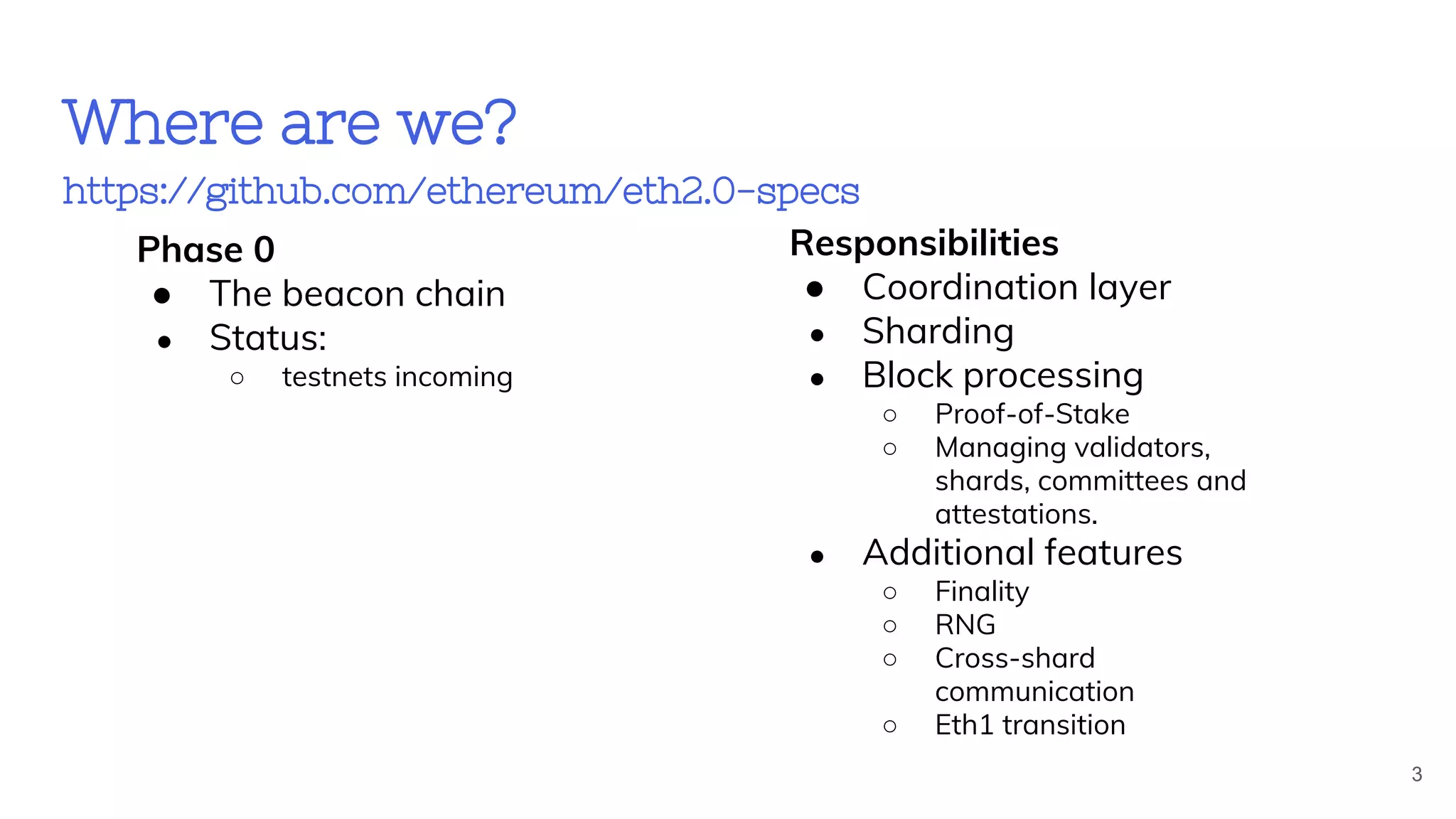
Phase 0
● The beacon chain
● Status:
○ testnets incoming
Responsibilities
● Coordination layer
● Sharding
● Block processing
○ Proof-of-Stake
○ Managing validators,
shards, committees and
attestations.
● Additional features
○ Finality
○ RNG
○ Cross-shard
communication
○ Eth1 transition
3
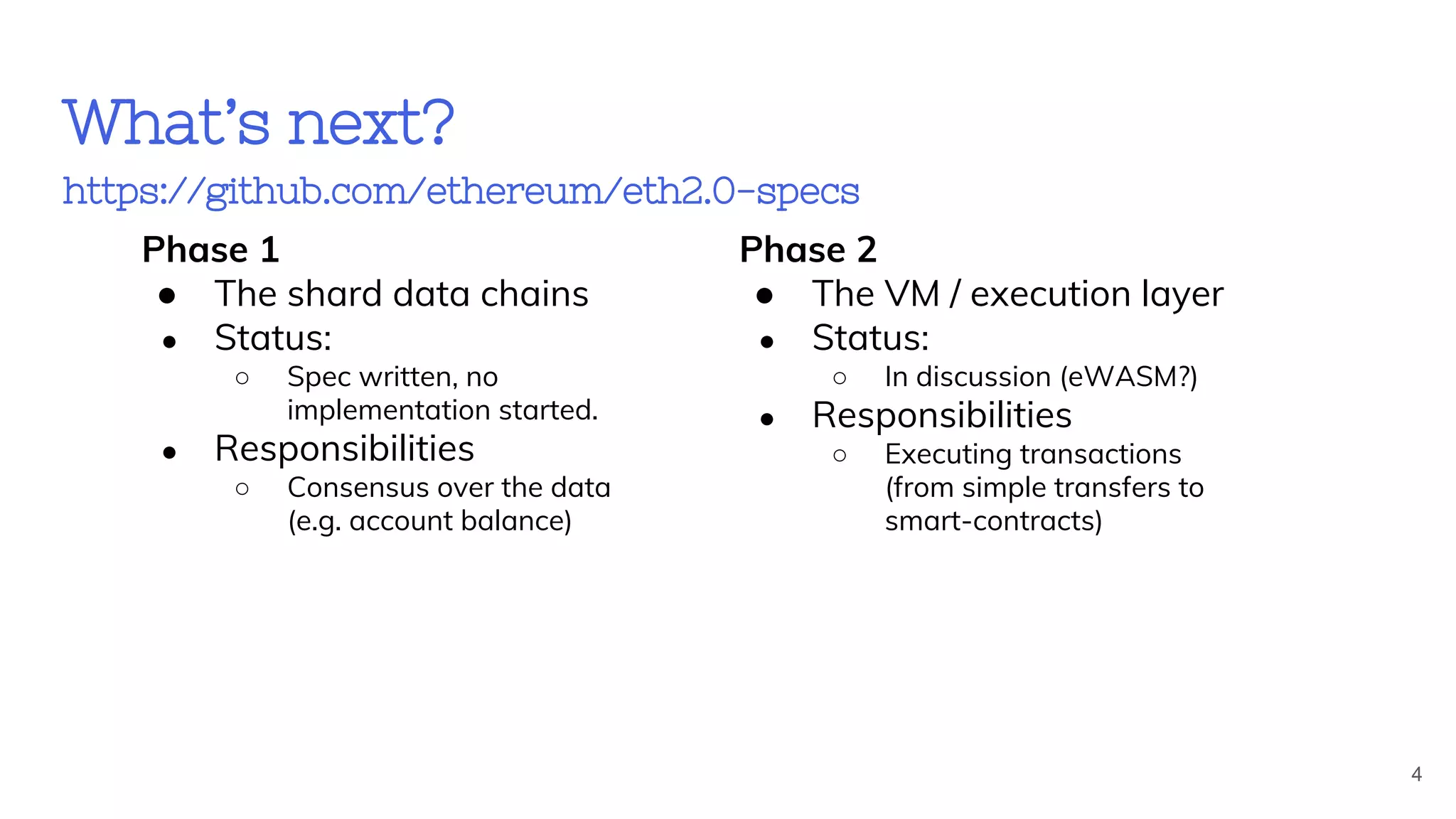
What’s next?
https://github.com/ethereum/eth2.0-specs
Phase 1
● The shard data chains
● Status:
○ Spec written, no
implementation started.
● Responsibilities
○ Consensus over the data
(e.g. account balance)
Phase 2
● The VM / execution layer
● Status:
○ In discussion (eWASM?)
● Responsibilities
○ Executing transactions
(from simple transfers to
smart-contracts)
4
What’s next?
https://github.com/ethereum/wiki/wiki/Sharding-roadmap
Phase 3
● Light clients
Phase 4
● Cross-shard transactions
5
What’s next?
https://github.com/ethereum/wiki/wiki/Sharding-roadmap
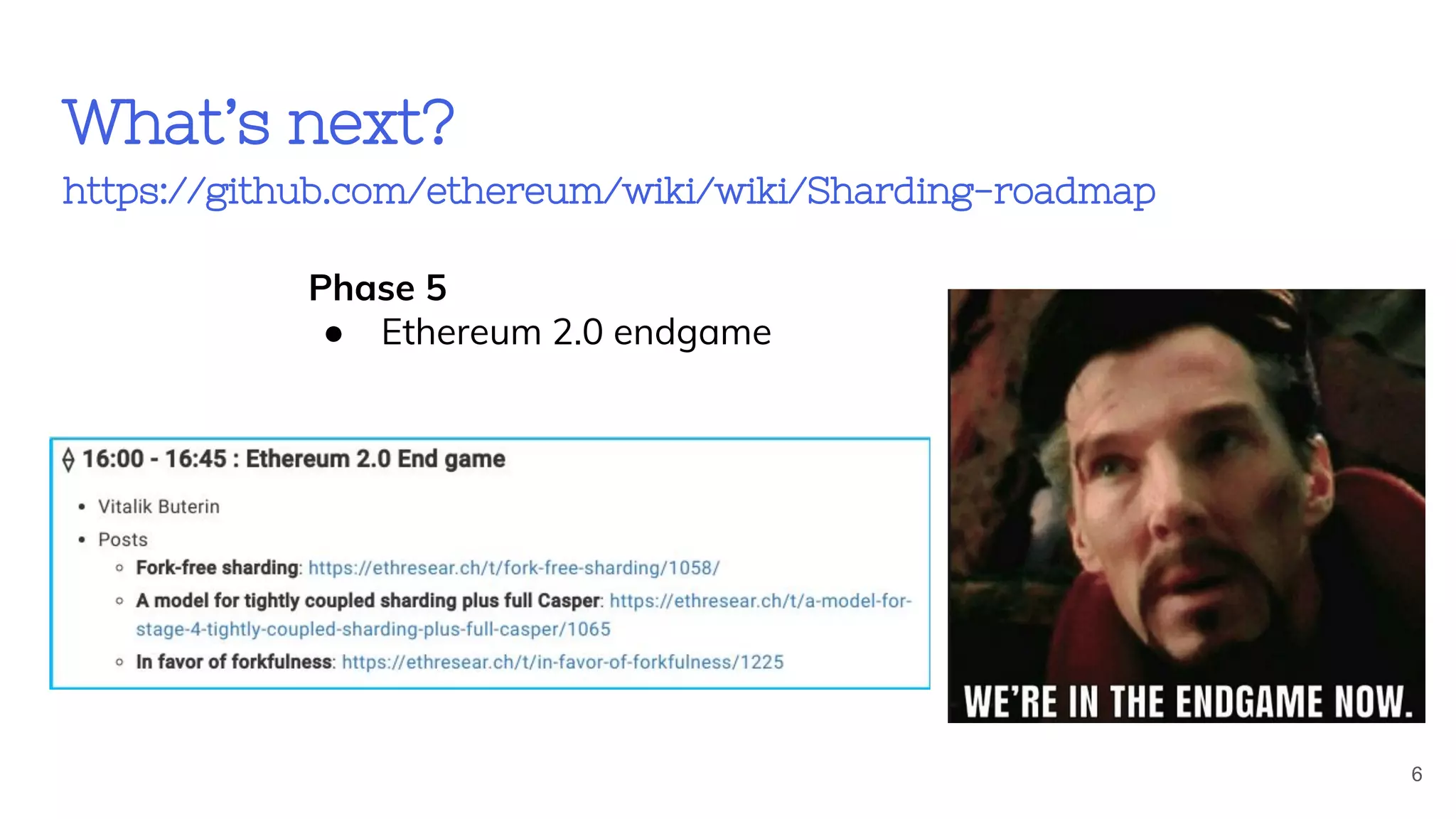
Phase 5
● Ethereum 2.0 endgame
6
What’s next?
https://github.com/ethereum/wiki/wiki/Sharding-roadmap
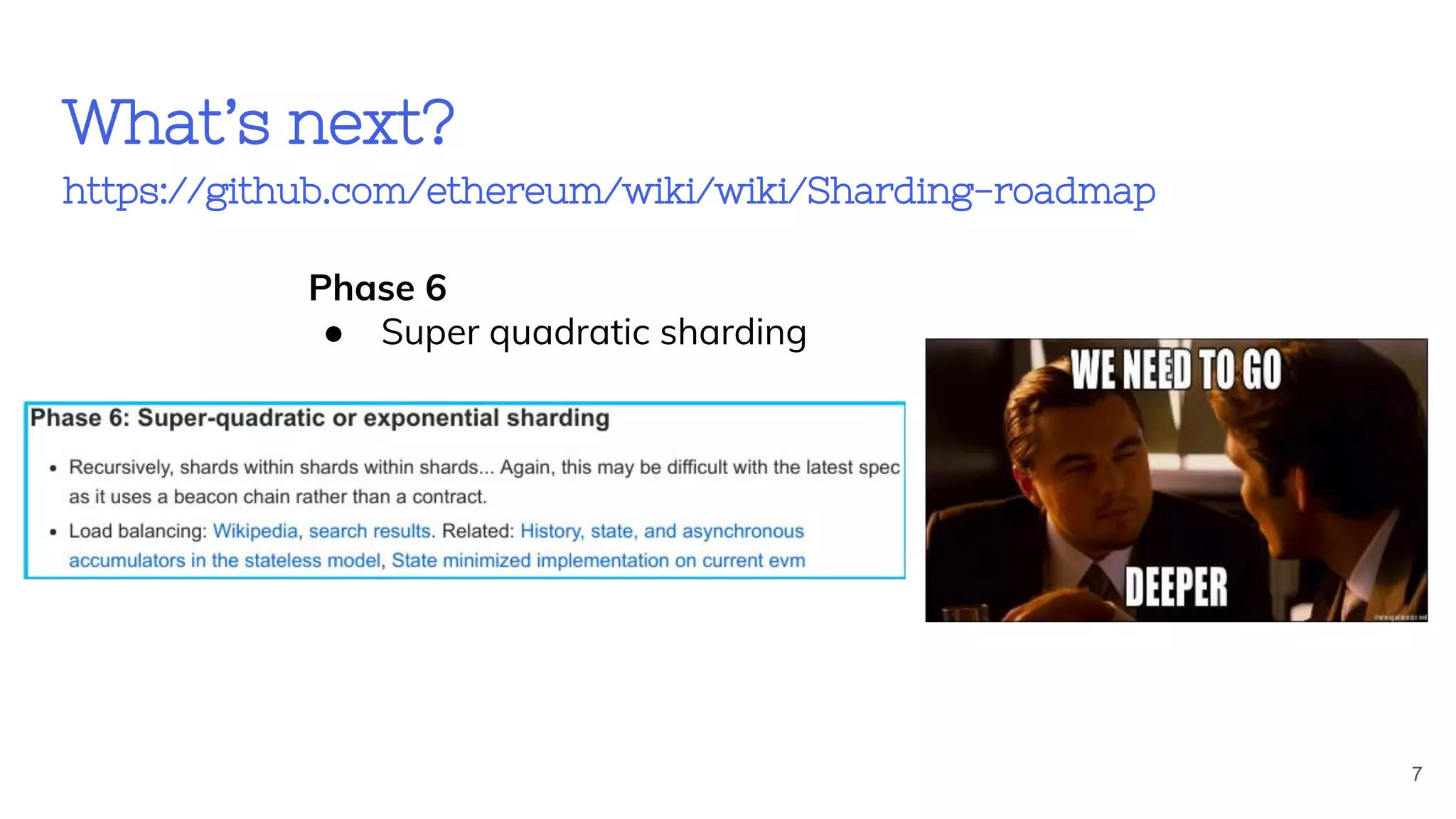
Phase 6
● Super quadratic sharding
7
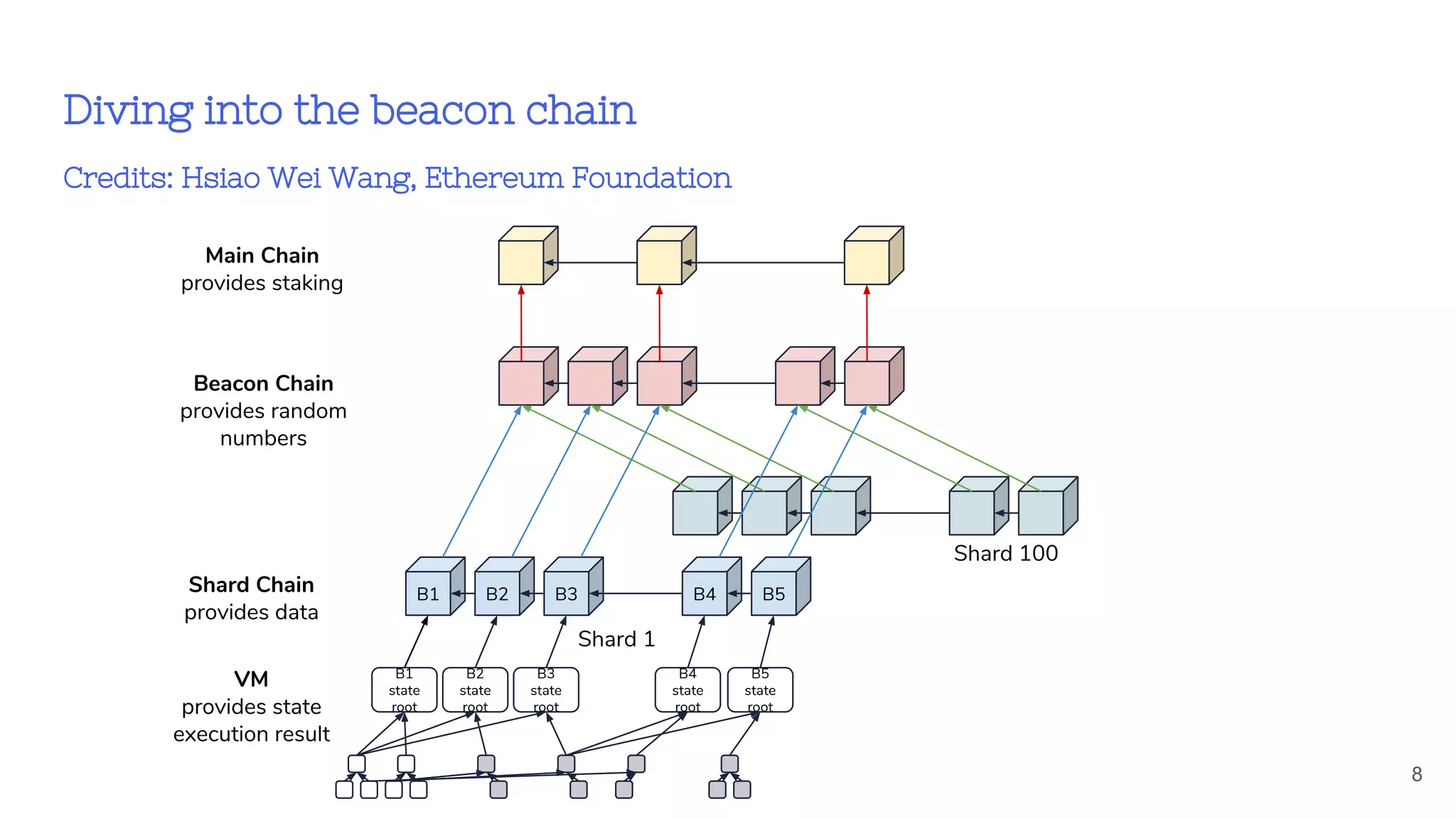
Diving into the beacon chain
Credits: Hsiao Wei Wang, Ethereum Foundation
8
Beacon Chain
provides random
numbers
Shard Chain
provides data
Shard 100
B1 B2 B3 B4 B5
VM
provides state
execution result
Shard 1
Main Chain
provides staking
B1
state
root
B2
state
root
B3
state
root
B4
state
root
B5
state
root
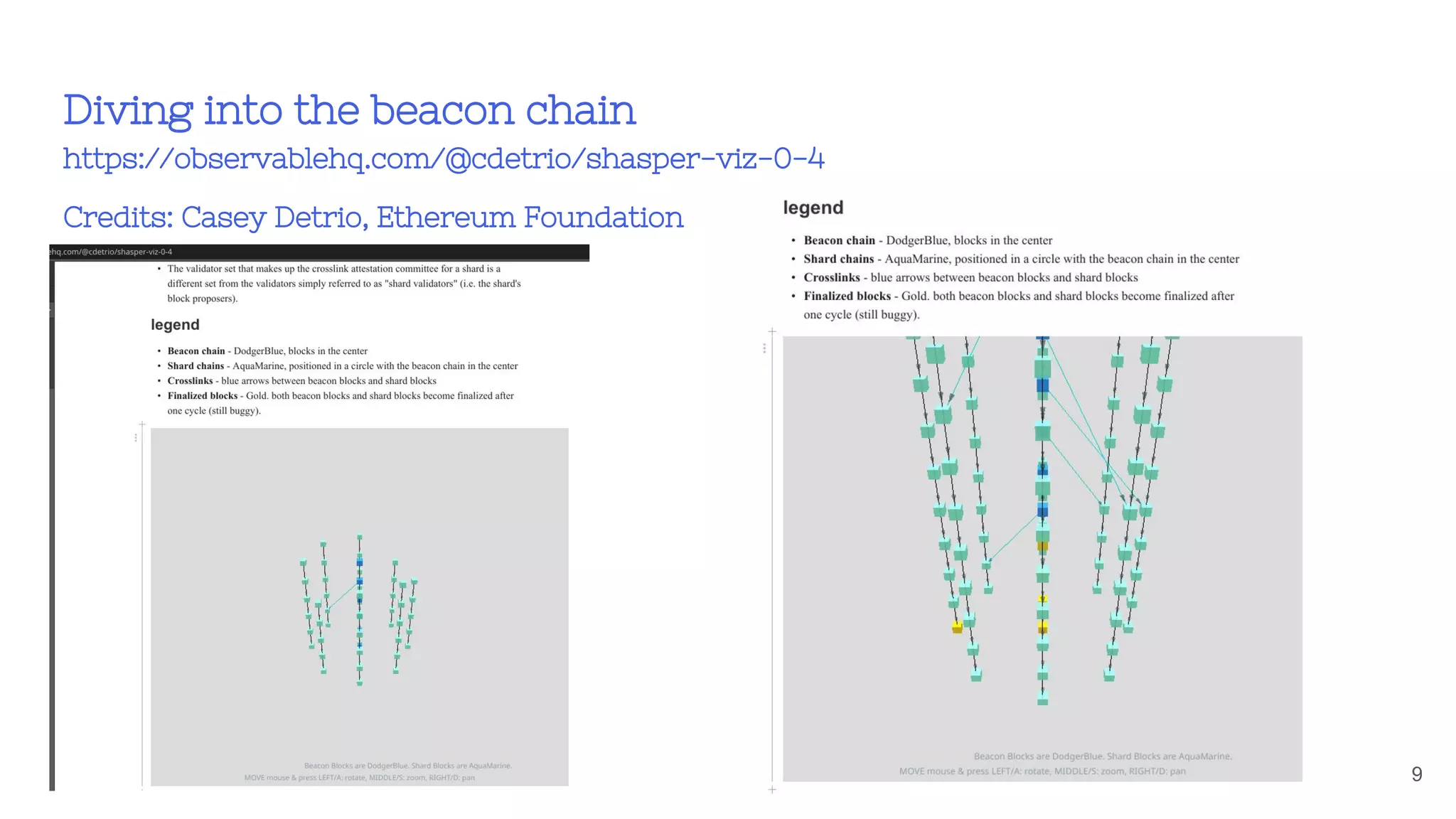
Diving into the beacon chain
https://observablehq.com/@cdetrio/shasper-viz-0-4
Credits: Casey Detrio, Ethereum Foundation
9
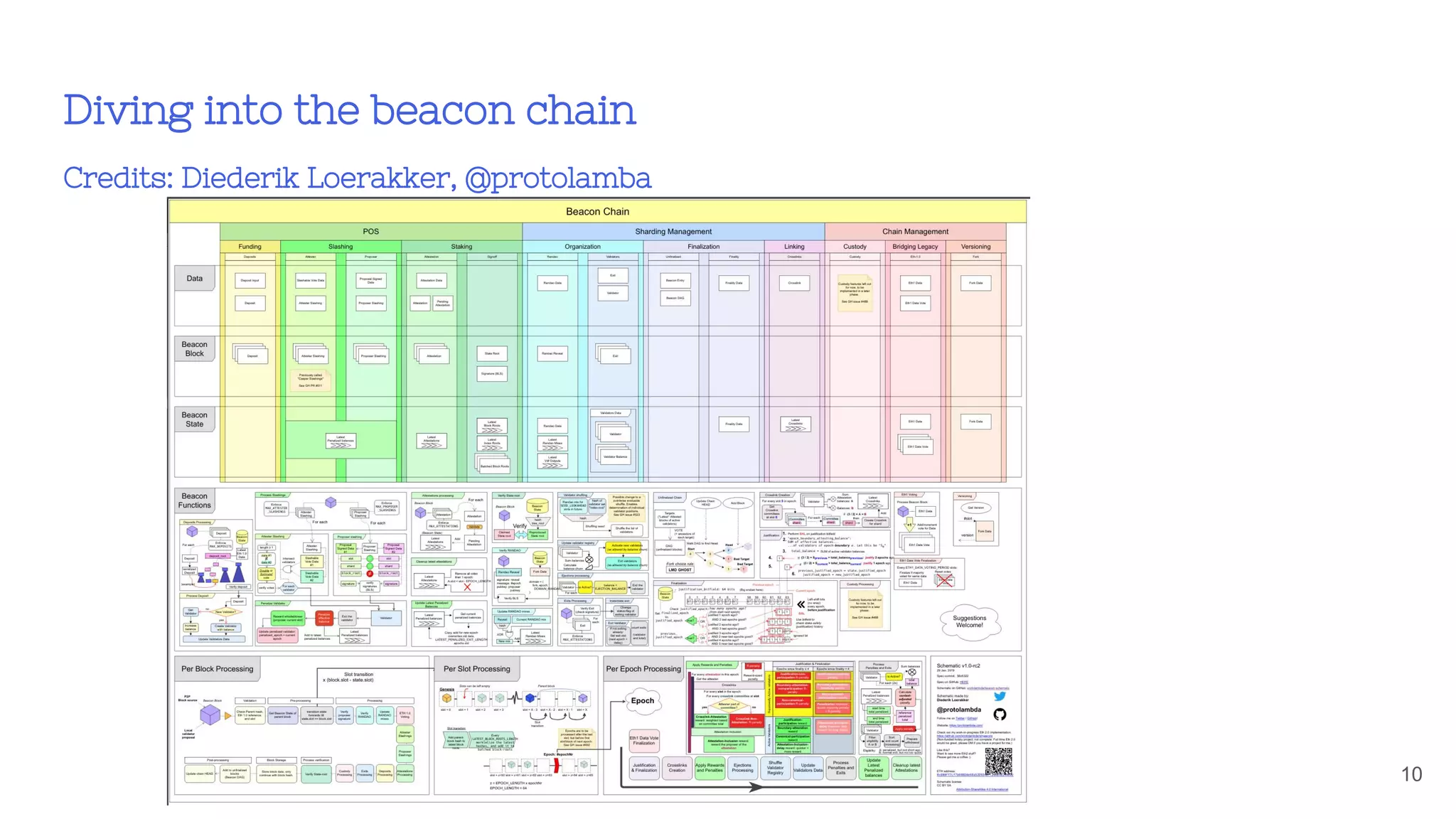
Diving into the beacon chain
Credits: Diederik Loerakker, @protolamba
10
Blast from the past
https://web.archive.org/web/20131219030753/http://vitalik.ca/ethereum.html
11
Basic Building Blocks
Network: Ethereum will run on its own network with a memory-hard proof of
work (not yet released) and a 60-second block time using single-level
GHOST (see http://www.cs.huji.ac.il/~avivz/pubs/13/btc_scalability_full.pdf)
to improve security and fairness with fast confirmation times. The restriction
to single-level is done for simplicity and because a very fast block time is
undesirable for other reasons - namely, blocks will potentially take a very
long time to evaluate, so high levels of waste are computationally
undesirable, and block validation time will be potentially very high variance.
Currency: [...]
Issuance model: [...]
Transactions: transactions in Ethereum will be simple, with one sender,
one recipient, a value, a fee and a message consisting of zero or more data
items that are integers in [ 0 ... 2^256 - 1] (ie. 32 byte values). All
transactions are valid; transactions where the recipient has insufficient funds
simply do nothing. Transactions sent to the zero address (ie. whose
hexadecimal representation is all zeroes) are a special type of transaction,
creating a "contract".
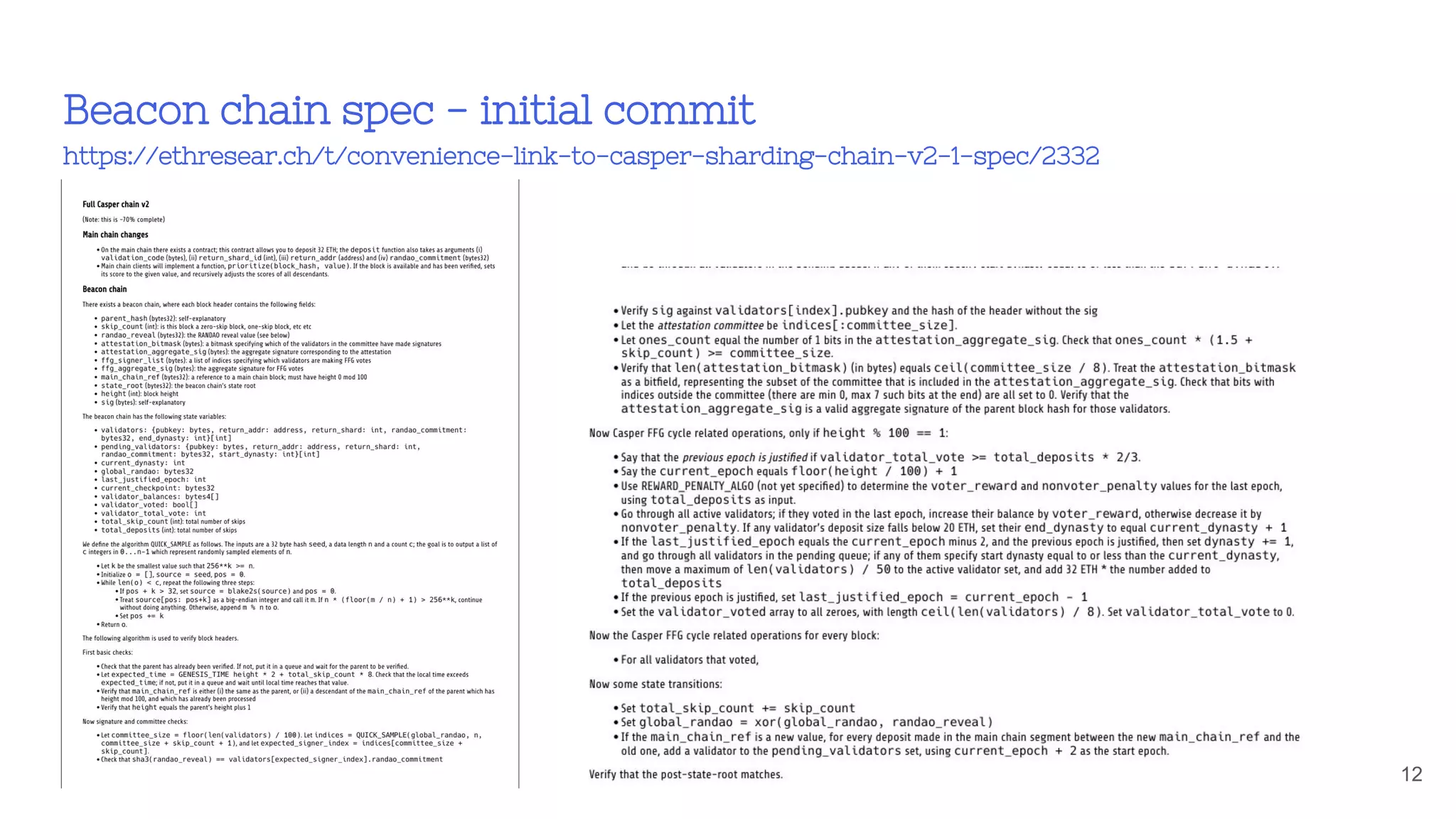
Beacon chain spec - initial commit
https://ethresear.ch/t/convenience-link-to-casper-sharding-chain-v2-1-spec/2332
12
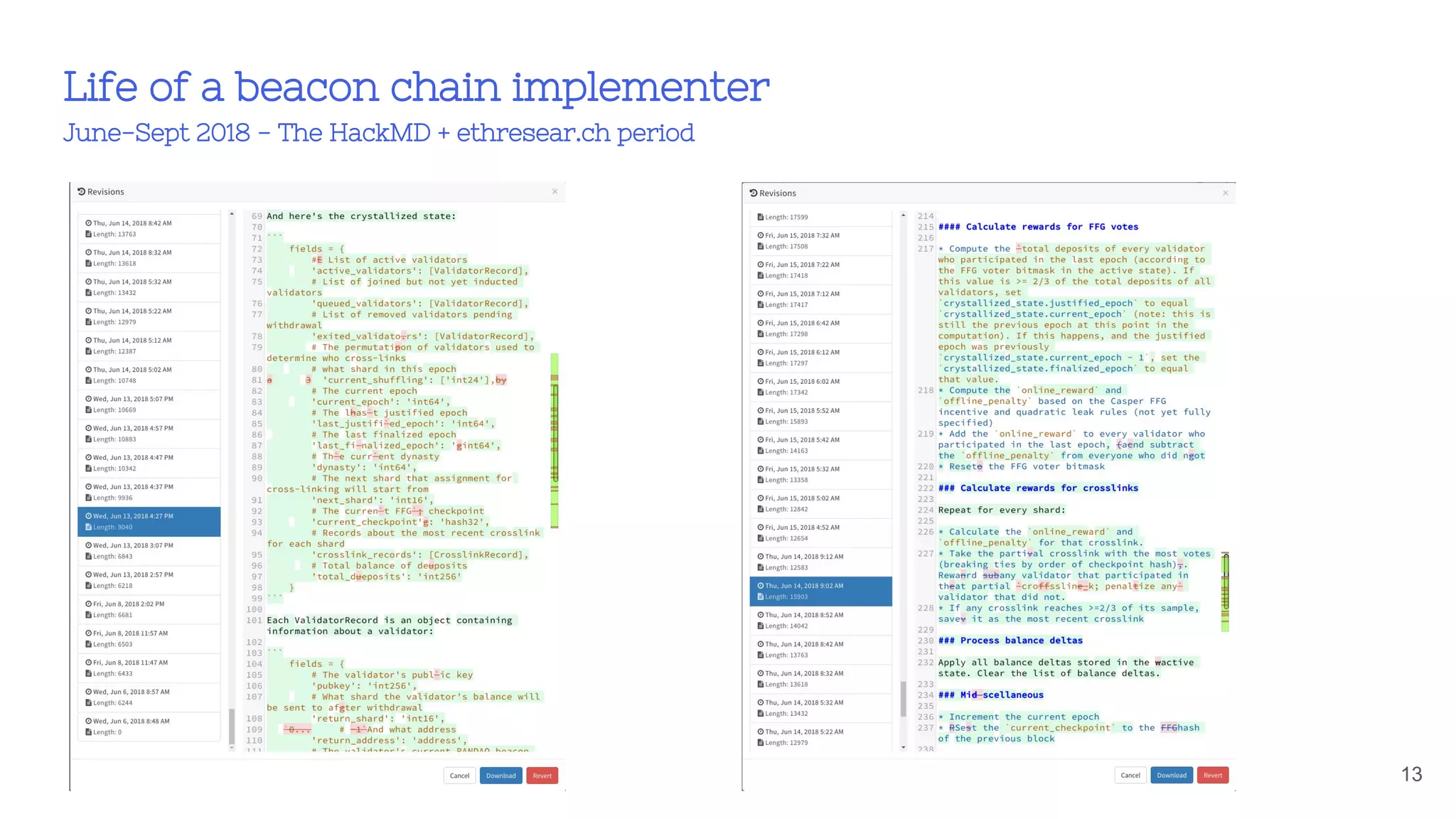
Life of a beacon chain implementer
June-Sept 2018 - The HackMD + ethresear.ch period
13
Life of a beacon chain implementer
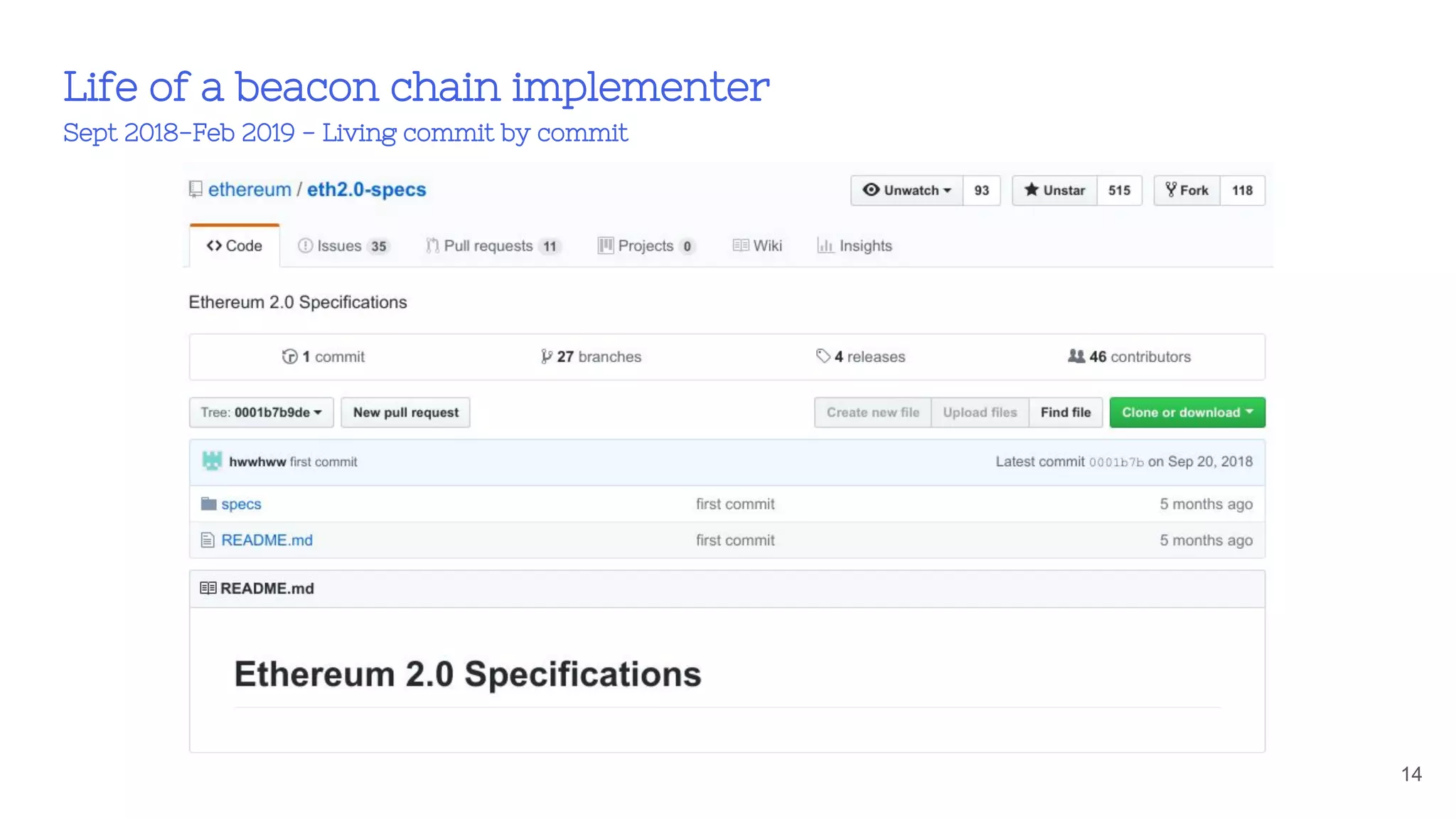
Sept 2018-Feb 2019 - Living commit by commit
14
Life of a beacon chain implementer
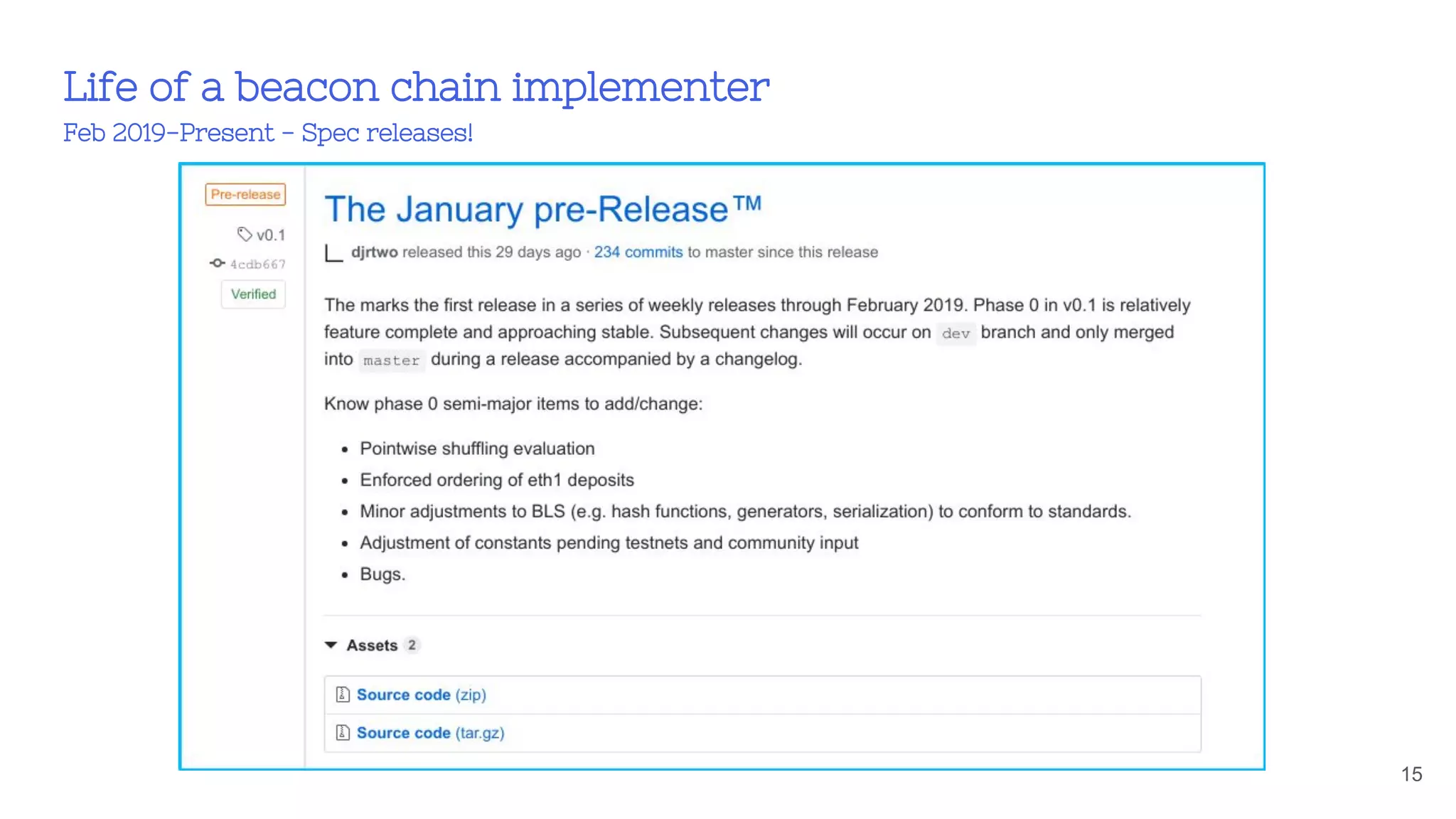
Feb 2019-Present - Spec releases!
15
What could go wrong?
16
What could go wrong?
17
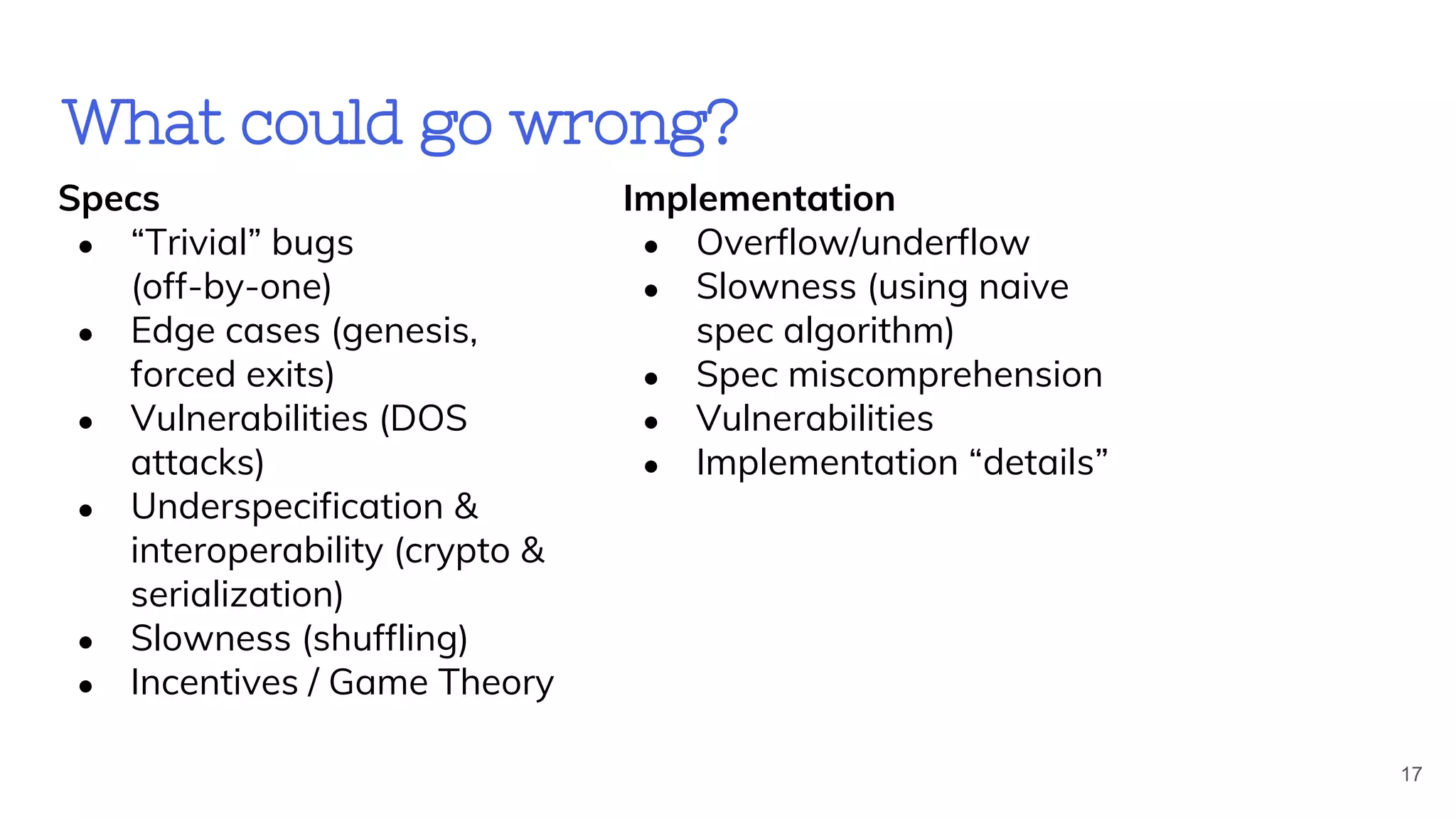
Specs
● “Trivial” bugs
(off-by-one)
● Edge cases (genesis,
forced exits)
● Vulnerabilities (DOS
attacks)
● Underspecification &
interoperability (crypto &
serialization)
● Slowness (shuffling)
● Incentives / Game Theory
Implementation
● Overflow/underflow
● Slowness (using naive
spec algorithm)
● Spec miscomprehension
● Vulnerabilities
● Implementation “details”
What could go wrong?
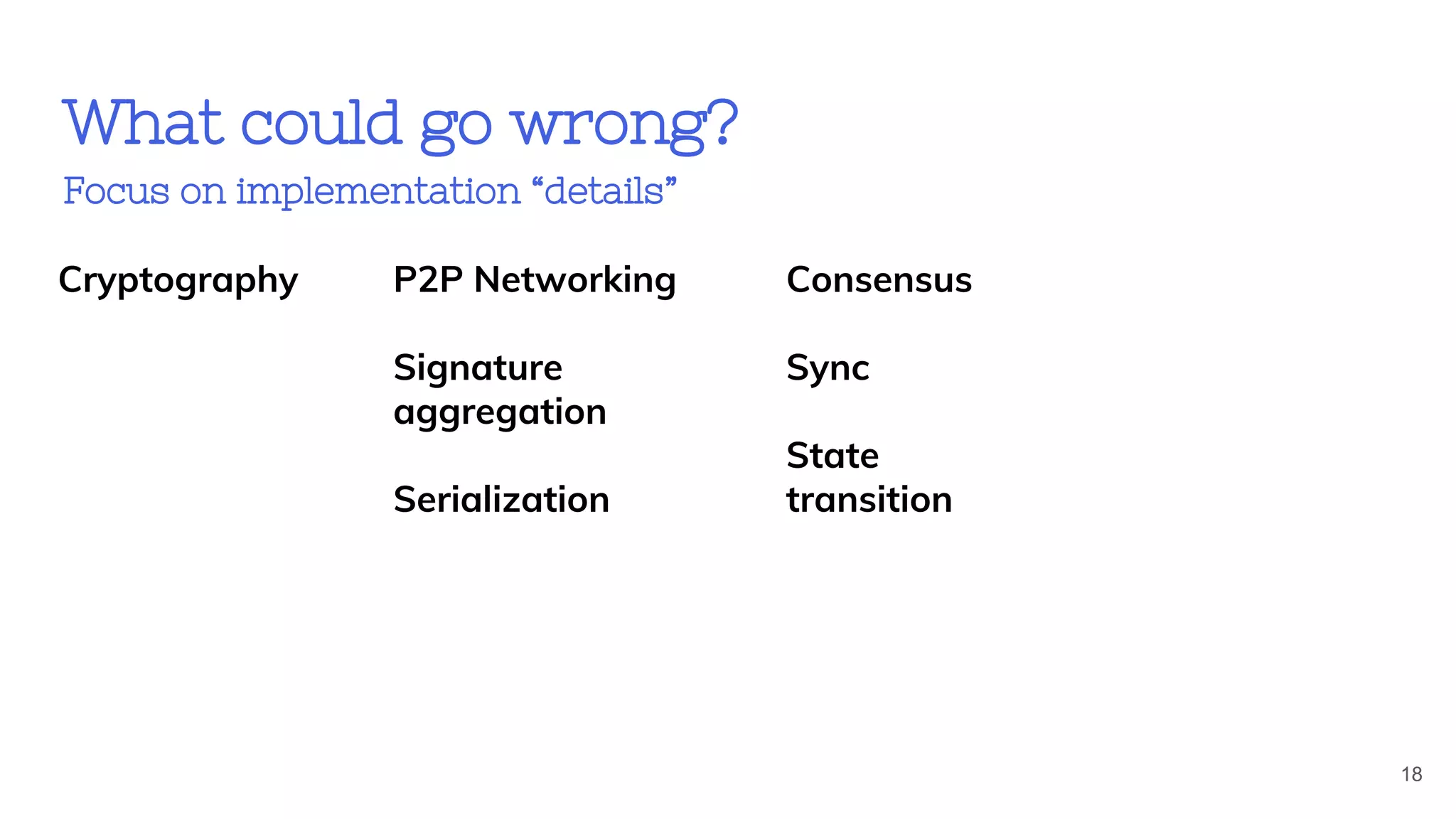
Focus on implementation “details”
18
Cryptography P2P Networking
Signature
aggregation
Serialization
Consensus
Sync
State
transition
What could go wrong?
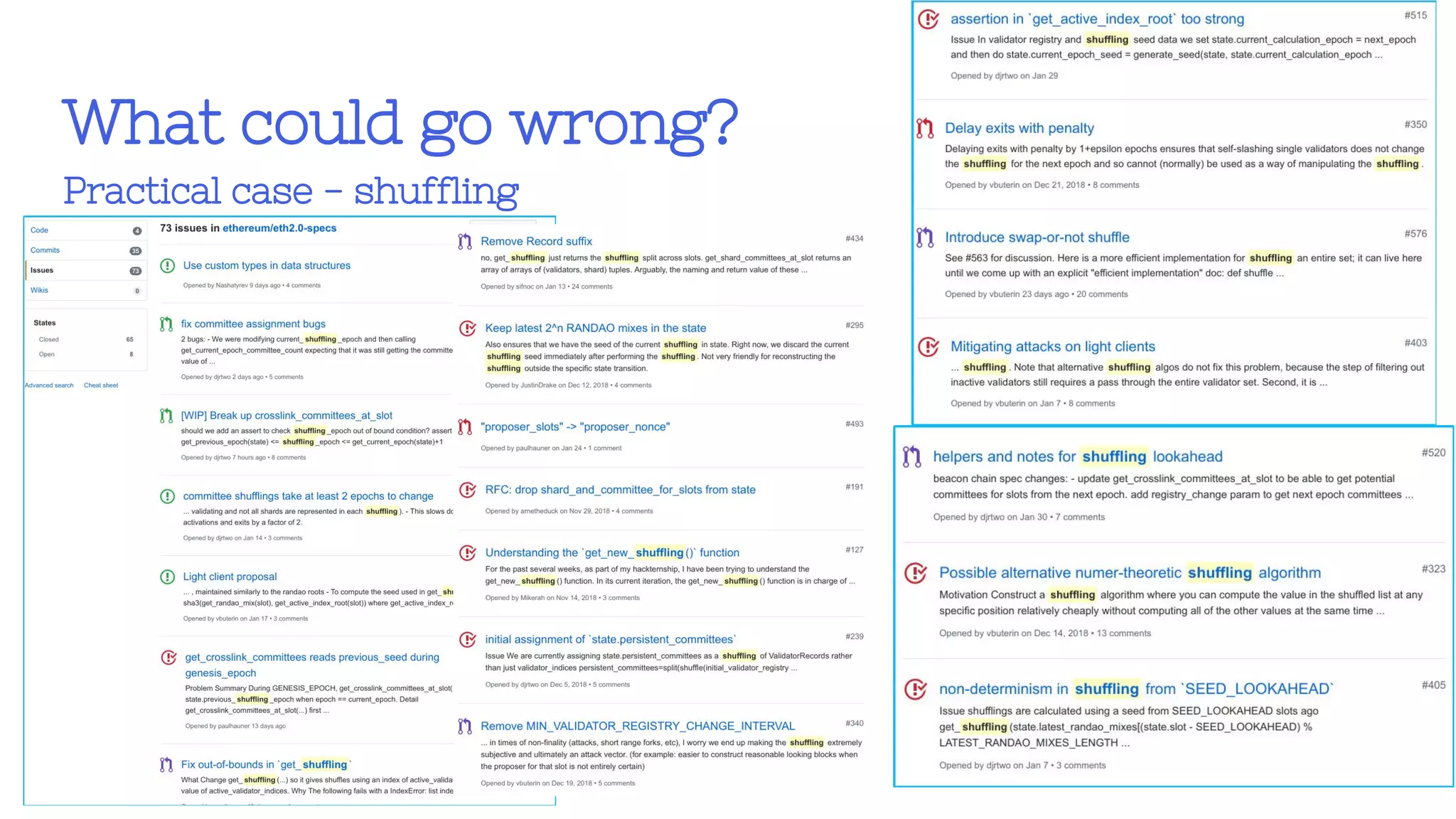
Practical case - shuffling
19
What could go wrong?
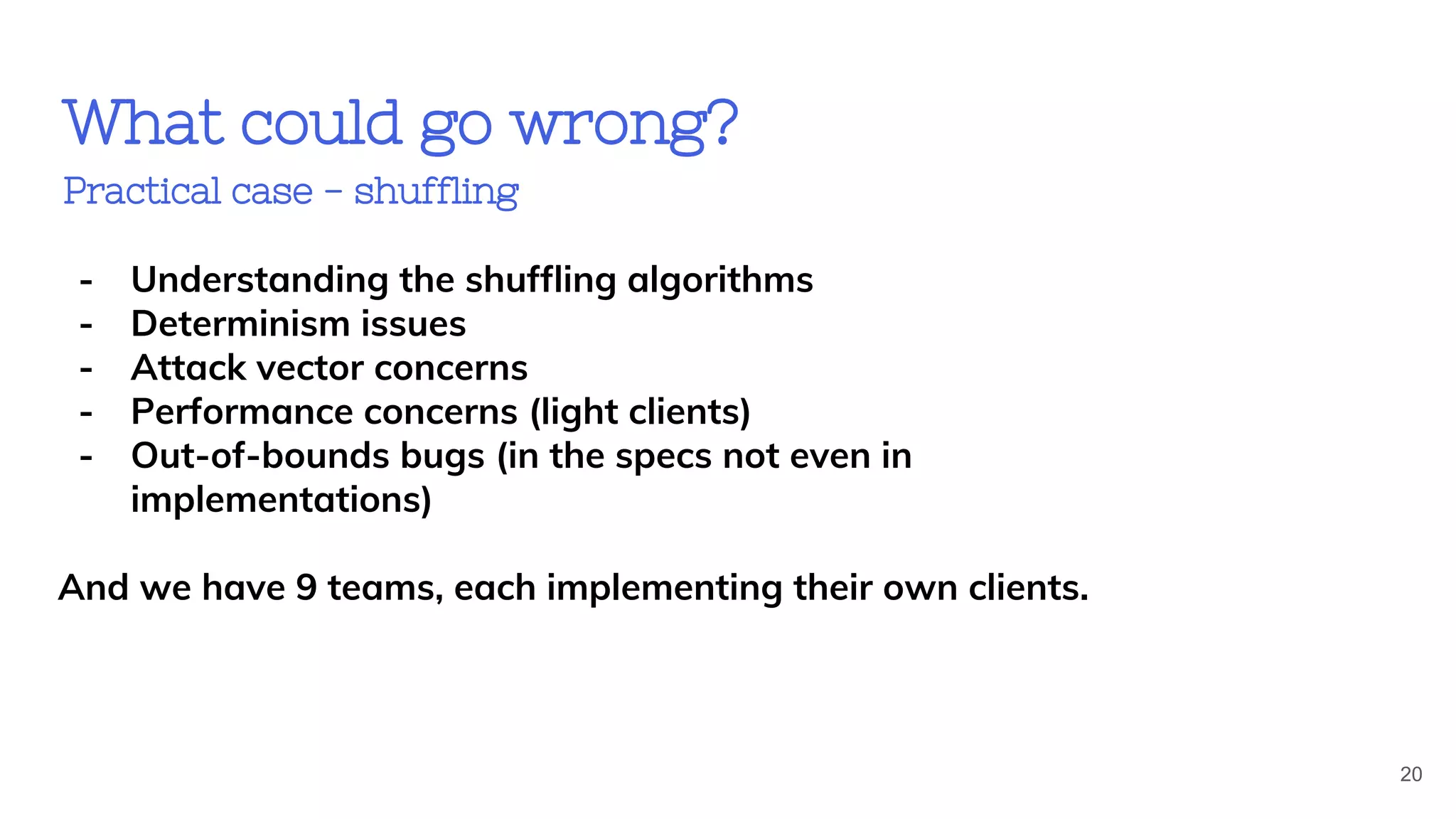
Practical case - shuffling
20
- Understanding the shuffling algorithms
- Determinism issues
- Attack vector concerns
- Performance concerns (light clients)
- Out-of-bounds bugs (in the specs not even in
implementations)
And we have 9 teams, each implementing their own clients.
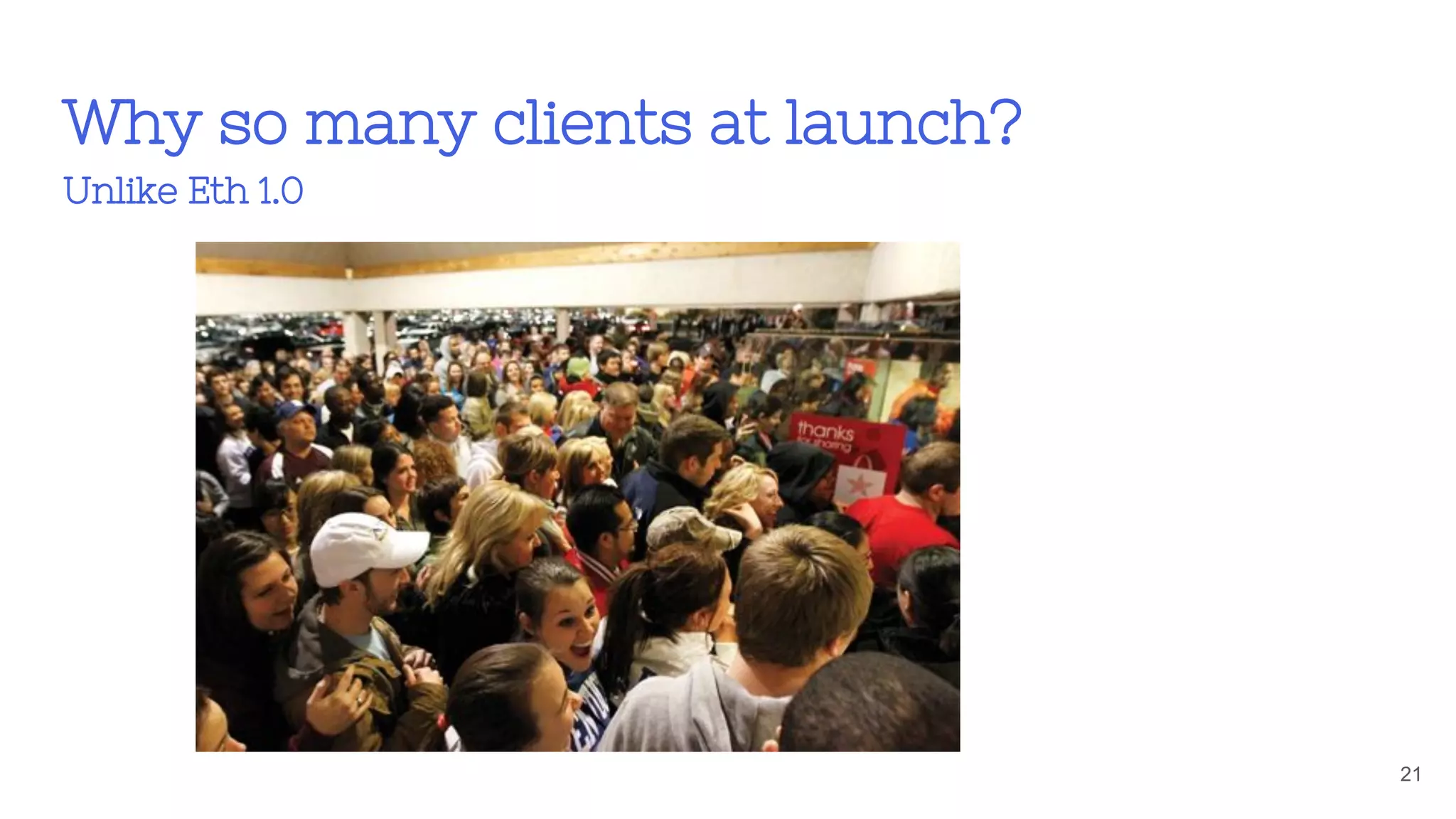
Why so many clients at launch?
Unlike Eth 1.0
21
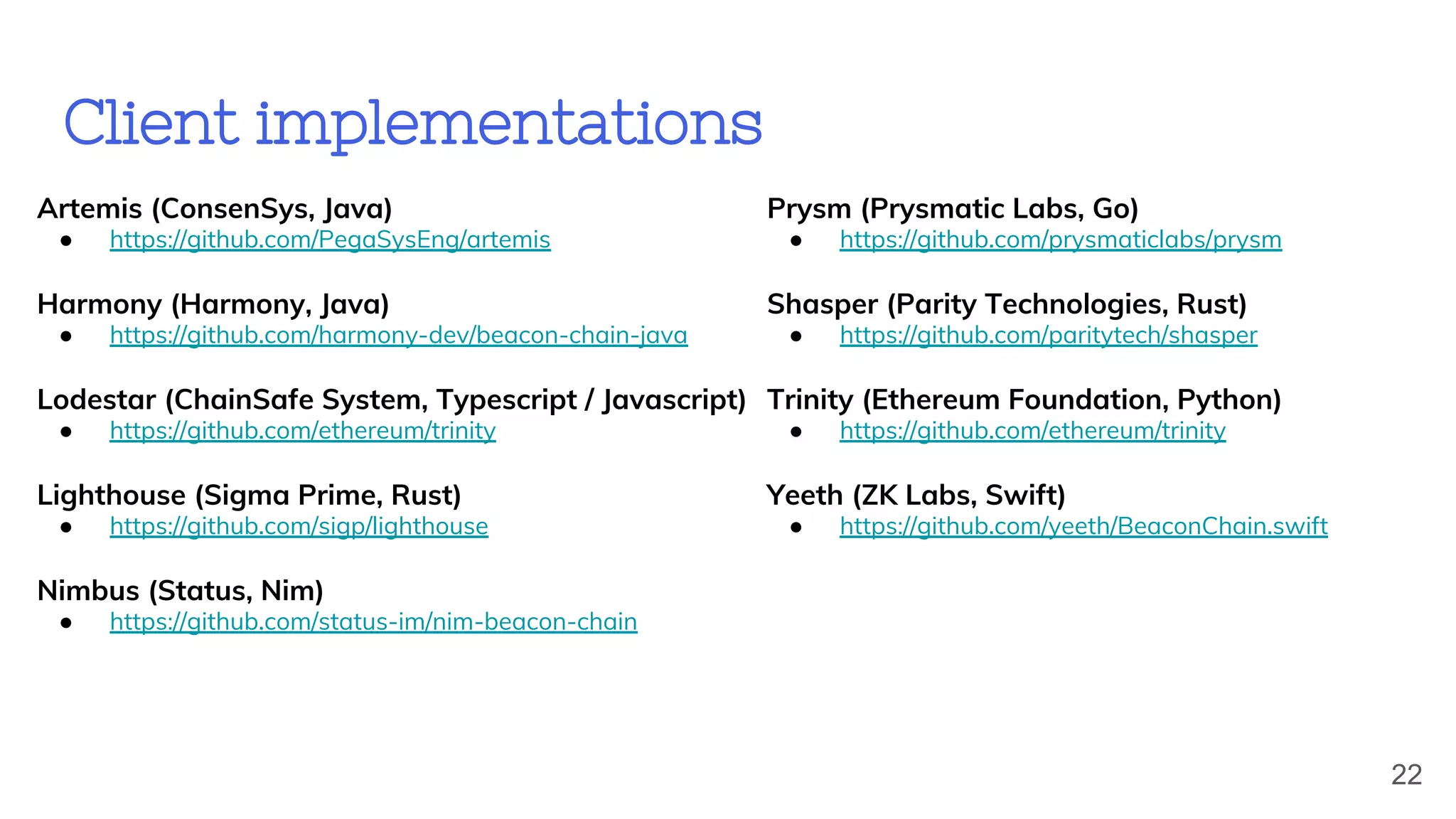
Client implementations
Prysm (Prysmatic Labs, Go)
● https://github.com/prysmaticlabs/prysm
Shasper (Parity Technologies, Rust)
● https://github.com/paritytech/shasper
Trinity (Ethereum Foundation, Python)
● https://github.com/ethereum/trinity
Yeeth (ZK Labs, Swift)
● https://github.com/yeeth/BeaconChain.swift
Artemis (ConsenSys, Java)
● https://github.com/PegaSysEng/artemis
Harmony (Harmony, Java)
● https://github.com/harmony-dev/beacon-chain-java
Lodestar (ChainSafe System, Typescript / Javascript)
● https://github.com/ethereum/trinity
Lighthouse (Sigma Prime, Rust)
● https://github.com/sigp/lighthouse
Nimbus (Status, Nim)
● https://github.com/status-im/nim-beacon-chain
22
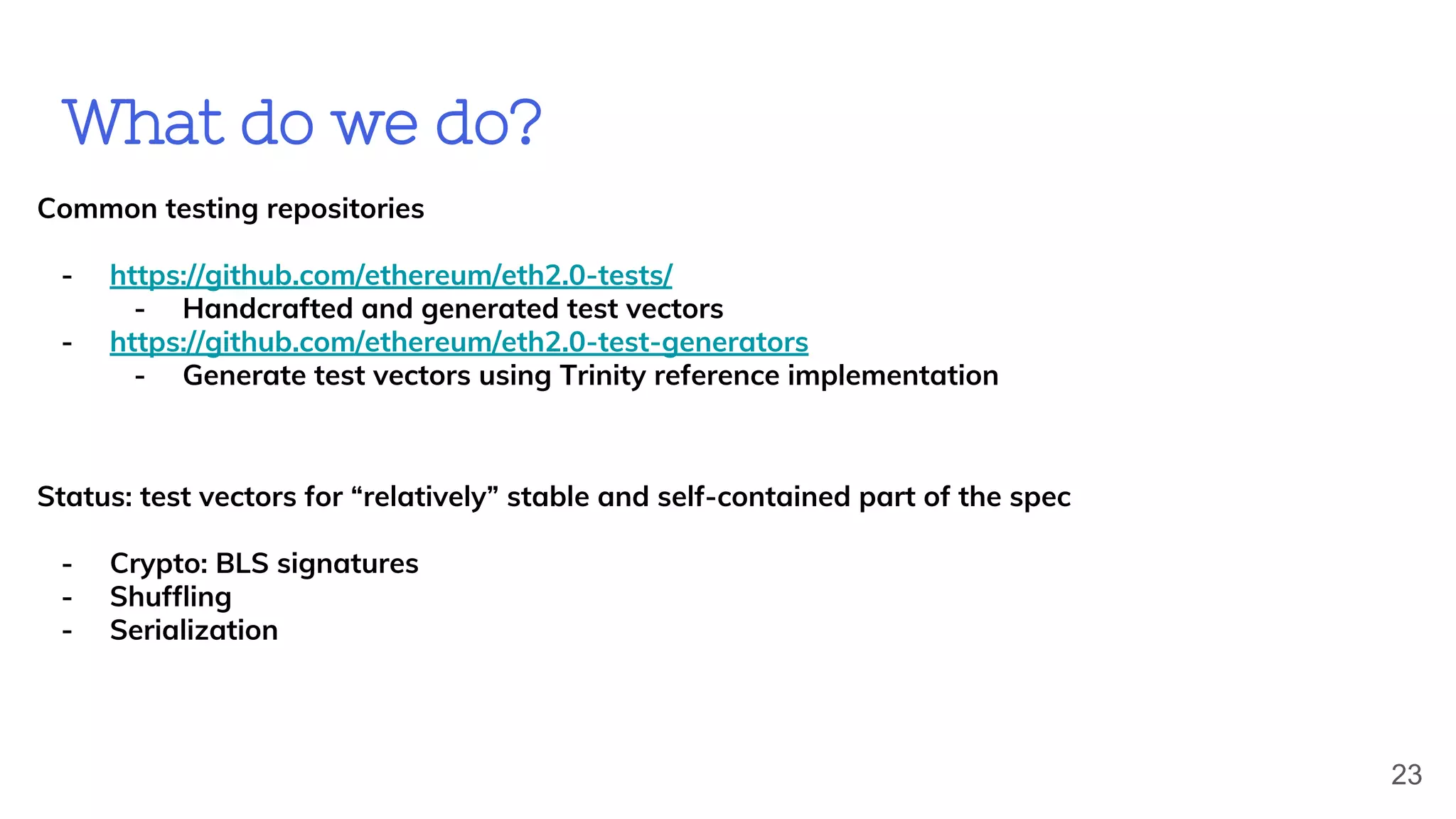
What do we do?
Common testing repositories
- https://github.com/ethereum/eth2.0-tests/
- Handcrafted and generated test vectors
- https://github.com/ethereum/eth2.0-test-generators
- Generate test vectors using Trinity reference implementation
Status: test vectors for “relatively” stable and self-contained part of the spec
- Crypto: BLS signatures
- Shuffling
- Serialization
23
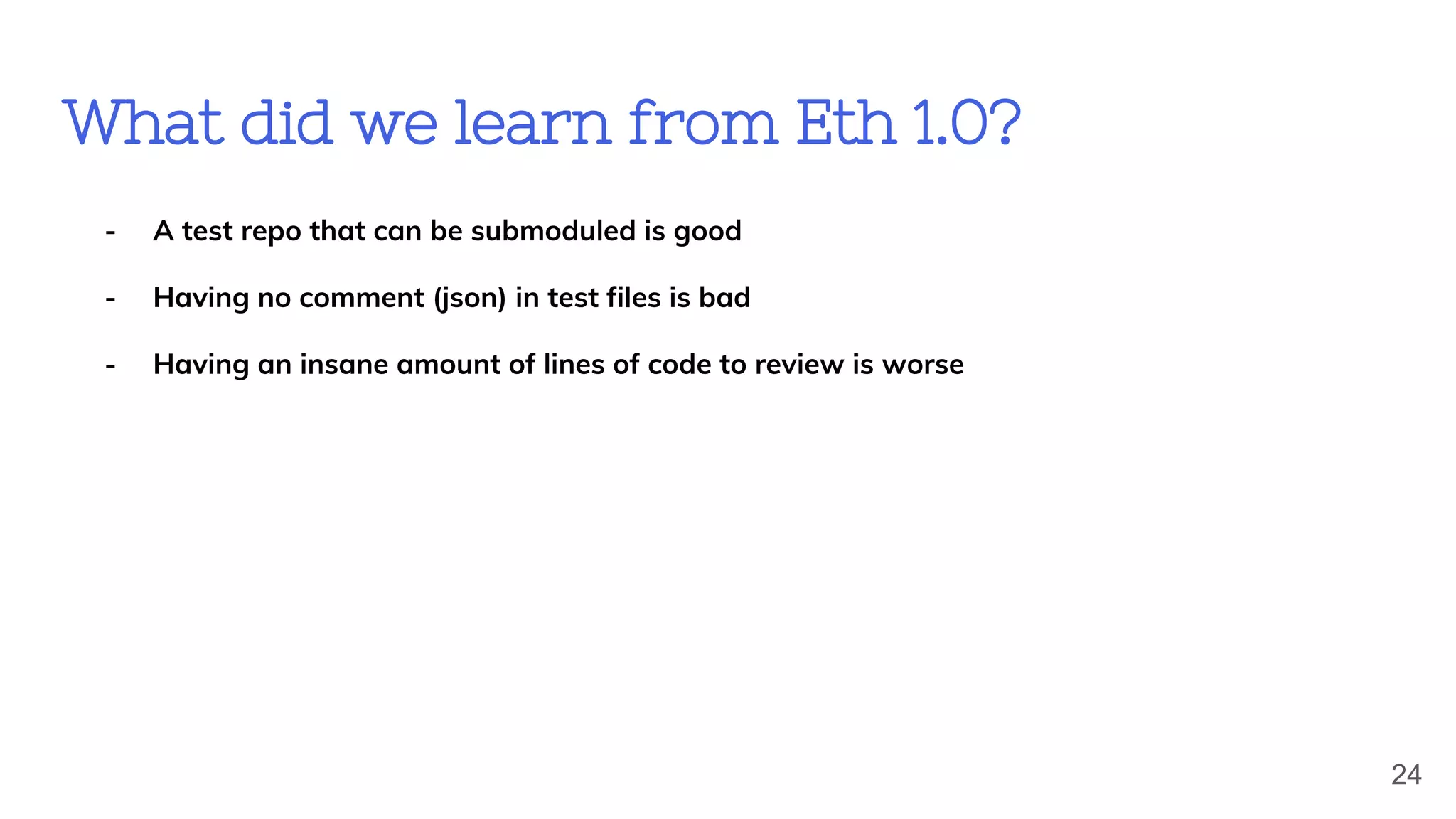
What did we learn from Eth 1.0?
24
- A test repo that can be submoduled is good
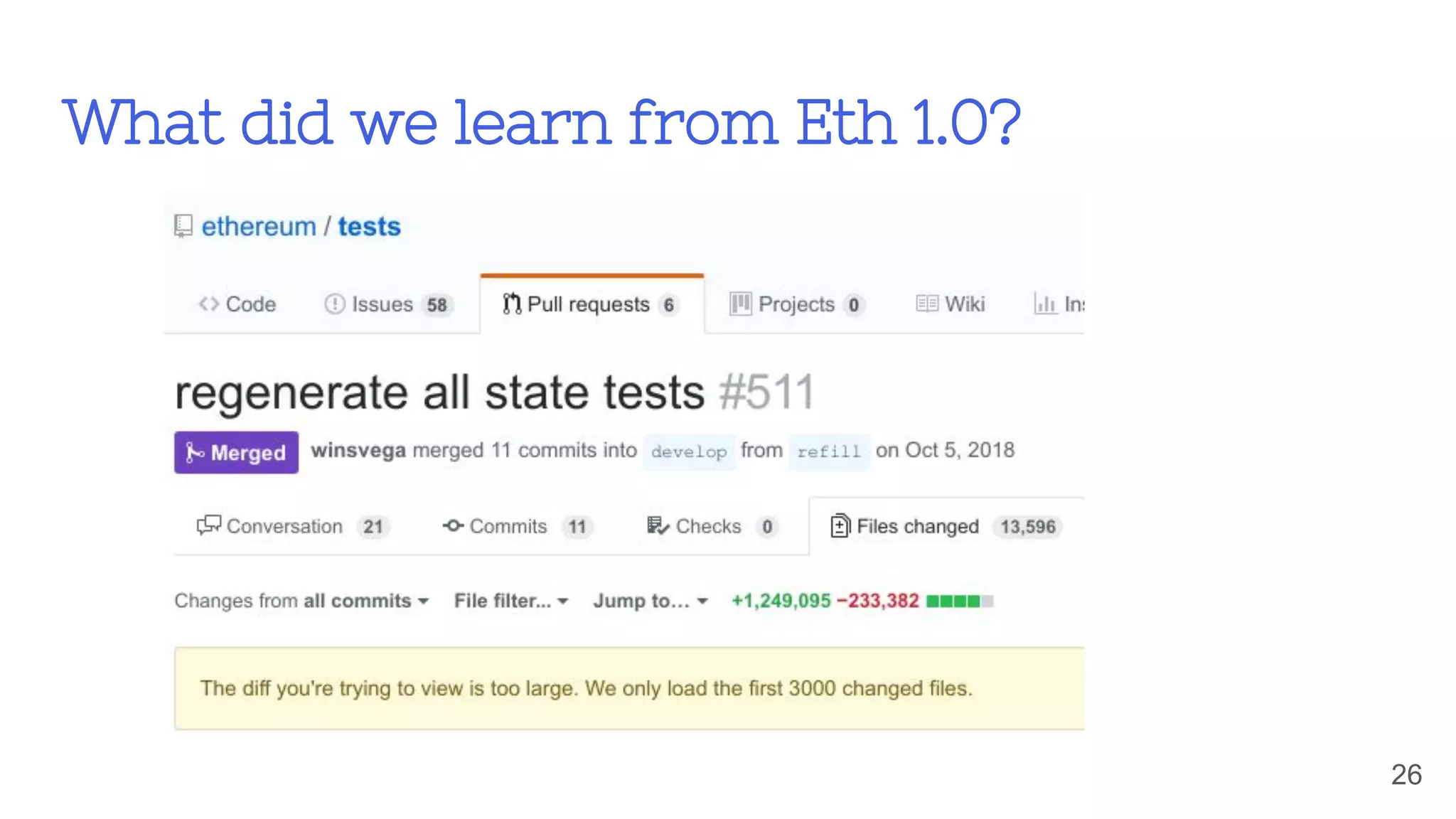
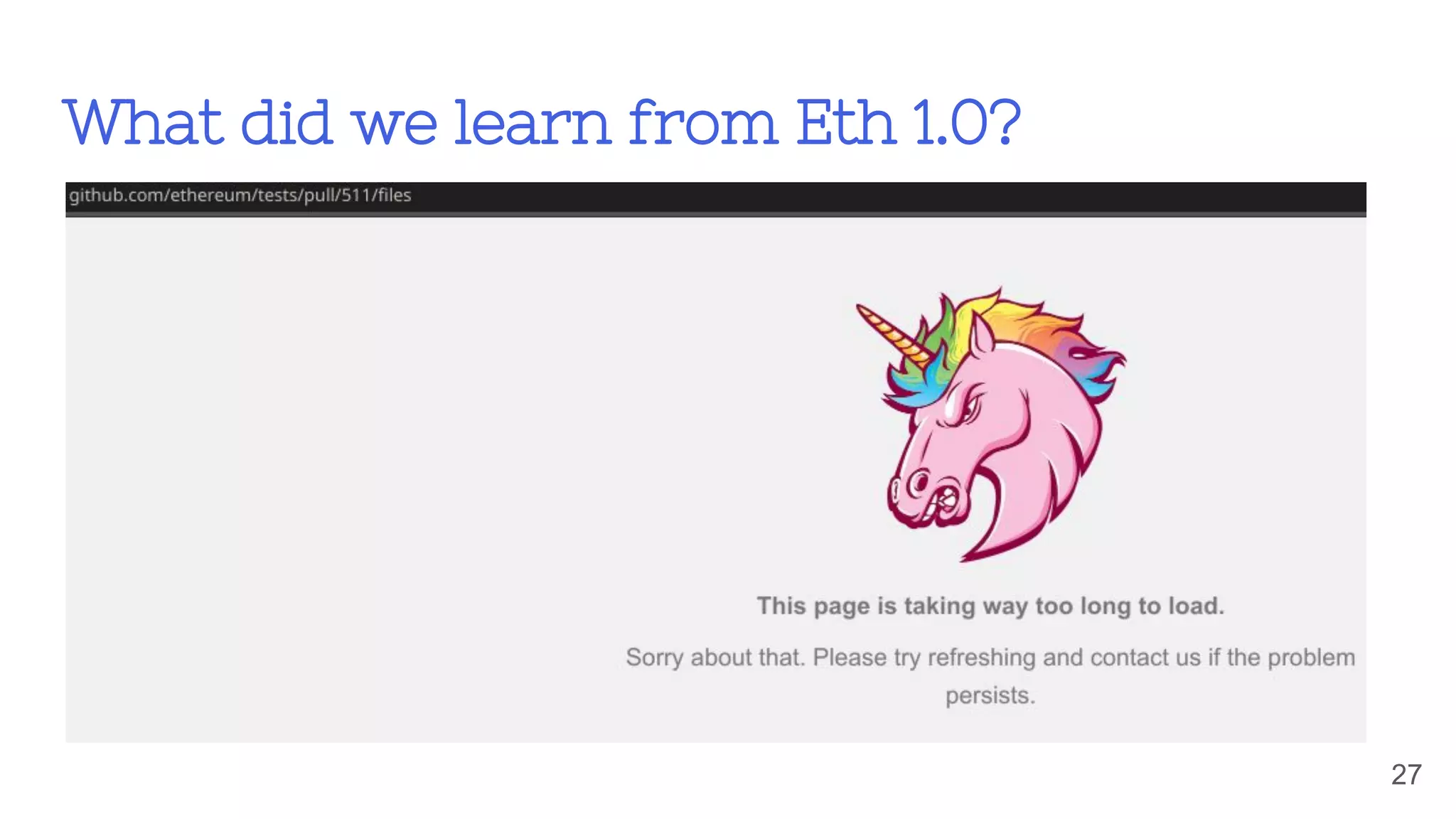
- Having no comment (json) in test files is bad
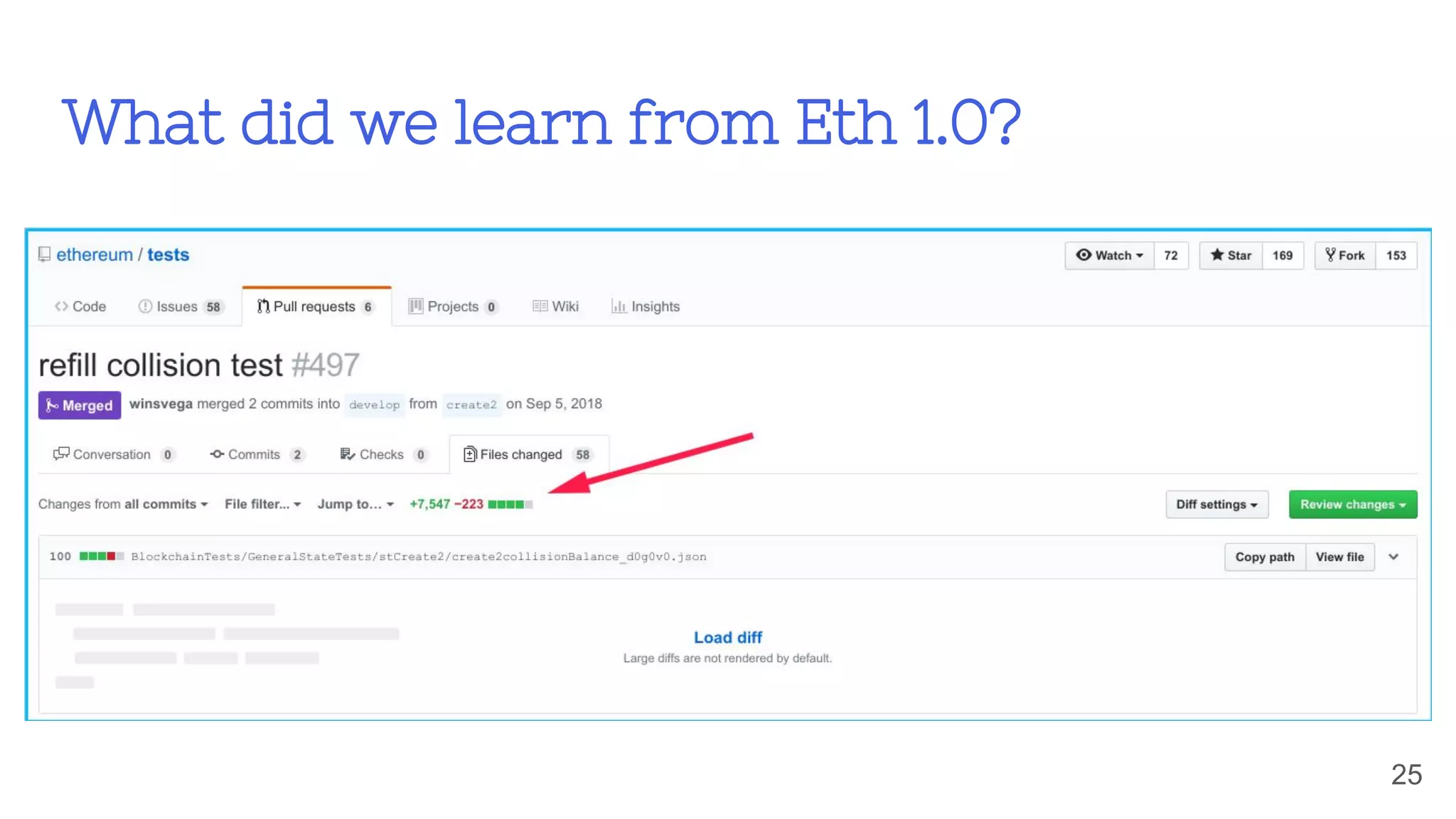
- Having an insane amount of lines of code to review is worse
What did we learn from Eth 1.0?
25
What did we learn from Eth 1.0?
26
What did we learn from Eth 1.0?
27
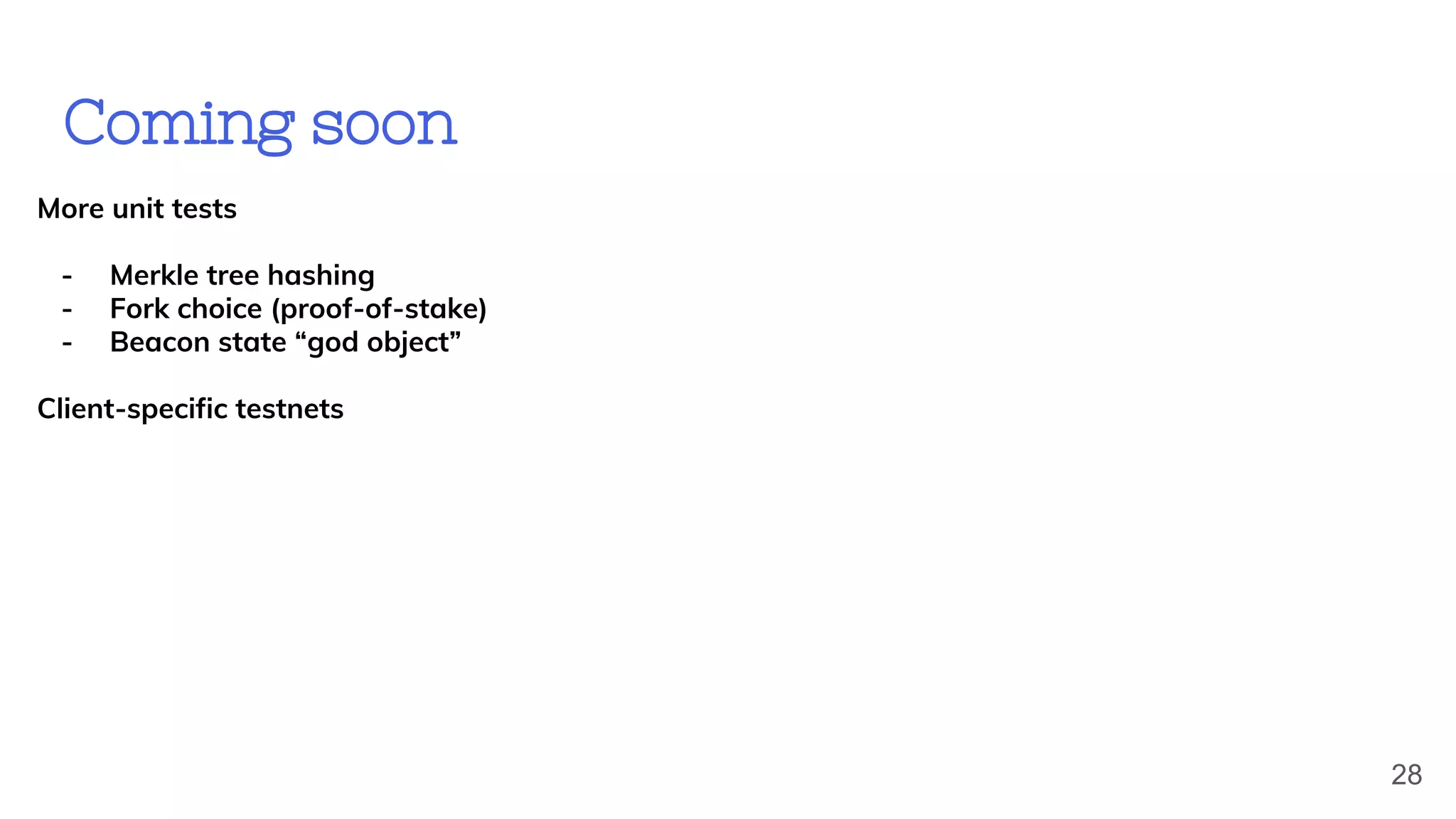
Coming soon
More unit tests
- Merkle tree hashing
- Fork choice (proof-of-stake)
- Beacon state “god object”
Client-specific testnets
28
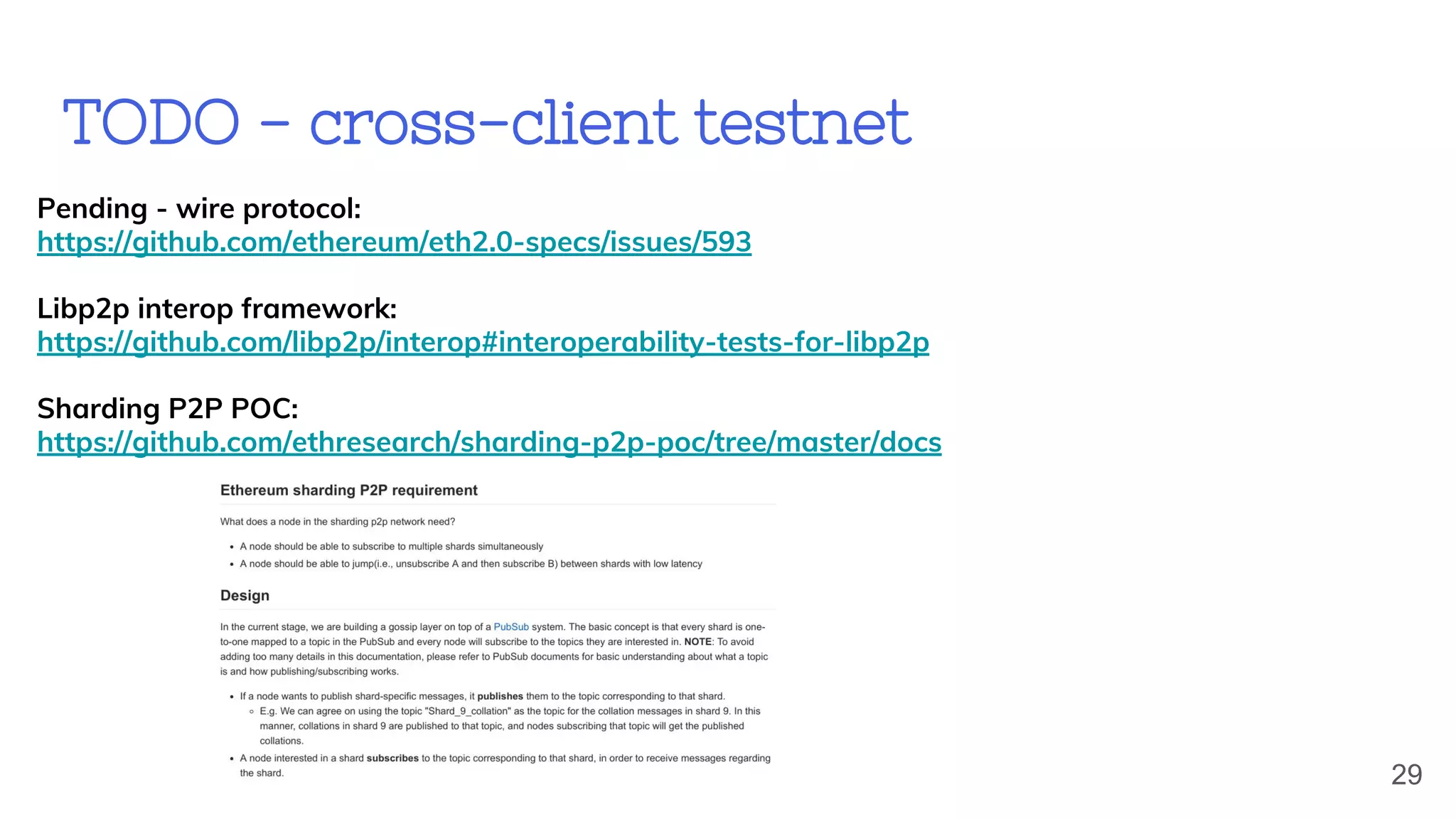
TODO - cross-client testnet
Pending - wire protocol:
https://github.com/ethereum/eth2.0-specs/issues/593
Libp2p interop framework:
https://github.com/libp2p/interop#interoperability-tests-for-libp2p
Sharding P2P POC:
https://github.com/ethresearch/sharding-p2p-poc/tree/master/docs
29
Simulations
Kinds of simulations for Eth 2.0
- High-level overview
- Full simulation with a real client (coming soon™)
- Sharding simulations
- Consensus simulations
Some are in color ;)
30
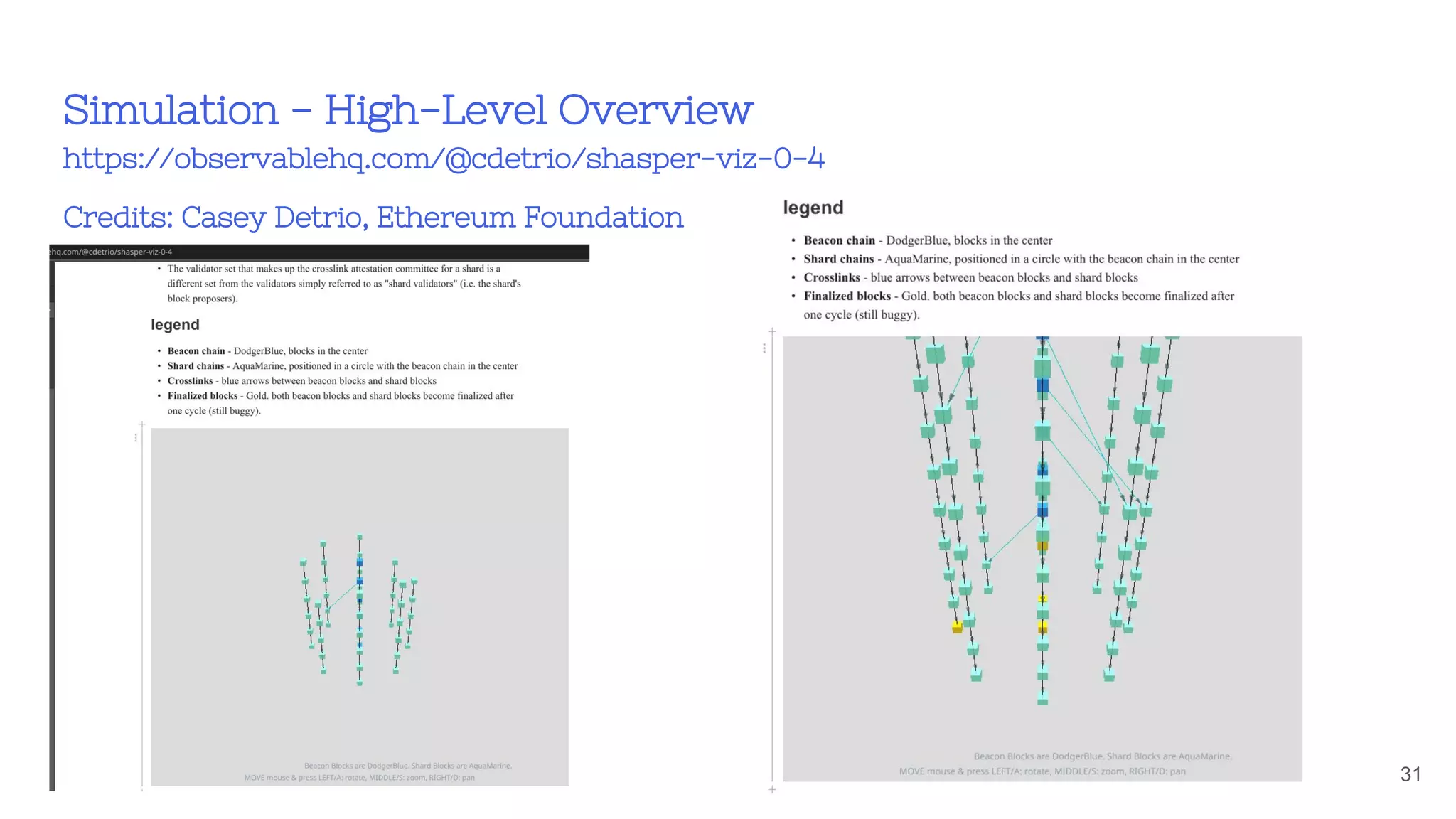
Simulation - High-Level Overview
https://observablehq.com/@cdetrio/shasper-viz-0-4
Credits: Casey Detrio, Ethereum Foundation
31
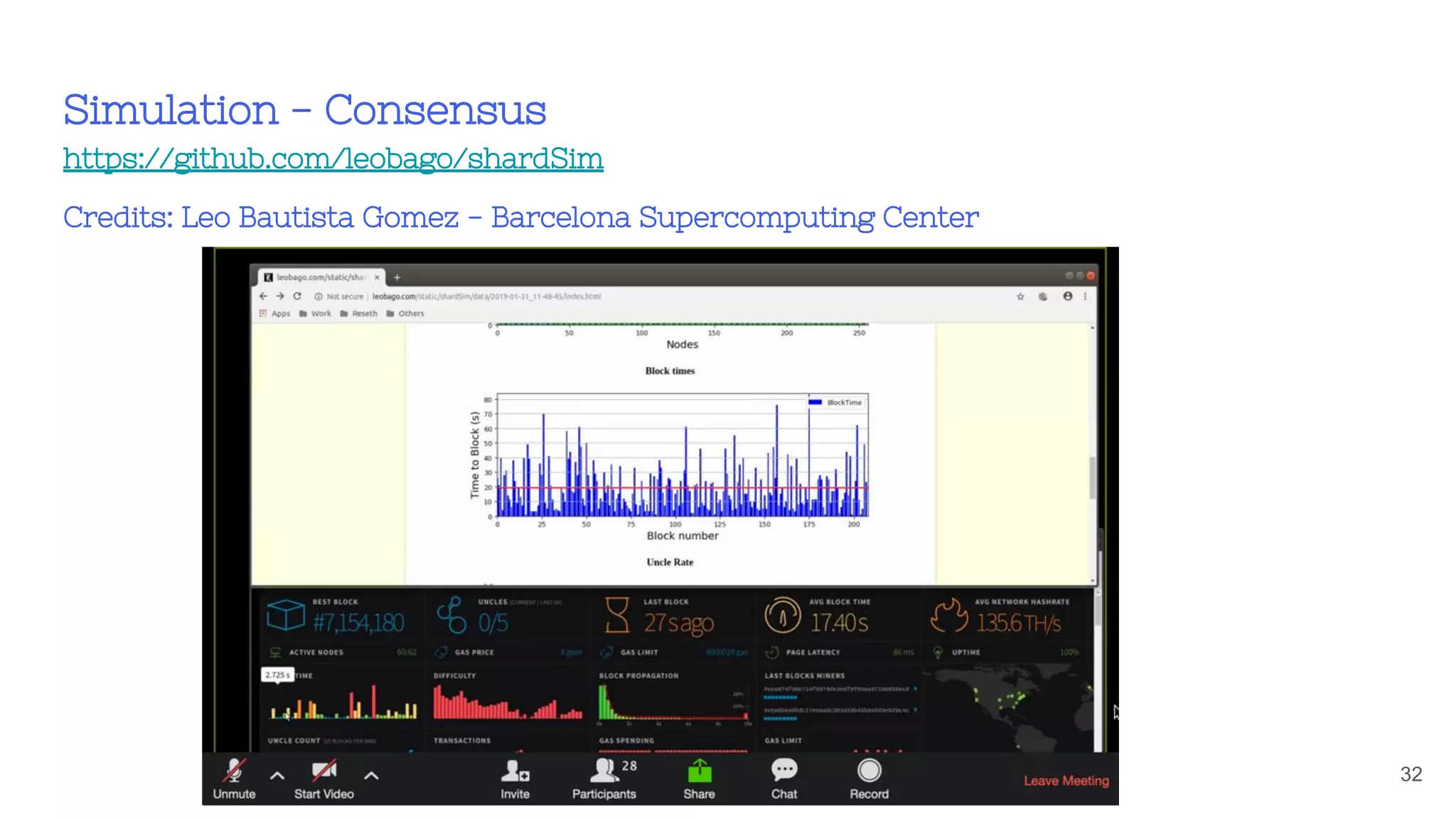
Simulation - Consensus
https://github.com/leobago/shardSim
Credits: Leo Bautista Gomez - Barcelona Supercomputing Center
32
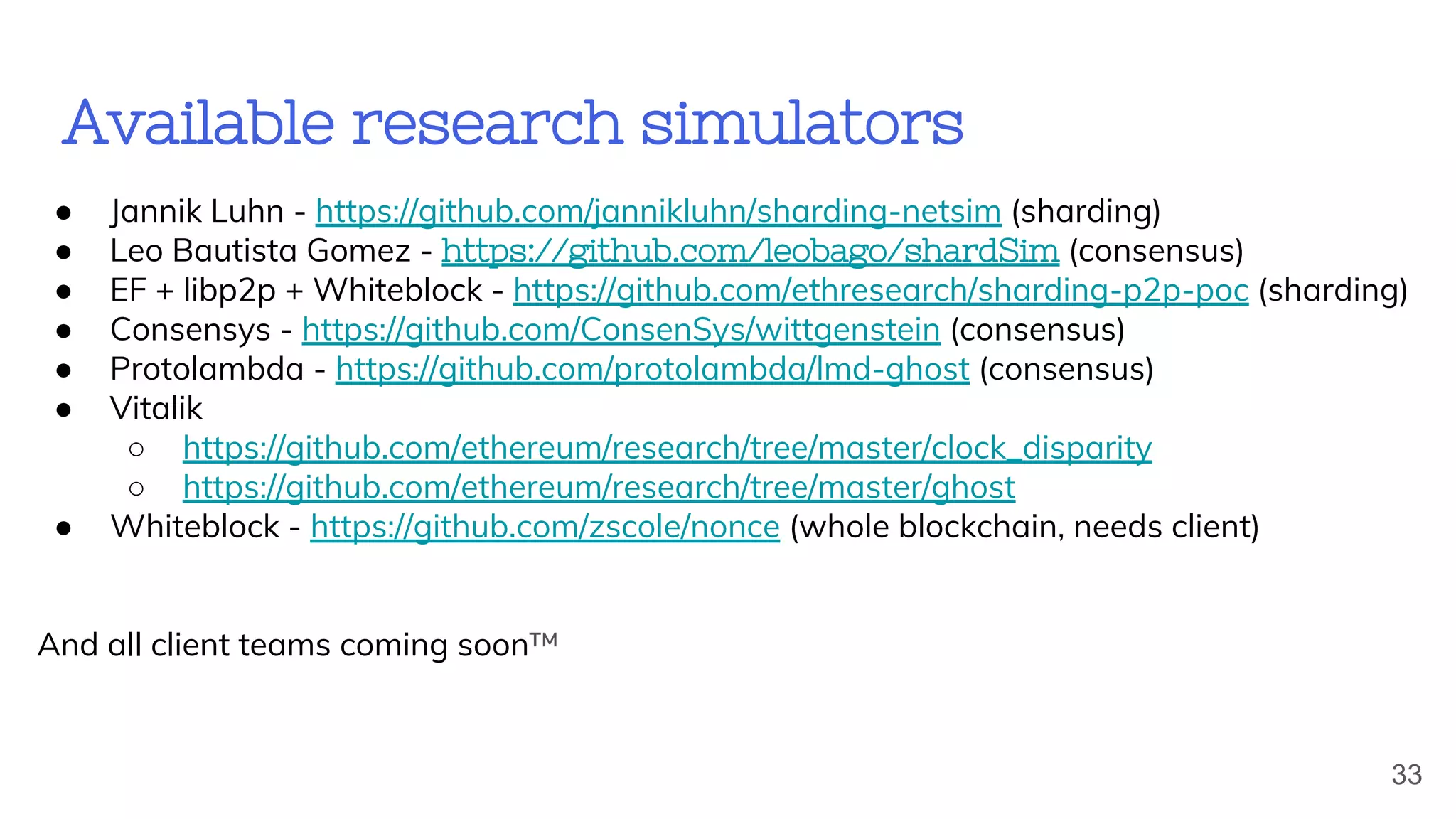
Available research simulators
● Jannik Luhn - https://github.com/jannikluhn/sharding-netsim (sharding)
● Leo Bautista Gomez - https://github.com/leobago/shardSim (consensus)
● EF + libp2p + Whiteblock - https://github.com/ethresearch/sharding-p2p-poc (sharding)
● Consensys - https://github.com/ConsenSys/wittgenstein (consensus)
● Protolambda - https://github.com/protolambda/lmd-ghost (consensus)
● Vitalik
○ https://github.com/ethereum/research/tree/master/clock_disparity
○ https://github.com/ethereum/research/tree/master/ghost
● Whiteblock - https://github.com/zscole/nonce (whole blockchain, needs client)
And all client teams coming soon™
33
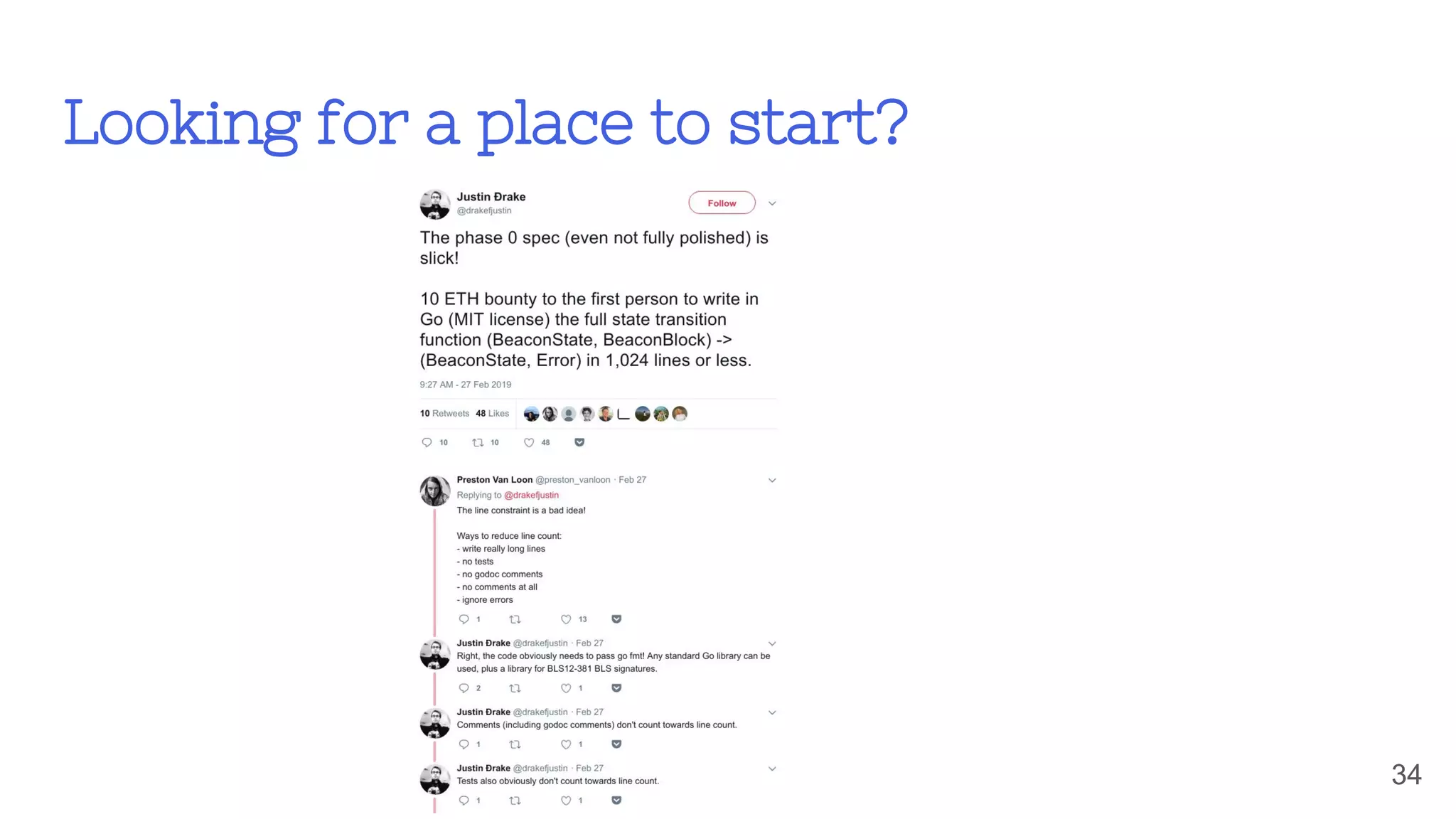
Looking for a place to start?
34
Thank you!
35

Eth cc --eth2-tests-and-implementation

  • 1.
    Eth 2.0 Testing andSimulation 1
  • 2.
    Hello!I am MamyRatsimbazafy Part of the Nimbus Eth1 and Eth2 implementer team at Status “Adolescent Full Mustang” @mratsim @m_ratsim 2
  • 3.
    Where are we? https://github.com/ethereum/eth2.0-specs Phase0 ● The beacon chain ● Status: ○ testnets incoming Responsibilities ● Coordination layer ● Sharding ● Block processing ○ Proof-of-Stake ○ Managing validators, shards, committees and attestations. ● Additional features ○ Finality ○ RNG ○ Cross-shard communication ○ Eth1 transition 3
  • 4.
    What’s next? https://github.com/ethereum/eth2.0-specs Phase 1 ●The shard data chains ● Status: ○ Spec written, no implementation started. ● Responsibilities ○ Consensus over the data (e.g. account balance) Phase 2 ● The VM / execution layer ● Status: ○ In discussion (eWASM?) ● Responsibilities ○ Executing transactions (from simple transfers to smart-contracts) 4
  • 5.
  • 6.
  • 7.
  • 8.
    Diving into thebeacon chain Credits: Hsiao Wei Wang, Ethereum Foundation 8 Beacon Chain provides random numbers Shard Chain provides data Shard 100 B1 B2 B3 B4 B5 VM provides state execution result Shard 1 Main Chain provides staking B1 state root B2 state root B3 state root B4 state root B5 state root
  • 9.
    Diving into thebeacon chain https://observablehq.com/@cdetrio/shasper-viz-0-4 Credits: Casey Detrio, Ethereum Foundation 9
  • 10.
    Diving into thebeacon chain Credits: Diederik Loerakker, @protolamba 10
  • 11.
    Blast from thepast https://web.archive.org/web/20131219030753/http://vitalik.ca/ethereum.html 11 Basic Building Blocks Network: Ethereum will run on its own network with a memory-hard proof of work (not yet released) and a 60-second block time using single-level GHOST (see http://www.cs.huji.ac.il/~avivz/pubs/13/btc_scalability_full.pdf) to improve security and fairness with fast confirmation times. The restriction to single-level is done for simplicity and because a very fast block time is undesirable for other reasons - namely, blocks will potentially take a very long time to evaluate, so high levels of waste are computationally undesirable, and block validation time will be potentially very high variance. Currency: [...] Issuance model: [...] Transactions: transactions in Ethereum will be simple, with one sender, one recipient, a value, a fee and a message consisting of zero or more data items that are integers in [ 0 ... 2^256 - 1] (ie. 32 byte values). All transactions are valid; transactions where the recipient has insufficient funds simply do nothing. Transactions sent to the zero address (ie. whose hexadecimal representation is all zeroes) are a special type of transaction, creating a "contract".
  • 12.
    Beacon chain spec- initial commit https://ethresear.ch/t/convenience-link-to-casper-sharding-chain-v2-1-spec/2332 12
  • 13.
    Life of abeacon chain implementer June-Sept 2018 - The HackMD + ethresear.ch period 13
  • 14.
    Life of abeacon chain implementer Sept 2018-Feb 2019 - Living commit by commit 14
  • 15.
    Life of abeacon chain implementer Feb 2019-Present - Spec releases! 15
  • 16.
    What could gowrong? 16
  • 17.
    What could gowrong? 17 Specs ● “Trivial” bugs (off-by-one) ● Edge cases (genesis, forced exits) ● Vulnerabilities (DOS attacks) ● Underspecification & interoperability (crypto & serialization) ● Slowness (shuffling) ● Incentives / Game Theory Implementation ● Overflow/underflow ● Slowness (using naive spec algorithm) ● Spec miscomprehension ● Vulnerabilities ● Implementation “details”
  • 18.
    What could gowrong? Focus on implementation “details” 18 Cryptography P2P Networking Signature aggregation Serialization Consensus Sync State transition
  • 19.
    What could gowrong? Practical case - shuffling 19
  • 20.
    What could gowrong? Practical case - shuffling 20 - Understanding the shuffling algorithms - Determinism issues - Attack vector concerns - Performance concerns (light clients) - Out-of-bounds bugs (in the specs not even in implementations) And we have 9 teams, each implementing their own clients.
  • 21.
    Why so manyclients at launch? Unlike Eth 1.0 21
  • 22.
    Client implementations Prysm (PrysmaticLabs, Go) ● https://github.com/prysmaticlabs/prysm Shasper (Parity Technologies, Rust) ● https://github.com/paritytech/shasper Trinity (Ethereum Foundation, Python) ● https://github.com/ethereum/trinity Yeeth (ZK Labs, Swift) ● https://github.com/yeeth/BeaconChain.swift Artemis (ConsenSys, Java) ● https://github.com/PegaSysEng/artemis Harmony (Harmony, Java) ● https://github.com/harmony-dev/beacon-chain-java Lodestar (ChainSafe System, Typescript / Javascript) ● https://github.com/ethereum/trinity Lighthouse (Sigma Prime, Rust) ● https://github.com/sigp/lighthouse Nimbus (Status, Nim) ● https://github.com/status-im/nim-beacon-chain 22
  • 23.
    What do wedo? Common testing repositories - https://github.com/ethereum/eth2.0-tests/ - Handcrafted and generated test vectors - https://github.com/ethereum/eth2.0-test-generators - Generate test vectors using Trinity reference implementation Status: test vectors for “relatively” stable and self-contained part of the spec - Crypto: BLS signatures - Shuffling - Serialization 23
  • 24.
    What did welearn from Eth 1.0? 24 - A test repo that can be submoduled is good - Having no comment (json) in test files is bad - Having an insane amount of lines of code to review is worse
  • 25.
    What did welearn from Eth 1.0? 25
  • 26.
    What did welearn from Eth 1.0? 26
  • 27.
    What did welearn from Eth 1.0? 27
  • 28.
    Coming soon More unittests - Merkle tree hashing - Fork choice (proof-of-stake) - Beacon state “god object” Client-specific testnets 28
  • 29.
    TODO - cross-clienttestnet Pending - wire protocol: https://github.com/ethereum/eth2.0-specs/issues/593 Libp2p interop framework: https://github.com/libp2p/interop#interoperability-tests-for-libp2p Sharding P2P POC: https://github.com/ethresearch/sharding-p2p-poc/tree/master/docs 29
  • 30.
    Simulations Kinds of simulationsfor Eth 2.0 - High-level overview - Full simulation with a real client (coming soon™) - Sharding simulations - Consensus simulations Some are in color ;) 30
  • 31.
    Simulation - High-LevelOverview https://observablehq.com/@cdetrio/shasper-viz-0-4 Credits: Casey Detrio, Ethereum Foundation 31
  • 32.
    Simulation - Consensus https://github.com/leobago/shardSim Credits:Leo Bautista Gomez - Barcelona Supercomputing Center 32
  • 33.
    Available research simulators ●Jannik Luhn - https://github.com/jannikluhn/sharding-netsim (sharding) ● Leo Bautista Gomez - https://github.com/leobago/shardSim (consensus) ● EF + libp2p + Whiteblock - https://github.com/ethresearch/sharding-p2p-poc (sharding) ● Consensys - https://github.com/ConsenSys/wittgenstein (consensus) ● Protolambda - https://github.com/protolambda/lmd-ghost (consensus) ● Vitalik ○ https://github.com/ethereum/research/tree/master/clock_disparity ○ https://github.com/ethereum/research/tree/master/ghost ● Whiteblock - https://github.com/zscole/nonce (whole blockchain, needs client) And all client teams coming soon™ 33
  • 34.
    Looking for aplace to start? 34
  • 35.