No locked doors, No windows barred
     Hacking OpenAM Infrastructure
  George Noseevich
  Andrew Petukhov


             ZeroNights 2012
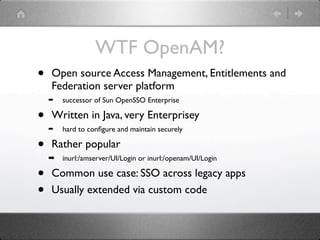
WTF OpenAM?
•   Open source Access Management, Entitlements and
    Federation server platform
    ➡   successor of Sun OpenSSO Enterprise

•   Written in Java, very Enterprisey
    ➡   hard to configure and maintain securely

•   Rather popular
    ➡   inurl:/amserver/UI/Login or inurl:/openam/UI/Login

•   Common use case: SSO across legacy apps
•   Usually extended via custom code
Motivation, Positioning & Layout
• Not just another hack via XXE
• Wanted to share our knowledge on how to develop
  an attack on OpenAM given an LFR and SSRF abilities
• Attack vectors on different OpenAM instances
  ➡   will start from the simplest one
  ➡   and steadily proceed to the worst case scenario (a security hardened one)

• Several interesting tricks
  ➡   data retrieval in blind XXE cases
  ➡   zip upload via HTTP PUT over gopher

• What is the proper way to fix XXE in Java?
Problem Statement
• OpenAM infrastructure
• Tomcat as a web container
• An ability to read local files and do SSRF
  ➡   e.g. XXE with gopher protocol enabled

• Goal: get an Admin in OpenAM Management Panel
• A side note: will not focus on general SSRF
  elaboration methodology, which is still valid here
To begin with: Loot da FileSystem!
Looting the FileSystem
• Gotta traverse directories
  ➡   Luckily possible to list them with XXE
  ➡   How would you tell a directory listing from a file contents?

• Gotta read files
  ➡   Special chars and binary are a problem as usual

• Would like to use GREP (General Resource
  Enumeration Protocol) and other posix tools
And along comes...

         XXE Fuse Demo

 A team of specially trained
monkeys are supporting this
         SaaS solution 24/7
        Request a free trial!


http://www.youtube.com/watch?v=7GtPgavI-sI
Looting the FileSystem
               XML-in-XML and OOB channels


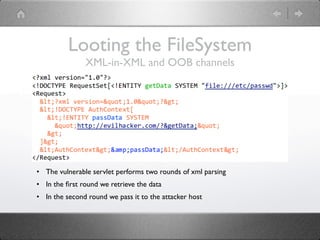
• The vulnerable servlet performs two rounds of xml parsing
• In the first round we retrieve the data
• In the second round we pass it to the attacker host
Looting the FileSystem
                  Possible Targets and Outcomes
1. Other apps on host
 ➡   especially management and monitoring

2. Configs (& credentials)
 ➡   read container config and extract HTTP credentials if needed
 ➡   ldap.conf may be especially juicy

3. Logs
 ➡   may contain private data (e.g. SQL query logs)
 ➡   may enable further attacks (see below)
Demo Time
 RCE via SSRF over XXE using Tomcat App Manager


http://www.youtube.com/watch?v=ZnsFhGYqI3g
RCE via SSRF over XXE
                      Wait, tell us the details!!!
• How do you POST or PUT via XXE?
   ➡   use gopher; at least until admins won’t update Java

• How do you upload ZIP through gopher?
   ➡   java gopher contains byte [] => String => byte [] conversion
   ➡   this mangles characters >= 0x80
   ➡   use zip -0 (store compression method)
   ➡   with a bit of luck you can use 0x00 instead of mangled chars (i.e. find&replace)
   ➡   the resulting file will have invalid checksums
   ➡   surprisingly (!) Tomcat WAR parser tolerates this
Looting the FileSystem
                Configs & credentials
• Container configs
   ➡   e.g. /usr/share/tomcat6/conf/

• OpenAM configs
   ➡   /home/user/openam/{install.log, .configParam}
   ➡   /home/user/openam/config/xml/

• Password file
   ➡   recommended way of configuring OpenAM is via ssoadm CLI tool:
       “In most ssoadm subcommands, the password file is required option.The password file is a simple file that
       contains the administrator password for the given task.”

       may encourage admins to store passwords in plaintext
Exploring OpenAM Features
• OpenAM uses custom Auth tokens
 ➡   web container session tokens are useless
 ➡   good targets to highjack privileged sessions

• OpenAM does Encryption
 ➡   uses Password-Based Encryption (PBEWithMD5AndDES) with low iteration
     count
 ➡   admin pwd is encrypted with default key and stored in bootstrap file
 ➡   XXE won’t let you read the bootstrap file
 ➡   other pwds and session tokens are encrypted using randomly generated
     instance key which is stored in binary data store
 ➡   instance key is shared across interconnected OpenAM instances (e.g. failover)
Juicy OpenAM Features
• Debugging
 ➡   {CONFIG_DIR}/{INSTANCE_NAME}/debug/
 ➡   If verbose debugging is enabled, we can read auth tokens and hijack sessions
 ➡   Quickly check via grep -r "AQIC"
 ➡   Admins do not log in too frequently
 ➡   Sessions expire
 ➡   Disabled by default =(

• Monitoring
 ➡   HTTP/JMX/SNMP facility to monitor OpenAM instance
 ➡   OpenAM-specific MBeans do not seem to provide anything useful
 ➡   Also disabled by default
Wait, but we need the features!
• Debugging
 ➡   Every single action in admin interface is СSRF-protected
 ➡   Debug.jsp is a quick page to control debug settings
 ➡   Devs didn't worry too much about CSRF there => you can CSRF verbose
     logging
 ➡   SSRF at Tomcat Shutdown Port to force admin login (or social engineer him)

• Monitoring
 ➡   Enable monitoring using the hijacked session; it will have the default (i.e. known)
     password
 ➡   SSRF at Tomcat Shutdown Port again to force reload
Putting it All Together
                  Dealing with the Worst Case
• Enable debugging
 ➡   CSRF and then read admin session token from logs

• Use admin session token to enable Monitoring
 ➡   SSRF at Tomcat Shutdown Port to force reload

• Pwn
 ➡   Use HotSpotDiagnostic MBean to force a heap dump into DOC_ROOT
 ➡   Download and analyze the dump (strings util would do)
 ➡   Grep out the encryption key and encrypted admin password
 ➡   Decrypt the password and rule'em all
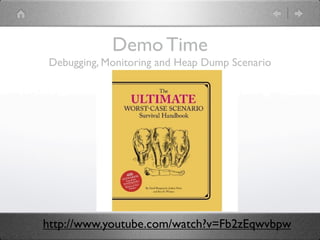
Demo Time
Debugging, Monitoring and Heap Dump Scenario


http://www.youtube.com/watch?v=Fb2zEqwvbpw
Wrap Up
 Fixing XXE
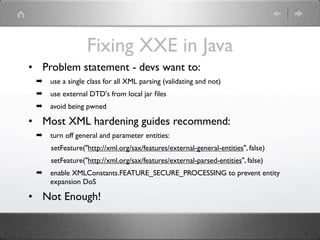
Fixing XXE in Java
• Problem statement - devs want to:
 ➡   use a single class for all XML parsing (validating and not)
 ➡   use external DTD's from local jar files
 ➡   avoid being pwned

• Most XML hardening guides recommend:
 ➡   turn off general and parameter entities:
     setFeature("http://xml.org/sax/features/external-general-entities", false)
     setFeature("http://xml.org/sax/features/external-parsed-entities", false)
 ➡   enable XMLConstants.FEATURE_SECURE_PROCESSING to prevent entity
     expansion DoS

• Not Enough!
Fixing XXE in Java
• In Java, if validation is enabled, SSRF is still possible


• Devs: okay, let's use our custom Entity resolver:
 ➡   documentBuilder.setEntityResolver(new XMLHandler())

• Almost there!
 ➡   make sure that XMLHandler returns an empty InputStream on error
 ➡   if you return null, JAXP will fall back to default resolvers!
Wrap Up
                                Conclusions
• Specific advice
 ➡   Never store passwords in files (who may have thought... )
 ➡   It's good to change monitoring password even if you do not use the feature
 ➡   Update Java and OpenAM (fix is available in nightly builds) - this would prevent
     XXE and disable gopher

• General advice: in SSRF world it is no longer safe to
  trust
 ➡   IP-based authentication could be subverted instantly
 ➡   Defying patching? Pwned! (think about delayed exploitation)
 ➡   Defying least privilege in DMZ? Very arrogant!
Question Time!
• George Noseevich
 ➡   Twitter: @webpentest
 ➡   Email: webpentest@gmail.com

• Andrew Petukhov
 ➡   Twitter: @p3tand
 ➡   Email: andrew.petukhov@internalsecurity.ru

• Show us the Source!
 ➡   Tools: http://internalsecurity.ru/media/resources/openam-xxe-tools.zip
 ➡   Video: http://www.youtube.com/playlist?
     list=PL1CBT43qUw294xCw79B01PbRQNKI6Qqdj
 ➡   WWW: http://internalsecurity.ru/research/