Estimation in Project Management
Intaver Institute
400, 7015, Macleod Trail S.W.,
Calgary, Alberta,
T2H 2K6,
Canada
Estimations in Project Management
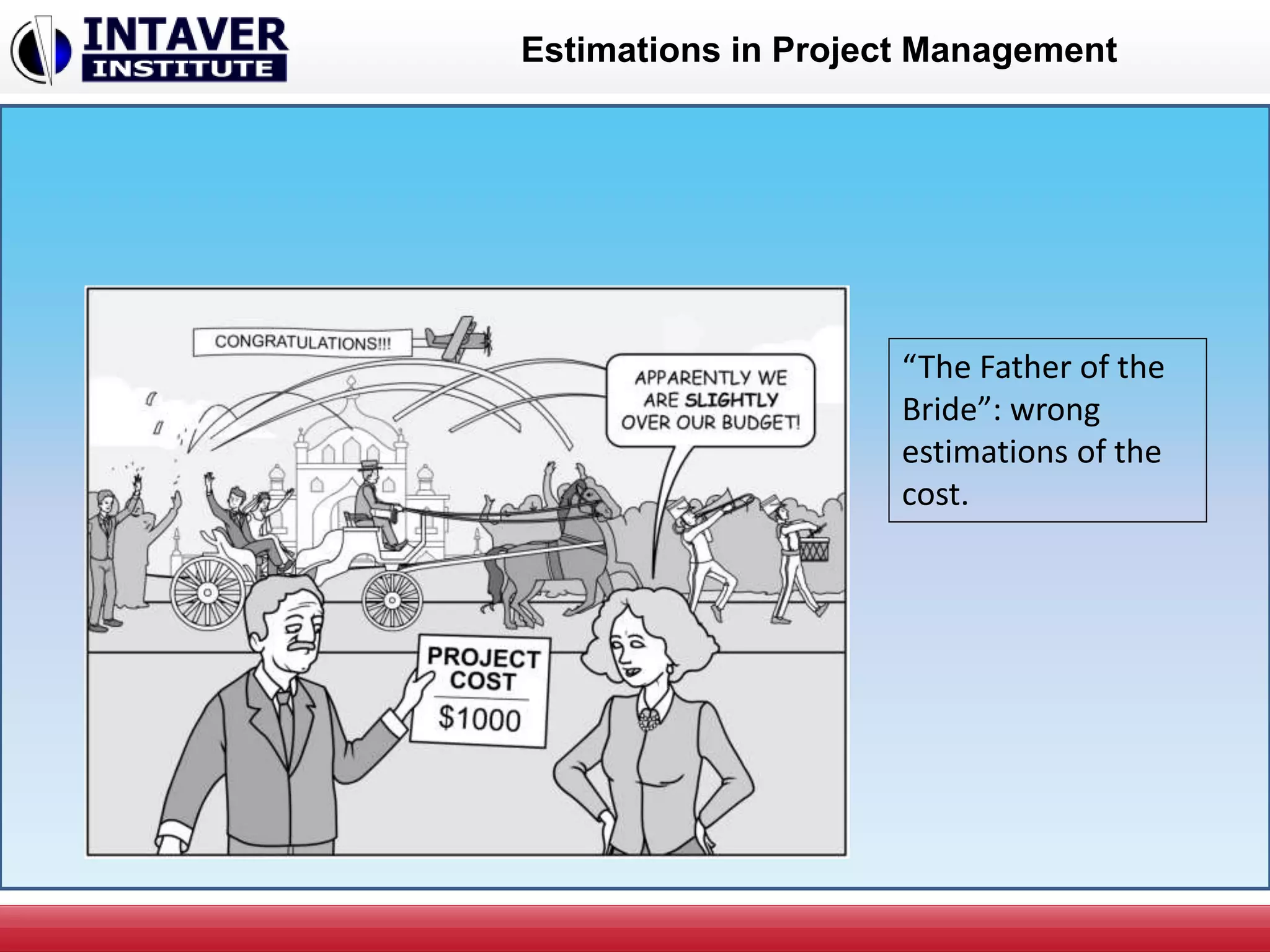
“The Father of the
Bride”: wrong
estimations of the
cost.
George Banks Mental Errors
1. He wanted to spend as little as possible and therefore was motivated
to come up with an unrealistically cheap estimate. He ignored all
evidence that would have suggested the true cost of the wedding
(expensive cake, large number of guests, etc.) when he did his rough
estimate.
2. He used a reference point (the cost of a house) to come up with the
estimate. It was completely irrelevant to a wedding and therefore was
nonsensical for this particular estimate (though good for the movie).
This is a classis example of anchoring.
3. He was overconfident. Weddings are a one-day event and it will take
place in his house, so he thought the amount of money required
would be manageable.
What Should Have George Banks Done to
Avoid a Nervous Breakdown ?
1. Ask some other people how much the wedding would cost
and use this number as a reference point.
2. Make a rough estimate by summing up all known
expenses without ignoring any items.
3. Make necessary contingency plans by continually asking,
“What else could happen?”
Politics of Psychology?
Flyvbjerg Curve
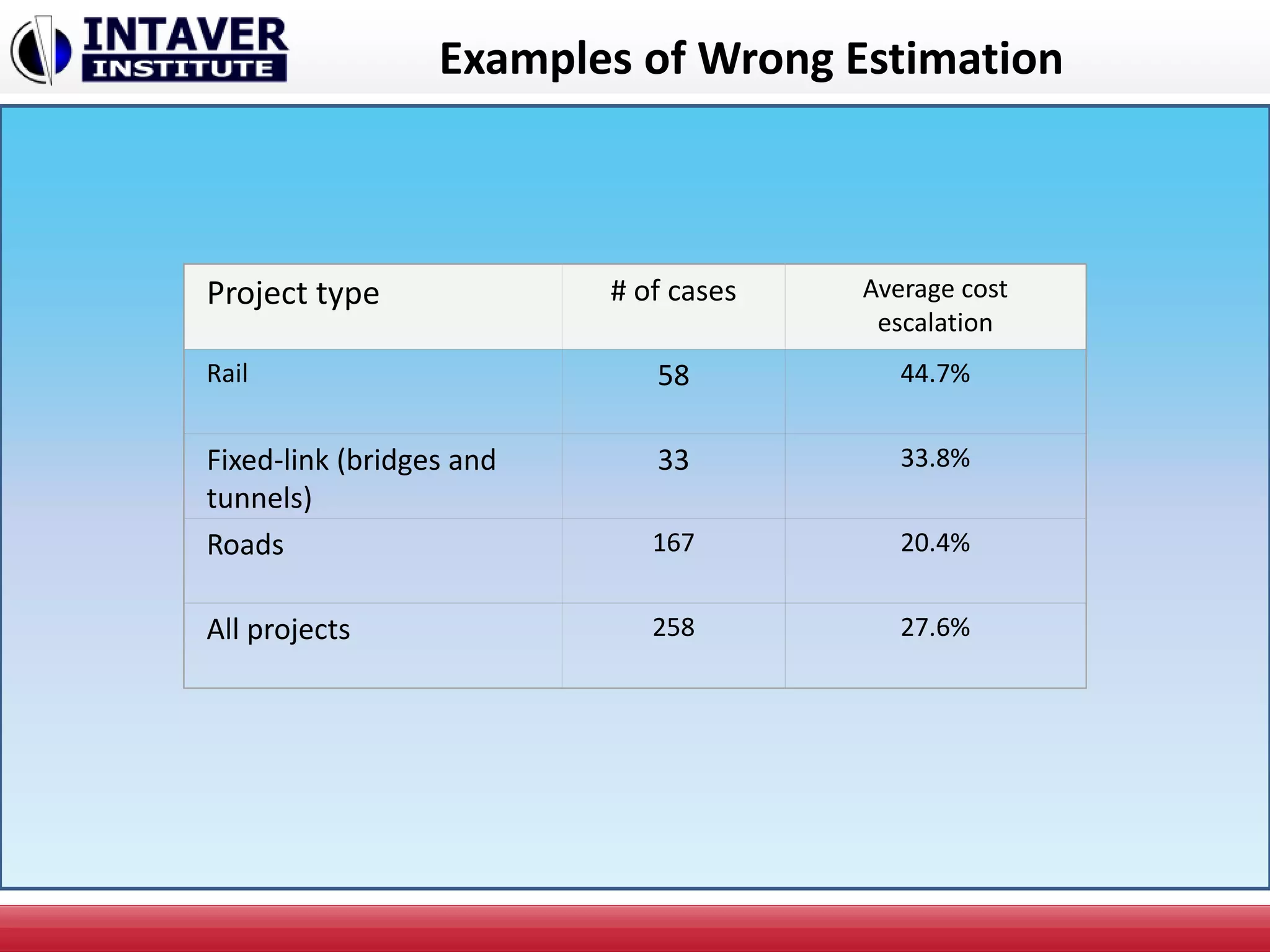
Examples of Wrong Estimation
Project type # of cases Average cost
escalation
Rail 58 44.7%
Fixed-link (bridges and
tunnels)
33 33.8%
Roads 167 20.4%
All projects 258 27.6%
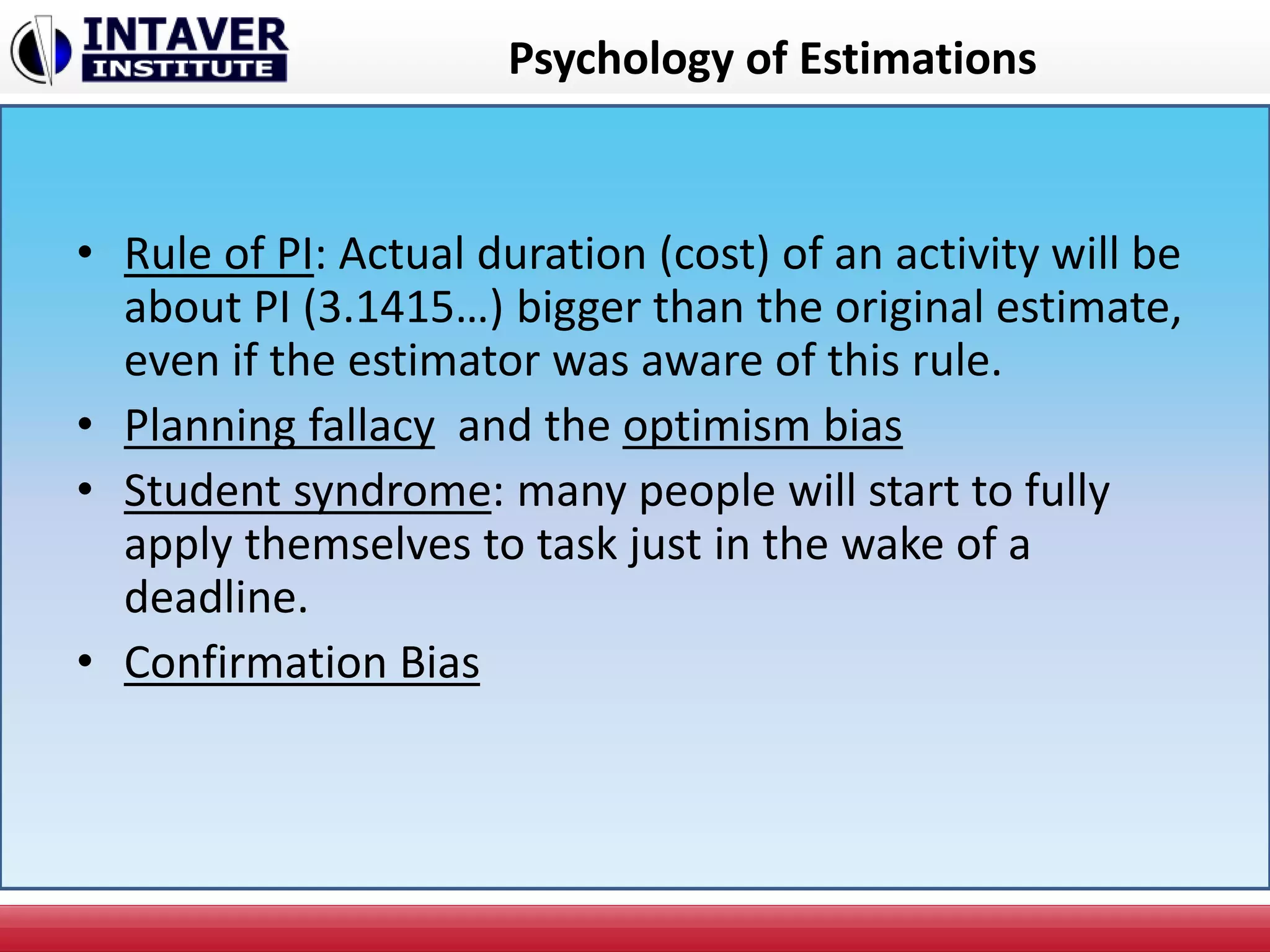
Psychology of Estimations
• Rule of PI: Actual duration (cost) of an activity will be
about PI (3.1415…) bigger than the original estimate,
even if the estimator was aware of this rule.
• Planning fallacy and the optimism bias
• Student syndrome: many people will start to fully
apply themselves to task just in the wake of a
deadline.
• Confirmation Bias
Availability Heuristic
Simple Psychological Exercise
1. Take three seconds to try to recall all of the projects or
large activities you were involved during the last year.
2. Now repeat step 1, but take 15 seconds.
3. Repeat steps 1 and 2 taking up to three minutes for each
step, and write down the results.
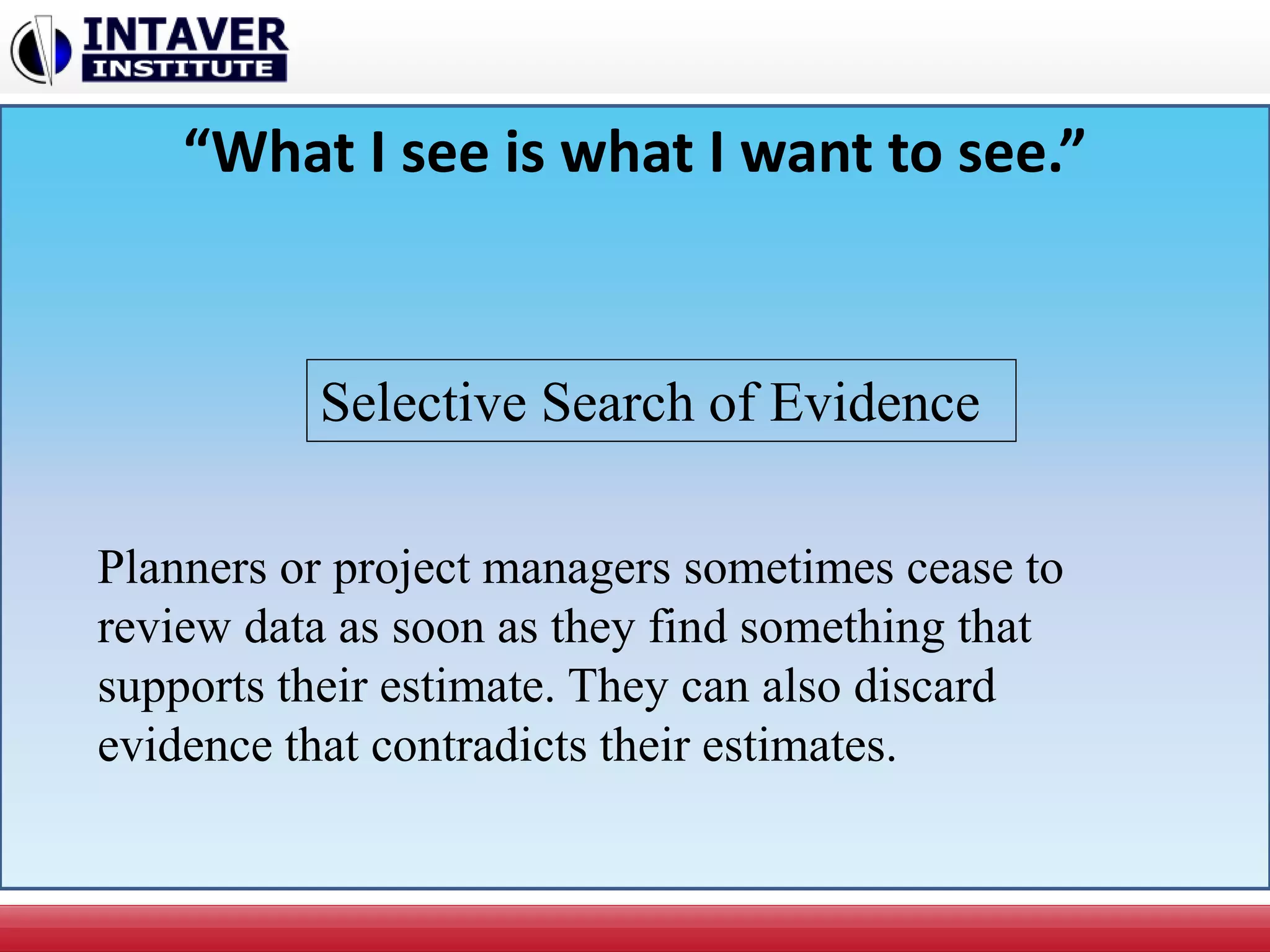
“What I see is what I want to see.”
Planners or project managers sometimes cease to
review data as soon as they find something that
supports their estimate. They can also discard
evidence that contradicts their estimates.
Selective Search of Evidence
Other Explanations Of Problems With
Estimation
• There is no established project estimation process.
• Inaccurate data is used, or historical data may not be
complete.
• The forecasting techniques and tools are inefficient.
• There is no ability to track actual project
performance, which can be used to refine estimates.
• The project planners are inexperienced.
Simple Remedies
• Never make a wild guess
• Collect Relevant Historical Data
• Reality checks
• Independent Assessment
Example of a Reality Check
NASA’s LISA Project cost estimation
500 1000 1500 2000 2500
Mission Cost ($ mln)
0
0
20
40
60
80
100
120
140
160
180
MissionDuration(mo)
HEAD
Magellan
Landsat 7
URAS LISA
CGRO Chandra (AXAF)
Galileo
Terra
HST
GOES I-M
Aqua
Estimating Probabilities
1. Subjective judgment
2. Relative frequency approach
3. Combination of both
Method of Eliciting Judgment
• Direct assessment of an event’s probability
• Ask the experts two opposing questions: “What is the
probability that the project will be canceled?” and “What
is the probability the project will be completed?”
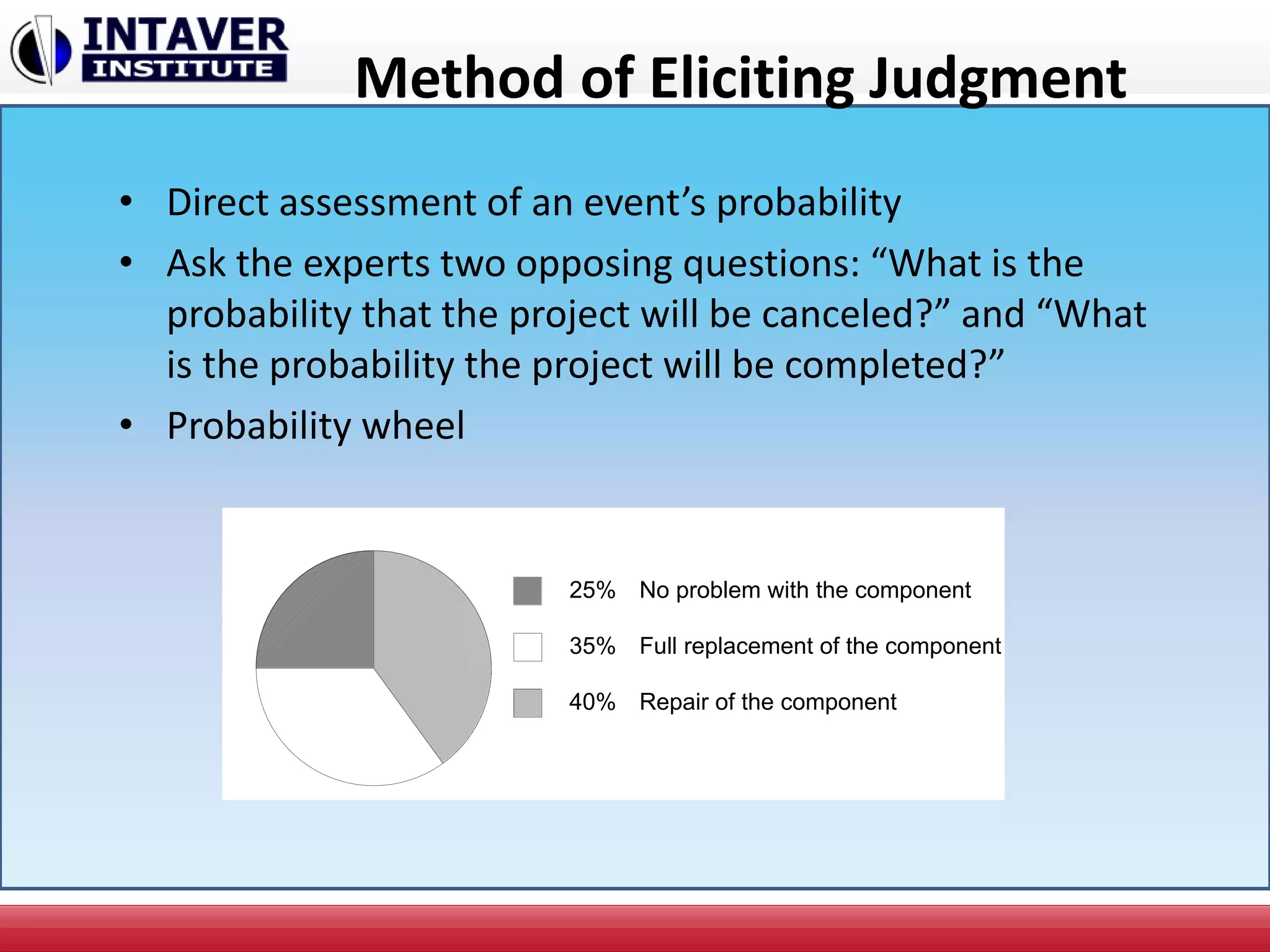
• Probability wheel
25% No problem with the component
35% Full replacement of the component
40% Repair of the component
Probability Method
Low
estimate
High
Estimate
11 intervals
How many
instances
per each
interval
Building Consensus
• Come back to original questions
• Visualize range on opinions
• People usually good in technical estimations but not good about cost
• Separation of compound events
Sensitivity to Probability
Maj. Ernest Y. Wong and Lt. Col. Rod Roederer of the U.S. Military
Academy (2006) reviewed the decision to attack Iraq from a decision
theory point of view. To make their point, they hypothetically assumed
that the decision to attack Iraq was based only on one criterion: the
existence of a stockpile of weapons of mass destruction (WMD). They
performed analysis using methods that we have discussed in this book.
They demonstrated that outcome of the decision to attack Iraq is very
sensitive to uncertainty in assessment of probability of Iraq having WMD
at this time.
If probability is greater than a certain break even number (say 75%), the
decision may be correct; and vice versa. However, if the probability is
expressed as a range (from 60% to 90%), and the break even point is
within this range, it is very hard to tell what course of actions should
have been taken.
Additional Resources
18
Project Think:
Why Good
Managers Make
Poor Project
Choices
Project Decisions:
The Art and Science
Introduction to
Project Risk
Management and
Decision Analysis
Project Risk
Analysis Made
Ridiculously Simple

Estimates in Project Management

  • 1.
    Estimation in ProjectManagement Intaver Institute 400, 7015, Macleod Trail S.W., Calgary, Alberta, T2H 2K6, Canada
  • 2.
    Estimations in ProjectManagement “The Father of the Bride”: wrong estimations of the cost.
  • 3.
    George Banks MentalErrors 1. He wanted to spend as little as possible and therefore was motivated to come up with an unrealistically cheap estimate. He ignored all evidence that would have suggested the true cost of the wedding (expensive cake, large number of guests, etc.) when he did his rough estimate. 2. He used a reference point (the cost of a house) to come up with the estimate. It was completely irrelevant to a wedding and therefore was nonsensical for this particular estimate (though good for the movie). This is a classis example of anchoring. 3. He was overconfident. Weddings are a one-day event and it will take place in his house, so he thought the amount of money required would be manageable.
  • 4.
    What Should HaveGeorge Banks Done to Avoid a Nervous Breakdown ? 1. Ask some other people how much the wedding would cost and use this number as a reference point. 2. Make a rough estimate by summing up all known expenses without ignoring any items. 3. Make necessary contingency plans by continually asking, “What else could happen?”
  • 5.
  • 6.
    Examples of WrongEstimation Project type # of cases Average cost escalation Rail 58 44.7% Fixed-link (bridges and tunnels) 33 33.8% Roads 167 20.4% All projects 258 27.6%
  • 7.
    Psychology of Estimations •Rule of PI: Actual duration (cost) of an activity will be about PI (3.1415…) bigger than the original estimate, even if the estimator was aware of this rule. • Planning fallacy and the optimism bias • Student syndrome: many people will start to fully apply themselves to task just in the wake of a deadline. • Confirmation Bias
  • 8.
    Availability Heuristic Simple PsychologicalExercise 1. Take three seconds to try to recall all of the projects or large activities you were involved during the last year. 2. Now repeat step 1, but take 15 seconds. 3. Repeat steps 1 and 2 taking up to three minutes for each step, and write down the results.
  • 9.
    “What I seeis what I want to see.” Planners or project managers sometimes cease to review data as soon as they find something that supports their estimate. They can also discard evidence that contradicts their estimates. Selective Search of Evidence
  • 10.
    Other Explanations OfProblems With Estimation • There is no established project estimation process. • Inaccurate data is used, or historical data may not be complete. • The forecasting techniques and tools are inefficient. • There is no ability to track actual project performance, which can be used to refine estimates. • The project planners are inexperienced.
  • 11.
    Simple Remedies • Nevermake a wild guess • Collect Relevant Historical Data • Reality checks • Independent Assessment
  • 12.
    Example of aReality Check NASA’s LISA Project cost estimation 500 1000 1500 2000 2500 Mission Cost ($ mln) 0 0 20 40 60 80 100 120 140 160 180 MissionDuration(mo) HEAD Magellan Landsat 7 URAS LISA CGRO Chandra (AXAF) Galileo Terra HST GOES I-M Aqua
  • 13.
    Estimating Probabilities 1. Subjectivejudgment 2. Relative frequency approach 3. Combination of both
  • 14.
    Method of ElicitingJudgment • Direct assessment of an event’s probability • Ask the experts two opposing questions: “What is the probability that the project will be canceled?” and “What is the probability the project will be completed?” • Probability wheel 25% No problem with the component 35% Full replacement of the component 40% Repair of the component
  • 15.
  • 16.
    Building Consensus • Comeback to original questions • Visualize range on opinions • People usually good in technical estimations but not good about cost • Separation of compound events
  • 17.
    Sensitivity to Probability Maj.Ernest Y. Wong and Lt. Col. Rod Roederer of the U.S. Military Academy (2006) reviewed the decision to attack Iraq from a decision theory point of view. To make their point, they hypothetically assumed that the decision to attack Iraq was based only on one criterion: the existence of a stockpile of weapons of mass destruction (WMD). They performed analysis using methods that we have discussed in this book. They demonstrated that outcome of the decision to attack Iraq is very sensitive to uncertainty in assessment of probability of Iraq having WMD at this time. If probability is greater than a certain break even number (say 75%), the decision may be correct; and vice versa. However, if the probability is expressed as a range (from 60% to 90%), and the break even point is within this range, it is very hard to tell what course of actions should have been taken.
  • 18.
    Additional Resources 18 Project Think: WhyGood Managers Make Poor Project Choices Project Decisions: The Art and Science Introduction to Project Risk Management and Decision Analysis Project Risk Analysis Made Ridiculously Simple