Essentials of Life-Span Development 3rd Edition
Santrock Solutions Manual download
https://testbankfan.com/product/essentials-of-life-span-
development-3rd-edition-santrock-solutions-manual-2/
Find test banks or solution manuals at testbankfan.com today!
We have selected some products that you may be interested in
Click the link to download now or visit testbankfan.com
for more options!.
Essentials of Life Span Development 3rd Edition Santrock
Test Bank
https://testbankfan.com/product/essentials-of-life-span-
development-3rd-edition-santrock-test-bank/
Essentials of Life-Span Development 3rd Edition Santrock
Test Bank
https://testbankfan.com/product/essentials-of-life-span-
development-3rd-edition-santrock-test-bank-2/
Essentials of Life Span Development 5th Edition Santrock
Solutions Manual
https://testbankfan.com/product/essentials-of-life-span-
development-5th-edition-santrock-solutions-manual/
Abnormal Child Psychology 5th Edition Mash Test Bank
https://testbankfan.com/product/abnormal-child-psychology-5th-edition-
mash-test-bank/
Behavior Modification Principles and Procedures 5th
Edition Miltenberger Test Bank
https://testbankfan.com/product/behavior-modification-principles-and-
procedures-5th-edition-miltenberger-test-bank/
Microeconomics 5th Edition Hubbard Test Bank
https://testbankfan.com/product/microeconomics-5th-edition-hubbard-
test-bank/
Microeconomics 2nd Edition Goolsbee Solutions Manual
https://testbankfan.com/product/microeconomics-2nd-edition-goolsbee-
solutions-manual/
Consumer Behaviour Australia 3rd Edition Solomon Test Bank
https://testbankfan.com/product/consumer-behaviour-australia-3rd-
edition-solomon-test-bank/
Crafting and Executing Strategy Concepts and Cases The
Quest for Competitive Advantage 21st Edition Thompson Test
Bank
https://testbankfan.com/product/crafting-and-executing-strategy-
concepts-and-cases-the-quest-for-competitive-advantage-21st-edition-
thompson-test-bank/
Exploring American Histories A Survey with Sources 2nd
Edition Hewitt Test Bank
https://testbankfan.com/product/exploring-american-histories-a-survey-
with-sources-2nd-edition-hewitt-test-bank/
Chapter 7 Physical and Cognitive Development in Middle and Late Childhood
Santrock: Essentials of Life-Span Development, 3e IM-7 | 1
© 2014 by McGraw-Hill Education. This is proprietary material solely for authorized instructor use. Not authorized for sale or distribution in any
manner. This document may not be copied, scanned, duplicated, forwarded, distributed, or posted on a website, in whole or part.
Chapter 7: Physical and Cognitive Development in Middle and Late
Childhood
Learning Goals
Learning Goal 1: Describe physical changes and health in middle and late childhood.
A. Discuss body growth and change.
B. Explain brain development.
C. Describe motor development.
D. Summarize the influence of exercise on health and development.
E. Discuss health, illness, and disease.
Learning Goal 2: Identify children with different types of disabilities and issues in educating
them.
A. Define and describe the scope of disabilities.
B. Discuss educational issues related to children with disabilities.
Learning Goal 3: Explain cognitive changes in middle and late childhood.
A. Describe and discuss Piaget's theory of cognitive development.
B. Discuss the information-processing theory.
C. Describe and define intelligence.
Learning Goal 4: Discuss language development in middle and late childhood.
A. Discuss vocabulary, grammar, and metalinguistic awareness.
B. Explain the development of reading during middle and late childhood.
C. Discuss bilingualism and second-language learning.
Overview of Resources
Chapter Outline Resources You Can Use
Physical Changes and Health Learning Goal 1: Describe physical changes and
health in middle and late childhood.
Body Growth and Change
The Brain
Motor Development
Exercise
Health, Illness, and Disease
Lecture Suggestion 1: The Long-Term
Consequences of Childhood Obesity
Personal Application 1: That’s My Kid!
Research Project 1: Current Exercise Levels
Interactive Exercise: Sensorimotor Neural
Circuits
Children with Disabilities Learning Goal 2: Identify children with
different types of disabilities and issues in
Chapter 7 Physical and Cognitive Development in Middle and Late Childhood
Santrock: Essentials of Life-Span Development, 3e IM-7 | 2
© 2014 by McGraw-Hill Education. This is proprietary material solely for authorized instructor use. Not authorized for sale or distribution in any
manner. This document may not be copied, scanned, duplicated, forwarded, distributed, or posted on a website, in whole or part.
educating them.
The Scope of Disabilities
Educational Issues
Lecture Suggestion 2: ADHD—An Intolerance
for Childhood Playfulness
Research Project 2: Interviewing Parents of
Children with Disabilities
Cognitive Changes Learning Goal 3: Explain cognitive changes in
middle and late childhood.
Piaget’s Cognitive Developmental Theory
Information Processing
Intelligence
Lecture Suggestion 3: Observational Issues in
Identifying Children with ADHD
Lecture Suggestion 4: Is Being a Child Prodigy a
Blessing or a Curse?
Classroom Activity 1: Time to Tell Time?
Classroom Activity 2: Is Psychology Just
Common Sense?
Classroom Activity 3: Test Anxiety: A Visit
with Teachers
Personal Application 2: Remember the Time…
Personal Application 3: Smart Move
Personal Application 4: Exploring Your
Creativity
Research Project 3: Assessment of a
Preoperational and a Concrete Operational Thinker
Language Development Learning Goal 4: Discuss language development
in middle and late childhood.
Vocabulary, Grammar, and Metalinguistic
Awareness
Reading
Bilingualism and Second-Language Learning
Lecture Suggestion 5: Environmental Influences
on Literacy
Review Classroom Activity 4: Critical-Thinking
Multiple-Choice Questions and Suggested Answers
Classroom Activity 5: Critical-Thinking Essay
Questions and Suggestions for Helping Students
Resources
Lecture Suggestions
Lecture Suggestion 1: The Long-Term Consequences of Childhood Obesity
Learning Goal 1: Describe physical changes and health in middle and late childhood.
The purpose of this lecture is to extend the discussion of the long-term physical and psychological
consequences of childhood obesity. Must et al. (1992) have documented morbidity and mortality rates
related to obesity in adolescence. Obese adolescents are at greater risk for death and adult obesity. These
Chapter 7 Physical and Cognitive Development in Middle and Late Childhood
Santrock: Essentials of Life-Span Development, 3e IM-7 | 3
© 2014 by McGraw-Hill Education. This is proprietary material solely for authorized instructor use. Not authorized for sale or distribution in any
manner. This document may not be copied, scanned, duplicated, forwarded, distributed, or posted on a website, in whole or part.
relationships are stronger for females than males. As Santrock discusses, both males and females suffer
psychological and social consequences of childhood obesity (pulmonary problems, hip problems, high
blood pressure and elevated blood cholesterol, low self-esteem, depression, and exclusion from peer
groups).
• Gortmaker et al. (1993) studied the long-term effects of childhood obesity by assessing young adults
who were obese as adolescents. These individuals had less education, less income, and were less
likely to be married than the individuals who were not obese as adolescents. These effects were
apparent despite the statistical control of initial SES and aptitude scores.
• These results cannot be explained by chronic health problems that interfere with academic or career
success. Gortmaker et al. ingeniously compared a group of individuals with chronic health problems
(diabetes, cerebral palsy) with the individuals who had been obese as adolescents. The individuals
with chronic health problems did not suffer the same consequences.
• What could explain the developmental pattern of obese individuals? The authors speculate that the
negative effects of early obesity are more likely due to stigmatization and discrimination.
Overweight individuals are negatively labeled, which reduces their chances of successful career
progression and mate selection.
• Obesity may be an important factor in determining class and success. This speculation calls into
question the long-held assumption of the unidirectional relationship between SES and obesity.
Being overweight is an increasingly prevalent health problem in children (Schiff , 2013; Summerbell &
others, 2012). Being overweight is defined in terms of body mass index (BMI), which is computed by a
formula that takes into account height and weight—children at or above the 97th percentile are included
in the obesity category, at or above the 95th percentile in the overweight category, and children at or
above the 85th percentile are described as at risk for being overweight (Centers for Disease Control and
Prevention, 2012a). Over the last three decades, the percentage of U.S. children who are at risk for being
overweight has doubled from 15 percent in the 1970s to almost 30 percent today, and the percentage of
children who are overweight has tripled during this time frame (Orsi, Hale, & Lynch, 2011). 12.1 percent
of 2- to 5-year-old U.S. children are obese. Th at figure is 50 percent higher for 6- to 11-year-old U.S.
children—in 2009–2010, 18 percent of U.S. 6- to 11-year-olds were classified as obese (Ogden & others,
2012). The levels of child obesity, overweight, and risk for being overweight remain far too high and are
expected to increase in the future (Wardlaw & Smith, 2012).
Sources:
Gortmaker, S. L., Must, A., Perrin, J. M., Sobol, A. M., & Dietz, W. H. (1993). Social and economic consequences
of overweight in adolescence and young adulthood. The New England Journal of Medicine, 329, 1008–1012.
Must, A., Jacques, P. F., Dallal, G. E., Bajema, C. J., & Dietz, W. H. (1992). Long-term morbidity and mortality of
overweight adolescents: A follow-up of the Harvard Growth Study of 1922 to 1935. The New England Journal of
Medicine, 327, 1350–1355.
Lecture Suggestion 2: ADHD—An Intolerance for Childhood Playfulness
Learning Goal 2: Identify children with different types of disabilities and issues in educating them.
The purpose of this lecture is to examine Panksepp’s (1998) proposal that attention deficit hyperactivity
disorder (ADHD) is overdiagnosed and reflects an intolerance for normal childhood behavior. ADHD is
the most common childhood disorder with approximately 15 percent of American children diagnosed (8
million children). This is an increase from 1 percent of the population in 1902 when this disorder was first
recognized. Given that there is no neurological explanation for this increase, Panksepp speculated that the
increase in standardized educational experiences has led to intolerance for normal playfulness.
Children with ADHD are often given psychostimulants which promote attention and markedly reduce
children’s urge to play, especially rough-and-tumble play (Panksepp & others, 1987). This concerned
Chapter 7 Physical and Cognitive Development in Middle and Late Childhood
Santrock: Essentials of Life-Span Development, 3e IM-7 | 4
© 2014 by McGraw-Hill Education. This is proprietary material solely for authorized instructor use. Not authorized for sale or distribution in any
manner. This document may not be copied, scanned, duplicated, forwarded, distributed, or posted on a website, in whole or part.
Panksepp, as we do not fully understand the impact that play has on the developing brain, and there is the
added concern that we do not understand the long-term neurological consequences of psychostimulant
drugs. Could it be that adults want to reduce children’s rambunctiousness because of inadequate space
and limited opportunities for children to express the natural biological need to play? After all, the
biological need to play intrudes into classroom activities when opportunity and space are limited. Thus,
Panksepp proposed that ADHD needs to be reconceptualized as a symptom of contemporary society and
our attempt to control normal playfulness in children and not as a symptom of neurological imbalance or
a disorder.
Is ADHD a normal variant of human diversity?
Given the research on the heritability of temperament and the concordance of symptoms of ADHD for
siblings, Panksepp argued that symptoms of ADHD are natural variations of child playfulness. The
simple criterion used to diagnose ADHD contributes to the frequency of medicating children. These
children may be normal, highly playful children who have difficulty adjusting to some institutional
expectations. Some of the symptoms can be interpreted in evolutionary terms. Distractibility may be
useful to monitor a changing environment. Difficulty following instructions may reflect independent
thought and judgement. Acting without regard for consequences may reflect risk-taking. Panksepp
argued that we should nurture these characteristics and adjust societal expectations rather than
medicate these children.
What are the neural differences in individuals with ADHD?
The major difference in the brains of individuals with ADHD is a 5 percent reduction in overall size of
the frontal areas. The size difference is accompanied by the lack of right–left symmetries (right is
smaller) (Castellanoes & others, 1996). The frontal lobes are necessary for long-term planning and the
elaboration of complex behavioral strategies. The increased activity level and rough-and-tumble play
demonstrated by children with ADHD is related to damage in these areas. Barkley (1997) theorized
that ADHD is a result of deficient behavioral inhibition, a function that allows better behavioral
flexibility, foresight, and regulation of behavior. Environmental factors, such as play, may improve
frontal lobe functions permanently.
As with learning disabilities, the development of brain-imaging techniques is leading to a better
understanding of ADHD (Almeida Montes & others, 2012; Cubillo & others, 2012; Qui & others,
2011). One study revealed that peak thickness of the cerebral cortex occurred three years later (10.5
years) in children with ADHD than in children without ADHD (peak at 7.5 years) (Shaw & others,
2007). The delay was more prominent in the prefrontal regions of the brain that especially are
important in attention and planning (see Figure 9.5). Another recent study also found delayed
development of the brain’s frontal lobes in children with ADHD, likely due to delayed or decreased
myelination (Nagel & others, 2011). Researchers also are exploring the roles that various
neurotransmitters, such as serotonin and dopamine, might play in ADHD (Dalley & Roiser, 2012;
Shen, Liao, & Tseng, 2012).
Do psychostimulants promote any long-term benefits or problems?
Psychostimulants promote activity in areas of the brain that control attention and goal-directed
behavior (Pliszka & others, 1996). While these drugs do improve attention and focus temporarily,
long-term benefits have not been found (if medication is terminated, ADHD symptoms return). The
long-term problems outweigh the short-term benefits. Side effects of these psychostimulants have been
found as well. For example, children do not like the way the drugs make them feel, and there is a small
Chapter 7 Physical and Cognitive Development in Middle and Late Childhood
Santrock: Essentials of Life-Span Development, 3e IM-7 | 5
© 2014 by McGraw-Hill Education. This is proprietary material solely for authorized instructor use. Not authorized for sale or distribution in any
manner. This document may not be copied, scanned, duplicated, forwarded, distributed, or posted on a website, in whole or part.
decrease in physical growth. Continued behavior problems in adulthood have been reported. There is
inconsistent evidence regarding the increased likelihood of drug abuse as it is difficult to ascertain
whether these consequences are due to constitutional differences or to the long-term use of
psychostimulants.
Stimulant medication such as Ritalin or Adderall (which has fewer side effects than Ritalin) is
effective in improving the attention of many children with ADHD, but it usually does not improve
their attention to the same level as children who do not have ADHD (Sclar & others, 2012; Wong &
Stevens, 2012). A meta-analysis concluded that behavior management treatments are useful in
reducing the effects of ADHD (Fabiano & others, 2009). Researchers have oft en found that a
combination of medication (such as Ritalin) and behavior management improves the behavior of some
but not all children with ADHD better than medication alone or behavior management alone (Parens &
Johnston, 2009).
What else might we do to address such childhood problems?
While there have been some lasting effects of combined cognitive and behavioral interventions, an
alternative proposed by Panksepp is a rough-and-tumble intervention. The innate desire to engage in
rough-and-tumble play may facilitate the normal maturation of children’s brains. Providing children
with abundant opportunity to play may reduce impulsivity. The logic is as follows. We know that
frontal areas mature with age, that the frequency of play decreases with age, and animals with frontal
area damage tend to be more playful (Panksepp & others, 1995).
The question remains, Does rough-and-tumble play facilitate frontal lobe maturation? Panksepp has tested
this hypothesis. Rats with smaller frontal lobes are hyperactive and playful. After considerable play
opportunities, they exhibit a greater than normal decline in their play behavior as they mature. Panksepp
et al. (1997) argued that playful experiences may regulate the brain’s “play circuits.”
In conclusion, despite 50 years of research, there is not sufficient evidence regarding extreme biological
or psychological deviance in individuals with ADHD to warrant the degree of current medical
intervention. Many children’s behavior has been modified with these drugs and has resulted in control of
classroom behavior, increased attention for academic pursuits, and less peer ostracism of children due to
the controlled behavior. Despite these benefits, Panksepp argued that the reduction in play behaviors may
harm children’s brain development and long-term control of behavior.
Sources:
Barkley, R. A. (1997). ADHD and the nature of self-control. New York: Guilford Press.
Castellanoes, F. X., Giedd, J. N., March, W. L., Hamburger, S. D., Vaituzis, A. C., Dickerstein, D. P., Sarfatti, S. E.,
Vauss, Y. C., Snell, J. W., Rajapakse, J. C., & Rapoport, J. L. (1996). Quantitative brain magnetic resonance
imaging in attention-deficit hyperactivity disorder. Archives of General Psychiatry, 53, 607–616.
Panksepp, J. (1998). Attention deficit hyperactivity disorders, psychostimulant, and intolerance of childhood
playfulness: A tragedy in the making? Current Directions in Psychological Science, 7, 91–97.
Panksepp, J., Normalsell, L. A., Cox, J. F., Crepeau, L., & Sacks, D. S. (1987). Psychopharmacology of social play.
In J. Mos (ed.), Ethnopharmocology of social behavior (pp. 132–144). Dordrecht, The Netherlands: Duphar.
Panksepp, J., Normalsell, L. A., Cox, J. F., & Siviy, S. (1995). Effects of neonatal decoritication on the social play
of juvenile rats. Physiology & Behavior, 56, 429–443.
Panksepp, J, Burgdorf, J., Turner, C., & Walter, M. (1997). A new animal model for ADHD: Unilateral frontal lobe
damage in neonatal rats. Society for Neuroscience Abstracts, 23, 691.
Pierce, R. C., & Kalvas, P. (1997). A circuitry model of the expression of behavioral sensitization to amphetamine-
like stimulants. Brain Research Reviews, 25, 192–216.
Pliszka, S. R., McCraken, J. T., & Mass, J. W. (1996). Catecholamines in attention-deficit hyperactivity disorder:
Current perspectives. Journal of the American Academy of Child and Adolescent Psychiatry, 35, 264–272.
Chapter 7 Physical and Cognitive Development in Middle and Late Childhood
Santrock: Essentials of Life-Span Development, 3e IM-7 | 6
© 2014 by McGraw-Hill Education. This is proprietary material solely for authorized instructor use. Not authorized for sale or distribution in any
manner. This document may not be copied, scanned, duplicated, forwarded, distributed, or posted on a website, in whole or part.
Robinson, T., & Berridge, K. (1993). The neural basis of drug craving: An incentive-sensitization theory of
addiction. Brain Research Reviews, 18, 247–291.
Lecture Suggestion 3: Observational Issues in Identifying Children with ADHD
Learning Goal 2: Identify children with different types of disabilities and issues in educating them.
There are several issues concerning the need for systematic observation to accurately diagnose a child
with ADHD and to correctly characterize the syndrome. A discussion of these issues provides additional
lessons about the use of observation in both practical and scientific applications.
First, discuss the reasons that ADHD typically is not identified until children are in the first or second
grade. A basic point is that the normal, everyday behavior of preschool children is so “hyperactive” in its
own right that the behavior does not necessarily draw attention to children who have the disorder.
Another way of stating this is that we do not have a sufficient observational basis for identifying ADHD
early on. Most of the symptoms of ADHD typically become troublesome when children engage in
structured activities. Prior to entering the school system, the impulsivity and attention deficits are not
problematic given that most activities are unstructured. Furthermore, identification of this “abnormality”
depends heavily on careful identification of normal behavioral patterns among children. Most parents do
not have the experience to differentiate typical playfulness in young children from atypical behavior.
Second, consider the possibility that hyperactivity is less a problem of too many behaviors and more a
problem of too much disorganized behavior. In the 1970s, researchers made systematic, comparative
observations of normal children, hyperactive children, and hyperactive children being treated with Ritalin.
They found that those receiving Ritalin did not “slow down,” but rather became more organized in their
play. This finding called into question the notion that Ritalin (a stimulant) has a truly paradoxical effect
(tranquilizing), and gave more support to the idea that the drug acts on brain processes that monitor and
organize behavior (see Lecture Suggestion 2 “ADHD—An Intolerance for Childhood Playfulness”).
Thus, casual observation of ADHD is inadequate to characterize the disorder. Careful descriptions are
needed of both “normal” children and those who have the syndrome, as well as detailed, systematic
observations of the behavior of the children in question. Assessments need to be multidimensional.
Assessment should include parent, teacher, and possibly peer reports, plus observation in naturalistic
settings.
• Parents can observe their child in a variety of settings and note fluctuations in behavior in response
to varying demands in different situations.
• Teachers can use various rating scales to facilitate their observations of the child’s behavior on a
daily basis. These scales also provide a normative comparison relative to other children’s behavior in
the same settings. This normative perspective is important for comparisons of children of the same
age and setting expectations.
• Systematic observations in play and school settings help experts quantify time spent off-task and
provide information on the child’s functioning. These are important observations of current behavior
given that parent and teacher observations may be biased or confounded by past behavior.
• Sociometric assessment can highlight peer popularity, rejection, social loneliness, and social anxiety
which may influence children’s behavior.
Lecture Suggestion 4: Is Being a Child Prodigy a Blessing or a Curse?
Learning Goal 3: Explain cognitive changes in middle and late childhood.
Child prodigies lie at one of the extreme ends of intelligence—the high end. Most prodigies would be, by
IQ alone, considered to be “gifted,” meaning they have an IQ score of 130 or higher. In addition,
prodigies have a superior talent in one or more domains—music, math, or art, to name a few.
Chapter 7 Physical and Cognitive Development in Middle and Late Childhood
Santrock: Essentials of Life-Span Development, 3e IM-7 | 7
© 2014 by McGraw-Hill Education. This is proprietary material solely for authorized instructor use. Not authorized for sale or distribution in any
manner. This document may not be copied, scanned, duplicated, forwarded, distributed, or posted on a website, in whole or part.
For prodigies whose level of intelligence is extremely high (i.e. a child who graduates college at age 12),
both gifts and challenges accompany the extreme intelligence.
Studies support the conclusion that gifted people tend to be more mature than others, have fewer
emotional problems than others, and grow up in a positive family climate (Davidson, 2000).
Individuals who are highly gifted are typically not gifted in many domains, and research on giftedness is
increasingly focused on domain-specific developmental trajectories (Sternberg & Sternberg, 2012;
Winner, 2009). An increasing number of experts argue that the education of children who are gifted in the
United States requires a significant overhaul (Ambrose, Sternberg, & Sriraman, 2012). Ellen Winner
(1996, 2006) argues that too often children who are gifted are socially isolated and under-challenged in
the classroom.
How does a child of genius fit into the world of his peers or even of his parents?
In March 2005, it was reported that Brandenn Bremmer, a musical and intellectual prodigy, committed
suicide at the age of 14 by shooting himself in the head. Brandenn had completed high school at the age
of 10. Home-schooled by his parents, he completed the 11th
and 12th
grades in seven months. He wanted
to be an anesthesiologist and was taking college courses in Colorado at the time of his death.
Brandenn had taught himself to read at 18 months, and begin playing piano at the age of three.
At the time of his death, he had just completed recording his second musical CD. Though his parents
denied seeing any signs of depression, later reports revealed a series of dark emails between Brandenn
and his older sister who did not live at home. His emails suggested the struggle of trying to “fit in” in the
everyday world.
Is a prodigy the product of nature or nurture? Both, says psychologist David Feldman. He says,
“Prodigies seem to be a combination of timing and talent and the right circumstances, all occurring during
the same moment and sustaining itself for at least ten years. So, a prodigy is a child with unusual talent
who appears in a society that has value for that talent” (“Unexplained Child Prodigies,” 2002).
Brandenn’s talent was valued, that’s for sure. But he was troubled enough to end his promising life, and
society lost a valuable human being, not just a valued talent.
Sources:
Child Prodigy, 14, Commits Suicide. (2005, March 18).
http://www.cbsnews.com/stories/2005/03/18/national/main681735.shtml
Lecture Suggestion 5: Environmental Influences on Literacy
Learning Goal 4: Discuss language development in middle and late childhood.
The purpose of this lecture is to examine research findings related to environmental influences on
children’s literacy. While basic-skills methods, phonics method, and whole-word methods obviously
factor into children’s learning to read, early experiences also influence this ability. Considerable research
has examined adults’ conversations with children and the influence of parent–child interactions on
literacy and language development (Crain-Thoreson & Dale, 1992; Huttenlocher, 1997; Snow, 1993).
The process of categorizing becomes easier as children increase their vocabulary (Clark, 2012).
Children’s vocabulary increases from an average of about 14,000 words at age 6 to an average of about
Chapter 7 Physical and Cognitive Development in Middle and Late Childhood
Santrock: Essentials of Life-Span Development, 3e IM-7 | 8
© 2014 by McGraw-Hill Education. This is proprietary material solely for authorized instructor use. Not authorized for sale or distribution in any
manner. This document may not be copied, scanned, duplicated, forwarded, distributed, or posted on a website, in whole or part.
40,000 words by age 11. Children make similar advances in grammar (Behrens, 2012). Advances in
vocabulary and grammar during the elementary school years are accompanied by the development of
metalinguistic awareness , which is knowledge about language, such as understanding what a preposition
is or being able to discuss the sounds of a language. Metalinguistic awareness allows children “to think
about their language, understand what words are, and even define them” (Berko Gleason, 2009, p. 4). It
improves considerably during the elementary school years (Pan & Uccelli, 2009). Defining words
becomes a regular part of classroom discourse, and children increase their knowledge of syntax as they
study and talk about the components of sentences such as subjects and verbs (Crain, 2012; Meltzi & Ely,
2009).
Reading development is influenced by early literacy activities such as “reading” picture books and
storytelling. Parents who ask their child to retell a story are facilitating the young child’s ability to read.
Snow found that children’s vocabulary is enhanced by exposure to adults who use relatively uncommon
words in everyday conversations with the child. Family contexts, especially adult–child conversations,
increase the likelihood of the child developing a larger vocabulary and the ability to recognize the words
in print, thus providing a strong foundation for literacy.
The whole-language approach stresses that reading instruction should parallel children’s natural language
learning. In contrast, the phonics approach emphasizes that reading instruction should teach basic rules
for translating written symbols into sounds. Research suggests that children can benefit from both
approaches, but instruction in phonics needs to be emphasized (Tompkins, 2013). An increasing number
of experts in the field of reading now conclude that direct instruction in phonics is a key aspect of
learning to read (Cunningham, 2013; Dow & Baer, 2013; Fox, 2012).
Crain-Thoreson and Dale (1992) found that parental instruction in letter-naming, sounds, and frequency
of storyreading was predictive of reading precocity at age 4 (knowledge of print conventions, invented
spelling, and awareness of phonology).
Huttenlocher (1997) reported that mothers influence children’s vocabulary and grammatical structure as
well. Children of “chatty” mothers averaged 131 more words than children of less talkative mothers by 20
months (by 24 months the difference was 295 words). There are differences in complexity of sentence
structure relative to children’s environments as well. Children who are exposed to their mother’s use of
complex sentences (dependent clauses, such as “when…” or “ because…” ) are much more likely to use
complex sentences. These early experiences have an impact on a child’s ability to read.
Sources:
Crain-Thoreson, C., & Dale, P. S. (1992). Do early talkers become early readers? Linguistic precocity, preschool
language, and emergent literacy. Developmental Psychology, 28, 421–429.
Huttenlocher, J. (1997, spring/summer). In How to build a baby’s brain, by S. Begley. Newsweek, 28–32.
Snow, C. E. (1993). Families as social contexts for literacy development. In W. Damon (Series Ed.) & C. Daiute
(Vol. Ed.), New Directions in Child Development: Vol. 61. The development of literacy through social interaction
(pp. 11–25). San Francisco: Jossey-Bass.
Classroom Activities
Classroom Activity 1: Time to Tell Time?
Learning Goal 3: Explain cognitive changes in middle and late childhood.
This activity highlights the development of understanding how to tell time. Have students discuss what
they remember about when they learned to read a clock. How did they deal with the time segments in
school? Did they always lose track of time? Do they remember how long car trips seemed to take, or how
Chapter 7 Physical and Cognitive Development in Middle and Late Childhood
Santrock: Essentials of Life-Span Development, 3e IM-7 | 9
© 2014 by McGraw-Hill Education. This is proprietary material solely for authorized instructor use. Not authorized for sale or distribution in any
manner. This document may not be copied, scanned, duplicated, forwarded, distributed, or posted on a website, in whole or part.
endless sermons were? How did anticipation about holidays affect time? Ask them if all children learn
that time is an important variable. Have students generate methods to teach children how to tell time.
Use the following information to introduce new points and questions:
• Middle-class children are introduced to an organized sense of time early in life—they tend to see
parents go to work at a certain time and return at a certain time, meals are scheduled, bedtime is
regular, and alarm clocks are used to get them up on time for school.
• Children reared in poverty do not see adults going to work at regular times, and they are less likely to
have consistent meal times or bedtimes. As a result, they can be overwhelmed by the school day
being divided into segments. They have difficulty conforming to schedules before they understand
time.
• During middle childhood, children gradually improve their ability to estimate time periods. By
second grade, most can name the days of the week; most third-graders can name the months of the
year; by fifth grade they can start with any day (month) and figure out which day (month) is three
from now; by tenth grade they can start at any day (month) and count backwards.
Logistics:
• Group size: Full-class discussion.
• Approximate time: Full-class discussion (20 minutes).
Source:
Friedman, W. (1986). The development of children’s knowledge of temporal structure. Child Development, 57,
1386–1400.
Taylor, E. (1989, February 27). Time is not on their side. Time, 74.
Classroom Activity 2: Is Psychology Just Common Sense?
Learning Goal 3: Explain cognitive changes in middle and late childhood.
The goal of this activity is to have students consider whether or not psychology is just common sense.
Present the following research studies, and have students predict the findings. Discuss why students
accurately or inaccurately predicted the findings.
Third-graders were shown two identical glasses filled equally full of colored liquid and asked to predict
what would happen if the contents of one glass were poured into a wider glass. (Get a prediction here.)
• About 90 percent of children predict that the level would be lower in the wider container. However, a
tube was secretly connected to the third container. As water was poured into the wide container,
extra water was added. The wider container actually filled up to a higher level than the narrower
container. How did the third-graders answer the question: “Is there the same amount of water in the
two containers?” (Get predictions and reasons here.) Over half replied that the wider container had
more water. Forty-two percent said that the amount of liquid was the same. Explanations included “a
trick glass that makes things look big.”
In one experiment, 6 year-olds and 9 year-olds were shown a small bit of an animal picture—not enough
for them to predict what the animal was. They were then asked to predict whether another person could
identify the animal from the same amount of information. What did the children say? (Get predictions and
reasons here.)
• Forty-four percent of the 6 year-olds said the other person would be able to identify the animal.
Almost all of the 9 year-olds correctly realized that the other person also would not be able to
identify the animal.
Researchers asked first- and fourth-graders to imagine that they were playing with a friend in the kitchen
Chapter 7 Physical and Cognitive Development in Middle and Late Childhood
Santrock: Essentials of Life-Span Development, 3e IM-7 | 10
© 2014 by McGraw-Hill Education. This is proprietary material solely for authorized instructor use. Not authorized for sale or distribution in any
manner. This document may not be copied, scanned, duplicated, forwarded, distributed, or posted on a website, in whole or part.
(some were told the friend had been at their house before, and some were told the friend had never been
over before), and they were asking the friend to get a particular toy from their bedroom. How well did the
children do in giving toy-finding instructions? (Get predictions and reasons here.)
• Interestingly, both first- and fourth-graders provided more information to the friend who had never
visited the house. Overall, however, fourth-graders gave more precise information about locating the
toy.
Both this example and the one above show the gradual improvements in middle childhood in the ability to
judge how much information other people have and how much they need.
Logistics:
• Group size: Full-class discussion.
• Approximate time: Full-class discussion (20 minutes).
Sources:
Olson, D. R., & Astington, J. W. (1987). Seeing and knowing: On the ascription of mental states to young children.
Canadian Journal of Psychology, 41, 399–411.
Sonnenshein, S. (1988). The development of referential communication: Speaking to different listeners. Child
Development, 59, 694–670.
Classroom Activity 3: Test Anxiety: A Visit with Teachers
From Jarvis and Creasey, “Activities for Lifespan Developmental Psychology Courses”
Learning Goal 3: Explain cognitive changes in middle and late childhood.
Anxiety about school testing is becoming an increasing concern among students and their parents. This
activity involves inviting several teachers of students in middle to late childhood to class for a discussion
on test anxiety and is very useful for students who are currently experiencing test anxiety themselves
and/or those who have a history of such anxiety.
Demonstration:
Several teachers of middle to late childhood age students will be invited to class to discuss test anxiety.
Time:
We recommend that instructors prepare students ahead of time regarding the issue of standardized tests,
beginning in elementary school and the resulting anxiety some students face about such testing. We also
suggest instructors meet with invited teachers ahead of time and outline some key issues to discuss (the
importance of testing for school funding, evidence of test anxiety in students, suggestions for decreasing
anxiety and increasing test performance, etc.). Then the visit with the teachers should only last about 30
minutes or so. It is important to leave some class time beyond the teachers’ visit for class discussion.
Materials:
Instructors should have students generate some questions about testing and test anxiety to ask the visiting
teachers and organize them around central themes prior to the visit. Instructors should supply teachers
with a list of the themes generated by the class. Prior work with the students and teachers ensures a more
productive interview in class.
Procedures:
1. We recommend that instructors discuss the contexts of schools in middle to late childhood generally
and introduce the concepts of testing and test anxiety specifically before offering this activity.
2. In identifying appropriate teachers to invite to class, instructors should contact local schools by
phone and explicitly state that they seek teachers with knowledge of testing and test anxiety to invite
Chapter 7 Physical and Cognitive Development in Middle and Late Childhood
Santrock: Essentials of Life-Span Development, 3e IM-7 | 11
© 2014 by McGraw-Hill Education. This is proprietary material solely for authorized instructor use. Not authorized for sale or distribution in any
manner. This document may not be copied, scanned, duplicated, forwarded, distributed, or posted on a website, in whole or part.
to a college class. We recommend that teachers from different grade levels be invited in order to
obtain a developmental perspective on this issue. Visits can be scheduled during a school break time
that is not a break for the college.
3. When teachers visit the class, instructors should introduce them to the class and present the topic of
discussion and encourage the students to ask the teachers questions about testing and test anxiety.
Instructors should guide the discussion toward suggestions for dealing with and reducing anxiety and
improving students’ attitudes toward testing situations generally. We recommend instructors suggest
to teachers and the class that while such standardized tests are necessary, anxiety about them might
be significantly reduced by how teachers communicate information about the tests to students.
Children are concerned about what the tests mean and what it would mean if they did not do well on
them. How these issues are addressed in middle to late childhood has critical importance for older
students approaching testing situations.
4. It is imperative to write a thank-you letter on university letterhead to the teachers and send a copy to
the principal of the relevant schools. Although we teach adolescent development as a psychology
course, many of our students are education majors and benefit from direct opportunities to speak
with teachers on a professional basis such as this activity allows.
5. Instructors should encourage students to discuss what they learned in light of course material.
Instructors might have students write a brief summary of the visit incorporating course material into
their observations.
6. Finally, instructors might consider adding a short essay question about test anxiety to the next exam
as another way to connect this in-class activity to student learning.
Classroom Activity 4: Critical-Thinking Multiple-Choice Questions and Suggested Answers
Learning Goal 1: Describe physical changes and health in middle and late childhood.
Learning Goal 2: Identify children with different types of disabilities and issues in educating them.
Learning Goal 3: Explain cognitive changes in middle and late childhood.
Learning Goal 4: Discuss language development in middle and late childhood.
Discuss the critical-thinking multiple-choice questions presented in Handout 1.
Question 1 is similar to the exercises students have done for the previous chapters on cognition. Their task
is to integrate information in the chapter and draw appropriate conclusions about the material. This is
essentially a comprehension exercise, and students will probably do it well.
Question 2 is based on material from the second edition of Santrock’s Children. The main point of this
exercise is to get students to see how the contemporary debate about national differences in mathematics
achievement has been framed entirely in terms of differences in nurture between countries like Japan and
the United States. Commentators have seemingly assumed that there are no differences between Japanese
and U.S. children that could account for the observed performance differences, and they have been
willing to accept causal interpretations about the influence of observed differences in educational
practices. This is particularly interesting in comparison with the willingness of many to entertain seriously
the idea that racial differences in intellectual level and achievement in the U.S. are based on genetic or
motivational differences between classes and races of people. You may want to discuss this irony as
preparation for this exercise. The answers are presented in Handout 2.
Logistics:
• Materials: Handout 1 (Critical-Thinking Multiple-Choice Questions) and Handout 2 (Answers).
• Group size: Small groups to discuss the questions, then a full-class discussion.
• Approximate time: Small groups (15 minutes), full-class discussion of any questions (15 minutes).
Classroom Activity 5: Critical-Thinking Essay Questions and Suggestions for Helping Students
Chapter 7 Physical and Cognitive Development in Middle and Late Childhood
Santrock: Essentials of Life-Span Development, 3e IM-7 | 12
© 2014 by McGraw-Hill Education. This is proprietary material solely for authorized instructor use. Not authorized for sale or distribution in any
manner. This document may not be copied, scanned, duplicated, forwarded, distributed, or posted on a website, in whole or part.
Answer the Essays
Learning Goal 1: Describe physical changes and health in middle and late childhood.
Learning Goal 2: Identify children with different types of disabilities and issues in educating them.
Learning Goal 3: Explain cognitive changes in middle and late childhood.
Learning Goal 4: Discuss language development in middle and late childhood.
Discuss the critical-thinking essay questions presented in Handout 3. The purpose of this activity is
threefold. First, the answering of these questions facilitates students’ understanding of concepts in chapter
7. Second, this type of essay question affords the students an opportunity to apply the concepts to their
own lives which will facilitate their retention of the material. Third, the essay format also will give
students practice expressing themselves in written form. Ideas to help students answer the critical-
thinking essay questions are provided in Handout 4.
Logistics:
• Materials: Handout 3 (Essay Questions) and Handout 4 (Ideas to Help Answer).
• Group size: Individual, then full class.
• Approximate time: Individual (60 minutes), full-class discussion of any questions (30 minutes).
Personal Applications
Personal Application 1: That’s My Kid!
Learning Goal 1: Describe physical changes and health in middle and late childhood.
The purpose of this exercise is for students to reflect on their childhood activities. By middle childhood,
children often become involved in various extracurricular activities. There are many benefits to
participation in such activities, but there can be detriments if parents approach their children’s activities
with an improper perspective.
Instructions for Students: Recall the activities of your childhood. What did you participate in? Were these
activities your parents’ idea or yours? Did they simply suggest things and offer you a choice, or were you
enrolled without being consulted? Did they positively support and encourage your interests and
participation? Were they demanding and critical, exerting pressure on you to perform? How did your
early experiences with these endeavors influence your subsequent behavior and attitudes about being
involved in particular activities?
Use in the Classroom: Explore the ways in which parents approach directing their children’s interest in
various activities. What might determine how they respond to their children’s performance, and what
various results might manifest themselves in children’s behavior and attitudes? Which do you think is
better developmentally: children participating in a number of different activities, one at a time; children
participating in a number of different activities simultaneously; or children participating in a single
activity, and developing their skills over an extended period of time? What are the possible benefits and
disadvantages of each?
Personal Application 2: Remember the Time…
Learning Goal 3: Explain cognitive changes in middle and late childhood.
The purpose of this exercise is to demonstrate the long-term memory capabilities of middle childhood
through recollection of their own childhood experiences. Memory development continues during middle
and late childhood, enabling children to encode information in such a way as to significantly contribute to
their long-term memory.
Chapter 7 Physical and Cognitive Development in Middle and Late Childhood
Santrock: Essentials of Life-Span Development, 3e IM-7 | 13
© 2014 by McGraw-Hill Education. This is proprietary material solely for authorized instructor use. Not authorized for sale or distribution in any
manner. This document may not be copied, scanned, duplicated, forwarded, distributed, or posted on a website, in whole or part.
Instructions for Students: Recall, in as much detail as you can, an event from your childhood. What
enabled you to remember this experience? At the time, did you think that it was something you would
never forget? Are you certain your memory is accurate, or have you “filled in the blanks” over the years?
How much can you remember from this period in your life? Was recalling this event easy or difficult? Do
you have many more recollections from your childhood? If so, is there something similar about them
which may lead to your remembering them? If not, why might that be? For what point in your life do you
begin to have lots of memories?
Use in the Classroom: Have a class discussion on children’s memory encoding.
Personal Application 3: Smart Move
Learning Goal 3: Explain cognitive changes in middle and late childhood.
The purpose of this exercise is to prompt students to assess their intellectual strengths from the various
perspectives of multiple kinds of intelligence. Rather than assume that our intellectual functioning can be
summed up in a single number—the score on a traditional IQ test—some theorists believe that we have
particular intellectual strengths and weaknesses. Robert Sternberg’s triarchic theory of intelligence
identifies three areas of intelligence: analytical, creative, and practical. Individuals can be strong in any or
all of the three domains. Howard Gardner theorizes eight different types of intelligence, addressing
everything from verbal functioning to music and interpersonal skills. Both approaches assume an
individual’s intelligence profile will manifest itself in his or her academic and life functioning.
Instructions for Students: Identify your intellectual profile based on both Sternberg’s and Gardner’s
categories. In what areas are you strong? In what areas do you demonstrate weaknesses? How have these
strengths and weaknesses impacted your experiences in school? How have they played a role in your
decision to follow a particular career path? Have they influenced you socially in any way?
Use in the Classroom: Discuss intelligence in general. Can it be measured accurately? Should it be
assessed at all? How might this be problematic to individuals or society as a whole? Is the concept of IQ
as relevant and important as that of the existence of multiple intelligences? What practical use might be
made of Sternberg’s and Gardner’s theories? How early in life should intelligence—in any form—be
assessed? Who should be privy to this information and why? Discuss students’ views on breeding for
intelligence—and what effect this might have on society.
Sources:
Gardner, H. (1993). Multiple Intelligences. New York: Basic Books.
Sternberg, R. J. (1999). Intelligence. In M. A. Runco & S. Pritzker (Eds.), Encyclopedia of creativity. San Diego:
Academic Press.
Personal Application 4: Exploring Your Creativity
Learning Goal 3: Explain cognitive changes in middle and late childhood.
The purpose of this exercise is to encourage students to think about their own creativity so they can gain a
more complete perspective of its role in life-span development. Some developmental psychologists debate
whether or not creativity is an aspect of intelligence. Regardless of their perspective, psychologists do
agree that creativity is an important aspect of thinking and functioning in life.
Instructions for Students: Describe the ways in which you are creative. Do not limit yourself to thinking
of creativity as only manifesting itself in artistic ability. There are numerous ways in which individuals
can be creative—what are yours? If you do not believe you are creative in any way, describe the efforts
Chapter 7 Physical and Cognitive Development in Middle and Late Childhood
Santrock: Essentials of Life-Span Development, 3e IM-7 | 14
© 2014 by McGraw-Hill Education. This is proprietary material solely for authorized instructor use. Not authorized for sale or distribution in any
manner. This document may not be copied, scanned, duplicated, forwarded, distributed, or posted on a website, in whole or part.
you have made to be creative. What were the results? What might you do to expand your creative
functioning?
Use in the Classroom: Construct a brainstorming activity or present a unique problem to be solved. Have
students who believe they are creative work in small groups with those who say they are not. Afterward,
have groups share their efforts, and have the self-proclaimed “non-creative students” discuss what they
observed and learned from their creative peers. Try another exercise in which the less creative students
can apply what they have learned. What changed in their approach to the situation? How did they think
about it differently? Conclude by pointing out, through studies and their methodologies, that science, and
certainly developmental psychology, is a very creative field!
Research Project Ideas
Research Project 1: Current Exercise Levels
Learning Goal 1: Describe physical changes and health in middle and late childhood.
In this exercise, your students will use the questions provided in Handout 5 to interview three people
about their current exercise levels. One subject should be 5 years old, one 10 years old, and one 18 to 20
years old. (If the students are between 18 and 20 years old, they may use themselves as one of the
subjects.) The project will have to be approved by the human subjects review board at your school, and
students will need to get a signed informed consent form from the children’s parents.
Use in the Classroom: Have the students present their data from the research project. Examine the data for
age and sex differences in patterns of exercise. What activities do males and females perform? How do
these differ at different ages? Is amount of exercise a function of age or of sex? What other variables
might account for differences between individuals besides age and sex?
One might expect males to be more active than females and regular exercise for all individuals to increase
with age. The latter trend might be from a conscious decision to exercise. However, it could be that
children are more active than adolescents and therefore exercise more. Individual variation can include
parental models and reinforcement for participating in sports.
Research Project 2: Interviewing Parents of Children with Disabilities
Learning Goal 2: Identify children with different types of disabilities and discuss issues in educating
them.
In this exercise, each student will interview a parent of a child with disabilities (see Handout 6). The
project will have to be approved by the human subjects review board at your school, and the students will
need to get a signed informed consent form from the children’s parents.
Use in the Classroom: Have the students present their data from the research project. Examine common
themes in parents’ responses.
Research Project 3: Assessment of a Preoperational and a Concrete Operational Thinker
Learning Goal 3: Explain cognitive changes in middle and late childhood.
The purpose of this exercise is for students to see an example of a preoperational and a concrete
operational thinker. Students should pair up with another class member and test two children, a 4 to 5
year-old child and an 8 to 9 year-old child, using several of Piaget’s tasks. They should administer two
conservation and two classification tasks to each child, and then compare the children’s responses with
Chapter 7 Physical and Cognitive Development in Middle and Late Childhood
Santrock: Essentials of Life-Span Development, 3e IM-7 | 15
© 2014 by McGraw-Hill Education. This is proprietary material solely for authorized instructor use. Not authorized for sale or distribution in any
manner. This document may not be copied, scanned, duplicated, forwarded, distributed, or posted on a website, in whole or part.
each other and attempt to interpret those responses in view of Piaget’s theory. To test the two children,
they will need to clear this through the human subjects review board at your school and get a signed
informed consent form from the children’s parents.
Use in the Classroom: Have the students present data from the research project in class. Pool the data for
the two age groups, and compare mean performance for each age group. What kinds of behaviors were
seen in the 4 to 5 year-olds? What kinds of justifications did they give for their answers? What kinds of
answers did they give? How did the 8 to 9 year-olds differ from them? How do the class data relate to
Piaget’s theory?
The expectation is that the 4 to 5 year-olds will not be able to do either the simple classification task or
the class inclusion task. The 4 to 5 year-olds are also nonconservers for liquid and probably for numbers.
The 8 to 9 year-olds will be able to do all the classification and conservation tasks.
Videos
McGraw-Hill's Visual Assets Database for Life-span Development (VAD 2.0)
(http://www.mhhe.com/vad)
This is an on-line database of videos for use in the developmental psychology classroom created
specifically for instructors. You can customize classroom presentations by downloading the videos to
your computer and showing the videos on their own or inserting them into your course cartridge or
PowerPoint presentations. All of the videos are available with or without captions.
Multimedia Courseware for Child Development
Charlotte J. Patterson, University of Virginia
This video-based two-CD-ROM set (ISBN 0-07-254580-1) covers classic and contemporary experiments
in child development. Respected researcher Charlotte J. Patterson selected the video and wrote modules
that can be assigned to students. The modules also include suggestions for additional projects as well as a
testing component. Multimedia Courseware can be packaged with the text at a discount.
McGraw-Hill also offers other video and multimedia materials; ask your local representative about the
best products to meet your teaching needs.
Feature Films
In this section of the Instructor’s Manual, we suggest films that are widely available on sites like
amazon.com, documentary wire, Hulu, netflix.com, PBS video, etc.
What’s Eating Gilbert Grape? (1993)
Starring Johnny Depp, Leonardo DiCaprio, Juliette Lewis
Directed by Lasse Hallstrom
Gilbert takes care of his retarded brother because his mother is obese and cannot leave the house; she is
physically incapable of doing so. Gilbert has a lot on his plate, caring for the other children and working
to support them. So when he meets someone new, he finds it hard to find time for himself in his difficult
and sometimes suffocating life.
My Left Foot (1989)
Random documents with unrelated
content Scribd suggests to you:
The Project Gutenberg eBook of Über den
Bildungstrieb
This ebook is for the use of anyone anywhere in the United States
and most other parts of the world at no cost and with almost no
restrictions whatsoever. You may copy it, give it away or re-use it
under the terms of the Project Gutenberg License included with this
ebook or online at www.gutenberg.org. If you are not located in the
United States, you will have to check the laws of the country where
you are located before using this eBook.
Title: Über den Bildungstrieb
Author: Johann Friedrich Blumenbach
Release date: May 2, 2020 [eBook #61997]
Most recently updated: October 17, 2024
Language: German
Credits: Produced by Peter Becker, Reiner Ruf, and the Online
Distributed Proofreading Team at https://www.pgdp.net.
This file was produced from images generously made
available
by the Universitätsbibliothek Tübingen
(http://idb.ub.uni-tuebingen.de/digitue/tue/).
*** START OF THE PROJECT GUTENBERG EBOOK ÜBER DEN
BILDUNGSTRIEB ***
Anmerkungen zur Transkription
Der vorliegende Text wurde anhand der 1789 erschienenen Buchausgabe so weit wie
möglich originalgetreu wiedergegeben. Typographische Fehler wurden stillschweigend
korrigiert. Die Rechtschreibung weicht teilweise stark von den heutigen Gewohnheiten
ab; dennoch wurde die Original-Schreibweise beibehalten, solange der Text dadurch nicht
missverständlich wird.
Umlaute in Großbuchstaben (Ä, Ö, Ü) werden im Text als deren Umschreibungen (Ae, Oe,
Ue) dargestellt. Die Fußnoten wurden der Übersichtlichkeit halber an das Ende der
betreffenden Abschnitte versetzt.
Ueber den
Bildungstrieb.
Joh. Fr. Blumenbach
Prof. zu Gött. und Kön. Großbrit. Hofrath
über den
Bildungstrieb.
Göttingen
bey Johann Christian Dieterich.
1789.
Ich habe seit der Zeit, da ich den ersten Aufsatz über den
Bildungstrieb im Göttingischen Magazin bekannt gemacht, keine
Gelegenheit versäumt, diesen Gegenstand durch Beobachtungen
und Nachdenken weiter zu verfolgen und in helleres Licht zu setzen,
glaube auch alles Wichtige gelesen, geprüft und benutzt zu haben,
was von andern seitdem für oder wider denselben in Schriften
geäusert worden, und habe gesucht den Kern aus dem, was ich
schon davon bekannt gemacht, und die Resultate meiner fernern
zeitherigen Untersuchungen darüber, in diesen Blättern zusammen
zu fassen: und sie bey diesen wesentlichen Vorzügen auch gleich im
Aeusern von den vorigen unreifern Ausgaben gänzlich
auszuzeichnen. Göttingen, den 28ten Jan. 1789.
Deutung der Kupfer-Verzierungen.
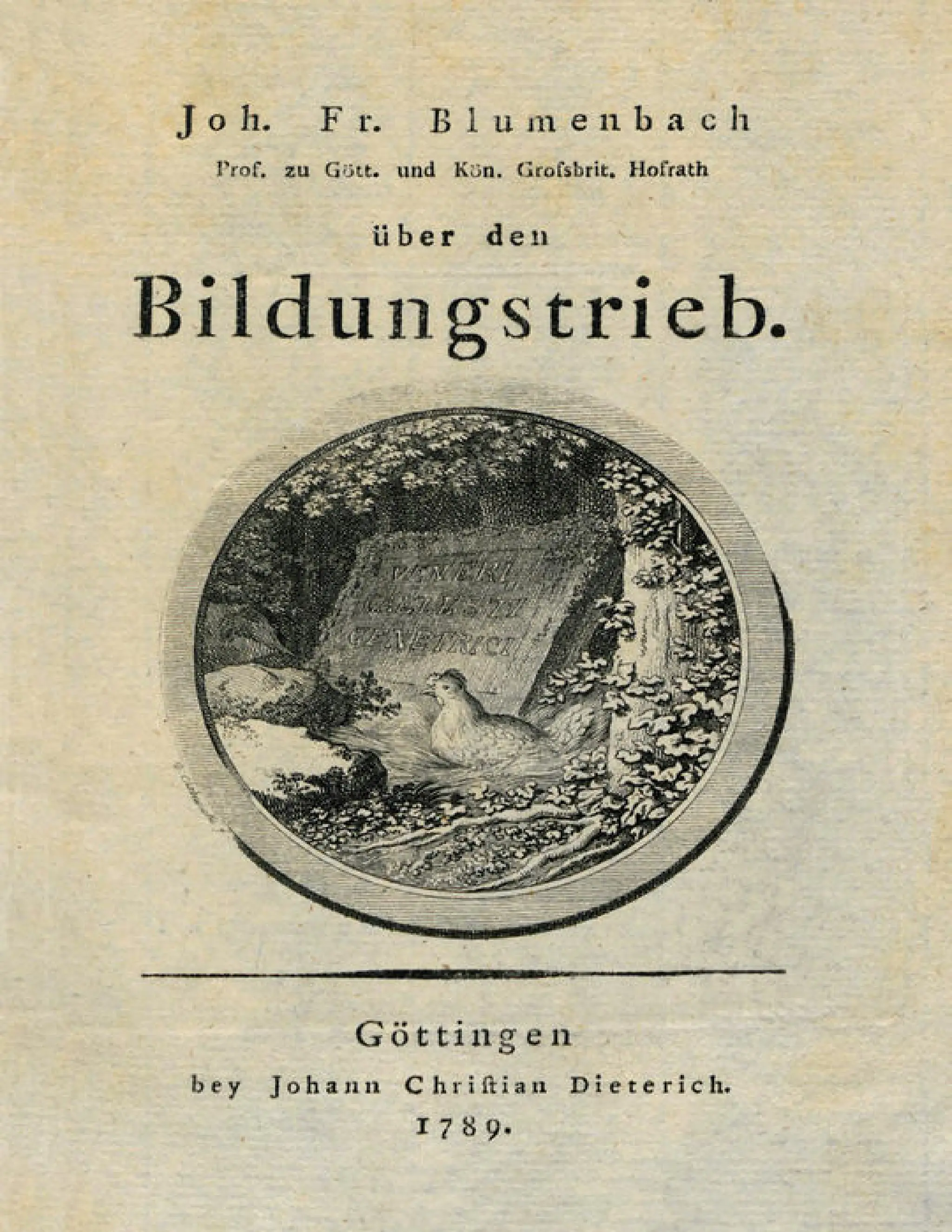
1. Auf dem Titel, eine Brüt-Henne als Symbol des Bildungstriebes
im Thierreich.
2. Auf der Anfangsleiste S. 1. ein aufkeimend Saamenkorn als
Bild dieses Triebes im Gewächsreich. Nach einer alten silbernen
Münze von Reggio in Calabrien beym GOLTZ.
3. Am Schluß S. 108. eine anständige und doch wie Naturkenner
wissen, sehr bedeutungsvolle Vorstellung des Genusses, der dann
den Bildungstrieb zur Folge hat.
Erster Abschnitt.
Von den verschiednen Wegen die man eingeschlagen hat, zu
einigem Aufschluß über das Zeugungsgeschäfte zu gelangen.
Was geht im Innern eines Geschöpfes vor, wenn es sich der
süßesten aller Regungen überlassen hat, und nun von einem
zweyten befruchtet einem dritten das Leben geben soll?
Nicht leicht wird eine Frage dieser Art genannt werden können,
die so allgemein und so zu allen Zeiten die heiße Neugierde des
Menschen, gereizt haben muß, als eben diese. Denn so
abentheuerlich es auch sonst scheint, die Betrachtungen und
Reflexionen des ersten Menschenpaars bestimmen zu wollen, so
natürlich bleibt doch die Voraussetzung, daß dieses uns allen eben
durch die Befolgung jenes süßesten unwiderstehlichsten Triebes so
wichtig gewordne Paar sehr bald erst zum Staunen und dann zum
Nachsinnen gekommen seyn mag, wie es allgemach bemerkte, was
dieselbe für eine große Wirkung — eine gleichsam wiederholte
Schöpfung — nach sich ziehe. So geläufig ihm aber gar bald diese
Erfahrung werden mußte, so sehr demüthigt es das menschliche
Wissen, daß die Urenkel jenes Paars nach so langen Jahrtausenden
über die Erklärung dieser Erfahrung noch so weniges befriedigendes
Licht haben verbreiten können, ungeachtet dieselbe in der Folge gar
bald der allgemeinste Gegenstand für Untersuchung der
nachdenkenden Köpfe geworden zu seyn scheint. Wenigstens betrifft
das was noch von Bruchstücken physiologischer Lehren und
Meinungen der ältesten Weltweisen und Aerzte[1] bey spätern
Schriftstellern aufbewahrt worden, großentheils Untersuchungen
über das Geheimnis der Zeugung: und seitdem vollends ist in der
Litterargeschichte der Philosophie und Arzneywissenschaft keine
Periode, worin sich nicht immer andre Männer auf die weitere
Verfolgung derselben eingelassen haben sollten.
Selbst in den düstern Jahrhunderten des mittlern Zeitalters, wo
sonst aller übrige Forschungsgeist im tiefen Schlummer der
Mönchsbarbarey versenkt lag, wachte doch immer die rege
Neugierde über diesen Gegenstand, so daß uns von den geistlichen
Herren jener Zeit noch manche sehr fleischlich abgefaßte Bücher
übrig sind[2], die zum Beweise dienen, wie sehr sie sich auch die
Theorie desselben haben angelegen seyn lassen.
Kein Wunder also, daß sich auch die Generations-Systeme, die
Versuche das große Problem zu lösen, nach und nach fast ins
Unendliche mehrten, und kein Zugang unbetreten blieb, wenn man
nur irgend wähnen konnte, daß er zu einem Aufschluß hierüber
führen werde, so daß dann freylich auch der offenbarsten Irrwege in
keinem andern Felde der Naturwissenschaft so viele geworden sind,
als eben hier.
Schon BOERHAAVE’S Lehrer, DRELINCOURT, hat allein 262 grundlose
Hypothesen über das Zeugungsgeschäfte aus den Schriften seiner
Vorgänger zusammen gestellt, — und nichts ist gewisser, als daß
sein eignes System die 263te ausmacht.
Inzwischen lassen sich doch diese unzählig-scheinenden Pfade
die man sich zu bahnen versucht hat, um zur Lösung dieses größten
aller physiologischen Räthsel zu gelangen, am Ende alle auf zwey
Hauptwege hinausführen, die neuerlich unter den Namen der
Evolution und der Epigenese allgemein bekannt worden.
Entweder nemlich man nimmt an, daß der reife, übrigens aber
rohe ungeformte Zeugungsstoff der Eltern, wenn er zu seiner Zeit
und unter den erforderlichen Umständen an den Ort seiner
Bestimmung gelangt, dann zum neuen Geschöpfe allmälig
ausgebildet werde. Dieß lehrt die Epigenese.
Oder aber man verwirft alle Zeugung in der Welt, und glaubt
dagegen, daß zu allen Menschen und Thieren und Pflanzen, die je
gelebt haben und noch leben werden, die Keime gleich bey der
ersten Schöpfung erschaffen worden, so daß sich nun eine
Generation nach der andern blos zu entwickeln braucht. Deshalb
heißt dieß die Lehre der Evolution.
Allein die Art und Weise dieser Evolution selbst, hat man wieder
durch sehr verschiedne Theorien zu erklären versucht.
HERACLIT nemlich (mit dem Zunamen, der Düstere) und
HIPPOCRATES oder wer sonst der Verfasser der unter des letztern
Werken befindlichen Bücher von der Lebensordnung seyn mag,
meinten, so wie manche ihrer neuern Nachfolger, diese Keime seyen
auf und in der ganzen Erde verbreitet, wo sie so lange
umherschwärmten, bis jeder die Zeugungstheile eines seiner schon
entwickelten Brüder von seiner Art anträfe, in ihnen gleichsam
Wurzel schlagen, seine bisherige Hülle abwerfen, und nun selbst zur
Entwickelung gelangen könne.
Diese Theorie hat aber außer dem (hier freylich am wenigsten
blendenden) Ansehen des HIPPOCRATES so schlechterdings nichts vor
sich, sondern ist so ganz blos aus den abentheuerlichsten
willkührlichsten Voraussetzungen aufgebaut, daß man nicht absieht,
was für irgend eine Hypothese man sich als unwahrscheinlich
versagen dürfte, wenn man sich eine solche, wie diese sogenannte
Panspermie, erlauben wollte. — Auch entschuldigt unser sel. GESNER
den Aufwand von Gelehrsamkeit, womit er diesen Roman beym
HIPPOCRATES commentirt hat, blos mit dem Bonmot der Königin
CHRISTINA: daß die Grillen der Alten immer doch eben soviel werth
seyen, als die Grillen der Neuern.
Mehr Beyfall haben zwey andere Evolutionstheorien erhalten,
nach welchen beiden die Keime nicht umherschwärmen, sondern
fein ruhig in einander geschachtelt und bey der ersten Schöpfung
gleich in die ersten Stammeltern gelegt seyn sollten, so daß nun eine
Generation derselben nach der andern durch die Paarung oder
Befruchtung zur Entwickelung gelange. Der Unterschied zwischen
beiden Theorien war blos der, daß diese Keime nach der einen beym
Vater, nach der andern aber bey der Mutter liegen sollten.
Wie nemlich im vorigen Jahrhundert die Vergrößerungsgläser
erfunden waren, und sich hiedurch Aussichten in eine neue Welt von
microscopischen Geschöpfen öffneten, so war bey der Neuheit dieser
Erfindung und der Leichtigkeit ihres Gebrauchs nichts natürlicher als
daß man nun aufs gerathewohl tausenderley Objecte unters
Microscop brachte, das so sehr mannichfaltige große
Ueberraschungen gewährte. So besah auch unter andern ein junger
Danziger LUDW. VON HAMMEN, der damals in Leiden Medicin studirte im
Aug. 1677 einen Tropfen männlichen Saamen von einem Hahn, den
er eben geöffnet hatte, unter seinem Glas, und erstaunte diesen
Tropfen als einen Ocean zu erblicken, der von unzähligen flinken,
raschen kleinen Thierchen belebt war. Diese unerwartete Erfahrung
bestätigte sich im reifen Saamen anderer männlichen Thiere, und
nun glaubte man in diesen Saamenwürmchen die Keime zu
künftigen vollkommnen Geschöpfen und mit ihnen folglich auch den
Schlüssel zum Geheimnis der Zeugung gefunden zu haben. Nun
begreife ich zwar nicht wie Naturforscher und Physiologen von
Profession den Saamenthierchen die willkührliche Bewegung und
überhaupt die Animalität haben absprechen können: aber noch weit
unbegreiflicher ist es, wie andre Männer diese in einem stagnirenden
thierischen Safte, (so wie ähnliche Infusionsthierchen in andern
Säften) zu erwartenden Würmchen zu beseelten Keimen künftiger
Menschen und Thiere haben hinaufwürdigen und erheben dürfen.
Ohne die längst bekannten, aber nie nur leidlich gehobnen
Zweifel zu wiederholen, die sich gegen eine so seltsame Behauptung
empören, so begnüge ich mich hier nur einige wenige
Bedenklichkeiten hinzuzusetzen, die doch auch ungelehrten Lesern
diese vorgegebne Würde der Saamenthierchen sehr verdächtig
machen müssen. So z. B. daß die Würmchen im Saamen der
nächstverwandten Thiere in ihrer Bildung so gänzlich von einander
verschieden, und andre, von den unähnlichsten Thieren einander so
auffallend ähnlich sind! Es kan kaum eine größere Unähnlichkeit
geben, als die zwischen den Saamenthierchen des Frosches beym
Hrn. VON GLEICHEN und denen vom Wassermolch bey Hrn. SPALLANZANI.
Hingegen kan die Aehnlichkeit zwischen zwey Wassertropfen nicht
täuschender seyn, als die zwischen den Saamenthierchen des
Menschen und des Esels in den Kupfern des erstern von jenen
beiden Beobachtern.
Eben dieser neuerliche, und hoffentlich letzte Verfechter jener
Würde der Saamenthierchen, hat beym Frosche gar zweyerley Arten
dieser Würmchen zugleich im gleichen Tropfen gesehen — und doch
sind wiederum beide von derjenigen Gattung die RÖSEL im
Froschsaamen gesehen, gleich weit verschieden! und jene haben
sich noch dazu in den Nieren so gut, wie in den Saamenbläsgen
gefunden etc.
Lauter Erscheinungen, die die zufällige Unbestimtheit dieser
fremden Gäste des männlichen Saamens so sehr erweisen, und die
ihnen aufgedrungene Würde so ganz vernichten, daß man
wenigstens eben so leicht hoffen darf mit dem sittsamen
PARACELSUS[3] und dem Mahler GAUTIER[4] aus bloßem männlichen
Saamen einen vollkommnen menschlichen Embryo hervorzubringen,
als ihn mit dem berühmten Academisten HARTZOEKER[5] in jedem
menschlichen Saamenthierchen völlig schon so wie nachher im
Mutterleibe krumm zusammen gebogen sitzen zu sehen.
Schon vor Entdeckung der Saamenthierchen hatte ein sonst
wenig bekannter Mann JOSEPH DE AROMATARIIS einen dritten Weg
eingeschlagen, das Zeugungsgeschäfte durch Evolution zu erklären,
denjenigen nemlich, der auf die vorgeblichen im mütterlichen
Eyerstock längst vor der Empfängnis zur Entwickelung vorräthig
liegenden präformirten Keime hinausläuft. Auch SWAMMERDAM hat ihn
betreten, doch blieb er im ganzen, vollends seit nun die
Saamenwürmchen das große Aufsehn machten, wenig besucht, bis
er mit einem Male in neuern Zeiten durch die Bemühungen der
großen Männer HALLER und BONNET am gangbarsten von allen
gemacht ward.
Nach dieser Evolutionstheorie haben wir, so wie das ganze
Menschengeschlecht in den beiden Eyerstöcken unserer ersten
Stamm-Mutter in einander geschachtelt und wie im tiefsten
Todesschlaf versenkt beysammen gelegen. Zwar sehr im Kleinen, als
Keime, aber, versteht sich, als präformirte, völlig ausgebildete
Miniaturen. Denn, sagt Hr. V. HALLER, “alle Eingeweide und die
Knochen selbst waren schon vorhero gebaut gegenwärtig, obgleich
in einem fast flüssigen Zustande.” Was man Empfängnis nennt, ist
nichts als das Erwachen des schlaftrunknen Keims durch den Reiz
des auf ihn wirkenden männlichen Saamens, der sein Herzchen zum
ersten Schlage antreibt u. s. w. Auch hat uns daher vor Kurzem einer
der neuesten Verfechter dieser Theorie, ein berühmter Genfer
Naturforscher, mit nichts geringerm, als einem Entwurf der
Geschichte der organisirten Körper vor ihrer Befruchtung, beschenkt,
und uns darin belehrt, daß wir 1) alle weit älter sind als wir geglaubt
hatten; daß 2) alle Menschen in der Welt von gleichem Alter sind,
der Großvater nicht um einen Tag älter als sein neugeborner Enkel
etc. und daß sich 3) dieses ehrwürdige Alter aller Menschen, die
gegenwärtig auf dem Erdenrund leben, nahe gegen 6000 Jahre
erstreckt. — Auch tritt er ganz der Meinung bey, die schon BAZIN
behauptet, daß wir seit der lieben langen Zeit da wir mit Cain und
Abel und den 200,000 Millionen übrigen Menschen zusammen
steckten, die der gemeinen Rechnung nach, seitdem vor uns dahin
gegangen sind quo pius Aeneas quo Tullus diues et Ancus, kurz seit
der ersten Schöpfung, zwar incognito und schlaftrunken, aber doch
nicht ganz ohne Bewegung brach gelegen haben, und daß wir
während der 57 Jahrhunderte eh uns die Reihe traf, daß wir durch
den oberwähnten Reiz entwickelt wurden, doch immer nach und
nach sachte gewachsen sind: wir konnten uns nemlich bey Cains
Schwester schon ein bißgen mehr ausdehnen, als bey ihrer Mutter,
wo sie selbst nebst ihren Geschwistern noch bey uns lag und uns
den Raum beengte; und so kriegten wir mit jeder neuen
Entwickelung eines unsrer Vorfahren ein geräumiger Logis, und das
that uns wohl, da streckten wir uns immer mehr und mehr, bis
endlich die Reihe der Entwickelung auch an uns kam!
So abentheuerlich romanhaft diese letztern Behauptungen
scheinen mögen, so fließen sie doch im Grunde ziemlich natürlich
aus den Grundsätzen jener Theorie. Für diese Grundsätze selbst
aber führten die Verfechter derselben, Hr. VON HALLER, Hr. SPALLANZANI
etc. Erfahrungen und Beobachtungen an, die wir im nächsten
Abschnitt näher beleuchten werden, die aber auf den ersten Blick so
einleuchtend und entscheidend scheinen, daß sich der allgemeine
Beyfall doch ganz wohl begreifen läßt, womit, zumal in den letztern
30 Jahren, die Präexistenz der präformirten Keime im weiblichen Eye
lange vor ihrer Befruchtung und Entwickelung, aufgenommen wurde.
Auch ich habe ihr vorhin beygepflichtet, habe sie gelehrt und in
mehreren Schriften vertheidigt, so daß in so fern hier diese Blätter
das Geständnis eigner Irthümer enthalten, denen ich nichts mehr
wünsche, als was Hr. DE LUC irgendwo sagt: “ein verbesserter Irthum
wird oft zu einer ungleich wichtigern Wahrheit, als manche positive
Wahrheiten, die unmittelbar als solche anerkannt worden.”
Der unerwartete Erfolg eines kleinen Versuchs den ich doch recht
in der Absicht angestellt hatte, um die Richtigkeit jener
Evolutionstheorie und den Ungrund der allmäligen Bildung zu
erweisen, brachte mich erst zum Scheideweg zurück und öffnete mir
bald eine neue der vorigen sehr entgegengesetzte Bahn. Wer so
wieder die Natur kämpft, dem geht’s doch leicht bey einem
unversehenen Blick in ihre enthülltern Reize, wie dort dem Menelaus,
da er ausgegangen war sein Schwerd gegen Helena zu zucken:
kaum sah sein Auge den Busen den er durchbohren wollte, so sank
sein gewaffneter Arm, und es war nun nicht um sie, sondern um ihn
geschehen[6].
Der Anlaß zu jenem Versuch war der: Ich fand, da ich einige
Ferientage auf dem Lande zubrachte, in einem Mühlbache eine Art
grüner Armpolypen, die sich durch einen langgestreckten
spindelförmigen Körper, und kurze meist steife Arme von der
gemeinen grünen Gattung auszeichneten, und mit deren Wundern
ich meiner Gesellschaft einen Theil ihrer Zeit vertreiben sollte. Theils
das warme trockne Sommerwetter, noch mehr aber die dauerhafte
Constitution dieser Polypen begünstigte die bekannten
Reproductionsversuche die wir damit anstellten so, daß die
Wiederersetzung gleichsam zusehends von statten zu gehen schien.
Schon den zweyten, dritten Tag waren den verstümmelten Thieren
wieder Arme, Schwänze u. s. w. angewachsen; nur bemerkten wir
immer sehr deutlich, daß die neuergänzten Polypen bey allem
reichlichen Futter, doch weit kleiner als vorher waren: und ein
verstümmelter Rumpf, so wie er die verlornen Theile wieder
hervortrieb, auch im gleichen Maaße, recht sichtlich einzukriechen,
und kürzer und dünner zu werden schien u. s. w.[7]
Einige Zeit nachdem ich wieder zur Stadt gekommen war, mußte
ich einen Menschen besuchen, der schon lange am Winddorn krank
gelegen hatte. Der Schade war über dem Knie, und offen, und auch
die weichen Theile zu einer tiefen Grube ausgeeitert. Es besserte
sich nachher, aber so wie die Lücke im Fleisch nach und nach wieder
mit plastischer Lymphe zur Narbe angefüllt wurde, so senkte sich
auch[8] das benachbarte gesunde Fleisch im gleichen Grade
allgemach nieder, schien gleichsam zu schwinden, so daß endlich die
Narbe in der Grube und das Fleisch am Rande derselben wieder fast
gleich standen, und jene nur noch eine breite aber ziemlich flache
Delle machten. Also mutatis mutandis der gleiche Fall, wie bey
meinen grünen Armpolypen aus dem Mühlgraben.
Ich habe seit der Zeit einen großen Theil meiner Muße auf die
weitere Prüfung und Untersuchung dieser damaligen Erfahrungen
verwandt, und alles was ich darin durch Beobachten und
Nachdenken gelernt habe, führt mich am Ende zu der
Ueberzeugung:
Daß keine präformirten Keime präexistiren: sondern daß in
dem vorher rohen ungebildeten Zeugungsstoff der organisirten
Körper nachdem er zu seiner Reife und an den Ort seiner
Bestimmung gelangt ist, ein besonderer, dann lebenslang thätiger
Trieb rege wird, ihre bestimmte Gestalt anfangs anzunehmen,
dann lebenslang zu erhalten, und wenn sie ja etwa verstümmelt
worden, wo möglich wieder herzustellen.
Ein Trieb, der folglich zu den Lebenskräften gehört, der aber
eben so deutlich von den übrigen Arten der Lebenskraft der
organisirten Körper (der Contractilität, Irritabilität, Sensilität etc.)
als von den allgemeinen physischen Kräften der Körper
überhaupt, verschieden ist; der die erste wichtigste Kraft zu aller
Zeugung, Ernährung, und Reproduction zu seyn scheint, und den
man um ihn von andern Lebenskräften zu unterscheiden, mit
dem Namen des Bildungstriebes (nisus formatiuus) bezeichnen
kan.
Hoffentlich ist für die mehresten Leser die Erinnerung sehr
überflüssig, daß das Wort Bildungstrieb, so gut, wie die Worte
Attraction[9], Schwere etc. zu nichts mehr und nichts weniger dienen
soll, als eine Kraft zu bezeichnen, deren constante Wirkung aus der
Erfahrung anerkannt worden, deren Ursache aber so gut wie die
Ursache der genannten, noch so allgemein anerkannten Naturkräfte,
für uns qualitas occulta ist. Es gilt von allen diesen Kräften was OVID
sagt: — causa latet, vis est notissima. Das Verdienst beym Studium
dieser Kräfte ist nur das, ihre Wirkungen näher zu bestimmen und
auf allgemeinere Gesetze zurück zu bringen.
D’ALEMBERT’S Nachfolger, der Hr. M. DE CONDORCET sagt in seiner
Lobrede auf unsern HALLER bey Gelegenheit der Irritabilität: “Man
fing wie gewöhnlich damit an, daß man die Wahrheit der Sache
läugnete; — und da das endlich doch nicht länger mit Ehren sich
thun lies, so endigte man damit, daß man nun sagte, das sey ja was
altes längst bekanntes!”
Da man nun neuerlich schon scharfsichtig genug worden ist,
eben die thierische Reizbarkeit schon im HOMER, und den
Harveyischen Blutumlauf im Prediger SALOMO beschrieben zu finden,
so müßte es vollends nicht gut seyn, wenn sich nicht auch zur Noth
der ganze nisus formativus aus allen den Werken über die
Erzeugung, die seit 2000 Jahren geschrieben und nun zusammen zu
keiner kleinen Bibliothek angeschwollen sind, sollte herausdeuten
lassen. Zumal da die vis plastica der Alten (besonders der
peripatetischen Schule) bey der Aehnlichkeit des Namens mit nisus
formativus zu einem solchen qui pro quo verleiten könnte.
Es soll mich aber freuen, wenn man mir einen einzigen dieser
Alten aufstellt, der von seiner plastischen Kraft auch nur
einigermaßen die bestimmten und den Phänomenen des
Zeugungsgeschäftes so genau entsprechenden Begriffe gäbe[10], wie
ich sie in diesen Blättern, (besonders im dritten Abschnitt) vom
Bildungstriebe zu geben versucht habe.
Ein sehr scharfsichtiger Physiologe Hr. C. F. WOLFF in Petersburg
hat eine andre Kraft fürs Wachsthum der Thiere und Pflanzen
angenommen, die er vis essentialis nennt: und die ebenfalls, wenn
man sie blos vom Hörensagen kennt, auf den ersten Blick mit dem
nisus formativus vermengt werden könnte.
Die gänzliche Verschiedenheit zwischen beiden muß aber einem
jeden einleuchten, sobald er sich die Mühe nimmt, den wahren
Begriff den Hr. WOLFF selbst von seiner vis essentialis angiebt in
seiner theoria generationis nachzulesen[11].
Ihm ist seine vis essentialis blos diejenige Kraft, wodurch der
Nahrungsstoff in die Pflanze oder in das junge Thier getrieben wird.
Dieß ist folglich zwar ein Requisit zum Bildungstrieb — aber bey
weitem nicht der Bildungstrieb selbst. Denn jene vis essentialis
wodurch die Nahrungssäfte in die Pflanze gebracht werden, zeigt
sich auch bey den unförmlichsten, widernatürlichsten, wuchernden
Auswüchsen der Gewächse, (an Baumstämmen etc.) wo gar kein
bestimmter Bildungstrieb statt hat. Eben so bey Mondkälbern etc.
Umgekehrt kan die vis essentialis bey schlecht ernährten
organischen Körpern sehr schwach seyn, dem eigentlichen
Bildungstriebe übrigens unbeschadet u. s. w.
So leid es mir thut, so bringt es doch die Natur der Sache einmal
nicht anders mit sich, als daß ich den Gründen und Erfahrungen für
den Bildungstrieb eine Wiederlegung der theils so blendenden
Argumente vorausschicken muß[12], deren sich zumal Hr. VON HALLER
zu Gunsten der Entwickelung aus dem weiblichen Eye bedient hat.
Was mir indeß diese Abweichung von dem Manne, dessen Schriften
und dessen Briefwechsel ich so unendlich viel verdanke, erleichtern
kan, ist theils die Gewißheit, daß selbst ein großer Theil des
etwanigen Guten, welches irgend in diesen Blättern enthalten seyn
mag, doch in so fern ihm zu verdanken ist, als es durch Prüfung und
weitern Verfolg seiner Untersuchungen veranlaßt wurde, und theils
die Ungewißheit, ob er nicht selbst wohl schon auf andre Spuren
gekommen, und in dem noch nicht bekannt gemachten Theil seines
letzten großen Werks[13] von seiner vorigen Meinung wieder
abgegangen seyn mag. Auf keinen Fall wird aber HALLER’S Ruhm das
mindeste von seinem verdienten Glanze verlieren, wenn Er auch
dennoch die eingewickelten Keime ferner behauptet, und sich der
allmäligen Bildung noch weiter wiedersetzt haben sollte; so wenig
als es HARVEY’S und NEWTON’S ewigen Nachruhm schwächen darf, daß
Jener das Daseyn der Milchgefäße im thierischen Körper, und Dieser
die Möglichkeit der farbenlosen Fernröhren geläugnet hat!
[1] Wie z. B. des ORPHEUS, des PYTHAGORAS, ANAXAGORAS etc.
[2] Z. B. von Pabst JOHANN XX., von Bischof ALBERT dem Großen
oder was sonst für ein ehrwürdiger Geistlicher der Verf. des
schmuzigen Büchleins von den Geheimnissen der Weiber ist. So
MICH. SCOTUS und viele a. m.
[3] Von Natur der Dinge an Johansen Winkelsteiner von Fryburg
im Uchtland. im VIten B. der Huserschen Ausg. seiner sämtlichen
Werke. S. 263. u. f.
Ein ähnliches Product beschreibt AMAT. LUSITANUS curation.
medicinal. Cent. VI. curat. 53. schol. p. 612. “Certo scimus
chimico artificio puerum conflatum esse, et omnia sua membra
perfecta contraxisse, ac motum habuisse: qui cum a vase, vbi
continebatur, esset extractus, moueri desiit. Nouit haec accuratius
JULIUS CAMILLUS, vir singularis doctrinae et rerum occultarum et
variarum hac nostra aetate magnus scrutator, et Hetrusca sua
lingua scriptor diligentissimus et accuratissimus.”
[4] Man sehe seine Génération de l’homme et des animaux. Par.
1750. 12. wie auch die Observ. sur l’hist. nat. I Th. und seinen
freylich etwas misgestalteten Fötus selbst mit lebendigen Farben
vorgestellt. Taf. A. fig. 3.
[5] Essay de Dioptrique. Par. 1694. 4. S. 230. wo der
scharfsichtige Mann eine genaue Abbildung des in die Hülle eines
Saamenthierchens eingewickelten und auf seine Befreyung
harrenden Kindchens gibt.
[6] GALENUS von den Lehrsätzen des Hippocrates und Plato: im
Vten Band der C h a r t i e r. Ausg. S. 147.
[7] Es ist zwar ganz wohl begreiflich, wie ein solcher kleiner
Umstand von manchen Beobachtern entweder in der Erwartung
größerer Merkwürdigkeiten ganz übersehen, oder aber nicht
anmerkenswerth gefunden wurde. Doch scheint der sorgfältige
RÖSEL darauf geachtet zu haben. Hist. der Polypen. im III B. der
Insectenbelustig. S. 490.
[8] Eine gleichfalls schon anderwärts bemerkte Erscheinung. Man
sehe die Abh. der Hrn. FABRE und LOUIS, des playes avec perte de
substance in den Mém. de l’ac. de Chirurgie. vol IV. S. 64. u. 106.
[9] So sagt z. B. NEWTON in den Quästionen an der 2ten Ausg.
seiner Optik, S. 380. der C l a r k i s c h e n Uebers. “Hanc vocem
attractionis ita hic accipi velim, vt in vniuersum solummodo vim
aliquam significare intelligatur, qua corpora ad se mutuo tendant;
cuicunque demum causae attribuenda sit illa vis.”
[10] Noch am bestimmtesten druckt sich doch F. BONAMICO der
bekannte Aristoteliker darüber aus, de formatione foetus p. 528.
“Spiritus in aërea seminis substantia comprehensus, aspersus
autem a calore caelesti, et vi a patre accepta, et ea quam a coelo
participat, in vterum foeminae coniectus, concoquit materias a
foemina infusas et pro ratione ipsarum variis modis afficiens efficit
instrumenta. Dum vero ea fabricat appellatur Facultas
διαπλαστικη seu δημιουργικη. Sed vbi exstructa fuerint
instrumenta, vt iis vti queat, quae prius erat vis formatrix, illis
vtens degenerat in animam.”
[11] So z. B. S. 12. “Vis vegetabilium essentialis ea est vis, qua
humores ex circumiacente terra, vel aliis corporibus colliguntur,
subire radicem coguntur, per omnem plantam distribuuntur,
partim ad diversa loca deponuntur, partim foras expelluntur.”
S. 13. “Quaecunque vero sit haec vis, sive attractrix, sive
propulsiva, sive aëri expanso debita, sive composita ex omnibus
hisce et pluribus; modo praestet enarratos effectus, et ponatur,
posita planta et humoribus nutritiis applicatis, id quod experientia
confirmatum est: sufficiet ea praesenti scopo et vocabitur a me
vis vegetabilium essentialis”
und in Anwendung auf die Erzeugung der Thiere S. 73.
“Embryonem hoc tempore (ovo sc. 36 horas incubato) ex
substantia ovi nutriri demonstrant illius volumen auctum,
perfectiones acquisitae, absentia cuiuscunque alius materiae,
consumtio albuminis et vitelli succedens, experimenta inferius
recensenda; consequenter: transire particulas nutrientes ex ovo
ad embryonem: et existere vim, qua id perficitur, quae non est
systaltica cordis et arteriarum, neque hinc facta pressio in venas
vicinas, neque harum compressio a motu musculorum, dirigentem
absque canalibus, viam determinantibus, adeoque analogam illi
(§. 1.) quam aeque vocabo essentialem.”
[12] Doch übergehe ich dabey alle diejenigen, zum Theil
ausnehmend scharfsinnigen Gegengründe, die schon in einer
kürzlich unter folgendem Titel erschienenen, überaus witzigen
und angenehmen Schrift der Evolution entgegen gestellt sind:
Zweifel gegen die Entwickelungstheorie. Ein Brief an Hrn. SENEBIER
von L.. P.. (PATRIN). Aus der französischen Handschrift übersetzt
von G. FORSTER, Göttingen, 1788. 8.
[13] Er schrieb mir selbst d. 28. Aug. 1776. “Ich danke der
Vorsehung, die mir so viele Lebenszeit gegeben hat, daß ich eine
neue Auflage der Physiologie habe ausarbeiten können, ohne die
ich der Welt viele Fehler würde zu wiederlegen gelassen haben.”
Zweyter Abschnitt.
Prüfung der Haupt-Gründe für die vorgegebne Präexistenz
des präformirten Keims im weiblichen Eye, und Gegengründe
zu ihrer Wiederlegung.
Am 13ten May 1758. ward in der Versammlung der königlichen
Societät der Wissenschaften zu Göttingen die berühmte Abhandlung
des Hrn. VON HALLER ihres damaligen Präsidenten über die Bildung
des Herzens im bebrüteten Küchelgen abgelesen, worin man
nachher das argumentum crucis zu Gunsten der präformirten Keime
zu finden geglaubt hat. Ihr Verfasser sagt nemlich, er habe
gefunden, daß die Haut des Dotters im bebrüteten Ey mit den
Häuten des daran hängenden Küchelgens, und die Blutgefäße des
letztern eben so mit den Adern der sogenannten figura venosa des
Dotters continuirten. Nun aber habe der Dotter mit seiner Haut
schon im Eyerstock der unbefruchteten Henne präexistirt, folglich
nach aller Wahrscheinlichkeit auch zugleich mit derselben, obgleich
unsichtbar das damit continuirende Küchelgen. — Doch druckte sich
der vorsichtige Mann anfangs immer noch behutsam und gleichsam
schwankend über diese Schlußfolge aus[14].
Hr. BONNET hingegen, der bald nachher seine Betrachtungen über
die organisirten Körper herausgab, und schon vorher für die
Entwickelung der präformirten Keime eingenommen war, faßte gleich
die Hallersche Bemerkung, erklärte sie für schlechterdings
Welcome to our website – the perfect destination for book lovers and
knowledge seekers. We believe that every book holds a new world,
offering opportunities for learning, discovery, and personal growth.
That’s why we are dedicated to bringing you a diverse collection of
books, ranging from classic literature and specialized publications to
self-development guides and children's books.
More than just a book-buying platform, we strive to be a bridge
connecting you with timeless cultural and intellectual values. With an
elegant, user-friendly interface and a smart search system, you can
quickly find the books that best suit your interests. Additionally,
our special promotions and home delivery services help you save time
and fully enjoy the joy of reading.
Join us on a journey of knowledge exploration, passion nurturing, and
personal growth every day!
testbankfan.com


Essentials of Life-Span Development 3rd Edition Santrock Solutions Manual

  • 1.
    Essentials of Life-SpanDevelopment 3rd Edition Santrock Solutions Manual download https://testbankfan.com/product/essentials-of-life-span- development-3rd-edition-santrock-solutions-manual-2/ Find test banks or solution manuals at testbankfan.com today!

  • 2.
    We have selectedsome products that you may be interested in Click the link to download now or visit testbankfan.com for more options!. Essentials of Life Span Development 3rd Edition Santrock Test Bank https://testbankfan.com/product/essentials-of-life-span- development-3rd-edition-santrock-test-bank/ Essentials of Life-Span Development 3rd Edition Santrock Test Bank https://testbankfan.com/product/essentials-of-life-span- development-3rd-edition-santrock-test-bank-2/ Essentials of Life Span Development 5th Edition Santrock Solutions Manual https://testbankfan.com/product/essentials-of-life-span- development-5th-edition-santrock-solutions-manual/ Abnormal Child Psychology 5th Edition Mash Test Bank https://testbankfan.com/product/abnormal-child-psychology-5th-edition- mash-test-bank/
  • 3.
    Behavior Modification Principlesand Procedures 5th Edition Miltenberger Test Bank https://testbankfan.com/product/behavior-modification-principles-and- procedures-5th-edition-miltenberger-test-bank/ Microeconomics 5th Edition Hubbard Test Bank https://testbankfan.com/product/microeconomics-5th-edition-hubbard- test-bank/ Microeconomics 2nd Edition Goolsbee Solutions Manual https://testbankfan.com/product/microeconomics-2nd-edition-goolsbee- solutions-manual/ Consumer Behaviour Australia 3rd Edition Solomon Test Bank https://testbankfan.com/product/consumer-behaviour-australia-3rd- edition-solomon-test-bank/ Crafting and Executing Strategy Concepts and Cases The Quest for Competitive Advantage 21st Edition Thompson Test Bank https://testbankfan.com/product/crafting-and-executing-strategy- concepts-and-cases-the-quest-for-competitive-advantage-21st-edition- thompson-test-bank/
  • 4.
    Exploring American HistoriesA Survey with Sources 2nd Edition Hewitt Test Bank https://testbankfan.com/product/exploring-american-histories-a-survey- with-sources-2nd-edition-hewitt-test-bank/
  • 5.
    Chapter 7 Physicaland Cognitive Development in Middle and Late Childhood Santrock: Essentials of Life-Span Development, 3e IM-7 | 1 © 2014 by McGraw-Hill Education. This is proprietary material solely for authorized instructor use. Not authorized for sale or distribution in any manner. This document may not be copied, scanned, duplicated, forwarded, distributed, or posted on a website, in whole or part. Chapter 7: Physical and Cognitive Development in Middle and Late Childhood Learning Goals Learning Goal 1: Describe physical changes and health in middle and late childhood. A. Discuss body growth and change. B. Explain brain development. C. Describe motor development. D. Summarize the influence of exercise on health and development. E. Discuss health, illness, and disease. Learning Goal 2: Identify children with different types of disabilities and issues in educating them. A. Define and describe the scope of disabilities. B. Discuss educational issues related to children with disabilities. Learning Goal 3: Explain cognitive changes in middle and late childhood. A. Describe and discuss Piaget's theory of cognitive development. B. Discuss the information-processing theory. C. Describe and define intelligence. Learning Goal 4: Discuss language development in middle and late childhood. A. Discuss vocabulary, grammar, and metalinguistic awareness. B. Explain the development of reading during middle and late childhood. C. Discuss bilingualism and second-language learning. Overview of Resources Chapter Outline Resources You Can Use Physical Changes and Health Learning Goal 1: Describe physical changes and health in middle and late childhood. Body Growth and Change The Brain Motor Development Exercise Health, Illness, and Disease Lecture Suggestion 1: The Long-Term Consequences of Childhood Obesity Personal Application 1: That’s My Kid! Research Project 1: Current Exercise Levels Interactive Exercise: Sensorimotor Neural Circuits Children with Disabilities Learning Goal 2: Identify children with different types of disabilities and issues in
  • 6.
    Chapter 7 Physicaland Cognitive Development in Middle and Late Childhood Santrock: Essentials of Life-Span Development, 3e IM-7 | 2 © 2014 by McGraw-Hill Education. This is proprietary material solely for authorized instructor use. Not authorized for sale or distribution in any manner. This document may not be copied, scanned, duplicated, forwarded, distributed, or posted on a website, in whole or part. educating them. The Scope of Disabilities Educational Issues Lecture Suggestion 2: ADHD—An Intolerance for Childhood Playfulness Research Project 2: Interviewing Parents of Children with Disabilities Cognitive Changes Learning Goal 3: Explain cognitive changes in middle and late childhood. Piaget’s Cognitive Developmental Theory Information Processing Intelligence Lecture Suggestion 3: Observational Issues in Identifying Children with ADHD Lecture Suggestion 4: Is Being a Child Prodigy a Blessing or a Curse? Classroom Activity 1: Time to Tell Time? Classroom Activity 2: Is Psychology Just Common Sense? Classroom Activity 3: Test Anxiety: A Visit with Teachers Personal Application 2: Remember the Time… Personal Application 3: Smart Move Personal Application 4: Exploring Your Creativity Research Project 3: Assessment of a Preoperational and a Concrete Operational Thinker Language Development Learning Goal 4: Discuss language development in middle and late childhood. Vocabulary, Grammar, and Metalinguistic Awareness Reading Bilingualism and Second-Language Learning Lecture Suggestion 5: Environmental Influences on Literacy Review Classroom Activity 4: Critical-Thinking Multiple-Choice Questions and Suggested Answers Classroom Activity 5: Critical-Thinking Essay Questions and Suggestions for Helping Students Resources Lecture Suggestions Lecture Suggestion 1: The Long-Term Consequences of Childhood Obesity Learning Goal 1: Describe physical changes and health in middle and late childhood. The purpose of this lecture is to extend the discussion of the long-term physical and psychological consequences of childhood obesity. Must et al. (1992) have documented morbidity and mortality rates related to obesity in adolescence. Obese adolescents are at greater risk for death and adult obesity. These
  • 7.
    Chapter 7 Physicaland Cognitive Development in Middle and Late Childhood Santrock: Essentials of Life-Span Development, 3e IM-7 | 3 © 2014 by McGraw-Hill Education. This is proprietary material solely for authorized instructor use. Not authorized for sale or distribution in any manner. This document may not be copied, scanned, duplicated, forwarded, distributed, or posted on a website, in whole or part. relationships are stronger for females than males. As Santrock discusses, both males and females suffer psychological and social consequences of childhood obesity (pulmonary problems, hip problems, high blood pressure and elevated blood cholesterol, low self-esteem, depression, and exclusion from peer groups). • Gortmaker et al. (1993) studied the long-term effects of childhood obesity by assessing young adults who were obese as adolescents. These individuals had less education, less income, and were less likely to be married than the individuals who were not obese as adolescents. These effects were apparent despite the statistical control of initial SES and aptitude scores. • These results cannot be explained by chronic health problems that interfere with academic or career success. Gortmaker et al. ingeniously compared a group of individuals with chronic health problems (diabetes, cerebral palsy) with the individuals who had been obese as adolescents. The individuals with chronic health problems did not suffer the same consequences. • What could explain the developmental pattern of obese individuals? The authors speculate that the negative effects of early obesity are more likely due to stigmatization and discrimination. Overweight individuals are negatively labeled, which reduces their chances of successful career progression and mate selection. • Obesity may be an important factor in determining class and success. This speculation calls into question the long-held assumption of the unidirectional relationship between SES and obesity. Being overweight is an increasingly prevalent health problem in children (Schiff , 2013; Summerbell & others, 2012). Being overweight is defined in terms of body mass index (BMI), which is computed by a formula that takes into account height and weight—children at or above the 97th percentile are included in the obesity category, at or above the 95th percentile in the overweight category, and children at or above the 85th percentile are described as at risk for being overweight (Centers for Disease Control and Prevention, 2012a). Over the last three decades, the percentage of U.S. children who are at risk for being overweight has doubled from 15 percent in the 1970s to almost 30 percent today, and the percentage of children who are overweight has tripled during this time frame (Orsi, Hale, & Lynch, 2011). 12.1 percent of 2- to 5-year-old U.S. children are obese. Th at figure is 50 percent higher for 6- to 11-year-old U.S. children—in 2009–2010, 18 percent of U.S. 6- to 11-year-olds were classified as obese (Ogden & others, 2012). The levels of child obesity, overweight, and risk for being overweight remain far too high and are expected to increase in the future (Wardlaw & Smith, 2012). Sources: Gortmaker, S. L., Must, A., Perrin, J. M., Sobol, A. M., & Dietz, W. H. (1993). Social and economic consequences of overweight in adolescence and young adulthood. The New England Journal of Medicine, 329, 1008–1012. Must, A., Jacques, P. F., Dallal, G. E., Bajema, C. J., & Dietz, W. H. (1992). Long-term morbidity and mortality of overweight adolescents: A follow-up of the Harvard Growth Study of 1922 to 1935. The New England Journal of Medicine, 327, 1350–1355. Lecture Suggestion 2: ADHD—An Intolerance for Childhood Playfulness Learning Goal 2: Identify children with different types of disabilities and issues in educating them. The purpose of this lecture is to examine Panksepp’s (1998) proposal that attention deficit hyperactivity disorder (ADHD) is overdiagnosed and reflects an intolerance for normal childhood behavior. ADHD is the most common childhood disorder with approximately 15 percent of American children diagnosed (8 million children). This is an increase from 1 percent of the population in 1902 when this disorder was first recognized. Given that there is no neurological explanation for this increase, Panksepp speculated that the increase in standardized educational experiences has led to intolerance for normal playfulness. Children with ADHD are often given psychostimulants which promote attention and markedly reduce children’s urge to play, especially rough-and-tumble play (Panksepp & others, 1987). This concerned
  • 8.
    Chapter 7 Physicaland Cognitive Development in Middle and Late Childhood Santrock: Essentials of Life-Span Development, 3e IM-7 | 4 © 2014 by McGraw-Hill Education. This is proprietary material solely for authorized instructor use. Not authorized for sale or distribution in any manner. This document may not be copied, scanned, duplicated, forwarded, distributed, or posted on a website, in whole or part. Panksepp, as we do not fully understand the impact that play has on the developing brain, and there is the added concern that we do not understand the long-term neurological consequences of psychostimulant drugs. Could it be that adults want to reduce children’s rambunctiousness because of inadequate space and limited opportunities for children to express the natural biological need to play? After all, the biological need to play intrudes into classroom activities when opportunity and space are limited. Thus, Panksepp proposed that ADHD needs to be reconceptualized as a symptom of contemporary society and our attempt to control normal playfulness in children and not as a symptom of neurological imbalance or a disorder. Is ADHD a normal variant of human diversity? Given the research on the heritability of temperament and the concordance of symptoms of ADHD for siblings, Panksepp argued that symptoms of ADHD are natural variations of child playfulness. The simple criterion used to diagnose ADHD contributes to the frequency of medicating children. These children may be normal, highly playful children who have difficulty adjusting to some institutional expectations. Some of the symptoms can be interpreted in evolutionary terms. Distractibility may be useful to monitor a changing environment. Difficulty following instructions may reflect independent thought and judgement. Acting without regard for consequences may reflect risk-taking. Panksepp argued that we should nurture these characteristics and adjust societal expectations rather than medicate these children. What are the neural differences in individuals with ADHD? The major difference in the brains of individuals with ADHD is a 5 percent reduction in overall size of the frontal areas. The size difference is accompanied by the lack of right–left symmetries (right is smaller) (Castellanoes & others, 1996). The frontal lobes are necessary for long-term planning and the elaboration of complex behavioral strategies. The increased activity level and rough-and-tumble play demonstrated by children with ADHD is related to damage in these areas. Barkley (1997) theorized that ADHD is a result of deficient behavioral inhibition, a function that allows better behavioral flexibility, foresight, and regulation of behavior. Environmental factors, such as play, may improve frontal lobe functions permanently. As with learning disabilities, the development of brain-imaging techniques is leading to a better understanding of ADHD (Almeida Montes & others, 2012; Cubillo & others, 2012; Qui & others, 2011). One study revealed that peak thickness of the cerebral cortex occurred three years later (10.5 years) in children with ADHD than in children without ADHD (peak at 7.5 years) (Shaw & others, 2007). The delay was more prominent in the prefrontal regions of the brain that especially are important in attention and planning (see Figure 9.5). Another recent study also found delayed development of the brain’s frontal lobes in children with ADHD, likely due to delayed or decreased myelination (Nagel & others, 2011). Researchers also are exploring the roles that various neurotransmitters, such as serotonin and dopamine, might play in ADHD (Dalley & Roiser, 2012; Shen, Liao, & Tseng, 2012). Do psychostimulants promote any long-term benefits or problems? Psychostimulants promote activity in areas of the brain that control attention and goal-directed behavior (Pliszka & others, 1996). While these drugs do improve attention and focus temporarily, long-term benefits have not been found (if medication is terminated, ADHD symptoms return). The long-term problems outweigh the short-term benefits. Side effects of these psychostimulants have been found as well. For example, children do not like the way the drugs make them feel, and there is a small
  • 9.
    Chapter 7 Physicaland Cognitive Development in Middle and Late Childhood Santrock: Essentials of Life-Span Development, 3e IM-7 | 5 © 2014 by McGraw-Hill Education. This is proprietary material solely for authorized instructor use. Not authorized for sale or distribution in any manner. This document may not be copied, scanned, duplicated, forwarded, distributed, or posted on a website, in whole or part. decrease in physical growth. Continued behavior problems in adulthood have been reported. There is inconsistent evidence regarding the increased likelihood of drug abuse as it is difficult to ascertain whether these consequences are due to constitutional differences or to the long-term use of psychostimulants. Stimulant medication such as Ritalin or Adderall (which has fewer side effects than Ritalin) is effective in improving the attention of many children with ADHD, but it usually does not improve their attention to the same level as children who do not have ADHD (Sclar & others, 2012; Wong & Stevens, 2012). A meta-analysis concluded that behavior management treatments are useful in reducing the effects of ADHD (Fabiano & others, 2009). Researchers have oft en found that a combination of medication (such as Ritalin) and behavior management improves the behavior of some but not all children with ADHD better than medication alone or behavior management alone (Parens & Johnston, 2009). What else might we do to address such childhood problems? While there have been some lasting effects of combined cognitive and behavioral interventions, an alternative proposed by Panksepp is a rough-and-tumble intervention. The innate desire to engage in rough-and-tumble play may facilitate the normal maturation of children’s brains. Providing children with abundant opportunity to play may reduce impulsivity. The logic is as follows. We know that frontal areas mature with age, that the frequency of play decreases with age, and animals with frontal area damage tend to be more playful (Panksepp & others, 1995). The question remains, Does rough-and-tumble play facilitate frontal lobe maturation? Panksepp has tested this hypothesis. Rats with smaller frontal lobes are hyperactive and playful. After considerable play opportunities, they exhibit a greater than normal decline in their play behavior as they mature. Panksepp et al. (1997) argued that playful experiences may regulate the brain’s “play circuits.” In conclusion, despite 50 years of research, there is not sufficient evidence regarding extreme biological or psychological deviance in individuals with ADHD to warrant the degree of current medical intervention. Many children’s behavior has been modified with these drugs and has resulted in control of classroom behavior, increased attention for academic pursuits, and less peer ostracism of children due to the controlled behavior. Despite these benefits, Panksepp argued that the reduction in play behaviors may harm children’s brain development and long-term control of behavior. Sources: Barkley, R. A. (1997). ADHD and the nature of self-control. New York: Guilford Press. Castellanoes, F. X., Giedd, J. N., March, W. L., Hamburger, S. D., Vaituzis, A. C., Dickerstein, D. P., Sarfatti, S. E., Vauss, Y. C., Snell, J. W., Rajapakse, J. C., & Rapoport, J. L. (1996). Quantitative brain magnetic resonance imaging in attention-deficit hyperactivity disorder. Archives of General Psychiatry, 53, 607–616. Panksepp, J. (1998). Attention deficit hyperactivity disorders, psychostimulant, and intolerance of childhood playfulness: A tragedy in the making? Current Directions in Psychological Science, 7, 91–97. Panksepp, J., Normalsell, L. A., Cox, J. F., Crepeau, L., & Sacks, D. S. (1987). Psychopharmacology of social play. In J. Mos (ed.), Ethnopharmocology of social behavior (pp. 132–144). Dordrecht, The Netherlands: Duphar. Panksepp, J., Normalsell, L. A., Cox, J. F., & Siviy, S. (1995). Effects of neonatal decoritication on the social play of juvenile rats. Physiology & Behavior, 56, 429–443. Panksepp, J, Burgdorf, J., Turner, C., & Walter, M. (1997). A new animal model for ADHD: Unilateral frontal lobe damage in neonatal rats. Society for Neuroscience Abstracts, 23, 691. Pierce, R. C., & Kalvas, P. (1997). A circuitry model of the expression of behavioral sensitization to amphetamine- like stimulants. Brain Research Reviews, 25, 192–216. Pliszka, S. R., McCraken, J. T., & Mass, J. W. (1996). Catecholamines in attention-deficit hyperactivity disorder: Current perspectives. Journal of the American Academy of Child and Adolescent Psychiatry, 35, 264–272.
  • 10.
    Chapter 7 Physicaland Cognitive Development in Middle and Late Childhood Santrock: Essentials of Life-Span Development, 3e IM-7 | 6 © 2014 by McGraw-Hill Education. This is proprietary material solely for authorized instructor use. Not authorized for sale or distribution in any manner. This document may not be copied, scanned, duplicated, forwarded, distributed, or posted on a website, in whole or part. Robinson, T., & Berridge, K. (1993). The neural basis of drug craving: An incentive-sensitization theory of addiction. Brain Research Reviews, 18, 247–291. Lecture Suggestion 3: Observational Issues in Identifying Children with ADHD Learning Goal 2: Identify children with different types of disabilities and issues in educating them. There are several issues concerning the need for systematic observation to accurately diagnose a child with ADHD and to correctly characterize the syndrome. A discussion of these issues provides additional lessons about the use of observation in both practical and scientific applications. First, discuss the reasons that ADHD typically is not identified until children are in the first or second grade. A basic point is that the normal, everyday behavior of preschool children is so “hyperactive” in its own right that the behavior does not necessarily draw attention to children who have the disorder. Another way of stating this is that we do not have a sufficient observational basis for identifying ADHD early on. Most of the symptoms of ADHD typically become troublesome when children engage in structured activities. Prior to entering the school system, the impulsivity and attention deficits are not problematic given that most activities are unstructured. Furthermore, identification of this “abnormality” depends heavily on careful identification of normal behavioral patterns among children. Most parents do not have the experience to differentiate typical playfulness in young children from atypical behavior. Second, consider the possibility that hyperactivity is less a problem of too many behaviors and more a problem of too much disorganized behavior. In the 1970s, researchers made systematic, comparative observations of normal children, hyperactive children, and hyperactive children being treated with Ritalin. They found that those receiving Ritalin did not “slow down,” but rather became more organized in their play. This finding called into question the notion that Ritalin (a stimulant) has a truly paradoxical effect (tranquilizing), and gave more support to the idea that the drug acts on brain processes that monitor and organize behavior (see Lecture Suggestion 2 “ADHD—An Intolerance for Childhood Playfulness”). Thus, casual observation of ADHD is inadequate to characterize the disorder. Careful descriptions are needed of both “normal” children and those who have the syndrome, as well as detailed, systematic observations of the behavior of the children in question. Assessments need to be multidimensional. Assessment should include parent, teacher, and possibly peer reports, plus observation in naturalistic settings. • Parents can observe their child in a variety of settings and note fluctuations in behavior in response to varying demands in different situations. • Teachers can use various rating scales to facilitate their observations of the child’s behavior on a daily basis. These scales also provide a normative comparison relative to other children’s behavior in the same settings. This normative perspective is important for comparisons of children of the same age and setting expectations. • Systematic observations in play and school settings help experts quantify time spent off-task and provide information on the child’s functioning. These are important observations of current behavior given that parent and teacher observations may be biased or confounded by past behavior. • Sociometric assessment can highlight peer popularity, rejection, social loneliness, and social anxiety which may influence children’s behavior. Lecture Suggestion 4: Is Being a Child Prodigy a Blessing or a Curse? Learning Goal 3: Explain cognitive changes in middle and late childhood. Child prodigies lie at one of the extreme ends of intelligence—the high end. Most prodigies would be, by IQ alone, considered to be “gifted,” meaning they have an IQ score of 130 or higher. In addition, prodigies have a superior talent in one or more domains—music, math, or art, to name a few.
  • 11.
    Chapter 7 Physicaland Cognitive Development in Middle and Late Childhood Santrock: Essentials of Life-Span Development, 3e IM-7 | 7 © 2014 by McGraw-Hill Education. This is proprietary material solely for authorized instructor use. Not authorized for sale or distribution in any manner. This document may not be copied, scanned, duplicated, forwarded, distributed, or posted on a website, in whole or part. For prodigies whose level of intelligence is extremely high (i.e. a child who graduates college at age 12), both gifts and challenges accompany the extreme intelligence. Studies support the conclusion that gifted people tend to be more mature than others, have fewer emotional problems than others, and grow up in a positive family climate (Davidson, 2000). Individuals who are highly gifted are typically not gifted in many domains, and research on giftedness is increasingly focused on domain-specific developmental trajectories (Sternberg & Sternberg, 2012; Winner, 2009). An increasing number of experts argue that the education of children who are gifted in the United States requires a significant overhaul (Ambrose, Sternberg, & Sriraman, 2012). Ellen Winner (1996, 2006) argues that too often children who are gifted are socially isolated and under-challenged in the classroom. How does a child of genius fit into the world of his peers or even of his parents? In March 2005, it was reported that Brandenn Bremmer, a musical and intellectual prodigy, committed suicide at the age of 14 by shooting himself in the head. Brandenn had completed high school at the age of 10. Home-schooled by his parents, he completed the 11th and 12th grades in seven months. He wanted to be an anesthesiologist and was taking college courses in Colorado at the time of his death. Brandenn had taught himself to read at 18 months, and begin playing piano at the age of three. At the time of his death, he had just completed recording his second musical CD. Though his parents denied seeing any signs of depression, later reports revealed a series of dark emails between Brandenn and his older sister who did not live at home. His emails suggested the struggle of trying to “fit in” in the everyday world. Is a prodigy the product of nature or nurture? Both, says psychologist David Feldman. He says, “Prodigies seem to be a combination of timing and talent and the right circumstances, all occurring during the same moment and sustaining itself for at least ten years. So, a prodigy is a child with unusual talent who appears in a society that has value for that talent” (“Unexplained Child Prodigies,” 2002). Brandenn’s talent was valued, that’s for sure. But he was troubled enough to end his promising life, and society lost a valuable human being, not just a valued talent. Sources: Child Prodigy, 14, Commits Suicide. (2005, March 18). http://www.cbsnews.com/stories/2005/03/18/national/main681735.shtml Lecture Suggestion 5: Environmental Influences on Literacy Learning Goal 4: Discuss language development in middle and late childhood. The purpose of this lecture is to examine research findings related to environmental influences on children’s literacy. While basic-skills methods, phonics method, and whole-word methods obviously factor into children’s learning to read, early experiences also influence this ability. Considerable research has examined adults’ conversations with children and the influence of parent–child interactions on literacy and language development (Crain-Thoreson & Dale, 1992; Huttenlocher, 1997; Snow, 1993). The process of categorizing becomes easier as children increase their vocabulary (Clark, 2012). Children’s vocabulary increases from an average of about 14,000 words at age 6 to an average of about
  • 12.
    Chapter 7 Physicaland Cognitive Development in Middle and Late Childhood Santrock: Essentials of Life-Span Development, 3e IM-7 | 8 © 2014 by McGraw-Hill Education. This is proprietary material solely for authorized instructor use. Not authorized for sale or distribution in any manner. This document may not be copied, scanned, duplicated, forwarded, distributed, or posted on a website, in whole or part. 40,000 words by age 11. Children make similar advances in grammar (Behrens, 2012). Advances in vocabulary and grammar during the elementary school years are accompanied by the development of metalinguistic awareness , which is knowledge about language, such as understanding what a preposition is or being able to discuss the sounds of a language. Metalinguistic awareness allows children “to think about their language, understand what words are, and even define them” (Berko Gleason, 2009, p. 4). It improves considerably during the elementary school years (Pan & Uccelli, 2009). Defining words becomes a regular part of classroom discourse, and children increase their knowledge of syntax as they study and talk about the components of sentences such as subjects and verbs (Crain, 2012; Meltzi & Ely, 2009). Reading development is influenced by early literacy activities such as “reading” picture books and storytelling. Parents who ask their child to retell a story are facilitating the young child’s ability to read. Snow found that children’s vocabulary is enhanced by exposure to adults who use relatively uncommon words in everyday conversations with the child. Family contexts, especially adult–child conversations, increase the likelihood of the child developing a larger vocabulary and the ability to recognize the words in print, thus providing a strong foundation for literacy. The whole-language approach stresses that reading instruction should parallel children’s natural language learning. In contrast, the phonics approach emphasizes that reading instruction should teach basic rules for translating written symbols into sounds. Research suggests that children can benefit from both approaches, but instruction in phonics needs to be emphasized (Tompkins, 2013). An increasing number of experts in the field of reading now conclude that direct instruction in phonics is a key aspect of learning to read (Cunningham, 2013; Dow & Baer, 2013; Fox, 2012). Crain-Thoreson and Dale (1992) found that parental instruction in letter-naming, sounds, and frequency of storyreading was predictive of reading precocity at age 4 (knowledge of print conventions, invented spelling, and awareness of phonology). Huttenlocher (1997) reported that mothers influence children’s vocabulary and grammatical structure as well. Children of “chatty” mothers averaged 131 more words than children of less talkative mothers by 20 months (by 24 months the difference was 295 words). There are differences in complexity of sentence structure relative to children’s environments as well. Children who are exposed to their mother’s use of complex sentences (dependent clauses, such as “when…” or “ because…” ) are much more likely to use complex sentences. These early experiences have an impact on a child’s ability to read. Sources: Crain-Thoreson, C., & Dale, P. S. (1992). Do early talkers become early readers? Linguistic precocity, preschool language, and emergent literacy. Developmental Psychology, 28, 421–429. Huttenlocher, J. (1997, spring/summer). In How to build a baby’s brain, by S. Begley. Newsweek, 28–32. Snow, C. E. (1993). Families as social contexts for literacy development. In W. Damon (Series Ed.) & C. Daiute (Vol. Ed.), New Directions in Child Development: Vol. 61. The development of literacy through social interaction (pp. 11–25). San Francisco: Jossey-Bass. Classroom Activities Classroom Activity 1: Time to Tell Time? Learning Goal 3: Explain cognitive changes in middle and late childhood. This activity highlights the development of understanding how to tell time. Have students discuss what they remember about when they learned to read a clock. How did they deal with the time segments in school? Did they always lose track of time? Do they remember how long car trips seemed to take, or how
  • 13.
    Chapter 7 Physicaland Cognitive Development in Middle and Late Childhood Santrock: Essentials of Life-Span Development, 3e IM-7 | 9 © 2014 by McGraw-Hill Education. This is proprietary material solely for authorized instructor use. Not authorized for sale or distribution in any manner. This document may not be copied, scanned, duplicated, forwarded, distributed, or posted on a website, in whole or part. endless sermons were? How did anticipation about holidays affect time? Ask them if all children learn that time is an important variable. Have students generate methods to teach children how to tell time. Use the following information to introduce new points and questions: • Middle-class children are introduced to an organized sense of time early in life—they tend to see parents go to work at a certain time and return at a certain time, meals are scheduled, bedtime is regular, and alarm clocks are used to get them up on time for school. • Children reared in poverty do not see adults going to work at regular times, and they are less likely to have consistent meal times or bedtimes. As a result, they can be overwhelmed by the school day being divided into segments. They have difficulty conforming to schedules before they understand time. • During middle childhood, children gradually improve their ability to estimate time periods. By second grade, most can name the days of the week; most third-graders can name the months of the year; by fifth grade they can start with any day (month) and figure out which day (month) is three from now; by tenth grade they can start at any day (month) and count backwards. Logistics: • Group size: Full-class discussion. • Approximate time: Full-class discussion (20 minutes). Source: Friedman, W. (1986). The development of children’s knowledge of temporal structure. Child Development, 57, 1386–1400. Taylor, E. (1989, February 27). Time is not on their side. Time, 74. Classroom Activity 2: Is Psychology Just Common Sense? Learning Goal 3: Explain cognitive changes in middle and late childhood. The goal of this activity is to have students consider whether or not psychology is just common sense. Present the following research studies, and have students predict the findings. Discuss why students accurately or inaccurately predicted the findings. Third-graders were shown two identical glasses filled equally full of colored liquid and asked to predict what would happen if the contents of one glass were poured into a wider glass. (Get a prediction here.) • About 90 percent of children predict that the level would be lower in the wider container. However, a tube was secretly connected to the third container. As water was poured into the wide container, extra water was added. The wider container actually filled up to a higher level than the narrower container. How did the third-graders answer the question: “Is there the same amount of water in the two containers?” (Get predictions and reasons here.) Over half replied that the wider container had more water. Forty-two percent said that the amount of liquid was the same. Explanations included “a trick glass that makes things look big.” In one experiment, 6 year-olds and 9 year-olds were shown a small bit of an animal picture—not enough for them to predict what the animal was. They were then asked to predict whether another person could identify the animal from the same amount of information. What did the children say? (Get predictions and reasons here.) • Forty-four percent of the 6 year-olds said the other person would be able to identify the animal. Almost all of the 9 year-olds correctly realized that the other person also would not be able to identify the animal. Researchers asked first- and fourth-graders to imagine that they were playing with a friend in the kitchen
  • 14.
    Chapter 7 Physicaland Cognitive Development in Middle and Late Childhood Santrock: Essentials of Life-Span Development, 3e IM-7 | 10 © 2014 by McGraw-Hill Education. This is proprietary material solely for authorized instructor use. Not authorized for sale or distribution in any manner. This document may not be copied, scanned, duplicated, forwarded, distributed, or posted on a website, in whole or part. (some were told the friend had been at their house before, and some were told the friend had never been over before), and they were asking the friend to get a particular toy from their bedroom. How well did the children do in giving toy-finding instructions? (Get predictions and reasons here.) • Interestingly, both first- and fourth-graders provided more information to the friend who had never visited the house. Overall, however, fourth-graders gave more precise information about locating the toy. Both this example and the one above show the gradual improvements in middle childhood in the ability to judge how much information other people have and how much they need. Logistics: • Group size: Full-class discussion. • Approximate time: Full-class discussion (20 minutes). Sources: Olson, D. R., & Astington, J. W. (1987). Seeing and knowing: On the ascription of mental states to young children. Canadian Journal of Psychology, 41, 399–411. Sonnenshein, S. (1988). The development of referential communication: Speaking to different listeners. Child Development, 59, 694–670. Classroom Activity 3: Test Anxiety: A Visit with Teachers From Jarvis and Creasey, “Activities for Lifespan Developmental Psychology Courses” Learning Goal 3: Explain cognitive changes in middle and late childhood. Anxiety about school testing is becoming an increasing concern among students and their parents. This activity involves inviting several teachers of students in middle to late childhood to class for a discussion on test anxiety and is very useful for students who are currently experiencing test anxiety themselves and/or those who have a history of such anxiety. Demonstration: Several teachers of middle to late childhood age students will be invited to class to discuss test anxiety. Time: We recommend that instructors prepare students ahead of time regarding the issue of standardized tests, beginning in elementary school and the resulting anxiety some students face about such testing. We also suggest instructors meet with invited teachers ahead of time and outline some key issues to discuss (the importance of testing for school funding, evidence of test anxiety in students, suggestions for decreasing anxiety and increasing test performance, etc.). Then the visit with the teachers should only last about 30 minutes or so. It is important to leave some class time beyond the teachers’ visit for class discussion. Materials: Instructors should have students generate some questions about testing and test anxiety to ask the visiting teachers and organize them around central themes prior to the visit. Instructors should supply teachers with a list of the themes generated by the class. Prior work with the students and teachers ensures a more productive interview in class. Procedures: 1. We recommend that instructors discuss the contexts of schools in middle to late childhood generally and introduce the concepts of testing and test anxiety specifically before offering this activity. 2. In identifying appropriate teachers to invite to class, instructors should contact local schools by phone and explicitly state that they seek teachers with knowledge of testing and test anxiety to invite
  • 15.
    Chapter 7 Physicaland Cognitive Development in Middle and Late Childhood Santrock: Essentials of Life-Span Development, 3e IM-7 | 11 © 2014 by McGraw-Hill Education. This is proprietary material solely for authorized instructor use. Not authorized for sale or distribution in any manner. This document may not be copied, scanned, duplicated, forwarded, distributed, or posted on a website, in whole or part. to a college class. We recommend that teachers from different grade levels be invited in order to obtain a developmental perspective on this issue. Visits can be scheduled during a school break time that is not a break for the college. 3. When teachers visit the class, instructors should introduce them to the class and present the topic of discussion and encourage the students to ask the teachers questions about testing and test anxiety. Instructors should guide the discussion toward suggestions for dealing with and reducing anxiety and improving students’ attitudes toward testing situations generally. We recommend instructors suggest to teachers and the class that while such standardized tests are necessary, anxiety about them might be significantly reduced by how teachers communicate information about the tests to students. Children are concerned about what the tests mean and what it would mean if they did not do well on them. How these issues are addressed in middle to late childhood has critical importance for older students approaching testing situations. 4. It is imperative to write a thank-you letter on university letterhead to the teachers and send a copy to the principal of the relevant schools. Although we teach adolescent development as a psychology course, many of our students are education majors and benefit from direct opportunities to speak with teachers on a professional basis such as this activity allows. 5. Instructors should encourage students to discuss what they learned in light of course material. Instructors might have students write a brief summary of the visit incorporating course material into their observations. 6. Finally, instructors might consider adding a short essay question about test anxiety to the next exam as another way to connect this in-class activity to student learning. Classroom Activity 4: Critical-Thinking Multiple-Choice Questions and Suggested Answers Learning Goal 1: Describe physical changes and health in middle and late childhood. Learning Goal 2: Identify children with different types of disabilities and issues in educating them. Learning Goal 3: Explain cognitive changes in middle and late childhood. Learning Goal 4: Discuss language development in middle and late childhood. Discuss the critical-thinking multiple-choice questions presented in Handout 1. Question 1 is similar to the exercises students have done for the previous chapters on cognition. Their task is to integrate information in the chapter and draw appropriate conclusions about the material. This is essentially a comprehension exercise, and students will probably do it well. Question 2 is based on material from the second edition of Santrock’s Children. The main point of this exercise is to get students to see how the contemporary debate about national differences in mathematics achievement has been framed entirely in terms of differences in nurture between countries like Japan and the United States. Commentators have seemingly assumed that there are no differences between Japanese and U.S. children that could account for the observed performance differences, and they have been willing to accept causal interpretations about the influence of observed differences in educational practices. This is particularly interesting in comparison with the willingness of many to entertain seriously the idea that racial differences in intellectual level and achievement in the U.S. are based on genetic or motivational differences between classes and races of people. You may want to discuss this irony as preparation for this exercise. The answers are presented in Handout 2. Logistics: • Materials: Handout 1 (Critical-Thinking Multiple-Choice Questions) and Handout 2 (Answers). • Group size: Small groups to discuss the questions, then a full-class discussion. • Approximate time: Small groups (15 minutes), full-class discussion of any questions (15 minutes). Classroom Activity 5: Critical-Thinking Essay Questions and Suggestions for Helping Students
  • 16.
    Chapter 7 Physicaland Cognitive Development in Middle and Late Childhood Santrock: Essentials of Life-Span Development, 3e IM-7 | 12 © 2014 by McGraw-Hill Education. This is proprietary material solely for authorized instructor use. Not authorized for sale or distribution in any manner. This document may not be copied, scanned, duplicated, forwarded, distributed, or posted on a website, in whole or part. Answer the Essays Learning Goal 1: Describe physical changes and health in middle and late childhood. Learning Goal 2: Identify children with different types of disabilities and issues in educating them. Learning Goal 3: Explain cognitive changes in middle and late childhood. Learning Goal 4: Discuss language development in middle and late childhood. Discuss the critical-thinking essay questions presented in Handout 3. The purpose of this activity is threefold. First, the answering of these questions facilitates students’ understanding of concepts in chapter 7. Second, this type of essay question affords the students an opportunity to apply the concepts to their own lives which will facilitate their retention of the material. Third, the essay format also will give students practice expressing themselves in written form. Ideas to help students answer the critical- thinking essay questions are provided in Handout 4. Logistics: • Materials: Handout 3 (Essay Questions) and Handout 4 (Ideas to Help Answer). • Group size: Individual, then full class. • Approximate time: Individual (60 minutes), full-class discussion of any questions (30 minutes). Personal Applications Personal Application 1: That’s My Kid! Learning Goal 1: Describe physical changes and health in middle and late childhood. The purpose of this exercise is for students to reflect on their childhood activities. By middle childhood, children often become involved in various extracurricular activities. There are many benefits to participation in such activities, but there can be detriments if parents approach their children’s activities with an improper perspective. Instructions for Students: Recall the activities of your childhood. What did you participate in? Were these activities your parents’ idea or yours? Did they simply suggest things and offer you a choice, or were you enrolled without being consulted? Did they positively support and encourage your interests and participation? Were they demanding and critical, exerting pressure on you to perform? How did your early experiences with these endeavors influence your subsequent behavior and attitudes about being involved in particular activities? Use in the Classroom: Explore the ways in which parents approach directing their children’s interest in various activities. What might determine how they respond to their children’s performance, and what various results might manifest themselves in children’s behavior and attitudes? Which do you think is better developmentally: children participating in a number of different activities, one at a time; children participating in a number of different activities simultaneously; or children participating in a single activity, and developing their skills over an extended period of time? What are the possible benefits and disadvantages of each? Personal Application 2: Remember the Time… Learning Goal 3: Explain cognitive changes in middle and late childhood. The purpose of this exercise is to demonstrate the long-term memory capabilities of middle childhood through recollection of their own childhood experiences. Memory development continues during middle and late childhood, enabling children to encode information in such a way as to significantly contribute to their long-term memory.
  • 17.
    Chapter 7 Physicaland Cognitive Development in Middle and Late Childhood Santrock: Essentials of Life-Span Development, 3e IM-7 | 13 © 2014 by McGraw-Hill Education. This is proprietary material solely for authorized instructor use. Not authorized for sale or distribution in any manner. This document may not be copied, scanned, duplicated, forwarded, distributed, or posted on a website, in whole or part. Instructions for Students: Recall, in as much detail as you can, an event from your childhood. What enabled you to remember this experience? At the time, did you think that it was something you would never forget? Are you certain your memory is accurate, or have you “filled in the blanks” over the years? How much can you remember from this period in your life? Was recalling this event easy or difficult? Do you have many more recollections from your childhood? If so, is there something similar about them which may lead to your remembering them? If not, why might that be? For what point in your life do you begin to have lots of memories? Use in the Classroom: Have a class discussion on children’s memory encoding. Personal Application 3: Smart Move Learning Goal 3: Explain cognitive changes in middle and late childhood. The purpose of this exercise is to prompt students to assess their intellectual strengths from the various perspectives of multiple kinds of intelligence. Rather than assume that our intellectual functioning can be summed up in a single number—the score on a traditional IQ test—some theorists believe that we have particular intellectual strengths and weaknesses. Robert Sternberg’s triarchic theory of intelligence identifies three areas of intelligence: analytical, creative, and practical. Individuals can be strong in any or all of the three domains. Howard Gardner theorizes eight different types of intelligence, addressing everything from verbal functioning to music and interpersonal skills. Both approaches assume an individual’s intelligence profile will manifest itself in his or her academic and life functioning. Instructions for Students: Identify your intellectual profile based on both Sternberg’s and Gardner’s categories. In what areas are you strong? In what areas do you demonstrate weaknesses? How have these strengths and weaknesses impacted your experiences in school? How have they played a role in your decision to follow a particular career path? Have they influenced you socially in any way? Use in the Classroom: Discuss intelligence in general. Can it be measured accurately? Should it be assessed at all? How might this be problematic to individuals or society as a whole? Is the concept of IQ as relevant and important as that of the existence of multiple intelligences? What practical use might be made of Sternberg’s and Gardner’s theories? How early in life should intelligence—in any form—be assessed? Who should be privy to this information and why? Discuss students’ views on breeding for intelligence—and what effect this might have on society. Sources: Gardner, H. (1993). Multiple Intelligences. New York: Basic Books. Sternberg, R. J. (1999). Intelligence. In M. A. Runco & S. Pritzker (Eds.), Encyclopedia of creativity. San Diego: Academic Press. Personal Application 4: Exploring Your Creativity Learning Goal 3: Explain cognitive changes in middle and late childhood. The purpose of this exercise is to encourage students to think about their own creativity so they can gain a more complete perspective of its role in life-span development. Some developmental psychologists debate whether or not creativity is an aspect of intelligence. Regardless of their perspective, psychologists do agree that creativity is an important aspect of thinking and functioning in life. Instructions for Students: Describe the ways in which you are creative. Do not limit yourself to thinking of creativity as only manifesting itself in artistic ability. There are numerous ways in which individuals can be creative—what are yours? If you do not believe you are creative in any way, describe the efforts
  • 18.
    Chapter 7 Physicaland Cognitive Development in Middle and Late Childhood Santrock: Essentials of Life-Span Development, 3e IM-7 | 14 © 2014 by McGraw-Hill Education. This is proprietary material solely for authorized instructor use. Not authorized for sale or distribution in any manner. This document may not be copied, scanned, duplicated, forwarded, distributed, or posted on a website, in whole or part. you have made to be creative. What were the results? What might you do to expand your creative functioning? Use in the Classroom: Construct a brainstorming activity or present a unique problem to be solved. Have students who believe they are creative work in small groups with those who say they are not. Afterward, have groups share their efforts, and have the self-proclaimed “non-creative students” discuss what they observed and learned from their creative peers. Try another exercise in which the less creative students can apply what they have learned. What changed in their approach to the situation? How did they think about it differently? Conclude by pointing out, through studies and their methodologies, that science, and certainly developmental psychology, is a very creative field! Research Project Ideas Research Project 1: Current Exercise Levels Learning Goal 1: Describe physical changes and health in middle and late childhood. In this exercise, your students will use the questions provided in Handout 5 to interview three people about their current exercise levels. One subject should be 5 years old, one 10 years old, and one 18 to 20 years old. (If the students are between 18 and 20 years old, they may use themselves as one of the subjects.) The project will have to be approved by the human subjects review board at your school, and students will need to get a signed informed consent form from the children’s parents. Use in the Classroom: Have the students present their data from the research project. Examine the data for age and sex differences in patterns of exercise. What activities do males and females perform? How do these differ at different ages? Is amount of exercise a function of age or of sex? What other variables might account for differences between individuals besides age and sex? One might expect males to be more active than females and regular exercise for all individuals to increase with age. The latter trend might be from a conscious decision to exercise. However, it could be that children are more active than adolescents and therefore exercise more. Individual variation can include parental models and reinforcement for participating in sports. Research Project 2: Interviewing Parents of Children with Disabilities Learning Goal 2: Identify children with different types of disabilities and discuss issues in educating them. In this exercise, each student will interview a parent of a child with disabilities (see Handout 6). The project will have to be approved by the human subjects review board at your school, and the students will need to get a signed informed consent form from the children’s parents. Use in the Classroom: Have the students present their data from the research project. Examine common themes in parents’ responses. Research Project 3: Assessment of a Preoperational and a Concrete Operational Thinker Learning Goal 3: Explain cognitive changes in middle and late childhood. The purpose of this exercise is for students to see an example of a preoperational and a concrete operational thinker. Students should pair up with another class member and test two children, a 4 to 5 year-old child and an 8 to 9 year-old child, using several of Piaget’s tasks. They should administer two conservation and two classification tasks to each child, and then compare the children’s responses with
  • 19.
    Chapter 7 Physicaland Cognitive Development in Middle and Late Childhood Santrock: Essentials of Life-Span Development, 3e IM-7 | 15 © 2014 by McGraw-Hill Education. This is proprietary material solely for authorized instructor use. Not authorized for sale or distribution in any manner. This document may not be copied, scanned, duplicated, forwarded, distributed, or posted on a website, in whole or part. each other and attempt to interpret those responses in view of Piaget’s theory. To test the two children, they will need to clear this through the human subjects review board at your school and get a signed informed consent form from the children’s parents. Use in the Classroom: Have the students present data from the research project in class. Pool the data for the two age groups, and compare mean performance for each age group. What kinds of behaviors were seen in the 4 to 5 year-olds? What kinds of justifications did they give for their answers? What kinds of answers did they give? How did the 8 to 9 year-olds differ from them? How do the class data relate to Piaget’s theory? The expectation is that the 4 to 5 year-olds will not be able to do either the simple classification task or the class inclusion task. The 4 to 5 year-olds are also nonconservers for liquid and probably for numbers. The 8 to 9 year-olds will be able to do all the classification and conservation tasks. Videos McGraw-Hill's Visual Assets Database for Life-span Development (VAD 2.0) (http://www.mhhe.com/vad) This is an on-line database of videos for use in the developmental psychology classroom created specifically for instructors. You can customize classroom presentations by downloading the videos to your computer and showing the videos on their own or inserting them into your course cartridge or PowerPoint presentations. All of the videos are available with or without captions. Multimedia Courseware for Child Development Charlotte J. Patterson, University of Virginia This video-based two-CD-ROM set (ISBN 0-07-254580-1) covers classic and contemporary experiments in child development. Respected researcher Charlotte J. Patterson selected the video and wrote modules that can be assigned to students. The modules also include suggestions for additional projects as well as a testing component. Multimedia Courseware can be packaged with the text at a discount. McGraw-Hill also offers other video and multimedia materials; ask your local representative about the best products to meet your teaching needs. Feature Films In this section of the Instructor’s Manual, we suggest films that are widely available on sites like amazon.com, documentary wire, Hulu, netflix.com, PBS video, etc. What’s Eating Gilbert Grape? (1993) Starring Johnny Depp, Leonardo DiCaprio, Juliette Lewis Directed by Lasse Hallstrom Gilbert takes care of his retarded brother because his mother is obese and cannot leave the house; she is physically incapable of doing so. Gilbert has a lot on his plate, caring for the other children and working to support them. So when he meets someone new, he finds it hard to find time for himself in his difficult and sometimes suffocating life. My Left Foot (1989)
  • 20.
    Random documents withunrelated content Scribd suggests to you:
  • 24.
    The Project GutenbergeBook of Über den Bildungstrieb
  • 25.
    This ebook isfor the use of anyone anywhere in the United States and most other parts of the world at no cost and with almost no restrictions whatsoever. You may copy it, give it away or re-use it under the terms of the Project Gutenberg License included with this ebook or online at www.gutenberg.org. If you are not located in the United States, you will have to check the laws of the country where you are located before using this eBook. Title: Über den Bildungstrieb Author: Johann Friedrich Blumenbach Release date: May 2, 2020 [eBook #61997] Most recently updated: October 17, 2024 Language: German Credits: Produced by Peter Becker, Reiner Ruf, and the Online Distributed Proofreading Team at https://www.pgdp.net. This file was produced from images generously made available by the Universitätsbibliothek Tübingen (http://idb.ub.uni-tuebingen.de/digitue/tue/). *** START OF THE PROJECT GUTENBERG EBOOK ÜBER DEN BILDUNGSTRIEB ***
  • 26.
    Anmerkungen zur Transkription Dervorliegende Text wurde anhand der 1789 erschienenen Buchausgabe so weit wie möglich originalgetreu wiedergegeben. Typographische Fehler wurden stillschweigend korrigiert. Die Rechtschreibung weicht teilweise stark von den heutigen Gewohnheiten ab; dennoch wurde die Original-Schreibweise beibehalten, solange der Text dadurch nicht missverständlich wird. Umlaute in Großbuchstaben (Ä, Ö, Ü) werden im Text als deren Umschreibungen (Ae, Oe, Ue) dargestellt. Die Fußnoten wurden der Übersichtlichkeit halber an das Ende der betreffenden Abschnitte versetzt.
  • 27.
  • 28.
    Joh. Fr. Blumenbach Prof.zu Gött. und Kön. Großbrit. Hofrath über den Bildungstrieb.
  • 29.
  • 30.
    Ich habe seitder Zeit, da ich den ersten Aufsatz über den Bildungstrieb im Göttingischen Magazin bekannt gemacht, keine Gelegenheit versäumt, diesen Gegenstand durch Beobachtungen und Nachdenken weiter zu verfolgen und in helleres Licht zu setzen, glaube auch alles Wichtige gelesen, geprüft und benutzt zu haben, was von andern seitdem für oder wider denselben in Schriften geäusert worden, und habe gesucht den Kern aus dem, was ich schon davon bekannt gemacht, und die Resultate meiner fernern zeitherigen Untersuchungen darüber, in diesen Blättern zusammen zu fassen: und sie bey diesen wesentlichen Vorzügen auch gleich im Aeusern von den vorigen unreifern Ausgaben gänzlich auszuzeichnen. Göttingen, den 28ten Jan. 1789.
  • 31.
    Deutung der Kupfer-Verzierungen. 1.Auf dem Titel, eine Brüt-Henne als Symbol des Bildungstriebes im Thierreich. 2. Auf der Anfangsleiste S. 1. ein aufkeimend Saamenkorn als Bild dieses Triebes im Gewächsreich. Nach einer alten silbernen Münze von Reggio in Calabrien beym GOLTZ. 3. Am Schluß S. 108. eine anständige und doch wie Naturkenner wissen, sehr bedeutungsvolle Vorstellung des Genusses, der dann den Bildungstrieb zur Folge hat.
  • 32.
    Erster Abschnitt. Von denverschiednen Wegen die man eingeschlagen hat, zu einigem Aufschluß über das Zeugungsgeschäfte zu gelangen. Was geht im Innern eines Geschöpfes vor, wenn es sich der süßesten aller Regungen überlassen hat, und nun von einem zweyten befruchtet einem dritten das Leben geben soll?
  • 33.
    Nicht leicht wirdeine Frage dieser Art genannt werden können, die so allgemein und so zu allen Zeiten die heiße Neugierde des Menschen, gereizt haben muß, als eben diese. Denn so abentheuerlich es auch sonst scheint, die Betrachtungen und Reflexionen des ersten Menschenpaars bestimmen zu wollen, so natürlich bleibt doch die Voraussetzung, daß dieses uns allen eben durch die Befolgung jenes süßesten unwiderstehlichsten Triebes so wichtig gewordne Paar sehr bald erst zum Staunen und dann zum Nachsinnen gekommen seyn mag, wie es allgemach bemerkte, was dieselbe für eine große Wirkung — eine gleichsam wiederholte Schöpfung — nach sich ziehe. So geläufig ihm aber gar bald diese Erfahrung werden mußte, so sehr demüthigt es das menschliche Wissen, daß die Urenkel jenes Paars nach so langen Jahrtausenden über die Erklärung dieser Erfahrung noch so weniges befriedigendes Licht haben verbreiten können, ungeachtet dieselbe in der Folge gar bald der allgemeinste Gegenstand für Untersuchung der nachdenkenden Köpfe geworden zu seyn scheint. Wenigstens betrifft das was noch von Bruchstücken physiologischer Lehren und Meinungen der ältesten Weltweisen und Aerzte[1] bey spätern Schriftstellern aufbewahrt worden, großentheils Untersuchungen über das Geheimnis der Zeugung: und seitdem vollends ist in der Litterargeschichte der Philosophie und Arzneywissenschaft keine Periode, worin sich nicht immer andre Männer auf die weitere Verfolgung derselben eingelassen haben sollten. Selbst in den düstern Jahrhunderten des mittlern Zeitalters, wo sonst aller übrige Forschungsgeist im tiefen Schlummer der Mönchsbarbarey versenkt lag, wachte doch immer die rege Neugierde über diesen Gegenstand, so daß uns von den geistlichen Herren jener Zeit noch manche sehr fleischlich abgefaßte Bücher übrig sind[2], die zum Beweise dienen, wie sehr sie sich auch die Theorie desselben haben angelegen seyn lassen. Kein Wunder also, daß sich auch die Generations-Systeme, die Versuche das große Problem zu lösen, nach und nach fast ins Unendliche mehrten, und kein Zugang unbetreten blieb, wenn man nur irgend wähnen konnte, daß er zu einem Aufschluß hierüber
  • 34.
    führen werde, sodaß dann freylich auch der offenbarsten Irrwege in keinem andern Felde der Naturwissenschaft so viele geworden sind, als eben hier. Schon BOERHAAVE’S Lehrer, DRELINCOURT, hat allein 262 grundlose Hypothesen über das Zeugungsgeschäfte aus den Schriften seiner Vorgänger zusammen gestellt, — und nichts ist gewisser, als daß sein eignes System die 263te ausmacht. Inzwischen lassen sich doch diese unzählig-scheinenden Pfade die man sich zu bahnen versucht hat, um zur Lösung dieses größten aller physiologischen Räthsel zu gelangen, am Ende alle auf zwey Hauptwege hinausführen, die neuerlich unter den Namen der Evolution und der Epigenese allgemein bekannt worden. Entweder nemlich man nimmt an, daß der reife, übrigens aber rohe ungeformte Zeugungsstoff der Eltern, wenn er zu seiner Zeit und unter den erforderlichen Umständen an den Ort seiner Bestimmung gelangt, dann zum neuen Geschöpfe allmälig ausgebildet werde. Dieß lehrt die Epigenese. Oder aber man verwirft alle Zeugung in der Welt, und glaubt dagegen, daß zu allen Menschen und Thieren und Pflanzen, die je gelebt haben und noch leben werden, die Keime gleich bey der ersten Schöpfung erschaffen worden, so daß sich nun eine Generation nach der andern blos zu entwickeln braucht. Deshalb heißt dieß die Lehre der Evolution. Allein die Art und Weise dieser Evolution selbst, hat man wieder durch sehr verschiedne Theorien zu erklären versucht. HERACLIT nemlich (mit dem Zunamen, der Düstere) und HIPPOCRATES oder wer sonst der Verfasser der unter des letztern Werken befindlichen Bücher von der Lebensordnung seyn mag, meinten, so wie manche ihrer neuern Nachfolger, diese Keime seyen auf und in der ganzen Erde verbreitet, wo sie so lange umherschwärmten, bis jeder die Zeugungstheile eines seiner schon entwickelten Brüder von seiner Art anträfe, in ihnen gleichsam
  • 35.
    Wurzel schlagen, seinebisherige Hülle abwerfen, und nun selbst zur Entwickelung gelangen könne. Diese Theorie hat aber außer dem (hier freylich am wenigsten blendenden) Ansehen des HIPPOCRATES so schlechterdings nichts vor sich, sondern ist so ganz blos aus den abentheuerlichsten willkührlichsten Voraussetzungen aufgebaut, daß man nicht absieht, was für irgend eine Hypothese man sich als unwahrscheinlich versagen dürfte, wenn man sich eine solche, wie diese sogenannte Panspermie, erlauben wollte. — Auch entschuldigt unser sel. GESNER den Aufwand von Gelehrsamkeit, womit er diesen Roman beym HIPPOCRATES commentirt hat, blos mit dem Bonmot der Königin CHRISTINA: daß die Grillen der Alten immer doch eben soviel werth seyen, als die Grillen der Neuern. Mehr Beyfall haben zwey andere Evolutionstheorien erhalten, nach welchen beiden die Keime nicht umherschwärmen, sondern fein ruhig in einander geschachtelt und bey der ersten Schöpfung gleich in die ersten Stammeltern gelegt seyn sollten, so daß nun eine Generation derselben nach der andern durch die Paarung oder Befruchtung zur Entwickelung gelange. Der Unterschied zwischen beiden Theorien war blos der, daß diese Keime nach der einen beym Vater, nach der andern aber bey der Mutter liegen sollten. Wie nemlich im vorigen Jahrhundert die Vergrößerungsgläser erfunden waren, und sich hiedurch Aussichten in eine neue Welt von microscopischen Geschöpfen öffneten, so war bey der Neuheit dieser Erfindung und der Leichtigkeit ihres Gebrauchs nichts natürlicher als daß man nun aufs gerathewohl tausenderley Objecte unters Microscop brachte, das so sehr mannichfaltige große Ueberraschungen gewährte. So besah auch unter andern ein junger Danziger LUDW. VON HAMMEN, der damals in Leiden Medicin studirte im Aug. 1677 einen Tropfen männlichen Saamen von einem Hahn, den er eben geöffnet hatte, unter seinem Glas, und erstaunte diesen Tropfen als einen Ocean zu erblicken, der von unzähligen flinken, raschen kleinen Thierchen belebt war. Diese unerwartete Erfahrung bestätigte sich im reifen Saamen anderer männlichen Thiere, und
  • 36.
    nun glaubte manin diesen Saamenwürmchen die Keime zu künftigen vollkommnen Geschöpfen und mit ihnen folglich auch den Schlüssel zum Geheimnis der Zeugung gefunden zu haben. Nun begreife ich zwar nicht wie Naturforscher und Physiologen von Profession den Saamenthierchen die willkührliche Bewegung und überhaupt die Animalität haben absprechen können: aber noch weit unbegreiflicher ist es, wie andre Männer diese in einem stagnirenden thierischen Safte, (so wie ähnliche Infusionsthierchen in andern Säften) zu erwartenden Würmchen zu beseelten Keimen künftiger Menschen und Thiere haben hinaufwürdigen und erheben dürfen. Ohne die längst bekannten, aber nie nur leidlich gehobnen Zweifel zu wiederholen, die sich gegen eine so seltsame Behauptung empören, so begnüge ich mich hier nur einige wenige Bedenklichkeiten hinzuzusetzen, die doch auch ungelehrten Lesern diese vorgegebne Würde der Saamenthierchen sehr verdächtig machen müssen. So z. B. daß die Würmchen im Saamen der nächstverwandten Thiere in ihrer Bildung so gänzlich von einander verschieden, und andre, von den unähnlichsten Thieren einander so auffallend ähnlich sind! Es kan kaum eine größere Unähnlichkeit geben, als die zwischen den Saamenthierchen des Frosches beym Hrn. VON GLEICHEN und denen vom Wassermolch bey Hrn. SPALLANZANI. Hingegen kan die Aehnlichkeit zwischen zwey Wassertropfen nicht täuschender seyn, als die zwischen den Saamenthierchen des Menschen und des Esels in den Kupfern des erstern von jenen beiden Beobachtern. Eben dieser neuerliche, und hoffentlich letzte Verfechter jener Würde der Saamenthierchen, hat beym Frosche gar zweyerley Arten dieser Würmchen zugleich im gleichen Tropfen gesehen — und doch sind wiederum beide von derjenigen Gattung die RÖSEL im Froschsaamen gesehen, gleich weit verschieden! und jene haben sich noch dazu in den Nieren so gut, wie in den Saamenbläsgen gefunden etc. Lauter Erscheinungen, die die zufällige Unbestimtheit dieser fremden Gäste des männlichen Saamens so sehr erweisen, und die
  • 37.
    ihnen aufgedrungene Würdeso ganz vernichten, daß man wenigstens eben so leicht hoffen darf mit dem sittsamen PARACELSUS[3] und dem Mahler GAUTIER[4] aus bloßem männlichen Saamen einen vollkommnen menschlichen Embryo hervorzubringen, als ihn mit dem berühmten Academisten HARTZOEKER[5] in jedem menschlichen Saamenthierchen völlig schon so wie nachher im Mutterleibe krumm zusammen gebogen sitzen zu sehen. Schon vor Entdeckung der Saamenthierchen hatte ein sonst wenig bekannter Mann JOSEPH DE AROMATARIIS einen dritten Weg eingeschlagen, das Zeugungsgeschäfte durch Evolution zu erklären, denjenigen nemlich, der auf die vorgeblichen im mütterlichen Eyerstock längst vor der Empfängnis zur Entwickelung vorräthig liegenden präformirten Keime hinausläuft. Auch SWAMMERDAM hat ihn betreten, doch blieb er im ganzen, vollends seit nun die Saamenwürmchen das große Aufsehn machten, wenig besucht, bis er mit einem Male in neuern Zeiten durch die Bemühungen der großen Männer HALLER und BONNET am gangbarsten von allen gemacht ward. Nach dieser Evolutionstheorie haben wir, so wie das ganze Menschengeschlecht in den beiden Eyerstöcken unserer ersten Stamm-Mutter in einander geschachtelt und wie im tiefsten Todesschlaf versenkt beysammen gelegen. Zwar sehr im Kleinen, als Keime, aber, versteht sich, als präformirte, völlig ausgebildete Miniaturen. Denn, sagt Hr. V. HALLER, “alle Eingeweide und die Knochen selbst waren schon vorhero gebaut gegenwärtig, obgleich in einem fast flüssigen Zustande.” Was man Empfängnis nennt, ist nichts als das Erwachen des schlaftrunknen Keims durch den Reiz des auf ihn wirkenden männlichen Saamens, der sein Herzchen zum ersten Schlage antreibt u. s. w. Auch hat uns daher vor Kurzem einer der neuesten Verfechter dieser Theorie, ein berühmter Genfer Naturforscher, mit nichts geringerm, als einem Entwurf der Geschichte der organisirten Körper vor ihrer Befruchtung, beschenkt, und uns darin belehrt, daß wir 1) alle weit älter sind als wir geglaubt hatten; daß 2) alle Menschen in der Welt von gleichem Alter sind, der Großvater nicht um einen Tag älter als sein neugeborner Enkel
  • 38.
    etc. und daßsich 3) dieses ehrwürdige Alter aller Menschen, die gegenwärtig auf dem Erdenrund leben, nahe gegen 6000 Jahre erstreckt. — Auch tritt er ganz der Meinung bey, die schon BAZIN behauptet, daß wir seit der lieben langen Zeit da wir mit Cain und Abel und den 200,000 Millionen übrigen Menschen zusammen steckten, die der gemeinen Rechnung nach, seitdem vor uns dahin gegangen sind quo pius Aeneas quo Tullus diues et Ancus, kurz seit der ersten Schöpfung, zwar incognito und schlaftrunken, aber doch nicht ganz ohne Bewegung brach gelegen haben, und daß wir während der 57 Jahrhunderte eh uns die Reihe traf, daß wir durch den oberwähnten Reiz entwickelt wurden, doch immer nach und nach sachte gewachsen sind: wir konnten uns nemlich bey Cains Schwester schon ein bißgen mehr ausdehnen, als bey ihrer Mutter, wo sie selbst nebst ihren Geschwistern noch bey uns lag und uns den Raum beengte; und so kriegten wir mit jeder neuen Entwickelung eines unsrer Vorfahren ein geräumiger Logis, und das that uns wohl, da streckten wir uns immer mehr und mehr, bis endlich die Reihe der Entwickelung auch an uns kam! So abentheuerlich romanhaft diese letztern Behauptungen scheinen mögen, so fließen sie doch im Grunde ziemlich natürlich aus den Grundsätzen jener Theorie. Für diese Grundsätze selbst aber führten die Verfechter derselben, Hr. VON HALLER, Hr. SPALLANZANI etc. Erfahrungen und Beobachtungen an, die wir im nächsten Abschnitt näher beleuchten werden, die aber auf den ersten Blick so einleuchtend und entscheidend scheinen, daß sich der allgemeine Beyfall doch ganz wohl begreifen läßt, womit, zumal in den letztern 30 Jahren, die Präexistenz der präformirten Keime im weiblichen Eye lange vor ihrer Befruchtung und Entwickelung, aufgenommen wurde. Auch ich habe ihr vorhin beygepflichtet, habe sie gelehrt und in mehreren Schriften vertheidigt, so daß in so fern hier diese Blätter das Geständnis eigner Irthümer enthalten, denen ich nichts mehr wünsche, als was Hr. DE LUC irgendwo sagt: “ein verbesserter Irthum wird oft zu einer ungleich wichtigern Wahrheit, als manche positive Wahrheiten, die unmittelbar als solche anerkannt worden.”
  • 39.
    Der unerwartete Erfolgeines kleinen Versuchs den ich doch recht in der Absicht angestellt hatte, um die Richtigkeit jener Evolutionstheorie und den Ungrund der allmäligen Bildung zu erweisen, brachte mich erst zum Scheideweg zurück und öffnete mir bald eine neue der vorigen sehr entgegengesetzte Bahn. Wer so wieder die Natur kämpft, dem geht’s doch leicht bey einem unversehenen Blick in ihre enthülltern Reize, wie dort dem Menelaus, da er ausgegangen war sein Schwerd gegen Helena zu zucken: kaum sah sein Auge den Busen den er durchbohren wollte, so sank sein gewaffneter Arm, und es war nun nicht um sie, sondern um ihn geschehen[6]. Der Anlaß zu jenem Versuch war der: Ich fand, da ich einige Ferientage auf dem Lande zubrachte, in einem Mühlbache eine Art grüner Armpolypen, die sich durch einen langgestreckten spindelförmigen Körper, und kurze meist steife Arme von der gemeinen grünen Gattung auszeichneten, und mit deren Wundern ich meiner Gesellschaft einen Theil ihrer Zeit vertreiben sollte. Theils das warme trockne Sommerwetter, noch mehr aber die dauerhafte Constitution dieser Polypen begünstigte die bekannten Reproductionsversuche die wir damit anstellten so, daß die Wiederersetzung gleichsam zusehends von statten zu gehen schien. Schon den zweyten, dritten Tag waren den verstümmelten Thieren wieder Arme, Schwänze u. s. w. angewachsen; nur bemerkten wir immer sehr deutlich, daß die neuergänzten Polypen bey allem reichlichen Futter, doch weit kleiner als vorher waren: und ein verstümmelter Rumpf, so wie er die verlornen Theile wieder hervortrieb, auch im gleichen Maaße, recht sichtlich einzukriechen, und kürzer und dünner zu werden schien u. s. w.[7] Einige Zeit nachdem ich wieder zur Stadt gekommen war, mußte ich einen Menschen besuchen, der schon lange am Winddorn krank gelegen hatte. Der Schade war über dem Knie, und offen, und auch die weichen Theile zu einer tiefen Grube ausgeeitert. Es besserte sich nachher, aber so wie die Lücke im Fleisch nach und nach wieder mit plastischer Lymphe zur Narbe angefüllt wurde, so senkte sich auch[8] das benachbarte gesunde Fleisch im gleichen Grade
  • 40.
    allgemach nieder, schiengleichsam zu schwinden, so daß endlich die Narbe in der Grube und das Fleisch am Rande derselben wieder fast gleich standen, und jene nur noch eine breite aber ziemlich flache Delle machten. Also mutatis mutandis der gleiche Fall, wie bey meinen grünen Armpolypen aus dem Mühlgraben. Ich habe seit der Zeit einen großen Theil meiner Muße auf die weitere Prüfung und Untersuchung dieser damaligen Erfahrungen verwandt, und alles was ich darin durch Beobachten und Nachdenken gelernt habe, führt mich am Ende zu der Ueberzeugung: Daß keine präformirten Keime präexistiren: sondern daß in dem vorher rohen ungebildeten Zeugungsstoff der organisirten Körper nachdem er zu seiner Reife und an den Ort seiner Bestimmung gelangt ist, ein besonderer, dann lebenslang thätiger Trieb rege wird, ihre bestimmte Gestalt anfangs anzunehmen, dann lebenslang zu erhalten, und wenn sie ja etwa verstümmelt worden, wo möglich wieder herzustellen. Ein Trieb, der folglich zu den Lebenskräften gehört, der aber eben so deutlich von den übrigen Arten der Lebenskraft der organisirten Körper (der Contractilität, Irritabilität, Sensilität etc.) als von den allgemeinen physischen Kräften der Körper überhaupt, verschieden ist; der die erste wichtigste Kraft zu aller Zeugung, Ernährung, und Reproduction zu seyn scheint, und den man um ihn von andern Lebenskräften zu unterscheiden, mit dem Namen des Bildungstriebes (nisus formatiuus) bezeichnen kan. Hoffentlich ist für die mehresten Leser die Erinnerung sehr überflüssig, daß das Wort Bildungstrieb, so gut, wie die Worte Attraction[9], Schwere etc. zu nichts mehr und nichts weniger dienen soll, als eine Kraft zu bezeichnen, deren constante Wirkung aus der Erfahrung anerkannt worden, deren Ursache aber so gut wie die Ursache der genannten, noch so allgemein anerkannten Naturkräfte,
  • 41.
    für uns qualitasocculta ist. Es gilt von allen diesen Kräften was OVID sagt: — causa latet, vis est notissima. Das Verdienst beym Studium dieser Kräfte ist nur das, ihre Wirkungen näher zu bestimmen und auf allgemeinere Gesetze zurück zu bringen. D’ALEMBERT’S Nachfolger, der Hr. M. DE CONDORCET sagt in seiner Lobrede auf unsern HALLER bey Gelegenheit der Irritabilität: “Man fing wie gewöhnlich damit an, daß man die Wahrheit der Sache läugnete; — und da das endlich doch nicht länger mit Ehren sich thun lies, so endigte man damit, daß man nun sagte, das sey ja was altes längst bekanntes!” Da man nun neuerlich schon scharfsichtig genug worden ist, eben die thierische Reizbarkeit schon im HOMER, und den Harveyischen Blutumlauf im Prediger SALOMO beschrieben zu finden, so müßte es vollends nicht gut seyn, wenn sich nicht auch zur Noth der ganze nisus formativus aus allen den Werken über die Erzeugung, die seit 2000 Jahren geschrieben und nun zusammen zu keiner kleinen Bibliothek angeschwollen sind, sollte herausdeuten lassen. Zumal da die vis plastica der Alten (besonders der peripatetischen Schule) bey der Aehnlichkeit des Namens mit nisus formativus zu einem solchen qui pro quo verleiten könnte. Es soll mich aber freuen, wenn man mir einen einzigen dieser Alten aufstellt, der von seiner plastischen Kraft auch nur einigermaßen die bestimmten und den Phänomenen des Zeugungsgeschäftes so genau entsprechenden Begriffe gäbe[10], wie ich sie in diesen Blättern, (besonders im dritten Abschnitt) vom Bildungstriebe zu geben versucht habe. Ein sehr scharfsichtiger Physiologe Hr. C. F. WOLFF in Petersburg hat eine andre Kraft fürs Wachsthum der Thiere und Pflanzen angenommen, die er vis essentialis nennt: und die ebenfalls, wenn man sie blos vom Hörensagen kennt, auf den ersten Blick mit dem nisus formativus vermengt werden könnte. Die gänzliche Verschiedenheit zwischen beiden muß aber einem jeden einleuchten, sobald er sich die Mühe nimmt, den wahren
  • 42.
    Begriff den Hr.WOLFF selbst von seiner vis essentialis angiebt in seiner theoria generationis nachzulesen[11]. Ihm ist seine vis essentialis blos diejenige Kraft, wodurch der Nahrungsstoff in die Pflanze oder in das junge Thier getrieben wird. Dieß ist folglich zwar ein Requisit zum Bildungstrieb — aber bey weitem nicht der Bildungstrieb selbst. Denn jene vis essentialis wodurch die Nahrungssäfte in die Pflanze gebracht werden, zeigt sich auch bey den unförmlichsten, widernatürlichsten, wuchernden Auswüchsen der Gewächse, (an Baumstämmen etc.) wo gar kein bestimmter Bildungstrieb statt hat. Eben so bey Mondkälbern etc. Umgekehrt kan die vis essentialis bey schlecht ernährten organischen Körpern sehr schwach seyn, dem eigentlichen Bildungstriebe übrigens unbeschadet u. s. w. So leid es mir thut, so bringt es doch die Natur der Sache einmal nicht anders mit sich, als daß ich den Gründen und Erfahrungen für den Bildungstrieb eine Wiederlegung der theils so blendenden Argumente vorausschicken muß[12], deren sich zumal Hr. VON HALLER zu Gunsten der Entwickelung aus dem weiblichen Eye bedient hat. Was mir indeß diese Abweichung von dem Manne, dessen Schriften und dessen Briefwechsel ich so unendlich viel verdanke, erleichtern kan, ist theils die Gewißheit, daß selbst ein großer Theil des etwanigen Guten, welches irgend in diesen Blättern enthalten seyn mag, doch in so fern ihm zu verdanken ist, als es durch Prüfung und weitern Verfolg seiner Untersuchungen veranlaßt wurde, und theils die Ungewißheit, ob er nicht selbst wohl schon auf andre Spuren gekommen, und in dem noch nicht bekannt gemachten Theil seines letzten großen Werks[13] von seiner vorigen Meinung wieder abgegangen seyn mag. Auf keinen Fall wird aber HALLER’S Ruhm das mindeste von seinem verdienten Glanze verlieren, wenn Er auch dennoch die eingewickelten Keime ferner behauptet, und sich der allmäligen Bildung noch weiter wiedersetzt haben sollte; so wenig als es HARVEY’S und NEWTON’S ewigen Nachruhm schwächen darf, daß
  • 43.
    Jener das Daseynder Milchgefäße im thierischen Körper, und Dieser die Möglichkeit der farbenlosen Fernröhren geläugnet hat! [1] Wie z. B. des ORPHEUS, des PYTHAGORAS, ANAXAGORAS etc. [2] Z. B. von Pabst JOHANN XX., von Bischof ALBERT dem Großen oder was sonst für ein ehrwürdiger Geistlicher der Verf. des schmuzigen Büchleins von den Geheimnissen der Weiber ist. So MICH. SCOTUS und viele a. m. [3] Von Natur der Dinge an Johansen Winkelsteiner von Fryburg im Uchtland. im VIten B. der Huserschen Ausg. seiner sämtlichen Werke. S. 263. u. f. Ein ähnliches Product beschreibt AMAT. LUSITANUS curation. medicinal. Cent. VI. curat. 53. schol. p. 612. “Certo scimus chimico artificio puerum conflatum esse, et omnia sua membra perfecta contraxisse, ac motum habuisse: qui cum a vase, vbi continebatur, esset extractus, moueri desiit. Nouit haec accuratius JULIUS CAMILLUS, vir singularis doctrinae et rerum occultarum et variarum hac nostra aetate magnus scrutator, et Hetrusca sua lingua scriptor diligentissimus et accuratissimus.” [4] Man sehe seine Génération de l’homme et des animaux. Par. 1750. 12. wie auch die Observ. sur l’hist. nat. I Th. und seinen freylich etwas misgestalteten Fötus selbst mit lebendigen Farben vorgestellt. Taf. A. fig. 3. [5] Essay de Dioptrique. Par. 1694. 4. S. 230. wo der scharfsichtige Mann eine genaue Abbildung des in die Hülle eines Saamenthierchens eingewickelten und auf seine Befreyung harrenden Kindchens gibt. [6] GALENUS von den Lehrsätzen des Hippocrates und Plato: im Vten Band der C h a r t i e r. Ausg. S. 147. [7] Es ist zwar ganz wohl begreiflich, wie ein solcher kleiner Umstand von manchen Beobachtern entweder in der Erwartung größerer Merkwürdigkeiten ganz übersehen, oder aber nicht anmerkenswerth gefunden wurde. Doch scheint der sorgfältige RÖSEL darauf geachtet zu haben. Hist. der Polypen. im III B. der Insectenbelustig. S. 490. [8] Eine gleichfalls schon anderwärts bemerkte Erscheinung. Man sehe die Abh. der Hrn. FABRE und LOUIS, des playes avec perte de substance in den Mém. de l’ac. de Chirurgie. vol IV. S. 64. u. 106.
  • 44.
    [9] So sagtz. B. NEWTON in den Quästionen an der 2ten Ausg. seiner Optik, S. 380. der C l a r k i s c h e n Uebers. “Hanc vocem attractionis ita hic accipi velim, vt in vniuersum solummodo vim aliquam significare intelligatur, qua corpora ad se mutuo tendant; cuicunque demum causae attribuenda sit illa vis.” [10] Noch am bestimmtesten druckt sich doch F. BONAMICO der bekannte Aristoteliker darüber aus, de formatione foetus p. 528. “Spiritus in aërea seminis substantia comprehensus, aspersus autem a calore caelesti, et vi a patre accepta, et ea quam a coelo participat, in vterum foeminae coniectus, concoquit materias a foemina infusas et pro ratione ipsarum variis modis afficiens efficit instrumenta. Dum vero ea fabricat appellatur Facultas διαπλαστικη seu δημιουργικη. Sed vbi exstructa fuerint instrumenta, vt iis vti queat, quae prius erat vis formatrix, illis vtens degenerat in animam.” [11] So z. B. S. 12. “Vis vegetabilium essentialis ea est vis, qua humores ex circumiacente terra, vel aliis corporibus colliguntur, subire radicem coguntur, per omnem plantam distribuuntur, partim ad diversa loca deponuntur, partim foras expelluntur.” S. 13. “Quaecunque vero sit haec vis, sive attractrix, sive propulsiva, sive aëri expanso debita, sive composita ex omnibus hisce et pluribus; modo praestet enarratos effectus, et ponatur, posita planta et humoribus nutritiis applicatis, id quod experientia confirmatum est: sufficiet ea praesenti scopo et vocabitur a me vis vegetabilium essentialis” und in Anwendung auf die Erzeugung der Thiere S. 73. “Embryonem hoc tempore (ovo sc. 36 horas incubato) ex substantia ovi nutriri demonstrant illius volumen auctum, perfectiones acquisitae, absentia cuiuscunque alius materiae, consumtio albuminis et vitelli succedens, experimenta inferius recensenda; consequenter: transire particulas nutrientes ex ovo ad embryonem: et existere vim, qua id perficitur, quae non est systaltica cordis et arteriarum, neque hinc facta pressio in venas vicinas, neque harum compressio a motu musculorum, dirigentem absque canalibus, viam determinantibus, adeoque analogam illi (§. 1.) quam aeque vocabo essentialem.” [12] Doch übergehe ich dabey alle diejenigen, zum Theil ausnehmend scharfsinnigen Gegengründe, die schon in einer kürzlich unter folgendem Titel erschienenen, überaus witzigen und angenehmen Schrift der Evolution entgegen gestellt sind: Zweifel gegen die Entwickelungstheorie. Ein Brief an Hrn. SENEBIER
  • 45.
    von L.. P..(PATRIN). Aus der französischen Handschrift übersetzt von G. FORSTER, Göttingen, 1788. 8. [13] Er schrieb mir selbst d. 28. Aug. 1776. “Ich danke der Vorsehung, die mir so viele Lebenszeit gegeben hat, daß ich eine neue Auflage der Physiologie habe ausarbeiten können, ohne die ich der Welt viele Fehler würde zu wiederlegen gelassen haben.”
  • 46.
    Zweyter Abschnitt. Prüfung derHaupt-Gründe für die vorgegebne Präexistenz des präformirten Keims im weiblichen Eye, und Gegengründe zu ihrer Wiederlegung. Am 13ten May 1758. ward in der Versammlung der königlichen Societät der Wissenschaften zu Göttingen die berühmte Abhandlung des Hrn. VON HALLER ihres damaligen Präsidenten über die Bildung des Herzens im bebrüteten Küchelgen abgelesen, worin man nachher das argumentum crucis zu Gunsten der präformirten Keime zu finden geglaubt hat. Ihr Verfasser sagt nemlich, er habe gefunden, daß die Haut des Dotters im bebrüteten Ey mit den Häuten des daran hängenden Küchelgens, und die Blutgefäße des letztern eben so mit den Adern der sogenannten figura venosa des Dotters continuirten. Nun aber habe der Dotter mit seiner Haut schon im Eyerstock der unbefruchteten Henne präexistirt, folglich nach aller Wahrscheinlichkeit auch zugleich mit derselben, obgleich unsichtbar das damit continuirende Küchelgen. — Doch druckte sich der vorsichtige Mann anfangs immer noch behutsam und gleichsam schwankend über diese Schlußfolge aus[14]. Hr. BONNET hingegen, der bald nachher seine Betrachtungen über die organisirten Körper herausgab, und schon vorher für die Entwickelung der präformirten Keime eingenommen war, faßte gleich die Hallersche Bemerkung, erklärte sie für schlechterdings
  • 47.
    Welcome to ourwebsite – the perfect destination for book lovers and knowledge seekers. We believe that every book holds a new world, offering opportunities for learning, discovery, and personal growth. That’s why we are dedicated to bringing you a diverse collection of books, ranging from classic literature and specialized publications to self-development guides and children's books. More than just a book-buying platform, we strive to be a bridge connecting you with timeless cultural and intellectual values. With an elegant, user-friendly interface and a smart search system, you can quickly find the books that best suit your interests. Additionally, our special promotions and home delivery services help you save time and fully enjoy the joy of reading. Join us on a journey of knowledge exploration, passion nurturing, and personal growth every day! testbankfan.com