Download the full version and explore a variety of test banks
or solution manuals at https://testbankdeal.com
Essentials of Life-Span Development 3rd Edition
Santrock Solutions Manual
_____ Follow the link below to get your download now _____
https://testbankdeal.com/product/essentials-of-life-span-
development-3rd-edition-santrock-solutions-manual-2/
Access testbankdeal.com now to download high-quality
test banks or solution manuals
We have selected some products that you may be interested in
Click the link to download now or visit testbankdeal.com
for more options!.
Essentials of Life Span Development 3rd Edition Santrock
Test Bank
https://testbankdeal.com/product/essentials-of-life-span-
development-3rd-edition-santrock-test-bank/
Essentials of Life-Span Development 3rd Edition Santrock
Test Bank
https://testbankdeal.com/product/essentials-of-life-span-
development-3rd-edition-santrock-test-bank-2/
Essentials of Life Span Development 5th Edition Santrock
Solutions Manual
https://testbankdeal.com/product/essentials-of-life-span-
development-5th-edition-santrock-solutions-manual/
Many Peoples Many Faiths 10th Edition Ellwood Test Bank
https://testbankdeal.com/product/many-peoples-many-faiths-10th-
edition-ellwood-test-bank/
Drugs Brain and Behavior 6th Edition Grilly Test Bank
https://testbankdeal.com/product/drugs-brain-and-behavior-6th-edition-
grilly-test-bank/
Principles of Environmental Science Inquiry and
Applications 7th Edition Cunningham Test Bank
https://testbankdeal.com/product/principles-of-environmental-science-
inquiry-and-applications-7th-edition-cunningham-test-bank/
Managerial Accounting for Managers 2nd Edition Noreen
Solutions Manual
https://testbankdeal.com/product/managerial-accounting-for-
managers-2nd-edition-noreen-solutions-manual/
Management Asia Pacific 5th Edition Samson Solutions
Manual
https://testbankdeal.com/product/management-asia-pacific-5th-edition-
samson-solutions-manual/
Principles of Economics 5th Edition Mankiw Test Bank
https://testbankdeal.com/product/principles-of-economics-5th-edition-
mankiw-test-bank/
Managerial Economics Markets and the Firm 2nd Edition
Boyes Test Bank
https://testbankdeal.com/product/managerial-economics-markets-and-the-
firm-2nd-edition-boyes-test-bank/
Chapter 7 Physical and Cognitive Development in Middle and Late Childhood
Santrock: Essentials of Life-Span Development, 3e IM-7 | 1
© 2014 by McGraw-Hill Education. This is proprietary material solely for authorized instructor use. Not authorized for sale or distribution in any
manner. This document may not be copied, scanned, duplicated, forwarded, distributed, or posted on a website, in whole or part.
Chapter 7: Physical and Cognitive Development in Middle and Late
Childhood
Learning Goals
Learning Goal 1: Describe physical changes and health in middle and late childhood.
A. Discuss body growth and change.
B. Explain brain development.
C. Describe motor development.
D. Summarize the influence of exercise on health and development.
E. Discuss health, illness, and disease.
Learning Goal 2: Identify children with different types of disabilities and issues in educating
them.
A. Define and describe the scope of disabilities.
B. Discuss educational issues related to children with disabilities.
Learning Goal 3: Explain cognitive changes in middle and late childhood.
A. Describe and discuss Piaget's theory of cognitive development.
B. Discuss the information-processing theory.
C. Describe and define intelligence.
Learning Goal 4: Discuss language development in middle and late childhood.
A. Discuss vocabulary, grammar, and metalinguistic awareness.
B. Explain the development of reading during middle and late childhood.
C. Discuss bilingualism and second-language learning.
Overview of Resources
Chapter Outline Resources You Can Use
Physical Changes and Health Learning Goal 1: Describe physical changes and
health in middle and late childhood.
Body Growth and Change
The Brain
Motor Development
Exercise
Health, Illness, and Disease
Lecture Suggestion 1: The Long-Term
Consequences of Childhood Obesity
Personal Application 1: That’s My Kid!
Research Project 1: Current Exercise Levels
Interactive Exercise: Sensorimotor Neural
Circuits
Children with Disabilities Learning Goal 2: Identify children with
different types of disabilities and issues in
Chapter 7 Physical and Cognitive Development in Middle and Late Childhood
Santrock: Essentials of Life-Span Development, 3e IM-7 | 2
© 2014 by McGraw-Hill Education. This is proprietary material solely for authorized instructor use. Not authorized for sale or distribution in any
manner. This document may not be copied, scanned, duplicated, forwarded, distributed, or posted on a website, in whole or part.
educating them.
The Scope of Disabilities
Educational Issues
Lecture Suggestion 2: ADHD—An Intolerance
for Childhood Playfulness
Research Project 2: Interviewing Parents of
Children with Disabilities
Cognitive Changes Learning Goal 3: Explain cognitive changes in
middle and late childhood.
Piaget’s Cognitive Developmental Theory
Information Processing
Intelligence
Lecture Suggestion 3: Observational Issues in
Identifying Children with ADHD
Lecture Suggestion 4: Is Being a Child Prodigy a
Blessing or a Curse?
Classroom Activity 1: Time to Tell Time?
Classroom Activity 2: Is Psychology Just
Common Sense?
Classroom Activity 3: Test Anxiety: A Visit
with Teachers
Personal Application 2: Remember the Time…
Personal Application 3: Smart Move
Personal Application 4: Exploring Your
Creativity
Research Project 3: Assessment of a
Preoperational and a Concrete Operational Thinker
Language Development Learning Goal 4: Discuss language development
in middle and late childhood.
Vocabulary, Grammar, and Metalinguistic
Awareness
Reading
Bilingualism and Second-Language Learning
Lecture Suggestion 5: Environmental Influences
on Literacy
Review Classroom Activity 4: Critical-Thinking
Multiple-Choice Questions and Suggested Answers
Classroom Activity 5: Critical-Thinking Essay
Questions and Suggestions for Helping Students
Resources
Lecture Suggestions
Lecture Suggestion 1: The Long-Term Consequences of Childhood Obesity
Learning Goal 1: Describe physical changes and health in middle and late childhood.
The purpose of this lecture is to extend the discussion of the long-term physical and psychological
consequences of childhood obesity. Must et al. (1992) have documented morbidity and mortality rates
related to obesity in adolescence. Obese adolescents are at greater risk for death and adult obesity. These
Chapter 7 Physical and Cognitive Development in Middle and Late Childhood
Santrock: Essentials of Life-Span Development, 3e IM-7 | 3
© 2014 by McGraw-Hill Education. This is proprietary material solely for authorized instructor use. Not authorized for sale or distribution in any
manner. This document may not be copied, scanned, duplicated, forwarded, distributed, or posted on a website, in whole or part.
relationships are stronger for females than males. As Santrock discusses, both males and females suffer
psychological and social consequences of childhood obesity (pulmonary problems, hip problems, high
blood pressure and elevated blood cholesterol, low self-esteem, depression, and exclusion from peer
groups).
• Gortmaker et al. (1993) studied the long-term effects of childhood obesity by assessing young adults
who were obese as adolescents. These individuals had less education, less income, and were less
likely to be married than the individuals who were not obese as adolescents. These effects were
apparent despite the statistical control of initial SES and aptitude scores.
• These results cannot be explained by chronic health problems that interfere with academic or career
success. Gortmaker et al. ingeniously compared a group of individuals with chronic health problems
(diabetes, cerebral palsy) with the individuals who had been obese as adolescents. The individuals
with chronic health problems did not suffer the same consequences.
• What could explain the developmental pattern of obese individuals? The authors speculate that the
negative effects of early obesity are more likely due to stigmatization and discrimination.
Overweight individuals are negatively labeled, which reduces their chances of successful career
progression and mate selection.
• Obesity may be an important factor in determining class and success. This speculation calls into
question the long-held assumption of the unidirectional relationship between SES and obesity.
Being overweight is an increasingly prevalent health problem in children (Schiff , 2013; Summerbell &
others, 2012). Being overweight is defined in terms of body mass index (BMI), which is computed by a
formula that takes into account height and weight—children at or above the 97th percentile are included
in the obesity category, at or above the 95th percentile in the overweight category, and children at or
above the 85th percentile are described as at risk for being overweight (Centers for Disease Control and
Prevention, 2012a). Over the last three decades, the percentage of U.S. children who are at risk for being
overweight has doubled from 15 percent in the 1970s to almost 30 percent today, and the percentage of
children who are overweight has tripled during this time frame (Orsi, Hale, & Lynch, 2011). 12.1 percent
of 2- to 5-year-old U.S. children are obese. Th at figure is 50 percent higher for 6- to 11-year-old U.S.
children—in 2009–2010, 18 percent of U.S. 6- to 11-year-olds were classified as obese (Ogden & others,
2012). The levels of child obesity, overweight, and risk for being overweight remain far too high and are
expected to increase in the future (Wardlaw & Smith, 2012).
Sources:
Gortmaker, S. L., Must, A., Perrin, J. M., Sobol, A. M., & Dietz, W. H. (1993). Social and economic consequences
of overweight in adolescence and young adulthood. The New England Journal of Medicine, 329, 1008–1012.
Must, A., Jacques, P. F., Dallal, G. E., Bajema, C. J., & Dietz, W. H. (1992). Long-term morbidity and mortality of
overweight adolescents: A follow-up of the Harvard Growth Study of 1922 to 1935. The New England Journal of
Medicine, 327, 1350–1355.
Lecture Suggestion 2: ADHD—An Intolerance for Childhood Playfulness
Learning Goal 2: Identify children with different types of disabilities and issues in educating them.
The purpose of this lecture is to examine Panksepp’s (1998) proposal that attention deficit hyperactivity
disorder (ADHD) is overdiagnosed and reflects an intolerance for normal childhood behavior. ADHD is
the most common childhood disorder with approximately 15 percent of American children diagnosed (8
million children). This is an increase from 1 percent of the population in 1902 when this disorder was first
recognized. Given that there is no neurological explanation for this increase, Panksepp speculated that the
increase in standardized educational experiences has led to intolerance for normal playfulness.
Children with ADHD are often given psychostimulants which promote attention and markedly reduce
children’s urge to play, especially rough-and-tumble play (Panksepp & others, 1987). This concerned
Chapter 7 Physical and Cognitive Development in Middle and Late Childhood
Santrock: Essentials of Life-Span Development, 3e IM-7 | 4
© 2014 by McGraw-Hill Education. This is proprietary material solely for authorized instructor use. Not authorized for sale or distribution in any
manner. This document may not be copied, scanned, duplicated, forwarded, distributed, or posted on a website, in whole or part.
Panksepp, as we do not fully understand the impact that play has on the developing brain, and there is the
added concern that we do not understand the long-term neurological consequences of psychostimulant
drugs. Could it be that adults want to reduce children’s rambunctiousness because of inadequate space
and limited opportunities for children to express the natural biological need to play? After all, the
biological need to play intrudes into classroom activities when opportunity and space are limited. Thus,
Panksepp proposed that ADHD needs to be reconceptualized as a symptom of contemporary society and
our attempt to control normal playfulness in children and not as a symptom of neurological imbalance or
a disorder.
Is ADHD a normal variant of human diversity?
Given the research on the heritability of temperament and the concordance of symptoms of ADHD for
siblings, Panksepp argued that symptoms of ADHD are natural variations of child playfulness. The
simple criterion used to diagnose ADHD contributes to the frequency of medicating children. These
children may be normal, highly playful children who have difficulty adjusting to some institutional
expectations. Some of the symptoms can be interpreted in evolutionary terms. Distractibility may be
useful to monitor a changing environment. Difficulty following instructions may reflect independent
thought and judgement. Acting without regard for consequences may reflect risk-taking. Panksepp
argued that we should nurture these characteristics and adjust societal expectations rather than
medicate these children.
What are the neural differences in individuals with ADHD?
The major difference in the brains of individuals with ADHD is a 5 percent reduction in overall size of
the frontal areas. The size difference is accompanied by the lack of right–left symmetries (right is
smaller) (Castellanoes & others, 1996). The frontal lobes are necessary for long-term planning and the
elaboration of complex behavioral strategies. The increased activity level and rough-and-tumble play
demonstrated by children with ADHD is related to damage in these areas. Barkley (1997) theorized
that ADHD is a result of deficient behavioral inhibition, a function that allows better behavioral
flexibility, foresight, and regulation of behavior. Environmental factors, such as play, may improve
frontal lobe functions permanently.
As with learning disabilities, the development of brain-imaging techniques is leading to a better
understanding of ADHD (Almeida Montes & others, 2012; Cubillo & others, 2012; Qui & others,
2011). One study revealed that peak thickness of the cerebral cortex occurred three years later (10.5
years) in children with ADHD than in children without ADHD (peak at 7.5 years) (Shaw & others,
2007). The delay was more prominent in the prefrontal regions of the brain that especially are
important in attention and planning (see Figure 9.5). Another recent study also found delayed
development of the brain’s frontal lobes in children with ADHD, likely due to delayed or decreased
myelination (Nagel & others, 2011). Researchers also are exploring the roles that various
neurotransmitters, such as serotonin and dopamine, might play in ADHD (Dalley & Roiser, 2012;
Shen, Liao, & Tseng, 2012).
Do psychostimulants promote any long-term benefits or problems?
Psychostimulants promote activity in areas of the brain that control attention and goal-directed
behavior (Pliszka & others, 1996). While these drugs do improve attention and focus temporarily,
long-term benefits have not been found (if medication is terminated, ADHD symptoms return). The
long-term problems outweigh the short-term benefits. Side effects of these psychostimulants have been
found as well. For example, children do not like the way the drugs make them feel, and there is a small
Chapter 7 Physical and Cognitive Development in Middle and Late Childhood
Santrock: Essentials of Life-Span Development, 3e IM-7 | 5
© 2014 by McGraw-Hill Education. This is proprietary material solely for authorized instructor use. Not authorized for sale or distribution in any
manner. This document may not be copied, scanned, duplicated, forwarded, distributed, or posted on a website, in whole or part.
decrease in physical growth. Continued behavior problems in adulthood have been reported. There is
inconsistent evidence regarding the increased likelihood of drug abuse as it is difficult to ascertain
whether these consequences are due to constitutional differences or to the long-term use of
psychostimulants.
Stimulant medication such as Ritalin or Adderall (which has fewer side effects than Ritalin) is
effective in improving the attention of many children with ADHD, but it usually does not improve
their attention to the same level as children who do not have ADHD (Sclar & others, 2012; Wong &
Stevens, 2012). A meta-analysis concluded that behavior management treatments are useful in
reducing the effects of ADHD (Fabiano & others, 2009). Researchers have oft en found that a
combination of medication (such as Ritalin) and behavior management improves the behavior of some
but not all children with ADHD better than medication alone or behavior management alone (Parens &
Johnston, 2009).
What else might we do to address such childhood problems?
While there have been some lasting effects of combined cognitive and behavioral interventions, an
alternative proposed by Panksepp is a rough-and-tumble intervention. The innate desire to engage in
rough-and-tumble play may facilitate the normal maturation of children’s brains. Providing children
with abundant opportunity to play may reduce impulsivity. The logic is as follows. We know that
frontal areas mature with age, that the frequency of play decreases with age, and animals with frontal
area damage tend to be more playful (Panksepp & others, 1995).
The question remains, Does rough-and-tumble play facilitate frontal lobe maturation? Panksepp has tested
this hypothesis. Rats with smaller frontal lobes are hyperactive and playful. After considerable play
opportunities, they exhibit a greater than normal decline in their play behavior as they mature. Panksepp
et al. (1997) argued that playful experiences may regulate the brain’s “play circuits.”
In conclusion, despite 50 years of research, there is not sufficient evidence regarding extreme biological
or psychological deviance in individuals with ADHD to warrant the degree of current medical
intervention. Many children’s behavior has been modified with these drugs and has resulted in control of
classroom behavior, increased attention for academic pursuits, and less peer ostracism of children due to
the controlled behavior. Despite these benefits, Panksepp argued that the reduction in play behaviors may
harm children’s brain development and long-term control of behavior.
Sources:
Barkley, R. A. (1997). ADHD and the nature of self-control. New York: Guilford Press.
Castellanoes, F. X., Giedd, J. N., March, W. L., Hamburger, S. D., Vaituzis, A. C., Dickerstein, D. P., Sarfatti, S. E.,
Vauss, Y. C., Snell, J. W., Rajapakse, J. C., & Rapoport, J. L. (1996). Quantitative brain magnetic resonance
imaging in attention-deficit hyperactivity disorder. Archives of General Psychiatry, 53, 607–616.
Panksepp, J. (1998). Attention deficit hyperactivity disorders, psychostimulant, and intolerance of childhood
playfulness: A tragedy in the making? Current Directions in Psychological Science, 7, 91–97.
Panksepp, J., Normalsell, L. A., Cox, J. F., Crepeau, L., & Sacks, D. S. (1987). Psychopharmacology of social play.
In J. Mos (ed.), Ethnopharmocology of social behavior (pp. 132–144). Dordrecht, The Netherlands: Duphar.
Panksepp, J., Normalsell, L. A., Cox, J. F., & Siviy, S. (1995). Effects of neonatal decoritication on the social play
of juvenile rats. Physiology & Behavior, 56, 429–443.
Panksepp, J, Burgdorf, J., Turner, C., & Walter, M. (1997). A new animal model for ADHD: Unilateral frontal lobe
damage in neonatal rats. Society for Neuroscience Abstracts, 23, 691.
Pierce, R. C., & Kalvas, P. (1997). A circuitry model of the expression of behavioral sensitization to amphetamine-
like stimulants. Brain Research Reviews, 25, 192–216.
Pliszka, S. R., McCraken, J. T., & Mass, J. W. (1996). Catecholamines in attention-deficit hyperactivity disorder:
Current perspectives. Journal of the American Academy of Child and Adolescent Psychiatry, 35, 264–272.
Chapter 7 Physical and Cognitive Development in Middle and Late Childhood
Santrock: Essentials of Life-Span Development, 3e IM-7 | 6
© 2014 by McGraw-Hill Education. This is proprietary material solely for authorized instructor use. Not authorized for sale or distribution in any
manner. This document may not be copied, scanned, duplicated, forwarded, distributed, or posted on a website, in whole or part.
Robinson, T., & Berridge, K. (1993). The neural basis of drug craving: An incentive-sensitization theory of
addiction. Brain Research Reviews, 18, 247–291.
Lecture Suggestion 3: Observational Issues in Identifying Children with ADHD
Learning Goal 2: Identify children with different types of disabilities and issues in educating them.
There are several issues concerning the need for systematic observation to accurately diagnose a child
with ADHD and to correctly characterize the syndrome. A discussion of these issues provides additional
lessons about the use of observation in both practical and scientific applications.
First, discuss the reasons that ADHD typically is not identified until children are in the first or second
grade. A basic point is that the normal, everyday behavior of preschool children is so “hyperactive” in its
own right that the behavior does not necessarily draw attention to children who have the disorder.
Another way of stating this is that we do not have a sufficient observational basis for identifying ADHD
early on. Most of the symptoms of ADHD typically become troublesome when children engage in
structured activities. Prior to entering the school system, the impulsivity and attention deficits are not
problematic given that most activities are unstructured. Furthermore, identification of this “abnormality”
depends heavily on careful identification of normal behavioral patterns among children. Most parents do
not have the experience to differentiate typical playfulness in young children from atypical behavior.
Second, consider the possibility that hyperactivity is less a problem of too many behaviors and more a
problem of too much disorganized behavior. In the 1970s, researchers made systematic, comparative
observations of normal children, hyperactive children, and hyperactive children being treated with Ritalin.
They found that those receiving Ritalin did not “slow down,” but rather became more organized in their
play. This finding called into question the notion that Ritalin (a stimulant) has a truly paradoxical effect
(tranquilizing), and gave more support to the idea that the drug acts on brain processes that monitor and
organize behavior (see Lecture Suggestion 2 “ADHD—An Intolerance for Childhood Playfulness”).
Thus, casual observation of ADHD is inadequate to characterize the disorder. Careful descriptions are
needed of both “normal” children and those who have the syndrome, as well as detailed, systematic
observations of the behavior of the children in question. Assessments need to be multidimensional.
Assessment should include parent, teacher, and possibly peer reports, plus observation in naturalistic
settings.
• Parents can observe their child in a variety of settings and note fluctuations in behavior in response
to varying demands in different situations.
• Teachers can use various rating scales to facilitate their observations of the child’s behavior on a
daily basis. These scales also provide a normative comparison relative to other children’s behavior in
the same settings. This normative perspective is important for comparisons of children of the same
age and setting expectations.
• Systematic observations in play and school settings help experts quantify time spent off-task and
provide information on the child’s functioning. These are important observations of current behavior
given that parent and teacher observations may be biased or confounded by past behavior.
• Sociometric assessment can highlight peer popularity, rejection, social loneliness, and social anxiety
which may influence children’s behavior.
Lecture Suggestion 4: Is Being a Child Prodigy a Blessing or a Curse?
Learning Goal 3: Explain cognitive changes in middle and late childhood.
Child prodigies lie at one of the extreme ends of intelligence—the high end. Most prodigies would be, by
IQ alone, considered to be “gifted,” meaning they have an IQ score of 130 or higher. In addition,
prodigies have a superior talent in one or more domains—music, math, or art, to name a few.
Chapter 7 Physical and Cognitive Development in Middle and Late Childhood
Santrock: Essentials of Life-Span Development, 3e IM-7 | 7
© 2014 by McGraw-Hill Education. This is proprietary material solely for authorized instructor use. Not authorized for sale or distribution in any
manner. This document may not be copied, scanned, duplicated, forwarded, distributed, or posted on a website, in whole or part.
For prodigies whose level of intelligence is extremely high (i.e. a child who graduates college at age 12),
both gifts and challenges accompany the extreme intelligence.
Studies support the conclusion that gifted people tend to be more mature than others, have fewer
emotional problems than others, and grow up in a positive family climate (Davidson, 2000).
Individuals who are highly gifted are typically not gifted in many domains, and research on giftedness is
increasingly focused on domain-specific developmental trajectories (Sternberg & Sternberg, 2012;
Winner, 2009). An increasing number of experts argue that the education of children who are gifted in the
United States requires a significant overhaul (Ambrose, Sternberg, & Sriraman, 2012). Ellen Winner
(1996, 2006) argues that too often children who are gifted are socially isolated and under-challenged in
the classroom.
How does a child of genius fit into the world of his peers or even of his parents?
In March 2005, it was reported that Brandenn Bremmer, a musical and intellectual prodigy, committed
suicide at the age of 14 by shooting himself in the head. Brandenn had completed high school at the age
of 10. Home-schooled by his parents, he completed the 11th
and 12th
grades in seven months. He wanted
to be an anesthesiologist and was taking college courses in Colorado at the time of his death.
Brandenn had taught himself to read at 18 months, and begin playing piano at the age of three.
At the time of his death, he had just completed recording his second musical CD. Though his parents
denied seeing any signs of depression, later reports revealed a series of dark emails between Brandenn
and his older sister who did not live at home. His emails suggested the struggle of trying to “fit in” in the
everyday world.
Is a prodigy the product of nature or nurture? Both, says psychologist David Feldman. He says,
“Prodigies seem to be a combination of timing and talent and the right circumstances, all occurring during
the same moment and sustaining itself for at least ten years. So, a prodigy is a child with unusual talent
who appears in a society that has value for that talent” (“Unexplained Child Prodigies,” 2002).
Brandenn’s talent was valued, that’s for sure. But he was troubled enough to end his promising life, and
society lost a valuable human being, not just a valued talent.
Sources:
Child Prodigy, 14, Commits Suicide. (2005, March 18).
http://www.cbsnews.com/stories/2005/03/18/national/main681735.shtml
Lecture Suggestion 5: Environmental Influences on Literacy
Learning Goal 4: Discuss language development in middle and late childhood.
The purpose of this lecture is to examine research findings related to environmental influences on
children’s literacy. While basic-skills methods, phonics method, and whole-word methods obviously
factor into children’s learning to read, early experiences also influence this ability. Considerable research
has examined adults’ conversations with children and the influence of parent–child interactions on
literacy and language development (Crain-Thoreson & Dale, 1992; Huttenlocher, 1997; Snow, 1993).
The process of categorizing becomes easier as children increase their vocabulary (Clark, 2012).
Children’s vocabulary increases from an average of about 14,000 words at age 6 to an average of about
Chapter 7 Physical and Cognitive Development in Middle and Late Childhood
Santrock: Essentials of Life-Span Development, 3e IM-7 | 8
© 2014 by McGraw-Hill Education. This is proprietary material solely for authorized instructor use. Not authorized for sale or distribution in any
manner. This document may not be copied, scanned, duplicated, forwarded, distributed, or posted on a website, in whole or part.
40,000 words by age 11. Children make similar advances in grammar (Behrens, 2012). Advances in
vocabulary and grammar during the elementary school years are accompanied by the development of
metalinguistic awareness , which is knowledge about language, such as understanding what a preposition
is or being able to discuss the sounds of a language. Metalinguistic awareness allows children “to think
about their language, understand what words are, and even define them” (Berko Gleason, 2009, p. 4). It
improves considerably during the elementary school years (Pan & Uccelli, 2009). Defining words
becomes a regular part of classroom discourse, and children increase their knowledge of syntax as they
study and talk about the components of sentences such as subjects and verbs (Crain, 2012; Meltzi & Ely,
2009).
Reading development is influenced by early literacy activities such as “reading” picture books and
storytelling. Parents who ask their child to retell a story are facilitating the young child’s ability to read.
Snow found that children’s vocabulary is enhanced by exposure to adults who use relatively uncommon
words in everyday conversations with the child. Family contexts, especially adult–child conversations,
increase the likelihood of the child developing a larger vocabulary and the ability to recognize the words
in print, thus providing a strong foundation for literacy.
The whole-language approach stresses that reading instruction should parallel children’s natural language
learning. In contrast, the phonics approach emphasizes that reading instruction should teach basic rules
for translating written symbols into sounds. Research suggests that children can benefit from both
approaches, but instruction in phonics needs to be emphasized (Tompkins, 2013). An increasing number
of experts in the field of reading now conclude that direct instruction in phonics is a key aspect of
learning to read (Cunningham, 2013; Dow & Baer, 2013; Fox, 2012).
Crain-Thoreson and Dale (1992) found that parental instruction in letter-naming, sounds, and frequency
of storyreading was predictive of reading precocity at age 4 (knowledge of print conventions, invented
spelling, and awareness of phonology).
Huttenlocher (1997) reported that mothers influence children’s vocabulary and grammatical structure as
well. Children of “chatty” mothers averaged 131 more words than children of less talkative mothers by 20
months (by 24 months the difference was 295 words). There are differences in complexity of sentence
structure relative to children’s environments as well. Children who are exposed to their mother’s use of
complex sentences (dependent clauses, such as “when…” or “ because…” ) are much more likely to use
complex sentences. These early experiences have an impact on a child’s ability to read.
Sources:
Crain-Thoreson, C., & Dale, P. S. (1992). Do early talkers become early readers? Linguistic precocity, preschool
language, and emergent literacy. Developmental Psychology, 28, 421–429.
Huttenlocher, J. (1997, spring/summer). In How to build a baby’s brain, by S. Begley. Newsweek, 28–32.
Snow, C. E. (1993). Families as social contexts for literacy development. In W. Damon (Series Ed.) & C. Daiute
(Vol. Ed.), New Directions in Child Development: Vol. 61. The development of literacy through social interaction
(pp. 11–25). San Francisco: Jossey-Bass.
Classroom Activities
Classroom Activity 1: Time to Tell Time?
Learning Goal 3: Explain cognitive changes in middle and late childhood.
This activity highlights the development of understanding how to tell time. Have students discuss what
they remember about when they learned to read a clock. How did they deal with the time segments in
school? Did they always lose track of time? Do they remember how long car trips seemed to take, or how
Chapter 7 Physical and Cognitive Development in Middle and Late Childhood
Santrock: Essentials of Life-Span Development, 3e IM-7 | 9
© 2014 by McGraw-Hill Education. This is proprietary material solely for authorized instructor use. Not authorized for sale or distribution in any
manner. This document may not be copied, scanned, duplicated, forwarded, distributed, or posted on a website, in whole or part.
endless sermons were? How did anticipation about holidays affect time? Ask them if all children learn
that time is an important variable. Have students generate methods to teach children how to tell time.
Use the following information to introduce new points and questions:
• Middle-class children are introduced to an organized sense of time early in life—they tend to see
parents go to work at a certain time and return at a certain time, meals are scheduled, bedtime is
regular, and alarm clocks are used to get them up on time for school.
• Children reared in poverty do not see adults going to work at regular times, and they are less likely to
have consistent meal times or bedtimes. As a result, they can be overwhelmed by the school day
being divided into segments. They have difficulty conforming to schedules before they understand
time.
• During middle childhood, children gradually improve their ability to estimate time periods. By
second grade, most can name the days of the week; most third-graders can name the months of the
year; by fifth grade they can start with any day (month) and figure out which day (month) is three
from now; by tenth grade they can start at any day (month) and count backwards.
Logistics:
• Group size: Full-class discussion.
• Approximate time: Full-class discussion (20 minutes).
Source:
Friedman, W. (1986). The development of children’s knowledge of temporal structure. Child Development, 57,
1386–1400.
Taylor, E. (1989, February 27). Time is not on their side. Time, 74.
Classroom Activity 2: Is Psychology Just Common Sense?
Learning Goal 3: Explain cognitive changes in middle and late childhood.
The goal of this activity is to have students consider whether or not psychology is just common sense.
Present the following research studies, and have students predict the findings. Discuss why students
accurately or inaccurately predicted the findings.
Third-graders were shown two identical glasses filled equally full of colored liquid and asked to predict
what would happen if the contents of one glass were poured into a wider glass. (Get a prediction here.)
• About 90 percent of children predict that the level would be lower in the wider container. However, a
tube was secretly connected to the third container. As water was poured into the wide container,
extra water was added. The wider container actually filled up to a higher level than the narrower
container. How did the third-graders answer the question: “Is there the same amount of water in the
two containers?” (Get predictions and reasons here.) Over half replied that the wider container had
more water. Forty-two percent said that the amount of liquid was the same. Explanations included “a
trick glass that makes things look big.”
In one experiment, 6 year-olds and 9 year-olds were shown a small bit of an animal picture—not enough
for them to predict what the animal was. They were then asked to predict whether another person could
identify the animal from the same amount of information. What did the children say? (Get predictions and
reasons here.)
• Forty-four percent of the 6 year-olds said the other person would be able to identify the animal.
Almost all of the 9 year-olds correctly realized that the other person also would not be able to
identify the animal.
Researchers asked first- and fourth-graders to imagine that they were playing with a friend in the kitchen
Chapter 7 Physical and Cognitive Development in Middle and Late Childhood
Santrock: Essentials of Life-Span Development, 3e IM-7 | 10
© 2014 by McGraw-Hill Education. This is proprietary material solely for authorized instructor use. Not authorized for sale or distribution in any
manner. This document may not be copied, scanned, duplicated, forwarded, distributed, or posted on a website, in whole or part.
(some were told the friend had been at their house before, and some were told the friend had never been
over before), and they were asking the friend to get a particular toy from their bedroom. How well did the
children do in giving toy-finding instructions? (Get predictions and reasons here.)
• Interestingly, both first- and fourth-graders provided more information to the friend who had never
visited the house. Overall, however, fourth-graders gave more precise information about locating the
toy.
Both this example and the one above show the gradual improvements in middle childhood in the ability to
judge how much information other people have and how much they need.
Logistics:
• Group size: Full-class discussion.
• Approximate time: Full-class discussion (20 minutes).
Sources:
Olson, D. R., & Astington, J. W. (1987). Seeing and knowing: On the ascription of mental states to young children.
Canadian Journal of Psychology, 41, 399–411.
Sonnenshein, S. (1988). The development of referential communication: Speaking to different listeners. Child
Development, 59, 694–670.
Classroom Activity 3: Test Anxiety: A Visit with Teachers
From Jarvis and Creasey, “Activities for Lifespan Developmental Psychology Courses”
Learning Goal 3: Explain cognitive changes in middle and late childhood.
Anxiety about school testing is becoming an increasing concern among students and their parents. This
activity involves inviting several teachers of students in middle to late childhood to class for a discussion
on test anxiety and is very useful for students who are currently experiencing test anxiety themselves
and/or those who have a history of such anxiety.
Demonstration:
Several teachers of middle to late childhood age students will be invited to class to discuss test anxiety.
Time:
We recommend that instructors prepare students ahead of time regarding the issue of standardized tests,
beginning in elementary school and the resulting anxiety some students face about such testing. We also
suggest instructors meet with invited teachers ahead of time and outline some key issues to discuss (the
importance of testing for school funding, evidence of test anxiety in students, suggestions for decreasing
anxiety and increasing test performance, etc.). Then the visit with the teachers should only last about 30
minutes or so. It is important to leave some class time beyond the teachers’ visit for class discussion.
Materials:
Instructors should have students generate some questions about testing and test anxiety to ask the visiting
teachers and organize them around central themes prior to the visit. Instructors should supply teachers
with a list of the themes generated by the class. Prior work with the students and teachers ensures a more
productive interview in class.
Procedures:
1. We recommend that instructors discuss the contexts of schools in middle to late childhood generally
and introduce the concepts of testing and test anxiety specifically before offering this activity.
2. In identifying appropriate teachers to invite to class, instructors should contact local schools by
phone and explicitly state that they seek teachers with knowledge of testing and test anxiety to invite
Chapter 7 Physical and Cognitive Development in Middle and Late Childhood
Santrock: Essentials of Life-Span Development, 3e IM-7 | 11
© 2014 by McGraw-Hill Education. This is proprietary material solely for authorized instructor use. Not authorized for sale or distribution in any
manner. This document may not be copied, scanned, duplicated, forwarded, distributed, or posted on a website, in whole or part.
to a college class. We recommend that teachers from different grade levels be invited in order to
obtain a developmental perspective on this issue. Visits can be scheduled during a school break time
that is not a break for the college.
3. When teachers visit the class, instructors should introduce them to the class and present the topic of
discussion and encourage the students to ask the teachers questions about testing and test anxiety.
Instructors should guide the discussion toward suggestions for dealing with and reducing anxiety and
improving students’ attitudes toward testing situations generally. We recommend instructors suggest
to teachers and the class that while such standardized tests are necessary, anxiety about them might
be significantly reduced by how teachers communicate information about the tests to students.
Children are concerned about what the tests mean and what it would mean if they did not do well on
them. How these issues are addressed in middle to late childhood has critical importance for older
students approaching testing situations.
4. It is imperative to write a thank-you letter on university letterhead to the teachers and send a copy to
the principal of the relevant schools. Although we teach adolescent development as a psychology
course, many of our students are education majors and benefit from direct opportunities to speak
with teachers on a professional basis such as this activity allows.
5. Instructors should encourage students to discuss what they learned in light of course material.
Instructors might have students write a brief summary of the visit incorporating course material into
their observations.
6. Finally, instructors might consider adding a short essay question about test anxiety to the next exam
as another way to connect this in-class activity to student learning.
Classroom Activity 4: Critical-Thinking Multiple-Choice Questions and Suggested Answers
Learning Goal 1: Describe physical changes and health in middle and late childhood.
Learning Goal 2: Identify children with different types of disabilities and issues in educating them.
Learning Goal 3: Explain cognitive changes in middle and late childhood.
Learning Goal 4: Discuss language development in middle and late childhood.
Discuss the critical-thinking multiple-choice questions presented in Handout 1.
Question 1 is similar to the exercises students have done for the previous chapters on cognition. Their task
is to integrate information in the chapter and draw appropriate conclusions about the material. This is
essentially a comprehension exercise, and students will probably do it well.
Question 2 is based on material from the second edition of Santrock’s Children. The main point of this
exercise is to get students to see how the contemporary debate about national differences in mathematics
achievement has been framed entirely in terms of differences in nurture between countries like Japan and
the United States. Commentators have seemingly assumed that there are no differences between Japanese
and U.S. children that could account for the observed performance differences, and they have been
willing to accept causal interpretations about the influence of observed differences in educational
practices. This is particularly interesting in comparison with the willingness of many to entertain seriously
the idea that racial differences in intellectual level and achievement in the U.S. are based on genetic or
motivational differences between classes and races of people. You may want to discuss this irony as
preparation for this exercise. The answers are presented in Handout 2.
Logistics:
• Materials: Handout 1 (Critical-Thinking Multiple-Choice Questions) and Handout 2 (Answers).
• Group size: Small groups to discuss the questions, then a full-class discussion.
• Approximate time: Small groups (15 minutes), full-class discussion of any questions (15 minutes).
Classroom Activity 5: Critical-Thinking Essay Questions and Suggestions for Helping Students
Chapter 7 Physical and Cognitive Development in Middle and Late Childhood
Santrock: Essentials of Life-Span Development, 3e IM-7 | 12
© 2014 by McGraw-Hill Education. This is proprietary material solely for authorized instructor use. Not authorized for sale or distribution in any
manner. This document may not be copied, scanned, duplicated, forwarded, distributed, or posted on a website, in whole or part.
Answer the Essays
Learning Goal 1: Describe physical changes and health in middle and late childhood.
Learning Goal 2: Identify children with different types of disabilities and issues in educating them.
Learning Goal 3: Explain cognitive changes in middle and late childhood.
Learning Goal 4: Discuss language development in middle and late childhood.
Discuss the critical-thinking essay questions presented in Handout 3. The purpose of this activity is
threefold. First, the answering of these questions facilitates students’ understanding of concepts in chapter
7. Second, this type of essay question affords the students an opportunity to apply the concepts to their
own lives which will facilitate their retention of the material. Third, the essay format also will give
students practice expressing themselves in written form. Ideas to help students answer the critical-
thinking essay questions are provided in Handout 4.
Logistics:
• Materials: Handout 3 (Essay Questions) and Handout 4 (Ideas to Help Answer).
• Group size: Individual, then full class.
• Approximate time: Individual (60 minutes), full-class discussion of any questions (30 minutes).
Personal Applications
Personal Application 1: That’s My Kid!
Learning Goal 1: Describe physical changes and health in middle and late childhood.
The purpose of this exercise is for students to reflect on their childhood activities. By middle childhood,
children often become involved in various extracurricular activities. There are many benefits to
participation in such activities, but there can be detriments if parents approach their children’s activities
with an improper perspective.
Instructions for Students: Recall the activities of your childhood. What did you participate in? Were these
activities your parents’ idea or yours? Did they simply suggest things and offer you a choice, or were you
enrolled without being consulted? Did they positively support and encourage your interests and
participation? Were they demanding and critical, exerting pressure on you to perform? How did your
early experiences with these endeavors influence your subsequent behavior and attitudes about being
involved in particular activities?
Use in the Classroom: Explore the ways in which parents approach directing their children’s interest in
various activities. What might determine how they respond to their children’s performance, and what
various results might manifest themselves in children’s behavior and attitudes? Which do you think is
better developmentally: children participating in a number of different activities, one at a time; children
participating in a number of different activities simultaneously; or children participating in a single
activity, and developing their skills over an extended period of time? What are the possible benefits and
disadvantages of each?
Personal Application 2: Remember the Time…
Learning Goal 3: Explain cognitive changes in middle and late childhood.
The purpose of this exercise is to demonstrate the long-term memory capabilities of middle childhood
through recollection of their own childhood experiences. Memory development continues during middle
and late childhood, enabling children to encode information in such a way as to significantly contribute to
their long-term memory.
Chapter 7 Physical and Cognitive Development in Middle and Late Childhood
Santrock: Essentials of Life-Span Development, 3e IM-7 | 13
© 2014 by McGraw-Hill Education. This is proprietary material solely for authorized instructor use. Not authorized for sale or distribution in any
manner. This document may not be copied, scanned, duplicated, forwarded, distributed, or posted on a website, in whole or part.
Instructions for Students: Recall, in as much detail as you can, an event from your childhood. What
enabled you to remember this experience? At the time, did you think that it was something you would
never forget? Are you certain your memory is accurate, or have you “filled in the blanks” over the years?
How much can you remember from this period in your life? Was recalling this event easy or difficult? Do
you have many more recollections from your childhood? If so, is there something similar about them
which may lead to your remembering them? If not, why might that be? For what point in your life do you
begin to have lots of memories?
Use in the Classroom: Have a class discussion on children’s memory encoding.
Personal Application 3: Smart Move
Learning Goal 3: Explain cognitive changes in middle and late childhood.
The purpose of this exercise is to prompt students to assess their intellectual strengths from the various
perspectives of multiple kinds of intelligence. Rather than assume that our intellectual functioning can be
summed up in a single number—the score on a traditional IQ test—some theorists believe that we have
particular intellectual strengths and weaknesses. Robert Sternberg’s triarchic theory of intelligence
identifies three areas of intelligence: analytical, creative, and practical. Individuals can be strong in any or
all of the three domains. Howard Gardner theorizes eight different types of intelligence, addressing
everything from verbal functioning to music and interpersonal skills. Both approaches assume an
individual’s intelligence profile will manifest itself in his or her academic and life functioning.
Instructions for Students: Identify your intellectual profile based on both Sternberg’s and Gardner’s
categories. In what areas are you strong? In what areas do you demonstrate weaknesses? How have these
strengths and weaknesses impacted your experiences in school? How have they played a role in your
decision to follow a particular career path? Have they influenced you socially in any way?
Use in the Classroom: Discuss intelligence in general. Can it be measured accurately? Should it be
assessed at all? How might this be problematic to individuals or society as a whole? Is the concept of IQ
as relevant and important as that of the existence of multiple intelligences? What practical use might be
made of Sternberg’s and Gardner’s theories? How early in life should intelligence—in any form—be
assessed? Who should be privy to this information and why? Discuss students’ views on breeding for
intelligence—and what effect this might have on society.
Sources:
Gardner, H. (1993). Multiple Intelligences. New York: Basic Books.
Sternberg, R. J. (1999). Intelligence. In M. A. Runco & S. Pritzker (Eds.), Encyclopedia of creativity. San Diego:
Academic Press.
Personal Application 4: Exploring Your Creativity
Learning Goal 3: Explain cognitive changes in middle and late childhood.
The purpose of this exercise is to encourage students to think about their own creativity so they can gain a
more complete perspective of its role in life-span development. Some developmental psychologists debate
whether or not creativity is an aspect of intelligence. Regardless of their perspective, psychologists do
agree that creativity is an important aspect of thinking and functioning in life.
Instructions for Students: Describe the ways in which you are creative. Do not limit yourself to thinking
of creativity as only manifesting itself in artistic ability. There are numerous ways in which individuals
can be creative—what are yours? If you do not believe you are creative in any way, describe the efforts
Chapter 7 Physical and Cognitive Development in Middle and Late Childhood
Santrock: Essentials of Life-Span Development, 3e IM-7 | 14
© 2014 by McGraw-Hill Education. This is proprietary material solely for authorized instructor use. Not authorized for sale or distribution in any
manner. This document may not be copied, scanned, duplicated, forwarded, distributed, or posted on a website, in whole or part.
you have made to be creative. What were the results? What might you do to expand your creative
functioning?
Use in the Classroom: Construct a brainstorming activity or present a unique problem to be solved. Have
students who believe they are creative work in small groups with those who say they are not. Afterward,
have groups share their efforts, and have the self-proclaimed “non-creative students” discuss what they
observed and learned from their creative peers. Try another exercise in which the less creative students
can apply what they have learned. What changed in their approach to the situation? How did they think
about it differently? Conclude by pointing out, through studies and their methodologies, that science, and
certainly developmental psychology, is a very creative field!
Research Project Ideas
Research Project 1: Current Exercise Levels
Learning Goal 1: Describe physical changes and health in middle and late childhood.
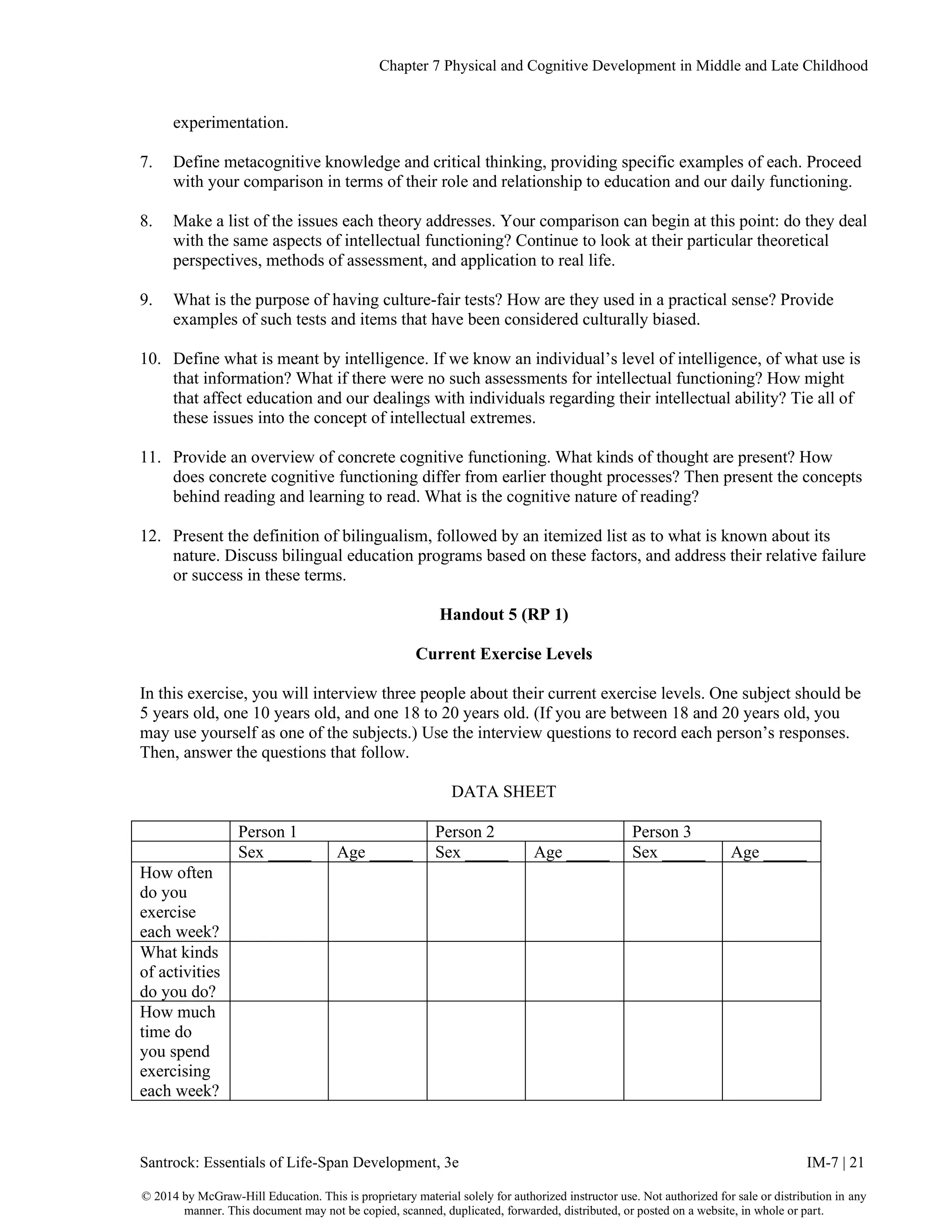
In this exercise, your students will use the questions provided in Handout 5 to interview three people
about their current exercise levels. One subject should be 5 years old, one 10 years old, and one 18 to 20
years old. (If the students are between 18 and 20 years old, they may use themselves as one of the
subjects.) The project will have to be approved by the human subjects review board at your school, and
students will need to get a signed informed consent form from the children’s parents.
Use in the Classroom: Have the students present their data from the research project. Examine the data for
age and sex differences in patterns of exercise. What activities do males and females perform? How do
these differ at different ages? Is amount of exercise a function of age or of sex? What other variables
might account for differences between individuals besides age and sex?
One might expect males to be more active than females and regular exercise for all individuals to increase
with age. The latter trend might be from a conscious decision to exercise. However, it could be that
children are more active than adolescents and therefore exercise more. Individual variation can include
parental models and reinforcement for participating in sports.
Research Project 2: Interviewing Parents of Children with Disabilities
Learning Goal 2: Identify children with different types of disabilities and discuss issues in educating
them.
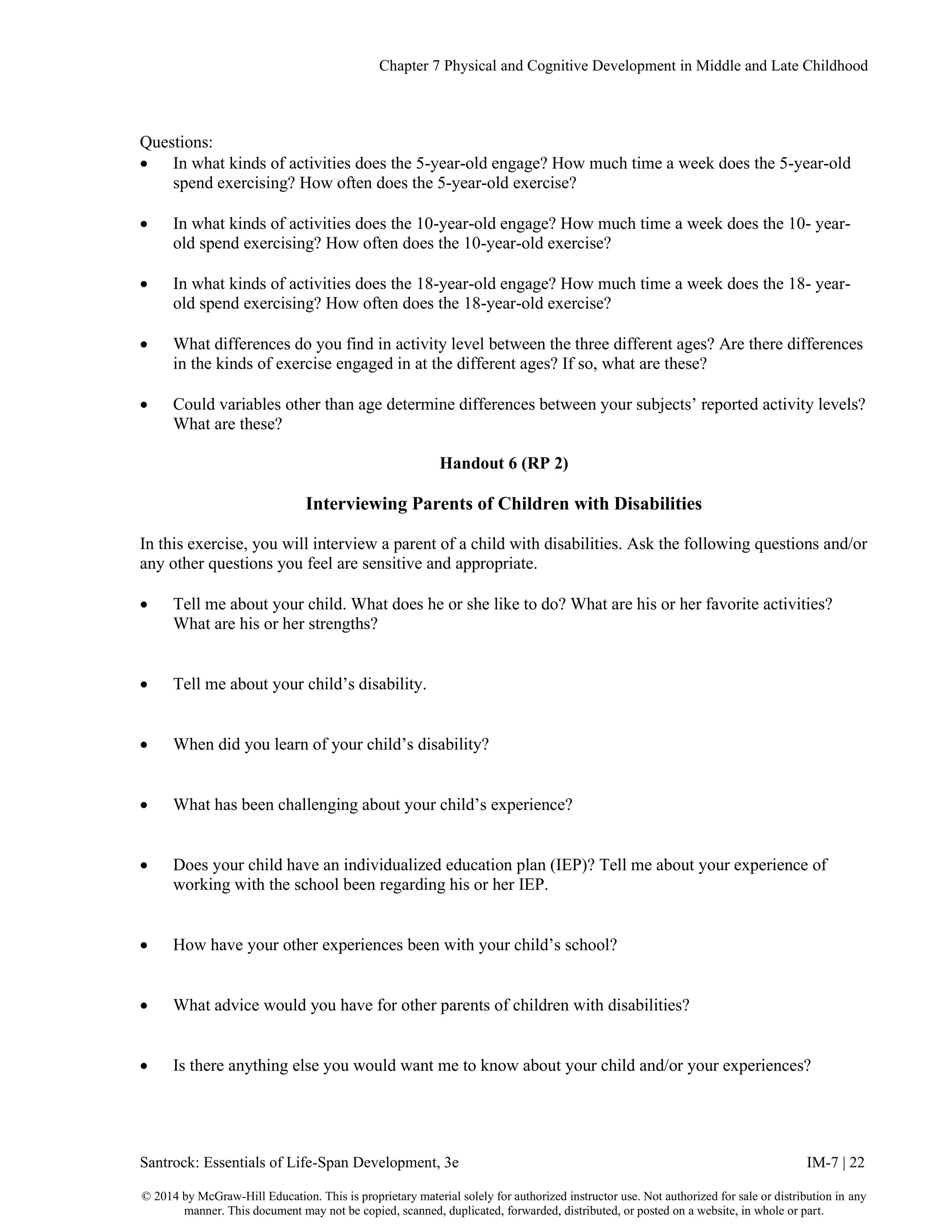
In this exercise, each student will interview a parent of a child with disabilities (see Handout 6). The
project will have to be approved by the human subjects review board at your school, and the students will
need to get a signed informed consent form from the children’s parents.
Use in the Classroom: Have the students present their data from the research project. Examine common
themes in parents’ responses.
Research Project 3: Assessment of a Preoperational and a Concrete Operational Thinker
Learning Goal 3: Explain cognitive changes in middle and late childhood.
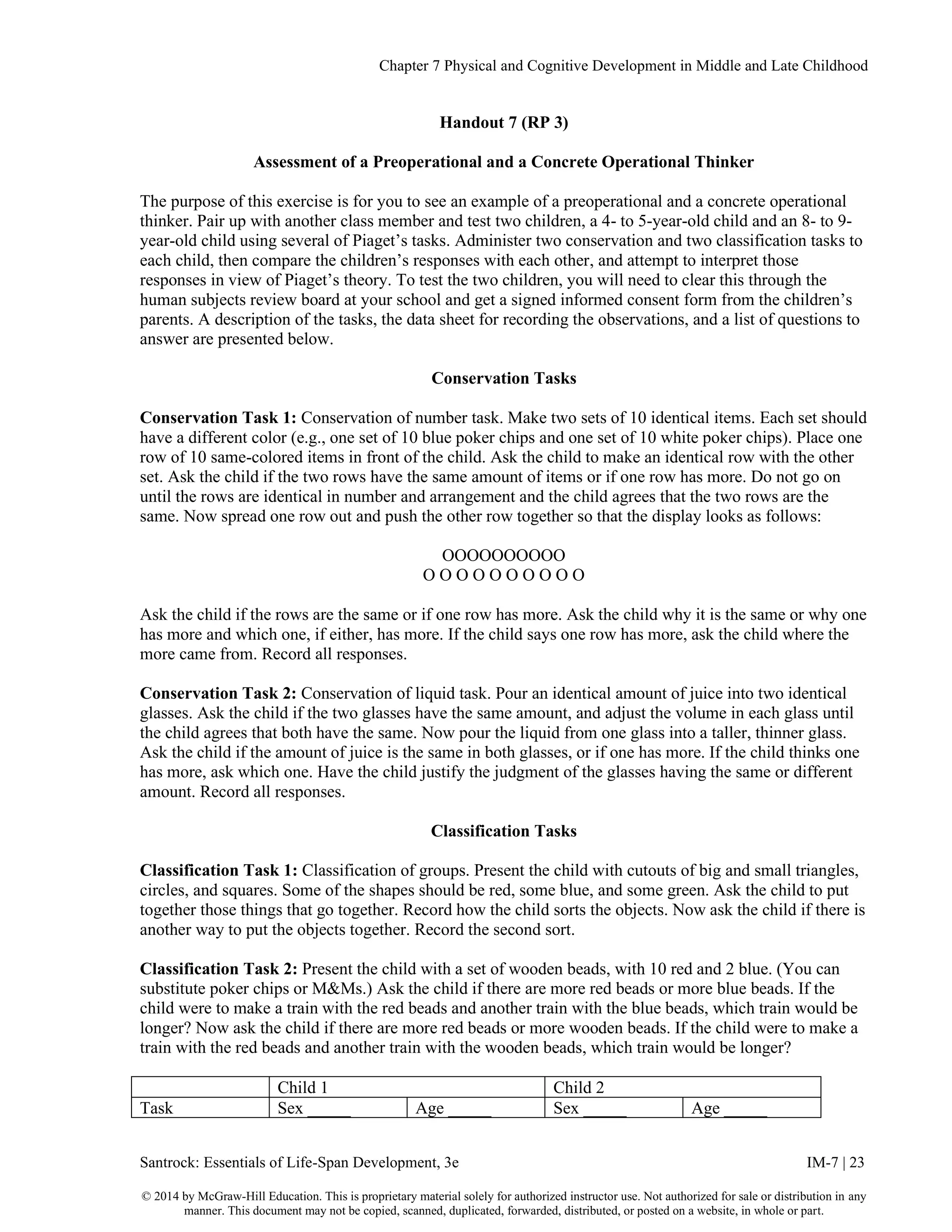
The purpose of this exercise is for students to see an example of a preoperational and a concrete
operational thinker. Students should pair up with another class member and test two children, a 4 to 5
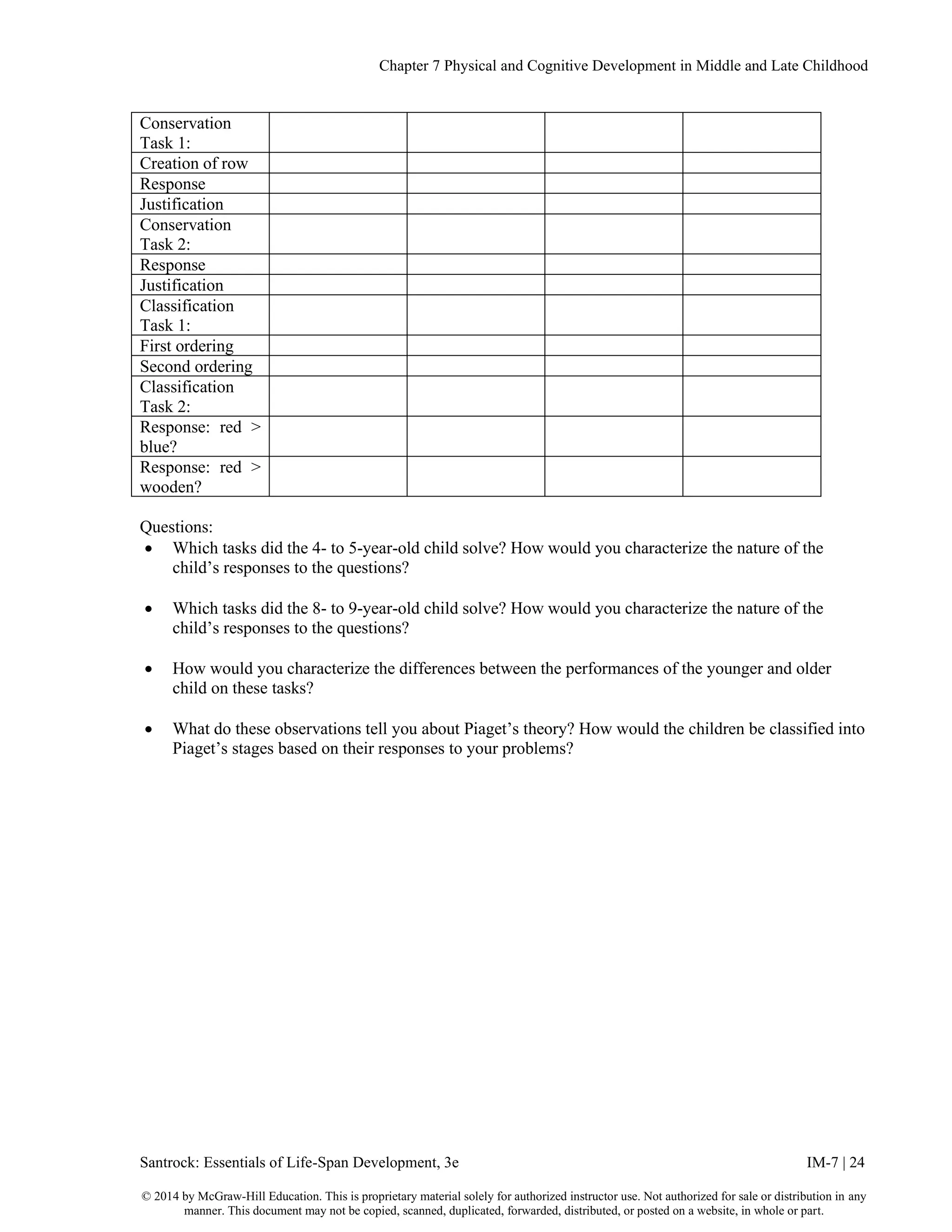
year-old child and an 8 to 9 year-old child, using several of Piaget’s tasks. They should administer two
conservation and two classification tasks to each child, and then compare the children’s responses with
Chapter 7 Physical and Cognitive Development in Middle and Late Childhood
Santrock: Essentials of Life-Span Development, 3e IM-7 | 15
© 2014 by McGraw-Hill Education. This is proprietary material solely for authorized instructor use. Not authorized for sale or distribution in any
manner. This document may not be copied, scanned, duplicated, forwarded, distributed, or posted on a website, in whole or part.
each other and attempt to interpret those responses in view of Piaget’s theory. To test the two children,
they will need to clear this through the human subjects review board at your school and get a signed
informed consent form from the children’s parents.
Use in the Classroom: Have the students present data from the research project in class. Pool the data for
the two age groups, and compare mean performance for each age group. What kinds of behaviors were
seen in the 4 to 5 year-olds? What kinds of justifications did they give for their answers? What kinds of
answers did they give? How did the 8 to 9 year-olds differ from them? How do the class data relate to
Piaget’s theory?
The expectation is that the 4 to 5 year-olds will not be able to do either the simple classification task or
the class inclusion task. The 4 to 5 year-olds are also nonconservers for liquid and probably for numbers.
The 8 to 9 year-olds will be able to do all the classification and conservation tasks.
Videos
McGraw-Hill's Visual Assets Database for Life-span Development (VAD 2.0)
(http://www.mhhe.com/vad)
This is an on-line database of videos for use in the developmental psychology classroom created
specifically for instructors. You can customize classroom presentations by downloading the videos to
your computer and showing the videos on their own or inserting them into your course cartridge or
PowerPoint presentations. All of the videos are available with or without captions.
Multimedia Courseware for Child Development
Charlotte J. Patterson, University of Virginia
This video-based two-CD-ROM set (ISBN 0-07-254580-1) covers classic and contemporary experiments
in child development. Respected researcher Charlotte J. Patterson selected the video and wrote modules
that can be assigned to students. The modules also include suggestions for additional projects as well as a
testing component. Multimedia Courseware can be packaged with the text at a discount.
McGraw-Hill also offers other video and multimedia materials; ask your local representative about the
best products to meet your teaching needs.
Feature Films
In this section of the Instructor’s Manual, we suggest films that are widely available on sites like
amazon.com, documentary wire, Hulu, netflix.com, PBS video, etc.
What’s Eating Gilbert Grape? (1993)
Starring Johnny Depp, Leonardo DiCaprio, Juliette Lewis
Directed by Lasse Hallstrom
Gilbert takes care of his retarded brother because his mother is obese and cannot leave the house; she is
physically incapable of doing so. Gilbert has a lot on his plate, caring for the other children and working
to support them. So when he meets someone new, he finds it hard to find time for himself in his difficult
and sometimes suffocating life.
My Left Foot (1989)
Chapter 7 Physical and Cognitive Development in Middle and Late Childhood
Santrock: Essentials of Life-Span Development, 3e IM-7 | 16
© 2014 by McGraw-Hill Education. This is proprietary material solely for authorized instructor use. Not authorized for sale or distribution in any
manner. This document may not be copied, scanned, duplicated, forwarded, distributed, or posted on a website, in whole or part.
Starring Daniel Day-Lewis, Brenda Fricker
Directed by Jim Sheridan
In this true story told through flashbacks, Christy Brown is born with crippling cerebral palsy into a poor,
working-class Irish family. Able only to use his left foot and to speak in guttural sounds, he is considered
retarded for the first 10 years of his life. Through the determination and dedication of his mother and his
own courage, Christy not only learns to grapple with life’s physical tasks and complex psychological
pains, but he also develops into a brilliant painter, poet, and author.
When Zachary Beaver Came to Town (2003)
Starring Jonathan Lipnicki, Sasha Neulinger, Eric Stoltz, Kevin Corrigan
Directed by John Schultz
An independent film based on a book, Zachary Beaver, is a tale of a young boy who experiences many
emotional journeys over one summer. His mom leaves to pursue a singing career, his best friend’s brother
is killed, and he meets another young boy who is obese and has problems of his own. It is an endearing
story of friendship, acceptance, life, and death that evokes a wide range of emotions while entertaining
the audience.
Web site Suggestions
At the time of publication, all sites were current and active; however, please be advised that you may
occasionally encounter a dead link.
Child Development and Parenting Information
http://www.childdevelopmentinfo.com/
Children and Adults with Attention Deficit Hyperactivity Disorder
http://www.chadd.org/
Gifted Development Center
http://www.gifteddevelopment.com/
Institute for Education Reform: Building a Powerful Reading Program
http://www.csus.edu/ier/reading.html
Learning Disabilities
http://www.ldonline.org/
Mental, Emotional, and Behavioral Disorders
http://mentalhealth.samhsa.gov/publications/allpubs/ca-0006/default.asp
National Association of School Psychologists
http://www.nasponline.org
Overweight Children and Adolescents
http://www.surgeongeneral.gov/topics/obesity/calltoaction/fact_adolescents.htm
Writing in Middle Childhood
Chapter 7 Physical and Cognitive Development in Middle and Late Childhood
Santrock: Essentials of Life-Span Development, 3e IM-7 | 17
© 2014 by McGraw-Hill Education. This is proprietary material solely for authorized instructor use. Not authorized for sale or distribution in any
manner. This document may not be copied, scanned, duplicated, forwarded, distributed, or posted on a website, in whole or part.
http://www.education.com/reference/article/writing-middle-childhood/ Handout 1 (CA 4)
Handout 1 (CA 4)
Critical-Thinking Multiple-Choice Questions
1. In chapter 7, students learnt about concrete operational thinking. Indicate which of the following
cases best illustrates concrete operations. Hint: There is more than one example of concrete
operational thinking. Circle the letters of the best answers, and explain why they are the best answers
and why the other answers are not as good.
a. Katie is asked, “Do you have a brother?” She says, “Yes.” Then she is asked, “Does he have a
sister?” She answers, “No.”
b. Ray says, “A fly is like both insects and birds. It’s like birds because it flies, but it’s like insects
because it has six legs.”
c. Tim is working on analogies. He declares, “Biking is to pedaling as riding in a car is to stepping
on the gas pedal because they both make the vehicle go!”
d. Bobby states, “I understand how this nickel and these five pennies are the same as this dime.”
e. Her teacher asks Mary, “How can the scale be brought back into balance?” Mary replies, “The
only way to do that is to remove the weight that made one pan sink lower than the other.”
2. Read the following passage on differences in levels of achievement in math between American,
Japanese, and Chinese children.
In 1986, Harold Stevenson, Shin-Ying Lee, and James W. Stigler published the first of many studies
comparing math achievement scores and the factors behind them in Japanese, Chinese, and
American children. They selected groups of first- and fifth-grade students from 10 schools each in
Sendai, Japan, and Taipei, China, and from 13 schools in the Minneapolis metropolitan area. These
three cities were chosen because they were roughly equivalent in terms of economic prosperity and
cultural status within each country as a whole. The schools selected had student populations that
were largely native-born and of similar socioeconomic class status within their cultures. Among the
schools, two first-grade classrooms and two fifth-grade classrooms were chosen at random from each
school with 12 students from each classroom who were rated on their mathematical skills in a test
that was carefully constructed to be equivalent in terms of each cultural context.
The results unleashed decades of discussion and concern, especially for American educators, for they
showed that while there was a gap in achievement among first-graders in the United States, Japan,
and China, by the fifth grade, that gap had widened significantly with American children falling far
behind their Japanese and Chinese counterparts. Even the best group of American fifth-grade
students ranked lower than the lowest Japanese group.
Stevenson et al. were criticized for the narrow scope of their initial study, so they conducted another
study 10 years later to look at a broader range of factors, this time selecting 10 schools each in
Sendai, Japan, and Taipei, China, and 20 schools within the greater Chicago area. They gathered
more data, this time including classroom observation and interviews with parents, but again the
results were heavily in favor of both Japanese and Chinese students.
So what could account for the poor performance on math tests by the American children? Stevenson
et al. had included the educational backgrounds of parents and teachers in their second study and
found that they were, in fact, lower in Japan than in the United States, while teachers from both
countries had the same levels of teaching experience. Also, in terms of general intelligence levels,
Chapter 7 Physical and Cognitive Development in Middle and Late Childhood
Santrock: Essentials of Life-Span Development, 3e IM-7 | 18
© 2014 by McGraw-Hill Education. This is proprietary material solely for authorized instructor use. Not authorized for sale or distribution in any
manner. This document may not be copied, scanned, duplicated, forwarded, distributed, or posted on a website, in whole or part.
American children were equally bright if not brighter than children in Japan and China.
The significant differences that did emerge had to do with the amount of time spent by the respective
groups of children on developing their math skills. Comparing just the Japanese and American
students, we see that while American students spend only five days each week in school for a total of
178 days a year, Japanese students spend nearly six days each week for a total of 240 days a year.
Furthermore, Japanese first-graders devote one-quarter of their classroom time to math, while
American first-graders spend only one-tenth. Away from school, Japanese children spend more time
on homework (37 versus 14 minutes each weekday for first-graders, 57 versus 46 minutes each
weekday for fifth-graders), and Japanese teachers are also much more likely to assign homework
over vacations and holidays (68% of Japanese teachers against 12% of American teachers). Finally,
classroom observations showed that only 46% of American students were paying attention in class,
while 65% of Japanese students were.
Sources:
Stevenson, H. W., Lee, S.-Y., & Stigler, J. W. (1986). Mathematics achievement of Chinese, Japanese and
American children. Science, 231, 693–699.
Stevenson, H. W., Chen, C., & Lee, S.-Y. (1993). Mathematics achievement of Chinese, Japanese and
American children: Ten years later. Science, 259, 53–58.
Suzuki, S. (2000). Viewed from the inside out: Beyond the behavioristic approach to Japanese classrooms.
Harvard Asia Quarterly, 4. Retrieved from http://www.asiaquarterly.com/
On the basis of this information, indicate which of the following statements constitutes an
assumption rather than an inference or an observation. Circle the letter of the best answer, and
explain why it is the best answer and why the other answers are not as good. Hint: There is more
than one assumption.
a. There are no genetic differences between Japanese and American children that could influence
mathematics achievement.
b. The differences between Japanese and American children’s scores are smallest for first-grade
girls.
c. The difference in achievement is caused by the amount of time spent in school.
d. Differences in achievement are not associated with differences in teacher experience.
e. Japanese and American children are equally motivated to achieve in mathematics.
Handout 2 (CA 4)
Answers for Critical-Thinking Multiple-Choice Questions
1. In chapter 7, students learnt about concrete operational thinking. Indicate which of the following
cases best illustrates concrete operations. Hint: There is more than one example of concrete
operational thinking. Circle the letters of the best answers, and explain why they are the best answers
and why the other answers are not as good.
a. Katie is asked, “Do you have a brother?” She says, “Yes.” Then she is asked, “Does he have a
sister?” She answers, “No.” is not an example of concrete operational thinking. Katie fails to
understand that sibling relationships are reciprocal, which is a sign of preoperational thinking
(irreversibility).
b. Ray says, “A fly is like both insects and birds. It’s like birds because it flies, but it’s like insects
because it has six legs.” is an example of concrete operational thinking. In this example, Ray is
able to understand that flies have attributes that place them in more than one category (creatures
Chapter 7 Physical and Cognitive Development in Middle and Late Childhood
Santrock: Essentials of Life-Span Development, 3e IM-7 | 19
© 2014 by McGraw-Hill Education. This is proprietary material solely for authorized instructor use. Not authorized for sale or distribution in any
manner. This document may not be copied, scanned, duplicated, forwarded, distributed, or posted on a website, in whole or part.
that fly and creatures with six legs). According to Piaget, this is a concrete operational skill.
c. Tim is working on analogies. He declares, “Biking is to pedaling as riding in a car is to stepping
on the gas pedal because they both make the vehicle go!” is not an example of concrete
operational thinking. In this example, Tim declares that he understands the equivalence of two
abstract relationships which is an aspect of formal operations.
d. Bobby states, “I understand how this nickel and these five pennies are the same as this dime.” is
an example of concrete operational thinking. Bobby is working with two concrete representations
of money and is able to add the values of the nickels and pennies to confirm their equivalence to
the dime. The equivalence also implies reversibility. All of these points characterize concrete
operational thinking.
e. Her teacher asks Mary, “How can the scale be brought back into balance?” Mary replies, “The
only way to do that is to remove the weight that made one pan sink lower than the other.” is an
example of concrete operational thinking. In this example, Mary shows reversibility. However,
she can only think of one solution to the problem and fails to realize that there are several ways to
balance a scale, another aspect of concrete operational thinking.
2. After reading the vignette titled “Achievement in Math Requires Time and Practice: Comparisons of
Children in the United States and Japan,” indicate which of the following statements constitutes an
assumption rather than an inference or an observation. (Hint: There is more than one assumption.)
Circle the letters of the best answers, and explain why they are the best answers and why the other
answers are not as good.
a. There are no genetic differences between Japanese and American children that could influence
mathematics achievement is an assumption. There is no data on this point, yet it must be true if
we want to say that the differences in performance are due to different educational practices. An
interesting point is that this is not assumed in discussions of differences between intelligence
scores of African American and White children.
b. The differences between Japanese and American children’s scores are smallest for first-grade
girls is an observation. It is a direct statement describing the children’s scores.
c. The difference in achievement is caused by the amount of time spent in school is an inference. It
is an interpretation of the finding that Japanese students spend more time in school and therefore
have higher mathematics achievement scores. There is nothing in these facts that indicates a
connection between the two.
d. Differences in achievement are not associated with differences in teacher experience is an
observation. No association between these two variables was found.
e. Japanese and American children are equally motivated to achieve in mathematics is an
assumption. Motivation is a relevant concern, but apparently no data was collected to examine
this issue. Thus, the researchers assumed that motivation was equal for both Japanese and
American students.
Handout 3 (CA 5)
Critical-Thinking Essay Questions
Your answers to these kinds of questions demonstrate an ability to comprehend and apply ideas discussed
in this chapter.
1. Describe physical growth and changes in gross and fine motor skills during middle and late
childhood.
2. Imagine that you are a parent of a child who wants to compete in sports. Explain how you would
Chapter 7 Physical and Cognitive Development in Middle and Late Childhood
Santrock: Essentials of Life-Span Development, 3e IM-7 | 20
© 2014 by McGraw-Hill Education. This is proprietary material solely for authorized instructor use. Not authorized for sale or distribution in any
manner. This document may not be copied, scanned, duplicated, forwarded, distributed, or posted on a website, in whole or part.
evaluate the pros and cons of participation in high-pressure sports.
3. Describe the consequences of childhood obesity, and explain why middle and late childhood is an
especially difficult time for a child to be obese.
4. Discuss the challenges of teaching children with disabilities in regular classrooms.
5. Explain and give examples of characteristics of concrete operational thought according to Piaget.
6. Discuss at least three findings that challenge Piaget’s theory about cognitive development.
7. Compare and contrast metacognitive knowledge and critical thinking. Also, explain how these ideas
relate to education and everyday life.
8. Compare and contrast Binet’s and Sternberg’s views of intelligence.
9. Explain why developmentalists try to create culture-fair tests, and evaluate their success to date.
10. Explain why and how mental retardation, giftedness, and creativity reflect the extremes of
intelligence.
11. Discuss how the development of concrete operations and other aspects of cognitive development
may lead to improvement in reading during middle and late childhood.
12. What is bilingual education? What is known about bilingualism? How successful have bilingual
education programs been?
Handout 4 (CA 5)
Ideas to Help You Answer Critical-Thinking Essay Questions
1. As you discuss the physical changes, relate them to specific examples of both gross and fine motor
skills. Address how the particular skills result from the physical changes that have taken place, and
compare later functioning based on physical development to earlier limitations in motor ability.
2. You might want to create a pros and cons list for a variety of different sports. Do some tend to be
more demanding than others? What advice would you give to your child?
3. Begin by painting a picture of the experiences of an obese child. Consider various activities children
engage in at school and on the playground (e.g., fitting into standard-size desks, sitting on a school
bus, being required to engage in physical fitness activities). Consider the importance of friendships at
this stage in life.
4. Answer this question not only from the teacher’s perspective, but from the perspective of a parent of
a learning disabled child. What experiences would you want for your child and why? Discuss how
difficult it is to meet both parents’ and teachers’ needs.
5. Begin your discussion of concrete operational thought with a description of preoperational cognitive
functioning. This will highlight the accomplishments that occur with the onset of concrete thinking.
6. Prior to each finding that challenges Piaget, present Piagetian theory, reasoning, and
Chapter 7 Physical and Cognitive Development in Middle and Late Childhood
Santrock: Essentials of Life-Span Development, 3e IM-7 | 21
© 2014 by McGraw-Hill Education. This is proprietary material solely for authorized instructor use. Not authorized for sale or distribution in any
manner. This document may not be copied, scanned, duplicated, forwarded, distributed, or posted on a website, in whole or part.
experimentation.
7. Define metacognitive knowledge and critical thinking, providing specific examples of each. Proceed
with your comparison in terms of their role and relationship to education and our daily functioning.
8. Make a list of the issues each theory addresses. Your comparison can begin at this point: do they deal
with the same aspects of intellectual functioning? Continue to look at their particular theoretical
perspectives, methods of assessment, and application to real life.
9. What is the purpose of having culture-fair tests? How are they used in a practical sense? Provide
examples of such tests and items that have been considered culturally biased.
10. Define what is meant by intelligence. If we know an individual’s level of intelligence, of what use is
that information? What if there were no such assessments for intellectual functioning? How might
that affect education and our dealings with individuals regarding their intellectual ability? Tie all of
these issues into the concept of intellectual extremes.
11. Provide an overview of concrete cognitive functioning. What kinds of thought are present? How
does concrete cognitive functioning differ from earlier thought processes? Then present the concepts
behind reading and learning to read. What is the cognitive nature of reading?
12. Present the definition of bilingualism, followed by an itemized list as to what is known about its
nature. Discuss bilingual education programs based on these factors, and address their relative failure
or success in these terms.
Handout 5 (RP 1)
Current Exercise Levels
In this exercise, you will interview three people about their current exercise levels. One subject should be
5 years old, one 10 years old, and one 18 to 20 years old. (If you are between 18 and 20 years old, you
may use yourself as one of the subjects.) Use the interview questions to record each person’s responses.
Then, answer the questions that follow.
DATA SHEET
Person 1 Person 2 Person 3
Sex _____ Age _____ Sex _____ Age _____ Sex _____ Age _____
How often
do you
exercise
each week?
What kinds
of activities
do you do?
How much
time do
you spend
exercising
each week?
Chapter 7 Physical and Cognitive Development in Middle and Late Childhood
Santrock: Essentials of Life-Span Development, 3e IM-7 | 22
© 2014 by McGraw-Hill Education. This is proprietary material solely for authorized instructor use. Not authorized for sale or distribution in any
manner. This document may not be copied, scanned, duplicated, forwarded, distributed, or posted on a website, in whole or part.
Questions:
• In what kinds of activities does the 5-year-old engage? How much time a week does the 5-year-old
spend exercising? How often does the 5-year-old exercise?
• In what kinds of activities does the 10-year-old engage? How much time a week does the 10- year-
old spend exercising? How often does the 10-year-old exercise?
• In what kinds of activities does the 18-year-old engage? How much time a week does the 18- year-
old spend exercising? How often does the 18-year-old exercise?
• What differences do you find in activity level between the three different ages? Are there differences
in the kinds of exercise engaged in at the different ages? If so, what are these?
• Could variables other than age determine differences between your subjects’ reported activity levels?
What are these?
Handout 6 (RP 2)
Interviewing Parents of Children with Disabilities
In this exercise, you will interview a parent of a child with disabilities. Ask the following questions and/or
any other questions you feel are sensitive and appropriate.
• Tell me about your child. What does he or she like to do? What are his or her favorite activities?
What are his or her strengths?
• Tell me about your child’s disability.
• When did you learn of your child’s disability?
• What has been challenging about your child’s experience?
• Does your child have an individualized education plan (IEP)? Tell me about your experience of
working with the school been regarding his or her IEP.
• How have your other experiences been with your child’s school?
• What advice would you have for other parents of children with disabilities?
• Is there anything else you would want me to know about your child and/or your experiences?
Chapter 7 Physical and Cognitive Development in Middle and Late Childhood
Santrock: Essentials of Life-Span Development, 3e IM-7 | 23
© 2014 by McGraw-Hill Education. This is proprietary material solely for authorized instructor use. Not authorized for sale or distribution in any
manner. This document may not be copied, scanned, duplicated, forwarded, distributed, or posted on a website, in whole or part.
Handout 7 (RP 3)
Assessment of a Preoperational and a Concrete Operational Thinker
The purpose of this exercise is for you to see an example of a preoperational and a concrete operational
thinker. Pair up with another class member and test two children, a 4- to 5-year-old child and an 8- to 9-
year-old child using several of Piaget’s tasks. Administer two conservation and two classification tasks to
each child, then compare the children’s responses with each other, and attempt to interpret those
responses in view of Piaget’s theory. To test the two children, you will need to clear this through the
human subjects review board at your school and get a signed informed consent form from the children’s
parents. A description of the tasks, the data sheet for recording the observations, and a list of questions to
answer are presented below.
Conservation Tasks
Conservation Task 1: Conservation of number task. Make two sets of 10 identical items. Each set should
have a different color (e.g., one set of 10 blue poker chips and one set of 10 white poker chips). Place one
row of 10 same-colored items in front of the child. Ask the child to make an identical row with the other
set. Ask the child if the two rows have the same amount of items or if one row has more. Do not go on
until the rows are identical in number and arrangement and the child agrees that the two rows are the
same. Now spread one row out and push the other row together so that the display looks as follows:
OOOOOOOOOO
O O O O O O O O O O
Ask the child if the rows are the same or if one row has more. Ask the child why it is the same or why one
has more and which one, if either, has more. If the child says one row has more, ask the child where the
more came from. Record all responses.
Conservation Task 2: Conservation of liquid task. Pour an identical amount of juice into two identical
glasses. Ask the child if the two glasses have the same amount, and adjust the volume in each glass until
the child agrees that both have the same. Now pour the liquid from one glass into a taller, thinner glass.
Ask the child if the amount of juice is the same in both glasses, or if one has more. If the child thinks one
has more, ask which one. Have the child justify the judgment of the glasses having the same or different
amount. Record all responses.
Classification Tasks
Classification Task 1: Classification of groups. Present the child with cutouts of big and small triangles,
circles, and squares. Some of the shapes should be red, some blue, and some green. Ask the child to put
together those things that go together. Record how the child sorts the objects. Now ask the child if there is
another way to put the objects together. Record the second sort.
Classification Task 2: Present the child with a set of wooden beads, with 10 red and 2 blue. (You can
substitute poker chips or M&Ms.) Ask the child if there are more red beads or more blue beads. If the
child were to make a train with the red beads and another train with the blue beads, which train would be
longer? Now ask the child if there are more red beads or more wooden beads. If the child were to make a
train with the red beads and another train with the wooden beads, which train would be longer?
Child 1 Child 2
Task Sex _____ Age _____ Sex _____ Age _____
Chapter 7 Physical and Cognitive Development in Middle and Late Childhood
Santrock: Essentials of Life-Span Development, 3e IM-7 | 24
© 2014 by McGraw-Hill Education. This is proprietary material solely for authorized instructor use. Not authorized for sale or distribution in any
manner. This document may not be copied, scanned, duplicated, forwarded, distributed, or posted on a website, in whole or part.
Conservation
Task 1:
Creation of row
Response
Justification
Conservation
Task 2:
Response
Justification
Classification
Task 1:
First ordering
Second ordering
Classification
Task 2:
Response: red >
blue?
Response: red >
wooden?
Questions:
• Which tasks did the 4- to 5-year-old child solve? How would you characterize the nature of the
child’s responses to the questions?
• Which tasks did the 8- to 9-year-old child solve? How would you characterize the nature of the
child’s responses to the questions?
• How would you characterize the differences between the performances of the younger and older
child on these tasks?
• What do these observations tell you about Piaget’s theory? How would the children be classified into
Piaget’s stages based on their responses to your problems?
Other documents randomly have
different content
the prototype of the ecclesiastical bands; and the use of a cylindrical
box to keep the ruff in has caused the survival of the old meaning of
the word in 'bandbox.' The stiff starched or propped band passed at
the commencement of the seventeenth century into the falling band
(not unlike a modern child's lace collar), of which the ecclesiastical
'bands' is the diminution.
The gown is of the pattern known as the Geneva gown—a black
silk gown with ample sleeves and faced with velvet.
It should be here remarked that there is considerable laxity in
individual usage. The cassock and scarf are almost universally
discarded, and, in fact, they were probably never very generally
worn. For the Geneva gown is often substituted the gown proper to
the university degree of the wearer.
Very few regulations affecting robes have been passed by any of
the assemblies of the churches in the Presbyterian Alliance. The
General Assembly of the Church of Scotland in 1575 passed an
important injunction, which, however, refers rather to personal than
to official attire. As it is a curious document, we give it here in full:
'For as muche as a comelie and decent apparrell is requisite in all, namelie,
ministers, and suche as beare functioun in the kirk, first, we thinke all kinde of
browdering [broidering] unseemlie; all begaires [coloured stripes] of velvet, in
gowne, hose, or coat, and all superfluous and vaine cutting out, steeking
[stitching] with silkes, all kinde of costlie sewing on pasments [laces], or
sumptuous and large steeking with silkes; all kinde of costlie sewing or variant
hewes in sarkes; all kinde of light and variant hewes in clothing, as reid, blew,
yellow, and suche like, which declare the lightnesse of the minde; all wearing of
rings, bracelets, buttons of silver, gold, or other mettall; all kinds of superfluiteis
of cloath in making of hose; all using of plaids in the kirk by readers or
ministers, namelie, in the time of their ministrie and using their office; all kinde
of gownning, cutting, doubletting, or breekes of velvet, satine, taffatie or suche
like; and costlie giltings of whingers and knives, and suche like; all silk hatts,
and hatts of diverse and light colours; but that their whole habite be of grave
colour, as blacke, russett, sad gray, sad browne; or searges, worsett, chamlett,
grogram, lylis, worset, or suche like; that the good Word of God, by them and
their immoderatenesse, be not slandered.'[93]
There is one rule, or rather unwritten convention, affecting the
wearing of vestments in the Presbyterian Church, at least, in the
British Islands. The bands are regarded as an indication that their
wearer is the minister of a recognised congregation; hence, when an
ordained minister of the Presbyterian Church who does not hold
such an office happens to be conducting a service, he does not wear
bands.
The Geneva gown has not always been worn in the Presbyterian
Churches abroad. Thus in the Church of Holland, till recently, the
official costume of a minister was a picturesque uniform, consisting
of the old three-cornered hat, and a coat resembling the ordinary
evening-dress coat, having a long pleated strip called the 'mantle'
hooked on the neck, obviously a survival from an earlier and more
ample gown of some kind, knee-breeches, buckled at the knees, and
buckled shoes. This costume was worn only when the minister was
officiating at service. It has now, however, been universally
abandoned for the Geneva gown.
The gown and bands, with or without the cassock and scarf, are
now worn only at Divine Service; but in the early part of the
seventeenth century (in Britain as on the Continent) they were worn
by ministers sitting in assembly as well, in accordance with the
decree of the Synod of Fife, which in 1611 ordained that ministers
should attend meetings in the exercise of Synodal assembly in black
gowns and other abulʒiements[94] prescribed in the Act of Parliament.
The elders never wear any insignia of office, and never have done
so.
[91] With one modification only. The albs are expressly ordered to be worn plain.
[92] For a complete analysis of the 'Ornaments Rubric' with elaborate historical and
legal disquisitions, reference should be made to the published report of the
Folkestone case (Kegan Paul, 1878).
[93] Calderwood, 'Historie of the Kirk of Scotland' (Wodrow Society), vol. iii, p. 354.
[94] Habiliments.
W
CHAPTER VII.
THE RITUAL USES OF VESTMENTS.
E have now described the form and ornamentation of the
different vestments worn by the clergy of the principal sections
of Christendom; but we have only incidentally touched upon another
and equally important matter, namely, when and how these
vestments were worn, and the liturgical practices connected with
them. A more extended account of these matters will be the subject
of the present chapter.
The non-reformed Western and Eastern Churches alone need
occupy our attention. The vestment uses of the various reformed
churches are practically nil, and all available details concerning these
Churches have already been given in the preceding chapter.
Vestments were obtained by a church or a cathedral in many
ways. They were often embroidered for presentation to the church
by ladies, who found in the work of embroidery an easy and
pleasant way of passing the time; or else by the inmates of
nunneries as a religious work. Some were presented as expiatory
offerings by conscience-stricken laymen; others bequeathed as a
perpetual memorial by incumbents or prelates. Others, again, were
purchased with money mulcted as compensation for sins.
The first sacred function in which any vestment took part was its
own benediction. This was always spoken by a bishop, and was in
form of prayers said over all the vestments of a suit together, and
the individual vestments separately. The following may be taken as
specimens of these dedicatory prayers; it is unnecessary to occupy
space in giving all, as complete sets can be found in any Pontifical:
Benedictio omnium vestimentorum simul.—Omnipotens Deus qui per Moisen
famulum tuum pontificalia et sacerdotalia ac levitica vestimenta ad explendum
ministerium eorum in conspectu tuo, et ad decorem tui nominis, per nostre
humilitatis servitutem pontificare ✠ benedicere ✠ consecrare digneris ✠ ut
divinis cultibus et sacris misteriis apta et benedicta existant; hiisque sacris
vestibus pontifices, sacerdotes seu levite tui induti ab omnibus impulsionibus
seu temptacionibus malignorum spirituum muniti et defensi esse mereantur,
tuisque ministeriis apte et condigne servire et inherere, atque in hiis placide tibi
et devote perseverare tribue. Per Christum. Oremus.
Deus invicte virtutis auctor, et omnium rerum creator ac sanctificator, intende
propicius ad preces nostras, et hec indumenta levitice et sacerdotalis glorie
ministris tuis sumenda tuo ore proprio benedicere ✠ sanctificare ✠ et
consecrare digneris omnesque eis utentes, tuis misteriis aptos, et tibi in eis
devote et amicabiliter servientes gratos effici concedas. Per Christum Dominum.
Benedictio Amicti.—Oremus. Benedic Domine quesume omnipotens Deus
amictum istum levitici seu sacerdotalis officii et concede propicius ut quicumque
eum capiti suo imposuerit benedictionem tuam accipiat; sitque in fide solidus et
sanctitatis gravedine fundatus. Per Christum. Etc.
The vestment thus dedicated was sprinkled with holy water after
each prayer.
The ritual uses of vestments may be conveniently described in two
parts; discussing in the first the persons by whom they were worn,
and, in the second, the occasions upon which, and the manner in
which, they were worn.
The vestments were distributed among the different orders of
clergy in a manner similar to that in which the early vestments of the
second period were allotted (see p. 28), but on a more complex
system, as befitted their greater elaboration. Some hints of this
system have already been given in the preceding pages; it will be
convenient here to amplify this information.
The seven orders of the Western Church are the three minor
orders (ostiarius, lector, acolytus), and the four major orders
(subdeacons, deacons, priests, and bishops; we may divide the last
into three subdivisions, bishops proper, archbishops, and the Pope).
All ranks wore the alb, and all the major orders the maniple. All
those above the rank of subdeacon wore amice and stole, and all
above the rank of deacon the chasuble. Subdeacons were
distinguished by the tunicle, deacons by the dalmatic; both
vestments were added to the outfit of bishops, the latter with a
remarkable distinction already described (p. 79). The stockings,
sandals, subcingulum (originally), mitre, gloves, ring, and staff were
peculiar to bishops and to certain abbots to whom these pontificalia
had been expressly granted by the Pope.[95] Archbishops added the
pall to this lengthy catalogue, and the Pope (who dispensed with the
pastoral staff) reserved the orale, and in later times the
subcingulum, for his exclusive use.
We now turn to the consideration of the occasions upon which,
and the manner in which, these vestments were worn.
The vestments worn at the mass by the celebrant and his
assistants were those which we have described under the heading of
'Eucharistic Vestments,' and of these one, the chasuble, was worn
exclusively at this service and at no other.
In Advent, and between Septuagesima and Easter, the deacons
and subdeacons were directed to substitute chasubles for their
dalmatics or tunicles; and these chasubles were ordered to be worn,
not in the usual manner, but folded, and passed across the breast
like the diaconal stole. That is to say, the chasuble, which must have
been of a flexible[96] material, was folded into a strip as narrow as
possible, and secured over the shoulder and under the girdle of the
alb. These were not to be worn during the whole service, however;
the subdeacon had to remove his folded chasuble at the Epistle; at
the Gospel the deacon had to cross his over the left arm, and so
keep it till after the post-communion.
There is but one representation of a deacon so vested known to
exist in England. It is one of a series of sculptured effigies of
ecclesiastics on the north-west tower of Wells Cathedral. These have
been described by Mr St John Hope in 'Archæologia,' vol. liv. We give
here the figure to which special reference is at present being made.
Besides the chasuble, the effigy is vested in cassock, amice, alb, and
girdle; and a book, probably meant for the Gospels, is represented
as carried in the hand.
It should be observed that at the mass of a feast falling within the
limits of time prescribed, the ordinary dalmatic and tunicle were
worn in the ordinary way.
Fig. 30.—Deacon in Folded Chasuble, Wells Cathedral.
This peculiar custom was unknown to the Franciscans. The
deacons of this order put off the dalmatic entirely upon fast-days,
and did not substitute any other vestment for it; a similar practice,
with respect to the tunicle, was observed by the subdeacons, so that
the deacons wore alb and stole only, the subdeacons alb and
maniple. This practice was not observed at the Vigils of Saints, or of
the Nativity, and on a few other occasions.
When a cleric of sacerdotal rank ministered (as opposed to
celebrated) at the mass, his dress was the amice, the alb, the stole,
and the cope. The same vestments are worn by the priest at the
mass of the pre-sanctified[97] on Good Friday.
Before the vestments are put on for the mass the priest must
wash his hands, and prepare the chalice, placing over it the
purificator or napkin used for wiping the sacred vessels. Above the
purificator he places the paten, with an unbroken host, and covers it
with a small linen cloth, over which he puts the burse. This done, he
takes the vestments one by one; he first receives the amice, takes it
by its ends and strings, and kisses the middle of it where there is a
cross. A prelate, it should be noticed, always puts on a surplice
before vesting. The amice being put in its place, the alb and girdle
are then assumed, then the maniple and chasuble. Each vestment is
kissed before being put on, and a prayer said with the assumption of
each; these prayers differ little in style from those said in the similar
ceremony in the Eastern Church, and it has therefore been thought
unnecessary to give them here.
In an inventory of the Vestry of Westminster Abbey,[98] the
following directions are given in a late fifteenth-century hand:
The Revestyng of the abbot of Westmʳ att evensong.—Fyrst the westerer shall
lay the abbots cope lowest opon the awter wᵗ in the sayd westre, nex opon hys
gray Ames, then hys surples, after that hys Rochett and uppermost his
Kerchure.
Hys Myter & crose beyng Redy wᵗ hys glovys and pontyfycalls.
The Revestyng of the sayd abbot att syngyng hy Masse.—Fyrst the westerer
shall lay lowest the chesebell, above that the dalmatyke and the dalmatyk wᵗ yᵉ
longest slevys uppermost & the other nethermost then hys stole & hys fanane
and hys gyrdyll, opon that his albe theropon his gray Ames a bove that hys
Rochett and uppermost hys kerchur wᵗ a vestry gyrdyll to tukk up his cole.
Hys Miter & crose beyng Redy wᵗ hys glovys and pontyfycalls And a fore all
thys you muste se that hys sabatyns & syndalls be Redy at hys first cūyng whan
he settyth hym downe in the travys.
This direction is important in one respect. It shows us the order in
which the vestments were put on, it is true; that, however, one
would naturally infer from the order in which they are seen in the
monuments. But it tells us also that a canon wore his canonical habit
underneath his mass habit at high mass, but so arranged that it
should be, as far as possible, out of sight; hence the direction to
have 'a vestry girdle to tuck up his cowl.' At Wells, Hereford, and
Norwich Cathedrals are to be seen figures of canons, the almuce or
amess appearing at the neck, although they are vested in eucharistic
habit.
The duty of the minister, as far as the vestments of the celebrant
are concerned, consists in seeing that the vestments are laid out in
their proper order on a table in the vestry, or, should there be no
vestry, on a side-table near the altar (never on the altar itself); the
vestments for the assistant should be on the right-hand side of those
for the celebrant, the vestments for the deacon and subdeacon on
the left. He should also see that each is properly put on, especially
that the alb is drawn through the girdle so as to overhang it and to
be raised about a finger's breadth from the ground, and that the
chasuble is straight. He must especially be careful that the assistant
does not put on his cope before the priest puts on his chasuble.
During the celebration he has to see that the chasuble is not
disarranged by genuflexions, and to raise the chasuble so as to give
complete freedom to the priest's arms at the elevation of the host.
After the celebration the vestments are taken off with similar
ceremonies in the reverse order.
On Ember days, Rogations, in processions, and when the Sunday
or Saint's day mass is said in the chapter house, on Ash Wednesday,
Good Friday, and Palm Sunday, albs and amices only are to be worn
by the ministers.
The dress at the ordinary offices (mattins, lauds, etc.) is amice,
alb, stole, and cope; a brass at Horsham represents a priest so
vested, and has the merit of showing the exact manner in which the
stole should be crossed. This combination of vestments was also
worn at benedictions, at absolution after a mass for the dead, and,
as just remarked, by the assistant at mass if a priest, and by the
celebrant at the mass of the pre-sanctified. 'The cope,' the rubric
tells us, 'is not strictly a sacerdotal vestment, but it is worn by the
rulers of the choir and others.'
The clergy in choir wear black (choral) copes, except on principal
doubles,[99] and on the doubles falling on Sunday, when silk copes of
the colour of the day are worn. On the vigil of Easter, and through
and on the octave, they wore surplices only, as also on doubles
occurring from Easter to Michaelmas.
If a bishop celebrate, and if it be Maunday Thursday, or
Whitsunday, he has seven deacons, seven subdeacons, and three
acolytes—on other doubles only five. On feasts with Rulers, two at
least; on Good Friday only one. The rulers of the choir were those
whose duty it was to chant the office and Kyrie at mass, and to
superintend the choristers. On doubles these were four in number,
on simples two. Rulers wore silk copes of the colour of the day over
a surplice, and had silver staves as emblems of office.
The Roman Pontifical lays down succinct rules for the vesting of a
bishop for the different duties of his position. These are as follows:
Confirmation.—White cope and stole, amice, rochet, mitra aurifrigiata.
Ordinations.—As for high mass: colour according to the day.
Consecration of a Bishop.—The consecrator as for high mass: colour according
to the day; each of the two assistant-bishops in rochet, cope, amice, stole, and
mitra simplex.
Profession of a Nun.—As for high mass.
Coronation of a Sovereign.—As for high mass: colour according to day; each
of the assistant-bishops in rochet, amice, white stole and cope, mitra simplex. In
England all the bishops used to wear full pontificalia.
Laying the Foundation of a Church.—Rochet, amice, white stole and cope,
mitra simplex, pastoral staff.
Consecration of a Church.—The same till the mass, then full pontificalia
(white).
Reconciliation of a Church.—The same.
Consecration of the Holy Oil on Maunday Thursday.—Full (white) pontificalia,
mitra pretiosa.
At a Synod held in a Cathedral Church.—Rochet, amice, red stole, red cope,
mitra pretiosa.
Procession of Palms.—Alb, amice, purple stole, purple cope, mitra simplex.
Procession of Corpus Christi.—Alb, amice, stole, tunic, dalmatic, white cope; a
mitra pretiosa borne behind. In England and in France red was the colour.
Rogation Days.—Alb, amice, purple stole, purple cope, mitra simplex.
In occasional services, such as baptism, a surplice and stole are
worn. At baptisms two stoles are used, one of violet, which is worn
at the first part of the service, and the other of white, which is
substituted for the first in the course of the office. This observance
has a symbolical meaning; violet being the colour which typifies sin
and penitence, and white being associated with ideas of purity, the
change in the stole is emblematic of the regenerating change which
the rite of baptism is supposed to work. A reversible stole, violet on
one side and white on the other, is sometimes used for this service.
In processions and benedictions at the altar (i.e., blessings of wax,
images, etc.) the cope must be worn. In other benedictions stole
and surplice are sufficient.
The cope must also be worn at an absolution after a mass for the
dead; the colour of the cope for such a service is black, the ministers
lay aside their dalmatics, and when the celebrant assumes the cope
he must lay aside his maniple. If for any reason a cope be not
obtainable, these rites (benedictions, absolutions, etc.) must be
performed in alb and crossed stole only, without chasuble or
maniple.
Should it be found necessary to celebrate high mass without the
aid of a deacon or subdeacon, the Epistle is ordered to be sung by a
lector vested in a surplice.
We must now approach an important branch of this complex
subject—the varieties in the colour of the vestments depending on
the character of the day, in other words, the liturgical colours of the
vestments.
It does not appear that the definite assigning of particular colours
to particular days is of older date than Innocent III's time; but
before him, and even as far back as the time of the fathers of the
church, we find that the early Christians had symbolical associations
with colours, which have formed the foundation on which the
elaborate structure of later times was built.
It is a matter of common knowledge that there are associations of
sentiment and colour which are practically indissoluble. Black and
sorrowful, white (or bright) and joyful, are synonymous terms, and
similar expressions are universal.
White, in the first ten centuries of Christianity, typified purity and
truth. Saints, angels, and Our Lord are for that reason represented
clothed in white. As we have seen, the earliest vestments were
probably white; the newly-baptized wore white during the week
after baptism, and the dead were shrouded in white; the latter,
however, probably more for convenience than for any symbolic
reason.
Red, the colour of flame, was associated with ideas of warm,
burning love. Our Lord is sometimes represented in red when
performing works of mercy.
Green, the colour of plants, was regarded as typifying life, and
sacred or beatified persons are sometimes depicted as clothed in this
colour in reference to their everlasting life. Lastly,
Violet, which is formed by a mixture of red and black, was said to
symbolize 'the union of love and pain in repentance.' It also typifies
sorrow, without any reference to sin as its cause; thus the Mater
Dolorosa is occasionally represented in a violet robe.[100]
Further than this we cannot go, and perhaps we have said too
much. It is quite possible that these theories may have been put
forward to account for phenomena which depended entirely on the
taste and whim of the painters. It is well known that in the early
ages of Christianity ideas of colour were vague, and yellow and
green, dark blue and black, light blue and violet, were all regarded
as being the same colour. Previous to the tenth century, it is quite
true that coloured vestments are to be seen in mosaics and fresco-
paintings; but the combinations of colours are such as to leave no
doubt that they were simply adopted by the painter as convenient
aids to distinguishing the various vestments from the surrounding
background and from each other.
Coming now to Innocent III, we find that he prescribes four
liturgical colours, white, red, black and green. These were the
principal or primary liturgical colours; but there are others,
secondary to these, which were modifications in tint of the
primaries. Thus, properly, red is the colour of martyrs, white the
colour of virgins; but there is a secondary colour, saffron, for
confessors, and the secondaries, rose and lily, are considered
interchangeable with red and white.
Hopelessly at variance are the practices throughout the Western
Church, and we will not attempt to give more than a brief outline of
the general principles. For those who desire fuller information
reference is made to a paper by Dr Wickham Legg in the first
volume of the Transactions of the St Paul's Ecclesiological Society, in
which no less than sixty-three different 'uses' are analyzed and
tabulated, or compared.
The rules to which we have just referred are almost the only
regulations respecting which uniform use prevails. For obvious
reasons, white is appropriated to feasts of St Mary and of the other
virgin saints; black is appropriated to the office of the dead; and red
to the feasts of martyrs. Usually white is used for Christmas and
Easter, and red for Whitsuntide and Feasts of Apostles. As a general
rule, however, the same sentimental associations are to be seen with
colours in the middle ages as may possibly be traced in earlier times:
violet being essentially penitential in its character, red being
indicative of fire, blood or love, white of purity and joy, black of
mourning, and green of life. Hence violet is the usual colour for
Advent and Lent, red for feasts of martyrs, apostles and evangelists,
and in some uses for Passion-tide and Easter; white for Christmas,
feasts of virgins, Easter, and sometimes Michaelmas and All Saints;
black for Good Friday and offices of the dead; green from the Octave
of Epiphany to Candlemas, and from Trinity to Advent. The use of
the last colour is, however, very arbitrary; it only occurs at one or
two seasons in the year in each diocese, and these are very diverse.
The following is the Roman sequence of colours for the year, and
it may be taken as an example of all:
Advent to Christmas Eve: black or violet.
Christmas Eve, if a Sunday: rose.
Christmas Day: white.
St Stephen: red.
St John the Evangelist: white.
Holy Innocents: violet; red if a Sunday.
Circumcision: white.
Epiphany: white.
Candlemas: violet for the procession of candles before mass,
then white.
Septuagesima to Maunday Thursday: violet.
Good Friday: black.
Easter: white.
Ascension: white.
Rogation Days: violet.
Pentecost: red.
Trinity Sunday: white.
Corpus Christi: white.
Trinity to Advent: green.
Feasts of the Virgin Mary: white.
St John Baptist: white.
St Michael: white.
All Saints: white.
Martyrs: red.
Apostles: red.
Evangelists: red.
Confessors: white.
Virgins: white.
Transfiguration: white.
Holy Cross: red.
Confirmation: white.
Dedication of a Church: white.
Harvest Festivals: white.
Requiem: black.
One or two miscellaneous points may be worth a passing notice
before we bring our account of the vestments of the Western Church
to a close.
During Lent it was the practice to cover up the images in the
church with a curtain called the velum quadrigesimale. In the Fabric
Rolls of York, for instance, we read the following entry (Anno 1518,
1519):
'Pro coloribus ad pingendum caminos de novo factos et pro e fauthoms
cordarum pro suspensione pannorum quadrigesimalium ante novum crucifixum
ivs.
'Pro pictione unius panni pendentis coram novo crucifixo in tempore
quadrigesimali, et pro les curtayn ringes et pro les laic ac pro suicione alterius
panni xiis.'
A point respecting the ring is worth mention. Doctors of Divinity
and bishops only may wear a ring in the Western Church, and the
former must take it off when celebrating mass.
Besides the Episcopal and Diaconal dalmatic, there is a third kind,
to which allusion must be made: the Imperial dalmatic, which from
time immemorial has been placed on the sovereigns of Europe at
their coronation.
The Imperial Dalmatic in the treasury of St Peter's at Rome is thus
described:
'It is laid upon a foundation of deep blue silk, having four different subjects on
the shoulders behind and in front, exhibiting—although taken from different
actions—the glorification of the body of our Lord. The whole has been carefully
wrought with gold tambour and silk, and the numerous figures (as many as
fifty-four) surrounding our Redeemer, who sits enthroned on a rainbow in the
centre, display simplicity and gracefulness of design. The field of the vestment is
powdered with flowers and crosses of gold and silver, having the bottom
enriched with a running floriated pattern. It has also a representation of
paradise, wherein the flowers, carried by tigers of gold, are of emerald green,
turquoise blue, and flame colour. Crosses of silver cantonned with tears of gold,
and of gold cantonned with tears of silver alternately, are inserted in the flowing
foliage at the edge. Other crosses within circles are also placed after the same
rule, when of gold in medallions of silver, and when of silver in the reverse
order.
'This vestment is assigned to the 12th century. It has been conjectured that
this dalmatic was formerly used by the German emperors when they were
consecrated and crowned, and when they assisted the pope at the office of
mass. On such occasions the emperor discharged the functions of subdeacon or
deacon, and, clothed with a dalmatic, chanted the Epistle and Gospel; in
illustration of this custom it may be remarked that several of the German
Emperors took part in the service, even so late as Charles V, who sung the
Gospel at Boulogne in 1529. The dalmatic was, in fact, in those times, as it
continues at the present day, both a regal and ecclesiastical habit, and it has
constantly been the custom of European kingdoms for the sovereigns to wear it
at their coronation.'[101]
But the Ecclesiastical nature of the regal costume of the middle
ages does not end with the dalmatic. Thus, the effigy of Richard I. at
Fontevraud wears a cope-like mantle, a dalmatic, and a white sub-
tunic, answering to the distinctive costumes of bishop or priest,
deacon and subdeacon respectively. When the body of Edward I was
exhumed at Westminster in 1774, he was found to wear among
other garments a dalmatic and a stole, crossed on the breast in the
priestly manner. The body of John, in Worcester, was found in 1797
to be habited in costume similar to that represented on his effigy,
with the addition of a monk's cowl, no doubt adopted in order to
safeguard his prospects of future happiness, as death in the
monastic habit was regarded as ensuring a passport to heaven.
The vestments of the Eastern Church are much simpler, and the
rites connected with them have nothing like the complexity
associated with those of the Western Church. They have but two
colours, for instance—violet for fast-days (including Lent),[102] and
white for the rest of the year—and ridicule the elaboration to which
liturgical colours have been brought in the Western Church. This fact
might be indicated, if any disproof of the existence of a primitive
system of liturgical colours were needed.
The following are the rubrical directions and prayers used at
vesting for the Eucharistic service in the Greek Church:
Being then come within the altar [after the procession up the church] they
[the priest and deacon] make three bows before the holy table, and kiss the
holy gospel and the holy table: then each, taking his στοιχάριον in his hand,
makes three bows and saith softly to himself:
O God, purify me, a sinner, and have mercy upon me.
The Deacon comes to the priest, holds his στοιχάριον and ὠράριον in his right
hand, and bowing down his head to him, saith:
Bless, sir, the στοιχάριον and the ὠράριον.
The priest. Blessed be our God always, now and for ever, even unto ages of
ages.
The deacon then goes apart on one side of the altar and puts on his
στοιχάριον, saying:
My soul shall rejoice in the Lord, for He hath put on me the robe of salvation,
and clothed me with the garment of gladness: as a bridegroom hath He put a
crown on my head and decked me like a bride.
Then, kissing the ὠράριον, he puts it upon his left shoulder. Then he puts on
his ἐπιμανίκια: putting on that on his right hand, he saith:
Thy right hand, O Lord, is glorified in strength; Thy right hand, O Lord, hath
destroyed the enemies, and in the greatness of Thy glory hast Thou put down
the adversaries.
Then, putting the other on his left hand:
Thy hands have made me and fashioned me. O give me understanding that I
may learn Thy commandments.
[He then prepares the sacred vessels.]
The priest puts on his sacred vestments in the following manner. First, taking
up his στοιχάριον in his left hand, and making three bows towards the east, he
signs it with the sign of the cross, saying:
Blessed be our God always, etc.
And then he puts it on, saying, My soul shall rejoice, etc., as the deacon said
above.
Next he takes up the ἐπιτραχήλιον, and, blessing it, he saith:
Blessed be God who poureth out His grace on His priests, like the precious
ointment upon the head that ran down unto the beard, even unto Aaron's
beard, and went down to the skirts of his clothing.
He then takes the ζώνη, and girding himself therewith, saith:
Blessed be God who hath girded me with strength, and hath put me in the
right way, making my feet like harts' feet, and hath set me up on high.
He next puts on his ἐπιμανίκια, saying as was said above by the deacon. After
which he takes up his ἐπιγονάτιον, if he be of such dignity as to wear one, and
blessing it and kissing it, saith:
Gird thee with thy sword upon thy thigh, O thou most mighty, according to
thy worship and renown. Good luck have thou with thine honour, ride on
because of the word of truth, of meekness, and righteousness, and thy right
hand shall teach thee terrible things: always, now and for ever, even unto ages
of ages. Amen.
Then he takes his φελώνιον, and blesses and kisses it, saying:
Let thy priests, O Lord, be clothed with righteousness, and let thy saints sing
with joyfulness: always, now and for ever, even unto ages of ages. Amen.[103]
When the vestments are put off after the communion, the priest
says Nunc Dimittis, τρισάγιον, and Pater Noster.
It does not appear that any complex rules hold good in the Greek
Church respecting the vestments to be worn on certain days in the
Church's year. The following synopsis of the vestment uses in the
ordination service will show most clearly the nature and distribution
of Ecclesiastical vestments in the Eastern Church.
Ordination of a Reader: A short φαινόλιον put on by the bishop,
which is presently removed by the subdeacons; the στοιχάριον is
then blessed and put on by the bishop.
Ordination of a Subdeacon: The candidate comes dressed in the
στοιχάριον; the subdeacons hand the ὠράριον to the bishop, who
signs it on the cross; the new subdeacon kisses the cross and the
bishop's hand, and girds himself with the ὠράριον.
Ordination of a Deacon: The candidate kneels before the altar; the
bishop, at the beginning of the service, puts the end of the
ὠμοφόριον upon him. After the service the bishop takes the ὠράριον
and puts it on the new deacon's left shoulder, saying ἄξιος, which is
repeated thrice by the choir; then the bishop gives him the
ἐπιμανίκια, and ἄξιος is repeated as before. The fan (for blowing flies
from the table) is presented after this, with the same words.
Ordination of a Priest: At the commencement the candidate kneels
at the altar, and the bishop puts the ὠμοφόριον on his head. At the
end the ὠμοφόριον is taken from him, and the ἐπιτραχήλιον is
received by the bishop, who kisses it; the newly-ordained priest
kisses the vestment and the bishop's hand; the bishop puts it on the
priest, saying ἄξιος, which is repeated as at the ordination of a
deacon. The ζώνη and φαινόλιον is then conferred in a similar
manner.
Ordination of a Bishop: The new bishop comes to the service in all
his sacred vestments. At the end the ὠμοφόριον is put upon the
elect, except when the consecration takes place in the see of the
bishop, in which case the σάκκος and the other episcopal garments
are given first. The same ceremonial is repeated as at the other
ordinations.
The vestments worn at the administration of baptism are the
φαινόλιον and ἐπιμανίκια.
There are three orders of devotees in the Greek monasteries. The
probationers wear a black cassock or vest called shaesa, and a hood
(Russian kamelauch, χαμαλαύχη). The proficients wear, in addition,
an upper cloak (μάνδυας). The perfect are distinguished by their
hood or vail, which perpetually conceals their faces from sight.
[95] When the abbot of a monastery was also a bishop, the prior had also the right
to wear pontificalia when his superior was absent.
[96] The difficulty of folding the chasuble without injuring it has led to the
substitution of a broad purple stole-like vestment, worn exactly like the folded
chasuble. This is called the stolone.
[97] The Sacrament when used on a day when the Eucharist service is not gone
through in its entirety.
[98] Edited by Dr Wickham Legg in 'Archaeologia,' vol. lii., p. 195.
[99] Feasts were divided into Doubles, Simples, and Sundays. Doubles were so-
called from the anthems being doubled, i.e., said throughout at the beginning and
end of the Psalms in the breviary office, instead of the first words only being said.
The principal doubles were Christmas, Epiphany, Easter, Ascension, Whitsunday,
Assumption, the Local Anniversary, and the Dedication of the Church.
[100] These explanations of colours are taken from Smith and Cheetham's
'Dictionary of Christian Antiquities.'
[101] Rev. C. H. Hartshorne in Arch. Journal.
[102] Violet or purple στοιχάρια are worn throughout Lent, except on Annunciation
Day, Palm Sunday, and Easter Eve.
[103] Translation from King's 'Rites and Ceremonies of the Greek Church in Russia.'
T
APPENDIX I.
COSTUMES OF THE RELIGIOUS ORDERS.
HE following appendix does not profess to furnish more than an outline of the
extensive subject with which it deals; for further details, as well as for
illustrations of members of each of the orders, reference must be made to the
great work of Bonanni, cited in Appendix III. Bonanni names the different habits
rather loosely; in the main his nomenclature has been followed, but brought to a
more uniform system.
Monks.
The dress of monks usually consists of the vestis, tunic or closed gown; the
scapular, roughly speaking, a narrow, chasuble-like dress, with the front and back
portions rectangular and of uniform width throughout; one or more open gowns
(pallium or cappa); and the caputium or hood, fastened at the back and capable of
being drawn over the head. 'Discalced' is not always to be taken in its fullest
significance, or as signifying more than simply 'sandaled.' Different vestments are
worn by individual orders or houses; the nature of these will be self-evident from
their names.
1. Alexians.—Black vestis and pallium, both reaching a little below the knee:
caputium.
2. Ambrose, St.—Dark-coloured gown with cappa and scapular. Discalced.
3. Antonius, St (Armenia).—Ample black tunic, girded, mantellum, cuculla, and
caputium.
4. Antonius, St (Canons of).—Black gown signed with a blue T; girded white
collar, black mantle, also signed with T. Others, who are devoted to manual
labour, wear a similar dress, but tawny in colour. The T is a representation of a
crutch, the symbol of sustaining and power.
5. Antonius, St (Egypt).—Black tunic and scapular, with round caputium.
Discalced.
6. Antonius, St (Syria).—Long black gown with short round caputium, black
leather girdle; over all, long black mantle.
7. Apostoli.—Tawny tunic with girdle of leather, scapular with caputium attached.
Cappa, and in winter short and narrow mantellum.
8. Aubert, St (Canons regular of; Cambrai).—Violet cassock, and cap or biretta:
white surplice.
9. Augustine, St.—Black tunic girded, black cape and hood. White may be worn
indoors.
10. Avellanans.—White tunic, scapular, azure pallium, square biretta in place of
mantellum.
11. Basil, St (Armenia).—Tunic and caputium white, scapular black.
12. Basil, St (Germany).—Tunic, long scapular, long broad cappa, caputium on
shoulder, and a biretta on head in outline resembling the 'Tam o' Shanter' cap.
13. Basil, St (Greece).—Black woollen tunic, over which another with sleeves
about three palms wide, open in front, with woollen fringes or loops of another
(but still dark) colour, which can be fastened with small buttons. Head always
covered with a cap, which conceals the ears. Caputium with vittae or streamers
attached, which hang over the shoulders, and are said to typify the cross.
14. Basil, St (Italy or Spain).—Till 1443 resembling the Greek dress (No. 13).
After that date, tunic, leather girdle, scapular, cuculla, caputium—all black.
15. Basil, St (Russia).—Like Greece (No. 13), with the addition of a small
cuculla.
16. Benedict, St (St Justina of Padua).—Black woollen tunic to which a caputium
is sewn. Scapular; cuculla from shoulder to feet with very wide sleeves.
17. Benedict, St (Clugniacs).—Black cappa clausa with rude sleeves or hood.
18. Benedict, St (India).—Black tunic somewhat short, white scapular, mantle,
and caputium.
19. Bethlehemites.—Black woollen tunic with leather girdle; cappa, on left side of
which a pannula with a representation of the manger at Bethlehem. Discalced.
Black cap on head.
20. Birgitta, St.—Gray tunic and cuculla, to which a caputium is sewn, gray
mantellum, signed with red cross, having a white roundle or plate at the centre.
21. Caelestines.—White, black caputium and scapular.
22. Camaldulenses (Hermits).—White woollen tunic, scapular and round caputium;
cuculla (also white) in service. Black shoes.
23. Camaldulenses (Monks).—As Benedictines, but white, and the scapular is
girded round the loins. Tunic with very wide sleeves, caputium, etc.
24. Capuchins.—Rough black woollen tunic girded with coarse rope; hood and
cape. Discalced.
25. Carmelites.—Tunic, girdle, scapular, caputium, brown; cappa or mantle white.
Hat on head black, except in Mantua, where it is white.
26. Carmelites a Monte Sacro.—Cappa shorter than that of the other Carmelites,
and no cap on head at any time.
27. Carthusians.—Black woollen pallium, over which white gown passed over the
head, and scapular with side loops.
28. Cistercians.—Benedict XII decreed brown as the Cistercian colour; but there
was an uncertainty as to the interpretation of this decree; some, alleging that gray
or black were included in the term 'brown,' wore those colours. To remedy this
confusion, Sixtus IV decreed black or white: black caputium and scapular girded
round loins; black cuculla added out of doors. In choir white.
29. Cistercians (Fogliantino).—Like the Benedictines in shape, white in colour.
Formerly discalced everywhere, now only in France. Black wooden sandals worn in
Italy.
30. Cistercians (La Trappe).—White cuculla with ample sleeves, girded;
caputium.
31. Chariton, St.—Lion-coloured tunic, with black cuculla and caputium.
32. Choors (Canons regular of; Bordeaux).—White woollen vestis, white linen
scapular; linen cotta in choir. Almuce, worn over the arms in summer, round the
neck in winter.
33. Coloriti (Calabria).—Long tunic, with round caputium and mantellum from
rough black natural wool; woollen girdle.
34. Columba, St (Avellana).—White woollen tunic or caputium, over which a
scapular; a narrow pallium added out of doors.
35. Cross, St (Canons regular of; Coimbra).—Cassock, surplice, and almuce; the
ordinary canonical dress.
36. Crucifers (Italy).—Blue tunic (formerly ash-coloured, or uncertain), scapular,
and hood. Silver cross constantly borne in the hand.
37. Crucifers (Belgium).—White tunic, scapular, and caputium; black mozetta,
signed in front with a red and white cross.
38. Crucifers (Lusitania).—Blue tunic, over which gown, mozetta and hood. A
pallium added out of doors.
39. Crucifers (Syria).—Black.
40. Dionysius, St (Canons regular of; Rheims).—Long surplice, over which (in
winter) a cappa clausa without armholes. Biretta. Almuce worn over arm.
41. Dominic, St.—Tunic, scapular, and broad round caputium of white wool. Black
cappa, shorter than the tunic, added out of doors.
42. Fontis Ebraldi (Fontevraud).—Black tunic girded, scapular, caputium.
43. Francis, St.—Ash-coloured tunic girded with a cord divided by three knots;
round caputium and mozetta.
44. Francis, St (de observantia).—Woollen tunic girded with cord; cape, hood;
colour formed by mixture of two parts of black wool to one of white. Discalced, in
wooden or leathern sandals.
45. Franciscans (of St Peter of Alcantara).—Rough and patched tunic girded with
cord; cape and hood. Feet entirely unprotected.
46. Francis de Paul, St (Fratres minimi).—Woollen tunic, dark tawny colour with
round caputium, whose ends hang below the loins before and behind, both girded
by a rope, the free end of which is knotted with five knots (novices knot three
knots only). Pallium reaching a little below the knees, worn in winter both indoors
and out. Formerly discalced, with sandals of various materials; afterwards,
however, this practice was dispensed with.
47. Genovefa, St (Canons regular of).—White vestis and rochet, black biretta, fur
almuce over left arm. In winter a long black pallium is added to the vestis and
rochet, and a black caputium or hood.
48. George in Alga, St (Canons regular of).—Cassock, over which a blue gown.
49. Gilbert, St (Canons regular of).—Black cassock and hood, and surplice lined
with lamb's wool. Linen cappa added at service.
50. Gramontans.—Any dress, very rough. The 'reformed' dress is a rough white
linen tunic, over which another, thinner, of black; scapular and caputium.
51. Hermits (Egypt).—Tawny tunic, black pallium.
52. Hippolytus St, (Brothers of Mercy of).—Brownish tunic, scapular, hood.
53. Humiliati.—White tunic, scapular, mantle, cape, and cap.
54. James, St (Canons regular of; Spada).—White woollen vestis and rochet.
55. Jerome, St (Hermits of).—White woollen tunic, scapular with round caputium,
cappa open in front: all black wool.
56. Jerome, St (Hermits of; foundation of Lupo Olmedo).—White tunic girt with
black leather girdle round loins; small round caputium and tawny cuculla. Black
biretta worn at home.
57. Jerome, St (Hermits of; foundation of Peter Gambacorta).—Tawny tunic
girded with leather girdle, tawny crimped cappa, round and narrow caputium,
square black biretta.
58. Jerome, St (Fiesole).—Tawny woollen vestis with crimped cappa open in
front. Leather girdle. Discalced; wooden sandals, afterwards abandoned.
59. Jesuati.—White tunic, square caputium, gray cappa (after 1367). A white
appendage, like a sleeve, worn instead of caputium, changed by Urban VIII for a
caputium of the same colour as the mantle.
60. Johannis Dei, St.—Dark ash-coloured tunic with scapular reaching to knees;
[104] round, pointless caputium. Black cap added out of doors.
61. John, St (Canons regular of; Chartres).—White vestis and rochet; almuce
over left shoulder.
62. John, St (Hermits of; de Pœnitentia).—Rough woollen cloth, tunic and cappa
with hood, feet entirely unprotected, heavy wooden cross suspended in front from
neck.
63. John Baptist, St (Canons regular of; England).—Black or brown vestis,
scapular, cappa clausa, and mantle, all signed with a black cross.
64. Klosterneuburg (Canons regular of; Austria).—White surplice and black
cappa, for which latter an almuce is substituted on festival days.
65. Lirinenses (Lerina Island, Tuscany).—Tunic and mantle girded with scarf, over
this sleeved cappa aperta with small caputium: all black.
66. Lo, St (Canons regular of; Rouen).—Violet cappa, violet mozetta or cape,
and hood in winter; white cassock and rochet.
67. Macharius, St (Egypt).—Violet tunic, black scapular, small cuculla; cap on
head covering hair, forehead, temples, and ears.
68. Mark, St (Canons regular of; Mantua).—White woollen vestis, rochet,
pallium, for which latter a mozetta is substituted in choir and a white biretta
added. Sheepskin almuce on left arm.
69. Martin, St (Esparnai [Aspreniacum, Campania]).—Vestis talaris of white,
above which a sarrocium or scorligium, which is a species of rochet, described by
Mauburnus.[105]
70. Mary, St (de Mercede Redemptionis Captivorum).—White tunic, scapula,
short caputium, and cappa. A small shield bearing party per fess in chief gules a
cross pattée argent in base three pallets (the base charge is the arms of the
Kingdom of Arragon), is worn in front.
71. Mary, St (de Mercede Redemptionis Captivorum, another dress).—In this the
caputium is prolonged and the feet discalced.
72. Mary, St (Servants of).—Coarse tunic, scapular, cappa and hood: all black.
73. Maurice, St (Canons regular of).—Cassock, rochet, purple cape or mozetta,
biretta.
74. Monte Luca (Hermits of).—Tunic, short chasuble-like scapular, mantle and
hood and cap or hat, the latter optional; all tawny colour. Some are discalced,
others with shoes or sandals.
75. Monte Senario (Hermits of).—Black tunic, scapular, pallium extending below
knees, caputium.
76. Monte Vergine (in Avellina; monks of).—Tunic, scapular, and cuculla; out of
doors pallium and cap substituted for cuculla. All white.
77. Olivetans.—White vestis with wide sleeves, caputium crispatum on shoulder.
78. Pachomius, St.—White woollen tunic and cuculla, the latter signed with a
violet cross.
79. Pamplona (Canons regular of).—Cassock, alb, sleeveless rochet, ash-coloured
mozetta.
80. Paul, St (Hermits).—White woollen vestis, rather short, with short mantellum
over, and short caputium; discalced.
81. Paul, St (Monks).—White tunic sleeved, caputium, and collar round
shoulders. Out of doors, black cap and cloak (white in Hungary).
82. Peter, St (Canons regular of; Monte Corbulo).—At first gray cassock and
rochet, and almuce or caputium; after 1521 black cassock, white-sleeved rochet,
and black cloak.
83. Poland (Canons regular of).—White tunic and linen surplice reaching to
about the knees, fur almuce about shoulders, dark-coloured skull-cap of wool
edged with fur.
84. Portugal (Canons regular of).—White rochet and tunic, tawny almuce, and
pallium.
85. Premonstratensians.—White tunic and scapular, sewn up in front, white
sleeveless cappa without girdle, white biretta, almuce, white shoes. (The white is
all natural, not dyed.)
86. Rouen (Canons regular of the Priory of the Two Lovers).—White tunic or alb
and rochet, almuce.
87. Rufus, St (Canons regular of; France).—White cassock buttoned up in front,
white girdle, black biretta.
88. Sabba, St.—Tawny tunic girded, with black scapular. Discalced.
89. Saviour, St (Canons regular of; Laterans).—White buttoned cassock, linen
rochet. Out of doors black pallium and biretta.
90. Saviour, St (Canons regular of; Lorraine).—Black tunic with little linen rochet
hanging down from the neck to the left side, five inches broad, like a girdle, over
which in choir a cotta, and gray almuce carried on the arm in summer; in winter a
full sleeveless rochet with cappa reaching to the ankles of black linen, whose front
edges are decorated with red cloth about a foot wide. Caputium, whose front edge
surrounds the face like an almuce, with fur about two inches wide.
91. Saviour, St (Canons regular of; Sylva Lacus Selva).—White woollen tunic,
rochet and scapular, black cappa.
92. Sepulchre, the Holy (Canons regular of).—White rochet, black cappa and
caputium. At the left side of the cappa a Greek cross cantoned by crosslets in red.
93. Sepulchre, the Holy (Canons regular of; Bohemia, Poland, Russia).—Black
vestis and rochet, over which a mantelletum—a waistcoat or rochet-like vestment,
sleeveless, but rather long, open in front, and reaching to a little above the knees
—on the left side of which a double-transomed cross.
94. Sylvester, St.—Tunic, caputium, scapular, cuculla of blue. Biretta worn on
sacred occasions.
95. Trinitatis, SS (Redemptionis Captivorum).—White tunic, scapular, and cappa,
with red and blue cross flory on the scapular and left side of the cappa.
96. Trinitatis, SS (Redemptionis Captivorum; Spain).—Cappa brown, otherwise
as above described. By others in Spain a tawny cappa is worn, and the feet are
discalced. Round black caputium added.
97. Trinitatis, SS (Redemptionis Captivorum; France).—All white, the cross plain;
feet discalced; caputium also white.
98. Usetz (Canons regular of).—White buttoned tunic and surplice, extinguisher-
shaped, like the ancient chasuble.
99. Valle de Choux (Burgundy, between Dijon and Autun, Canons regular of).—
White, black scapular, girded with black girdle.
100. Valle Ronceaux (Canons regular of).—Black, with white scapular, very small,
and resembling archiepiscopal pall. Black cappa added in service.
101. Valle di Scholari (Canons regular of).—White woollen tunic and scapular;
black cappa lined with lamb's wool, biretta.
102. Valley of Jehoshaphat (Canons regular of).—Full red cuculla and caputium.
103. Vallis Viridis (near Brussels; Canons regular of).—Black tunic and cassock,
white rochet, black caputium.
104. Vallumbrosans.—Identical with the Sylvestrines, but grayish-black instead of
blue.
105. Victor, St, Without the Walls (Canons regular of; Paris).—White tunic and
wide-sleeved surplice, almuce, biretta.
106. Vindesheim (Canons regular of).—White tunic and rochet, biretta, fur almuce
added on shoulders in winter.
107. William, St (Hermits of).—Tunic, over which another sleeveless, girded.
Scapular, feet entirely unprotected. At first white, but black after union with the
Augustinians.
Nuns.
The dress of nuns, as a general rule, consists of a vestis (gown or tunic), girt at
the waist, and a scapular. To these various orders add pallia, mantella, etc., as will
appear from the following list. As a general rule, a white gremial or breast-cloth is
fastened over the head and round the throat and breast; over this two loose vela
or cloths are placed on the head, the inner white, the outer black. The feet, even
of 'discalced' nuns, are protected at least by wooden, bark, or leathern sandals;
very rarely are the feet entirely unprotected.
1. Acemetae (or Vigilants).—Uncertain; according to some authorities, green
vestis, signed with a red cross, above which a mantellum or cape. Black velum on
head.
2. Agnes, St (Dordrecht).—White vestis and scapular, black velum on head, ruff
round neck.
3. Ambrose, St.—White, black velum on head.
4. Angelica, St (Milan).—White vestis and scapular, cross on breast, ring on
finger, with cross in place of a jewel.
5. Antonius, St (Syria).—No definite rule, any dress suitable to monastic life.
6. Augustine, St (Solitaries of, 1256).—Black; Gregory IX gave licence to wear
white, with black scapular and velum on head.
7. Augustine, St (ancient habit).—Black tunic, white linen rochet, on head a
cloth, ornamented with semée of red crosses, reaching down the back like a cloak
or cope.
8. Augustine, St (discalced; Spain).—Similar to the corresponding monks, but
with the usual vela on the head.
9. Augustine, St (discalced; Lusitania).—White vestis (to which a black vestis is
added on feast days) girded with black leather girdle, white scapular, black
mantellum; on the head a rough white linen cloth hanging before the face to the
eyes, but behind to the waist. On this white cloth another, black, about five palms
in breadth.
10. Augustine, St (Penitents of).—Black vestis and cappa, reaching to knees;
scapular white; face covered with a black veil.
11. Augustine, St (Venice).—White; black veil on face.
12. Basil, St (Eastern).—Natural (undyed) black dress; black mafors (narrow
scapular-like pallium); gloves or sleeves covering the arms and hands as far as the
fingers; black velum covering the whole head.
13. Basil, St (Western).—As in the East till 1560. After that date, black vestis,
scapular and velum reaching from head to knees; black gremial or breast-cloth. A
cassock with ample sleeves added for church services.
14. Begga, St (Antwerp).—Black vestis, black pallium from head downwards, a
cap (biretta), resembling in outline an inverted saucer, on head white velum round
head and across breast.
15. Benedict, St.—As monks, but with velum in place of caputium.
16. Benedict, St (de Monte Calvario).—White tunic and scapular, with black
velum on head. Discalced.
17. Birgitta, St.—White camisia, gray tunic, cuculla with sleeves reaching to tip
of middle finger, gray mantellum. On the head a 'garland' or 'wreath' concealing
the forehead and cheeks, and secured at the back of the head by a pin. On this is
placed a black velum fastened by three pins, one on the forehead and one over
each ear. Above this is a corona of white cloth consisting of a Greek cross passing
over the head from forehead to back and from ear to ear, the ends joined by a
circle that passes round the temples. At each of the intersections of the cross arms
with each other and with the circle is fastened a small piece (gutta) of red cloth—
the total of five doubtless typical of the Five Wounds.
18. Caesarius, St.—White vestis, girded; black velum on head.
19. Calatiavans.—White; white scapular signed with red cross flory, usual white
and black vela on head.
20. Camaldulenses.—White; scapular confined with white girdle; usual vela on
head.
21. Canonesses regular (Belgium, Lorraine, etc.).—White tunic girt at waist,
mantle over; black velum on head; a rochet is worn in some houses.
22. Canonesses regular (Rouen).—Originally white; now black tunic, black
mantellum lined and edged with white mouse-fur; black and white vela disposed
as usual on head.
23. Canonesses (Mons).—Black vestis with white sleeves; black velum on head
reaching down back half-way; pallium or mantle on shoulder hanging to ground,
black lined with white. In church service the dress consists of white linen surplice
or cassock reaching to feet, braided with a cord sewn upon it arranged in
ornamental knots and scrolls; peaked head-dress, from the point of which hangs a
long pendant streamer. Pallium or mantle of black silk, lined with mouse-fur, white
with black spots.
24. Capuchins.—Rough woollen vestis, scapular, mantellum, white gremial cloth,
black and white vela on head.
25. Carmelites (ancient).—Tawny tunic, short white pallium or mantle, white
velum encircling head.
26. Carmelites (modern).—Tawny tunic and scapular, white pallium reaching to
feet, usual vela on head.
27. Carmelites (France).—Brown habit, white mantellum lined with fur, white
gremial cloth covering head and breast, black velum above this.
28. Carmelites (discalced).—Like ordinary Carmelites, but with somewhat long
cappa of coarse cloth; two black vela on head; feet shod with woollen cloth and
bark sandals.
29. Carthusians.—White tunic and scapular; cloth on neck and breast, usual
velamina on head.
30. Cassian.—White tunic and linen rochet, with black velum on head.
31. Cistercians.—White; gray (sometimes black) scapular, girded; in choir a white
cuculla added.
32. Clugniacs.—Black tunic, girded; ample scapular, also black; usual vela on
head.
33. Columbanus, St.—White tunic, cuculla, gremial cloth, and velum on head.
34. Cross, St (Penitents of).—White tunic, over which another, black, girded with
leather girdle. White gremial cloth and velum.
35. Dominic, St.—White vestis, girded; scapular; black and white vela on head.
In choir or at the Sacrament a cappa is added.
36. Dominic, St (Penitents of).—White tunic and scapular; white gremial cloth
and velum, over which a flowing black pallium is placed which hangs down to the
feet.
37. Eligius, St.—Black tunic, white mantle, white gremial cloth on head and
breast, over which black velum.
38. Fontevraud.—Black tunic, white gremial and velum.
39. Fontevraud (reformed).—Black pallium added to previous dress.
40. Francis of Assisi, St.—Rough tunic girt with a rope, scapular and mantellum;
white gremial cloth. Discalced; feet in wooden sandals.
41. Fructuosus, St.—Cuculla, pallium, and tunic, all gray; girdle securing tunic
black. Discalced (sandals worn in summer, shoes in winter).
42. Genovefa, St (Canonesses of).—White tunic and surplice, black fur 'almutia,'
ornamented with white spots, worn at service over left arm (something like a long
maniple). White gremial cloth, and black velum over it on head.
43. Gilbert, St.—Black tunic, mantle, and hood, the last lined with lamb's wool.
44. Hilary, St.—Gray tunic, not long, over which a short tawny pallium; black
velum on head, with white band round forehead; shoes with pointed toes turned
upward.
45. Hospitalers of St John of Jerusalem.—Tawny tunic with white cross sewn on
breast. White velum on head.
46. Hospitalers of St John of Jerusalem (France).—Black vestis signed with a white
cross fourchée; pallium with similar cross on left shoulder; white and black vela on
head. Fastened to the pallium a rosary divided into eight parts, symbolical of the
instruments of the Passion.
47. Hospitalers (Canonesses; Paris).—White vestis, linen rochet, pallium from
shoulders to feet, usual vela on head.
48. Hospitalers of the Holy Ghost (Saxony).—Black vestis, with double-transomed
cross fourchée in white on the left side of breast. Usual vela on head.
49. Humiliati (Milan).—White tunic girded; loose white scapular; white velum.
50. Infant Jesus, Virgins of.—Woollen vestis of dark tawny colour. On certain days
black velum on head reaching nearly to feet.
51. Isidore, St.—Uncertain; probably gray tunic and cappa with hood. Discalced.
52. James, St, de Spatha.—Black vestis with red cross flory fichée on the right on
the breast. White cappa reaching to feet. Usual vela on head.
53. Jerome, St.—White tunic, gray scapular, black pallium, black velum on head.
54. Jesuatae.—White tunic and brown scapular; cappa of the same colour added
at service. Usual vela on head.
55. Lateran Canonesses Regular.—White tunic and rochet; white gremial cloth over
head and breast, over which black velum. A wide-sleeved surplice added for
service.
56. Laurence, St (Venice).—Black vestis with white velum on head, not altogether
covering the hair. A long flowing cassock added for a service-robe, and a long
black velum placed over the white velum.
57. Macharius, St.—Tawny vestis with black cappa, or a sheepskin over it.
58. Malta, Knights of.—Black tunic and scapular, black pallium, very long and
supported over the arms to keep it from the ground; white Maltese cross on left
shoulder of pallium. Black and white silk chain hanging from neck supporting
wooden images of the instruments of the Passion.
59. Maria, St, in Capitolio (Canonesses of).—Silk vestis, above which a white
rochet. Head covered with long black velum reaching to ground. At first a crimped,
ruff-like collar round the neck; this was afterwards abandoned.
60. Maria Fuliensis, St.—Rough white vestis; white gremial cloth on head and
breast, loosely covered with black velum. Discalced.
61. Mary the Virgin, St, Annunciation of.—Gray tunic, white chlamys or cloak, red
cross-shaped scapular, usual head coverings.
62. Mary the Virgin, St, Annunciation of (another order).—White vestis, black
girdle, white scapular, blue gown, white gremial on head and breast, black velum.
63. Mary the Virgin, St, Assumption of.—Blue, secured with white girdle, white
scapular, white gremial cloth, white velum (very long) on head. In choir a pallium
of mixed silk and blue wool is added.
64. Mary the Virgin, St (Canonesses regular of).—Black tunic, over which a long
black cappa is girded in choir; usual gremial cloth and vela.
65. Mary the Virgin, St, Daughters of (Cremona).—Black. Resembling the habit of
the priests of the Society of Jesus, but with black velum in place of biretta. An
extra black velum and an extra black mantle is added out of doors.
66. Maria, Sta (de Mercede Redemptionis Captivorum).—White vestis and
scapular; usual vela on head. In centre of breast a shield bearing party per fess in
chief gules a cross pattée argent, in base three pallets.
67. Mary the Virgin, St, Servants of.—Same as corresponding monks, with velum
instead of caputium. In Germany certain of this order wear a white velum with a
blue star on the forehead.
Welcome to our website – the perfect destination for book lovers and
knowledge seekers. We believe that every book holds a new world,
offering opportunities for learning, discovery, and personal growth.
That’s why we are dedicated to bringing you a diverse collection of
books, ranging from classic literature and specialized publications to
self-development guides and children's books.
More than just a book-buying platform, we strive to be a bridge
connecting you with timeless cultural and intellectual values. With an
elegant, user-friendly interface and a smart search system, you can
quickly find the books that best suit your interests. Additionally,
our special promotions and home delivery services help you save time
and fully enjoy the joy of reading.
Join us on a journey of knowledge exploration, passion nurturing, and
personal growth every day!
testbankdeal.com


Essentials of Life-Span Development 3rd Edition Santrock Solutions Manual

  • 1.
    Download the fullversion and explore a variety of test banks or solution manuals at https://testbankdeal.com Essentials of Life-Span Development 3rd Edition Santrock Solutions Manual _____ Follow the link below to get your download now _____ https://testbankdeal.com/product/essentials-of-life-span- development-3rd-edition-santrock-solutions-manual-2/ Access testbankdeal.com now to download high-quality test banks or solution manuals
  • 2.
    We have selectedsome products that you may be interested in Click the link to download now or visit testbankdeal.com for more options!. Essentials of Life Span Development 3rd Edition Santrock Test Bank https://testbankdeal.com/product/essentials-of-life-span- development-3rd-edition-santrock-test-bank/ Essentials of Life-Span Development 3rd Edition Santrock Test Bank https://testbankdeal.com/product/essentials-of-life-span- development-3rd-edition-santrock-test-bank-2/ Essentials of Life Span Development 5th Edition Santrock Solutions Manual https://testbankdeal.com/product/essentials-of-life-span- development-5th-edition-santrock-solutions-manual/ Many Peoples Many Faiths 10th Edition Ellwood Test Bank https://testbankdeal.com/product/many-peoples-many-faiths-10th- edition-ellwood-test-bank/
  • 3.
    Drugs Brain andBehavior 6th Edition Grilly Test Bank https://testbankdeal.com/product/drugs-brain-and-behavior-6th-edition- grilly-test-bank/ Principles of Environmental Science Inquiry and Applications 7th Edition Cunningham Test Bank https://testbankdeal.com/product/principles-of-environmental-science- inquiry-and-applications-7th-edition-cunningham-test-bank/ Managerial Accounting for Managers 2nd Edition Noreen Solutions Manual https://testbankdeal.com/product/managerial-accounting-for- managers-2nd-edition-noreen-solutions-manual/ Management Asia Pacific 5th Edition Samson Solutions Manual https://testbankdeal.com/product/management-asia-pacific-5th-edition- samson-solutions-manual/ Principles of Economics 5th Edition Mankiw Test Bank https://testbankdeal.com/product/principles-of-economics-5th-edition- mankiw-test-bank/
  • 4.
    Managerial Economics Marketsand the Firm 2nd Edition Boyes Test Bank https://testbankdeal.com/product/managerial-economics-markets-and-the- firm-2nd-edition-boyes-test-bank/
  • 5.
    Chapter 7 Physicaland Cognitive Development in Middle and Late Childhood Santrock: Essentials of Life-Span Development, 3e IM-7 | 1 © 2014 by McGraw-Hill Education. This is proprietary material solely for authorized instructor use. Not authorized for sale or distribution in any manner. This document may not be copied, scanned, duplicated, forwarded, distributed, or posted on a website, in whole or part. Chapter 7: Physical and Cognitive Development in Middle and Late Childhood Learning Goals Learning Goal 1: Describe physical changes and health in middle and late childhood. A. Discuss body growth and change. B. Explain brain development. C. Describe motor development. D. Summarize the influence of exercise on health and development. E. Discuss health, illness, and disease. Learning Goal 2: Identify children with different types of disabilities and issues in educating them. A. Define and describe the scope of disabilities. B. Discuss educational issues related to children with disabilities. Learning Goal 3: Explain cognitive changes in middle and late childhood. A. Describe and discuss Piaget's theory of cognitive development. B. Discuss the information-processing theory. C. Describe and define intelligence. Learning Goal 4: Discuss language development in middle and late childhood. A. Discuss vocabulary, grammar, and metalinguistic awareness. B. Explain the development of reading during middle and late childhood. C. Discuss bilingualism and second-language learning. Overview of Resources Chapter Outline Resources You Can Use Physical Changes and Health Learning Goal 1: Describe physical changes and health in middle and late childhood. Body Growth and Change The Brain Motor Development Exercise Health, Illness, and Disease Lecture Suggestion 1: The Long-Term Consequences of Childhood Obesity Personal Application 1: That’s My Kid! Research Project 1: Current Exercise Levels Interactive Exercise: Sensorimotor Neural Circuits Children with Disabilities Learning Goal 2: Identify children with different types of disabilities and issues in
  • 6.
    Chapter 7 Physicaland Cognitive Development in Middle and Late Childhood Santrock: Essentials of Life-Span Development, 3e IM-7 | 2 © 2014 by McGraw-Hill Education. This is proprietary material solely for authorized instructor use. Not authorized for sale or distribution in any manner. This document may not be copied, scanned, duplicated, forwarded, distributed, or posted on a website, in whole or part. educating them. The Scope of Disabilities Educational Issues Lecture Suggestion 2: ADHD—An Intolerance for Childhood Playfulness Research Project 2: Interviewing Parents of Children with Disabilities Cognitive Changes Learning Goal 3: Explain cognitive changes in middle and late childhood. Piaget’s Cognitive Developmental Theory Information Processing Intelligence Lecture Suggestion 3: Observational Issues in Identifying Children with ADHD Lecture Suggestion 4: Is Being a Child Prodigy a Blessing or a Curse? Classroom Activity 1: Time to Tell Time? Classroom Activity 2: Is Psychology Just Common Sense? Classroom Activity 3: Test Anxiety: A Visit with Teachers Personal Application 2: Remember the Time… Personal Application 3: Smart Move Personal Application 4: Exploring Your Creativity Research Project 3: Assessment of a Preoperational and a Concrete Operational Thinker Language Development Learning Goal 4: Discuss language development in middle and late childhood. Vocabulary, Grammar, and Metalinguistic Awareness Reading Bilingualism and Second-Language Learning Lecture Suggestion 5: Environmental Influences on Literacy Review Classroom Activity 4: Critical-Thinking Multiple-Choice Questions and Suggested Answers Classroom Activity 5: Critical-Thinking Essay Questions and Suggestions for Helping Students Resources Lecture Suggestions Lecture Suggestion 1: The Long-Term Consequences of Childhood Obesity Learning Goal 1: Describe physical changes and health in middle and late childhood. The purpose of this lecture is to extend the discussion of the long-term physical and psychological consequences of childhood obesity. Must et al. (1992) have documented morbidity and mortality rates related to obesity in adolescence. Obese adolescents are at greater risk for death and adult obesity. These
  • 7.
    Chapter 7 Physicaland Cognitive Development in Middle and Late Childhood Santrock: Essentials of Life-Span Development, 3e IM-7 | 3 © 2014 by McGraw-Hill Education. This is proprietary material solely for authorized instructor use. Not authorized for sale or distribution in any manner. This document may not be copied, scanned, duplicated, forwarded, distributed, or posted on a website, in whole or part. relationships are stronger for females than males. As Santrock discusses, both males and females suffer psychological and social consequences of childhood obesity (pulmonary problems, hip problems, high blood pressure and elevated blood cholesterol, low self-esteem, depression, and exclusion from peer groups). • Gortmaker et al. (1993) studied the long-term effects of childhood obesity by assessing young adults who were obese as adolescents. These individuals had less education, less income, and were less likely to be married than the individuals who were not obese as adolescents. These effects were apparent despite the statistical control of initial SES and aptitude scores. • These results cannot be explained by chronic health problems that interfere with academic or career success. Gortmaker et al. ingeniously compared a group of individuals with chronic health problems (diabetes, cerebral palsy) with the individuals who had been obese as adolescents. The individuals with chronic health problems did not suffer the same consequences. • What could explain the developmental pattern of obese individuals? The authors speculate that the negative effects of early obesity are more likely due to stigmatization and discrimination. Overweight individuals are negatively labeled, which reduces their chances of successful career progression and mate selection. • Obesity may be an important factor in determining class and success. This speculation calls into question the long-held assumption of the unidirectional relationship between SES and obesity. Being overweight is an increasingly prevalent health problem in children (Schiff , 2013; Summerbell & others, 2012). Being overweight is defined in terms of body mass index (BMI), which is computed by a formula that takes into account height and weight—children at or above the 97th percentile are included in the obesity category, at or above the 95th percentile in the overweight category, and children at or above the 85th percentile are described as at risk for being overweight (Centers for Disease Control and Prevention, 2012a). Over the last three decades, the percentage of U.S. children who are at risk for being overweight has doubled from 15 percent in the 1970s to almost 30 percent today, and the percentage of children who are overweight has tripled during this time frame (Orsi, Hale, & Lynch, 2011). 12.1 percent of 2- to 5-year-old U.S. children are obese. Th at figure is 50 percent higher for 6- to 11-year-old U.S. children—in 2009–2010, 18 percent of U.S. 6- to 11-year-olds were classified as obese (Ogden & others, 2012). The levels of child obesity, overweight, and risk for being overweight remain far too high and are expected to increase in the future (Wardlaw & Smith, 2012). Sources: Gortmaker, S. L., Must, A., Perrin, J. M., Sobol, A. M., & Dietz, W. H. (1993). Social and economic consequences of overweight in adolescence and young adulthood. The New England Journal of Medicine, 329, 1008–1012. Must, A., Jacques, P. F., Dallal, G. E., Bajema, C. J., & Dietz, W. H. (1992). Long-term morbidity and mortality of overweight adolescents: A follow-up of the Harvard Growth Study of 1922 to 1935. The New England Journal of Medicine, 327, 1350–1355. Lecture Suggestion 2: ADHD—An Intolerance for Childhood Playfulness Learning Goal 2: Identify children with different types of disabilities and issues in educating them. The purpose of this lecture is to examine Panksepp’s (1998) proposal that attention deficit hyperactivity disorder (ADHD) is overdiagnosed and reflects an intolerance for normal childhood behavior. ADHD is the most common childhood disorder with approximately 15 percent of American children diagnosed (8 million children). This is an increase from 1 percent of the population in 1902 when this disorder was first recognized. Given that there is no neurological explanation for this increase, Panksepp speculated that the increase in standardized educational experiences has led to intolerance for normal playfulness. Children with ADHD are often given psychostimulants which promote attention and markedly reduce children’s urge to play, especially rough-and-tumble play (Panksepp & others, 1987). This concerned
  • 8.
    Chapter 7 Physicaland Cognitive Development in Middle and Late Childhood Santrock: Essentials of Life-Span Development, 3e IM-7 | 4 © 2014 by McGraw-Hill Education. This is proprietary material solely for authorized instructor use. Not authorized for sale or distribution in any manner. This document may not be copied, scanned, duplicated, forwarded, distributed, or posted on a website, in whole or part. Panksepp, as we do not fully understand the impact that play has on the developing brain, and there is the added concern that we do not understand the long-term neurological consequences of psychostimulant drugs. Could it be that adults want to reduce children’s rambunctiousness because of inadequate space and limited opportunities for children to express the natural biological need to play? After all, the biological need to play intrudes into classroom activities when opportunity and space are limited. Thus, Panksepp proposed that ADHD needs to be reconceptualized as a symptom of contemporary society and our attempt to control normal playfulness in children and not as a symptom of neurological imbalance or a disorder. Is ADHD a normal variant of human diversity? Given the research on the heritability of temperament and the concordance of symptoms of ADHD for siblings, Panksepp argued that symptoms of ADHD are natural variations of child playfulness. The simple criterion used to diagnose ADHD contributes to the frequency of medicating children. These children may be normal, highly playful children who have difficulty adjusting to some institutional expectations. Some of the symptoms can be interpreted in evolutionary terms. Distractibility may be useful to monitor a changing environment. Difficulty following instructions may reflect independent thought and judgement. Acting without regard for consequences may reflect risk-taking. Panksepp argued that we should nurture these characteristics and adjust societal expectations rather than medicate these children. What are the neural differences in individuals with ADHD? The major difference in the brains of individuals with ADHD is a 5 percent reduction in overall size of the frontal areas. The size difference is accompanied by the lack of right–left symmetries (right is smaller) (Castellanoes & others, 1996). The frontal lobes are necessary for long-term planning and the elaboration of complex behavioral strategies. The increased activity level and rough-and-tumble play demonstrated by children with ADHD is related to damage in these areas. Barkley (1997) theorized that ADHD is a result of deficient behavioral inhibition, a function that allows better behavioral flexibility, foresight, and regulation of behavior. Environmental factors, such as play, may improve frontal lobe functions permanently. As with learning disabilities, the development of brain-imaging techniques is leading to a better understanding of ADHD (Almeida Montes & others, 2012; Cubillo & others, 2012; Qui & others, 2011). One study revealed that peak thickness of the cerebral cortex occurred three years later (10.5 years) in children with ADHD than in children without ADHD (peak at 7.5 years) (Shaw & others, 2007). The delay was more prominent in the prefrontal regions of the brain that especially are important in attention and planning (see Figure 9.5). Another recent study also found delayed development of the brain’s frontal lobes in children with ADHD, likely due to delayed or decreased myelination (Nagel & others, 2011). Researchers also are exploring the roles that various neurotransmitters, such as serotonin and dopamine, might play in ADHD (Dalley & Roiser, 2012; Shen, Liao, & Tseng, 2012). Do psychostimulants promote any long-term benefits or problems? Psychostimulants promote activity in areas of the brain that control attention and goal-directed behavior (Pliszka & others, 1996). While these drugs do improve attention and focus temporarily, long-term benefits have not been found (if medication is terminated, ADHD symptoms return). The long-term problems outweigh the short-term benefits. Side effects of these psychostimulants have been found as well. For example, children do not like the way the drugs make them feel, and there is a small
  • 9.
    Chapter 7 Physicaland Cognitive Development in Middle and Late Childhood Santrock: Essentials of Life-Span Development, 3e IM-7 | 5 © 2014 by McGraw-Hill Education. This is proprietary material solely for authorized instructor use. Not authorized for sale or distribution in any manner. This document may not be copied, scanned, duplicated, forwarded, distributed, or posted on a website, in whole or part. decrease in physical growth. Continued behavior problems in adulthood have been reported. There is inconsistent evidence regarding the increased likelihood of drug abuse as it is difficult to ascertain whether these consequences are due to constitutional differences or to the long-term use of psychostimulants. Stimulant medication such as Ritalin or Adderall (which has fewer side effects than Ritalin) is effective in improving the attention of many children with ADHD, but it usually does not improve their attention to the same level as children who do not have ADHD (Sclar & others, 2012; Wong & Stevens, 2012). A meta-analysis concluded that behavior management treatments are useful in reducing the effects of ADHD (Fabiano & others, 2009). Researchers have oft en found that a combination of medication (such as Ritalin) and behavior management improves the behavior of some but not all children with ADHD better than medication alone or behavior management alone (Parens & Johnston, 2009). What else might we do to address such childhood problems? While there have been some lasting effects of combined cognitive and behavioral interventions, an alternative proposed by Panksepp is a rough-and-tumble intervention. The innate desire to engage in rough-and-tumble play may facilitate the normal maturation of children’s brains. Providing children with abundant opportunity to play may reduce impulsivity. The logic is as follows. We know that frontal areas mature with age, that the frequency of play decreases with age, and animals with frontal area damage tend to be more playful (Panksepp & others, 1995). The question remains, Does rough-and-tumble play facilitate frontal lobe maturation? Panksepp has tested this hypothesis. Rats with smaller frontal lobes are hyperactive and playful. After considerable play opportunities, they exhibit a greater than normal decline in their play behavior as they mature. Panksepp et al. (1997) argued that playful experiences may regulate the brain’s “play circuits.” In conclusion, despite 50 years of research, there is not sufficient evidence regarding extreme biological or psychological deviance in individuals with ADHD to warrant the degree of current medical intervention. Many children’s behavior has been modified with these drugs and has resulted in control of classroom behavior, increased attention for academic pursuits, and less peer ostracism of children due to the controlled behavior. Despite these benefits, Panksepp argued that the reduction in play behaviors may harm children’s brain development and long-term control of behavior. Sources: Barkley, R. A. (1997). ADHD and the nature of self-control. New York: Guilford Press. Castellanoes, F. X., Giedd, J. N., March, W. L., Hamburger, S. D., Vaituzis, A. C., Dickerstein, D. P., Sarfatti, S. E., Vauss, Y. C., Snell, J. W., Rajapakse, J. C., & Rapoport, J. L. (1996). Quantitative brain magnetic resonance imaging in attention-deficit hyperactivity disorder. Archives of General Psychiatry, 53, 607–616. Panksepp, J. (1998). Attention deficit hyperactivity disorders, psychostimulant, and intolerance of childhood playfulness: A tragedy in the making? Current Directions in Psychological Science, 7, 91–97. Panksepp, J., Normalsell, L. A., Cox, J. F., Crepeau, L., & Sacks, D. S. (1987). Psychopharmacology of social play. In J. Mos (ed.), Ethnopharmocology of social behavior (pp. 132–144). Dordrecht, The Netherlands: Duphar. Panksepp, J., Normalsell, L. A., Cox, J. F., & Siviy, S. (1995). Effects of neonatal decoritication on the social play of juvenile rats. Physiology & Behavior, 56, 429–443. Panksepp, J, Burgdorf, J., Turner, C., & Walter, M. (1997). A new animal model for ADHD: Unilateral frontal lobe damage in neonatal rats. Society for Neuroscience Abstracts, 23, 691. Pierce, R. C., & Kalvas, P. (1997). A circuitry model of the expression of behavioral sensitization to amphetamine- like stimulants. Brain Research Reviews, 25, 192–216. Pliszka, S. R., McCraken, J. T., & Mass, J. W. (1996). Catecholamines in attention-deficit hyperactivity disorder: Current perspectives. Journal of the American Academy of Child and Adolescent Psychiatry, 35, 264–272.
  • 10.
    Chapter 7 Physicaland Cognitive Development in Middle and Late Childhood Santrock: Essentials of Life-Span Development, 3e IM-7 | 6 © 2014 by McGraw-Hill Education. This is proprietary material solely for authorized instructor use. Not authorized for sale or distribution in any manner. This document may not be copied, scanned, duplicated, forwarded, distributed, or posted on a website, in whole or part. Robinson, T., & Berridge, K. (1993). The neural basis of drug craving: An incentive-sensitization theory of addiction. Brain Research Reviews, 18, 247–291. Lecture Suggestion 3: Observational Issues in Identifying Children with ADHD Learning Goal 2: Identify children with different types of disabilities and issues in educating them. There are several issues concerning the need for systematic observation to accurately diagnose a child with ADHD and to correctly characterize the syndrome. A discussion of these issues provides additional lessons about the use of observation in both practical and scientific applications. First, discuss the reasons that ADHD typically is not identified until children are in the first or second grade. A basic point is that the normal, everyday behavior of preschool children is so “hyperactive” in its own right that the behavior does not necessarily draw attention to children who have the disorder. Another way of stating this is that we do not have a sufficient observational basis for identifying ADHD early on. Most of the symptoms of ADHD typically become troublesome when children engage in structured activities. Prior to entering the school system, the impulsivity and attention deficits are not problematic given that most activities are unstructured. Furthermore, identification of this “abnormality” depends heavily on careful identification of normal behavioral patterns among children. Most parents do not have the experience to differentiate typical playfulness in young children from atypical behavior. Second, consider the possibility that hyperactivity is less a problem of too many behaviors and more a problem of too much disorganized behavior. In the 1970s, researchers made systematic, comparative observations of normal children, hyperactive children, and hyperactive children being treated with Ritalin. They found that those receiving Ritalin did not “slow down,” but rather became more organized in their play. This finding called into question the notion that Ritalin (a stimulant) has a truly paradoxical effect (tranquilizing), and gave more support to the idea that the drug acts on brain processes that monitor and organize behavior (see Lecture Suggestion 2 “ADHD—An Intolerance for Childhood Playfulness”). Thus, casual observation of ADHD is inadequate to characterize the disorder. Careful descriptions are needed of both “normal” children and those who have the syndrome, as well as detailed, systematic observations of the behavior of the children in question. Assessments need to be multidimensional. Assessment should include parent, teacher, and possibly peer reports, plus observation in naturalistic settings. • Parents can observe their child in a variety of settings and note fluctuations in behavior in response to varying demands in different situations. • Teachers can use various rating scales to facilitate their observations of the child’s behavior on a daily basis. These scales also provide a normative comparison relative to other children’s behavior in the same settings. This normative perspective is important for comparisons of children of the same age and setting expectations. • Systematic observations in play and school settings help experts quantify time spent off-task and provide information on the child’s functioning. These are important observations of current behavior given that parent and teacher observations may be biased or confounded by past behavior. • Sociometric assessment can highlight peer popularity, rejection, social loneliness, and social anxiety which may influence children’s behavior. Lecture Suggestion 4: Is Being a Child Prodigy a Blessing or a Curse? Learning Goal 3: Explain cognitive changes in middle and late childhood. Child prodigies lie at one of the extreme ends of intelligence—the high end. Most prodigies would be, by IQ alone, considered to be “gifted,” meaning they have an IQ score of 130 or higher. In addition, prodigies have a superior talent in one or more domains—music, math, or art, to name a few.
  • 11.
    Chapter 7 Physicaland Cognitive Development in Middle and Late Childhood Santrock: Essentials of Life-Span Development, 3e IM-7 | 7 © 2014 by McGraw-Hill Education. This is proprietary material solely for authorized instructor use. Not authorized for sale or distribution in any manner. This document may not be copied, scanned, duplicated, forwarded, distributed, or posted on a website, in whole or part. For prodigies whose level of intelligence is extremely high (i.e. a child who graduates college at age 12), both gifts and challenges accompany the extreme intelligence. Studies support the conclusion that gifted people tend to be more mature than others, have fewer emotional problems than others, and grow up in a positive family climate (Davidson, 2000). Individuals who are highly gifted are typically not gifted in many domains, and research on giftedness is increasingly focused on domain-specific developmental trajectories (Sternberg & Sternberg, 2012; Winner, 2009). An increasing number of experts argue that the education of children who are gifted in the United States requires a significant overhaul (Ambrose, Sternberg, & Sriraman, 2012). Ellen Winner (1996, 2006) argues that too often children who are gifted are socially isolated and under-challenged in the classroom. How does a child of genius fit into the world of his peers or even of his parents? In March 2005, it was reported that Brandenn Bremmer, a musical and intellectual prodigy, committed suicide at the age of 14 by shooting himself in the head. Brandenn had completed high school at the age of 10. Home-schooled by his parents, he completed the 11th and 12th grades in seven months. He wanted to be an anesthesiologist and was taking college courses in Colorado at the time of his death. Brandenn had taught himself to read at 18 months, and begin playing piano at the age of three. At the time of his death, he had just completed recording his second musical CD. Though his parents denied seeing any signs of depression, later reports revealed a series of dark emails between Brandenn and his older sister who did not live at home. His emails suggested the struggle of trying to “fit in” in the everyday world. Is a prodigy the product of nature or nurture? Both, says psychologist David Feldman. He says, “Prodigies seem to be a combination of timing and talent and the right circumstances, all occurring during the same moment and sustaining itself for at least ten years. So, a prodigy is a child with unusual talent who appears in a society that has value for that talent” (“Unexplained Child Prodigies,” 2002). Brandenn’s talent was valued, that’s for sure. But he was troubled enough to end his promising life, and society lost a valuable human being, not just a valued talent. Sources: Child Prodigy, 14, Commits Suicide. (2005, March 18). http://www.cbsnews.com/stories/2005/03/18/national/main681735.shtml Lecture Suggestion 5: Environmental Influences on Literacy Learning Goal 4: Discuss language development in middle and late childhood. The purpose of this lecture is to examine research findings related to environmental influences on children’s literacy. While basic-skills methods, phonics method, and whole-word methods obviously factor into children’s learning to read, early experiences also influence this ability. Considerable research has examined adults’ conversations with children and the influence of parent–child interactions on literacy and language development (Crain-Thoreson & Dale, 1992; Huttenlocher, 1997; Snow, 1993). The process of categorizing becomes easier as children increase their vocabulary (Clark, 2012). Children’s vocabulary increases from an average of about 14,000 words at age 6 to an average of about
  • 12.
    Chapter 7 Physicaland Cognitive Development in Middle and Late Childhood Santrock: Essentials of Life-Span Development, 3e IM-7 | 8 © 2014 by McGraw-Hill Education. This is proprietary material solely for authorized instructor use. Not authorized for sale or distribution in any manner. This document may not be copied, scanned, duplicated, forwarded, distributed, or posted on a website, in whole or part. 40,000 words by age 11. Children make similar advances in grammar (Behrens, 2012). Advances in vocabulary and grammar during the elementary school years are accompanied by the development of metalinguistic awareness , which is knowledge about language, such as understanding what a preposition is or being able to discuss the sounds of a language. Metalinguistic awareness allows children “to think about their language, understand what words are, and even define them” (Berko Gleason, 2009, p. 4). It improves considerably during the elementary school years (Pan & Uccelli, 2009). Defining words becomes a regular part of classroom discourse, and children increase their knowledge of syntax as they study and talk about the components of sentences such as subjects and verbs (Crain, 2012; Meltzi & Ely, 2009). Reading development is influenced by early literacy activities such as “reading” picture books and storytelling. Parents who ask their child to retell a story are facilitating the young child’s ability to read. Snow found that children’s vocabulary is enhanced by exposure to adults who use relatively uncommon words in everyday conversations with the child. Family contexts, especially adult–child conversations, increase the likelihood of the child developing a larger vocabulary and the ability to recognize the words in print, thus providing a strong foundation for literacy. The whole-language approach stresses that reading instruction should parallel children’s natural language learning. In contrast, the phonics approach emphasizes that reading instruction should teach basic rules for translating written symbols into sounds. Research suggests that children can benefit from both approaches, but instruction in phonics needs to be emphasized (Tompkins, 2013). An increasing number of experts in the field of reading now conclude that direct instruction in phonics is a key aspect of learning to read (Cunningham, 2013; Dow & Baer, 2013; Fox, 2012). Crain-Thoreson and Dale (1992) found that parental instruction in letter-naming, sounds, and frequency of storyreading was predictive of reading precocity at age 4 (knowledge of print conventions, invented spelling, and awareness of phonology). Huttenlocher (1997) reported that mothers influence children’s vocabulary and grammatical structure as well. Children of “chatty” mothers averaged 131 more words than children of less talkative mothers by 20 months (by 24 months the difference was 295 words). There are differences in complexity of sentence structure relative to children’s environments as well. Children who are exposed to their mother’s use of complex sentences (dependent clauses, such as “when…” or “ because…” ) are much more likely to use complex sentences. These early experiences have an impact on a child’s ability to read. Sources: Crain-Thoreson, C., & Dale, P. S. (1992). Do early talkers become early readers? Linguistic precocity, preschool language, and emergent literacy. Developmental Psychology, 28, 421–429. Huttenlocher, J. (1997, spring/summer). In How to build a baby’s brain, by S. Begley. Newsweek, 28–32. Snow, C. E. (1993). Families as social contexts for literacy development. In W. Damon (Series Ed.) & C. Daiute (Vol. Ed.), New Directions in Child Development: Vol. 61. The development of literacy through social interaction (pp. 11–25). San Francisco: Jossey-Bass. Classroom Activities Classroom Activity 1: Time to Tell Time? Learning Goal 3: Explain cognitive changes in middle and late childhood. This activity highlights the development of understanding how to tell time. Have students discuss what they remember about when they learned to read a clock. How did they deal with the time segments in school? Did they always lose track of time? Do they remember how long car trips seemed to take, or how
  • 13.
    Chapter 7 Physicaland Cognitive Development in Middle and Late Childhood Santrock: Essentials of Life-Span Development, 3e IM-7 | 9 © 2014 by McGraw-Hill Education. This is proprietary material solely for authorized instructor use. Not authorized for sale or distribution in any manner. This document may not be copied, scanned, duplicated, forwarded, distributed, or posted on a website, in whole or part. endless sermons were? How did anticipation about holidays affect time? Ask them if all children learn that time is an important variable. Have students generate methods to teach children how to tell time. Use the following information to introduce new points and questions: • Middle-class children are introduced to an organized sense of time early in life—they tend to see parents go to work at a certain time and return at a certain time, meals are scheduled, bedtime is regular, and alarm clocks are used to get them up on time for school. • Children reared in poverty do not see adults going to work at regular times, and they are less likely to have consistent meal times or bedtimes. As a result, they can be overwhelmed by the school day being divided into segments. They have difficulty conforming to schedules before they understand time. • During middle childhood, children gradually improve their ability to estimate time periods. By second grade, most can name the days of the week; most third-graders can name the months of the year; by fifth grade they can start with any day (month) and figure out which day (month) is three from now; by tenth grade they can start at any day (month) and count backwards. Logistics: • Group size: Full-class discussion. • Approximate time: Full-class discussion (20 minutes). Source: Friedman, W. (1986). The development of children’s knowledge of temporal structure. Child Development, 57, 1386–1400. Taylor, E. (1989, February 27). Time is not on their side. Time, 74. Classroom Activity 2: Is Psychology Just Common Sense? Learning Goal 3: Explain cognitive changes in middle and late childhood. The goal of this activity is to have students consider whether or not psychology is just common sense. Present the following research studies, and have students predict the findings. Discuss why students accurately or inaccurately predicted the findings. Third-graders were shown two identical glasses filled equally full of colored liquid and asked to predict what would happen if the contents of one glass were poured into a wider glass. (Get a prediction here.) • About 90 percent of children predict that the level would be lower in the wider container. However, a tube was secretly connected to the third container. As water was poured into the wide container, extra water was added. The wider container actually filled up to a higher level than the narrower container. How did the third-graders answer the question: “Is there the same amount of water in the two containers?” (Get predictions and reasons here.) Over half replied that the wider container had more water. Forty-two percent said that the amount of liquid was the same. Explanations included “a trick glass that makes things look big.” In one experiment, 6 year-olds and 9 year-olds were shown a small bit of an animal picture—not enough for them to predict what the animal was. They were then asked to predict whether another person could identify the animal from the same amount of information. What did the children say? (Get predictions and reasons here.) • Forty-four percent of the 6 year-olds said the other person would be able to identify the animal. Almost all of the 9 year-olds correctly realized that the other person also would not be able to identify the animal. Researchers asked first- and fourth-graders to imagine that they were playing with a friend in the kitchen
  • 14.
    Chapter 7 Physicaland Cognitive Development in Middle and Late Childhood Santrock: Essentials of Life-Span Development, 3e IM-7 | 10 © 2014 by McGraw-Hill Education. This is proprietary material solely for authorized instructor use. Not authorized for sale or distribution in any manner. This document may not be copied, scanned, duplicated, forwarded, distributed, or posted on a website, in whole or part. (some were told the friend had been at their house before, and some were told the friend had never been over before), and they were asking the friend to get a particular toy from their bedroom. How well did the children do in giving toy-finding instructions? (Get predictions and reasons here.) • Interestingly, both first- and fourth-graders provided more information to the friend who had never visited the house. Overall, however, fourth-graders gave more precise information about locating the toy. Both this example and the one above show the gradual improvements in middle childhood in the ability to judge how much information other people have and how much they need. Logistics: • Group size: Full-class discussion. • Approximate time: Full-class discussion (20 minutes). Sources: Olson, D. R., & Astington, J. W. (1987). Seeing and knowing: On the ascription of mental states to young children. Canadian Journal of Psychology, 41, 399–411. Sonnenshein, S. (1988). The development of referential communication: Speaking to different listeners. Child Development, 59, 694–670. Classroom Activity 3: Test Anxiety: A Visit with Teachers From Jarvis and Creasey, “Activities for Lifespan Developmental Psychology Courses” Learning Goal 3: Explain cognitive changes in middle and late childhood. Anxiety about school testing is becoming an increasing concern among students and their parents. This activity involves inviting several teachers of students in middle to late childhood to class for a discussion on test anxiety and is very useful for students who are currently experiencing test anxiety themselves and/or those who have a history of such anxiety. Demonstration: Several teachers of middle to late childhood age students will be invited to class to discuss test anxiety. Time: We recommend that instructors prepare students ahead of time regarding the issue of standardized tests, beginning in elementary school and the resulting anxiety some students face about such testing. We also suggest instructors meet with invited teachers ahead of time and outline some key issues to discuss (the importance of testing for school funding, evidence of test anxiety in students, suggestions for decreasing anxiety and increasing test performance, etc.). Then the visit with the teachers should only last about 30 minutes or so. It is important to leave some class time beyond the teachers’ visit for class discussion. Materials: Instructors should have students generate some questions about testing and test anxiety to ask the visiting teachers and organize them around central themes prior to the visit. Instructors should supply teachers with a list of the themes generated by the class. Prior work with the students and teachers ensures a more productive interview in class. Procedures: 1. We recommend that instructors discuss the contexts of schools in middle to late childhood generally and introduce the concepts of testing and test anxiety specifically before offering this activity. 2. In identifying appropriate teachers to invite to class, instructors should contact local schools by phone and explicitly state that they seek teachers with knowledge of testing and test anxiety to invite
  • 15.
    Chapter 7 Physicaland Cognitive Development in Middle and Late Childhood Santrock: Essentials of Life-Span Development, 3e IM-7 | 11 © 2014 by McGraw-Hill Education. This is proprietary material solely for authorized instructor use. Not authorized for sale or distribution in any manner. This document may not be copied, scanned, duplicated, forwarded, distributed, or posted on a website, in whole or part. to a college class. We recommend that teachers from different grade levels be invited in order to obtain a developmental perspective on this issue. Visits can be scheduled during a school break time that is not a break for the college. 3. When teachers visit the class, instructors should introduce them to the class and present the topic of discussion and encourage the students to ask the teachers questions about testing and test anxiety. Instructors should guide the discussion toward suggestions for dealing with and reducing anxiety and improving students’ attitudes toward testing situations generally. We recommend instructors suggest to teachers and the class that while such standardized tests are necessary, anxiety about them might be significantly reduced by how teachers communicate information about the tests to students. Children are concerned about what the tests mean and what it would mean if they did not do well on them. How these issues are addressed in middle to late childhood has critical importance for older students approaching testing situations. 4. It is imperative to write a thank-you letter on university letterhead to the teachers and send a copy to the principal of the relevant schools. Although we teach adolescent development as a psychology course, many of our students are education majors and benefit from direct opportunities to speak with teachers on a professional basis such as this activity allows. 5. Instructors should encourage students to discuss what they learned in light of course material. Instructors might have students write a brief summary of the visit incorporating course material into their observations. 6. Finally, instructors might consider adding a short essay question about test anxiety to the next exam as another way to connect this in-class activity to student learning. Classroom Activity 4: Critical-Thinking Multiple-Choice Questions and Suggested Answers Learning Goal 1: Describe physical changes and health in middle and late childhood. Learning Goal 2: Identify children with different types of disabilities and issues in educating them. Learning Goal 3: Explain cognitive changes in middle and late childhood. Learning Goal 4: Discuss language development in middle and late childhood. Discuss the critical-thinking multiple-choice questions presented in Handout 1. Question 1 is similar to the exercises students have done for the previous chapters on cognition. Their task is to integrate information in the chapter and draw appropriate conclusions about the material. This is essentially a comprehension exercise, and students will probably do it well. Question 2 is based on material from the second edition of Santrock’s Children. The main point of this exercise is to get students to see how the contemporary debate about national differences in mathematics achievement has been framed entirely in terms of differences in nurture between countries like Japan and the United States. Commentators have seemingly assumed that there are no differences between Japanese and U.S. children that could account for the observed performance differences, and they have been willing to accept causal interpretations about the influence of observed differences in educational practices. This is particularly interesting in comparison with the willingness of many to entertain seriously the idea that racial differences in intellectual level and achievement in the U.S. are based on genetic or motivational differences between classes and races of people. You may want to discuss this irony as preparation for this exercise. The answers are presented in Handout 2. Logistics: • Materials: Handout 1 (Critical-Thinking Multiple-Choice Questions) and Handout 2 (Answers). • Group size: Small groups to discuss the questions, then a full-class discussion. • Approximate time: Small groups (15 minutes), full-class discussion of any questions (15 minutes). Classroom Activity 5: Critical-Thinking Essay Questions and Suggestions for Helping Students
  • 16.
    Chapter 7 Physicaland Cognitive Development in Middle and Late Childhood Santrock: Essentials of Life-Span Development, 3e IM-7 | 12 © 2014 by McGraw-Hill Education. This is proprietary material solely for authorized instructor use. Not authorized for sale or distribution in any manner. This document may not be copied, scanned, duplicated, forwarded, distributed, or posted on a website, in whole or part. Answer the Essays Learning Goal 1: Describe physical changes and health in middle and late childhood. Learning Goal 2: Identify children with different types of disabilities and issues in educating them. Learning Goal 3: Explain cognitive changes in middle and late childhood. Learning Goal 4: Discuss language development in middle and late childhood. Discuss the critical-thinking essay questions presented in Handout 3. The purpose of this activity is threefold. First, the answering of these questions facilitates students’ understanding of concepts in chapter 7. Second, this type of essay question affords the students an opportunity to apply the concepts to their own lives which will facilitate their retention of the material. Third, the essay format also will give students practice expressing themselves in written form. Ideas to help students answer the critical- thinking essay questions are provided in Handout 4. Logistics: • Materials: Handout 3 (Essay Questions) and Handout 4 (Ideas to Help Answer). • Group size: Individual, then full class. • Approximate time: Individual (60 minutes), full-class discussion of any questions (30 minutes). Personal Applications Personal Application 1: That’s My Kid! Learning Goal 1: Describe physical changes and health in middle and late childhood. The purpose of this exercise is for students to reflect on their childhood activities. By middle childhood, children often become involved in various extracurricular activities. There are many benefits to participation in such activities, but there can be detriments if parents approach their children’s activities with an improper perspective. Instructions for Students: Recall the activities of your childhood. What did you participate in? Were these activities your parents’ idea or yours? Did they simply suggest things and offer you a choice, or were you enrolled without being consulted? Did they positively support and encourage your interests and participation? Were they demanding and critical, exerting pressure on you to perform? How did your early experiences with these endeavors influence your subsequent behavior and attitudes about being involved in particular activities? Use in the Classroom: Explore the ways in which parents approach directing their children’s interest in various activities. What might determine how they respond to their children’s performance, and what various results might manifest themselves in children’s behavior and attitudes? Which do you think is better developmentally: children participating in a number of different activities, one at a time; children participating in a number of different activities simultaneously; or children participating in a single activity, and developing their skills over an extended period of time? What are the possible benefits and disadvantages of each? Personal Application 2: Remember the Time… Learning Goal 3: Explain cognitive changes in middle and late childhood. The purpose of this exercise is to demonstrate the long-term memory capabilities of middle childhood through recollection of their own childhood experiences. Memory development continues during middle and late childhood, enabling children to encode information in such a way as to significantly contribute to their long-term memory.
  • 17.
    Chapter 7 Physicaland Cognitive Development in Middle and Late Childhood Santrock: Essentials of Life-Span Development, 3e IM-7 | 13 © 2014 by McGraw-Hill Education. This is proprietary material solely for authorized instructor use. Not authorized for sale or distribution in any manner. This document may not be copied, scanned, duplicated, forwarded, distributed, or posted on a website, in whole or part. Instructions for Students: Recall, in as much detail as you can, an event from your childhood. What enabled you to remember this experience? At the time, did you think that it was something you would never forget? Are you certain your memory is accurate, or have you “filled in the blanks” over the years? How much can you remember from this period in your life? Was recalling this event easy or difficult? Do you have many more recollections from your childhood? If so, is there something similar about them which may lead to your remembering them? If not, why might that be? For what point in your life do you begin to have lots of memories? Use in the Classroom: Have a class discussion on children’s memory encoding. Personal Application 3: Smart Move Learning Goal 3: Explain cognitive changes in middle and late childhood. The purpose of this exercise is to prompt students to assess their intellectual strengths from the various perspectives of multiple kinds of intelligence. Rather than assume that our intellectual functioning can be summed up in a single number—the score on a traditional IQ test—some theorists believe that we have particular intellectual strengths and weaknesses. Robert Sternberg’s triarchic theory of intelligence identifies three areas of intelligence: analytical, creative, and practical. Individuals can be strong in any or all of the three domains. Howard Gardner theorizes eight different types of intelligence, addressing everything from verbal functioning to music and interpersonal skills. Both approaches assume an individual’s intelligence profile will manifest itself in his or her academic and life functioning. Instructions for Students: Identify your intellectual profile based on both Sternberg’s and Gardner’s categories. In what areas are you strong? In what areas do you demonstrate weaknesses? How have these strengths and weaknesses impacted your experiences in school? How have they played a role in your decision to follow a particular career path? Have they influenced you socially in any way? Use in the Classroom: Discuss intelligence in general. Can it be measured accurately? Should it be assessed at all? How might this be problematic to individuals or society as a whole? Is the concept of IQ as relevant and important as that of the existence of multiple intelligences? What practical use might be made of Sternberg’s and Gardner’s theories? How early in life should intelligence—in any form—be assessed? Who should be privy to this information and why? Discuss students’ views on breeding for intelligence—and what effect this might have on society. Sources: Gardner, H. (1993). Multiple Intelligences. New York: Basic Books. Sternberg, R. J. (1999). Intelligence. In M. A. Runco & S. Pritzker (Eds.), Encyclopedia of creativity. San Diego: Academic Press. Personal Application 4: Exploring Your Creativity Learning Goal 3: Explain cognitive changes in middle and late childhood. The purpose of this exercise is to encourage students to think about their own creativity so they can gain a more complete perspective of its role in life-span development. Some developmental psychologists debate whether or not creativity is an aspect of intelligence. Regardless of their perspective, psychologists do agree that creativity is an important aspect of thinking and functioning in life. Instructions for Students: Describe the ways in which you are creative. Do not limit yourself to thinking of creativity as only manifesting itself in artistic ability. There are numerous ways in which individuals can be creative—what are yours? If you do not believe you are creative in any way, describe the efforts
  • 18.
    Chapter 7 Physicaland Cognitive Development in Middle and Late Childhood Santrock: Essentials of Life-Span Development, 3e IM-7 | 14 © 2014 by McGraw-Hill Education. This is proprietary material solely for authorized instructor use. Not authorized for sale or distribution in any manner. This document may not be copied, scanned, duplicated, forwarded, distributed, or posted on a website, in whole or part. you have made to be creative. What were the results? What might you do to expand your creative functioning? Use in the Classroom: Construct a brainstorming activity or present a unique problem to be solved. Have students who believe they are creative work in small groups with those who say they are not. Afterward, have groups share their efforts, and have the self-proclaimed “non-creative students” discuss what they observed and learned from their creative peers. Try another exercise in which the less creative students can apply what they have learned. What changed in their approach to the situation? How did they think about it differently? Conclude by pointing out, through studies and their methodologies, that science, and certainly developmental psychology, is a very creative field! Research Project Ideas Research Project 1: Current Exercise Levels Learning Goal 1: Describe physical changes and health in middle and late childhood. In this exercise, your students will use the questions provided in Handout 5 to interview three people about their current exercise levels. One subject should be 5 years old, one 10 years old, and one 18 to 20 years old. (If the students are between 18 and 20 years old, they may use themselves as one of the subjects.) The project will have to be approved by the human subjects review board at your school, and students will need to get a signed informed consent form from the children’s parents. Use in the Classroom: Have the students present their data from the research project. Examine the data for age and sex differences in patterns of exercise. What activities do males and females perform? How do these differ at different ages? Is amount of exercise a function of age or of sex? What other variables might account for differences between individuals besides age and sex? One might expect males to be more active than females and regular exercise for all individuals to increase with age. The latter trend might be from a conscious decision to exercise. However, it could be that children are more active than adolescents and therefore exercise more. Individual variation can include parental models and reinforcement for participating in sports. Research Project 2: Interviewing Parents of Children with Disabilities Learning Goal 2: Identify children with different types of disabilities and discuss issues in educating them. In this exercise, each student will interview a parent of a child with disabilities (see Handout 6). The project will have to be approved by the human subjects review board at your school, and the students will need to get a signed informed consent form from the children’s parents. Use in the Classroom: Have the students present their data from the research project. Examine common themes in parents’ responses. Research Project 3: Assessment of a Preoperational and a Concrete Operational Thinker Learning Goal 3: Explain cognitive changes in middle and late childhood. The purpose of this exercise is for students to see an example of a preoperational and a concrete operational thinker. Students should pair up with another class member and test two children, a 4 to 5 year-old child and an 8 to 9 year-old child, using several of Piaget’s tasks. They should administer two conservation and two classification tasks to each child, and then compare the children’s responses with
  • 19.
    Chapter 7 Physicaland Cognitive Development in Middle and Late Childhood Santrock: Essentials of Life-Span Development, 3e IM-7 | 15 © 2014 by McGraw-Hill Education. This is proprietary material solely for authorized instructor use. Not authorized for sale or distribution in any manner. This document may not be copied, scanned, duplicated, forwarded, distributed, or posted on a website, in whole or part. each other and attempt to interpret those responses in view of Piaget’s theory. To test the two children, they will need to clear this through the human subjects review board at your school and get a signed informed consent form from the children’s parents. Use in the Classroom: Have the students present data from the research project in class. Pool the data for the two age groups, and compare mean performance for each age group. What kinds of behaviors were seen in the 4 to 5 year-olds? What kinds of justifications did they give for their answers? What kinds of answers did they give? How did the 8 to 9 year-olds differ from them? How do the class data relate to Piaget’s theory? The expectation is that the 4 to 5 year-olds will not be able to do either the simple classification task or the class inclusion task. The 4 to 5 year-olds are also nonconservers for liquid and probably for numbers. The 8 to 9 year-olds will be able to do all the classification and conservation tasks. Videos McGraw-Hill's Visual Assets Database for Life-span Development (VAD 2.0) (http://www.mhhe.com/vad) This is an on-line database of videos for use in the developmental psychology classroom created specifically for instructors. You can customize classroom presentations by downloading the videos to your computer and showing the videos on their own or inserting them into your course cartridge or PowerPoint presentations. All of the videos are available with or without captions. Multimedia Courseware for Child Development Charlotte J. Patterson, University of Virginia This video-based two-CD-ROM set (ISBN 0-07-254580-1) covers classic and contemporary experiments in child development. Respected researcher Charlotte J. Patterson selected the video and wrote modules that can be assigned to students. The modules also include suggestions for additional projects as well as a testing component. Multimedia Courseware can be packaged with the text at a discount. McGraw-Hill also offers other video and multimedia materials; ask your local representative about the best products to meet your teaching needs. Feature Films In this section of the Instructor’s Manual, we suggest films that are widely available on sites like amazon.com, documentary wire, Hulu, netflix.com, PBS video, etc. What’s Eating Gilbert Grape? (1993) Starring Johnny Depp, Leonardo DiCaprio, Juliette Lewis Directed by Lasse Hallstrom Gilbert takes care of his retarded brother because his mother is obese and cannot leave the house; she is physically incapable of doing so. Gilbert has a lot on his plate, caring for the other children and working to support them. So when he meets someone new, he finds it hard to find time for himself in his difficult and sometimes suffocating life. My Left Foot (1989)
  • 20.
    Chapter 7 Physicaland Cognitive Development in Middle and Late Childhood Santrock: Essentials of Life-Span Development, 3e IM-7 | 16 © 2014 by McGraw-Hill Education. This is proprietary material solely for authorized instructor use. Not authorized for sale or distribution in any manner. This document may not be copied, scanned, duplicated, forwarded, distributed, or posted on a website, in whole or part. Starring Daniel Day-Lewis, Brenda Fricker Directed by Jim Sheridan In this true story told through flashbacks, Christy Brown is born with crippling cerebral palsy into a poor, working-class Irish family. Able only to use his left foot and to speak in guttural sounds, he is considered retarded for the first 10 years of his life. Through the determination and dedication of his mother and his own courage, Christy not only learns to grapple with life’s physical tasks and complex psychological pains, but he also develops into a brilliant painter, poet, and author. When Zachary Beaver Came to Town (2003) Starring Jonathan Lipnicki, Sasha Neulinger, Eric Stoltz, Kevin Corrigan Directed by John Schultz An independent film based on a book, Zachary Beaver, is a tale of a young boy who experiences many emotional journeys over one summer. His mom leaves to pursue a singing career, his best friend’s brother is killed, and he meets another young boy who is obese and has problems of his own. It is an endearing story of friendship, acceptance, life, and death that evokes a wide range of emotions while entertaining the audience. Web site Suggestions At the time of publication, all sites were current and active; however, please be advised that you may occasionally encounter a dead link. Child Development and Parenting Information http://www.childdevelopmentinfo.com/ Children and Adults with Attention Deficit Hyperactivity Disorder http://www.chadd.org/ Gifted Development Center http://www.gifteddevelopment.com/ Institute for Education Reform: Building a Powerful Reading Program http://www.csus.edu/ier/reading.html Learning Disabilities http://www.ldonline.org/ Mental, Emotional, and Behavioral Disorders http://mentalhealth.samhsa.gov/publications/allpubs/ca-0006/default.asp National Association of School Psychologists http://www.nasponline.org Overweight Children and Adolescents http://www.surgeongeneral.gov/topics/obesity/calltoaction/fact_adolescents.htm Writing in Middle Childhood
  • 21.
    Chapter 7 Physicaland Cognitive Development in Middle and Late Childhood Santrock: Essentials of Life-Span Development, 3e IM-7 | 17 © 2014 by McGraw-Hill Education. This is proprietary material solely for authorized instructor use. Not authorized for sale or distribution in any manner. This document may not be copied, scanned, duplicated, forwarded, distributed, or posted on a website, in whole or part. http://www.education.com/reference/article/writing-middle-childhood/ Handout 1 (CA 4) Handout 1 (CA 4) Critical-Thinking Multiple-Choice Questions 1. In chapter 7, students learnt about concrete operational thinking. Indicate which of the following cases best illustrates concrete operations. Hint: There is more than one example of concrete operational thinking. Circle the letters of the best answers, and explain why they are the best answers and why the other answers are not as good. a. Katie is asked, “Do you have a brother?” She says, “Yes.” Then she is asked, “Does he have a sister?” She answers, “No.” b. Ray says, “A fly is like both insects and birds. It’s like birds because it flies, but it’s like insects because it has six legs.” c. Tim is working on analogies. He declares, “Biking is to pedaling as riding in a car is to stepping on the gas pedal because they both make the vehicle go!” d. Bobby states, “I understand how this nickel and these five pennies are the same as this dime.” e. Her teacher asks Mary, “How can the scale be brought back into balance?” Mary replies, “The only way to do that is to remove the weight that made one pan sink lower than the other.” 2. Read the following passage on differences in levels of achievement in math between American, Japanese, and Chinese children. In 1986, Harold Stevenson, Shin-Ying Lee, and James W. Stigler published the first of many studies comparing math achievement scores and the factors behind them in Japanese, Chinese, and American children. They selected groups of first- and fifth-grade students from 10 schools each in Sendai, Japan, and Taipei, China, and from 13 schools in the Minneapolis metropolitan area. These three cities were chosen because they were roughly equivalent in terms of economic prosperity and cultural status within each country as a whole. The schools selected had student populations that were largely native-born and of similar socioeconomic class status within their cultures. Among the schools, two first-grade classrooms and two fifth-grade classrooms were chosen at random from each school with 12 students from each classroom who were rated on their mathematical skills in a test that was carefully constructed to be equivalent in terms of each cultural context. The results unleashed decades of discussion and concern, especially for American educators, for they showed that while there was a gap in achievement among first-graders in the United States, Japan, and China, by the fifth grade, that gap had widened significantly with American children falling far behind their Japanese and Chinese counterparts. Even the best group of American fifth-grade students ranked lower than the lowest Japanese group. Stevenson et al. were criticized for the narrow scope of their initial study, so they conducted another study 10 years later to look at a broader range of factors, this time selecting 10 schools each in Sendai, Japan, and Taipei, China, and 20 schools within the greater Chicago area. They gathered more data, this time including classroom observation and interviews with parents, but again the results were heavily in favor of both Japanese and Chinese students. So what could account for the poor performance on math tests by the American children? Stevenson et al. had included the educational backgrounds of parents and teachers in their second study and found that they were, in fact, lower in Japan than in the United States, while teachers from both countries had the same levels of teaching experience. Also, in terms of general intelligence levels,
  • 22.
    Chapter 7 Physicaland Cognitive Development in Middle and Late Childhood Santrock: Essentials of Life-Span Development, 3e IM-7 | 18 © 2014 by McGraw-Hill Education. This is proprietary material solely for authorized instructor use. Not authorized for sale or distribution in any manner. This document may not be copied, scanned, duplicated, forwarded, distributed, or posted on a website, in whole or part. American children were equally bright if not brighter than children in Japan and China. The significant differences that did emerge had to do with the amount of time spent by the respective groups of children on developing their math skills. Comparing just the Japanese and American students, we see that while American students spend only five days each week in school for a total of 178 days a year, Japanese students spend nearly six days each week for a total of 240 days a year. Furthermore, Japanese first-graders devote one-quarter of their classroom time to math, while American first-graders spend only one-tenth. Away from school, Japanese children spend more time on homework (37 versus 14 minutes each weekday for first-graders, 57 versus 46 minutes each weekday for fifth-graders), and Japanese teachers are also much more likely to assign homework over vacations and holidays (68% of Japanese teachers against 12% of American teachers). Finally, classroom observations showed that only 46% of American students were paying attention in class, while 65% of Japanese students were. Sources: Stevenson, H. W., Lee, S.-Y., & Stigler, J. W. (1986). Mathematics achievement of Chinese, Japanese and American children. Science, 231, 693–699. Stevenson, H. W., Chen, C., & Lee, S.-Y. (1993). Mathematics achievement of Chinese, Japanese and American children: Ten years later. Science, 259, 53–58. Suzuki, S. (2000). Viewed from the inside out: Beyond the behavioristic approach to Japanese classrooms. Harvard Asia Quarterly, 4. Retrieved from http://www.asiaquarterly.com/ On the basis of this information, indicate which of the following statements constitutes an assumption rather than an inference or an observation. Circle the letter of the best answer, and explain why it is the best answer and why the other answers are not as good. Hint: There is more than one assumption. a. There are no genetic differences between Japanese and American children that could influence mathematics achievement. b. The differences between Japanese and American children’s scores are smallest for first-grade girls. c. The difference in achievement is caused by the amount of time spent in school. d. Differences in achievement are not associated with differences in teacher experience. e. Japanese and American children are equally motivated to achieve in mathematics. Handout 2 (CA 4) Answers for Critical-Thinking Multiple-Choice Questions 1. In chapter 7, students learnt about concrete operational thinking. Indicate which of the following cases best illustrates concrete operations. Hint: There is more than one example of concrete operational thinking. Circle the letters of the best answers, and explain why they are the best answers and why the other answers are not as good. a. Katie is asked, “Do you have a brother?” She says, “Yes.” Then she is asked, “Does he have a sister?” She answers, “No.” is not an example of concrete operational thinking. Katie fails to understand that sibling relationships are reciprocal, which is a sign of preoperational thinking (irreversibility). b. Ray says, “A fly is like both insects and birds. It’s like birds because it flies, but it’s like insects because it has six legs.” is an example of concrete operational thinking. In this example, Ray is able to understand that flies have attributes that place them in more than one category (creatures
  • 23.
    Chapter 7 Physicaland Cognitive Development in Middle and Late Childhood Santrock: Essentials of Life-Span Development, 3e IM-7 | 19 © 2014 by McGraw-Hill Education. This is proprietary material solely for authorized instructor use. Not authorized for sale or distribution in any manner. This document may not be copied, scanned, duplicated, forwarded, distributed, or posted on a website, in whole or part. that fly and creatures with six legs). According to Piaget, this is a concrete operational skill. c. Tim is working on analogies. He declares, “Biking is to pedaling as riding in a car is to stepping on the gas pedal because they both make the vehicle go!” is not an example of concrete operational thinking. In this example, Tim declares that he understands the equivalence of two abstract relationships which is an aspect of formal operations. d. Bobby states, “I understand how this nickel and these five pennies are the same as this dime.” is an example of concrete operational thinking. Bobby is working with two concrete representations of money and is able to add the values of the nickels and pennies to confirm their equivalence to the dime. The equivalence also implies reversibility. All of these points characterize concrete operational thinking. e. Her teacher asks Mary, “How can the scale be brought back into balance?” Mary replies, “The only way to do that is to remove the weight that made one pan sink lower than the other.” is an example of concrete operational thinking. In this example, Mary shows reversibility. However, she can only think of one solution to the problem and fails to realize that there are several ways to balance a scale, another aspect of concrete operational thinking. 2. After reading the vignette titled “Achievement in Math Requires Time and Practice: Comparisons of Children in the United States and Japan,” indicate which of the following statements constitutes an assumption rather than an inference or an observation. (Hint: There is more than one assumption.) Circle the letters of the best answers, and explain why they are the best answers and why the other answers are not as good. a. There are no genetic differences between Japanese and American children that could influence mathematics achievement is an assumption. There is no data on this point, yet it must be true if we want to say that the differences in performance are due to different educational practices. An interesting point is that this is not assumed in discussions of differences between intelligence scores of African American and White children. b. The differences between Japanese and American children’s scores are smallest for first-grade girls is an observation. It is a direct statement describing the children’s scores. c. The difference in achievement is caused by the amount of time spent in school is an inference. It is an interpretation of the finding that Japanese students spend more time in school and therefore have higher mathematics achievement scores. There is nothing in these facts that indicates a connection between the two. d. Differences in achievement are not associated with differences in teacher experience is an observation. No association between these two variables was found. e. Japanese and American children are equally motivated to achieve in mathematics is an assumption. Motivation is a relevant concern, but apparently no data was collected to examine this issue. Thus, the researchers assumed that motivation was equal for both Japanese and American students. Handout 3 (CA 5) Critical-Thinking Essay Questions Your answers to these kinds of questions demonstrate an ability to comprehend and apply ideas discussed in this chapter. 1. Describe physical growth and changes in gross and fine motor skills during middle and late childhood. 2. Imagine that you are a parent of a child who wants to compete in sports. Explain how you would
  • 24.
    Chapter 7 Physicaland Cognitive Development in Middle and Late Childhood Santrock: Essentials of Life-Span Development, 3e IM-7 | 20 © 2014 by McGraw-Hill Education. This is proprietary material solely for authorized instructor use. Not authorized for sale or distribution in any manner. This document may not be copied, scanned, duplicated, forwarded, distributed, or posted on a website, in whole or part. evaluate the pros and cons of participation in high-pressure sports. 3. Describe the consequences of childhood obesity, and explain why middle and late childhood is an especially difficult time for a child to be obese. 4. Discuss the challenges of teaching children with disabilities in regular classrooms. 5. Explain and give examples of characteristics of concrete operational thought according to Piaget. 6. Discuss at least three findings that challenge Piaget’s theory about cognitive development. 7. Compare and contrast metacognitive knowledge and critical thinking. Also, explain how these ideas relate to education and everyday life. 8. Compare and contrast Binet’s and Sternberg’s views of intelligence. 9. Explain why developmentalists try to create culture-fair tests, and evaluate their success to date. 10. Explain why and how mental retardation, giftedness, and creativity reflect the extremes of intelligence. 11. Discuss how the development of concrete operations and other aspects of cognitive development may lead to improvement in reading during middle and late childhood. 12. What is bilingual education? What is known about bilingualism? How successful have bilingual education programs been? Handout 4 (CA 5) Ideas to Help You Answer Critical-Thinking Essay Questions 1. As you discuss the physical changes, relate them to specific examples of both gross and fine motor skills. Address how the particular skills result from the physical changes that have taken place, and compare later functioning based on physical development to earlier limitations in motor ability. 2. You might want to create a pros and cons list for a variety of different sports. Do some tend to be more demanding than others? What advice would you give to your child? 3. Begin by painting a picture of the experiences of an obese child. Consider various activities children engage in at school and on the playground (e.g., fitting into standard-size desks, sitting on a school bus, being required to engage in physical fitness activities). Consider the importance of friendships at this stage in life. 4. Answer this question not only from the teacher’s perspective, but from the perspective of a parent of a learning disabled child. What experiences would you want for your child and why? Discuss how difficult it is to meet both parents’ and teachers’ needs. 5. Begin your discussion of concrete operational thought with a description of preoperational cognitive functioning. This will highlight the accomplishments that occur with the onset of concrete thinking. 6. Prior to each finding that challenges Piaget, present Piagetian theory, reasoning, and
  • 25.
    Chapter 7 Physicaland Cognitive Development in Middle and Late Childhood Santrock: Essentials of Life-Span Development, 3e IM-7 | 21 © 2014 by McGraw-Hill Education. This is proprietary material solely for authorized instructor use. Not authorized for sale or distribution in any manner. This document may not be copied, scanned, duplicated, forwarded, distributed, or posted on a website, in whole or part. experimentation. 7. Define metacognitive knowledge and critical thinking, providing specific examples of each. Proceed with your comparison in terms of their role and relationship to education and our daily functioning. 8. Make a list of the issues each theory addresses. Your comparison can begin at this point: do they deal with the same aspects of intellectual functioning? Continue to look at their particular theoretical perspectives, methods of assessment, and application to real life. 9. What is the purpose of having culture-fair tests? How are they used in a practical sense? Provide examples of such tests and items that have been considered culturally biased. 10. Define what is meant by intelligence. If we know an individual’s level of intelligence, of what use is that information? What if there were no such assessments for intellectual functioning? How might that affect education and our dealings with individuals regarding their intellectual ability? Tie all of these issues into the concept of intellectual extremes. 11. Provide an overview of concrete cognitive functioning. What kinds of thought are present? How does concrete cognitive functioning differ from earlier thought processes? Then present the concepts behind reading and learning to read. What is the cognitive nature of reading? 12. Present the definition of bilingualism, followed by an itemized list as to what is known about its nature. Discuss bilingual education programs based on these factors, and address their relative failure or success in these terms. Handout 5 (RP 1) Current Exercise Levels In this exercise, you will interview three people about their current exercise levels. One subject should be 5 years old, one 10 years old, and one 18 to 20 years old. (If you are between 18 and 20 years old, you may use yourself as one of the subjects.) Use the interview questions to record each person’s responses. Then, answer the questions that follow. DATA SHEET Person 1 Person 2 Person 3 Sex _____ Age _____ Sex _____ Age _____ Sex _____ Age _____ How often do you exercise each week? What kinds of activities do you do? How much time do you spend exercising each week?
  • 26.
    Chapter 7 Physicaland Cognitive Development in Middle and Late Childhood Santrock: Essentials of Life-Span Development, 3e IM-7 | 22 © 2014 by McGraw-Hill Education. This is proprietary material solely for authorized instructor use. Not authorized for sale or distribution in any manner. This document may not be copied, scanned, duplicated, forwarded, distributed, or posted on a website, in whole or part. Questions: • In what kinds of activities does the 5-year-old engage? How much time a week does the 5-year-old spend exercising? How often does the 5-year-old exercise? • In what kinds of activities does the 10-year-old engage? How much time a week does the 10- year- old spend exercising? How often does the 10-year-old exercise? • In what kinds of activities does the 18-year-old engage? How much time a week does the 18- year- old spend exercising? How often does the 18-year-old exercise? • What differences do you find in activity level between the three different ages? Are there differences in the kinds of exercise engaged in at the different ages? If so, what are these? • Could variables other than age determine differences between your subjects’ reported activity levels? What are these? Handout 6 (RP 2) Interviewing Parents of Children with Disabilities In this exercise, you will interview a parent of a child with disabilities. Ask the following questions and/or any other questions you feel are sensitive and appropriate. • Tell me about your child. What does he or she like to do? What are his or her favorite activities? What are his or her strengths? • Tell me about your child’s disability. • When did you learn of your child’s disability? • What has been challenging about your child’s experience? • Does your child have an individualized education plan (IEP)? Tell me about your experience of working with the school been regarding his or her IEP. • How have your other experiences been with your child’s school? • What advice would you have for other parents of children with disabilities? • Is there anything else you would want me to know about your child and/or your experiences?
  • 27.
    Chapter 7 Physicaland Cognitive Development in Middle and Late Childhood Santrock: Essentials of Life-Span Development, 3e IM-7 | 23 © 2014 by McGraw-Hill Education. This is proprietary material solely for authorized instructor use. Not authorized for sale or distribution in any manner. This document may not be copied, scanned, duplicated, forwarded, distributed, or posted on a website, in whole or part. Handout 7 (RP 3) Assessment of a Preoperational and a Concrete Operational Thinker The purpose of this exercise is for you to see an example of a preoperational and a concrete operational thinker. Pair up with another class member and test two children, a 4- to 5-year-old child and an 8- to 9- year-old child using several of Piaget’s tasks. Administer two conservation and two classification tasks to each child, then compare the children’s responses with each other, and attempt to interpret those responses in view of Piaget’s theory. To test the two children, you will need to clear this through the human subjects review board at your school and get a signed informed consent form from the children’s parents. A description of the tasks, the data sheet for recording the observations, and a list of questions to answer are presented below. Conservation Tasks Conservation Task 1: Conservation of number task. Make two sets of 10 identical items. Each set should have a different color (e.g., one set of 10 blue poker chips and one set of 10 white poker chips). Place one row of 10 same-colored items in front of the child. Ask the child to make an identical row with the other set. Ask the child if the two rows have the same amount of items or if one row has more. Do not go on until the rows are identical in number and arrangement and the child agrees that the two rows are the same. Now spread one row out and push the other row together so that the display looks as follows: OOOOOOOOOO O O O O O O O O O O Ask the child if the rows are the same or if one row has more. Ask the child why it is the same or why one has more and which one, if either, has more. If the child says one row has more, ask the child where the more came from. Record all responses. Conservation Task 2: Conservation of liquid task. Pour an identical amount of juice into two identical glasses. Ask the child if the two glasses have the same amount, and adjust the volume in each glass until the child agrees that both have the same. Now pour the liquid from one glass into a taller, thinner glass. Ask the child if the amount of juice is the same in both glasses, or if one has more. If the child thinks one has more, ask which one. Have the child justify the judgment of the glasses having the same or different amount. Record all responses. Classification Tasks Classification Task 1: Classification of groups. Present the child with cutouts of big and small triangles, circles, and squares. Some of the shapes should be red, some blue, and some green. Ask the child to put together those things that go together. Record how the child sorts the objects. Now ask the child if there is another way to put the objects together. Record the second sort. Classification Task 2: Present the child with a set of wooden beads, with 10 red and 2 blue. (You can substitute poker chips or M&Ms.) Ask the child if there are more red beads or more blue beads. If the child were to make a train with the red beads and another train with the blue beads, which train would be longer? Now ask the child if there are more red beads or more wooden beads. If the child were to make a train with the red beads and another train with the wooden beads, which train would be longer? Child 1 Child 2 Task Sex _____ Age _____ Sex _____ Age _____
  • 28.
    Chapter 7 Physicaland Cognitive Development in Middle and Late Childhood Santrock: Essentials of Life-Span Development, 3e IM-7 | 24 © 2014 by McGraw-Hill Education. This is proprietary material solely for authorized instructor use. Not authorized for sale or distribution in any manner. This document may not be copied, scanned, duplicated, forwarded, distributed, or posted on a website, in whole or part. Conservation Task 1: Creation of row Response Justification Conservation Task 2: Response Justification Classification Task 1: First ordering Second ordering Classification Task 2: Response: red > blue? Response: red > wooden? Questions: • Which tasks did the 4- to 5-year-old child solve? How would you characterize the nature of the child’s responses to the questions? • Which tasks did the 8- to 9-year-old child solve? How would you characterize the nature of the child’s responses to the questions? • How would you characterize the differences between the performances of the younger and older child on these tasks? • What do these observations tell you about Piaget’s theory? How would the children be classified into Piaget’s stages based on their responses to your problems?
  • 29.
    Other documents randomlyhave different content
  • 30.
    the prototype ofthe ecclesiastical bands; and the use of a cylindrical box to keep the ruff in has caused the survival of the old meaning of the word in 'bandbox.' The stiff starched or propped band passed at the commencement of the seventeenth century into the falling band (not unlike a modern child's lace collar), of which the ecclesiastical 'bands' is the diminution. The gown is of the pattern known as the Geneva gown—a black silk gown with ample sleeves and faced with velvet. It should be here remarked that there is considerable laxity in individual usage. The cassock and scarf are almost universally discarded, and, in fact, they were probably never very generally worn. For the Geneva gown is often substituted the gown proper to the university degree of the wearer. Very few regulations affecting robes have been passed by any of the assemblies of the churches in the Presbyterian Alliance. The General Assembly of the Church of Scotland in 1575 passed an important injunction, which, however, refers rather to personal than to official attire. As it is a curious document, we give it here in full: 'For as muche as a comelie and decent apparrell is requisite in all, namelie, ministers, and suche as beare functioun in the kirk, first, we thinke all kinde of browdering [broidering] unseemlie; all begaires [coloured stripes] of velvet, in gowne, hose, or coat, and all superfluous and vaine cutting out, steeking [stitching] with silkes, all kinde of costlie sewing on pasments [laces], or sumptuous and large steeking with silkes; all kinde of costlie sewing or variant hewes in sarkes; all kinde of light and variant hewes in clothing, as reid, blew, yellow, and suche like, which declare the lightnesse of the minde; all wearing of rings, bracelets, buttons of silver, gold, or other mettall; all kinds of superfluiteis of cloath in making of hose; all using of plaids in the kirk by readers or ministers, namelie, in the time of their ministrie and using their office; all kinde of gownning, cutting, doubletting, or breekes of velvet, satine, taffatie or suche like; and costlie giltings of whingers and knives, and suche like; all silk hatts, and hatts of diverse and light colours; but that their whole habite be of grave colour, as blacke, russett, sad gray, sad browne; or searges, worsett, chamlett, grogram, lylis, worset, or suche like; that the good Word of God, by them and their immoderatenesse, be not slandered.'[93]
  • 31.
    There is onerule, or rather unwritten convention, affecting the wearing of vestments in the Presbyterian Church, at least, in the British Islands. The bands are regarded as an indication that their wearer is the minister of a recognised congregation; hence, when an ordained minister of the Presbyterian Church who does not hold such an office happens to be conducting a service, he does not wear bands. The Geneva gown has not always been worn in the Presbyterian Churches abroad. Thus in the Church of Holland, till recently, the official costume of a minister was a picturesque uniform, consisting of the old three-cornered hat, and a coat resembling the ordinary evening-dress coat, having a long pleated strip called the 'mantle' hooked on the neck, obviously a survival from an earlier and more ample gown of some kind, knee-breeches, buckled at the knees, and buckled shoes. This costume was worn only when the minister was officiating at service. It has now, however, been universally abandoned for the Geneva gown. The gown and bands, with or without the cassock and scarf, are now worn only at Divine Service; but in the early part of the seventeenth century (in Britain as on the Continent) they were worn by ministers sitting in assembly as well, in accordance with the decree of the Synod of Fife, which in 1611 ordained that ministers should attend meetings in the exercise of Synodal assembly in black gowns and other abulʒiements[94] prescribed in the Act of Parliament. The elders never wear any insignia of office, and never have done so. [91] With one modification only. The albs are expressly ordered to be worn plain. [92] For a complete analysis of the 'Ornaments Rubric' with elaborate historical and legal disquisitions, reference should be made to the published report of the Folkestone case (Kegan Paul, 1878). [93] Calderwood, 'Historie of the Kirk of Scotland' (Wodrow Society), vol. iii, p. 354. [94] Habiliments.
  • 33.
    W CHAPTER VII. THE RITUALUSES OF VESTMENTS. E have now described the form and ornamentation of the different vestments worn by the clergy of the principal sections of Christendom; but we have only incidentally touched upon another and equally important matter, namely, when and how these vestments were worn, and the liturgical practices connected with them. A more extended account of these matters will be the subject of the present chapter. The non-reformed Western and Eastern Churches alone need occupy our attention. The vestment uses of the various reformed churches are practically nil, and all available details concerning these Churches have already been given in the preceding chapter. Vestments were obtained by a church or a cathedral in many ways. They were often embroidered for presentation to the church by ladies, who found in the work of embroidery an easy and pleasant way of passing the time; or else by the inmates of nunneries as a religious work. Some were presented as expiatory offerings by conscience-stricken laymen; others bequeathed as a perpetual memorial by incumbents or prelates. Others, again, were purchased with money mulcted as compensation for sins. The first sacred function in which any vestment took part was its own benediction. This was always spoken by a bishop, and was in form of prayers said over all the vestments of a suit together, and the individual vestments separately. The following may be taken as specimens of these dedicatory prayers; it is unnecessary to occupy space in giving all, as complete sets can be found in any Pontifical: Benedictio omnium vestimentorum simul.—Omnipotens Deus qui per Moisen famulum tuum pontificalia et sacerdotalia ac levitica vestimenta ad explendum ministerium eorum in conspectu tuo, et ad decorem tui nominis, per nostre
  • 34.
    humilitatis servitutem pontificare✠ benedicere ✠ consecrare digneris ✠ ut divinis cultibus et sacris misteriis apta et benedicta existant; hiisque sacris vestibus pontifices, sacerdotes seu levite tui induti ab omnibus impulsionibus seu temptacionibus malignorum spirituum muniti et defensi esse mereantur, tuisque ministeriis apte et condigne servire et inherere, atque in hiis placide tibi et devote perseverare tribue. Per Christum. Oremus. Deus invicte virtutis auctor, et omnium rerum creator ac sanctificator, intende propicius ad preces nostras, et hec indumenta levitice et sacerdotalis glorie ministris tuis sumenda tuo ore proprio benedicere ✠ sanctificare ✠ et consecrare digneris omnesque eis utentes, tuis misteriis aptos, et tibi in eis devote et amicabiliter servientes gratos effici concedas. Per Christum Dominum. Benedictio Amicti.—Oremus. Benedic Domine quesume omnipotens Deus amictum istum levitici seu sacerdotalis officii et concede propicius ut quicumque eum capiti suo imposuerit benedictionem tuam accipiat; sitque in fide solidus et sanctitatis gravedine fundatus. Per Christum. Etc. The vestment thus dedicated was sprinkled with holy water after each prayer. The ritual uses of vestments may be conveniently described in two parts; discussing in the first the persons by whom they were worn, and, in the second, the occasions upon which, and the manner in which, they were worn. The vestments were distributed among the different orders of clergy in a manner similar to that in which the early vestments of the second period were allotted (see p. 28), but on a more complex system, as befitted their greater elaboration. Some hints of this system have already been given in the preceding pages; it will be convenient here to amplify this information. The seven orders of the Western Church are the three minor orders (ostiarius, lector, acolytus), and the four major orders (subdeacons, deacons, priests, and bishops; we may divide the last into three subdivisions, bishops proper, archbishops, and the Pope). All ranks wore the alb, and all the major orders the maniple. All those above the rank of subdeacon wore amice and stole, and all above the rank of deacon the chasuble. Subdeacons were distinguished by the tunicle, deacons by the dalmatic; both vestments were added to the outfit of bishops, the latter with a
  • 35.
    remarkable distinction alreadydescribed (p. 79). The stockings, sandals, subcingulum (originally), mitre, gloves, ring, and staff were peculiar to bishops and to certain abbots to whom these pontificalia had been expressly granted by the Pope.[95] Archbishops added the pall to this lengthy catalogue, and the Pope (who dispensed with the pastoral staff) reserved the orale, and in later times the subcingulum, for his exclusive use. We now turn to the consideration of the occasions upon which, and the manner in which, these vestments were worn. The vestments worn at the mass by the celebrant and his assistants were those which we have described under the heading of 'Eucharistic Vestments,' and of these one, the chasuble, was worn exclusively at this service and at no other. In Advent, and between Septuagesima and Easter, the deacons and subdeacons were directed to substitute chasubles for their dalmatics or tunicles; and these chasubles were ordered to be worn, not in the usual manner, but folded, and passed across the breast like the diaconal stole. That is to say, the chasuble, which must have been of a flexible[96] material, was folded into a strip as narrow as possible, and secured over the shoulder and under the girdle of the alb. These were not to be worn during the whole service, however; the subdeacon had to remove his folded chasuble at the Epistle; at the Gospel the deacon had to cross his over the left arm, and so keep it till after the post-communion. There is but one representation of a deacon so vested known to exist in England. It is one of a series of sculptured effigies of ecclesiastics on the north-west tower of Wells Cathedral. These have been described by Mr St John Hope in 'Archæologia,' vol. liv. We give here the figure to which special reference is at present being made. Besides the chasuble, the effigy is vested in cassock, amice, alb, and girdle; and a book, probably meant for the Gospels, is represented as carried in the hand.
  • 36.
    It should beobserved that at the mass of a feast falling within the limits of time prescribed, the ordinary dalmatic and tunicle were worn in the ordinary way. Fig. 30.—Deacon in Folded Chasuble, Wells Cathedral. This peculiar custom was unknown to the Franciscans. The deacons of this order put off the dalmatic entirely upon fast-days, and did not substitute any other vestment for it; a similar practice, with respect to the tunicle, was observed by the subdeacons, so that
  • 37.
    the deacons worealb and stole only, the subdeacons alb and maniple. This practice was not observed at the Vigils of Saints, or of the Nativity, and on a few other occasions. When a cleric of sacerdotal rank ministered (as opposed to celebrated) at the mass, his dress was the amice, the alb, the stole, and the cope. The same vestments are worn by the priest at the mass of the pre-sanctified[97] on Good Friday. Before the vestments are put on for the mass the priest must wash his hands, and prepare the chalice, placing over it the purificator or napkin used for wiping the sacred vessels. Above the purificator he places the paten, with an unbroken host, and covers it with a small linen cloth, over which he puts the burse. This done, he takes the vestments one by one; he first receives the amice, takes it by its ends and strings, and kisses the middle of it where there is a cross. A prelate, it should be noticed, always puts on a surplice before vesting. The amice being put in its place, the alb and girdle are then assumed, then the maniple and chasuble. Each vestment is kissed before being put on, and a prayer said with the assumption of each; these prayers differ little in style from those said in the similar ceremony in the Eastern Church, and it has therefore been thought unnecessary to give them here. In an inventory of the Vestry of Westminster Abbey,[98] the following directions are given in a late fifteenth-century hand: The Revestyng of the abbot of Westmʳ att evensong.—Fyrst the westerer shall lay the abbots cope lowest opon the awter wᵗ in the sayd westre, nex opon hys gray Ames, then hys surples, after that hys Rochett and uppermost his Kerchure. Hys Myter & crose beyng Redy wᵗ hys glovys and pontyfycalls. The Revestyng of the sayd abbot att syngyng hy Masse.—Fyrst the westerer shall lay lowest the chesebell, above that the dalmatyke and the dalmatyk wᵗ yᵉ longest slevys uppermost & the other nethermost then hys stole & hys fanane and hys gyrdyll, opon that his albe theropon his gray Ames a bove that hys Rochett and uppermost hys kerchur wᵗ a vestry gyrdyll to tukk up his cole. Hys Miter & crose beyng Redy wᵗ hys glovys and pontyfycalls And a fore all thys you muste se that hys sabatyns & syndalls be Redy at hys first cūyng whan he settyth hym downe in the travys.
  • 38.
    This direction isimportant in one respect. It shows us the order in which the vestments were put on, it is true; that, however, one would naturally infer from the order in which they are seen in the monuments. But it tells us also that a canon wore his canonical habit underneath his mass habit at high mass, but so arranged that it should be, as far as possible, out of sight; hence the direction to have 'a vestry girdle to tuck up his cowl.' At Wells, Hereford, and Norwich Cathedrals are to be seen figures of canons, the almuce or amess appearing at the neck, although they are vested in eucharistic habit. The duty of the minister, as far as the vestments of the celebrant are concerned, consists in seeing that the vestments are laid out in their proper order on a table in the vestry, or, should there be no vestry, on a side-table near the altar (never on the altar itself); the vestments for the assistant should be on the right-hand side of those for the celebrant, the vestments for the deacon and subdeacon on the left. He should also see that each is properly put on, especially that the alb is drawn through the girdle so as to overhang it and to be raised about a finger's breadth from the ground, and that the chasuble is straight. He must especially be careful that the assistant does not put on his cope before the priest puts on his chasuble. During the celebration he has to see that the chasuble is not disarranged by genuflexions, and to raise the chasuble so as to give complete freedom to the priest's arms at the elevation of the host. After the celebration the vestments are taken off with similar ceremonies in the reverse order. On Ember days, Rogations, in processions, and when the Sunday or Saint's day mass is said in the chapter house, on Ash Wednesday, Good Friday, and Palm Sunday, albs and amices only are to be worn by the ministers. The dress at the ordinary offices (mattins, lauds, etc.) is amice, alb, stole, and cope; a brass at Horsham represents a priest so vested, and has the merit of showing the exact manner in which the stole should be crossed. This combination of vestments was also
  • 39.
    worn at benedictions,at absolution after a mass for the dead, and, as just remarked, by the assistant at mass if a priest, and by the celebrant at the mass of the pre-sanctified. 'The cope,' the rubric tells us, 'is not strictly a sacerdotal vestment, but it is worn by the rulers of the choir and others.' The clergy in choir wear black (choral) copes, except on principal doubles,[99] and on the doubles falling on Sunday, when silk copes of the colour of the day are worn. On the vigil of Easter, and through and on the octave, they wore surplices only, as also on doubles occurring from Easter to Michaelmas. If a bishop celebrate, and if it be Maunday Thursday, or Whitsunday, he has seven deacons, seven subdeacons, and three acolytes—on other doubles only five. On feasts with Rulers, two at least; on Good Friday only one. The rulers of the choir were those whose duty it was to chant the office and Kyrie at mass, and to superintend the choristers. On doubles these were four in number, on simples two. Rulers wore silk copes of the colour of the day over a surplice, and had silver staves as emblems of office. The Roman Pontifical lays down succinct rules for the vesting of a bishop for the different duties of his position. These are as follows: Confirmation.—White cope and stole, amice, rochet, mitra aurifrigiata. Ordinations.—As for high mass: colour according to the day. Consecration of a Bishop.—The consecrator as for high mass: colour according to the day; each of the two assistant-bishops in rochet, cope, amice, stole, and mitra simplex. Profession of a Nun.—As for high mass. Coronation of a Sovereign.—As for high mass: colour according to day; each of the assistant-bishops in rochet, amice, white stole and cope, mitra simplex. In England all the bishops used to wear full pontificalia. Laying the Foundation of a Church.—Rochet, amice, white stole and cope, mitra simplex, pastoral staff. Consecration of a Church.—The same till the mass, then full pontificalia (white). Reconciliation of a Church.—The same. Consecration of the Holy Oil on Maunday Thursday.—Full (white) pontificalia, mitra pretiosa.
  • 40.
    At a Synodheld in a Cathedral Church.—Rochet, amice, red stole, red cope, mitra pretiosa. Procession of Palms.—Alb, amice, purple stole, purple cope, mitra simplex. Procession of Corpus Christi.—Alb, amice, stole, tunic, dalmatic, white cope; a mitra pretiosa borne behind. In England and in France red was the colour. Rogation Days.—Alb, amice, purple stole, purple cope, mitra simplex. In occasional services, such as baptism, a surplice and stole are worn. At baptisms two stoles are used, one of violet, which is worn at the first part of the service, and the other of white, which is substituted for the first in the course of the office. This observance has a symbolical meaning; violet being the colour which typifies sin and penitence, and white being associated with ideas of purity, the change in the stole is emblematic of the regenerating change which the rite of baptism is supposed to work. A reversible stole, violet on one side and white on the other, is sometimes used for this service. In processions and benedictions at the altar (i.e., blessings of wax, images, etc.) the cope must be worn. In other benedictions stole and surplice are sufficient. The cope must also be worn at an absolution after a mass for the dead; the colour of the cope for such a service is black, the ministers lay aside their dalmatics, and when the celebrant assumes the cope he must lay aside his maniple. If for any reason a cope be not obtainable, these rites (benedictions, absolutions, etc.) must be performed in alb and crossed stole only, without chasuble or maniple. Should it be found necessary to celebrate high mass without the aid of a deacon or subdeacon, the Epistle is ordered to be sung by a lector vested in a surplice. We must now approach an important branch of this complex subject—the varieties in the colour of the vestments depending on the character of the day, in other words, the liturgical colours of the vestments. It does not appear that the definite assigning of particular colours to particular days is of older date than Innocent III's time; but
  • 41.
    before him, andeven as far back as the time of the fathers of the church, we find that the early Christians had symbolical associations with colours, which have formed the foundation on which the elaborate structure of later times was built. It is a matter of common knowledge that there are associations of sentiment and colour which are practically indissoluble. Black and sorrowful, white (or bright) and joyful, are synonymous terms, and similar expressions are universal. White, in the first ten centuries of Christianity, typified purity and truth. Saints, angels, and Our Lord are for that reason represented clothed in white. As we have seen, the earliest vestments were probably white; the newly-baptized wore white during the week after baptism, and the dead were shrouded in white; the latter, however, probably more for convenience than for any symbolic reason. Red, the colour of flame, was associated with ideas of warm, burning love. Our Lord is sometimes represented in red when performing works of mercy. Green, the colour of plants, was regarded as typifying life, and sacred or beatified persons are sometimes depicted as clothed in this colour in reference to their everlasting life. Lastly, Violet, which is formed by a mixture of red and black, was said to symbolize 'the union of love and pain in repentance.' It also typifies sorrow, without any reference to sin as its cause; thus the Mater Dolorosa is occasionally represented in a violet robe.[100] Further than this we cannot go, and perhaps we have said too much. It is quite possible that these theories may have been put forward to account for phenomena which depended entirely on the taste and whim of the painters. It is well known that in the early ages of Christianity ideas of colour were vague, and yellow and green, dark blue and black, light blue and violet, were all regarded as being the same colour. Previous to the tenth century, it is quite true that coloured vestments are to be seen in mosaics and fresco-
  • 42.
    paintings; but thecombinations of colours are such as to leave no doubt that they were simply adopted by the painter as convenient aids to distinguishing the various vestments from the surrounding background and from each other. Coming now to Innocent III, we find that he prescribes four liturgical colours, white, red, black and green. These were the principal or primary liturgical colours; but there are others, secondary to these, which were modifications in tint of the primaries. Thus, properly, red is the colour of martyrs, white the colour of virgins; but there is a secondary colour, saffron, for confessors, and the secondaries, rose and lily, are considered interchangeable with red and white. Hopelessly at variance are the practices throughout the Western Church, and we will not attempt to give more than a brief outline of the general principles. For those who desire fuller information reference is made to a paper by Dr Wickham Legg in the first volume of the Transactions of the St Paul's Ecclesiological Society, in which no less than sixty-three different 'uses' are analyzed and tabulated, or compared. The rules to which we have just referred are almost the only regulations respecting which uniform use prevails. For obvious reasons, white is appropriated to feasts of St Mary and of the other virgin saints; black is appropriated to the office of the dead; and red to the feasts of martyrs. Usually white is used for Christmas and Easter, and red for Whitsuntide and Feasts of Apostles. As a general rule, however, the same sentimental associations are to be seen with colours in the middle ages as may possibly be traced in earlier times: violet being essentially penitential in its character, red being indicative of fire, blood or love, white of purity and joy, black of mourning, and green of life. Hence violet is the usual colour for Advent and Lent, red for feasts of martyrs, apostles and evangelists, and in some uses for Passion-tide and Easter; white for Christmas, feasts of virgins, Easter, and sometimes Michaelmas and All Saints; black for Good Friday and offices of the dead; green from the Octave
  • 43.
    of Epiphany toCandlemas, and from Trinity to Advent. The use of the last colour is, however, very arbitrary; it only occurs at one or two seasons in the year in each diocese, and these are very diverse. The following is the Roman sequence of colours for the year, and it may be taken as an example of all: Advent to Christmas Eve: black or violet. Christmas Eve, if a Sunday: rose. Christmas Day: white. St Stephen: red. St John the Evangelist: white. Holy Innocents: violet; red if a Sunday. Circumcision: white. Epiphany: white. Candlemas: violet for the procession of candles before mass, then white. Septuagesima to Maunday Thursday: violet. Good Friday: black. Easter: white. Ascension: white. Rogation Days: violet. Pentecost: red. Trinity Sunday: white. Corpus Christi: white. Trinity to Advent: green. Feasts of the Virgin Mary: white. St John Baptist: white. St Michael: white. All Saints: white. Martyrs: red. Apostles: red. Evangelists: red. Confessors: white. Virgins: white. Transfiguration: white. Holy Cross: red. Confirmation: white.
  • 44.
    Dedication of aChurch: white. Harvest Festivals: white. Requiem: black. One or two miscellaneous points may be worth a passing notice before we bring our account of the vestments of the Western Church to a close. During Lent it was the practice to cover up the images in the church with a curtain called the velum quadrigesimale. In the Fabric Rolls of York, for instance, we read the following entry (Anno 1518, 1519): 'Pro coloribus ad pingendum caminos de novo factos et pro e fauthoms cordarum pro suspensione pannorum quadrigesimalium ante novum crucifixum ivs. 'Pro pictione unius panni pendentis coram novo crucifixo in tempore quadrigesimali, et pro les curtayn ringes et pro les laic ac pro suicione alterius panni xiis.' A point respecting the ring is worth mention. Doctors of Divinity and bishops only may wear a ring in the Western Church, and the former must take it off when celebrating mass. Besides the Episcopal and Diaconal dalmatic, there is a third kind, to which allusion must be made: the Imperial dalmatic, which from time immemorial has been placed on the sovereigns of Europe at their coronation. The Imperial Dalmatic in the treasury of St Peter's at Rome is thus described: 'It is laid upon a foundation of deep blue silk, having four different subjects on the shoulders behind and in front, exhibiting—although taken from different actions—the glorification of the body of our Lord. The whole has been carefully wrought with gold tambour and silk, and the numerous figures (as many as fifty-four) surrounding our Redeemer, who sits enthroned on a rainbow in the centre, display simplicity and gracefulness of design. The field of the vestment is powdered with flowers and crosses of gold and silver, having the bottom enriched with a running floriated pattern. It has also a representation of paradise, wherein the flowers, carried by tigers of gold, are of emerald green,
  • 45.
    turquoise blue, andflame colour. Crosses of silver cantonned with tears of gold, and of gold cantonned with tears of silver alternately, are inserted in the flowing foliage at the edge. Other crosses within circles are also placed after the same rule, when of gold in medallions of silver, and when of silver in the reverse order. 'This vestment is assigned to the 12th century. It has been conjectured that this dalmatic was formerly used by the German emperors when they were consecrated and crowned, and when they assisted the pope at the office of mass. On such occasions the emperor discharged the functions of subdeacon or deacon, and, clothed with a dalmatic, chanted the Epistle and Gospel; in illustration of this custom it may be remarked that several of the German Emperors took part in the service, even so late as Charles V, who sung the Gospel at Boulogne in 1529. The dalmatic was, in fact, in those times, as it continues at the present day, both a regal and ecclesiastical habit, and it has constantly been the custom of European kingdoms for the sovereigns to wear it at their coronation.'[101] But the Ecclesiastical nature of the regal costume of the middle ages does not end with the dalmatic. Thus, the effigy of Richard I. at Fontevraud wears a cope-like mantle, a dalmatic, and a white sub- tunic, answering to the distinctive costumes of bishop or priest, deacon and subdeacon respectively. When the body of Edward I was exhumed at Westminster in 1774, he was found to wear among other garments a dalmatic and a stole, crossed on the breast in the priestly manner. The body of John, in Worcester, was found in 1797 to be habited in costume similar to that represented on his effigy, with the addition of a monk's cowl, no doubt adopted in order to safeguard his prospects of future happiness, as death in the monastic habit was regarded as ensuring a passport to heaven. The vestments of the Eastern Church are much simpler, and the rites connected with them have nothing like the complexity associated with those of the Western Church. They have but two colours, for instance—violet for fast-days (including Lent),[102] and white for the rest of the year—and ridicule the elaboration to which liturgical colours have been brought in the Western Church. This fact might be indicated, if any disproof of the existence of a primitive system of liturgical colours were needed.
  • 46.
    The following arethe rubrical directions and prayers used at vesting for the Eucharistic service in the Greek Church: Being then come within the altar [after the procession up the church] they [the priest and deacon] make three bows before the holy table, and kiss the holy gospel and the holy table: then each, taking his στοιχάριον in his hand, makes three bows and saith softly to himself: O God, purify me, a sinner, and have mercy upon me. The Deacon comes to the priest, holds his στοιχάριον and ὠράριον in his right hand, and bowing down his head to him, saith: Bless, sir, the στοιχάριον and the ὠράριον. The priest. Blessed be our God always, now and for ever, even unto ages of ages. The deacon then goes apart on one side of the altar and puts on his στοιχάριον, saying: My soul shall rejoice in the Lord, for He hath put on me the robe of salvation, and clothed me with the garment of gladness: as a bridegroom hath He put a crown on my head and decked me like a bride. Then, kissing the ὠράριον, he puts it upon his left shoulder. Then he puts on his ἐπιμανίκια: putting on that on his right hand, he saith: Thy right hand, O Lord, is glorified in strength; Thy right hand, O Lord, hath destroyed the enemies, and in the greatness of Thy glory hast Thou put down the adversaries. Then, putting the other on his left hand: Thy hands have made me and fashioned me. O give me understanding that I may learn Thy commandments. [He then prepares the sacred vessels.] The priest puts on his sacred vestments in the following manner. First, taking up his στοιχάριον in his left hand, and making three bows towards the east, he signs it with the sign of the cross, saying: Blessed be our God always, etc. And then he puts it on, saying, My soul shall rejoice, etc., as the deacon said above. Next he takes up the ἐπιτραχήλιον, and, blessing it, he saith: Blessed be God who poureth out His grace on His priests, like the precious ointment upon the head that ran down unto the beard, even unto Aaron's beard, and went down to the skirts of his clothing. He then takes the ζώνη, and girding himself therewith, saith: Blessed be God who hath girded me with strength, and hath put me in the right way, making my feet like harts' feet, and hath set me up on high. He next puts on his ἐπιμανίκια, saying as was said above by the deacon. After which he takes up his ἐπιγονάτιον, if he be of such dignity as to wear one, and
  • 47.
    blessing it andkissing it, saith: Gird thee with thy sword upon thy thigh, O thou most mighty, according to thy worship and renown. Good luck have thou with thine honour, ride on because of the word of truth, of meekness, and righteousness, and thy right hand shall teach thee terrible things: always, now and for ever, even unto ages of ages. Amen. Then he takes his φελώνιον, and blesses and kisses it, saying: Let thy priests, O Lord, be clothed with righteousness, and let thy saints sing with joyfulness: always, now and for ever, even unto ages of ages. Amen.[103] When the vestments are put off after the communion, the priest says Nunc Dimittis, τρισάγιον, and Pater Noster. It does not appear that any complex rules hold good in the Greek Church respecting the vestments to be worn on certain days in the Church's year. The following synopsis of the vestment uses in the ordination service will show most clearly the nature and distribution of Ecclesiastical vestments in the Eastern Church. Ordination of a Reader: A short φαινόλιον put on by the bishop, which is presently removed by the subdeacons; the στοιχάριον is then blessed and put on by the bishop. Ordination of a Subdeacon: The candidate comes dressed in the στοιχάριον; the subdeacons hand the ὠράριον to the bishop, who signs it on the cross; the new subdeacon kisses the cross and the bishop's hand, and girds himself with the ὠράριον. Ordination of a Deacon: The candidate kneels before the altar; the bishop, at the beginning of the service, puts the end of the ὠμοφόριον upon him. After the service the bishop takes the ὠράριον and puts it on the new deacon's left shoulder, saying ἄξιος, which is repeated thrice by the choir; then the bishop gives him the ἐπιμανίκια, and ἄξιος is repeated as before. The fan (for blowing flies from the table) is presented after this, with the same words. Ordination of a Priest: At the commencement the candidate kneels at the altar, and the bishop puts the ὠμοφόριον on his head. At the end the ὠμοφόριον is taken from him, and the ἐπιτραχήλιον is received by the bishop, who kisses it; the newly-ordained priest
  • 48.
    kisses the vestmentand the bishop's hand; the bishop puts it on the priest, saying ἄξιος, which is repeated as at the ordination of a deacon. The ζώνη and φαινόλιον is then conferred in a similar manner. Ordination of a Bishop: The new bishop comes to the service in all his sacred vestments. At the end the ὠμοφόριον is put upon the elect, except when the consecration takes place in the see of the bishop, in which case the σάκκος and the other episcopal garments are given first. The same ceremonial is repeated as at the other ordinations. The vestments worn at the administration of baptism are the φαινόλιον and ἐπιμανίκια. There are three orders of devotees in the Greek monasteries. The probationers wear a black cassock or vest called shaesa, and a hood (Russian kamelauch, χαμαλαύχη). The proficients wear, in addition, an upper cloak (μάνδυας). The perfect are distinguished by their hood or vail, which perpetually conceals their faces from sight. [95] When the abbot of a monastery was also a bishop, the prior had also the right to wear pontificalia when his superior was absent. [96] The difficulty of folding the chasuble without injuring it has led to the substitution of a broad purple stole-like vestment, worn exactly like the folded chasuble. This is called the stolone. [97] The Sacrament when used on a day when the Eucharist service is not gone through in its entirety. [98] Edited by Dr Wickham Legg in 'Archaeologia,' vol. lii., p. 195. [99] Feasts were divided into Doubles, Simples, and Sundays. Doubles were so- called from the anthems being doubled, i.e., said throughout at the beginning and end of the Psalms in the breviary office, instead of the first words only being said. The principal doubles were Christmas, Epiphany, Easter, Ascension, Whitsunday, Assumption, the Local Anniversary, and the Dedication of the Church. [100] These explanations of colours are taken from Smith and Cheetham's 'Dictionary of Christian Antiquities.' [101] Rev. C. H. Hartshorne in Arch. Journal. [102] Violet or purple στοιχάρια are worn throughout Lent, except on Annunciation Day, Palm Sunday, and Easter Eve. [103] Translation from King's 'Rites and Ceremonies of the Greek Church in Russia.'
  • 50.
    T APPENDIX I. COSTUMES OFTHE RELIGIOUS ORDERS. HE following appendix does not profess to furnish more than an outline of the extensive subject with which it deals; for further details, as well as for illustrations of members of each of the orders, reference must be made to the great work of Bonanni, cited in Appendix III. Bonanni names the different habits rather loosely; in the main his nomenclature has been followed, but brought to a more uniform system. Monks. The dress of monks usually consists of the vestis, tunic or closed gown; the scapular, roughly speaking, a narrow, chasuble-like dress, with the front and back portions rectangular and of uniform width throughout; one or more open gowns (pallium or cappa); and the caputium or hood, fastened at the back and capable of being drawn over the head. 'Discalced' is not always to be taken in its fullest significance, or as signifying more than simply 'sandaled.' Different vestments are worn by individual orders or houses; the nature of these will be self-evident from their names. 1. Alexians.—Black vestis and pallium, both reaching a little below the knee: caputium. 2. Ambrose, St.—Dark-coloured gown with cappa and scapular. Discalced. 3. Antonius, St (Armenia).—Ample black tunic, girded, mantellum, cuculla, and caputium. 4. Antonius, St (Canons of).—Black gown signed with a blue T; girded white collar, black mantle, also signed with T. Others, who are devoted to manual
  • 51.
    labour, wear asimilar dress, but tawny in colour. The T is a representation of a crutch, the symbol of sustaining and power. 5. Antonius, St (Egypt).—Black tunic and scapular, with round caputium. Discalced. 6. Antonius, St (Syria).—Long black gown with short round caputium, black leather girdle; over all, long black mantle. 7. Apostoli.—Tawny tunic with girdle of leather, scapular with caputium attached. Cappa, and in winter short and narrow mantellum. 8. Aubert, St (Canons regular of; Cambrai).—Violet cassock, and cap or biretta: white surplice. 9. Augustine, St.—Black tunic girded, black cape and hood. White may be worn indoors. 10. Avellanans.—White tunic, scapular, azure pallium, square biretta in place of mantellum. 11. Basil, St (Armenia).—Tunic and caputium white, scapular black. 12. Basil, St (Germany).—Tunic, long scapular, long broad cappa, caputium on shoulder, and a biretta on head in outline resembling the 'Tam o' Shanter' cap. 13. Basil, St (Greece).—Black woollen tunic, over which another with sleeves about three palms wide, open in front, with woollen fringes or loops of another (but still dark) colour, which can be fastened with small buttons. Head always covered with a cap, which conceals the ears. Caputium with vittae or streamers attached, which hang over the shoulders, and are said to typify the cross. 14. Basil, St (Italy or Spain).—Till 1443 resembling the Greek dress (No. 13). After that date, tunic, leather girdle, scapular, cuculla, caputium—all black. 15. Basil, St (Russia).—Like Greece (No. 13), with the addition of a small cuculla. 16. Benedict, St (St Justina of Padua).—Black woollen tunic to which a caputium is sewn. Scapular; cuculla from shoulder to feet with very wide sleeves. 17. Benedict, St (Clugniacs).—Black cappa clausa with rude sleeves or hood. 18. Benedict, St (India).—Black tunic somewhat short, white scapular, mantle, and caputium. 19. Bethlehemites.—Black woollen tunic with leather girdle; cappa, on left side of which a pannula with a representation of the manger at Bethlehem. Discalced. Black cap on head. 20. Birgitta, St.—Gray tunic and cuculla, to which a caputium is sewn, gray mantellum, signed with red cross, having a white roundle or plate at the centre.
  • 52.
    21. Caelestines.—White, blackcaputium and scapular. 22. Camaldulenses (Hermits).—White woollen tunic, scapular and round caputium; cuculla (also white) in service. Black shoes. 23. Camaldulenses (Monks).—As Benedictines, but white, and the scapular is girded round the loins. Tunic with very wide sleeves, caputium, etc. 24. Capuchins.—Rough black woollen tunic girded with coarse rope; hood and cape. Discalced. 25. Carmelites.—Tunic, girdle, scapular, caputium, brown; cappa or mantle white. Hat on head black, except in Mantua, where it is white. 26. Carmelites a Monte Sacro.—Cappa shorter than that of the other Carmelites, and no cap on head at any time. 27. Carthusians.—Black woollen pallium, over which white gown passed over the head, and scapular with side loops. 28. Cistercians.—Benedict XII decreed brown as the Cistercian colour; but there was an uncertainty as to the interpretation of this decree; some, alleging that gray or black were included in the term 'brown,' wore those colours. To remedy this confusion, Sixtus IV decreed black or white: black caputium and scapular girded round loins; black cuculla added out of doors. In choir white. 29. Cistercians (Fogliantino).—Like the Benedictines in shape, white in colour. Formerly discalced everywhere, now only in France. Black wooden sandals worn in Italy. 30. Cistercians (La Trappe).—White cuculla with ample sleeves, girded; caputium. 31. Chariton, St.—Lion-coloured tunic, with black cuculla and caputium. 32. Choors (Canons regular of; Bordeaux).—White woollen vestis, white linen scapular; linen cotta in choir. Almuce, worn over the arms in summer, round the neck in winter. 33. Coloriti (Calabria).—Long tunic, with round caputium and mantellum from rough black natural wool; woollen girdle. 34. Columba, St (Avellana).—White woollen tunic or caputium, over which a scapular; a narrow pallium added out of doors. 35. Cross, St (Canons regular of; Coimbra).—Cassock, surplice, and almuce; the ordinary canonical dress. 36. Crucifers (Italy).—Blue tunic (formerly ash-coloured, or uncertain), scapular, and hood. Silver cross constantly borne in the hand.
  • 53.
    37. Crucifers (Belgium).—Whitetunic, scapular, and caputium; black mozetta, signed in front with a red and white cross. 38. Crucifers (Lusitania).—Blue tunic, over which gown, mozetta and hood. A pallium added out of doors. 39. Crucifers (Syria).—Black. 40. Dionysius, St (Canons regular of; Rheims).—Long surplice, over which (in winter) a cappa clausa without armholes. Biretta. Almuce worn over arm. 41. Dominic, St.—Tunic, scapular, and broad round caputium of white wool. Black cappa, shorter than the tunic, added out of doors. 42. Fontis Ebraldi (Fontevraud).—Black tunic girded, scapular, caputium. 43. Francis, St.—Ash-coloured tunic girded with a cord divided by three knots; round caputium and mozetta. 44. Francis, St (de observantia).—Woollen tunic girded with cord; cape, hood; colour formed by mixture of two parts of black wool to one of white. Discalced, in wooden or leathern sandals. 45. Franciscans (of St Peter of Alcantara).—Rough and patched tunic girded with cord; cape and hood. Feet entirely unprotected. 46. Francis de Paul, St (Fratres minimi).—Woollen tunic, dark tawny colour with round caputium, whose ends hang below the loins before and behind, both girded by a rope, the free end of which is knotted with five knots (novices knot three knots only). Pallium reaching a little below the knees, worn in winter both indoors and out. Formerly discalced, with sandals of various materials; afterwards, however, this practice was dispensed with. 47. Genovefa, St (Canons regular of).—White vestis and rochet, black biretta, fur almuce over left arm. In winter a long black pallium is added to the vestis and rochet, and a black caputium or hood. 48. George in Alga, St (Canons regular of).—Cassock, over which a blue gown. 49. Gilbert, St (Canons regular of).—Black cassock and hood, and surplice lined with lamb's wool. Linen cappa added at service. 50. Gramontans.—Any dress, very rough. The 'reformed' dress is a rough white linen tunic, over which another, thinner, of black; scapular and caputium. 51. Hermits (Egypt).—Tawny tunic, black pallium. 52. Hippolytus St, (Brothers of Mercy of).—Brownish tunic, scapular, hood. 53. Humiliati.—White tunic, scapular, mantle, cape, and cap. 54. James, St (Canons regular of; Spada).—White woollen vestis and rochet.
  • 54.
    55. Jerome, St(Hermits of).—White woollen tunic, scapular with round caputium, cappa open in front: all black wool. 56. Jerome, St (Hermits of; foundation of Lupo Olmedo).—White tunic girt with black leather girdle round loins; small round caputium and tawny cuculla. Black biretta worn at home. 57. Jerome, St (Hermits of; foundation of Peter Gambacorta).—Tawny tunic girded with leather girdle, tawny crimped cappa, round and narrow caputium, square black biretta. 58. Jerome, St (Fiesole).—Tawny woollen vestis with crimped cappa open in front. Leather girdle. Discalced; wooden sandals, afterwards abandoned. 59. Jesuati.—White tunic, square caputium, gray cappa (after 1367). A white appendage, like a sleeve, worn instead of caputium, changed by Urban VIII for a caputium of the same colour as the mantle. 60. Johannis Dei, St.—Dark ash-coloured tunic with scapular reaching to knees; [104] round, pointless caputium. Black cap added out of doors. 61. John, St (Canons regular of; Chartres).—White vestis and rochet; almuce over left shoulder. 62. John, St (Hermits of; de Pœnitentia).—Rough woollen cloth, tunic and cappa with hood, feet entirely unprotected, heavy wooden cross suspended in front from neck. 63. John Baptist, St (Canons regular of; England).—Black or brown vestis, scapular, cappa clausa, and mantle, all signed with a black cross. 64. Klosterneuburg (Canons regular of; Austria).—White surplice and black cappa, for which latter an almuce is substituted on festival days. 65. Lirinenses (Lerina Island, Tuscany).—Tunic and mantle girded with scarf, over this sleeved cappa aperta with small caputium: all black. 66. Lo, St (Canons regular of; Rouen).—Violet cappa, violet mozetta or cape, and hood in winter; white cassock and rochet. 67. Macharius, St (Egypt).—Violet tunic, black scapular, small cuculla; cap on head covering hair, forehead, temples, and ears. 68. Mark, St (Canons regular of; Mantua).—White woollen vestis, rochet, pallium, for which latter a mozetta is substituted in choir and a white biretta added. Sheepskin almuce on left arm. 69. Martin, St (Esparnai [Aspreniacum, Campania]).—Vestis talaris of white, above which a sarrocium or scorligium, which is a species of rochet, described by Mauburnus.[105]
  • 55.
    70. Mary, St(de Mercede Redemptionis Captivorum).—White tunic, scapula, short caputium, and cappa. A small shield bearing party per fess in chief gules a cross pattée argent in base three pallets (the base charge is the arms of the Kingdom of Arragon), is worn in front. 71. Mary, St (de Mercede Redemptionis Captivorum, another dress).—In this the caputium is prolonged and the feet discalced. 72. Mary, St (Servants of).—Coarse tunic, scapular, cappa and hood: all black. 73. Maurice, St (Canons regular of).—Cassock, rochet, purple cape or mozetta, biretta. 74. Monte Luca (Hermits of).—Tunic, short chasuble-like scapular, mantle and hood and cap or hat, the latter optional; all tawny colour. Some are discalced, others with shoes or sandals. 75. Monte Senario (Hermits of).—Black tunic, scapular, pallium extending below knees, caputium. 76. Monte Vergine (in Avellina; monks of).—Tunic, scapular, and cuculla; out of doors pallium and cap substituted for cuculla. All white. 77. Olivetans.—White vestis with wide sleeves, caputium crispatum on shoulder. 78. Pachomius, St.—White woollen tunic and cuculla, the latter signed with a violet cross. 79. Pamplona (Canons regular of).—Cassock, alb, sleeveless rochet, ash-coloured mozetta. 80. Paul, St (Hermits).—White woollen vestis, rather short, with short mantellum over, and short caputium; discalced. 81. Paul, St (Monks).—White tunic sleeved, caputium, and collar round shoulders. Out of doors, black cap and cloak (white in Hungary). 82. Peter, St (Canons regular of; Monte Corbulo).—At first gray cassock and rochet, and almuce or caputium; after 1521 black cassock, white-sleeved rochet, and black cloak. 83. Poland (Canons regular of).—White tunic and linen surplice reaching to about the knees, fur almuce about shoulders, dark-coloured skull-cap of wool edged with fur. 84. Portugal (Canons regular of).—White rochet and tunic, tawny almuce, and pallium. 85. Premonstratensians.—White tunic and scapular, sewn up in front, white sleeveless cappa without girdle, white biretta, almuce, white shoes. (The white is all natural, not dyed.)
  • 56.
    86. Rouen (Canonsregular of the Priory of the Two Lovers).—White tunic or alb and rochet, almuce. 87. Rufus, St (Canons regular of; France).—White cassock buttoned up in front, white girdle, black biretta. 88. Sabba, St.—Tawny tunic girded, with black scapular. Discalced. 89. Saviour, St (Canons regular of; Laterans).—White buttoned cassock, linen rochet. Out of doors black pallium and biretta. 90. Saviour, St (Canons regular of; Lorraine).—Black tunic with little linen rochet hanging down from the neck to the left side, five inches broad, like a girdle, over which in choir a cotta, and gray almuce carried on the arm in summer; in winter a full sleeveless rochet with cappa reaching to the ankles of black linen, whose front edges are decorated with red cloth about a foot wide. Caputium, whose front edge surrounds the face like an almuce, with fur about two inches wide. 91. Saviour, St (Canons regular of; Sylva Lacus Selva).—White woollen tunic, rochet and scapular, black cappa. 92. Sepulchre, the Holy (Canons regular of).—White rochet, black cappa and caputium. At the left side of the cappa a Greek cross cantoned by crosslets in red. 93. Sepulchre, the Holy (Canons regular of; Bohemia, Poland, Russia).—Black vestis and rochet, over which a mantelletum—a waistcoat or rochet-like vestment, sleeveless, but rather long, open in front, and reaching to a little above the knees —on the left side of which a double-transomed cross. 94. Sylvester, St.—Tunic, caputium, scapular, cuculla of blue. Biretta worn on sacred occasions. 95. Trinitatis, SS (Redemptionis Captivorum).—White tunic, scapular, and cappa, with red and blue cross flory on the scapular and left side of the cappa. 96. Trinitatis, SS (Redemptionis Captivorum; Spain).—Cappa brown, otherwise as above described. By others in Spain a tawny cappa is worn, and the feet are discalced. Round black caputium added. 97. Trinitatis, SS (Redemptionis Captivorum; France).—All white, the cross plain; feet discalced; caputium also white. 98. Usetz (Canons regular of).—White buttoned tunic and surplice, extinguisher- shaped, like the ancient chasuble. 99. Valle de Choux (Burgundy, between Dijon and Autun, Canons regular of).— White, black scapular, girded with black girdle. 100. Valle Ronceaux (Canons regular of).—Black, with white scapular, very small, and resembling archiepiscopal pall. Black cappa added in service.
  • 57.
    101. Valle diScholari (Canons regular of).—White woollen tunic and scapular; black cappa lined with lamb's wool, biretta. 102. Valley of Jehoshaphat (Canons regular of).—Full red cuculla and caputium. 103. Vallis Viridis (near Brussels; Canons regular of).—Black tunic and cassock, white rochet, black caputium. 104. Vallumbrosans.—Identical with the Sylvestrines, but grayish-black instead of blue. 105. Victor, St, Without the Walls (Canons regular of; Paris).—White tunic and wide-sleeved surplice, almuce, biretta. 106. Vindesheim (Canons regular of).—White tunic and rochet, biretta, fur almuce added on shoulders in winter. 107. William, St (Hermits of).—Tunic, over which another sleeveless, girded. Scapular, feet entirely unprotected. At first white, but black after union with the Augustinians. Nuns. The dress of nuns, as a general rule, consists of a vestis (gown or tunic), girt at the waist, and a scapular. To these various orders add pallia, mantella, etc., as will appear from the following list. As a general rule, a white gremial or breast-cloth is fastened over the head and round the throat and breast; over this two loose vela or cloths are placed on the head, the inner white, the outer black. The feet, even of 'discalced' nuns, are protected at least by wooden, bark, or leathern sandals; very rarely are the feet entirely unprotected. 1. Acemetae (or Vigilants).—Uncertain; according to some authorities, green vestis, signed with a red cross, above which a mantellum or cape. Black velum on head. 2. Agnes, St (Dordrecht).—White vestis and scapular, black velum on head, ruff round neck. 3. Ambrose, St.—White, black velum on head. 4. Angelica, St (Milan).—White vestis and scapular, cross on breast, ring on finger, with cross in place of a jewel. 5. Antonius, St (Syria).—No definite rule, any dress suitable to monastic life. 6. Augustine, St (Solitaries of, 1256).—Black; Gregory IX gave licence to wear white, with black scapular and velum on head. 7. Augustine, St (ancient habit).—Black tunic, white linen rochet, on head a cloth, ornamented with semée of red crosses, reaching down the back like a cloak
  • 58.
    or cope. 8. Augustine,St (discalced; Spain).—Similar to the corresponding monks, but with the usual vela on the head. 9. Augustine, St (discalced; Lusitania).—White vestis (to which a black vestis is added on feast days) girded with black leather girdle, white scapular, black mantellum; on the head a rough white linen cloth hanging before the face to the eyes, but behind to the waist. On this white cloth another, black, about five palms in breadth. 10. Augustine, St (Penitents of).—Black vestis and cappa, reaching to knees; scapular white; face covered with a black veil. 11. Augustine, St (Venice).—White; black veil on face. 12. Basil, St (Eastern).—Natural (undyed) black dress; black mafors (narrow scapular-like pallium); gloves or sleeves covering the arms and hands as far as the fingers; black velum covering the whole head. 13. Basil, St (Western).—As in the East till 1560. After that date, black vestis, scapular and velum reaching from head to knees; black gremial or breast-cloth. A cassock with ample sleeves added for church services. 14. Begga, St (Antwerp).—Black vestis, black pallium from head downwards, a cap (biretta), resembling in outline an inverted saucer, on head white velum round head and across breast. 15. Benedict, St.—As monks, but with velum in place of caputium. 16. Benedict, St (de Monte Calvario).—White tunic and scapular, with black velum on head. Discalced. 17. Birgitta, St.—White camisia, gray tunic, cuculla with sleeves reaching to tip of middle finger, gray mantellum. On the head a 'garland' or 'wreath' concealing the forehead and cheeks, and secured at the back of the head by a pin. On this is placed a black velum fastened by three pins, one on the forehead and one over each ear. Above this is a corona of white cloth consisting of a Greek cross passing over the head from forehead to back and from ear to ear, the ends joined by a circle that passes round the temples. At each of the intersections of the cross arms with each other and with the circle is fastened a small piece (gutta) of red cloth— the total of five doubtless typical of the Five Wounds. 18. Caesarius, St.—White vestis, girded; black velum on head. 19. Calatiavans.—White; white scapular signed with red cross flory, usual white and black vela on head. 20. Camaldulenses.—White; scapular confined with white girdle; usual vela on head.
  • 59.
    21. Canonesses regular(Belgium, Lorraine, etc.).—White tunic girt at waist, mantle over; black velum on head; a rochet is worn in some houses. 22. Canonesses regular (Rouen).—Originally white; now black tunic, black mantellum lined and edged with white mouse-fur; black and white vela disposed as usual on head. 23. Canonesses (Mons).—Black vestis with white sleeves; black velum on head reaching down back half-way; pallium or mantle on shoulder hanging to ground, black lined with white. In church service the dress consists of white linen surplice or cassock reaching to feet, braided with a cord sewn upon it arranged in ornamental knots and scrolls; peaked head-dress, from the point of which hangs a long pendant streamer. Pallium or mantle of black silk, lined with mouse-fur, white with black spots. 24. Capuchins.—Rough woollen vestis, scapular, mantellum, white gremial cloth, black and white vela on head. 25. Carmelites (ancient).—Tawny tunic, short white pallium or mantle, white velum encircling head. 26. Carmelites (modern).—Tawny tunic and scapular, white pallium reaching to feet, usual vela on head. 27. Carmelites (France).—Brown habit, white mantellum lined with fur, white gremial cloth covering head and breast, black velum above this. 28. Carmelites (discalced).—Like ordinary Carmelites, but with somewhat long cappa of coarse cloth; two black vela on head; feet shod with woollen cloth and bark sandals. 29. Carthusians.—White tunic and scapular; cloth on neck and breast, usual velamina on head. 30. Cassian.—White tunic and linen rochet, with black velum on head. 31. Cistercians.—White; gray (sometimes black) scapular, girded; in choir a white cuculla added. 32. Clugniacs.—Black tunic, girded; ample scapular, also black; usual vela on head. 33. Columbanus, St.—White tunic, cuculla, gremial cloth, and velum on head. 34. Cross, St (Penitents of).—White tunic, over which another, black, girded with leather girdle. White gremial cloth and velum. 35. Dominic, St.—White vestis, girded; scapular; black and white vela on head. In choir or at the Sacrament a cappa is added.
  • 60.
    36. Dominic, St(Penitents of).—White tunic and scapular; white gremial cloth and velum, over which a flowing black pallium is placed which hangs down to the feet. 37. Eligius, St.—Black tunic, white mantle, white gremial cloth on head and breast, over which black velum. 38. Fontevraud.—Black tunic, white gremial and velum. 39. Fontevraud (reformed).—Black pallium added to previous dress. 40. Francis of Assisi, St.—Rough tunic girt with a rope, scapular and mantellum; white gremial cloth. Discalced; feet in wooden sandals. 41. Fructuosus, St.—Cuculla, pallium, and tunic, all gray; girdle securing tunic black. Discalced (sandals worn in summer, shoes in winter). 42. Genovefa, St (Canonesses of).—White tunic and surplice, black fur 'almutia,' ornamented with white spots, worn at service over left arm (something like a long maniple). White gremial cloth, and black velum over it on head. 43. Gilbert, St.—Black tunic, mantle, and hood, the last lined with lamb's wool. 44. Hilary, St.—Gray tunic, not long, over which a short tawny pallium; black velum on head, with white band round forehead; shoes with pointed toes turned upward. 45. Hospitalers of St John of Jerusalem.—Tawny tunic with white cross sewn on breast. White velum on head. 46. Hospitalers of St John of Jerusalem (France).—Black vestis signed with a white cross fourchée; pallium with similar cross on left shoulder; white and black vela on head. Fastened to the pallium a rosary divided into eight parts, symbolical of the instruments of the Passion. 47. Hospitalers (Canonesses; Paris).—White vestis, linen rochet, pallium from shoulders to feet, usual vela on head. 48. Hospitalers of the Holy Ghost (Saxony).—Black vestis, with double-transomed cross fourchée in white on the left side of breast. Usual vela on head. 49. Humiliati (Milan).—White tunic girded; loose white scapular; white velum. 50. Infant Jesus, Virgins of.—Woollen vestis of dark tawny colour. On certain days black velum on head reaching nearly to feet. 51. Isidore, St.—Uncertain; probably gray tunic and cappa with hood. Discalced. 52. James, St, de Spatha.—Black vestis with red cross flory fichée on the right on the breast. White cappa reaching to feet. Usual vela on head. 53. Jerome, St.—White tunic, gray scapular, black pallium, black velum on head.
  • 61.
    54. Jesuatae.—White tunicand brown scapular; cappa of the same colour added at service. Usual vela on head. 55. Lateran Canonesses Regular.—White tunic and rochet; white gremial cloth over head and breast, over which black velum. A wide-sleeved surplice added for service. 56. Laurence, St (Venice).—Black vestis with white velum on head, not altogether covering the hair. A long flowing cassock added for a service-robe, and a long black velum placed over the white velum. 57. Macharius, St.—Tawny vestis with black cappa, or a sheepskin over it. 58. Malta, Knights of.—Black tunic and scapular, black pallium, very long and supported over the arms to keep it from the ground; white Maltese cross on left shoulder of pallium. Black and white silk chain hanging from neck supporting wooden images of the instruments of the Passion. 59. Maria, St, in Capitolio (Canonesses of).—Silk vestis, above which a white rochet. Head covered with long black velum reaching to ground. At first a crimped, ruff-like collar round the neck; this was afterwards abandoned. 60. Maria Fuliensis, St.—Rough white vestis; white gremial cloth on head and breast, loosely covered with black velum. Discalced. 61. Mary the Virgin, St, Annunciation of.—Gray tunic, white chlamys or cloak, red cross-shaped scapular, usual head coverings. 62. Mary the Virgin, St, Annunciation of (another order).—White vestis, black girdle, white scapular, blue gown, white gremial on head and breast, black velum. 63. Mary the Virgin, St, Assumption of.—Blue, secured with white girdle, white scapular, white gremial cloth, white velum (very long) on head. In choir a pallium of mixed silk and blue wool is added. 64. Mary the Virgin, St (Canonesses regular of).—Black tunic, over which a long black cappa is girded in choir; usual gremial cloth and vela. 65. Mary the Virgin, St, Daughters of (Cremona).—Black. Resembling the habit of the priests of the Society of Jesus, but with black velum in place of biretta. An extra black velum and an extra black mantle is added out of doors. 66. Maria, Sta (de Mercede Redemptionis Captivorum).—White vestis and scapular; usual vela on head. In centre of breast a shield bearing party per fess in chief gules a cross pattée argent, in base three pallets. 67. Mary the Virgin, St, Servants of.—Same as corresponding monks, with velum instead of caputium. In Germany certain of this order wear a white velum with a blue star on the forehead.
  • 62.
    Welcome to ourwebsite – the perfect destination for book lovers and knowledge seekers. We believe that every book holds a new world, offering opportunities for learning, discovery, and personal growth. That’s why we are dedicated to bringing you a diverse collection of books, ranging from classic literature and specialized publications to self-development guides and children's books. More than just a book-buying platform, we strive to be a bridge connecting you with timeless cultural and intellectual values. With an elegant, user-friendly interface and a smart search system, you can quickly find the books that best suit your interests. Additionally, our special promotions and home delivery services help you save time and fully enjoy the joy of reading. Join us on a journey of knowledge exploration, passion nurturing, and personal growth every day! testbankdeal.com