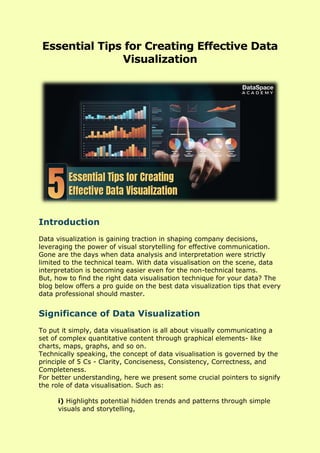
Essential Tips for Creating Effective Data
Visualization
Introduction
Data visualization is gaining traction in shaping company decisions,
leveraging the power of visual storytelling for effective communication.
Gone are the days when data analysis and interpretation were strictly
limited to the technical team. With data visualisation on the scene, data
interpretation is becoming easier even for the non-technical teams.
But, how to find the right data visualisation technique for your data? The
blog below offers a pro guide on the best data visualization tips that every
data professional should master.
Significance of Data Visualization
To put it simply, data visualisation is all about visually communicating a
set of complex quantitative content through graphical elements- like
charts, maps, graphs, and so on.
Technically speaking, the concept of data visualisation is governed by the
principle of 5 Cs - Clarity, Conciseness, Consistency, Correctness, and
Completeness.
For better understanding, here we present some crucial pointers to signify
the role of data visualisation. Such as:
i) Highlights potential hidden trends and patterns through simple
visuals and storytelling,
ii) Enables key decision-makers to build a data-backed business,
iii) An effective way to communicate data-backed ideas in simple
language,
iv) Simplifies monitoring important data metrics and key
performance indicators (KPIs).
Best practices of Data Visualization
Whether you are a beginner or a skilled data professional, we will guide
you through the best practices with effective data visualization tips as
follows:
1. Prioritise your audience:
This is the key step where most of the blunder happens. Do not just
prioritise your choice of visual representations and colours. Instead,
tailor visuals and colours according to your audience- executives,
sales team, admin team, or the core decision makers. Be audience-
specific rather than presenting a general visualization.
2. Keep your visualization simple yet effective:
Refrain from overloading the visualisation with complexities. Opt.
for to-the-point visualisation, highlighting essential pointers that
perfectly sync with your target audience’s interpretation.
3. Choose visualisation mindfully:
The best visualisation techniques can greatly influence how your
data is interpreted and understood. So it's important to know the
visualisation types and their applications for better data
interpretation.
i) Line charts, best for monitoring trends and shifts over time
and demonstrating the correlation between multiple variables,
ii) Bar charts to visualise quantities for distinct categories,
iii) Scatter plots help to display the interrelation between two
variables using parallel axes.
Learn more about the best data visualization techniques with
applicable dos and don’ts in this comprehensive guide.
4. Master the art of storytelling:
Data visualization is not only about presenting a visual
representation of data. One also needs to master the art of
storytelling to simplify visualisation for everyone with an engaging
approach.
5. Impact with Interactive Visualisations:
Offer your audiences an interactive visualisation experience by
incorporating features like tooltips. These nifty features provide
additional information about a key term or data points to the users
on hovering. Other interactive features include filter, drill down,
sorting, show & hide values.
Conclusion
Mastering data visualisation is all about the right blend of technical
expertise, creativity, and strategic application. Get started with brilliant
data visualisation by mastering the best power BI course online.
Follow us on:

Essential Tips for Creating Effective Data Visualization.pdf

  • 1.
    Essential Tips forCreating Effective Data Visualization Introduction Data visualization is gaining traction in shaping company decisions, leveraging the power of visual storytelling for effective communication. Gone are the days when data analysis and interpretation were strictly limited to the technical team. With data visualisation on the scene, data interpretation is becoming easier even for the non-technical teams. But, how to find the right data visualisation technique for your data? The blog below offers a pro guide on the best data visualization tips that every data professional should master. Significance of Data Visualization To put it simply, data visualisation is all about visually communicating a set of complex quantitative content through graphical elements- like charts, maps, graphs, and so on. Technically speaking, the concept of data visualisation is governed by the principle of 5 Cs - Clarity, Conciseness, Consistency, Correctness, and Completeness. For better understanding, here we present some crucial pointers to signify the role of data visualisation. Such as: i) Highlights potential hidden trends and patterns through simple visuals and storytelling,
  • 2.
    ii) Enables keydecision-makers to build a data-backed business, iii) An effective way to communicate data-backed ideas in simple language, iv) Simplifies monitoring important data metrics and key performance indicators (KPIs). Best practices of Data Visualization Whether you are a beginner or a skilled data professional, we will guide you through the best practices with effective data visualization tips as follows: 1. Prioritise your audience: This is the key step where most of the blunder happens. Do not just prioritise your choice of visual representations and colours. Instead, tailor visuals and colours according to your audience- executives, sales team, admin team, or the core decision makers. Be audience- specific rather than presenting a general visualization. 2. Keep your visualization simple yet effective: Refrain from overloading the visualisation with complexities. Opt. for to-the-point visualisation, highlighting essential pointers that perfectly sync with your target audience’s interpretation. 3. Choose visualisation mindfully: The best visualisation techniques can greatly influence how your data is interpreted and understood. So it's important to know the visualisation types and their applications for better data interpretation. i) Line charts, best for monitoring trends and shifts over time and demonstrating the correlation between multiple variables, ii) Bar charts to visualise quantities for distinct categories, iii) Scatter plots help to display the interrelation between two variables using parallel axes. Learn more about the best data visualization techniques with applicable dos and don’ts in this comprehensive guide. 4. Master the art of storytelling: Data visualization is not only about presenting a visual representation of data. One also needs to master the art of storytelling to simplify visualisation for everyone with an engaging approach.
  • 3.
    5. Impact withInteractive Visualisations: Offer your audiences an interactive visualisation experience by incorporating features like tooltips. These nifty features provide additional information about a key term or data points to the users on hovering. Other interactive features include filter, drill down, sorting, show & hide values. Conclusion Mastering data visualisation is all about the right blend of technical expertise, creativity, and strategic application. Get started with brilliant data visualisation by mastering the best power BI course online. Follow us on: