ESSENTIAL NEWBORN
CARE
D. N.A.ADDOTEY
MEANING OF NEWBORN CARE
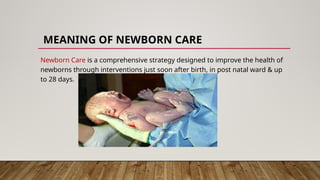
Newborn Care is a comprehensive strategy designed to improve the health of
newborns through interventions just soon after birth, in post natal ward & up
to 28 days.
PURPOSE OF NEWBORN CARE
• Early detection of problems & danger signs.
• To help mother to meet the basic needs of baby: breast feeding, warmth, prevention of
infection.
• To initiate the breast feeding within 1 hour of birth.
• To encourage & educate the mother to give exclusive breast feeding and care of baby.
• To treat the problems such as asphyxia & sepsis.
• To advice mother and family members for continuing care, immunizations and growth
monitoring.
COMPONENTS OF NEWBORN CARE
• Prepare the labour room for birth of baby.
• Immediate new born care.
• New born care on first day.
• New born physical examination.
• Care of new born during the first 28 days.
• Educate the mother and family members about the new born care.
HEALTHY NEWBORN
A healthy infant:
• is born at term between 38-42 weeks.
• have average birth weight.
• cries immediately following birth.
• establishes independent rhythmic respiration & quickly adapts to changed
environment.
IMMEDIATE BASIC CARE
• Dry the baby
• Replace the wet towel
• Position the baby
• Establishment of open airway
• Maintenance of temperature
• Initiate breastfeeding within a hour of birth
• Identification of newborn
• Administer inj. vitamin k
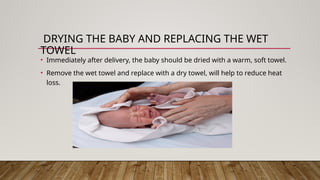
DRYING THE BABY AND REPLACING THE WET
TOWEL
• Immediately after delivery, the baby should be dried with a warm, soft towel.
• Remove the wet towel and replace with a dry towel, will help to reduce heat
loss.
MECHANISM OF HEAT LOSS IN NEWBORN
The new born can loss heat by:
• Convection: by air in room
• Radiation: by cold windows or walls
• Evaporation: by baby bath
• Conduction: by cold hands or stethoscope or instruments.
MAINTENANCE OF TEMPERATURE
• Immediately dry the baby under a radiant warmer
• Skin to skin contact with mother
• Cover the neonate with warm towel. the head and extremities should be
covered properly
• Rooming in
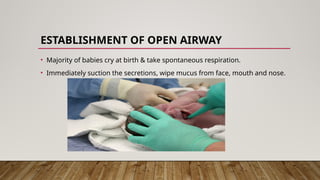
ESTABLISHMENT OF OPEN AIRWAY
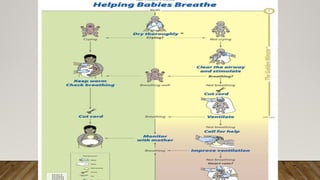
• Majority of babies cry at birth & take spontaneous respiration.
• Immediately suction the secretions, wipe mucus from face, mouth and nose.
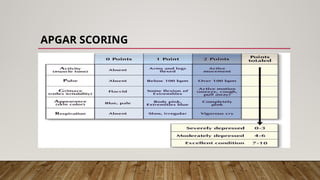
APGAR SCORING
APGAR SCORING
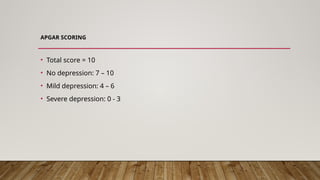
• Total score = 10
• No depression: 7 – 10
• Mild depression: 4 – 6
• Severe depression: 0 - 3
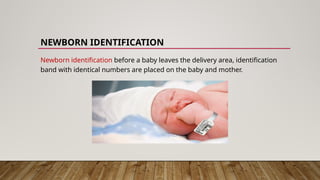
NEWBORN IDENTIFICATION
Newborn identification before a baby leaves the delivery area, identification
band with identical numbers are placed on the baby and mother.
VITAMIN K ADMINISTRATION TO NEWBORN
• Vitamin K prevent neonatal hemorrhage during first few days of life before
infant is able to produce vitamin K.
• Term infants (1mg) – IM
• Preterm infants (0.5mg) – IM
Alternative route:
• Oral dose: 2mg orally at birth
• Repeat dose (2mg) at 3 – 5 days and at 4- 6 weeks of age.
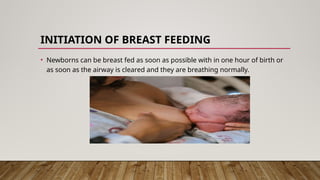
INITIATION OF BREAST FEEDING
• Newborns can be breast fed as soon as possible with in one hour of birth or
as soon as the airway is cleared and they are breathing normally.
DAILY ROUTINE CARE OF NEONATES
• The majority of complication of the normal newborn may occur during first
24 hours or within 7 days.
• Close observation and daily essential routine care is important for health and
survival of the newborn baby.
MAJOR GOALS
• Establish and maintain homeostasis
• Stability of normal physiological status.
DAILY ROUTINE CARE OF NEONATES
• Warmth
• Breast feeding
• Skin care & baby bath
• Care of umbilical cord
• Care of eyes
• Clothing of baby
• General care
• Taking anthropometric
measurements
• Protection from infection
• Observation
• Immunization
• Follow up
WARMTH
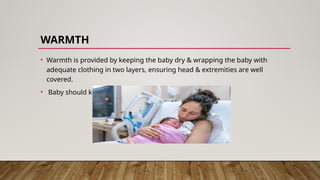
• Warmth is provided by keeping the baby dry & wrapping the baby with
adequate clothing in two layers, ensuring head & extremities are well
covered.
• Baby should kept by the side of the mother.
BREAST FEEDING
• The baby should be put to the mother’s breast within half an hour of birth or
as soon as possible the mother has recovered from the exertion of labor.
• The energy requirement initially is 55cal/kg/day and increase to about
120cal/kg/day at 1st week of age.
The neonate loses about 7 to 8% of body weight during 1st week and regains
body weight from 10th day and then continue to gain weight.
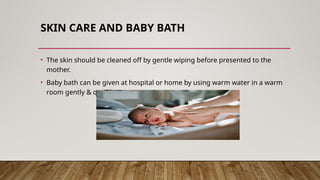
SKIN CARE AND BABY BATH
• The skin should be cleaned off by gentle wiping before presented to the
mother.
• Baby bath can be given at hospital or home by using warm water in a warm
room gently & quickly.
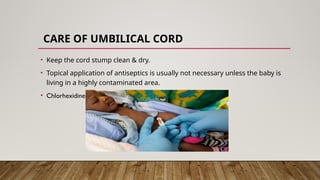
CARE OF UMBILICAL CORD
• Keep the cord stump clean & dry.
• Topical application of antiseptics is usually not necessary unless the baby is
living in a highly contaminated area.
• Chlorhexidine gel
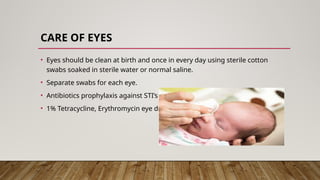
CARE OF EYES
• Eyes should be clean at birth and once in every day using sterile cotton
swabs soaked in sterile water or normal saline.
• Separate swabs for each eye.
• Antibiotics prophylaxis against STI’s
• 1% Tetracycline, Erythromycin eye drops
DAILY OBSERVATION OF NEONATES
• The neonates should be monitored for danger signs.
Danger signs:
• poor feeding, sucking and swallowing reflex
• cold to touch or having rise in body temperature
• poor activity or poor response to stimulation
• excessive crying & irritability
• rapid respiration, more than 60/min and presence of chest retraction.
DAILY OBSERVATION OF NEONATES
Danger signs:
• central cyanosis
• drooling of saliva or chocking during feeding
• labored respiration or absence of respiration
• jaundice appears within 24 hours
• no urine within 48 hours or meconium within 24 hours
DAILY OBSERVATION OF NEONATES
Danger signs:
• convulsion
• bleeding or umbilical discharge
• diarrhea, vomiting and abdominal distention
• infection
THANK YOU

ESSENTIAL NEWBORN CARE BY DNA PowerPoint presentation

  • 1.
  • 2.
    MEANING OF NEWBORNCARE Newborn Care is a comprehensive strategy designed to improve the health of newborns through interventions just soon after birth, in post natal ward & up to 28 days.
  • 3.
    PURPOSE OF NEWBORNCARE • Early detection of problems & danger signs. • To help mother to meet the basic needs of baby: breast feeding, warmth, prevention of infection. • To initiate the breast feeding within 1 hour of birth. • To encourage & educate the mother to give exclusive breast feeding and care of baby. • To treat the problems such as asphyxia & sepsis. • To advice mother and family members for continuing care, immunizations and growth monitoring.
  • 4.
    COMPONENTS OF NEWBORNCARE • Prepare the labour room for birth of baby. • Immediate new born care. • New born care on first day. • New born physical examination. • Care of new born during the first 28 days. • Educate the mother and family members about the new born care.
  • 5.
    HEALTHY NEWBORN A healthyinfant: • is born at term between 38-42 weeks. • have average birth weight. • cries immediately following birth. • establishes independent rhythmic respiration & quickly adapts to changed environment.
  • 6.
    IMMEDIATE BASIC CARE •Dry the baby • Replace the wet towel • Position the baby • Establishment of open airway • Maintenance of temperature • Initiate breastfeeding within a hour of birth • Identification of newborn • Administer inj. vitamin k
  • 7.
    DRYING THE BABYAND REPLACING THE WET TOWEL • Immediately after delivery, the baby should be dried with a warm, soft towel. • Remove the wet towel and replace with a dry towel, will help to reduce heat loss.
  • 8.
    MECHANISM OF HEATLOSS IN NEWBORN The new born can loss heat by: • Convection: by air in room • Radiation: by cold windows or walls • Evaporation: by baby bath • Conduction: by cold hands or stethoscope or instruments.
  • 9.
    MAINTENANCE OF TEMPERATURE •Immediately dry the baby under a radiant warmer • Skin to skin contact with mother • Cover the neonate with warm towel. the head and extremities should be covered properly • Rooming in
  • 10.
    ESTABLISHMENT OF OPENAIRWAY • Majority of babies cry at birth & take spontaneous respiration. • Immediately suction the secretions, wipe mucus from face, mouth and nose.
  • 11.
  • 12.
    APGAR SCORING • Totalscore = 10 • No depression: 7 – 10 • Mild depression: 4 – 6 • Severe depression: 0 - 3
  • 13.
    NEWBORN IDENTIFICATION Newborn identificationbefore a baby leaves the delivery area, identification band with identical numbers are placed on the baby and mother.
  • 14.
    VITAMIN K ADMINISTRATIONTO NEWBORN • Vitamin K prevent neonatal hemorrhage during first few days of life before infant is able to produce vitamin K. • Term infants (1mg) – IM • Preterm infants (0.5mg) – IM Alternative route: • Oral dose: 2mg orally at birth • Repeat dose (2mg) at 3 – 5 days and at 4- 6 weeks of age.
  • 15.
    INITIATION OF BREASTFEEDING • Newborns can be breast fed as soon as possible with in one hour of birth or as soon as the airway is cleared and they are breathing normally.
  • 16.
    DAILY ROUTINE CAREOF NEONATES • The majority of complication of the normal newborn may occur during first 24 hours or within 7 days. • Close observation and daily essential routine care is important for health and survival of the newborn baby.
  • 17.
    MAJOR GOALS • Establishand maintain homeostasis • Stability of normal physiological status.
  • 18.
    DAILY ROUTINE CAREOF NEONATES • Warmth • Breast feeding • Skin care & baby bath • Care of umbilical cord • Care of eyes • Clothing of baby • General care • Taking anthropometric measurements • Protection from infection • Observation • Immunization • Follow up
  • 19.
    WARMTH • Warmth isprovided by keeping the baby dry & wrapping the baby with adequate clothing in two layers, ensuring head & extremities are well covered. • Baby should kept by the side of the mother.
  • 20.
    BREAST FEEDING • Thebaby should be put to the mother’s breast within half an hour of birth or as soon as possible the mother has recovered from the exertion of labor. • The energy requirement initially is 55cal/kg/day and increase to about 120cal/kg/day at 1st week of age. The neonate loses about 7 to 8% of body weight during 1st week and regains body weight from 10th day and then continue to gain weight.
  • 21.
    SKIN CARE ANDBABY BATH • The skin should be cleaned off by gentle wiping before presented to the mother. • Baby bath can be given at hospital or home by using warm water in a warm room gently & quickly.
  • 22.
    CARE OF UMBILICALCORD • Keep the cord stump clean & dry. • Topical application of antiseptics is usually not necessary unless the baby is living in a highly contaminated area. • Chlorhexidine gel
  • 23.
    CARE OF EYES •Eyes should be clean at birth and once in every day using sterile cotton swabs soaked in sterile water or normal saline. • Separate swabs for each eye. • Antibiotics prophylaxis against STI’s • 1% Tetracycline, Erythromycin eye drops
  • 24.
    DAILY OBSERVATION OFNEONATES • The neonates should be monitored for danger signs. Danger signs: • poor feeding, sucking and swallowing reflex • cold to touch or having rise in body temperature • poor activity or poor response to stimulation • excessive crying & irritability • rapid respiration, more than 60/min and presence of chest retraction.
  • 25.
    DAILY OBSERVATION OFNEONATES Danger signs: • central cyanosis • drooling of saliva or chocking during feeding • labored respiration or absence of respiration • jaundice appears within 24 hours • no urine within 48 hours or meconium within 24 hours
  • 26.
    DAILY OBSERVATION OFNEONATES Danger signs: • convulsion • bleeding or umbilical discharge • diarrhea, vomiting and abdominal distention • infection
  • 28.