Essential Case Management Skills for
Professionals
Case management is a critical field that involves
coordinating and managing resources and services
to meet an individual's or a group's health and social
needs. Professionals in this field must possess a
diverse set of skills to effectively support their
clients. This blog explores the essential case
management skills that professionals need to
succeed.
1. Communication Skills
Effective communication is at the heart of case
management. Professionals must be adept at both
speaking and listening to understand the needs and
concerns of their clients.
Active Listening: Listening carefully to clients to
understand their needs, concerns, and
preferences.
Clear Communication: Conveying information
clearly and understandably to clients, families,
and other professionals.
sageeducation.edu.au
2. Empathy and Compassion
Understanding and sharing the feelings of others are
crucial for building trust and rapport with clients.
Client-Centered Approach: Focusing on the
client’s unique needs and experiences.
Emotional Support: Providing comfort and
support, especially in challenging situations.
Cultural Sensitivity: Respecting and
understanding the diverse backgrounds of
clients.
3. Organizational Skills
Case managers juggle multiple tasks and
responsibilities, requiring strong organizational
abilities.
Time Management: Prioritizing tasks effectively
to manage time efficiently.
Multitasking: Handling multiple cases
simultaneously without losing quality.
Attention to Detail: Keeping accurate records
and details to avoid errors in client care.
sageeducation.edu.au
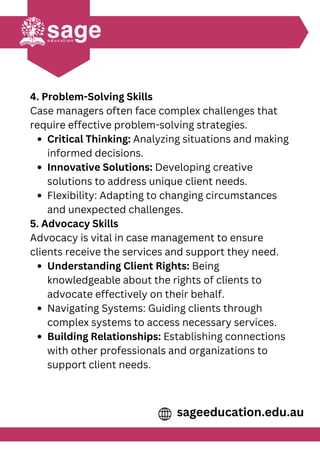
4. Problem-Solving Skills
Case managers often face complex challenges that
require effective problem-solving strategies.
Critical Thinking: Analyzing situations and making
informed decisions.
Innovative Solutions: Developing creative
solutions to address unique client needs.
Flexibility: Adapting to changing circumstances
and unexpected challenges.
5. Advocacy Skills
Advocacy is vital in case management to ensure
clients receive the services and support they need.
Understanding Client Rights: Being
knowledgeable about the rights of clients to
advocate effectively on their behalf.
Navigating Systems: Guiding clients through
complex systems to access necessary services.
Building Relationships: Establishing connections
with other professionals and organizations to
support client needs.
sageeducation.edu.au
4. Problem-Solving Skills
Case managers often face complex challenges that
require effective problem-solving strategies.
Critical Thinking: Analyzing situations and making
informed decisions.
Innovative Solutions: Developing creative
solutions to address unique client needs.
Flexibility: Adapting to changing circumstances
and unexpected challenges.
5. Advocacy Skills
Advocacy is vital in case management to ensure
clients receive the services and support they need.
Understanding Client Rights: Being
knowledgeable about the rights of clients to
advocate effectively on their behalf.
Navigating Systems: Guiding clients through
complex systems to access necessary services.
Building Relationships: Establishing connections
with other professionals and organizations to
support client needs.
sageeducation.edu.au
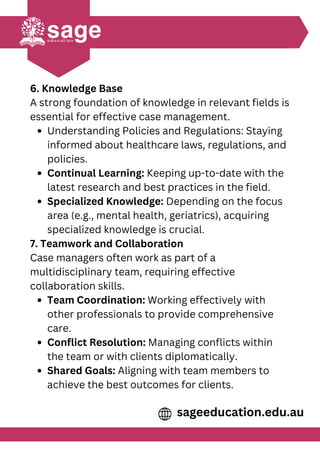
6. Knowledge Base
A strong foundation of knowledge in relevant fields is
essential for effective case management.
Understanding Policies and Regulations: Staying
informed about healthcare laws, regulations, and
policies.
Continual Learning: Keeping up-to-date with the
latest research and best practices in the field.
Specialized Knowledge: Depending on the focus
area (e.g., mental health, geriatrics), acquiring
specialized knowledge is crucial.
7. Teamwork and Collaboration
Case managers often work as part of a
multidisciplinary team, requiring effective
collaboration skills.
Team Coordination: Working effectively with
other professionals to provide comprehensive
care.
Conflict Resolution: Managing conflicts within
the team or with clients diplomatically.
Shared Goals: Aligning with team members to
achieve the best outcomes for clients.
sageeducation.edu.au
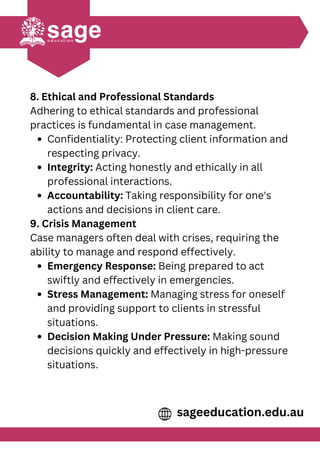
8. Ethical and Professional Standards
Adhering to ethical standards and professional
practices is fundamental in case management.
Confidentiality: Protecting client information and
respecting privacy.
Integrity: Acting honestly and ethically in all
professional interactions.
Accountability: Taking responsibility for one's
actions and decisions in client care.
9. Crisis Management
Case managers often deal with crises, requiring the
ability to manage and respond effectively.
Emergency Response: Being prepared to act
swiftly and effectively in emergencies.
Stress Management: Managing stress for oneself
and providing support to clients in stressful
situations.
Decision Making Under Pressure: Making sound
decisions quickly and effectively in high-pressure
situations.
sageeducation.edu.au
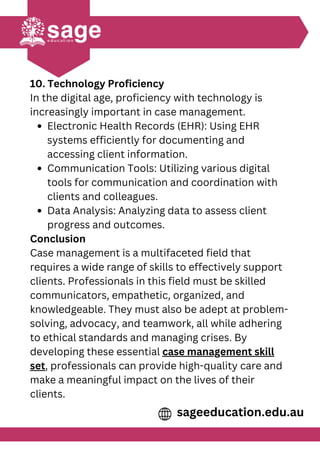
10. Technology Proficiency
In the digital age, proficiency with technology is
increasingly important in case management.
Electronic Health Records (EHR): Using EHR
systems efficiently for documenting and
accessing client information.
Communication Tools: Utilizing various digital
tools for communication and coordination with
clients and colleagues.
Data Analysis: Analyzing data to assess client
progress and outcomes.
Conclusion
Case management is a multifaceted field that
requires a wide range of skills to effectively support
clients. Professionals in this field must be skilled
communicators, empathetic, organized, and
knowledgeable. They must also be adept at problem-
solving, advocacy, and teamwork, all while adhering
to ethical standards and managing crises. By
developing these essential case management skill
set, professionals can provide high-quality care and
make a meaningful impact on the lives of their
clients.
sageeducation.edu.au

Essential Case Management Skills for Professionals

  • 1.
    Essential Case ManagementSkills for Professionals Case management is a critical field that involves coordinating and managing resources and services to meet an individual's or a group's health and social needs. Professionals in this field must possess a diverse set of skills to effectively support their clients. This blog explores the essential case management skills that professionals need to succeed. 1. Communication Skills Effective communication is at the heart of case management. Professionals must be adept at both speaking and listening to understand the needs and concerns of their clients. Active Listening: Listening carefully to clients to understand their needs, concerns, and preferences. Clear Communication: Conveying information clearly and understandably to clients, families, and other professionals. sageeducation.edu.au
  • 2.
    2. Empathy andCompassion Understanding and sharing the feelings of others are crucial for building trust and rapport with clients. Client-Centered Approach: Focusing on the client’s unique needs and experiences. Emotional Support: Providing comfort and support, especially in challenging situations. Cultural Sensitivity: Respecting and understanding the diverse backgrounds of clients. 3. Organizational Skills Case managers juggle multiple tasks and responsibilities, requiring strong organizational abilities. Time Management: Prioritizing tasks effectively to manage time efficiently. Multitasking: Handling multiple cases simultaneously without losing quality. Attention to Detail: Keeping accurate records and details to avoid errors in client care. sageeducation.edu.au
  • 3.
    4. Problem-Solving Skills Casemanagers often face complex challenges that require effective problem-solving strategies. Critical Thinking: Analyzing situations and making informed decisions. Innovative Solutions: Developing creative solutions to address unique client needs. Flexibility: Adapting to changing circumstances and unexpected challenges. 5. Advocacy Skills Advocacy is vital in case management to ensure clients receive the services and support they need. Understanding Client Rights: Being knowledgeable about the rights of clients to advocate effectively on their behalf. Navigating Systems: Guiding clients through complex systems to access necessary services. Building Relationships: Establishing connections with other professionals and organizations to support client needs. sageeducation.edu.au
  • 4.
    4. Problem-Solving Skills Casemanagers often face complex challenges that require effective problem-solving strategies. Critical Thinking: Analyzing situations and making informed decisions. Innovative Solutions: Developing creative solutions to address unique client needs. Flexibility: Adapting to changing circumstances and unexpected challenges. 5. Advocacy Skills Advocacy is vital in case management to ensure clients receive the services and support they need. Understanding Client Rights: Being knowledgeable about the rights of clients to advocate effectively on their behalf. Navigating Systems: Guiding clients through complex systems to access necessary services. Building Relationships: Establishing connections with other professionals and organizations to support client needs. sageeducation.edu.au
  • 5.
    6. Knowledge Base Astrong foundation of knowledge in relevant fields is essential for effective case management. Understanding Policies and Regulations: Staying informed about healthcare laws, regulations, and policies. Continual Learning: Keeping up-to-date with the latest research and best practices in the field. Specialized Knowledge: Depending on the focus area (e.g., mental health, geriatrics), acquiring specialized knowledge is crucial. 7. Teamwork and Collaboration Case managers often work as part of a multidisciplinary team, requiring effective collaboration skills. Team Coordination: Working effectively with other professionals to provide comprehensive care. Conflict Resolution: Managing conflicts within the team or with clients diplomatically. Shared Goals: Aligning with team members to achieve the best outcomes for clients. sageeducation.edu.au
  • 6.
    8. Ethical andProfessional Standards Adhering to ethical standards and professional practices is fundamental in case management. Confidentiality: Protecting client information and respecting privacy. Integrity: Acting honestly and ethically in all professional interactions. Accountability: Taking responsibility for one's actions and decisions in client care. 9. Crisis Management Case managers often deal with crises, requiring the ability to manage and respond effectively. Emergency Response: Being prepared to act swiftly and effectively in emergencies. Stress Management: Managing stress for oneself and providing support to clients in stressful situations. Decision Making Under Pressure: Making sound decisions quickly and effectively in high-pressure situations. sageeducation.edu.au
  • 7.
    10. Technology Proficiency Inthe digital age, proficiency with technology is increasingly important in case management. Electronic Health Records (EHR): Using EHR systems efficiently for documenting and accessing client information. Communication Tools: Utilizing various digital tools for communication and coordination with clients and colleagues. Data Analysis: Analyzing data to assess client progress and outcomes. Conclusion Case management is a multifaceted field that requires a wide range of skills to effectively support clients. Professionals in this field must be skilled communicators, empathetic, organized, and knowledgeable. They must also be adept at problem- solving, advocacy, and teamwork, all while adhering to ethical standards and managing crises. By developing these essential case management skill set, professionals can provide high-quality care and make a meaningful impact on the lives of their clients. sageeducation.edu.au