(c) Copyright CTA CHC52008, MODULE 6 Version Date: 3.5.2013
Diploma of Community Services
(Case Management)
Module 6
CHCCM504D: Promote High Quality Case Management
1
(c) Copyright CTA CHC52008, MODULE 6 Version Date: 3.5.2013
This unit is all about...
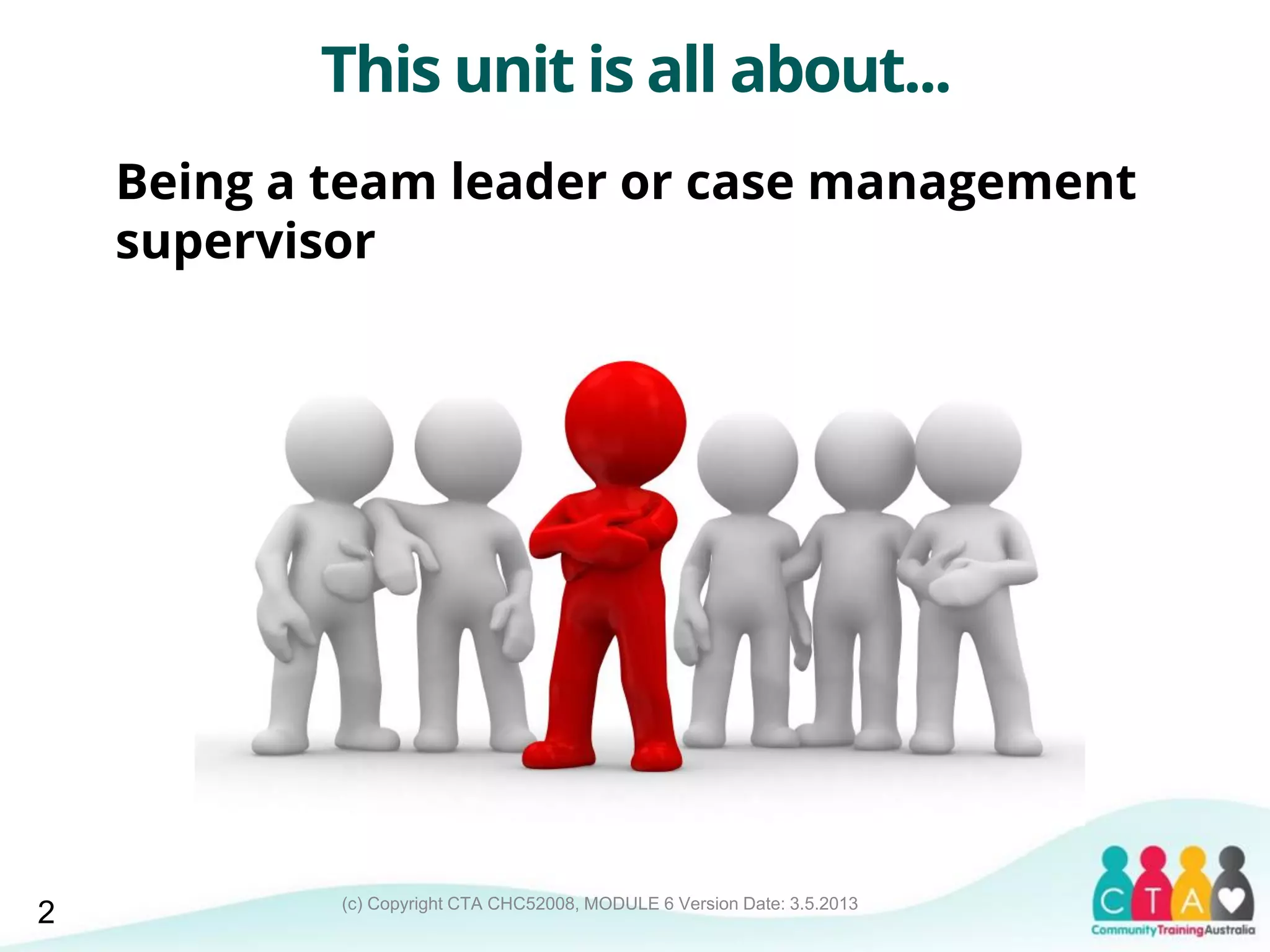
Being a team leader or case management
supervisor
2
(c) Copyright CTA CHC52008, MODULE 6 Version Date: 3.5.2013
In charge?
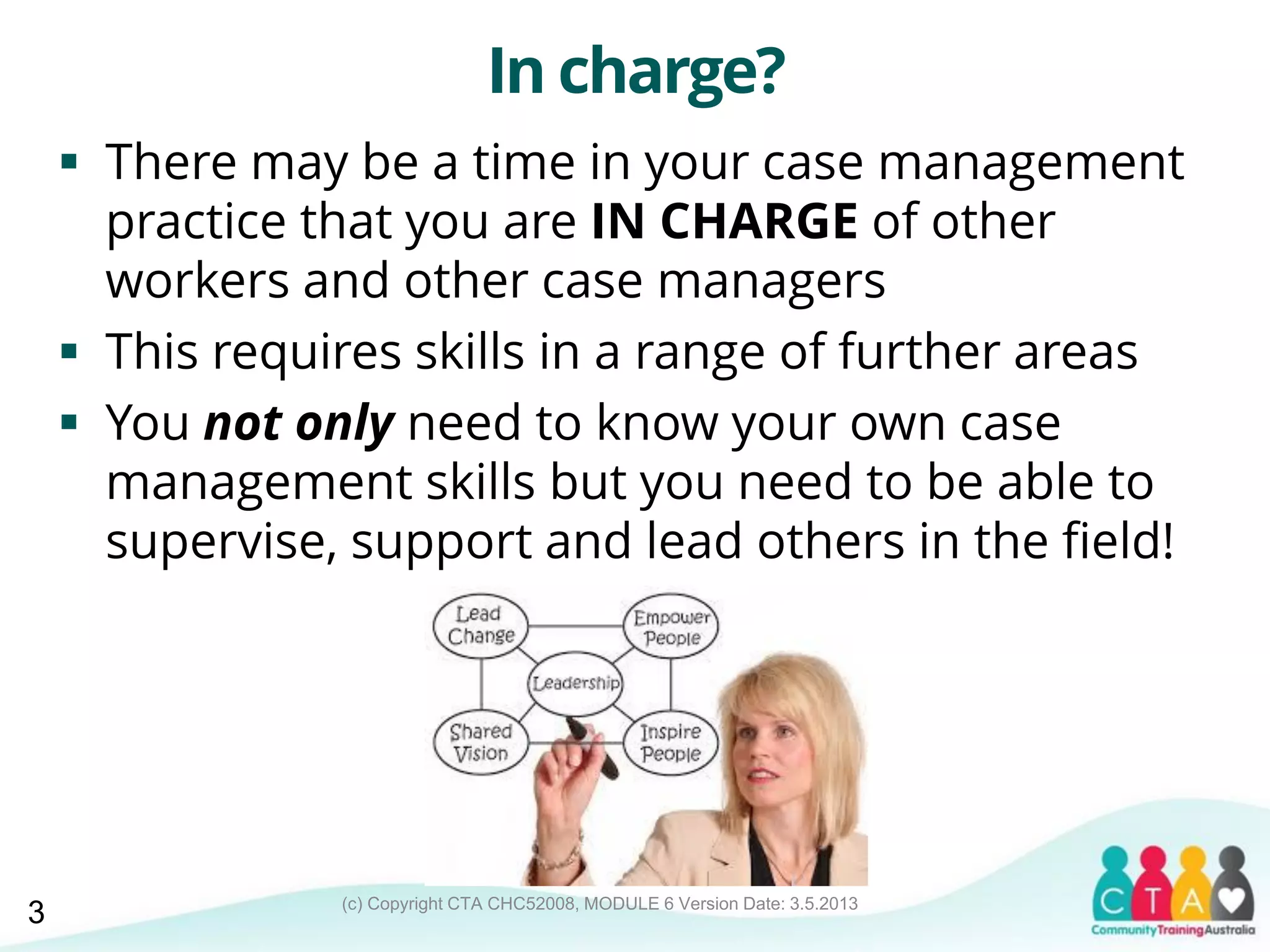
 There may be a time in your case management
practice that you are IN CHARGE of other
workers and other case managers
 This requires skills in a range of further areas
 You not only need to know your own case
management skills but you need to be able to
supervise, support and lead others in the field!
3
(c) Copyright CTA CHC52008, MODULE 6 Version Date: 3.5.2013
It is a nice idea...
What exactly does it involve?
 Professional development and training
programs
 Practice reviews and audits
 Organisation policy and procedures
 Relevant program standards
 Service and professional standards, including
code of professional ethics or code of practice
 Research current trends in case management
 Analysis and evaluation of practices
 Plans for practice improvement
4
(c) Copyright CTA CHC52008, MODULE 6 Version Date: 3.5.2013
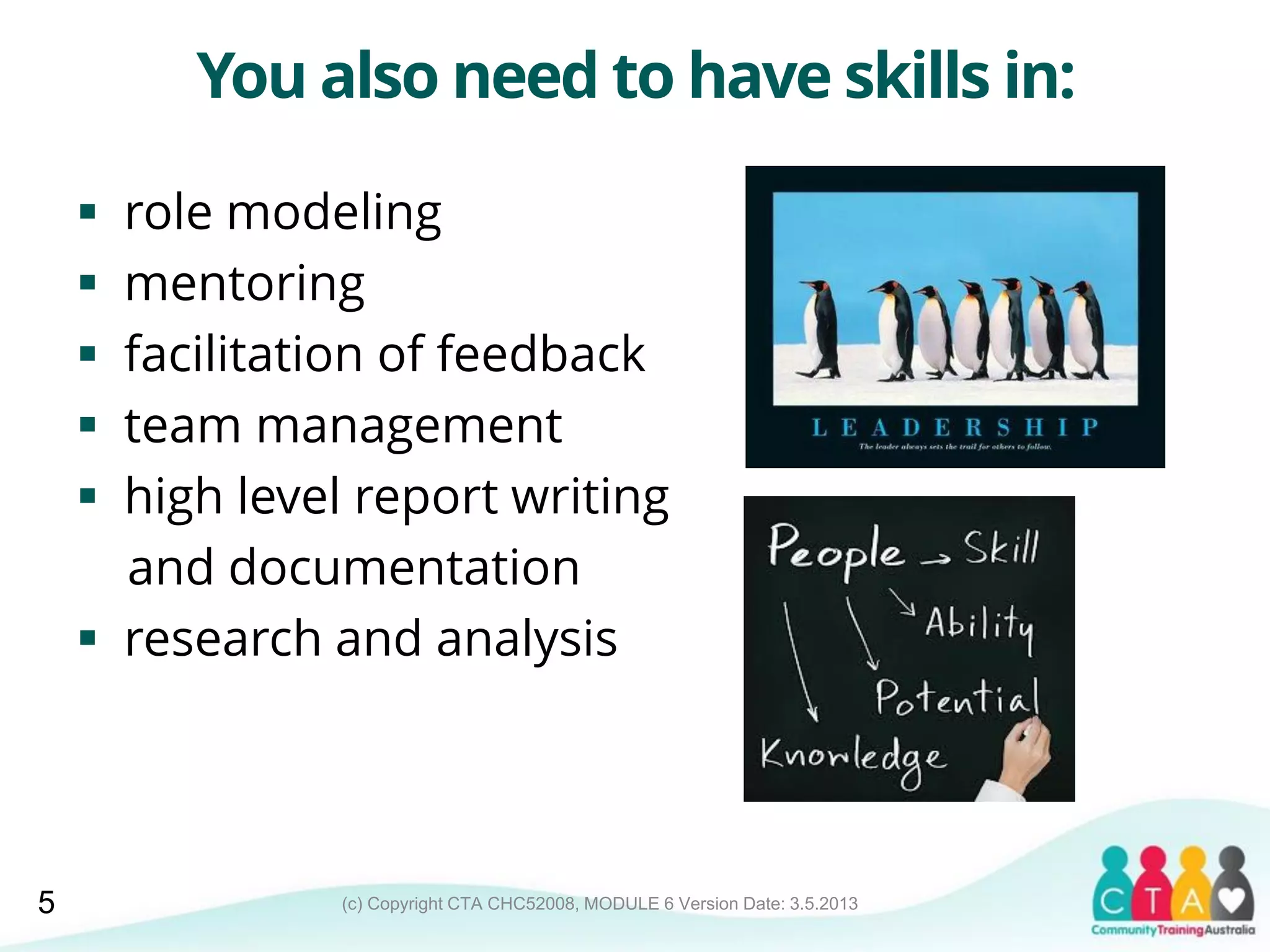
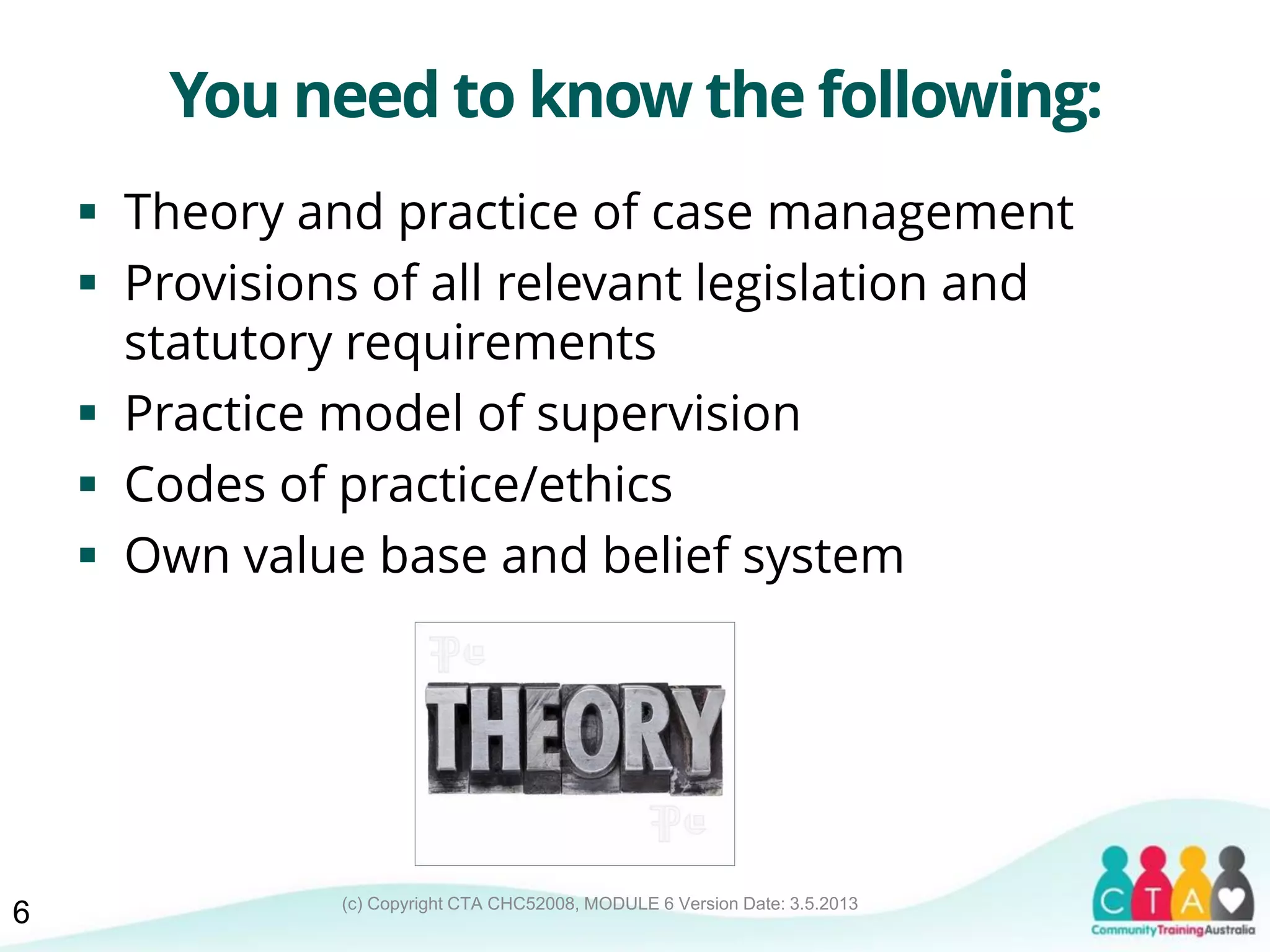
You also need to have skills in:
 role modeling
 mentoring
 facilitation of feedback
 team management
 high level report writing
and documentation
 research and analysis
5
(c) Copyright CTA CHC52008, MODULE 6 Version Date: 3.5.2013
You need to know the following:
 Theory and practice of case management
 Provisions of all relevant legislation and
statutory requirements
 Practice model of supervision
 Codes of practice/ethics
 Own value base and belief system
6
(c) Copyright CTA CHC52008, MODULE 6 Version Date: 3.5.2013
So let’s start with
what you need to know ....
Theory and practice of case management
• While case management is a relatively new
field it has grown quickly and has developed
over the last 50 years into quite a well
documented field
• There are theories that underpin case
management practice...
• Let’s look at some of these:
7
(c) Copyright CTA CHC52008, MODULE 6 Version Date: 3.5.2013
Client Centred Practice: Carl Rogers
 This approach to client care revolves around the
notion that the client is their own expert and
therefore it is important to consult them about their
goals, hopes, aspirations and preferences!
 This leads on to some of the main aspects of case
management... that it is a collaborative process that
empowers clients to take control of their own lives...
 The plan is developed in collaboration with the client and
reflects their choices and preferences for the service
arrangements being developed. The goal is to empower
the client and ensure that they are involved in all aspects
of the planning and service arrangement in a dynamic
way. Case Management Society of Australia
8
(c) Copyright CTA CHC52008, MODULE 6 Version Date: 3.5.2013
Solution Focused Strength Based
Strategies: Shazer, Berg,
 These approaches to client support involve the
understanding that people grow and develop
more when they feel they are already having
success
 St Luke’s adopted the Strength Based Approach
with great success for families involved in Child
Safety
 They made their practice fun, honouring of
difference and focusing on successes rather than
on failures. It is also future orientated rather than
dwelling in the mistakes of the past
9
(c) Copyright CTA CHC52008, MODULE 6 Version Date: 3.5.2013
Solution focused brief therapy (SFBT)
Often referred to as simply 'solution focused
therapy' or 'brief therapy', is a type of talking
therapy that is based upon social
constructionist philosophy.
It focuses on what clients want to achieve
through therapy rather than on the problem(s)
that made them seek help.
The approach does not focus on the past, but
instead, focuses on the present and future
10
(c) Copyright CTA CHC52008, MODULE 6 Version Date: 3.5.2013
Strength Based Practice:
Reynolds, Saleebey, Rapp, Weick
• Strengths based practice is a social work practice
theory that emphasises people's self
determination and strengths. Strengths based
practice is client led, with a focus on future
outcomes and strengths that the people bring to
a problem or crisis. A proto-theorist for this
practice was social worker Bertha Reynolds, who
criticised the American social work tendency to
adopt a psychoanalytic approach (and the
corollary dependence on the DSM IV) with clients.
It was formally developed by a team from the
University of Kansas
11
(c) Copyright CTA CHC52008, MODULE 6 Version Date: 3.5.2013
Systems Theory:
 Systems theory relates to the understanding that
there are many diverse systems interacting in our
world, including family, work, government, health
systems, etc.
 The relationships to the eco-systems of nature
forms the understanding that one system makes
way for another until there is equilibrium
 Mind mapping techniques work well in this
framework and help us understand the many
interlocking systems that human beings are
involved in
12
(c) Copyright CTA CHC52008, MODULE 6 Version Date: 3.5.2013
Critical Theories
 Critical social work is the application of social
work from a critical theory perspective
 Critical social work seeks to address social
injustices, as opposed to focusing on individual
people's problems
 Critical theories explain social problems as arising
from various forms of oppression
 This theory is like all social work theories in that it
is made up of a polyglot of theories from across
the humanities and sciences, borrowing from
many different schools of thought including
Marxism, social democracy and anarchism
13
(c) Copyright CTA CHC52008, MODULE 6 Version Date: 3.5.2013
Theories...
 There are some arguments that theories in
the end come and go but the practices are
what remains behind..
 However as a Case Manager or Case
Management Supervisor it is important to
become acquainted with the various theories
(and there are tons of them) over time and
contemplate them and the practice that you
are in charge of
14
(c) Copyright CTA CHC52008, MODULE 6 Version Date: 3.5.2013
Is it legal?
Provisions of all relevant legislation and
statutory requirements
 One of the very important issues that you will need to
be aware of is the relevant legislation for the work in
client support and employee management
 Changing legislation is something you need to be
watching carefully
 Where can you find this easily? The internet is a
healthy source of information on changing legislation
and statutory requirements
 http://www.hreoc.gov.au/about/legislation/index.html Australian
Human Rights Commission
15
(c) Copyright CTA CHC52008, MODULE 6 Version Date: 3.5.2013
How will you supervise others?
Practice model of supervision
• There are various models of supervision
• It consists of the practitioner meeting regularly
with another professional, not necessarily more
senior, but normally with training in the skills of
supervision, to discuss casework and other
professional issues in a structured way. This is
often known as clinical or counselling supervision
or consultation. The purpose is to assist the
practitioner to learn from his or her experience
and progress in expertise, as well as to ensure
good service to the client or patient.
16
(c) Copyright CTA CHC52008, MODULE 6 Version Date: 3.5.2013
Finding one that fits ...
 Codes of practice/ethics
 We can find these again on the Internet, look up
Case Management Society of Australia…we can then
use these codes to write our own that works and
reflects our own particular values
 Leadership style: Autocratic, Democratic, Strength
Based, Laissez Faire, etc.
 Discuss: What would each of these look like in
practice?
 Discuss: How easy is it to follow the examples we
have had in our own life?
 How hard is it to choose a practice model that we
actually believe in?
17
(c) Copyright CTA CHC52008, MODULE 6 Version Date: 3.5.2013
When leading others ...
Own value base and belief system
 We never have to evaluate this more carefully
than when we have responsibility for others
 Where have our values and beliefs come from?
are they completely static?
 Have they moved over time and how well are
we able to work with others with different
ideas and values?
 Are we going to impose ours?
 Discuss
18
(c) Copyright CTA CHC52008, MODULE 6 Version Date: 3.5.2013
Then the personal skills...
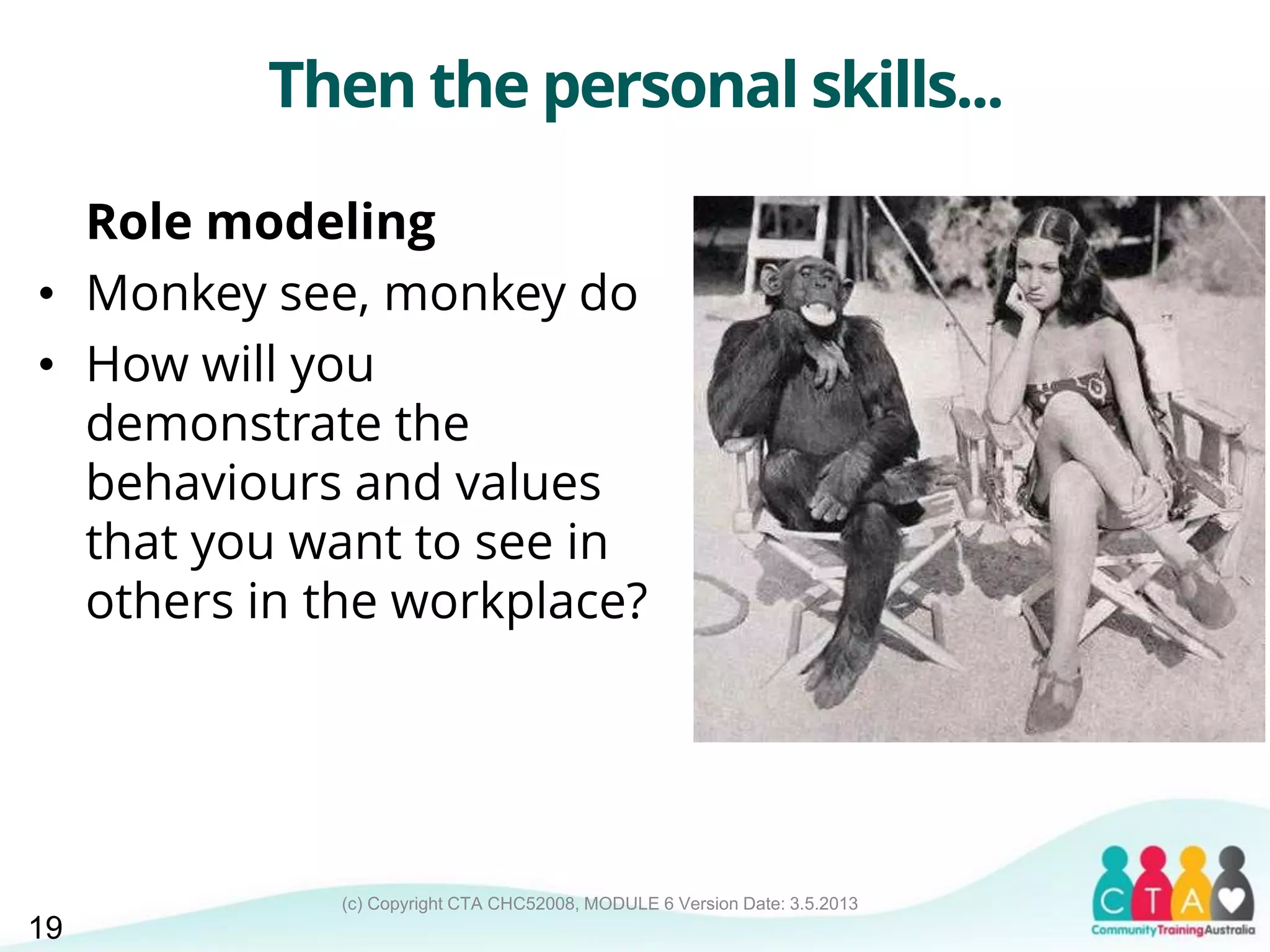
Role modeling
• Monkey see, monkey do
• How will you
demonstrate the
behaviours and values
that you want to see in
others in the workplace?
19
(c) Copyright CTA CHC52008, MODULE 6 Version Date: 3.5.2013
Helping someone find their feet...
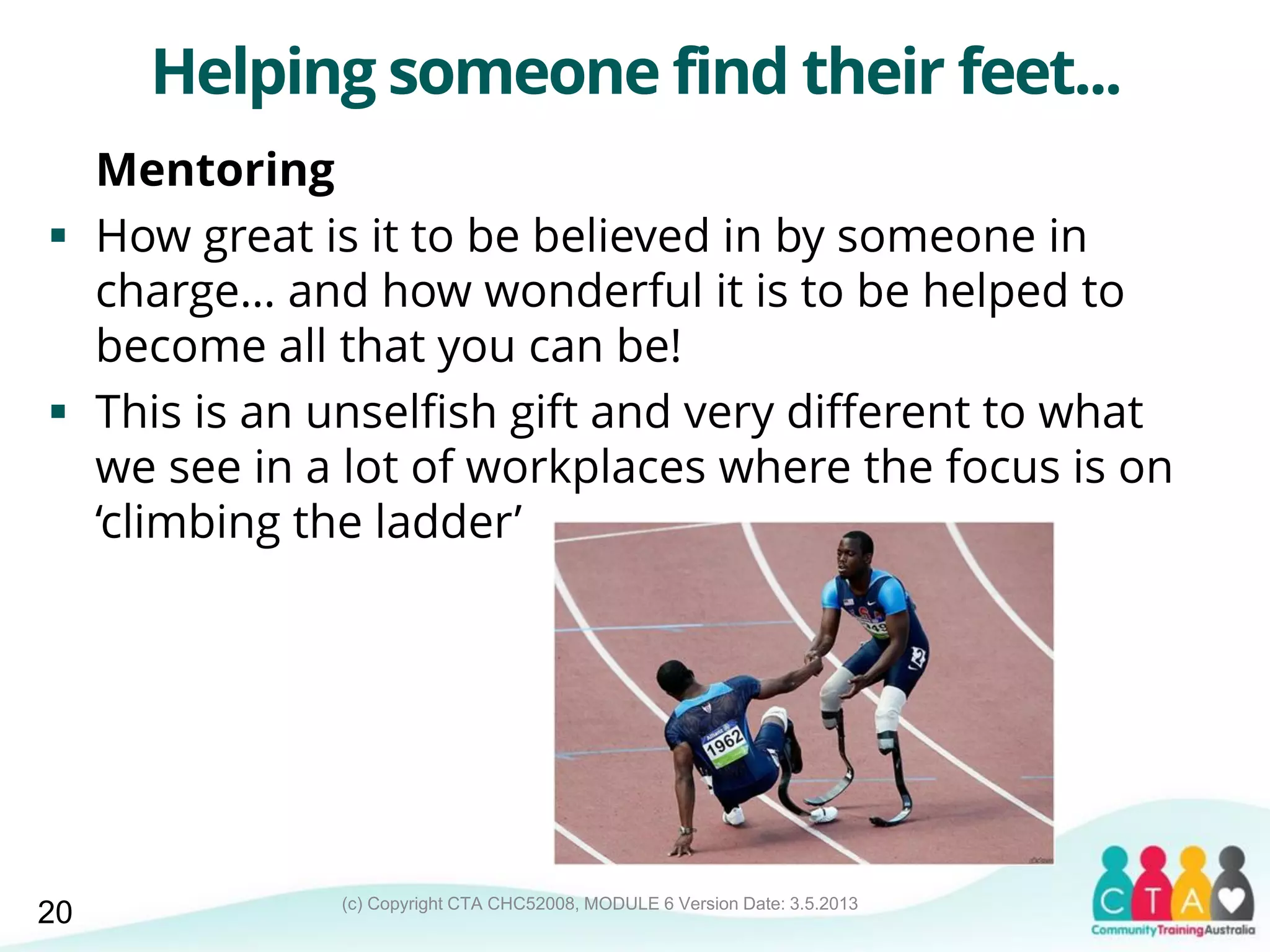
Mentoring
 How great is it to be believed in by someone in
charge… and how wonderful it is to be helped to
become all that you can be!
 This is an unselfish gift and very different to what
we see in a lot of workplaces where the focus is on
‘climbing the ladder’
20
(c) Copyright CTA CHC52008, MODULE 6 Version Date: 3.5.2013
People need to have their say!
Facilitation of feedback
• It’s not just your thoughts and words as a
supervisor that counts… we all have the need to
have input…
• But this can come as negative rabble, backbiting,
dominating etc.
• To facilitate feedback from all colleagues and all
stakeholders in case management practice is a very
important skill…
• Discuss: How do you think you can do this?
(take to the white board come up with some ideas)
21
(c) Copyright CTA CHC52008, MODULE 6 Version Date: 3.5.2013
To manage a group of people...
Team management
• Its easy to criticise a manager but it’s another
thing to have to do it yourself!
• Discuss
– What are all of the aspects of managing a
team that you can think of.
– What tools might you need to do this well?
(Use the white board)
22
(c) Copyright CTA CHC52008, MODULE 6 Version Date: 3.5.2013
If you don’t already enjoy report
writing – you soon will!
 High level report writing and documentation
 One of the hardest things to do for ‘people’ is to keep
your documentation in order and to keep on top of
writing reports
 One of the kindest things you can do for yourself and
your team is to create ‘proformas’. Proformas ensure
that all the information that needs to be documented
is easily completed
 Your team can help create the proforma
 Proformas help people who find writing things down
difficult as well as for those who have to read the and
check the documents... that’s you!
23
(c) Copyright CTA CHC52008, MODULE 6 Version Date: 3.5.2013
Thank Goodness for the Internet!
Research and analysis
As a manager you will have to find out more
information about all sorts of things:
– Specific client conditions
– Ways of doing things
– Legislation, WHS
– Codes of conduct, employee/employer relations
– Management strategies
You must be able to use the internet
We will practice this in our assessment so that
you know what you are in for!
24
(c) Copyright CTA CHC52008, MODULE 6 Version Date: 3.5.2013
In addition...
Professional development and training
programs
 Establish any up skilling and professional
development your team and/or individuals may
require
 Assist staff to create their development plan,
providing constant feedback and support
 Encourage staff involvement in training programs,
This is often a great time for team building
activities to take place
 Try to make professional development really
fun and enjoyable
25
(c) Copyright CTA CHC52008, MODULE 6 Version Date: 3.5.2013
Check ...
Practice reviews and audits
 This is kind of like a fire drill for your
paperwork and service standards
 Think about ways of getting ready for formal
reviews or audits by having ‘practice ones’:
– Let people know that you will do some ‘spot’
checks to ensure policies and procedures
are being adhered to
– for example home visits, have they
happened?
– paperwork up to date? Etc.
26
(c) Copyright CTA CHC52008, MODULE 6 Version Date: 3.5.2013
Your guidelines and the way you carry
them out:
Organisation policy and procedures
• Policies and procedures move and change over time
but somebody, namely you, needs to be in charge of
implementing and updating the changes… ensuring
everyone is aware of the changes and are on the
same page
• Sometimes it may take a disaster to identify that a
change in policy and procedure is required… but
that’s ok they are living documents and you can’t
be a crystal ball gazer. None of us know everything
that may possibly happen within a service!
27
(c) Copyright CTA CHC52008, MODULE 6 Version Date: 3.5.2013
Forming benchmarks
Relevant program standards
 This is about thinking through your programs
and working out the standards that you want
to provide your staff and clients
 For example: case managers to meet with
their clients weekly, holding weekly team
meetings, providing SMS messages for clients
to remind them of appointments
 These are the quality standards that keep your
services world class
 Discuss: What other ideas do you have?
28
(c) Copyright CTA CHC52008, MODULE 6 Version Date: 3.5.2013
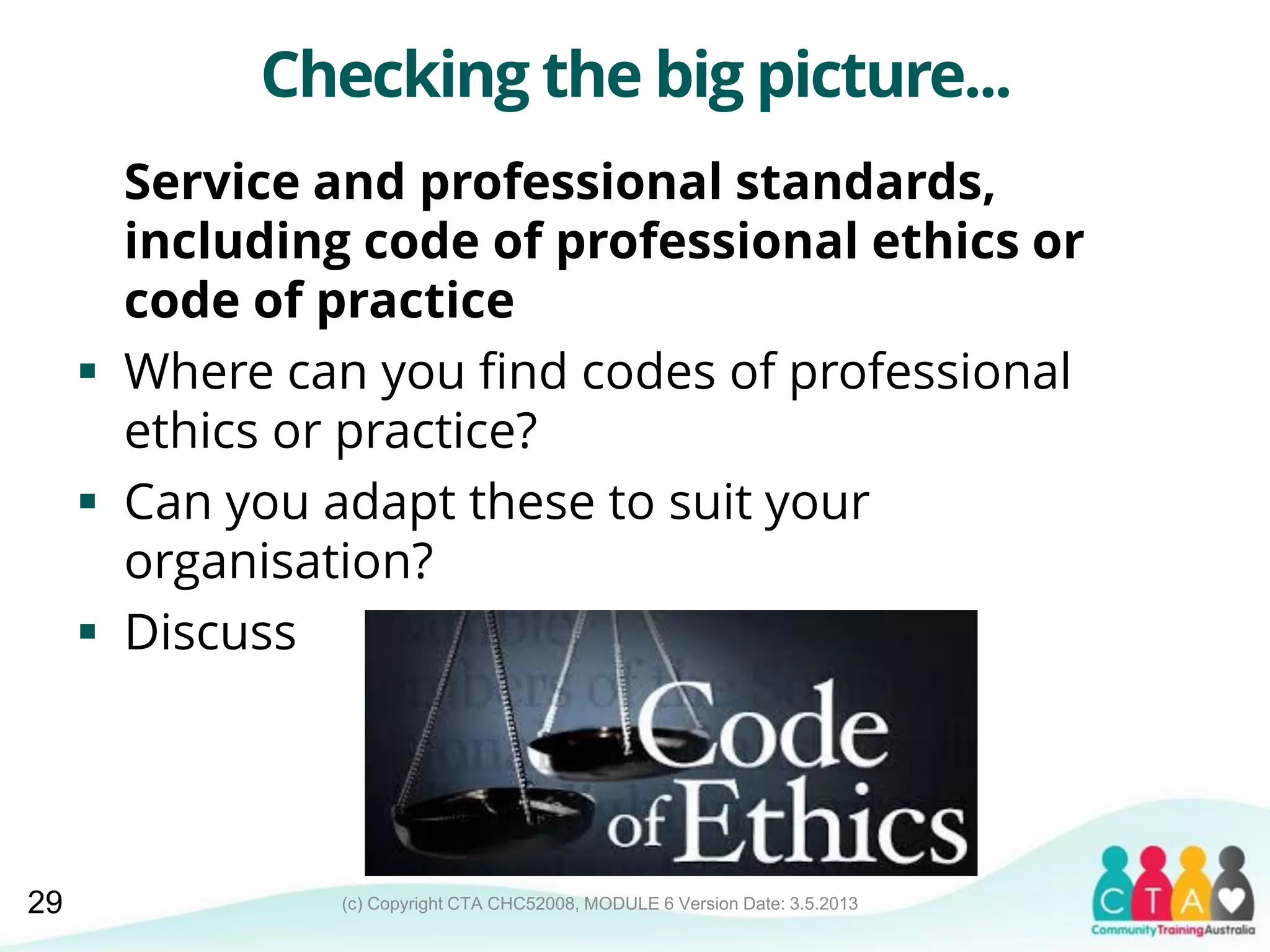
Checking the big picture...
Service and professional standards,
including code of professional ethics or
code of practice
 Where can you find codes of professional
ethics or practice?
 Can you adapt these to suit your
organisation?
 Discuss
29
(c) Copyright CTA CHC52008, MODULE 6 Version Date: 3.5.2013
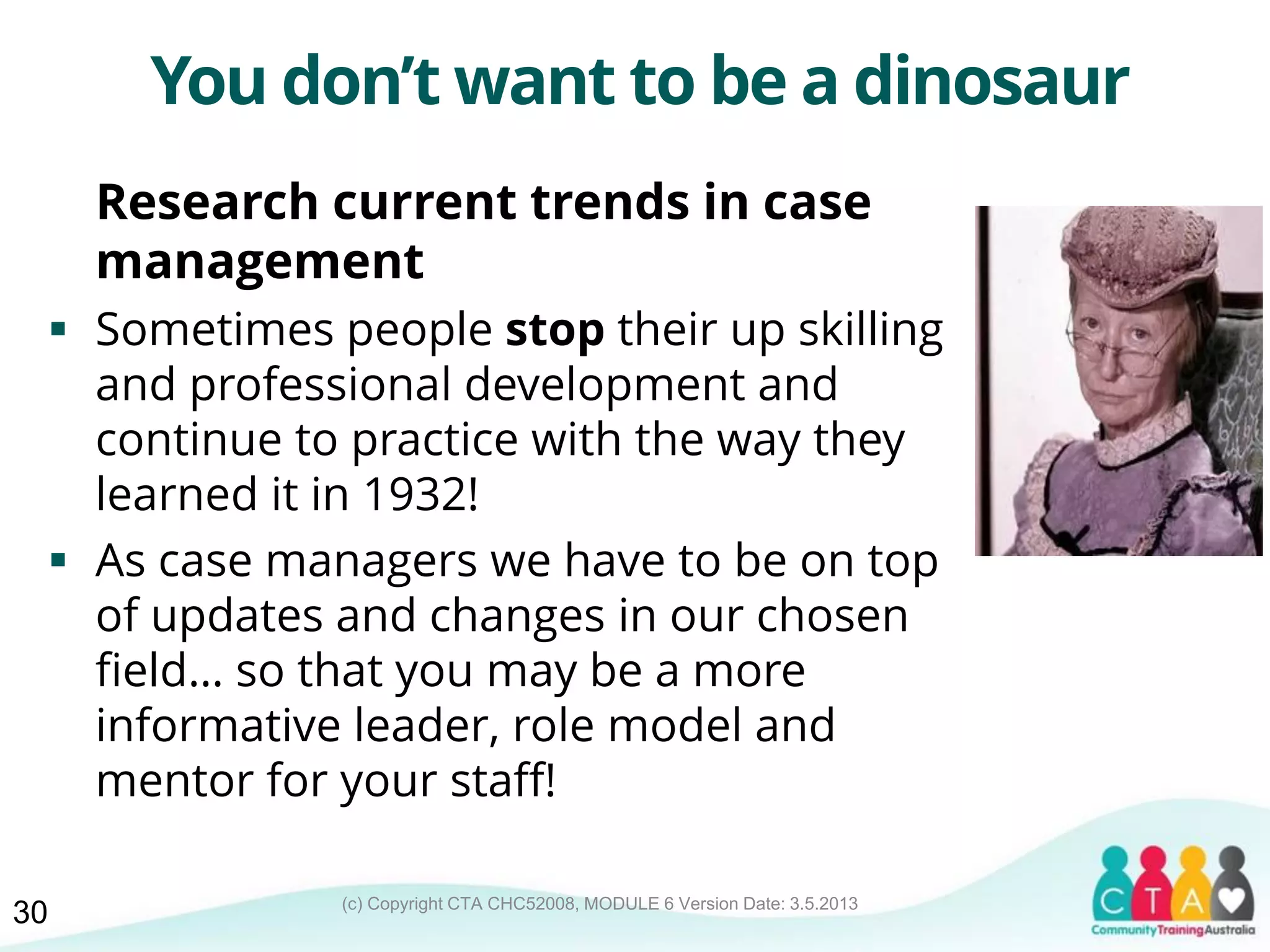
You don’t want to be a dinosaur
Research current trends in case
management
 Sometimes people stop their up skilling
and professional development and
continue to practice with the way they
learned it in 1932!
 As case managers we have to be on top
of updates and changes in our chosen
field… so that you may be a more
informative leader, role model and
mentor for your staff!
30
(c) Copyright CTA CHC52008, MODULE 6 Version Date: 3.5.2013
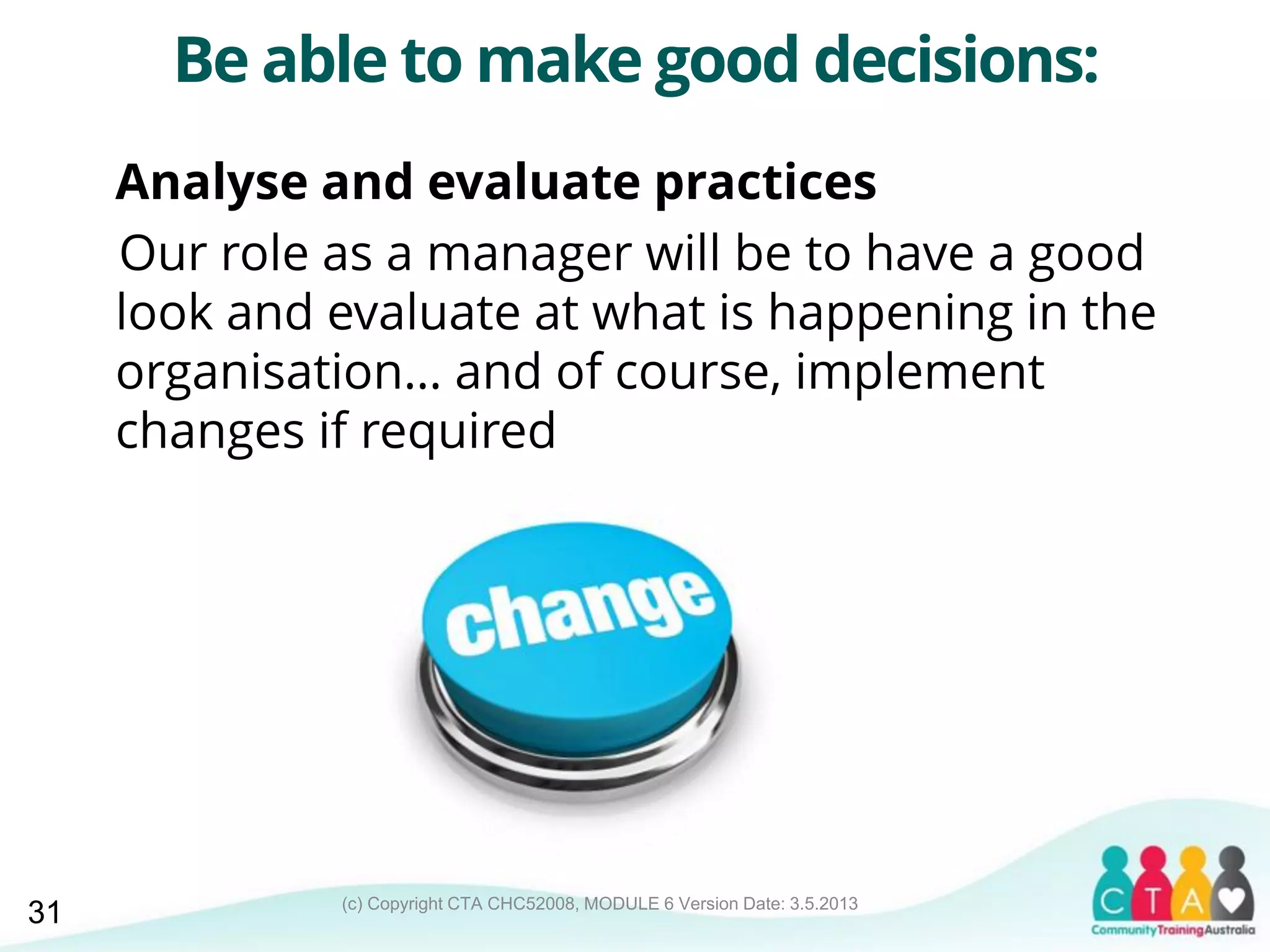
Be able to make good decisions:
Analyse and evaluate practices
Our role as a manager will be to have a good
look and evaluate at what is happening in the
organisation… and of course, implement
changes if required
31
(c) Copyright CTA CHC52008, MODULE 6 Version Date: 3.5.2013
Always getting better...
Plan for practice improvement
 Case Management practice doesn’t improve on its
own, it has to be planned for
 First you have that as your goal... set it
 Then constantly think of improvements that can
be made
 Then plan and schedule times to implement the
improvements...
 Monitor and review the changes; have the
changes had the desired effect? is any ‘fine-
tuning’ required?
32
(c) Copyright CTA CHC52008, MODULE 6 Version Date: 3.5.2013
Good luck
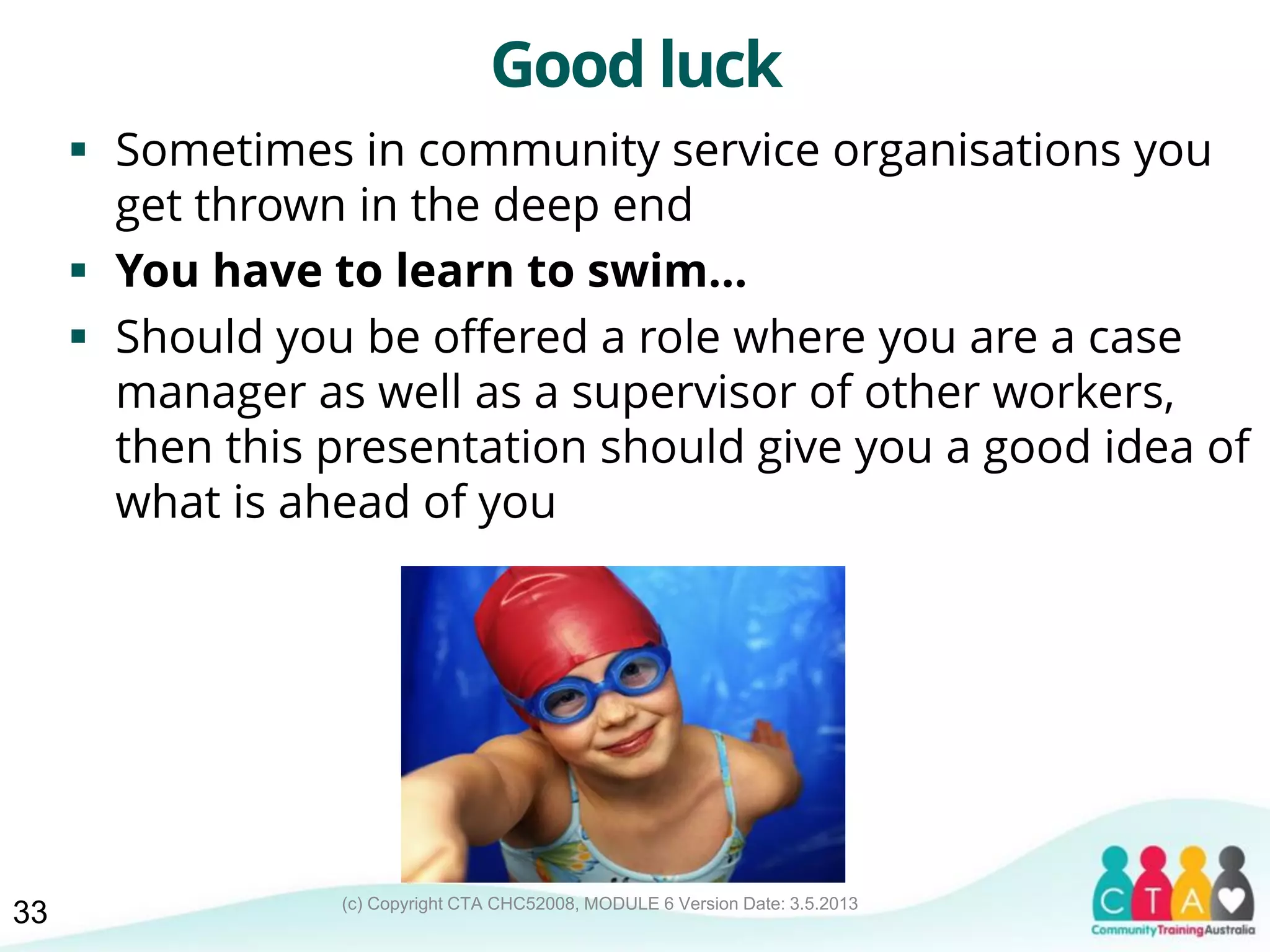
 Sometimes in community service organisations you
get thrown in the deep end
 You have to learn to swim...
 Should you be offered a role where you are a case
manager as well as a supervisor of other workers,
then this presentation should give you a good idea of
what is ahead of you
33

Module 6 chccm504 d promote high quality case management v 3.5.13

  • 1.
    (c) Copyright CTACHC52008, MODULE 6 Version Date: 3.5.2013 Diploma of Community Services (Case Management) Module 6 CHCCM504D: Promote High Quality Case Management 1
  • 2.
    (c) Copyright CTACHC52008, MODULE 6 Version Date: 3.5.2013 This unit is all about... Being a team leader or case management supervisor 2
  • 3.
    (c) Copyright CTACHC52008, MODULE 6 Version Date: 3.5.2013 In charge?  There may be a time in your case management practice that you are IN CHARGE of other workers and other case managers  This requires skills in a range of further areas  You not only need to know your own case management skills but you need to be able to supervise, support and lead others in the field! 3
  • 4.
    (c) Copyright CTACHC52008, MODULE 6 Version Date: 3.5.2013 It is a nice idea... What exactly does it involve?  Professional development and training programs  Practice reviews and audits  Organisation policy and procedures  Relevant program standards  Service and professional standards, including code of professional ethics or code of practice  Research current trends in case management  Analysis and evaluation of practices  Plans for practice improvement 4
  • 5.
    (c) Copyright CTACHC52008, MODULE 6 Version Date: 3.5.2013 You also need to have skills in:  role modeling  mentoring  facilitation of feedback  team management  high level report writing and documentation  research and analysis 5
  • 6.
    (c) Copyright CTACHC52008, MODULE 6 Version Date: 3.5.2013 You need to know the following:  Theory and practice of case management  Provisions of all relevant legislation and statutory requirements  Practice model of supervision  Codes of practice/ethics  Own value base and belief system 6
  • 7.
    (c) Copyright CTACHC52008, MODULE 6 Version Date: 3.5.2013 So let’s start with what you need to know .... Theory and practice of case management • While case management is a relatively new field it has grown quickly and has developed over the last 50 years into quite a well documented field • There are theories that underpin case management practice... • Let’s look at some of these: 7
  • 8.
    (c) Copyright CTACHC52008, MODULE 6 Version Date: 3.5.2013 Client Centred Practice: Carl Rogers  This approach to client care revolves around the notion that the client is their own expert and therefore it is important to consult them about their goals, hopes, aspirations and preferences!  This leads on to some of the main aspects of case management... that it is a collaborative process that empowers clients to take control of their own lives...  The plan is developed in collaboration with the client and reflects their choices and preferences for the service arrangements being developed. The goal is to empower the client and ensure that they are involved in all aspects of the planning and service arrangement in a dynamic way. Case Management Society of Australia 8
  • 9.
    (c) Copyright CTACHC52008, MODULE 6 Version Date: 3.5.2013 Solution Focused Strength Based Strategies: Shazer, Berg,  These approaches to client support involve the understanding that people grow and develop more when they feel they are already having success  St Luke’s adopted the Strength Based Approach with great success for families involved in Child Safety  They made their practice fun, honouring of difference and focusing on successes rather than on failures. It is also future orientated rather than dwelling in the mistakes of the past 9
  • 10.
    (c) Copyright CTACHC52008, MODULE 6 Version Date: 3.5.2013 Solution focused brief therapy (SFBT) Often referred to as simply 'solution focused therapy' or 'brief therapy', is a type of talking therapy that is based upon social constructionist philosophy. It focuses on what clients want to achieve through therapy rather than on the problem(s) that made them seek help. The approach does not focus on the past, but instead, focuses on the present and future 10
  • 11.
    (c) Copyright CTACHC52008, MODULE 6 Version Date: 3.5.2013 Strength Based Practice: Reynolds, Saleebey, Rapp, Weick • Strengths based practice is a social work practice theory that emphasises people's self determination and strengths. Strengths based practice is client led, with a focus on future outcomes and strengths that the people bring to a problem or crisis. A proto-theorist for this practice was social worker Bertha Reynolds, who criticised the American social work tendency to adopt a psychoanalytic approach (and the corollary dependence on the DSM IV) with clients. It was formally developed by a team from the University of Kansas 11
  • 12.
    (c) Copyright CTACHC52008, MODULE 6 Version Date: 3.5.2013 Systems Theory:  Systems theory relates to the understanding that there are many diverse systems interacting in our world, including family, work, government, health systems, etc.  The relationships to the eco-systems of nature forms the understanding that one system makes way for another until there is equilibrium  Mind mapping techniques work well in this framework and help us understand the many interlocking systems that human beings are involved in 12
  • 13.
    (c) Copyright CTACHC52008, MODULE 6 Version Date: 3.5.2013 Critical Theories  Critical social work is the application of social work from a critical theory perspective  Critical social work seeks to address social injustices, as opposed to focusing on individual people's problems  Critical theories explain social problems as arising from various forms of oppression  This theory is like all social work theories in that it is made up of a polyglot of theories from across the humanities and sciences, borrowing from many different schools of thought including Marxism, social democracy and anarchism 13
  • 14.
    (c) Copyright CTACHC52008, MODULE 6 Version Date: 3.5.2013 Theories...  There are some arguments that theories in the end come and go but the practices are what remains behind..  However as a Case Manager or Case Management Supervisor it is important to become acquainted with the various theories (and there are tons of them) over time and contemplate them and the practice that you are in charge of 14
  • 15.
    (c) Copyright CTACHC52008, MODULE 6 Version Date: 3.5.2013 Is it legal? Provisions of all relevant legislation and statutory requirements  One of the very important issues that you will need to be aware of is the relevant legislation for the work in client support and employee management  Changing legislation is something you need to be watching carefully  Where can you find this easily? The internet is a healthy source of information on changing legislation and statutory requirements  http://www.hreoc.gov.au/about/legislation/index.html Australian Human Rights Commission 15
  • 16.
    (c) Copyright CTACHC52008, MODULE 6 Version Date: 3.5.2013 How will you supervise others? Practice model of supervision • There are various models of supervision • It consists of the practitioner meeting regularly with another professional, not necessarily more senior, but normally with training in the skills of supervision, to discuss casework and other professional issues in a structured way. This is often known as clinical or counselling supervision or consultation. The purpose is to assist the practitioner to learn from his or her experience and progress in expertise, as well as to ensure good service to the client or patient. 16
  • 17.
    (c) Copyright CTACHC52008, MODULE 6 Version Date: 3.5.2013 Finding one that fits ...  Codes of practice/ethics  We can find these again on the Internet, look up Case Management Society of Australia…we can then use these codes to write our own that works and reflects our own particular values  Leadership style: Autocratic, Democratic, Strength Based, Laissez Faire, etc.  Discuss: What would each of these look like in practice?  Discuss: How easy is it to follow the examples we have had in our own life?  How hard is it to choose a practice model that we actually believe in? 17
  • 18.
    (c) Copyright CTACHC52008, MODULE 6 Version Date: 3.5.2013 When leading others ... Own value base and belief system  We never have to evaluate this more carefully than when we have responsibility for others  Where have our values and beliefs come from? are they completely static?  Have they moved over time and how well are we able to work with others with different ideas and values?  Are we going to impose ours?  Discuss 18
  • 19.
    (c) Copyright CTACHC52008, MODULE 6 Version Date: 3.5.2013 Then the personal skills... Role modeling • Monkey see, monkey do • How will you demonstrate the behaviours and values that you want to see in others in the workplace? 19
  • 20.
    (c) Copyright CTACHC52008, MODULE 6 Version Date: 3.5.2013 Helping someone find their feet... Mentoring  How great is it to be believed in by someone in charge… and how wonderful it is to be helped to become all that you can be!  This is an unselfish gift and very different to what we see in a lot of workplaces where the focus is on ‘climbing the ladder’ 20
  • 21.
    (c) Copyright CTACHC52008, MODULE 6 Version Date: 3.5.2013 People need to have their say! Facilitation of feedback • It’s not just your thoughts and words as a supervisor that counts… we all have the need to have input… • But this can come as negative rabble, backbiting, dominating etc. • To facilitate feedback from all colleagues and all stakeholders in case management practice is a very important skill… • Discuss: How do you think you can do this? (take to the white board come up with some ideas) 21
  • 22.
    (c) Copyright CTACHC52008, MODULE 6 Version Date: 3.5.2013 To manage a group of people... Team management • Its easy to criticise a manager but it’s another thing to have to do it yourself! • Discuss – What are all of the aspects of managing a team that you can think of. – What tools might you need to do this well? (Use the white board) 22
  • 23.
    (c) Copyright CTACHC52008, MODULE 6 Version Date: 3.5.2013 If you don’t already enjoy report writing – you soon will!  High level report writing and documentation  One of the hardest things to do for ‘people’ is to keep your documentation in order and to keep on top of writing reports  One of the kindest things you can do for yourself and your team is to create ‘proformas’. Proformas ensure that all the information that needs to be documented is easily completed  Your team can help create the proforma  Proformas help people who find writing things down difficult as well as for those who have to read the and check the documents... that’s you! 23
  • 24.
    (c) Copyright CTACHC52008, MODULE 6 Version Date: 3.5.2013 Thank Goodness for the Internet! Research and analysis As a manager you will have to find out more information about all sorts of things: – Specific client conditions – Ways of doing things – Legislation, WHS – Codes of conduct, employee/employer relations – Management strategies You must be able to use the internet We will practice this in our assessment so that you know what you are in for! 24
  • 25.
    (c) Copyright CTACHC52008, MODULE 6 Version Date: 3.5.2013 In addition... Professional development and training programs  Establish any up skilling and professional development your team and/or individuals may require  Assist staff to create their development plan, providing constant feedback and support  Encourage staff involvement in training programs, This is often a great time for team building activities to take place  Try to make professional development really fun and enjoyable 25
  • 26.
    (c) Copyright CTACHC52008, MODULE 6 Version Date: 3.5.2013 Check ... Practice reviews and audits  This is kind of like a fire drill for your paperwork and service standards  Think about ways of getting ready for formal reviews or audits by having ‘practice ones’: – Let people know that you will do some ‘spot’ checks to ensure policies and procedures are being adhered to – for example home visits, have they happened? – paperwork up to date? Etc. 26
  • 27.
    (c) Copyright CTACHC52008, MODULE 6 Version Date: 3.5.2013 Your guidelines and the way you carry them out: Organisation policy and procedures • Policies and procedures move and change over time but somebody, namely you, needs to be in charge of implementing and updating the changes… ensuring everyone is aware of the changes and are on the same page • Sometimes it may take a disaster to identify that a change in policy and procedure is required… but that’s ok they are living documents and you can’t be a crystal ball gazer. None of us know everything that may possibly happen within a service! 27
  • 28.
    (c) Copyright CTACHC52008, MODULE 6 Version Date: 3.5.2013 Forming benchmarks Relevant program standards  This is about thinking through your programs and working out the standards that you want to provide your staff and clients  For example: case managers to meet with their clients weekly, holding weekly team meetings, providing SMS messages for clients to remind them of appointments  These are the quality standards that keep your services world class  Discuss: What other ideas do you have? 28
  • 29.
    (c) Copyright CTACHC52008, MODULE 6 Version Date: 3.5.2013 Checking the big picture... Service and professional standards, including code of professional ethics or code of practice  Where can you find codes of professional ethics or practice?  Can you adapt these to suit your organisation?  Discuss 29
  • 30.
    (c) Copyright CTACHC52008, MODULE 6 Version Date: 3.5.2013 You don’t want to be a dinosaur Research current trends in case management  Sometimes people stop their up skilling and professional development and continue to practice with the way they learned it in 1932!  As case managers we have to be on top of updates and changes in our chosen field… so that you may be a more informative leader, role model and mentor for your staff! 30
  • 31.
    (c) Copyright CTACHC52008, MODULE 6 Version Date: 3.5.2013 Be able to make good decisions: Analyse and evaluate practices Our role as a manager will be to have a good look and evaluate at what is happening in the organisation… and of course, implement changes if required 31
  • 32.
    (c) Copyright CTACHC52008, MODULE 6 Version Date: 3.5.2013 Always getting better... Plan for practice improvement  Case Management practice doesn’t improve on its own, it has to be planned for  First you have that as your goal... set it  Then constantly think of improvements that can be made  Then plan and schedule times to implement the improvements...  Monitor and review the changes; have the changes had the desired effect? is any ‘fine- tuning’ required? 32
  • 33.
    (c) Copyright CTACHC52008, MODULE 6 Version Date: 3.5.2013 Good luck  Sometimes in community service organisations you get thrown in the deep end  You have to learn to swim...  Should you be offered a role where you are a case manager as well as a supervisor of other workers, then this presentation should give you a good idea of what is ahead of you 33