ESMYA
O
N
CH3
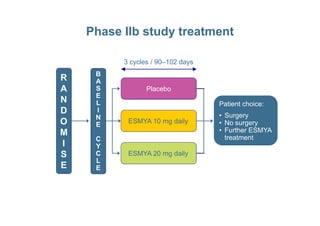
H3C OCH3
OCCH3
O
1.Chabbert-Buffet et al. J Clin Endocrinol Metab 2007;92:3582–3589
Dr. Francisco Vázquez Fernández
Introduction to ESMYA
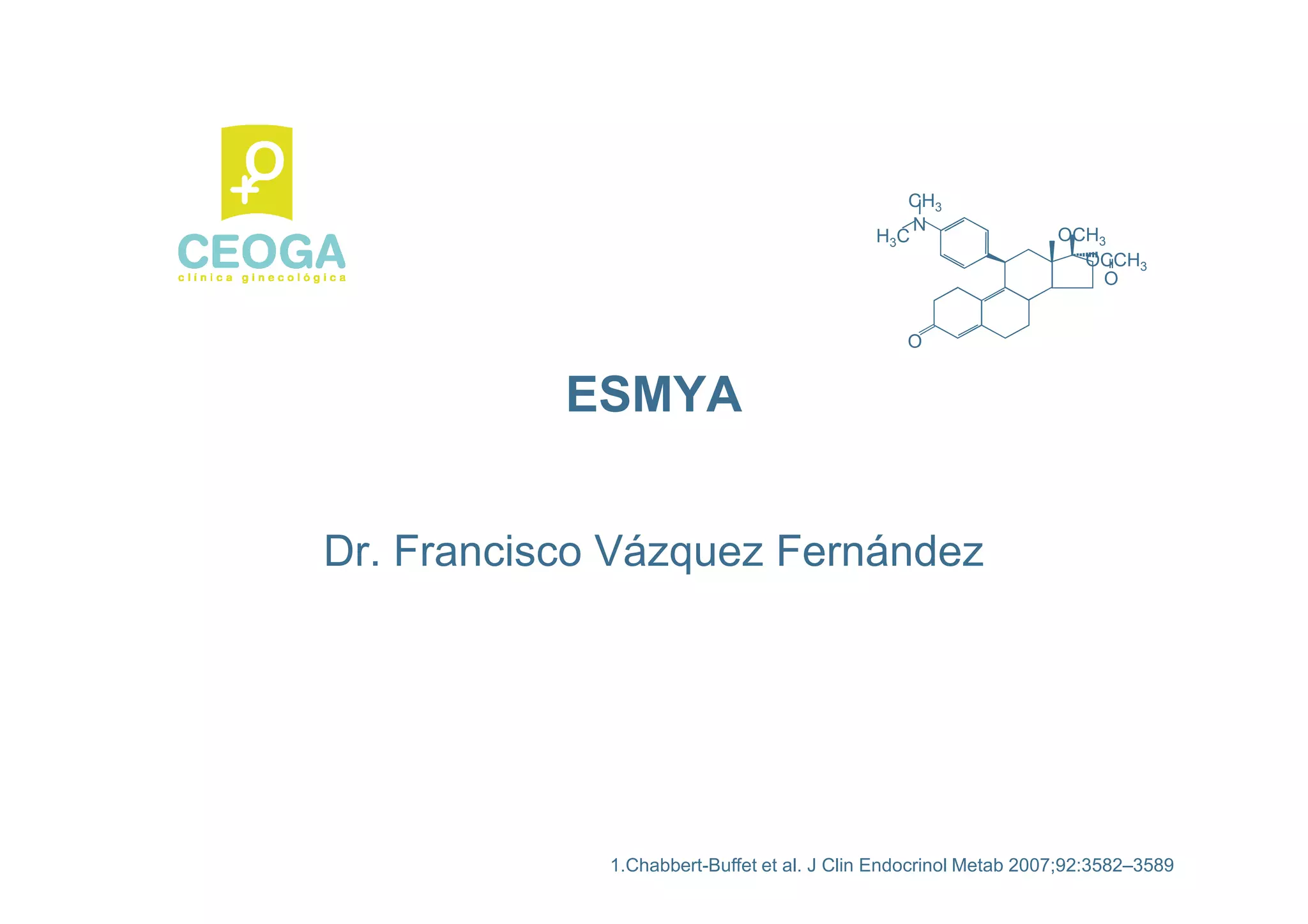
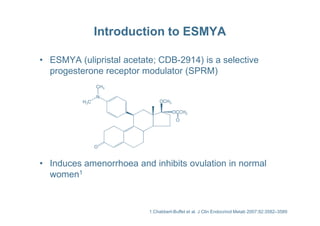
• ESMYA (ulipristal acetate; CDB-2914) is a selective
progesterone receptor modulator (SPRM)
N
CH3
H3C OCH3
OCCH3
• Induces amenorrhoea and inhibits ovulation in normal
women1
O
OCCH3
O
1.Chabbert-Buffet et al. J Clin Endocrinol Metab 2007;92:3582–3589
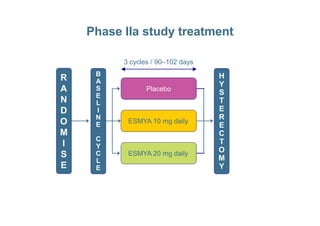
Phase IIa study treatment
Placebo
3 cycles / 90–102 days
B
A
S
E
L
I
H
Y
S
T
E
R
R
A
N
D
ESMYA 10 mg daily
ESMYA 20 mg daily
I
N
E
C
Y
C
L
E
R
E
C
T
O
M
Y
D
O
M
I
S
E
Phase IIb study treatment
Patient choice:
• Surgery
Placebo
3 cycles / 90–102 days
B
A
S
E
L
I
R
A
N
D • Surgery
• No surgery
• Further ESMYA
treatment
ESMYA 10 mg daily
ESMYA 20 mg daily
I
N
E
C
Y
C
L
E
D
O
M
I
S
E
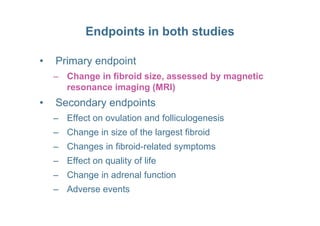
Endpoints in both studies
• Primary endpoint
– Change in fibroid size, assessed by magnetic
resonance imaging (MRI)
• Secondary endpoints
– Effect on ovulation and folliculogenesis– Effect on ovulation and folliculogenesis
– Change in size of the largest fibroid
– Changes in fibroid-related symptoms
– Effect on quality of life
– Change in adrenal function
– Adverse events
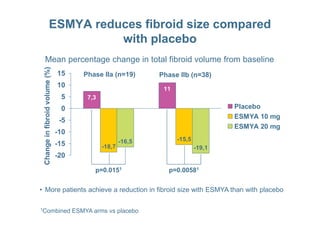
ESMYA reduces fibroid size compared
with placebo
7,3
11
0
5
10
15
Changeinfibroidvolume(%)
Placebo
ESMYA 10 mg
Mean percentage change in total fibroid volume from baseline
Phase IIa (n=19) Phase IIb (n=38)
-18,7
-15,5-16,5
-19,1
-20
-15
-10
-5
Changeinfibroidvolume(%)
ESMYA 10 mg
ESMYA 20 mg
p=0.0151
1Combined ESMYA arms vs placebo
p=0.00581
• More patients achieve a reduction in fibroid size with ESMYA than with placebo
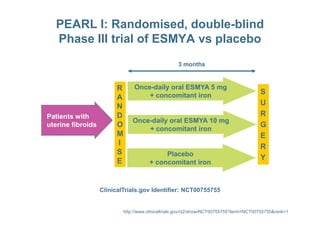
PEARL I: Randomised, double-blind
Phase III trial of ESMYA vs placebo
R
A
N
D
S
U
RPatients with
3 months
Once-daily oral ESMYA 5 mg
+ concomitant iron
D
O
M
I
S
E
R
G
E
R
Y
Patients with
uterine fibroids
http://www.clinicaltrials.gov/ct2/show/NCT00755755?term=NCT00755755&rank=1
Once-daily oral ESMYA 10 mg
+ concomitant iron
Placebo
+ concomitant iron
ClinicalTrials.gov Identifier: NCT00755755
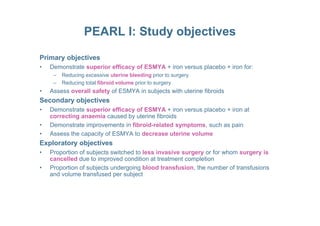
PEARL I: Study objectives
Primary objectives
• Demonstrate superior efficacy of ESMYA + iron versus placebo + iron for:
– Reducing excessive uterine bleeding prior to surgery
– Reducing total fibroid volume prior to surgery
• Assess overall safety of ESMYA in subjects with uterine fibroids
Secondary objectives
• Demonstrate superior efficacy of ESMYA + iron versus placebo + iron at
correcting anaemia caused by uterine fibroidscorrecting anaemia caused by uterine fibroids
• Demonstrate improvements in fibroid-related symptoms, such as pain
• Assess the capacity of ESMYA to decrease uterine volume
Exploratory objectives
• Proportion of subjects switched to less invasive surgery or for whom surgery is
cancelled due to improved condition at treatment completion
• Proportion of subjects undergoing blood transfusion, the number of transfusions
and volume transfused per subject
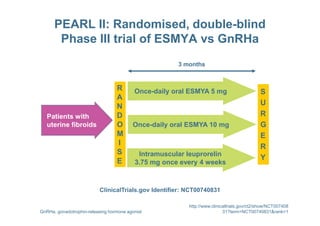
PEARL II: Randomised, double-blind
Phase III trial of ESMYA vs GnRHa
R
A
N
D
S
U
RPatients with
3 months
Once-daily oral ESMYA 5 mg
http://www.clinicaltrials.gov/ct2/show/NCT007408
31?term=NCT00740831&rank=1GnRHa, gonadotrophin-releasing hormone agonist
D
O
M
I
S
E
R
G
E
R
Y
Patients with
uterine fibroids Once-daily oral ESMYA 10 mg
Intramuscular leuprorelin
3.75 mg once every 4 weeks
ClinicalTrials.gov Identifier: NCT00740831
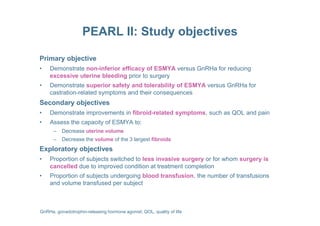
PEARL II: Study objectives
Primary objective
• Demonstrate non-inferior efficacy of ESMYA versus GnRHa for reducing
excessive uterine bleeding prior to surgery
• Demonstrate superior safety and tolerability of ESMYA versus GnRHa for
castration-related symptoms and their consequences
Secondary objectives
• Demonstrate improvements in fibroid-related symptoms, such as QOL and pain• Demonstrate improvements in fibroid-related symptoms, such as QOL and pain
• Assess the capacity of ESMYA to:
– Decrease uterine volume
– Decrease the volume of the 3 largest fibroids
Exploratory objectives
• Proportion of subjects switched to less invasive surgery or for whom surgery is
cancelled due to improved condition at treatment completion
• Proportion of subjects undergoing blood transfusion, the number of transfusions
and volume transfused per subject
GnRHa, gonadotrophin-releasing hormone agonist; QOL, quality of life
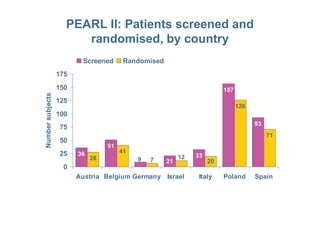
PEARL II: Patients screened and
randomised, by country
157
126
100
125
150
175
Numbersubjects
Screened Randomised
36
51
21
33
93
28
41
20
71
9 7 12
0
25
50
75
100
Austria Belgium Germany Israel Italy Poland Spain
Numbersubjects
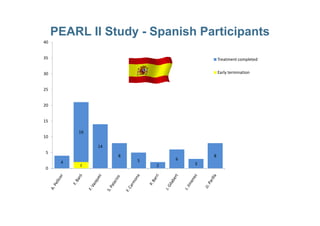
PEARL II Study - Spanish Participants
20
25
30
35
40
Treatment completed
Early termination
2
4
19
14
8
5
2
6
3
8
0
5
10
15
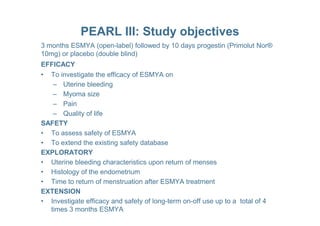
3 months ESMYA (open-label) followed by 10 days progestin (Primolut Nor®
10mg) or placebo (double blind)
EFFICACY
• To investigate the efficacy of ESMYA on
– Uterine bleeding
– Myoma size
– Pain
– Quality of life
PEARL III: Study objectives
– Quality of life
SAFETY
• To assess safety of ESMYA
• To extend the existing safety database
EXPLORATORY
• Uterine bleeding characteristics upon return of menses
• Histology of the endometrium
• Time to return of menstruation after ESMYA treatment
EXTENSION
• Investigate efficacy and safety of long-term on-off use up to a total of 4
times 3 months ESMYA
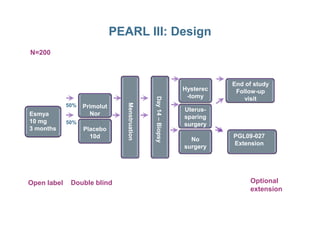
Esmya
Primolut
Nor
Menstruation
Day14
Hysterec
-tomy
End of study
Follow-up
visit
50%
N=200
Uterus-
PEARL III: Design
Esmya
10 mg
3 months
Nor
10mg
Placebo
10d
Menstruation
Day14–Biopsy
No
surgery
PGL09-027
Extension
50%
Double blindOpen label Optional
extension
sparing
surgery
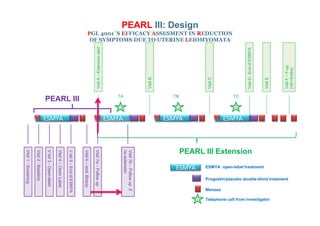
PEARL III: Design
PGL 4001´S EFFICACY ASSESMENT IN REDUCTION
OF SYMPTOMS DUE TO UTERINE LEIOMYOMATA
PEARL III VisitA–Extensionstart
VisitB
VisitC
VisitE
VisitF–F-up
(VE+3mths)
VisitD–EndofESMYA
TA TB TC
ESMYA ESMYA ESMYAESMYA
PEARL III Extension
Visit1-Screening
Visit2-Baseline
Visit6–end.Biopsy
Visit4–OpenLabel
Visit3-Open-label
Visit5–EndofESMYA
Visit7a–Followup
ESMYA ESMYA open-label treatment
Progestin/placebo double-blind treatment
Menses
Telephone call from investigator
Visit7b–Followupif
noextension

Esmya

  • 1.
    ESMYA O N CH3 H3C OCH3 OCCH3 O 1.Chabbert-Buffet etal. J Clin Endocrinol Metab 2007;92:3582–3589 Dr. Francisco Vázquez Fernández
  • 2.
    Introduction to ESMYA •ESMYA (ulipristal acetate; CDB-2914) is a selective progesterone receptor modulator (SPRM) N CH3 H3C OCH3 OCCH3 • Induces amenorrhoea and inhibits ovulation in normal women1 O OCCH3 O 1.Chabbert-Buffet et al. J Clin Endocrinol Metab 2007;92:3582–3589
  • 3.
    Phase IIa studytreatment Placebo 3 cycles / 90–102 days B A S E L I H Y S T E R R A N D ESMYA 10 mg daily ESMYA 20 mg daily I N E C Y C L E R E C T O M Y D O M I S E
  • 4.
    Phase IIb studytreatment Patient choice: • Surgery Placebo 3 cycles / 90–102 days B A S E L I R A N D • Surgery • No surgery • Further ESMYA treatment ESMYA 10 mg daily ESMYA 20 mg daily I N E C Y C L E D O M I S E
  • 5.
    Endpoints in bothstudies • Primary endpoint – Change in fibroid size, assessed by magnetic resonance imaging (MRI) • Secondary endpoints – Effect on ovulation and folliculogenesis– Effect on ovulation and folliculogenesis – Change in size of the largest fibroid – Changes in fibroid-related symptoms – Effect on quality of life – Change in adrenal function – Adverse events
  • 6.
    ESMYA reduces fibroidsize compared with placebo 7,3 11 0 5 10 15 Changeinfibroidvolume(%) Placebo ESMYA 10 mg Mean percentage change in total fibroid volume from baseline Phase IIa (n=19) Phase IIb (n=38) -18,7 -15,5-16,5 -19,1 -20 -15 -10 -5 Changeinfibroidvolume(%) ESMYA 10 mg ESMYA 20 mg p=0.0151 1Combined ESMYA arms vs placebo p=0.00581 • More patients achieve a reduction in fibroid size with ESMYA than with placebo
  • 7.
    PEARL I: Randomised,double-blind Phase III trial of ESMYA vs placebo R A N D S U RPatients with 3 months Once-daily oral ESMYA 5 mg + concomitant iron D O M I S E R G E R Y Patients with uterine fibroids http://www.clinicaltrials.gov/ct2/show/NCT00755755?term=NCT00755755&rank=1 Once-daily oral ESMYA 10 mg + concomitant iron Placebo + concomitant iron ClinicalTrials.gov Identifier: NCT00755755
  • 8.
    PEARL I: Studyobjectives Primary objectives • Demonstrate superior efficacy of ESMYA + iron versus placebo + iron for: – Reducing excessive uterine bleeding prior to surgery – Reducing total fibroid volume prior to surgery • Assess overall safety of ESMYA in subjects with uterine fibroids Secondary objectives • Demonstrate superior efficacy of ESMYA + iron versus placebo + iron at correcting anaemia caused by uterine fibroidscorrecting anaemia caused by uterine fibroids • Demonstrate improvements in fibroid-related symptoms, such as pain • Assess the capacity of ESMYA to decrease uterine volume Exploratory objectives • Proportion of subjects switched to less invasive surgery or for whom surgery is cancelled due to improved condition at treatment completion • Proportion of subjects undergoing blood transfusion, the number of transfusions and volume transfused per subject
  • 9.
    PEARL II: Randomised,double-blind Phase III trial of ESMYA vs GnRHa R A N D S U RPatients with 3 months Once-daily oral ESMYA 5 mg http://www.clinicaltrials.gov/ct2/show/NCT007408 31?term=NCT00740831&rank=1GnRHa, gonadotrophin-releasing hormone agonist D O M I S E R G E R Y Patients with uterine fibroids Once-daily oral ESMYA 10 mg Intramuscular leuprorelin 3.75 mg once every 4 weeks ClinicalTrials.gov Identifier: NCT00740831
  • 10.
    PEARL II: Studyobjectives Primary objective • Demonstrate non-inferior efficacy of ESMYA versus GnRHa for reducing excessive uterine bleeding prior to surgery • Demonstrate superior safety and tolerability of ESMYA versus GnRHa for castration-related symptoms and their consequences Secondary objectives • Demonstrate improvements in fibroid-related symptoms, such as QOL and pain• Demonstrate improvements in fibroid-related symptoms, such as QOL and pain • Assess the capacity of ESMYA to: – Decrease uterine volume – Decrease the volume of the 3 largest fibroids Exploratory objectives • Proportion of subjects switched to less invasive surgery or for whom surgery is cancelled due to improved condition at treatment completion • Proportion of subjects undergoing blood transfusion, the number of transfusions and volume transfused per subject GnRHa, gonadotrophin-releasing hormone agonist; QOL, quality of life
  • 11.
    PEARL II: Patientsscreened and randomised, by country 157 126 100 125 150 175 Numbersubjects Screened Randomised 36 51 21 33 93 28 41 20 71 9 7 12 0 25 50 75 100 Austria Belgium Germany Israel Italy Poland Spain Numbersubjects
  • 12.
    PEARL II Study- Spanish Participants 20 25 30 35 40 Treatment completed Early termination 2 4 19 14 8 5 2 6 3 8 0 5 10 15
  • 13.
    3 months ESMYA(open-label) followed by 10 days progestin (Primolut Nor® 10mg) or placebo (double blind) EFFICACY • To investigate the efficacy of ESMYA on – Uterine bleeding – Myoma size – Pain – Quality of life PEARL III: Study objectives – Quality of life SAFETY • To assess safety of ESMYA • To extend the existing safety database EXPLORATORY • Uterine bleeding characteristics upon return of menses • Histology of the endometrium • Time to return of menstruation after ESMYA treatment EXTENSION • Investigate efficacy and safety of long-term on-off use up to a total of 4 times 3 months ESMYA
  • 14.
    Esmya Primolut Nor Menstruation Day14 Hysterec -tomy End of study Follow-up visit 50% N=200 Uterus- PEARLIII: Design Esmya 10 mg 3 months Nor 10mg Placebo 10d Menstruation Day14–Biopsy No surgery PGL09-027 Extension 50% Double blindOpen label Optional extension sparing surgery
  • 15.
    PEARL III: Design PGL4001´S EFFICACY ASSESMENT IN REDUCTION OF SYMPTOMS DUE TO UTERINE LEIOMYOMATA PEARL III VisitA–Extensionstart VisitB VisitC VisitE VisitF–F-up (VE+3mths) VisitD–EndofESMYA TA TB TC ESMYA ESMYA ESMYAESMYA PEARL III Extension Visit1-Screening Visit2-Baseline Visit6–end.Biopsy Visit4–OpenLabel Visit3-Open-label Visit5–EndofESMYA Visit7a–Followup ESMYA ESMYA open-label treatment Progestin/placebo double-blind treatment Menses Telephone call from investigator Visit7b–Followupif noextension