ESET Research Whitepapers  //  January 2018 // Author: Filip Kafka
ESET’S GUIDE TO
DEOBFUSCATING
AND
DEVIRTUALIZING
FINFISHER
ESET’s guide to deobfuscating and devirtualizing FinFisher2
CONTENTS
Introduction	3
Anti-disassembly	4
FinFisher’s virtual machine	 7
Terms and definitions	 8
Vm_start	8
FinFisher’s interpreter	 10
1. Creating an IDA graph	 10
2. Vm_dispatcher	 11
3. Vm_context	 12
4. Virtual instruction implementations – vm_handlers	 14
5. Writing your own disassembler	 17
6. Understanding the implementation of this virtual machine	 19
7. Automating the disassembly process for more FinFisher samples	 20
8. Compiling disassembled code without the VM	 20
Conclusion	22
Appendix A: IDA Python script for naming FinFisher vm_handlers	 23
ESET’s guide to deobfuscating and devirtualizing FinFisher3
Thanks to its strong anti-analysis measures, the
FinFisher spyware has gone largely unexplored.
Despite being a prominent surveillance tool,
only partial analyses have been published on its
more recent samples.
Things were put in motion in the summer
of 2017 with ESET’s analysis of FinFisher
surveillance campaigns that ESET had
discovered in several countries. In the course of
our research, we have identified campaigns where
internet service providers most probably played
the key role in compromising the victims with
FinFisher.
When we started thoroughly analyzing this
malware, the main part of our effort was
overcoming FinFisher’s anti-analysis measures
in its Windows versions. The combination
of advanced obfuscation techniques and
proprietary virtualization makes FinFisher very
hard to de-cloak.
To share what we learnt in de-cloaking this
malware, we have created this guide to help
others take a peek inside FinFisher and analyze
it. Apart from offering practical insight into
analyzing FinFisher’s virtual machine, the
guide can also help readers to understand
virtual machine protection in general – that
is, proprietary virtual machines found inside a
binary and used for software protection. We
will not be discussing virtual machines used in
interpreted programming languages to provide
compatibility across various platforms, such as
the Java VM.
We have also analyzed Android versions of
FinFisher, whose protection mechanism is based
on an open source LLVM obfuscator. It is not as
sophisticated or interesting as the protection
mechanism used in the Windows versions, thus
we will not be discussing it in this guide.
Hopefully, experts from security researchers to
malware analysts will make use of this guide to
better understand FinFisher’s tools and tactics,
and to protect their customers against this
omnipotent security and privacy threat.
INTRODUCTION
ESET’s guide to deobfuscating and devirtualizing FinFisher4
ANTI-
DISASSEMBLY
When we open a FinFisher sample in IDA Pro,
the first protection we notice in the main
function is a simple, yet very effective, anti-
disassembly trick.
FinFisher uses a common anti-disassembly
technique – hiding the execution flow by
replacing one unconditional jump with two
complementary, conditional jumps. These
conditional jumps both target the same
location, so regardless of which jump is made,
the same effective code execution flow results.
The conditional jumps are then followed by
garbage bytes. These are meant to misdirect the
disassembler, which normally will not recognize
that they are dead code, and will steam on,
disassembling garbage code.
What makes this malware special is the way
in which it uses this technique. In most other
malware we’ve analyzed, it is only used a few
times. FinFisher, however, uses this trick after
every single instruction.
This protection is very effective at fooling the
disassembler – many parts of the code aren’t
disassembled properly. And of course, it is
impossible to use the graph mode in IDA Pro.
Our first task will be to get rid of this anti-
disassembly protection.
The code was clearly not obfuscated manually
but with an automated tool and we can observe
a pattern in all the jump pairs.
There are two different types of jump pairs –
near jump with a 32-bit offset and short jump
with an 8-bit offset.
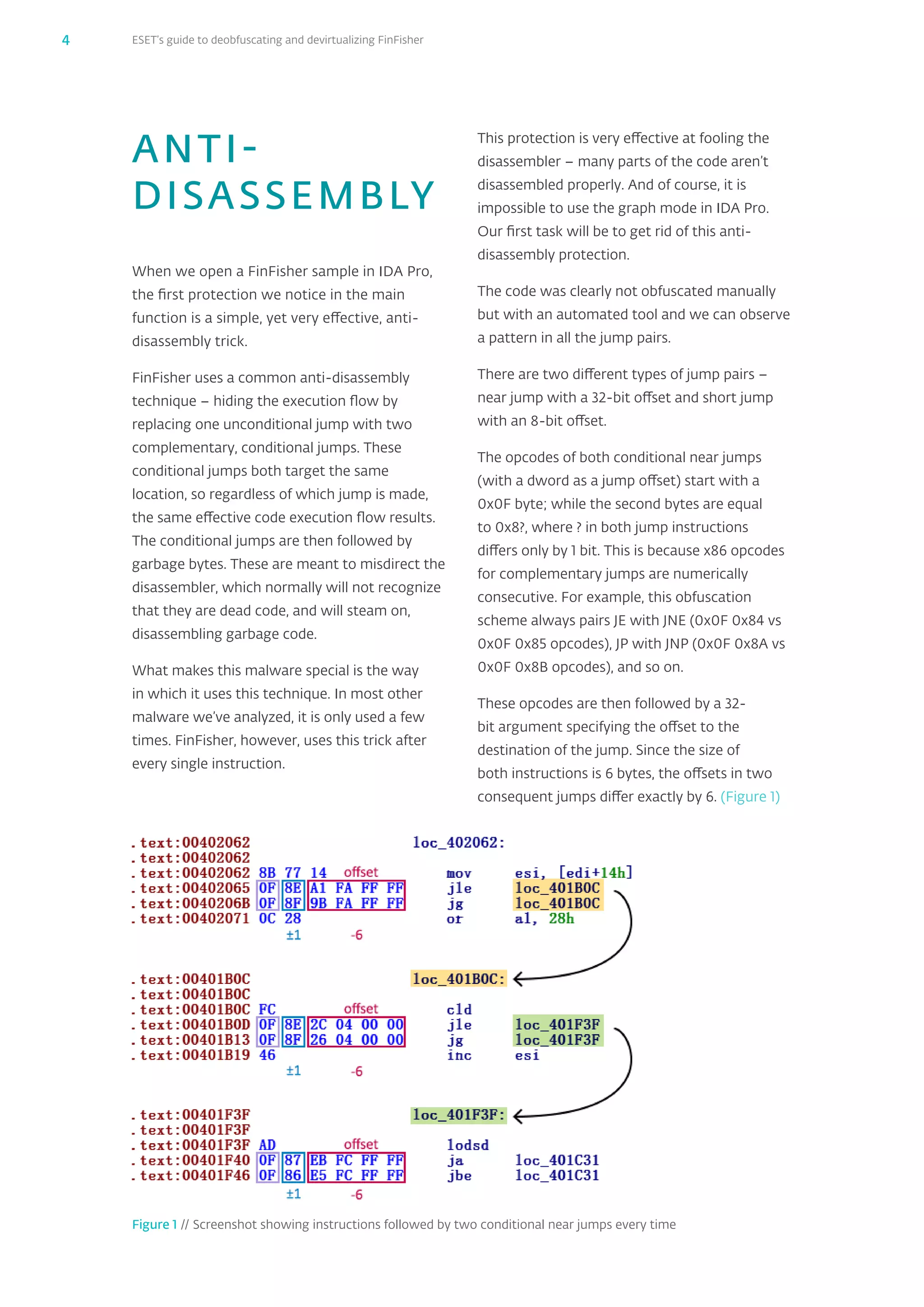
The opcodes of both conditional near jumps
(with a dword as a jump offset) start with a
0x0F byte; while the second bytes are equal
to 0x8?, where ? in both jump instructions
differs only by 1 bit. This is because x86 opcodes
for complementary jumps are numerically
consecutive. For example, this obfuscation
scheme always pairs JE with JNE (0x0F 0x84 vs
0x0F 0x85 opcodes), JP with JNP (0x0F 0x8A vs
0x0F 0x8B opcodes), and so on.
These opcodes are then followed by a 32-
bit argument specifying the offset to the
destination of the jump. Since the size of
both instructions is 6 bytes, the offsets in two
consequent jumps differ exactly by 6. (Figure 1)
Figure 1 // Screenshot showing instructions followed by two conditional near jumps every time
ESET’s guide to deobfuscating and devirtualizing FinFisher5
For example, the code below can be used to detect two of these consecutive conditional jumps:
def is_jump_near_pair(addr):
jcc1 = Byte(addr+1)
jcc2 = Byte(addr+7)
# do they start like near conditional jumps?
if Byte(addr) != 0x0F || Byte(addr+6) != 0x0F:
	 return False
# are there really 2 consequent near conditional jumps?
if (jcc1  0xF0 != 0x80) || (jcc2  0xF0 != 0x80):
	 return False
# are the conditional jumps complementary?
if abs(jcc1-jcc2) != 1:
	 return False
# do those 2 conditional jumps point to the same destination?
dst1 = Dword(addr+2)
dst2 = Dword(addr+8)
if dst1-dst2 != 6:
	 return False
return True
Deobfuscation of short jumps is based on the
same idea, only the constants are different.
The opcode of a short conditional jump equals
0x7?, and is followed by one byte – the jump
offset. So again, when we want to detect two
consecutive, conditional near jumps, we have to
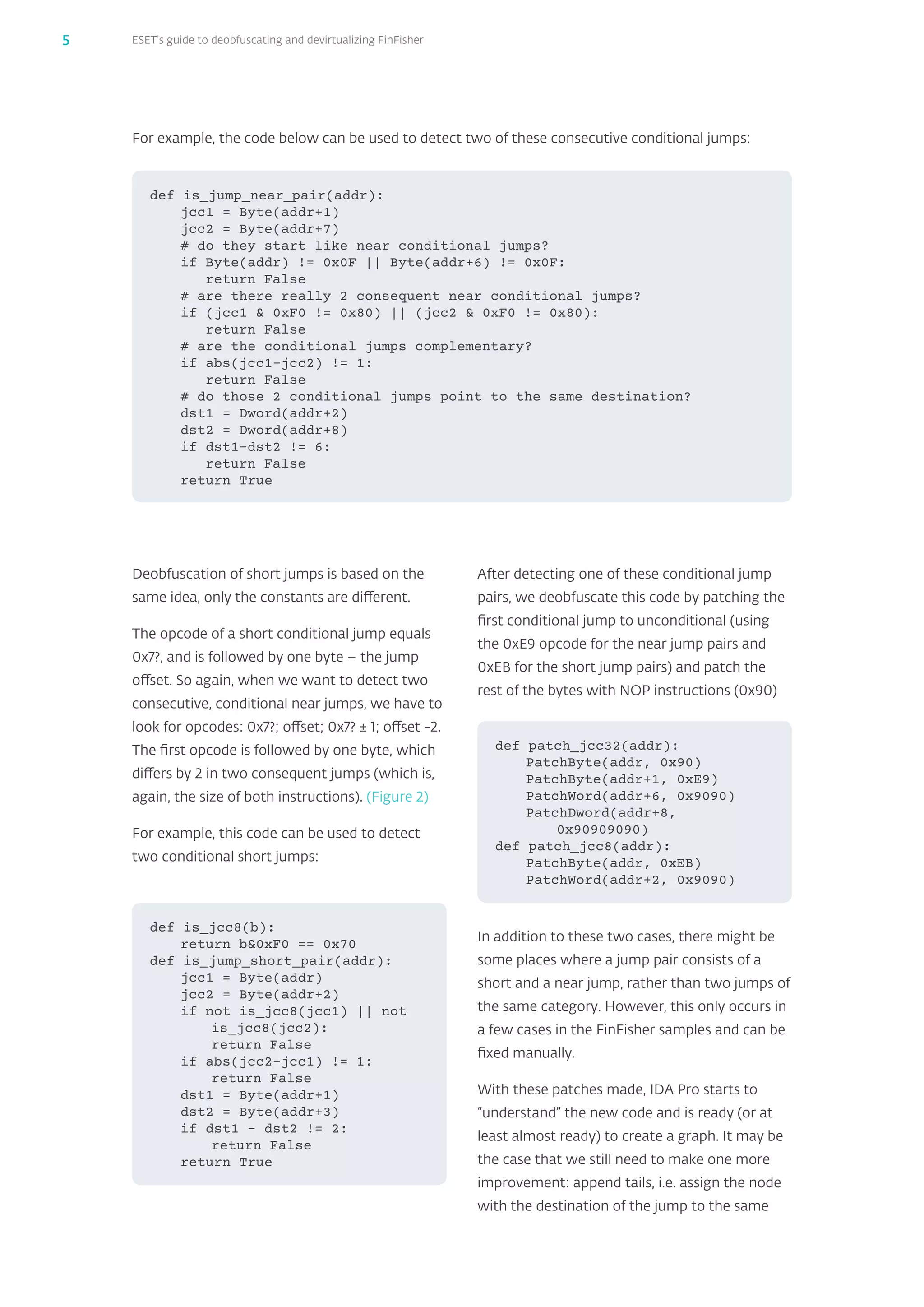
look for opcodes: 0x7?; offset; 0x7? ± 1; offset -2.
The first opcode is followed by one byte, which
differs by 2 in two consequent jumps (which is,
again, the size of both instructions). (Figure 2)
For example, this code can be used to detect
two conditional short jumps:
After detecting one of these conditional jump
pairs, we deobfuscate this code by patching the
first conditional jump to unconditional (using
the 0xE9 opcode for the near jump pairs and
0xEB for the short jump pairs) and patch the
rest of the bytes with NOP instructions (0x90)
In addition to these two cases, there might be
some places where a jump pair consists of a
short and a near jump, rather than two jumps of
the same category. However, this only occurs in
a few cases in the FinFisher samples and can be
fixed manually.
With these patches made, IDA Pro starts to
“understand” the new code and is ready (or at
least almost ready) to create a graph. It may be
the case that we still need to make one more
improvement: append tails, i.e. assign the node
with the destination of the jump to the same
def is_jcc8(b):
return b0xF0 == 0x70
def is_jump_short_pair(addr):
jcc1 = Byte(addr)
jcc2 = Byte(addr+2)
if not is_jcc8(jcc1) || not
is_jcc8(jcc2):
	 return False
if abs(jcc2–jcc1) != 1:
	 return False
dst1 = Byte(addr+1)
dst2 = Byte(addr+3)
if dst1 – dst2 != 2:
	 return False
return True
def patch_jcc32(addr):
PatchByte(addr, 0x90)
PatchByte(addr+1, 0xE9)
PatchWord(addr+6, 0x9090)
PatchDword(addr+8,
0x90909090)
def patch_jcc8(addr):
PatchByte(addr, 0xEB)
PatchWord(addr+2, 0x9090)
ESET’s guide to deobfuscating and devirtualizing FinFisher6
graph where the node with the jump instruction
is located. For this, we can use the IDA Python
function append_‌func_‌tail.
The last step of overcoming the anti-disassembly
tricks consists of fixing function definitions. It may
still occur that the instruction after the jumps is
push ebp, in which case IDA Pro (incorrectly)
treats this as the beginning of a function and
creates a new function definition. In that case, we
have to remove the function definition, create the
correct one and append tails again.
This is how we can get rid of FinFisher’s first
layer of protection – anti-disassembly.
Figure 2 // Examples of instructions followed by two conditional short jumps every time
ESET’s guide to deobfuscating and devirtualizing FinFisher7
FINFISHER’S
VIRTUAL
MACHINE
After a successful deobfuscation of the first
layer, we can see a clearer main function whose
sole purpose is to launch a custom virtual
machine and let it interpret the bytecode with
the actual payload.
As opposed to a regular executable, an
executable with a virtual machine inside uses
a set of virtualized instructions, rather than
directly using the instructions of the processor.
Virtualized instructions are executed by a
virtual processor, which has its own structure
and does not translate the bytecode into a
native machine code. This virtual processor as
well as the bytecode (and virtual instructions)
are defined by the programmer of the virtual
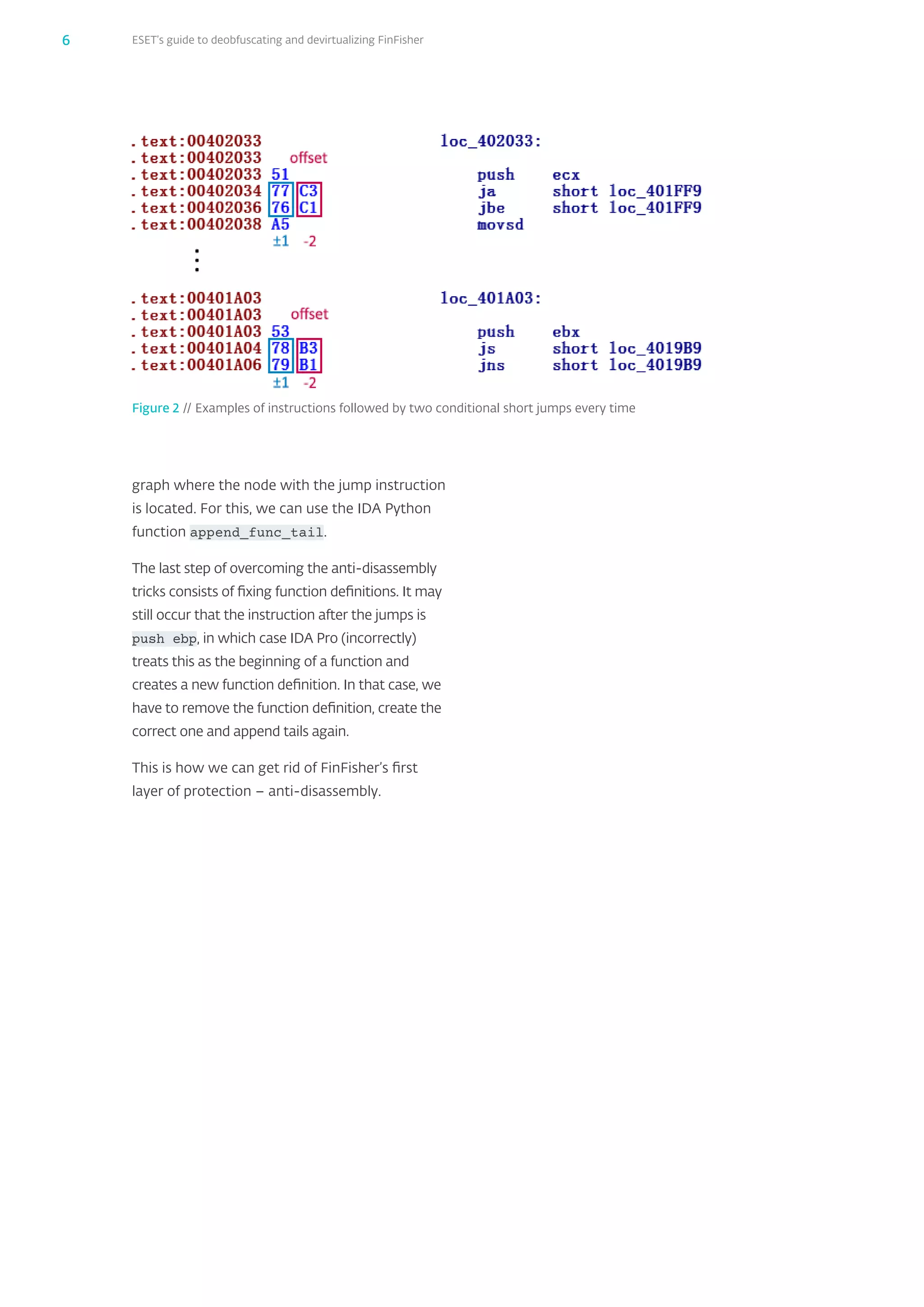
machine. (Figure 3)
As mentioned in the introduction, a well-known
example of a virtual machine is the Java Virtual
Machine. But in this case, the virtual machine
is inside the binary, so we are dealing with a
virtual machine used for a protection against
reverse engineering. There are well-known
commercial virtual machine protectors, for
example VMProtect or Code Virtualizer.
The FinFisher spyware was compiled from
source code and the compiled binary was
then protected with a virtual machine at the
Figure 3 // Bytecode interpreted by the virtual CPU
assembly level. The protection process includes
translating instructions of the original binary
into virtual instructions and then creating a
new binary that contains the bytecode and the
virtual CPU. Native instructions from the original
binary are lost. The protected, virtualized
sample must have the same behavior as a non-
protected sample.
To analyze a binary protected with a virtual
machine, one needs to:
1.	 Analyze the virtual CPU.
2.	 Write one’s own disassembler for this custom
virtual CPU
and parse the bytecode.
3.	 Optional step: compile the disassembled code
into a binary file to
get rid of the virtual machine.
The first two tasks are very time-consuming,
and the first one can also get quite difficult.
It includes analyzing every vm_‌handler and
understanding how registers, memory access,
calls, etc. are translated.
ESET’s guide to deobfuscating and devirtualizing FinFisher8
Terms and definitions
There is no standard for naming particular parts
of a virtual machine. Hence, we will define some
terms which will be referenced throughout the
whole paper.
•	 Virtual machine (vm) – custom, virtual CPU;
contains parts like the
vm_‌dispatcher, vm_‌start, vm_‌handlers
•	 vm_‌start – the initialization part; memory
allocation and decryption routines are
executed here
•	 Bytecode (also known as pcode) – virtual
opcodes of vm_‌instructions with their
arguments are stored here
•	 vm_‌dispatcher – fetches and decodes virtual
opcode; is basically a preparation for the
execution of one of the vm_‌handlers
•	 vm_‌handler – an implementation of a
vm_‌instruction; executing one vm_‌handler
means executing one vm_‌instruction
•	 Interpreter (also known as vm_‌loop) –
vm_‌dispatcher + vm_‌handlers – the virtual
CPU
•	 Virtual opcode – an analog of the native
opcode
•	 vm_‌context (vm_‌structure) – an internal
structure used by the interpreter
•	 vi_‌params – a structure in the vm_‌context
structure; the virtual instruction parameters,
used by the vm_‌handler; it includes the
vm_‌opcode and arguments
When interpreting the bytecode, the virtual
machine uses a virtual stack and a single virtual
register.
•	 vm_‌stack – an analog of a native stack, which
is used by the virtual machine
•	 vm_‌register – an analog of a native register,
used by this virtual machine; further
referenced as tmp_‌REG
•	 vm_‌instruction – an instruction defined
by developers of vm; the body (the
implementation) of the instruction is called its
vm_‌handler
In the following sections, we will describe the
parts of the virtual machine in more technical
detail and explain how to analyze them.
A deobfuscated graph of the main malware
function consists of three parts – an
initialization part and two other parts which
we have named vm_‌start and interpreter
(vm_‌dispatcher + vm_‌handlers).
The initialization part specifies a unique
identifier of what could be interpreted as a
bytecode entry point, and pushes it on the stack.
Then, it jumps to the vm_‌start part that is an
initialization routine for the virtual machine
itself. It decrypts the bytecode and passes
control to the vm_‌dispatcher that loops over
the virtual instructions of the bytecode and
interprets them using the vm_‌handlers.
The vm_‌dispatcher starts with a pusha
instruction and ends with a jmp dword ptr
[eax+ecx*4] instruction (or similar), which is a
jump to the relevant vm_‌handler.
Vm_‌start
The graph created after the deobfuscation of
the first layer is seen in Figure 4. The vm_‌start
part is not so important for the analysis of the
interpreter. However, it can help us understand
the whole implementation of the vm; how it
uses and handles virtual flags, virtual stack, etc.
The second part – the vm_‌dispatcher with
vm_‌handlers – is the crucial one.
The vm_‌start is called from almost every
function, including the main function. The calling
function always pushes a virtual instruction
identifier and then it jumps to vm_‌start. Every
virtual instruction has its own virtual identifier.
In this example, the identifier of the virtual
entry point, where the execution from the main
function starts, is 0x21CD0554. (Figure 5)
In this part, there is a lot of code for preparing
the vm_‌dispatcher – mainly for preparing
the bytecode and allocating memory for the
ESET’s guide to deobfuscating and devirtualizing FinFisher9
whole interpreter. The most important parts of the code do the
following:
1.	 Allocate 1MB with RWX permission for bytecode and a few
more variables.
2.	 Allocate 0x10000 bytes RWX for local variables in the virtual
machine for the current thread – the vm_‌stack.
3.	 Decrypt a piece of code using an XOR decryption routine. The
decrypted code is an aPLib unpacking routine.
The XOR decryption routine used in the sample is a slightly
modified version of XOR dword, key routine. Actually, it skips
the first of the six dwords and then XORs only the remaining
5 dwords with the key. Following is the algorithm for the
routine (further referred to as XOR decryption_‌code):
4.	 Call aPLib unpacking routine to unpack bytecode. After
unpacking, virtual opcodes are still encrypted. (Figure 6)
Preparing virtual opcodes (step 1, 3 and 4) is done only once –
at the beginning – and is skipped in subsequent executions of
vm_‌start, when only instructions for proper handling of flags
and registers are executed.
Figure4//Graphofthevm_startandvm_dispatcher
int array[6];
int key;
for (i = 1; i  6; i++) {
	 array[i] ^= key;
}
Figure 5 // vm_start is called from each of the 119 virtualized functions.
The ID of the first virtual instruction of the respective function
is given as an argument.
ESET’s guide to deobfuscating and devirtualizing FinFisher10
Figure 6 // All the code from the vm_start to the vm_dispatcher in grouped nodes named based on their purpose.
FINFISHER’S
INTERPRETER
This part includes the vm_‌dispatcher with all
the vm_‌handlers (34 in FinFisher samples) and
is crucial for analyzing and/or devirtualizing the
virtual machine. The interpreter executes the
bytecode.
The instruction jmp dword ptr [eax+ecx*4]
jumps to one of the 34 vm_‌handlers. Each
vm_‌handler implements one virtual machine
instruction. In order to know what every
vm_‌handler does, we first need to understand
the vm_‌context and vm_‌dispatcher.
1. Creating an IDA graph
Before diving into it, creating a well-structured
graph can really help understanding the
interpreter. We recommend splitting the
graph into two parts – the vm_‌start and the
vm_‌dispatcher, i.e. to define a beginning of a
function at the vm_‌dispatcher’s first instruction.
What is still missing is the actual vm_‌handlers
referenced by the vm_‌dispatcher. In order to
connect these handlers with the graph of the
ESET’s guide to deobfuscating and devirtualizing FinFisher11
vm_‌dispatcher, the following functions can be
used:
AddCodeXref(addr_‌of_‌jmp_‌instr,
vm_‌handler, XREF_‌USER|fl_‌JN)
adding references from the last vm_‌dispatcher
instruction to the beginnings of the
vm_‌handlers
AppendFchunk
appending tails again
After appending every vm_‌handler to the
dispatcher function, the resulting graph should
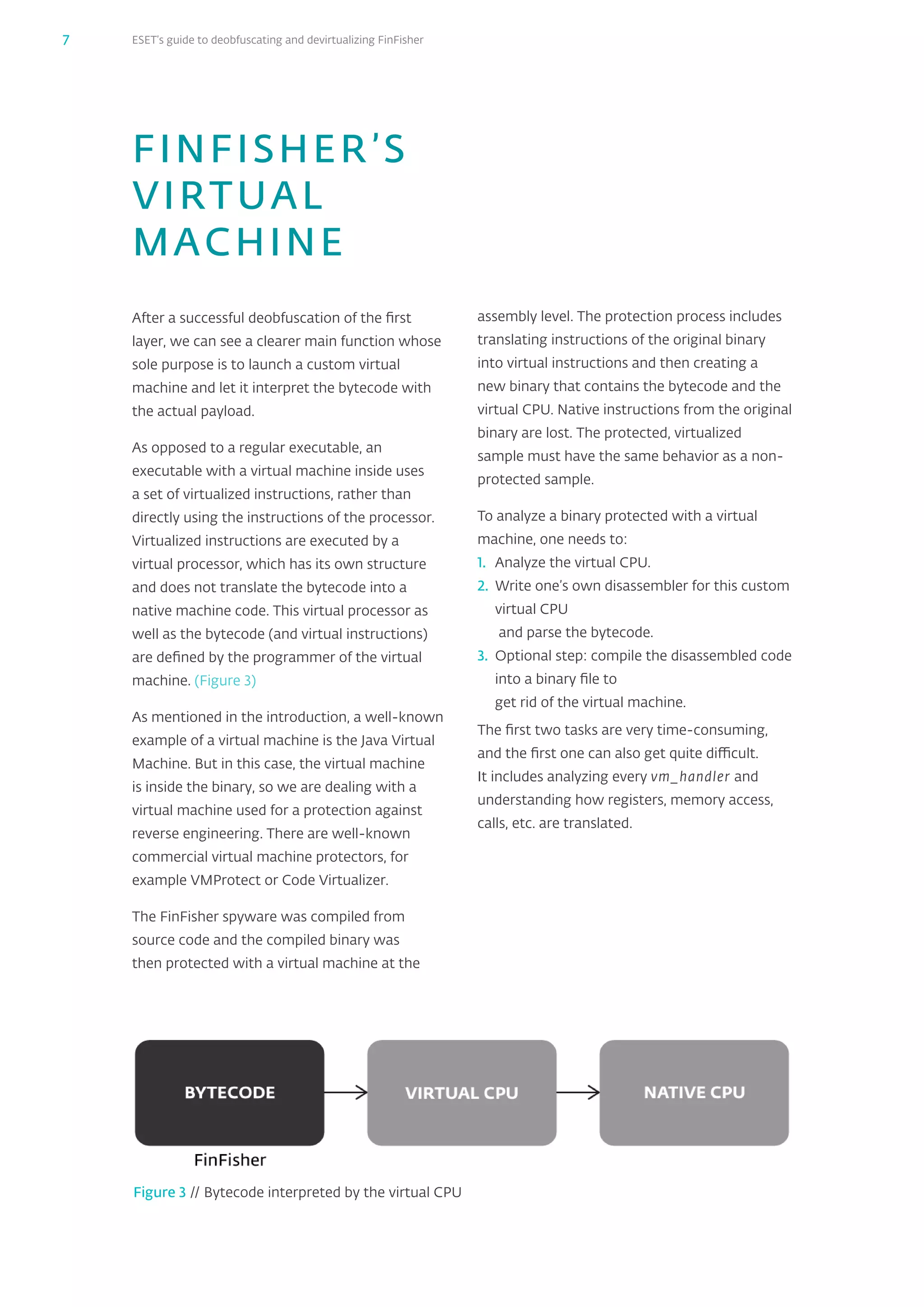
look like (Figure 7)
Figure 7 // Graph of the vm_dispatcher with all 34 vm_handlers.
2. Vm_‌dispatcher
This part is responsible for fetching and
decoding the bytecode. It performs the
following steps:
•	 Executes pusha and pusf instructions to
prepare virtual registers and virtual flags for
further execution of a virtual instruction.
•	 Retrieves the base address of the image and
address of vm_‌stack
•	 Reads 24 bytes of bytecode specifying the
next vm_‌instruction
and its arguments
ESET’s guide to deobfuscating and devirtualizing FinFisher12
•	 Decrypts the bytecode with the previously
described XOR decryption routine
•	 Adds the image base to the bytecode
argument in case the argument is a global
variable
•	 Retrieves the virtual opcode (number 0-33)
from the decrypted bytecode
•	 Jumps to the corresponding vm_‌handler
which interprets the virtual opcode
After the vm_‌handler for an instruction has
executed, the same sequence of steps is
repeated for the next one, starting from the
vm_‌dispatcher’s first instruction.
In the case of the vm_‌call handler, the control
is passed to the vm_‌start part instead (except
for instances when a non-virtualized function
follows).
3. Vm_‌context
In this part, we will describe the vm_‌context
– a structure used by the virtual machine,
containing all the information necessary
for executing the vm_‌dispatcher and each
vm_‌handler.
When looking at the code of both the
vm_‌dispatcher and the vm_‌handlers in greater
detail, we can notice there are a lot of data
operation instructions, referring to ebx+offset,
where offset is a number from 0x00 to 0x50.
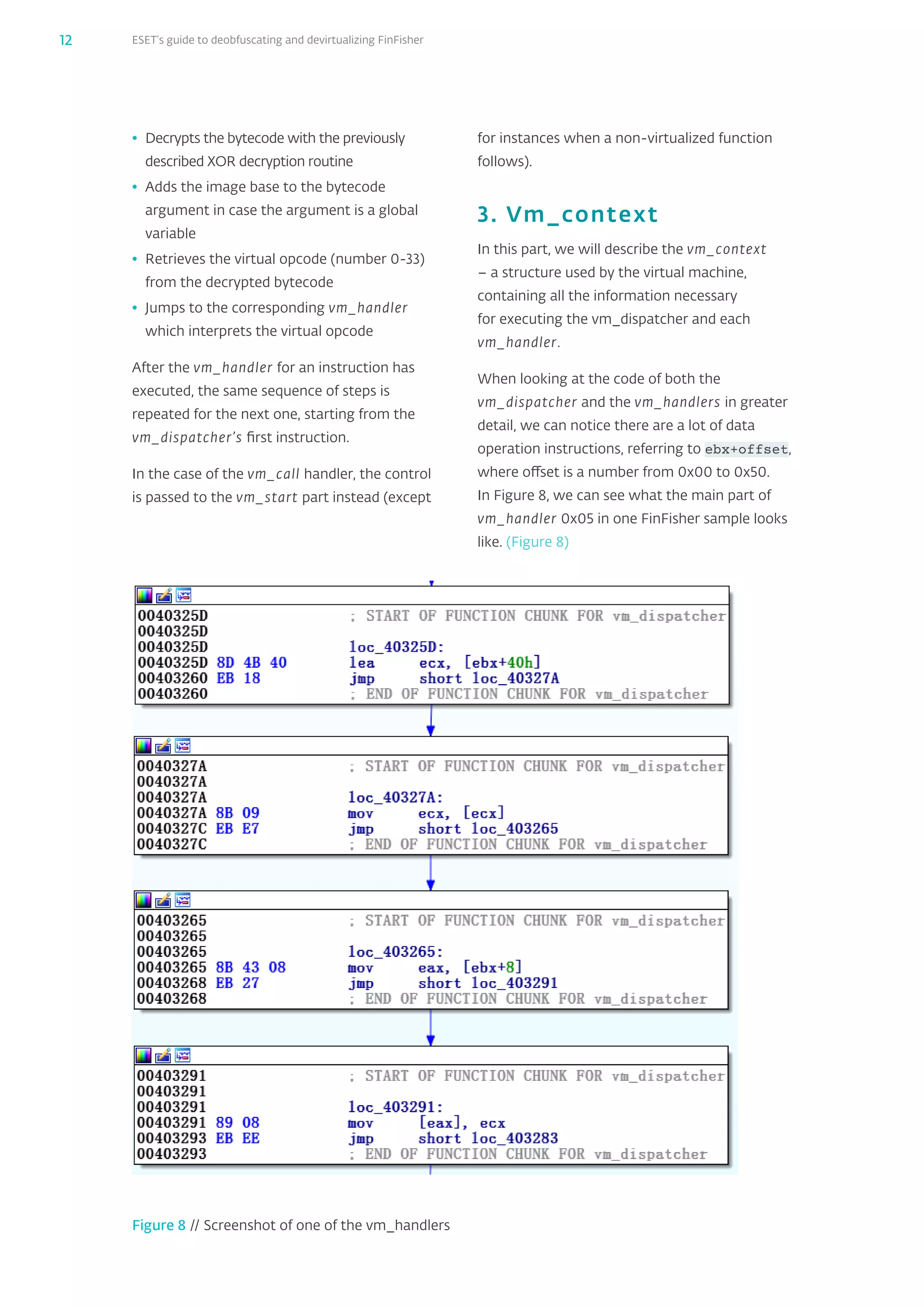
In Figure 8, we can see what the main part of
vm_‌handler 0x05 in one FinFisher sample looks
like. (Figure 8)
Figure 8 // Screenshot of one of the vm_handlers
ESET’s guide to deobfuscating and devirtualizing FinFisher13
The ebx register points to a structure we named
vm_‌context. We must understand how this
structure is used – what the members are, what
they mean, and how they are used. When solving
this puzzle for the first time, a bit of guessing
is needed as to how the vm_‌context and its
members are used.
For example, let’s have a look at the sequence of
instructions at the end of the vm_‌dispatcher:
Since we know that the last instruction is a
jump to a vm_‌handler, we can conclude that
ecx contains a virtual opcode and thus the
0x3C member of a vm_‌struct refers to a virtual
opcode number.
Let’s make one more educated guess. At the end
of almost every vm_‌handler,
struct vm_context {
DWORD vm_instruct_ptr; // instruction pointer to the bytecode
DWORD vm_stack; // address of the vm_stack
DWORD tmp_REG; // used as a “register” in the virtual machine
DWORD vm_dispatcher_loop; // address of the vm_dispatcher
DWORD cleanAndVMDispatchFn; // address of the function which pops values and jumps
to the vm_dispatcher skipping the first few instructions from it
DWORD cleanUpDynamicCodeFn; // address of the function which cleans vm_instr_ptr and
calls cleanAndVMDispatchFn
DWORD jmpLoc1;	// address of jump location
DWORD jmpLoc2;	// address of next vm_opcode – just executing next vm_instruction
DWORD Bytecode_start; // address of the start of the bytecode in data section
DWORD DispatchEBP;
DWORD ImageBase; // Image base address
DWORD ESP0_flags; // top of the native stack (there are saved flags of the vm_code)
DWORD ESP1_flags; // same as previous
DWORD LoadVOpcodesSectionFn;
vi_params bytecode; // everything necessary for executing vm_handler, see below
DWORD limitForTopOfStack; // top limit for the stack
};
movzx ecx, byte ptr [ebx+0x3C]	
// opcode for vm_handler
jmp dword ptr [eax+ecx*4]	
// jumping to one of the 34 vm_
handlers
there is the following instruction:
add dword ptr [ebx], 0x18.
This same member of the vm_‌context was
also used earlier in the vm_‌dispatcher’s
code – just before jumping to a vm_‌handler.
The vm_‌dispatcher copies 24 bytes from
the structure member to a different location
([ebx+38h]) and decrypts it with the XOR
decryption routine to obtain a part of the actual
bytecode.
Hence, we can start thinking of the first
member of the vm_‌context ([ebx+0h]) as a
vm_‌instruction_‌pointer, and of the decrypted
location (from [ebx+38h] to [ebx+50h]) as an
ID of a virtual instruction, its virtual opcode and
arguments. Together, we will call the structure
vi_‌params.
Following the steps described above, and using
a debugger to see what values are stored in the
respective structure members, we can figure
out all the members of the vm_‌context.
After the analysis, we can rebuild both
FinFisher’s vm_‌context and vi_‌params
structure:
ESET’s guide to deobfuscating and devirtualizing FinFisher14
struct vi_params {
DWORD Virtual_instr_id;
DWORD OpCode; // values 0 – 33 - tells which handler to execute
DWORD Arg0; // 4 dword arguments for vm_handler
DWORD Arg4; // sometimes unused
DWORD Arg8; // sometimes unused
DWORD ArgC; // sometimes unused
};
4. Virtual instruction
implementations –
vm_‌handlers
Each vm_‌handler handles one virtual opcode
– since we have 34 vm_‌handlers, there
are at most 34 virtual opcodes. Executing
one vm_‌handler means executing one
vm_‌instruction, so in order to reveal what a
vm_‌instruction does, we need to analyze the
corresponding vm_‌handler.
After reconstructing the vm_‌context and
naming all the offsets from ebx, the previously
shown vm_‌handler changes to a much more
readable form, as seen in Figure 9.
At the end of this function, we notice a
sequence of instructions, starting with the
vm_‌instruction_‌pointer, being incremented
by 24 – the size of each vm_‌instruction’s
vi_‌params structure. Since this sequence
is repeated at the end of almost every
vm_‌handler, we conclude it is a standard
function epilogue and the actual body of the
vm_‌handler can be written as simply as:
mov	 [tmp_‌REG], Arg0
So, there we go – we have just analyzed the
first instruction of the virtual machine. :-)
Figure 9 // The previous
vm_handler after
inserting the
vm_context structure
ESET’s guide to deobfuscating and devirtualizing FinFisher15
To illustrate how the analyzed instruction works
when executed, let’s consider the vi_‌params
structure filled as follows:
From what was stated above, we can see that
the following instruction will be executed:
mov	 [tmp_‌REG], 0x42
Figure 10 // Screenshot of a JNP_handler
struct vi_params {
DWORD ID_of_virt_instr = doesn’t
matter;
DWORD OpCode = 0x0C;
DWORD Arg0 = 0x42;
DWORD Arg4 = 0;
DWORD Arg8 = 0;
DWORD ArgC = 0;
};
At this point, we should understand what
one of the vm_‌instructions does. The
steps we followed should serve as a decent
demonstration of how the entire interpreter
works.
However, there are some vm_‌handlers that are
harder to analyze. This vm’s conditional jumps
are tricky to understand because of the way
they translate flags.
As mentioned before, the vm_‌dispatcher starts
with pushing native EFLAGS (of vm_‌code) to
the top of the native stack. Therefore, when the
handler for a respective jump is deciding whether
to jump or not, it looks at EFLAGS at the native
stack and implements its own jump method.
Figure 10 illustrates how the virtual JNP handler is
implemented by checking the parity flag.
(Figure 10)
ESET’s guide to deobfuscating and devirtualizing FinFisher16
For other virtual conditional jumps, it may be necessary to check several flags – for example, the jump
result of the virtualized JBE depends on the values of both CF and ZF – but the principle stays the
same.
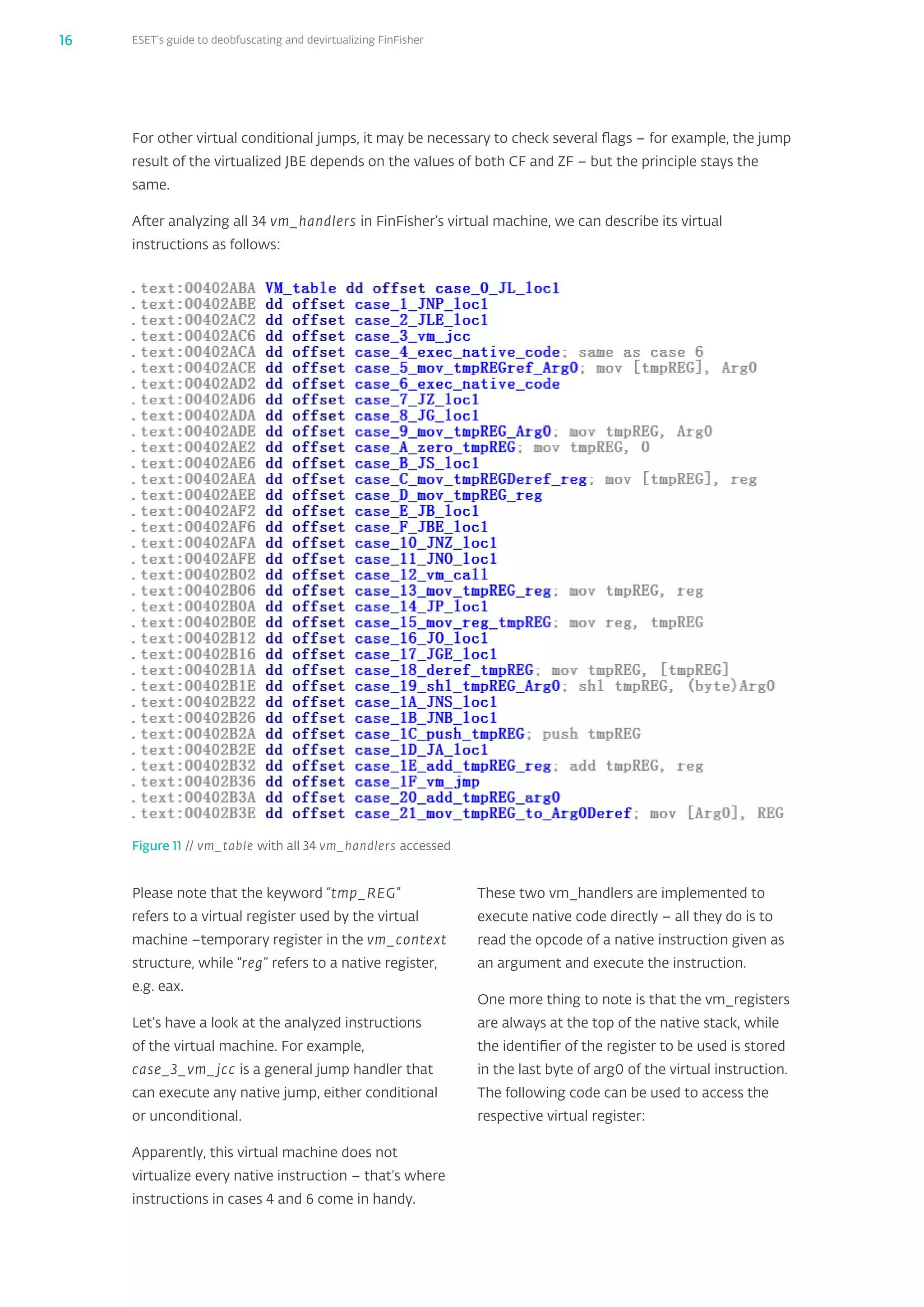
After analyzing all 34 vm_‌handlers in FinFisher’s virtual machine, we can describe its virtual
instructions as follows:
Figure 11 // vm_table with all 34 vm_handlers accessed
Please note that the keyword “tmp_‌REG”
refers to a virtual register used by the virtual
machine –temporary register in the vm_‌context
structure, while “reg” refers to a native register,
e.g. eax.
Let’s have a look at the analyzed instructions
of the virtual machine. For example,
case_‌3_‌vm_‌jcc is a general jump handler that
can execute any native jump, either conditional
or unconditional.
Apparently, this virtual machine does not
virtualize every native instruction – that’s where
instructions in cases 4 and 6 come in handy.
These two vm_‌handlers are implemented to
execute native code directly – all they do is to
read the opcode of a native instruction given as
an argument and execute the instruction.
One more thing to note is that the vm_‌registers
are always at the top of the native stack, while
the identifier of the register to be used is stored
in the last byte of arg0 of the virtual instruction.
The following code can be used to access the
respective virtual register:
ESET’s guide to deobfuscating and devirtualizing FinFisher17
jump. This “jump offset” is actually an offset in
the bytecode. When parsing jumps, we need to
put a marker to the location to which it jumps.
For example, this code can be used:
Finally, there is a vm_‌handler responsible for
executing native instructions from arguments,
which needs special treatment. For this, we
have to use a disassembler for native x86
instructions – for example, the open source tool
Distorm.
The length of an instruction is stored in
vm_‌context.vi_‌params.OpCode  0x0000FF00.
The opcode of the native instruction that
will be executed is stored in the arguments.
The following code can be used to parse the
vm_‌handler that executes native code:
5. Writing your own
disassembler
After we have correctly analyzed all the
vm_‌instructions, there is still one step to
be done before we can start the analysis
of the sample – we need to write our own
disassembler for the bytecode (parsing it
manually would be problematic due to its size).
By putting in the effort and writing a more
robust disassembler we can save ourselves
some trouble when FinFisher’s virtual machine
is changed and updated.
Let’s start with the vm_‌handler 0x0C, which
executes the following instruction:
mov [tmp_‌REG], reg
This instruction takes exactly one argument
– the identifier of a native register to be used
as reg. This identifier must be mapped into
a native register name, for instance using a
resolve_‌reg function as described above.
The following code can be used to dissasemble
this vm_‌handler:
Again, vm_‌handlers for jumps are harder
to understand. In case of jumps, members
vm_‌context.vi_‌params.Arg0 and vm_‌context.
vi_‌params.Arg1 store the offset by which to
def vm_0C(state, vi_params):
global instr
reg_pos = 7 – (vi_arams[arg0]
 0x000000FF)
tmpinstr = “mov [tmp_REG],
%s” % resolve_reg(reg_pos)
instr.append(tmpinstr)
return
def computeLoc1(pos, vi_params):
global instr
jmp_offset = (vi_params[arg0]
 0x00FFFFFF) + (vi_params[arg1]
 0xFF000000)
if jmp_offset  0x7FFFFFFF:
jmp_offset /= 0x18 # their
increment by 0x18 is my
increment by 1
else:
jmp_offset = int((-
0x100000000 + jmp_offset)
/ 0x18)
return pos+jmp_offset
def resolve_reg(reg_pos):
stack_regs = [‘eax’, ‘ecx’, ‘edx’, ‘ebx’, ‘esp’, ‘ebp’, ‘esi’, ‘edi’]
stack_regs.reverse()
return stack_regs[reg_pos]
reg_pos = 7 – (state[arg0]  0x000000FF)
reg = resolve_reg(reg_pos)
ESET’s guide to deobfuscating and devirtualizing FinFisher18
For example, from the part of the bytecode
shown in Figure 12, we may get the following
output:
mov tmp_REG, 0
add tmp_REG, EBP
add tmp_REG, 0x10
mov tmp_REG, [tmp_REG]
push tmp_REG
mov tmp_REG, EAX
push tmp_REG
Figure 12 // Part of the unpacked and decrypted FinFisher bytecode
Up to this point, we have created Python
functions to disassemble each vm_‌handler. All
of these, combined with the code responsible
for marking jump locations, finding the ID of
a virtual instruction after the call and a few
others, are necessary for writing your own
disassembler.
Afterwards, we can run the finished
disassembler on the bytecode.
def vm_04(vi_params, pos):
global instr
nBytes = vi_params[opCode]  0x0000FF00
dyn_instr = pack(“LLLL”, vi_params[arg0], vi_params[arg4],
vi_params[arg8], vi_params[argC])[0:nBytes]
dec_instr = distorm3.Decode(0x0, dyn_instr, distorm3.Decode32Bits)
tmpinstr = “%s” % (dec_instr[0][2])
instr.append(tmpinstr)
return
ESET’s guide to deobfuscating and devirtualizing FinFisher19
6. Understanding the
implementation of
this virtual machine
After we have analyzed all the virtual handlers
and constructed a custom disassembler, we can
have one more look at the virtual instructions to
get an overall idea of how they were created.
First, we must understand that the virtualization
protection was implemented at the assembly
level. The authors translated native instructions
into their own, somewhat complicated
instructions, which are to be executed by a
custom virtual CPU. To achieve this, a temporary
“register” (tmp_‌REG) is used.
We can look at some examples to see how
this translation works. For example, the virtual
instruction from the previous example –
mov tmp_‌REG, EAX
push tmp_‌REG
– was translated from the original native
instruction push eax. When virtualized, a
temporary register was used in an intermediate
step to change the instruction into something
more complicated.
Let’s consider another example:
The native instructions that were translated into
these virtualized instructions were the following
(with reg being one of the native registers):
mov reg, [ebp+0x10]
push reg
This is, however, not the only way to virtualize
a set of instructions. There are other virtual
machine protectors with other approaches. For
instance, one of the commercial vm protectors
translates each math operation instruction
mov tmp_REG, 0
add tmp_REG, EBP
add tmp_REG, 0x10
mov tmp_REG, [tmp_REG]
push tmp_REG
into NOR logic, with a number of temporary
registers being used instead of one.
Conversely, FinFisher’s virtual machine did not
go as far as to cover all the native instructions.
While many of them can be virtualized, some
can’t – math instructions, such as add, imul and
div, being some examples. If these instructions
appear in the original binary, the vm_‌handler
responsible for executing native instructions is
called to handle them in the protected binary.
The only change is that EFLAGS and native
registers are popped from the native stack just
before the native instruction is executed, and
pushed back after it is executed. This is how the
virtualization of every native instruction was
avoided.
A significant drawback of protecting binaries
with a virtual machine is the performance
impact. In the caseof FinFisher’s virtual
machine, we estimate it to be more than one
hundred times slower than native code, based
on the number of instructions that have to be
executed to handle every single vm_‌instruction
(vm_‌dispatcher + vm_‌handler).
Therefore, it makes sense to protect only
selected parts of the binary– and this is also the
case in the FinFisher samples we analyzed.
Moreover, as mentioned before, some of
the virtual machine handlers can call native
functions directly. As a result, the users of the
virtual machine protection (i.e. the authors
of FinFisher) can look at the functions at the
assembly level and mark which of them are
to be protected by the virtual machine. For
those that are marked, their instructions will be
virtualized, for those that are not, the original
functions will be called by the respective virtual
handler. Thus, the execution might be less time-
consuming while the most interesting parts of
the binary stay protected. (Figure 13)
ESET’s guide to deobfuscating and devirtualizing FinFisher20
7. Automating the
disassembly process
for more FinFisher
samples
In addition to the length of the bytecode our
parser has to process, we have to keep in mind
that there is some randomization across various
FinFisher samples. Although the same virtual
machine has been used for the protection, the
mapping between the virtual opcodes and the
vm_‌handlers is not always constant. They can
be (and are) paired randomly and differently
for each of the FinFisher samples we analyzed.
It means that if the vm_‌handler for the 0x5
virtual opcode in this sample handles the mov
[tmp_‌REG], arg0 instruction, it may be
assigned a different virtual opcode in another
protected sample.
To address this issue, we can use a signature
for each of the analyzed vm_‌handlers. The
IDA Python script in Appendix A can be applied
after we have generated a graph as shown in
Figure 7 (it is particularly important to have
the jz/jnz jump obfuscation eliminated – as
described in the first section of this guide) to
name the handlers based on their signatures.
(With a small modification, the script can also
Figure 13 // Scheme representing FinFisher’s entire vm protection and how the execution can jump out of the vm
be used to recreate the signatures in case the
vm_‌handlers are changed in a future FinFisher
update.)
As mentioned above, the first vm_‌handler
in the FinFisher sample you analyze may be
different than JL, as in the example FinFisher
sample, but the script will identify all of the
vm_‌handlers correctly.
8. Compiling
disassembled code
without the VM
After disassembly and after a few
modifications, it is possible to compile the
code. We will treat virtual instructions as native
instructions. As a result, we will get a pure
binary without the protection.
Most of the vm_‌instructions can be compiled
immediately using copy-paste, since the output
of our disassembler mostly consists of native-
looking instructions. But some cases need
special treatment:
•	 tmp_‌REG – since we defined tmp_‌REG as
a global variable, we need to make code
adjustments for cases when an address
stored in it is being dereferenced. (Since
ESET’s guide to deobfuscating and devirtualizing FinFisher21
dereferencing an address which is in a global
variable is not possible in the x86 instruction
set.) For example, the vm contains the virtual
instruction mov tmp_‌REG, [tmp_‌REG] which
needs to be rewritten as follows:
•	 Flags – Virtual instructions do not change
the flags, but native math instructions do.
Therefore, we need to make sure that virtual
math instruction won’t change flags in the
devirtualized binary either, which means
we have to save flags before executing
this instruction and restore them after the
execution.
•	 Jumps and calls – we have to put a marker to
the destination virtual instruction (jumps) or
function (calls).
push eax
mov eax, tmp_REG
mov eax, [eax]
mov tmp_REG, eax
pop eax
•	 API function calls – in most cases, API
functions are loaded dynamically, whereas
in others they are referenced from the IAT of
the binary, so these cases need to be handled
accordingly.
•	 Global variables, native code – Some global
variables need to be kept in the devirtualized
binary. Also in the FinFisher dropper, there is a
function for switching to x64 from x86 that is
executed natively (actually it is done only with
the retf instruction). All these must be kept
in the code when compiling.
Depending on the output of your disassembler,
you may still need to do a few more
modifications to get pure native instructions
that can be compiled. Then, you can compile the
code with your favorite assembly-compiler into
a binary without the VM.
ESET’s guide to deobfuscating and devirtualizing FinFisher22
CONCLUSION
In this guide, we have described how FinFisher
uses two elaborate techniques to protect
its main payload. The primary intention of
this protection is not to avoid AV detection,
but to cover the configuration files and new
techniques implemented in the spyware by
hindering analysis by reverse engineers. As
no other detailed analysis of the obfuscated
FinFisher spyware has been published to date,
it seems the developers of these protection
mechanisms have been successful.
We have shown how we can overcome the
anti-disassembly layer automatically, and how
the virtual machine can be efficiently analyzed.
We hope this guide can help reverse engineers
analyze vm-protected FinFisher samples, as
well to better understand other virtual machine
protectors in general.
ESET’s guide to deobfuscating and devirtualizing FinFisher23
Appendix A
IDA Python script for naming
FinFisher vm_‌handlers
The script is also available on ESET’s GitHub repository:
https://github.com/eset/malware-research/blob/master/finfisher/ida_finfisher_vm.py
i​m​p​o​r​t​ ​s​y​s​
S​I​G​S​ ​=​ ​{​ ​‘​8​d​4​b​4​0​8​b​4​3​2​c​8​b​0​a​9​0​8​0​0​f​9​5​c​2​a​9​8​0​0​0​0​f​9​5​c​0​3​a​c​2​7​5​f​f​6​3​1​c​’​ ​:​ ​‘​c​a​s​e​_​0​_​J​L​
_​l​o​c​1​’​,​ ​‘​8​d​4​b​4​0​8​b​4​3​2​c​8​b​0​a​9​4​0​0​0​7​4​f​f​6​3​1​c​’​ ​:​ ​‘​c​a​s​e​_​1​_​J​N​P​_​l​o​c​1​’​,​ ​‘​8​d​4​b​4​0​8​b​4​3​2​c​
8​b​0​a​9​4​0​0​0​0​7​5​a​9​0​8​0​0​f​9​5​c​2​a​9​8​0​0​0​0​f​9​5​c​0​3​a​c​2​7​5​f​f​6​3​1​c​’​ ​:​ ​‘​c​a​s​e​_​2​_​J​L​E​_​l​o​c​1​’​,​ ​‘​8​d​4​
b​4​0​8​b​7​b​5​0​8​b​4​3​2​c​8​3​e​0​2​f​8​d​b​c​3​8​3​1​1​8​1​2​b​5​c​7​8​7​c​f​e​7​e​d​4​a​e​9​2​f​8​b​0​6​6​c​7​8​7​d​3​e​7​e​
4​a​f​9​b​8​e​8​0​0​0​0​5​8​8​d​8​0​’​ ​:​ ​‘​c​a​s​e​_​3​_​v​m​_​j​c​c​’​,​ ​‘​8​b​7​b​5​0​8​b​4​3​2​c​8​3​e​0​2​f​3​f​8​5​7​6​6​c​7​7​a​c​6​6​6​8​
1​3​7​3​1​6​7​8​3​c​7​2​8​d​7​3​4​0​f​b​6​4​b​3​d​f​3​a​4​c​6​7​e​9​8​0​3​7​8​1​8​b​4​3​c​8​9​4​7​1​c​6​4​7​5​6​c​8​0​7​7​5​a​f​8​3​3​1​8​5​8​8​b​6​
3​2​c​’​ ​:​ ​‘​c​a​s​e​_​4​_​e​x​e​c​_​n​a​t​i​v​e​_​c​o​d​e​’​,​ ​‘​8​d​4​b​4​0​8​b​9​8​b​4​3​8​8​9​8​8​3​3​1​8​8​b​4​3​c​8​b​6​3​2​c​’​ ​:​ ​‘​c​
a​s​e​_​5​_​m​o​v​_​t​m​p​_​R​E​G​r​e​f​_​a​r​g​0​’​,​ ​‘​8​b​7​b​5​0​8​b​4​3​2​c​8​3​e​0​2​f​3​f​8​5​7​6​6​c​7​7​a​c​6​6​6​8​1​3​7​3​1​6​7​8​3​c​7​
2​8​d​7​3​4​0​f​b​6​4​b​3​d​f​3​a​4​c​6​7​e​9​8​0​3​7​8​1​8​b​4​3​c​8​9​4​7​1​c​6​4​7​5​6​c​8​0​7​7​5​a​f​8​3​3​1​8​5​8​8​b​6​3​2​c​’​ ​:​ ​‘​c​a​s​
e​_​6​_​e​x​e​c​_​n​a​t​i​v​e​_​c​o​d​e​’​,​ ​‘​8​d​4​b​4​0​8​b​4​3​2​c​8​b​0​a​9​4​0​0​0​0​7​5​f​f​6​3​1​c​’​ ​:​ ​‘​c​a​s​e​_​7​_​J​Z​_​l​o​c​1​’​
,​ ​‘​8​d​4​b​4​0​8​b​4​3​2​c​8​b​0​a​9​4​0​0​0​0​7​5​a​9​0​8​0​0​f​9​5​c​2​a​9​8​0​0​0​0​f​9​5​c​0​3​a​c​2​7​5​f​f​6​3​1​8​’​ ​:​ ​‘​c​a​s​e​_​8​_​
J​G​_​l​o​c​1​’​,​ ​‘​8​d​4​3​4​0​8​b​0​8​9​4​3​8​8​3​3​1​8​8​b​4​3​c​8​b​6​3​2​c​’​ ​:​ ​‘​c​a​s​e​_​9​_​m​o​v​_​t​m​p​_​R​E​G​_​a​r​g​0​’​,​ ​‘​3​
3​c​9​8​9​4​b​8​8​3​3​1​8​8​b​6​3​2​c​8​b​4​3​c​’​ ​:​ ​‘​c​a​s​e​_​A​_​z​e​r​o​_​t​m​p​_​R​E​G​’​,​ ​‘​8​d​4​b​4​0​8​b​4​3​2​c​8​b​0​a​9​8​0​0​0​0​
7​5​f​f​6​3​1​c​’​ ​:​ ​‘​c​a​s​e​_​B​_​J​S​_​l​o​c​1​’​,​ ​‘​8​d​4​b​4​0​f​b​6​9​b​8​7​0​0​0​2​b​c​1​8​b​4​b​2​c​8​b​5​4​8​1​4​8​b​4​b​8​8​9​1​1​8​
3​3​1​8​8​b​4​3​c​8​b​6​3​2​c​’​ ​:​ ​‘​c​a​s​e​_​C​_​m​o​v​_​t​m​p​_​R​E​G​D​e​r​e​f​_​t​m​p​_​R​E​G​’​,​ ​‘​8​d​4​b​4​0​f​b​6​9​b​8​7​0​0​0​2​b​c​
1​8​b​4​b​2​c​8​b​4​4​8​1​4​8​9​4​3​8​8​3​3​1​8​8​b​4​3​c​8​b​6​3​2​c​’​ ​:​ ​‘​c​a​s​e​_​D​_​m​o​v​_​t​m​p​_​R​E​G​_​t​m​p​_​R​E​G​’​,​ ​‘​8​d​4​b​
4​0​8​b​4​3​2​c​8​b​0​a​9​1​0​0​0​7​5​f​f​6​3​1​c​’​ ​:​ ​‘​c​a​s​e​_​E​_​J​B​_​l​o​c​1​’​,​ ​‘​8​d​4​b​4​0​8​b​4​3​2​c​8​b​0​a​9​1​0​0​0​7​5​a​9​4​
0​0​0​0​7​5​f​f​6​3​1​c​’​ ​:​ ​‘​c​a​s​e​_​F​_​J​B​E​_​l​o​c​1​’​,​ ​‘​8​d​4​b​4​0​8​b​4​3​2​c​8​b​0​a​9​4​0​0​0​0​7​4​f​f​6​3​1​c​’​ ​:​ ​‘​c​a​s​
e​_​1​0​_​J​N​Z​_​l​o​c​1​’​,​ ​‘​8​d​4​b​4​0​8​b​4​3​2​c​8​b​0​a​9​0​8​0​0​7​4​f​f​6​3​1​c​’​ ​:​ ​‘​c​a​s​e​_​1​1​_​J​N​O​_​l​o​c​1​’​,​ ​‘​8​b​7​
b​5​0​8​3​4​3​5​0​3​0​8​d​4​b​4​0​8​b​4​1​4​3​4​3​2​8​5​7​6​6​c​7​7​3​f​5​0​6​6​8​1​3​7​a​2​3​1​c​6​4​7​2​c​2​8​0​7​7​2​a​a​8​d​5​7​d​8​3​c​7​3​8​9​
1​7​8​3​e​f​3​c​7​4​7​7​a​3​0​0​0​8​0​7​7​7​c​b​8​3​c​7​8​8​9​7​8​3​e​f​8​c​6​4​7​c​f​2​8​0​7​7​c​3​1​8​3​c​7​d​c​6​7​6​8​8​b​3​8​3​c​0​1​8​8​9​4​7​
1​8​3​c​7​5​6​6​c​7​7​7​7​f​e​6​6​8​1​3​7​1​7​6​2​8​3​c​7​2​c​6​7​2​d​8​0​3​7​4​5​8​9​5​f​1​8​3​c​7​5​c​6​7​8​4​8​0​3​7​d​f​4​7​8​b​4​3​1​4​c​6​7​4​
0​8​0​3​7​2​8​8​9​4​7​1​8​3​c​7​5​c​6​7​9​2​8​0​3​7​5​1​5​f​8​b​6​3​2​c​’​ ​:​ ​‘​c​a​s​e​_​1​2​_​v​m​_​c​a​l​l​’​,​ ​‘​8​d​4​b​4​0​b​8​7​0​0​0​2​b​
1​8​b​5​3​2​c​8​b​4​4​8​2​4​8​9​4​3​8​8​3​3​1​8​8​b​4​3​c​8​b​6​3​2​c​’​ ​:​ ​‘​c​a​s​e​_​1​3​_​m​o​v​_​t​m​p​_​R​E​G​_​t​m​p​_​R​E​G​_​n​o​t​R​l​y​
’​,​ ​‘​8​d​4​b​4​0​8​b​4​3​2​c​8​b​0​a​9​4​0​0​0​7​5​f​f​6​3​1​c​’​ ​:​ ​‘​c​a​s​e​_​1​4​_​J​P​_​l​o​c​1​’​,​ ​‘​8​d​4​b​4​0​f​b​6​9​b​8​7​0​0​0​2​
b​c​1​8​b​4​b​2​c​8​b​5​3​8​8​9​5​4​8​1​4​8​3​3​1​8​8​b​4​3​c​8​b​6​3​2​c​’​ ​:​ ​‘​c​a​s​e​_​1​5​_​m​o​v​_​t​m​p​_​R​E​G​_​t​m​p​_​R​E​G​’​,​ ​‘​8​
d​4​b​4​0​8​b​4​3​2​c​8​b​0​a​9​0​8​0​0​7​5​f​f​6​3​1​c​’​ ​:​ ​‘​c​a​s​e​_​1​6​_​J​O​_​l​o​c​1​’​,​ ​‘​8​d​4​b​4​0​8​b​4​3​2​c​8​b​0​a​9​0​8​0​0​f​
9​5​c​2​a​9​8​0​0​0​0​f​9​5​c​0​3​a​c​2​7​4​f​f​6​3​1​c​’​ ​:​ ​‘​c​a​s​e​_​1​7​_​J​G​E​_​l​o​c​1​’​,​ ​‘​8​b​4​3​8​8​b​0​8​9​4​3​8​8​3​3​1​8​8​b​4​
3​c​8​b​6​3​2​c​’​ ​:​ ​‘​c​a​s​e​_​1​8​_​d​e​r​e​f​_​t​m​p​_​R​E​G​’​,​ ​‘​8​d​4​b​4​0​8​b​4​3​8​8​b​9​d​3​e​0​8​9​4​3​8​8​3​3​1​8​8​b​4​3​c​8​b​6​
3​2​c​’​ ​:​ ​‘​c​a​s​e​_​1​9​_​s​h​l​_​t​m​p​_​R​E​G​_​a​r​g​0​l​’​,​ ​‘​8​d​4​b​4​0​8​b​4​3​2​c​8​b​0​a​9​8​0​0​0​0​7​4​f​f​6​3​1​c​’​ ​:​ ​‘​c​a​
s​e​_​1​A​_​J​N​S​_​l​o​c​1​’​,​ ​‘​8​d​4​b​4​0​8​b​4​3​2​c​8​b​0​a​9​1​0​0​0​7​4​f​f​6​3​1​c​’​ ​:​ ​‘​c​a​s​e​_​1​B​_​J​N​B​_​l​o​c​1​’​,​ ​‘​8​b​
7​b​2​c​8​b​7​3​2​c​8​3​e​f​4​b​9​2​4​0​0​0​f​c​f​3​a​4​8​3​6​b​2​c​4​8​b​4​b​2​c​8​b​4​3​8​8​9​4​1​2​4​8​3​3​1​8​8​b​4​3​c​8​b​6​3​2​c​’​ ​:​ ​‘​c​
a​s​e​_​1​C​_​p​u​s​h​_​t​m​p​_​R​E​G​’​,​ ​‘​8​d​4​b​4​0​8​b​4​3​2​c​8​b​0​a​9​4​0​0​0​0​7​5​a​9​1​0​0​0​7​5​f​f​6​3​1​8​’​ ​:​ ​‘​c​a​s​e​_​1​D​_​
J​A​_​l​o​c​1​’​,​ ​‘​8​d​4​b​4​0​b​8​7​0​0​0​2​b​1​8​b​5​3​2​c​8​b​4​4​8​2​4​1​4​3​8​8​3​3​1​8​8​b​4​3​c​8​b​6​3​2​c​’​ ​:​ ​‘​c​a​s​e​_​1​E​_​a​d​
d​_​s​t​a​c​k​_​v​a​l​_​t​o​_​t​m​p​_​R​E​G​’​,​ ​‘​8​b​7​b​5​0​8​3​4​3​5​0​3​0​6​6​c​7​7​a​c​3​7​6​6​8​1​3​7​3​1​5​6​5​7​8​3​c​7​2​8​d​4​b​4​0​c​6​
7​2​e​8​0​3​7​4​6​f​b​6​4​3​3​d​3​c​7​8​3​c​0​5​8​9​4​7​1​8​3​c​7​5​8​d​7​1​4​f​b​6​4​b​3​d​f​3​a​4​5​a​c​6​7​1​2​8​0​3​7​7​a​8​b​3​8​3​c​0​1​8​8​9​
4​7​1​8​3​c​7​5​6​6​c​7​7​7​f​3​0​6​6​8​1​3​7​1​f​a​c​8​3​c​7​2​c​6​7​1​f​8​0​3​7​7​7​8​9​5​f​1​8​3​c​7​5​c​6​7​7​0​8​0​3​7​2​b​4​7​c​6​7​9​8​0​3​7​
6​1​8​b​4​b​1​4​8​9​4​f​1​8​3​c​7​5​c​6​7​7​7​8​0​3​7​b​4​8​b​6​3​2​c​8​d​1​2​’​ ​:​ ​‘​c​a​s​e​_​1​F​_​v​m​_​j​m​p​’​,​ ​‘​8​d​4​b​4​0​8​b​9​1​4​b​
8​8​3​3​1​8​8​b​4​3​c​8​b​6​3​2​c​’​ ​:​ ​‘​c​a​s​e​_​2​0​_​a​d​d​_​a​r​g​0​_​t​o​_​t​m​p​_​R​E​G​’​,​ ​‘​8​d​4​b​4​0​8​b​9​8​b​4​3​8​8​9​1​8​3​3​1​
8​8​b​6​3​2​c​8​b​4​3​c​’​ ​:​ ​‘​c​a​s​e​_​2​1​_​m​o​v​_​t​m​p​_​R​E​G​_​t​o​_​a​r​g​0​D​e​r​e​f​e​r​e​n​c​e​d​’​ ​}​
S​W​I​T​C​H​ ​=​ ​0​ ​#​ ​a​d​d​r​ ​o​f​ ​j​m​p​ ​ ​ ​ ​ ​d​w​o​r​d​ ​p​t​r​ ​[​e​a​x​+​e​c​x​*​4​]​ ​(​j​u​m​p​ ​t​o​ ​v​m​_​h​a​n​d​l​e​r​s​)​
S​W​I​T​C​H​_​S​I​Z​E​ ​=​ ​3​4​ ​ ​ ​ ​
s​i​g​ ​=​ ​[​]​
d​e​f​ ​a​p​p​e​n​d​_​b​y​t​e​s​(​i​n​s​t​r​,​ ​a​d​d​r​)​:​
​ ​ ​ ​f​o​r​ ​j​ ​i​n​ ​r​a​n​g​e​(​i​n​s​t​r​.​s​i​z​e​)​:​
​ ​ ​ ​ ​ ​ ​ ​s​i​g​.​a​p​p​e​n​d​(​B​y​t​e​(​a​d​d​r​)​)​
ESET’s guide to deobfuscating and devirtualizing FinFisher24
​ ​ ​ ​ ​ ​ ​ ​a​d​d​r​ ​+​=​ ​1​
​ ​ ​ ​r​e​t​u​r​n​ ​a​d​d​r​
d​e​f​ ​m​a​k​e​S​i​g​N​a​m​e​(​s​i​g​_​n​a​m​e​,​ ​v​m​_​h​a​n​d​l​e​r​)​:​
​ ​ ​ ​p​r​i​n​t​ ​“​n​a​m​i​n​g​ ​%​x​ ​a​s​ ​%​s​”​ ​%​ ​(​v​m​_​h​a​n​d​l​e​r​,​ ​s​i​g​_​n​a​m​e​)​
 ​ ​ ​ ​M​a​k​e​N​a​m​e​(​v​m​_​h​a​n​d​l​e​r​,​ ​s​i​g​_​n​a​m​e​)​
​ ​ ​ ​r​e​t​u​r​n​
i​f​ ​S​W​I​T​C​H​ ​=​=​ ​0​:​
​ ​ ​ ​p​r​i​n​t​ ​“​F​i​r​s​t​ ​s​p​e​c​i​f​y​ ​a​d​d​r​e​s​s​ ​o​f​ ​s​w​i​t​c​h​ ​j​u​m​p​ ​-​ ​j​u​m​p​ ​t​o​ ​v​m​_​h​a​n​d​l​e​r​s​!​”​
​ ​ ​ ​s​y​s​.​e​x​i​t​(​1​)​
​​​​
f​o​r​ ​i​ ​i​n​ ​r​a​n​g​e​(​S​W​I​T​C​H​_​S​I​Z​E​)​:​
​ ​ ​ ​a​d​d​r​ ​=​ ​D​w​o​r​d​(​S​W​I​T​C​H​+​i​*​4​)​
​ ​ ​ ​f​a​d​d​r​ ​=​ ​a​d​d​r​
​​​​
​ ​ ​ ​s​i​g​ ​=​ ​[​]​
​​​​
​ ​ ​ ​w​h​i​l​e​ ​1​:​
​​​​​​​​
​ ​ ​ ​ ​ ​ ​ ​i​n​s​t​r​ ​=​ ​D​e​c​o​d​e​I​n​s​t​r​u​c​t​i​o​n​(​a​d​d​r​)​
​ ​ ​ ​ ​ ​ ​ ​i​f​ ​i​n​s​t​r​.​g​e​t​_​c​a​n​o​n​_​m​n​e​m​(​)​ ​=​=​ ​“​j​m​p​”​ ​a​n​d​ ​(​B​y​t​e​(​a​d​d​r​)​ ​=​=​ ​0​x​e​b​ ​o​r​ ​B​y​t​e​
(​a​d​d​r​)​ ​=​=​ ​0​x​e​9​)​:​
​ ​ ​ ​ ​ ​ ​ ​ ​ ​ ​ ​a​d​d​r​ ​=​ ​i​n​s​t​r​.​O​p​1​.​a​d​d​r​
​ ​ ​ ​ ​ ​ ​ ​ ​ ​ ​ ​c​o​n​t​i​n​u​e​
​ ​ ​ ​ ​ ​ ​ ​i​f​ ​i​n​s​t​r​.​g​e​t​_​c​a​n​o​n​_​m​n​e​m​(​)​ ​=​=​ ​“​j​m​p​”​ ​a​n​d​ ​B​y​t​e​(​a​d​d​r​)​ ​=​=​ ​0​x​f​f​ ​a​n​d​ ​B​y​t​e​
(​a​d​d​r​+​1​)​ ​=​=​ ​0​x​6​3​ ​a​n​d​ ​(​B​y​t​e​(​a​d​d​r​+​2​)​ ​=​=​ ​0​x​1​8​ ​o​r​ ​B​y​t​e​(​a​d​d​r​+​2​)​ ​=​=​ ​0​x​1​C​)​:​
​ ​ ​ ​ ​ ​ ​ ​ ​ ​ ​ ​a​d​d​r​ ​=​ ​a​p​p​e​n​d​_​b​y​t​e​s​(​i​n​s​t​r​,​ ​a​d​d​r​)​
​ ​ ​ ​ ​ ​ ​ ​ ​ ​ ​ ​b​r​e​a​k​
​ ​ ​ ​ ​ ​ ​ ​i​f​ ​i​n​s​t​r​.​g​e​t​_​c​a​n​o​n​_​m​n​e​m​(​)​ ​=​=​ ​“​j​m​p​”​ ​a​n​d​ ​B​y​t​e​(​a​d​d​r​)​ ​=​=​ ​0​x​f​f​:​
​ ​ ​ ​ ​ ​ ​ ​ ​ ​ ​ ​b​r​e​a​k​
​ ​ ​ ​ ​ ​ ​ ​i​f​ ​i​n​s​t​r​.​g​e​t​_​c​a​n​o​n​_​m​n​e​m​(​)​ ​=​=​ ​“​j​z​”​:​
​ ​ ​ ​ ​ ​ ​ ​ ​ ​ ​ ​s​i​g​.​a​p​p​e​n​d​(​B​y​t​e​(​a​d​d​r​)​)​
​ ​ ​ ​ ​ ​ ​ ​ ​ ​ ​ ​a​d​d​r​ ​+​=​ ​i​n​s​t​r​.​s​i​z​e​
​ ​ ​ ​ ​ ​ ​ ​ ​ ​ ​ ​c​o​n​t​i​n​u​e​
​ ​ ​ ​ ​ ​ ​ ​i​f​ ​i​n​s​t​r​.​g​e​t​_​c​a​n​o​n​_​m​n​e​m​(​)​ ​=​=​ ​“​j​n​z​”​:​
​ ​ ​ ​ ​ ​ ​ ​ ​ ​ ​ ​s​i​g​.​a​p​p​e​n​d​(​B​y​t​e​(​a​d​d​r​)​)​
​ ​ ​ ​ ​ ​ ​ ​ ​ ​ ​ ​a​d​d​r​ ​+​=​ ​i​n​s​t​r​.​s​i​z​e​
​ ​ ​ ​ ​ ​ ​ ​ ​ ​ ​ ​c​o​n​t​i​n​u​e​
​ ​ ​ ​ ​ ​ ​ ​i​f​ ​i​n​s​t​r​.​g​e​t​_​c​a​n​o​n​_​m​n​e​m​(​)​ ​=​=​ ​“​n​o​p​”​:​
​ ​ ​ ​ ​ ​ ​ ​ ​ ​ ​ ​a​d​d​r​ ​+​=​ ​1​
​ ​ ​ ​ ​ ​ ​ ​ ​ ​ ​ ​c​o​n​t​i​n​u​e​
​ ​ ​ ​ ​ ​ ​ ​a​d​d​r​ ​=​ ​a​p​p​e​n​d​_​b​y​t​e​s​(​i​n​s​t​r​,​ ​a​d​d​r​)​
​​​​
​ ​ ​ ​s​i​g​_​s​t​r​ ​=​ ​“​”​.​j​o​i​n​(​[​h​e​x​(​l​)​[​2​:​]​ ​f​o​r​ ​l​ ​i​n​ ​s​i​g​]​)​
​ ​ ​ ​h​s​i​g​ ​=​ ​‘​’​.​j​o​i​n​(​m​a​p​(​c​h​r​,​ ​s​i​g​)​)​.​e​n​c​o​d​e​(​“​h​e​x​”​)​
​​​​
​ ​ ​ ​f​o​r​ ​k​e​y​,​ ​v​a​l​u​e​ ​i​n​ ​S​I​G​S​.​i​t​e​r​i​t​e​m​s​(​)​:​
​ ​ ​ ​ ​ ​ ​ ​i​f​ ​l​e​n​(​k​e​y​)​ ​​ ​l​e​n​(​s​i​g​_​s​t​r​)​:​
 ​ ​ ​ ​ ​ ​ ​ ​ ​ ​ ​ ​i​f​ ​k​e​y​.​f​i​n​d​(​s​i​g​_​s​t​r​)​ ​​=​ ​0​:​
 ​ ​ ​ ​ ​ ​ ​ ​ ​ ​ ​ ​ ​ ​ ​ ​m​a​k​e​S​i​g​N​a​m​e​(​v​a​l​u​e​,​ ​f​a​d​d​r​)​
​ ​ ​ ​ ​ ​ ​ ​e​l​s​e​:​
 ​ ​ ​ ​ ​ ​ ​ ​ ​ ​ ​ ​i​f​ ​s​i​g​_​s​t​r​.​f​i​n​d​(​k​e​y​)​ ​​=​ ​0​:​
 ​ ​ ​ ​ ​ ​ ​ ​ ​ ​ ​ ​ ​ ​ ​ ​m​a​k​e​S​i​g​N​a​m​e​(​v​a​l​u​e​,​ ​f​a​d​d​r​)​

ESET’s guide to deobfuscating and devirtualizing FinFisher

  • 1.
    ESET Research Whitepapers //  January 2018 // Author: Filip Kafka ESET’S GUIDE TO DEOBFUSCATING AND DEVIRTUALIZING FINFISHER
  • 2.
    ESET’s guide todeobfuscating and devirtualizing FinFisher2 CONTENTS Introduction 3 Anti-disassembly 4 FinFisher’s virtual machine 7 Terms and definitions 8 Vm_start 8 FinFisher’s interpreter 10 1. Creating an IDA graph 10 2. Vm_dispatcher 11 3. Vm_context 12 4. Virtual instruction implementations – vm_handlers 14 5. Writing your own disassembler 17 6. Understanding the implementation of this virtual machine 19 7. Automating the disassembly process for more FinFisher samples 20 8. Compiling disassembled code without the VM 20 Conclusion 22 Appendix A: IDA Python script for naming FinFisher vm_handlers 23
  • 3.
    ESET’s guide todeobfuscating and devirtualizing FinFisher3 Thanks to its strong anti-analysis measures, the FinFisher spyware has gone largely unexplored. Despite being a prominent surveillance tool, only partial analyses have been published on its more recent samples. Things were put in motion in the summer of 2017 with ESET’s analysis of FinFisher surveillance campaigns that ESET had discovered in several countries. In the course of our research, we have identified campaigns where internet service providers most probably played the key role in compromising the victims with FinFisher. When we started thoroughly analyzing this malware, the main part of our effort was overcoming FinFisher’s anti-analysis measures in its Windows versions. The combination of advanced obfuscation techniques and proprietary virtualization makes FinFisher very hard to de-cloak. To share what we learnt in de-cloaking this malware, we have created this guide to help others take a peek inside FinFisher and analyze it. Apart from offering practical insight into analyzing FinFisher’s virtual machine, the guide can also help readers to understand virtual machine protection in general – that is, proprietary virtual machines found inside a binary and used for software protection. We will not be discussing virtual machines used in interpreted programming languages to provide compatibility across various platforms, such as the Java VM. We have also analyzed Android versions of FinFisher, whose protection mechanism is based on an open source LLVM obfuscator. It is not as sophisticated or interesting as the protection mechanism used in the Windows versions, thus we will not be discussing it in this guide. Hopefully, experts from security researchers to malware analysts will make use of this guide to better understand FinFisher’s tools and tactics, and to protect their customers against this omnipotent security and privacy threat. INTRODUCTION
  • 4.
    ESET’s guide todeobfuscating and devirtualizing FinFisher4 ANTI- DISASSEMBLY When we open a FinFisher sample in IDA Pro, the first protection we notice in the main function is a simple, yet very effective, anti- disassembly trick. FinFisher uses a common anti-disassembly technique – hiding the execution flow by replacing one unconditional jump with two complementary, conditional jumps. These conditional jumps both target the same location, so regardless of which jump is made, the same effective code execution flow results. The conditional jumps are then followed by garbage bytes. These are meant to misdirect the disassembler, which normally will not recognize that they are dead code, and will steam on, disassembling garbage code. What makes this malware special is the way in which it uses this technique. In most other malware we’ve analyzed, it is only used a few times. FinFisher, however, uses this trick after every single instruction. This protection is very effective at fooling the disassembler – many parts of the code aren’t disassembled properly. And of course, it is impossible to use the graph mode in IDA Pro. Our first task will be to get rid of this anti- disassembly protection. The code was clearly not obfuscated manually but with an automated tool and we can observe a pattern in all the jump pairs. There are two different types of jump pairs – near jump with a 32-bit offset and short jump with an 8-bit offset. The opcodes of both conditional near jumps (with a dword as a jump offset) start with a 0x0F byte; while the second bytes are equal to 0x8?, where ? in both jump instructions differs only by 1 bit. This is because x86 opcodes for complementary jumps are numerically consecutive. For example, this obfuscation scheme always pairs JE with JNE (0x0F 0x84 vs 0x0F 0x85 opcodes), JP with JNP (0x0F 0x8A vs 0x0F 0x8B opcodes), and so on. These opcodes are then followed by a 32- bit argument specifying the offset to the destination of the jump. Since the size of both instructions is 6 bytes, the offsets in two consequent jumps differ exactly by 6. (Figure 1) Figure 1 // Screenshot showing instructions followed by two conditional near jumps every time
  • 5.
    ESET’s guide todeobfuscating and devirtualizing FinFisher5 For example, the code below can be used to detect two of these consecutive conditional jumps: def is_jump_near_pair(addr): jcc1 = Byte(addr+1) jcc2 = Byte(addr+7) # do they start like near conditional jumps? if Byte(addr) != 0x0F || Byte(addr+6) != 0x0F: return False # are there really 2 consequent near conditional jumps? if (jcc1 0xF0 != 0x80) || (jcc2 0xF0 != 0x80): return False # are the conditional jumps complementary? if abs(jcc1-jcc2) != 1: return False # do those 2 conditional jumps point to the same destination? dst1 = Dword(addr+2) dst2 = Dword(addr+8) if dst1-dst2 != 6: return False return True Deobfuscation of short jumps is based on the same idea, only the constants are different. The opcode of a short conditional jump equals 0x7?, and is followed by one byte – the jump offset. So again, when we want to detect two consecutive, conditional near jumps, we have to look for opcodes: 0x7?; offset; 0x7? ± 1; offset -2. The first opcode is followed by one byte, which differs by 2 in two consequent jumps (which is, again, the size of both instructions). (Figure 2) For example, this code can be used to detect two conditional short jumps: After detecting one of these conditional jump pairs, we deobfuscate this code by patching the first conditional jump to unconditional (using the 0xE9 opcode for the near jump pairs and 0xEB for the short jump pairs) and patch the rest of the bytes with NOP instructions (0x90) In addition to these two cases, there might be some places where a jump pair consists of a short and a near jump, rather than two jumps of the same category. However, this only occurs in a few cases in the FinFisher samples and can be fixed manually. With these patches made, IDA Pro starts to “understand” the new code and is ready (or at least almost ready) to create a graph. It may be the case that we still need to make one more improvement: append tails, i.e. assign the node with the destination of the jump to the same def is_jcc8(b): return b0xF0 == 0x70 def is_jump_short_pair(addr): jcc1 = Byte(addr) jcc2 = Byte(addr+2) if not is_jcc8(jcc1) || not is_jcc8(jcc2): return False if abs(jcc2–jcc1) != 1: return False dst1 = Byte(addr+1) dst2 = Byte(addr+3) if dst1 – dst2 != 2: return False return True def patch_jcc32(addr): PatchByte(addr, 0x90) PatchByte(addr+1, 0xE9) PatchWord(addr+6, 0x9090) PatchDword(addr+8, 0x90909090) def patch_jcc8(addr): PatchByte(addr, 0xEB) PatchWord(addr+2, 0x9090)
  • 6.
    ESET’s guide todeobfuscating and devirtualizing FinFisher6 graph where the node with the jump instruction is located. For this, we can use the IDA Python function append_‌func_‌tail. The last step of overcoming the anti-disassembly tricks consists of fixing function definitions. It may still occur that the instruction after the jumps is push ebp, in which case IDA Pro (incorrectly) treats this as the beginning of a function and creates a new function definition. In that case, we have to remove the function definition, create the correct one and append tails again. This is how we can get rid of FinFisher’s first layer of protection – anti-disassembly. Figure 2 // Examples of instructions followed by two conditional short jumps every time
  • 7.
    ESET’s guide todeobfuscating and devirtualizing FinFisher7 FINFISHER’S VIRTUAL MACHINE After a successful deobfuscation of the first layer, we can see a clearer main function whose sole purpose is to launch a custom virtual machine and let it interpret the bytecode with the actual payload. As opposed to a regular executable, an executable with a virtual machine inside uses a set of virtualized instructions, rather than directly using the instructions of the processor. Virtualized instructions are executed by a virtual processor, which has its own structure and does not translate the bytecode into a native machine code. This virtual processor as well as the bytecode (and virtual instructions) are defined by the programmer of the virtual machine. (Figure 3) As mentioned in the introduction, a well-known example of a virtual machine is the Java Virtual Machine. But in this case, the virtual machine is inside the binary, so we are dealing with a virtual machine used for a protection against reverse engineering. There are well-known commercial virtual machine protectors, for example VMProtect or Code Virtualizer. The FinFisher spyware was compiled from source code and the compiled binary was then protected with a virtual machine at the Figure 3 // Bytecode interpreted by the virtual CPU assembly level. The protection process includes translating instructions of the original binary into virtual instructions and then creating a new binary that contains the bytecode and the virtual CPU. Native instructions from the original binary are lost. The protected, virtualized sample must have the same behavior as a non- protected sample. To analyze a binary protected with a virtual machine, one needs to: 1. Analyze the virtual CPU. 2. Write one’s own disassembler for this custom virtual CPU and parse the bytecode. 3. Optional step: compile the disassembled code into a binary file to get rid of the virtual machine. The first two tasks are very time-consuming, and the first one can also get quite difficult. It includes analyzing every vm_‌handler and understanding how registers, memory access, calls, etc. are translated.
  • 8.
    ESET’s guide todeobfuscating and devirtualizing FinFisher8 Terms and definitions There is no standard for naming particular parts of a virtual machine. Hence, we will define some terms which will be referenced throughout the whole paper. • Virtual machine (vm) – custom, virtual CPU; contains parts like the vm_‌dispatcher, vm_‌start, vm_‌handlers • vm_‌start – the initialization part; memory allocation and decryption routines are executed here • Bytecode (also known as pcode) – virtual opcodes of vm_‌instructions with their arguments are stored here • vm_‌dispatcher – fetches and decodes virtual opcode; is basically a preparation for the execution of one of the vm_‌handlers • vm_‌handler – an implementation of a vm_‌instruction; executing one vm_‌handler means executing one vm_‌instruction • Interpreter (also known as vm_‌loop) – vm_‌dispatcher + vm_‌handlers – the virtual CPU • Virtual opcode – an analog of the native opcode • vm_‌context (vm_‌structure) – an internal structure used by the interpreter • vi_‌params – a structure in the vm_‌context structure; the virtual instruction parameters, used by the vm_‌handler; it includes the vm_‌opcode and arguments When interpreting the bytecode, the virtual machine uses a virtual stack and a single virtual register. • vm_‌stack – an analog of a native stack, which is used by the virtual machine • vm_‌register – an analog of a native register, used by this virtual machine; further referenced as tmp_‌REG • vm_‌instruction – an instruction defined by developers of vm; the body (the implementation) of the instruction is called its vm_‌handler In the following sections, we will describe the parts of the virtual machine in more technical detail and explain how to analyze them. A deobfuscated graph of the main malware function consists of three parts – an initialization part and two other parts which we have named vm_‌start and interpreter (vm_‌dispatcher + vm_‌handlers). The initialization part specifies a unique identifier of what could be interpreted as a bytecode entry point, and pushes it on the stack. Then, it jumps to the vm_‌start part that is an initialization routine for the virtual machine itself. It decrypts the bytecode and passes control to the vm_‌dispatcher that loops over the virtual instructions of the bytecode and interprets them using the vm_‌handlers. The vm_‌dispatcher starts with a pusha instruction and ends with a jmp dword ptr [eax+ecx*4] instruction (or similar), which is a jump to the relevant vm_‌handler. Vm_‌start The graph created after the deobfuscation of the first layer is seen in Figure 4. The vm_‌start part is not so important for the analysis of the interpreter. However, it can help us understand the whole implementation of the vm; how it uses and handles virtual flags, virtual stack, etc. The second part – the vm_‌dispatcher with vm_‌handlers – is the crucial one. The vm_‌start is called from almost every function, including the main function. The calling function always pushes a virtual instruction identifier and then it jumps to vm_‌start. Every virtual instruction has its own virtual identifier. In this example, the identifier of the virtual entry point, where the execution from the main function starts, is 0x21CD0554. (Figure 5) In this part, there is a lot of code for preparing the vm_‌dispatcher – mainly for preparing the bytecode and allocating memory for the
  • 9.
    ESET’s guide todeobfuscating and devirtualizing FinFisher9 whole interpreter. The most important parts of the code do the following: 1. Allocate 1MB with RWX permission for bytecode and a few more variables. 2. Allocate 0x10000 bytes RWX for local variables in the virtual machine for the current thread – the vm_‌stack. 3. Decrypt a piece of code using an XOR decryption routine. The decrypted code is an aPLib unpacking routine. The XOR decryption routine used in the sample is a slightly modified version of XOR dword, key routine. Actually, it skips the first of the six dwords and then XORs only the remaining 5 dwords with the key. Following is the algorithm for the routine (further referred to as XOR decryption_‌code): 4. Call aPLib unpacking routine to unpack bytecode. After unpacking, virtual opcodes are still encrypted. (Figure 6) Preparing virtual opcodes (step 1, 3 and 4) is done only once – at the beginning – and is skipped in subsequent executions of vm_‌start, when only instructions for proper handling of flags and registers are executed. Figure4//Graphofthevm_startandvm_dispatcher int array[6]; int key; for (i = 1; i 6; i++) { array[i] ^= key; } Figure 5 // vm_start is called from each of the 119 virtualized functions. The ID of the first virtual instruction of the respective function is given as an argument.
  • 10.
    ESET’s guide todeobfuscating and devirtualizing FinFisher10 Figure 6 // All the code from the vm_start to the vm_dispatcher in grouped nodes named based on their purpose. FINFISHER’S INTERPRETER This part includes the vm_‌dispatcher with all the vm_‌handlers (34 in FinFisher samples) and is crucial for analyzing and/or devirtualizing the virtual machine. The interpreter executes the bytecode. The instruction jmp dword ptr [eax+ecx*4] jumps to one of the 34 vm_‌handlers. Each vm_‌handler implements one virtual machine instruction. In order to know what every vm_‌handler does, we first need to understand the vm_‌context and vm_‌dispatcher. 1. Creating an IDA graph Before diving into it, creating a well-structured graph can really help understanding the interpreter. We recommend splitting the graph into two parts – the vm_‌start and the vm_‌dispatcher, i.e. to define a beginning of a function at the vm_‌dispatcher’s first instruction. What is still missing is the actual vm_‌handlers referenced by the vm_‌dispatcher. In order to connect these handlers with the graph of the
  • 11.
    ESET’s guide todeobfuscating and devirtualizing FinFisher11 vm_‌dispatcher, the following functions can be used: AddCodeXref(addr_‌of_‌jmp_‌instr, vm_‌handler, XREF_‌USER|fl_‌JN) adding references from the last vm_‌dispatcher instruction to the beginnings of the vm_‌handlers AppendFchunk appending tails again After appending every vm_‌handler to the dispatcher function, the resulting graph should look like (Figure 7) Figure 7 // Graph of the vm_dispatcher with all 34 vm_handlers. 2. Vm_‌dispatcher This part is responsible for fetching and decoding the bytecode. It performs the following steps: • Executes pusha and pusf instructions to prepare virtual registers and virtual flags for further execution of a virtual instruction. • Retrieves the base address of the image and address of vm_‌stack • Reads 24 bytes of bytecode specifying the next vm_‌instruction and its arguments
  • 12.
    ESET’s guide todeobfuscating and devirtualizing FinFisher12 • Decrypts the bytecode with the previously described XOR decryption routine • Adds the image base to the bytecode argument in case the argument is a global variable • Retrieves the virtual opcode (number 0-33) from the decrypted bytecode • Jumps to the corresponding vm_‌handler which interprets the virtual opcode After the vm_‌handler for an instruction has executed, the same sequence of steps is repeated for the next one, starting from the vm_‌dispatcher’s first instruction. In the case of the vm_‌call handler, the control is passed to the vm_‌start part instead (except for instances when a non-virtualized function follows). 3. Vm_‌context In this part, we will describe the vm_‌context – a structure used by the virtual machine, containing all the information necessary for executing the vm_‌dispatcher and each vm_‌handler. When looking at the code of both the vm_‌dispatcher and the vm_‌handlers in greater detail, we can notice there are a lot of data operation instructions, referring to ebx+offset, where offset is a number from 0x00 to 0x50. In Figure 8, we can see what the main part of vm_‌handler 0x05 in one FinFisher sample looks like. (Figure 8) Figure 8 // Screenshot of one of the vm_handlers
  • 13.
    ESET’s guide todeobfuscating and devirtualizing FinFisher13 The ebx register points to a structure we named vm_‌context. We must understand how this structure is used – what the members are, what they mean, and how they are used. When solving this puzzle for the first time, a bit of guessing is needed as to how the vm_‌context and its members are used. For example, let’s have a look at the sequence of instructions at the end of the vm_‌dispatcher: Since we know that the last instruction is a jump to a vm_‌handler, we can conclude that ecx contains a virtual opcode and thus the 0x3C member of a vm_‌struct refers to a virtual opcode number. Let’s make one more educated guess. At the end of almost every vm_‌handler, struct vm_context { DWORD vm_instruct_ptr; // instruction pointer to the bytecode DWORD vm_stack; // address of the vm_stack DWORD tmp_REG; // used as a “register” in the virtual machine DWORD vm_dispatcher_loop; // address of the vm_dispatcher DWORD cleanAndVMDispatchFn; // address of the function which pops values and jumps to the vm_dispatcher skipping the first few instructions from it DWORD cleanUpDynamicCodeFn; // address of the function which cleans vm_instr_ptr and calls cleanAndVMDispatchFn DWORD jmpLoc1; // address of jump location DWORD jmpLoc2; // address of next vm_opcode – just executing next vm_instruction DWORD Bytecode_start; // address of the start of the bytecode in data section DWORD DispatchEBP; DWORD ImageBase; // Image base address DWORD ESP0_flags; // top of the native stack (there are saved flags of the vm_code) DWORD ESP1_flags; // same as previous DWORD LoadVOpcodesSectionFn; vi_params bytecode; // everything necessary for executing vm_handler, see below DWORD limitForTopOfStack; // top limit for the stack }; movzx ecx, byte ptr [ebx+0x3C] // opcode for vm_handler jmp dword ptr [eax+ecx*4] // jumping to one of the 34 vm_ handlers there is the following instruction: add dword ptr [ebx], 0x18. This same member of the vm_‌context was also used earlier in the vm_‌dispatcher’s code – just before jumping to a vm_‌handler. The vm_‌dispatcher copies 24 bytes from the structure member to a different location ([ebx+38h]) and decrypts it with the XOR decryption routine to obtain a part of the actual bytecode. Hence, we can start thinking of the first member of the vm_‌context ([ebx+0h]) as a vm_‌instruction_‌pointer, and of the decrypted location (from [ebx+38h] to [ebx+50h]) as an ID of a virtual instruction, its virtual opcode and arguments. Together, we will call the structure vi_‌params. Following the steps described above, and using a debugger to see what values are stored in the respective structure members, we can figure out all the members of the vm_‌context. After the analysis, we can rebuild both FinFisher’s vm_‌context and vi_‌params structure:
  • 14.
    ESET’s guide todeobfuscating and devirtualizing FinFisher14 struct vi_params { DWORD Virtual_instr_id; DWORD OpCode; // values 0 – 33 - tells which handler to execute DWORD Arg0; // 4 dword arguments for vm_handler DWORD Arg4; // sometimes unused DWORD Arg8; // sometimes unused DWORD ArgC; // sometimes unused }; 4. Virtual instruction implementations – vm_‌handlers Each vm_‌handler handles one virtual opcode – since we have 34 vm_‌handlers, there are at most 34 virtual opcodes. Executing one vm_‌handler means executing one vm_‌instruction, so in order to reveal what a vm_‌instruction does, we need to analyze the corresponding vm_‌handler. After reconstructing the vm_‌context and naming all the offsets from ebx, the previously shown vm_‌handler changes to a much more readable form, as seen in Figure 9. At the end of this function, we notice a sequence of instructions, starting with the vm_‌instruction_‌pointer, being incremented by 24 – the size of each vm_‌instruction’s vi_‌params structure. Since this sequence is repeated at the end of almost every vm_‌handler, we conclude it is a standard function epilogue and the actual body of the vm_‌handler can be written as simply as: mov [tmp_‌REG], Arg0 So, there we go – we have just analyzed the first instruction of the virtual machine. :-) Figure 9 // The previous vm_handler after inserting the vm_context structure
  • 15.
    ESET’s guide todeobfuscating and devirtualizing FinFisher15 To illustrate how the analyzed instruction works when executed, let’s consider the vi_‌params structure filled as follows: From what was stated above, we can see that the following instruction will be executed: mov [tmp_‌REG], 0x42 Figure 10 // Screenshot of a JNP_handler struct vi_params { DWORD ID_of_virt_instr = doesn’t matter; DWORD OpCode = 0x0C; DWORD Arg0 = 0x42; DWORD Arg4 = 0; DWORD Arg8 = 0; DWORD ArgC = 0; }; At this point, we should understand what one of the vm_‌instructions does. The steps we followed should serve as a decent demonstration of how the entire interpreter works. However, there are some vm_‌handlers that are harder to analyze. This vm’s conditional jumps are tricky to understand because of the way they translate flags. As mentioned before, the vm_‌dispatcher starts with pushing native EFLAGS (of vm_‌code) to the top of the native stack. Therefore, when the handler for a respective jump is deciding whether to jump or not, it looks at EFLAGS at the native stack and implements its own jump method. Figure 10 illustrates how the virtual JNP handler is implemented by checking the parity flag. (Figure 10)
  • 16.
    ESET’s guide todeobfuscating and devirtualizing FinFisher16 For other virtual conditional jumps, it may be necessary to check several flags – for example, the jump result of the virtualized JBE depends on the values of both CF and ZF – but the principle stays the same. After analyzing all 34 vm_‌handlers in FinFisher’s virtual machine, we can describe its virtual instructions as follows: Figure 11 // vm_table with all 34 vm_handlers accessed Please note that the keyword “tmp_‌REG” refers to a virtual register used by the virtual machine –temporary register in the vm_‌context structure, while “reg” refers to a native register, e.g. eax. Let’s have a look at the analyzed instructions of the virtual machine. For example, case_‌3_‌vm_‌jcc is a general jump handler that can execute any native jump, either conditional or unconditional. Apparently, this virtual machine does not virtualize every native instruction – that’s where instructions in cases 4 and 6 come in handy. These two vm_‌handlers are implemented to execute native code directly – all they do is to read the opcode of a native instruction given as an argument and execute the instruction. One more thing to note is that the vm_‌registers are always at the top of the native stack, while the identifier of the register to be used is stored in the last byte of arg0 of the virtual instruction. The following code can be used to access the respective virtual register:
  • 17.
    ESET’s guide todeobfuscating and devirtualizing FinFisher17 jump. This “jump offset” is actually an offset in the bytecode. When parsing jumps, we need to put a marker to the location to which it jumps. For example, this code can be used: Finally, there is a vm_‌handler responsible for executing native instructions from arguments, which needs special treatment. For this, we have to use a disassembler for native x86 instructions – for example, the open source tool Distorm. The length of an instruction is stored in vm_‌context.vi_‌params.OpCode 0x0000FF00. The opcode of the native instruction that will be executed is stored in the arguments. The following code can be used to parse the vm_‌handler that executes native code: 5. Writing your own disassembler After we have correctly analyzed all the vm_‌instructions, there is still one step to be done before we can start the analysis of the sample – we need to write our own disassembler for the bytecode (parsing it manually would be problematic due to its size). By putting in the effort and writing a more robust disassembler we can save ourselves some trouble when FinFisher’s virtual machine is changed and updated. Let’s start with the vm_‌handler 0x0C, which executes the following instruction: mov [tmp_‌REG], reg This instruction takes exactly one argument – the identifier of a native register to be used as reg. This identifier must be mapped into a native register name, for instance using a resolve_‌reg function as described above. The following code can be used to dissasemble this vm_‌handler: Again, vm_‌handlers for jumps are harder to understand. In case of jumps, members vm_‌context.vi_‌params.Arg0 and vm_‌context. vi_‌params.Arg1 store the offset by which to def vm_0C(state, vi_params): global instr reg_pos = 7 – (vi_arams[arg0] 0x000000FF) tmpinstr = “mov [tmp_REG], %s” % resolve_reg(reg_pos) instr.append(tmpinstr) return def computeLoc1(pos, vi_params): global instr jmp_offset = (vi_params[arg0] 0x00FFFFFF) + (vi_params[arg1] 0xFF000000) if jmp_offset 0x7FFFFFFF: jmp_offset /= 0x18 # their increment by 0x18 is my increment by 1 else: jmp_offset = int((- 0x100000000 + jmp_offset) / 0x18) return pos+jmp_offset def resolve_reg(reg_pos): stack_regs = [‘eax’, ‘ecx’, ‘edx’, ‘ebx’, ‘esp’, ‘ebp’, ‘esi’, ‘edi’] stack_regs.reverse() return stack_regs[reg_pos] reg_pos = 7 – (state[arg0] 0x000000FF) reg = resolve_reg(reg_pos)
  • 18.
    ESET’s guide todeobfuscating and devirtualizing FinFisher18 For example, from the part of the bytecode shown in Figure 12, we may get the following output: mov tmp_REG, 0 add tmp_REG, EBP add tmp_REG, 0x10 mov tmp_REG, [tmp_REG] push tmp_REG mov tmp_REG, EAX push tmp_REG Figure 12 // Part of the unpacked and decrypted FinFisher bytecode Up to this point, we have created Python functions to disassemble each vm_‌handler. All of these, combined with the code responsible for marking jump locations, finding the ID of a virtual instruction after the call and a few others, are necessary for writing your own disassembler. Afterwards, we can run the finished disassembler on the bytecode. def vm_04(vi_params, pos): global instr nBytes = vi_params[opCode] 0x0000FF00 dyn_instr = pack(“LLLL”, vi_params[arg0], vi_params[arg4], vi_params[arg8], vi_params[argC])[0:nBytes] dec_instr = distorm3.Decode(0x0, dyn_instr, distorm3.Decode32Bits) tmpinstr = “%s” % (dec_instr[0][2]) instr.append(tmpinstr) return
  • 19.
    ESET’s guide todeobfuscating and devirtualizing FinFisher19 6. Understanding the implementation of this virtual machine After we have analyzed all the virtual handlers and constructed a custom disassembler, we can have one more look at the virtual instructions to get an overall idea of how they were created. First, we must understand that the virtualization protection was implemented at the assembly level. The authors translated native instructions into their own, somewhat complicated instructions, which are to be executed by a custom virtual CPU. To achieve this, a temporary “register” (tmp_‌REG) is used. We can look at some examples to see how this translation works. For example, the virtual instruction from the previous example – mov tmp_‌REG, EAX push tmp_‌REG – was translated from the original native instruction push eax. When virtualized, a temporary register was used in an intermediate step to change the instruction into something more complicated. Let’s consider another example: The native instructions that were translated into these virtualized instructions were the following (with reg being one of the native registers): mov reg, [ebp+0x10] push reg This is, however, not the only way to virtualize a set of instructions. There are other virtual machine protectors with other approaches. For instance, one of the commercial vm protectors translates each math operation instruction mov tmp_REG, 0 add tmp_REG, EBP add tmp_REG, 0x10 mov tmp_REG, [tmp_REG] push tmp_REG into NOR logic, with a number of temporary registers being used instead of one. Conversely, FinFisher’s virtual machine did not go as far as to cover all the native instructions. While many of them can be virtualized, some can’t – math instructions, such as add, imul and div, being some examples. If these instructions appear in the original binary, the vm_‌handler responsible for executing native instructions is called to handle them in the protected binary. The only change is that EFLAGS and native registers are popped from the native stack just before the native instruction is executed, and pushed back after it is executed. This is how the virtualization of every native instruction was avoided. A significant drawback of protecting binaries with a virtual machine is the performance impact. In the caseof FinFisher’s virtual machine, we estimate it to be more than one hundred times slower than native code, based on the number of instructions that have to be executed to handle every single vm_‌instruction (vm_‌dispatcher + vm_‌handler). Therefore, it makes sense to protect only selected parts of the binary– and this is also the case in the FinFisher samples we analyzed. Moreover, as mentioned before, some of the virtual machine handlers can call native functions directly. As a result, the users of the virtual machine protection (i.e. the authors of FinFisher) can look at the functions at the assembly level and mark which of them are to be protected by the virtual machine. For those that are marked, their instructions will be virtualized, for those that are not, the original functions will be called by the respective virtual handler. Thus, the execution might be less time- consuming while the most interesting parts of the binary stay protected. (Figure 13)
  • 20.
    ESET’s guide todeobfuscating and devirtualizing FinFisher20 7. Automating the disassembly process for more FinFisher samples In addition to the length of the bytecode our parser has to process, we have to keep in mind that there is some randomization across various FinFisher samples. Although the same virtual machine has been used for the protection, the mapping between the virtual opcodes and the vm_‌handlers is not always constant. They can be (and are) paired randomly and differently for each of the FinFisher samples we analyzed. It means that if the vm_‌handler for the 0x5 virtual opcode in this sample handles the mov [tmp_‌REG], arg0 instruction, it may be assigned a different virtual opcode in another protected sample. To address this issue, we can use a signature for each of the analyzed vm_‌handlers. The IDA Python script in Appendix A can be applied after we have generated a graph as shown in Figure 7 (it is particularly important to have the jz/jnz jump obfuscation eliminated – as described in the first section of this guide) to name the handlers based on their signatures. (With a small modification, the script can also Figure 13 // Scheme representing FinFisher’s entire vm protection and how the execution can jump out of the vm be used to recreate the signatures in case the vm_‌handlers are changed in a future FinFisher update.) As mentioned above, the first vm_‌handler in the FinFisher sample you analyze may be different than JL, as in the example FinFisher sample, but the script will identify all of the vm_‌handlers correctly. 8. Compiling disassembled code without the VM After disassembly and after a few modifications, it is possible to compile the code. We will treat virtual instructions as native instructions. As a result, we will get a pure binary without the protection. Most of the vm_‌instructions can be compiled immediately using copy-paste, since the output of our disassembler mostly consists of native- looking instructions. But some cases need special treatment: • tmp_‌REG – since we defined tmp_‌REG as a global variable, we need to make code adjustments for cases when an address stored in it is being dereferenced. (Since
  • 21.
    ESET’s guide todeobfuscating and devirtualizing FinFisher21 dereferencing an address which is in a global variable is not possible in the x86 instruction set.) For example, the vm contains the virtual instruction mov tmp_‌REG, [tmp_‌REG] which needs to be rewritten as follows: • Flags – Virtual instructions do not change the flags, but native math instructions do. Therefore, we need to make sure that virtual math instruction won’t change flags in the devirtualized binary either, which means we have to save flags before executing this instruction and restore them after the execution. • Jumps and calls – we have to put a marker to the destination virtual instruction (jumps) or function (calls). push eax mov eax, tmp_REG mov eax, [eax] mov tmp_REG, eax pop eax • API function calls – in most cases, API functions are loaded dynamically, whereas in others they are referenced from the IAT of the binary, so these cases need to be handled accordingly. • Global variables, native code – Some global variables need to be kept in the devirtualized binary. Also in the FinFisher dropper, there is a function for switching to x64 from x86 that is executed natively (actually it is done only with the retf instruction). All these must be kept in the code when compiling. Depending on the output of your disassembler, you may still need to do a few more modifications to get pure native instructions that can be compiled. Then, you can compile the code with your favorite assembly-compiler into a binary without the VM.
  • 22.
    ESET’s guide todeobfuscating and devirtualizing FinFisher22 CONCLUSION In this guide, we have described how FinFisher uses two elaborate techniques to protect its main payload. The primary intention of this protection is not to avoid AV detection, but to cover the configuration files and new techniques implemented in the spyware by hindering analysis by reverse engineers. As no other detailed analysis of the obfuscated FinFisher spyware has been published to date, it seems the developers of these protection mechanisms have been successful. We have shown how we can overcome the anti-disassembly layer automatically, and how the virtual machine can be efficiently analyzed. We hope this guide can help reverse engineers analyze vm-protected FinFisher samples, as well to better understand other virtual machine protectors in general.
  • 23.
    ESET’s guide todeobfuscating and devirtualizing FinFisher23 Appendix A IDA Python script for naming FinFisher vm_‌handlers The script is also available on ESET’s GitHub repository: https://github.com/eset/malware-research/blob/master/finfisher/ida_finfisher_vm.py i​m​p​o​r​t​ ​s​y​s​ S​I​G​S​ ​=​ ​{​ ​‘​8​d​4​b​4​0​8​b​4​3​2​c​8​b​0​a​9​0​8​0​0​f​9​5​c​2​a​9​8​0​0​0​0​f​9​5​c​0​3​a​c​2​7​5​f​f​6​3​1​c​’​ ​:​ ​‘​c​a​s​e​_​0​_​J​L​ _​l​o​c​1​’​,​ ​‘​8​d​4​b​4​0​8​b​4​3​2​c​8​b​0​a​9​4​0​0​0​7​4​f​f​6​3​1​c​’​ ​:​ ​‘​c​a​s​e​_​1​_​J​N​P​_​l​o​c​1​’​,​ ​‘​8​d​4​b​4​0​8​b​4​3​2​c​ 8​b​0​a​9​4​0​0​0​0​7​5​a​9​0​8​0​0​f​9​5​c​2​a​9​8​0​0​0​0​f​9​5​c​0​3​a​c​2​7​5​f​f​6​3​1​c​’​ ​:​ ​‘​c​a​s​e​_​2​_​J​L​E​_​l​o​c​1​’​,​ ​‘​8​d​4​ b​4​0​8​b​7​b​5​0​8​b​4​3​2​c​8​3​e​0​2​f​8​d​b​c​3​8​3​1​1​8​1​2​b​5​c​7​8​7​c​f​e​7​e​d​4​a​e​9​2​f​8​b​0​6​6​c​7​8​7​d​3​e​7​e​ 4​a​f​9​b​8​e​8​0​0​0​0​5​8​8​d​8​0​’​ ​:​ ​‘​c​a​s​e​_​3​_​v​m​_​j​c​c​’​,​ ​‘​8​b​7​b​5​0​8​b​4​3​2​c​8​3​e​0​2​f​3​f​8​5​7​6​6​c​7​7​a​c​6​6​6​8​ 1​3​7​3​1​6​7​8​3​c​7​2​8​d​7​3​4​0​f​b​6​4​b​3​d​f​3​a​4​c​6​7​e​9​8​0​3​7​8​1​8​b​4​3​c​8​9​4​7​1​c​6​4​7​5​6​c​8​0​7​7​5​a​f​8​3​3​1​8​5​8​8​b​6​ 3​2​c​’​ ​:​ ​‘​c​a​s​e​_​4​_​e​x​e​c​_​n​a​t​i​v​e​_​c​o​d​e​’​,​ ​‘​8​d​4​b​4​0​8​b​9​8​b​4​3​8​8​9​8​8​3​3​1​8​8​b​4​3​c​8​b​6​3​2​c​’​ ​:​ ​‘​c​ a​s​e​_​5​_​m​o​v​_​t​m​p​_​R​E​G​r​e​f​_​a​r​g​0​’​,​ ​‘​8​b​7​b​5​0​8​b​4​3​2​c​8​3​e​0​2​f​3​f​8​5​7​6​6​c​7​7​a​c​6​6​6​8​1​3​7​3​1​6​7​8​3​c​7​ 2​8​d​7​3​4​0​f​b​6​4​b​3​d​f​3​a​4​c​6​7​e​9​8​0​3​7​8​1​8​b​4​3​c​8​9​4​7​1​c​6​4​7​5​6​c​8​0​7​7​5​a​f​8​3​3​1​8​5​8​8​b​6​3​2​c​’​ ​:​ ​‘​c​a​s​ e​_​6​_​e​x​e​c​_​n​a​t​i​v​e​_​c​o​d​e​’​,​ ​‘​8​d​4​b​4​0​8​b​4​3​2​c​8​b​0​a​9​4​0​0​0​0​7​5​f​f​6​3​1​c​’​ ​:​ ​‘​c​a​s​e​_​7​_​J​Z​_​l​o​c​1​’​ ,​ ​‘​8​d​4​b​4​0​8​b​4​3​2​c​8​b​0​a​9​4​0​0​0​0​7​5​a​9​0​8​0​0​f​9​5​c​2​a​9​8​0​0​0​0​f​9​5​c​0​3​a​c​2​7​5​f​f​6​3​1​8​’​ ​:​ ​‘​c​a​s​e​_​8​_​ J​G​_​l​o​c​1​’​,​ ​‘​8​d​4​3​4​0​8​b​0​8​9​4​3​8​8​3​3​1​8​8​b​4​3​c​8​b​6​3​2​c​’​ ​:​ ​‘​c​a​s​e​_​9​_​m​o​v​_​t​m​p​_​R​E​G​_​a​r​g​0​’​,​ ​‘​3​ 3​c​9​8​9​4​b​8​8​3​3​1​8​8​b​6​3​2​c​8​b​4​3​c​’​ ​:​ ​‘​c​a​s​e​_​A​_​z​e​r​o​_​t​m​p​_​R​E​G​’​,​ ​‘​8​d​4​b​4​0​8​b​4​3​2​c​8​b​0​a​9​8​0​0​0​0​ 7​5​f​f​6​3​1​c​’​ ​:​ ​‘​c​a​s​e​_​B​_​J​S​_​l​o​c​1​’​,​ ​‘​8​d​4​b​4​0​f​b​6​9​b​8​7​0​0​0​2​b​c​1​8​b​4​b​2​c​8​b​5​4​8​1​4​8​b​4​b​8​8​9​1​1​8​ 3​3​1​8​8​b​4​3​c​8​b​6​3​2​c​’​ ​:​ ​‘​c​a​s​e​_​C​_​m​o​v​_​t​m​p​_​R​E​G​D​e​r​e​f​_​t​m​p​_​R​E​G​’​,​ ​‘​8​d​4​b​4​0​f​b​6​9​b​8​7​0​0​0​2​b​c​ 1​8​b​4​b​2​c​8​b​4​4​8​1​4​8​9​4​3​8​8​3​3​1​8​8​b​4​3​c​8​b​6​3​2​c​’​ ​:​ ​‘​c​a​s​e​_​D​_​m​o​v​_​t​m​p​_​R​E​G​_​t​m​p​_​R​E​G​’​,​ ​‘​8​d​4​b​ 4​0​8​b​4​3​2​c​8​b​0​a​9​1​0​0​0​7​5​f​f​6​3​1​c​’​ ​:​ ​‘​c​a​s​e​_​E​_​J​B​_​l​o​c​1​’​,​ ​‘​8​d​4​b​4​0​8​b​4​3​2​c​8​b​0​a​9​1​0​0​0​7​5​a​9​4​ 0​0​0​0​7​5​f​f​6​3​1​c​’​ ​:​ ​‘​c​a​s​e​_​F​_​J​B​E​_​l​o​c​1​’​,​ ​‘​8​d​4​b​4​0​8​b​4​3​2​c​8​b​0​a​9​4​0​0​0​0​7​4​f​f​6​3​1​c​’​ ​:​ ​‘​c​a​s​ e​_​1​0​_​J​N​Z​_​l​o​c​1​’​,​ ​‘​8​d​4​b​4​0​8​b​4​3​2​c​8​b​0​a​9​0​8​0​0​7​4​f​f​6​3​1​c​’​ ​:​ ​‘​c​a​s​e​_​1​1​_​J​N​O​_​l​o​c​1​’​,​ ​‘​8​b​7​ b​5​0​8​3​4​3​5​0​3​0​8​d​4​b​4​0​8​b​4​1​4​3​4​3​2​8​5​7​6​6​c​7​7​3​f​5​0​6​6​8​1​3​7​a​2​3​1​c​6​4​7​2​c​2​8​0​7​7​2​a​a​8​d​5​7​d​8​3​c​7​3​8​9​ 1​7​8​3​e​f​3​c​7​4​7​7​a​3​0​0​0​8​0​7​7​7​c​b​8​3​c​7​8​8​9​7​8​3​e​f​8​c​6​4​7​c​f​2​8​0​7​7​c​3​1​8​3​c​7​d​c​6​7​6​8​8​b​3​8​3​c​0​1​8​8​9​4​7​ 1​8​3​c​7​5​6​6​c​7​7​7​7​f​e​6​6​8​1​3​7​1​7​6​2​8​3​c​7​2​c​6​7​2​d​8​0​3​7​4​5​8​9​5​f​1​8​3​c​7​5​c​6​7​8​4​8​0​3​7​d​f​4​7​8​b​4​3​1​4​c​6​7​4​ 0​8​0​3​7​2​8​8​9​4​7​1​8​3​c​7​5​c​6​7​9​2​8​0​3​7​5​1​5​f​8​b​6​3​2​c​’​ ​:​ ​‘​c​a​s​e​_​1​2​_​v​m​_​c​a​l​l​’​,​ ​‘​8​d​4​b​4​0​b​8​7​0​0​0​2​b​ 1​8​b​5​3​2​c​8​b​4​4​8​2​4​8​9​4​3​8​8​3​3​1​8​8​b​4​3​c​8​b​6​3​2​c​’​ ​:​ ​‘​c​a​s​e​_​1​3​_​m​o​v​_​t​m​p​_​R​E​G​_​t​m​p​_​R​E​G​_​n​o​t​R​l​y​ ’​,​ ​‘​8​d​4​b​4​0​8​b​4​3​2​c​8​b​0​a​9​4​0​0​0​7​5​f​f​6​3​1​c​’​ ​:​ ​‘​c​a​s​e​_​1​4​_​J​P​_​l​o​c​1​’​,​ ​‘​8​d​4​b​4​0​f​b​6​9​b​8​7​0​0​0​2​ b​c​1​8​b​4​b​2​c​8​b​5​3​8​8​9​5​4​8​1​4​8​3​3​1​8​8​b​4​3​c​8​b​6​3​2​c​’​ ​:​ ​‘​c​a​s​e​_​1​5​_​m​o​v​_​t​m​p​_​R​E​G​_​t​m​p​_​R​E​G​’​,​ ​‘​8​ d​4​b​4​0​8​b​4​3​2​c​8​b​0​a​9​0​8​0​0​7​5​f​f​6​3​1​c​’​ ​:​ ​‘​c​a​s​e​_​1​6​_​J​O​_​l​o​c​1​’​,​ ​‘​8​d​4​b​4​0​8​b​4​3​2​c​8​b​0​a​9​0​8​0​0​f​ 9​5​c​2​a​9​8​0​0​0​0​f​9​5​c​0​3​a​c​2​7​4​f​f​6​3​1​c​’​ ​:​ ​‘​c​a​s​e​_​1​7​_​J​G​E​_​l​o​c​1​’​,​ ​‘​8​b​4​3​8​8​b​0​8​9​4​3​8​8​3​3​1​8​8​b​4​ 3​c​8​b​6​3​2​c​’​ ​:​ ​‘​c​a​s​e​_​1​8​_​d​e​r​e​f​_​t​m​p​_​R​E​G​’​,​ ​‘​8​d​4​b​4​0​8​b​4​3​8​8​b​9​d​3​e​0​8​9​4​3​8​8​3​3​1​8​8​b​4​3​c​8​b​6​ 3​2​c​’​ ​:​ ​‘​c​a​s​e​_​1​9​_​s​h​l​_​t​m​p​_​R​E​G​_​a​r​g​0​l​’​,​ ​‘​8​d​4​b​4​0​8​b​4​3​2​c​8​b​0​a​9​8​0​0​0​0​7​4​f​f​6​3​1​c​’​ ​:​ ​‘​c​a​ s​e​_​1​A​_​J​N​S​_​l​o​c​1​’​,​ ​‘​8​d​4​b​4​0​8​b​4​3​2​c​8​b​0​a​9​1​0​0​0​7​4​f​f​6​3​1​c​’​ ​:​ ​‘​c​a​s​e​_​1​B​_​J​N​B​_​l​o​c​1​’​,​ ​‘​8​b​ 7​b​2​c​8​b​7​3​2​c​8​3​e​f​4​b​9​2​4​0​0​0​f​c​f​3​a​4​8​3​6​b​2​c​4​8​b​4​b​2​c​8​b​4​3​8​8​9​4​1​2​4​8​3​3​1​8​8​b​4​3​c​8​b​6​3​2​c​’​ ​:​ ​‘​c​ a​s​e​_​1​C​_​p​u​s​h​_​t​m​p​_​R​E​G​’​,​ ​‘​8​d​4​b​4​0​8​b​4​3​2​c​8​b​0​a​9​4​0​0​0​0​7​5​a​9​1​0​0​0​7​5​f​f​6​3​1​8​’​ ​:​ ​‘​c​a​s​e​_​1​D​_​ J​A​_​l​o​c​1​’​,​ ​‘​8​d​4​b​4​0​b​8​7​0​0​0​2​b​1​8​b​5​3​2​c​8​b​4​4​8​2​4​1​4​3​8​8​3​3​1​8​8​b​4​3​c​8​b​6​3​2​c​’​ ​:​ ​‘​c​a​s​e​_​1​E​_​a​d​ d​_​s​t​a​c​k​_​v​a​l​_​t​o​_​t​m​p​_​R​E​G​’​,​ ​‘​8​b​7​b​5​0​8​3​4​3​5​0​3​0​6​6​c​7​7​a​c​3​7​6​6​8​1​3​7​3​1​5​6​5​7​8​3​c​7​2​8​d​4​b​4​0​c​6​ 7​2​e​8​0​3​7​4​6​f​b​6​4​3​3​d​3​c​7​8​3​c​0​5​8​9​4​7​1​8​3​c​7​5​8​d​7​1​4​f​b​6​4​b​3​d​f​3​a​4​5​a​c​6​7​1​2​8​0​3​7​7​a​8​b​3​8​3​c​0​1​8​8​9​ 4​7​1​8​3​c​7​5​6​6​c​7​7​7​f​3​0​6​6​8​1​3​7​1​f​a​c​8​3​c​7​2​c​6​7​1​f​8​0​3​7​7​7​8​9​5​f​1​8​3​c​7​5​c​6​7​7​0​8​0​3​7​2​b​4​7​c​6​7​9​8​0​3​7​ 6​1​8​b​4​b​1​4​8​9​4​f​1​8​3​c​7​5​c​6​7​7​7​8​0​3​7​b​4​8​b​6​3​2​c​8​d​1​2​’​ ​:​ ​‘​c​a​s​e​_​1​F​_​v​m​_​j​m​p​’​,​ ​‘​8​d​4​b​4​0​8​b​9​1​4​b​ 8​8​3​3​1​8​8​b​4​3​c​8​b​6​3​2​c​’​ ​:​ ​‘​c​a​s​e​_​2​0​_​a​d​d​_​a​r​g​0​_​t​o​_​t​m​p​_​R​E​G​’​,​ ​‘​8​d​4​b​4​0​8​b​9​8​b​4​3​8​8​9​1​8​3​3​1​ 8​8​b​6​3​2​c​8​b​4​3​c​’​ ​:​ ​‘​c​a​s​e​_​2​1​_​m​o​v​_​t​m​p​_​R​E​G​_​t​o​_​a​r​g​0​D​e​r​e​f​e​r​e​n​c​e​d​’​ ​}​ S​W​I​T​C​H​ ​=​ ​0​ ​#​ ​a​d​d​r​ ​o​f​ ​j​m​p​ ​ ​ ​ ​ ​d​w​o​r​d​ ​p​t​r​ ​[​e​a​x​+​e​c​x​*​4​]​ ​(​j​u​m​p​ ​t​o​ ​v​m​_​h​a​n​d​l​e​r​s​)​ S​W​I​T​C​H​_​S​I​Z​E​ ​=​ ​3​4​ ​ ​ ​ ​ s​i​g​ ​=​ ​[​]​ d​e​f​ ​a​p​p​e​n​d​_​b​y​t​e​s​(​i​n​s​t​r​,​ ​a​d​d​r​)​:​ ​ ​ ​ ​f​o​r​ ​j​ ​i​n​ ​r​a​n​g​e​(​i​n​s​t​r​.​s​i​z​e​)​:​ ​ ​ ​ ​ ​ ​ ​ ​s​i​g​.​a​p​p​e​n​d​(​B​y​t​e​(​a​d​d​r​)​)​
  • 24.
    ESET’s guide todeobfuscating and devirtualizing FinFisher24 ​ ​ ​ ​ ​ ​ ​ ​a​d​d​r​ ​+​=​ ​1​ ​ ​ ​ ​r​e​t​u​r​n​ ​a​d​d​r​ d​e​f​ ​m​a​k​e​S​i​g​N​a​m​e​(​s​i​g​_​n​a​m​e​,​ ​v​m​_​h​a​n​d​l​e​r​)​:​ ​ ​ ​ ​p​r​i​n​t​ ​“​n​a​m​i​n​g​ ​%​x​ ​a​s​ ​%​s​”​ ​%​ ​(​v​m​_​h​a​n​d​l​e​r​,​ ​s​i​g​_​n​a​m​e​)​ ​ ​ ​ ​M​a​k​e​N​a​m​e​(​v​m​_​h​a​n​d​l​e​r​,​ ​s​i​g​_​n​a​m​e​)​ ​ ​ ​ ​r​e​t​u​r​n​ i​f​ ​S​W​I​T​C​H​ ​=​=​ ​0​:​ ​ ​ ​ ​p​r​i​n​t​ ​“​F​i​r​s​t​ ​s​p​e​c​i​f​y​ ​a​d​d​r​e​s​s​ ​o​f​ ​s​w​i​t​c​h​ ​j​u​m​p​ ​-​ ​j​u​m​p​ ​t​o​ ​v​m​_​h​a​n​d​l​e​r​s​!​”​ ​ ​ ​ ​s​y​s​.​e​x​i​t​(​1​)​ ​​​​ f​o​r​ ​i​ ​i​n​ ​r​a​n​g​e​(​S​W​I​T​C​H​_​S​I​Z​E​)​:​ ​ ​ ​ ​a​d​d​r​ ​=​ ​D​w​o​r​d​(​S​W​I​T​C​H​+​i​*​4​)​ ​ ​ ​ ​f​a​d​d​r​ ​=​ ​a​d​d​r​ ​​​​ ​ ​ ​ ​s​i​g​ ​=​ ​[​]​ ​​​​ ​ ​ ​ ​w​h​i​l​e​ ​1​:​ ​​​​​​​​ ​ ​ ​ ​ ​ ​ ​ ​i​n​s​t​r​ ​=​ ​D​e​c​o​d​e​I​n​s​t​r​u​c​t​i​o​n​(​a​d​d​r​)​ ​ ​ ​ ​ ​ ​ ​ ​i​f​ ​i​n​s​t​r​.​g​e​t​_​c​a​n​o​n​_​m​n​e​m​(​)​ ​=​=​ ​“​j​m​p​”​ ​a​n​d​ ​(​B​y​t​e​(​a​d​d​r​)​ ​=​=​ ​0​x​e​b​ ​o​r​ ​B​y​t​e​ (​a​d​d​r​)​ ​=​=​ ​0​x​e​9​)​:​ ​ ​ ​ ​ ​ ​ ​ ​ ​ ​ ​ ​a​d​d​r​ ​=​ ​i​n​s​t​r​.​O​p​1​.​a​d​d​r​ ​ ​ ​ ​ ​ ​ ​ ​ ​ ​ ​ ​c​o​n​t​i​n​u​e​ ​ ​ ​ ​ ​ ​ ​ ​i​f​ ​i​n​s​t​r​.​g​e​t​_​c​a​n​o​n​_​m​n​e​m​(​)​ ​=​=​ ​“​j​m​p​”​ ​a​n​d​ ​B​y​t​e​(​a​d​d​r​)​ ​=​=​ ​0​x​f​f​ ​a​n​d​ ​B​y​t​e​ (​a​d​d​r​+​1​)​ ​=​=​ ​0​x​6​3​ ​a​n​d​ ​(​B​y​t​e​(​a​d​d​r​+​2​)​ ​=​=​ ​0​x​1​8​ ​o​r​ ​B​y​t​e​(​a​d​d​r​+​2​)​ ​=​=​ ​0​x​1​C​)​:​ ​ ​ ​ ​ ​ ​ ​ ​ ​ ​ ​ ​a​d​d​r​ ​=​ ​a​p​p​e​n​d​_​b​y​t​e​s​(​i​n​s​t​r​,​ ​a​d​d​r​)​ ​ ​ ​ ​ ​ ​ ​ ​ ​ ​ ​ ​b​r​e​a​k​ ​ ​ ​ ​ ​ ​ ​ ​i​f​ ​i​n​s​t​r​.​g​e​t​_​c​a​n​o​n​_​m​n​e​m​(​)​ ​=​=​ ​“​j​m​p​”​ ​a​n​d​ ​B​y​t​e​(​a​d​d​r​)​ ​=​=​ ​0​x​f​f​:​ ​ ​ ​ ​ ​ ​ ​ ​ ​ ​ ​ ​b​r​e​a​k​ ​ ​ ​ ​ ​ ​ ​ ​i​f​ ​i​n​s​t​r​.​g​e​t​_​c​a​n​o​n​_​m​n​e​m​(​)​ ​=​=​ ​“​j​z​”​:​ ​ ​ ​ ​ ​ ​ ​ ​ ​ ​ ​ ​s​i​g​.​a​p​p​e​n​d​(​B​y​t​e​(​a​d​d​r​)​)​ ​ ​ ​ ​ ​ ​ ​ ​ ​ ​ ​ ​a​d​d​r​ ​+​=​ ​i​n​s​t​r​.​s​i​z​e​ ​ ​ ​ ​ ​ ​ ​ ​ ​ ​ ​ ​c​o​n​t​i​n​u​e​ ​ ​ ​ ​ ​ ​ ​ ​i​f​ ​i​n​s​t​r​.​g​e​t​_​c​a​n​o​n​_​m​n​e​m​(​)​ ​=​=​ ​“​j​n​z​”​:​ ​ ​ ​ ​ ​ ​ ​ ​ ​ ​ ​ ​s​i​g​.​a​p​p​e​n​d​(​B​y​t​e​(​a​d​d​r​)​)​ ​ ​ ​ ​ ​ ​ ​ ​ ​ ​ ​ ​a​d​d​r​ ​+​=​ ​i​n​s​t​r​.​s​i​z​e​ ​ ​ ​ ​ ​ ​ ​ ​ ​ ​ ​ ​c​o​n​t​i​n​u​e​ ​ ​ ​ ​ ​ ​ ​ ​i​f​ ​i​n​s​t​r​.​g​e​t​_​c​a​n​o​n​_​m​n​e​m​(​)​ ​=​=​ ​“​n​o​p​”​:​ ​ ​ ​ ​ ​ ​ ​ ​ ​ ​ ​ ​a​d​d​r​ ​+​=​ ​1​ ​ ​ ​ ​ ​ ​ ​ ​ ​ ​ ​ ​c​o​n​t​i​n​u​e​ ​ ​ ​ ​ ​ ​ ​ ​a​d​d​r​ ​=​ ​a​p​p​e​n​d​_​b​y​t​e​s​(​i​n​s​t​r​,​ ​a​d​d​r​)​ ​​​​ ​ ​ ​ ​s​i​g​_​s​t​r​ ​=​ ​“​”​.​j​o​i​n​(​[​h​e​x​(​l​)​[​2​:​]​ ​f​o​r​ ​l​ ​i​n​ ​s​i​g​]​)​ ​ ​ ​ ​h​s​i​g​ ​=​ ​‘​’​.​j​o​i​n​(​m​a​p​(​c​h​r​,​ ​s​i​g​)​)​.​e​n​c​o​d​e​(​“​h​e​x​”​)​ ​​​​ ​ ​ ​ ​f​o​r​ ​k​e​y​,​ ​v​a​l​u​e​ ​i​n​ ​S​I​G​S​.​i​t​e​r​i​t​e​m​s​(​)​:​ ​ ​ ​ ​ ​ ​ ​ ​i​f​ ​l​e​n​(​k​e​y​)​ ​​ ​l​e​n​(​s​i​g​_​s​t​r​)​:​ ​ ​ ​ ​ ​ ​ ​ ​ ​ ​ ​ ​i​f​ ​k​e​y​.​f​i​n​d​(​s​i​g​_​s​t​r​)​ ​​=​ ​0​:​ ​ ​ ​ ​ ​ ​ ​ ​ ​ ​ ​ ​ ​ ​ ​ ​m​a​k​e​S​i​g​N​a​m​e​(​v​a​l​u​e​,​ ​f​a​d​d​r​)​ ​ ​ ​ ​ ​ ​ ​ ​e​l​s​e​:​ ​ ​ ​ ​ ​ ​ ​ ​ ​ ​ ​ ​i​f​ ​s​i​g​_​s​t​r​.​f​i​n​d​(​k​e​y​)​ ​​=​ ​0​:​ ​ ​ ​ ​ ​ ​ ​ ​ ​ ​ ​ ​ ​ ​ ​ ​m​a​k​e​S​i​g​N​a​m​e​(​v​a​l​u​e​,​ ​f​a​d​d​r​)​