ESAP-ITE 2018
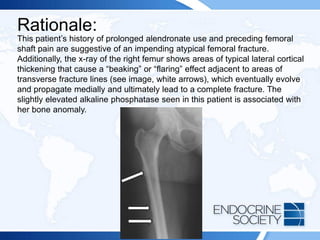
Slide Deck
ADRENAL
ITE 2018 Question 7
A 54-year-old man is referred for evaluation of fatigue and possible Cushing
syndrome. His problems started after a back injury at work 1 year ago. He
developed sudden lower back pain while lifting a heavy load and was sent
home. He was evaluated and prescribed physical therapy for 6 weeks with
some relief, and then he was given monthly back injections in a pain clinic
for 6 months (the last treatment was 4 months ago). The injections markedly
eased his pain, but he developed rapid weight gain, hunger, easy bruising,
and facial fullness. His initial evaluation with his primary care physician
documented the following laboratory values:
• Plasma ACTH = 4 pg/mL (10-60 pg/mL) (SI: 0.9 pmol/L [2.2-13.2 pmol/L])
• Urinary free cortisol = <3 µg/24 h (4-50 µg/24 h) (SI: <8.3 nmol/d [11-138
nmol/d])
• Overnight 1-mg dexamethasone suppression test, cortisol = <0.2 µg/dL (SI: <5.5
nmol/L)
ITE 2018 Question 7
The patient is referred to you for further evaluation. He reports that his
condition has not changed over the last 6 months. On physical examination,
he has facial plethora and fullness, prominent supraclavicular fat pads, and
dermal atrophy with diffuse bruising. His blood pressure is 130/80 mm Hg.
His visual fields are full, and he has no pedal edema.
Which of the following diagnostic tests
will reveal the etiology of his Cushing
syndrome?
A. Late-night salivary cortisol measurement
B. MRI-directed pituitary with contrast
C. 111In-pentetreotide (“octreotide”) scan
D. CT scan with fine cuts of the adrenal glands
E. Urine synthetic glucocorticoid testing
Correct Answer: E
Learning objective:
Confirm the diagnosis of iatrogenic Cushing syndrome and
recognize the magnitude and duration of glucocorticoid excess
caused by injectable corticosteroids.
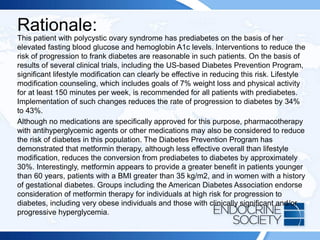
Rationale:
Corticosteroid injections for back pain are commonly administered in pain
clinics, and patients are often unaware that the pain medicine is a mixture
of anaesthetics and potent synthetic corticosteroids. A typical history
includes the abrupt onset of cushingoid features and metabolic
consequences. Because these drugs do not activate the
mineralocorticoid receptor as do high concentrations of cortisol,
hypertension and hypokalemia are usually absent. When soluble
preparations such as methylprednisolone are injected into the synovial
fluid of a joint space, the drug is absorbed and cleared within several
days, limiting the cumulative consequences. When a suspension
preparation is injected into a relatively avascular space, the drug is
absorbed very slowly, and the endocrinologic action can be profound and
sustained. The most common agent causing long-term problems is
triamcinolone acetonide, 0.1% suspensions, when given as facet joint or
myofascial injections. The cumulative effect of 40 mg of triamcinolone
acetonide is equivalent to roughly 1.2 g of hydrocortisone, more than the
average person produces in 100 days.
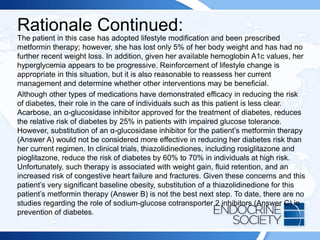
Rationale Continued:
The particulate formulation prolongs the absorption of the triamcinolone
acetonide over weeks to months, which creates a sustained toxic
exposure. Patients with HIV infection taking the potent CYP3A4 inhibitor
ritonavir are particularly susceptible due to delayed metabolism of the
triamcinolone.
Although late-night salivary cortisol measurement (Answer A) might
generally be the most sensitive test for ACTH-dependent
hypercortisolism, this patient has low serum cortisol and plasma ACTH
values, suggesting exogenous hypercortisolism. Imaging studies
(Answers B, C, and D) would only be indicated if the screening laboratory
tests suggested endogenous hypercortisolism. In this case, the urine
synthetic glucocorticoid screen (Answer E) was positive for triamcinolone
acetonide, despite the last injection being 4 months ago.
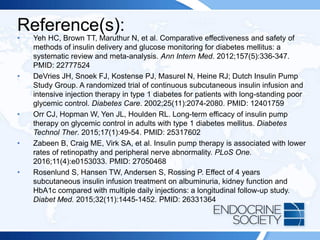
Reference(s):
• Danaher PJ, Salsbury TL, Delmar JA. Metabolic derangement after
injection of triamcinolone into the hip of an HIV-infected patient
receiving ritonavir. Orthopedics. 2009;32(6):450. PMID: 19634808
• Iglesias P, González J, Díez JJ. Acute and persistent iatrogenic
Cushing's syndrome after a single dose of triamcinolone acetonide. J
Endocrinol Invest. 2005;28(11):1019-1023. PMID: 16483182
• Taylor RL, Grebe SK, Singh RJ. Quantitative, highly sensitive liquid
chromatography-tandem mass spectrometry method for detection of
synthetic corticosteroids. Clin Chem. 2004;50(12):2345-2352. PMID:
15486026
ITE 2018 Question 18
You are consulted regarding a 74-year-old man in the orthopedic unit 4 days
after a left total hip replacement. The patient reported severe left flank
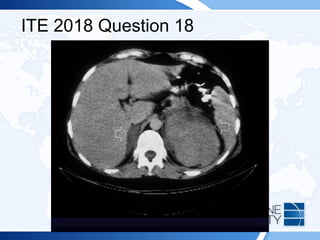
discomfort for 24 hours and abdominal CT was performed (see image).
Bilateral adrenal enlargement was noted (arrows). His medical team now
seeks your consultation. He has been ambulatory since surgery, but his
appetite has been poor and he has had trouble adhering to the physical
therapy program. He has a history of well-controlled hypertension for many
years. His postoperative medications include acetaminophen/codeine,
amlodipine, and low-molecular-weight heparin.
ITE 2018 Question 18
On physical examination, he is alert and uncomfortable. His blood pressure
is 126/70 mm Hg, pulse rate is 110 beats/min, and temperature is 99.8°F
(37.7°C). His height is 69 in (175.3 cm), and weight is 197 lb (89.5 kg) (BMI
= 29.1 kg/m2). He has truncal obesity, but does not appear cushingoid. He
has no hyperpigmentation. His thyroid gland is normal. Findings on chest
and cardiac examinations are remarkable only for a rapid regular beat. His
abdomen is soft, but there is some guarding to palpation in the left flank. He
has no edema, and findings on neurologic examination are normal.
ITE 2018 Question 18
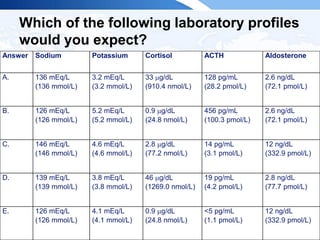
Which of the following laboratory profiles
would you expect?
Answer Sodium Potassium Cortisol ACTH Aldosterone
A. 136 mEq/L
(136 mmol/L)
3.2 mEq/L
(3.2 mmol/L)
33 g/dL
(910.4 nmol/L)
128 pg/mL
(28.2 pmol/L)
2.6 ng/dL
(72.1 pmol/L)
B. 126 mEq/L
(126 mmol/L)
5.2 mEq/L
(5.2 mmol/L)
0.9 g/dL
(24.8 nmol/L)
456 pg/mL
(100.3 pmol/L)
2.6 ng/dL
(72.1 pmol/L)
C. 146 mEq/L
(146 mmol/L)
4.6 mEq/L
(4.6 mmol/L)
2.8 g/dL
(77.2 nmol/L)
14 pg/mL
(3.1 pmol/L)
12 ng/dL
(332.9 pmol/L)
D. 139 mEq/L
(139 mmol/L)
3.8 mEq/L
(3.8 mmol/L)
46 g/dL
(1269.0 nmol/L)
19 pg/mL
(4.2 pmol/L)
2.8 ng/dL
(77.7 pmol/L)
E. 126 mEq/L
(126 mmol/L)
4.1 mEq/L
(4.1 mmol/L)
0.9 g/dL
(24.8 nmol/L)
<5 pg/mL
(1.1 pmol/L)
12 ng/dL
(332.9 pmol/L)
Correct Answer: B
Learning objective:
Diagnose bilateral adrenal hemorrhage and identify the associated
biochemical and metabolic derangements expected from primary
adrenal insufficiency.
Rationale:
Before the introduction of CT, bilateral adrenal hemorrhage (as seen in
the vignette’s image) was often fatal and identified only at postmortem
examination. Adrenal hemorrhage was initially identified in association
with fulminant meningococcemia in children (Waterhouse-Friderichsen
syndrome), but this is a rare event now. Adrenal hemorrhage is usually
seen in patients with a history of thromboembolic disease or recent
surgery requiring either therapeutic or prophylactic anticoagulation.
Coagulopathies such as heparin-induced thrombocytopenia and
antiphospholipid syndrome associated with lupus anticoagulant are also
well-appreciated causes of bilateral adrenal hemorrhage. The symptoms
are often not dramatic with pain of varying severity in the abdomen, flank,
lower back, or chest. There are usually few clues on physical examination
except for a low-grade fever. Interestingly, hypotension is a late finding
and usually heralds the onset of catastrophic shock that can be mistaken
for septic shock.
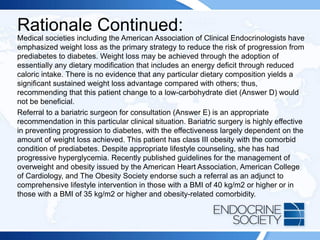
Rationale Continued:
Primary adrenocortical insufficiency is always expected in these patients
with subnormal cortisol and elevated ACTH, which is illustrated in the
laboratory profile of Answer B. The most common laboratory findings are
hyponatremia and hyperkalemia related primarily to cortisol deficiency and
the lack of glucocorticoid negative feedback on vasopressin, as well as
mineralocorticoid deficiency contributing to decreased potassium
clearance. The mechanisms associated with adrenal hemorrhage are
multifactorial: because each adrenal gland has only 1 vein, any rise in
venous pressure with or without adrenal vein thrombosis creates a
“vascular dam” and, in the presence of a coagulopathy (endogenous or
exogenous), it will lead to a possible hemorrhagic event. Stress with
increases in adrenal blood flow may contribute to the pathogenesis. The
eccentric muscular arrangement in the adrenal vein may make it
particularly vulnerable to the formation of platelet thrombi, especially when
there is turbulence and stasis. Of course, the adrenal veins have very high
epinephrine levels, which may also contribute to platelet aggregation.
Rationale Continued:
Hypernatremia (Answer C) would not be expected in patients with bilateral
adrenal hemorrhage, but it might be expected in patients with
hypothalamic-pituitary shock with secondary adrenal insufficiency and
neurogenic diabetes insipidus associated with severe anoxic brain injury.
Pituitary apoplexy (Answer E) might also cause secondary adrenal
insufficiency in the setting of anticoagulation. Bilateral adrenal enlargement
can certainly be seen in patients with ACTH-dependent Cushing syndrome
(Answer A), but the adrenal enlargement is usually symmetric and follows
the contour of the adrenal glands. Critically ill patients may also have
dissociation between cortisol and aldosterone (Answer D) with preferential
secretion of cortisol. Critically ill patients maintain adequate cortisol
secretion despite ACTH levels that actually decline during the course of
their stay in the intensive care unit. This is related to several factors
including increased adrenal sensitivity to ACTH, as well as decreased renal
and hepatic metabolic clearance of cortisol during critical illness.
Reference(s):
• Rao RH, Vagnucci AH, Amico JA. Bilateral massive adrenal
hemorrhage: early recognition and treatment. Ann Intern Med.
1989;110(3):227-235. PMID: 2643380
• Wolverson MK, Kannegiesser H. CT of bilateral adrenal hemorrhage
with acute adrenal insufficiency in the adult. AJR Am J Roentgenol.
1984;142(2):311-314. PMID: 6607597
• Muñoz Corsini L, Delgado Arnaiz C, Garcia del Valle S, Reboto Cortes
P, Lopez del Castillo A. Postoperative bilateral adrenal hemorrhage:
correlation between clinical and radiological signs. J Clin Anesth.
2008;20(8):605-608. PMID: 19100934
• Findling JW, Waters VO, Raff H. The dissociation of renin and
aldosterone during critical illness. J Clin Endocrinol Metab.
1987;64(3):592-595. PMID: 3029157
• Boonen E, Vervenne H, Meersseman P, et al. Reduced cortisol
metabolism during critical illness. N Engl J Med. 2013;368(16):1477-
1488. PMID: 23506003
ITE 2018 Question 24
A 55-year-old woman presents with episodic palpitations, sweats, and
headaches. Biochemical testing reveals that her plasma normetanephrine
level is 5-fold greater than the upper limit of the reference range. Abdominal
CT identifies a 3-cm left adrenal mass with a lipid-poor density of 34
Hounsfield units and a malignant-appearing, 2.5-cm right renal mass
suggestive of renal cell carcinoma. Relevant family history includes a
gastrointestinal stromal tumor in her 48-year-old brother and metastatic
pheochromocytoma in her 58-year-old sister.
Which of the following genes is most
likely to harbor a pathogenic mutation in
this patient?
A. SDHB
B. RET
C. SDHAF2
D. MEN1
E. NF1
Correct Answer: A
Learning objective:
Differentiate among the inherited pheochromocytoma-
paraganglioma syndromes.
Rationale:
This patient’s clinical presentation is concerning for pheochromocytoma,
with biochemical evidence to support the presence of a catecholamine-
secreting tumor and imaging that demonstrates a lipid-poor adrenal mass
in addition to a probable renal cell carcinoma. This combination of
pheochromocytoma and renal cell carcinoma should raise the possibility
of an inherited tumor predisposition syndrome such as von-Hippel–
Lindau syndrome (VHL gene), one of the succinate dehydrogenase gene
mutation syndromes (SDHA, SDHB, SDHC, SDHD, or SDHAF2), or a
mutation in the TMEM127 gene. These autosomal dominant syndromes
all carry a lifetime risk for developing pheochromocytoma,
paraganglioma, and renal cell carcinoma. VHL mutations are also
associated with many other vascular and nervous system tumors, while
SDHx mutations can be associated with gastrointestinal stromal tumors
(as seen in the patient’s brother) and potentially with pancreatic
neuroendocrine tumors and pituitary adenomas.
Rationale Continued:
Although a pathogenic mutation in either SDHB (Answer A) or SDHAF2
(Answer C) could potentially explain this patient’s presentation, an SDHB
mutation is statistically far more likely because SDHAF2 mutations are
exceedingly rare (only a few cases have been identified).
Mutations in the RET proto-oncogene (Answer B), which cause multiple
endocrine neoplasia type 2, and mutations in the NF1 gene (Answer E),
which cause neurofibromatosis type 1, increase the risk for
pheochromocytoma, but neither syndrome is known to be associated with
renal tumors or gastrointestinal stromal tumors. Mutations in the MEN1
gene (Answer D), which cause multiple endocrine neoplasia type 1, are not
associated with pheochromocytoma, renal cell carcinoma, or
gastrointestinal stromal tumors.
Rationale Continued:
The prevalence of a germline mutation in patients with pheochromocytoma
or paraganglioma is estimated to be 25% to 40%. Many gene mutations are
associated not only with pheochromocytoma and paraganglioma, but also
with other tumors (eg, renal cell carcinoma, gastrointestinal stromal
tumors). Genetic testing should be discussed with every patient, as
recommended by the Endocrine Society Clinical Practice Guidelines in
2014. The discovery of a germline mutation has important surveillance
implications for affected patients and their family members. Patients with a
known mutation can be screened (with imaging) for tumors associated with
that specific mutation. Although the exact surveillance recommendations
have not been validated with evidence yet, it is generally recommended
that patients with a known pheochromocytoma-paraganglioma genetic
syndrome undergo longitudinal surveillance with a combination of plasma
fractionated metanephrine measurement and imaging.
.
Reference(s):
• Lenders JW, Duh QY, Eisenhofer G, et al; Endocrine Society.
Pheochromocytoma and paraganglioma: an Endocrine Society Clinical
Practice Guideline. J Clin Endocrinol Metab. 2014;99(6):1915-1942.
PMID: 24893135
• Rana HQ, Rainville IR, Vaidya A. Genetic testing in the clinical care of
patients with pheochromocytoma and paraganglioma. Curr Opin
Endocrinol Diabetes Obes. 2014;21(3):166-176. PMID: 24739310
ITE 2018 Question 37
A 21-year-old woman comes to your practice for the first time on transfer of
care from her pediatric endocrinologist. Congenital adrenal hyperplasia due
to 21-hydoxylase deficiency was diagnosed at birth. Her current treatment
consists of dexamethasone, 0.5 mg at bedtime, and fludrocortisone acetate,
0.1 mg every morning. She has regular menses, is not sexually active, and
is not attempting to become pregnant. Her only concerns are difficulty losing
weight and poor sleep.
On physical examination, her height is 58 in (147.3 cm) and weight is 143 lb
(65 kg) (BMI = 29.9 kg/m2). Her blood pressure is 110/66 mm Hg. She has
no hirsutism, acne, or purple striae, and her skin is somewhat thinned.
ITE 2018 Question 37
Laboratory test results:
• Sodium = 138 mEq/L (136-142 mEq/L) (SI: 138 mmol/L [136-142 mmol/L])
• Potassium = 4.8 mEq/L (3.5-5.0 mEq/L) (SI: 4.8 mmol/L [3.5-5.0 mmol/L])
• Serum DHEA-S = <15 µg/dL (44-332 µg/dL) (SI: <0.4 µmol/L [1.19-9.11 µmol/L])
• Serum testosterone = <20 ng/dL (8-60 ng/dL) (SI: <0.7 nmol/L [0.3-2.1 nmol/L])
• Plasma renin activity = 3.4 ng/mL per h (0.6-4.3 ng/mL per h)
• Serum androstenedione = 30 ng/dL (80-240 ng/dL) (SI: 1.0 nmol/L [2.79-8.38
nmol/L])
Which of the following is the most
appropriate next step in her
management?
A. Order genotyping of the CYP21A2 gene
B. Measure serum 17-hydroxyprogesterone
C. Divide the dexamethasone dose as 0.25 mg twice daily
D. Reduce the glucocorticoid dosage
E. Stop fludrocortisone acetate
Correct Answer: D
Learning objective:
Guide therapy of congenital adrenal hyperplasia on the basis of
clinical and laboratory information.
Rationale:
The treatment of 21-hydroxylase deficiency requires glucocorticoids to
both replace the cortisol deficiency and to control the adrenal-derived
androgen excess. In children, divided doses of hydrocortisone are the
standard of therapy, but in adults, many different regimens are used.
Each glucocorticoid has advantages and disadvantages. Dexamethasone
given at bedtime is the most effective way to prevent the early-morning
ACTH rise and thus control the androgen excess; however,
dexamethasone is difficult to titrate and easily causes iatrogenic Cushing
syndrome. Dexamethasone also has no mineralocorticoid activity like
hydrocortisone. In general, the goal is to provide the minimum amount of
glucocorticoid to keep androgen production at goal, which is typically in
the normal range or slightly higher if tolerated. The other consideration,
which does not apply to this case, is that in women attempting pregnancy,
the follicular-phase progesterone should be maintained at less than 0.6
ng/mL (<1.9 nmol/L), which sometimes requires higher doses than those
needed to control the androgen excess.
Rationale Continued:
This young woman has regular menses, no signs of androgen excess, and
low levels of all the 19-carbon steroids (DHEA-S, testosterone, and
androstenedione). She also has some subtle features of iatrogenic Cushing
syndrome, so she is on more therapy than she needs. Thus, reducing the
glucocorticoid dosage (Answer D) is the most appropriate management
step.
CYP21A2 genotyping (Answer A) will not change her therapy, which is
determined by her clinical status and laboratory data. Measuring 17-
hydroxyprogesterone (Answer B) will not be informative because the
downstream steroids are low; even if the value is high, therapy should not
be intensified. Giving the dexamethasone twice daily (Answer C) might be
more effective, but this change is not needed and will be more difficult and
possibly more toxic. Her blood pressure is low-normal, and her potassium
and plasma renin activity are high-normal, so the fludrocortisone acetate
should not be decreased (Answer E) and might even need to be increased
slightly.
Reference(s):
• Auchus RJ, Arlt W. Approach to the patient: the adult with congenital
adrenal hyperplasia. J Clin Endocrinol Metab. 2013;98(7):2645-2655.
PMID: 23837188
• Arlt W, Willis DS, Wild SH, et al; United Kingdom Congenital Adrenal
Hyperplasia Adult Study Executive (CaHASE). Health status of adults
with congenital adrenal hyperplasia: a cohort study of 203 patients. J
Clin Endocrinol Metab. 2010;95(11):5110-5121. PMID: 20719839
• Casteràs A, De Silva P, Rumsby G, Conway GS. Reassessing
fecundity in women with classical congenital adrenal hyperplasia
(CAH): normal pregnancy rate but reduced fertility rate. Clin
Endocrinol (Oxf). 2009:70(6):833-837. PMID: 19250265
ITE 2018 Question 45
You are asked to evaluate a 56-year-old woman with an adrenal mass.
Breast cancer (T2 N1 M0) was diagnosed 1 year ago and she is currently on
letrozole therapy. She has no other notable health problems and takes no
other medications.
On physical examination, she appears well. Her blood pressure is 112/78
mm Hg. Her height is 65 in (165 cm), and weight is 135 lb (61.4 kg) (BMI =
22.5 kg/m2). No abnormalities are noted.
ITE 2018 Question 45
Laboratory test results:
• Cortisol (8 AM, after 1 mg overnight dexamethasone suppression test) =
1.1 μg/dL (SI: 30.3 nmol/L)
• Metanephrines (plasma fractionated)
o Metanephrine = 22 pg/mL (<57 pg/mL) (SI: 111.5 pmol/L [<289
pmol/L])
o Normetanephrine = 112 pg/mL (<148 pg/mL) (SI: 611.5 pmol/L [<808
pmol/L])
• Aldosterone = 10 ng/dL (1-21 ng/dL) (SI: 277.4 pmol/L [27.7-582.5
pmol/L])
• Plasma renin activity = 1.4 ng/mL per h (0.6-4.3 ng/mL per h)
ITE 2018 Question 45
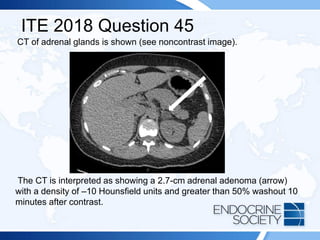
CT of adrenal glands is shown (see noncontrast image).
The CT is interpreted as showing a 2.7-cm adrenal adenoma (arrow)
with a density of –10 Hounsfield units and greater than 50% washout 10
minutes after contrast.
Which of the following is the best step in
the management of this patient’s adrenal
mass?
A. No further investigation required
B. Adrenal biopsy
C. Laparoscopic adrenalectomy
D. Fluorodeoxyglucose PET CT
E. Adrenal MRI
Correct Answer: A
Learning objective:
Identify radiologic characteristics typical of benign adrenal
adenomas.
Rationale:
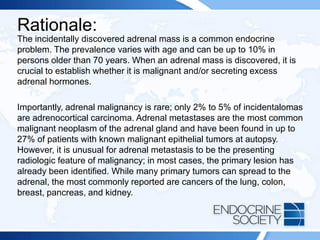
The incidentally discovered adrenal mass is a common endocrine
problem. The prevalence varies with age and can be up to 10% in
persons older than 70 years. When an adrenal mass is discovered, it is
crucial to establish whether it is malignant and/or secreting excess
adrenal hormones.
Importantly, adrenal malignancy is rare; only 2% to 5% of incidentalomas
are adrenocortical carcinoma. Adrenal metastases are the most common
malignant neoplasm of the adrenal gland and have been found in up to
27% of patients with known malignant epithelial tumors at autopsy.
However, it is unusual for adrenal metastasis to be the presenting
radiologic feature of malignancy; in most cases, the primary lesion has
already been identified. While many primary tumors can spread to the
adrenal, the most commonly reported are cancers of the lung, colon,
breast, pancreas, and kidney.
Rationale Continued:
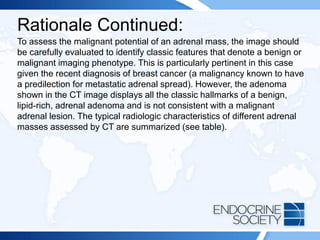
To assess the malignant potential of an adrenal mass, the image should
be carefully evaluated to identify classic features that denote a benign or
malignant imaging phenotype. This is particularly pertinent in this case
given the recent diagnosis of breast cancer (a malignancy known to have
a predilection for metastatic adrenal spread). However, the adenoma
shown in the CT image displays all the classic hallmarks of a benign,
lipid-rich, adrenal adenoma and is not consistent with a malignant
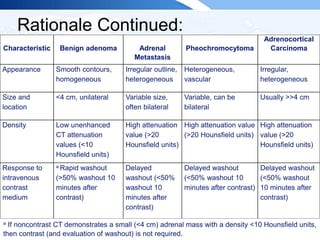
adrenal lesion. The typical radiologic characteristics of different adrenal
masses assessed by CT are summarized (see table).
Rationale Continued:
Characteristic Benign adenoma Adrenal
Metastasis
Pheochromocytoma
Adrenocortical
Carcinoma
Appearance Smooth contours,
homogeneous
Irregular outline,
heterogeneous
Heterogeneous,
vascular
Irregular,
heterogeneous
Size and
location
<4 cm, unilateral Variable size,
often bilateral
Variable, can be
bilateral
Usually >>4 cm
Density Low unenhanced
CT attenuation
values (<10
Hounsfield units)
High attenuation
value (>20
Hounsfield units)
High attenuation value
(>20 Hounsfield units)
High attenuation
value (>20
Hounsfield units)
Response to
intravenous
contrast
medium
a Rapid washout
(>50% washout 10
minutes after
contrast)
Delayed
washout (<50%
washout 10
minutes after
contrast)
Delayed washout
(<50% washout 10
minutes after contrast)
Delayed washout
(<50% washout
10 minutes after
contrast)
a If noncontrast CT demonstrates a small (<4 cm) adrenal mass with a density <10 Hounsfield units,
then contrast (and evaluation of washout) is not required.
Rationale Continued:
The adrenal lesion in this vignette is small with low attenuation (lipid rich,
with a density of <10 Hounsfield units) and displays rapid washout of
intravenous contrast. In addition, the biochemistry also illustrates that this
adrenal mass is nonfunctional. Therefore, this benign, nonfunctional
lesion requires no further investigation (Answer A).
Given that this lesion is clearly benign, the history of breast cancer is not
relevant in this case and adrenal biopsy (Answer B) is unnecessary.
Adrenal biopsy should be reserved for patients with a known extra-
adrenal malignancy who have an adrenal lesion with indeterminate
imaging characteristics and no evidence of catecholamine excess. There
is no indication for surgical resection of this mass (Answer C) on the
basis of radiologic appearance or biochemical characteristics.
Rationale Continued:
PET scanning with fluorodeoxyglucose (Answer D) is not routinely
required in the evaluation of adrenal masses, but it could have been a
useful additional tool in this case if the imaging phenotype had been less
reassuring. Finally, MRI (Answer E) offers no advantage over CT in the
radiologic evaluation of adrenal masses.
The radiologic and clinical follow-up of such masses remains
controversial. No prospective studies have been conducted to determine
the optimal frequency and duration of follow-up for adrenal
incidentalomas. In addition, the radiation exposure related to additional
CT scanning should be considered. The recently published European
guideline on the management of such masses, however, would suggest
that for this small adenoma with benign imaging characteristics, no
further routine radiologic follow-up is indicated. However, many clinicians
would advocate for another CT in 6 to 12 months to ensure no change in
the size or appearance of the adenoma.
Reference(s):
• Fassnacht M, Arlt W, Bancos I, et al. Management of adrenal
incidentalomas: European Society of Endocrinology Clinical Practice
Guideline in collaboration with the European Network for the Study of
Adrenal Tumors. Eur J Endocrinol. 2016;175(2):G1-G34. PMID:
27390021
• Nieman LK. Approach to the patient with an adrenal incidentaloma. J
Clin Endocrinol Metab. 2010;95(9):4106-4113. PMID: 20823463
ITE 2018 Question 47
A nephrologist colleague asks you for an opinion regarding a 42-year-old
woman with primary hyperaldosteronism diagnosed 2 months earlier. Her
blood pressure has been well controlled on spironolactone alone, and her
other antihypertensive medications have been discontinued. She has a
normal potassium concentration without supplementation.
She had initially presented with a 6-year history of intermittent hypokalemia
and hypertension requiring 3 to 4 antihypertensive medications.
ITE 2018 Question 47
Initial laboratory test results (while taking lisinopril, hydrochlorothiazide, and
amlodipine):
• Morning serum aldosterone = 19 ng/dL (1-21 ng/dL) (SI: 527.1 pmol/L
[27.7-582.5 pmol/L])
• Plasma renin activity = 0.2 ng/mL per h (0.6-4.3 ng/mL per h)
• Urinary aldosterone = 18 µg/24 h
• Urinary sodium = 202 mEq/24 h (40-217 mEq/24 h) (SI: 202 mmol/d [40-
217 mmol/d])
ITE 2018 Question 47
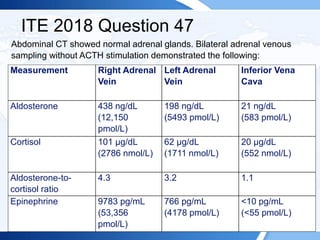
Abdominal CT showed normal adrenal glands. Bilateral adrenal venous
sampling without ACTH stimulation demonstrated the following:
Measurement Right Adrenal
Vein
Left Adrenal
Vein
Inferior Vena
Cava
Aldosterone 438 ng/dL
(12,150
pmol/L)
198 ng/dL
(5493 pmol/L)
21 ng/dL
(583 pmol/L)
Cortisol 101 µg/dL
(2786 nmol/L)
62 µg/dL
(1711 nmol/L)
20 µg/dL
(552 nmol/L)
Aldosterone-to-
cortisol ratio
4.3 3.2 1.1
Epinephrine 9783 pg/mL
(53,356
pmol/L)
766 pg/mL
(4178 pmol/L)
<10 pg/mL
(<55 pmol/L)
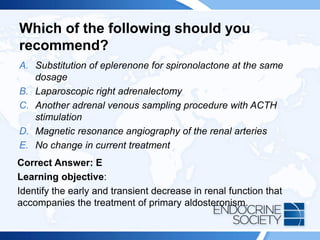
Which of the following should you
recommend?
A. Substitution of eplerenone for spironolactone at the same
dosage
B. Laparoscopic right adrenalectomy
C. Another adrenal venous sampling procedure with ACTH
stimulation
D. Magnetic resonance angiography of the renal arteries
E. No change in current treatment
Correct Answer: E
Learning objective:
Identify the early and transient decrease in renal function that
accompanies the treatment of primary aldosteronism.
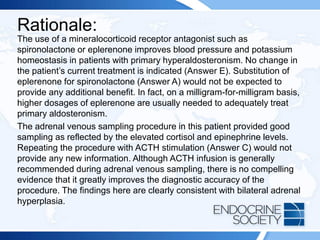
Rationale:
The use of a mineralocorticoid receptor antagonist such as
spironolactone or eplerenone improves blood pressure and potassium
homeostasis in patients with primary hyperaldosteronism. No change in
the patient’s current treatment is indicated (Answer E). Substitution of
eplerenone for spironolactone (Answer A) would not be expected to
provide any additional benefit. In fact, on a milligram-for-milligram basis,
higher dosages of eplerenone are usually needed to adequately treat
primary aldosteronism.
The adrenal venous sampling procedure in this patient provided good
sampling as reflected by the elevated cortisol and epinephrine levels.
Repeating the procedure with ACTH stimulation (Answer C) would not
provide any new information. Although ACTH infusion is generally
recommended during adrenal venous sampling, there is no compelling
evidence that it greatly improves the diagnostic accuracy of the
procedure. The findings here are clearly consistent with bilateral adrenal
hyperplasia.
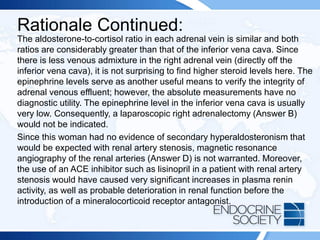
Rationale Continued:
The aldosterone-to-cortisol ratio in each adrenal vein is similar and both
ratios are considerably greater than that of the inferior vena cava. Since
there is less venous admixture in the right adrenal vein (directly off the
inferior vena cava), it is not surprising to find higher steroid levels here. The
epinephrine levels serve as another useful means to verify the integrity of
adrenal venous effluent; however, the absolute measurements have no
diagnostic utility. The epinephrine level in the inferior vena cava is usually
very low. Consequently, a laparoscopic right adrenalectomy (Answer B)
would not be indicated.
Since this woman had no evidence of secondary hyperaldosteronism that
would be expected with renal artery stenosis, magnetic resonance
angiography of the renal arteries (Answer D) is not warranted. Moreover,
the use of an ACE inhibitor such as lisinopril in a patient with renal artery
stenosis would have caused very significant increases in plasma renin
activity, as well as probable deterioration in renal function before the
introduction of a mineralocorticoid receptor antagonist.
Reference(s):
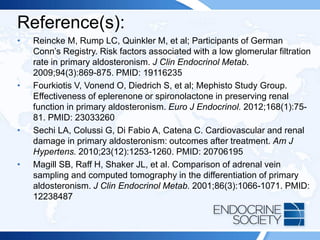
• Reincke M, Rump LC, Quinkler M, et al; Participants of German
Conn’s Registry. Risk factors associated with a low glomerular filtration
rate in primary aldosteronism. J Clin Endocrinol Metab.
2009;94(3):869-875. PMID: 19116235
• Fourkiotis V, Vonend O, Diedrich S, et al; Mephisto Study Group.
Effectiveness of eplerenone or spironolactone in preserving renal
function in primary aldosteronism. Euro J Endocrinol. 2012;168(1):75-
81. PMID: 23033260
• Sechi LA, Colussi G, Di Fabio A, Catena C. Cardiovascular and renal
damage in primary aldosteronism: outcomes after treatment. Am J
Hypertens. 2010;23(12):1253-1260. PMID: 20706195
• Magill SB, Raff H, Shaker JL, et al. Comparison of adrenal vein
sampling and computed tomography in the differentiation of primary
aldosteronism. J Clin Endocrinol Metab. 2001;86(3):1066-1071. PMID:
12238487
ITE 2018 Question 53
A 36-year-old woman has a 10-year history of anxiety and depression. She
has been treated with venlafaxine for 5 years with substantial improvements
in her anxiety, but over the last year she has developed more frequent
anxiety episodes and occasional palpitations. Alprazolam was prescribed
several weeks ago, but it has not relieved her symptoms. During a routine
primary care appointment, her blood pressure was 162/90 mm Hg, her pulse
rate was 102 beats/min, and she was noted to be anxious. Her primary care
physician ordered thyroid function tests, which were normal, and then
ordered measurement of plasma metanephrines to evaluate whether she
could have a catecholamine-producing tumor contributing to her anxiety.
• Plasma normetanephrine = 222 pg/mL (<148 pg/mL) (SI: 1212.1 pmol/L
[<808 pmol/L])
• Plasma metanephrine = 80 pg/mL (<57 pg/mL) (SI: 405.6 pmol/L [<289
pmol/L])
Which of the following is the most likely
interpretation of these results?
A. Anxiety
B. “False-positive” results related to venlafaxine use
C. “False-positive” results related to alprazolam use
D. Paraganglioma
E. Pheochromocytoma
Correct Answer: B
Learning objective:
Interpret laboratory measurement of metanephrines when
evaluating for a catecholamine-secreting tumor and identify
potential causes of false-positive results.
Rationale:
Pheochromocytomas are neuroendocrine tumors of the adrenal medulla
that are capable of synthesizing and secreting dopamine, norepinephrine,
and epinephrine. Paragangliomas are neuroendocrine tumors that
usually arise from chromaffin cells of the autonomic nervous system and
are capable of synthesizing and secreting dopamine and norepinephrine,
but not epinephrine. Therefore, elevations in plasma normetanephrine
(the metabolite of norepinephrine) may indicate either a functional
pheochromocytoma or paraganglioma, whereas elevations in plasma
metanephrine are associated with pheochromocytomas. Importantly,
symptomatic pheochromocytomas and paragangliomas that induce a
syndrome of catecholamine excess typically have substantial elevations
in plasma metanephrines—usually at least 4-fold above the upper limit of
the reference range, but almost always greater than 2-fold. In this case,
the 1.5-fold elevations above the upper normal limit (both
normetanephrine and metanephrine) are inconsistent with symptomatic
pheochromocytoma or paraganglioma (thus, Answers D and E are
incorrect).
Rationale Continued:
An increasingly common cause of false-positive test results in this setting is
the use of medications such as tricyclic antidepressants, serotonin
reuptake inhibitors, and norepinephrine and/or epinephrine reuptake
inhibitors. These medications (such as venlafaxine [Answer B]) can induce
mild elevations in plasma normetanephrine and metanephrine that are
usually less than 2-fold greater than the upper limit of the reference range;
however, in rare cases these medications can induce greater than 2-fold
elevations in metanephrines. This suspicion is difficult to confirm since
stopping the medication may not be safe from a psychiatric view point and
it can take 6 to 8 weeks after medication cessation for metanephrines to
normalize. A clonidine suppression test may eliminate the source of
sympathetic nervous system false-positive results, but it is rarely used in
clinical practice. Therefore, one must often rely on clinical judgment and
close monitoring to assess for progressive symptoms.
Rationale Continued:
Another cause of increased sympathoadrenergic tone is anxiety (Answer
A). Increased sympathetic nervous system activity with anxiety, or even
seated or upright posture, can mildly increase plasma normetanephrine
levels. However, these elevations are typically much less than 2-fold
greater than the upper limit of the reference range, and anxiety is less likely
than antidepressants to induce such elevations.
Alprazolam (Answer C) does not induce elevations in plasma
metanephrines.
Reference(s):
• Lenders JW, Duh QY, Eisenhofer G, et al; Endocrine Society.
Pheochromocytoma and paraganglioma: an Endocrine Society Clinical
Practice Guideline. J Clin Endocrinol Metab. 2014;99(6):1915-1942.
PMID: 24893135
• Neary NM, King KS, Pacak K. Drugs and pheochromocytoma--don’t
be fooled by every elevated metanephrine. N Engl J Med.
2011;364(23):2268-2270. PMID: 21651412
ITE 2018 Question 83
A 34-year-old man is referred because of weight gain of 30 lb (13.6 kg) over
the past 3 years despite eating a healthful diet. He reports no skin changes
or muscle weakness. He has a history of hypertension, epilepsy, and a
recent diagnosis of impaired glucose tolerance. His medications include
lamotrigine, carbamazepine, lisinopril, amlodipine, and atorvastatin.
On physical examination, he is centrally obese. His height is 72 in (182.9
cm), and weight is 280 lb (127.3 kg) (BMI = 38.0 kg/m2). There are a few
pale striae over the abdominal wall but no other skin changes. There is no
proximal myopathy. His blood pressure is 151/94 mm Hg.
ITE 2018 Question 83
Laboratory test results:
• Sodium = 138 mEq/L (136-142 mEq/L) (SI: 138 mmol/L [136-142 mmol/L])
• Potassium = 4.9 mEq/L (3.5-5.0 mEq/L) (SI: 4.9 mmol/L [3.5-5.0 mmol/L])
• Serum urea nitrogen = 18 mg/dL (8-23 mg/dL) (SI: 6.4 mmol/L [2.9-8.2 mmol/L])
• Creatinine = 0.9 mg/dL (0.7-1.3 mg/dL) (SI: 79.6 μmol/L [61.9-114.9 μmol/L])
• Glucose = 175 mg/dL (70-99 mg/dL) (SI: 9.7 mmol/L [3.9-5.5 mmol/L])
• TSH = 2.4 mIU/L (0.5-5.0 mIU/L)
• Free T4 = 1.3 ng/dL (0.8-1.8 ng/dL) (SI: 16.7 pmol/L [10.30-23.17 pmol/L])
• Cortisol (8 AM, after 1-mg overnight dexamethasone suppression test) = 14
μg/dL (SI: 386.2 nmol/L)
In light of these results, which of the
following is the most appropriate next
investigation?
A. Perform adrenal CT
B. Perform pituitary MRI
C. Measure 24-hour urinary free cortisol
D. Perform a 2-day low-dose dexamethasone suppression test
E. Stop lamotrigine and perform another 1-mg overnight
dexamethasone suppression test
Correct Answer: C
Learning objective:
Select appropriate screening tests for cortisol excess and describe
the potential for concomitant medication to interfere with
dexamethasone.
Rationale:
While this young patient with modest weight gain, hypertension, and
impaired glucose tolerance has no pathognomonic clinical signs of
Cushing syndrome, screening for cortisol excess was justified. However,
clinical suspicion is low given the absence of significant striae, thin
bruised skin, or proximal myopathy. It is, therefore, surprising that the
overnight dexamethasone suppression test result is suggestive of cortisol
excess. In normal individuals, early-morning plasma cortisol should
suppress to less than 1.8 μg/dL (<50 nmol/L) after 1 mg of
dexamethasone is administered between 11 PM and midnight the night
before. In this case, the abnormal result merits additional evaluation.
Given the low clinical suspicion, additional biochemical screening tests
should be performed before further investigation and imaging to
determine the underlying cause of cortisol excess. Imaging studies
(Answers A and B) would be premature before confirmation of
hypercortisolism.
Rationale Continued:
The Endocrine Society Clinical Practice Guideline for the diagnosis of
Cushing syndrome suggests a number of first-line tests in the initial
screening for cortisol excess: the 1-mg overnight dexamethasone
suppression test, 2-day low-dose dexamethasone suppression test, late-
night salivary cortisol measurement, or 24-hour urinary free cortisol
measurement. Given that this patient has an abnormal result from one test
(1-mg overnight dexamethasone suppression test), as well as minimal
clinical evidence of cortisol excess, another test to confirm or dispute this
result is warranted.
Rationale Continued:
This patient is taking carbamazepine, which is known to induce hepatic
CYP3A4 enzymes that increase the metabolism of dexamethasone and
potentially lead to a false-positive result. Therefore, any further screening
test that uses dexamethasone (eg, low-dose dexamethasone suppression
test [Answer D]) would be similarly affected. Measuring plasma
dexamethasone at the time of the dexamethasone suppression test is
helpful in identifying inadequate exposure to dexamethasone during
testing. Other inducers of hepatic CYP3A4 that can cause false-positive
results in this setting include mitotane, rifampicin, barbiturates, and
phenytoin. Lamotrigine does not affect dexamethasone metabolism in this
way, so repeating the test after stopping lamotrigine (Answer E) would not
be helpful. Moreover, it is inadvisable to stop an anticonvulsant medication
without consulting the patient’s neurologist.
Rationale Continued:
Measurement of 24-hour urinary cortisol excretion (Answer C) provides a
direct and robust index of cortisol secretion and is unaffected by
concomitant medication. It is therefore the most sensible next test to
exclude cortisol excess in this patient who is unable to undergo
dexamethasone suppression testing. Late-night salivary cortisol
measurement would also be useful, but it is not offered as an answer
choice.
Reference(s):
• Nieman LK, Biller BM, Findling JW, et al. The diagnosis of Cushing’s
syndrome: an Endocrine Society Clinical Practice Guideline. J Clin
Endocrinol Metab. 2008;93(5):1526-1540. PMID: 18334580
• Ma RC, Chan WB, So WY, Tong PC, Chan JC, Chow CC.
Carbamazepine and false positive dexamethasone suppression tests
for Cushing’s syndrome. BMJ. 2005;330:(7486):299-300. PMID:
15695278
ITE 2018 Question 86
A 40-year-old woman presents with rapidly progressive hirsutism, secondary
amenorrhea, balding, voice deepening, and hypertension over the last 6
months. Her primary care physician obtained some initial laboratory tests:
ITE 2018 Question 86
• Sodium = 143 mEq/L (136-142 mEq/L) (SI: 143 mmol/L [136-142 mmol/L])
• Potassium = 3.1 mEq/L (3.5-5.0 mEq/L) (SI: 3.1 mmol/L [3.5-5.0 mmol/L])
• Serum aldosterone = <2 ng/dL (1-21 ng/dL) (SI: <55.5 pmol/L [27.7-582.5
pmol/L])
• Plasma renin activity = <0.6 ng/mL per h (0.6-4.3 ng/mL per h)
• Plasma ACTH = 11 pg/mL (10-60 pg/mL) (SI: 2.4 pmol/L [2.2-13.2 pmol/L])
• Serum cortisol = 14 µg/dL (5-25 µg/dL) (SI: 386.2 nmol/L [137.9-689.7 nmol/L])
• Serum DHEA-S = 2833 μg/dL (18-244 μg/dL) (SI: 76.8 μmol/L [0.49-6.61
μmol/L])
• Serum total testosterone = 310 ng/dL (8-60 ng/dL) (SI: 10.8 nmol/L [0.3-2.1
nmol/L])
• Sex hormone–binding globulin = 1.0 µg/mL (2.2-14.6 µg/mL) (SI: 8.9 nmol/L [20-
130 nmol/L])
Which of the following is the most likely
diagnosis?
A. Macronodular adrenocortical hyperplasia
B. Nonclassic 11β-hydroxylase deficiency
C. Adrenocortical carcinoma
D. Licorice ingestion
E. Anabolic steroid abuse
Correct Answer: C
Learning objective:
Suspect adrenal cortical carcinoma on the basis of clinical
features.
Rationale:
Functional benign adrenal adenomas nearly always produce a single
active hormone as their final product. Large cortisol-producing adenomas
sometimes cosecrete aldosterone, but usually one hormone excess is
dominant, while the second is mild. In contrast, overt, clinically
manifested excess of more than one active steroid, such as androgen
and mineralocorticoid excess, is characteristic of adrenal cancer (Answer
C). Furthermore, the rapid progression of androgen excess alone, with
very high testosterone and virilization (voice deepening), is worrisome for
an adrenal or ovarian tumor. Coexistence of mineralocorticoid excess,
disproportionate to the cortisol and aldosterone concentrations, suggests
elevation of cortisol precursors, primarily corticosterone and 11-
deoxycorticosterone. Adrenal carcinomas tend to be relatively deficient in
11β-hydroxylase activity, leading to elevation of 11-deoxycortisol and
further upstream intermediates, which can account for the robust
androgen and mineralocorticoid excess with normal or modestly elevated
cortisol.
Rationale Continued:
Macronodular adrenocortical hyperplasia (Answer A) typically manifests
with pure cortisol excess, and the mineralocorticoid excess is due to
cortisol and parallels cortisol production. DHEA-S is typically normal in
hypercortisolemic patients with macronodular hyperplasia rather than
suppressed as is often the case in hypercortisolemic patients with
unilateral adrenal cortical adenomas, but this preservation of DHEA-S
does not account for the profound androgen excess in this patient. While
mild or nonclassic 11β-hydroxylase deficiency (Answer B) has been
described, these patients have mild androgen excess and rarely have
hypertension; the abrupt onset in this vignette is also inconsistent with a
genetic etiology. Licorice ingestion (Answer D) can cause hypertension
despite normal amounts of cortisol, but it does not lead to androgen
excess. Glycyrrhetinic acid, derived from the glycyrrhizic acid found in
licorice, inhibits 11β-hydroxysteroid dehydrogenase type 2, not 11β-
hydroxylase. Anabolic steroid abuse (Answer E) could account for the
androgen excess but not the mineralocorticoid excess.
Reference(s):
• Arlt W, Biehl M, Taylor AE, et al. Urine steroid metabolomics as a
biomarker tool for detecting malignancy in adrenal tumors. J Clin
Endocrinol Metab. 2011;96(12):3775-3784. PMID: 21917861
• Messer CK, Kirschenbaum A, New MI, Unger P, Gabrilove JL, Levine
AC. Concomitant secretion of glucocorticoid, androgens, and
mineralocorticoid by an adrenocortical carcinoma: case report and
review of literature. Endocr Pract. 2007;13(4):408-412. PMID:
17669719
BONE / CALCIUM
ITE 2018 Question 5
You are seeing a 73-year-old man who has been treated with alendronate,
70 mg weekly, for 2 years. His recent DXA scan shows a femoral neck T
score of –2.7 and no change in bone mineral density compared with findings
from 2 years ago. He says he is 3 in (7.6 cm) shorter than his young adult
height, but he does not know whether his height has changed over the past
few years. Vertebral fracture assessment shows a compression fracture of
L1. For the past several years, he has had back pain almost every day,
some days more than others, but he does not recall an incident that might
explain this finding.
Which of the following tests is most likely to
give useful information regarding the age of
this fracture if it occurred more than 6 months
ago?
A. Bone-specific alkaline phosphatase measurement
B. Lumbar spine radiograph
C. MRI
D. CT
E. Nuclear medicine bone scan
Correct Answer: E
Learning objective:
Choose a nuclear medicine bone scan over MRI to determine the
age of a vertebral fracture.
Rationale:
This patient cannot recall any circumstances that might account for the
fracture. In this case, it would be useful to know whether the fracture
occurred within the past 2 years. A nuclear medicine bone scan (Answer
E) will show uptake for 1 to 2 years after a fracture.
Although it is common to detect vertebral fractures on radiographs
(Answer B), and radiographs may be more sensitive than vertebral
fracture assessment for finding subtle fractures (grade 1), the age of the
fracture cannot be determined with this modality. Bone turnover markers,
such as bone-specific alkaline phosphatase (Answer A), increase as part
of fracture repair and may remain high for 6 to 12 months, but the
magnitude and duration of the rise are not well characterized. MRI
(Answer C) shows marrow edema soon after a fracture, but this usually
resolves within 2 to 3 months. MRI (or CT) may be useful to rule out
malignancy as a cause of the fracture. CT (Answer D) is fine for
morphometry (determining whether there is a fracture), but it is not as
good as MRI for dating the acute fracture.
Rationale Continued:
A fracture is not an indication of treatment failure; however, it is certainly
not the desired outcome and consideration of changing medications
would be reasonable. If the scan indicates that the fracture occurred
within the last 2 years, then changing medications is reasonable.
However, if the fracture is older, then continuing alendronate is
reasonable.
Reference(s):
• Kim JH, Kim JI, Jang BH, Seo JG, Kim JH. The comparison of bone
scan and MRI in osteoporotic compression fractures. Asian Spine J.
2010;4(2):89-95. PMID: 21165311
• Ishiyama M, Numaguchi Y, Makidono A, et al. Contrast-enhanced MRI
for detecting intravertebral cleft formation: relation to the time since
onset of vertebral fracture. AJR Am J Roentgenol. 2013;201(1):W117-
W123. PMID: 23789683
• Warwick R, Willatt JM, Singhal B, Borremans J, Meagher T.
Comparison of computed tomographic and magnetic resonance
imaging in fracture healing after spinal injury. Spinal Cord.
2009;47(12):874-877. PMID: 19528996
ITE 2018 Question 8
You are asked to see a 64-year-old woman who was found to have an elevated
serum PTH level of 87 pg/mL (10-65 pg/mL) (SI: 87 ng/L [10-65 ng/L]) as part of an
evaluation for low bone mass (lowest T scores, –2.1 in the spine and –1.6 in the left
femoral neck) documented on routine DXA testing. Her BMI is 32 kg/m2. She has
been taking 2000 IU of vitamin D daily for several years, and her daily calcium intake
is from a balanced diet that includes 3 cups of milk per day without calcium
supplements. Her serum calcium levels have consistently ranged between 9.3 and
10.0 mg/dL (2.3-2.5 mmol/L), within the laboratory’s reference range.
Other laboratory test results:
• Serum 25-hydroxyvitamin D = 48 ng/mL (25-80 ng/mL [optimal]) (SI: 119.8
nmol/L [62.4-199.7 nmol/L])
• Serum creatinine = 1.1 mg/dL (0.6-1.1 mg/dL) (SI: 97.2 µmol/L [53.0-97.2
µmol/L])
• Repeated PTH = 79 pg/mL (10-65 pg/mL) (SI: 79 ng/L [10-65 ng/L])
Which of the following is the most appropriate
next step?
A. Order a sestamibi parathyroid scan
B. Measure 24-hour urinary calcium and creatinine
C. Increase the vitamin D dosage and measure PTH in 3
months
D. Start calcium carbonate 500 mg twice daily and measure
PTH in 6 months
Correct Answer: B
Learning objective:
Correctly evaluate an elevated PTH value in the setting of a
normal serum calcium level.
Rationale:
This patient is most likely one of the 15% of postmenopausal women with
osteoporosis who have hypercalciuria. In men with osteoporosis,
hypercalciuria is even more common, present in 20%. Hypercalciuria can
lead to a negative calcium balance and compensatory secondary
hyperparathyroidism. Other potential causes of secondary
hyperparathyroidism in this patient include obesity (which is associated with
reduced conversion of 25-hydroxyvitamin D to 1,25-dihydroxyvitamin D) and
the combination of age and chronic kidney disease. With increasing age,
secondary hyperparathyroidism is more likely to occur with mild renal
insufficiency. The best next step is to measure 24-hour urinary calcium and
creatinine (Answer B). Occult primary hyperparathyroidism (normocalcemic
primary hyperparathyroidism) is a possibility, but this diagnosis cannot be
made until secondary hyperparathyroidism is excluded. A sestamibi scan
(Answer A) should only be done after a diagnosis of primary
hyperparathyroidism is made. Her 25-hydroxyvitamin D level is already at
goal, so increasing her vitamin D dosage (Answer C) is inappropriate. Her
calcium intake is already adequate and adding calcium supplements (Answer
D) is unlikely to change her PTH.
Reference(s):
• Rejnmark L, Vestergaard P, Heickendorff L, Mosekilde L. Determinants
of plasma PTH and their implication for defining a reference interval.
Clin Endocrinol (Oxf). 2011;74(1):37-43. PMID: 21039730
• Eastell R, Brandi ML, Costa AG, D'Amour P, Shoback DM, Thakker
RV. Diagnosis of asymptomatic primary hyperparathyroidism:
proceedings of the Fourth International Workshop. J Clin Endocrinol
Metab. 2014;99(10):3570-3579. PMID: 25162666
• Souberbielle JC, Cavalier E, Cormier C. How to manage an isolated
elevated PTH? Ann Endocrinol (Paris). 2015;76(2):134-141. PMID:
25882890
ITE 2018 Question 19
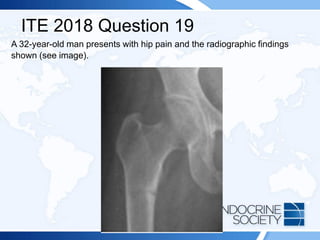
A 32-year-old man presents with hip pain and the radiographic findings
shown (see image).
ITE 2018 Question 19
Laboratory test results:
• Serum calcium = 8.2 mg/dL (8.2-10.2 mg/dL) (SI: 2.1 mmol/L [2.1-2.6
mmol/L])
• Phosphate = 2.2 mg/dL (2.3-4.7 mg/dL) (SI: 0.7 mmol/L [0.7-1.5
mmol/L])
• Creatinine = 0.9 mg/dL (0.7-1.3 mg/dL) (SI: 79.6 µmol/L [61.9-114.9
µmol/L])
• Serum alkaline phosphatase = 346 U/L (50-120 U/L) (SI: 5.78 µkat/L
[0.84-2.00 µkat/L])
Measurement of which of the following is most
likely to provide this patient’s diagnosis?
A. Fibroblast growth factor 23
B. 1,25-Dihydroxyvitamin D
C. 25-Hydroxyvitamin D
D. PTH
Correct Answer: C
Learning objective:
Identify clinical and radiographic findings in osteomalacia (severe
vitamin D deficiency).
Rationale:
Shown on the radiograph is a Looser zone, characteristic of osteomalacia.
Mechanical stress of blood vessels overlying the uncalcified cortical bone affected
by osteomalacia is thought to cause “pseudo fractures” that appear as transverse
zones of rarefaction, sometimes as wide as 1 cm, often multiple, and generally
symmetric. Typical locations are the ischium, ilium, pubis, femur, tibia, radius,
fibula, lower ribs, and scapula.
This patient has a longstanding history of celiac disease and nonadherence to
dietary recommendations. His serum 25-hydroxyvitamin D level (Answer C) was
undetectable (<7 ng/mL [<17.5 nmol/L]). High-dosage vitamin D3, 100,000 IU
daily, did not correct the vitamin D deficiency, but ultraviolet light (tanning salon)
was successful. Chemical clues to osteomalacia include hypocalcemia,
hypophosphatemia, and elevated alkaline phosphatase. Excess fibroblast growth
factor 23 (Answer A) causes hypophosphatemia, but it is rare. While a low serum
1,25-dihydroxyvitamin D level (Answer B) would produce this pattern, it is usually
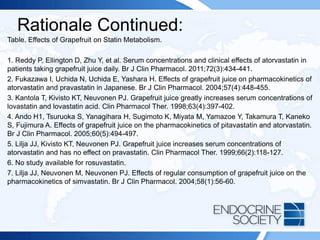
caused by vitamin D–dependent rickets type 1 (1α-hydroxylase deficiency) and is
typically diagnosed in childhood. Although this patient may have a high PTH level
(Answer D), its measurement would not identify the underlying cause.
Reference(s):
• Reginato AJ, Falasca GF, Pappu R, McKnight B, Agha A.
Musculoskeletal manifestations of osteomalacia: report of 26 cases
and literature review. Semin Arthritis Rheum. 1999;28(5):287-304.
PMID: 10342386
• Lips P, van Schoor NM. The effect of vitamin D on bone and
osteoporosis. Best Pract Res Clin Endocrinol Metab. 2011;25(4):585-
591. PMID: 21872800
• Thacher TD, Clarke BL. Vitamin D insufficiency. Mayo Clin Proc.
2011;86(1):50-60. PMID: 21193656
• Bhan A, Rao AD, Rao DS. Osteomalacia as a result of vitamin D
deficiency. Endocrinol Metab Clin North Am. 2010;39(2):321-331.
PMID: 20511054
ITE 2018 Question 38
A 68-year-old man is admitted to the hospital for worsening back pain and
obstructive urinary symptoms. His only home medication is
hydrochlorothiazide, 50 mg daily. CT shows a large necrotic prostate mass
with metastases to the pelvis and spine. Laboratory test results reveal a
calcium concentration of 15.1 mg/dL (8.2-10.2 mg/dL) (SI: 3.8 mmol/L [2.1-
2.6 mmol/L]), and he is given 4 mg of intravenous zoledronic acid.
Additionally, high-dosage dexamethasone is initiated for spinal cord
compromise, and high-dosage ketoconazole is initiated for rapid medical
castration.
You are now consulted for symptomatic hypocalcemia that has been present
for 4 days since his admission despite frequent infusions of calcium
gluconate, 1 g intravenously. When you tap the skin over his facial nerve,
contractions are seen. His reflexes are brisk.
ITE 2018 Question 38
Laboratory test results:
• Serum total calcium = 5.6 mg/dL (8.2-10.2 mg/dL) (SI: 1.4 mmol/L [2.1-2.6 mmol/L])
• Ionized calcium = 2.9 mg/dL (4.60-5.08 mg/dL) (SI: 0.7 mmol/L [1.2-1.3 mmol/L])
• Phosphate = 1.7 mg/dL (2.3-4.7 mg/dL) (SI: 0.5 mmol/L [0.7-1.5 mmol/L])
• Serum creatinine = 1.3 mg/dL (0.7-1.3 mg/dL) (SI: 114.9 µmol/L [61.9-114.9
µmol/L])
• Alkaline phosphatase = 81 U/L (50-120 U/L) (SI: 1.35 µkat/L [0.84-2.00 µkat/L])
• PTH = 245 pg/mL (10-65 pg/mL) (SI: 245 ng/L [10-65 ng/L])
• PTHrP = 34.9 pg/mL (14-27 pg/mL) (SI: 34.9 ng/L [14-27 ng/L])
• Magnesium = 2.0 mg/dL (1.5-2.3 mg/dL) (SI: 0.8 mmol/L [0.6-0.9 mmol/L])
• Albumin = 2.9 g/dL (3.5-5.0 g/dL) (SI: 29 g/L [35-50 g/L])
• 25-Hydroxyvitamin D = <8 ng/mL (25-80 ng/mL [optimal]) (SI: <20.0 nmol/L [62.4-
199.7 nmol/L])
In addition to this patient’s vitamin D
deficiency, which other factor had a role in his
severe hypocalcemia after bisphosphonate
infusion?
A. Ketoconazole
B. Osteolytic metastases
C. Adrenal insufficiency
D. Thiazide diuretic use
Correct Answer: A
Learning objective:
Identify a high ketoconazole dosage as a contributor to
hypocalcemia due to the suppression of 1α-hydroxylase, which
prevents activation of vitamin D.
Rationale:
This patient recently started high-dosage ketoconazole (Answer A) as
part of his prostate cancer treatment. Ketoconazole is an antifungal agent
that binds to cytochrome P450 and inhibits the renal synthesis of 1α-
hydroxylase. This drug has been shown to lower serum 1,25-
dihydroxyvitamin D levels in healthy patients and in patients with primary
hyperparathyroidism. Ketoconazole is used as a second-line treatment
for patients with granulomatous disease such as sarcoid whose condition
is refractory to prednisone to decrease calcium levels by reducing
calcitriol production. The use of this agent is limited by its liver and
cardiac toxicity. Of note, ketoconazole is also used in the treatment of
Cushing disease because of its effects on steroid synthesis by inhibiting
cytochrome P450 enzymes and significantly reducing cortisol levels.
Rationale Continued:
Prostate cancer frequently metastasizes to bone, and bone metastases
are present in nearly all patients with advanced prostate cancer.
Metastatic bone disease is generally divided into osteoblastic and
osteolytic disease, but most cancers lie within a spectrum of these two
extremes. Osteolytic metastases (Answer B) are much more common,
however, and are one of the most feared complications of malignancy.
They are usually destructive and are much more likely to be associated
with pathologic fracture and hypercalcemia (not hypocalcemia).
Hypercalcemia occurs when bone destruction is advanced. The bone
metastases observed in prostate cancer are primarily osteoblastic, but
there is a significant osteolytic component that is mediated by
osteoclasts. Hypercalcemia occurs more commonly in patients with
osteolytic metastases than in patients with osteoblastic metastases.
Rationale Continued:
Hypercalcemia, not hypocalcemia, can occasionally occur in patients with
adrenal insufficiency (Answer C). The mechanisms that contribute to
hypercalcemia from adrenal insufficiency include increased bone
resorption, volume contraction, and increased proximal tubular calcium
reabsorption along with binding of calcium to serum proteins. Cortisol
administration corrects the hypercalcemia.
Thiazide diuretics (Answer D) can raise, not lower, serum calcium levels
by lowering urinary calcium excretion. This propensity for hypercalcemia
is pronounced in patients with an underlying increase in bone resorption,
such as those with hyperparathyroidism.
Reference(s):
• Conron M, Beynon HL. Ketoconazole for the treatment of refractory
hypercalcemic sarcoidosis. Sarcoidosis Vasc Diffuse Lung Dis.
2000;17(3):277-280. PMID: 11033844.
• Hannan FM, Thakker RV. Investigating hypocalcaemia. BMJ.
2013;346:f2213. PMID: 23661111
ITE 2018 Question 40
After passing a kidney stone, a generally healthy 20-year-old woman is referred to
you by her urologist. She does not take any calcium or vitamin supplements.
Laboratory test results:
• Serum calcium = 11.0 mg/dL (8.2-10.2 mg/dL) (SI: 2.8 mmol/L [2.1-2.6 mmol/L])
• 25-Hydroxyvitamin D = 70 ng/mL (25-80 ng/mL [optimal]) (SI: 174.7 nmol/L [62.4-
199.7 nmol/L])
• 1,25-Dihydroxyvitamin D = 75 pg/mL (16-65 pg/mL) (SI: 195 pmol/L [41.6-169.0
pmol/L])
• PTH = <10 pg/mL (10-65 pg/mL) (SI: <10 ng/L [10-65 ng/L])
• Serum protein electrophoresis and urine protein electrophoresis, normal
• PTHrP, undetectable
A PET-CT is normal. Her brother also has nephrolithiasis.
Measurement of which of the following would
result in a definitive diagnosis?
A. 24,25-Dihydroxyvitamin D
B. 24-Hour urinary calcium
C. Serum phosphate
D. Serum C-telopeptide
Correct Answer: A
Learning objective:
Identify CYP24A1 mutations as a cause of hypercalcemia.
Rationale:
The hypercalcemia in this patient is mediated by 1,25-dihydroxyvitamin D
since PTH and PTHrP are undetectable and there is no evidence of
multiple myeloma. Her 1,25-dihydroxyvitamin D level is inappropriately
high for an undetectable PTH because PTH controls the renal production
of 1,25-dihydroxyvitamin D. The cause is homozygous CYP24A1
mutations, and the diagnosis can be made by documenting an
inappropriately low 24,25-dihydroxyvitamin level (Answer A) (24,25-
dihydroxyvitamin D / 25-hydroxyvitamin D < 10%). CYP24A1 mutations
as a cause of hypercalcemia were first reported in 2011, initially noted in
idiopathic infantile hypercalcemia and soon after described in adults
presenting with kidney stones. This patient’s 24-hour urinary calcium
(Answer B) should be elevated, but documenting this will not lead to the
diagnosis. Serum phosphate (Answer C) is generally normal in persons
with CYP24A1 mutations and measuring it will not lead to the diagnosis.
Measuring serum C-telopeptide (Answer D) will not help diagnose the
problem.
Reference(s):
• Mugg A, Legeza B, Tee MK, Damm I, Long RK, Miller WL. Quantitation
of CYP23A1 enzymatic activity with a simple two-hybrid system. J Clin
Endocrinol Metab. 2015;100(2):684-688. PMID: 25375986
• Schlingmann KP, Kaufmann M, Weber S, et al. Mutations in CYP24A1
and idiopathic infantile hypercalcemia. N Engl J Med.
2011;365(5):410-421. PMID: 21675912
• Streeten EA, Zarbalian K, Damcott CM. CYP24A1 mutations in
idiopathic infantile hypercalcemia. N Engl J Med. 2011;365(18):1741-
1742. PMID: 22047572
ITE 2018 Question 42
A 59-year-old woman is referred to you for evaluation of hypophosphatemia. She had
a liver transplant 10 years ago for alcoholic cirrhosis, after which she stopped drinking
alcohol. She developed hepatitis B after the transplant. Osteoporosis was diagnosed
10 years ago and was treated with oral bisphosphonates for 5 years. Over the past 5
years, she has had severe, diffuse bone pain and has had fractures diagnosed at L3,
the pelvis, and several ribs. A recent hip radiograph showed a medial stress fracture
of the proximal femur. Medications include tacrolimus, mycophenolate, and tenofovir.
DXA shows T scores of –4.4 in the spine and –3.2 in the total hip.
ITE 2018 Question 42
Laboratory test results:
• Alanine aminotransferase, normal
• Aspartate aminotransferase, normal
• Complete blood count, normal
• Alkaline phosphatase = 412 U/L (50-120 U/L) (SI: 6.88 mkat/L [0.84-2.00 mkat/L])
• 25-Hydroxyvitamin D = 25 ng/mL (25-80 ng/mL [optimal]) (SI: 62.4 nmol/L [62.4-199.7 nmol/L])
• 1,25-Dihydroxyvitamin D = 52.6 pg/mL (16-65 pg/mL) (SI: 136.8 pmol/L [41.6-169.0 pmol/L])
• PTH = 65 pg/mL (10-65 pg/mL) (SI: 65 ng/L [10-65 ng/L])
• Creatinine = 0.9 mg/dL (0.6-1.1 mg/dL) (SI: 79.6 mmol/L [53.0-97.2 mmol/L])
• Calcium = 8.9 mg/dL (8.2-10.2 mg/dL) (SI: 2.2 mmol/L [2.1-2.6 mmol/L])
• Phosphate = 1.2 mg/dL (2.3-4.7 mg/dL) (SI: 0.4 mmol/L [0.7-1.5 mmol/L])
• Fibroblast growth factor 23 = 150 RU/mL (<180 RU/mL)
• Urinalysis dipstick, normal
• Tubular reabsorption of phosphate (TRP) = 80% (>95%)
Which of the following would be most likely to
correct her hypophosphatemia?
A. Change from tenofovir to entecavir
B. Change from tacrolimus to prednisone
C. Start octreotide
D. Add calcitriol
Correct Answer: A
Learning objective:
Identify drug-induced hypophosphatemia.
Rationale:
This patient has urinary phosphate wasting, as indicated by her low
tubular reabsorption of phosphate. Low serum phosphate causes
osteomalacia, leading to elevation of alkaline phosphatase and fracture.
Urinary phosphate wasting can be caused by fibroblast growth factor 23
(tumor-induced osteomalacia), best imaged by an octreotide scan, but
her fibroblast growth factor 23 level is normal. Her normal 1,25-
dihydroxyvitamin D level is additional evidence against tumor-induced
osteomalacia. Another medication that can cause hypophosphatemia is
tenofovir; changing to entecavir (Answer A) normalized her serum
phosphate, decreased her alkaline phosphatase, and dramatically
improved her bone mineral density.
Rationale Continued:
Tacrolimus does not cause hypophosphatemia, so changing to
prednisone (Answer B) will not help. Paraproteins can cause
pseudohypophosphatemia, but her reduced tubular reabsorption of
phosphate tells you that she has true hyperphosphaturia. Calcitriol
(Answer D) helps to absorb calcium and phosphate from the
gastrointestinal tract, but this effect is not potent enough to normalize her
serum phosphate. Octreotide (Answer C) does not treat
hypophosphatemia.
Reference(s):
• Gara N, Zhao X, Collins MT, et al. Renal tubular dysfunction during
long-term adefovir or tenofovir therapy in chronic hepatitis B. Aliment
Pharmacol Ther. 2012;35(11):1317-1325. PMID: 22506503
• Ruppe MD, Jan de Beur SM. Disorders of phosphate homeostasis. In:
Rosen CJ, Compston JE, Lian JB, eds. Primer on the Metabolic Bone
Diseases and Disorders of Mineral Metabolism. Washington, DC: The
American Society for Bone and Mineral Research; 2008:601-612.
ITE 2018 Question 50
A 38-year-old man is referred to you for persistent hypercalcemia. He has no history
of peptic ulcer disease, nephrolithiasis, or hypertension. Eight months ago, he
underwent parathyroidectomy on the basis of the following laboratory values:
• Serum calcium = 11.5 mg/dL (8.2-10.2 mg/dL) (SI: 2.88 mmol/L [2.1-2.6 mmol/L])
• PTH = 50 pg/mL (10-65 pg/mL) (SI: 50 ng/L [10-65 ng/L])
• Serum creatinine = 1.05 mg/dL (0.7-1.3 mg/dL) (SI: 92.8 mmol/L [61.9-114.9
µmol/L])
• 25-Hydroxyvitamin D = 22 ng/mL (25-80 ng/mL [optimal]) (SI: 54.9 nmol/L [62.4-
199.7 nmol/L])
• Serum phosphate = 2.1 mg/dL (2.3-4.7 mg/dL) (SI: 0.68 mmol/L [0.7-1.5 mmol/L])
Two enlarged glands were resected during the operation, with the final pathology
report documenting hyperplasia in both glands. However, intraoperative PTH levels
remained elevated. Postoperatively, his calcium concentration was 11.6 mg/dL (2.90
mmol/L) and his PTH concentration was 54 pg/mL (54 ng/L).
Which of the following is the best next step in
his care?
A. Perform neck ultrasonography
B. Order a 4D CT of the neck
C. Refer for a second surgery with biopsy and resection of
1 or both remaining parathyroid glands
D. Measure 24-hour urinary calcium and creatinine
excretion
Correct Answer: D
Learning objective:
Include familial hypocalciuric hypercalcemia in the differential
diagnosis for persistent hyperparathyroidism after parathyroid
surgery.
Rationale:
PTH-dependent hypercalcemia was correctly diagnosed in this patient
despite the evaluation being incomplete. Although most patients with this
pattern of laboratory results have primary hyperparathyroidism, other
diagnoses can present with similar biochemistry. Of note, the PTH level in
this patient was in the “normal” range. While inappropriately normal PTH
levels are not atypical in patients with primary hyperparathyroidism, most
have frankly elevated PTH levels. In addition, this patient had no
previously documented calcium values for comparison, so it was not
possible to distinguish an acquired problem from a congenital problem.
Evaluation of such patients should include measurement of 24-hour
urinary calcium excretion (Answer D), not so much to determine whether
a patient is an appropriate surgical candidate, but rather to exclude
familial hypocalciuric hypercalcemia (FHH). Indeed, this patient’s 24-hour
urinary calcium excretion was very low and the fractional excretion of
calcium (calcium-to-creatinine ratio) was less than 0.01.
Rationale Continued:
Calculating a calcium-to-creatinine clearance ratio is helpful to distinguish
FHH from primary hyperparathyroidism, as 80% of patients with FHH
have a ratio less than 0.01 and most patients with primary
hyperparathyroidism have a ratio greater than 0.02. The calcium-to-
creatinine clearance is calculated with the following equation: [24 h
urinary calcium X serum creatinine] ¸ [serum calcium X 24 h urinary
creatinine].
FHH is an autosomal dominant disorder with high penetrance and is
caused by inactivating mutations in the CASR gene. More than 200
CASR mutations have been described. In this disorder, the parathyroid
glands have reduced sensitivity to calcium and higher serum calcium
levels are needed to reduce parathyroid release. The calcium-PTH curve
is shifted to the right, resetting the serum calcium to a higher level. In the
kidney, this produces an increase in tubular calcium and magnesium
reabsorption.
Rationale Continued:
Typical biochemical abnormalities include hypercalcemia, hypocalciuria,
normal or slightly elevated PTH, and elevated magnesium. Genetic
testing in this patient revealed that he was heterozygous for a novel
mutation in the CASR gene. Persons who are heterozygous for an
inactivating CASR mutation typically have mild hypercalcemia due to only
partial loss of calcium-sensing receptor function. Although genetic testing
might be considered, additional genetic causes unrelated to the CASR
gene (eg, the AP2S1 gene) can be responsible for the clinical picture of
FHH. Thus, CASR genetic testing is reserved for situations when the
patient makes this request or when the urinary fractional excretion of
calcium is borderline (eg, ~0.01).
Rationale Continued:
Although further imaging of the neck with ultrasonography (Answer A) or
4D CT (Answer B) would be indicated if the patient had persistent primary
hyperparathyroidism despite attempted surgical resection, visualization of
the parathyroid glands is not indicated in the setting of FHH. Indeed,
resection of all 4 glands would result in severe hypocalcemia and thereby
cause harm. Most patients with FHH are asymptomatic; do not develop
nephrolithiasis due to the low urinary calcium excretion; and do not
experience complications such as bone loss, hypertension, or peptic
ulcer disease. Surgery (Answer C) is not indicated in FHH.
Reference(s):
• Hendy GN, D’Souza-Li L, Yang B, Canaff L, Cole DE. Mutations of the
calcium-sensing receptor (CASR) in familial hypocalciuric
hypercalcemia, neonatal severe hyperparathyroidism, and autosomal
dominant hypocalcemia. Hum Mutat. 2000;16(4):281-296. PMID:
11013439
• Brown EM. The calcium-sensing receptor: physiology, pathophysiology
and CaR-based therapeutics. Subcell Biochem. 2007;45:139-167.
PMID: 18193637
ITE 2018 Question 58
You are called by an emergency department physician for advice in caring for a
35-year-old woman with a 5-year history of postsurgical hypoparathyroidism,
previously well controlled, who has come to the emergency department after
having a seizure. She is now conscious but confused. She has been out of town
and without her medication for 3 days. Yesterday, she told her daughter she was
having some problems with tingling and muscle spasms.
Laboratory test results:
• Calcium = 5.8 mg/dL (8.2-10.2 mg/dL) (SI: 1.5 mmol/L [2.1-2.6 mmol/L])
• Albumin = 3.8 g/dL (3.5-5.0 g/dL) (SI: 38 g/L [3.5-5.0 g/L])
• Phosphate = 5.3 mg/dL (2.3-4.7 mg/dL) (SI: 1.7 mmol/L [0.7-1.5 mmol/L])
• Magnesium = 1.9 mg/dL (1.5-2.3 mg/dL) (SI: 0.78 mmol/L [0.6-0.9 mmol/L])
• Creatinine = 0.9 mg/dL (0.6-1.1 mg/dL) (SI: 79.6 µmol/L [53.0-97.2 µmol/L])
In addition to restarting treatment with oral calcium
and calcitriol, which additional intravenous treatment
(with cardiac monitoring) would be best?
A. Calcium chloride: intravenous bolus of 0.1 ampule (1 mL of 100 mg/mL of
calcium chloride) followed by a continuous infusion of 0.5 mg/kg of
elemental calcium per hour
B. Calcium chloride: intravenous bolus of 1 ampule (10 mL of 100 mg/mL of
calcium chloride) followed by a continuous infusion of 2 mg/kg per of
elemental calcium per hour
C. Calcium gluconate: intravenous bolus of 2 ampules (20 mL of 100 mg/mL
of calcium gluconate) followed by a continuous infusion of 1 mg/kg
elemental calcium per hour
D. Calcium gluconate: Intravenous bolus of 500 mL (100mg/ml of calcium
gluconate) followed by a continuous infusion to achieve a total dose of
2000 mg elemental calcium over 24 hours
Correct Answer: C
Learning objective:
Manage acute, severe hypocalcemia.
Rationale:
This patient needs rapid correction of hypocalcemia. Calcium gluconate is
preferred over calcium chloride because the latter is more likely to cause
vein sclerosis and tissue necrosis if extravasated (thus, Answers A and B are
incorrect). The dose of intravenous calcium is dangerously high in Answer D,
and infusion of calcium compounds can be associated with cardiac
arrhythmias and infarction. In addition, hyperphosphatemia may be
associated with metastatic soft-tissue calcification. Dosing at 1 mg/kg per h
(Answer C) would be a total dose of 1680 mg daily for a patient weighing 70
kg; a higher rate might be required for patients with a profound calcium
deficiency, but this patient has only been without her usual calcium intake for
72 hours.
Ordering intravenous calcium can be potentially confusing. For intravenous
use, a 10-mL ampule of calcium gluconate contains 93 mg of elemental
calcium; a 10-mL ampule of 10% calcium chloride contains 272 mg of
calcium. In some situations, adding a calcium salt to an intravenous liter bag
of 0.9% saline or 5% dextrose requires removing some of the fluid to allow
space for the added calcium salt.
Reference(s):
• Zalonga GP, Chernow B. Hypocalcemia in critical illness. JAMA.
1986;256(14):1924-1929. PMID: 7140332
• Carroll R, Matfin G. Endocrine and metabolic emergencies:
hypocalcaemia. Ther Adv Endocrinol Metab. 2010;1(1):29-33. PMID:
23148147
ITE 2018 Question 63
An 80-year-old woman with Paget disease is referred to you for evaluation.
Ten years ago, a nuclear bone scan showed increased uptake limited to the
right tibia, and radiographs showed pagetic changes of the tibia. Her alkaline
phosphatase level at that time was 125 U/L (2.09 µkat/L) (reference range,
50-120 U/L [0.84-2.00 µkat/L]). She has not received treatment. She now
describes severe pain in her right tibia and a radiograph shows coarsened
trabeculae. Her alkaline phosphatase concentration is 250 U/L (4.18 µkat/L).
Her gamma-glutamyltranspeptidase level is normal.
Which of the following should be the next step
in this patient’s evaluation?
A. C-telopeptide measurement
B. Percutaneous biopsy of the tibia
C. Whole-body bone scan
D. MRI of the right tibia
Correct Answer: D
Learning objective:
Recognize the clinical presentation of osteosarcoma and
recommend appropriate evaluation.
Rationale:
This patient has developed an osteosarcoma in her tibia, a rare
complication of Paget disease (0.5%-1%), but an important one to
consider when a patient presents with severe pain in a pagetic bone and
an increase in alkaline phosphatase from baseline. In this case, MRI
(Answer D) or CT of her tibia is the next step to assess for tumor. A
whole-body bone scan (Answer C) is most likely to show increased
uptake in the tibia, but it will not result in a diagnosis of tumor. Bone
biopsies (Answer B) in Paget disease generally need to be done open,
rather than percutaneously, to be diagnostic and this would not be done
in her case before further imaging, which is less invasive. C-telopeptide
(Answer A) is expected to be elevated in Paget disease, but its
measurement will not help to distinguish between active Paget disease
and osteosarcoma.
Reference(s):
• Deyrup AT, Montag AG, Inwards CY, Xu Z, Swee RG, Krishnan Unni K.
Sarcomas arising in Paget disease of bone: a clinicopathologic
analysis of 70 cases. Arch Pathol Lab Med. 2007;131(6):942-946.
PMID: 17550323
• Reid IR. Pharmacotherapy of Paget's disease of bone. Expert Opin
Pharmacother. 2012;13(5):637-646. PMID: 22339140
• Ralston SH. Clinical practice. Paget's disease of bone. N Engl J Med.
2013;368(7):644-650. PMID: 23406029
ITE 2018 Question 69
You are asked to see a 38-year-old man in the emergency department after he had a
seizure and was found to be hypocalcemic. His height is 70 in (177.8 cm), and he
has no history of calcium or bone problems. In querying about his family history, you
learn that his mother died at age 25 years in a car crash that occurred after she
experienced a seizure (she was reportedly otherwise healthy). The patient has 2
healthy teenaged children.
Laboratory test results:
• Serum calcium = 6.5 mg/dL (8.2-10.2 mg/dL) (SI: 1.6 mmol/L [2.1-2.6 mmol/L])
• Albumin = 3.8 g/dL (3.5-5.0 g/dL) (SI: 38 g/L [3.5-5.0 g/L])
• Serum phosphate = 5.6 mg/dL (2.3-4.7 mg/dL) (SI: 1.8 mmol/L [0.7-1.5 mmol/L])
• Serum creatinine = 0.8 mg/dL (0.7-1.3 mg/dL) (SI: 70.7 µmol/L [61.9-114.9
µmol/L])
• PTH = 5 pg/mL (10-65 pg/mL) (SI: 5 ng/L [10-65 ng/L])
Which of the following tests is most likely
to determine the diagnosis in this
patient?
A. Measurement of 24-hour urinary calcium
B. Measurement of 25-hydroxyvitamin D
C. Measurement of fibroblast growth factor 23
D. RET mutational analysis
E. CASR mutational analysis
Correct Answer: E
Learning objective:
Recognize hyperphosphatemia in association with hypocalcemia
as indicative of hypoparathyroidism and recommend genetic
testing for CASR mutations.
Rationale:
The patient’s elevated serum phosphate tells you that the cause of his
hypocalcemia is hypoparathyroidism, not vitamin D deficiency. In approximately
one-half of patients with hypoparathyroidism, the cause is an activating CASR
mutation (Answer E). Other known causes of hypoparathyroidism include
autoimmune disease (eg, polyglandular failure due to APECED [autoimmune
polyendocrinopathy-candidiasis-ectodermal dystrophy]), infiltrative disease (eg,
hemochromatosis), HIV infection, and truly idiopathic hypoparathyroidism.
Hypoparathyroidism due to CASR mutations is inherited in an autosomal
dominant manner, so this patient’s mother was most likely also affected. If a
mutation is found in this patient, the family should be counseled about
presymptomatic testing for his children.
Fibroblast growth factor 23 excess (Answer C) causes hypophosphatemia, not
hyperphosphatemia. Measuring 24-hour urinary calcium excretion (Answer A) will
not help make the diagnosis. If this were vitamin D deficiency (Answer B), the
patient’s serum phosphate level would be low or normal, not elevated. Mutations
in the RET proto-oncogene (Answer D) are associated with multiple endocrine
neoplasia type 2 and genetic testing will not help in this patient’s assessment.
Reference(s):
• Kemp EH, Habibullah M, Kluger N, et al. Prevalence and clinical
associations of calcium-sensing receptor and NALP5 autoantibodies in
Finnish APECED patients. J Clin Endocrinol Metab. 2014;99(3):1064-
1071. PMID: 24423312
• Hannan FM, Thakker RV. Calcium-sensing receptor (CaSR) mutations
and disorders of calcium, electrolyte and water metabolism. Best Pract
Res Clin Endocrinol Metab. 2013;27(3):359-371. PMID: 23856265
ITE 2018 Question 80
A 57-year-old woman is referred to you by her orthopedic surgeon for medical
management of a bone lesion before surgical fixation. She was just evaluated for
new-onset right wrist pain and deformity that occurred after an injury at work. The
pain has worsened and is now refractory to anti-inflammatory medication. This has
made it difficult for her to work. She received a recommendation to proceed with
surgery to decrease the deformity of her bow and to stabilize the bone with plate,
screw, and cement fixation. A whole-body bone scan shows markedly increased
activity involving the entire right radius (see image).
ITE 2018 Question 80
An x-ray shows enlargement of her right forearm with cortical thickening, trabecular
coarsening, and bowing (see image).
ITE 2018 Question 80
She describes paresthesias in her right fingers, as well as pain that extends up to her
right shoulder.
She has no axillary lymphadenopathy. Her right upper extremity has an obvious
distal radial deformity with an apex dorsal bow and is tender to palpation but is
neurovascularly intact with no sensory deficits.
Laboratory test results:
• Serum total calcium = 9.4 mg/dL (8.2-10.2 mg/dL) (SI: 2.4 mmol/L [2.1-2.6 mmol/L])
• Phosphate = 3.7 mg/dL (2.3-4.7 mg/dL) (SI: 1.2 mg/dL [0.7-1.5 mmol/L])
• Serum creatinine = 0.7 mg/dL (0.6-1.1 mg/dL) (SI: 61.9 µmol/L [53.0-97.2 µmol/L])
• Alkaline phosphatase = 381 U/L (50-120 U/L) (SI: 6.4 µkat/L [0.84-2.00 µkat/L])
• PTH = 47 pg/mL (10-65 pg/mL) (SI: 47 ng/L [10-65 ng/L])
• Urinary N-telopeptide = 189 nmol BCE/mmol creat (24-124 nmol BCE/mmol creat)
Which of the following is the best
management plan?
A. Denosumab
B. Palliative radiation therapy
C. Surgical correction of the radius
D. Intravenous zoledronic acid
E. Teriparatide
Correct Answer: D
Learning objective:
Recommend preoperative medical treatment to reduce abnormal
bone turnover in the setting of Paget disease.
Rationale:
Paget disease of bone is a derangement in bone metabolism caused by
increased bone resorption due to abnormal osteoclast physiology.
Osteoclasts in pagetic bone are abnormal, with a bizarre appearance. They
are multinucleated and are present in excessive numbers. This is a fairly
common finding and is seen at a prevalence of 2% to 9% in some
populations. The average age at diagnosis is in the fifth decade of life with a
slight predilection for men. Paget disease is rarely seen in persons younger
than 40 years. Most patients with Paget disease are asymptomatic and the
diagnosis is made after an elevated alkaline phosphatase concentration is
detected on routine laboratory evaluation or abnormalities are noted on
radiographs. Paget disease can affect any bone, but it is most typically seen
in the skull, spine, pelvis, and long bones. More significant clinical
manifestations include pain, deformity, fractures, increased predisposition to
the development of bone tumors, abnormalities in calcium and phosphate
metabolism (especially when immobilized), and hypervascularity of lesions,
as seen in this patient, which can increase the risk of bleeding complications
with orthopedic surgery.
Rationale Continued:
The mainstay of pharmacotherapy for Paget disease is antiresorptive
medications, including bisphosphonates and calcitonin. The more potent
bisphosphonates—alendronate, risedronate, and zoledronic acid (Answer
D)—can induce biochemical remissions in most patients. Zoledronic acid is
the most likely agent to produce a long remission. Treatment with
antiresorptive therapy before orthopedic surgery is indicated to diminish the
vascularity of the bone and surrounding soft tissue and should reduce
perioperative bleeding (thus, Answer C is incorrect). Additionally, treatment of
asymptomatic Paget disease may be indicated depending on the location
and activity of the disease. Disease sites at high risk of complications include
weight-bearing bones, skull, spine, and a bone contiguous with a joint. It is
reasonable to initiate pharmacotherapy if the disease is present at other sites
when elevations in alkaline phosphatase exceed 2 to 4 times the upper
normal limit for the assay. The most potent antiresorptive agent, denosumab
(Answer A), has been reported to decrease disease activity in 1 patient with
Paget disease, but this has not been studied extensively and it would not be
considered first-line therapy.
Rationale Continued:
A rare complication of Paget disease is the transformation of pagetic bone
into malignant osteosarcoma. Due to this increased risk of sarcoma,
radiation therapy to pagetic bone (Answer B) is not recommended. Likewise,
therapy with teriparatide (Answer E) would be contraindicated.
Reference(s):
• Ralston SH, Langston AL, Reid IR. Pathogenesis and management of
Paget’s disease of bone. Lancet. 2008;372(9633):155-163. PMID:
18620951
• Lyles KW, Siris ES, Singer FR, Meunier PJ. A clinical approach to the
diagnosis and management of Paget’s disease of bone. J Bone Miner
Res. 2001;16(8):1379-1387. PMID: 11499860
• Siris ES, Lyles KW, Singer FR, Meunier PJ. Medical management of
Paget’s disease of bone: indications for treatment and review of
current therapies. J Bone Miner Res. 2006;21(Suppl 2):P94-P98.
PMID: 17229018
• Singer FR, Bone HG 3rd, Hosking DJ, et al; Endocrine Society.
Paget's disease of bone: an Endocrine Society clinical practice
guideline. J Clin Endocrinol Metab. 2014;99(12):4408-4022. PMID:
25406796
ITE 2018 Question 85
A 58-year-old postmenopausal woman is referred for evaluation of thigh
pain. She has a history of low bone mass (osteopenia) treated with
alendronate for 8 years. She now presents with a 2-month history of severe,
deep, sharp pain in her right thigh. It is worse when she is walking but
remains as a less severe ache when at rest. She has no fatigue, rash, or
easy bruising. She has no history of trauma, fracture, or loss of height.
On physical examination, her blood pressure is 143/82 mm Hg and pulse
rate is 94 beats/min. Her height is 59 in (150 cm), and weight is 187 lb (85
kg) (BMI = 37.8 kg/m2). She has no striae and no facial plethora. There is no
kyphosis, no bowing of her legs, and no warmth along her legs. Pain is not
elicited by rotation of the hips or with flexion/extension at the knees.
ITE 2018 Question 85
Laboratory test results:
• Calcium = 8.8 mg/dL (8.2-10.2 mg/dL) (SI: 2.2 mmol/L [2.1-2.6 mmol/L])
• Phosphate = 3.0 mg/dL (2.3-4.7 mg/dL) (SI: 1.0 mmol/L [0.7-1.5 mmol/L])
• Albumin = 3.8 g/dL (3.5-5.0 g/dL) (SI: 38 g/L [35-50 g/L])
• Alkaline phosphatase = 135 U/L (50-120 U/L) (SI: 2.3 μkat/L [0.84-2.00 μkat/L])
• 25-Hydroxyvitamin D = 19 ng/mL (25-80 ng/mL [optimal]) (SI: 47.4 nmol/L [62.4-
199.7 nmol/L])
• 1,25-Dihydroxyvitamin D = 30 pg/mL (16-65 pg/mL) (SI: 78 pmol/L [41.6-169.0
pmol/L])
• Intact PTH = 63 pg/mL (10-65 pg/mL) (SI: 63 ng/L [10-65 ng/L])
• Osteocalcin = 21.9 ng/mL (9.0-42.0 ng/mL) (SI: 21.9 µg/L [9.0-42.0 µg/L])
• Serum C-telopeptide = 93 pg/mL (104-1008 pg/mL [postmenopausal women])
ITE 2018 Question 85
X-ray of the right femur is shown (see image).
Which of the following is the most likely
cause of her femur pain?
A. Bone malignancy leading to tumor-induced osteomalacia
B. Prolonged bisphosphonate use
C. Paget disease of bone
D. Mastocytosis
E. Osteomalacia from vitamin D deficiency
Correct Answer: B
Learning objective:
Recognize the clinical presentation of impending atypical femoral
fracture due to prolonged bisphosphonate use.
Rationale:
This patient’s history of prolonged alendronate use and preceding femoral
shaft pain are suggestive of an impending atypical femoral fracture.
Additionally, the x-ray of the right femur shows areas of typical lateral cortical
thickening that cause a “beaking” or “flaring” effect adjacent to areas of
transverse fracture lines (see image, white arrows), which eventually evolve
and propagate medially and ultimately lead to a complete fracture. The
slightly elevated alkaline phosphatase seen in this patient is associated with
her bone anomaly.
Rationale Continued:
The precise incidence of medication-related atypical femoral fracture related
to the duration of bisphosphonate use (Answer B) is unknown, but in some
studies, it is reported to range from 38.9 cases/100,000 person-years (with 6
to 8 years of bisphosphonate use) to 107.5/100,000 person-years (with more
than 10 years of bisphosphonate use). The median duration of
bisphosphonate use in patients with an atypical femoral fracture is 7 years. A
prodrome of persistent thigh or groin pain is common (70% of cases). A
complete fracture is associated with sudden onset of severe pain associated
with little or no trauma. If a patient on bisphosphonate therapy reports
persistent thigh or groin pain, it is recommended to obtain plain radiographs
of the symptomatic hip, including full diaphysis of the femur and the
contralateral hip, because the contralateral side is also affected in 19% to
41% of cases. If the radiograph is negative but clinical suspicion remains
high, a technetium bone scan or MRI of the femur should be performed. In
patients with incomplete subtrochanteric/femoral shaft fractures associated
with pain, as in this case, prophylactic reconstruction nail fixation is
recommended.
Rationale Continued:
If there is minimal pain, conservative therapy with limited weight bearing with
crutches or a walker for 2 to 3 months is recommended. In patients with low
bone mass (osteopenia) and no other high risks for fracture, a drug holiday
from bisphosphonate therapy should be considered after 5 years of use. The
Task Force of the American Society for Bone and Mineral Research
emphasizes that the incidence of atypical femoral fracture associated with
bisphosphate therapy for osteoporosis is very low, especially when
compared with the number of vertebral, hip, and other fractures that are
prevented by bisphosphonate therapy.
This patient does not have tumor-induced osteomalacia (Answer A) because
her phosphate and 1,25-dihydroxyvitamin D levels are not low. She does not
have osteomalacia from vitamin D deficiency (Answer E) because her
calcium and phosphate levels are normal and the radiographic appearance
is not consistent with osteomalacia. Mastocytosis (Answer D) is incorrect
because she has no anemia and does not report any urticaria or rash. The
radiologic findings on the femoral x-ray are not consistent with Paget disease
of bone (Answer C).
Reference(s):
• Gedmintas L, Solomon DH, Kim SC. Bisphosphonates and risk of
subtrochanteric, femoral shaft, and atypical femur fracture: a
systematic review and meta-analysis. J Bone Miner Res.
2013;28(8):1729-1737. PMID: 23408697
• Shane E, Burr D, Ebeling PR, et al. Atypical subtrochanteric and
diaphyseal femoral fractures: second report of a task force of the
American Society for Bone and Mineral Research. J Bone Miner Res.
2014;29(1):1-23. PMID: 23712442
• Toro G, Ojeda-Thies C, Calabro G, et al. Management of atypical
femoral fracture: a scoping review and comprehensive algorithm. BMC
Musculoskelet Disord. 2016;17:227. PMID: 27215972
DIABETES
ITE 2018 Question 1
A 45-year-old man with a 5-year history of type 2 diabetes mellitus presents
to the emergency department with worsening fatigue and is found to have
acute renal injury. His creatinine concentration on presentation is 3.5 mg/dL
(309.4 µmol/L); review of his outpatient records shows his creatinine
concentration was 1.8 mg/dL (159.1 µmol/L) 6 months ago. The patient
reports having a CT with contrast 1 week ago to follow-up on a nonspecific
finding on previous imaging. He has had no nausea or vomiting.
His current insulin regimen consists of premixed 70/30 insulin, 30 units in the
morning and 30 units with his evening meal. He also takes metformin, 1000
mg twice daily. His blood glucose readings at home, prior to the CT, were
150 to 180 mg/dL (8.3-10.0 mmol/L).
ITE 2018 Question 1
On physical examination, his height is 70 in (177.8 cm) and weight is 200 lb
(90.9 kg) (BMI = 28.7 kg/m2).
Laboratory test results on admission:
• Hemoglobin A1c = 8.0% (4.0%-5.6%) (64 mmol/mol [20-38 mmol/mol])
• Estimated glomerular filtration rate = 30 mL/min per 1.73 m2 (>60
mL/min per 1.72 m2)
• Glucose = 120 mg/dL (70-99 mg/dL) (SI: 6.7 mmol/L [3.9-5.5 mmol/L])
The patient is admitted to a general medicine ward. In
addition to holding metformin, which of the following
scheduled insulin regimens should you recommend?
Answer
Daily Basal
Insulin
Prandial
Insulin (per
meal) Blood Glucose Target
A. 30 units 10 units
110-140 mg/dL
(6.1-7.8 mmol/L)
B. 22 units 5 units
110-140 mg/dL
(6.1-7.8 mmol/L)
C. 22 units 7 units
140-180 mg/dL
(7.8-10.0 mmol/L)
D. 15 units 5 units
140-180 mg/dL
(7.8-10.0 mmol/L)
E. 30 units 10 units
140-180 mg/dL
(7.8-10.0 mmol/L)
Correct Answer: C
Learning objective:
Adjust the insulin dosage on the basis of changes in the
glomerular filtration rate in patients with diabetes mellitus.
Rationale Continued:
This question addresses how to adjust insulin on the basis of changes in
the glomerular filtration rate. Exogenous insulin is primarily eliminated by
the kidney. As the glomerular filtration rate decreases, clearance and
catabolism of insulin decrease. A common rule of thumb is that the insulin
dosage should be reduced by 25% when the estimated glomerular
filtration rate decreases to 10 to 50 mL/min per 1.73 m2, and the dosage
should be reduced by 50% when it decreases to less than 10 mL/min per
1.73 m2. The American Diabetes Association recommends a target blood
glucose range of 140 to 180 mg/dL (7.8-10.0 mmol/L) for hospitalized
patients.
This patient most likely has contrast-induced nephropathy. Diabetes is a
major risk factor for this complication, especially when the patient has
underlying renal impairment. It is recommended that metformin be held
for 24 hours before receiving contrast material. It is not clear in this
vignette whether this precaution was taken.
Rationale:
Metformin does not increase the risk for contrast-induced nephropathy,
but the reduced glomerular filtration rate places a patient on metformin at
higher risk for lactic acidosis.
This patient takes 60 units of insulin per day as 70/30 split in 2 doses.
Reducing his daily dose by 25% translates to a daily dose of 45 units. If
one assumes his appetite is normal, then 50% can be provided as basal
insulin (~22 units) and the other 50% can be given as prandial insulin (~7
units per meal). Of the listed choices, Answer C is the closest to this
calculation. Answers A and E are too aggressive, and the blood glucose
target is also too low in Answer A. Answer B is very close to the desired
calculation, but the blood glucose target is too low, especially in patient at
higher risk of hypoglycemia with acute renal injury. Answer D is too
conservative.
Reference(s):
• American Diabetes Association. 14. Diabetes care in the hospital.
Diabetes Care. 2017;40(Suppl 1):S120-S127.
• Clement S, Braithwaite SS, Magee MF, et al; American Diabetes
Association Diabetes in Hospitals Writing Committee. Management
of diabetes and hyperglycemia in hospitals. Diabetes Care.
2004;27(2):553-591. PMID: 14747243
• Biesenbach G, Raml A, Schmekal B, Eichbauer-Sturm G. Decreased
insulin requirement in relation to GFR in nephropathic type 1 and
insulin-treated type 2 diabetic patients. Diabet Med. 2003;20(8):642-
645. PMID: 12873291
• Snyder RW, Berns JS. Use of insulin and oral hypoglycemic
medications in patients with diabetes mellitus and advanced kidney
disease. Semin Dial. 2004;17(5):365-370. PMID: 15461745
ITE 2018 Question 10
A 19-year-old woman is referred to you for assistance with type 1 diabetes
management. Diabetes was diagnosed at age 10 years. Her current insulin
regimen includes insulin glargine, 10 units in the morning and 5 units in the
evening. She boluses insulin aspart before meals using an insulin-to-
carbohydrate ratio of 1 unit for each 15 g of carbohydrate and a sensitivity
factor of 1 unit to lower her glucose 100 mg/dL (5.55 mmol/L) to a target
level of 100 mg/dL (5.55 mmol/L). She participates in aerobic exercises for
60 to 90 minutes daily and weight training for 30 minutes 3 times per week.
Her diet is rich in fruits, vegetables, lean meats, and mostly high-fiber
carbohydrates. She feels comfortable with carbohydrate counting when
eating at home, but has more difficulty accurately assessing the
carbohydrate content of foods eaten at restaurants. She measures her
glucose level 4 to 8 times daily.
ITE 2018 Question 10
Her downloaded glucose meter shows glucose concentrations that range
from 42 to 493 mg/dL (2.33 to 27.36 mmol/L) with a mean of 168 mg/dL
(9.32 mmol/L) and a standard deviation of 76 mg/dL (4.22 mmol/L). Glucose
levels are least variable after eating a similar daily breakfast and are quite
variable throughout the rest of the day. She senses that her glucose levels
are low when they fall below 60 mg/dL (3.33 mmol/L) because she feels
“different.” She has not had any episodes of severe hypoglycemia requiring
assistance.
ITE 2018 Question 10
Physical examination findings are unremarkable.
Laboratory test results:
• Hemoglobin A1c = 7.6% (4.0%-5.6%) (60 mmol/mol [20-38 mmol/mol])
• LDL cholesterol = 52 mg/dL (<100 mg/dL [optimal]) (SI: 1.35 mmol/L
[<2.59 mmol/L])
• Urinary albumin-to-creatinine ratio = 7 mg/g creat (<30 mg/g creat)
The patient asks whether insulin pump therapy would assist with her
diabetes control.
Which of the following outcomes would be
most likely if this patient’s insulin regimen
were changed to insulin pump therapy?
A. Reduced hemoglobin A1c
B. Reduced flexibility in the timing of her meals
C. Reduced risk of diabetic ketoacidosis
D. Increased total daily insulin dose requirement
E. No change in the risk of microvascular complications
Correct Answer: A
Learning objective:
Counsel a patient with type 1 diabetes mellitus on potential
outcomes of switching from a multiple daily injection regimen to
insulin pump therapy.
Rationale:
Insulin pump therapy has become an increasingly popular mode of insulin
delivery in patients with type 1 diabetes since its successful use in the
Diabetes Control and Complications Trial. Benefits of continuous
subcutaneous insulin infusion (CSII) include adjustable basal insulin dosing,
allowing for changes in basal rates depending on time of day and physical
activity levels. Insulin pumps also allow use of very small increments of
insulin down to 0.05 units, which is useful in highly insulin-sensitive patients,
such as the woman presented in this vignette. In clinical trials comparing
CSII with multiple daily injections, the benefits of pump therapy are
dependent on the types of comparator injectable insulin.
A recent meta-analysis of adults with type 1 diabetes mellitus, including
studies that compared use of CSII and multiple daily insulin injections (both
with rapid-acting insulin analogue), showed significant reductions in
hemoglobin A1c with CSII. Other observational studies also demonstrate
significantly greater hemoglobin A1c reduction in patients using CSII (thus,
Answer A is correct).
Rationale Continued:
A 10% to 20% insulin dosage reduction is commonly recommended when
insulin pump therapy is initiated in patients with only mildly elevated
hemoglobin A1c levels. Reductions in the total daily insulin dose can be seen in
some patients when compared with the dose in multiple daily injection–treated
patients, perhaps because of more consistent insulin absorption from a single
subcutaneous insulin depot in pump therapy (thus, Answer D is incorrect).
Overall, ketoacidosis rates are not higher in patients treated with insulin pump
therapy vs multiple daily injections, although ketoacidosis can develop more
rapidly in patients treated only with short- or rapid-acting insulin should the
insulin infusion be interrupted (thus, Answer C is incorrect). Studies comparing
rates of microvascular complications between CSII and multiple daily injections
found lower rates of retinopathy and neuropathy and reduction of urine
microalbuminuria after adjustment for reduction of the hemoglobin A1c level in
the CSII group (thus, Answer E is incorrect).
Properly dosed basal rates using pump therapy or basal glargine or detemir
insulins do not precipitate hypoglycemia if a meal is missed or delayed (thus,
Answer B is incorrect).
Reference(s):
• Yeh HC, Brown TT, Maruthur N, et al. Comparative effectiveness and safety of
methods of insulin delivery and glucose monitoring for diabetes mellitus: a
systematic review and meta-analysis. Ann Intern Med. 2012;157(5):336-347.
PMID: 22777524
• DeVries JH, Snoek FJ, Kostense PJ, Masurel N, Heine RJ; Dutch Insulin Pump
Study Group. A randomized trial of continuous subcutaneous insulin infusion and
intensive injection therapy in type 1 diabetes for patients with long-standing poor
glycemic control. Diabetes Care. 2002;25(11):2074-2080. PMID: 12401759
• Orr CJ, Hopman W, Yen JL, Houlden RL. Long-term efficacy of insulin pump
therapy on glycemic control in adults with type 1 diabetes mellitus. Diabetes
Technol Ther. 2015;17(1):49-54. PMID: 25317602
• Zabeen B, Craig ME, Virk SA, et al. Insulin pump therapy is associated with lower
rates of retinopathy and peripheral nerve abnormality. PLoS One.
2016;11(4):e0153033. PMID: 27050468
• Rosenlund S, Hansen TW, Andersen S, Rossing P. Effect of 4 years
subcutaneous insulin infusion treatment on albuminuria, kidney function and
HbA1c compared with multiple daily injections: a longitudinal follow-up study.
Diabet Med. 2015;32(11):1445-1452. PMID: 26331364
ITE 2018 Question 17
An otherwise healthy 20-year-old African American man comes to clinic for a
follow-up visit. He was hospitalized for treatment of diabetic ketoacidosis 4
months ago.
Laboratory test results at hospital admission:
• Plasma glucose = 748 mg/dL (70-99 mg/dL) (SI: 41.5 mmol/L [3.9-5.5
mmol/L])
• Bicarbonate = 10 mEq/L (21-28 mEq/L) (SI: 10 mmol/L [21-28 mEq/L])
• Anion gap = 22 mEq/L (3-11 mEq/L)
• Creatinine = 2.2 mg/dL (0.7-1.3 mg/dL) (SI: 194.5 µmol/L [61.9-114.9
µmol/L])
• Estimated glomerular filtration rate = 34 mL/min per 1.73 m2 (>60
mL/min per 1.73 m2)
• Moderate ketones present in the serum
ITE 2018 Question 17
No obvious cause of the diabetic ketoacidosis was found. He was treated
with intravenous fluids and a continuous insulin infusion. The acidosis
resolved and he was discharged on basal-bolus insulin. The total insulin
dose at the time of discharge was 1.0 units/kg per day.
The insulin doses have been gradually reduced over time. He is now
administering 12 units of insulin glargine at bedtime and 3 units of insulin
aspart before each meal. The 2-week average glucose value is 107 mg/dL
(5.9 mmol/L). The fasting glucose values range from 79 to 106 mg/dL (4.4-
5.9 mmol/L).
He has no other medical problems. He does not have hypertension or
dyslipidemia. He does not drink alcohol or smoke cigarettes. His mother, 2 of
his 4 siblings, and several other maternal relatives have a history of
diabetes.
ITE 2018 Question 17
On physical examination, his height is 73 in (185 cm) and weight is 242 lb (110
kg) (BMI = 31.9 kg/m2). His blood pressure is 122/83 mm Hg, and pulse rate is
82 beats/min. He has central weight distribution. There is evidence of
acanthosis nigricans. The rest of the examination findings are normal.
Current laboratory test results (fasting):
• Hemoglobin A1c = 5.8% (4.0%-5.6%) (40 mmol/mol [20-38 mmol/mol])
• Creatinine = 1.3 mg/dL (0.7-1.3 mg/dL) (SI: 114.9 µmol/L [61.9-114.9 µmol/L])
• Estimated glomerular filtration rate = >60 mL/min per 1.73 m2 (>60 mL/min per 1.73 m2)
• Electrolytes, normal
• TSH, normal
• C-peptide = 3.2 ng/mL (0.9-4.3 ng/mL) (SI: 1.06 nmol/L [0.30-1.42 nmol/L])
• Glucose = 124 mg/dL (70-99 mg/dL) (SI: 6.9 mmol/L [3.9-5.5 mmol/L])
• Glutamic acid decarboxylase antibodies, undetectable
Which of the following is the best next
step in treating this patient’s diabetes?
A. Stop insulin aspart and start empagliflozin
B. Stop insulin aspart and start glimepiride
C. Stop all insulin and start metformin
D. Stop all insulin and instruct the patient to continue diet
treatment alone
E. Continue the current insulin regimen
Correct Answer: C
Learning objective:
Diagnose and manage ketosis-prone diabetes mellitus.
Rationale:
Ketosis-prone diabetes mellitus is a heterogeneous disorder that is
intermediate in features between type 1 and type 2 diabetes. Affected
patients usually present with diabetic ketoacidosis but do not have the typical
phenotype of patients with type 1 diabetes. These patients are almost always
obese and usually have a family history of type 2 diabetes. Most often the
syndrome occurs in ethnic minority groups. After recovery from the episode
of ketoacidosis and resolution of glucose toxicity, β-cell function improves in
most but not all patients.
Rationale Continued:
Patients with ketosis-prone diabetes mellitus do not fit well into the diabetes
classification scheme promulgated by the American Diabetes Association. An
attempt to use the presence or absence of autoimmune markers and β-cell
reserve (by measuring C-peptide) has led to the development of the Aβ
system of classification of patients with ketosis-prone diabetes. Four
subgroups have been defined, and categorizing patients into one of these
groups can help guide appropriate treatment.
The Aβ categories are as follows:
A+β- Autoantibodies are present, β-cell function is absent
A+β+ Autoantibodies are present, β-cell function is present
A-β- Autoantibodies are absent, β-cell function is absent
A-β+ Autoantibodies are absent, β-cell function is present
Rationale Continued:
Types A+β- and A-β- are distinct immunologically, but these patients are
considered to have type 1 diabetes by the American Diabetes Association
classification scheme. Types A+β+ and A-β+ are also distinct but have
characteristics typical of patients with type 2 diabetes. Most patients with
ketosis-prone diabetes present with the A-β+ subtype. The patient in the
vignette would fit into this subgroup.
Patients with ketosis-prone diabetes should be treated in the usual manner
for diabetic ketoacidosis, including intravenous fluids, continuous intravenous
insulin infusion, and correction of electrolyte abnormalities. Once the diabetic
ketoacidosis has resolved, patients should be discharged on intensive insulin
therapy. Assessment of β-cell reserve should be done once glucose toxicity
has resolved (weeks to months later). This can be accomplished with a
fasting or glucagon-stimulated C-peptide measurement. Most clinicians use
the presence or absence of glutamic acid decarboxylase antibodies as a
marker of autoimmune status, although the insulin-associated protein 2 (IA-
2) antibody can also be measured.
Rationale Continued:
Management of ketosis-prone diabetes can be guided on the basis of the Aβ
subtype. Patients with autoantibodies (A+β+ and A+β-) are at higher risk for
recurrent ketoacidosis and require long-term insulin therapy. Patients with
the β+ subtypes have reversible β-cell function and can be treated with oral
antihyperglycemic agents. Metformin (Answer C) is the preferred medication
for patients with the subtype A-β+. A randomized, placebo-controlled trial of
obese African American patients who had originally presented with diabetic
ketoacidosis or hyperglycemic crisis demonstrated that after resolution of
severe hyperglycemia, metformin (1000 mg daily) and sitagliptin (100 mg
daily) were both effective in preventing hyperglycemic relapse over a 4-year
follow-up period. Patients with prolonged remission had improved β-cell
function. This patient has intact β-cell function and the insulin doses are quite
small given his BMI. Therefore, the insulin can be stopped.
Rationale Continued:
No clinical data are available regarding the use of sodium-glucose
cotransporter 2 inhibitors, such as empagliflozin (Answer A), in the treatment
of patients with ketosis-prone diabetes, so this is not the best step. Because
this patient is obese and should be treated with an insulin sensitizer,
glimepiride (Answer B) is not the drug of choice. According to the American
Diabetes Association treatment guidelines, all patients with type 2 diabetes
should be treated with metformin as initial treatment, so diet therapy alone
(Answer D) is insufficient. Continuing the same low-dosage insulin regimen
(Answer E) is a treatment option, but not the best one. This patient currently
has excellent glycemic control. Insulin is not needed and the patient should
do well on metformin alone.
Reference(s):
• Banerji MA, Chaiken RL, Huey H, et al. GAD antibody negative NIDDM
in adult black subjects with diabetic ketoacidosis and increased
frequency of human leucocyte antigen DR3 and DR4. Flatbush diabetes.
Diabetes. 1994;43(6):741-745. PMID: 8194658
• Umpierrez GE, Smiley D, Kitabchi AE. Narrative review: Ketosis-prone
type 2 diabetes mellitus. Ann Intern Med. 2006;144(5):350-357. PMID:
16520476
• Balasubramanyan A, Nalini R, Hampe CS, Maldonado M. Syndromes of
ketosis-prone diabetes mellitus. Endocr Rev. 2008;29(3):292-302. PMID:
18292467
• American Diabetes Association. 2. Classification and Diagnosis of
Diabetes. Diabetes Care. 2016;39(Suppl 1):S13-S22. PMID: 26696675
• Vellanki P, Smiley DD, Stefanovski D, et al. Randomized controlled study
of metformin and sitagliptin on long-term normoglycemia remission in
African American patients with hyperglycemic crises. Diabetes Care.
2016;39(11):1948-1955. PMID: 27573938
ITE 2018 Question 23
A 63-year-old man is evaluated in the diabetes clinic. His chief concern is
muscle pain in the thighs and legs. The pain started in the right thigh but has
progressed to both lower extremities over the last 3 months. He has had
aching, burning pain, predominantly in the thighs. He has trouble getting out
of bed and walking up stairs. His appetite is poor and he has lost 23 lb (10.5
kg) since symptoms began.
Diabetes mellitus was diagnosed at age 56 years, and he takes metformin,
850 mg twice daily. He has a history of microalbuminuria and peripheral
neuropathy, but he has never had a foot ulcer. He has hypertension and
dyslipidemia for which he takes enalapril, 10 mg twice daily, and pravastatin,
40 mg daily.
ITE 2018 Question 23
On physical examination, his height is 70 in (178 cm) and weight is 178 lb
(80.9 kg) (BMI = 25.5 k/m2). His blood pressure is 142/84 mm Hg, pulse rate
is 86 beats/min, and respiratory rate is 12 breaths/min. Findings on
examination of the heart, lungs, and abdomen are normal. There is wasting
of the right quadriceps and decreased muscle strength with hip and knee
flexion and extension and to a lesser degree in the ankles. Neurologic
examination reveals absent ankle reflexes, diminished vibrational sense,
and diminished response to monofilament testing in both feet.
ITE 2018 Question 23
Laboratory test results:
• Hemoglobin A1c = 8.0% (4.0%-5.6%) (64 mmol/mol [20-38 mmol/mol])
• Creatinine = 1.3 mg/dL (0.7-1.3 mg/dL) (SI: 114.9 µmol/L [61.9-114.9 µmol/L])
• Estimated glomerular filtration rate = 60 mL/min per 1.73 m2 (>60 mL/min per
1.73 m2)
• Electrolytes, normal
• TSH, normal
• Vitamin B12 and folic acid, normal
• Creatine kinase, normal
• Serum electrophoresis, no monoclonal protein
• Erythrocyte sedimentation rate = 24 mm/h (0-20 mm/h)
Which of the following is the best next
step in this patient’s management?
A. Add insulin
B. Add gabapentin
C. Add prednisone
D. Add pregabalin
E. Stop metformin and start insulin
Correct Answer: A
Learning objective:
Diagnose the syndrome of diabetic neuropathic cachexia and
recommend appropriate treatment.
Rationale:
Diabetic proximal neuropathy, also called diabetic amyotrophy, diabetic
lumbosacral radiculopathy, or Bruns-Garland syndrome, is an uncommon
form of mixed sensory-motor dysfunction that is most commonly found in
middle-aged or elderly men who have type 2 diabetes. Diabetic amyotrophy
is almost always associated with coexisting peripheral neuropathy. The
etiology of the syndrome is unknown, but it has been attributed to metabolic
derangements, inflammatory factors, and ischemia. A prospective study of 33
patients with diabetic proximal neuropathy who underwent sural or superficial
peroneal nerve biopsy demonstrated evidence of ischemic injury (which
included findings of axonal degeneration, multifocal fiber loss, focal
perineural necrosis, and neovascularization) compared with findings in
healthy control patients. The proposed cause of the ischemia was
microscopic vasculitis. Electromyography and nerve conduction studies
demonstrate slowed conduction time and velocity in both motor and sensory
nerves. There is evidence of denervation of the involved proximal muscle
groups.
Rationale Continued:
Patients with diabetic amyotrophy usually present with unilateral thigh pain
followed by weakness in the proximal muscles of the lower extremities. In
most patients, the symptoms progress to involve both thighs and obturator
muscles. Distal muscle involvement may develop later. Some patients
present with bilateral lower-extremity pain. Weight loss is common and some
patients have cachexia. The typical course is progression of symptoms over
6 to 12 months. This is followed by partial to full recovery in most patients
over a period of months to years. However, some patients do not fully
recover muscle function and need assistance to ambulate.
Supportive care is important in patients who have diabetic amyotrophy as
most will recover fully. However, when a patient has significant weight loss as
in this case, then insulin should be started not only to improve glycemic
control but also as an anabolic agent to promote weight gain. Metformin does
not need to be stopped in this patient (thus, Answer E is incorrect). He
should continue metformin and start insulin (Answer A).
Rationale Continued:
Gabapentin (Answer B) and pregabalin (Answer D) are anticonvulsant
medications that are used to treat neuropathic pain associated with diabetes
and other disorders. As the patient in this case was already started on
duloxetine, it is redundant to add either gabapentin or pregabalin. Duloxetine
is a selective serotonin and norepinephrine reuptake inhibitor that can be
used to treat depression and diabetic neuropathy pain. None of these
medications will alter the root cause of the diabetic proximal neuropathy and
are used to relieve symptoms.
Chronic inflammatory demyelinating polyradiculopathy should be considered
in the differential diagnosis in cases of diabetic proximal neuropathy.
However, patients with chronic inflammatory demyelinating polyradiculopathy
have symmetric involvement of the extremities and there is greater motor
than sensory involvement. In addition, affected patients typically do not lose
weight. Patients with chronic inflammatory demyelinating polyradiculopathy
are often treated with intravenous immunoglobulins or plasma exchange,
usually combined with high-dosage pulse glucocorticoids.
Rationale Continued:
No randomized controlled trials have been conducted to assess effective
treatment of diabetic amyotrophy. There are limited and conflicting data on
the effectiveness of immunoglobulin treatment, plasma exchange,
cyclophosphamide, or glucocorticoids (Answer C). A randomized, double-
blind study of patients with diabetic lumbosacral radiculopathy failed to
demonstrate improvement in the primary study end point, a neuropathy
impairment score, with intravenous methylprednisolone compared with
placebo.
The patient in this vignette would benefit from physical therapy to improve
strength and balance. Fall prevention is important. He should be evaluated
for devices to assist ambulation such as a cane, a walker, or even a
wheelchair until he recovers.
Reference(s):
• Barohn RJ, Sahenk Z, Warmolts JR, Mendell JR. The Bruns-Garland syndrome
(diabetic amyotrophy). Revisited 100 years later. Arch Neurol. 1991;48(11):1130-1135.
PMID: 1953396
• Bastron JA, Thomas JE. Diabetic polyradiculopathy: clinical and electromyographic
findings in 105 patients. Mayo Clin Proc. 1981;56(12):725-732. PMID: 7311600
• Dyck PJ, Norell JE, Dyck PJ. Microvasculitis and ischemia in diabetic lumbosacral
radiculoplexus neuropathy. Neurology. 1999;53(9):2113-2121. PMID: 10599791
• Zochodne DW, Isaac D, Jones C. Failure of immunotherapy to prevent, arrest or
reverse diabetic lumbosacral plexopathy. Acta Neurol Scand. 2003;107(4):299-301.
PMID: 12675705
• Van den Bergh PY, Hadden RD, Bouche P, et al; European Federation of Neurological
Societies; Peripheral Nerve Society. European Federation of Neurological
Societies/Peripheral Nerve Society guideline on management of chronic inflammatory
demyelinating polyradiculopathy: report of a joint task force of the European
Federation of Neurological Societies and the Peripheral Nerve Society - first revision
[published correction appears in Eur J Neurol. 2011;18(5):796]. Eur J Neurol.
2010;17(3):356-363. PMID: 20456730
• Thaisetthawatkul P, Dyck PJ. Treatment of diabetic and nondiabetic lumbosacral
radiculoplexus neuropathy. Curr Treat Options Neurol. 2010;12(2):95-99. PMID:
20842573
ITE 2018 Question 27
A 35-year-old woman has been evaluated on multiple occasions for frequent
symptoms of tachycardia, sweating, tremor, and anxiety that are relieved by
food intake. The spells are disruptive and have become noticeable over the
past 6 months, but she has not required any assistance during these
episodes. Recently, at the time of a routine blood draw and after a 14-hour
fast, the patient was found to have a venous glucose concentration of 48
mg/dL (2.7 mmol/L). She is referred to you for evaluation. The patient has no
notable medical history and is not taking any medication. She has never had
surgery. She exercises regularly, and over the past 2 years she has
participated in 4 half-marathons.
On physical examination, her resting heart rate is 45 beats/min and blood
pressure is 105/60 mm Hg. Her height is 63 in (160 cm), and weight is 118 lb
(53.6 kg) (BMI = 20.9 kg/m2). There has been no change in weight over the
past year.
ITE 2018 Question 27
An outpatient fast is undertaken. The patient last ate at 6:00 PM the
preceding day and presents to the endocrine testing center at 8:00 AM.
Symptoms occur at 9:45 AM. A point-of-care glucose value is 49 mg/dL (2.7
mmol/L). Blood is drawn for a hypoglycemia survey and glucagon is
administered, with blood sampling every 10 minutes for the subsequent 30
minutes.
The patient’s glucose concentration is 52 mg/dL (2.9
mmol/L). Imaging studies of the pancreas would be
indicated on the basis of which of the following sets of
laboratory values?
Answer Insulin C-Peptide Proinsulin
Glucose Rise
after Glucagon
(D)
Insulin
Antibodie
s
Sulfonylure
a Screen
A.
3.2mIU/mL
(22.2 pmol/L)
4.0 ng/mL
(1.3 nmol/L)
16 pg/mL
(1.8 pmol/L)
31 mg/dL
(1.7 mmol/L)
Negative Negative
B.
15.0mIU/mL
(101.2 pmol/L)
4.5 ng/mL
(1.5 nmol/L)
32 pg/mL
(3.6 pmol/L)
31 mg/dL
(1.7 mmol/L)
Negative Positive
C.
112.0mIU/mL
(777.8 pmol/L)
<2.0 ng/mL
(<0.7
nmol/L)
<5 pg/mL
(<0.6
pmol/L)
38 mg/dL
(2.1 mmol/L)
Negative Negative
D.
212.0mIU/mL
(1472.3
mmol/L)
10.3 ng/mL
(3.4 nmol/L)
230 pg/mL
(26.1
pmol/L)
45 mg/dL
(2.5 mmol/L)
Positive Negative
E.
5.0mIU/mL
(34.7 pmol/L)
<2.0 ng/mL
(0.7 nmol/L)
<5 pg/mL
(<0.6
5 mg/dL
(0.3 mmol/L)
Negative Negative
Correct Answer: A
Learning objective:
Evaluate a patient with recurrent hypoglycemic symptoms and
interpret results from a fast.
Rationale:
This patient’s presentation is strongly suggestive of an insulinoma. Typically,
patients with insulinoma report having symptoms for 6 to 18 months before
presentation and, contrary to popular belief, marked weight gain does not always
occur. The set of laboratory values presented in Answer A are most compatible
with an insulinoma. In normal circumstances, endogenous production of β-cell
polypeptides should cease, as would be expected when glucose concentrations
fall below the 60 to 55 mg/dL threshold (3.3 to 3.1 mmol/L). This is certainly not
the case in this scenario where there is inappropriate persistence of β-cell
polypeptide secretion. Occasionally, patients who are lean and exercise regularly
have undetectable insulin at the time of hypoglycemia. However, a diagnosis of
endogenous hyperinsulinemic hypoglycemia can be made when taking into
account C-peptide and proinsulin concentrations at the time of hypoglycemia.
Moreover, noninsulin surrogates such as measurement of β-hydroxybutyrate and
the response to glucagon are helpful in strengthening the diagnosis. The pattern
of results in Answer A should prompt attempts to localize the tumor before
surgical treatment and potential cure. The tumors mediating hypoglycemia in
circumstances such the one presented in this vignette are rarely occult and are
easily detected on imaging.
Rationale Continued:
Diagnosing an insulinoma requires the use of an oral hypoglycemic screen
capable of detecting fourth-generation sulfonylureas and agents such as
repaglinide. Otherwise, use of these agents produces results that are
biochemically indistinguishable from those due to an insulinoma.
Documenting the use of such agents, as indicated in the results of Answer B,
would not prompt further imaging studies or surgical treatment.
The use of exogenous insulin to produce factitious hypoglycemia would
produce a biochemical picture compatible with Answer C and would not be
an indication for localization studies. A response to glucagon implies the
presence of insulin, or an insulinlike factor, which protects hepatic glycogen
from glycogenolysis to glucose. This most likely varies in these
circumstances and is dependent on the timing and dosing of insulin before
the development of hypoglycemia. Nevertheless, the presence of elevated
insulin (marked) with suppression of the other β-cell polypeptides strongly
suggests the use of exogenous insulin.
Rationale Continued:
Insulin antibody–mediated hypoglycemia would explain the laboratory data in
Answer D. Indeed, this is the only condition likely to explain such a marked
elevation in insulin and the accompanying β-cell polypeptides. This would not
require localization studies.
Answer E is compatible with a normal response to a fast. The insulin in this
case is at the limit of detectability, but this illustrates several important points.
First, since the Endocrine Society guidelines were written, immunoassays
and their normal ranges and performance characteristics have changed, so it
is important to understand that those values are not to be adhered to blindly.
Second, results from the accompanying laboratory tests all strongly suggest
that there is no inappropriate insulin secretion at the time of hypoglycemia.
Third, when looking at β-cell polypeptides, it is important to appreciate that
concentrations represent the net sum of secretion, distribution, and
clearance. Given the long half-lives of proinsulin and C-peptide, the fact that
these are not detectable bolsters the impression that endogenous insulin
secretion was not present at the time the fast ended.
Reference(s):
• Placzkowski KA, Vella A, Thompson GB, et al. Secular trends in the
presentation and management of functioning insulinoma at the Mayo
Clinic, 1987-2007. J Clin Endocrinol Metab. 2009;94(4):1069-1073.
PMID: 19141587
• Coelho C, Druce MR, Grossman AB. Diagnosis of insulinoma in a
patient with hypoglycemia without obvious hyperinsulinemia. Nat Rev
Endocrinol. 2009;5(11):628-631. PMID: 19844250
• O'Brien T, O'Brien PC, Service FJ. Insulin surrogates in insulinoma. J
Clin Endocrinol Metab. 1993;77(2):448-451. PMID: 8345050
• Cryer PE, Axelrod L, Grossman AB, et al; Endocrine Society.
Evaluation and management of adult hypoglycemic disorders: an
Endocrine Society Clinical Practice Guideline. J Clin Endocrinol
Metab. 2009;94(3):709-728. PMID: 19088155
ITE 2018 Question 33
A 26-year-old woman with a 13-year history of type 1 diabetes mellitus and
β-thalassemia requests help with her diabetes management. Despite being
on a basal-bolus regimen with insulin glargine and insulin aspart for 5 years
and checking her blood glucose 5 to 7 times daily with appropriate insulin
adjustments, she has been unable to reduce her hemoglobin A1c level
below 8.0% (<64 mmol/mol). This is mainly because she has had frequent
mild hypoglycemia with any increases in her insulin dosage, mostly during
daylight hours. Her weight is 122 lb (55.5 kg), and her hemoglobin A1c level
is 8.2% (66 mmol/mol). Her serum creatinine level and urinary albumin-to-
creatinine ratio are normal. You confirm the accuracy of her meter readings
by comparison with a laboratory glucose test result. Review of her glucose
meter for the last 30 days shows 181 values, which are averaged in the
Table:
ITE 2018 Question 33
Morning Lunch Dinner Bedtime Overnight Overall
Mean
glucose
136 mg/dL
(±20)
(7.6 mmol/L
[±1.1])
142 mg/dL
(±34) (7.9
mmol/L
[±1.9])
133 mg/dL
(±27)
(7.4 mmol/L
[±1.5])
132 mg/dL
(±31)
(7.3 mmol/L
[±2.3])
96 mg/dL
(±19)
(5.3 mmol/L
[±1.1])
128 mg/dL
(±21)
(7.1 mmol/L
[±1.2])
Values are presented with standard deviation in parentheses.
Which of the following is the best
management option now?
A. Use self-monitored glucose levels to guide treatment
B. Increase insulin glargine by 2 units every 3 days to keep fasting blood
glucose levels between 80 and 130 mg/dL (4.4 and 7.2 mmol/L)
C. Add a twice-daily glucagonlike peptide 1 receptor agonist before
breakfast and her evening meal
D. Adjust the insulin-to-carbohydrate ratio
E. Initiate insulin pump therapy
Correct Answer: A
Learning objective:
Explain the relationship between hemoglobin A1c and the
estimated average glucose and identify factors that can interfere
with hemoglobin A1c measurement.
Rationale:
In this case, the hemoglobin A1c level of 8.2% (66 mmol/mol) correlates
with an estimated average glucose concentration of 189 mg/dL (10.5
mmol/L), a number very different from the downloaded value from the
patient’s meter, 128 mg/dL (7.1 mmol/L). This could mean that the patient
is not monitoring at the times of highest blood glucose levels or that the
meter is not accurate (which you checked); it could also reflect that some
factor is interfering with the reliability of the hemoglobin A1c assay. β-
Thalassemia is associated with falsely elevated hemoglobin A1c values.
Measuring fructosamine is a good option to confirm your suspicion, but
this choice is not offered. Relying on self-monitored blood glucose levels
to guide treatment is the best management strategy (Answer A).
Rationale Continued:
A problem in carbohydrate counting (Answer D) would not cause the
discrepancy between the hemoglobin A1c level and the average glucose
concentration. Neither increasing the insulin glargine dosage (Answer B)
nor adding a glucagonlike peptide 1 receptor agonist (Answer C) will
address or correct the discrepancy between the hemoglobin A1c level
and the average glucose concentration. Further, titrating the glargine
dose is not the best choice as it may worsen the daytime hypoglycemia.
Also, there is no evidence to support the use of a glucagonlike peptide 1
receptor agonist in patients with type 1 diabetes, and the combination
may worsen the daytime hypoglycemia. Although an insulin pump
(Answer E) might be a good treatment option for many reasons, it also
does not address or correct the discrepancy between the hemoglobin
A1c and the average glucose concentration.
Reference(s):
• Kahn R, Fonseca V. Translating the A1C assay. Diabetes Care.
2008;31(8):1704-1707. PMID: 18540045
• Nathan DM, Kuenen J, Borg R, Zheng H, Schoenfeld D, Heine RJ;
A1c-Derived Average Glucose Study Group. Translating the A1C
assay into estimated average glucose values [published correction
appears in Diabetes Care. 2009;32(1):207]. Diabetes Care.
2008;31(8):1473-1478. PMID: 18540046
• Wiwanitkit V. Problem of using hemoglobin A1C measurement in
endemic area of hemoglobinopathy. Prim Care Diabetes.
2007;1(3):173-175. PMID: 18632040
ITE 2018 Question 41
A 23-year-old woman with a 15-year history of type 1 diabetes mellitus
presents with a new skin lesion. She reports a nonpainful sore on her
anterior left lower extremity that has enlarged over the past 3 months. On
physical examination, you observe the lesion (see image).
Which of the following is the most likely
diagnosis?
A. Erythema nodosum
B. Scleredema
C. Necrobiosis lipoidica diabeticorum
D. Necrolytic migratory erythema
E. Granuloma annulare
Correct Answer: C
Learning objective:
Identify dermopathies common to diabetes mellitus.
Rationale:
Necrobiosis lipoidica diabeticorum (Answer C) is a dermatologic lesion
classically seen overlying the anterior shin, characterized by a shallow
depression into the dermis that is erythematous, often with a slightly
yellow hue, and with telangiectasias. Lesion size varies considerably,
ranging between one and several centimeters in diameter, and lesions
can grow over time and are frequently bilateral. Pathologically, it is
characterized by abnormal collagen degeneration with a granulomatous
response and abnormal blood vessel formation. The cause is unknown
and evidence for any course of treatment has been limited, but attempted
treatments have included nonsteroidal inflammatory agents, cryotherapy,
and topical glucocorticoid agents for early lesions and intralesional
corticosteroids injected into the borders of established lesions. Systemic
glucocorticoid therapy may also be effective but may prove problematic
for patients with diabetes given associated hyperglycemia.
Rationale Continued:
Erythema nodosum (Answer A) has painful erythematous nodules or
plaquelike lesions in a similar distribution, but it does not occur with
increased frequency in patients with diabetes. It commonly accompanies
systemic infections or sarcoidosis. Scleredema (Answer B) is a rare
diffuse thickening of the back, which is sometimes confused with
scleroderma (a condition that commonly affects the face and extremities).
Scleredema occurs with increased frequency in diabetes. Necrolytic
migratory erythema (Answer D) is a rash on the abdomen, pelvic region,
buttocks, or upper legs that is nontender and has irregular borders,
sometimes associated with scaling or crusting. It is encountered in
patients with glucagonoma syndrome, which often leads to
hyperglycemia. Finally, granuloma annulare (Answer E), another skin
condition associated with diabetes, consists of raised, nontender and
nonerythematous papules, sometimes forming rings, usually distributed
over hands, arms, feet, and legs.
Reference(s):
• Thiboutot DM. Clinical review 74: Dermatological manifestations of
endocrine disorders. J Clin Endocrinol Metab. 1995;80(10):3082-
3087. PMID: 75559901
• Heidenheim M, Jemec GE. Successful treatment of necrobiosis
lipoidica diabeticorum with photodynamic therapy. Arch Dermatol.
2006;142(12):1548-1550. PMID: 17178979
ITE 2018 Question 44
A 38-year-old man with a 25-year history of type 1 diabetes mellitus has a
history of a healed right plantar ulcer 2 years ago. His hemoglobin A1c level
is 7.6% (60 mmol/mol) on multiple daily insulin injections. He has
hypertension controlled on an ACE inhibitor and dyslipidemia controlled on a
statin. On foot examination, he has absent sensation to 10-g monofilament,
absent ankle reflexes, callus formation on the plantar aspect of the second
and third metatarsal heads, and diminished pedal pulses.
Which of the following is the strongest
predictor of the development of future
foot ulcers in this patient?
A. Absent ankle reflexes
B. Peripheral vascular disease
C. Abnormal monofilament testing
D. Male gender
E. History of previous ulceration
Correct Answer: E
Learning objective:
Identify predictors of increased risk of foot ulcers.
Rationale:
The lifetime risk that a person with diabetes mellitus will develop a foot
ulcer is about 25%. Multiple factors are associated with an increased risk
of ulceration, including previous ulceration or amputation, the presence of
peripheral neuropathy with loss of protective sensation, foot deformity,
and poorly controlled diabetes. All of the given options are risk factors for
the development of future ulcers, but the strongest predictive factor is a
history of previous ulceration (Answer E), with an odds ratio of 56.8 and
up to a 10-fold increased risk for amputation. Other factors are absent
ankle reflexes associated with neuropathy (odds ratio, –6.48) (Answer A),
abnormal monofilament testing (odds ratio, –18.42) (Answer C), and male
gender (odds ratio, –2.15) (Answer D). Peripheral vascular disease
(Answer B) is an important prognostic factor for delayed wound healing
and amputations but not a strong independent predictor of foot ulceration.
Reference(s):
• Boulton AJ, Armstrong DG, Albert SF, et al; American Diabetes
Association; American Association of Clinical Endocrinologists.
Comprehensive foot examination and risk assessment: a report of the
task force of the foot care interest group of the American Diabetes
Association, with endorsement by the American Association of Clinical
Endocrinologists. Diabetes Care. 2008;31(8):1679-1685. PMID:
18663232
• McNeely MJ, Boyko EJ, Ahroni JH, et al. The independent contributions
of diabetic neuropathy and vasculopathy in foot ulceration. How great
are the risks? Diabetes Care. 1995;18(2):216-219. PMID: 7729300
• Moura Neto A, Zantut-Wittmann DE, Fernandes TD, Nery M, Parisi MC.
Risk factors for ulceration and amputation in diabetic foot: study in a
cohort of 496 patients. Endocrine. 2013;44(1):119-124. PMID: 23124278
• Vinik AI. Diabetic Neuropathies. In: Skyler JS, ed. Atlas of Diabetes. 4th
ed. New York, NY: Springer; 2012:295-312.
ITE 2018 Question 51
A 62-year-old man with a history of type 2 diabetes mellitus complicated by
nonproliferative retinopathy and microalbuminuria returns to see you for a
follow-up appointment and management of his blood glucose levels. His
diabetes was initially treated with oral antihyperglycemic medications;
however, he required the addition of insulin to his regimen approximately 5
years ago. In addition to metformin, he currently takes 2 daily injections of
75% insulin lispro protamine suspension/25% insulin lispro injection (75/25
insulin) at the dose of 50 units before breakfast and 30 units before his
evening meal.
ITE 2018 Question 51
The patient reports consistently eating 3 meals per day, generally at 7:00
AM, 11:30 AM, and 7:00 PM. He reports good adherence to his medical
therapy. He has expressed frustration over his hemoglobin A1c values, as
his fingerstick glucose levels checked twice daily before administration of his
insulin doses are almost always 150 mg/dL (8.3 mmol/L) or lower. He has
had no problems with hypoglycemia or hypoglycemia unawareness.
His point-of-care hemoglobin A1c level at today’s visit is unchanged at 9.1%
(76 mmol/mol).
The patient has worn a continuous glucose monitor for 5 days before today’s
office visit. He reports no notable alteration in his medication use, dietary
habits, or physical activity during this period. The data obtained from the
continuous glucose monitor are displayed (see graph).
ITE 2018 Question 51
Which of the following is the best next
step in this patient’s care?
A. Give the patient a new blood glucose testing meter
B. Change to 45 units of once-daily basal, long-acting insulin and 15
units of rapid-acting insulin before meals
C. Change timing of blood glucose testing to 2 hours after the start of
each meal
D. Modify 75/25 insulin dosing to 60 units before breakfast and 30 units
before the evening meal
E. Modify 75/25 insulin dosing to 50 units before breakfast and 40 units
before the evening meal
Correct Answer: B
Learning objective:
Interpret and use data obtained via continuous glucose monitoring
to modify glycemic management.
Rationale:
This patient with type 2 diabetes mellitus has what appears to be a marked
discrepancy between his home capillary plasma glucose readings and his
hemoglobin A1c values. Although not specifically addressed in this question,
this discordance is sometimes due to conditions such as anemia,
hemoglobinopathy, or clinically significant renal dysfunction, which may
contribute to unreliable hemoglobin A1c results. In the absence of such a
condition, self-monitored blood glucose values much lower than that
suggested by the hemoglobin A1c level should prompt an investigation for
hyperglycemia occurring at times other than those routinely monitored.
This patient has undergone continuous glucose monitoring over a
consecutive 5-day period. As displayed in the accompanying image, the data
obtained during this monitoring reveal consistent and significant increases in
his glucose levels following the midday and evening meals.
Rationale Continued:
Interestingly, the patient’s glucose values before breakfast and the evening
meal are generally in the much lower range that he had reported. Giving the
patient a new blood glucose testing meter (Answer A) does not appear
necessary because the glucose sensor data coincide nicely with his reported
values. Changing the timing of his blood glucose testing to 2 hours after the
start of each meal (Answer C) may well have been the simplest way to detect
his postprandial hyperglycemia. However, this is not the best next step in his
care because adequate data are available now to modify the patient’s insulin
regimen. In general, the goal for the peak postprandial capillary glucose
concentration is less than 180 mg/dL (<9.99 mmol/L) checked 1 to 2 hours
after the start of meals. This patient’s postprandial glucose values often
exceed this goal considerably. American Diabetes Association guidelines
suggest that it is appropriate to target postprandial hyperglycemia if the
hemoglobin A1clevel remains elevated despite adequate preprandial control.
Rationale Continued:
Modification of this patient’s insulin regimen to 1 injection daily of basal, long-
acting insulin and rapid-acting insulin doses given at all meals (Answer B) is
the step that will most effectively address postprandial control of glucose at
all times of day. The insulin doses outlined in this answer (45 units of once-
daily basal, long-acting insulin and 15 units of rapid-acting insulin before
meals) provide 50% of his total daily insulin dose as basal coverage, and
divide the remaining 50% among his 3 meals. Continued and more frequent
blood glucose testing will most likely be required to appropriately adjust his
insulin doses from this initial regimen, particularly if some meals are much
larger and/or higher in carbohydrates than others.
Rationale Continued:
Modification of the patient’s 75/25 insulin dosing to 60 units before breakfast
and 30 units before the evening meal (Answer D) may have unpredictable
results. Although the increased morning dose might to some extent reduce
the rise in glucose following the midday meal, it is unclear whether the peak
effect of the morning dose of mixed insulin will coincide closely with the
absorption of carbohydrates from that meal. In addition, given the fairly
minimal rise in blood glucose after breakfast, it is possible that an increased
dose of mixed insulin in the morning may result in hypoglycemia before the
midday meal. Furthermore, this dosing change does not address the
hyperglycemia that occurs after the evening meal. Similarly, modification in
the patient’s 75/25 insulin dosing to 50 units before breakfast and 40 units
before the evening meal (Answer E) might improve his glycemic control after
the evening meal and perhaps overnight as well. However, this dosing
change would be unlikely to affect his midday hyperglycemia whatsoever.
This modification might also increase his risk of hypoglycemia overnight or in
the early morning hours.
Reference(s):
• American Diabetes Association. Standards of medical care in
diabetes--2017. Diabetes Care. 2017;40(Suppl 1):S14-S80. PMID:
24357209
• Garber AJ, Abrahamson MJ, Barzilay JI, et al. American Association
of Clinical Endocrinologists’ comprehensive diabetes management
algorithm 2013 consensus statement--executive summary. Endocr
Pract. 2013;19(3):536-557. PMID: 27979887
ITE 2018 Question 56
A 34-year-old Asian man with a history of Graves disease has developed
episodes of diaphoresis, tachycardia, and tremor over the past 6 months.
These episodes typically occur during prolonged fasting or during exercise
and are reversed with ingestion of sugared beverages. He is brought to the
emergency department after losing consciousness during a soccer match in
which he was participating. His hyperthyroidism has been treated with
methimazole, 20 mg daily, and his TSH levels have been normal over the
past year. He has no other notable medical history. He has no family
members with diabetes mellitus or hypoglycemia.
On physical examination, he is lethargic and diaphoretic. His blood pressure
is 148/92 mm Hg, and his pulse rate is 108 beats/min. Vitiligo is noted. His
thyroid is nonpalpable. His lungs are clear, he is oxygenating well, and
cardiac sounds are rapid but otherwise normal. His abdomen is soft without
masses. Neurologic testing is otherwise nonfocal. The rest of the
examination findings are unremarkable.
ITE 2018 Question 56
A blood glucose measurement is documented to be 37 mg/dL (2.1 mmol/L).
Results of other routine laboratory tests are normal, including those
assessing renal and hepatic function.
Although all of the following tests may
appropriately be part of the evaluation for
hypoglycemia, which test is most likely to
demonstrate the cause of this patient’s
hypoglycemic syndrome?
A. Insulin autoantibody assessment
B. Urinary sulfonylurea screen
C. Cortisol measurement
D. Urinary ketone assessment
Correct Answer: A
Learning objective:
Investigate causes of hypoglycemia not related to treatment of
diabetes mellitus.
Rationale Continued:
Hypoglycemia in patients without diabetes mellitus has a broad differential. In
unprovoked hypoglycemia in patients with preexisting autoimmune disease
(such as Graves disease), the possibility of insulin autoantibody syndrome
(Hirata disease) should be strongly considered. In this condition, first
described by Hirata et al in 1970, autoantibodies (IgG) are produced that
bind insulin with variable affinity, which may result in glucose intolerance.
Sudden dissociation of prebound insulin from the antibody results, however,
in unpredictable episodes of hypoglycemia. This can be seen as a rare
adverse reaction to methimazole, and almost all cases of methimazole-
induced insulin autoimmune syndrome are reported in East Asia, especially
in Japan. This association is due to the DRB1*0406 genotype, which is
relatively common in persons of East Asian descent, and it is exclusively
associated with an elevated risk of developing methimazole-induced insulin
autoimmune syndrome. Additionally, the specific allelic combination of HLA-
Bw62/Cw4/DR4 carrying DRB1*0406 is a major genetic risk factor. Thus, the
best next step in this vignette is an insulin autoantibody assessment (Answer
A).
Rationale:
All the other answer choices are unlikely to reveal the precise cause of the
hypoglycemia. A urinary sulfonylurea screen (Answer B) is appropriate in all
cases in which endogenous insulin and C-peptide hypersecretion are
demonstrated. It is an unlikely culprit here, however, given the strong history
of autoimmunity and the lack of apparent access to antihyperglycemic drugs.
Both C-peptide and insulin levels should be obtained. In Hirata disease,
increased insulin levels are usually demonstrated, particularly if the insulin
assay cannot distinguish between bound and unbound insulin. C-peptide
levels are variable, but usually detectable. There is nothing in the history to
suggest hypoadrenalism. Although a cortisol level (Answer C) should be
checked routinely in the evaluation of hypoglycemia, it is likely to be normal
(or high if obtained during hypoglycemia). Urinary ketones (Answer D) are
typically suppressed when excess insulin is present, so there is no need to
evaluate ketones now.
Reference(s):
• Lupsa BC, Chong AY, Cochran EK, Soos MA, Semple RK, Gorden P.
Autoimmune forms of hypoglycemia. Medicine (Baltimore).
2009;88(3):141-153. PMID: 19440117
• Uchigata Y, Kuwata S, Tsushima T, et al. Patients with Graves'
disease who developed insulin autoimmune syndrome (Hirata
disease) possess HLA-Bw62/Cw4/DR4 carrying DRB1*0406. J Clin
Endocrinol Metab. 1993;77(1):249-254. PMID: 8325948
ITE 2018 Question 59
A 22-year-old woman has questions about the treatment of her diabetes
mellitus. In childhood, she was told that she had elevated glucose levels, but
diabetes was not diagnosed until she was 21. She has been taking
metformin, 750 mg twice daily, for the last year and has intermittent bloating
and loose stools. She saw a nutritionist 2 months ago to review a diet plan.
Her 2-week average glucose value is 124 mg/dL (6.9 mmol/L). She has no
hypoglycemia. She does not have hypertension and is not on lipid-lowering
medication.
Her mother was diagnosed with diabetes in her mid-teens, as was the
patient’s older brother. Her maternal grandfather also had diabetes. The
patient’s brother was found to have a mutation in the glucokinase gene
(GCK).
ITE 2018 Question 59
On physical examination, her height is 66 in (168 cm) and weight is 136 lb
(61.8 kg) (BMI = 21.9 kg/m2). Her blood pressure is 106/72 mm Hg, and
pulse rate is 62 beats/min. Examination findings are normal.
Laboratory test results:
• Hemoglobin A1c = 5.9% (4.0%-5.6%) (41 mmol/mol [20-38 mmol/mol])
• Creatinine = 0.7 mg/dL (0.6-1.1 mg/dL) (SI: 61.9 µmol/L [53.0-97.2 µmol/L])
• Estimated glomerular filtration rate = >90 mL/min per 1.73 m2 (>60 mL/min per
1.73 m2)
• Electrolytes, normal
• TSH, normal
• C-peptide = 1.8 ng/mL (0.9-4.3 ng/mL) (SI: 0.6 nmol/L [0.30-1.42 nmol/L])
• Glucose = 136 mg/dL (70-99 mg/dL) (SI: 7.5 mmol/L [3.9-5.5 mmol/L])
• Glutamic acid decarboxylase antibodies, undetectable
Which of the following is the best next
step in the treatment of diabetes in this
patient?
A. Continue metformin
B. Stop metformin and continue with diet treatment
C. Stop metformin and start a sulfonylurea
D. Stop metformin and start a sodium-glucose cotransporter 2
inhibitor
E. Stop metformin and start a glucagonlike peptide 1 analogue
Correct Answer: B
Learning objective:
Manage monogenic diabetes due to a mutation in the glucokinase
gene.
Rationale:
Maturity-onset diabetes of the young (MODY) is a heterogeneous disorder of
glucose metabolism that comprises approximately 2% of all diabetes cases.
This nonketotic monogenic form of diabetes is characterized by absence of
autoimmune antibodies and measurable C-peptide levels. Patients with
MODY are typically diagnosed with diabetes in the second or third decade of
life, and there is an autosomal dominant form of inheritance. The syndrome
is characterized by single-gene mutations, each of which leads to a
characteristic type of diabetes that may involve abnormal β-cell development,
regulation, or function. Mutations can also occur in the insulin gene itself.
The course of the disease, microvascular complications, and associated non-
pancreatic manifestations are dependent on the molecular defect in each
subtype of monogenic diabetes. The disease is often misclassified as either
type 1 or type 2 diabetes, which can lead to inappropriate treatment as is the
case in this vignette.
Rationale Continued:
There are at least 11 monogenic forms of diabetes. The prevalence of each subtype
varies depending on ethnicity. The most common MODY subtype is due to one of
several mutations in the hepatic nuclear factor 1α (HNF1A; MODY3), which leads to a
defect in insulin secretion. There is also a lower renal threshold for glycosuria, and
these patients have lifelong glycosuria that is often first detected in childhood.
Patients with MODY3 are extremely sensitive to sulfonylureas and account for 52% to
65% of all cases of MODY.
Glucokinase acts as the glucose sensor for the β cell and catalyzes the transfer of
phosphate from ATP to glucose. Glucokinase is the rate-limiting step in glycolysis and
glycogen storage. Patients who have one of the numerous mutations in the GCK
gene have MODY 2, which is characterized by a higher threshold for glucose-
stimulated insulin secretion. The resultant hyperglycemia is usually mild and stable.
The fasting glucose is typically in the range of 90 to 104 mg/dL (5.0-5.8 mmol/L).
Patients with GCK mutations account for 15% to 31% of all cases of MODY. Affected
patients do not typically develop microangiopathic complications. Diet therapy alone
is the treatment of choice in almost all cases of MODY2 as long as the patient
maintains a normal body weight. The exception is during pregnancy when women
may need insulin therapy.
Rationale Continued:
The patient in this vignette has a sibling who was found to have a GCK
mutation. All affected members of the immediate family with diabetes are
assumed to have the same defect in β-cell function. The correct treatment for
this patient’s hyperglycemia is diet therapy alone (Answer B).
Because this patient was having gastrointestinal adverse effects that may be
attributable to metformin, the drug should be stopped (thus, Answer A is
incorrect). Furthermore, metformin does not address the defect in GCK
function and is largely ineffective in the treatment of this patient’s mild
diabetes. Pharmacologic treatment of the hyperglycemia with a sulfonylurea
(Answer C), sodium-glucose cotransporter 2 inhibitor (Answer D), or a
glucagonlike peptide 1 analogue (Answer E) is not needed. Additionally, use
of a sulfonylurea could potentially cause hypoglycemia in this setting.
Reference(s):
• Fajans SS, Bell GI, Polonsky KS. Molecular mechanisms and clinical
pathophysiology of maturity-onset diabetes of the young. N Engl J
Med. 2001;345(13):971-980. PMID: 11575290
• Thanabalasingham G, Owen KR. Diagnosis and management of
maturity onset diabetes of the young (MODY). BMJ. 2011;343:d6044.
PMID: 22012810
• Naylor R, Philipson LH. Who should have genetic testing for maturity-
onset diabetes of the young? Clin Endocrinol. 2011;75(4):422-426.
PMID: 21521318
• Steele AM, Shields BM, Wensley KJ, Colclough K, Ellard S,
Hattersley AT. Prevalence of vascular complications among patients
with glucokinase mutations and prolonged, mild hyperglycemia.
JAMA. 2014;311(3):279-286. PMID: 24430320
ITE 2018 Question 62
A 62-year-old man with a 10-year history of type 2 diabetes mellitus presents
for cardiovascular evaluation. He has a personal history of cardiovascular
disease, with a myocardial infarction that occurred at age 58 years. He also
has a family history of heart disease. His current medications include
lisinopril, 20 mg daily; metformin, 1000 mg daily; insulin lispro, 4 units before
each meal; and insulin glargine, 20 units in the morning. He quit smoking 5
years ago after a 20 pack-year history. On physical examination, his seated
blood pressure is 140/90 mm Hg and BMI is 30 kg/m2.
ITE 2018 Question 62
Recent laboratory test results:
• Hemoglobin A1c = 6.8% (4.0%-5.6%) (51 mmol/mol [20-38 mmol/mol])
• Fasting plasma glucose = 94 mg/dL (70-99 mg/dL) (SI: 5.2 mmol/L [3.9-
5.5 mmol/L])
• Total cholesterol = 189 mg/dL (<200 mg/dL [optimal]) (SI: 4.90 mmol/L
[<5.18 mmol/L])
• Triglycerides = 120 mg/dL (<150 mg/dL [optimal]) (SI: 1.36 mmol/L
[<1.70 mmol/L])
• LDL cholesterol = 135 mg/dL (<100 mg/dL [optimal]) (SI: 3.50 mmol/L
[<2.59 mmol/L])
• HDL cholesterol = 40 mg/dL (>60 mg/dL [optimal]) (SI: 1.04 mmol/L
[>1.55 mmol/L])
Which of the following is the best
treatment to address his lipid profile?
A. Pravastatin, 40 mg daily
B. Rosuvastatin, 20 mg daily
C. Lovastatin, 40 mg daily
D. Simvastatin, 20 mg daily
Correct Answer: B
Learning objective:
Recommend appropriate statin intensity dosing in patients with
type 2 diabetes mellitus.
Rationale:
Current recommendations for statin treatment have been revised such that
treatment initiation and the initial statin dosage are personalized on the basis
of risk profile, rather than LDL-cholesterol levels. In patients with type 2
diabetes who are 40 years or older, moderate-intensity statin treatment, if
clinically indicated, is recommended in addition to lifestyle counseling and
behavioral modification. However, for patients with a high risk for
cardiovascular disease (defined as an LDL-cholesterol level of 100 mg/dL or
greater [≥2.6 mmol/L], high blood pressure, history of cigarette smoking,
overweight/obesity, or a history of cardiovascular disease), high-intensity
statin therapy is advised. Clinical trials have shown that individuals at high
risk for cardiovascular disease have a significant reduction in further
cardiovascular events with an aggressive regimen of high-intensity statin
therapy. Currently, limited clinical trial evidence is available for statin therapy
for persons older than 75 years or younger than 40 years. The only high-
intensity statin therapy listed in the answer options is rosuvastatin, 20 mg
daily (Answer B). Answers A, C, and D are all moderate-intensity statin
therapy options.
Reference(s):
• Stone NJ, Robinson JG, Lichtenstein AH, et al. 2013 ACC/AHA
guideline on the treatment of blood cholesterol to reduce
atherosclerotic cardiovascular risk in adults: a report of the American
College of Cardiology/American Heart Association Task Force on
Practice Guidelines [published corrections appear in J Am Coll
Cardiol. 2014;63(25 Pt B):3024-3025 and J Am Coll Cardiol.
2015;66(24):2812]. J Am Coll Cardiol. 2014;63(25 Pt B):2889-2934.
PMID: 24239923
• American Diabetes Association. Standards of medical care in
diabetes--2017. Diabetes Care. 2017;40(Suppl 1):S1-S135.
ITE 2018 Question 68
A 25-year-old woman with type 2 diabetes mellitus and hypertriglyceridemia
is referred for possible Cushing syndrome. She was a healthy child and had
menarche at age 13 years. Soon after, she noticed gradually progressive
rounding of her face. Her menses are generally irregular.
On physical examination, she has moon facies, dorsocervical and
supraclavicular fat pads, moderate acanthosis nigricans on her neck and
axillae, and mild hirsutism. There is no facial plethora, bruises, or skin
thinning. She has normal proximal and distal strength and muscular arms
and legs. The liver edge is palpable just below the costal margin.
ITE 2018 Question 68
Laboratory test results:
• Electrolytes and creatinine, normal
• Glucose (fasting) = 168 mg/dL (70-99 mg/dL) (SI: 9.3 mmol/L [3.9-5.5 mmol/L])
• Insulin (fasting) = 43 µIU/mL (1.4-14.0 µIU/mL) (SI: 298.6 pmol/L [9.7-97.2 pmol/L])
• Triglycerides (fasting) = 350 mg/dL (<150 mg/dL [optimal]) (3.96 mmol/L [<1.70 mmol/L])
• Hemoglobin A1c = 6.2% (4.0%-5.6%) (44 mmol/mol [20-38 mmol/mol])
• Plasma ACTH (8 AM) = 22 pg/mL (10-60 pg/mL) (SI: 4.8 pmol/L [2.2-13.2 pmol/L])
• Urinary free cortisol = 13 µg/24 h (4-50 µg/24 h) (SI: 35.9 nmol/d [11-138 nmol/d])
(creatinine = 1.2 g)
• Serum cortisol (8 AM) after 1 mg dexamethasone at 11 PM the previous night = 0.9 µg/dL
(SI: 24.8 nmol/L)
• Serum testosterone = 40 ng/dL (8-60 ng/dL) (SI: 1.4 nmol/L [0.3-2.1 nmol/L])
• Serum sex hormone–binding globulin = 1.3 µg/mL (2.2-14.6 µg/mL) (SI: 12 nmol/L [20-130
nmol/L])
Which of the following is the best test to
establish the diagnosis?
A. [111In]-pentetreotide (octreotide) scan
B. CT of the adrenal glands
C. MRI of the liver
D. MRI of the sella
E. MRI of the legs
Correct Answer: E
Learning objective:
Recognize and diagnose lipodystrophy.
Rationale:
This patient presents with an unusual mix of findings, some of which are typical of
Cushing syndrome and others that favor polycystic ovary syndrome. While she does
have the head and neck fat accumulation typical of Cushing syndrome, patients with
Cushing syndrome of this severity should have dermal atrophy and muscle weakness,
which she lacks. Instead, she has muscular-appearing arms and legs. Furthermore,
her ACTH, urinary free cortisol, and dexamethasone-suppressed cortisol are all solidly
normal. Nevertheless, she has marked insulin resistance and early diabetes mellitus
with acanthosis nigricans and an enlarged (fatty) liver. She shows signs of mild
androgen excess and low sex hormone–binding globulin. The key clues to her
diagnosis are the gradual progression from puberty over many years and the
muscular extremities despite fat deposition in the head and neck, which is typical of
Dunnigan variety or familial partial lipodystrophy. Most cases of familial partial
lipodystrophy are caused by mutations in the lamin A/C gene (LMNA) and are
inherited in an autosomal dominant manner. In addition to familial partial
lipodystrophy, LMNA mutations cause a spectrum of diseases collectively known as
the laminopathies, including progeria, Emery-Dreifuss muscular dystrophy,
mandibuloacral dysplasia, and restrictive dermopathy. Patients with laminopathy can
also have renal, skeletal, and other manifestations in mesenchymal tissues. MRI of
the legs (Answer E) will show pathologic loss of subcutaneous fat with enlarged
muscles—diagnostic of lipodystrophy.
Rationale Continued:
Pentetreotide scan (Answer A), sellar MRI (Answer D), and adrenal CT
(Answer B) are localization studies for Cushing syndrome and should be
performed only after the diagnosis of hypercortisolism is established. Her
cortisol production and dynamics are normal, obviating the need for such
imaging studies. Liver MRI (Answer C) might show fatty liver, but the
appearance is nonspecific and will not identify the cause of the fatty liver.
Reference(s):
• Garg A, Peshock RM, Fleckenstein JL. Adipose tissue distribution
pattern in patients with familial partial lipodystrophy (Dunnigan
variety). J Clin Endocrinol Metab. 1999;84(1):170-174. PMID:
9920078
• Garg A. Clinical review#: Lipodystrophies: genetic and acquired body
fat disorders. J Clin Endocrinol Metab. 2011;96(11):3313-3325.
PMID: 21865368
• Vantyghem MC, Balavoine AS, Douillard C, et al. How to diagnose a
lipodystrophy syndrome. Ann Endocrinol (Paris). 2012;73(3):170-189.
PMID: 22748602
• Ji H, Weatherall P, Adams-Huet B, Garg A. Increased skeletal muscle
volume in women with familial partial lipodystrophy, Dunnigan variety.
J Clin Endocrinol Metab. 2013;98(8):E1410-E1413. PMID: 23783098
ITE 2018 Question 70
A 49-year-old man with a history of morbid obesity, hypothyroidism, and type
2 diabetes mellitus had a gastric bypass operation 14 months ago. His
preoperative BMI was 42 kg/m2. After surgery, his diabetes resolved and his
insulin therapy was discontinued. His weight fell and stabilized at a BMI of
29 kg/m2. He was told to take a potent multivitamin and 1200 mg of calcium
daily. He has not had any follow-up for the last 4 months. Over the previous
month, he has had several episodes where he felt shaky, sweaty, and
irritable. A family member brought him to the emergency department
yesterday at 11:00 AM for confusion that had developed after eating a large
breakfast at a buffet restaurant. His plasma glucose level was documented
to be 35 mg/dL (1.9 mmol/L).
After treating the acute hypoglycemia,
stabilizing his condition, and restarting home
glucose monitoring, which of the following
would be the most appropriate treatment to
prevent a recurrent episode?
A. Low-carbohydrate diet
B. Partial pancreatectomy
C. Octreotide
D. Diazoxide
Correct Answer: A
Learning objective:
Determine the appropriate management for hyperinsulinemic
hypoglycemia after gastric bypass surgery.
Rationale:
Gastric bypass surgery has a dramatic effect on carbohydrate metabolism.
Eighty percent of patients who had diabetes preoperatively do not require
medication for diabetes after surgery. Diabetes resolves in many of these
individuals within weeks of the operation. It appears that the exposure of
distal bowel to food results in exaggerated secretion of glucagonlike peptide
1, which may facilitate the improvement in glucose control seen after surgery.
Postprandial hypoglycemia is an uncommon late complication of gastric
bypass surgery that is increasingly recognized. It appears that in some
individuals, perhaps in response to ongoing stimulation by glucagonlike
peptide 1, β-cell proliferation occurs, resulting in nesidioblastosis, which is a
state of islet hyperplasia associated with excessive insulin secretion and
endogenous hyperinsulinemic hypoglycemia. Some patients may develop
multiple small insulinomas.
Rationale Continued:
The management of this condition is controversial. While partial
pancreatectomy (Answer B) was suggested in the initial series, other authors
have suggested that many of these patients can be managed by reducing
carbohydrate intake (Answer A), consuming low–glycemic index
carbohydrates, and always eating carbohydrates in the context of a mixed
meal. While acarbose, octreotide (Answer C), calcium channel blockers, and
diazoxide (Answer D) have all been used as treatments, diet alone alleviates
symptoms in 50% to 70% of affected individuals, so it is the initial treatment
of choice. It appears that the condition recurs in many individuals who have a
subtotal pancreatectomy, and those who have more aggressive pancreatic
surgery can develop pancreatic diabetes. For this reason, pancreatectomy is
a treatment that is currently used only if other treatments fail and the patient
remains debilitated by frequent episodes of hypoglycemia that limit functional
capacity.
Reference(s):
• Service GJ, Thompson GB, Service FJ, Andrews JC, Collazo-Clavell
ML, Lloyd RV. Hyperinsulinemic hypoglycemia with nesidioblastosis
after gastric-bypass surgery. N Engl J Med. 2005;353(3):249-254.
PMID: 16034010
• Kellogg TA, Bantle JP, Leslie DB, et al. Postgastric bypass
hyperinsulinemic hypoglycemia syndrome: characterization and
response to a modified diet. Surg Obes Relat Dis. 2008;4(4):492-499.
PMID: 18656831
• Cui Y, Elahi D, Andersen DK. Advances in the etiology and
management of hyperinsulinemic hypoglycemia after Roux-en-Y
gastric bypass. J Gastrointest Surg. 2011;15(10):1879-1888. PMID:
21671112
ITE 2018 Question 71
A 58-year-old man is admitted to the hospital for pneumonia with hypoxia.
Intravenous antibiotics and oxygen therapy have been initiated, and
admission is anticipated to last 3 to 4 days. He has a 20-year history of type
2 diabetes mellitus complicated by peripheral neuropathy and impaired renal
function. His diabetes has been relatively poorly controlled with hemoglobin
A1c values ranging from 8.2% to 9.8% (66-84 mmol/mol) over the past few
years. One year ago, his regimen was transitioned to U500 insulin and his
current dose is 340 units before breakfast and 280 units before his evening
meal (total daily dose 620 units). Other medications include losartan,
atorvastatin, aspirin, and gabapentin. He admits that he does not follow a
diabetes diet, but instead grazes continuously throughout the day. His most
recent hemoglobin A1c value 5 weeks ago was 8.4% (68 mmol/mol).
ITE 2018 Question 71
On physical examination, he is febrile with a temperature of 101.2°F
(38.4°C), but he is alert and cheerful. His blood pressure is 133/95 mm Hg,
pulse rate is 96 beats/min, and respiratory rate is 18 breaths/min. His height
is 69 in (175.3 cm), and weight is 265 lb (120.5 kg) (BMI = 39.1 kg/m2). He
has general obesity with no features of lipodystrophy. A carbohydrate-
consistent diabetes diet has been ordered.
Which of the following is the best management
plan?
A. Continue U500 insulin twice daily before meals—total daily dose 620
units
B. Continue U500 insulin twice daily before meals at 90% of home doses—
total daily dose 560 units
C. Change to insulin glargine, 300 units once daily, and insulin aspart, 100
units with meals + correction dosing—total daily dose 600 units
D. Change to insulin glargine, 150 units daily, and insulin aspart, 50 units,
with meals + correction dosing—total daily dose 300 units + correction
E. Change to intravenous insulin at 15 units/h—total daily dose 360 units
Correct Answer: D
Learning objective:
Manage the insulin regimen of an inpatient whose home regimen consists
of U500 insulin.
Rationale:
The scenario in this vignette is becoming more common with the obesity
epidemic and the increasing use of U500 insulin. While there are very few
prospective data on U500 insulin use, a number of retrospective studies
have demonstrated the utility of this concentrated insulin in treating
individuals with marked insulin resistance. Many clinicians consider U500
insulin use in patients requiring more than 200 units of insulin daily, or more
than 2 units/kg per day. In outpatient use, U500 insulin has been reported to
lead to improved glycemic control and improved patient satisfaction, most
likely because of smaller injection volumes facilitating the administration of
large insulin doses. In the United States, a U500 insulin pen and syringe
were recently released in which the administration of the insulin dose is
indicated by units (in 5-unit increments). However, many U500 insulin users
still administer it by syringe, and thus prescriptions should clarify dosing by
both volume (in mL) or insulin syringe units and specify total insulin (U100
insulin) units.
Rationale Continued:
When a patient on a U500 insulin regimen is admitted to hospital, diabetes
management can be challenging. Many hospitals do not use U500 insulin in
inpatients because of concerns about dosing errors between U100 and U500
insulin administration orders, particularly the increased risk of hypoglycemia.
Furthermore, many patients with diabetes have decreased insulin needs
during their hospital stay. Previous studies of glucose control in patients in
general wards (excluding intensive care units) have indicated that severe
hypoglycemia occurs in up to 8% of patients with diabetes, and
hypoglycemic events during admissions are associated with increased
inpatient mortality and length of stay. While tight glycemic control during
inpatient admissions has demonstrated benefits in critically ill patients, there
is no evidence to support tight glycemic control in patients admitted to
general wards and avoidance of severe hypoglycemia may be the first
priority.
Rationale Continued:
Very few data are available regarding the use of U500 insulin in hospitalized
patients. One single-center retrospective study compared 41 U500 users
who were maintained on U500 during admission with 20 U500 users whose
regimens were converted to U100 insulin during admission. The group
maintained on U500 had higher home insulin doses and an average
reduction in total daily dose of 15%, whereas the group converted to U100
insulin had lower home insulin doses but a larger drop in inpatient insulin
dose (decreased by 65%). However, the glucose levels were not significantly
different between the groups.
Rationale Continued:
The group maintained on U500 insulin had more days with hypoglycemia but
a shorter length of stay than the group converted to U100 insulin, and the
authors concluded that use of U500 insulin during admission may be
appropriate for some patients. Another single-center retrospective study
compared inpatient insulin doses with home insulin doses for U500 insulin
users (all patients’ regimens were converted to U100 insulin during
admission) and reported that the average inpatient insulin dose was only
22.6% of the usual home dose. Patients were stratified into 3 groups based
on their preadmission hemoglobin A1c level (<8%, 8%-9%, >9% [<64, 64-75,
>75 mmol/mol]). All 3 groups had dose reductions of 75% to 80% compared
with the home insulin dose, yet hypoglycemia was present in 2% to 4% of
point-of-care blood glucose readings. The group with the highest
preadmission hemoglobin A1c value had the most hyperglycemia during
inpatient admissions. A notable difference between the 2 studies is the home
total daily insulin use: the first study (Tripathy et al) had home insulin doses
of 200 U100 units daily, whereas the second study (Palladino et al) reported
home insulin doses of 300 to 500 U100 units daily.
Rationale Continued:
For the patient in this vignette, use of U500 insulin during the inpatient stay
at either the usual home dose (Answer A) or 90% of the usual home dose
(Answer B) could put him at high risk for hypoglycemia. He admits to poor
dietary adherence at home, and although his current illness could be
expected to increase insulin resistance, the effect of decreased caloric and
carbohydrate intake from his diabetes diet in the hospital is likely to dominate
his inpatient insulin needs. Furthermore, the long half-life of U500 insulin is
less desirable in inpatients in whom nothing-by-mouth status can change
suddenly. Thus, use of U500 insulin during his admission is not the best
answer. While conversion of his home insulin dose to U100 insulin (Answer
C) is an option, his most likely decreased inpatient caloric intake raises the
concern for hypoglycemia. Use of basal-bolus U100 insulin during hospital
admission with a dose reduction of at least 50% (Answer D) is appropriate to
decrease the risk of hypoglycemia. Daily follow-up and titration of the dose
can reduce his risk of uncontrolled hyperglycemia. Although use of
intravenous insulin (Answer E) has been well validated in critically ill patients,
it is often not practical on general wards and is very difficult to manage in
patients who are eating.
Reference(s):
• Palladino CE, Eberly ME, Emmons JT, Tannock LR. Management of
U-500 insulin users during inpatient admissions within a Veterans
Affairs Medical Center. Diabetes Res Clin Pract. 2016;114:32-36.
PMID: 27103366
• Tripathy PR, Lansang MC. U-500 regular insulin use in hospitalized
patients. Endocr Pract. 2015;21(1):54-58. PMID: 25628119
• Turchin A, Matheny ME, Shubina M, Scanlon JV, Greenwood B,
Pendergrass ML. Hypoglycemia and clinical outcomes in patients
with diabetes hospitalized in the general ward. Diabetes Care.
2009;32(7):1153-1157. PMID: 19564471
ITE 2018 Question 72
A 32-year-old woman with polycystic ovary syndrome delivered a baby 2
years ago. During that pregnancy, she was treated for gestational diabetes
with dietary restriction and was able to maintain her fingerstick blood
glucose levels within the targeted range and her hemoglobin A1c level less
than 6.0% (<42 mmol/mol). After delivery, her glycemia normalized. Twelve
weeks postpartum, her 2-hour plasma glucose value during a follow-up oral
glucose tolerance test was documented to be 136 mg/dL (7.5 mmol/L). She
just learned that she is pregnant and presents for evaluation.
Which of the following should you recommend?
A. No intervention now; screen with oral glucose tolerance
testing at 24 to 28 weeks for gestational diabetes
B. Screen with oral glucose tolerance testing now for type 2
diabetes and again at 24 to 28 weeks for gestational diabetes
C. Screen with hemoglobin A1c measurement now for type 2
diabetes and with oral glucose tolerance testing at 24 to 28
weeks for gestational diabetes
D. Start self-monitoring of blood glucose before and 2 hours after
meals
Correct Answer: B
Learning objective:
Recommend a screening protocol for gestational diabetes mellitus.
Rationale:
Recurrence rates in women with a history of gestational diabetes mellitus are
high, and it recurs in at least 50% of future pregnancies. Given the higher
risk of type 2 diabetes in women with a history of gestational diabetes,
current American Diabetes Association guidelines recommend screening at
the time that pregnancy is established for undiagnosed type 2 diabetes. If
type 2 diabetes is not present, the oral glucose tolerance test should be
repeated at the standard time of 24 to 28 weeks’ gestation (thus, Answer B is
correct and Answer A is incorrect). In this manner, woman at high risk will
undergo more aggressive surveillance, allowing for earlier and more
aggressive therapy, which has been associated with improved fetal and
maternal outcomes.
Hemoglobin A1c measurement (Answer C) is not an approved method for
type 2 diabetes screening in early pregnancy. Because of increased red
blood cell turnover in pregnancy, hemoglobin A1c levels are reduced and are
not reliable as a marker of chronic glycemia in this setting. Self-monitoring of
blood glucose (Answer D) could be considered, but it is also not a
standardized diagnostic method; there is no reason to begin monitoring now
if the patient screens negative.
Reference(s):
• American Diabetes Association. Standards of medical care in
diabetes--2017. Diabetes Care. 2017;40(Suppl 1):S1-S135.
ITE 2018 Question 74
A 59-year-old man with an 18-year history of diabetes mellitus is being
treated with insulin glargine and metformin. He has had longstanding
hypertension, hyperlipidemia, and renal insufficiency, but no previous heart
attack or stroke. His review of systems is negative. He stopped smoking
cigarettes 2 years ago. He asks for recommendations to help him reduce his
risk of a cardiovascular event. Both his father and paternal uncle have
diabetes and developed coronary artery disease requiring stenting.
His medication regimen is as follows: insulin glargine, 36 units at bedtime;
metformin, 500 mg twice daily; atorvastatin; lisinopril; hydrochlorothiazide;
and amlodipine.
ITE 2018 Question 74
On physical examination, his blood pressure is 138/82 mm Hg and pulse
rate is 88 beats/min. His height is 73.5 in (186.7 cm), and weight is 247 lb
(112 kg) (BMI = 32.1 kg/m2). Eye examination reveals bilateral retinal
microaneurysms. On cardiac examination, he has a regular rate and rhythm,
a loud S4, no S3, and no murmurs. There are no carotid bruits. His
abdomen is obese with no striae or renal bruits. On neurologic examination,
there is symmetric decreased light touch and vibration sense in both feet.
ITE 2018 Question 74
Laboratory test results:
• Hemoglobin A1c = 8.3% (4.0%-5.6%) (67 mmol/mol [20-38 mmol/mol])
• Fasting glucose = 142 mg/dL (70-99 mg/dL) (SI: 7.9 mmol/L [3.9-5.5
mmol/L])
• Serum urea nitrogen = 31 mg/dL (8-23 mg/dL) (SI: 11.1 mmol/L [2.9-8.2
mmol/L])
• Creatinine = 1.8 mg/dL (0.7-1.3 mg/dL) (SI: 159.1 µmol/L [61.9-114.9
µmol/L])
• Estimated glomerular filtration rate = 40 mL/min per 1.73 m2 (>60
mL/min per 1.73 m2)
• Liver function, normal
You decide to add therapy. Which of the
following is the best agent for this
patient?
A. Premeal aspart insulin
B. Glipizide
C. Acarbose
D. Sitagliptin
E. Liraglutide
Correct Answer: E
Learning objective:
Recommend antihyperglycemic agents associated with improved
cardiovascular outcomes.
Rationale:
All of the listed choices would lower this patient’s hemoglobin A1c. Factors that
should weigh into decision-making when adding an antihyperglycemic medication
to the regimen of patients with type 2 diabetes include effectiveness, weight
effects, hypoglycemia risk, other potential adverse effects, and cost. Because
patients with type 2 diabetes have a high risk of cardiovascular disease, which is
the leading cause of death in this population, the effect of diabetes medications
on cardiovascular outcomes is an additional factor that should be considered.
In 2008, the US FDA introduced guidelines for studies of new diabetes
medications to track longer-term cardiovascular outcomes to document safety.
Large clinical trials have now demonstrated that several diabetes medications
have longer-term beneficial cardiovascular effects. In the United Kingdom
Prospective Diabetes Study, metformin therapy for 10 years, when compared with
conventional nutritional therapy in overweight patients with type 2 diabetes,
significantly reduced the risk of myocardial infraction by 39% and all-cause
mortality by 36%. Premeal rapid-acting insulin (Answer A), sulfonylureas (Answer
B), and acarbose (Answer C) have not been shown to reduce cardiovascular
events. When compared with placebo, 3 years of sitagliptin treatment (Answer D)
in the TECOS study (Trial Evaluating Cardiovascular Outcomes with Sitagliptin)
was not associated with lower rates of major cardiovascular events.
Rationale:
In addition to glucose-lowering actions, glucagonlike peptide 1 receptor
agonists have been associated with favorable cardiometabolic effects,
including weight loss and lower systolic blood pressure, triglycerides, and C-
reactive protein. The LEADER trial (Liraglutide Effect and Action in Diabetes:
Evaluation of Cardiovascular Outcome Results) showed a 13% lower rate of
major cardiovascular events after 3.8 years in patients with type 2 diabetes
at high risk for a cardiovascular event who were randomly assigned to
liraglutide (Answer E) vs placebo. Thus, liraglutide is the best
recommendation for this patient.
Although not listed as an option here, the sodium-glucose cotransporter 2
inhibitor empagliflozin has also been shown to have cardiovascular benefits.
A median treatment duration of 2.6 years with empagliflozin in the EMPA-
REG OUTCOME trial led to a relative risk reduction of 38% in death of
cardiovascular causes among patients with type 2 diabetes at increased
cardiovascular risk. However, empagliflozin use is controversial in patients
with an impaired glomerular filtration rate, as in this case.
Reference(s):
• UK Prospective Diabetes Study (UKPDS) Group. Effect of intensive
blood-glucose control with metformin on complications in overweight
patients with type 2 diabetes (UKPDS 34). Lancet.
1998;352(9131):854-865. PMID: 9742977
• Varanasi A, Patel P, Makdissi A, Dhindsa S, Chaudhuri A, Dandona P.
Clinical use of liraglutide in type 2 diabetes and its effects on
cardiovascular risk factors. Endocr Pract. 2012;18(2):140-145. PMID:
21856595
• Marso SP, Daniels GH, Brown-Frandsen K, et al; LEADER Trial
Investigators. Liraglutide and cardiovascular outcomes in type 2
diabetes. N Engl J Med. 2016;375(4):311-322. PMID: 27295427
• Zinman B, Wanner C, Lachin JM, et al; EMPA-REG OUTCOME
Investigators. Empagliflozin, cardiovascular outcomes, and mortality
in type 2 diabetes. N Engl J Med. 2015;373(22):2117-2128. PMID:
26378978
ITE 2018 Question 77
A 32-year-old man has a 12-year history of type 1 diabetes mellitus. Insulin
pump therapy was initiated 7 years ago. He has had reasonable glycemic
control, with hemoglobin A1c levels ranging from 6.6% to 7.5% (49-58
mmol/mol) over the last 4 years. The total insulin dose per day is 32.6 units;
34% is basal insulin and 66% is bolus and correctional insulin.
He is training for a half marathon, scheduled in 3 months. He runs between
5 and 12 miles in the late afternoon, 6 days per week. He usually leaves his
insulin pump on when he trains and does not adjust the rate during the
activity. His glucose values are in the range of 113 to 160 mg/dL (6.3-8.9
mmol/L) immediately after most of his runs. He has noted that hypoglycemia
occurs 5 to 12 hours after some of the more strenuous runs. Although he
has good hypoglycemia awareness and is able to treat these nocturnal
hypoglycemia episodes, he would like to avoid them if possible.
ITE 2018 Question 77
Physical examination findings are normal.
Laboratory test results:
• Hemoglobin A1c = 7.1% (4.0%-5.6%) (54 mmol/mol [20-38 mmol/mol])
• Creatinine = 1.0 mg/dL (0.7-1.3 mg/dL) (SI: 88.4 µmol/L [61.9-114.9
µmol/L])
• Estimated glomerular filtration rate = >90 mL/min per 1.73 m2 (>60
mL/min per 1.73 m2)
• Electrolytes, normal
Which of the following is the best
treatment option for this patient?
A. Ingest carbohydrates to increase glucose to >170 mg/dL (>9.4
mmol/L) before each strenuous run
B. Lower the basal insulin rate by 50% before each strenuous run
C. Skip the premeal bolus for the meal after the run
D. On days of a strenuous run, lower the basal rate for 7 hours starting
at bedtime
E. Remove the pump before each run and restart the pump after the
run
Correct Answer: D
Learning objective:
Manage the effects of exercise on glucose levels in patients with
diabetes mellitus.
Rationale:
Exercise is recommended for patients with diabetes mellitus to prevent weight
gain, improve glycemic control, and reduce cardiovascular risk factors. Patients
with type 1 diabetes can safely engage in vigorous exercise such as training for
and participating in marathon or half-marathon races or long-distance bicycle
races. However, precautions must be taken to maintain the patient’s safety. For
most patients, the optimal glucose level during exercise is in the range of 120 to
180 mg/dL (6.7-10.0 mmol/L). If the glucose level before exercise is less than 100
to 120 mg/dL (<5.6 mmol/L), the patient should ingest 15 to 30 g of rapid-acting
carbohydrate and have carbohydrates readily available during exercise. Intensive
exercise should be avoided if the glucose level is greater than 250 mg/dL (>13.9
mmol/L) or if ketosis is present. One study demonstrated that patients with type 1
diabetes who had hyperglycemia, a relative insulin deficiency, and ketosis who
underwent a 3-hour bout of exercise (stationary bicycling) developed even higher
glucose levels, an increase in glucagon and cortisol, and worsening of ketosis
during the exercise. Hyperglycemia can occur in some patients with type 1
diabetes, especially after high-intensity exercise, due to counterregulatory
hormone release.
Rationale Continued:
Avoidance of hypoglycemia is key in patients with diabetes who exercise.
Hypoglycemia can occur during and for up to 18 hours after moderate or
intensive exercise. In one study, 48% of youth experienced nocturnal
hypoglycemia during the ensuing night after engaging in a 1-hour bout of
afternoon exercise.
If the pre-exercise meal, the amount and intensity of exercise, and the insulin
regimen are kept fairly constant in patients with type 1 diabetes, then glucose
responses during and after exercise are predictable and the risk of hypoglycemia
is lessened. The patient is this vignette develops intermittent hypoglycemia 5 to
12 hours after strenuous runs. Two possible strategies to avoid hypoglycemia are
to add carbohydrates before and after exercise or to lower the insulin infusion
rates. As he does not usually have hypoglycemia during or immediately after the
run, ingesting carbohydrates to increase glucose before each strenuous run
(Answer A) is incorrect. Lowering the basal rate (Answer B) or stopping the pump
during the exercise (Answer E) would affect the glucose values during and for
several hours after the exercise but would not prevent hypoglycemia that occurs
many hours after the exercise.
Rationale Continued:
Skipping the premeal bolus of insulin for the meal after the exercise (Answer C)
might lead to postmeal hyperglycemia and may or may not prevent hypoglycemia
that occurs 5 to 12 hours after the run.
Patients with type 1 diabetes who are on insulin pump therapy can modify the
basal rate in response to exercise or increased activity. A study of 16 youth with
type 1 diabetes (mean age 13.3 years) treated with insulin pumps in whom
standardized afternoon exercise for 60 minutes was conducted showed that a
20% reduction in overnight basal insulin rates significantly reduced the risk of
nocturnal hypoglycemia the night following exercise.
The optimal approach in this situation is to have the patient use a lower basal rate
starting at bedtime (about 5 to 6 hours after the exercise) and lasting for 7 hours
(Answer D). The patient can start with a temporary lower rate of 50% to 75% of
the usual basal rate during this time. He can adjust the basal rate accordingly to
prevent episodes of nocturnal hypoglycemia that occur late after exercise.
Another treatment option for this patient would be to consider use of a continuous
glucose sensor. This would improve the ability to detect hypoglycemia during and
after exercise, especially at night when he is most vulnerable to hypoglycemia.
Reference(s):
• Mitchell TH, Abraham G, Schiffrin A, Leiter LA, Marliss EB. Hyperglycemia
after intense exercise in IDDM subjects during continuous subcutaneous
insulin infusion. Diabetes Care. 1988;11(4):311-317. PMID: 3042306
• Tsalikian E, Mauras N, Beck RW, et al; Diabetes Research in Children
Network Direcnet Study Group. Impact of exercise on overnight glycemic
control in children with type 1 diabetes mellitus. J Pediatr. 2005;147(4):528-
534. PMID: 16227041
• Temple MY, Bar-Or O, Riddell MC. The reliability and repeatability of the
blood glucose response to prolonged exercise in adolescent boys with IDDM.
Diabetes Care. 1995;18(3)326-332. PMID: 7555475
• Berger M, Berchtold P, Cuppers HJ, et al. Metabolic and hormonal effects of
muscular exercise in juvenile type diabetes. Diabetologia. 1977;13(4):355-
365. PMID: 410693
• Taplin CE, Cobry E, Messer L, McFann K, Chase HP, Fiallo-Scharer R.
Preventing post-exercise nocturnal hypoglycemia in children with type 1
diabetes. J Pediatr. 2010;157(5):784-788.e1. PMID: 20650471
ITE 2018 Question 78
A 29-year-old woman with polycystic ovary syndrome returns to your clinic
for a routine follow-up appointment. She has a history of obesity, hirsutism,
irregular menses, and infertility, but has no current plans for pregnancy. A
previous evaluation for Cushing syndrome revealed no evidence of
hypercortisolism. Prediabetes was diagnosed approximately 2 years ago on
the basis of an elevated fasting glucose concentration and a hemoglobin
A1c value of 5.7% (39 mmol/mol). At that time, the patient received
comprehensive lifestyle education with an emphasis on weight loss through
caloric restriction and regular physical activity. She reports that she
exercises regularly and that she has been able to lose approximately 5% of
her initial body weight, primarily by reducing her fat intake. The patient has
taken metformin at a dosage of 1000 mg twice daily for the past year; she
has tolerated the medication well and has had no difficulty with adherence.
ITE 2018 Question 78
On physical examination, her blood pressure is 135/78 mm Hg and pulse
rate is 88 beats/min. Her height is 63 in (160 cm), and weight is 317 lb
(144.1 kg) (BMI = 56.1 kg/m2). Her weight is unchanged from that
documented at her last appointment 4 months ago.
Laboratory test results:
• Hemoglobin A1c = 6.1% (4.0%-5.6%) (43 mmol/mol [20-38 mmol/mol])
• Sodium = 141 mEq/L (136-142 mEq/L) (SI: 141 mmol/L [136-142 mmol/L])
• Potassium = 3.8 mEq/L (3.5-5.0 mEq/L) (SI: 3.8 mmol/L [3.5-5.0 mmol/L])
• Creatinine = 0.7 mg/dL (0.6-1.1 mg/dL) (SI: 61.9 µmol/L [53.0-97.2 µmol/L])
• Glomerular filtration rate = 104 mL/min per 1.73 m2 (>60 mL/min per 1.73 m2)
• Fasting glucose = 115 mg/dL (70-99 mg/dL) (SI: 6.38 mmol/L [3.9-5.5 mmol/L)
Which of the following is the best management
plan to prevent progression from prediabetes to
diabetes in this patient?
A. Substitute an α-glucosidase inhibitor for metformin
B. Substitute a thiazolidinedione for metformin
C. Substitute a sodium-glucose cotransporter 2 inhibitor for metformin
D. Recommend changing to a very low-carbohydrate diet
E. Refer to a bariatric surgeon for consultation
Correct Answer: E
Learning objective:
Recommend bariatric surgery as a management option for a
morbidly obese patient with prediabetes.
Rationale:
This patient with polycystic ovary syndrome has prediabetes on the basis of her
elevated fasting blood glucose and hemoglobin A1c levels. Interventions to reduce the
risk of progression to frank diabetes are reasonable in such patients. On the basis of
results of several clinical trials, including the US-based Diabetes Prevention Program,
significant lifestyle modification can clearly be effective in reducing this risk. Lifestyle
modification counseling, which includes goals of 7% weight loss and physical activity
for at least 150 minutes per week, is recommended for all patients with prediabetes.
Implementation of such changes reduces the rate of progression to diabetes by 34%
to 43%.
Although no medications are specifically approved for this purpose, pharmacotherapy
with antihyperglycemic agents or other medications may also be considered to reduce
the risk of diabetes in this population. The Diabetes Prevention Program has
demonstrated that metformin therapy, although less effective overall than lifestyle
modification, reduces the conversion from prediabetes to diabetes by approximately
30%. Interestingly, metformin appears to provide a greater benefit in patients younger
than 60 years, patients with a BMI greater than 35 kg/m2, and in women with a history
of gestational diabetes. Groups including the American Diabetes Association endorse
consideration of metformin therapy for individuals at high risk for progression to
diabetes, including very obese individuals and those with clinically significant and/or
progressive hyperglycemia.
Rationale Continued:
The patient in this case has adopted lifestyle modification and been prescribed
metformin therapy; however, she has lost only 5% of her body weight and has had no
further recent weight loss. In addition, given her available hemoglobin A1c values, her
hyperglycemia appears to be progressive. Reinforcement of lifestyle change is
appropriate in this situation, but it is also reasonable to reassess her current
management and determine whether other interventions may be beneficial.
Although other types of medications have demonstrated efficacy in reducing the risk
of diabetes, their role in the care of individuals such as this patient is less clear.
Acarbose, an α-glucosidase inhibitor approved for the treatment of diabetes, reduces
the relative risk of diabetes by 25% in patients with impaired glucose tolerance.
However, substitution of an α-glucosidase inhibitor for the patient’s metformin therapy
(Answer A) would not be considered more effective in reducing her diabetes risk than
her current regimen. In clinical trials, thiazolidinediones, including rosiglitazone and
pioglitazone, reduce the risk of diabetes by 60% to 70% in individuals at high risk.
Unfortunately, such therapy is associated with weight gain, fluid retention, and an
increased risk of congestive heart failure and fractures. Given these concerns and this
patient’s very significant baseline obesity, substitution of a thiazolidinedione for this
patient’s metformin therapy (Answer B) is not the best next step. To date, there are no
studies regarding the role of sodium-glucose cotransporter 2 inhibitors (Answer C) in
prevention of diabetes.
Rationale Continued:
Medical societies including the American Association of Clinical Endocrinologists have
emphasized weight loss as the primary strategy to reduce the risk of progression from
prediabetes to diabetes. Weight loss may be achieved through the adoption of
essentially any dietary modification that includes an energy deficit through reduced
caloric intake. There is no evidence that any particular dietary composition yields a
significant sustained weight loss advantage compared with others; thus,
recommending that this patient change to a low-carbohydrate diet (Answer D) would
not be beneficial.
Referral to a bariatric surgeon for consultation (Answer E) is an appropriate
recommendation in this particular clinical situation. Bariatric surgery is highly effective
in preventing progression to diabetes, with the effectiveness largely dependent on the
amount of weight loss achieved. This patient has class III obesity with the comorbid
condition of prediabetes. Despite appropriate lifestyle counseling, she has had
progressive hyperglycemia. Recently published guidelines for the management of
overweight and obesity issued by the American Heart Association, American College
of Cardiology, and The Obesity Society endorse such a referral as an adjunct to
comprehensive lifestyle intervention in those with a BMI of 40 kg/m2 or higher or in
those with a BMI of 35 kg/m2 or higher and obesity-related comorbidity.
Reference(s):
• Tabák AG, Herder C, Rathmann W, Brunner EJ, Kivimäki M. Prediabetes: a
high-risk state for diabetes development. Lancet. 2012;379(9833):2279-
2290. PMID: 22683128
• Jensen MD, Ryan DH, Apovian CM, et al. 2013 AHA/ACC/TOS Guideline for
the Management of Overweight and Obesity in Adults: A Report of the
American College of Cardiology/American Heart Association Task Force on
Practice Guidelines and The Obesity Society [published correction appears
in J Am Coll Cardiol. 2014;63(25 Pt B):3029-3030]. J Am Coll Cardiol.
2014;63(Pt B):2985-3023. PMID: 24239920
• Garber AJ, Abrahamson MJ, Barzilay JI, et al. American Association of
Clinical Endocrinologists’ comprehensive diabetes management algorithm
2013 consensus statement—executive summary. Endocr Pract.
2013;19(3):536-557. PMID: 23816937
ITE 2018 Question 84
A 34-year-old Asian American woman presents to discuss her risk for
diabetes mellitus. She feels well and has no concerns. She has no known
medical conditions, and she has never been pregnant. Her only medication
is a daily multivitamin. She has no known family history of diabetes and does
not smoke cigarettes or drink alcohol.
On physical examination, her blood pressure is 126/80 mm Hg and her BMI
is 24 kg/m2. The rest of her physical examination findings are unremarkable.
In addition to counseling regarding diet and
physical activity, which of the following is the
most appropriate next management step with
respect to her diabetes risk?
A. Perform screening for type 2 diabetes at age 45 years
B. Perform screening for type 2 diabetes if she develops relevant
symptoms such as polyuria or polydipsia
C. Perform screening for type 2 diabetes now
D. Schedule a return visit for one year and address her diabetes risk at
that time
Correct Answer: C
Learning objective:
Select the appropriate criteria for type 2 diabetes mellitus screening
in patients of diverse ethnic backgrounds.
Rationale:
Although the mainstay of diabetes prevention should always focus on
lifestyle management, including diet and physical activity counseling, the
screening guidelines vary. Current guidelines (American Diabetes
Association, World Health Organization) suggest a BMI criterion for type
2 diabetes screening in Asian Americans of 23 kg/m2 (decreased from 25
kg/m2 in the general population) because data demonstrate that Asian
Americans are at greater risk for diabetes at a lower BMI than non-Asian
populations. Using a BMI criterion between 23 and 24 kg/m2, sensitivity
of detection is 80% for essentially all Asian American populations.
Although a BMI cut point lower than 23 kg/m2 has been proposed, the
specificity for diabetes detection is considerably less at 13.1%. Therefore,
this patient should be screened for type 2 diabetes now (Answer C).
Delaying screening (Answers A, B, and D) will not serve her best
interests.
Reference(s):
• WHO Expert Consultation. Appropriate body-mass index for Asian
populations and its implications for policy and intervention strategies
[published correction appears in Lancet. 2004;363(9412):902]. Lancet.
2004;363(9403):157-163. PMID: 14726171
• American Diabetes Association. Standards of medical care in diabetes--
2017. Diabetes Care. 2017;40(Suppl 1):S1-S135.
ITE 2018 Question 88
A 39-year-old man is referred to you for evaluation of metabolic syndrome.
The patient has gained 26 lb (11.8 kg) over the past year and has developed
hypertension and dyslipidemia. His medical history is notable for
schizophrenia/schizoaffective disorder requiring olanzapine and trazodone,
which he has taken for the past 15 months. He also takes
hydrochlorothiazide and a calcium channel blocker for hypertension.
On physical examination, he has a flat affect, but he is coherent and
answers questions appropriately. His blood pressure is 128/68 mm Hg.
Weight is 238 lb (108.2 kg) (BMI = 34.1 kg/m²), and waist circumference is
41.5 in (105 cm). His skin has normal mobility and thickness, he has central
obesity, and his abdomen has pale striae. Muscle bulk and strength are
normal.
ITE 2018 Question 88
Laboratory test results (sample drawn while fasting):
• TSH = 1.1 mIU/L (0.5-5.0 mIU/L)
• Glucose = 119 mg/dL (70-99 mg/dL) (SI: 6.6 mmol/L [3.9-5.5 mmol/L])
• Total cholesterol = 224 mg/dL (<200 mg/dL [optimal]) (SI: 5.80 mmol/L
[<5.18 mmol/L])
• Triglycerides = 427 mg/dL (<150 mg/dL [optimal]) (SI: 4.82 mmol/L
[<1.70 mmol/L])
• LDL cholesterol = 92 mg/dL (<100 mg/dL [optimal]) (SI: 2.38 mmol/L
[<2.59 mmol/L])
• HDL cholesterol = 38 mg/dL (>60 mg/dL [optimal]) (SI: 0.98 mmol/L
[>1.55 mmol/L])
As the best next step in this patient’s
care, you should suggest that his
psychiatrist change his regimen from
olanzapine to:
A. Clozapine
B. Quetiapine
C. Risperidone
D. Aripiprazole
Correct Answer: D
Learning objective:
Manage the metabolic complications of atypical antipsychotic
medications.
Rationale:
The key features in this case are rapid weight gain and development of
hypertriglyceridemia since initiation of olanzapine therapy. Atypical
antipsychotic agents, such as olanzapine, are now frequently used to
treat thought disorders because of a lower risk of extrapyramidal adverse
effects than with traditional antipsychotic drugs. However, several
compounds in this drug class have metabolic consequences including
weight gain, hyperlipidemia, insulin resistance, and impaired glucose
metabolism. The drugs most frequently implicated are clozapine and
olanzapine. Although definitive epidemiologic data are not available, up to
30% to 40% of patients treated with clozapine and olanzapine are
reported to develop weight gain and associated metabolic disorders.
Rationale Continued:
In this patient, the temporal association of olanzapine initiation and the
onset of weight gain with subsequent hypertension and
hypertriglyceridemia suggests that use of this medication is the proximate
cause of his problems. Given that there are other antipsychotic drugs that
have lesser metabolic effects, it is important to communicate with the
physician treating the schizophrenia, discuss the likely role of olanzapine
in this case, and explore alternative treatments. Aripiprazole (Answer D),
ziprasidone, and amisulpride have little or no association with metabolic
abnormalities. Thus, of the listed options, aripiprazole is the best choice.
Clozapine (Answer A) is associated with the same problems as
olanzapine. Risperidone (Answer C) and quetiapine (Answer B) have
intermediate effects and are thus not the best options.
Reference(s):
• Newcomer JW. Metabolic considerations in the use of antipsychotic
medications: a review of recent evidence. J Clin Psychiatry. 2007;68(Suppl
1):20-27. PMID: 17286524
• De Hert M, Detraux J, van Winkel R, Yu W, Correll CU. Metabolic and
cardiovascular adverse effects associated with antipsychotic drugs. Nat Rev
Endocrinol. 2011;8(2):114-126. PMID: 22009159
ITE 2018 Question 90
A 65-year-old man with a 30-year history of type 1 diabetes mellitus returns to
see you for a routine follow-up appointment. He was referred to you for
management 2 years ago after recurrent episodes of hypoglycemia, some of
which had been severe and required the assistance of others. At that time, his
insulin therapy was changed to a regimen including once-daily dosing of
insulin glargine and multiple daily doses of insulin aspart with meals.
The patient keeps a careful blood glucose log in which he records 8 to 10
fingerstick blood glucose readings daily. His glycemic control stabilized
following the change in his insulin regimen. Although he periodically
experiences blood glucose levels between 60 and 70 mg/dL (3.33-3.89
mmol/L) in the very early morning, his ability to sense hypoglycemia has
improved. The patient’s most recent episode of severe hypoglycemia occurred
18 months ago during the nighttime while he was asleep. His diabetes is
complicated by microalbuminuria, peripheral neuropathy, and retinopathy that
has required photocoagulation but not resulted in clinically significant vision
impairment.
ITE 2018 Question 90
Although he has never experienced a driving mishap related to hypoglycemia,
he voluntarily stopped driving when he was referred to you for care. He now
asks whether it would be advisable for him to resume operation of a motor
vehicle for personal use.
On physical examination, the patient is alert and appears well. Blood pressure
is 127/64 mm Hg, and pulse rate is 62 beats/min. His height is 67.5 in (171.5
cm), and weight is 162 lb (73.6 kg) (BMI = 25.0 kg/m2). He has evidence of
previous photocoagulation on undilated funduscopic examination, but visual
fields are grossly intact. He has no foot deformities, foot lesions, or gait
abnormalities. He has a few areas of sensory loss on monofilament testing of
the plantar surfaces of both feet, but proprioception is preserved.
Laboratory test results:
• Hemoglobin A1c = 7.6% (4.0%-5.6%) (60 mmol/mol [20-38 mmol/mol])
In addition to reducing the patient’s dosage of
insulin glargine, which of the following should
you recommend now?
A. Continued avoidance of driving given his high risk of hypoglycemia-
related mishaps
B. Continued avoidance of driving given his diabetes-related
complications
C. Resumption of driving after education to minimize risk of
hypoglycemia while driving
D. Transition to insulin pump therapy before resumption of driving
E. Use of a continuous glucose-monitoring device during all periods of
driving
Correct Answer: C
Learning objective:
Use current recommendations to counsel a patient with type 1 diabetes
mellitus regarding driving safety.
Rationale:
Although most patients with diabetes are able to safely operate a motor
vehicle, care must be taken to identify those patients at high risk for
driving-related mishaps. Patients with a history of hypoglycemia, impaired
vision, or peripheral neuropathy may be at increased risk for such events;
however, the presence of these conditions should not automatically
disqualify a patient from driving. Personalized assessment of driving
safety and appropriate counseling and care to minimize the risk of
hypoglycemia are essential to reducing the risk of motor vehicle
accidents. Patients with hypoglycemia that occurs without explanation or
warning and those with a history of severe hypoglycemia within the past
year are considered to be at higher risk; however, hypoglycemia that has
occurred only during sleep should not automatically result in driving
restrictions. Notably, the most significant predictor of collisions appears to
be a history of hypoglycemia and/or mishaps occuring while driving
Rationale Continued:
This patient with longstanding type 1 diabetes does have a history of
severe hypoglycemia; however, this has not been a problem since his
insulin regimen was modified. He is measuring his fingerstick blood
glucose levels many times per day, and he has not documented frequent
problems with hypoglycemia. His last episode of severe hypoglycemia
occurred 18 months ago and was not during daytime hours. Most
importantly, he has no history of driving mishaps and has only voluntarily
discontinued use of his motor vehicle. Continued avoidance of driving
because of fear of hypoglycemia-related collision (Answer A) does not
appear necessary. As previously noted, there are particular diabetes-
related complications that may pose a contraindication to driving.
However, as this patient does not have clinically significant vision
impairment and has only mild sensory loss in his feet, he does not need
to avoid driving because of his complications (thus, Answer B is
incorrect).
Rationale Continued:
This patient should resume use of his vehicle after receiving appropriate
education and counseling to minimize the likelihood of hypoglycemia
while driving (Answer C). The American Diabetes Association
recommends that this counseling include instructions to always check
blood glucose before driving and regularly thereafter if an individual is
driving for longer than 1 hour. Education regarding the impact of even
modest hypoglycemia on driving and decision-making should be included
in this counseling. Should hypoglycemia occur during operation of a
vehicle, driving should immediately cease and not resume until 30 to 60
minutes after the low blood glucose is adequately treated to ensure full
recovery of neurocognitive function. Drivers should always have access
to a blood glucose meter and snacks, including a form of rapid-acting
glucose, in the vehicle. This patient should be regularly reassessed at all
follow-up appointments regarding his ability to continue to drive safely. If
hypoglycemia becomes a more frequent or significant problem, or if his
diabetes-related complications progress, he may need to relinquish his
driving privileges.
Rationale Continued:
Although this patient may be a candidate for insulin pump therapy for
other reasons, this change in therapy would not be required before motor
vehicle use. He is currently experiencing little to no hypoglycemia on his
regimen of multiple daily insulin injections, and thus a change to insulin
pump therapy (Answer D) would not enhance his driving safety. Use of a
continuous glucose-monitoring device during periods of driving may be a
reasonable consideration for some patients. This patient monitors his
blood glucose levels very closely and is not currently experiencing
frequent or unexplained hypoglycemia; thus, a requirement that he use
continuous glucose monitoring while driving (Answer E) is unnecessary.
Furthermore, use of a continuous glucose-monitoring device would not
be an appropriate substitute for educational intervention or for fingerstick
blood glucose testing.
.
Reference(s):
• American Diabetes Association, Lorber D, Anderson J, et al. Diabetes and
driving. Diabetes Care. 2014;37(Suppl 1):S97-S103. PMID: 24357217
• Choudhary P, Amiel SA. Hypoglycaemia: current management and
controversies. Postgrad Med J. 2011;87(1026):298-306. PMID: 21296797
• Cox DJ, Kovatchev B, Vandecar K, Gonder-Frederick L, Ritterband L, Clarke
W. Hypoglycemia preceding fatal car collisions. Diabetes Care.
2006;29(2):467-468. PMID: 16443915
FEMALE REPRODUCTION
ITE 2018 Question 22
A 19-year-old Italian woman presents with hirsutism and irregular menses.
She had early development of pubic hair at age 7 years. Menarche was at
age 11 years. Her cycles have always been irregular, and she has been
treated intermittently with oral contraceptives.
On physical examination, her BMI is 25 kg/m2. She has hair on her chin,
upper lip, and neck; 8 hairs on her areolae; and hair to her umbilicus. She
has no clitoromegaly. There is no facial plethora or violaceous striae.
Findings on neuromuscular examination are normal.
ITE 2018 Question 22
Laboratory test results (day 5 of an induced menstrual cycle):
• LH = 5.0 mIU/mL (1.0-18.0 mIU/mL [follicular phase]) (SI: 5.0 IU/L [1.0-18.0
IU/L])
• FSH = 4.0 mIU/mL (2.0-12.0 mIU/mL [follicular phase]) (SI: 4.0 IU/L [2.0-12.0
IU/L])
• Estradiol = 40 pg/mL (10-180 pg/mL [follicular phase]) (SI: 146.8 pmol/L [36.7-
660.8 pmol/L])
• Testosterone = 50 ng/dL (8-60 ng/dL) (SI: 1.74 nmol/L [0.3-2.1 nmol/L])
• 17-Hydroxyprogesterone = 330 ng/dL (<285 ng/dL [luteal phase]; <80 ng/dL
[follicular phase]) (SI: 10.0 nmol/L [<8.6 nmol/L] [luteal phase]; [<2.4 nmol/L]
[follicular phase])
• DHEA-S = 440 µg/dL (44-332 µg/dL) (SI: 11.9 µmol/L [1.19-9.00 µmol/L])
• Prolactin = 18 ng/mL (4-30 ng/dL) (SI: 0.78 nmol/L [0.17-1.30 nmol/L])
Which of the following is the best next
step?
A. 1-mg overnight dexamethasone suppression test
B. Pituitary MRI
C. Adrenal CT
D. Transvaginal ultrasonography
E. Measurement of 17-hydroxyprogesterone 30 minutes after
cosyntropin
Correct Answer: E
Learning objective:
Diagnose nonclassic congenital adrenal hyperplasia and review
the evaluation of a patient with hyperandrogenic anovulation.
Rationale:
Nonclassic congenital adrenal hyperplasia (CAH) is a rare cause of
hyperandrogenic anovulation in adolescence (hirsutism with irregular
menses). The incidence varies from 1 to 10 per 20,000 live births. Nonclassic
CAH is more common in those of Italian, Hispanic, Ashkenazi Jewish, and
Eskimo descent.
Although measuring a random 17-hydroxyprogesterone concentration in the
follicular phase of the menstrual cycle may detect many cases of CAH, the
definitive test is assessing the 17- hydroxyprogesterone level 30 minutes
after cosyntropin administration (synthetic ACTH) (Answer E). In women with
nonclassic CAH, basal serum 17-hydroxyprogesterone concentrations
(during the follicular phase of the menstrual cycle) are usually greater than
200 ng/dL (>6.1 nmol/L) (high-normal or high). The diagnosis of 21-
hydroxylase deficiency is confirmed by documenting stimulated levels of 17-
hydroxyprogesterone greater than 1000 to 1500 ng/dL (30.3 to 45.5 nmol/L)
30 to 60 minutes after ACTH stimulation. Treatment of nonclassic CAH
consists of a combination oral contraceptive with a less androgenic progestin
and an androgen-receptor blocker (spironolactone) to treat the hirsutism.
Rationale Continued:
Cushing syndrome can be associated with adrenal hyperandrogenism,
but the findings on physical examination in this patient do not support that
diagnosis. Moreover, the half-life of DHEA-S is long (days) and dynamic
testing using glucocorticoid suppression (Answer A) must be carried out
for a longer duration (eg, 3-5 days). A patient with polycystic ovary
syndrome could present with a scenario similar to that of this patient, but
the laboratory data of a borderline elevated 17-hydroxyprogesterone
value is more consistent with nonclassic CAH. Thus, proceeding to an
imaging study of the adrenal glands (Answer C) is incorrect. A patient
with a prolactinoma may present with hirsutism and often an elevated
DHEA-S level, but not elevated testosterone or 17-hydroxyprogesterone.
Thus, pituitary MRI (Answer B) is not the best next step. Ovarian tumors
may make a combination of ovarian androgens, but affected patients
usually have a testosterone level in the normal range for a man (240-800
ng/dL [8.3-27.8 nmol/L]), not an elevated 17-hydroxyprogesterone level.
Thus, transvaginal ultrasonography (Answer D) is unnecessary.
Reference(s):
• Speiser PW, Azziz R, Baskin LS, et al; Endocrine Society. Congenital
adrenal hyperplasia due to steroid 21-hydroxylase deficiency: an
Endocrine Society Clinical Practice Guideline [published correction
appears in J Clin Endocrinol Metab. 2010;95(11):5137]. J Clin
Endocrinol Metab. 2010;95(9):4133-4160. PMID: 20823466
ITE 2018 Question 36
A 27-year-old woman is referred to your office for hirsutism, amenorrhea,
and an elevated 17-hydroxyprogesterone level. She notes irregular menses
starting at menarche, with cycles every 45 to 60 days. Her last menses was
2 months ago. She reports hirsutism on her chin, lower abdomen, and upper
thighs since age 18 years. She had been taking an oral contraceptive for 8
years, but stopped 5 months ago to try for pregnancy. Her hirsutism has
worsened since stopping hormonal contraception. Her physical examination
is notable for mild hirsutism with a Ferriman-Gallwey score of 10.
ITE 2018 Question 36
Laboratory test results from 1 month ago:
• Total testosterone = 69 ng/dL (8-60 ng/dL) (SI: 2.4 nmol/L [0.3-2.1
nmol/L])
• DHEA-S = 115 µg/dL (44-332 µg/dL) (SI: 3.1 µmol/L [1.19-9.00 µmol/L])
• 17-Hydroxyprogesterone = 687 ng/dL (<80 ng/dL [follicular]) (SI: 20.8
nmol/L [<2.4 nmol/L])
• Progesterone = 23.5 ng/mL (≤1.0 ng/mL [follicular]) (SI: 74.7 nmol/L
[≤3.2 nmol/L])
• Estradiol = 1970 pg/mL (10-180 pg/mL [follicular]) (SI: 7232 pmol/L
[36.7-660.8 pmol/L])
Which of the following is the best next
step in the evaluation of this patient?
A. ACTH stimulation test
B. CT of the adrenal glands
C. Ovarian ultrasonography
D. Free testosterone measurement
E. hCG measurement
Correct Answer: E
Learning objective:
Guide the workup of amenorrhea and late-onset congenital
adrenal hyperplasia.
Rationale:
This patient has been having unprotected intercourse and is pregnant.
Pregnancy is the most common cause of secondary amenorrhea, and it
should always be considered in women with amenorrhea and/or irregular
menses. In the current case, the last menses was 2 months ago; she
most likely ovulated 6 weeks ago and at the time of the blood draw by the
primary care physician she was 2 weeks pregnant. Thus, measuring hCG
in this patient (Answer E) is the correct next step.
Rationale Continued:
Late-onset congenital adrenal hyperplasia, caused most commonly by
mutations in the gene encoding 21-hydroxylase, is diagnosed on the
basis of an elevated 17α-hydroxyprogesterone level, either at baseline or
in response to ACTH. A baseline level must be drawn in the follicular
phase because in the luteal phase, the corpus luteum secretes
progesterone and 17α-hydroxyprogesterone. In the setting of pregnancy,
hCG drives the corpus luteum to continue producing both hormones;
therefore, levels of 17α-hydroxyprogesterone and progesterone are high.
When measuring 17α-hydroxyprogesterone in women with irregular
menses even in the absence of pregnancy, it is important to check a
concomitant progesterone level because spontaneous ovulation can
occur and the 17α-hydroxyprogesterone level would appear falsely
elevated. Moreover, in any patient with nonclassic congenital adrenal
hyperplasia, the DHEA-S level should be high if the 17α-
hydroxyprogesterone level is high. Thus, an ACTH stimulation test
(Answer A) should not be the next step in this patient’s care.
Rationale Continued:
Adrenal CT (Answer B) should not be performed before a clear adrenal
hormonal abnormality is identified, and it would not be indicated in a
woman with late-onset congenital adrenal hyperplasia. Pregnancy must
also be excluded before CT is performed. Ovarian ultrasonography
(Answer C) would not be indicated in a patient with an elevated 17α-
hydroxyprogesterone level, regardless of whether the testing had been
performed at the appropriate time in the cycle. A free testosterone level
(Answer D) may be elevated in women with a normal total testosterone
level who have low levels of sex hormone–binding globulin. However,
measurement of free testosterone would not be helpful in identifying a
diagnosis for her hyperandrogenism/amenorrhea and should not be done
while there remain other possible causes for her amenorrhea.
Reference(s):
• Practice Committee of the American Society for Reproductive
Medicine. Current evaluation of amenorrhea. Fertil Steril.
2006;86(5):S148-S155. PMID: 17055812
ITE 2018 Question 43
A 28-year-old woman with polycystic ovary syndrome presents to your office
to discuss the health risks associated with her diagnosis. She had early
menarche at age 11 years, hirsutism and acne since age 13 years, and
weight gain from 120 lb (54.5 kg) to 170 lb (77.3 kg) in her 20s. She has a
family history of hypertension and type 2 diabetes mellitus. She has been
trying to lose weight on a low-carbohydrate diet, and she started an exercise
program to improve her chance of fertility.
Physical examination reveals normal vital signs and mild hirsutism and
without signs of hypercortisolism. Findings on cardiovascular and pulmonary
examinations are normal.
For which of the following is she at
increased risk as compared with the
general population?
A. Autoimmune thyroid disease
B. Stroke
C. Myocardial infarction
D. Obstructive sleep apnea
E. Development of pituitary tumor
Correct Answer: D
Learning objective:
Identify increased medical risks associated with polycystic ovary
syndrome.
Rationale:
Polycystic ovary syndrome is a common disorder that occurs in 6% to 8%
of women. Affected patients usually present with hirsutism, acne, and
irregular menses. Sixty percent of affected women become obese.
Occasionally, girls with polycystic ovary syndrome can exercise and
implement lifestyle interventions to mask the symptoms of the disorder and
actually induce a picture of hypothalamic amenorrhea. Their polycystic
ovary syndrome phenotype then manifests when their diet, lifestyle, or
exercise regimen is modified or they stop therapy with oral contraceptives.
Two definitions have been used to define polycystic ovary syndrome:
• National Institutes of Health criteria, which include oligoovulation and
clinical and/or biochemical hyperandrogenism after excluding
congenital adrenal hyperplasia, hyperprolactinemia, Cushing
syndrome, and other disorders.
• Revised Rotterdam criteria, which added the criterion of
ultrasonography with at least 12 small cysts around the periphery of
the ovary.
Rationale Continued:
This patient has not had ultrasonography, but her clinical picture fits the
criteria with hirsutism and anovulation.
Recently, investigators have emphasized the increased risk of obstructive
sleep apnea (Answer D) in women with polycystic ovary syndrome. The
risk is worse with concomitant obesity, but it is also increased when
compared with BMI-matched control women. Treatment of obstructive
sleep apnea may improve some of the symptoms and metabolic
components of the disorder as women age.
Rationale Continued:
Women with polycystic ovary syndrome are at risk for impaired glucose
tolerance and type 2 diabetes mellitus with a risk 5 to 10 times that of age-
matched control women. In women with polycystic ovary syndrome, the
prevalence of impaired glucose tolerance is 30% to 35% and the prevalence
of type 2 diabetes mellitus is 3% to 10%. The risk of prediabetes and
diabetes is higher in those women who are obese. For example, in normal-
weight women with polycystic ovary syndrome, the risk is 10% to 15% for
impaired glucose tolerance and 1% to 2% for diabetes. But, taken together,
all women with polycystic ovary syndrome have an increased risk compared
with that of age-matched and weight-matched control women. Metabolic
complications are more common when there is a family history of type 2
diabetes mellitus. The recent Endocrine Society guidelines recommend use
of a 75-g oral glucose tolerance test to screen for impaired glucose
intolerance in women with polycystic ovary syndrome because of increased
sensitivity, but state that hemoglobin A1c measurement may be more
practical and cost effective.
Rationale Continued:
Despite an increase in metabolic syndrome and cardiac risk factors, studies
have not yet shown an increased risk of cardiovascular disease (ie, myocardial
infarction [Answer C] or stroke [Answer B]) in women with polycystic ovary
syndrome. Studies have suggested that women with polycystic ovary
syndrome are at risk for endometrial hyperplasia and endometrial cancer at an
earlier age. In addition, women with polycystic ovary syndrome have a higher
risk of nonalcoholic fatty liver disease, but it is unclear whether treatment
strategies alter this risk. Autoimmune thyroid disease (Answer A) is not
increased in polycystic ovary syndrome. If a patient undergoes ovulation
induction with antiestrogens (clomiphene or letrozole) or gonadotropins, she
will have an increased risk of multiple gestations. Pregnancy complications in
women with polycystic ovary syndrome include gestational diabetes mellitus,
preterm delivery, and preeclampsia. Patients with polycystic ovary syndrome
can have mild hyperprolactinemia, although the medical basis for that finding
is not known. However, they do not have a higher incidence of prolactinoma
(or other types of pituitary tumors) (Answer E) compared with the prevalence in
the general population.
Reference(s):
• Legro RS, Arslanian SA, Ehrmann DA, et al; Endocrine Society.
Diagnosis and treatment of polycystic ovary syndrome: an Endocrine
Society clinical practice guideline. J Clin Endocrinol Metab.
2013;98(12):4565-4592. PMID: 24151290
ITE 2018 Question 49
A 30-year-old patient (46,XX karyotype) with gender dysphoria presents for
follow-up after initiating hormone treatment. He had undergone psychological
evaluation and lived as a male for the last 6 months before starting androgen
therapy. He was treated with topical testosterone, 50 mg daily. He has never
smoked cigarettes. He is now seen after 6 months for follow-up. He notes
increased facial and body hair, deepening of his voice, and enlargement of the
clitoris. He reports an improvement in strength and an increase in libido.
On physical examination, his blood pressure is 132/70 mm Hg. His height is
66.5 in (168.9 cm), and weight is 197 lb (89.5 kg) (BMI = 31.3 kg/m2). Skin
examination reveals mild acne and increased male- pattern hair over the face,
chest, and extremities with some temporal balding.
Laboratory test results:
Total testosterone = 711 ng/dL (300-900 ng/dL [male]; 8-60 ng/dL [female]) (SI:
24.6 nmol/L [10.4-31.2 nmol/L] [male]; [0.3-2.1 nmol/L] [female])
Which of the following is the most likely
metabolic change after starting
testosterone treatment in this patient?
A. Decreased visceral adiposity
B. Increased body mass index
C. Decreased blood pressure
D. Increased HDL cholesterol
E. Decreased waist-to-hip ratio
Correct Answer: B
Learning objective:
Identify the metabolic effects of testosterone therapy in female-to-
male transgender individuals.
Rationale:
In female-to-male transgender treatment, the goal of hormone therapy is to
achieve male-range testosterone levels, as in this vignette. It is
recommended that patients be monitored for adverse effects of therapy every
3 months during the first year, then yearly or twice yearly thereafter. The
adverse effects for which to monitor include erythrocytosis, liver dysfunction,
hypertension, excessive weight gain, salt retention, lipid changes, excessive
or cystic acne, and adverse psychological changes. In addition, routine breast
and gynecologic care is necessary if surgical treatment (mastectomy or
hysterectomy/oophorectomy) has not been performed.
The most consistent effect of testosterone therapy is weight gain and
increased BMI (Answer B). The weight gain is partially related to increased
muscle mass. However, testosterone also increases central (visceral)
adiposity and the waist-to-hip ratio (thus, Answers A and E are incorrect).
Therefore, careful adherence to diet and exercise is important.
Rationale Continued:
Study findings are inconsistent regarding changes in blood pressure, but
several have demonstrated a slight increase in systolic blood pressure
with testosterone treatment (thus, Answer C is incorrect). However,
triglycerides tend to increase with testosterone therapy and HDL-
cholesterol levels tend to decrease (thus, Answer D is incorrect).
Physicians should initiate treatment for cardiovascular risk factors as they
appear and ensure that patients stop cigarette smoking. However, long-
term studies are needed to evaluate the cardiovascular morbidity and
mortality in female-to-male individuals.
Reference(s):
• Hembree WC, Cohen-Kettenis P, Gooren L, et al; Endocrine Society.
Endocrine Treatment of Gender-Dysphoric/Gender-Incongruent
Persons: An Endocrine Society Clinical Practice Guideline. J Clin
Endocrinol Metab. 2017;102(11):3869-3903. PMID: 28945902
ITE 2018 Question 75
An 18-year-old girl presents with primary amenorrhea and short stature. Her
blood pressure is 140/90 mm Hg. Her height is 56 in (142.2 cm) (BMI = 28
kg/m2). She has absent breast development and scant pubic and axillary hair.
Laboratory test results:
• FSH = 35 mIU/mL (2.0-12.0 mIU/mL [follicular phase]) (SI: 35 IU/L [2.0-
12.0 IU/L])
• LH = 28 mIU/mL (1.0-18.0 mIU/mL [follicular phase]) (SI: 28 IU/L [1.0-18.0
IU/L])
• Estradiol = <10 pg/mL (10-180 pg/mL [follicular phase]) (SI: <36.7 pmol/L
[36.7-660.8 pmol/L])
• Karyotype = 45,X
In the identification of medical problems
associated with this patient’s diagnosis,
which of the following tests should be
ordered next?
A. Insulin tolerance test
B. Vaginal ultrasonography
C. GH stimulation test with arginine
D. Thyroid ultrasonography
E. Cardiac MRI
Correct Answer: E
Learning objective:
Recommend appropriate evaluation for girls with gonadal
dysgenesis.
Rationale:
Turner syndrome (or gonadal dysgenesis) occurs in 1 in 2500 live births and
is associated with growth failure, pubertal delay, and cardiac abnormalities.
Current recommendations include cardiac MRI (Answer E) or
echocardiography for all girls with Turner syndrome to assess for congenital
cardiovascular abnormalities (present in 50%), and this is the most important
test to perform next in this patient. Congenital cardiac abnormalities
associated with Turner syndrome include coarctation of the aorta, bicuspid
aortic valve, and partial anomalous pulmonary venous return. Women with
Turner syndrome have an increased standardized mortality ratio of 3.5 for
coronary disease (presumably due to lack of estrogen therapy in the past,
metabolic phenotype, obesity, hypertension, and coronary artery disease
risk). MRI follow-up is recommended every 5 to 10 years in adulthood to
assess for aortic dissection (0.65% to 1.4%), which is predicted by aortic
dilation.
Rationale Continued:
Diabetes risk is increased in patients with Turner syndrome (related to their
short stature and obesity), and hemoglobin A1c measurement or glucose
tolerance testing can be used for screening. An insulin tolerance test (Answer
A) is used to screen for adrenal insufficiency and is not indicated. There is no
need to perform vaginal ultrasonography (Answer B) because the patient’s
karyotype is 45,X. Mosaicism is present in 10% of patients with Turner
syndrome, and 5% may have Y-chromosomal material. In these cases,
ultrasonography would be needed to assess for the risk of gonadoblastoma
(5% to 30%). Patients with gonadal dysgenesis are often GH deficient, and
testing would include assessment of the GH axis with more than 1
secretagogue in childhood. In adults, since growth hormone–releasing
hormone is not available, current standard screening is with glucagon (thus,
Answer C is incorrect). Patients with Turner syndrome have an increased risk
of autoimmune thyroid disease, but appropriate screening would be TSH and
thyroid antibody assessment, not thyroid ultrasonography (Answer D).
Rationale Continued:
In most cases, Turner syndrome is diagnosed when girls present with short
stature and/or pubertal delay. Although girls with Turner syndrome are not
strictly GH deficient, GH can be used before sex steroids to improve
predicted adult stature. In this syndrome, short stature is due to the loss of
the short stature homeobox gene (SHOX), which also contributes to the
cubitus valgus and short fourth metacarpals. Induction of puberty should be
accomplished with low-dosage estradiol that is subsequently increased to
mimic normal puberty to induce breast development. Progestin is added last
to differentiate the ductules of the breast. Oral contraceptives or continuous
estrogen and progestin are not used initially because the progestin may
inhibit breast development. Some suggest that low-dosage hormone therapy
may be preferable to oral contraceptives over the long term because of the
cardiovascular and metabolic risks in these patients.
Reference(s):
• Bondy CA; Turner Syndrome Study Group. Care of girls and women
with Turner syndrome: a guideline of the Turner Syndrome Study
Group. J Clin Endocrinol Metab. 2007;92(1):10-25. PMID: 17047017
ITE 2018 Question 81
A 22-year-old woman comes to you for follow-up of androgen insensitivity. The
patient was found to have female genitalia at birth despite amniocentesis
demonstrating a 46,XY karyotype. An elevated testosterone level was
documented. At age 12 years, she underwent vaginal reconstruction/dilatation.
The family elected not to pursue orchiectomy, and the gonadal tissue
remained in the patient’s abdomen. As an adult, the patient has not chosen to
undergo orchiectomy based on her fear of decreased libido and her belief that
the risks of malignancy are lower than those reported.
On physical examination, her blood pressure is 110/80 mm Hg. Her height is
69 in (175.3 cm), and weight is 147 lb (66.8 kg) (BMI = 21.7 kg/m2). On skin
examination, she has no axillary or pubic hair. Her breasts are Tanner stage 5.
No masses are noted on abdominal examination. Pelvic examination reveals a
vaginal length of 1.5 cm.
Which of the following tests is best used in
monitoring this patient for gonadal
malignancy?
A. Abdominal ultrasonography
B. α-Fetoprotein measurement
C. hCG measurement
D. Testosterone measurement
E. Estradiol measurement
Correct Answer: A
Learning objective:
Recommend the best monitoring strategy for malignancy in a
patient with complete androgen insensitivity syndrome.
Rationale:
Androgen insensitivity syndrome results from mutations in the gene encoding the
androgen receptor and can be complete or partial. In complete androgen
insensitivity syndrome, as in this vignette, there is no androgen-mediated genital
development in the fetus. Therefore, there is an absence of male external
genitalia. There is also absence of androgen-mediated hair growth from adrenal
androgens (pubic and axillary hair) and testicular androgens (male-hair pattern).
The testes are present and may be found in the inguinal canal, presenting as
hernias, or as masses in the labioscrotal folds, but they are most commonly
found intraabdominally (78%). The testes make antimullerian hormone.
Therefore, there is regression of the mullerian structures: the uterus, tubes, and
upper two-thirds of the vagina. Testosterone is also produced and aromatized to
estradiol, resulting in breast development. Patients with complete androgen
insensitivity have female features, primary amenorrhea, and absence of sexual
hair in the presence of an XY karyotype. Partial androgen insensitivity syndrome
is caused by a less deleterious mutation in the androgen receptor gene that
results in partial activity. Development of male external genitalia can be partial
and incomplete.
Rationale Continued:
Studies examining the fate of the testes in patients with complete androgen insensitivity
syndrome have been small. The current data suggest that the risk for testicular cancer is
0.8% before puberty and 2% to 3.6% in adults. The tumors that develop in adults with
complete androgen insensitivity are seminomas and gonadoblastomas. Gonadoblastomas
are noninvasive in situ lesions that precede seminomas and are the most common lesion.
One theory suggests that they arise from failed gonocytes (germ cells before
differentiation), but little is understood about their pathophysiology. They contain germ
cells, stroma, and Sertoli cells. When the germ-cell material invades the stroma, it is
diagnosed as a seminoma. It is recommended that individuals with androgen insensitivity
syndrome undergo gonadectomy after puberty is complete because of the increased risk
of invasive tumors in adults. However, some families choose to leave gonads intact so
that the patient can make an informed decision about gonadectomy in adulthood. Few
data are available to suggest appropriate monitoring strategies or to provide outcome
information to patients who elect to keep gonads intact. If testes are intraabdominal, they
can be moved to a location that is easier to view and ultrasonography can then be used to
improve detection in follow-up. Existing protocols recommend that ultrasonography or MRI
be performed every 6 to 12 months to look for changes in testicular size or morphology
(Answer A). Ultrasonography can also be combined with biopsy to look for in situ lesions,
which are the most common initial presentation.
Rationale Continued:
With intact gonads, testosterone levels are in the male range and
testosterone is converted to estradiol. Substantial levels of estradiol result
from increased substrate for aromatase. Therefore, estradiol levels (Answer
E) correlate with androgen levels and do not predict malignant changes in the
retained gonads. Testosterone will remain elevated, produced by the testes,
but it is not necessary to measure its concentration (Answer D).
Measurement of hCG (Answer C) will detect some seminomas, but it is not
secreted in most cases and is therefore not a good screening tool by itself.
Rather, yearly measurement should be combined with MRI or
ultrasonography. α-Fetoprotein is not secreted by seminomas (the invasive
tumor), so its measurement (Answer B) is not useful to detect potentially
invasive disease.
Reference(s):
• Ulbright TM, Young RH. Gonadoblastoma and selected other aspects
of gonadal pathology in young patients with disorders of sex
development. Sem Diag Pathol. 2014;31(5):427-440. PMID: 25129544
• Gomez-Lobo V, Amies Oelschlager AM; North American Society for
Pediatric and Adolescent Gynecology. Disorders of sexual
development in adult women. Obstet Gynecol. 2016;128(5):1162-
1173. PMID: 27741188
• Patel V, Kastl RK, Gomez-Lobo V. Timing of gonadectomy in patients
with complete androgen insensitivity syndrome-current
recommendations and future directions. J Pediatr Adolesc Gynecol.
2016;29(4):320-325. PMID: 26428189
ITE 2018 Question 82
A 22-year-old woman presents to discuss treatment options for hirsutism. She
had menarche at age 10 years and has always had irregular menses. Acne
and abnormal hair growth began at puberty. She is currently on an oral
contraceptive (ethinyl estradiol 30 mcg/norethindrone 0.5 mg).
On physical examination, her BMI is 27 kg/m2. Excess hair is observed on her
upper lip, chin, and neck. No hair is present on her upper chest, upper back,
or upper abdomen. She has no temporal recession of her hairline. She has
scattered acne. Findings on pelvic examination are normal.
Laboratory test results:
• Testosterone = 75 ng/dL (8-60 ng/dL) (SI: 2.6 nmol/L [0.3-2.1 nmol/L])
• DHEA-S = 297 µg/dL (44-332 µg/dL) (SI: 8.0 µmol/L [1.19-9.00 µmol/L])
Which of the following is the best next
treatment option for improving hirsutism in
this patient?
A. Add flutamide
B. Add spironolactone
C. Change to ethinyl estradiol, 20 mcg, with levonorgestrel, 1 mg
D. Change to bedtime dexamethasone
E. Change to bazedoxifene
Correct Answer: B
Learning objective:
Recommend therapy for hirsutism.
Rationale:
Hirsutism in women is defined as excessive terminal hair growth in a male
pattern. With the Ferriman- Gallwey scoring method, a score of 8 or higher is
indicative of hirsutism. The Endocrine Society Clinical Practice Guidelines on the
Evaluation and Treatment of Hirsutism in Premenopausal Women recommend
screening androgen levels in women with moderate or severe hirsutism or any
hirsutism associated with irregular menses or infertility, central obesity,
acanthosis nigricans, rapid onset or progression, or clitoromegaly. Testosterone
levels do not always correlate with the severity of the hirsutism. About 50% of
patients with hirsutism have no other issues, and in these cases the hirsutism is
deemed familial, ethnic, or idiopathic. When associated with other symptoms and
signs, evaluation for polycystic ovary syndrome, Cushing syndrome, congenital
adrenal hyperplasia, hyperprolactinemia, and, rarely, ovarian or adrenal tumors,
is appropriate.
Rationale Continued:
Treatment of excessive hair growth can be accomplished with local measures such as
shaving, waxing, depilatories, photoepilation, etc. The antiandrogen spironolactone
(Answer B) is useful as a treatment in dosages of 50 to 100 mg daily, often as an
adjunct to an oral contraceptive with a less androgenic progestin. Spironolactone is
not recommended alone in premenopausal women because it can cause irregular
menses and has the theoretical risk of inducing ambiguous genitalia in a male fetus if
taken during early pregnancy. The Endocrine Society Evaluation and Treatment of
Hirsutism in Premenopausal Women Clinical Practice Guideline recommends that the
first-line pharmacologic therapy be an oral contraceptive with a less androgenic
progestin (ie, norethindrone or drospirenone, not norgestrel or levonorgestrel). Ethinyl
estradiol 20 mcg with levonorgestrel 1 mg (Answer C) is incorrect because that oral
contraceptive pill consists of a low ethinyl estradiol dose with androgenic progestin
that is more often used in perimenopausal women. Oral contraceptives work to reduce
hirsutism by several mechanisms, including suppression of gonadotropins (the
stimulus to ovarian androgen production); an increase in sex hormone–binding
globulin, which decreases free testosterone levels; and some suppression of adrenal
androgens. In addition, they optimize menstrual cycle regularity and flow and provide
contraception.
Rationale Continued:
Flutamide (Answer A) is a pure antiandrogen and has demonstrated
effectiveness similar to that of spironolactone, but it has a risk of hepatic toxicity
and is thus not recommended. Bazedoxifene (Answer E) is a mixed estrogen
agonist/antagonist and is not recommended in premenopausal women or as a
means to suppress endogenous androgen production. Dexamethasone (Answer
D) would be used if the source of the hyperandrogenism were from the adrenal
gland, in particular in women with congenital adrenal hyperplasia. However, in
this case, the adrenal androgen DHEA-S is normal, which makes an adrenal
source unlikely.
Reference(s):
• Martin KA, Chang RJ, Ehrmann DA, et al. Evaluation and treatment of
hirsutism in premenopausal women: an Endocrine Society Clinical
Practice Guideline. J Clin Endocrinol Metab. 2008;93(4):1105-1120.
PMID: 18252793
• Legro RS, Arslanian SA, Ehrmann DA, et al; Endocrine Society.
Diagnosis and treatment of polycystic ovary syndrome: an Endocrine
Society Clinical Practice Guideline. J Clin Endocrinol Metab.
2013;98(12):4565-4592. PMID: 24151290
LIPID / OBESITY
ITE 2018 Question 2
A 54-year-old man makes an appointment to discuss hyperlipidemia. He has a
history of focal segmental glomerulosclerosis causing progressive renal failure
and he recently started hemodialysis. He is being assessed for possible renal
transplant. He does not smoke cigarettes. He has longstanding hypertension
(controlled on 3 medications) and a family history of cardiovascular disease in
his father and paternal uncle who had myocardial infarctions at age 52 years
and 48 years, respectively.
On physical examination, his height is 73 in (185.4 cm) and weight is 195 lb
(88.6 kg) (BMI = 25.7 kg/m2). His blood pressure is 128/64 mm Hg, and pulse
rate is 74 beats/min.
ITE 2018 Question 2
Laboratory test results (fasting):
• Total cholesterol = 200 mg/dL (<200 mg/dL [optimal]) (SI: 5.18 mmol/L
[<5.18 mmol/L])
• LDL cholesterol = 158 mg/dL (<100 mg/dL [optimal]) (SI: 4.09 mmol/L
[<2.59 mmol/L])
• HDL cholesterol = 32 mg/dL (>60 mg/dL [optimal]) (SI: 0.83 mmol/L [>1.55
mmol/L])
• Triglycerides = 176 mg/dL (<150 mg/dL [optimal]) (SI: 1.99 mmol/L [<1.70
mmol/L])
He wants to know whether he should start a
statin to reduce his cardiovascular risk. Which of
the following should you recommend?
A. Start a statin; he will have the same relative risk reduction as
that of a patient with normal renal function
B. Start a statin; however, his relative risk reduction is less than
that of a patient without chronic kidney disease
C. Start a statin; specifically, simvastatin—no other statin has
been shown to reduce cardiovascular risk in patients with
chronic kidney disease
D. Do not start a statin; it has no cardiovascular benefit in this
patient
E. Do not start a statin; it is contraindicated in this patient
Correct Answer: D
Learning objective:
Advise patients on the use of statins in the setting of chronic
kidney disease.
Rationale:
The role of statins to reduce cardiovascular risk has been studied in many groups
of patients, and statins have been shown to reduce cardiovascular disease and
mortality in the settings of primary and secondary prevention and in men, women,
and all ethnic groups studied. However, end-stage kidney disease (patients on
dialysis) is the one patient group that does not benefit from statin use (thus,
Answer D is correct and Answers A, B, and C are incorrect). Although patients
with pre–end-stage kidney disease taking statins appear to have a similar risk
reduction in cardiovascular disease events as do individuals without chronic
kidney disease, patients who have progressed to end-stage disease do not
receive any benefit.
Rationale Continued:
The AURORA trial (A Study to Evaluate the Use of Rosuvastatin in Subjects on
Regular Hemodialysis: An Assessment of Survival and Cardiovascular Events)
evaluated rosuvastatin’s effect on cardiovascular end points in patients receiving
hemodialysis and found no benefit compared with observations in the placebo
group. The Study of Heart and Renal Protection (SHARP) randomly assigned
patients with chronic kidney disease stages 3 through 5 to placebo or simvastatin
plus ezetimibe. Although there was evidence of benefit overall, the subgroup
analysis suggested that this was mainly driven by the nondialysis group and the
patients undergoing dialysis had no benefit. It is important to note that statins
reduce the relative risk of cardiovascular disease to a similar extent in patients
with predialysis chronic kidney disease as they do in patients without chronic
kidney disease, but because patients with chronic kidney disease have a greater
baseline risk, the absolute risk reduction with statin treatment is greater in
patients with predialysis chronic kidney disease than in patients without chronic
kidney disease.
Rationale Continued:
Although several post hoc analyses of these trials have suggested potential
benefit for various subgroups of patients receiving dialysis, conclusions from 3
major trials have not found a conclusive benefit for statin use in patients receiving
dialysis. Statins are not routinely recommended; however, they are not
contraindicated (thus, Answer E is incorrect). There are no guidelines for patients
who are taking statins at the time of progression to dialysis; thus, the decision to
continue or cease statin therapy should be made on a personalized basis.
However, there is fairly good evidence that statin therapy improves
cardiovascular survival after renal transplant and statins should be considered in
that setting.
Reference(s):
• Palmer SC, Navaneethan SD, Craig JC, et al. HMG CoA reductase
inhibitors (statins) for dialysis patients. Cochrane Database Syst Rev.
2013;9:CD004289. PMID: 24022428
• Tonelli M, Wanner C; Kidney Disease: Improving Global Outcomes
Lipid Guideline Development Work Group Members. Lipid
management in chronic kidney disease: synopsis of the Kidney
Disease: Improving Global Outcomes 2013 Clinical Practice Guideline.
Ann Intern Med. 2014;160(3):182. PMID: 24323134
ITE 2018 Question 9
A 64-year-old woman calls your office with concerns about her medications.
She recently started a new diet that is heavy in fruits, including a daily glass of
grapefruit juice for breakfast every day. She recalls the pharmacist telling her
that she cannot take statins if she eats grapefruit. She had a myocardial
infarction followed by coronary artery bypass grafting 3 years ago and she has
since been taking atorvastatin, 40 mg daily. She has hypertension controlled
with metoprolol. She is obese but is otherwise healthy. At her last visit, her
weight was 186 lb (84.5 kg) and height was 64 in (162.6 cm) (BMI = 31.9
kg/m2).
ITE 2018 Question 9
Recent laboratory test results (fasting) while on atorvastatin (but before starting
the grapefruit diet):
• Total cholesterol = 142 mg/dL (<200 mg/dL [optimal]) (SI: 3.68 mmol/L
[<5.18 mmol/L])
• HDL cholesterol = 42 mg/dL (>60 mg/dL [optimal]) (SI: 1.09 mmol/L [>1.55
mmol/L])
• LDL cholesterol = 69 mg/dL (<100 mg/dL [optimal]) (SI: 1.79 mmol/L [<2.59
mmol/L])
• Triglycerides = 98 mg/dL (<150 mg/dL [optimal]) (SI: 1.11 mmol/L [<1.70
mmol/L])
• Creatinine = 0.7 mg/dL (0.6-1.1 mg/dL) (SI: 61.9 µmol/L [53.0-97.2 µmol/L])
• ALT = 28 U/L (10-40 U/L) (SI: 0.47 µkat/L [0.17-0.67 µkat/L])
Which of the following should be your
advice?
A. Discontinue statin therapy
B. Stop the statin and start alirocumab
C. Stop the statin and start a fibrate
D. Stop the statin and start ezetimibe
E. Continue the current statin at the same dosage
Correct Answer: E
Learning objective:
Counsel a patient on the pharmacology of statins and diet–drug
interactions, specifically the effect of grapefruit and grapefruit juice.
Rationale:
The issue in this vignette is the safety of statin use in patients who consume
grapefruit (fruit or juice). The lay literature is ripe with danger warnings about the
consumption of grapefruit while taking statins, and patients are routinely
counseled to avoid grapefruit or its juice when taking certain medications,
including statins. Grapefruit and its juice contain a number of compounds that
irreversibly inhibit CYP3A enzymes that are key in the metabolism of a number of
drugs. Most statins undergo significant metabolism by the CYP3A system; thus, if
the enzymes are inhibited, this leads to increased systemic plasma
concentrations of statins, which has the potential to increase clinical and adverse
effects. Because the CYP3A system is irreversibly inhibited, this can have effects
on drug clearance for up to several days after even a single dose. However, the
impact of inhibiting CYP3A on statin metabolism is related to the clearance
pathway and bioavailability of the specific agent. For example, simvastatin
undergoes extensive first-pass metabolism by CYP3A4, so its mean oral
bioavailability is about 5%; inhibition of CYP3A4 could lead to significant
increases—up to 10-fold—in its bioavailability. Conversely, atorvastatin has a
higher mean oral bioavailability of 15% to 30%, so concentrations are only
modestly increased by CYP3A inhibitors.
Rationale Continued:
Another consideration is how much grapefruit or juice does it take to have a significant
impact on CYP3A? Several small pharmacokinetic studies suggest that it takes more than
500 mL of grapefruit juice on a daily basis to affect drug metabolism. Consumption of 600
to 750 mL of grapefruit juice each day has been shown to increase the plasma
concentration of atorvastatin of by 1.3- to 3.3-fold. However, it is quite rare to consume that
much grapefruit or grapefruit juice on a regular basis. One study evaluated more commonly
consumed amounts: one 300-mL (10-oz) glass of grapefruit juice per day for 90 days in
long-term atorvastatin users. Participants were randomly assigned to continue their usual
atorvastatin dosage or to decrease their baseline dosage by 50% when starting the
grapefruit juice. Participants who continued their baseline dosage had an increase in
atorvastatin plasma concentrations of up to 26% compared with concentrations at
baseline, with negligible changes in lipid levels and no adverse effects on liver function or
serum creatine phosphokinase values. Participants randomly assigned to decrease their
baseline dosage by 50% had a decrease in plasma atorvastatin concentrations of 12% to
25%, with an increase in LDL-cholesterol concentration (9%) and triglycerides (23%)
compared with baseline concentrations. Again, no adverse effects on liver function or
creatine phosphokinase levels were observed. Thus, on the basis of this study’s findings,
the Answer E is correct—no change in statin dosage is needed. The prescribing
information raises concern with “excessive grapefruit juice consumption >1.2 liters/day.”
Rationale Continued:
If this patient had any other risk factors such as use of other CYP3A4
inhibitors (eg, protease inhibitors, some calcium channel blockers, some
macrolide antibiotics), were frail, or were taking multiple medications, then
decreasing the statin dosage might be reasonable. Given this patient’s high
risk for a recurrent cardiovascular event, discontinuing the statin, even if
starting an alternative agent such as a fibrate or ezetimibe, would not be
appropriate (thus, Answers A, C, D are incorrect). Starting alirocumab (a
PCSK9 inhibitor) (Answer B) is not necessary and would add significant cost.
It is important to note that different statins are subject to different metabolism,
and thus the response to grapefruit juice or other inhibitors of CYP3A4 is
agent specific. Most studies evaluating the effect of grapefruit on statins are
relatively short term (see table).
Rationale Continued:
Statin (Study #) Oral
Bioavailabi
lity
CYP3A4
Metabolism
Effect of Grapefruit
Juice on Plasma
Statin Levels
Grapefruit Juice
Dosage Studied
Recommendation With
Grapefruit Juice
Atorvastatin (1) 15%-30% Yes ↑ up to 26%
300 mL daily
´90 days
No change
Atorvastatin (2) 15%-30% Yes ↑ up to 144%
750 mL daily
´4 days
Reduce dosage if high
dosage of grapefruit juice
Lovastatin (3) <5% Yes ↑ up to 12-fold
600 mL daily
´2 days
Discontinue or reduce
dosage
Pitavastatin (4) 50% No ↑ up to 13%
750 mL daily
´4 days
No change
Pravastatin (5) 17% No No effect
600 mL daily
´2 days
No change
Rosuvastatin (6) 20% No N/A N/A No change
Simvastatin (7) <5% Yes ↑ up to 9-fold
600 mL daily
´2 days
Discontinue or reduce
dosage
Rationale Continued:
Table. Effects of Grapefruit on Statin Metabolism.
1. Reddy P, Ellington D, Zhu Y, et al. Serum concentrations and clinical effects of atorvastatin in
patients taking grapefruit juice daily. Br J Clin Pharmacol. 2011;72(3):434-441.
2. Fukazawa I, Uchida N, Uchida E, Yashara H. Effects of grapefruit juice on pharmacokinetics of
atorvastatin and pravastatin in Japanese. Br J Clin Pharmacol. 2004;57(4):448-455.
3. Kantola T, Kivisto KT, Neuvonen PJ. Grapefruit juice greatly increases serum concentrations of
lovastatin and lovastatin acid. Clin Pharmacol Ther. 1998;63(4):397-402.
4. Ando H1, Tsuruoka S, Yanagihara H, Sugimoto K, Miyata M, Yamazoe Y, Takamura T, Kaneko
S, Fujimura A. Effects of grapefruit juice on the pharmacokinetics of pitavastatin and atorvastatin.
Br J Clin Pharmacol. 2005;60(5):494-497.
5. Lilja JJ, Kivisto KT, Neuvonen PJ. Grapefruit juice increases serum concentrations of
atorvastatin and has no effect on pravastatin. Clin Pharmacol Ther. 1999;66(2):118-127.
6. No study available for rosuvastatin.
7. Lilja JJ, Neuvonen M, Neuvonen PJ. Effects of regular consumption of grapefruit juice on the
pharmacokinetics of simvastatin. Br J Clin Pharmacol. 2004;58(1):56-60.
Reference(s):
• Kiani J, Imam SZ. Medicinal importance of grapefruit juice and its
interaction with various drugs. Nutr J. 2007;6:33. PMID: 17971226
ITE 2018 Question 11
An 18-year-old man is referred by his pediatric endocrinologist to establish care
with you. He comes with his mother who tells you that he was diagnosed with
Prader-Willi syndrome at age 3 years. As a baby, he had feeding difficulties due
to poor muscle tone, but his appetite increased as he got older. His mother must
constantly monitor his food intake. She reports that he is hungry all the time and
she has resorted to locking kitchen cabinets to ensure he does not have access
to food. He takes no medications.
On physical examination, his blood pressure is 120/85 mm Hg, pulse rate is 60
beats/min, and BMI is 41 kg/m2. The rest of his examination findings are
unremarkable.
During the visit, you discuss the endocrinopathies associated with his medical
condition. The patient and his mother are very concerned about his weight and
would like to learn about weight-loss options.
Which of the following would you
recommend to manage his obesity?
A. Biliopancreatic diversion
B. Roux-en-Y gastric bypass
C. Topiramate
D. Leptin
E. Referral to a dietitian for guidance on a supervised and
restricted diet
Correct Answer: E
Learning objective:
Counsel families regarding weight-loss strategies appropriate for
patients with Prader-Willi syndrome.
Rationale:
Prader-Willi syndrome is the most common form of obesity caused by a genetic
syndrome. The underlying genetic defect is the absence of paternal expression of
the Prader-Willi syndrome critical region on the long arm of chromosome 15 (an
imprinted region). At birth, affected infants are hypotonic and have feeding
difficulties, but as they get older they develop progressive hyperphagia and
obesity. The cornerstone for weight control in these patients includes institution of
a low-calorie diet, rigorous supervision, regular exercise, restricted access to
food, and psychological and behavioral counseling for the patient and family.
Therefore, a referral to a dietitian to discuss a supervised low-calorie, well-
balanced diet should be offered to this patient (Answer E).
Rationale Continued:
Pharmacologic and surgical strategies to assist with weight loss have been studied
in this population, but none has been shown to control hyperphagia. An open-label
study in which topiramate (Answer C) was administered to patients with Prader-Willi
syndrome showed that it did not significantly alter appetite or decrease BMI.
Patients with Prader-Willi syndrome have leptin levels similar to those without
syndromic obesity; therefore, they are not leptin deficient and prescribing leptin
(Answer D) is incorrect. A case series of patients with Prader-Willi syndrome who
underwent bariatric surgery showed that within 2 to 5 years after biliopancreatic
diversion (Answer A), nearly half of the patients regained weight. Regarding Roux-
en-Y gastric bypass (Answer B), 63% of patients with Prader-Willi syndrome were
described as having poor weight-loss response, 23% had complications, and 47%
required surgical revision. These procedures did not achieve the expected weight
loss and were associated with high morbidity. Thus, they are currently not
recommended as treatment options for patients with Prader-Willi syndrome.
Endocrinopathies associated with Prader-Willi syndrome include GH deficiency,
hypogonadism, adrenal insufficiency, hypothyroidism, type 2 diabetes, and
osteoporosis.
Reference(s):
• Irizarry KA, Miller M, Freemark M, Haqq AM. Prader Willi syndrome:
genetics, metabolomics, hormonal function, and new approaches to
therapy. Adv Pediatr. 2016;63(1):47-77. PMID: 2742689
• Goldstone AP, Holland AJ, Hauffa BP, Hokken-Koelega AC, Tauber M;,
speakers contributors at the Second Expert Meeting of the
Comprehensive Care of Patients with PWS. Recommendations for the
diagnosis and management of Prader-Willi syndrome [published
correction appears in J Clin Endocrinol Metab. 2008;93(11):4183-4197]. J
Clin Endocrinol Metab. 2008;93(11):4183-4197. PMID: 18697869
• Irizarry KA, Bain J, Butler MG, et al. Metabolic profiling in Prader-Willi
syndrome and nonsyndromic obesity: sex differences and the role of
growth hormone. Clin Endocrinol (Oxf). 2015;83(6):797-805. PMID:
25736874
• Scheimann AO, Butler MG, Gourash L, Cuffari C, Klish W. Critical analysis
of bariatric procedures in Prader-Willi syndrome. J Pediatr Gastroenterol
Nutr. 2008;46(1):80-83. PMID: 18162838
ITE 2018 Question 12
You are asked to see a 45-year-old man with a history of type 2 diabetes mellitus for
routine follow-up. He feels well and has no acute concerns. You have been
encouraging his efforts at lifestyle changes with the hope of achieving some weight
loss. His weight of 244 lb (110.9 kg) has been stable over the past year. He is
otherwise healthy. He comments that he was relieved when he recently heard on the
news that lifestyle changes do not really help people with type 2 diabetes, and he
asks whether he must continue his activity program of walking 30 minutes 4 to 5
times per week. He currently takes metformin, 2000 mg daily; simvastatin, 20 mg
daily; and lisinopril, 20 mg daily.
On physical examination, he appears well. His height is 70 in (177.8 cm), and weight
is 244 lb (110.9 kg) (BMI = 35 kg/m2). His blood pressure is 138/80 mm Hg.
Laboratory test results:
• Hemoglobin A1c = 6.8% (4.0%-5.6%) (51 mmol/mol [20-38 mmol/mol])
• Serum creatinine = 1.0 mg/dL (0.7-1.3 mg/dL) (SI: 88.4 mmol/L [61.9-114.9
mmol/L])
In this patient, intensive lifestyle changes (goals
of weight loss of >7% and 175 minutes of
moderate-intensity activity per week) would be
expected to decrease which of the following?
A. Risk of nonfatal stroke
B. Risk of nonfatal cardiac events
C. Risk of fatal cardiac events
D. Risk of developing diabetic microvascular disease
E. Need for insulin therapy
Correct Answer: E
Learning objective:
Counsel patients with type 2 diabetes mellitus regarding the
impact of intensive lifestyle interventions.
Rationale:
The Look AHEAD trial recruited more than 5000 overweight or obese persons with
type 2 diabetes and randomly assigned them to either intensive lifestyle changes
(goal of achieving weight loss >7% by aiming for a calorie goal of 1200 to 1800 kcal
per day and engaging in 175 minutes of moderate-intensity physical activity per
week) or a control program of support and education about lifestyle changes. The
study aim was to detect the impact of lifestyle intervention on cardiovascular events
using a composite score. The composite score included death of cardiovascular
causes, nonfatal myocardial infarction, nonfatal stroke, and hospitalization for
angina. Both cohorts experienced weight loss; the average differential weight loss
between the 2 cohorts was 4% over the course of the study and 2.5% at the end of
the study. Yet, there was no significant reduction in cardiovascular events or
mortality in the intervention group compared with outcomes in the control group
(thus, Answers A, B, and C are incorrect). The intervention cohort did experience
significant improvements in urinary incontinence, sleep apnea, depression, mobility,
and physical functioning. A decreased need for glucose-lowering therapy was also
observed in the intervention cohort (thus, Answer E is correct). Impact on diabetes-
related complications was not studied (thus, Answer D is incorrect).
Rationale Continued:
Despite the lack of a significant reduction in cardiovascular events in the
intervention group, many reassuring findings in this study support continued
encouragement of patients to pursue a healthful lifestyle. The control group that
participated in educational sessions about lifestyle changes did achieve a weight
loss of 3.5% by the end of the study. This and statin use have been considered
factors in the overall low number of events observed in both cohorts. No details
were provided regarding the weekly activity in which the study participants
engaged.
Reference(s):
• Look AHEAD Research Group, Wing RR, Bolin P, Brancatti FL, et al.
Cardiovascular effects of intensive lifestyle interventions in type 2
diabetes [published correction appears in N Engl J Med.
2014;370(19):1866]. N Engl J Med. 2013;369(2):145-154. PMID:
23796131
ITE 2018 Question 25
A 36-year-old woman with a peak lifetime BMI of 46 kg/m2 had a
laparoscopic gastric bypass operation in another state 8 weeks ago. She
initially did well, but 3 weeks ago she started to have episodes of vomiting.
Over the last 5 days, she has been vomiting almost everything she eats, and
in the last 2 days, her husband says that she has become increasingly
confused, dysarthric, and unsteady. On neurologic examination, she is
clearly confused, has nystagmus, is unsteady on standing, has decreased
sensation on her lower extremities, and has a right third nerve palsy.
This patient most likely has a deficiency of
which of the following?
A. Vitamin B12
B. Vitamin D (severe)
C. Thiamine
D. Folate
E. Zinc
Correct Answer: C
Learning objective:
Differentiate among the vitamin deficiencies that can occur after
gastric bypass surgery.
Rationale:
The symptoms displayed by this patient are characteristic of Wernicke
encephalopathy, which is caused by a deficiency of thiamine (Answer C).
Thiamine deficiency causes neuronal death due to metabolic dysfunction of
astrocytes within the central nervous system. The classic triad of this condition is
confusion, ataxia, and nystagmus. A wide range of other abnormalities can be
seen, including cranial nerve dysfunction, peripheral neuropathies, seizures, and
psychosis. Because thiamine is a water-soluble vitamin, body stores can be
depleted within days to weeks of inadequate intake. The condition typically
presents 4 to 12 weeks after bariatric surgery but can occur as early as 2 weeks
and as late as 18 months after surgery. Although most commonly reported
following gastric bypass surgery, Wernicke encephalopathy can occur after any
type of bariatric surgery. The most common antecedent is persistent vomiting,
which then severely limits thiamine intake. Other less common precipitating
factors are intravenous glucose or parenteral nutrition administration without
thiamine supplementation. The condition is important to recognize, as treatment
with parenteral thiamine (100 mg daily for 7 to 14 days, or 500 mg 3 times daily
for 3 days) must be administered to prevent serious morbidity.
Rationale Continued:
Although vitamin B12 deficiency (Answer A) can cause neurologic symptoms
and signs, body stores of B12 are sizable, so deficiency does not usually
occur until 6 to 24 months after bariatric surgery. Folate deficiency (Answer
D) is uncommon and typically presents as anemia. Zinc deficiency (Answer
E) is rare; it is associated with skin and hair findings and is primarily seen
after biliary pancreatic diversion. Vitamin D deficiency (Answer B) can cause
generalized weakness, but vitamin D is fat-soluble, so deficiency typically
occurs months or years after bariatric surgery. In addition, vitamin D
deficiency would not be expected to cause the focal neurologic signs that this
patient exhibits.
Reference(s):
• Aasheim ET. Wernicke encephalopathy after bariatric surgery, a
systematic review. Ann Surg. 2008;248(5):714-720. PMID: 18948797
• Serra A, Sechi G, Singh S, Kumar A. Wernicke encephalopathy after
obesity surgery: a systematic review. Neurology. 2007;69(6):615. PMID:
17679686
• Mechanick JI, Youdim A, Jones DB, et al; American Association of Clinical
Endocrinologists; Obesity Society; American Society for Metabolic &
Bariatric Surgery. Clinical practice guidelines for the perioperative
nutritional, metabolic, and nonsurgical support of the bariatric surgery
patient—2013 update: cosponsored by the American Association of
Clinical Endocrinologists, The Obesity Society, and American Society for
Metabolic & Bariatric Surgery. Obesity (Silver Spring). 2009;17(Suppl
1):S1-S70. PMID: 23529939
ITE 2018 Question 28
A 43-year-old woman with a history of hypertension and gastroesophageal
reflux disease returns to see you 1 year after sleeve gastrectomy. You
initially met her 2 years ago for evaluation and management of her medically
complicated obesity. After a complete evaluation, you recommended she
undergo bariatric surgery. The patient was reluctant to have Roux-en-Y
gastric bypass because her sister had multiple complications after the same
procedure. The patient instead elected to have a sleeve gastrectomy, and
her BMI decreased from 44 to 28 kg/m2. The patient is pleased with her
weight loss, but reports dysphagia with solids and epigastric pain. Also, she
frequently feels nauseated and has had 1 episode of vomiting.
On physical examination, her vital signs are stable, abdomen is soft, bowel
sounds are present, and there is no focal tenderness.
Given her symptoms, which of the
following should be performed next?
A. Esophageal pH testing
B. Upper gastrointestinal series
C. Abdominal ultrasonography
D. Abdominal CT
E. Gastric emptying study
Correct Answer: B
Learning objective:
Evaluate for complications associated with sleeve gastrectomy.
Rationale:
Sleeve gastrectomy is one of the most frequently performed bariatric operations.
It reduces the gastric capacity to 25%, which restricts oral intake. Loss of excess
weight of 67.1% has been reported 12 months after surgery. Postoperative
complications after sleeve gastrectomy include leaks, fistulas, bleeding, stenosis,
and gastroesophageal reflux disease. When a patient who has a history of sleeve
gastrectomy presents with abdominal symptoms, the clinician should determine
whether they are secondary to a surgical complication.
The patient in this vignette presents with dysphagia, nausea, and an episode of
emesis, all of which are symptoms associated with gastric stenosis after sleeve
gastrectomy. This complication can occur in the early postoperative period or in
the months following the operation. When it presents later, the symptoms may be
gradual in onset. In most cases, resolution of the stenosis is achieved by
endoscopic dilatation.
Rationale Continued:
Some of the patient’s symptoms could be explained by severe gastroesophageal
reflux disease. The diagnostic test that will help determine the etiology of her
symptoms is an upper gastrointestinal series (Answer B), which will show
stenosis if present. If the upper gastrointestinal series is negative, esophageal pH
testing (Answer A) would be an appropriate next step. This test is especially
useful in patients with atypical gastroesophageal reflux disease symptoms, as it
helps determine whether reflux is the etiology.
Abdominal CT or ultrasonography (Answers C and D) would be useful if the
patient presented with symptoms due to an abscess secondary to a leak. This
complication usually occurs days to weeks after surgery. Additional symptoms
from an abdominal abscess would be abdominal pain and fever.
A gastric emptying study (Answer E) is used to evaluate gastric motor function
and is usually performed after a mechanical obstruction has been ruled out.
Reference(s):
• Benaiges D, Mas-Lorenzo A, Goday A, et al. Laparoscopic sleeve
gastrectomy: more than a restrictive bariatric surgery procedure? World J
Gastroenterol. 2015;21(41):11804-11814. PMID: 26557004
• Binda A, Jaworski P, Tarnowski W. Stenosis after sleeve gastrectomy--
cause, diagnosis and management strategy. Pol Przegl Chir.
2013;85(12):730-736. PMID: 24468595
A new drug acting by which of the following
mechanisms would be predicted to be an effective
weight-loss medication?
A. Agouti-related protein (AGRP) receptor agonist
B. Neuropeptide Y (NPY) receptor agonist
C. Melanocortin 4 receptor (MC4R) agonist
D. Ghrelin receptor agonist
E. Glucagonlike protein 1 (GLP-1) receptor antagonist
Correct Answer: C
Learning objective:
Explain the neurotransmitter and hormonal systems in the hypothalamus
that regulate feeding.
ITE 2018 Question 32
Rationale:
The discovery of leptin in 1994 opened the door to our understanding of the
hypothalamic regulation of appetite and body weight. Studies over subsequent
years resulted in the identification of 2 sets of neurons located in the arcuate
nucleus of the hypothalamus. One group of neurons coproduces AGRP (agouti-
related protein) and NPY (neuropeptide Y) that result in stimulation of feeding.
Another adjacent group of neurons synthesize pro-opiomelanocortin (POMC),
which results in the secretion of α-melanocyte-stimulating hormone (α-MSH) that
inhibits food intake by binding to and activating neuronal melanocortin 4 receptor
(MC4R) on downstream neurons located in the paraventricular nucleus of the
hypothalamus. Leptin, produced by adipose tissue, and ghrelin, produced by the
gastrointestinal tract, act like the gas and brake pedals of a car to adjust food
intake, with leptin inhibiting food intake and ghrelin stimulating it. Leptin acts by
inhibiting AGRP neurons and stimulating POMC neurons while ghrelin inhibits
POMC neurons. Glucagonlike peptide 1 (GLP-1) works both peripherally and
centrally to reduce food intake both by slowing gastric emptying and by directly
regulating appetite in the brain.
Rationale Continued:
On the basis of these physiologic functions of these 2 populations of neurons,
one would predict that medications that reduce GLP-1 action or increase NPY,
AGRP, or ghrelin action (Answers A, B, D, and E) would stimulate appetite and
cause weight gain. Conversely, because MC4R action is to reduce food intake,
one would predict that an MC4R agonist would potentially be a useful weight-loss
medication (thus, Answer C is correct). Unfortunately, to date, MC4R agonists
developed by pharmaceutical companies have not proven to be potent weight-
loss medications in humans, raising questions about the importance of
hypothalamic control of feeding as compared with other feeding stimuli such as
the rewarding properties of highly palatable food.
Reference(s):
• Morton GJ, Meek TH, Schwartz MW. Neurobiology of food intake in health
and disease. Nat Rev Neurosci. 2014;15(6):367-378. PMID: 24840801
• Sohn JW, Elmquist JK, Williams KW. Neuronal circuits that regulate
feeding behavior and metabolism. Trends Neurosci. 2013;36(9):504-512.
PMID: 23790727
• Shah M, Vella A. Effects of GLP-1 on appetite and weight. Rev Endocr
Metab Disord. 2014;15(3):181-187. PMID: 24811133
• Cone RD. Studies on the physiological functions of the melanocortin
system. Endocr Rev. 2006;27(7):736-749. PMID: 17077189
ITE 2018 Question 61
A 38-year-old transgender woman (male-to-female) presents to discuss
gender-affirming hormone therapy. She struggled with anxiety and
depression in her teenage years and 20s. She states that she drank alcohol
heavily in the past, but quit completely after she had an episode of
pancreatitis in her late 20s. She struggles with her weight. She recently
sought psychological evaluation, and her psychologist concluded that she
has gender dysphoria. At today’s appointment, the patient requests estrogen
therapy, and she presents a letter from her psychologist stating that the
patient is ready to transition.
On physical examination, her height is 71 in (180.3 cm) and weight is 215 lb
(97.7 kg) (BMI = 30.0 kg/m2). Her blood pressure is 136/86 mm Hg, and
pulse rate is 72 beats/min. Physical examination findings are otherwise
normal.
ITE 2018 Question 61
You counsel the patient regarding potential adverse effects of medications
and then prescribe transdermal estradiol and spironolactone. Two months
later, she returns for follow-up assessment.
Measurement Before therapy After 2 Months of Therapy
Total cholesterol 210 mg/dL (5.44 mmol/L) 245 mg/dL (6.35 mmol/L)
HDL cholesterol 26 mg/dL (0.67 mmol/L) 24 mg/dL (0.62 mmol/L)
LDL cholesterol 166 mg/dL (4.30 mmol/L)
Not calculated
Triglycerides 204 mg/dL (2.31 mmol/L) 780 mg/dL (8.81 mmol/L)
Estradiol Not measured 43 pg/mL (157.9 pmol/L)
Potassium 3.6 mEq/L (3.6 mmol/L) 4.2 mEq/L (4.2 mmol/L)
In addition to counseling regarding a low-
fat diet, which of the following is the best
next step in this patient’s care?
A. Discontinue estradiol therapy
B. Change the route of estrogen administration to oral delivery
C. Prescribe a fibrate
D. Prescribe niacin
E. Discontinue spironolactone
Correct Answer: C
Learning objective:
Manage secondary hypertriglyceridemia in a transgender patient.
Rationale:
Elevated triglycerides can occur in susceptible individuals who are prescribed
estrogen therapy, and management of this problem can be difficult. Because this
patient has had an episode of pancreatitis, which may or may not be alcohol
related, she is at relatively high risk for another episode, and watchful waiting or
dietary control as the sole strategy is not appropriate. This patient’s estradiol level
is barely out of the normal male range; thus, increasing her estradiol dosage
would be appropriate and this could further elevate triglycerides. In addition to
dietary counseling, medication changes are indicated.
Rationale Continued:
If discontinuing estrogen is an option (Answer A) (for example, in a young woman
taking an oral contraceptive, an alternative form of birth control may be
reasonable), then this should be done. However, because there is no other
treatment given this patient’s goals, it is unlikely that she would be willing to
discontinue estrogen. At this point, she has had no adverse medical events or
contraindications to therapy, so discontinuing estradiol therapy is incorrect. The
route of estrogen delivery (oral, transdermal, intramuscular) has been studied for
effects on estrogen-related complications. Transdermal estrogen avoids hepatic
first-pass metabolism and tends to have less induction of hepatic protein
synthesis, particularly inflammatory, coagulation, and fibrinolysis proteins, than
oral estrogen. Similarly, transdermal estrogen is associated with less elevation of
HDL cholesterol and triglycerides than oral estrogen, but this effect varies among
individuals. Given that this patient has a history of pancreatitis and substantial
triglyceride elevations while taking estrogen, changing the delivery route (Answer
B) is not sufficient to reduce her risk and could potentially increase her
triglyceride elevations.
Rationale Continued:
Spironolactone has no significant effects on lipids, so discontinuing this
medication (Answer E) is incorrect.
Given her history of pancreatitis, elevated triglycerides, and low HDL-cholesterol
level, addition of lipid-modifying therapy is appropriate. Fibrates (Answer C) tend
to raise the HDL-cholesterol level by up to 10% and lower triglycerides by up to
50% (or more, in instances of acute perturbations of triglycerides). Niacin
(Answer D) has a more potent effect on increasing HDL cholesterol (by up to
30%), but it less effectively reduces triglycerides than fibrates. Although either
agent is reasonable to try, the adverse effect profile of niacin is less tolerable than
that of fibrates, so Answer C is correct.
Reference(s):
• Goodman MP. Are all estrogens created equal? A review of oral vs.
transdermal therapy. J Womens Health (Larchmt). 2012;21(2):161-169.
PMID: 22011208
• Meriggiola MC, Jannini EA, Lenzi A, Maggi M, Manieri C. Endocrine
treatment of transsexual persons: an Endocrine Society Clinical Practice
Guideline: commentary from a European perspective. Eur J Endocrinol.
2010;162(5):831-833. PMID: 20150325
ITE 2018 Question 65
A 45-year-old man is referred by his primary care physician for lipid
management after presenting to the emergency department with atypical
chest pain a few weeks ago. Workup was negative for a cardiac etiology of
chest pain. He recalls being told he had low HDL cholesterol 10 years ago,
but he was never prescribed therapy. His primary care physician recently
diagnosed hypertension and prescribed nifedipine. He takes no other
medications or supplements. The patient does not smoke cigarettes and
drinks 1 alcoholic beverage per week. He is adopted and no family history is
known.
On physical examination, his blood pressure is 130/70 mm Hg. His height is
65.5 in (166.5 cm), and weight is 154 lb (70 kg) (BMI = 25.2 kg/m2). No
hepatosplenomegaly or xanthomas are noted on examination.
ITE 2018 Question 65
Laboratory test results (sample drawn while fasting):
• Total cholesterol = 137 mg/dL (<200 mg/dL [optimal]) (SI: 3.55 mmol/L [<5.18
mmol/L])
• Triglycerides = 212 mg/dL (<150 mg/dL [optimal]) (SI: 2.40 mmol/L [<1.70
mmol/L])
• HDL cholesterol = 15 mg/dL (>60 mg/dL [optimal]) (SI: 0.39 mmol/L [>1.55
mmol/L])
• LDL cholesterol = 80 mg/dL (<100 mg/dL [optimal]) (SI: 2.07 mmol/L [<2.59
mmol/L])
• Non-HDL cholesterol = 122 mg/dL (<130 mg/dL [optimal]) (SI: 3.16 mmol/L
[<3.37 mmol/L])
• TSH = 2.1 mIU/L (0.5-5.0 mIU/L)
• Plasma glucose (fasting) = 120 mg/dL (70-99 mg/dL) (SI: 6.7 mmol/L [3.9-5.5
mmol/L])
Which of the following should be
recommended now?
A. A statin
B. A fibrate
C. Niacin
D. Pioglitazone
E. No therapy
Correct Answer: A
Learning objective:
Manage the risks associated with very low HDL-cholesterol levels.
Rationale:
This patient has a very low HDL-cholesterol level. Low HDL-cholesterol is
currently defined as a value below 40 mg/dL (<1.04 mmol/L) in men or below 50
mg/dL (<1.30 mmol/L) in women, corresponding to approximately the 50th
percentile. Clinical and epidemiologic studies have demonstrated the inverse and
independent association between HDL cholesterol and the risk of coronary heart
disease. Therefore, low HDL cholesterol is established as a classic independent
risk factor and has become part of several multiparametric algorithms used for
cardiovascular risk estimation.
HDL-cholesterol levels below 40 mg/dL (<1.04 mmol/L) are often associated with
hypertriglyceridemia, obesity, insulin resistance, and diabetes. However, marked
HDL-cholesterol deficiency with values below 20 mg/dL (<0.52 mmol/L) is rare
and can be associated very high triglyceride levels (>500 mg/dL [5.65 mmol/L]).
However, in the absence of severe hypertriglyceridemia, such low HDL-
cholesterol levels are associated with perturbations in the HDL metabolic
pathways, which is typically a result of impaired HDL biogenesis.
Rationale Continued:
Use of anabolic steroids is commonly associated with low HDL-cholesterol levels.
Additionally, a paradoxical reduction in HDL cholesterol can occur with use of
fibrates (Answer B) and thiazolidinediones (eg, pioglitazone [Answer D]), either
individually or when used in combination. Such reductions are idiosyncratic and
typically occur in individuals with baseline HDL-cholesterol levels below 25 mg/dL
(<0.65 mmol/L). Polymorphisms in 1 or more genes associated with HDL
metabolism may predispose to such an effect. A sudden, dramatic decrease in HDL
cholesterol is occasionally precipitated by an underlying hematologic malignancy.
However, there is no evidence of such disorders in this patient.
Primary low HDL-cholesterol syndromes as part of monogenic disorders, although
rare in the general population, are more frequently observed in individuals with very
low HDL-cholesterol levels. Such genetic disorders occur due to mutations in the
genes encoding apolipoprotein A-I (the primary protein associated with HDL),
ABCA1 (the protein that allows cellular cholesterol to be taken up by apolipoprotein
A-I to form HDL particles), or LCAT (the enzyme that esterifies the cholesterol so
that it can move into the core of HDL).
Rationale Continued:
Persons with ABCA1 mutations (leading to Tangier disease) or LCAT mutations
(fish-eye disease) do not develop premature cardiovascular disease. These
individuals typically have characteristic clinical features that can aid in diagnosis.
Individuals with APOA1 mutations, however, are at risk for premature
cardiovascular disease. Affected individuals usually have normal levels of LDL
cholesterol, triglycerides, and non-HDL cholesterol but very low levels of HDL
cholesterol. Similar patterns can often be detected if family members are
screened. Family history of premature cardiovascular disease is also usually
present (this patient, however, was adopted). It is highly likely that this patient
has an APOA1 mutation. In such patients, measured apolipoprotein A-I levels are
typically low. An LDL-cholesterol value less than 70 mg/dL (<1.81 mmol/L) should
be targeted, especially for secondary prevention of atherosclerotic cardiovascular
disease.
Rationale Continued:
In the setting of primary prevention, as in this patient, statin therapy (Answer A)
should be recommended. Optimizing traditional risk factors, subclinical
atherosclerosis imaging with coronary artery calcium scanning, or carotid intima-
media thickness assessment may also be indicated for risk assessment. Niacin
(Answer C) can raise HDL-cholesterol levels, but evidence for benefit in primary
cardiovascular prevention is lacking. Prescribing no therapy (Answer E) would be
inadequate.
Reference(s):
• Rader DJ, deGoma EM. Approach to the patient with extremely low HDL-
cholesterol. J Clin Endocrinol Metab. 2012;97(10):3399-3407. PMID:
23043194
• Schaefer EJ, Anthanont P, Diffenderfer MR, Polisecki E, Asztalos BF.
Diagnosis and treatment of high density lipoprotein deficiency. Prog
Cardiovasc Dis. 2016;59(2):97-106. PMID: 27565770
ITE 2018 Question 73
A 51-year-old man comes to see you for care of type 2 diabetes mellitus. His
fasting lipid panel reveals the following:
• LDL cholesterol = 92 mg/dL (<100 mg/dL [optimal]) (SI: 2.38 mmol/L
[<2.59 mmol/L])
• HDL cholesterol = 42 mg/dL (>60 mg/dL [optimal]) (SI: 1.09 mmol/L
[>1.55 mmol/L])
• Triglycerides = 320 mg/dL (<150 mg/dL [optimal]) (SI: 3.62 mmol/L
[<1.70 mmol/L])
On the basis of the current American Heart
Association guidelines for the treatment of
hyperlipidemia, which of the following medications
would be most appropriate for this patient?
A. Gemfibrozil
B. Rosuvastatin
C. Omega-3 fatty acids
D. Rosuvastatin plus fenofibrate
E. No medication needed
Correct Answer: B
Learning objective:
Recommend a treatment approach for moderate
hypertriglyceridemia in patients with type 2 diabetes mellitus.
Rationale:
Cardiovascular disease remains the primary cause of death for persons with
diabetes mellitus and aggressive approaches to prevent disease are warranted
(thus, Answer E is incorrect). The most common lipid abnormalities seen in
patients with diabetes are increased triglyceride and reduced HDL-cholesterol
levels. While it would therefore make sense that lowering serum triglyceride
levels might reduce cardiovascular disease risk, studies examining this
hypothesis have to date not demonstrated any benefit of lowering triglyceride
levels with fibrates (Answer A) or omega-3 fatty acids (Answer C) in patients with
diabetes. Fibrate therapy for individuals with diabetes failed to show a reduction
in primary cardiovascular end points in the Bezafibrate Infarction Prevention
(BIP) trial and more recently in the Action to Control Cardiovascular Risk in
Diabetes trial (ACCORD). The ACCORD trial specifically tested whether adding a
fibrate to a statin (Answer D) conferred any additional cardiovascular benefits.
The results were negative.
Rationale Continued:
These studies have been criticized for not selecting for individuals with elevated
triglycerides at baseline, and post hoc analyses suggest a benefit among those
with high baseline triglyceride levels. The Fenofibrate Intervention and Event
Lowering in Diabetes study (FIELD) enrolled nearly 10,000 patients with type 2
diabetes, of which about 3650 were women. This study also failed to
demonstrate that fenofibrate reduced cardiovascular events. Conversely, statins
have been unequivocally shown to reduce coronary heart disease risk in patients
with diabetes in randomized controlled trials and in post hoc analyses of such
trials. A number of ongoing studies are addressing this important question, and
new insights may emerge over time, but the currently available data suggest that
the single best approach to cardiovascular risk reduction in patients with diabetes
is reduction of LDL-cholesterol levels with a statin (thus, Answer B is correct).
This is why the focus of the current cholesterol guidelines is almost exclusively
on patients for whom statins should be prescribed.
Reference(s):
• Wannamethee SG, Shaper AG, Whincup PH, Lennon L, Sattar N. Impact of
diabetes on cardiovascular disease risk and all-cause mortality in older men:
influence of age at onset, diabetes duration, and established and novel risk
factors. Arch Intern Med. 2011;171(5):404-410. PMID: 21403036
• Cholesterol Treatment Trialists’ (CTT) Collaboration, Baigent C, Blackwell L, et
al. Efficacy and safety of more intensive lowering of LDL cholesterol: a meta-
analysis of data from 170,000 participants in 26 randomised trials. Lancet.
2010;376(9753):1670-1681. PMID: 21067804
• ACCORD Study Group, Ginsberg HN, Elam MB, et al. Effects of combination
lipid therapy in type 2 diabetes mellitus [published correction appears in N
Engl J Med. 2010;362(18):1748]. N Engl J Med. 2010;362(17):1563-1574.
PMID: 20228404
• Jun M, Foote C, Lv J, et al. Effects of fibrates on cardiovascular outcomes: a
systematic review and meta-analysis. Lancet. 2010;375(9729):1875-1884.
PMID: 20462635
• Nordestgaard BG, Varbo A. Triglycerides and cardiovascular disease. Lancet.
2014;384(9943):626-635. PMID: 25131982
ITE 2018 Question 76
A 32-year-old man presents for lipid management. He reports a history of
elevated cholesterol detected at age 12 years. He was prescribed colestipol
and subsequently lovastatin, which he took until age 18 years. His regimen
was then switched to rosuvastatin, and ezetimibe was soon added. He is
adopted and family history is unknown. He does not smoke cigarettes or
drink alcohol.
On physical examination, his blood pressure is 124/80 mm Hg. His height is
66.5 in (169 cm), and weight is 196 lb (89 kg) (BMI = 31.2 kg/m2).
Xanthelasma are present over the left upper and lower eyelids, and you note
several tendon xanthomas in both Achilles tendons and dorsum of the hands
bilaterally.
ITE 2018 Question 76
Laboratory test results are shown (samples drawn while fasting) (see table).
Measurement No Therapy
On
Rosuvastatin,
40 mg Daily
On Rosuvastatin,
40 mg Daily, and
Ezetimibe, 10 mg
Daily
Reference Ranges
Total cholesterol
473 mg/dL
(12.25 mmol/L)
417 mg/dL
(10.80 mmol/L)
393 mg/dL
(10.18 mmol/L)
<200 mg/dL (optimal)
(SI: <5.18 mmol/L)
Triglycerides
133 mg/dL
(1.28 mmol/L)
95 mg/dL
(1.07 mmol/L)
97 mg/dL
1.10 mmol/L)
triglycerides, <150 mg/dL (optimal)
(SI: <1.70 mmol/L)
HDL cholesterol
41 mg/dL
(1.06 mmol/L)
38 mg/dL
(0.98 mmol/L)
42 mg/dL
(1.09 mmol/L)
>60 mg/dL (optimal)
(SI: >1.55 mmol/L)
LDL cholesterol
405 mg/dL
(10.49 mmol/L)
360 mg/dL
(9.32 mmol/L)
332 mg/dL
(8.60 mmol/L)
<100 mg/dL (optimal)
(SI: <2.59 mmol/L)
Non-HDL cholesterol
432 mg/dL
(11.19 mmol/L)
379 mg/dL
(9.82 mmol/L)
351 mg/dL
(9.09 mmol/L)
<130 mg/dL (optimal)
(SI: <3.37 mmol/L)
Apolipoprotein B …
285 mg/dL
(2.85 g/L)
…
50-110 mg/dL
(SI: 0.5-1.1 g/L)
Hemoglobin A1c …
5.3%
(34 mmol/mol)
…
4.0%-5.6%
(20-38 mmol/mol)
TSH … 1.2 mIU/L … 0.5-5.0 mIU/L
Which of the following should you add as
the best next step in this patient’s
management?
A. Evolocumab
B. Niacin
C. Colesevelam
D. Fenofibrate
E. Lipoprotein apheresis
Correct Answer: A
Learning objective:
Recommend appropriate management of heterozygous familial
hypercholesterolemia.
Rationale:
On the basis of this patient’s clinical features and laboratory values, he has familial
hypercholesterolemia (FH), a genetic disorder characterized by very high blood LDL-
cholesterol levels. FH is an autosomal dominant disorder caused by mutations in the
genes involved in LDL-receptor–mediated cholesterol uptake pathways. The severity
of the phenotype depends on residual LDL-receptor activity. FH homozygotes or
compound heterozygotes (individuals with 2 mutated LDLR alleles) are more severely
affected than heterozygotes. The mode of inheritance in this patient is unclear as he
was adopted.
A pathognomonic clinical finding in FH, as observed in this patient, is the presence of
tendon xanthomas on the extensor tendons of the hands or in the Achilles tendons;
such xanthomas can also occur in the triceps and patellar tendons. However, absence
of tendon xanthomas does not rule out FH. Secondary causes of
hypercholesterolemia, commonly hypothyroidism and renal disease, should be
considered and are excluded based on the laboratory test results provided. FH is
diagnosed on the basis of clinical findings (if present), family history, and lipid levels.
Genetic testing is not widely used for diagnosis in the United States, in part because
of cost and lack of insurance coverage.
Rationale Continued:
Treatment of FH involves starting lipid-lowering therapy as early as possible
given the increased lifetime risk of premature cardiovascular disease. All patients
should be educated about lifestyle management. LDL-cholesterol lowering using
statins is first-line therapy, with a goal of at least 50% reduction in LDL-
cholesterol levels. Response to statins varies widely in patients with FH and
depends on several factors, including residual LDL-receptor activity associated
with each genetic variant. Statins increase the functional activity of residual LDL
receptors. When LDL-cholesterol–lowering targets cannot be reached by statins
alone, other drug therapies should be considered.
Evolocumab (Answer A) is a proprotein convertase subtilisin/kexin type 9
(PCSK9) inhibitor antibody that is currently available for treatment of FH. PCSK9
is a serine protease that is secreted by the liver and targets the LDL receptor for
degradation. Thus, the higher the plasma levels of PCSK9, the lower the number
of LDL receptors and vice versa.
Rationale Continued:
Monoclonal antibodies such as evolocumab and alirocumab bind to PCSK9 and
prevent LDL-receptor degradation, leading to more available LDL receptors and
therefore lower LDL-cholesterol levels in the blood. When a PCSK9 inhibitor is
added to high-intensity statin therapy, up to 100% of the PCSK9 is bound by the
antibody, resulting in a 50% reduction in LDL cholesterol. A recent randomized
controlled trial of evolocumab vs placebo in individuals with known
atherosclerotic cardiovascular disease receiving statin therapy showed a marked
reduction in LDL-cholesterol levels and a reduction in cardiovascular risk with the
addition of evolocumab. However, the role of PCSK9 inhibition in primary
prevention is not known. Nevertheless, this patient should be offered PCSK9
inhibitor therapy due to his markedly elevated LDL-cholesterol levels and genetic
hypercholesterolemia. Risk for premature cardiovascular disease is very high.
Ezetimibe, niacin, and bile acid sequestrants can all lower LDL-cholesterol levels
and work in combination with statins, but their relative effectiveness is lower than
that of evolocumab.
Rationale Continued:
Niacin (Answer B), a water-soluble B vitamin, lowers LDL cholesterol and raises
HDL cholesterol. Addition of niacin can decrease LDL cholesterol up to 25%.
However, in this patient, niacin would not provide sufficient LDL-cholesterol
lowering.
Bile acid sequestrants (Answer C) bind to bile salts within the intestinal lumen,
preventing their enterohepatic reuptake. This signals further bile salt production,
which decreases intracellular cholesterol and up-regulates hepatic LDL
receptors. This, in turn, causes increased clearance of circulating LDL
cholesterol, levels of which decrease by 10% to 20%. Addition of colesevelam to
this patient’s regimen would not provide significant LDL-cholesterol lowering.
Rationale Continued:
Fenofibrate (Answer D) is a selective peroxisome proliferator–activated receptor
α agonist that lowers triglyceride levels with very modest LDL-cholesterol
lowering. In this individual with normal triglyceride levels, there is no indication for
fibrate therapy. Lipoprotein apheresis (Answer E) is an extracorporeal method of
removing apolipoprotein B–containing lipoproteins from the circulation. Apheresis
can improve endothelial function, atherosclerosis, and clinical outcomes, but it is
time consuming and expensive, comparable to hemodialysis. Criteria for
lipoprotein apheresis in patients receiving maximally tolerated lipid-lowering
therapy include an LDL-cholesterol level greater than 500 mg/dL (>12.95 mmol/L)
in patients with homozygous FH; an LDL-cholesterol level greater than 300
mg/dL (>7.77 mmol/L) in patients with heterozygous FH; and an LDL-cholesterol
level greater than 200 mg/dL (>5.18 mmol/L) in patients with heterozygous FH
and atherosclerotic cardiovascular disease. Treatments are given every 1 to 2
weeks and each session takes 3 to 4 hours. However, newer available therapies
have reduced the need for apheresis.
Reference(s):
• Sabatine MS, Giugliano RP, Keech AC, et al; FOURIER Steering
Committee and Investigators. Evolocumab and clinical outcomes in
patients with cardiovascular disease. N Engl J Med. 2017;376(18):1713-
1722. PMID: 28304224
• Cartier JL, Goldberg AC. Familial hypercholesterolemia: advances in
recognition and therapy. Prog Cardiovasc Dis. 2016;59(2):125-134. PMID:
27477957
• Santos RD, Gidding SS, Hegele RA, et al; International Atherosclerosis
Society Severe Familial Hypercholesterolemia Panel. Defining severe
familial hypercholesterolaemia and the implications for clinical
management: a consensus statement from the International
Atherosclerosis Society Severe Familial Hypercholesterolemia Panel.
Lancet Diabetes Endocrinol. 2016;4(10):850-861. PMID: 27246162
MALE REPRODUCTION
ITE 2018 Question 14
A 32-year-old man is referred for management of chemotherapy-related
primary hypogonadism. He initially presented to his primary care physician 6
months ago with fatigue and decreased libido. After appropriate workup,
intramuscular testosterone enanthate, 200 mg every 2 weeks, was initiated.
Although he is better overall, he is bothered by fluctuation in his mood that
occurs a few days before his next injection. He also experiences fatigue at the
same time. On physical examination, his vital signs are normal. Testicular
volume is 14 mL bilaterally.
Laboratory test results:
• Testosterone (1 week after testosterone injection) = 767 ng/dL (300-900
ng/dL) (SI: 26.6 nmol/L [10.4-31.2 nmol/L])
• Hematocrit = 42.2% (41%-50%) (SI: 0.422 [0.41-0.51])
• Prostate-specific antigen = 1.0 ng/mL (<2.0 ng/mL) (SI: 1.0 µg/L [<2.0
µg/L])
Which of the following is the best next step
in this patient’s management?
A. Change the current regimen to 400 mg every 4 weeks
B. Change the current regimen to 100 mg every week
C. Switch to testosterone cypionate at the current dosage
D. Continue the current regimen with reassurance
Correct Answer: B
Learning objective:
Describe the pharmacokinetics of injectable testosterone esters
and manage adverse effects by altering the dose and frequency of
administration.
Rationale:
Intramuscular testosterone esters have been used for the treatment of
hypogonadism for the past 7 decades and are the least expensive of the
testosterone replacement modalities. Additionally, on-treatment serum
testosterone levels with injections are predictable and reflect the injected dose.
Some of the most common adverse effects of testosterone esters are fluctuations
in mood, energy, and sexual function that occur a few days before the next
injection. Such fluctuations are due to the pharmacokinetics of these esters that
consist of peaks and troughs. Immediately after injection, serum testosterone
concentrations rapidly increase, often exceeding the upper normal limit of the
reference range. Patients generally feel well during this period and often report
an increase in energy. Testosterone levels are then maintained in the serum via
gradual release from their muscle depot. However, before the next dose, these
concentrations decrease, sometimes even falling below the lower normal limit.
Rationale Continued:
The main reason for these symptoms is the “roller-coaster” pharmacokinetics of
these esters, which is more pronounced when a larger dose of testosterone is
administered at a lower frequency. Pharmacokinetic studies have shown that the
dosage of 100 mg weekly results in testosterone concentrations within the normal
range with minimal fluctuations. Therefore, decreasing the testosterone dose and
increasing the frequency of its administration (Answer B) will benefit this patient.
Although his serum testosterone level midway during injections is normal, his
symptoms are due to the trough levels before the next dose. Hence, continuing
the current regimen (Answer D) is not optimal. Changing the regimen to 400 mg
every 4 weeks (Answer A) would result in even greater peaks and troughs and is
likely to worsen his symptoms. The pharmacokinetics of testosterone cypionate
are similar to those of testosterone enanthate. Hence, switching esters (Answer
C) will not address his problem.
Reference(s):
• Bhasin S, Cunningham GR, Hayes FJ, et al; Task Force, Endocrine
Society. Testosterone therapy in men with androgen deficiency
syndromes: an Endocrine Society clinical practice guideline. J Clin
Endocrinol Metab. 2010;95(6):2536-2559. PMID: 20525905
• Basaria S. Male hypogonadism. Lancet. 2014;383(9924):1250-1263.
PMID: 24119423
• Edelstein D, Sivanandy M, Shahani S, Basaria S. The latest options
and future agents for treating male hypogonadism. Expert Opin
Pharmacother. 2007;8(17):2991-3008. PMID: 18001258
• Snyder PJ, Lawrence DA. Treatment of male hypogonadism with
testosterone enanthate. J Clin Endocrinol Metab. 1980;51(6):1335-
1339. PMID: 6777395
ITE 2018 Question 34
A 33-year-old man is evaluated for low libido and erectile dysfunction of 5
months’ duration. He also notes loss of morning erections over the same time
frame. There is no history of head or testicular trauma. He is married and has
fathered 2 children. His medical history is notable for rheumatoid arthritis
diagnosed 9 months ago. He was prescribed methotrexate, 7.5 mg weekly,
and prednisone, 60 mg daily. Three months ago, his prednisone dosage was
reduced to 20 mg daily because his arthritic symptoms were markedly
improved. He takes no other medications.
On physical examination, the patient has a round face with mild plethora. BMI
is 28.1 kg/m2. His visual fields are normal. Testicular volume is 15 mL
bilaterally. He has mild swelling of the distal interphalangeal joints.
ITE 2018 Question 34
Laboratory test results:
• Total testosterone (morning) = 151 ng/dL (300-900 ng/dL) (SI: 5.2 nmol/L
10.4-31.2 nmol/L])
• LH = 2.9 mIU/mL (1.0-9.0 mIU/mL) (SI: 2.9 IU/L [1.0-9.0 IU/L])
• FSH = 3.3 mIU/mL (1.0-13.0 mIU/mL) (SI: 3.3 IU/L [1.0-13.0 IU/L])
• Prolactin = 13 ng/mL (4-23 ng/mL) (SI: 0.6 nmol/L [0.17-1.00 nmol/L])
• Transferrin saturation = 32% (14%-50%)
Pituitary MRI shows a 3-mm microadenoma without evidence of stalk
deviation.
Which of the following is most likely to be
responsible for the patient's androgen
deficiency?
A. Pituitary adenoma
B. Methotrexate
C. Prednisone
D. Hemochromatosis
Correct Answer: C
Learning objective:
Recognize exogenous hypercortisolism as a cause of secondary
hypogonadism.
Rationale:
This patient has glucocorticoid-induced hypogonadism (Answer C). Both
endogenous and exogenous hypercortisolism are associated with hypogonadism in
both sexes. Hypogonadism is commonly seen in Cushing syndrome, which is
reversed upon correction of hypercortisolism. Similarly, supraphysiologic doses of
exogenous glucocorticoids commonly suppress the gonadal axis. Prednisone
dosages of 15 mg daily or higher (physiologic dosage ≤5 mg daily) result in
testosterone suppression. Studies have shown an inverse association between the
dosage of glucocorticoids and serum testosterone levels, and suppression of
gonadal hormones can occur as early as 3 days after initiation of glucocorticoids.
Although both primary and secondary forms of hypogonadism have been described,
most studies report low or inappropriately normal gonadotropins along with low
serum testosterone, suggesting a secondary process (as seen in the present case).
Some studies have shown that glucocorticoids inhibit synthesis and secretion of
GnRH. Recovery of the gonadal axis may take months after discontinuation of
glucocorticoids. Interventional studies have shown that testosterone replacement in
men with glucocorticoid-induced hypogonadism improves bone mass, muscle mass
and strength, and quality of life.
Rationale Continued:
This patient has a nonsecreting pituitary microadenoma. Unlike macroadenomas
that can cause central hypogonadism by compressing gonadotrophs,
microadenomas are unlikely to cause central hypogonadism (thus, Answer A is
incorrect). Methotrexate (Answer B) is used in the treatment of rheumatoid
arthritis and is not associated with hypogonadism. Although hemochromatosis
(Answer D) is a well-established cause of secondary hypogonadism, this patient's
transferrin saturation is normal (generally >45% in men with hemochromatosis).
Reference(s):
• Reid IR, Ibbertson HK, France JT, Pybus J. Plasma testosterone
concentrations in asthmatic men treated with glucocorticoids. Br Med J
(Clin Res Ed). 1985;291(6495):574. PMID: 2931151
• MacAdams MR, White RH, Chipps BE. Reduction of serum
testosterone levels during chronic glucocorticoid therapy. Ann Intern
Med. 1986;104(5):648-651. PMID: 3083749
• Crawford BA, Liu PY, Kean MT, Bleasel JF, Handelsman DJ.
Randomized placebo-controlled trial of androgen effects on muscle
and bone in men requiring long-term systemic glucocorticoid
treatment. J Clin Endocrinol Metab. 2003;88(7):3167-3176. PMID:
12843161
ITE 2018 Question 39
You are asked to see a 40-year-old hospitalized man for evaluation of bilateral
gynecomastia. The patient was in good health until 6 weeks ago when he
developed mild intermittent hemoptysis. Worsening hemoptysis brought him to
the emergency department 2 days ago. Chest roentgenogram is grossly
abnormal (see images).
Posteroanterior view. Lateral view
ITE 2018 Question 39
The patient has been admitted to the hospital for the workup of hemoptysis.
Bilateral gynecomastia was noted on initial physical examination, which
prompted a request for endocrine consultation.
The patient reports first noticing breast enlargement 7 months ago; however,
over the past 3 months, his breasts have increased in size and have become
tender. He has no galactorrhea. He reluctantly shares that he has noticed an
increase in his left testicular size. His libido has been normal. He has no
hepatic disease; he does not consume alcohol. Review of systems is notable
for palpitations and sweaty palms. He has no headache or vision symptoms.
He is married and has 2 biologic children.
ITE 2018 Question 39
On physical examination, he is a well-developed man. His blood pressure is
148/68 mm Hg, and pulse rate is 96 beats/min. BMI is 29 kg/m2. He has
normal facial and body hair. There is no proptosis, but bilateral lid retraction is
present. His thyroid gland is normal. There is bilateral gynecomastia: 3.5 cm
(left breast) and 3 cm (right breast). The breasts are tender without nipple
discoloration or retraction. Auscultation of the lungs reveals decreased air
entry at the bases. His phallus and scrotum are normal. The right testis is
normal with a volume of 20 mL; the left testis is larger with a hard, irregular
mass. Deep tendon reflexes are brisk.
In addition to an elevated hCG level, which
of the following patterns of hormonal
abnormalities is likely to be present in this
patient?
Correct Answer: A
Learning objective:
Diagnose choriocarcinoma of the testes in a man with gynecomastia
and predict the expected hormonal pattern.
Rationale:
This patient has choriocarcinoma (a germ-cell tumor) of the testes with
metastases to the lungs. Chest roentgenogram shows typical nodules and
parenchymal opacification. Germ-cell tumors are broadly divided into pure
seminomas and nonseminomatous germ-cell tumors. The latter category
consists of embryonal carcinoma, Leydig-cell tumors, Sertoli-cell tumors, and
choriocarcinoma. Approximately 5% of men with testicular germ-cell tumors
present with gynecomastia as part of the paraneoplastic syndrome (mainly
nonseminomatous types).
Gynecomastia is the presenting feature in some cases, with most men
reporting tenderness. Although patients may present with a palpable
testicular mass (as in this case), often these highly functional tumors are
small and not palpable, requiring ultrasonography for localization.
Rationale Continued:
Choriocarcinomas secrete hCG and the serum concentration is generally
proportional to the tumor burden (higher levels seen in metastatic disease).
The hCG molecule shares its α-subunit with other glycoprotein hormones
such as LH and TSH and acts at their native receptors. In men, Leydig cells
of the testes are responsible for the direct secretion of 15% of estradiol (the
remaining 85% is produced peripherally by extraglandular aromatization).
Chronic oversecretion of hCG stimulates aromatase activity in the Leydig
cells by acting on the LH receptor (also known as the LH/hCG receptor),
resulting in excessive (5- to 10-fold) generation of estradiol from the testes.
Although testosterone secretion is maintained in the normal range, the net
effect is a relative increase in the estradiol to testosterone ratio.
Rationale Continued:
This patient’s lab values were as follows: serum β-hCG, 147,000 mIU/mL
(147,000 IU/L); testosterone, 680 ng/dL (23.6 nmol/L); and estradiol, 103
pg/mL (378 pmol/L). Elevated estradiol results in suppressed gonadotropins
due to negative feedback. Marked overproduction of β-hCG, as seen in this
patient, can also result in paraneoplastic hyperthyroidism by direct stimulation
of TSH receptors on the thyrocytes. This patient has some clinical features of
hyperthyroidism and his TSH was suppressed to 0.13 mIU/L. The
biochemical profile that is most consistent with choriocarcinoma syndrome is
depicted in Answer A.
Rationale Continued:
The pattern shown in Answer B occurs in patients with androgen insensitivity
syndromes. These men have mutations in the genes encoding target
androgen receptors. Therefore, despite robust testosterone production (and
its aromatization to estradiol), LH levels increase above normal, leading to
further increases in testosterone and estradiol production. Patients with
complete androgen insensitivity have a female phenotype, while men with
partial androgen insensitivity present with gynecomastia, genital tract
abnormalities, and reduced virilization.
The pattern shown in Answer C reflects biochemical parameters of men with
Leydig-cell tumors of the testes. Though uncommon (accounting for 1% to
2% of all testicular tumors), they are highly functional, with 25% of affected
men presenting with gynecomastia. These feminizing tumors directly secrete
excessive quantities of estradiol. In addition to gynecomastia, affected men
present with loss of libido, erectile dysfunction, and reduced hair growth.
Rationale Continued:
The pattern shown in Answer D is seen in men with primary hypogonadism,
in whom testosterone production is reduced as a result of testicular disease.
The loss of negative feedback causes an increase in LH levels, which
stimulate aromatase activity in the Leydig cells (similar to β-hCG). This
results in increased aromatization of testosterone. Although serum estradiol
levels are within the low-normal range, there is a relative increase in the
estradiol to testosterone ratio leading to gynecomastia.
The pattern shown in Answer E is the laboratory profile of a patient who has
gynecomastia as a consequence of primary hyperthyroidism. This is mainly
seen in Graves disease where approximately 10% of men present with breast
enlargement. Hyperthyroidism is associated with an increase in the serum
concentration of sex hormone–binding globulin, resulting in an elevation in
both total testosterone and total estradiol levels.
Rationale Continued:
However, both testosterone and estradiol compete for the same sex
hormone–binding globulin molecule, and testosterone has a higher affinity for
sex hormone–binding globulin than does estradiol. This displaces estradiol
from sex hormone–binding globulin, releasing free estradiol and altering the
free estradiol to free testosterone ratio, causing gynecomastia. Serum LH
levels remain in the normal range. This patient’s symptoms of thyrotoxicosis
are due to hCG-mediated secondary hyperthyroidism, not primary
hyperthyroidism.
Reference(s):
• Braunstein GD. Clinical practice. Gynecomastia. N Engl J Med.
2007;357(12):1229-1237. PMID: 17881754
• Tseng A Jr, Horning SJ, Freiha FS, Resser KJ, Hannigan JF Jr, Torti FM.
Gynecomastia in testicular cancer patients. Prognostic and therapeutic
implications. Cancer. 1985;56(10):2534-2538. PMID: 4042075
• Mahoudeau JA, Valcke JC, Bricaire H. Dissociated responses of plasma
testosterone and estradiol to human chorionic gonadotropin in adult men.
J Clin Endocrinol Metab. 1975;41(1):13-20. PMID: 1150857
• Kirschner MA, Wider JA, Ross GT. Leydig cell function in men with
gonadotrophin-producing testicular tumors. J Clin Endocrinol Metab.
1970;30(4):504-511. PMID: 4244874
• Djaladat H, Nichols C, Daneshmand S. Androgen-producing testicular
germ cell tumors. J Clin Oncol. 2011;29(21):e634-e635. PMID: 21606422
• Kandori S, Kawai K, Fukuhara Y, et al. A case of metastatic testicular
cancer complicated by pulmonary hemorrhage due to choriocarcinoma
syndrome. Int J Clin Oncol. 2010;15(6):611-614. PMID: 20544252
ITE 2018 Question 55
A 36-year-old pharmacist is referred for evaluation of a low serum
testosterone level. He reports decreased libido, low energy, and hand
arthralgias. He has a 16-year-old biologic son, but no children in his second
marriage. He takes no medications and is generally healthy. Specifically, he
does not take opioids, androgenic anabolic steroids, or corticosteroids.
On physical examination, he is well virilized with normal secondary sexual
characteristics and a BMI of 24 kg/m². He has normal skin without striae.
There is no gynecomastia. Testicular volume is 15 mL bilaterally. The patient
has a normal gait and is able to squat without using his arms to assist.
ITE 2018 Question 55
Laboratory test results:
• Total testosterone = 150 ng/dL (300-900 ng/dL) (SI: 5.2 nmol/L [10.4-31.2
nmol/L])
• Serum prolactin = 20 ng/mL (5-20 ng/mL) (SI: 0.9 nmol/L [0.2-0.9 nmol/L])
• FSH = 3.0 mIU/mL (1.0-13.0 mIU/mL) (SI: 3.0 IU/L [1.0-13.0 IU/L])
• LH = 3.0 mIU/mL (1.0-9.0 mIU/mL) (SI: 3.0 IU/L [1.0-9.0 IU/L])
X-ray of the hands reveals chondrocalcinosis of the small joints bilaterally.
Sellar MRI reveals no pituitary mass.
Pituitary MRI shows a 3-mm microadenoma without evidence of stalk
deviation.
Which of the following studies is most likely
to identify this patient’s diagnosis?
A. Assessment of transferrin saturation
B. Urine toxicology screen for opioids
C. Serum epitestosterone measurement
D. Dexamethasone suppression test
E. Measurement of serum prolactin after serial dilution
Correct Answer: A
Learning objective:
Diagnose hemochromatosis as a cause of secondary
hypogonadism.
Rationale:
This patient has secondary hypogonadism (symptoms and/or signs of
hypogonadism, low serum testosterone, and low or inappropriately normal
gonadotropin levels). Considering that his testes are adult size and he is virilized,
one can conclude he has acquired secondary hypogonadism after the onset of
puberty. Common causes of postpubertal, acquired secondary hypogonadism
include pituitary macroadenomas, Cushing syndrome, and hyperprolactinemia.
Other causes are opioid use, sleep apnea, and iron overload syndromes (such as
hemochromatosis). Hemochromatosis should be considered in younger men with
secondary hypogonadism that is not due to a macroadenoma, Cushing syndrome,
or hyperprolactinemia. Hand arthralgias, chondrocalcinosis, diffuse or focal macular
hyperpigmentation, and secondary hypogonadism are the earliest manifestations of
iron overload syndromes. In men, hereditary hemochromatosis often causes these
sequelae in the third and fourth decades. Later in the disease course, patients may
experience heart failure, cirrhosis, and diabetes mellitus. There is a form of
hereditary hemochromatosis that is more severe and presents much earlier.
Acquired forms of iron overload syndromes (eg, due to multiple transfusions) also
may cause disease earlier.
Rationale Continued:
Hemochromatosis is inherited in an autosomal recessive manner and has a
prevalence of about 0.4% in populations of northern European descent, but it has
much lower clinical penetrance, and disease severity is highly variable. Mutations in
the HFE gene are responsible, and the most common genotype is homozygosity for
the Cys282Tyr (C282Y) mutation. Assessment of transferrin saturation (Answer A)
is the most useful initial test for hemochromatosis; a transferrin saturation less than
45% is enough to exclude the diagnosis. In the appropriate clinical setting, C282Y
homozygosity suffices to make the diagnosis of hemochromatosis, but liver biopsy
with iron staining remains the criterion standard for diagnosis.
Rationale Continued:
Opioid abuse is a possibility in this man, who has access to opioids in his
occupation as a pharmacist. However, opioids do not cause chondrocalcinosis and
arthralgias (thus, Answer B is incorrect). Serum epitestosterone is measured to test
for exogenous testosterone abuse. Epitestosterone is produced by the testes and is
low in patients who are taking exogenous testosterone (thus, Answer C is incorrect).
Cushing syndrome can be excluded as the etiology of secondary hypogonadism in
this patient on clinical grounds. Screening for Cushing syndrome with a
dexamethasone suppression test (Answer D) is not indicated given this patient’s
history and physical examination. Serial dilution of serum is done to examine for the
“hook” effect when measuring prolactin in patients with marked hyperprolactinemia.
This is unlikely in this man who has normal sellar imaging (thus, Answer E is
incorrect).
Reference(s):
• Bhasin S, Cunningham GR, Hayes FJ, et al; Task Force, Endocrine
Society. Testosterone therapy in adult men with androgen deficiency
syndromes: an Endocrine Society clinical practice guideline. J Clin
Endocrinol Metab. 2010;95(6):2536-2559. PMID: 20525905
• Moyer TP, Highsmith WE, Smyrk TC, Gross JB Jr. Hereditary
hemochromatosis: laboratory evaluation. Clin Chim Acta.
2011;412(17-18):1485-1492. PMID: 21510925
• van Bokhoven MA, van Deursen CT, Swinkels DW. Diagnosis and
management of hereditary haemochromatosis. BMJ. 2011;342:c7251.
PMID: 21248018
ITE 2018 Question 66
A 42-year-old man is referred for evaluation of a low serum testosterone level.
He has been troubled by decreasing libido and low energy. He has two
teenaged children.
On physical examination, his BMI is 23 kg/m2. He has normal secondary
sexual characteristics with no gynecomastia, striae, or acne. His testicular
volume is 15 mL bilaterally.
Laboratory test results:
• Total testosterone = 150 ng/dL (300-900 ng/dL) (SI: 5.2 nmol/L [10.4-31.2
nmol/L])
• LH = 3.0 mIU/mL (1.0-9.0 mIU/mL) (SI: 3.0 IU/L [1.0-9.0 IU/L])
• FSH = 3.0 mIU/mL (1.0-13.0 mIU/mL) (SI: 3.0 IU/L [1.0-13.0 IU/L])
Sellar CT is normal.
Which of the following is the most
appropriate next test?
A. 24-Hour urinary free cortisol measurement
B. Karyotype analysis
C. Sellar MRI
D. Serum epitestosterone measurement
E. Serum prolactin measurement
Correct Answer: E
Learning objective:
Measure prolactin in a man with secondary hypogonadism.
Rationale:
This patient has secondary hypogonadism (low serum testosterone and
inappropriately normal gonadotropin levels). Given that his testes are adult sized
and he appears to be normally virilized, he has acquired secondary
hypogonadism after the onset of puberty. Common causes of postpubertal
acquired secondary hypogonadism include a pituitary macroadenoma, Cushing
syndrome, and hyperprolactinemia. Other causes include opioid use, sleep
apnea, and iron-overload syndromes (including hemochromatosis). Prolactin
should be measured in all men with secondary hypogonadism (Answer E).
Rationale Continued:
In this patient, measurement of 24-hour urinary free cortisol (Answer A) is not
indicated because Cushing syndrome is unlikely on the basis of his history and
physical examination findings. Serum epitestosterone is a test for exogenous
testosterone abuse. Epitestosterone is produced by the testes, and the
testosterone-to-epitestosterone ratio is elevated in patients who are taking
exogenous testosterone. This patient is not abusing anabolic steroids as evident
from his physical examination and the fact that his gonadotropins are
inappropriately normal, not suppressed. Thus, measuring serum epitestosterone
(Answer D) is incorrect. Karyotyping for Klinefelter syndrome (Answer B), the
most common genetic cause of primary hypogonadism, is not indicated in this
patient. Compared with sellar CT, sellar MRI (Answer C) is more sensitive for
identifying pituitary microadenomas (nonfunctional microadenomas rarely cause
hypogonadism), but it is not more sensitive than CT for detecting
macroadenomas. Nonetheless, imaging studies should not be done until the
workup for pituitary hormonal function is complete. In this instance, evaluation for
hyperprolactinemia is essential.
Reference(s):
• Bhasin S, Cunningham GR, Hayes FJ, et al; Task Force, Endocrine
Society. Testosterone therapy in men with androgen deficiency
syndromes: an Endocrine Society clinical practice guideline. J Clin
Endocrinol Metab. 2010;95(6):2536-2559. PMID: 20525905
ITE 2018 Question 79
A 26-year-old man returns to your clinic for management of his cystic fibrosis–
related diabetes mellitus. He is followed by a multidisciplinary team of
providers, including a pulmonologist and endocrinologist. The patient has
been married for 2 years and the couple is now interested in having a child.
Neither the patient, nor his wife has attempted to have a child in the past. His
wife’s family has no history of cystic fibrosis and she is otherwise well with
regular menses. The couple has already undergone genetic counseling and
testing, and his wife was found not to be a cystic fibrosis carrier.
The patient’s current medications are insulin glargine once daily, insulin aspart
before meals, pancreatic enzyme supplements, multivitamins and a mucolytic
agent.
On physical examination, his blood pressure is 116/62 mm Hg. His height is
72 in (183 cm), and weight is 143 lb (65 kg) (BMI = 19.4 kg/m2). Physical
examination findings are unremarkable. His testes are 15 mL bilaterally
without any masses.
Regarding their fertility, you should advise which
of the following approaches for this couple?
A. Consideration of adoption as fertility is not possible for men
with cystic fibrosis
B. Semen collection for use with intrauterine insemination
C. Semen collection for use with in vitro fertilization
D. Urology referral for percutaneous epididymal sperm aspiration
for use with in vitro fertilization
E. Urology referral for testicular excisional biopsy with sperm
extraction for use with in vitro fertilization
Correct Answer: D
Learning objective:
Recommend appropriate fertility options to men with cystic fibrosis.
Rationale:
The median survival of men with cystic fibrosis (CF) has dramatically increased
over the last half century, with many men living into their 30s and 40s. From a
reproductive standpoint, more than 95% of men with CF have congenital bilateral
absence of the vas deferens, which results in obstructive azoospermia. In
addition to the azoospermia, the ejaculate of these men shows a low volume and
low pH. However, men with CF usually have sperm in the testes and
epididymides that can potentially be retrieved for use in assisted reproductive
techniques (in vitro fertilization) such as intracytoplasmic sperm injection.
Aspiration of the epididymal contents often is successful in retrieving sperm
(thus, Answer D is correct). Testicular biopsy (Answer E) would not be needed at
this time and is a more complex procedure. Of note, sperm retrieved from men
with CF using epididymal aspiration often have diminished motility and hence
may not be suitable, as removed, for fertilization.
While a difficult proposition, fertility is possible (thus, Answer A is incorrect).
Obtaining a standard semen sample for intrauterine insemination (Answer B) or
in vitro fertilization (Answer C) would not be helpful because it would most likely
contain no sperm (in almost all men with CF).
Reference(s):
• Ahmad A, Ahmed A, Patrizio P. Cystic fibrosis and fertility. Curr Opin
Obstet Gynecol. 2013;25(3):167-172. PMID: 23429570
• Popli K, Stewart J. Infertility and its management in men with cystic
fibrosis: review of literature and clinical practices in the UK. Hum Fertil
(Camb). 2007;10(4):217-221. PMID: 18049957
PITUITARY
ITE 2018 Question 4
You are asked to see a 38-year-old woman who underwent successful
transsphenoidal resection of a nonfunctioning pituitary adenoma 6 months
ago. Postoperative endocrine testing demonstrated anterior pituitary
dysfunction, and the following medications were prescribed: hydrocortisone,
25 mg daily in divided doses; levothyroxine, 150 mcg daily; and a combined
oral contraceptive pill (norethindrone and ethinyl estradiol, 1/35).
She has 2 children, aged 10 and 12 years, and she had a tubal ligation after
her second child was born. She has been experiencing regular and
predictable withdrawal bleeds since starting the oral contraceptive pill. Despite
good adherence to her treatment regimen, she continues to experience
lethargy, general malaise, and low mood.
On physical examination, she appears well. Her height is 66 in (167.6 cm),
and weight is 141 lb (64.1 kg) (BMI = 22.8 kg/m2). Her blood pressure is
124/79 mm Hg (supine) with no notable postural drop. She appears euthyroid.
ITE 2018 Question 4
Laboratory test results:
• Sodium = 137 mEq/L (136-142 mEq/L) (SI: 137 mmol/L [136-142 mmol/L])
• Potassium = 4.4 mEq/L (3.5-5.0 mEq/L) (SI: 4.4 mmol/L [3.5-5.0 mmol/L])
• Creatinine = 0.7 mg/dL (0.6-1.1 mg/dL) (SI: 61.9 µmol/L [53.0-97.2
µmol/L])
• TSH = 2.1 mIU/L (0.5-5.0 mIU/L)
• Free T4 = 1.4 ng/dL (0.8-1.8 ng/dL) (SI: 18.0 pmol/L [10.3-23.17 pmol/L])
• GH = <0.01 ng/mL (0.01-3.61 ng/mL) (SI: <0.01 mg/L [0.01-3.61 mg/L])
• IGF-1 = <50 ng/mL (106-277 ng/mL) (SI: 6.6 nmol/L [13.9-36.3 nmol/L])
• DHEA-S = 14 µg/dL (31-228 µg/dL) (SI: 0.38 µmol/L [0.84-6.78 µmol/L])
GH therapy is initiated. Which of the following
adjustments to her current endocrine therapy
may be required?
A. No adjustment required
B. Reduce the hydrocortisone dosage
C. Switch from the combined oral contraceptive pill to transdermal
estrogen and progestin
D. Reduce the levothyroxine dosage
E. Add DHEA
Correct Answer: C
Learning objective:
Assess whether adjustment of other endocrine replacement
therapies is necessary in a patient with hypopituitarism who is
commencing growth hormone treatment.
Rationale:
GH-mediated stimulation of hepatic IGF-1 production can be influenced by gonadal
steroids; specifically, oral estrogen is a negative regulator of this process. Therefore,
continuation of oral estrogen replacement in this patient could reduce the
effectiveness of GH therapy or result in a requirement for a higher than necessary
GH dosage to achieve satisfactory IGF-1 levels. This negative effect on IGF-1
production is less evident when estrogen is administered transdermally (thus,
Answer C is correct and Answer A is incorrect).
In contrast, there is evidence that androgen replacement may stimulate IGF-1
production. Therefore, DHEA (Answer E) can be associated with a decrease in the
GH dosage required to reach satisfactory IGF-1 levels. However, this is not an
indication to start DHEA replacement. Indeed, the Endocrine Society clinical
practice guideline on androgen therapy in women recommends against making
such a diagnosis because there is no clearly defined clinical syndrome associated
with androgen deficiency in women, the natural history of androgen production in
healthy women is unclear, and there is no consistent benefit associated with
androgen replacement in clinical trials. Finally, in the United States, DHEA is widely
available in over-the-counter formulations, which has implications for quality control.
Rationale Continued:
GH replacement lowers serum cortisol levels, probably due to enhanced
conversion of cortisone to cortisol in the GH-deficient state, thus unmasking
central hypoadrenalism. Therefore, it is important to ensure that the
hypothalamic-pituitary-adrenal axis is normal before commencing GH therapy.
However, if the patient is already on an adequate dosage of corticosteroid
replacement (and this patient is), there is no automatic requirement to adjust
glucocorticoid replacement dosages (Answer B).
Finally, it has been demonstrated that GH replacement can lower serum free T4
levels, perhaps due to increased deiodination of T4. Thus, free T4 levels should
be monitored during GH treatment, and the levothyroxine dosage may need to be
increased rather than decreased (although this is not often necessary) (thus,
Answer D is incorrect).
Reference(s):
• Molitch ME, Clemmons DR, Malozowski S, Merriam GR, Vance ML;
Endocrine Society. Evaluation and treatment of adult growth hormone
deficiency: an Endocrine Society Clinical Practice Guideline. J Clin
Endocrinol Metab. 2011;96(6):1587-1609. PMID: 21602453
• Porretti S, Giavoli C, Ronchi C, et al. Recombinant human GH
replacement therapy and thyroid function in a large group of adult GH-
deficient patients: when does L-T(4) therapy become mandatory? J
Clin Endocrinol Metab. 2002;87(5):2042-2045. PMID: 11994338
ITE 2018 Question 15
A 37-year-old woman with no notable medical history except for
hysterectomy 5 years ago (after the birth of her second child) started
developing headaches about 4 months ago. Initial head CT was normal.
Over the following 2 months, her headaches became worse, and she
developed panhypopituitarism, including diabetes insipidus. Brain MRI
showed diffuse enlargement of the pituitary gland and stalk thickening (4
mm). Lymphocytic hypophysitis was presumptively diagnosed, and she was
treated with high-dosage dexamethasone, 4 mg twice daily. Now, 2 months
later, her headaches have not improved. Her vision remains subjectively
normal. She has no fever or chills. She has gained 20 lb (9.1 kg) since
starting dexamethasone. Her pituitary mass has further enlarged. In addition
to dexamethasone, she takes levothyroxine, 100 mcg daily, and
desmopressin, 0.2 mg twice daily orally, with good control of polyuria.
ITE 2018 Question 15
On physical examination, her height is 65 in (165 cm) and weight is 196 lb
(89 kg) (BMI = 32.6 kg/m2). Her blood pressure is 124/78 mm Hg, and pulse
rate is 89 beats/min. She is afebrile. She has normally pigmented skin,
normal findings on neurologic examination, and no tremors.
Chest x-ray is normal.
Which of the following is the most
appropriate next step?
A. Perform a pituitary biopsy
B. Perform a tuberculin skin test
C. Measure transferrin saturation and ferritin
D. Measure serum angiotensin-converting enzyme levels
E. Measure pituitary antibodies
Correct Answer: A
Learning objective:
Determine the need for tissue diagnosis in patients with enlarging
sellar masses.
Rationale:
Pituitary pathologic processes are not limited to adenomas, but include a vast range
of neoplastic, inflammatory, infiltrative, infectious, and vascular diseases. The
presence of diabetes insipidus rules out a pituitary adenoma, since diabetes
insipidus is almost never seen in the setting of non-operated adenomas.
In a young woman who presents with pituitary enlargement and diabetes insipidus,
lymphocytic hypophysitis is certainly to be included in the differential diagnosis. This
was initially considered the most likely diagnosis in this patient, thus prompting
initiation of glucocorticoid therapy. Mass shrinkage with glucocorticoids would not
have been pathognomonic of lymphocytic hypophysitis, as other pathologies (eg,
sarcoidosis) would most likely respond to such therapy. However, the lack of
response and, in fact, the progression of disease despite glucocorticoid therapy
raises the suspicion for infectious, infiltrative, or neoplastic disease. Therefore, a
diagnostic procedure that provides a final diagnosis is mandatory. Of the listed
answer options, the only one that fits in this category is pituitary biopsy (Answer A).
Rationale Continued:
This patient had a pituitary abscess, which required a long course of intravenous
and oral antibiotics. Pituitary abscesses are rare, and they can appear de novo or in
glands that have been operated or harbor a previous pathologic process. Spread
from sinus infection can be seen, but usually no obvious cause is identified.
Although abscesses typically appear as cystic lesions on MRI, their appearance
may vary.
Measuring angiotensin-converting enzyme (Answer D) would not help even if the
value were abnormal, as this test is not sensitive or specific for sarcoidosis.
Furthermore, in the case of sarcoidosis, the mass would have most likely shrunk
with glucocorticoid therapy. Although pituitary tuberculosis was in the differential
diagnosis, a positive tuberculin skin test (Answer B) would not be diagnostic of
pituitary tuberculosis. While hemochromatosis (Answer C) can cause
hypopituitarism, effects of this condition are rare in women and would not cause
pituitary enlargement, headaches, and diabetes insipidus. Pituitary antibody testing
(Answer E) is not yet routinely used, and these antibodies may be present in
several pituitary diseases. Furthermore, even if positive, the diagnosis of
lymphocytic hypophysitis would be unlikely given worsening of mass effect while on
glucocorticoid therapy.
Reference(s):
• Carpinteri R, Patelli I, Casanueva FF, Giustina A. Pituitary tumours:
inflammatory and granulomatous expansive lesions of the pituitary.
Best Pract Res Clin Endocrinol Metab. 2009;23(5):639-550. PMID:
25732650
• Fukuoka H. Hypophysitis. Endocrinol Metab Clin North Am.
2015;44(1):143-149. PMID: 25732650
• Karagiannis AK, Dimitropoulou F, Papatheodorou A, Lyra S, Seretis A,
Vryonidou A. Pituitary abscess: a case report and review of the
literature. Endocrinol Diabetes Metab Case Rep. 2016;2016:160014.
PMID: 27274845
• Chaichana K, Larman T, Salvatori R. Pituitary abscess with unusual
MRI appearance. Endocrine. 2016;54(3):837-848. PMID: 27655290
ITE 2018 Question 21
A 19-year-old man is referred to you for further treatment of gigantism that
was diagnosed 3 months ago. His initial workup was prompted by a physical
examination done for his college basketball team. During this examination, it
was documented that he had grown one-half inch in the preceding 6 months
and that he had noticed changes in the features of his face, hands, and feet
that were suggestive of acromegaly. Laboratory test results were consistent
with acromegaly (see table).
A 2-cm sellar/suprasellar pituitary macroadenoma was documented on MRI.
The patient underwent transsphenoidal resection of the tumor. The surgeon
considered the resection to be complete. Now, 2 months after the operation,
MRI shows postoperative changes, but no visible tumor mass. Other
pituitary function is normal, including a testosterone measurement. A hand x-
ray shows fused epiphyses. Findings on cardiac echocardiogram are
normal.
ITE 2018 Question 21
Measurement Preoperatively
1 Month
Postoperatively
2 Months
Postoperatively
GH 28 ng/mL (28 µg/L) 0.8 ng/mL (0.8 µg/L)
0.5 ng/mL (0.5
µg/L)
IGF-1*
1300 ng/mL
(170.3 nmol/L)
686 ng/mL (89.9
nmol/L)
587 ng/mL (76.9
nmol/L)
Prolactin
28 ng/mL (1.2
nmol/L)
10 ng/mL (0.4 nmol/L) …
*IGF-1 reference range for age: 147-527 ng/mL (SI: 19.3-69.0 nmol/L)
ITE 2018 Question 21
When you evaluate the patient today, he feels well. His mother reports
thinning of his face and hands since his operation. On physical examination,
his height is 82.5 in (209.6 cm) and weight is 267 lb (121.4 kg) (BMI = 27.6
kg/m2). Blood pressure is 110/76 mm Hg, and pulse rate is 64 beats/min. He
has a slightly prominent lower jaw and large, but not full, hands and feet.
Which of the following should you advise
now?
A. Long-acting somatostatin analogue
B. Pegvisomant
C. Gamma-knife radiotherapy
D. Cabergoline
E. No additional therapy now
Correct Answer: E
Learning objective:
Guide postoperative management of acromegaly on the basis of
the biochemical evaluation and describe the pitfalls of testing.
Rationale:
This young man presented with gigantism, which is defined as acromegaly due to a
GH-secreting pituitary tumor that presents in a patient younger than age 18 years.
Postoperatively, his IGF-1 level has been falling, although it is not yet normal 2
months after surgery. His random GH level is low, but this alone is not used to
distinguish remission from disease persistence. Only a random GH level that is very
low, and less than the glucose-suppressed GH cutoff expected for remission, could
be used to support a remission. Given his decreasing IGF-1 level and other aspects
of his surgical and postoperative course, this patient is most likely in remission. IGF-
1 levels often continue to fall during the first 3 months after successful resection of
GH-secreting pituitary tumors, and some patients who achieve remission do not
have a normal IGF-1 level until even longer after surgery. In a patient with a
decreasing IGF-1 level and a GH level suggestive of remission, continued
monitoring of IGF-1 and GH should be instituted and additional treatment of
acromegaly should not be started too early after surgery. IGF-1 levels fall with age
after puberty, so the upper normal limit of IGF-1 will fall every year for this young
man. If he is truly in remission, this will be proven with continued follow-up.
Rationale Continued:
In another month (3 months postoperatively), IGF-1 and glucose-suppressed GH should be
measured again. His glucose-suppressed GH level obtained 3 months after surgery should
be less than 0.5 ng/mL (0.5 µg/L) when measured with most commercially available GH
assays. Even without certainty about his disease status now, his clinical course should be
followed without intervention for the time being (thus, Answer E is correct and Answers A,
B, C, and D are incorrect).
A number of pitfalls exist when interpreting GH and IGF-1 levels both for diagnosis and
determining remission in patients with acromegaly. Discrepant test results, with one
hormone being elevated and the other being normal, is fairly common and can make
determination of disease status difficult. In the diagnostic evaluation for acromegaly or in
the evaluation of postoperative remission in a patient with known acromegaly, it is
important to consider other conditions that can lead to discrepant GH and IGF-1 results.
IGF-1 levels are only rarely elevated in conditions other than acromegaly, but they can be
high in the setting of puberty, pregnancy, or hyperthyroidism. IGF-1 levels can be low in the
context of hypothyroidism, malnutrition, poorly controlled type 1 diabetes mellitus, liver
failure, renal failure, and oral estrogen use. GH can be elevated and fail to suppress
normally in the absence of an acromegaly diagnosis in patients with liver disease, renal
insufficiency, malnutrition, anorexia nervosa, or hyperthyroidism, as well as during
adolescence or in patients taking oral estrogen.
Reference(s):
• Freda PU. Monitoring of acromegaly: what should be performed when
GH and IGF-1 levels are discrepant? Clin Endocrinol (Oxf).
2009;71(2):166-170. PMID: 19226264
• Feelders RA, Bidlingmaier M, Strasburger CJ, et al. Postoperative
evaluation of patients with acromegaly: clinical significance and timing
of oral glucose tolerance testing and measurement of (free) insulin-like
growth factor I, acid-labile subunit, and growth hormone-binding
protein levels. J Clin Endocrinol Metab. 2005:90:6480-6489. PMID:
16159936
ITE 2018 Question 31
You are called to the surgical intensive care unit to evaluate a 21-year-old
man admitted 48 hours ago after head trauma caused by a motor vehicle
crash. The patient has no notable medical history. Head CT is normal, but he
is unresponsive and intubated. The intensive care unit team has had
problems maintaining his blood pressure, and the diagnosis of adrenal
insufficiency is being considered. He is presently on an epinephrine drip.
Physical examination findings are normal except for vital signs. His blood
pressure is 85/60 mm Hg, and pulse rate is 112 beats/min. Testes are
normal size.
ITE 2018 Question 31
Laboratory test results:
• Sodium = 137 mEq/L (136-142 mEq/L) (SI: 137 mmol/L [136-142
mmol/L])
• Potassium = 4.0 mEq/L (3.5-5.0 mEq/L) (SI: 4.0 mmol/L [3.5-5.0
mmol/L])
• Serum urea nitrogen = 21 mg/dL (8-23 mg/dL) (SI: 7.5 mmol/L [2.9-8.2
mmol/L])
• Creatinine = 1.1 mg/dL (0.7-1.3 mg/dL) (SI: 97.2 µmol/L [61.9-114.9
µmol/L])
The intensive care unit team has just performed a 250-mcg ACTH simulation
test. The baseline cortisol value was 3.9 µg/dL (107.6 nmol/L). Sixty minutes
after administration of 250 mcg of ACTH, it was 24.1 µg/dL (664.9 nmol/L).
Which of the following is the most
appropriate next step?
A. Measure serum aldosterone
B. Perform another ACTH stimulation test with 1 mcg of ACTH
C. Administer fludrocortisone
D. Administer stress-dose steroids
E. No other testing required
Correct Answer: D
Learning objective:
Explain how results from ACTH stimulation testing may be normal
in patients with recent-onset central adrenal insufficiency.
Rationale:
The evaluation of adrenal function must be done with a clear understanding of the
situation in which a sample for cortisol measurement was collected. For example, a
low cortisol collected in the middle of the night may be normal in a patient with
normal circadian rhythm, but not in a situation of acute stress. Also, because total
cortisol is generally measured, some adjustment must be made on the basis of the
(presumed) cortisol-binding globulin levels, which are increased by oral estrogen
and are reduced in malnourished patients (in general correlating with serum
albumin). Therefore, in a patient who has been in the intensive care unit for a long
time, cortisol levels may be lower than they would have been at the beginning of
hospital admission simply due to reduced binding protein. Unfortunately, an exact
formula is not available to perform an accurate correction of cortisol based on
albumin level..
Rationale Continued:
This patient was admitted to the hospital recently and was healthy before the head
trauma, so his nutritional status and cortisol-binding globulin levels should be normal.
He is acutely sick, requiring pressors to maintain blood pressure. In such a situation,
his serum cortisol should be maximally stimulated, above 20 µg/dL (>551.8 nmol/L).
Furthermore, even a low cortisol-binding globulin could not explain such a low cortisol
level. Therefore, the baseline serum cortisol value of 3.9 µg/dL (107.6 nmol/L) is
diagnostic of adrenal insufficiency (assuming that he had not received synthetic
glucocorticoid therapy that would have suppressed his hypothalamic-pituitary-adrenal
axis) (thus, Answer E is incorrect). Because he had head trauma, his adrenal
insufficiency is most likely due to acute traumatic brain injury. He was healthy before
the accident, so it would take several weeks of reduced ACTH secretion to cause
adrenal atrophy that would result into a reduced serum cortisol response during an
ACTH stimulation test. This is the reason why his cortisol peak was normal. Results
from a test that assesses the whole hypothalamic-pituitary-adrenal axis (such as an
insulin tolerance test) would already be abnormal, but a stimulation test is not
necessary here. Of note, an insulin tolerance test would not be safe to perform in a
critically ill patient. Therefore, the most appropriate next step is to administer stress-
dose steroids (Answer D).
Rationale Continued:
Measuring serum aldosterone (Answer A) would not help because it would most
likely be normal in this case of secondary adrenal insufficiency. The result from a 1-
mcg ACTH stimulation test (Answer B) would also most likely be normal.
Fludrocortisone (Answer C) is not needed in the setting of secondary adrenal
insufficiency. Furthermore, even if this were primary adrenal insufficiency, stress-
dose hydrocortisone would have enough mineralocorticoid activity, so the addition of
a mineralocorticoid would be unnecessary.
Reference(s):
• Wagner AK, McCullough EH, Niyonkuru C, et al. Acute serum
hormone levels: characterization and prognosis after severe traumatic
brain injury. J Neurotrauma. 2011;28(6):871-888. PMID: 21488721
• Ospina NS, Al Nofal A, Bancos I, et al. ACTH stimulation tests for the
diagnosis of adrenal insufficiency: systematic review and meta-
analysis. J Clin Endocrinol Metab. 2016;101(2):427-434. PMID:
26649617
• Venkatesh B, Cohen J. The utility of the corticotropin test to diagnose
adrenal insufficiency in critical illness: an update. Clin Endocrinol
(Oxf). 2015;83(3):289-297. PMID: 25521173
• Hamrahian AH, Oseni TS, Arafah BM. Measurements of serum free
cortisol in critically ill patients. N Engl J Med. 2004;350(16):1629-1638.
PMID: 15084695
ITE 2018 Question 35
A 31-year-old woman first presented 4 years earlier with amenorrhea and
galactorrhea. An 11-mm prolactinoma was identified, and she has since
been treated with cabergoline. Her current dosage is 0.5 mg twice weekly.
She has regular menses and no galactorrhea. She has recently married and
wishes to become pregnant as soon as possible; she is using no
contraception.
On physical examination, she appears well. Her height is 64 in (162.6 cm),
and weight is 140 lb (63.6 kg) (BMI = 24 kg/m2). Her blood pressure is
105/68 mm Hg. No abnormalities are noted.
Laboratory test results:
• Prolactin = 26 ng/mL (4-30 ng/mL) (SI: 1.13 nmol/L [0.17-1.30 nmol/L])
• β-hCG = 2.1 mIU/mL (<3.0 mIU/mL) (SI: 2.1 mIU/mL [<3.0 IU/L])
ITE 2018 Question 35
Pituitary MRI shows a 5-mm left-sided microadenoma (see image, arrow).
Which of the following is the best advice
for this patient?
A. Stop cabergoline now
B. Stop cabergoline once pregnant
C. Switch from cabergoline to bromocriptine once pregnant
D. Reduce the cabergoline dosage to 0.25 mg once weekly
E. Continue cabergoline indefinitely
Correct Answer: B
Learning objective:
Guide the management of microprolactinoma in a woman seeking
to become pregnant.
Rationale:
This patient has had an excellent clinical, biochemical, and radiologic response to
cabergoline (a dopamine agonist) used to treat her prolactinoma. The main question
relates to the safety of dopamine agonists during pregnancy and when or if they
should be discontinued in women who wish to become pregnant.
The main aims of prolactin-lowering therapy in this patient were to restore pituitary-
gonadal function and allow spontaneous ovulation, as well as to shrink her
macroadenoma to minimize the consequence of pituitary expansion during
pregnancy. Stopping therapy suddenly now (Answer A) would put her at risk for
relapse given her visible adenoma on MRI and the fact that her serum prolactin
remains at the high end of the normal range on her current cabergoline dosage.
While the Endocrine Society clinical practice guideline for the management of
prolactinoma suggests that therapy can be withdrawn after 2 years if there has been
a response to treatment, this should be done gradually with dosage tapering and
monitoring of serum prolactin. This may be an option if the patient accepts that there
is a risk of recurrence of hyperprolactinemia. However, even if this were embarked
upon, the cabergoline dosage should be gradually reduced to 0.25 mg twice weekly
(thus, Answer D is incorrect).
Rationale Continued:
Both cabergoline and bromocriptine effectively manage hyperprolactinemia.
However, cabergoline is often the drug of first choice because it is more effective
than bromocriptine and is better tolerated. While there is more accumulated
experience with bromocriptine in pregnancy, both drugs are considered safe. The
incidence of miscarriage and congenital malformations associated with each drug is
no higher than in the general population. As a result of greater experience, some
clinicians may favor the use of bromocriptine to treat prolactin excess when
pregnancy is desired, although many would use cabergoline. Regardless, in the
setting of a microprolactinoma, there is no requirement to continue dopamine
agonist therapy once the patient is pregnant (thus, Answer C is incorrect).
Rationale Continued:
It is unusual for dopamine agonist therapy to be continued throughout pregnancy
(Answer E) and it is not warranted in this case. Very rarely, treatment may be
resumed during pregnancy if an adenoma expands sufficiently to result in visual
field impairment. The chance that an increase in the size of a lactotroph adenoma
will be clinically important depends on the size of the adenoma before pregnancy.
For a microadenoma such as the one described in this vignette, the risk is very low.
One review of 12 studies involving 658 patients with microprolactinomas showed
that only 2.7% exhibited a symptomatic increase in adenoma size during pregnancy.
The only other circumstance in which continuation of dopamine agonist therapy in
pregnancy may be prudent is in women who have macroadenomas that are
invasive or abutting the optic chiasm and who have not had prepregnancy debulking
surgery or radiotherapy.
Therefore, the best course of action is to advise the patient to stop her cabergoline
once pregnant (Answer B). Continuation of therapy until that time ensures ongoing
fertility, but the small size and position of her microadenoma (away from the optic
chiasm) indicate that ongoing treatment during pregnancy is not justified.
Reference(s):
• Melmed S, Casanueva FF, Hoffman AR, et al; Endocrine Society.
Diagnosis and treatment of hyperprolactinemia: an Endocrine Society
clinical practice guideline. J Clin Endocrinol Metab. 2011;96(2):273-
288. PMID: 21296991
• Molitch ME. Prolactinoma in pregnancy. Best Pract Res Clin
Endocrinol Metab. 2011;25(6):885-896. PMID: 22115164
ITE 2018 Question 46
A 43-year-old woman is referred for management of Cushing disease
manifested by typical signs and symptoms.
Laboratory test results:
• Urinary free cortisol = 451 µg/24 h (4-50 µg/24 h) (SI: 1244.8 nmol/d
[11.0-138.0 nmol/d])
• Serum cortisol (8 AM) = 28 µg/dL (5-25 µg/dL) (SI: 772.5 nmol/L [137.9-
689.7 nmol/L])
• ACTH = 93 pg/mL (10-60 pg/mL) (SI: 20.5 pmol/L [2.2-13.2 pmol/L])
Following incomplete surgical removal of her 9-mm pituitary adenoma, her
hormone levels remain elevated. While on medical therapy, the patient
subsequently develops diabetes mellitus.
Which of the following treatment options is
most likely to be contributing to the
development of diabetes in this patient?
A. Metyrapone
B. Pasireotide
C. Ketoconazole
D. Mifepristone
Correct Answer: B
Learning objective:
Identify the adverse effects of medications used to treat Cushing
disease.
Rationale:
Of the somatostatin analogues, only pasireotide (Answer B) is effective in
treating Cushing disease. Although lowering cortisol levels by pasireotide
improves insulin resistance, pasireotide also inhibits insulin secretion to some
extent and decreases glucagonlike peptide 1 and glucose insulinotropic
peptide levels; the net effect is a worsening of glucose tolerance in most
patients with the development of diabetes in many. Mifepristone (Answer D)
blocks the glucocorticoid receptor, resulting in marked improvement in
symptoms of hypercortisolism, including glucose levels. Metyrapone (Answer
A) and ketoconazole (Answer C) decrease cortisol levels without any effect
on insulin, glucagonlike peptide 1, or glucose insulinotropic peptide and thus
decrease, rather than increase, glucose levels.
Reference(s):
• Colao A, Petersenn S, Newell-Price J, et al; Pasireotide B2305 Study
Group. A 12-month phase 3 study of pasireotide in Cushing disease
[published correction appears in N Engl J Med. 2012;367(8):780]. N
Engl J Med. 2012;366(10):914-924. PMID: 22397653
• Wallia A, Colleran K, Prunell JQ, Gross C, Molitch ME. Improvement in
insulin sensitivity during mifepristone treatment of Cushing syndrome:
early and late effects. Diabetes Care. 2013;36(9):E147-E148. PMID:
23970725
• Molitch ME. Current approaches to the pharmacological management
of Cushing's disease. Mol Cell Endocrinol. 2015;408:185-189. PMID:
2540859
ITE 2018 Question 48
A 19-year-old man is referred for gigantism. His height is 82 in (208.3 cm),
and his weight is 273 lb (124.1 kg) (BMI = 28.5 kg/m2), His hands and feet
are enlarged, and he has prognathism. A maternal uncle was thought to
have had a pituitary adenoma of uncertain type. There is no known family
history of calcium disorders or kidney stones.
Laboratory test results:
• Random GH = 90 ng/mL (0.01-0.97 ng/mL) (SI: 90 µg/L [0.01-0.97 µg/L])
• Serum IGF-1 = 1233 ng/mL (147-527 ng/mL) (SI: 161.5 nmol/L [19.3-
69.0 nmol/L])
• Serum calcium, normal
MRI shows a 4.3-cm pituitary adenoma with suprasellar extension.
A germline mutation in which of the
following genes is most likely responsible
for the findings in this patient?
A. GNAS (GNAS complex locus)
B. PROP1 (PROP paired-like homeobox 1)
C. AIP (aryl hydrocarbon receptor interacting protein)
D. MEN1 (menin)
Correct Answer: C
Learning objective:
Identify the genes associated with familial pituitary adenoma
syndromes.
Rationale:
A small number of germline mutations are implicated in somatotroph
tumorigenesis. These include mutations in AIP (associated with isolated
familial pituitary adenomas), MEN1, (associated with multiple endocrine
neoplasia type 1), and PRKAR1A (associated with Carney complex).
Germline inactivating mutations in AIP (aryl hydrocarbon receptor interacting
protein) (Answer C) predispose individuals to pituitary tumors, especially
somatotropinomas. Overall, approximately one-third of families with familial
isolated pituitary adenomas (FIPA) harbor germline AIP mutations.
Furthermore, as many as 20% of individuals younger than 18 years who have
apparently sporadic pituitary macroadenomas harbor a pathogenic germline
AIP mutation. Tumors associated with AIP mutations are usually large and
are often diagnosed in childhood or early adulthood, hence the presentation
with gigantism. Importantly, these mutations exhibit low penetrance, so the
disorder may appear to skip generations or be noted in distant relatives.
Rationale Continued:
Hyperparathyroidism is the most frequent and usually the earliest presenting
manifestation in multiple endocrine neoplasia type 1. The absence of
hyperparathyroidism or a second endocrine neoplasia renders this diagnosis
unlikely in this patient (thus, Answer D is incorrect). Somatic activating point
mutations in GNAS (Answer A), referred to as the gsp oncogene, however,
represent one of the most common molecular alterations identified in
sporadic somatotroph adenomas and are present in about 30% of sporadic
GH-secreting tumors; these are somatic—not germline—mutations (ie, not
familial). The protein encoded by PROP1 (Answer B) is a transcription factor
important in the differentiation of the GH and prolactin cell line.
Reference(s):
• Tichomirowa MA, Barlier A, Daly AF, et al. High prevalence of AIP
gene mutations following focused screening in young patients with
sporadic pituitary macroadenomas. Eur J Endocrinol.
2011;165(4):509-515. PMID: 21753072
• Georgitsi M, De Menis E, Cannavò S, et al. Aryl hydrocarbon receptor
interacting protein (AIP) gene mutation analysis in children and
adolescents with sporadic pituitary adenomas. Clin Endocrinol (Oxf).
2008;69(4):621-627. PMID: 18410548
• Vandeva S, Jaffrain-Rea ML, Daly AF, Tichomirowa M, Zacharieva S,
Beckers A. The genetics of pituitary adenomas. Best Pract Res Clin
Endocrinol Metab. 2010;24(3):461-476. PMID: 20833337
ITE 2018 Question 60
Following transsphenoidal surgery, a 56-year-old woman with acromegaly
has residual tumor in the clivus.
Postoperative laboratory test results:
• GH = 9.0 ng/mL (0.01-3.61 ng/mL) (SI: 9.0 µg/L [0.01-3.61 µg/L])
• IGF-1 = 490 ng/mL (78-220 ng/mL) (SI: 64.2 nmol/L [10.2-28.8 nmol/L])
Her GH and IGF-1 levels decrease by about 10% with administration of
octreotide LAR, 30 mg every 4 weeks, and she remains symptomatic.
Which of the following is the best
treatment option to normalize her IGF-1
levels and improve her symptoms?
A. Change to daily pegvisomant
B. Change to lanreotide depot
C. Add cabergoline, twice weekly
D. Perform gamma-knife irradiation of the residual tumor
Correct Answer: A
Learning objective:
Manage persistent acromegaly after transsphenoidal surgery.
Rationale:
Pegvisomant (Answer A) has the highest likelihood of normalizing this
patient’s IGF-1 levels and improving her symptoms. Overall, the response
rates to long-acting somatostatin analogues appear to be lower in recent
series than in older ones, with normalization of IGF-1 levels occurring in only
about 40% of patients. This change is most likely due to preselection of
responsive patients in the earlier studies. If octreotide LAR has only a
minimal effect, it is very unlikely that lanreotide depot (Answer B) would be
able to normalize IGF-1 levels in the same patient. Cabergoline (Answer C)
normalizes GH and IGF-1 levels in about one-third of patients with
acromegaly, especially in those with minimal elevations, and it can be added
to somatostatin analogues for additional effect. However, with only a minimal
response to high-dosage octreotide LAR, it is quite unlikely that the 2
medications together will normalize IGF-1 levels. Irradiation (Answer D) could
certainly be done, but it will take years to be effective.
Reference(s):
• Katznelson L, Laws ER Jr, Melmed S, Molitch ME, Utz A, Wass JA;
Endocrine Society. Acromegaly: an Endocrine Society clinical practice
guideline. J Clin Endocrinol Metab. 2014;99(11):3933-3951. PMID:
25356808
ITE 2018 Question 64
During her third month of pregnancy, a 26-year-old woman has developed
hypertension; diabetes mellitus; hirsutism; and wide, purple striae on her
abdomen.
Laboratory test results:
• Serum cortisol (8 AM) = 37 μg/dL (5-25 μg/dL [nonpregnant patients])
(SI: 1020.8 nmol/L [137.9-689.7 nmol/L])
• ACTH = 129 pg/mL (10-60 pg/mL) (SI: 28.4 pmol/L [2.2-13.2 pmol/L])
• Urinary free cortisol = 475 µg/24 h (4-50 µg/24 h [nonpregnant patients])
(SI: 1311 nmol/d [11-138 nmol/d])
MRI shows a 6-mm pituitary adenoma.
Which of the following options should be
recommended?
A. Defer therapy until after delivery
B. Begin ketoconazole
C. Begin mifepristone
D. Begin cabergoline
E. Refer for transsphenoidal surgery
Correct Answer: E
Learning objective:
Treat Cushing disease during pregnancy.
Rationale:
Treatment of Cushing disease during pregnancy results in better fetal
outcomes. Thus, deferring therapy until after delivery (Answer A) is
inappropriate. In expert neurosurgical hands, transsphenoidal surgery
(Answer E) has a cure rate of 80% to 90% for microadenomas with very low
complication and fetal loss rates when performed in the second trimester.
Ketoconazole (Answer B) has a black box warning regarding liver function
abnormalities; it has never been approved for use during pregnancy and
normalizes urinary free cortisol levels in only about 50% of patients.
Mifepristone (Answer C) (also known as RU486) was originally developed as
a progesterone receptor blocker and is a potent abortifacient; therefore, its
use in pregnancy is absolutely contraindicated. Although cabergoline (Answer
D) is safe when stopped after conception, there is little experience when used
throughout pregnancy, and its ability to normalize cortisol levels in Cushing
disease is only modest.
Reference(s):
• Marions L. Mifepristone dose in the regimen with misoprostol for
medical abortion. Contraception. 2006;74(1):21-25. PMID: 16781255
• Lindsay JR, Jonklaas J, Oldfield EH, Nieman LK. Cushing’s syndrome
during pregnancy: personal experience and review of the literature. J
Clin Endocrinol Metab. 2005;90(5):3077-3083. PMID: 15705919
• Cohen-Kerem R, Railton C, Oren D, Lishner M, Koren G. Pregnancy
outcome following non-obstetric surgical intervention. Am J Surgery.
2005;190(3):467-473. PMID: 16105538
ITE 2018 Question 89
A 19-year-old woman is known to have hypopituitarism and diabetes
insipidus due to Langerhans cell histiocytosis involving her hypothalamus
and pituitary stalk. She was just admitted to the hospital following head
trauma from a motor vehicle crash and is now in a drug-induced coma. She
is being treated with stress-dose steroids and has continued desmopressin,
as well as D5W (5% dextrose in water) at a rate of 100 mL/h. You are called
to see her when her morning serum sodium concentration is documented to
be 112 mEq/L (112 mmol/L).
In addition to holding the desmopressin, which
of the following is the best treatment plan?
A. Change the D5W to normal saline and measure serum sodium
in 2 to 4 hours
B. Change the D5W to normal saline and measure serum sodium
in 12 hours
C. Change the D5W to half-normal saline and measure serum
sodium every 2 to 4 hours
D. Give hypertonic saline to raise the serum sodium by 6 mEq/L
(6 mmol/L) over 6 hours
Correct Answer: D
Learning objective:
Treat the acute development of severe hyponatremia.
Rationale:
Even a standard dose of desmopressin can cause hyponatremia if a person continues to
drink; usually progressive nausea limits the intake. Unfortunately in this case, the patient is
unconscious and cannot control her fluid intake. The treatment at this point is tricky. We
cannot judge any mental symptoms from the hyponatremia because she is unconscious,
but she is at high risk for developing brain edema and is at risk for seizures and brain
herniation because of the presumed rapid development of the hyponatremia. Therefore,
hypertonic saline at a rate of 1 mL/kg per h should be given over a few hours to raise her
serum sodium about 4 to 6 mEq/L (4-6 mmol/L) to remove her from acute danger (Answer
D). Although desmopressin should be held initially, the urine output must be observed very
carefully; when it wears off, she will start to excrete high volumes of dilute urine and might
experience an overly rapid correction of the hyponatremia. Correcting the hyponatremia at
rates higher than about 12 mEq/L (12 mmol/L) over 24 hours could put her at risk for
central pontine myelinolysis. However, the degree of hyponatremia is severe and has
developed rapidly, so one cannot simply change the D5W to saline and wait for the
desmopressin to wear off (Answers A, B, and C). Therefore, her urine output and serum
sodium must be monitored every 2 to 4 hours to avoid a correction that is too rapid.
Waiting 12 hours is insufficiently close monitoring. Reinstitution of desmopressin when
urine output increases may then be indicated, but not when she is first seen.
Reference(s):
• Verbalis JG, Goldsmith SR, Greenberg A, et al. Diagnosis, evaluation,
and treatment of hyponatremia: expert panel recommendations. Am J
Med. 2013;126(10 Suppl 1):S1-S42. PMID: 24074529
• Sterns RH. Disorders of plasma sodium--causes, consequences, and
correction. N Engl J Med. 2015;372(1):55-65. PMID: 25551526
THYROID
ITE 2018 Question 3
A 69-year-old woman in whom stage III papillary thyroid cancer was
diagnosed 15 years ago has just moved to your area and presents for an
initial visit. Her initial therapy consisted of thyroidectomy and radioiodine
administration. The pathology from her surgery had documented a 3-cm
papillary cancer with involvement of left central and left lateral cervical
nodes. She had been monitored with recombinant TSH-stimulated
radioiodine scanning and thyroglobulin measurement on 2 occasions (1 and
3 years after her diagnosis). She has had periodic cervical ultrasonography
that has not revealed any suspicious thyroid bed lesions or cervical lymph
nodes. Review of her past laboratory testing shows that thyroglobulin has
been consistently undetectable and her TSH concentration has been
between 0.01 and 0.09 mIU/L.
ITE 2018 Question 3
She has no specific concerns except for difficulty sleeping characterized by early
awakening and inability to get back to sleep. She has osteoporosis treated with a
bisphosphonate, but no other medical problems. Her levothyroxine dosage is 137
mcg daily (2.3 mcg/kg as a weight-based dosage).
On physical examination, there is no palpable tissue in the thyroid bed and no
cervical adenopathy.
Laboratory test results:
• TSH = 0.09 mIU/L (0.5-5.0 mIU/L)
• Free T4 = 1.8 ng/dL (0.8-1.8 ng/dL) (SI: 23.2 pmol/L [10.30-23.17 pmol/L])
• Serum thyroglobulin = <0.1 ng/mL (<1.0 ng/mL) (SI: <0.1 µg/L [<0.1 µg/L])
• Antithyroglobulin antibodies, negative
Cervical ultrasonography shows absence of tissue in the thyroid bed and some
subcentimeter, benign-appearing lymph nodes bilaterally.
Which of the following is the best management
plan?
A. Reduce the levothyroxine dosage to 112 mcg daily
B. Reduce the levothyroxine dosage to 112 mcg daily and add
liothyronine, 5 mcg daily
C. Continue the current levothyroxine dosage
D. Continue the current levothyroxine dosage and add a β-adrenergic
blocker
E. Order a recombinant TSH-stimulated whole-body radioiodine scan
and thyroglobulin measurement
Correct Answer: A
Learning objective:
Assess the risks vs benefits of levothyroxine therapy to suppress serum
TSH in a patient with a history of thyroid cancer and determine the
appropriate serum TSH goal.
Rationale:
This patient had stage III thyroid cancer because she was older than 45 years when she
was found to have a 3-cm tumor with cervical lymph node involvement. She is now 15
years out from her initial diagnosis. No uptake in a TSH-stimulated radioiodine scan and an
undetectable serum thyroglobulin concentration on 2 occasions are excellent predictors of
disease-free status and a biochemically complete response to therapy. In addition, the
patient’s subsequent surveillance has continued to indicate that there is no detectable
disease present on the basis of her unremarkable cervical ultrasonography and
undetectable basal serum thyroglobulin levels. Thus, although the patient has some
recurrence risk, her risk is quite low. The new American Joint Committee on Cancer
(AJCC) staging system would place her, at age 55 at the time of diagnosis, as originally
having stage I disease. This system goes into effect on January 1, 2018.
Suppression of serum TSH, by essentially inducing iatrogenic subclinical hyperthyroidism,
is an important tool for managing differentiated thyroid cancer. However, its benefit is most
clearly demonstrated in patients who have high-risk thyroid cancer. Although continued
TSH suppression (Answer C) would have been an appropriate approach to managing this
patient immediately after diagnosis, such therapy is no longer merited for several reasons.
Rationale Continued:
First, following an approach in which this patient’s risk is reassessed on the basis of results
of follow-up monitoring, she now has a much lower recurrence risk than she did
immediately after her diagnosis. Thus, there is now less benefit of TSH suppression. In
addition, as with any other therapy, the risks vs benefits must be evaluated. At her age, the
risks associated with this degree of TSH suppression (her current TSH concentration is
0.09 mIU/L) are considerable. The 2 main risks of TSH suppression that are particularly
relevant for this patient are the detrimental effects of hyperthyroidism on bone density, with
a resultant increase in fracture risk, and the risk of atrial fibrillation. Although both these
risks are significant, it is especially important to consider risks to the skeleton in an
individual who already has established osteoporosis. It is difficult to separate age-related
bone loss from hyperthyroidism-induced bone loss in this age population. The risk of atrial
fibrillation is approximately doubled in those with subclinical hyperthyroidism, whereas the
fracture risk may be increased by 3- to 4-fold. All-cause mortality may also be increased in
those with subclinical hyperthyroidism.
Rationale Continued:
The best management strategy for this patient, which accounts for her low risk of thyroid
cancer recurrence but her high fracture risk (based on her age, low serum TSH, low BMI,
and established osteoporosis), would be to adjust her levothyroxine dosing to maintain her
serum TSH concentration within the normal range. Thus, her levothyroxine dosage should
be lowered and her dosage should be adjusted on the basis of her serum TSH levels.
Given her body weight, a levothyroxine dosage of 100 mcg (94 mcg = 1.6 mcg/kg) might
be predicted to result in a normal serum TSH. A reasonable strategy would be to reduce
her dosage to 112 mcg daily (Answer A) and titrate on the basis of her serum TSH values.
Although occasionally a repeated TSH-stimulated scan and thyroglobulin measurement
(Answer E) may yield a positive result, this occurs in only a very small percentage of
cases. Reducing this patient’s levothyroxine dosage and adding liothyronine (Answer B) is
not likely to reduce her degree of TSH suppression, so this would not reduce her risk of
worsening osteoporosis or developing atrial fibrillation. β-Adrenergic blockade (Answer D)
could reduce the tachycardia and potentially alleviate some of the tremor. However, it
would have no bearing on her potential for bone loss and is not indicated.
Reference(s):
• Haugen BR, Alexander EK, Bible KC, et al. 2015 American Thyroid
Association Management Guidelines for Adult Patients with Thyroid
Nodules and Differentiated Thyroid Cancer: The American Thyroid
Association Guidelines Task Force on Thyroid Nodules and
Differentiated Thyroid Cancer. Thyroid. 2016;26(1):1-133. PMID:
26462967
• Carhill AA, Litofsky DR, Ross DS, et al. Long-term outcomes following
therapy in differentiated thyroid carcinoma: NTCTCS Registry Analysis
1987-2012. J Clin Endocrinol Metab. 2015;100(9):3270-3279. PMID:
26171797
• Biondi B, Cooper DS. Benefits of thyrotropin suppression versus the
risks of adverse effects in differentiated thyroid cancer. Thyroid.
2010;20(2):135-146. PMID: 20151821
• Amin MN, Edge S, Greene F, et al, eds. AJCC Cancer Staging
Manual. 8th ed, New York, NY: Springer International Publishing;
2017.
ITE 2018 Question 6
A 72-year-old man is referred to you by his primary care physician because of
abnormal thyroid function test results and a right-sided neck mass. The patient
reports no symptoms of thyroid dysfunction and was not aware of the neck mass
until his physician noted it.
On physical examination, his blood pressure is 134/76 mm Hg and pulse rate is 76
beats/min. Examination of his neck confirms a right-sided neck mass (2 cm in
maximal diameter) that moves with swallowing. There is no palpable cervical
lymphadenopathy. There is no tremor and no obvious signs of thyroid-related
ophthalmopathy.
Laboratory test results:
• TSH = 0.06 mIU/L (0.5-5.0 mIU/L)
• Free T4 = 1.6 ng/dL (0.8-1.8 ng/dL) (SI: 20.6 pmol/L [10.30-23.17 pmol/L])
• Free T3 = 4.0 pg/mL (2.3-4.2 pg/mL) (SI: 6.1 pmol/L [3.53-6.45 pmol/L])
ITE 2018 Question 6
In view of the low TSH level, a technetium 99mTc pertechnetate scan is performed
(see images).
ITE 2018 Question 6
Thyroid ultrasonography is also performed (see images). This confirms a dominant
mixed cystic/solid right-sided nodule (16 x 20 x 23 mm) with internal colloid. On the
left side, there is a solid, isoechoic nodule (14 x 15 x 12 mm) with no
microcalcifications and no internal blood flow.
Which of the following is the best next step in
this patient’s management?
A. Ultrasound-guided FNAB of both right- and left-sided thyroid
nodules
B. Ultrasound-guided FNAB of the right-sided thyroid nodule
C. Ultrasound-guided FNAB of the left-sided thyroid nodule
D. Treatment with 131I radioactive iodine
E. Measurement of serum thyroid-stimulating immunoglobulin
Correct Answer: C
Learning objective:
Combine thyroid ultrasonography and scintigraphy findings to
guide the investigation of functioning and nonfunctioning thyroid
nodules.
Rationale:
This patient has mild subclinical hyperthyroidism and a palpable thyroid nodule. A
technetium scan has been performed to investigate the underlying etiology of his mild
thyrotoxicosis. Because there is significant tracer uptake on this scan, a diagnosis of
thyroiditis is unlikely and the differential diagnosis is Graves disease or toxic nodular
hyperthyroidism. On physical examination, only 1 right-sided nodule is detected, but on
ultrasonography, a left-sided nodule is also present. To evaluate which of the thyroid
nodules is functioning, careful comparison of the isotope and ultrasound imaging is
required.
The technetium scan indicates significant tracer uptake in the lowest portion of the right
thyroid lobe corresponding to the palpable thyroid abnormality with reduced uptake in the
upper part of the right lobe consistent with the presence of a right-sided autonomous
nodule as the cause of subclinical hyperthyroidism. This nodule corresponds to a benign-
appearing mixed cystic/solid nodule. Careful inspection of the technetium scan also
indicates a markedly photopenic area, lacking all pixels, in the left thyroid lobe representing
a “cold,” nonfunctioning nodule. This corresponds to an isoechoic solid thyroid nodule
without calcification on ultrasonography, and current American Thyroid Association
guidelines classify this as a nodule with low suspicion of malignancy.
Rationale Continued:
The risk of malignancy in such nodules is estimated to be 5% to 10%. FNAB is
recommended in low-suspicion nodules that are 1.5 cm or larger in maximum diameter. On
the basis of size criteria, a decision to proceed with FNAB is debatable. However, the
complete absence of isotope uptake should raise suspicion that thyroid cancer may be
present, and the most appropriate action is to perform ultrasound-guided FNAB of the left-
sided cold nodule (Answer C). If the cytologic findings are benign, then radioactive iodine
to treat subclinical hyperthyroidism is warranted because the serum TSH concentration is
less than 0.1 mIU/L. However, if cytologic findings are indeterminate or suspicious, then
surgery is the most appropriate treatment option.
FNAB of functioning nodules (the right-sided nodule) (Answers A and B) is not
recommended since the risk of malignancy is very low. Measurement of serum thyroid-
stimulating immunoglobulin (Answer E) may be useful in determining the etiology of
hyperthyroidism, but because the presence of an autonomous nodule has already been
confirmed this is not the best option.
Treatment with radioactive iodine (Answer D) should not precede ultrasound-guided FNAB
of the left-sided cold nodule. Thyroid malignancy would preclude the use radioactive iodine
therapy prior to thyroidectomy. Also, radioiodine therapy can result in false-positive thyroid
nodule cytology in a subsequently biopsied nodule.
Reference(s):
• Ross DS, Burch HB, Cooper DS, et al. 2016 American Thyroid
Association guidelines for diagnosis and management of
hyperthyroidism and other causes of thyrotoxicosis. Thyroid.
2016;26(10):1343-1420. PMID: 27521067
• Haugen BR, Alexander EK, Bible KC, et al. 2015 American Thyroid
Association management guidelines for adult patients with thyroid
nodules and differentiated thyroid cancer: The American Thyroid
Association Guidelines Task Force on Thyroid Nodules and
Differentiated Thyroid Cancer. Thyroid. 2016;26(1):1-133. PMID:
26462967
• Centeno BA, Szyfelbein WM, Daniels GH, Vickery AL Jr. Fine needle
aspiration biopsy of the thyroid gland in patients with prior Graves'
disease treated with radioactive iodine. Morphologic findings and
potential pitfalls. Acta Cytol. 1996;40(6):1189-1197. PMID: 8960027
ITE 2018 Question 13
A 29-year-old man presented with severe thyrotoxicosis 1 year ago. His presentation
was complicated by severe orbitopathy and schizophrenia for which he had recently
stopped taking his prescribed medications. His endocrinologist recommended that he
undergo thyroidectomy, but he elected to be treated with antithyroid medications. He
initially required 60 mg of methimazole daily to control his hyperthyroidism. Since
then, his thyroid status has varied considerably with periods of both undertreatment
and overtreatment. Recently, he has been euthyroid while taking 5 mg of
methimazole daily.
The patient would now like to begin a trial off methimazole to see if he can remain
euthyroid. He currently has no symptoms of hyperthyroidism. His other medications
include risperidone for schizophrenia and cholecalciferol for vitamin D deficiency.
On physical examination, his blood pressure is 108/76 mm Hg and pulse rate is 88
beats/min. He has moderate proptosis, but no signs of active ophthalmopathy. His
thyroid gland is slightly enlarged, but he has no bruit. His deep tendon reflexes are
normal.
ITE 2018 Question 13
His thyroid function test results at the time of diagnosis and current values are shown
(see table).
Measurement
Time of Assessment
At Diagnosis
Now
TSH <0.001 mIU/L 1.6 mIU/L
Free T4
>7.0 ng/dL
(90.1 pmol/L)
1.5 ng/dL
(19.3 pmol/L)
Total T3
>800 ng/dL
(12.3 pmol/L)
140 ng/dL
(2.2 nmol/L)
Thyroid-
stimulating
immunoglobulin
400% 290%
Reference ranges:
TSH, 0.5-5.0 mIU/L
free T4, 0.8-1.8 ng/dL (SI: 10.30-
23.17 pmol/L)
total T3, 70-200 ng/dL (SI: 1.08-
3.08 nmol/L)
thyroid-stimulating immunoglobulin,
≤120% of basal activity.
Which of the following factors most directly
predicts the likelihood that this patient will
experience relapse of his Graves disease while
off antithyroid medication?
A. Vitamin D deficiency
B. Initial requirement for 60 mg methimazole
C. Variable adherence to taking medications
D. Orbitopathy
E. Current thyroid-stimulating immunoglobulin titer
Correct Answer: E
Learning objective:
Describe factors that are useful for predicting remission of Graves
disease.
Rationale:
Several features of this patient’s presentation indicate that he has severe Graves disease.
At the time of his initial presentation, he had very high thyroid hormone levels with
significant thyroid-stimulating immunoglobulin elevation. TSH receptor antibodies (TRAb)
can be assessed by measuring either TSH- binding inhibition immunoglobulin or thyroid-
stimulating immunoglobulin. TSH-binding inhibition immunoglobulin assays are competition
assays that measure inhibition of binding of either a labeled monoclonal antihuman TSH-
receptor antibody or labeled TSH to a recombinant TSH receptor. Bioassays for thyroid-
stimulating immunoglobulin measure the ability of simulating antibodies to increase the
intracellular level of cAMP in cultured Chinese hamster ovary cells. The thyroid-stimulating
immunoglobulin assay was used to assess TRAb levels in the patient described in this
vignette. Although his thyroid examination at presentation is not provided, it would be
expected that he would have had a large goiter, as well as the described orbitopathy.
When a patient such as this is initially treated with methimazole, current recommendations
suggest that therapy should be continued for approximately 12 to 18 months.
Rationale Continued:
When considering whether a patient might go into remission after the initial period of
thionamide treatment, several factors should be considered. Lower chance of remission is
documented in individuals with large goiters and higher free T4 levels, in men, and in
patients who smoke cigarettes. However, the most direct assessment of the likelihood of
remission is the degree of TRAb elevation at the end of the initial period of therapy. Those
who have low TRAb levels at that time have a greater likelihood of achieving permanent
remission, compared with relapse rates of 80% or more in those whose TRAb levels
remain persistently elevated. In fact, the current American Thyroid Association
Hyperthyroidism Management Guidelines published in 2016 suggest that after 12 to 18
months of methimazole therapy, the medication can be discontinued if TSH and TRAb are
normal. Although this patient’s TSH concentration is normal, his TRAb levels remain
elevated, predicting a reduced likelihood of remission (thus, Answer E is correct).
Rationale Continued:
The patient’s concurrent orbitopathy and his initial requirement for a high methimazole
dosage to attain euthyroidism might also be associated with lower long-term remission
rates. However, the predictive value of these factors is most likely mediated by the degree
of TRAb elevation. In other words, patients with high TRAb levels are more likely to have
large goiters and coexistent orbitopathy, and they may require higher initial methimazole
dosages (thus, Answers B and D are incorrect). This patient’s high methimazole dosage
may also be due to the treating physician increasing the dosage when the patient was
failing to adhere to his medication regimen.
Variable adherence to antithyroid drug therapy is certainly a barrier to achieving a
euthyroid state. However, this factor has not been directly studied as a risk factor for
relapse that is independent of elevated TRAb titers (thus, Answer C is incorrect). Even if a
patient undergoes thyroidectomy or radioactive iodine therapy, the patient must still adhere
to levothyroxine therapy.
Vitamin D status has been investigated as a factor that may influence the course of
autoimmune diseases, such as Hashimoto thyroiditis and Graves disease. Some
preliminary studies suggest that 25- hydroxyvitamin D levels may be lower in patients with
Graves disease who suffer a relapse than in those who go into remission. However, such
data are preliminary (thus, Answer A is incorrect).
Reference(s):
• Ross DS, Burch HB, Cooper DS, et al. 2016 American Thyroid
Association Guidelines for Diagnosis and Management of
Hyperthyroidism and Other Causes of Thyrotoxicosis. Thyroid.
2016;26(10):1343-1421. PMID: 27521067
• Laurberg P, Wallin G, Tallstedt L, Abraham-Nordling M, Lundell G,
Torring O. TSH-receptor autoimmunity in Graves' disease after therapy
with anti-thyroid drugs, surgery, or radioiodine: a 5-year prospective
randomized study. Eur J Endocrinol. Eur J Endocrinol. 2008;158(1):69-
75. PMID: 18166819
• Carella C, Mazziotti G, Sorvillo F, et al. Serum thyrotropin receptor
antibodies concentrations in patients with Graves' disease before, at
the end of methimazole treatment, and after drug withdrawal: evidence
that the activity of thyrotropin receptor antibody and/or thyroid
response modify during the observation period. Thyroid.
2006;16(3):295-302. PMID: 16571093
ITE 2018 Question 16
You are consulted regarding the management of a thyroid nodule in a 38-year-old
man. Thyroid ultrasonography showed a 4.9 × 3 × 4.2-cm right-sided nodule. The
nodule was described as solid with a central hypoechoic region. FNAB of the nodule
was performed, and cytologic examination documented a Hurthle-cell nodule, with a
differential diagnosis including Hurthle-cell adenoma vs Hurthle-cell carcinoma. The
patient has no other medical conditions. He has no compressive symptoms.
On physical examination, his right thyroid lobe is clearly visible. The right-sided
nodule is firm, nontender, and not associated with any other palpable nodules or
lymphadenopathy. There is no apparent tracheal deviation. The rest of his physical
examination findings are unremarkable. The sonographic appearance of the 4.9-cm
nodule is shown (see image).
ITE 2018 Question 16
Which of the following courses of action would
you recommend to this patient and his primary
care physician?
A. Repeated thyroid ultrasonography in 1 year
B. Repeated FNAB of the 4.9-cm nodule with Gene Expression
Classifier testing
C. Percutaneous ethanol injection into the 4.9-cm nodule
D. Right lobectomy
Correct Answer: D
Learning objective:
Determine whether surgery is indicated for thyroid nodules larger
than 4 cm on the basis of their cytologic characteristics.
Rationale:
There are 2 main considerations regarding this patient’s right-sided nodule: (1) the nodule
is large and the patient is young and (2) the cytology has Hurthle-cell features. Several
diagnostic tools provide excellent information about the likelihood of malignancy within a
nodule. These include cytologic features and ultrasound characteristics and patterns of the
nodule. Although there does not seem to be a clear association with increasing nodule size
within the range of 1 to 4 cm, some mixed data suggest that there is a relatively high risk of
cancer in nodules greater than 4 cm in dimensions. For example, in one 2009 study in
which some of the nodules larger than 4 cm underwent FNAB using palpation guidance, 11
of 96 nodules with either benign, inconclusive, or nondiagnostic cytologic characteristics
were found to have cancer within the nodule at the time of surgery, leading to a malignancy
rate of 11%. In a more recent study in which the nodules were subject to ultrasound-guided
FNAB before surgery, there was a malignancy rate of 10% in nodules that were benign
according to FNAB cytology and a malignancy rate of 29% in nodules with indeterminate
cytology. These data have led some to recommend lobectomy for cytologically benign
nodules that are greater than 4 cm. However, another study showed lower rates of
malignancy of 1.8% in nodules greater than 3 cm with benign cytologic characteristics.
However, the malignancy rate was 33% in cytologically indeterminate nodules. Thus, in this
patient, it is unclear whether the size of his nodule alone should lead to a recommendation
for surgery.
Rationale Continued:
An additional consideration in this patient is the specific cytology of his nodule. Hurthle-cell
neoplasia is classified as Bethesda cytologic category IV, but it accounts for only a small
percentage of this category (see table). One study found that 11 of 43 patients undergoing
surgery for nodules with this cytologic category had a diagnosis of malignancy. Older
patient age and larger nodule size seem to correlate with malignancy. Although it is
appealing to consider molecular markers to help decide on the best course of action in this
patient, the assessment of molecular markers is less studied for Hurthle-cell neoplasia. In
one recent study of such lesions, the Gene Expression Classifier results were “suspicious”
for 43 of 46 lesions, with only 6 being confirmed malignant at the time of surgery. Thus, the
positive predictive value is low and there is a high rate of false-positive results with this
particular cytology. The Gene Expression Classifier (Answer B) would therefore add little
additional information. Although not given as an option in this vignette, a 7-gene molecular
panel could be considered for obtaining additional information about this nodule. The
caveat, however, is that many Hurthle-cell cancers do not have mutations such as BRAF,
PET/PTC, RAS, and PAX8/PPARG, which are among the mutations included in this gene
panel. The performance of such molecular panels in this specific tumor subtype has not
been well documented.
Rationale Continued:
Categories
Description
Approximat
e
Frequency
Risk of
Malignancy
I Unsatisfactory 5%-10%
N/A
II Benign 60%-70% 0%-3%
III
Atypia of undetermined significance or
follicular lesion of undetermined
significance
15%-20%
5%-15%
IV
Follicular neoplasm or suspicious for
follicular neoplasm (includes Hurthle-
cell neoplasm or suspicious for
Hurthle-cell neoplasm)
15%-30%
V Suspicious for malignancy 60%-75%
VI Malignant 7%-8% 97%-99%
Rationale Continued:
Thus, although the size of the nodule alone may not be a sufficient indication for surgery,
the size combined with the Hurthle-cell neoplasm cytologic characteristics makes surgery
the wisest choice and a diagnostic lobectomy (Answer D) is indicated. Follow-up
ultrasonography without other action (Answer A) is not the best option given the
combination of nodule size and cytology and the patient’s young age. Ethanol ablation
(Answer C) is most appropriate for cystic nodules, which usually have a very low risk of
malignancy.
Reference(s):
• Brauner E, Holmes BJ, Krane JF, et al. Performance of the Afirma
Gene Expression Classifier in Hurthle cell thyroid nodules differs from
other indeterminate thyroid nodules. Thyroid. 2015;25(7):789-796.
PMID: 25962906
• Haugen BR, Alexander EK, Bible KC, et al. 2015 American Thyroid
Association Management Guidelines for Adult Patients with Thyroid
Nodules and Differentiated Thyroid Cancer: The American Thyroid
Association Guidelines Task Force on Thyroid Nodules and
Differentiated Thyroid Cancer. Thyroid. 2016;26(1):1-133. PMID:
26462967
• Lee KH, Shin JH, Ko ES, et al. Predictive factors of malignancy in
patients with cytologically suspicious for Hurthle cell neoplasm of
thyroid nodules. Int J Surg. 2013;11(9):898-902. PMID: 23916366
• Wharry LI, McCoy KL, Stang MT, et al. Thyroid nodules (≥4 cm): can
ultrasound and cytology reliably exclude cancer? World J Surg.
2014;38(3):614-621. PMID: 24081539
ITE 2018 Question 20
A 25-year-old woman presents for further evaluation and management of a left-sided
thyroid nodule that was palpated by her gynecologist during a visit for an annual
examination. The gynecologist had ordered thyroid function testing and thyroid
ultrasonography and referred her to you. The patient has no history of thyroid
dysfunction, no symptoms suggestive of either hypothyroidism or hyperthyroidism,
and no compressive symptoms.
On visual inspection, you note that her thyroid gland is asymmetric, with the left lobe
being larger than the right. You palpate a mobile, soft, 1-cm nodule within the left
lobe of the thyroid. Otherwise, she has no abnormal examination findings.
Thyroid function test results:
• TSH = 1.2 mIU/L (0.5-5.0 mIU/L)
• Free T4 = 1.3 ng/dL (0.8-1.8 ng/dL) (SI: 16.7 pmol/L [10.30-23.17 pmol/L])
ITE 2018 Question 20
You review her ultrasound, which shows the 1-cm nodule palpated on the left side of
her thyroid (see image, blue arrow) and a 1.2-cm, nonpalpable nodule in the
contralateral lobe (see image, arrow).
Left Lobe
ITE 2018 Question 20
You review her ultrasound, which shows the 1-cm nodule palpated on the left side of
her thyroid (see image, blue arrow) and a 1.2-cm, nonpalpable nodule in the
contralateral lobe (see image, arrow).
Right
Lobe
Which of the following is the best next diagnostic
step?
A. FNAB of the 1-cm nodule (in the left lobe)
B. FNAB of the 1.2-cm nodule (in the right lobe)
C. FNAB of both the 1-cm and 1.2-cm nodules
D. Follow-up ultrasonography in 6 months
E. 123I thyroid scan and uptake
Correct Answer: B
Learning objective:
Interpret ultrasound characteristics of a thyroid nodule to
determine whether fine-needle aspiration biopsy is warranted.
Rationale:
The incidence of differentiated thyroid cancer has been increasing in recent years, at least
in part due to increased diagnosis. Thyroid cancer is predicted to become the third most
common malignancy diagnosed in women and to exceed the incidence of colorectal cancer
by the year 2019. Despite the steadily rising incidence of thyroid cancer, the number of
deaths caused by thyroid cancer has remained stable. Although this patient’s imaging was
performed because of a palpable thyroid nodule, a more suspicious nodule was actually
incidentally found.
The patient’s 1-cm nodule in the left thyroid lobe is a pure cyst without a mural component
and does not require FNAB (thus, Answers A and C are incorrect). Pure cysts are
anechoic, demonstrate posterior acoustic enhancement, and lack intranodular vascular
flow on ultrasonography. Cystic composition and spongiform appearance is each an
excellent predictor of a benign nodule. Only cystic nodules with a solid component are
considered for biopsy for diagnostic purposes. The risk of malignancy in mixed cystic and
solid nodules decreases as the cystic proportion of the nodule increases. Cystic nodules
may require aspiration to alleviate compressive symptoms or pain if they increase in size.
In addition, such nodules may be managed by surgical excision if the fluid reaccumulates
after repeated aspirations.
Rationale Continued:
The 1.2-cm nodule in the right thyroid lobe is suspicious because of the presence of
microcalcifications, irregular borders, and hypoechogenicity. The sonographic pattern of
this nodule would be characterized by the current American Thyroid Association guidelines
as high suspicion. The risk of malignancy in such nodules is estimated to be greater than
70% to 90%. FNAB is recommended for nodules that are 1 cm or larger in maximum
diameter. Thus, this nodule should be biopsied now (Answer B) despite the fact that it was
incidentally found. Given the suspicious appearance of this nodule, simply obtaining follow-
up ultrasonography in 6 months (Answer D) is incorrect.
In the case of a patient with multiple thyroid nodules, the nodules should be prioritized for
biopsy on the basis of sonographic pattern and size. Thyroid nodules consistent with the
American Thyroid Association intermediate or high suspicion pattern should be biopsied if
1 cm or larger, while FNAB of lower risk nodules should not be performed until they are at
least 1.5 cm (low suspicion pattern) or 2 cm (very low suspicion pattern) in size. The risk of
malignancy is thought to be similar regardless of whether the patient has a solitary nodule
or a multinodular gland.
Rationale Continued:
A thyroid scan and uptake (scintigraphy) (Answer E) will determine whether a nodule is
functioning or nonfunctioning, but it is not the best test to determine whether a thyroid
nodule is malignant. Although many thyroid cancers have decreased isotope uptake
compared with the surrounding thyroid tissue (ie, appear “cold”), other lesions, such as the
cystic nodule present in this patient, may also appear “cold” with such imaging.
Note: Right thyroid lobe image in the vignette is reprinted from Bahn RS, Castro MR.
Approach to the patient with nontoxic multinodular goiter. J Clin Endocrinol Metab.
2011;96(5):1202-1212.
Reference(s):
• Moon WJ, Jung SL, Lee JH, et al; Thyroid Study Group, Korean Society of Neuro-
and Head and Neck Radiology. Benign and malignant thyroid nodules: US
differentiation--multicenter retrospective study. Radiology. 2008;247(3):762-770.
PMID: 18403624
• Brito JP, Gionfriddo MR, Al Nofal A, et al. The accuracy of thyroid nodule
ultrasound to predict thyroid cancer: systematic review and meta-analysis. J Clin
Endocrinol Metab. 2014;99(4):1253-1263. PMID: 24276450
• Frates MC, Benson CB, Charboneau JW, et al; Society of Radiologists in
Ultrasound. Management of thyroid nodules detected at US: Society of
Radiologists in Ultrasound consensus conference statement. Radiology.
2005;237(3):794-800. PMID: 16304103
• Fish SA, Langer JE, Mandel SJ. Sonographic imaging of thyroid nodules and
cervical lymph nodes. Endocrinol Metab Clin North Am. 2008;37(2):401-417.
PMID: 18502334
• Haugen BR, Alexander EK, Bible KC, et al. 2015 American Thyroid Association
Management Guidelines for Adult Patients with Thyroid Nodules and Differentiated
Thyroid Cancer: The American Thyroid Association Guidelines Task Force on
Thyroid Nodules and Differentiated Thyroid Cancer. Thyroid. 2016;26(1):1-133.
PMID: 26462967
ITE 2018 Question 26
A 39-year-old woman presents with a new 10-lb (4.5-kg) weight gain, constipation,
irregular menses, and cold intolerance. She gets up very early in the morning for her job
as a school bus driver and reports that she is exhausted by early afternoon. She has
been feeling so poorly that she has called in sick to work for the past 4 days.
Laboratory test results (sample collected while fasting):
• TSH = 167 mIU/L (0.5-5.0 mIU/L)
• Free T4 = 0.2 ng/dL (0.8-1.8 ng/dL) (SI: 2.6 pmol/L [10.3-23.2 pmol/L])
• TPO antibodies = 692 IU/mL (<2.0 IU/mL) (SI: 692 kIU/L [<2.0 kIU/L])
• Total cholesterol = 292 mg/dL (<200 mg/dL [optimal]) (SI: 7.56 mmol/L [<5.18
mmol/L])
• LDL cholesterol = 201 mg/dL (<100 mg/dL [optimal]) (SI: 5.21 mmol/L [<2.59 mmol/L])
• Triglycerides = 195 mg/dL (<150 mg/dL [optimal]) (SI: 2.20 mmol/L [<3.88 mmol/L])
• HDL cholesterol = 52 mg/dL (>60 mg/dL [optimal]) (SI: 1.35 mmol/L [>1.55 mmol/L])
Levothyroxine is started.
Which of the following is appropriate advice at
the time of diagnosis?
A. She can expect significant loss of fat mass within the next few
months
B. She should start a statin now to reduce the cardiovascular risk
from her hypothyroidism
C. It is safe to return to driving as soon as the levothyroxine is
started
D. She should use reliable contraception for the next few months
Correct Answer: D
Learning objective:
Educate patients in the setting of newly diagnosed overt
hypothyroidism, including counseling regarding the importance of
avoiding both driving and conception.
Rationale:
Patient education is important at the time of hypothyroidism diagnosis. This
patient should avoid pregnancy until the hypothyroidism is well controlled,
since overt hypothyroidism is associated with adverse obstetric and fetal
outcomes including miscarriage, stillbirth, gestational hypertension, preterm
delivery, low birth weight, and decreased child intelligence (thus, Answer D is
correct). Contrary to popular opinion, weight loss following initiation of
treatment for overt hypothyroidism is modest and is primarily due to diuresis
rather than loss of fat mass (thus, Answer A is incorrect). Driving simulation
studies show that severe hypothyroidism slows reaction times similar to the
effects of intoxication; patients should be advised to avoid driving until overt
hypothyroidism has resolved (thus, Answer C is incorrect). Hyperlipidemia
may resolve with treatment of hypothyroidism and there is a theoretic concern
for increased rhabdomyolysis risk when statins are used in the setting of
overt hypothyroidism (thus, Answer B is incorrect).
Reference(s):
• Jonklaas J, Bianco AC, Bauer AJ, et al; American Thyroid Association
Task Force on Thyroid Hormone Replacement. Guidelines for the
treatment of hypothyroidism: prepared by the American Thyroid
Association Task Force on Thyroid Hormone Replacement. Thyroid.
2014;24(12):1670-1751. 25266247
• Alexander EK, Pearce EN, Brent GA, et al. 2017 Guidelines of the
American Thyroid Association for the Diagnosis and Management of
Thyroid Disease During Pregnancy and the Postpartum. Thyroid.
2017;27(3):315-389. PMID: 28056690
• Smith CD, Grondin R, LeMaster W, Martin B, Gold BT, Ain KB.
Reversible cognitive, motor, and driving impairments in severe
hypothyroidism. Thyroid. 2015;25(1):28-36. PMID: 25381990
• Karmisholt J, Andersen S, Laurberg P. Weight loss after therapy of
hypothyroidism is mainly caused by excretion of excess body water
associated with myxoedema. J Clin Endocrinol Metab.
2011;96(1):E99-E103. PMID: 20926526
ITE 2018 Question 29
A 24-year-old man with type 1 diabetes mellitus presents with fatigue and
abdominal discomfort.
Laboratory test results:
• Serum TSH = 15.2 mIU/L (0.5-5.0 mIU/L)
• Free T4 = 0.7 ng/dL (0.8-1.8 ng/dL) (SI: 9.0 pmol/L [10.3-23.2 pmol/L])
• TPO antibodies, positive
Replacement therapy with levothyroxine is initiated, but 2 weeks later he
reports feeling worse than ever. On physical examination, the patient’s blood
pressure is 106/74 mm Hg and pulse rate is 104 beats/min.
Repeated thyroid function testing:
• Serum TSH = 5.8 mIU/L
• Free T4 = 1.2 ng/dL (SI: 15.4 pmol/L)
Which of the following is the most appropriate
action now?
A. Increase the levothyroxine dosage
B. Measure serum vitamin B12 levels
C. Assess transglutaminase antibody titers
D. Evaluate for autonomic insufficiency
E. Evaluate for adrenal insufficiency
Correct Answer: E
Learning objective:
Evaluate for concurrent adrenal insufficiency in a patient with
autoimmune thyroid disease.
Rationale:
This patient with 2 autoimmune endocrine conditions (type 1 diabetes mellitus
and Hashimoto thyroiditis) has now developed acute adrenal insufficiency
following initiation of thyroid hormone therapy. The mechanism underlying this
occurrence relates to an enhanced metabolism of the already marginal cortisol
levels. In retrospect, this patient’s fatigue and abdominal pain are not typical of a
patient with mild hypothyroidism, and given the relatively common concurrence of
type 1 diabetes, Hashimoto thyroiditis, and adrenal insufficiency together
(polyglandular autoimmune syndrome type 2, previously known as Schmidt
syndrome), testing for adrenal insufficiency should have been considered before
starting thyroid hormone (thus, Answer E is correct). Vitamin B12 deficiency and
celiac disease (addressed by Answers B and C, respectively) both occur with
increased frequency in patients with Hashimoto thyroiditis, but these answers
miss the point of this case. Increasing the levothyroxine dosage (Answer A)
without addressing the underlying adrenal insufficiency would only exacerbate
the adrenal insufficiency. Autonomic insufficiency (Answer D) is unlikely in this
clinical context; the increased heart rate is appropriate for this patient’s mild
hypotension.
Reference(s):
• Graves L 3rd, Klein RM, Walling AD. Addisonian crisis precipitated by
thyroxine therapy: a complication of type 2 autoimmune polyglandular
syndrome. South Med J. 2003;96(8):824-827. PMID: 14515930
• Hahner S, Loeffler M, Bleicken B, et al. Epidemiology of adrenal crisis
in chronic adrenal insufficiency: the need for new prevention
strategies. Eur J Endocrinol. 2010;162(3):597-602. PMID: 19955259
ITE 2018 Question 30
A 37-year-old woman presents for ongoing management of hyperthyroidism. Graves
disease was diagnosed 3 months ago when she presented with typical symptoms
and signs of thyrotoxicosis. She did not report any symptoms of ophthalmopathy and
there was no clinical evidence of thyroid eye disease at presentation.
Laboratory test results at diagnosis:
• Serum TSH = <0.01 mIU/L (0.5-5.0 mIU/L)
• Serum free T4 = 3.5 ng/dL (0.8-1.8 ng/dL) (SI: 45.0 pmol/L [10.30-23.17 pmol/L])
• Serum free T3 = 9.8 pg/mL (2.3-4.2 pg/mL) (SI: 15.1 pmol/L [3.53-6.45 pmol/L])
• TSH receptor antibodies, markedly elevated
She smokes 10 cigarettes daily (she started smoking at age 18 years).
ITE 2018 Question 30
Her primary care physician prescribed methimazole, 20 mg daily, and propranolol, 80 mg twice
daily. Although she initially felt better after starting methimazole and propranolol, she reports
nausea within 2 hours of taking methimazole and increasing joint pains and itchy skin in the
past 2 months. Moreover, she has developed progressive redness and watering of her eyes
over the past 4 weeks. Acquaintances have commented that her eyes are bulging, but she does
not have any vision disturbance.
On eye examination, she has bilateral lid retraction (<2 mm) and proptosis (1 mm of the left eye
and 2 mm of the right eye). There is bilateral conjunctival injection and bilateral swelling and
redness of the eyelids. Visual acuity is 6/6 bilaterally, and there is no restriction of eye
movements. On physical examination, a diffuse, smooth goiter is palpable in her neck. She
does not have a rash. Laboratory test results today:
• Serum TSH = <0.01 mIU/L
• Serum free T4 = 2.6 ng/dL (SI: 33.5 pmol/L)
• Serum free T3 = 5.9 pg/mL (SI: 9.1 pmol/L)
The patient reports that her sister was successfully treated with radioactive iodine for Graves
disease 5 years earlier and she would like to undergo the same therapy.
In addition to smoking cessation, which of the
following should you recommend for the
subsequent management of her thyrotoxicosis?
A. Replace methimazole with propylthiouracil
B. Administer radioiodine with concurrent corticosteroid treatment
C. Continue methimazole with concurrent corticosteroid treatment
D. Proceed with total thyroidectomy
E. Continue current regimen
Correct Answer: B
Learning objective:
Evaluate the activity and severity of Graves ophthalmopathy and
consider advantages and disadvantages of the therapeutic options
in Graves thyrotoxicosis.
Rationale:
This patient has developed symptoms and signs of Graves ophthalmopathy, an
inflammatory eye disease that develops in the orbit in association with autoimmune thyroid
disorders. In most cases, it occurs in patients with current or previous Graves disease and
may present during, before, or after presentation with thyrotoxicosis. Approximately half of
patients with Graves disease have symptoms and signs of ophthalmopathy and 5% have
severe disease, sometimes sight-threatening. The natural history of the disease is one of
rapid deterioration followed by gradual improvement towards the baseline. Graves
ophthalmopathy is assessed by evaluation of disease activity and severity. The activity is
determined using the clinical activity score, which generates 1 point for each of the
following: pain in primary gaze; pain with eye movement; chemosis; eyelid swelling; eyelid
erythema; conjunctival redness; caruncula swelling; and, over the past 3 months,
decreased visual acuity, increased diplopia, and proptosis. The maximum score is 10.
Graves ophthalmopathy is considered “active” with a clinical activity score of 3 or higher.
The severity is graded as mild, moderate-to-severe, and sight-threatening as agreed upon
by a consensus statement of the European Group of Graves Orbitopathy (EUGOGO). Both
activity and severity must be considered in therapeutic decisions regarding treatment of
eye disease itself, as well as the treatment of hyperthyroidism. On the basis of the provided
information, this patient has mild active Graves ophthalmopathy.
Rationale Continued:
She is a current cigarette smoker, which is the most important known risk factor for
the development of or worsening of Graves ophthalmopathy, and several studies have
shown a detrimental effect of smoking on Graves ophthalmopathy in patients treated
with radioactive iodine. The risk is directly proportional to the number of cigarettes
smoked per day. Former smokers have significantly lower risks than current smokers.
Clinicians should advise all patients, and especially those with Graves
ophthalmopathy, to stop smoking and should refer them to a structured smoking-
cessation program. Besides smoking, risk factors for the deterioration of Graves
ophthalmopathy after radioiodine therapy include high pretreatment T3 values, active
and progressive Graves ophthalmopathy over the preceding 3 months, high
pretreatment TSH-receptor antibodies, and development of hypothyroidism after
treatment. Current American Thyroid Association guidelines recommend steroid
prophylaxis for patients with mild active Graves ophthalmopathy. Typical steroid
regimens involve a high dosage of oral glucocorticoids for 2 months, although a lower
dosage given for 6 weeks could be equally effective.
Rationale Continued:
This patient has developed adverse effects of antithyroid drug treatment and specifically
requests a particular and acceptable form of treatment for her condition. After discussion of
the logistics, benefits, and drawbacks, the administration of radioiodine with concurrent
glucocorticoid therapy (Answer B) is a reasonable approach. For reasons described above,
she should be advised to stop smoking, although radioiodine is not contraindicated in light
of her smoking status. Radiation protection guidance is variable across the globe, but most
national and international protection rules advise against prolonged and close contact with
children, especially those aged less than 5 years.
Adverse effects of antithyroid drugs occur in roughly 3% of treated patients and most are
minor and transient. Major adverse effects are rare and include agranulocytosis induced by
both methimazole and propylthiouracil, teratogenic effects from methimazole, and toxic
hepatitis from propylthiouracil. Persistent minor adverse effects of antithyroid drugs should
be managed by cessation of medication and recommending radioactive iodine or surgery
or switching to the other antithyroid drug when radioiodine or surgery is not an option.
Replacement of methimazole with propylthiouracil (Answer A) is a reasonable strategy in
this case, although in view of the patient’s specific request for radioiodine treatment (an
appropriate therapeutic option in her situation), preference should be given to this
treatment strategy.
Rationale Continued:
Although corticosteroid therapy (Answer C) may reduce this patient’s symptoms of
Graves ophthalmopathy, it is not a long-term solution and only with cessation of the
methimazole will the intolerance subside.
Total thyroidectomy (Answer D) is incorrect because she is requesting radioactive
iodine therapy and this is not contraindicated in the current situation.
Because she has had persistent adverse effects from methimazole for 2 months, it is
inappropriate to encourage her to continue to take this treatment (Answer E).
Reference(s):
• Ross DS, Burch HB, Cooper DS, et al. 2016 American Thyroid
Association Guidelines for Diagnosis and Management of
Hyperthyroidism and Other Causes of Thyrotoxicosis. Thyroid.
2016;26(10):1343-1421. PMID: 27521067
• Bartalena L, Baldeschi L, Boboridis K, et al; European Group on
Graves' Orbitopathy (EUGOGO). The 2016 European Thyroid
Association/European Group on Graves' Orbitopathy Guidelines for
the Management of Graves' Orbitopathy. Eur Thyroid J. 2016;5(1):9-
26. PMID: 27099835
• Bahn RS. Graves' ophthalmopathy. N Engl J Med. 2010;362(8):726-
738. PMID: 20181974
• Traisk F, Tallstedt L, Abraham-Nordling M, et al; Thyroid Study Group
of TT 96. Thyroid-associated ophthalmopathy after treatment for
Graves' hyperthyroidism with antithyroid drugs or iodine-131. J Clin
Endocrinol Metab. 2009;94(10):3700-3707. PMID: 19723755
ITE 2018 Question 52
A 72-year-old man is referred after the detection of a retrosternal goiter with tracheal
deviation on a chest radiograph. The patient has a 6-month history of mild positional
dyspnea at rest and intermittent orthopnea. He reports no symptoms of stridor,
dysphagia, or dysphonia. He has a longstanding history of mild chronic obstructive
pulmonary disease and is a former cigarette smoker.
On physical examination, he has a multinodular goiter in the neck that is palpable in
a neutral position and visible in a supine position with neck extension. The lower lobe
of the thyroid gland extends below the sternal notch and cannot be palpated. The
Pemberton sign is negative. There is tracheal deviation to the left. The rest of his
examination findings are normal.
Laboratory test results:
• Serum TSH = 3.5 mIU/L (0.5-5.0 mIU/L)
• Serum free T4 = 1.2 ng/dL (0.8-1.8 ng/dL) (SI: 15.4 pmol/L [10.30-23.17 pmol/L])
• TPO antibodies = 18 IU/mL (<2.0 IU/mL) (SI: 18 kIU/L [<2.0 kIU/L]
ITE 2018 Question 52
Pulmonary Function Test: Flow volume loop does not show evidence of clinically
significant extrathoracic obstruction.
CT of his neck and chest is performed (see images).
Axial View
ITE 2018 Question 52
Coronal View
ITE 2018 Question 52
The patient’s primary care physician has suggested that he will require surgery, but
the patient would like to avoid surgery if possible.
Which of the following treatment strategies
should you recommend now?
A. Prednisone, 40 mg daily for 2 weeks, then taper over 1 month
B. Levothyroxine sufficient to suppress TSH below the lower limit
of the reference range
C. No therapy now; perform another CT in 4 to 6 months
D. Total thyroidectomy
E. Radioactive iodine ablation following administration of
recombinant human TSH
Correct Answer: C
Learning objective:
Interpret clinical and radiologic findings related to retrosternal
goiter and manage nontoxic goiter associated with mild tracheal
compression.
Rationale:
This patient has a large nontoxic multinodular goiter associated with retrosternal extension,
tracheal deviation, and mild tracheal compression. The symptoms and signs associated
with a goiter depend on the size and location. Direct compression of the trachea or
esophagus (most commonly by substernal goiter) can worsen dysphagia to solids,
positional dyspnea, and dysphonia. Dyspnea, which may be reported as orthopnea, is the
most common symptom. Positional dyspnea, defined as difficulty breathing at rest
improved by position change, is more common with retrosternal goiters and is highly
associated with tracheal compression on cross-sectional imaging. Obesity may also
contribute to positional dyspnea.
Dysphagia or difficulty swallowing solids is commonly associated with goitrous
compression, but it is also common in elderly patients for a variety of reasons. Similar to
dyspnea, dysphagia is more often seen in substernal goiters than in cervical goiters.
Hoarseness or dysphonia is a change in quality or volume of voice and requires indirect or
fiberoptic laryngoscopy to evaluate laryngeal nerve function and/or alternative causes such
as laryngeal neoplasm.
Rationale Continued:
The Pemberton maneuver is a physical examination tool demonstrating latent pressure in
the thoracic inlet and is achieved by asking the patient to elevate both arms until they
touch the sides of the face. A positive Pemberton sign is marked by the presence of facial
congestion and cyanosis, as well as respiratory distress after approximately 1 minute. A
positive Pemberton sign is indicative of superior vena cava syndrome, commonly due to a
mass in the mediastinum. The sign most often indicates the presence of a retrosternal
goiter where the goiter “corks off” the thoracic inlet, it but may be positive in any patient
with adenopathy, tumor, or fibrosis involving the mediastinum.
The diagnostic evaluation of goiter includes the measurement of serum TSH to identify
evidence of thyroid dysfunction. The standard imaging modality for assessment of thyroid
enlargement is thyroid ultrasonography, which is useful in determining the number and size
of thyroid nodules, as well as identifying features suggestive of thyroid malignancy.
Because ultrasonography is limited in cases with substernal extension, cross-sectional
imaging should be considered and is frequently helpful, especially in assessing for mass
effect on the trachea and determining the diameter of the trachea. Tracheal compression is
described as the greatest percentage reduction in tracheal diameter and is more common
in substernal goiter than in cervical goiter.
Rationale Continued:
Earlier reports recommended thyroidectomy for any degree of luminal narrowing on CT
imaging, but more recent studies have found that positional dyspnea improves or resolves
after surgery for substernal goiter, varied stepwise with the degree of preoperative tracheal
compression. Narrowing of less than 35% is associated with a 65% to 70% likelihood of
resolution of positional dyspnea, whereas narrowing of 35% or greater is associated with a
95% to 98% chance of resolution after resection. A consensus statement concludes that
surgery may be reasonable for patients with smaller degrees of tracheal compression if they
are symptomatic or for younger patients to prevent progression. Asymptomatic, elderly, and/or
medically infirm patients may be followed up conservatively for evidence of progression. The
patient described in this vignette has relatively minor symptoms: his CT scan shows less than
35% (20%) narrowing of the tracheal lumen and he does not want to undergo surgery.
Therefore, conservatively assessing his rate of progression in 6 months is the best strategy
(thus, Answer C is correct and Answer D is incorrect).
A prolonged course of prednisone (Answer A) is useful in the management of chronic
obstructive pulmonary disease. However the clinical features described in the vignette do not
suggest that the dyspnea is due to worsening or uncontrolled pulmonary disease.
Corticosteroid treatment is of limited benefit in reducing the inflammation associated with large
retrosternal goiters, but it may be used after radioiodine administration.
Rationale Continued:
Medical treatment options for management of nontoxic goiter include administration of
suppressive dosages of levothyroxine and radioiodine treatment. Thyroid hormone
suppressive treatment is the less effective treatment, and when used long-term, it is
associated with adverse effects on the cardiovascular system and bone mineral density
caused by iatrogenic thyrotoxicosis. Therefore, levothyroxine therapy (Answer B) is
generally not recommended for long-term treatment of nontoxic multinodular goiter.
Radioactive iodine ablation treatment of goiter (Answer E) is associated with a 40% to 60%
reduction in volume within 2 years of therapy, but most shrinkage occurs within the first few
months of treatment. Pretreatment with recombinant human TSH may reduce the required
radioiodine dose, potentially reducing the risk of complications to other organs from
radiation exposure. In the absence of sufficient evidence of clinically significant tracheal
compression and narrowing, it is more appropriate to adopt a conservative approach with
clinical and radiologic re-evaluation in 6 months.
Reference(s):
• Chen AY, Bernet VJ, Carty SE, et al. American Thyroid Association
statement on optimal surgical management of goiter. Thyroid.
2014;24(2):181-189. PMID: 24295043
• Stang MT, Armstrong MJ, Ogilvie JB, et al. Positional dyspnea and
tracheal compression as indications for goiter resection. Arch Surg.
2012;147(7):621-626. PMID: 22430090
• Bonnema SJ, Hegedüs L. Radioiodine therapy in benign thyroid
diseases: effects, side effects, and factors affecting therapeutic
outcome. Endocr Rev. 2012;33(6):920-980. PMID: 22961916
ITE 2018 Question 54
A 78-year-old man is seen by his primary care physician for his annual check-up.
Generally, he feels well and has no specific concerns, except for a gradual decrease
in his energy level and strength. His only chronic medical problems are hypertension
and osteoarthritis.
On physical examination, his weight is unchanged from 1 year ago and his BMI is
normal. His blood pressure is 134/80 mm Hg. Palpation of the neck reveals a
normal-sized, slightly firm thyroid gland. His examination findings are otherwise
unremarkable aside from osteoarthritis in his hands.
Laboratory test results:
• Serum sodium = 134 mEq/L (136-142 mEq/L) (SI: 134 mmol/L [136-142 mmol/L])
• Other serum electrolytes, normal
• Total cholesterol = 180 mg/dL (<200 mg/dL [optimal]) (SI: 4.66 mmol/L [<5.18 mmol/L])
• LDL cholesterol = 129 mg/dL (<100 mg/dL [optimal]) (SI: 3.34 mmol/L [<2.59 mmol/L])
• TSH = 5.7 mIU/L (0.5-5.0 mIU/L)
ITE 2018 Question 54
Laboratory test results 2 months later:
• TSH = 5.9 mIU/L (0.5-5.0 mIU/L)
• Free T4 = 1.0 ng/dL (0.8-1.8 ng/dL) (SI: 12.9 pmol/L [10.30-23.17 pmol/L])
• TPO antibodies = <2.0 IU/mL (<2.0 IU/mL) (SI: <2.0 kIU/L [<2.0 kIU/L])
In addition to explaining that his thyroid hormones
should be monitored going forward, which of the
following would you recommend now?
A. Levothyroxine, 1.6 mcg/kg daily
B. Levothyroxine, 25 mcg daily
C. Levothyroxine initiation if his serum LDL-cholesterol concentration
rises above 130 mg/dL (>3.37 mmol/L)
D. Levothyroxine initiation if his serum sodium remains below the normal
range during routine follow-up testing
E. No thyroid hormone replacement
Correct Answer: E
Learning objective:
Interpret the serum TSH concentration in elderly patients.
Rationale:
This patient has a serum TSH level that is above the laboratory reference range (0.5-5.0
mIU/L). Generally, such reference ranges are reported for healthy populations without
evidence of thyroid disease and are not further adjusted for other characteristics. It is now
appreciated that many other factors, including age, sex, ethnicity, and the pregnant state,
can alter the reference range for serum TSH. Particularly notable are the effects of age and
pregnancy. With respect to age, both the median serum TSH concentration and the 97.5th
percentile increase with advancing age. Such data have led to recommendations that both
levothyroxine initiation and titration of levothyroxine therapy be considered in the context of
relevant patient characteristics.
A study of the effect of age on the TSH reference range has been performed using the
National Health and Nutrition Examination Survey III database (see figure). In this study,
the 97.5th percentile of TSH values for individuals aged 50 to 59 years, 60 to 69 years, 70
to 79 years, and 80 years and older was 4.04, 4.33, 5.90, and 7.45 mIU/L, respectively. For
the age range that includes the 78-year-old man in this vignette, the 95% confidence
interval for the 97.5th percentile was 5.24 to 8.60 mIU/L. The same study also examined
the distribution of TSH values above 4.5 mIU/L and found that 70% of the elevated values
for persons 80 years and older fell within the 97.5th percentile of their age-specific range.
Therefore, this patient’s serum TSH concentration is within the normal limits for his age,
and no thyroid hormone replacement is indicated (Answer E).
Rationale Continued:
Figure reprinted from Surks MI, Hollowell JG. Age-specific distribution of serum
thyrotropin and antithyroid antibodies in the US population: implications for the prevalence
of subclinical hypothyroidism. J Clin Endocrinol Metab. 2007;92(12):4575-4582.
Rationale Continued:
Initiating levothyroxine now (Answers A and B) is not advisable because his TSH
concentration is normal when his age is considered. There are other general cautions that
are also important when considering levothyroxine initiation in elderly patients. The target
serum TSH concentration should probably be higher in older persons, and for the patient
being discussed who is between 70 and 80 years old, a target TSH concentration of 4.0 to
6.0 mIU/L is reasonable. This patient’s TSH level already falls within the targeted range.
Unfortunately, 50% of individuals older than 65 years who take levothyroxine are either
undertreated or overtreated, suggesting that levothyroxine therapy should be carefully
monitored in the elderly population. Observational data show decreased mortality rates and
improved measures of well-being in elderly persons with TSH levels that are above the
traditional reference range for the general population.
Hypothyroidism generally does not cause hyponatremia, unless the degree of TSH elevation
is more substantial (thus, Answer D is incorrect). Although the mechanism causing
hyponatremia in cases of more severe hypothyroidism is not well understood, it is thought to
involve altered renal dynamics due to decreased blood volume and diminished cardiac
output. There may also be reduced secretion of atrial natriuretic peptide and reduced
metabolism of antidiuretic hormone. The most likely causes of hyponatremia in this patient’s
age group are treatment with hydrochlorothiazide, reset osmostat syndrome, or the
syndrome of inappropriate antidiuretic hormone secretion.
Rationale Continued:
Although treatment of subclinical hypothyroidism is well documented to improve the lipid
profile, it is not clear that this patient truly has subclinical hypothyroidism or an LDL-
cholesterol concentration that merits treatment (thus, Answer C is incorrect). Moreover,
beneficial effects on the lipid profile are generally in proportion to the degree of serum TSH
elevation. Thus, if levothyroxine therapy were initiated in this patient, there may not be a
substantial reduction in LDL cholesterol. The issue of when it is appropriate to treat
patients with subclinical hypothyroidism because of beneficial effects on symptoms,
cognition, and cardiovascular risk is not clear. Generally, treatment is indicated for serum
TSH values greater than 10 mIU/L. Treatment at lower TSH values may be appropriate for
specific patients, including younger patients.
Reference(s):
• Stott DJ, Rodondi N, Kearney PM, et al. Thyroid hormone therapy for
older adults with subclinical hypothyroidism. N Engl J Med.
2017;376(26):2534-2544. PMID: 28402245
• Surks MI, Hollowell JG. Age-specific distribution of serum thyrotropin
and antithyroid antibodies in the US population: implications for the
prevalence of subclinical hypothyroidism. J Clin Endocrinol Metab.
2007;92(12):4575-4582. PMID: 17911171
• Somwaru LL, Arnold AM, Joshi N, Fried LP, Cappola AR. High
frequency of and factors associated with thyroid hormone over-
replacement and under-replacement in men and women aged 65 and
over. J Clin Endocrinol Metab. 2009;94(4):1342-1345. 19126628
ITE 2018 Question 57
A 58-year-old woman with stage IV medullary thyroid cancer is referred for
consideration of further therapy. Medullary thyroid cancer was diagnosed 8
years earlier and she had a persistent postoperative serum calcitonin
elevation. Distant metastases to the lungs and ribs were detected 1 year
ago, with disease progression over the past 6 months. Physical examination
reveals a well-healed thyroidectomy scar, but findings are otherwise
unremarkable.
Laboratory test results:
• Serum calcitonin = 15,000 pg/mL (<8 pg/mL) (SI: 4380 pmol/L [<2.34
pmol/L])
• Carcinoembryonic antigen = 65 ng/mL (<2.5 ng/mL) (SI: 65 µg/L [<2.5
µg/L])
Which of the following is the most
appropriate next step in this patient’s
management?
A. Radiolabeled calcitonin antibody therapy
B. Chemotherapy with adriamycin and cisplatin
C. Radiotherapy to the lung and rib lesions
D. Tyrosine kinase inhibitor therapy
E. Prophylactic whole-brain radiotherapy
Correct Answer: D
Learning objective:
List indications for tyrosine kinase inhibitor therapy in
advanced medullary thyroid cancer.
Rationale:
The tyrosine kinase inhibitors are a group of drugs that affect several proteins involved
in the modulation of cell growth. Receptor kinases are involved in both normal cellular
function and pathologic processes such as oncogenesis, metastasis, tumor
angiogenesis, and maintenance of the tumor microenvironment. Tyrosine kinase
inhibitors are small, orally active molecules that inhibit phosphorylation of tyrosine
molecules at key ATP-binding sites. Affected targets include VEGF receptors 2 and 3,
platelet-derived growth factor receptor, Flt-3, c-kit, and RET. On the basis of phase III
trials showing beneficial effects, two tyrosine kinase inhibitors, vandetanib and
cabozantinib, have been approved for treatment of medullary thyroid cancer in
patients with extensive local disease or distant metastases. Although complete
remissions are very rare with these agents, disease stabilization and prolongation of
progression-free survival have been found when compared with placebo (30.5 months
vs 19.3 months for vandetanib; 11.2 vs 4 months for cabozantinib in phase III trials)
(thus, Answer D is correct). Palliative therapy is another option in this patient, given
the limited, albeit improved, response duration for tyrosine kinase inhibitors.
Rationale Continued:
Radiolabeled anti-CEA antibodies (not calcitonin antibodies [Answer A]) have been
evaluated in medullary thyroid cancer and certain gastrointestinal tumors, with less
than impressive results. Cytotoxic chemotherapy (Answer B) has been applied to
therapy for metastatic medullary thyroid cancer, with limited utility; most regimens
involve dacarbazine combined with a second agent (not adriamycin and cisplatin).
Focal radiotherapy (Answer C) will not delay the systemic progression of metastatic
disease in this patient. There is no role for whole-brain irradiation (Answer E) in this
case.
Rationale Continued:
Table. Tyrosine Kinase Inhibitors Currently Approved for Use in Advanced Thyroid
Cancer.
Tyrosine
Kinase
Inhibitor
Type of
Thyroid
Cancer
Effectiveness: Progression-
Free Survival Compared With
Placebo*
Vandetanib Medullary
30.5 vs 19.3 months
Cabozantinib Medullary 11.2 vs 4 months
Sorafanib Differentiated 10.8 vs 5.8 months
Lenvatinib Differentiated 18.3 vs 3.6 months
*Note: enrolled
populations were
different; efficacy
cannot be compared
directly across
studies. Many other
multikinase
inhibitors are
currently being
investigated for use
in advanced thyroid
cancer.
Reference(s):
• Ye L, Santarpia L, Gagel RF. The evolving field of tyrosine kinase
inhibitors in the treatment of endocrine tumors. Endocr Rev.
2010;31(4):578-599. PMID: 20605972
• Bernet V, Smallridge R. New therapeutic options for advanced forms
of thyroid cancer. Expert Opin Emerg Drugs. 2014;19(2):225-241.
PMID: 24588376
• Wells SA Jr, Asa SL, Dralle H, et al; American Thyroid Association
Guidelines Task Force on Medullary Thyroid Carcinoma. Revised
American Thyroid Association Guidelines for the Management of
Medullary Thyroid Carcinoma. Thyroid. 2015;25(6):567-610. PMID:
25810047
ITE 2018 Question 67
A 32-year-old woman in her 16th week of pregnancy is referred for
evaluation of thyrotoxicosis. She initially presented with palpitations and
tremor. She has no nausea, vomiting, or abdominal pain. On physical
examination, her pulse rate is 109 beats/min, and she has no
ophthalmopathy. The thyroid is at the upper limit of normal size without
tenderness, bruit, or nodules. Results from serial thyroid function tests are
shown (see table).
ITE 2018 Question 67
Measurement
Time of Testing
Prepregnancy
8 Weeks’
Gestation
12 Weeks’
Gestation
16 Weeks’
Gestation
TSH 0.51 mIU/L
0.012 mIU/L
<0.008 mIU/L <0.008 mIU/L
Free T4
0.9 ng/dL
(11.6 pmol/L)
1.61 ng/dL
(20.7 pmol/L)
1.98 ng/dL
(25.5 pmol/L)
2.10 ng/dL
(27.0 pmol/L)
Total T3 … …
301 ng/dL
(4.64 nmol/L)
296 ng/dL
(4.56 nmol/L)
Reference ranges: TSH, 0.5-5.0 mIU/L; free T4, 0.8-1.8 ng/dL (10.3-23.2
pmol/L); total T3, 70-200 ng/dL (1.1-3.1 nmol/L).
ITE 2018 Question 67
Serum thyroglobulin is in the mid-normal range. At 12 weeks’ gestation, the
quantitative β-hCG level was 190,450 mIU/mL (190,450 IU/L) (reference
range for 12 weeks’ gestation, 27,832-210,612 mIU/mL [27,832-210,612
IU/L]).
Which of the following is the most likely
etiology of this patient’s thyrotoxicosis?
A. Surreptitious use of thyroid extract
B. Graves disease
C. Subacute thyroiditis
D. Gestational thyrotoxicosis
E. Molar pregnancy
Correct Answer: B
Learning objective:
Perform the differential diagnosis for thyrotoxicosis in the first
trimester of pregnancy.
Rationale:
This patient has moderate thyrotoxicosis in the first and early second trimester. The
primary differential is between Graves disease and gestational thyrotoxicosis.
Gestational thyrotoxicosis is the most frequent cause of hyperthyroidism in the first
trimester. It is typically seen in women with hyperemesis gravidarum and is caused by
markedly elevated serum β-hCG levels. The concentration of β-hCG correlates with
the severity of nausea, and gestational thyrotoxicosis is unusual in women without
clinically significant nausea and vomiting. Gestational thyrotoxicosis resolves
spontaneously as β-hCG levels fall after weeks 10 to 12 of gestation. Graves disease
is far more likely in this vignette because the thyrotoxicosis is not resolving after 12
weeks’ gestation, as she has no nausea and vomiting (thus, Answer B is correct and
Answer D is incorrect). Serum thyroglobulin levels would be low with surreptitious
thyroid hormone ingestion (Answer A). Subacute thyroiditis (Answer C) is unlikely in
the absence of thyroid pain. Molar pregnancy (Answer E), a form of gestational
trophoblastic disease, generally presents with abnormal vaginal bleeding, an enlarged
uterus, and a positive pregnancy test resulting from β-hCG elevation. Hyperthyroidism
occurs in approximately 5% of women with gestational trophoblastic disease due to
hCG stimulation of the TSH receptor (1 U of hCG is equivalent to approximately 0.001
U of TSH).
Reference(s):
• Cooper DS, Laurberg P. Hyperthyroidism in pregnancy. Lancet
Diabetes Endocrinol. 2013;1(3):238-249. PMID: 24622372
• Alexander EK, Pearce EN, Brent GA, et al. 2017 Guidelines of the
American Thyroid Association for the Diagnosis and Management of
Thyroid Disease During Pregnancy and the Postpartum. Thyroid.
2017;27(3):315-389. PMID: 28056690
ITE 2018 Question 87
A 66-year-old man is taking amiodarone for refractory atrial fibrillation.
Baseline thyroid function tests are normal, but one year after starting
amiodarone he develops thyrotoxicosis. On physical examination, the
patient has a pulse rate of 92 beats/min, no goiter or thyroid tenderness, a
normal lung examination, and no edema.
Laboratory test results:
• Serum TSH = <0.01 mIU/L (0.5-5.0 mIU/L)
• Free T4 = 4.3 ng/mL (0.8-1.8 ng/mL) (SI: 55.3 pmol/L [10.3-23.2 pmol/L])
• Total T3 = 215 ng/dL (70-200 ng/dL) (SI: 215 nmol/L [1.1-3.1 nmol/L])
• Radioactive iodine uptake, <1%
ITE 2018 Question 87
Thyroid ultrasonography shows some nodularity with mildly increased
vascularity of the nodules. Methimazole, 30 mg daily, is initiated, and the
patient has repeated thyroid function testing performed 2 weeks later, which
shows no improvement. His cardiologist feels strongly that the amiodarone
should not be stopped.
Which of the following should be the next
step in this patient’s management?
A. Add prednisone to methimazole
B. Replace methimazole with lithium
C. Replace methimazole with prednisone
D. Refer for thyroidectomy
Correct Answer: A
Learning objective:
Treat amiodarone-induced thyrotoxicosis.
Rationale:
Although this patient has amiodarone-induced thyrotoxicosis, it was initially diagnosed
as iodine-induced thyrotoxicosis and was treated with methimazole, with minimal
response. Two subtypes of amiodarone-induced thyrotoxicosis have been described:
type 1, which is believed to be an iodine-induced thyrotoxicosis occurring in patients who
often have preexisting thyroid autonomy, and type 2, which is a destructive thyroiditis.
Distinguishing between the 2 subtypes can be difficult. The presence of hypervascularity
on Doppler ultrasonography favors type 1, while low vascularity favors type 2. In this
patient, ultrasonographic findings are indeterminate. Some patients who have mixed
types of amiodarone-induced thyrotoxicosis respond best to combination therapy.
Combination therapy is indicated in patients demonstrating an inadequate response to
monotherapy, in patients in whom a subtype cannot be determined using available
testing, and in patients with severe complications (generally cardiovascular compromise)
in whom stepwise therapy would be inappropriate. Thus, adding prednisone to
methimazole (Answer A) is the best option. Replacing methimazole with lithium or
prednisone (Answers B and C) is likely to be less effective than additive therapy in a
refractory case in which types 1 and 2 cannot be differentiated. Thyroidectomy (Answer
D) in patients with uncontrolled thyrotoxicosis and underlying heart disease is a high-risk
procedure and should be considered only when medical therapies have been
exhausted.
Reference(s):
• Bogazzi F, Tomisti L, Bartalena L, Aghini-Lombardi F, Martino E.
Amiodarone and the thyroid: a 2012 update. J Endocrinol Invest.
2012;35(3):340-348. PMID: 22433945
• Ross DS, Burch HB, Cooper DS, et al. 2016 American Thyroid
Association Guidelines for Diagnosis and Management of
Hyperthyroidism and Other Causes of Thyrotoxicosis. Thyroid.
2016;26(10):1343-1421. PMID: 27521067

ESAP ITE for the year 2018 slide deck slides

  • 1.
  • 2.
  • 3.
    ITE 2018 Question7 A 54-year-old man is referred for evaluation of fatigue and possible Cushing syndrome. His problems started after a back injury at work 1 year ago. He developed sudden lower back pain while lifting a heavy load and was sent home. He was evaluated and prescribed physical therapy for 6 weeks with some relief, and then he was given monthly back injections in a pain clinic for 6 months (the last treatment was 4 months ago). The injections markedly eased his pain, but he developed rapid weight gain, hunger, easy bruising, and facial fullness. His initial evaluation with his primary care physician documented the following laboratory values: • Plasma ACTH = 4 pg/mL (10-60 pg/mL) (SI: 0.9 pmol/L [2.2-13.2 pmol/L]) • Urinary free cortisol = <3 µg/24 h (4-50 µg/24 h) (SI: <8.3 nmol/d [11-138 nmol/d]) • Overnight 1-mg dexamethasone suppression test, cortisol = <0.2 µg/dL (SI: <5.5 nmol/L)
  • 4.
    ITE 2018 Question7 The patient is referred to you for further evaluation. He reports that his condition has not changed over the last 6 months. On physical examination, he has facial plethora and fullness, prominent supraclavicular fat pads, and dermal atrophy with diffuse bruising. His blood pressure is 130/80 mm Hg. His visual fields are full, and he has no pedal edema.
  • 5.
    Which of thefollowing diagnostic tests will reveal the etiology of his Cushing syndrome? A. Late-night salivary cortisol measurement B. MRI-directed pituitary with contrast C. 111In-pentetreotide (“octreotide”) scan D. CT scan with fine cuts of the adrenal glands E. Urine synthetic glucocorticoid testing Correct Answer: E Learning objective: Confirm the diagnosis of iatrogenic Cushing syndrome and recognize the magnitude and duration of glucocorticoid excess caused by injectable corticosteroids.
  • 6.
    Rationale: Corticosteroid injections forback pain are commonly administered in pain clinics, and patients are often unaware that the pain medicine is a mixture of anaesthetics and potent synthetic corticosteroids. A typical history includes the abrupt onset of cushingoid features and metabolic consequences. Because these drugs do not activate the mineralocorticoid receptor as do high concentrations of cortisol, hypertension and hypokalemia are usually absent. When soluble preparations such as methylprednisolone are injected into the synovial fluid of a joint space, the drug is absorbed and cleared within several days, limiting the cumulative consequences. When a suspension preparation is injected into a relatively avascular space, the drug is absorbed very slowly, and the endocrinologic action can be profound and sustained. The most common agent causing long-term problems is triamcinolone acetonide, 0.1% suspensions, when given as facet joint or myofascial injections. The cumulative effect of 40 mg of triamcinolone acetonide is equivalent to roughly 1.2 g of hydrocortisone, more than the average person produces in 100 days.
  • 7.
    Rationale Continued: The particulateformulation prolongs the absorption of the triamcinolone acetonide over weeks to months, which creates a sustained toxic exposure. Patients with HIV infection taking the potent CYP3A4 inhibitor ritonavir are particularly susceptible due to delayed metabolism of the triamcinolone. Although late-night salivary cortisol measurement (Answer A) might generally be the most sensitive test for ACTH-dependent hypercortisolism, this patient has low serum cortisol and plasma ACTH values, suggesting exogenous hypercortisolism. Imaging studies (Answers B, C, and D) would only be indicated if the screening laboratory tests suggested endogenous hypercortisolism. In this case, the urine synthetic glucocorticoid screen (Answer E) was positive for triamcinolone acetonide, despite the last injection being 4 months ago.
  • 8.
    Reference(s): • Danaher PJ,Salsbury TL, Delmar JA. Metabolic derangement after injection of triamcinolone into the hip of an HIV-infected patient receiving ritonavir. Orthopedics. 2009;32(6):450. PMID: 19634808 • Iglesias P, González J, Díez JJ. Acute and persistent iatrogenic Cushing's syndrome after a single dose of triamcinolone acetonide. J Endocrinol Invest. 2005;28(11):1019-1023. PMID: 16483182 • Taylor RL, Grebe SK, Singh RJ. Quantitative, highly sensitive liquid chromatography-tandem mass spectrometry method for detection of synthetic corticosteroids. Clin Chem. 2004;50(12):2345-2352. PMID: 15486026
  • 9.
    ITE 2018 Question18 You are consulted regarding a 74-year-old man in the orthopedic unit 4 days after a left total hip replacement. The patient reported severe left flank discomfort for 24 hours and abdominal CT was performed (see image). Bilateral adrenal enlargement was noted (arrows). His medical team now seeks your consultation. He has been ambulatory since surgery, but his appetite has been poor and he has had trouble adhering to the physical therapy program. He has a history of well-controlled hypertension for many years. His postoperative medications include acetaminophen/codeine, amlodipine, and low-molecular-weight heparin.
  • 10.
    ITE 2018 Question18 On physical examination, he is alert and uncomfortable. His blood pressure is 126/70 mm Hg, pulse rate is 110 beats/min, and temperature is 99.8°F (37.7°C). His height is 69 in (175.3 cm), and weight is 197 lb (89.5 kg) (BMI = 29.1 kg/m2). He has truncal obesity, but does not appear cushingoid. He has no hyperpigmentation. His thyroid gland is normal. Findings on chest and cardiac examinations are remarkable only for a rapid regular beat. His abdomen is soft, but there is some guarding to palpation in the left flank. He has no edema, and findings on neurologic examination are normal.
  • 11.
  • 12.
    Which of thefollowing laboratory profiles would you expect? Answer Sodium Potassium Cortisol ACTH Aldosterone A. 136 mEq/L (136 mmol/L) 3.2 mEq/L (3.2 mmol/L) 33 g/dL (910.4 nmol/L) 128 pg/mL (28.2 pmol/L) 2.6 ng/dL (72.1 pmol/L) B. 126 mEq/L (126 mmol/L) 5.2 mEq/L (5.2 mmol/L) 0.9 g/dL (24.8 nmol/L) 456 pg/mL (100.3 pmol/L) 2.6 ng/dL (72.1 pmol/L) C. 146 mEq/L (146 mmol/L) 4.6 mEq/L (4.6 mmol/L) 2.8 g/dL (77.2 nmol/L) 14 pg/mL (3.1 pmol/L) 12 ng/dL (332.9 pmol/L) D. 139 mEq/L (139 mmol/L) 3.8 mEq/L (3.8 mmol/L) 46 g/dL (1269.0 nmol/L) 19 pg/mL (4.2 pmol/L) 2.8 ng/dL (77.7 pmol/L) E. 126 mEq/L (126 mmol/L) 4.1 mEq/L (4.1 mmol/L) 0.9 g/dL (24.8 nmol/L) <5 pg/mL (1.1 pmol/L) 12 ng/dL (332.9 pmol/L)
  • 13.
    Correct Answer: B Learningobjective: Diagnose bilateral adrenal hemorrhage and identify the associated biochemical and metabolic derangements expected from primary adrenal insufficiency.
  • 14.
    Rationale: Before the introductionof CT, bilateral adrenal hemorrhage (as seen in the vignette’s image) was often fatal and identified only at postmortem examination. Adrenal hemorrhage was initially identified in association with fulminant meningococcemia in children (Waterhouse-Friderichsen syndrome), but this is a rare event now. Adrenal hemorrhage is usually seen in patients with a history of thromboembolic disease or recent surgery requiring either therapeutic or prophylactic anticoagulation. Coagulopathies such as heparin-induced thrombocytopenia and antiphospholipid syndrome associated with lupus anticoagulant are also well-appreciated causes of bilateral adrenal hemorrhage. The symptoms are often not dramatic with pain of varying severity in the abdomen, flank, lower back, or chest. There are usually few clues on physical examination except for a low-grade fever. Interestingly, hypotension is a late finding and usually heralds the onset of catastrophic shock that can be mistaken for septic shock.
  • 15.
    Rationale Continued: Primary adrenocorticalinsufficiency is always expected in these patients with subnormal cortisol and elevated ACTH, which is illustrated in the laboratory profile of Answer B. The most common laboratory findings are hyponatremia and hyperkalemia related primarily to cortisol deficiency and the lack of glucocorticoid negative feedback on vasopressin, as well as mineralocorticoid deficiency contributing to decreased potassium clearance. The mechanisms associated with adrenal hemorrhage are multifactorial: because each adrenal gland has only 1 vein, any rise in venous pressure with or without adrenal vein thrombosis creates a “vascular dam” and, in the presence of a coagulopathy (endogenous or exogenous), it will lead to a possible hemorrhagic event. Stress with increases in adrenal blood flow may contribute to the pathogenesis. The eccentric muscular arrangement in the adrenal vein may make it particularly vulnerable to the formation of platelet thrombi, especially when there is turbulence and stasis. Of course, the adrenal veins have very high epinephrine levels, which may also contribute to platelet aggregation.
  • 16.
    Rationale Continued: Hypernatremia (AnswerC) would not be expected in patients with bilateral adrenal hemorrhage, but it might be expected in patients with hypothalamic-pituitary shock with secondary adrenal insufficiency and neurogenic diabetes insipidus associated with severe anoxic brain injury. Pituitary apoplexy (Answer E) might also cause secondary adrenal insufficiency in the setting of anticoagulation. Bilateral adrenal enlargement can certainly be seen in patients with ACTH-dependent Cushing syndrome (Answer A), but the adrenal enlargement is usually symmetric and follows the contour of the adrenal glands. Critically ill patients may also have dissociation between cortisol and aldosterone (Answer D) with preferential secretion of cortisol. Critically ill patients maintain adequate cortisol secretion despite ACTH levels that actually decline during the course of their stay in the intensive care unit. This is related to several factors including increased adrenal sensitivity to ACTH, as well as decreased renal and hepatic metabolic clearance of cortisol during critical illness.
  • 17.
    Reference(s): • Rao RH,Vagnucci AH, Amico JA. Bilateral massive adrenal hemorrhage: early recognition and treatment. Ann Intern Med. 1989;110(3):227-235. PMID: 2643380 • Wolverson MK, Kannegiesser H. CT of bilateral adrenal hemorrhage with acute adrenal insufficiency in the adult. AJR Am J Roentgenol. 1984;142(2):311-314. PMID: 6607597 • Muñoz Corsini L, Delgado Arnaiz C, Garcia del Valle S, Reboto Cortes P, Lopez del Castillo A. Postoperative bilateral adrenal hemorrhage: correlation between clinical and radiological signs. J Clin Anesth. 2008;20(8):605-608. PMID: 19100934 • Findling JW, Waters VO, Raff H. The dissociation of renin and aldosterone during critical illness. J Clin Endocrinol Metab. 1987;64(3):592-595. PMID: 3029157 • Boonen E, Vervenne H, Meersseman P, et al. Reduced cortisol metabolism during critical illness. N Engl J Med. 2013;368(16):1477- 1488. PMID: 23506003
  • 18.
    ITE 2018 Question24 A 55-year-old woman presents with episodic palpitations, sweats, and headaches. Biochemical testing reveals that her plasma normetanephrine level is 5-fold greater than the upper limit of the reference range. Abdominal CT identifies a 3-cm left adrenal mass with a lipid-poor density of 34 Hounsfield units and a malignant-appearing, 2.5-cm right renal mass suggestive of renal cell carcinoma. Relevant family history includes a gastrointestinal stromal tumor in her 48-year-old brother and metastatic pheochromocytoma in her 58-year-old sister.
  • 19.
    Which of thefollowing genes is most likely to harbor a pathogenic mutation in this patient? A. SDHB B. RET C. SDHAF2 D. MEN1 E. NF1 Correct Answer: A Learning objective: Differentiate among the inherited pheochromocytoma- paraganglioma syndromes.
  • 20.
    Rationale: This patient’s clinicalpresentation is concerning for pheochromocytoma, with biochemical evidence to support the presence of a catecholamine- secreting tumor and imaging that demonstrates a lipid-poor adrenal mass in addition to a probable renal cell carcinoma. This combination of pheochromocytoma and renal cell carcinoma should raise the possibility of an inherited tumor predisposition syndrome such as von-Hippel– Lindau syndrome (VHL gene), one of the succinate dehydrogenase gene mutation syndromes (SDHA, SDHB, SDHC, SDHD, or SDHAF2), or a mutation in the TMEM127 gene. These autosomal dominant syndromes all carry a lifetime risk for developing pheochromocytoma, paraganglioma, and renal cell carcinoma. VHL mutations are also associated with many other vascular and nervous system tumors, while SDHx mutations can be associated with gastrointestinal stromal tumors (as seen in the patient’s brother) and potentially with pancreatic neuroendocrine tumors and pituitary adenomas.
  • 21.
    Rationale Continued: Although apathogenic mutation in either SDHB (Answer A) or SDHAF2 (Answer C) could potentially explain this patient’s presentation, an SDHB mutation is statistically far more likely because SDHAF2 mutations are exceedingly rare (only a few cases have been identified). Mutations in the RET proto-oncogene (Answer B), which cause multiple endocrine neoplasia type 2, and mutations in the NF1 gene (Answer E), which cause neurofibromatosis type 1, increase the risk for pheochromocytoma, but neither syndrome is known to be associated with renal tumors or gastrointestinal stromal tumors. Mutations in the MEN1 gene (Answer D), which cause multiple endocrine neoplasia type 1, are not associated with pheochromocytoma, renal cell carcinoma, or gastrointestinal stromal tumors.
  • 22.
    Rationale Continued: The prevalenceof a germline mutation in patients with pheochromocytoma or paraganglioma is estimated to be 25% to 40%. Many gene mutations are associated not only with pheochromocytoma and paraganglioma, but also with other tumors (eg, renal cell carcinoma, gastrointestinal stromal tumors). Genetic testing should be discussed with every patient, as recommended by the Endocrine Society Clinical Practice Guidelines in 2014. The discovery of a germline mutation has important surveillance implications for affected patients and their family members. Patients with a known mutation can be screened (with imaging) for tumors associated with that specific mutation. Although the exact surveillance recommendations have not been validated with evidence yet, it is generally recommended that patients with a known pheochromocytoma-paraganglioma genetic syndrome undergo longitudinal surveillance with a combination of plasma fractionated metanephrine measurement and imaging. .
  • 23.
    Reference(s): • Lenders JW,Duh QY, Eisenhofer G, et al; Endocrine Society. Pheochromocytoma and paraganglioma: an Endocrine Society Clinical Practice Guideline. J Clin Endocrinol Metab. 2014;99(6):1915-1942. PMID: 24893135 • Rana HQ, Rainville IR, Vaidya A. Genetic testing in the clinical care of patients with pheochromocytoma and paraganglioma. Curr Opin Endocrinol Diabetes Obes. 2014;21(3):166-176. PMID: 24739310
  • 24.
    ITE 2018 Question37 A 21-year-old woman comes to your practice for the first time on transfer of care from her pediatric endocrinologist. Congenital adrenal hyperplasia due to 21-hydoxylase deficiency was diagnosed at birth. Her current treatment consists of dexamethasone, 0.5 mg at bedtime, and fludrocortisone acetate, 0.1 mg every morning. She has regular menses, is not sexually active, and is not attempting to become pregnant. Her only concerns are difficulty losing weight and poor sleep. On physical examination, her height is 58 in (147.3 cm) and weight is 143 lb (65 kg) (BMI = 29.9 kg/m2). Her blood pressure is 110/66 mm Hg. She has no hirsutism, acne, or purple striae, and her skin is somewhat thinned.
  • 25.
    ITE 2018 Question37 Laboratory test results: • Sodium = 138 mEq/L (136-142 mEq/L) (SI: 138 mmol/L [136-142 mmol/L]) • Potassium = 4.8 mEq/L (3.5-5.0 mEq/L) (SI: 4.8 mmol/L [3.5-5.0 mmol/L]) • Serum DHEA-S = <15 µg/dL (44-332 µg/dL) (SI: <0.4 µmol/L [1.19-9.11 µmol/L]) • Serum testosterone = <20 ng/dL (8-60 ng/dL) (SI: <0.7 nmol/L [0.3-2.1 nmol/L]) • Plasma renin activity = 3.4 ng/mL per h (0.6-4.3 ng/mL per h) • Serum androstenedione = 30 ng/dL (80-240 ng/dL) (SI: 1.0 nmol/L [2.79-8.38 nmol/L])
  • 26.
    Which of thefollowing is the most appropriate next step in her management? A. Order genotyping of the CYP21A2 gene B. Measure serum 17-hydroxyprogesterone C. Divide the dexamethasone dose as 0.25 mg twice daily D. Reduce the glucocorticoid dosage E. Stop fludrocortisone acetate Correct Answer: D Learning objective: Guide therapy of congenital adrenal hyperplasia on the basis of clinical and laboratory information.
  • 27.
    Rationale: The treatment of21-hydroxylase deficiency requires glucocorticoids to both replace the cortisol deficiency and to control the adrenal-derived androgen excess. In children, divided doses of hydrocortisone are the standard of therapy, but in adults, many different regimens are used. Each glucocorticoid has advantages and disadvantages. Dexamethasone given at bedtime is the most effective way to prevent the early-morning ACTH rise and thus control the androgen excess; however, dexamethasone is difficult to titrate and easily causes iatrogenic Cushing syndrome. Dexamethasone also has no mineralocorticoid activity like hydrocortisone. In general, the goal is to provide the minimum amount of glucocorticoid to keep androgen production at goal, which is typically in the normal range or slightly higher if tolerated. The other consideration, which does not apply to this case, is that in women attempting pregnancy, the follicular-phase progesterone should be maintained at less than 0.6 ng/mL (<1.9 nmol/L), which sometimes requires higher doses than those needed to control the androgen excess.
  • 28.
    Rationale Continued: This youngwoman has regular menses, no signs of androgen excess, and low levels of all the 19-carbon steroids (DHEA-S, testosterone, and androstenedione). She also has some subtle features of iatrogenic Cushing syndrome, so she is on more therapy than she needs. Thus, reducing the glucocorticoid dosage (Answer D) is the most appropriate management step. CYP21A2 genotyping (Answer A) will not change her therapy, which is determined by her clinical status and laboratory data. Measuring 17- hydroxyprogesterone (Answer B) will not be informative because the downstream steroids are low; even if the value is high, therapy should not be intensified. Giving the dexamethasone twice daily (Answer C) might be more effective, but this change is not needed and will be more difficult and possibly more toxic. Her blood pressure is low-normal, and her potassium and plasma renin activity are high-normal, so the fludrocortisone acetate should not be decreased (Answer E) and might even need to be increased slightly.
  • 29.
    Reference(s): • Auchus RJ,Arlt W. Approach to the patient: the adult with congenital adrenal hyperplasia. J Clin Endocrinol Metab. 2013;98(7):2645-2655. PMID: 23837188 • Arlt W, Willis DS, Wild SH, et al; United Kingdom Congenital Adrenal Hyperplasia Adult Study Executive (CaHASE). Health status of adults with congenital adrenal hyperplasia: a cohort study of 203 patients. J Clin Endocrinol Metab. 2010;95(11):5110-5121. PMID: 20719839 • Casteràs A, De Silva P, Rumsby G, Conway GS. Reassessing fecundity in women with classical congenital adrenal hyperplasia (CAH): normal pregnancy rate but reduced fertility rate. Clin Endocrinol (Oxf). 2009:70(6):833-837. PMID: 19250265
  • 30.
    ITE 2018 Question45 You are asked to evaluate a 56-year-old woman with an adrenal mass. Breast cancer (T2 N1 M0) was diagnosed 1 year ago and she is currently on letrozole therapy. She has no other notable health problems and takes no other medications. On physical examination, she appears well. Her blood pressure is 112/78 mm Hg. Her height is 65 in (165 cm), and weight is 135 lb (61.4 kg) (BMI = 22.5 kg/m2). No abnormalities are noted.
  • 31.
    ITE 2018 Question45 Laboratory test results: • Cortisol (8 AM, after 1 mg overnight dexamethasone suppression test) = 1.1 μg/dL (SI: 30.3 nmol/L) • Metanephrines (plasma fractionated) o Metanephrine = 22 pg/mL (<57 pg/mL) (SI: 111.5 pmol/L [<289 pmol/L]) o Normetanephrine = 112 pg/mL (<148 pg/mL) (SI: 611.5 pmol/L [<808 pmol/L]) • Aldosterone = 10 ng/dL (1-21 ng/dL) (SI: 277.4 pmol/L [27.7-582.5 pmol/L]) • Plasma renin activity = 1.4 ng/mL per h (0.6-4.3 ng/mL per h)
  • 32.
    ITE 2018 Question45 CT of adrenal glands is shown (see noncontrast image). The CT is interpreted as showing a 2.7-cm adrenal adenoma (arrow) with a density of –10 Hounsfield units and greater than 50% washout 10 minutes after contrast.
  • 33.
    Which of thefollowing is the best step in the management of this patient’s adrenal mass? A. No further investigation required B. Adrenal biopsy C. Laparoscopic adrenalectomy D. Fluorodeoxyglucose PET CT E. Adrenal MRI Correct Answer: A Learning objective: Identify radiologic characteristics typical of benign adrenal adenomas.
  • 34.
    Rationale: The incidentally discoveredadrenal mass is a common endocrine problem. The prevalence varies with age and can be up to 10% in persons older than 70 years. When an adrenal mass is discovered, it is crucial to establish whether it is malignant and/or secreting excess adrenal hormones. Importantly, adrenal malignancy is rare; only 2% to 5% of incidentalomas are adrenocortical carcinoma. Adrenal metastases are the most common malignant neoplasm of the adrenal gland and have been found in up to 27% of patients with known malignant epithelial tumors at autopsy. However, it is unusual for adrenal metastasis to be the presenting radiologic feature of malignancy; in most cases, the primary lesion has already been identified. While many primary tumors can spread to the adrenal, the most commonly reported are cancers of the lung, colon, breast, pancreas, and kidney.
  • 35.
    Rationale Continued: To assessthe malignant potential of an adrenal mass, the image should be carefully evaluated to identify classic features that denote a benign or malignant imaging phenotype. This is particularly pertinent in this case given the recent diagnosis of breast cancer (a malignancy known to have a predilection for metastatic adrenal spread). However, the adenoma shown in the CT image displays all the classic hallmarks of a benign, lipid-rich, adrenal adenoma and is not consistent with a malignant adrenal lesion. The typical radiologic characteristics of different adrenal masses assessed by CT are summarized (see table).
  • 36.
    Rationale Continued: Characteristic Benignadenoma Adrenal Metastasis Pheochromocytoma Adrenocortical Carcinoma Appearance Smooth contours, homogeneous Irregular outline, heterogeneous Heterogeneous, vascular Irregular, heterogeneous Size and location <4 cm, unilateral Variable size, often bilateral Variable, can be bilateral Usually >>4 cm Density Low unenhanced CT attenuation values (<10 Hounsfield units) High attenuation value (>20 Hounsfield units) High attenuation value (>20 Hounsfield units) High attenuation value (>20 Hounsfield units) Response to intravenous contrast medium a Rapid washout (>50% washout 10 minutes after contrast) Delayed washout (<50% washout 10 minutes after contrast) Delayed washout (<50% washout 10 minutes after contrast) Delayed washout (<50% washout 10 minutes after contrast) a If noncontrast CT demonstrates a small (<4 cm) adrenal mass with a density <10 Hounsfield units, then contrast (and evaluation of washout) is not required.
  • 37.
    Rationale Continued: The adrenallesion in this vignette is small with low attenuation (lipid rich, with a density of <10 Hounsfield units) and displays rapid washout of intravenous contrast. In addition, the biochemistry also illustrates that this adrenal mass is nonfunctional. Therefore, this benign, nonfunctional lesion requires no further investigation (Answer A). Given that this lesion is clearly benign, the history of breast cancer is not relevant in this case and adrenal biopsy (Answer B) is unnecessary. Adrenal biopsy should be reserved for patients with a known extra- adrenal malignancy who have an adrenal lesion with indeterminate imaging characteristics and no evidence of catecholamine excess. There is no indication for surgical resection of this mass (Answer C) on the basis of radiologic appearance or biochemical characteristics.
  • 38.
    Rationale Continued: PET scanningwith fluorodeoxyglucose (Answer D) is not routinely required in the evaluation of adrenal masses, but it could have been a useful additional tool in this case if the imaging phenotype had been less reassuring. Finally, MRI (Answer E) offers no advantage over CT in the radiologic evaluation of adrenal masses. The radiologic and clinical follow-up of such masses remains controversial. No prospective studies have been conducted to determine the optimal frequency and duration of follow-up for adrenal incidentalomas. In addition, the radiation exposure related to additional CT scanning should be considered. The recently published European guideline on the management of such masses, however, would suggest that for this small adenoma with benign imaging characteristics, no further routine radiologic follow-up is indicated. However, many clinicians would advocate for another CT in 6 to 12 months to ensure no change in the size or appearance of the adenoma.
  • 39.
    Reference(s): • Fassnacht M,Arlt W, Bancos I, et al. Management of adrenal incidentalomas: European Society of Endocrinology Clinical Practice Guideline in collaboration with the European Network for the Study of Adrenal Tumors. Eur J Endocrinol. 2016;175(2):G1-G34. PMID: 27390021 • Nieman LK. Approach to the patient with an adrenal incidentaloma. J Clin Endocrinol Metab. 2010;95(9):4106-4113. PMID: 20823463
  • 40.
    ITE 2018 Question47 A nephrologist colleague asks you for an opinion regarding a 42-year-old woman with primary hyperaldosteronism diagnosed 2 months earlier. Her blood pressure has been well controlled on spironolactone alone, and her other antihypertensive medications have been discontinued. She has a normal potassium concentration without supplementation. She had initially presented with a 6-year history of intermittent hypokalemia and hypertension requiring 3 to 4 antihypertensive medications.
  • 41.
    ITE 2018 Question47 Initial laboratory test results (while taking lisinopril, hydrochlorothiazide, and amlodipine): • Morning serum aldosterone = 19 ng/dL (1-21 ng/dL) (SI: 527.1 pmol/L [27.7-582.5 pmol/L]) • Plasma renin activity = 0.2 ng/mL per h (0.6-4.3 ng/mL per h) • Urinary aldosterone = 18 µg/24 h • Urinary sodium = 202 mEq/24 h (40-217 mEq/24 h) (SI: 202 mmol/d [40- 217 mmol/d])
  • 42.
    ITE 2018 Question47 Abdominal CT showed normal adrenal glands. Bilateral adrenal venous sampling without ACTH stimulation demonstrated the following: Measurement Right Adrenal Vein Left Adrenal Vein Inferior Vena Cava Aldosterone 438 ng/dL (12,150 pmol/L) 198 ng/dL (5493 pmol/L) 21 ng/dL (583 pmol/L) Cortisol 101 µg/dL (2786 nmol/L) 62 µg/dL (1711 nmol/L) 20 µg/dL (552 nmol/L) Aldosterone-to- cortisol ratio 4.3 3.2 1.1 Epinephrine 9783 pg/mL (53,356 pmol/L) 766 pg/mL (4178 pmol/L) <10 pg/mL (<55 pmol/L)
  • 43.
    Which of thefollowing should you recommend? A. Substitution of eplerenone for spironolactone at the same dosage B. Laparoscopic right adrenalectomy C. Another adrenal venous sampling procedure with ACTH stimulation D. Magnetic resonance angiography of the renal arteries E. No change in current treatment Correct Answer: E Learning objective: Identify the early and transient decrease in renal function that accompanies the treatment of primary aldosteronism.
  • 44.
    Rationale: The use ofa mineralocorticoid receptor antagonist such as spironolactone or eplerenone improves blood pressure and potassium homeostasis in patients with primary hyperaldosteronism. No change in the patient’s current treatment is indicated (Answer E). Substitution of eplerenone for spironolactone (Answer A) would not be expected to provide any additional benefit. In fact, on a milligram-for-milligram basis, higher dosages of eplerenone are usually needed to adequately treat primary aldosteronism. The adrenal venous sampling procedure in this patient provided good sampling as reflected by the elevated cortisol and epinephrine levels. Repeating the procedure with ACTH stimulation (Answer C) would not provide any new information. Although ACTH infusion is generally recommended during adrenal venous sampling, there is no compelling evidence that it greatly improves the diagnostic accuracy of the procedure. The findings here are clearly consistent with bilateral adrenal hyperplasia.
  • 45.
    Rationale Continued: The aldosterone-to-cortisolratio in each adrenal vein is similar and both ratios are considerably greater than that of the inferior vena cava. Since there is less venous admixture in the right adrenal vein (directly off the inferior vena cava), it is not surprising to find higher steroid levels here. The epinephrine levels serve as another useful means to verify the integrity of adrenal venous effluent; however, the absolute measurements have no diagnostic utility. The epinephrine level in the inferior vena cava is usually very low. Consequently, a laparoscopic right adrenalectomy (Answer B) would not be indicated. Since this woman had no evidence of secondary hyperaldosteronism that would be expected with renal artery stenosis, magnetic resonance angiography of the renal arteries (Answer D) is not warranted. Moreover, the use of an ACE inhibitor such as lisinopril in a patient with renal artery stenosis would have caused very significant increases in plasma renin activity, as well as probable deterioration in renal function before the introduction of a mineralocorticoid receptor antagonist.
  • 46.
    Reference(s): • Reincke M,Rump LC, Quinkler M, et al; Participants of German Conn’s Registry. Risk factors associated with a low glomerular filtration rate in primary aldosteronism. J Clin Endocrinol Metab. 2009;94(3):869-875. PMID: 19116235 • Fourkiotis V, Vonend O, Diedrich S, et al; Mephisto Study Group. Effectiveness of eplerenone or spironolactone in preserving renal function in primary aldosteronism. Euro J Endocrinol. 2012;168(1):75- 81. PMID: 23033260 • Sechi LA, Colussi G, Di Fabio A, Catena C. Cardiovascular and renal damage in primary aldosteronism: outcomes after treatment. Am J Hypertens. 2010;23(12):1253-1260. PMID: 20706195 • Magill SB, Raff H, Shaker JL, et al. Comparison of adrenal vein sampling and computed tomography in the differentiation of primary aldosteronism. J Clin Endocrinol Metab. 2001;86(3):1066-1071. PMID: 12238487
  • 47.
    ITE 2018 Question53 A 36-year-old woman has a 10-year history of anxiety and depression. She has been treated with venlafaxine for 5 years with substantial improvements in her anxiety, but over the last year she has developed more frequent anxiety episodes and occasional palpitations. Alprazolam was prescribed several weeks ago, but it has not relieved her symptoms. During a routine primary care appointment, her blood pressure was 162/90 mm Hg, her pulse rate was 102 beats/min, and she was noted to be anxious. Her primary care physician ordered thyroid function tests, which were normal, and then ordered measurement of plasma metanephrines to evaluate whether she could have a catecholamine-producing tumor contributing to her anxiety. • Plasma normetanephrine = 222 pg/mL (<148 pg/mL) (SI: 1212.1 pmol/L [<808 pmol/L]) • Plasma metanephrine = 80 pg/mL (<57 pg/mL) (SI: 405.6 pmol/L [<289 pmol/L])
  • 48.
    Which of thefollowing is the most likely interpretation of these results? A. Anxiety B. “False-positive” results related to venlafaxine use C. “False-positive” results related to alprazolam use D. Paraganglioma E. Pheochromocytoma Correct Answer: B Learning objective: Interpret laboratory measurement of metanephrines when evaluating for a catecholamine-secreting tumor and identify potential causes of false-positive results.
  • 49.
    Rationale: Pheochromocytomas are neuroendocrinetumors of the adrenal medulla that are capable of synthesizing and secreting dopamine, norepinephrine, and epinephrine. Paragangliomas are neuroendocrine tumors that usually arise from chromaffin cells of the autonomic nervous system and are capable of synthesizing and secreting dopamine and norepinephrine, but not epinephrine. Therefore, elevations in plasma normetanephrine (the metabolite of norepinephrine) may indicate either a functional pheochromocytoma or paraganglioma, whereas elevations in plasma metanephrine are associated with pheochromocytomas. Importantly, symptomatic pheochromocytomas and paragangliomas that induce a syndrome of catecholamine excess typically have substantial elevations in plasma metanephrines—usually at least 4-fold above the upper limit of the reference range, but almost always greater than 2-fold. In this case, the 1.5-fold elevations above the upper normal limit (both normetanephrine and metanephrine) are inconsistent with symptomatic pheochromocytoma or paraganglioma (thus, Answers D and E are incorrect).
  • 50.
    Rationale Continued: An increasinglycommon cause of false-positive test results in this setting is the use of medications such as tricyclic antidepressants, serotonin reuptake inhibitors, and norepinephrine and/or epinephrine reuptake inhibitors. These medications (such as venlafaxine [Answer B]) can induce mild elevations in plasma normetanephrine and metanephrine that are usually less than 2-fold greater than the upper limit of the reference range; however, in rare cases these medications can induce greater than 2-fold elevations in metanephrines. This suspicion is difficult to confirm since stopping the medication may not be safe from a psychiatric view point and it can take 6 to 8 weeks after medication cessation for metanephrines to normalize. A clonidine suppression test may eliminate the source of sympathetic nervous system false-positive results, but it is rarely used in clinical practice. Therefore, one must often rely on clinical judgment and close monitoring to assess for progressive symptoms.
  • 51.
    Rationale Continued: Another causeof increased sympathoadrenergic tone is anxiety (Answer A). Increased sympathetic nervous system activity with anxiety, or even seated or upright posture, can mildly increase plasma normetanephrine levels. However, these elevations are typically much less than 2-fold greater than the upper limit of the reference range, and anxiety is less likely than antidepressants to induce such elevations. Alprazolam (Answer C) does not induce elevations in plasma metanephrines.
  • 52.
    Reference(s): • Lenders JW,Duh QY, Eisenhofer G, et al; Endocrine Society. Pheochromocytoma and paraganglioma: an Endocrine Society Clinical Practice Guideline. J Clin Endocrinol Metab. 2014;99(6):1915-1942. PMID: 24893135 • Neary NM, King KS, Pacak K. Drugs and pheochromocytoma--don’t be fooled by every elevated metanephrine. N Engl J Med. 2011;364(23):2268-2270. PMID: 21651412
  • 53.
    ITE 2018 Question83 A 34-year-old man is referred because of weight gain of 30 lb (13.6 kg) over the past 3 years despite eating a healthful diet. He reports no skin changes or muscle weakness. He has a history of hypertension, epilepsy, and a recent diagnosis of impaired glucose tolerance. His medications include lamotrigine, carbamazepine, lisinopril, amlodipine, and atorvastatin. On physical examination, he is centrally obese. His height is 72 in (182.9 cm), and weight is 280 lb (127.3 kg) (BMI = 38.0 kg/m2). There are a few pale striae over the abdominal wall but no other skin changes. There is no proximal myopathy. His blood pressure is 151/94 mm Hg.
  • 54.
    ITE 2018 Question83 Laboratory test results: • Sodium = 138 mEq/L (136-142 mEq/L) (SI: 138 mmol/L [136-142 mmol/L]) • Potassium = 4.9 mEq/L (3.5-5.0 mEq/L) (SI: 4.9 mmol/L [3.5-5.0 mmol/L]) • Serum urea nitrogen = 18 mg/dL (8-23 mg/dL) (SI: 6.4 mmol/L [2.9-8.2 mmol/L]) • Creatinine = 0.9 mg/dL (0.7-1.3 mg/dL) (SI: 79.6 μmol/L [61.9-114.9 μmol/L]) • Glucose = 175 mg/dL (70-99 mg/dL) (SI: 9.7 mmol/L [3.9-5.5 mmol/L]) • TSH = 2.4 mIU/L (0.5-5.0 mIU/L) • Free T4 = 1.3 ng/dL (0.8-1.8 ng/dL) (SI: 16.7 pmol/L [10.30-23.17 pmol/L]) • Cortisol (8 AM, after 1-mg overnight dexamethasone suppression test) = 14 μg/dL (SI: 386.2 nmol/L)
  • 55.
    In light ofthese results, which of the following is the most appropriate next investigation? A. Perform adrenal CT B. Perform pituitary MRI C. Measure 24-hour urinary free cortisol D. Perform a 2-day low-dose dexamethasone suppression test E. Stop lamotrigine and perform another 1-mg overnight dexamethasone suppression test Correct Answer: C Learning objective: Select appropriate screening tests for cortisol excess and describe the potential for concomitant medication to interfere with dexamethasone.
  • 56.
    Rationale: While this youngpatient with modest weight gain, hypertension, and impaired glucose tolerance has no pathognomonic clinical signs of Cushing syndrome, screening for cortisol excess was justified. However, clinical suspicion is low given the absence of significant striae, thin bruised skin, or proximal myopathy. It is, therefore, surprising that the overnight dexamethasone suppression test result is suggestive of cortisol excess. In normal individuals, early-morning plasma cortisol should suppress to less than 1.8 μg/dL (<50 nmol/L) after 1 mg of dexamethasone is administered between 11 PM and midnight the night before. In this case, the abnormal result merits additional evaluation. Given the low clinical suspicion, additional biochemical screening tests should be performed before further investigation and imaging to determine the underlying cause of cortisol excess. Imaging studies (Answers A and B) would be premature before confirmation of hypercortisolism.
  • 57.
    Rationale Continued: The EndocrineSociety Clinical Practice Guideline for the diagnosis of Cushing syndrome suggests a number of first-line tests in the initial screening for cortisol excess: the 1-mg overnight dexamethasone suppression test, 2-day low-dose dexamethasone suppression test, late- night salivary cortisol measurement, or 24-hour urinary free cortisol measurement. Given that this patient has an abnormal result from one test (1-mg overnight dexamethasone suppression test), as well as minimal clinical evidence of cortisol excess, another test to confirm or dispute this result is warranted.
  • 58.
    Rationale Continued: This patientis taking carbamazepine, which is known to induce hepatic CYP3A4 enzymes that increase the metabolism of dexamethasone and potentially lead to a false-positive result. Therefore, any further screening test that uses dexamethasone (eg, low-dose dexamethasone suppression test [Answer D]) would be similarly affected. Measuring plasma dexamethasone at the time of the dexamethasone suppression test is helpful in identifying inadequate exposure to dexamethasone during testing. Other inducers of hepatic CYP3A4 that can cause false-positive results in this setting include mitotane, rifampicin, barbiturates, and phenytoin. Lamotrigine does not affect dexamethasone metabolism in this way, so repeating the test after stopping lamotrigine (Answer E) would not be helpful. Moreover, it is inadvisable to stop an anticonvulsant medication without consulting the patient’s neurologist.
  • 59.
    Rationale Continued: Measurement of24-hour urinary cortisol excretion (Answer C) provides a direct and robust index of cortisol secretion and is unaffected by concomitant medication. It is therefore the most sensible next test to exclude cortisol excess in this patient who is unable to undergo dexamethasone suppression testing. Late-night salivary cortisol measurement would also be useful, but it is not offered as an answer choice.
  • 60.
    Reference(s): • Nieman LK,Biller BM, Findling JW, et al. The diagnosis of Cushing’s syndrome: an Endocrine Society Clinical Practice Guideline. J Clin Endocrinol Metab. 2008;93(5):1526-1540. PMID: 18334580 • Ma RC, Chan WB, So WY, Tong PC, Chan JC, Chow CC. Carbamazepine and false positive dexamethasone suppression tests for Cushing’s syndrome. BMJ. 2005;330:(7486):299-300. PMID: 15695278
  • 61.
    ITE 2018 Question86 A 40-year-old woman presents with rapidly progressive hirsutism, secondary amenorrhea, balding, voice deepening, and hypertension over the last 6 months. Her primary care physician obtained some initial laboratory tests:
  • 62.
    ITE 2018 Question86 • Sodium = 143 mEq/L (136-142 mEq/L) (SI: 143 mmol/L [136-142 mmol/L]) • Potassium = 3.1 mEq/L (3.5-5.0 mEq/L) (SI: 3.1 mmol/L [3.5-5.0 mmol/L]) • Serum aldosterone = <2 ng/dL (1-21 ng/dL) (SI: <55.5 pmol/L [27.7-582.5 pmol/L]) • Plasma renin activity = <0.6 ng/mL per h (0.6-4.3 ng/mL per h) • Plasma ACTH = 11 pg/mL (10-60 pg/mL) (SI: 2.4 pmol/L [2.2-13.2 pmol/L]) • Serum cortisol = 14 µg/dL (5-25 µg/dL) (SI: 386.2 nmol/L [137.9-689.7 nmol/L]) • Serum DHEA-S = 2833 μg/dL (18-244 μg/dL) (SI: 76.8 μmol/L [0.49-6.61 μmol/L]) • Serum total testosterone = 310 ng/dL (8-60 ng/dL) (SI: 10.8 nmol/L [0.3-2.1 nmol/L]) • Sex hormone–binding globulin = 1.0 µg/mL (2.2-14.6 µg/mL) (SI: 8.9 nmol/L [20- 130 nmol/L])
  • 63.
    Which of thefollowing is the most likely diagnosis? A. Macronodular adrenocortical hyperplasia B. Nonclassic 11β-hydroxylase deficiency C. Adrenocortical carcinoma D. Licorice ingestion E. Anabolic steroid abuse Correct Answer: C Learning objective: Suspect adrenal cortical carcinoma on the basis of clinical features.
  • 64.
    Rationale: Functional benign adrenaladenomas nearly always produce a single active hormone as their final product. Large cortisol-producing adenomas sometimes cosecrete aldosterone, but usually one hormone excess is dominant, while the second is mild. In contrast, overt, clinically manifested excess of more than one active steroid, such as androgen and mineralocorticoid excess, is characteristic of adrenal cancer (Answer C). Furthermore, the rapid progression of androgen excess alone, with very high testosterone and virilization (voice deepening), is worrisome for an adrenal or ovarian tumor. Coexistence of mineralocorticoid excess, disproportionate to the cortisol and aldosterone concentrations, suggests elevation of cortisol precursors, primarily corticosterone and 11- deoxycorticosterone. Adrenal carcinomas tend to be relatively deficient in 11β-hydroxylase activity, leading to elevation of 11-deoxycortisol and further upstream intermediates, which can account for the robust androgen and mineralocorticoid excess with normal or modestly elevated cortisol.
  • 65.
    Rationale Continued: Macronodular adrenocorticalhyperplasia (Answer A) typically manifests with pure cortisol excess, and the mineralocorticoid excess is due to cortisol and parallels cortisol production. DHEA-S is typically normal in hypercortisolemic patients with macronodular hyperplasia rather than suppressed as is often the case in hypercortisolemic patients with unilateral adrenal cortical adenomas, but this preservation of DHEA-S does not account for the profound androgen excess in this patient. While mild or nonclassic 11β-hydroxylase deficiency (Answer B) has been described, these patients have mild androgen excess and rarely have hypertension; the abrupt onset in this vignette is also inconsistent with a genetic etiology. Licorice ingestion (Answer D) can cause hypertension despite normal amounts of cortisol, but it does not lead to androgen excess. Glycyrrhetinic acid, derived from the glycyrrhizic acid found in licorice, inhibits 11β-hydroxysteroid dehydrogenase type 2, not 11β- hydroxylase. Anabolic steroid abuse (Answer E) could account for the androgen excess but not the mineralocorticoid excess.
  • 66.
    Reference(s): • Arlt W,Biehl M, Taylor AE, et al. Urine steroid metabolomics as a biomarker tool for detecting malignancy in adrenal tumors. J Clin Endocrinol Metab. 2011;96(12):3775-3784. PMID: 21917861 • Messer CK, Kirschenbaum A, New MI, Unger P, Gabrilove JL, Levine AC. Concomitant secretion of glucocorticoid, androgens, and mineralocorticoid by an adrenocortical carcinoma: case report and review of literature. Endocr Pract. 2007;13(4):408-412. PMID: 17669719
  • 67.
  • 68.
    ITE 2018 Question5 You are seeing a 73-year-old man who has been treated with alendronate, 70 mg weekly, for 2 years. His recent DXA scan shows a femoral neck T score of –2.7 and no change in bone mineral density compared with findings from 2 years ago. He says he is 3 in (7.6 cm) shorter than his young adult height, but he does not know whether his height has changed over the past few years. Vertebral fracture assessment shows a compression fracture of L1. For the past several years, he has had back pain almost every day, some days more than others, but he does not recall an incident that might explain this finding.
  • 69.
    Which of thefollowing tests is most likely to give useful information regarding the age of this fracture if it occurred more than 6 months ago? A. Bone-specific alkaline phosphatase measurement B. Lumbar spine radiograph C. MRI D. CT E. Nuclear medicine bone scan Correct Answer: E Learning objective: Choose a nuclear medicine bone scan over MRI to determine the age of a vertebral fracture.
  • 70.
    Rationale: This patient cannotrecall any circumstances that might account for the fracture. In this case, it would be useful to know whether the fracture occurred within the past 2 years. A nuclear medicine bone scan (Answer E) will show uptake for 1 to 2 years after a fracture. Although it is common to detect vertebral fractures on radiographs (Answer B), and radiographs may be more sensitive than vertebral fracture assessment for finding subtle fractures (grade 1), the age of the fracture cannot be determined with this modality. Bone turnover markers, such as bone-specific alkaline phosphatase (Answer A), increase as part of fracture repair and may remain high for 6 to 12 months, but the magnitude and duration of the rise are not well characterized. MRI (Answer C) shows marrow edema soon after a fracture, but this usually resolves within 2 to 3 months. MRI (or CT) may be useful to rule out malignancy as a cause of the fracture. CT (Answer D) is fine for morphometry (determining whether there is a fracture), but it is not as good as MRI for dating the acute fracture.
  • 71.
    Rationale Continued: A fractureis not an indication of treatment failure; however, it is certainly not the desired outcome and consideration of changing medications would be reasonable. If the scan indicates that the fracture occurred within the last 2 years, then changing medications is reasonable. However, if the fracture is older, then continuing alendronate is reasonable.
  • 72.
    Reference(s): • Kim JH,Kim JI, Jang BH, Seo JG, Kim JH. The comparison of bone scan and MRI in osteoporotic compression fractures. Asian Spine J. 2010;4(2):89-95. PMID: 21165311 • Ishiyama M, Numaguchi Y, Makidono A, et al. Contrast-enhanced MRI for detecting intravertebral cleft formation: relation to the time since onset of vertebral fracture. AJR Am J Roentgenol. 2013;201(1):W117- W123. PMID: 23789683 • Warwick R, Willatt JM, Singhal B, Borremans J, Meagher T. Comparison of computed tomographic and magnetic resonance imaging in fracture healing after spinal injury. Spinal Cord. 2009;47(12):874-877. PMID: 19528996
  • 73.
    ITE 2018 Question8 You are asked to see a 64-year-old woman who was found to have an elevated serum PTH level of 87 pg/mL (10-65 pg/mL) (SI: 87 ng/L [10-65 ng/L]) as part of an evaluation for low bone mass (lowest T scores, –2.1 in the spine and –1.6 in the left femoral neck) documented on routine DXA testing. Her BMI is 32 kg/m2. She has been taking 2000 IU of vitamin D daily for several years, and her daily calcium intake is from a balanced diet that includes 3 cups of milk per day without calcium supplements. Her serum calcium levels have consistently ranged between 9.3 and 10.0 mg/dL (2.3-2.5 mmol/L), within the laboratory’s reference range. Other laboratory test results: • Serum 25-hydroxyvitamin D = 48 ng/mL (25-80 ng/mL [optimal]) (SI: 119.8 nmol/L [62.4-199.7 nmol/L]) • Serum creatinine = 1.1 mg/dL (0.6-1.1 mg/dL) (SI: 97.2 µmol/L [53.0-97.2 µmol/L]) • Repeated PTH = 79 pg/mL (10-65 pg/mL) (SI: 79 ng/L [10-65 ng/L])
  • 74.
    Which of thefollowing is the most appropriate next step? A. Order a sestamibi parathyroid scan B. Measure 24-hour urinary calcium and creatinine C. Increase the vitamin D dosage and measure PTH in 3 months D. Start calcium carbonate 500 mg twice daily and measure PTH in 6 months Correct Answer: B Learning objective: Correctly evaluate an elevated PTH value in the setting of a normal serum calcium level.
  • 75.
    Rationale: This patient ismost likely one of the 15% of postmenopausal women with osteoporosis who have hypercalciuria. In men with osteoporosis, hypercalciuria is even more common, present in 20%. Hypercalciuria can lead to a negative calcium balance and compensatory secondary hyperparathyroidism. Other potential causes of secondary hyperparathyroidism in this patient include obesity (which is associated with reduced conversion of 25-hydroxyvitamin D to 1,25-dihydroxyvitamin D) and the combination of age and chronic kidney disease. With increasing age, secondary hyperparathyroidism is more likely to occur with mild renal insufficiency. The best next step is to measure 24-hour urinary calcium and creatinine (Answer B). Occult primary hyperparathyroidism (normocalcemic primary hyperparathyroidism) is a possibility, but this diagnosis cannot be made until secondary hyperparathyroidism is excluded. A sestamibi scan (Answer A) should only be done after a diagnosis of primary hyperparathyroidism is made. Her 25-hydroxyvitamin D level is already at goal, so increasing her vitamin D dosage (Answer C) is inappropriate. Her calcium intake is already adequate and adding calcium supplements (Answer D) is unlikely to change her PTH.
  • 76.
    Reference(s): • Rejnmark L,Vestergaard P, Heickendorff L, Mosekilde L. Determinants of plasma PTH and their implication for defining a reference interval. Clin Endocrinol (Oxf). 2011;74(1):37-43. PMID: 21039730 • Eastell R, Brandi ML, Costa AG, D'Amour P, Shoback DM, Thakker RV. Diagnosis of asymptomatic primary hyperparathyroidism: proceedings of the Fourth International Workshop. J Clin Endocrinol Metab. 2014;99(10):3570-3579. PMID: 25162666 • Souberbielle JC, Cavalier E, Cormier C. How to manage an isolated elevated PTH? Ann Endocrinol (Paris). 2015;76(2):134-141. PMID: 25882890
  • 77.
    ITE 2018 Question19 A 32-year-old man presents with hip pain and the radiographic findings shown (see image).
  • 78.
    ITE 2018 Question19 Laboratory test results: • Serum calcium = 8.2 mg/dL (8.2-10.2 mg/dL) (SI: 2.1 mmol/L [2.1-2.6 mmol/L]) • Phosphate = 2.2 mg/dL (2.3-4.7 mg/dL) (SI: 0.7 mmol/L [0.7-1.5 mmol/L]) • Creatinine = 0.9 mg/dL (0.7-1.3 mg/dL) (SI: 79.6 µmol/L [61.9-114.9 µmol/L]) • Serum alkaline phosphatase = 346 U/L (50-120 U/L) (SI: 5.78 µkat/L [0.84-2.00 µkat/L])
  • 79.
    Measurement of whichof the following is most likely to provide this patient’s diagnosis? A. Fibroblast growth factor 23 B. 1,25-Dihydroxyvitamin D C. 25-Hydroxyvitamin D D. PTH Correct Answer: C Learning objective: Identify clinical and radiographic findings in osteomalacia (severe vitamin D deficiency).
  • 80.
    Rationale: Shown on theradiograph is a Looser zone, characteristic of osteomalacia. Mechanical stress of blood vessels overlying the uncalcified cortical bone affected by osteomalacia is thought to cause “pseudo fractures” that appear as transverse zones of rarefaction, sometimes as wide as 1 cm, often multiple, and generally symmetric. Typical locations are the ischium, ilium, pubis, femur, tibia, radius, fibula, lower ribs, and scapula. This patient has a longstanding history of celiac disease and nonadherence to dietary recommendations. His serum 25-hydroxyvitamin D level (Answer C) was undetectable (<7 ng/mL [<17.5 nmol/L]). High-dosage vitamin D3, 100,000 IU daily, did not correct the vitamin D deficiency, but ultraviolet light (tanning salon) was successful. Chemical clues to osteomalacia include hypocalcemia, hypophosphatemia, and elevated alkaline phosphatase. Excess fibroblast growth factor 23 (Answer A) causes hypophosphatemia, but it is rare. While a low serum 1,25-dihydroxyvitamin D level (Answer B) would produce this pattern, it is usually caused by vitamin D–dependent rickets type 1 (1α-hydroxylase deficiency) and is typically diagnosed in childhood. Although this patient may have a high PTH level (Answer D), its measurement would not identify the underlying cause.
  • 81.
    Reference(s): • Reginato AJ,Falasca GF, Pappu R, McKnight B, Agha A. Musculoskeletal manifestations of osteomalacia: report of 26 cases and literature review. Semin Arthritis Rheum. 1999;28(5):287-304. PMID: 10342386 • Lips P, van Schoor NM. The effect of vitamin D on bone and osteoporosis. Best Pract Res Clin Endocrinol Metab. 2011;25(4):585- 591. PMID: 21872800 • Thacher TD, Clarke BL. Vitamin D insufficiency. Mayo Clin Proc. 2011;86(1):50-60. PMID: 21193656 • Bhan A, Rao AD, Rao DS. Osteomalacia as a result of vitamin D deficiency. Endocrinol Metab Clin North Am. 2010;39(2):321-331. PMID: 20511054
  • 82.
    ITE 2018 Question38 A 68-year-old man is admitted to the hospital for worsening back pain and obstructive urinary symptoms. His only home medication is hydrochlorothiazide, 50 mg daily. CT shows a large necrotic prostate mass with metastases to the pelvis and spine. Laboratory test results reveal a calcium concentration of 15.1 mg/dL (8.2-10.2 mg/dL) (SI: 3.8 mmol/L [2.1- 2.6 mmol/L]), and he is given 4 mg of intravenous zoledronic acid. Additionally, high-dosage dexamethasone is initiated for spinal cord compromise, and high-dosage ketoconazole is initiated for rapid medical castration. You are now consulted for symptomatic hypocalcemia that has been present for 4 days since his admission despite frequent infusions of calcium gluconate, 1 g intravenously. When you tap the skin over his facial nerve, contractions are seen. His reflexes are brisk.
  • 83.
    ITE 2018 Question38 Laboratory test results: • Serum total calcium = 5.6 mg/dL (8.2-10.2 mg/dL) (SI: 1.4 mmol/L [2.1-2.6 mmol/L]) • Ionized calcium = 2.9 mg/dL (4.60-5.08 mg/dL) (SI: 0.7 mmol/L [1.2-1.3 mmol/L]) • Phosphate = 1.7 mg/dL (2.3-4.7 mg/dL) (SI: 0.5 mmol/L [0.7-1.5 mmol/L]) • Serum creatinine = 1.3 mg/dL (0.7-1.3 mg/dL) (SI: 114.9 µmol/L [61.9-114.9 µmol/L]) • Alkaline phosphatase = 81 U/L (50-120 U/L) (SI: 1.35 µkat/L [0.84-2.00 µkat/L]) • PTH = 245 pg/mL (10-65 pg/mL) (SI: 245 ng/L [10-65 ng/L]) • PTHrP = 34.9 pg/mL (14-27 pg/mL) (SI: 34.9 ng/L [14-27 ng/L]) • Magnesium = 2.0 mg/dL (1.5-2.3 mg/dL) (SI: 0.8 mmol/L [0.6-0.9 mmol/L]) • Albumin = 2.9 g/dL (3.5-5.0 g/dL) (SI: 29 g/L [35-50 g/L]) • 25-Hydroxyvitamin D = <8 ng/mL (25-80 ng/mL [optimal]) (SI: <20.0 nmol/L [62.4- 199.7 nmol/L])
  • 84.
    In addition tothis patient’s vitamin D deficiency, which other factor had a role in his severe hypocalcemia after bisphosphonate infusion? A. Ketoconazole B. Osteolytic metastases C. Adrenal insufficiency D. Thiazide diuretic use Correct Answer: A Learning objective: Identify a high ketoconazole dosage as a contributor to hypocalcemia due to the suppression of 1α-hydroxylase, which prevents activation of vitamin D.
  • 85.
    Rationale: This patient recentlystarted high-dosage ketoconazole (Answer A) as part of his prostate cancer treatment. Ketoconazole is an antifungal agent that binds to cytochrome P450 and inhibits the renal synthesis of 1α- hydroxylase. This drug has been shown to lower serum 1,25- dihydroxyvitamin D levels in healthy patients and in patients with primary hyperparathyroidism. Ketoconazole is used as a second-line treatment for patients with granulomatous disease such as sarcoid whose condition is refractory to prednisone to decrease calcium levels by reducing calcitriol production. The use of this agent is limited by its liver and cardiac toxicity. Of note, ketoconazole is also used in the treatment of Cushing disease because of its effects on steroid synthesis by inhibiting cytochrome P450 enzymes and significantly reducing cortisol levels.
  • 86.
    Rationale Continued: Prostate cancerfrequently metastasizes to bone, and bone metastases are present in nearly all patients with advanced prostate cancer. Metastatic bone disease is generally divided into osteoblastic and osteolytic disease, but most cancers lie within a spectrum of these two extremes. Osteolytic metastases (Answer B) are much more common, however, and are one of the most feared complications of malignancy. They are usually destructive and are much more likely to be associated with pathologic fracture and hypercalcemia (not hypocalcemia). Hypercalcemia occurs when bone destruction is advanced. The bone metastases observed in prostate cancer are primarily osteoblastic, but there is a significant osteolytic component that is mediated by osteoclasts. Hypercalcemia occurs more commonly in patients with osteolytic metastases than in patients with osteoblastic metastases.
  • 87.
    Rationale Continued: Hypercalcemia, nothypocalcemia, can occasionally occur in patients with adrenal insufficiency (Answer C). The mechanisms that contribute to hypercalcemia from adrenal insufficiency include increased bone resorption, volume contraction, and increased proximal tubular calcium reabsorption along with binding of calcium to serum proteins. Cortisol administration corrects the hypercalcemia. Thiazide diuretics (Answer D) can raise, not lower, serum calcium levels by lowering urinary calcium excretion. This propensity for hypercalcemia is pronounced in patients with an underlying increase in bone resorption, such as those with hyperparathyroidism.
  • 88.
    Reference(s): • Conron M,Beynon HL. Ketoconazole for the treatment of refractory hypercalcemic sarcoidosis. Sarcoidosis Vasc Diffuse Lung Dis. 2000;17(3):277-280. PMID: 11033844. • Hannan FM, Thakker RV. Investigating hypocalcaemia. BMJ. 2013;346:f2213. PMID: 23661111
  • 89.
    ITE 2018 Question40 After passing a kidney stone, a generally healthy 20-year-old woman is referred to you by her urologist. She does not take any calcium or vitamin supplements. Laboratory test results: • Serum calcium = 11.0 mg/dL (8.2-10.2 mg/dL) (SI: 2.8 mmol/L [2.1-2.6 mmol/L]) • 25-Hydroxyvitamin D = 70 ng/mL (25-80 ng/mL [optimal]) (SI: 174.7 nmol/L [62.4- 199.7 nmol/L]) • 1,25-Dihydroxyvitamin D = 75 pg/mL (16-65 pg/mL) (SI: 195 pmol/L [41.6-169.0 pmol/L]) • PTH = <10 pg/mL (10-65 pg/mL) (SI: <10 ng/L [10-65 ng/L]) • Serum protein electrophoresis and urine protein electrophoresis, normal • PTHrP, undetectable A PET-CT is normal. Her brother also has nephrolithiasis.
  • 90.
    Measurement of whichof the following would result in a definitive diagnosis? A. 24,25-Dihydroxyvitamin D B. 24-Hour urinary calcium C. Serum phosphate D. Serum C-telopeptide Correct Answer: A Learning objective: Identify CYP24A1 mutations as a cause of hypercalcemia.
  • 91.
    Rationale: The hypercalcemia inthis patient is mediated by 1,25-dihydroxyvitamin D since PTH and PTHrP are undetectable and there is no evidence of multiple myeloma. Her 1,25-dihydroxyvitamin D level is inappropriately high for an undetectable PTH because PTH controls the renal production of 1,25-dihydroxyvitamin D. The cause is homozygous CYP24A1 mutations, and the diagnosis can be made by documenting an inappropriately low 24,25-dihydroxyvitamin level (Answer A) (24,25- dihydroxyvitamin D / 25-hydroxyvitamin D < 10%). CYP24A1 mutations as a cause of hypercalcemia were first reported in 2011, initially noted in idiopathic infantile hypercalcemia and soon after described in adults presenting with kidney stones. This patient’s 24-hour urinary calcium (Answer B) should be elevated, but documenting this will not lead to the diagnosis. Serum phosphate (Answer C) is generally normal in persons with CYP24A1 mutations and measuring it will not lead to the diagnosis. Measuring serum C-telopeptide (Answer D) will not help diagnose the problem.
  • 92.
    Reference(s): • Mugg A,Legeza B, Tee MK, Damm I, Long RK, Miller WL. Quantitation of CYP23A1 enzymatic activity with a simple two-hybrid system. J Clin Endocrinol Metab. 2015;100(2):684-688. PMID: 25375986 • Schlingmann KP, Kaufmann M, Weber S, et al. Mutations in CYP24A1 and idiopathic infantile hypercalcemia. N Engl J Med. 2011;365(5):410-421. PMID: 21675912 • Streeten EA, Zarbalian K, Damcott CM. CYP24A1 mutations in idiopathic infantile hypercalcemia. N Engl J Med. 2011;365(18):1741- 1742. PMID: 22047572
  • 93.
    ITE 2018 Question42 A 59-year-old woman is referred to you for evaluation of hypophosphatemia. She had a liver transplant 10 years ago for alcoholic cirrhosis, after which she stopped drinking alcohol. She developed hepatitis B after the transplant. Osteoporosis was diagnosed 10 years ago and was treated with oral bisphosphonates for 5 years. Over the past 5 years, she has had severe, diffuse bone pain and has had fractures diagnosed at L3, the pelvis, and several ribs. A recent hip radiograph showed a medial stress fracture of the proximal femur. Medications include tacrolimus, mycophenolate, and tenofovir. DXA shows T scores of –4.4 in the spine and –3.2 in the total hip.
  • 94.
    ITE 2018 Question42 Laboratory test results: • Alanine aminotransferase, normal • Aspartate aminotransferase, normal • Complete blood count, normal • Alkaline phosphatase = 412 U/L (50-120 U/L) (SI: 6.88 mkat/L [0.84-2.00 mkat/L]) • 25-Hydroxyvitamin D = 25 ng/mL (25-80 ng/mL [optimal]) (SI: 62.4 nmol/L [62.4-199.7 nmol/L]) • 1,25-Dihydroxyvitamin D = 52.6 pg/mL (16-65 pg/mL) (SI: 136.8 pmol/L [41.6-169.0 pmol/L]) • PTH = 65 pg/mL (10-65 pg/mL) (SI: 65 ng/L [10-65 ng/L]) • Creatinine = 0.9 mg/dL (0.6-1.1 mg/dL) (SI: 79.6 mmol/L [53.0-97.2 mmol/L]) • Calcium = 8.9 mg/dL (8.2-10.2 mg/dL) (SI: 2.2 mmol/L [2.1-2.6 mmol/L]) • Phosphate = 1.2 mg/dL (2.3-4.7 mg/dL) (SI: 0.4 mmol/L [0.7-1.5 mmol/L]) • Fibroblast growth factor 23 = 150 RU/mL (<180 RU/mL) • Urinalysis dipstick, normal • Tubular reabsorption of phosphate (TRP) = 80% (>95%)
  • 95.
    Which of thefollowing would be most likely to correct her hypophosphatemia? A. Change from tenofovir to entecavir B. Change from tacrolimus to prednisone C. Start octreotide D. Add calcitriol Correct Answer: A Learning objective: Identify drug-induced hypophosphatemia.
  • 96.
    Rationale: This patient hasurinary phosphate wasting, as indicated by her low tubular reabsorption of phosphate. Low serum phosphate causes osteomalacia, leading to elevation of alkaline phosphatase and fracture. Urinary phosphate wasting can be caused by fibroblast growth factor 23 (tumor-induced osteomalacia), best imaged by an octreotide scan, but her fibroblast growth factor 23 level is normal. Her normal 1,25- dihydroxyvitamin D level is additional evidence against tumor-induced osteomalacia. Another medication that can cause hypophosphatemia is tenofovir; changing to entecavir (Answer A) normalized her serum phosphate, decreased her alkaline phosphatase, and dramatically improved her bone mineral density.
  • 97.
    Rationale Continued: Tacrolimus doesnot cause hypophosphatemia, so changing to prednisone (Answer B) will not help. Paraproteins can cause pseudohypophosphatemia, but her reduced tubular reabsorption of phosphate tells you that she has true hyperphosphaturia. Calcitriol (Answer D) helps to absorb calcium and phosphate from the gastrointestinal tract, but this effect is not potent enough to normalize her serum phosphate. Octreotide (Answer C) does not treat hypophosphatemia.
  • 98.
    Reference(s): • Gara N,Zhao X, Collins MT, et al. Renal tubular dysfunction during long-term adefovir or tenofovir therapy in chronic hepatitis B. Aliment Pharmacol Ther. 2012;35(11):1317-1325. PMID: 22506503 • Ruppe MD, Jan de Beur SM. Disorders of phosphate homeostasis. In: Rosen CJ, Compston JE, Lian JB, eds. Primer on the Metabolic Bone Diseases and Disorders of Mineral Metabolism. Washington, DC: The American Society for Bone and Mineral Research; 2008:601-612.
  • 99.
    ITE 2018 Question50 A 38-year-old man is referred to you for persistent hypercalcemia. He has no history of peptic ulcer disease, nephrolithiasis, or hypertension. Eight months ago, he underwent parathyroidectomy on the basis of the following laboratory values: • Serum calcium = 11.5 mg/dL (8.2-10.2 mg/dL) (SI: 2.88 mmol/L [2.1-2.6 mmol/L]) • PTH = 50 pg/mL (10-65 pg/mL) (SI: 50 ng/L [10-65 ng/L]) • Serum creatinine = 1.05 mg/dL (0.7-1.3 mg/dL) (SI: 92.8 mmol/L [61.9-114.9 µmol/L]) • 25-Hydroxyvitamin D = 22 ng/mL (25-80 ng/mL [optimal]) (SI: 54.9 nmol/L [62.4- 199.7 nmol/L]) • Serum phosphate = 2.1 mg/dL (2.3-4.7 mg/dL) (SI: 0.68 mmol/L [0.7-1.5 mmol/L]) Two enlarged glands were resected during the operation, with the final pathology report documenting hyperplasia in both glands. However, intraoperative PTH levels remained elevated. Postoperatively, his calcium concentration was 11.6 mg/dL (2.90 mmol/L) and his PTH concentration was 54 pg/mL (54 ng/L).
  • 100.
    Which of thefollowing is the best next step in his care? A. Perform neck ultrasonography B. Order a 4D CT of the neck C. Refer for a second surgery with biopsy and resection of 1 or both remaining parathyroid glands D. Measure 24-hour urinary calcium and creatinine excretion Correct Answer: D Learning objective: Include familial hypocalciuric hypercalcemia in the differential diagnosis for persistent hyperparathyroidism after parathyroid surgery.
  • 101.
    Rationale: PTH-dependent hypercalcemia wascorrectly diagnosed in this patient despite the evaluation being incomplete. Although most patients with this pattern of laboratory results have primary hyperparathyroidism, other diagnoses can present with similar biochemistry. Of note, the PTH level in this patient was in the “normal” range. While inappropriately normal PTH levels are not atypical in patients with primary hyperparathyroidism, most have frankly elevated PTH levels. In addition, this patient had no previously documented calcium values for comparison, so it was not possible to distinguish an acquired problem from a congenital problem. Evaluation of such patients should include measurement of 24-hour urinary calcium excretion (Answer D), not so much to determine whether a patient is an appropriate surgical candidate, but rather to exclude familial hypocalciuric hypercalcemia (FHH). Indeed, this patient’s 24-hour urinary calcium excretion was very low and the fractional excretion of calcium (calcium-to-creatinine ratio) was less than 0.01.
  • 102.
    Rationale Continued: Calculating acalcium-to-creatinine clearance ratio is helpful to distinguish FHH from primary hyperparathyroidism, as 80% of patients with FHH have a ratio less than 0.01 and most patients with primary hyperparathyroidism have a ratio greater than 0.02. The calcium-to- creatinine clearance is calculated with the following equation: [24 h urinary calcium X serum creatinine] ¸ [serum calcium X 24 h urinary creatinine]. FHH is an autosomal dominant disorder with high penetrance and is caused by inactivating mutations in the CASR gene. More than 200 CASR mutations have been described. In this disorder, the parathyroid glands have reduced sensitivity to calcium and higher serum calcium levels are needed to reduce parathyroid release. The calcium-PTH curve is shifted to the right, resetting the serum calcium to a higher level. In the kidney, this produces an increase in tubular calcium and magnesium reabsorption.
  • 103.
    Rationale Continued: Typical biochemicalabnormalities include hypercalcemia, hypocalciuria, normal or slightly elevated PTH, and elevated magnesium. Genetic testing in this patient revealed that he was heterozygous for a novel mutation in the CASR gene. Persons who are heterozygous for an inactivating CASR mutation typically have mild hypercalcemia due to only partial loss of calcium-sensing receptor function. Although genetic testing might be considered, additional genetic causes unrelated to the CASR gene (eg, the AP2S1 gene) can be responsible for the clinical picture of FHH. Thus, CASR genetic testing is reserved for situations when the patient makes this request or when the urinary fractional excretion of calcium is borderline (eg, ~0.01).
  • 104.
    Rationale Continued: Although furtherimaging of the neck with ultrasonography (Answer A) or 4D CT (Answer B) would be indicated if the patient had persistent primary hyperparathyroidism despite attempted surgical resection, visualization of the parathyroid glands is not indicated in the setting of FHH. Indeed, resection of all 4 glands would result in severe hypocalcemia and thereby cause harm. Most patients with FHH are asymptomatic; do not develop nephrolithiasis due to the low urinary calcium excretion; and do not experience complications such as bone loss, hypertension, or peptic ulcer disease. Surgery (Answer C) is not indicated in FHH.
  • 105.
    Reference(s): • Hendy GN,D’Souza-Li L, Yang B, Canaff L, Cole DE. Mutations of the calcium-sensing receptor (CASR) in familial hypocalciuric hypercalcemia, neonatal severe hyperparathyroidism, and autosomal dominant hypocalcemia. Hum Mutat. 2000;16(4):281-296. PMID: 11013439 • Brown EM. The calcium-sensing receptor: physiology, pathophysiology and CaR-based therapeutics. Subcell Biochem. 2007;45:139-167. PMID: 18193637
  • 106.
    ITE 2018 Question58 You are called by an emergency department physician for advice in caring for a 35-year-old woman with a 5-year history of postsurgical hypoparathyroidism, previously well controlled, who has come to the emergency department after having a seizure. She is now conscious but confused. She has been out of town and without her medication for 3 days. Yesterday, she told her daughter she was having some problems with tingling and muscle spasms. Laboratory test results: • Calcium = 5.8 mg/dL (8.2-10.2 mg/dL) (SI: 1.5 mmol/L [2.1-2.6 mmol/L]) • Albumin = 3.8 g/dL (3.5-5.0 g/dL) (SI: 38 g/L [3.5-5.0 g/L]) • Phosphate = 5.3 mg/dL (2.3-4.7 mg/dL) (SI: 1.7 mmol/L [0.7-1.5 mmol/L]) • Magnesium = 1.9 mg/dL (1.5-2.3 mg/dL) (SI: 0.78 mmol/L [0.6-0.9 mmol/L]) • Creatinine = 0.9 mg/dL (0.6-1.1 mg/dL) (SI: 79.6 µmol/L [53.0-97.2 µmol/L])
  • 107.
    In addition torestarting treatment with oral calcium and calcitriol, which additional intravenous treatment (with cardiac monitoring) would be best? A. Calcium chloride: intravenous bolus of 0.1 ampule (1 mL of 100 mg/mL of calcium chloride) followed by a continuous infusion of 0.5 mg/kg of elemental calcium per hour B. Calcium chloride: intravenous bolus of 1 ampule (10 mL of 100 mg/mL of calcium chloride) followed by a continuous infusion of 2 mg/kg per of elemental calcium per hour C. Calcium gluconate: intravenous bolus of 2 ampules (20 mL of 100 mg/mL of calcium gluconate) followed by a continuous infusion of 1 mg/kg elemental calcium per hour D. Calcium gluconate: Intravenous bolus of 500 mL (100mg/ml of calcium gluconate) followed by a continuous infusion to achieve a total dose of 2000 mg elemental calcium over 24 hours Correct Answer: C Learning objective: Manage acute, severe hypocalcemia.
  • 108.
    Rationale: This patient needsrapid correction of hypocalcemia. Calcium gluconate is preferred over calcium chloride because the latter is more likely to cause vein sclerosis and tissue necrosis if extravasated (thus, Answers A and B are incorrect). The dose of intravenous calcium is dangerously high in Answer D, and infusion of calcium compounds can be associated with cardiac arrhythmias and infarction. In addition, hyperphosphatemia may be associated with metastatic soft-tissue calcification. Dosing at 1 mg/kg per h (Answer C) would be a total dose of 1680 mg daily for a patient weighing 70 kg; a higher rate might be required for patients with a profound calcium deficiency, but this patient has only been without her usual calcium intake for 72 hours. Ordering intravenous calcium can be potentially confusing. For intravenous use, a 10-mL ampule of calcium gluconate contains 93 mg of elemental calcium; a 10-mL ampule of 10% calcium chloride contains 272 mg of calcium. In some situations, adding a calcium salt to an intravenous liter bag of 0.9% saline or 5% dextrose requires removing some of the fluid to allow space for the added calcium salt.
  • 109.
    Reference(s): • Zalonga GP,Chernow B. Hypocalcemia in critical illness. JAMA. 1986;256(14):1924-1929. PMID: 7140332 • Carroll R, Matfin G. Endocrine and metabolic emergencies: hypocalcaemia. Ther Adv Endocrinol Metab. 2010;1(1):29-33. PMID: 23148147
  • 110.
    ITE 2018 Question63 An 80-year-old woman with Paget disease is referred to you for evaluation. Ten years ago, a nuclear bone scan showed increased uptake limited to the right tibia, and radiographs showed pagetic changes of the tibia. Her alkaline phosphatase level at that time was 125 U/L (2.09 µkat/L) (reference range, 50-120 U/L [0.84-2.00 µkat/L]). She has not received treatment. She now describes severe pain in her right tibia and a radiograph shows coarsened trabeculae. Her alkaline phosphatase concentration is 250 U/L (4.18 µkat/L). Her gamma-glutamyltranspeptidase level is normal.
  • 111.
    Which of thefollowing should be the next step in this patient’s evaluation? A. C-telopeptide measurement B. Percutaneous biopsy of the tibia C. Whole-body bone scan D. MRI of the right tibia Correct Answer: D Learning objective: Recognize the clinical presentation of osteosarcoma and recommend appropriate evaluation.
  • 112.
    Rationale: This patient hasdeveloped an osteosarcoma in her tibia, a rare complication of Paget disease (0.5%-1%), but an important one to consider when a patient presents with severe pain in a pagetic bone and an increase in alkaline phosphatase from baseline. In this case, MRI (Answer D) or CT of her tibia is the next step to assess for tumor. A whole-body bone scan (Answer C) is most likely to show increased uptake in the tibia, but it will not result in a diagnosis of tumor. Bone biopsies (Answer B) in Paget disease generally need to be done open, rather than percutaneously, to be diagnostic and this would not be done in her case before further imaging, which is less invasive. C-telopeptide (Answer A) is expected to be elevated in Paget disease, but its measurement will not help to distinguish between active Paget disease and osteosarcoma.
  • 113.
    Reference(s): • Deyrup AT,Montag AG, Inwards CY, Xu Z, Swee RG, Krishnan Unni K. Sarcomas arising in Paget disease of bone: a clinicopathologic analysis of 70 cases. Arch Pathol Lab Med. 2007;131(6):942-946. PMID: 17550323 • Reid IR. Pharmacotherapy of Paget's disease of bone. Expert Opin Pharmacother. 2012;13(5):637-646. PMID: 22339140 • Ralston SH. Clinical practice. Paget's disease of bone. N Engl J Med. 2013;368(7):644-650. PMID: 23406029
  • 114.
    ITE 2018 Question69 You are asked to see a 38-year-old man in the emergency department after he had a seizure and was found to be hypocalcemic. His height is 70 in (177.8 cm), and he has no history of calcium or bone problems. In querying about his family history, you learn that his mother died at age 25 years in a car crash that occurred after she experienced a seizure (she was reportedly otherwise healthy). The patient has 2 healthy teenaged children. Laboratory test results: • Serum calcium = 6.5 mg/dL (8.2-10.2 mg/dL) (SI: 1.6 mmol/L [2.1-2.6 mmol/L]) • Albumin = 3.8 g/dL (3.5-5.0 g/dL) (SI: 38 g/L [3.5-5.0 g/L]) • Serum phosphate = 5.6 mg/dL (2.3-4.7 mg/dL) (SI: 1.8 mmol/L [0.7-1.5 mmol/L]) • Serum creatinine = 0.8 mg/dL (0.7-1.3 mg/dL) (SI: 70.7 µmol/L [61.9-114.9 µmol/L]) • PTH = 5 pg/mL (10-65 pg/mL) (SI: 5 ng/L [10-65 ng/L])
  • 115.
    Which of thefollowing tests is most likely to determine the diagnosis in this patient? A. Measurement of 24-hour urinary calcium B. Measurement of 25-hydroxyvitamin D C. Measurement of fibroblast growth factor 23 D. RET mutational analysis E. CASR mutational analysis Correct Answer: E Learning objective: Recognize hyperphosphatemia in association with hypocalcemia as indicative of hypoparathyroidism and recommend genetic testing for CASR mutations.
  • 116.
    Rationale: The patient’s elevatedserum phosphate tells you that the cause of his hypocalcemia is hypoparathyroidism, not vitamin D deficiency. In approximately one-half of patients with hypoparathyroidism, the cause is an activating CASR mutation (Answer E). Other known causes of hypoparathyroidism include autoimmune disease (eg, polyglandular failure due to APECED [autoimmune polyendocrinopathy-candidiasis-ectodermal dystrophy]), infiltrative disease (eg, hemochromatosis), HIV infection, and truly idiopathic hypoparathyroidism. Hypoparathyroidism due to CASR mutations is inherited in an autosomal dominant manner, so this patient’s mother was most likely also affected. If a mutation is found in this patient, the family should be counseled about presymptomatic testing for his children. Fibroblast growth factor 23 excess (Answer C) causes hypophosphatemia, not hyperphosphatemia. Measuring 24-hour urinary calcium excretion (Answer A) will not help make the diagnosis. If this were vitamin D deficiency (Answer B), the patient’s serum phosphate level would be low or normal, not elevated. Mutations in the RET proto-oncogene (Answer D) are associated with multiple endocrine neoplasia type 2 and genetic testing will not help in this patient’s assessment.
  • 117.
    Reference(s): • Kemp EH,Habibullah M, Kluger N, et al. Prevalence and clinical associations of calcium-sensing receptor and NALP5 autoantibodies in Finnish APECED patients. J Clin Endocrinol Metab. 2014;99(3):1064- 1071. PMID: 24423312 • Hannan FM, Thakker RV. Calcium-sensing receptor (CaSR) mutations and disorders of calcium, electrolyte and water metabolism. Best Pract Res Clin Endocrinol Metab. 2013;27(3):359-371. PMID: 23856265
  • 118.
    ITE 2018 Question80 A 57-year-old woman is referred to you by her orthopedic surgeon for medical management of a bone lesion before surgical fixation. She was just evaluated for new-onset right wrist pain and deformity that occurred after an injury at work. The pain has worsened and is now refractory to anti-inflammatory medication. This has made it difficult for her to work. She received a recommendation to proceed with surgery to decrease the deformity of her bow and to stabilize the bone with plate, screw, and cement fixation. A whole-body bone scan shows markedly increased activity involving the entire right radius (see image).
  • 119.
    ITE 2018 Question80 An x-ray shows enlargement of her right forearm with cortical thickening, trabecular coarsening, and bowing (see image).
  • 120.
    ITE 2018 Question80 She describes paresthesias in her right fingers, as well as pain that extends up to her right shoulder. She has no axillary lymphadenopathy. Her right upper extremity has an obvious distal radial deformity with an apex dorsal bow and is tender to palpation but is neurovascularly intact with no sensory deficits. Laboratory test results: • Serum total calcium = 9.4 mg/dL (8.2-10.2 mg/dL) (SI: 2.4 mmol/L [2.1-2.6 mmol/L]) • Phosphate = 3.7 mg/dL (2.3-4.7 mg/dL) (SI: 1.2 mg/dL [0.7-1.5 mmol/L]) • Serum creatinine = 0.7 mg/dL (0.6-1.1 mg/dL) (SI: 61.9 µmol/L [53.0-97.2 µmol/L]) • Alkaline phosphatase = 381 U/L (50-120 U/L) (SI: 6.4 µkat/L [0.84-2.00 µkat/L]) • PTH = 47 pg/mL (10-65 pg/mL) (SI: 47 ng/L [10-65 ng/L]) • Urinary N-telopeptide = 189 nmol BCE/mmol creat (24-124 nmol BCE/mmol creat)
  • 121.
    Which of thefollowing is the best management plan? A. Denosumab B. Palliative radiation therapy C. Surgical correction of the radius D. Intravenous zoledronic acid E. Teriparatide Correct Answer: D Learning objective: Recommend preoperative medical treatment to reduce abnormal bone turnover in the setting of Paget disease.
  • 122.
    Rationale: Paget disease ofbone is a derangement in bone metabolism caused by increased bone resorption due to abnormal osteoclast physiology. Osteoclasts in pagetic bone are abnormal, with a bizarre appearance. They are multinucleated and are present in excessive numbers. This is a fairly common finding and is seen at a prevalence of 2% to 9% in some populations. The average age at diagnosis is in the fifth decade of life with a slight predilection for men. Paget disease is rarely seen in persons younger than 40 years. Most patients with Paget disease are asymptomatic and the diagnosis is made after an elevated alkaline phosphatase concentration is detected on routine laboratory evaluation or abnormalities are noted on radiographs. Paget disease can affect any bone, but it is most typically seen in the skull, spine, pelvis, and long bones. More significant clinical manifestations include pain, deformity, fractures, increased predisposition to the development of bone tumors, abnormalities in calcium and phosphate metabolism (especially when immobilized), and hypervascularity of lesions, as seen in this patient, which can increase the risk of bleeding complications with orthopedic surgery.
  • 123.
    Rationale Continued: The mainstayof pharmacotherapy for Paget disease is antiresorptive medications, including bisphosphonates and calcitonin. The more potent bisphosphonates—alendronate, risedronate, and zoledronic acid (Answer D)—can induce biochemical remissions in most patients. Zoledronic acid is the most likely agent to produce a long remission. Treatment with antiresorptive therapy before orthopedic surgery is indicated to diminish the vascularity of the bone and surrounding soft tissue and should reduce perioperative bleeding (thus, Answer C is incorrect). Additionally, treatment of asymptomatic Paget disease may be indicated depending on the location and activity of the disease. Disease sites at high risk of complications include weight-bearing bones, skull, spine, and a bone contiguous with a joint. It is reasonable to initiate pharmacotherapy if the disease is present at other sites when elevations in alkaline phosphatase exceed 2 to 4 times the upper normal limit for the assay. The most potent antiresorptive agent, denosumab (Answer A), has been reported to decrease disease activity in 1 patient with Paget disease, but this has not been studied extensively and it would not be considered first-line therapy.
  • 124.
    Rationale Continued: A rarecomplication of Paget disease is the transformation of pagetic bone into malignant osteosarcoma. Due to this increased risk of sarcoma, radiation therapy to pagetic bone (Answer B) is not recommended. Likewise, therapy with teriparatide (Answer E) would be contraindicated.
  • 125.
    Reference(s): • Ralston SH,Langston AL, Reid IR. Pathogenesis and management of Paget’s disease of bone. Lancet. 2008;372(9633):155-163. PMID: 18620951 • Lyles KW, Siris ES, Singer FR, Meunier PJ. A clinical approach to the diagnosis and management of Paget’s disease of bone. J Bone Miner Res. 2001;16(8):1379-1387. PMID: 11499860 • Siris ES, Lyles KW, Singer FR, Meunier PJ. Medical management of Paget’s disease of bone: indications for treatment and review of current therapies. J Bone Miner Res. 2006;21(Suppl 2):P94-P98. PMID: 17229018 • Singer FR, Bone HG 3rd, Hosking DJ, et al; Endocrine Society. Paget's disease of bone: an Endocrine Society clinical practice guideline. J Clin Endocrinol Metab. 2014;99(12):4408-4022. PMID: 25406796
  • 126.
    ITE 2018 Question85 A 58-year-old postmenopausal woman is referred for evaluation of thigh pain. She has a history of low bone mass (osteopenia) treated with alendronate for 8 years. She now presents with a 2-month history of severe, deep, sharp pain in her right thigh. It is worse when she is walking but remains as a less severe ache when at rest. She has no fatigue, rash, or easy bruising. She has no history of trauma, fracture, or loss of height. On physical examination, her blood pressure is 143/82 mm Hg and pulse rate is 94 beats/min. Her height is 59 in (150 cm), and weight is 187 lb (85 kg) (BMI = 37.8 kg/m2). She has no striae and no facial plethora. There is no kyphosis, no bowing of her legs, and no warmth along her legs. Pain is not elicited by rotation of the hips or with flexion/extension at the knees.
  • 127.
    ITE 2018 Question85 Laboratory test results: • Calcium = 8.8 mg/dL (8.2-10.2 mg/dL) (SI: 2.2 mmol/L [2.1-2.6 mmol/L]) • Phosphate = 3.0 mg/dL (2.3-4.7 mg/dL) (SI: 1.0 mmol/L [0.7-1.5 mmol/L]) • Albumin = 3.8 g/dL (3.5-5.0 g/dL) (SI: 38 g/L [35-50 g/L]) • Alkaline phosphatase = 135 U/L (50-120 U/L) (SI: 2.3 μkat/L [0.84-2.00 μkat/L]) • 25-Hydroxyvitamin D = 19 ng/mL (25-80 ng/mL [optimal]) (SI: 47.4 nmol/L [62.4- 199.7 nmol/L]) • 1,25-Dihydroxyvitamin D = 30 pg/mL (16-65 pg/mL) (SI: 78 pmol/L [41.6-169.0 pmol/L]) • Intact PTH = 63 pg/mL (10-65 pg/mL) (SI: 63 ng/L [10-65 ng/L]) • Osteocalcin = 21.9 ng/mL (9.0-42.0 ng/mL) (SI: 21.9 µg/L [9.0-42.0 µg/L]) • Serum C-telopeptide = 93 pg/mL (104-1008 pg/mL [postmenopausal women])
  • 128.
    ITE 2018 Question85 X-ray of the right femur is shown (see image).
  • 129.
    Which of thefollowing is the most likely cause of her femur pain? A. Bone malignancy leading to tumor-induced osteomalacia B. Prolonged bisphosphonate use C. Paget disease of bone D. Mastocytosis E. Osteomalacia from vitamin D deficiency Correct Answer: B Learning objective: Recognize the clinical presentation of impending atypical femoral fracture due to prolonged bisphosphonate use.
  • 130.
    Rationale: This patient’s historyof prolonged alendronate use and preceding femoral shaft pain are suggestive of an impending atypical femoral fracture. Additionally, the x-ray of the right femur shows areas of typical lateral cortical thickening that cause a “beaking” or “flaring” effect adjacent to areas of transverse fracture lines (see image, white arrows), which eventually evolve and propagate medially and ultimately lead to a complete fracture. The slightly elevated alkaline phosphatase seen in this patient is associated with her bone anomaly.
  • 131.
    Rationale Continued: The preciseincidence of medication-related atypical femoral fracture related to the duration of bisphosphonate use (Answer B) is unknown, but in some studies, it is reported to range from 38.9 cases/100,000 person-years (with 6 to 8 years of bisphosphonate use) to 107.5/100,000 person-years (with more than 10 years of bisphosphonate use). The median duration of bisphosphonate use in patients with an atypical femoral fracture is 7 years. A prodrome of persistent thigh or groin pain is common (70% of cases). A complete fracture is associated with sudden onset of severe pain associated with little or no trauma. If a patient on bisphosphonate therapy reports persistent thigh or groin pain, it is recommended to obtain plain radiographs of the symptomatic hip, including full diaphysis of the femur and the contralateral hip, because the contralateral side is also affected in 19% to 41% of cases. If the radiograph is negative but clinical suspicion remains high, a technetium bone scan or MRI of the femur should be performed. In patients with incomplete subtrochanteric/femoral shaft fractures associated with pain, as in this case, prophylactic reconstruction nail fixation is recommended.
  • 132.
    Rationale Continued: If thereis minimal pain, conservative therapy with limited weight bearing with crutches or a walker for 2 to 3 months is recommended. In patients with low bone mass (osteopenia) and no other high risks for fracture, a drug holiday from bisphosphonate therapy should be considered after 5 years of use. The Task Force of the American Society for Bone and Mineral Research emphasizes that the incidence of atypical femoral fracture associated with bisphosphate therapy for osteoporosis is very low, especially when compared with the number of vertebral, hip, and other fractures that are prevented by bisphosphonate therapy. This patient does not have tumor-induced osteomalacia (Answer A) because her phosphate and 1,25-dihydroxyvitamin D levels are not low. She does not have osteomalacia from vitamin D deficiency (Answer E) because her calcium and phosphate levels are normal and the radiographic appearance is not consistent with osteomalacia. Mastocytosis (Answer D) is incorrect because she has no anemia and does not report any urticaria or rash. The radiologic findings on the femoral x-ray are not consistent with Paget disease of bone (Answer C).
  • 133.
    Reference(s): • Gedmintas L,Solomon DH, Kim SC. Bisphosphonates and risk of subtrochanteric, femoral shaft, and atypical femur fracture: a systematic review and meta-analysis. J Bone Miner Res. 2013;28(8):1729-1737. PMID: 23408697 • Shane E, Burr D, Ebeling PR, et al. Atypical subtrochanteric and diaphyseal femoral fractures: second report of a task force of the American Society for Bone and Mineral Research. J Bone Miner Res. 2014;29(1):1-23. PMID: 23712442 • Toro G, Ojeda-Thies C, Calabro G, et al. Management of atypical femoral fracture: a scoping review and comprehensive algorithm. BMC Musculoskelet Disord. 2016;17:227. PMID: 27215972
  • 134.
  • 135.
    ITE 2018 Question1 A 45-year-old man with a 5-year history of type 2 diabetes mellitus presents to the emergency department with worsening fatigue and is found to have acute renal injury. His creatinine concentration on presentation is 3.5 mg/dL (309.4 µmol/L); review of his outpatient records shows his creatinine concentration was 1.8 mg/dL (159.1 µmol/L) 6 months ago. The patient reports having a CT with contrast 1 week ago to follow-up on a nonspecific finding on previous imaging. He has had no nausea or vomiting. His current insulin regimen consists of premixed 70/30 insulin, 30 units in the morning and 30 units with his evening meal. He also takes metformin, 1000 mg twice daily. His blood glucose readings at home, prior to the CT, were 150 to 180 mg/dL (8.3-10.0 mmol/L).
  • 136.
    ITE 2018 Question1 On physical examination, his height is 70 in (177.8 cm) and weight is 200 lb (90.9 kg) (BMI = 28.7 kg/m2). Laboratory test results on admission: • Hemoglobin A1c = 8.0% (4.0%-5.6%) (64 mmol/mol [20-38 mmol/mol]) • Estimated glomerular filtration rate = 30 mL/min per 1.73 m2 (>60 mL/min per 1.72 m2) • Glucose = 120 mg/dL (70-99 mg/dL) (SI: 6.7 mmol/L [3.9-5.5 mmol/L])
  • 137.
    The patient isadmitted to a general medicine ward. In addition to holding metformin, which of the following scheduled insulin regimens should you recommend? Answer Daily Basal Insulin Prandial Insulin (per meal) Blood Glucose Target A. 30 units 10 units 110-140 mg/dL (6.1-7.8 mmol/L) B. 22 units 5 units 110-140 mg/dL (6.1-7.8 mmol/L) C. 22 units 7 units 140-180 mg/dL (7.8-10.0 mmol/L) D. 15 units 5 units 140-180 mg/dL (7.8-10.0 mmol/L) E. 30 units 10 units 140-180 mg/dL (7.8-10.0 mmol/L)
  • 138.
    Correct Answer: C Learningobjective: Adjust the insulin dosage on the basis of changes in the glomerular filtration rate in patients with diabetes mellitus.
  • 139.
    Rationale Continued: This questionaddresses how to adjust insulin on the basis of changes in the glomerular filtration rate. Exogenous insulin is primarily eliminated by the kidney. As the glomerular filtration rate decreases, clearance and catabolism of insulin decrease. A common rule of thumb is that the insulin dosage should be reduced by 25% when the estimated glomerular filtration rate decreases to 10 to 50 mL/min per 1.73 m2, and the dosage should be reduced by 50% when it decreases to less than 10 mL/min per 1.73 m2. The American Diabetes Association recommends a target blood glucose range of 140 to 180 mg/dL (7.8-10.0 mmol/L) for hospitalized patients. This patient most likely has contrast-induced nephropathy. Diabetes is a major risk factor for this complication, especially when the patient has underlying renal impairment. It is recommended that metformin be held for 24 hours before receiving contrast material. It is not clear in this vignette whether this precaution was taken.
  • 140.
    Rationale: Metformin does notincrease the risk for contrast-induced nephropathy, but the reduced glomerular filtration rate places a patient on metformin at higher risk for lactic acidosis. This patient takes 60 units of insulin per day as 70/30 split in 2 doses. Reducing his daily dose by 25% translates to a daily dose of 45 units. If one assumes his appetite is normal, then 50% can be provided as basal insulin (~22 units) and the other 50% can be given as prandial insulin (~7 units per meal). Of the listed choices, Answer C is the closest to this calculation. Answers A and E are too aggressive, and the blood glucose target is also too low in Answer A. Answer B is very close to the desired calculation, but the blood glucose target is too low, especially in patient at higher risk of hypoglycemia with acute renal injury. Answer D is too conservative.
  • 141.
    Reference(s): • American DiabetesAssociation. 14. Diabetes care in the hospital. Diabetes Care. 2017;40(Suppl 1):S120-S127. • Clement S, Braithwaite SS, Magee MF, et al; American Diabetes Association Diabetes in Hospitals Writing Committee. Management of diabetes and hyperglycemia in hospitals. Diabetes Care. 2004;27(2):553-591. PMID: 14747243 • Biesenbach G, Raml A, Schmekal B, Eichbauer-Sturm G. Decreased insulin requirement in relation to GFR in nephropathic type 1 and insulin-treated type 2 diabetic patients. Diabet Med. 2003;20(8):642- 645. PMID: 12873291 • Snyder RW, Berns JS. Use of insulin and oral hypoglycemic medications in patients with diabetes mellitus and advanced kidney disease. Semin Dial. 2004;17(5):365-370. PMID: 15461745
  • 142.
    ITE 2018 Question10 A 19-year-old woman is referred to you for assistance with type 1 diabetes management. Diabetes was diagnosed at age 10 years. Her current insulin regimen includes insulin glargine, 10 units in the morning and 5 units in the evening. She boluses insulin aspart before meals using an insulin-to- carbohydrate ratio of 1 unit for each 15 g of carbohydrate and a sensitivity factor of 1 unit to lower her glucose 100 mg/dL (5.55 mmol/L) to a target level of 100 mg/dL (5.55 mmol/L). She participates in aerobic exercises for 60 to 90 minutes daily and weight training for 30 minutes 3 times per week. Her diet is rich in fruits, vegetables, lean meats, and mostly high-fiber carbohydrates. She feels comfortable with carbohydrate counting when eating at home, but has more difficulty accurately assessing the carbohydrate content of foods eaten at restaurants. She measures her glucose level 4 to 8 times daily.
  • 143.
    ITE 2018 Question10 Her downloaded glucose meter shows glucose concentrations that range from 42 to 493 mg/dL (2.33 to 27.36 mmol/L) with a mean of 168 mg/dL (9.32 mmol/L) and a standard deviation of 76 mg/dL (4.22 mmol/L). Glucose levels are least variable after eating a similar daily breakfast and are quite variable throughout the rest of the day. She senses that her glucose levels are low when they fall below 60 mg/dL (3.33 mmol/L) because she feels “different.” She has not had any episodes of severe hypoglycemia requiring assistance.
  • 144.
    ITE 2018 Question10 Physical examination findings are unremarkable. Laboratory test results: • Hemoglobin A1c = 7.6% (4.0%-5.6%) (60 mmol/mol [20-38 mmol/mol]) • LDL cholesterol = 52 mg/dL (<100 mg/dL [optimal]) (SI: 1.35 mmol/L [<2.59 mmol/L]) • Urinary albumin-to-creatinine ratio = 7 mg/g creat (<30 mg/g creat) The patient asks whether insulin pump therapy would assist with her diabetes control.
  • 145.
    Which of thefollowing outcomes would be most likely if this patient’s insulin regimen were changed to insulin pump therapy? A. Reduced hemoglobin A1c B. Reduced flexibility in the timing of her meals C. Reduced risk of diabetic ketoacidosis D. Increased total daily insulin dose requirement E. No change in the risk of microvascular complications Correct Answer: A Learning objective: Counsel a patient with type 1 diabetes mellitus on potential outcomes of switching from a multiple daily injection regimen to insulin pump therapy.
  • 146.
    Rationale: Insulin pump therapyhas become an increasingly popular mode of insulin delivery in patients with type 1 diabetes since its successful use in the Diabetes Control and Complications Trial. Benefits of continuous subcutaneous insulin infusion (CSII) include adjustable basal insulin dosing, allowing for changes in basal rates depending on time of day and physical activity levels. Insulin pumps also allow use of very small increments of insulin down to 0.05 units, which is useful in highly insulin-sensitive patients, such as the woman presented in this vignette. In clinical trials comparing CSII with multiple daily injections, the benefits of pump therapy are dependent on the types of comparator injectable insulin. A recent meta-analysis of adults with type 1 diabetes mellitus, including studies that compared use of CSII and multiple daily insulin injections (both with rapid-acting insulin analogue), showed significant reductions in hemoglobin A1c with CSII. Other observational studies also demonstrate significantly greater hemoglobin A1c reduction in patients using CSII (thus, Answer A is correct).
  • 147.
    Rationale Continued: A 10%to 20% insulin dosage reduction is commonly recommended when insulin pump therapy is initiated in patients with only mildly elevated hemoglobin A1c levels. Reductions in the total daily insulin dose can be seen in some patients when compared with the dose in multiple daily injection–treated patients, perhaps because of more consistent insulin absorption from a single subcutaneous insulin depot in pump therapy (thus, Answer D is incorrect). Overall, ketoacidosis rates are not higher in patients treated with insulin pump therapy vs multiple daily injections, although ketoacidosis can develop more rapidly in patients treated only with short- or rapid-acting insulin should the insulin infusion be interrupted (thus, Answer C is incorrect). Studies comparing rates of microvascular complications between CSII and multiple daily injections found lower rates of retinopathy and neuropathy and reduction of urine microalbuminuria after adjustment for reduction of the hemoglobin A1c level in the CSII group (thus, Answer E is incorrect). Properly dosed basal rates using pump therapy or basal glargine or detemir insulins do not precipitate hypoglycemia if a meal is missed or delayed (thus, Answer B is incorrect).
  • 148.
    Reference(s): • Yeh HC,Brown TT, Maruthur N, et al. Comparative effectiveness and safety of methods of insulin delivery and glucose monitoring for diabetes mellitus: a systematic review and meta-analysis. Ann Intern Med. 2012;157(5):336-347. PMID: 22777524 • DeVries JH, Snoek FJ, Kostense PJ, Masurel N, Heine RJ; Dutch Insulin Pump Study Group. A randomized trial of continuous subcutaneous insulin infusion and intensive injection therapy in type 1 diabetes for patients with long-standing poor glycemic control. Diabetes Care. 2002;25(11):2074-2080. PMID: 12401759 • Orr CJ, Hopman W, Yen JL, Houlden RL. Long-term efficacy of insulin pump therapy on glycemic control in adults with type 1 diabetes mellitus. Diabetes Technol Ther. 2015;17(1):49-54. PMID: 25317602 • Zabeen B, Craig ME, Virk SA, et al. Insulin pump therapy is associated with lower rates of retinopathy and peripheral nerve abnormality. PLoS One. 2016;11(4):e0153033. PMID: 27050468 • Rosenlund S, Hansen TW, Andersen S, Rossing P. Effect of 4 years subcutaneous insulin infusion treatment on albuminuria, kidney function and HbA1c compared with multiple daily injections: a longitudinal follow-up study. Diabet Med. 2015;32(11):1445-1452. PMID: 26331364
  • 149.
    ITE 2018 Question17 An otherwise healthy 20-year-old African American man comes to clinic for a follow-up visit. He was hospitalized for treatment of diabetic ketoacidosis 4 months ago. Laboratory test results at hospital admission: • Plasma glucose = 748 mg/dL (70-99 mg/dL) (SI: 41.5 mmol/L [3.9-5.5 mmol/L]) • Bicarbonate = 10 mEq/L (21-28 mEq/L) (SI: 10 mmol/L [21-28 mEq/L]) • Anion gap = 22 mEq/L (3-11 mEq/L) • Creatinine = 2.2 mg/dL (0.7-1.3 mg/dL) (SI: 194.5 µmol/L [61.9-114.9 µmol/L]) • Estimated glomerular filtration rate = 34 mL/min per 1.73 m2 (>60 mL/min per 1.73 m2) • Moderate ketones present in the serum
  • 150.
    ITE 2018 Question17 No obvious cause of the diabetic ketoacidosis was found. He was treated with intravenous fluids and a continuous insulin infusion. The acidosis resolved and he was discharged on basal-bolus insulin. The total insulin dose at the time of discharge was 1.0 units/kg per day. The insulin doses have been gradually reduced over time. He is now administering 12 units of insulin glargine at bedtime and 3 units of insulin aspart before each meal. The 2-week average glucose value is 107 mg/dL (5.9 mmol/L). The fasting glucose values range from 79 to 106 mg/dL (4.4- 5.9 mmol/L). He has no other medical problems. He does not have hypertension or dyslipidemia. He does not drink alcohol or smoke cigarettes. His mother, 2 of his 4 siblings, and several other maternal relatives have a history of diabetes.
  • 151.
    ITE 2018 Question17 On physical examination, his height is 73 in (185 cm) and weight is 242 lb (110 kg) (BMI = 31.9 kg/m2). His blood pressure is 122/83 mm Hg, and pulse rate is 82 beats/min. He has central weight distribution. There is evidence of acanthosis nigricans. The rest of the examination findings are normal. Current laboratory test results (fasting): • Hemoglobin A1c = 5.8% (4.0%-5.6%) (40 mmol/mol [20-38 mmol/mol]) • Creatinine = 1.3 mg/dL (0.7-1.3 mg/dL) (SI: 114.9 µmol/L [61.9-114.9 µmol/L]) • Estimated glomerular filtration rate = >60 mL/min per 1.73 m2 (>60 mL/min per 1.73 m2) • Electrolytes, normal • TSH, normal • C-peptide = 3.2 ng/mL (0.9-4.3 ng/mL) (SI: 1.06 nmol/L [0.30-1.42 nmol/L]) • Glucose = 124 mg/dL (70-99 mg/dL) (SI: 6.9 mmol/L [3.9-5.5 mmol/L]) • Glutamic acid decarboxylase antibodies, undetectable
  • 152.
    Which of thefollowing is the best next step in treating this patient’s diabetes? A. Stop insulin aspart and start empagliflozin B. Stop insulin aspart and start glimepiride C. Stop all insulin and start metformin D. Stop all insulin and instruct the patient to continue diet treatment alone E. Continue the current insulin regimen Correct Answer: C Learning objective: Diagnose and manage ketosis-prone diabetes mellitus.
  • 153.
    Rationale: Ketosis-prone diabetes mellitusis a heterogeneous disorder that is intermediate in features between type 1 and type 2 diabetes. Affected patients usually present with diabetic ketoacidosis but do not have the typical phenotype of patients with type 1 diabetes. These patients are almost always obese and usually have a family history of type 2 diabetes. Most often the syndrome occurs in ethnic minority groups. After recovery from the episode of ketoacidosis and resolution of glucose toxicity, β-cell function improves in most but not all patients.
  • 154.
    Rationale Continued: Patients withketosis-prone diabetes mellitus do not fit well into the diabetes classification scheme promulgated by the American Diabetes Association. An attempt to use the presence or absence of autoimmune markers and β-cell reserve (by measuring C-peptide) has led to the development of the Aβ system of classification of patients with ketosis-prone diabetes. Four subgroups have been defined, and categorizing patients into one of these groups can help guide appropriate treatment. The Aβ categories are as follows: A+β- Autoantibodies are present, β-cell function is absent A+β+ Autoantibodies are present, β-cell function is present A-β- Autoantibodies are absent, β-cell function is absent A-β+ Autoantibodies are absent, β-cell function is present
  • 155.
    Rationale Continued: Types A+β-and A-β- are distinct immunologically, but these patients are considered to have type 1 diabetes by the American Diabetes Association classification scheme. Types A+β+ and A-β+ are also distinct but have characteristics typical of patients with type 2 diabetes. Most patients with ketosis-prone diabetes present with the A-β+ subtype. The patient in the vignette would fit into this subgroup. Patients with ketosis-prone diabetes should be treated in the usual manner for diabetic ketoacidosis, including intravenous fluids, continuous intravenous insulin infusion, and correction of electrolyte abnormalities. Once the diabetic ketoacidosis has resolved, patients should be discharged on intensive insulin therapy. Assessment of β-cell reserve should be done once glucose toxicity has resolved (weeks to months later). This can be accomplished with a fasting or glucagon-stimulated C-peptide measurement. Most clinicians use the presence or absence of glutamic acid decarboxylase antibodies as a marker of autoimmune status, although the insulin-associated protein 2 (IA- 2) antibody can also be measured.
  • 156.
    Rationale Continued: Management ofketosis-prone diabetes can be guided on the basis of the Aβ subtype. Patients with autoantibodies (A+β+ and A+β-) are at higher risk for recurrent ketoacidosis and require long-term insulin therapy. Patients with the β+ subtypes have reversible β-cell function and can be treated with oral antihyperglycemic agents. Metformin (Answer C) is the preferred medication for patients with the subtype A-β+. A randomized, placebo-controlled trial of obese African American patients who had originally presented with diabetic ketoacidosis or hyperglycemic crisis demonstrated that after resolution of severe hyperglycemia, metformin (1000 mg daily) and sitagliptin (100 mg daily) were both effective in preventing hyperglycemic relapse over a 4-year follow-up period. Patients with prolonged remission had improved β-cell function. This patient has intact β-cell function and the insulin doses are quite small given his BMI. Therefore, the insulin can be stopped.
  • 157.
    Rationale Continued: No clinicaldata are available regarding the use of sodium-glucose cotransporter 2 inhibitors, such as empagliflozin (Answer A), in the treatment of patients with ketosis-prone diabetes, so this is not the best step. Because this patient is obese and should be treated with an insulin sensitizer, glimepiride (Answer B) is not the drug of choice. According to the American Diabetes Association treatment guidelines, all patients with type 2 diabetes should be treated with metformin as initial treatment, so diet therapy alone (Answer D) is insufficient. Continuing the same low-dosage insulin regimen (Answer E) is a treatment option, but not the best one. This patient currently has excellent glycemic control. Insulin is not needed and the patient should do well on metformin alone.
  • 158.
    Reference(s): • Banerji MA,Chaiken RL, Huey H, et al. GAD antibody negative NIDDM in adult black subjects with diabetic ketoacidosis and increased frequency of human leucocyte antigen DR3 and DR4. Flatbush diabetes. Diabetes. 1994;43(6):741-745. PMID: 8194658 • Umpierrez GE, Smiley D, Kitabchi AE. Narrative review: Ketosis-prone type 2 diabetes mellitus. Ann Intern Med. 2006;144(5):350-357. PMID: 16520476 • Balasubramanyan A, Nalini R, Hampe CS, Maldonado M. Syndromes of ketosis-prone diabetes mellitus. Endocr Rev. 2008;29(3):292-302. PMID: 18292467 • American Diabetes Association. 2. Classification and Diagnosis of Diabetes. Diabetes Care. 2016;39(Suppl 1):S13-S22. PMID: 26696675 • Vellanki P, Smiley DD, Stefanovski D, et al. Randomized controlled study of metformin and sitagliptin on long-term normoglycemia remission in African American patients with hyperglycemic crises. Diabetes Care. 2016;39(11):1948-1955. PMID: 27573938
  • 159.
    ITE 2018 Question23 A 63-year-old man is evaluated in the diabetes clinic. His chief concern is muscle pain in the thighs and legs. The pain started in the right thigh but has progressed to both lower extremities over the last 3 months. He has had aching, burning pain, predominantly in the thighs. He has trouble getting out of bed and walking up stairs. His appetite is poor and he has lost 23 lb (10.5 kg) since symptoms began. Diabetes mellitus was diagnosed at age 56 years, and he takes metformin, 850 mg twice daily. He has a history of microalbuminuria and peripheral neuropathy, but he has never had a foot ulcer. He has hypertension and dyslipidemia for which he takes enalapril, 10 mg twice daily, and pravastatin, 40 mg daily.
  • 160.
    ITE 2018 Question23 On physical examination, his height is 70 in (178 cm) and weight is 178 lb (80.9 kg) (BMI = 25.5 k/m2). His blood pressure is 142/84 mm Hg, pulse rate is 86 beats/min, and respiratory rate is 12 breaths/min. Findings on examination of the heart, lungs, and abdomen are normal. There is wasting of the right quadriceps and decreased muscle strength with hip and knee flexion and extension and to a lesser degree in the ankles. Neurologic examination reveals absent ankle reflexes, diminished vibrational sense, and diminished response to monofilament testing in both feet.
  • 161.
    ITE 2018 Question23 Laboratory test results: • Hemoglobin A1c = 8.0% (4.0%-5.6%) (64 mmol/mol [20-38 mmol/mol]) • Creatinine = 1.3 mg/dL (0.7-1.3 mg/dL) (SI: 114.9 µmol/L [61.9-114.9 µmol/L]) • Estimated glomerular filtration rate = 60 mL/min per 1.73 m2 (>60 mL/min per 1.73 m2) • Electrolytes, normal • TSH, normal • Vitamin B12 and folic acid, normal • Creatine kinase, normal • Serum electrophoresis, no monoclonal protein • Erythrocyte sedimentation rate = 24 mm/h (0-20 mm/h)
  • 162.
    Which of thefollowing is the best next step in this patient’s management? A. Add insulin B. Add gabapentin C. Add prednisone D. Add pregabalin E. Stop metformin and start insulin Correct Answer: A Learning objective: Diagnose the syndrome of diabetic neuropathic cachexia and recommend appropriate treatment.
  • 163.
    Rationale: Diabetic proximal neuropathy,also called diabetic amyotrophy, diabetic lumbosacral radiculopathy, or Bruns-Garland syndrome, is an uncommon form of mixed sensory-motor dysfunction that is most commonly found in middle-aged or elderly men who have type 2 diabetes. Diabetic amyotrophy is almost always associated with coexisting peripheral neuropathy. The etiology of the syndrome is unknown, but it has been attributed to metabolic derangements, inflammatory factors, and ischemia. A prospective study of 33 patients with diabetic proximal neuropathy who underwent sural or superficial peroneal nerve biopsy demonstrated evidence of ischemic injury (which included findings of axonal degeneration, multifocal fiber loss, focal perineural necrosis, and neovascularization) compared with findings in healthy control patients. The proposed cause of the ischemia was microscopic vasculitis. Electromyography and nerve conduction studies demonstrate slowed conduction time and velocity in both motor and sensory nerves. There is evidence of denervation of the involved proximal muscle groups.
  • 164.
    Rationale Continued: Patients withdiabetic amyotrophy usually present with unilateral thigh pain followed by weakness in the proximal muscles of the lower extremities. In most patients, the symptoms progress to involve both thighs and obturator muscles. Distal muscle involvement may develop later. Some patients present with bilateral lower-extremity pain. Weight loss is common and some patients have cachexia. The typical course is progression of symptoms over 6 to 12 months. This is followed by partial to full recovery in most patients over a period of months to years. However, some patients do not fully recover muscle function and need assistance to ambulate. Supportive care is important in patients who have diabetic amyotrophy as most will recover fully. However, when a patient has significant weight loss as in this case, then insulin should be started not only to improve glycemic control but also as an anabolic agent to promote weight gain. Metformin does not need to be stopped in this patient (thus, Answer E is incorrect). He should continue metformin and start insulin (Answer A).
  • 165.
    Rationale Continued: Gabapentin (AnswerB) and pregabalin (Answer D) are anticonvulsant medications that are used to treat neuropathic pain associated with diabetes and other disorders. As the patient in this case was already started on duloxetine, it is redundant to add either gabapentin or pregabalin. Duloxetine is a selective serotonin and norepinephrine reuptake inhibitor that can be used to treat depression and diabetic neuropathy pain. None of these medications will alter the root cause of the diabetic proximal neuropathy and are used to relieve symptoms. Chronic inflammatory demyelinating polyradiculopathy should be considered in the differential diagnosis in cases of diabetic proximal neuropathy. However, patients with chronic inflammatory demyelinating polyradiculopathy have symmetric involvement of the extremities and there is greater motor than sensory involvement. In addition, affected patients typically do not lose weight. Patients with chronic inflammatory demyelinating polyradiculopathy are often treated with intravenous immunoglobulins or plasma exchange, usually combined with high-dosage pulse glucocorticoids.
  • 166.
    Rationale Continued: No randomizedcontrolled trials have been conducted to assess effective treatment of diabetic amyotrophy. There are limited and conflicting data on the effectiveness of immunoglobulin treatment, plasma exchange, cyclophosphamide, or glucocorticoids (Answer C). A randomized, double- blind study of patients with diabetic lumbosacral radiculopathy failed to demonstrate improvement in the primary study end point, a neuropathy impairment score, with intravenous methylprednisolone compared with placebo. The patient in this vignette would benefit from physical therapy to improve strength and balance. Fall prevention is important. He should be evaluated for devices to assist ambulation such as a cane, a walker, or even a wheelchair until he recovers.
  • 167.
    Reference(s): • Barohn RJ,Sahenk Z, Warmolts JR, Mendell JR. The Bruns-Garland syndrome (diabetic amyotrophy). Revisited 100 years later. Arch Neurol. 1991;48(11):1130-1135. PMID: 1953396 • Bastron JA, Thomas JE. Diabetic polyradiculopathy: clinical and electromyographic findings in 105 patients. Mayo Clin Proc. 1981;56(12):725-732. PMID: 7311600 • Dyck PJ, Norell JE, Dyck PJ. Microvasculitis and ischemia in diabetic lumbosacral radiculoplexus neuropathy. Neurology. 1999;53(9):2113-2121. PMID: 10599791 • Zochodne DW, Isaac D, Jones C. Failure of immunotherapy to prevent, arrest or reverse diabetic lumbosacral plexopathy. Acta Neurol Scand. 2003;107(4):299-301. PMID: 12675705 • Van den Bergh PY, Hadden RD, Bouche P, et al; European Federation of Neurological Societies; Peripheral Nerve Society. European Federation of Neurological Societies/Peripheral Nerve Society guideline on management of chronic inflammatory demyelinating polyradiculopathy: report of a joint task force of the European Federation of Neurological Societies and the Peripheral Nerve Society - first revision [published correction appears in Eur J Neurol. 2011;18(5):796]. Eur J Neurol. 2010;17(3):356-363. PMID: 20456730 • Thaisetthawatkul P, Dyck PJ. Treatment of diabetic and nondiabetic lumbosacral radiculoplexus neuropathy. Curr Treat Options Neurol. 2010;12(2):95-99. PMID: 20842573
  • 168.
    ITE 2018 Question27 A 35-year-old woman has been evaluated on multiple occasions for frequent symptoms of tachycardia, sweating, tremor, and anxiety that are relieved by food intake. The spells are disruptive and have become noticeable over the past 6 months, but she has not required any assistance during these episodes. Recently, at the time of a routine blood draw and after a 14-hour fast, the patient was found to have a venous glucose concentration of 48 mg/dL (2.7 mmol/L). She is referred to you for evaluation. The patient has no notable medical history and is not taking any medication. She has never had surgery. She exercises regularly, and over the past 2 years she has participated in 4 half-marathons. On physical examination, her resting heart rate is 45 beats/min and blood pressure is 105/60 mm Hg. Her height is 63 in (160 cm), and weight is 118 lb (53.6 kg) (BMI = 20.9 kg/m2). There has been no change in weight over the past year.
  • 169.
    ITE 2018 Question27 An outpatient fast is undertaken. The patient last ate at 6:00 PM the preceding day and presents to the endocrine testing center at 8:00 AM. Symptoms occur at 9:45 AM. A point-of-care glucose value is 49 mg/dL (2.7 mmol/L). Blood is drawn for a hypoglycemia survey and glucagon is administered, with blood sampling every 10 minutes for the subsequent 30 minutes.
  • 170.
    The patient’s glucoseconcentration is 52 mg/dL (2.9 mmol/L). Imaging studies of the pancreas would be indicated on the basis of which of the following sets of laboratory values? Answer Insulin C-Peptide Proinsulin Glucose Rise after Glucagon (D) Insulin Antibodie s Sulfonylure a Screen A. 3.2mIU/mL (22.2 pmol/L) 4.0 ng/mL (1.3 nmol/L) 16 pg/mL (1.8 pmol/L) 31 mg/dL (1.7 mmol/L) Negative Negative B. 15.0mIU/mL (101.2 pmol/L) 4.5 ng/mL (1.5 nmol/L) 32 pg/mL (3.6 pmol/L) 31 mg/dL (1.7 mmol/L) Negative Positive C. 112.0mIU/mL (777.8 pmol/L) <2.0 ng/mL (<0.7 nmol/L) <5 pg/mL (<0.6 pmol/L) 38 mg/dL (2.1 mmol/L) Negative Negative D. 212.0mIU/mL (1472.3 mmol/L) 10.3 ng/mL (3.4 nmol/L) 230 pg/mL (26.1 pmol/L) 45 mg/dL (2.5 mmol/L) Positive Negative E. 5.0mIU/mL (34.7 pmol/L) <2.0 ng/mL (0.7 nmol/L) <5 pg/mL (<0.6 5 mg/dL (0.3 mmol/L) Negative Negative
  • 171.
    Correct Answer: A Learningobjective: Evaluate a patient with recurrent hypoglycemic symptoms and interpret results from a fast.
  • 172.
    Rationale: This patient’s presentationis strongly suggestive of an insulinoma. Typically, patients with insulinoma report having symptoms for 6 to 18 months before presentation and, contrary to popular belief, marked weight gain does not always occur. The set of laboratory values presented in Answer A are most compatible with an insulinoma. In normal circumstances, endogenous production of β-cell polypeptides should cease, as would be expected when glucose concentrations fall below the 60 to 55 mg/dL threshold (3.3 to 3.1 mmol/L). This is certainly not the case in this scenario where there is inappropriate persistence of β-cell polypeptide secretion. Occasionally, patients who are lean and exercise regularly have undetectable insulin at the time of hypoglycemia. However, a diagnosis of endogenous hyperinsulinemic hypoglycemia can be made when taking into account C-peptide and proinsulin concentrations at the time of hypoglycemia. Moreover, noninsulin surrogates such as measurement of β-hydroxybutyrate and the response to glucagon are helpful in strengthening the diagnosis. The pattern of results in Answer A should prompt attempts to localize the tumor before surgical treatment and potential cure. The tumors mediating hypoglycemia in circumstances such the one presented in this vignette are rarely occult and are easily detected on imaging.
  • 173.
    Rationale Continued: Diagnosing aninsulinoma requires the use of an oral hypoglycemic screen capable of detecting fourth-generation sulfonylureas and agents such as repaglinide. Otherwise, use of these agents produces results that are biochemically indistinguishable from those due to an insulinoma. Documenting the use of such agents, as indicated in the results of Answer B, would not prompt further imaging studies or surgical treatment. The use of exogenous insulin to produce factitious hypoglycemia would produce a biochemical picture compatible with Answer C and would not be an indication for localization studies. A response to glucagon implies the presence of insulin, or an insulinlike factor, which protects hepatic glycogen from glycogenolysis to glucose. This most likely varies in these circumstances and is dependent on the timing and dosing of insulin before the development of hypoglycemia. Nevertheless, the presence of elevated insulin (marked) with suppression of the other β-cell polypeptides strongly suggests the use of exogenous insulin.
  • 174.
    Rationale Continued: Insulin antibody–mediatedhypoglycemia would explain the laboratory data in Answer D. Indeed, this is the only condition likely to explain such a marked elevation in insulin and the accompanying β-cell polypeptides. This would not require localization studies. Answer E is compatible with a normal response to a fast. The insulin in this case is at the limit of detectability, but this illustrates several important points. First, since the Endocrine Society guidelines were written, immunoassays and their normal ranges and performance characteristics have changed, so it is important to understand that those values are not to be adhered to blindly. Second, results from the accompanying laboratory tests all strongly suggest that there is no inappropriate insulin secretion at the time of hypoglycemia. Third, when looking at β-cell polypeptides, it is important to appreciate that concentrations represent the net sum of secretion, distribution, and clearance. Given the long half-lives of proinsulin and C-peptide, the fact that these are not detectable bolsters the impression that endogenous insulin secretion was not present at the time the fast ended.
  • 175.
    Reference(s): • Placzkowski KA,Vella A, Thompson GB, et al. Secular trends in the presentation and management of functioning insulinoma at the Mayo Clinic, 1987-2007. J Clin Endocrinol Metab. 2009;94(4):1069-1073. PMID: 19141587 • Coelho C, Druce MR, Grossman AB. Diagnosis of insulinoma in a patient with hypoglycemia without obvious hyperinsulinemia. Nat Rev Endocrinol. 2009;5(11):628-631. PMID: 19844250 • O'Brien T, O'Brien PC, Service FJ. Insulin surrogates in insulinoma. J Clin Endocrinol Metab. 1993;77(2):448-451. PMID: 8345050 • Cryer PE, Axelrod L, Grossman AB, et al; Endocrine Society. Evaluation and management of adult hypoglycemic disorders: an Endocrine Society Clinical Practice Guideline. J Clin Endocrinol Metab. 2009;94(3):709-728. PMID: 19088155
  • 176.
    ITE 2018 Question33 A 26-year-old woman with a 13-year history of type 1 diabetes mellitus and β-thalassemia requests help with her diabetes management. Despite being on a basal-bolus regimen with insulin glargine and insulin aspart for 5 years and checking her blood glucose 5 to 7 times daily with appropriate insulin adjustments, she has been unable to reduce her hemoglobin A1c level below 8.0% (<64 mmol/mol). This is mainly because she has had frequent mild hypoglycemia with any increases in her insulin dosage, mostly during daylight hours. Her weight is 122 lb (55.5 kg), and her hemoglobin A1c level is 8.2% (66 mmol/mol). Her serum creatinine level and urinary albumin-to- creatinine ratio are normal. You confirm the accuracy of her meter readings by comparison with a laboratory glucose test result. Review of her glucose meter for the last 30 days shows 181 values, which are averaged in the Table:
  • 177.
    ITE 2018 Question33 Morning Lunch Dinner Bedtime Overnight Overall Mean glucose 136 mg/dL (±20) (7.6 mmol/L [±1.1]) 142 mg/dL (±34) (7.9 mmol/L [±1.9]) 133 mg/dL (±27) (7.4 mmol/L [±1.5]) 132 mg/dL (±31) (7.3 mmol/L [±2.3]) 96 mg/dL (±19) (5.3 mmol/L [±1.1]) 128 mg/dL (±21) (7.1 mmol/L [±1.2]) Values are presented with standard deviation in parentheses.
  • 178.
    Which of thefollowing is the best management option now? A. Use self-monitored glucose levels to guide treatment B. Increase insulin glargine by 2 units every 3 days to keep fasting blood glucose levels between 80 and 130 mg/dL (4.4 and 7.2 mmol/L) C. Add a twice-daily glucagonlike peptide 1 receptor agonist before breakfast and her evening meal D. Adjust the insulin-to-carbohydrate ratio E. Initiate insulin pump therapy Correct Answer: A Learning objective: Explain the relationship between hemoglobin A1c and the estimated average glucose and identify factors that can interfere with hemoglobin A1c measurement.
  • 179.
    Rationale: In this case,the hemoglobin A1c level of 8.2% (66 mmol/mol) correlates with an estimated average glucose concentration of 189 mg/dL (10.5 mmol/L), a number very different from the downloaded value from the patient’s meter, 128 mg/dL (7.1 mmol/L). This could mean that the patient is not monitoring at the times of highest blood glucose levels or that the meter is not accurate (which you checked); it could also reflect that some factor is interfering with the reliability of the hemoglobin A1c assay. β- Thalassemia is associated with falsely elevated hemoglobin A1c values. Measuring fructosamine is a good option to confirm your suspicion, but this choice is not offered. Relying on self-monitored blood glucose levels to guide treatment is the best management strategy (Answer A).
  • 180.
    Rationale Continued: A problemin carbohydrate counting (Answer D) would not cause the discrepancy between the hemoglobin A1c level and the average glucose concentration. Neither increasing the insulin glargine dosage (Answer B) nor adding a glucagonlike peptide 1 receptor agonist (Answer C) will address or correct the discrepancy between the hemoglobin A1c level and the average glucose concentration. Further, titrating the glargine dose is not the best choice as it may worsen the daytime hypoglycemia. Also, there is no evidence to support the use of a glucagonlike peptide 1 receptor agonist in patients with type 1 diabetes, and the combination may worsen the daytime hypoglycemia. Although an insulin pump (Answer E) might be a good treatment option for many reasons, it also does not address or correct the discrepancy between the hemoglobin A1c and the average glucose concentration.
  • 181.
    Reference(s): • Kahn R,Fonseca V. Translating the A1C assay. Diabetes Care. 2008;31(8):1704-1707. PMID: 18540045 • Nathan DM, Kuenen J, Borg R, Zheng H, Schoenfeld D, Heine RJ; A1c-Derived Average Glucose Study Group. Translating the A1C assay into estimated average glucose values [published correction appears in Diabetes Care. 2009;32(1):207]. Diabetes Care. 2008;31(8):1473-1478. PMID: 18540046 • Wiwanitkit V. Problem of using hemoglobin A1C measurement in endemic area of hemoglobinopathy. Prim Care Diabetes. 2007;1(3):173-175. PMID: 18632040
  • 182.
    ITE 2018 Question41 A 23-year-old woman with a 15-year history of type 1 diabetes mellitus presents with a new skin lesion. She reports a nonpainful sore on her anterior left lower extremity that has enlarged over the past 3 months. On physical examination, you observe the lesion (see image).
  • 183.
    Which of thefollowing is the most likely diagnosis? A. Erythema nodosum B. Scleredema C. Necrobiosis lipoidica diabeticorum D. Necrolytic migratory erythema E. Granuloma annulare Correct Answer: C Learning objective: Identify dermopathies common to diabetes mellitus.
  • 184.
    Rationale: Necrobiosis lipoidica diabeticorum(Answer C) is a dermatologic lesion classically seen overlying the anterior shin, characterized by a shallow depression into the dermis that is erythematous, often with a slightly yellow hue, and with telangiectasias. Lesion size varies considerably, ranging between one and several centimeters in diameter, and lesions can grow over time and are frequently bilateral. Pathologically, it is characterized by abnormal collagen degeneration with a granulomatous response and abnormal blood vessel formation. The cause is unknown and evidence for any course of treatment has been limited, but attempted treatments have included nonsteroidal inflammatory agents, cryotherapy, and topical glucocorticoid agents for early lesions and intralesional corticosteroids injected into the borders of established lesions. Systemic glucocorticoid therapy may also be effective but may prove problematic for patients with diabetes given associated hyperglycemia.
  • 185.
    Rationale Continued: Erythema nodosum(Answer A) has painful erythematous nodules or plaquelike lesions in a similar distribution, but it does not occur with increased frequency in patients with diabetes. It commonly accompanies systemic infections or sarcoidosis. Scleredema (Answer B) is a rare diffuse thickening of the back, which is sometimes confused with scleroderma (a condition that commonly affects the face and extremities). Scleredema occurs with increased frequency in diabetes. Necrolytic migratory erythema (Answer D) is a rash on the abdomen, pelvic region, buttocks, or upper legs that is nontender and has irregular borders, sometimes associated with scaling or crusting. It is encountered in patients with glucagonoma syndrome, which often leads to hyperglycemia. Finally, granuloma annulare (Answer E), another skin condition associated with diabetes, consists of raised, nontender and nonerythematous papules, sometimes forming rings, usually distributed over hands, arms, feet, and legs.
  • 186.
    Reference(s): • Thiboutot DM.Clinical review 74: Dermatological manifestations of endocrine disorders. J Clin Endocrinol Metab. 1995;80(10):3082- 3087. PMID: 75559901 • Heidenheim M, Jemec GE. Successful treatment of necrobiosis lipoidica diabeticorum with photodynamic therapy. Arch Dermatol. 2006;142(12):1548-1550. PMID: 17178979
  • 187.
    ITE 2018 Question44 A 38-year-old man with a 25-year history of type 1 diabetes mellitus has a history of a healed right plantar ulcer 2 years ago. His hemoglobin A1c level is 7.6% (60 mmol/mol) on multiple daily insulin injections. He has hypertension controlled on an ACE inhibitor and dyslipidemia controlled on a statin. On foot examination, he has absent sensation to 10-g monofilament, absent ankle reflexes, callus formation on the plantar aspect of the second and third metatarsal heads, and diminished pedal pulses.
  • 188.
    Which of thefollowing is the strongest predictor of the development of future foot ulcers in this patient? A. Absent ankle reflexes B. Peripheral vascular disease C. Abnormal monofilament testing D. Male gender E. History of previous ulceration Correct Answer: E Learning objective: Identify predictors of increased risk of foot ulcers.
  • 189.
    Rationale: The lifetime riskthat a person with diabetes mellitus will develop a foot ulcer is about 25%. Multiple factors are associated with an increased risk of ulceration, including previous ulceration or amputation, the presence of peripheral neuropathy with loss of protective sensation, foot deformity, and poorly controlled diabetes. All of the given options are risk factors for the development of future ulcers, but the strongest predictive factor is a history of previous ulceration (Answer E), with an odds ratio of 56.8 and up to a 10-fold increased risk for amputation. Other factors are absent ankle reflexes associated with neuropathy (odds ratio, –6.48) (Answer A), abnormal monofilament testing (odds ratio, –18.42) (Answer C), and male gender (odds ratio, –2.15) (Answer D). Peripheral vascular disease (Answer B) is an important prognostic factor for delayed wound healing and amputations but not a strong independent predictor of foot ulceration.
  • 190.
    Reference(s): • Boulton AJ,Armstrong DG, Albert SF, et al; American Diabetes Association; American Association of Clinical Endocrinologists. Comprehensive foot examination and risk assessment: a report of the task force of the foot care interest group of the American Diabetes Association, with endorsement by the American Association of Clinical Endocrinologists. Diabetes Care. 2008;31(8):1679-1685. PMID: 18663232 • McNeely MJ, Boyko EJ, Ahroni JH, et al. The independent contributions of diabetic neuropathy and vasculopathy in foot ulceration. How great are the risks? Diabetes Care. 1995;18(2):216-219. PMID: 7729300 • Moura Neto A, Zantut-Wittmann DE, Fernandes TD, Nery M, Parisi MC. Risk factors for ulceration and amputation in diabetic foot: study in a cohort of 496 patients. Endocrine. 2013;44(1):119-124. PMID: 23124278 • Vinik AI. Diabetic Neuropathies. In: Skyler JS, ed. Atlas of Diabetes. 4th ed. New York, NY: Springer; 2012:295-312.
  • 191.
    ITE 2018 Question51 A 62-year-old man with a history of type 2 diabetes mellitus complicated by nonproliferative retinopathy and microalbuminuria returns to see you for a follow-up appointment and management of his blood glucose levels. His diabetes was initially treated with oral antihyperglycemic medications; however, he required the addition of insulin to his regimen approximately 5 years ago. In addition to metformin, he currently takes 2 daily injections of 75% insulin lispro protamine suspension/25% insulin lispro injection (75/25 insulin) at the dose of 50 units before breakfast and 30 units before his evening meal.
  • 192.
    ITE 2018 Question51 The patient reports consistently eating 3 meals per day, generally at 7:00 AM, 11:30 AM, and 7:00 PM. He reports good adherence to his medical therapy. He has expressed frustration over his hemoglobin A1c values, as his fingerstick glucose levels checked twice daily before administration of his insulin doses are almost always 150 mg/dL (8.3 mmol/L) or lower. He has had no problems with hypoglycemia or hypoglycemia unawareness. His point-of-care hemoglobin A1c level at today’s visit is unchanged at 9.1% (76 mmol/mol). The patient has worn a continuous glucose monitor for 5 days before today’s office visit. He reports no notable alteration in his medication use, dietary habits, or physical activity during this period. The data obtained from the continuous glucose monitor are displayed (see graph).
  • 193.
  • 194.
    Which of thefollowing is the best next step in this patient’s care? A. Give the patient a new blood glucose testing meter B. Change to 45 units of once-daily basal, long-acting insulin and 15 units of rapid-acting insulin before meals C. Change timing of blood glucose testing to 2 hours after the start of each meal D. Modify 75/25 insulin dosing to 60 units before breakfast and 30 units before the evening meal E. Modify 75/25 insulin dosing to 50 units before breakfast and 40 units before the evening meal Correct Answer: B Learning objective: Interpret and use data obtained via continuous glucose monitoring to modify glycemic management.
  • 195.
    Rationale: This patient withtype 2 diabetes mellitus has what appears to be a marked discrepancy between his home capillary plasma glucose readings and his hemoglobin A1c values. Although not specifically addressed in this question, this discordance is sometimes due to conditions such as anemia, hemoglobinopathy, or clinically significant renal dysfunction, which may contribute to unreliable hemoglobin A1c results. In the absence of such a condition, self-monitored blood glucose values much lower than that suggested by the hemoglobin A1c level should prompt an investigation for hyperglycemia occurring at times other than those routinely monitored. This patient has undergone continuous glucose monitoring over a consecutive 5-day period. As displayed in the accompanying image, the data obtained during this monitoring reveal consistent and significant increases in his glucose levels following the midday and evening meals.
  • 196.
  • 197.
    Rationale Continued: Interestingly, thepatient’s glucose values before breakfast and the evening meal are generally in the much lower range that he had reported. Giving the patient a new blood glucose testing meter (Answer A) does not appear necessary because the glucose sensor data coincide nicely with his reported values. Changing the timing of his blood glucose testing to 2 hours after the start of each meal (Answer C) may well have been the simplest way to detect his postprandial hyperglycemia. However, this is not the best next step in his care because adequate data are available now to modify the patient’s insulin regimen. In general, the goal for the peak postprandial capillary glucose concentration is less than 180 mg/dL (<9.99 mmol/L) checked 1 to 2 hours after the start of meals. This patient’s postprandial glucose values often exceed this goal considerably. American Diabetes Association guidelines suggest that it is appropriate to target postprandial hyperglycemia if the hemoglobin A1clevel remains elevated despite adequate preprandial control.
  • 198.
    Rationale Continued: Modification ofthis patient’s insulin regimen to 1 injection daily of basal, long- acting insulin and rapid-acting insulin doses given at all meals (Answer B) is the step that will most effectively address postprandial control of glucose at all times of day. The insulin doses outlined in this answer (45 units of once- daily basal, long-acting insulin and 15 units of rapid-acting insulin before meals) provide 50% of his total daily insulin dose as basal coverage, and divide the remaining 50% among his 3 meals. Continued and more frequent blood glucose testing will most likely be required to appropriately adjust his insulin doses from this initial regimen, particularly if some meals are much larger and/or higher in carbohydrates than others.
  • 199.
    Rationale Continued: Modification ofthe patient’s 75/25 insulin dosing to 60 units before breakfast and 30 units before the evening meal (Answer D) may have unpredictable results. Although the increased morning dose might to some extent reduce the rise in glucose following the midday meal, it is unclear whether the peak effect of the morning dose of mixed insulin will coincide closely with the absorption of carbohydrates from that meal. In addition, given the fairly minimal rise in blood glucose after breakfast, it is possible that an increased dose of mixed insulin in the morning may result in hypoglycemia before the midday meal. Furthermore, this dosing change does not address the hyperglycemia that occurs after the evening meal. Similarly, modification in the patient’s 75/25 insulin dosing to 50 units before breakfast and 40 units before the evening meal (Answer E) might improve his glycemic control after the evening meal and perhaps overnight as well. However, this dosing change would be unlikely to affect his midday hyperglycemia whatsoever. This modification might also increase his risk of hypoglycemia overnight or in the early morning hours.
  • 200.
    Reference(s): • American DiabetesAssociation. Standards of medical care in diabetes--2017. Diabetes Care. 2017;40(Suppl 1):S14-S80. PMID: 24357209 • Garber AJ, Abrahamson MJ, Barzilay JI, et al. American Association of Clinical Endocrinologists’ comprehensive diabetes management algorithm 2013 consensus statement--executive summary. Endocr Pract. 2013;19(3):536-557. PMID: 27979887
  • 201.
    ITE 2018 Question56 A 34-year-old Asian man with a history of Graves disease has developed episodes of diaphoresis, tachycardia, and tremor over the past 6 months. These episodes typically occur during prolonged fasting or during exercise and are reversed with ingestion of sugared beverages. He is brought to the emergency department after losing consciousness during a soccer match in which he was participating. His hyperthyroidism has been treated with methimazole, 20 mg daily, and his TSH levels have been normal over the past year. He has no other notable medical history. He has no family members with diabetes mellitus or hypoglycemia. On physical examination, he is lethargic and diaphoretic. His blood pressure is 148/92 mm Hg, and his pulse rate is 108 beats/min. Vitiligo is noted. His thyroid is nonpalpable. His lungs are clear, he is oxygenating well, and cardiac sounds are rapid but otherwise normal. His abdomen is soft without masses. Neurologic testing is otherwise nonfocal. The rest of the examination findings are unremarkable.
  • 202.
    ITE 2018 Question56 A blood glucose measurement is documented to be 37 mg/dL (2.1 mmol/L). Results of other routine laboratory tests are normal, including those assessing renal and hepatic function.
  • 203.
    Although all ofthe following tests may appropriately be part of the evaluation for hypoglycemia, which test is most likely to demonstrate the cause of this patient’s hypoglycemic syndrome? A. Insulin autoantibody assessment B. Urinary sulfonylurea screen C. Cortisol measurement D. Urinary ketone assessment Correct Answer: A Learning objective: Investigate causes of hypoglycemia not related to treatment of diabetes mellitus.
  • 204.
    Rationale Continued: Hypoglycemia inpatients without diabetes mellitus has a broad differential. In unprovoked hypoglycemia in patients with preexisting autoimmune disease (such as Graves disease), the possibility of insulin autoantibody syndrome (Hirata disease) should be strongly considered. In this condition, first described by Hirata et al in 1970, autoantibodies (IgG) are produced that bind insulin with variable affinity, which may result in glucose intolerance. Sudden dissociation of prebound insulin from the antibody results, however, in unpredictable episodes of hypoglycemia. This can be seen as a rare adverse reaction to methimazole, and almost all cases of methimazole- induced insulin autoimmune syndrome are reported in East Asia, especially in Japan. This association is due to the DRB1*0406 genotype, which is relatively common in persons of East Asian descent, and it is exclusively associated with an elevated risk of developing methimazole-induced insulin autoimmune syndrome. Additionally, the specific allelic combination of HLA- Bw62/Cw4/DR4 carrying DRB1*0406 is a major genetic risk factor. Thus, the best next step in this vignette is an insulin autoantibody assessment (Answer A).
  • 205.
    Rationale: All the otheranswer choices are unlikely to reveal the precise cause of the hypoglycemia. A urinary sulfonylurea screen (Answer B) is appropriate in all cases in which endogenous insulin and C-peptide hypersecretion are demonstrated. It is an unlikely culprit here, however, given the strong history of autoimmunity and the lack of apparent access to antihyperglycemic drugs. Both C-peptide and insulin levels should be obtained. In Hirata disease, increased insulin levels are usually demonstrated, particularly if the insulin assay cannot distinguish between bound and unbound insulin. C-peptide levels are variable, but usually detectable. There is nothing in the history to suggest hypoadrenalism. Although a cortisol level (Answer C) should be checked routinely in the evaluation of hypoglycemia, it is likely to be normal (or high if obtained during hypoglycemia). Urinary ketones (Answer D) are typically suppressed when excess insulin is present, so there is no need to evaluate ketones now.
  • 206.
    Reference(s): • Lupsa BC,Chong AY, Cochran EK, Soos MA, Semple RK, Gorden P. Autoimmune forms of hypoglycemia. Medicine (Baltimore). 2009;88(3):141-153. PMID: 19440117 • Uchigata Y, Kuwata S, Tsushima T, et al. Patients with Graves' disease who developed insulin autoimmune syndrome (Hirata disease) possess HLA-Bw62/Cw4/DR4 carrying DRB1*0406. J Clin Endocrinol Metab. 1993;77(1):249-254. PMID: 8325948
  • 207.
    ITE 2018 Question59 A 22-year-old woman has questions about the treatment of her diabetes mellitus. In childhood, she was told that she had elevated glucose levels, but diabetes was not diagnosed until she was 21. She has been taking metformin, 750 mg twice daily, for the last year and has intermittent bloating and loose stools. She saw a nutritionist 2 months ago to review a diet plan. Her 2-week average glucose value is 124 mg/dL (6.9 mmol/L). She has no hypoglycemia. She does not have hypertension and is not on lipid-lowering medication. Her mother was diagnosed with diabetes in her mid-teens, as was the patient’s older brother. Her maternal grandfather also had diabetes. The patient’s brother was found to have a mutation in the glucokinase gene (GCK).
  • 208.
    ITE 2018 Question59 On physical examination, her height is 66 in (168 cm) and weight is 136 lb (61.8 kg) (BMI = 21.9 kg/m2). Her blood pressure is 106/72 mm Hg, and pulse rate is 62 beats/min. Examination findings are normal. Laboratory test results: • Hemoglobin A1c = 5.9% (4.0%-5.6%) (41 mmol/mol [20-38 mmol/mol]) • Creatinine = 0.7 mg/dL (0.6-1.1 mg/dL) (SI: 61.9 µmol/L [53.0-97.2 µmol/L]) • Estimated glomerular filtration rate = >90 mL/min per 1.73 m2 (>60 mL/min per 1.73 m2) • Electrolytes, normal • TSH, normal • C-peptide = 1.8 ng/mL (0.9-4.3 ng/mL) (SI: 0.6 nmol/L [0.30-1.42 nmol/L]) • Glucose = 136 mg/dL (70-99 mg/dL) (SI: 7.5 mmol/L [3.9-5.5 mmol/L]) • Glutamic acid decarboxylase antibodies, undetectable
  • 209.
    Which of thefollowing is the best next step in the treatment of diabetes in this patient? A. Continue metformin B. Stop metformin and continue with diet treatment C. Stop metformin and start a sulfonylurea D. Stop metformin and start a sodium-glucose cotransporter 2 inhibitor E. Stop metformin and start a glucagonlike peptide 1 analogue Correct Answer: B Learning objective: Manage monogenic diabetes due to a mutation in the glucokinase gene.
  • 210.
    Rationale: Maturity-onset diabetes ofthe young (MODY) is a heterogeneous disorder of glucose metabolism that comprises approximately 2% of all diabetes cases. This nonketotic monogenic form of diabetes is characterized by absence of autoimmune antibodies and measurable C-peptide levels. Patients with MODY are typically diagnosed with diabetes in the second or third decade of life, and there is an autosomal dominant form of inheritance. The syndrome is characterized by single-gene mutations, each of which leads to a characteristic type of diabetes that may involve abnormal β-cell development, regulation, or function. Mutations can also occur in the insulin gene itself. The course of the disease, microvascular complications, and associated non- pancreatic manifestations are dependent on the molecular defect in each subtype of monogenic diabetes. The disease is often misclassified as either type 1 or type 2 diabetes, which can lead to inappropriate treatment as is the case in this vignette.
  • 211.
    Rationale Continued: There areat least 11 monogenic forms of diabetes. The prevalence of each subtype varies depending on ethnicity. The most common MODY subtype is due to one of several mutations in the hepatic nuclear factor 1α (HNF1A; MODY3), which leads to a defect in insulin secretion. There is also a lower renal threshold for glycosuria, and these patients have lifelong glycosuria that is often first detected in childhood. Patients with MODY3 are extremely sensitive to sulfonylureas and account for 52% to 65% of all cases of MODY. Glucokinase acts as the glucose sensor for the β cell and catalyzes the transfer of phosphate from ATP to glucose. Glucokinase is the rate-limiting step in glycolysis and glycogen storage. Patients who have one of the numerous mutations in the GCK gene have MODY 2, which is characterized by a higher threshold for glucose- stimulated insulin secretion. The resultant hyperglycemia is usually mild and stable. The fasting glucose is typically in the range of 90 to 104 mg/dL (5.0-5.8 mmol/L). Patients with GCK mutations account for 15% to 31% of all cases of MODY. Affected patients do not typically develop microangiopathic complications. Diet therapy alone is the treatment of choice in almost all cases of MODY2 as long as the patient maintains a normal body weight. The exception is during pregnancy when women may need insulin therapy.
  • 212.
    Rationale Continued: The patientin this vignette has a sibling who was found to have a GCK mutation. All affected members of the immediate family with diabetes are assumed to have the same defect in β-cell function. The correct treatment for this patient’s hyperglycemia is diet therapy alone (Answer B). Because this patient was having gastrointestinal adverse effects that may be attributable to metformin, the drug should be stopped (thus, Answer A is incorrect). Furthermore, metformin does not address the defect in GCK function and is largely ineffective in the treatment of this patient’s mild diabetes. Pharmacologic treatment of the hyperglycemia with a sulfonylurea (Answer C), sodium-glucose cotransporter 2 inhibitor (Answer D), or a glucagonlike peptide 1 analogue (Answer E) is not needed. Additionally, use of a sulfonylurea could potentially cause hypoglycemia in this setting.
  • 213.
    Reference(s): • Fajans SS,Bell GI, Polonsky KS. Molecular mechanisms and clinical pathophysiology of maturity-onset diabetes of the young. N Engl J Med. 2001;345(13):971-980. PMID: 11575290 • Thanabalasingham G, Owen KR. Diagnosis and management of maturity onset diabetes of the young (MODY). BMJ. 2011;343:d6044. PMID: 22012810 • Naylor R, Philipson LH. Who should have genetic testing for maturity- onset diabetes of the young? Clin Endocrinol. 2011;75(4):422-426. PMID: 21521318 • Steele AM, Shields BM, Wensley KJ, Colclough K, Ellard S, Hattersley AT. Prevalence of vascular complications among patients with glucokinase mutations and prolonged, mild hyperglycemia. JAMA. 2014;311(3):279-286. PMID: 24430320
  • 214.
    ITE 2018 Question62 A 62-year-old man with a 10-year history of type 2 diabetes mellitus presents for cardiovascular evaluation. He has a personal history of cardiovascular disease, with a myocardial infarction that occurred at age 58 years. He also has a family history of heart disease. His current medications include lisinopril, 20 mg daily; metformin, 1000 mg daily; insulin lispro, 4 units before each meal; and insulin glargine, 20 units in the morning. He quit smoking 5 years ago after a 20 pack-year history. On physical examination, his seated blood pressure is 140/90 mm Hg and BMI is 30 kg/m2.
  • 215.
    ITE 2018 Question62 Recent laboratory test results: • Hemoglobin A1c = 6.8% (4.0%-5.6%) (51 mmol/mol [20-38 mmol/mol]) • Fasting plasma glucose = 94 mg/dL (70-99 mg/dL) (SI: 5.2 mmol/L [3.9- 5.5 mmol/L]) • Total cholesterol = 189 mg/dL (<200 mg/dL [optimal]) (SI: 4.90 mmol/L [<5.18 mmol/L]) • Triglycerides = 120 mg/dL (<150 mg/dL [optimal]) (SI: 1.36 mmol/L [<1.70 mmol/L]) • LDL cholesterol = 135 mg/dL (<100 mg/dL [optimal]) (SI: 3.50 mmol/L [<2.59 mmol/L]) • HDL cholesterol = 40 mg/dL (>60 mg/dL [optimal]) (SI: 1.04 mmol/L [>1.55 mmol/L])
  • 216.
    Which of thefollowing is the best treatment to address his lipid profile? A. Pravastatin, 40 mg daily B. Rosuvastatin, 20 mg daily C. Lovastatin, 40 mg daily D. Simvastatin, 20 mg daily Correct Answer: B Learning objective: Recommend appropriate statin intensity dosing in patients with type 2 diabetes mellitus.
  • 217.
    Rationale: Current recommendations forstatin treatment have been revised such that treatment initiation and the initial statin dosage are personalized on the basis of risk profile, rather than LDL-cholesterol levels. In patients with type 2 diabetes who are 40 years or older, moderate-intensity statin treatment, if clinically indicated, is recommended in addition to lifestyle counseling and behavioral modification. However, for patients with a high risk for cardiovascular disease (defined as an LDL-cholesterol level of 100 mg/dL or greater [≥2.6 mmol/L], high blood pressure, history of cigarette smoking, overweight/obesity, or a history of cardiovascular disease), high-intensity statin therapy is advised. Clinical trials have shown that individuals at high risk for cardiovascular disease have a significant reduction in further cardiovascular events with an aggressive regimen of high-intensity statin therapy. Currently, limited clinical trial evidence is available for statin therapy for persons older than 75 years or younger than 40 years. The only high- intensity statin therapy listed in the answer options is rosuvastatin, 20 mg daily (Answer B). Answers A, C, and D are all moderate-intensity statin therapy options.
  • 218.
    Reference(s): • Stone NJ,Robinson JG, Lichtenstein AH, et al. 2013 ACC/AHA guideline on the treatment of blood cholesterol to reduce atherosclerotic cardiovascular risk in adults: a report of the American College of Cardiology/American Heart Association Task Force on Practice Guidelines [published corrections appear in J Am Coll Cardiol. 2014;63(25 Pt B):3024-3025 and J Am Coll Cardiol. 2015;66(24):2812]. J Am Coll Cardiol. 2014;63(25 Pt B):2889-2934. PMID: 24239923 • American Diabetes Association. Standards of medical care in diabetes--2017. Diabetes Care. 2017;40(Suppl 1):S1-S135.
  • 219.
    ITE 2018 Question68 A 25-year-old woman with type 2 diabetes mellitus and hypertriglyceridemia is referred for possible Cushing syndrome. She was a healthy child and had menarche at age 13 years. Soon after, she noticed gradually progressive rounding of her face. Her menses are generally irregular. On physical examination, she has moon facies, dorsocervical and supraclavicular fat pads, moderate acanthosis nigricans on her neck and axillae, and mild hirsutism. There is no facial plethora, bruises, or skin thinning. She has normal proximal and distal strength and muscular arms and legs. The liver edge is palpable just below the costal margin.
  • 220.
    ITE 2018 Question68 Laboratory test results: • Electrolytes and creatinine, normal • Glucose (fasting) = 168 mg/dL (70-99 mg/dL) (SI: 9.3 mmol/L [3.9-5.5 mmol/L]) • Insulin (fasting) = 43 µIU/mL (1.4-14.0 µIU/mL) (SI: 298.6 pmol/L [9.7-97.2 pmol/L]) • Triglycerides (fasting) = 350 mg/dL (<150 mg/dL [optimal]) (3.96 mmol/L [<1.70 mmol/L]) • Hemoglobin A1c = 6.2% (4.0%-5.6%) (44 mmol/mol [20-38 mmol/mol]) • Plasma ACTH (8 AM) = 22 pg/mL (10-60 pg/mL) (SI: 4.8 pmol/L [2.2-13.2 pmol/L]) • Urinary free cortisol = 13 µg/24 h (4-50 µg/24 h) (SI: 35.9 nmol/d [11-138 nmol/d]) (creatinine = 1.2 g) • Serum cortisol (8 AM) after 1 mg dexamethasone at 11 PM the previous night = 0.9 µg/dL (SI: 24.8 nmol/L) • Serum testosterone = 40 ng/dL (8-60 ng/dL) (SI: 1.4 nmol/L [0.3-2.1 nmol/L]) • Serum sex hormone–binding globulin = 1.3 µg/mL (2.2-14.6 µg/mL) (SI: 12 nmol/L [20-130 nmol/L])
  • 221.
    Which of thefollowing is the best test to establish the diagnosis? A. [111In]-pentetreotide (octreotide) scan B. CT of the adrenal glands C. MRI of the liver D. MRI of the sella E. MRI of the legs Correct Answer: E Learning objective: Recognize and diagnose lipodystrophy.
  • 222.
    Rationale: This patient presentswith an unusual mix of findings, some of which are typical of Cushing syndrome and others that favor polycystic ovary syndrome. While she does have the head and neck fat accumulation typical of Cushing syndrome, patients with Cushing syndrome of this severity should have dermal atrophy and muscle weakness, which she lacks. Instead, she has muscular-appearing arms and legs. Furthermore, her ACTH, urinary free cortisol, and dexamethasone-suppressed cortisol are all solidly normal. Nevertheless, she has marked insulin resistance and early diabetes mellitus with acanthosis nigricans and an enlarged (fatty) liver. She shows signs of mild androgen excess and low sex hormone–binding globulin. The key clues to her diagnosis are the gradual progression from puberty over many years and the muscular extremities despite fat deposition in the head and neck, which is typical of Dunnigan variety or familial partial lipodystrophy. Most cases of familial partial lipodystrophy are caused by mutations in the lamin A/C gene (LMNA) and are inherited in an autosomal dominant manner. In addition to familial partial lipodystrophy, LMNA mutations cause a spectrum of diseases collectively known as the laminopathies, including progeria, Emery-Dreifuss muscular dystrophy, mandibuloacral dysplasia, and restrictive dermopathy. Patients with laminopathy can also have renal, skeletal, and other manifestations in mesenchymal tissues. MRI of the legs (Answer E) will show pathologic loss of subcutaneous fat with enlarged muscles—diagnostic of lipodystrophy.
  • 223.
    Rationale Continued: Pentetreotide scan(Answer A), sellar MRI (Answer D), and adrenal CT (Answer B) are localization studies for Cushing syndrome and should be performed only after the diagnosis of hypercortisolism is established. Her cortisol production and dynamics are normal, obviating the need for such imaging studies. Liver MRI (Answer C) might show fatty liver, but the appearance is nonspecific and will not identify the cause of the fatty liver.
  • 224.
    Reference(s): • Garg A,Peshock RM, Fleckenstein JL. Adipose tissue distribution pattern in patients with familial partial lipodystrophy (Dunnigan variety). J Clin Endocrinol Metab. 1999;84(1):170-174. PMID: 9920078 • Garg A. Clinical review#: Lipodystrophies: genetic and acquired body fat disorders. J Clin Endocrinol Metab. 2011;96(11):3313-3325. PMID: 21865368 • Vantyghem MC, Balavoine AS, Douillard C, et al. How to diagnose a lipodystrophy syndrome. Ann Endocrinol (Paris). 2012;73(3):170-189. PMID: 22748602 • Ji H, Weatherall P, Adams-Huet B, Garg A. Increased skeletal muscle volume in women with familial partial lipodystrophy, Dunnigan variety. J Clin Endocrinol Metab. 2013;98(8):E1410-E1413. PMID: 23783098
  • 225.
    ITE 2018 Question70 A 49-year-old man with a history of morbid obesity, hypothyroidism, and type 2 diabetes mellitus had a gastric bypass operation 14 months ago. His preoperative BMI was 42 kg/m2. After surgery, his diabetes resolved and his insulin therapy was discontinued. His weight fell and stabilized at a BMI of 29 kg/m2. He was told to take a potent multivitamin and 1200 mg of calcium daily. He has not had any follow-up for the last 4 months. Over the previous month, he has had several episodes where he felt shaky, sweaty, and irritable. A family member brought him to the emergency department yesterday at 11:00 AM for confusion that had developed after eating a large breakfast at a buffet restaurant. His plasma glucose level was documented to be 35 mg/dL (1.9 mmol/L).
  • 226.
    After treating theacute hypoglycemia, stabilizing his condition, and restarting home glucose monitoring, which of the following would be the most appropriate treatment to prevent a recurrent episode? A. Low-carbohydrate diet B. Partial pancreatectomy C. Octreotide D. Diazoxide Correct Answer: A Learning objective: Determine the appropriate management for hyperinsulinemic hypoglycemia after gastric bypass surgery.
  • 227.
    Rationale: Gastric bypass surgeryhas a dramatic effect on carbohydrate metabolism. Eighty percent of patients who had diabetes preoperatively do not require medication for diabetes after surgery. Diabetes resolves in many of these individuals within weeks of the operation. It appears that the exposure of distal bowel to food results in exaggerated secretion of glucagonlike peptide 1, which may facilitate the improvement in glucose control seen after surgery. Postprandial hypoglycemia is an uncommon late complication of gastric bypass surgery that is increasingly recognized. It appears that in some individuals, perhaps in response to ongoing stimulation by glucagonlike peptide 1, β-cell proliferation occurs, resulting in nesidioblastosis, which is a state of islet hyperplasia associated with excessive insulin secretion and endogenous hyperinsulinemic hypoglycemia. Some patients may develop multiple small insulinomas.
  • 228.
    Rationale Continued: The managementof this condition is controversial. While partial pancreatectomy (Answer B) was suggested in the initial series, other authors have suggested that many of these patients can be managed by reducing carbohydrate intake (Answer A), consuming low–glycemic index carbohydrates, and always eating carbohydrates in the context of a mixed meal. While acarbose, octreotide (Answer C), calcium channel blockers, and diazoxide (Answer D) have all been used as treatments, diet alone alleviates symptoms in 50% to 70% of affected individuals, so it is the initial treatment of choice. It appears that the condition recurs in many individuals who have a subtotal pancreatectomy, and those who have more aggressive pancreatic surgery can develop pancreatic diabetes. For this reason, pancreatectomy is a treatment that is currently used only if other treatments fail and the patient remains debilitated by frequent episodes of hypoglycemia that limit functional capacity.
  • 229.
    Reference(s): • Service GJ,Thompson GB, Service FJ, Andrews JC, Collazo-Clavell ML, Lloyd RV. Hyperinsulinemic hypoglycemia with nesidioblastosis after gastric-bypass surgery. N Engl J Med. 2005;353(3):249-254. PMID: 16034010 • Kellogg TA, Bantle JP, Leslie DB, et al. Postgastric bypass hyperinsulinemic hypoglycemia syndrome: characterization and response to a modified diet. Surg Obes Relat Dis. 2008;4(4):492-499. PMID: 18656831 • Cui Y, Elahi D, Andersen DK. Advances in the etiology and management of hyperinsulinemic hypoglycemia after Roux-en-Y gastric bypass. J Gastrointest Surg. 2011;15(10):1879-1888. PMID: 21671112
  • 230.
    ITE 2018 Question71 A 58-year-old man is admitted to the hospital for pneumonia with hypoxia. Intravenous antibiotics and oxygen therapy have been initiated, and admission is anticipated to last 3 to 4 days. He has a 20-year history of type 2 diabetes mellitus complicated by peripheral neuropathy and impaired renal function. His diabetes has been relatively poorly controlled with hemoglobin A1c values ranging from 8.2% to 9.8% (66-84 mmol/mol) over the past few years. One year ago, his regimen was transitioned to U500 insulin and his current dose is 340 units before breakfast and 280 units before his evening meal (total daily dose 620 units). Other medications include losartan, atorvastatin, aspirin, and gabapentin. He admits that he does not follow a diabetes diet, but instead grazes continuously throughout the day. His most recent hemoglobin A1c value 5 weeks ago was 8.4% (68 mmol/mol).
  • 231.
    ITE 2018 Question71 On physical examination, he is febrile with a temperature of 101.2°F (38.4°C), but he is alert and cheerful. His blood pressure is 133/95 mm Hg, pulse rate is 96 beats/min, and respiratory rate is 18 breaths/min. His height is 69 in (175.3 cm), and weight is 265 lb (120.5 kg) (BMI = 39.1 kg/m2). He has general obesity with no features of lipodystrophy. A carbohydrate- consistent diabetes diet has been ordered.
  • 232.
    Which of thefollowing is the best management plan? A. Continue U500 insulin twice daily before meals—total daily dose 620 units B. Continue U500 insulin twice daily before meals at 90% of home doses— total daily dose 560 units C. Change to insulin glargine, 300 units once daily, and insulin aspart, 100 units with meals + correction dosing—total daily dose 600 units D. Change to insulin glargine, 150 units daily, and insulin aspart, 50 units, with meals + correction dosing—total daily dose 300 units + correction E. Change to intravenous insulin at 15 units/h—total daily dose 360 units Correct Answer: D Learning objective: Manage the insulin regimen of an inpatient whose home regimen consists of U500 insulin.
  • 233.
    Rationale: The scenario inthis vignette is becoming more common with the obesity epidemic and the increasing use of U500 insulin. While there are very few prospective data on U500 insulin use, a number of retrospective studies have demonstrated the utility of this concentrated insulin in treating individuals with marked insulin resistance. Many clinicians consider U500 insulin use in patients requiring more than 200 units of insulin daily, or more than 2 units/kg per day. In outpatient use, U500 insulin has been reported to lead to improved glycemic control and improved patient satisfaction, most likely because of smaller injection volumes facilitating the administration of large insulin doses. In the United States, a U500 insulin pen and syringe were recently released in which the administration of the insulin dose is indicated by units (in 5-unit increments). However, many U500 insulin users still administer it by syringe, and thus prescriptions should clarify dosing by both volume (in mL) or insulin syringe units and specify total insulin (U100 insulin) units.
  • 234.
    Rationale Continued: When apatient on a U500 insulin regimen is admitted to hospital, diabetes management can be challenging. Many hospitals do not use U500 insulin in inpatients because of concerns about dosing errors between U100 and U500 insulin administration orders, particularly the increased risk of hypoglycemia. Furthermore, many patients with diabetes have decreased insulin needs during their hospital stay. Previous studies of glucose control in patients in general wards (excluding intensive care units) have indicated that severe hypoglycemia occurs in up to 8% of patients with diabetes, and hypoglycemic events during admissions are associated with increased inpatient mortality and length of stay. While tight glycemic control during inpatient admissions has demonstrated benefits in critically ill patients, there is no evidence to support tight glycemic control in patients admitted to general wards and avoidance of severe hypoglycemia may be the first priority.
  • 235.
    Rationale Continued: Very fewdata are available regarding the use of U500 insulin in hospitalized patients. One single-center retrospective study compared 41 U500 users who were maintained on U500 during admission with 20 U500 users whose regimens were converted to U100 insulin during admission. The group maintained on U500 had higher home insulin doses and an average reduction in total daily dose of 15%, whereas the group converted to U100 insulin had lower home insulin doses but a larger drop in inpatient insulin dose (decreased by 65%). However, the glucose levels were not significantly different between the groups.
  • 236.
    Rationale Continued: The groupmaintained on U500 insulin had more days with hypoglycemia but a shorter length of stay than the group converted to U100 insulin, and the authors concluded that use of U500 insulin during admission may be appropriate for some patients. Another single-center retrospective study compared inpatient insulin doses with home insulin doses for U500 insulin users (all patients’ regimens were converted to U100 insulin during admission) and reported that the average inpatient insulin dose was only 22.6% of the usual home dose. Patients were stratified into 3 groups based on their preadmission hemoglobin A1c level (<8%, 8%-9%, >9% [<64, 64-75, >75 mmol/mol]). All 3 groups had dose reductions of 75% to 80% compared with the home insulin dose, yet hypoglycemia was present in 2% to 4% of point-of-care blood glucose readings. The group with the highest preadmission hemoglobin A1c value had the most hyperglycemia during inpatient admissions. A notable difference between the 2 studies is the home total daily insulin use: the first study (Tripathy et al) had home insulin doses of 200 U100 units daily, whereas the second study (Palladino et al) reported home insulin doses of 300 to 500 U100 units daily.
  • 237.
    Rationale Continued: For thepatient in this vignette, use of U500 insulin during the inpatient stay at either the usual home dose (Answer A) or 90% of the usual home dose (Answer B) could put him at high risk for hypoglycemia. He admits to poor dietary adherence at home, and although his current illness could be expected to increase insulin resistance, the effect of decreased caloric and carbohydrate intake from his diabetes diet in the hospital is likely to dominate his inpatient insulin needs. Furthermore, the long half-life of U500 insulin is less desirable in inpatients in whom nothing-by-mouth status can change suddenly. Thus, use of U500 insulin during his admission is not the best answer. While conversion of his home insulin dose to U100 insulin (Answer C) is an option, his most likely decreased inpatient caloric intake raises the concern for hypoglycemia. Use of basal-bolus U100 insulin during hospital admission with a dose reduction of at least 50% (Answer D) is appropriate to decrease the risk of hypoglycemia. Daily follow-up and titration of the dose can reduce his risk of uncontrolled hyperglycemia. Although use of intravenous insulin (Answer E) has been well validated in critically ill patients, it is often not practical on general wards and is very difficult to manage in patients who are eating.
  • 238.
    Reference(s): • Palladino CE,Eberly ME, Emmons JT, Tannock LR. Management of U-500 insulin users during inpatient admissions within a Veterans Affairs Medical Center. Diabetes Res Clin Pract. 2016;114:32-36. PMID: 27103366 • Tripathy PR, Lansang MC. U-500 regular insulin use in hospitalized patients. Endocr Pract. 2015;21(1):54-58. PMID: 25628119 • Turchin A, Matheny ME, Shubina M, Scanlon JV, Greenwood B, Pendergrass ML. Hypoglycemia and clinical outcomes in patients with diabetes hospitalized in the general ward. Diabetes Care. 2009;32(7):1153-1157. PMID: 19564471
  • 239.
    ITE 2018 Question72 A 32-year-old woman with polycystic ovary syndrome delivered a baby 2 years ago. During that pregnancy, she was treated for gestational diabetes with dietary restriction and was able to maintain her fingerstick blood glucose levels within the targeted range and her hemoglobin A1c level less than 6.0% (<42 mmol/mol). After delivery, her glycemia normalized. Twelve weeks postpartum, her 2-hour plasma glucose value during a follow-up oral glucose tolerance test was documented to be 136 mg/dL (7.5 mmol/L). She just learned that she is pregnant and presents for evaluation.
  • 240.
    Which of thefollowing should you recommend? A. No intervention now; screen with oral glucose tolerance testing at 24 to 28 weeks for gestational diabetes B. Screen with oral glucose tolerance testing now for type 2 diabetes and again at 24 to 28 weeks for gestational diabetes C. Screen with hemoglobin A1c measurement now for type 2 diabetes and with oral glucose tolerance testing at 24 to 28 weeks for gestational diabetes D. Start self-monitoring of blood glucose before and 2 hours after meals Correct Answer: B Learning objective: Recommend a screening protocol for gestational diabetes mellitus.
  • 241.
    Rationale: Recurrence rates inwomen with a history of gestational diabetes mellitus are high, and it recurs in at least 50% of future pregnancies. Given the higher risk of type 2 diabetes in women with a history of gestational diabetes, current American Diabetes Association guidelines recommend screening at the time that pregnancy is established for undiagnosed type 2 diabetes. If type 2 diabetes is not present, the oral glucose tolerance test should be repeated at the standard time of 24 to 28 weeks’ gestation (thus, Answer B is correct and Answer A is incorrect). In this manner, woman at high risk will undergo more aggressive surveillance, allowing for earlier and more aggressive therapy, which has been associated with improved fetal and maternal outcomes. Hemoglobin A1c measurement (Answer C) is not an approved method for type 2 diabetes screening in early pregnancy. Because of increased red blood cell turnover in pregnancy, hemoglobin A1c levels are reduced and are not reliable as a marker of chronic glycemia in this setting. Self-monitoring of blood glucose (Answer D) could be considered, but it is also not a standardized diagnostic method; there is no reason to begin monitoring now if the patient screens negative.
  • 242.
    Reference(s): • American DiabetesAssociation. Standards of medical care in diabetes--2017. Diabetes Care. 2017;40(Suppl 1):S1-S135.
  • 243.
    ITE 2018 Question74 A 59-year-old man with an 18-year history of diabetes mellitus is being treated with insulin glargine and metformin. He has had longstanding hypertension, hyperlipidemia, and renal insufficiency, but no previous heart attack or stroke. His review of systems is negative. He stopped smoking cigarettes 2 years ago. He asks for recommendations to help him reduce his risk of a cardiovascular event. Both his father and paternal uncle have diabetes and developed coronary artery disease requiring stenting. His medication regimen is as follows: insulin glargine, 36 units at bedtime; metformin, 500 mg twice daily; atorvastatin; lisinopril; hydrochlorothiazide; and amlodipine.
  • 244.
    ITE 2018 Question74 On physical examination, his blood pressure is 138/82 mm Hg and pulse rate is 88 beats/min. His height is 73.5 in (186.7 cm), and weight is 247 lb (112 kg) (BMI = 32.1 kg/m2). Eye examination reveals bilateral retinal microaneurysms. On cardiac examination, he has a regular rate and rhythm, a loud S4, no S3, and no murmurs. There are no carotid bruits. His abdomen is obese with no striae or renal bruits. On neurologic examination, there is symmetric decreased light touch and vibration sense in both feet.
  • 245.
    ITE 2018 Question74 Laboratory test results: • Hemoglobin A1c = 8.3% (4.0%-5.6%) (67 mmol/mol [20-38 mmol/mol]) • Fasting glucose = 142 mg/dL (70-99 mg/dL) (SI: 7.9 mmol/L [3.9-5.5 mmol/L]) • Serum urea nitrogen = 31 mg/dL (8-23 mg/dL) (SI: 11.1 mmol/L [2.9-8.2 mmol/L]) • Creatinine = 1.8 mg/dL (0.7-1.3 mg/dL) (SI: 159.1 µmol/L [61.9-114.9 µmol/L]) • Estimated glomerular filtration rate = 40 mL/min per 1.73 m2 (>60 mL/min per 1.73 m2) • Liver function, normal
  • 246.
    You decide toadd therapy. Which of the following is the best agent for this patient? A. Premeal aspart insulin B. Glipizide C. Acarbose D. Sitagliptin E. Liraglutide Correct Answer: E Learning objective: Recommend antihyperglycemic agents associated with improved cardiovascular outcomes.
  • 247.
    Rationale: All of thelisted choices would lower this patient’s hemoglobin A1c. Factors that should weigh into decision-making when adding an antihyperglycemic medication to the regimen of patients with type 2 diabetes include effectiveness, weight effects, hypoglycemia risk, other potential adverse effects, and cost. Because patients with type 2 diabetes have a high risk of cardiovascular disease, which is the leading cause of death in this population, the effect of diabetes medications on cardiovascular outcomes is an additional factor that should be considered. In 2008, the US FDA introduced guidelines for studies of new diabetes medications to track longer-term cardiovascular outcomes to document safety. Large clinical trials have now demonstrated that several diabetes medications have longer-term beneficial cardiovascular effects. In the United Kingdom Prospective Diabetes Study, metformin therapy for 10 years, when compared with conventional nutritional therapy in overweight patients with type 2 diabetes, significantly reduced the risk of myocardial infraction by 39% and all-cause mortality by 36%. Premeal rapid-acting insulin (Answer A), sulfonylureas (Answer B), and acarbose (Answer C) have not been shown to reduce cardiovascular events. When compared with placebo, 3 years of sitagliptin treatment (Answer D) in the TECOS study (Trial Evaluating Cardiovascular Outcomes with Sitagliptin) was not associated with lower rates of major cardiovascular events.
  • 248.
    Rationale: In addition toglucose-lowering actions, glucagonlike peptide 1 receptor agonists have been associated with favorable cardiometabolic effects, including weight loss and lower systolic blood pressure, triglycerides, and C- reactive protein. The LEADER trial (Liraglutide Effect and Action in Diabetes: Evaluation of Cardiovascular Outcome Results) showed a 13% lower rate of major cardiovascular events after 3.8 years in patients with type 2 diabetes at high risk for a cardiovascular event who were randomly assigned to liraglutide (Answer E) vs placebo. Thus, liraglutide is the best recommendation for this patient. Although not listed as an option here, the sodium-glucose cotransporter 2 inhibitor empagliflozin has also been shown to have cardiovascular benefits. A median treatment duration of 2.6 years with empagliflozin in the EMPA- REG OUTCOME trial led to a relative risk reduction of 38% in death of cardiovascular causes among patients with type 2 diabetes at increased cardiovascular risk. However, empagliflozin use is controversial in patients with an impaired glomerular filtration rate, as in this case.
  • 249.
    Reference(s): • UK ProspectiveDiabetes Study (UKPDS) Group. Effect of intensive blood-glucose control with metformin on complications in overweight patients with type 2 diabetes (UKPDS 34). Lancet. 1998;352(9131):854-865. PMID: 9742977 • Varanasi A, Patel P, Makdissi A, Dhindsa S, Chaudhuri A, Dandona P. Clinical use of liraglutide in type 2 diabetes and its effects on cardiovascular risk factors. Endocr Pract. 2012;18(2):140-145. PMID: 21856595 • Marso SP, Daniels GH, Brown-Frandsen K, et al; LEADER Trial Investigators. Liraglutide and cardiovascular outcomes in type 2 diabetes. N Engl J Med. 2016;375(4):311-322. PMID: 27295427 • Zinman B, Wanner C, Lachin JM, et al; EMPA-REG OUTCOME Investigators. Empagliflozin, cardiovascular outcomes, and mortality in type 2 diabetes. N Engl J Med. 2015;373(22):2117-2128. PMID: 26378978
  • 250.
    ITE 2018 Question77 A 32-year-old man has a 12-year history of type 1 diabetes mellitus. Insulin pump therapy was initiated 7 years ago. He has had reasonable glycemic control, with hemoglobin A1c levels ranging from 6.6% to 7.5% (49-58 mmol/mol) over the last 4 years. The total insulin dose per day is 32.6 units; 34% is basal insulin and 66% is bolus and correctional insulin. He is training for a half marathon, scheduled in 3 months. He runs between 5 and 12 miles in the late afternoon, 6 days per week. He usually leaves his insulin pump on when he trains and does not adjust the rate during the activity. His glucose values are in the range of 113 to 160 mg/dL (6.3-8.9 mmol/L) immediately after most of his runs. He has noted that hypoglycemia occurs 5 to 12 hours after some of the more strenuous runs. Although he has good hypoglycemia awareness and is able to treat these nocturnal hypoglycemia episodes, he would like to avoid them if possible.
  • 251.
    ITE 2018 Question77 Physical examination findings are normal. Laboratory test results: • Hemoglobin A1c = 7.1% (4.0%-5.6%) (54 mmol/mol [20-38 mmol/mol]) • Creatinine = 1.0 mg/dL (0.7-1.3 mg/dL) (SI: 88.4 µmol/L [61.9-114.9 µmol/L]) • Estimated glomerular filtration rate = >90 mL/min per 1.73 m2 (>60 mL/min per 1.73 m2) • Electrolytes, normal
  • 252.
    Which of thefollowing is the best treatment option for this patient? A. Ingest carbohydrates to increase glucose to >170 mg/dL (>9.4 mmol/L) before each strenuous run B. Lower the basal insulin rate by 50% before each strenuous run C. Skip the premeal bolus for the meal after the run D. On days of a strenuous run, lower the basal rate for 7 hours starting at bedtime E. Remove the pump before each run and restart the pump after the run Correct Answer: D Learning objective: Manage the effects of exercise on glucose levels in patients with diabetes mellitus.
  • 253.
    Rationale: Exercise is recommendedfor patients with diabetes mellitus to prevent weight gain, improve glycemic control, and reduce cardiovascular risk factors. Patients with type 1 diabetes can safely engage in vigorous exercise such as training for and participating in marathon or half-marathon races or long-distance bicycle races. However, precautions must be taken to maintain the patient’s safety. For most patients, the optimal glucose level during exercise is in the range of 120 to 180 mg/dL (6.7-10.0 mmol/L). If the glucose level before exercise is less than 100 to 120 mg/dL (<5.6 mmol/L), the patient should ingest 15 to 30 g of rapid-acting carbohydrate and have carbohydrates readily available during exercise. Intensive exercise should be avoided if the glucose level is greater than 250 mg/dL (>13.9 mmol/L) or if ketosis is present. One study demonstrated that patients with type 1 diabetes who had hyperglycemia, a relative insulin deficiency, and ketosis who underwent a 3-hour bout of exercise (stationary bicycling) developed even higher glucose levels, an increase in glucagon and cortisol, and worsening of ketosis during the exercise. Hyperglycemia can occur in some patients with type 1 diabetes, especially after high-intensity exercise, due to counterregulatory hormone release.
  • 254.
    Rationale Continued: Avoidance ofhypoglycemia is key in patients with diabetes who exercise. Hypoglycemia can occur during and for up to 18 hours after moderate or intensive exercise. In one study, 48% of youth experienced nocturnal hypoglycemia during the ensuing night after engaging in a 1-hour bout of afternoon exercise. If the pre-exercise meal, the amount and intensity of exercise, and the insulin regimen are kept fairly constant in patients with type 1 diabetes, then glucose responses during and after exercise are predictable and the risk of hypoglycemia is lessened. The patient is this vignette develops intermittent hypoglycemia 5 to 12 hours after strenuous runs. Two possible strategies to avoid hypoglycemia are to add carbohydrates before and after exercise or to lower the insulin infusion rates. As he does not usually have hypoglycemia during or immediately after the run, ingesting carbohydrates to increase glucose before each strenuous run (Answer A) is incorrect. Lowering the basal rate (Answer B) or stopping the pump during the exercise (Answer E) would affect the glucose values during and for several hours after the exercise but would not prevent hypoglycemia that occurs many hours after the exercise.
  • 255.
    Rationale Continued: Skipping thepremeal bolus of insulin for the meal after the exercise (Answer C) might lead to postmeal hyperglycemia and may or may not prevent hypoglycemia that occurs 5 to 12 hours after the run. Patients with type 1 diabetes who are on insulin pump therapy can modify the basal rate in response to exercise or increased activity. A study of 16 youth with type 1 diabetes (mean age 13.3 years) treated with insulin pumps in whom standardized afternoon exercise for 60 minutes was conducted showed that a 20% reduction in overnight basal insulin rates significantly reduced the risk of nocturnal hypoglycemia the night following exercise. The optimal approach in this situation is to have the patient use a lower basal rate starting at bedtime (about 5 to 6 hours after the exercise) and lasting for 7 hours (Answer D). The patient can start with a temporary lower rate of 50% to 75% of the usual basal rate during this time. He can adjust the basal rate accordingly to prevent episodes of nocturnal hypoglycemia that occur late after exercise. Another treatment option for this patient would be to consider use of a continuous glucose sensor. This would improve the ability to detect hypoglycemia during and after exercise, especially at night when he is most vulnerable to hypoglycemia.
  • 256.
    Reference(s): • Mitchell TH,Abraham G, Schiffrin A, Leiter LA, Marliss EB. Hyperglycemia after intense exercise in IDDM subjects during continuous subcutaneous insulin infusion. Diabetes Care. 1988;11(4):311-317. PMID: 3042306 • Tsalikian E, Mauras N, Beck RW, et al; Diabetes Research in Children Network Direcnet Study Group. Impact of exercise on overnight glycemic control in children with type 1 diabetes mellitus. J Pediatr. 2005;147(4):528- 534. PMID: 16227041 • Temple MY, Bar-Or O, Riddell MC. The reliability and repeatability of the blood glucose response to prolonged exercise in adolescent boys with IDDM. Diabetes Care. 1995;18(3)326-332. PMID: 7555475 • Berger M, Berchtold P, Cuppers HJ, et al. Metabolic and hormonal effects of muscular exercise in juvenile type diabetes. Diabetologia. 1977;13(4):355- 365. PMID: 410693 • Taplin CE, Cobry E, Messer L, McFann K, Chase HP, Fiallo-Scharer R. Preventing post-exercise nocturnal hypoglycemia in children with type 1 diabetes. J Pediatr. 2010;157(5):784-788.e1. PMID: 20650471
  • 257.
    ITE 2018 Question78 A 29-year-old woman with polycystic ovary syndrome returns to your clinic for a routine follow-up appointment. She has a history of obesity, hirsutism, irregular menses, and infertility, but has no current plans for pregnancy. A previous evaluation for Cushing syndrome revealed no evidence of hypercortisolism. Prediabetes was diagnosed approximately 2 years ago on the basis of an elevated fasting glucose concentration and a hemoglobin A1c value of 5.7% (39 mmol/mol). At that time, the patient received comprehensive lifestyle education with an emphasis on weight loss through caloric restriction and regular physical activity. She reports that she exercises regularly and that she has been able to lose approximately 5% of her initial body weight, primarily by reducing her fat intake. The patient has taken metformin at a dosage of 1000 mg twice daily for the past year; she has tolerated the medication well and has had no difficulty with adherence.
  • 258.
    ITE 2018 Question78 On physical examination, her blood pressure is 135/78 mm Hg and pulse rate is 88 beats/min. Her height is 63 in (160 cm), and weight is 317 lb (144.1 kg) (BMI = 56.1 kg/m2). Her weight is unchanged from that documented at her last appointment 4 months ago. Laboratory test results: • Hemoglobin A1c = 6.1% (4.0%-5.6%) (43 mmol/mol [20-38 mmol/mol]) • Sodium = 141 mEq/L (136-142 mEq/L) (SI: 141 mmol/L [136-142 mmol/L]) • Potassium = 3.8 mEq/L (3.5-5.0 mEq/L) (SI: 3.8 mmol/L [3.5-5.0 mmol/L]) • Creatinine = 0.7 mg/dL (0.6-1.1 mg/dL) (SI: 61.9 µmol/L [53.0-97.2 µmol/L]) • Glomerular filtration rate = 104 mL/min per 1.73 m2 (>60 mL/min per 1.73 m2) • Fasting glucose = 115 mg/dL (70-99 mg/dL) (SI: 6.38 mmol/L [3.9-5.5 mmol/L)
  • 259.
    Which of thefollowing is the best management plan to prevent progression from prediabetes to diabetes in this patient? A. Substitute an α-glucosidase inhibitor for metformin B. Substitute a thiazolidinedione for metformin C. Substitute a sodium-glucose cotransporter 2 inhibitor for metformin D. Recommend changing to a very low-carbohydrate diet E. Refer to a bariatric surgeon for consultation Correct Answer: E Learning objective: Recommend bariatric surgery as a management option for a morbidly obese patient with prediabetes.
  • 260.
    Rationale: This patient withpolycystic ovary syndrome has prediabetes on the basis of her elevated fasting blood glucose and hemoglobin A1c levels. Interventions to reduce the risk of progression to frank diabetes are reasonable in such patients. On the basis of results of several clinical trials, including the US-based Diabetes Prevention Program, significant lifestyle modification can clearly be effective in reducing this risk. Lifestyle modification counseling, which includes goals of 7% weight loss and physical activity for at least 150 minutes per week, is recommended for all patients with prediabetes. Implementation of such changes reduces the rate of progression to diabetes by 34% to 43%. Although no medications are specifically approved for this purpose, pharmacotherapy with antihyperglycemic agents or other medications may also be considered to reduce the risk of diabetes in this population. The Diabetes Prevention Program has demonstrated that metformin therapy, although less effective overall than lifestyle modification, reduces the conversion from prediabetes to diabetes by approximately 30%. Interestingly, metformin appears to provide a greater benefit in patients younger than 60 years, patients with a BMI greater than 35 kg/m2, and in women with a history of gestational diabetes. Groups including the American Diabetes Association endorse consideration of metformin therapy for individuals at high risk for progression to diabetes, including very obese individuals and those with clinically significant and/or progressive hyperglycemia.
  • 261.
    Rationale Continued: The patientin this case has adopted lifestyle modification and been prescribed metformin therapy; however, she has lost only 5% of her body weight and has had no further recent weight loss. In addition, given her available hemoglobin A1c values, her hyperglycemia appears to be progressive. Reinforcement of lifestyle change is appropriate in this situation, but it is also reasonable to reassess her current management and determine whether other interventions may be beneficial. Although other types of medications have demonstrated efficacy in reducing the risk of diabetes, their role in the care of individuals such as this patient is less clear. Acarbose, an α-glucosidase inhibitor approved for the treatment of diabetes, reduces the relative risk of diabetes by 25% in patients with impaired glucose tolerance. However, substitution of an α-glucosidase inhibitor for the patient’s metformin therapy (Answer A) would not be considered more effective in reducing her diabetes risk than her current regimen. In clinical trials, thiazolidinediones, including rosiglitazone and pioglitazone, reduce the risk of diabetes by 60% to 70% in individuals at high risk. Unfortunately, such therapy is associated with weight gain, fluid retention, and an increased risk of congestive heart failure and fractures. Given these concerns and this patient’s very significant baseline obesity, substitution of a thiazolidinedione for this patient’s metformin therapy (Answer B) is not the best next step. To date, there are no studies regarding the role of sodium-glucose cotransporter 2 inhibitors (Answer C) in prevention of diabetes.
  • 262.
    Rationale Continued: Medical societiesincluding the American Association of Clinical Endocrinologists have emphasized weight loss as the primary strategy to reduce the risk of progression from prediabetes to diabetes. Weight loss may be achieved through the adoption of essentially any dietary modification that includes an energy deficit through reduced caloric intake. There is no evidence that any particular dietary composition yields a significant sustained weight loss advantage compared with others; thus, recommending that this patient change to a low-carbohydrate diet (Answer D) would not be beneficial. Referral to a bariatric surgeon for consultation (Answer E) is an appropriate recommendation in this particular clinical situation. Bariatric surgery is highly effective in preventing progression to diabetes, with the effectiveness largely dependent on the amount of weight loss achieved. This patient has class III obesity with the comorbid condition of prediabetes. Despite appropriate lifestyle counseling, she has had progressive hyperglycemia. Recently published guidelines for the management of overweight and obesity issued by the American Heart Association, American College of Cardiology, and The Obesity Society endorse such a referral as an adjunct to comprehensive lifestyle intervention in those with a BMI of 40 kg/m2 or higher or in those with a BMI of 35 kg/m2 or higher and obesity-related comorbidity.
  • 263.
    Reference(s): • Tabák AG,Herder C, Rathmann W, Brunner EJ, Kivimäki M. Prediabetes: a high-risk state for diabetes development. Lancet. 2012;379(9833):2279- 2290. PMID: 22683128 • Jensen MD, Ryan DH, Apovian CM, et al. 2013 AHA/ACC/TOS Guideline for the Management of Overweight and Obesity in Adults: A Report of the American College of Cardiology/American Heart Association Task Force on Practice Guidelines and The Obesity Society [published correction appears in J Am Coll Cardiol. 2014;63(25 Pt B):3029-3030]. J Am Coll Cardiol. 2014;63(Pt B):2985-3023. PMID: 24239920 • Garber AJ, Abrahamson MJ, Barzilay JI, et al. American Association of Clinical Endocrinologists’ comprehensive diabetes management algorithm 2013 consensus statement—executive summary. Endocr Pract. 2013;19(3):536-557. PMID: 23816937
  • 264.
    ITE 2018 Question84 A 34-year-old Asian American woman presents to discuss her risk for diabetes mellitus. She feels well and has no concerns. She has no known medical conditions, and she has never been pregnant. Her only medication is a daily multivitamin. She has no known family history of diabetes and does not smoke cigarettes or drink alcohol. On physical examination, her blood pressure is 126/80 mm Hg and her BMI is 24 kg/m2. The rest of her physical examination findings are unremarkable.
  • 265.
    In addition tocounseling regarding diet and physical activity, which of the following is the most appropriate next management step with respect to her diabetes risk? A. Perform screening for type 2 diabetes at age 45 years B. Perform screening for type 2 diabetes if she develops relevant symptoms such as polyuria or polydipsia C. Perform screening for type 2 diabetes now D. Schedule a return visit for one year and address her diabetes risk at that time Correct Answer: C Learning objective: Select the appropriate criteria for type 2 diabetes mellitus screening in patients of diverse ethnic backgrounds.
  • 266.
    Rationale: Although the mainstayof diabetes prevention should always focus on lifestyle management, including diet and physical activity counseling, the screening guidelines vary. Current guidelines (American Diabetes Association, World Health Organization) suggest a BMI criterion for type 2 diabetes screening in Asian Americans of 23 kg/m2 (decreased from 25 kg/m2 in the general population) because data demonstrate that Asian Americans are at greater risk for diabetes at a lower BMI than non-Asian populations. Using a BMI criterion between 23 and 24 kg/m2, sensitivity of detection is 80% for essentially all Asian American populations. Although a BMI cut point lower than 23 kg/m2 has been proposed, the specificity for diabetes detection is considerably less at 13.1%. Therefore, this patient should be screened for type 2 diabetes now (Answer C). Delaying screening (Answers A, B, and D) will not serve her best interests.
  • 267.
    Reference(s): • WHO ExpertConsultation. Appropriate body-mass index for Asian populations and its implications for policy and intervention strategies [published correction appears in Lancet. 2004;363(9412):902]. Lancet. 2004;363(9403):157-163. PMID: 14726171 • American Diabetes Association. Standards of medical care in diabetes-- 2017. Diabetes Care. 2017;40(Suppl 1):S1-S135.
  • 268.
    ITE 2018 Question88 A 39-year-old man is referred to you for evaluation of metabolic syndrome. The patient has gained 26 lb (11.8 kg) over the past year and has developed hypertension and dyslipidemia. His medical history is notable for schizophrenia/schizoaffective disorder requiring olanzapine and trazodone, which he has taken for the past 15 months. He also takes hydrochlorothiazide and a calcium channel blocker for hypertension. On physical examination, he has a flat affect, but he is coherent and answers questions appropriately. His blood pressure is 128/68 mm Hg. Weight is 238 lb (108.2 kg) (BMI = 34.1 kg/m²), and waist circumference is 41.5 in (105 cm). His skin has normal mobility and thickness, he has central obesity, and his abdomen has pale striae. Muscle bulk and strength are normal.
  • 269.
    ITE 2018 Question88 Laboratory test results (sample drawn while fasting): • TSH = 1.1 mIU/L (0.5-5.0 mIU/L) • Glucose = 119 mg/dL (70-99 mg/dL) (SI: 6.6 mmol/L [3.9-5.5 mmol/L]) • Total cholesterol = 224 mg/dL (<200 mg/dL [optimal]) (SI: 5.80 mmol/L [<5.18 mmol/L]) • Triglycerides = 427 mg/dL (<150 mg/dL [optimal]) (SI: 4.82 mmol/L [<1.70 mmol/L]) • LDL cholesterol = 92 mg/dL (<100 mg/dL [optimal]) (SI: 2.38 mmol/L [<2.59 mmol/L]) • HDL cholesterol = 38 mg/dL (>60 mg/dL [optimal]) (SI: 0.98 mmol/L [>1.55 mmol/L])
  • 270.
    As the bestnext step in this patient’s care, you should suggest that his psychiatrist change his regimen from olanzapine to: A. Clozapine B. Quetiapine C. Risperidone D. Aripiprazole Correct Answer: D Learning objective: Manage the metabolic complications of atypical antipsychotic medications.
  • 271.
    Rationale: The key featuresin this case are rapid weight gain and development of hypertriglyceridemia since initiation of olanzapine therapy. Atypical antipsychotic agents, such as olanzapine, are now frequently used to treat thought disorders because of a lower risk of extrapyramidal adverse effects than with traditional antipsychotic drugs. However, several compounds in this drug class have metabolic consequences including weight gain, hyperlipidemia, insulin resistance, and impaired glucose metabolism. The drugs most frequently implicated are clozapine and olanzapine. Although definitive epidemiologic data are not available, up to 30% to 40% of patients treated with clozapine and olanzapine are reported to develop weight gain and associated metabolic disorders.
  • 272.
    Rationale Continued: In thispatient, the temporal association of olanzapine initiation and the onset of weight gain with subsequent hypertension and hypertriglyceridemia suggests that use of this medication is the proximate cause of his problems. Given that there are other antipsychotic drugs that have lesser metabolic effects, it is important to communicate with the physician treating the schizophrenia, discuss the likely role of olanzapine in this case, and explore alternative treatments. Aripiprazole (Answer D), ziprasidone, and amisulpride have little or no association with metabolic abnormalities. Thus, of the listed options, aripiprazole is the best choice. Clozapine (Answer A) is associated with the same problems as olanzapine. Risperidone (Answer C) and quetiapine (Answer B) have intermediate effects and are thus not the best options.
  • 273.
    Reference(s): • Newcomer JW.Metabolic considerations in the use of antipsychotic medications: a review of recent evidence. J Clin Psychiatry. 2007;68(Suppl 1):20-27. PMID: 17286524 • De Hert M, Detraux J, van Winkel R, Yu W, Correll CU. Metabolic and cardiovascular adverse effects associated with antipsychotic drugs. Nat Rev Endocrinol. 2011;8(2):114-126. PMID: 22009159
  • 274.
    ITE 2018 Question90 A 65-year-old man with a 30-year history of type 1 diabetes mellitus returns to see you for a routine follow-up appointment. He was referred to you for management 2 years ago after recurrent episodes of hypoglycemia, some of which had been severe and required the assistance of others. At that time, his insulin therapy was changed to a regimen including once-daily dosing of insulin glargine and multiple daily doses of insulin aspart with meals. The patient keeps a careful blood glucose log in which he records 8 to 10 fingerstick blood glucose readings daily. His glycemic control stabilized following the change in his insulin regimen. Although he periodically experiences blood glucose levels between 60 and 70 mg/dL (3.33-3.89 mmol/L) in the very early morning, his ability to sense hypoglycemia has improved. The patient’s most recent episode of severe hypoglycemia occurred 18 months ago during the nighttime while he was asleep. His diabetes is complicated by microalbuminuria, peripheral neuropathy, and retinopathy that has required photocoagulation but not resulted in clinically significant vision impairment.
  • 275.
    ITE 2018 Question90 Although he has never experienced a driving mishap related to hypoglycemia, he voluntarily stopped driving when he was referred to you for care. He now asks whether it would be advisable for him to resume operation of a motor vehicle for personal use. On physical examination, the patient is alert and appears well. Blood pressure is 127/64 mm Hg, and pulse rate is 62 beats/min. His height is 67.5 in (171.5 cm), and weight is 162 lb (73.6 kg) (BMI = 25.0 kg/m2). He has evidence of previous photocoagulation on undilated funduscopic examination, but visual fields are grossly intact. He has no foot deformities, foot lesions, or gait abnormalities. He has a few areas of sensory loss on monofilament testing of the plantar surfaces of both feet, but proprioception is preserved. Laboratory test results: • Hemoglobin A1c = 7.6% (4.0%-5.6%) (60 mmol/mol [20-38 mmol/mol])
  • 276.
    In addition toreducing the patient’s dosage of insulin glargine, which of the following should you recommend now? A. Continued avoidance of driving given his high risk of hypoglycemia- related mishaps B. Continued avoidance of driving given his diabetes-related complications C. Resumption of driving after education to minimize risk of hypoglycemia while driving D. Transition to insulin pump therapy before resumption of driving E. Use of a continuous glucose-monitoring device during all periods of driving Correct Answer: C Learning objective: Use current recommendations to counsel a patient with type 1 diabetes mellitus regarding driving safety.
  • 277.
    Rationale: Although most patientswith diabetes are able to safely operate a motor vehicle, care must be taken to identify those patients at high risk for driving-related mishaps. Patients with a history of hypoglycemia, impaired vision, or peripheral neuropathy may be at increased risk for such events; however, the presence of these conditions should not automatically disqualify a patient from driving. Personalized assessment of driving safety and appropriate counseling and care to minimize the risk of hypoglycemia are essential to reducing the risk of motor vehicle accidents. Patients with hypoglycemia that occurs without explanation or warning and those with a history of severe hypoglycemia within the past year are considered to be at higher risk; however, hypoglycemia that has occurred only during sleep should not automatically result in driving restrictions. Notably, the most significant predictor of collisions appears to be a history of hypoglycemia and/or mishaps occuring while driving
  • 278.
    Rationale Continued: This patientwith longstanding type 1 diabetes does have a history of severe hypoglycemia; however, this has not been a problem since his insulin regimen was modified. He is measuring his fingerstick blood glucose levels many times per day, and he has not documented frequent problems with hypoglycemia. His last episode of severe hypoglycemia occurred 18 months ago and was not during daytime hours. Most importantly, he has no history of driving mishaps and has only voluntarily discontinued use of his motor vehicle. Continued avoidance of driving because of fear of hypoglycemia-related collision (Answer A) does not appear necessary. As previously noted, there are particular diabetes- related complications that may pose a contraindication to driving. However, as this patient does not have clinically significant vision impairment and has only mild sensory loss in his feet, he does not need to avoid driving because of his complications (thus, Answer B is incorrect).
  • 279.
    Rationale Continued: This patientshould resume use of his vehicle after receiving appropriate education and counseling to minimize the likelihood of hypoglycemia while driving (Answer C). The American Diabetes Association recommends that this counseling include instructions to always check blood glucose before driving and regularly thereafter if an individual is driving for longer than 1 hour. Education regarding the impact of even modest hypoglycemia on driving and decision-making should be included in this counseling. Should hypoglycemia occur during operation of a vehicle, driving should immediately cease and not resume until 30 to 60 minutes after the low blood glucose is adequately treated to ensure full recovery of neurocognitive function. Drivers should always have access to a blood glucose meter and snacks, including a form of rapid-acting glucose, in the vehicle. This patient should be regularly reassessed at all follow-up appointments regarding his ability to continue to drive safely. If hypoglycemia becomes a more frequent or significant problem, or if his diabetes-related complications progress, he may need to relinquish his driving privileges.
  • 280.
    Rationale Continued: Although thispatient may be a candidate for insulin pump therapy for other reasons, this change in therapy would not be required before motor vehicle use. He is currently experiencing little to no hypoglycemia on his regimen of multiple daily insulin injections, and thus a change to insulin pump therapy (Answer D) would not enhance his driving safety. Use of a continuous glucose-monitoring device during periods of driving may be a reasonable consideration for some patients. This patient monitors his blood glucose levels very closely and is not currently experiencing frequent or unexplained hypoglycemia; thus, a requirement that he use continuous glucose monitoring while driving (Answer E) is unnecessary. Furthermore, use of a continuous glucose-monitoring device would not be an appropriate substitute for educational intervention or for fingerstick blood glucose testing. .
  • 281.
    Reference(s): • American DiabetesAssociation, Lorber D, Anderson J, et al. Diabetes and driving. Diabetes Care. 2014;37(Suppl 1):S97-S103. PMID: 24357217 • Choudhary P, Amiel SA. Hypoglycaemia: current management and controversies. Postgrad Med J. 2011;87(1026):298-306. PMID: 21296797 • Cox DJ, Kovatchev B, Vandecar K, Gonder-Frederick L, Ritterband L, Clarke W. Hypoglycemia preceding fatal car collisions. Diabetes Care. 2006;29(2):467-468. PMID: 16443915
  • 282.
  • 283.
    ITE 2018 Question22 A 19-year-old Italian woman presents with hirsutism and irregular menses. She had early development of pubic hair at age 7 years. Menarche was at age 11 years. Her cycles have always been irregular, and she has been treated intermittently with oral contraceptives. On physical examination, her BMI is 25 kg/m2. She has hair on her chin, upper lip, and neck; 8 hairs on her areolae; and hair to her umbilicus. She has no clitoromegaly. There is no facial plethora or violaceous striae. Findings on neuromuscular examination are normal.
  • 284.
    ITE 2018 Question22 Laboratory test results (day 5 of an induced menstrual cycle): • LH = 5.0 mIU/mL (1.0-18.0 mIU/mL [follicular phase]) (SI: 5.0 IU/L [1.0-18.0 IU/L]) • FSH = 4.0 mIU/mL (2.0-12.0 mIU/mL [follicular phase]) (SI: 4.0 IU/L [2.0-12.0 IU/L]) • Estradiol = 40 pg/mL (10-180 pg/mL [follicular phase]) (SI: 146.8 pmol/L [36.7- 660.8 pmol/L]) • Testosterone = 50 ng/dL (8-60 ng/dL) (SI: 1.74 nmol/L [0.3-2.1 nmol/L]) • 17-Hydroxyprogesterone = 330 ng/dL (<285 ng/dL [luteal phase]; <80 ng/dL [follicular phase]) (SI: 10.0 nmol/L [<8.6 nmol/L] [luteal phase]; [<2.4 nmol/L] [follicular phase]) • DHEA-S = 440 µg/dL (44-332 µg/dL) (SI: 11.9 µmol/L [1.19-9.00 µmol/L]) • Prolactin = 18 ng/mL (4-30 ng/dL) (SI: 0.78 nmol/L [0.17-1.30 nmol/L])
  • 285.
    Which of thefollowing is the best next step? A. 1-mg overnight dexamethasone suppression test B. Pituitary MRI C. Adrenal CT D. Transvaginal ultrasonography E. Measurement of 17-hydroxyprogesterone 30 minutes after cosyntropin Correct Answer: E Learning objective: Diagnose nonclassic congenital adrenal hyperplasia and review the evaluation of a patient with hyperandrogenic anovulation.
  • 286.
    Rationale: Nonclassic congenital adrenalhyperplasia (CAH) is a rare cause of hyperandrogenic anovulation in adolescence (hirsutism with irregular menses). The incidence varies from 1 to 10 per 20,000 live births. Nonclassic CAH is more common in those of Italian, Hispanic, Ashkenazi Jewish, and Eskimo descent. Although measuring a random 17-hydroxyprogesterone concentration in the follicular phase of the menstrual cycle may detect many cases of CAH, the definitive test is assessing the 17- hydroxyprogesterone level 30 minutes after cosyntropin administration (synthetic ACTH) (Answer E). In women with nonclassic CAH, basal serum 17-hydroxyprogesterone concentrations (during the follicular phase of the menstrual cycle) are usually greater than 200 ng/dL (>6.1 nmol/L) (high-normal or high). The diagnosis of 21- hydroxylase deficiency is confirmed by documenting stimulated levels of 17- hydroxyprogesterone greater than 1000 to 1500 ng/dL (30.3 to 45.5 nmol/L) 30 to 60 minutes after ACTH stimulation. Treatment of nonclassic CAH consists of a combination oral contraceptive with a less androgenic progestin and an androgen-receptor blocker (spironolactone) to treat the hirsutism.
  • 287.
    Rationale Continued: Cushing syndromecan be associated with adrenal hyperandrogenism, but the findings on physical examination in this patient do not support that diagnosis. Moreover, the half-life of DHEA-S is long (days) and dynamic testing using glucocorticoid suppression (Answer A) must be carried out for a longer duration (eg, 3-5 days). A patient with polycystic ovary syndrome could present with a scenario similar to that of this patient, but the laboratory data of a borderline elevated 17-hydroxyprogesterone value is more consistent with nonclassic CAH. Thus, proceeding to an imaging study of the adrenal glands (Answer C) is incorrect. A patient with a prolactinoma may present with hirsutism and often an elevated DHEA-S level, but not elevated testosterone or 17-hydroxyprogesterone. Thus, pituitary MRI (Answer B) is not the best next step. Ovarian tumors may make a combination of ovarian androgens, but affected patients usually have a testosterone level in the normal range for a man (240-800 ng/dL [8.3-27.8 nmol/L]), not an elevated 17-hydroxyprogesterone level. Thus, transvaginal ultrasonography (Answer D) is unnecessary.
  • 288.
    Reference(s): • Speiser PW,Azziz R, Baskin LS, et al; Endocrine Society. Congenital adrenal hyperplasia due to steroid 21-hydroxylase deficiency: an Endocrine Society Clinical Practice Guideline [published correction appears in J Clin Endocrinol Metab. 2010;95(11):5137]. J Clin Endocrinol Metab. 2010;95(9):4133-4160. PMID: 20823466
  • 289.
    ITE 2018 Question36 A 27-year-old woman is referred to your office for hirsutism, amenorrhea, and an elevated 17-hydroxyprogesterone level. She notes irregular menses starting at menarche, with cycles every 45 to 60 days. Her last menses was 2 months ago. She reports hirsutism on her chin, lower abdomen, and upper thighs since age 18 years. She had been taking an oral contraceptive for 8 years, but stopped 5 months ago to try for pregnancy. Her hirsutism has worsened since stopping hormonal contraception. Her physical examination is notable for mild hirsutism with a Ferriman-Gallwey score of 10.
  • 290.
    ITE 2018 Question36 Laboratory test results from 1 month ago: • Total testosterone = 69 ng/dL (8-60 ng/dL) (SI: 2.4 nmol/L [0.3-2.1 nmol/L]) • DHEA-S = 115 µg/dL (44-332 µg/dL) (SI: 3.1 µmol/L [1.19-9.00 µmol/L]) • 17-Hydroxyprogesterone = 687 ng/dL (<80 ng/dL [follicular]) (SI: 20.8 nmol/L [<2.4 nmol/L]) • Progesterone = 23.5 ng/mL (≤1.0 ng/mL [follicular]) (SI: 74.7 nmol/L [≤3.2 nmol/L]) • Estradiol = 1970 pg/mL (10-180 pg/mL [follicular]) (SI: 7232 pmol/L [36.7-660.8 pmol/L])
  • 291.
    Which of thefollowing is the best next step in the evaluation of this patient? A. ACTH stimulation test B. CT of the adrenal glands C. Ovarian ultrasonography D. Free testosterone measurement E. hCG measurement Correct Answer: E Learning objective: Guide the workup of amenorrhea and late-onset congenital adrenal hyperplasia.
  • 292.
    Rationale: This patient hasbeen having unprotected intercourse and is pregnant. Pregnancy is the most common cause of secondary amenorrhea, and it should always be considered in women with amenorrhea and/or irregular menses. In the current case, the last menses was 2 months ago; she most likely ovulated 6 weeks ago and at the time of the blood draw by the primary care physician she was 2 weeks pregnant. Thus, measuring hCG in this patient (Answer E) is the correct next step.
  • 293.
    Rationale Continued: Late-onset congenitaladrenal hyperplasia, caused most commonly by mutations in the gene encoding 21-hydroxylase, is diagnosed on the basis of an elevated 17α-hydroxyprogesterone level, either at baseline or in response to ACTH. A baseline level must be drawn in the follicular phase because in the luteal phase, the corpus luteum secretes progesterone and 17α-hydroxyprogesterone. In the setting of pregnancy, hCG drives the corpus luteum to continue producing both hormones; therefore, levels of 17α-hydroxyprogesterone and progesterone are high. When measuring 17α-hydroxyprogesterone in women with irregular menses even in the absence of pregnancy, it is important to check a concomitant progesterone level because spontaneous ovulation can occur and the 17α-hydroxyprogesterone level would appear falsely elevated. Moreover, in any patient with nonclassic congenital adrenal hyperplasia, the DHEA-S level should be high if the 17α- hydroxyprogesterone level is high. Thus, an ACTH stimulation test (Answer A) should not be the next step in this patient’s care.
  • 294.
    Rationale Continued: Adrenal CT(Answer B) should not be performed before a clear adrenal hormonal abnormality is identified, and it would not be indicated in a woman with late-onset congenital adrenal hyperplasia. Pregnancy must also be excluded before CT is performed. Ovarian ultrasonography (Answer C) would not be indicated in a patient with an elevated 17α- hydroxyprogesterone level, regardless of whether the testing had been performed at the appropriate time in the cycle. A free testosterone level (Answer D) may be elevated in women with a normal total testosterone level who have low levels of sex hormone–binding globulin. However, measurement of free testosterone would not be helpful in identifying a diagnosis for her hyperandrogenism/amenorrhea and should not be done while there remain other possible causes for her amenorrhea.
  • 295.
    Reference(s): • Practice Committeeof the American Society for Reproductive Medicine. Current evaluation of amenorrhea. Fertil Steril. 2006;86(5):S148-S155. PMID: 17055812
  • 296.
    ITE 2018 Question43 A 28-year-old woman with polycystic ovary syndrome presents to your office to discuss the health risks associated with her diagnosis. She had early menarche at age 11 years, hirsutism and acne since age 13 years, and weight gain from 120 lb (54.5 kg) to 170 lb (77.3 kg) in her 20s. She has a family history of hypertension and type 2 diabetes mellitus. She has been trying to lose weight on a low-carbohydrate diet, and she started an exercise program to improve her chance of fertility. Physical examination reveals normal vital signs and mild hirsutism and without signs of hypercortisolism. Findings on cardiovascular and pulmonary examinations are normal.
  • 297.
    For which ofthe following is she at increased risk as compared with the general population? A. Autoimmune thyroid disease B. Stroke C. Myocardial infarction D. Obstructive sleep apnea E. Development of pituitary tumor Correct Answer: D Learning objective: Identify increased medical risks associated with polycystic ovary syndrome.
  • 298.
    Rationale: Polycystic ovary syndromeis a common disorder that occurs in 6% to 8% of women. Affected patients usually present with hirsutism, acne, and irregular menses. Sixty percent of affected women become obese. Occasionally, girls with polycystic ovary syndrome can exercise and implement lifestyle interventions to mask the symptoms of the disorder and actually induce a picture of hypothalamic amenorrhea. Their polycystic ovary syndrome phenotype then manifests when their diet, lifestyle, or exercise regimen is modified or they stop therapy with oral contraceptives. Two definitions have been used to define polycystic ovary syndrome: • National Institutes of Health criteria, which include oligoovulation and clinical and/or biochemical hyperandrogenism after excluding congenital adrenal hyperplasia, hyperprolactinemia, Cushing syndrome, and other disorders. • Revised Rotterdam criteria, which added the criterion of ultrasonography with at least 12 small cysts around the periphery of the ovary.
  • 299.
    Rationale Continued: This patienthas not had ultrasonography, but her clinical picture fits the criteria with hirsutism and anovulation. Recently, investigators have emphasized the increased risk of obstructive sleep apnea (Answer D) in women with polycystic ovary syndrome. The risk is worse with concomitant obesity, but it is also increased when compared with BMI-matched control women. Treatment of obstructive sleep apnea may improve some of the symptoms and metabolic components of the disorder as women age.
  • 300.
    Rationale Continued: Women withpolycystic ovary syndrome are at risk for impaired glucose tolerance and type 2 diabetes mellitus with a risk 5 to 10 times that of age- matched control women. In women with polycystic ovary syndrome, the prevalence of impaired glucose tolerance is 30% to 35% and the prevalence of type 2 diabetes mellitus is 3% to 10%. The risk of prediabetes and diabetes is higher in those women who are obese. For example, in normal- weight women with polycystic ovary syndrome, the risk is 10% to 15% for impaired glucose tolerance and 1% to 2% for diabetes. But, taken together, all women with polycystic ovary syndrome have an increased risk compared with that of age-matched and weight-matched control women. Metabolic complications are more common when there is a family history of type 2 diabetes mellitus. The recent Endocrine Society guidelines recommend use of a 75-g oral glucose tolerance test to screen for impaired glucose intolerance in women with polycystic ovary syndrome because of increased sensitivity, but state that hemoglobin A1c measurement may be more practical and cost effective.
  • 301.
    Rationale Continued: Despite anincrease in metabolic syndrome and cardiac risk factors, studies have not yet shown an increased risk of cardiovascular disease (ie, myocardial infarction [Answer C] or stroke [Answer B]) in women with polycystic ovary syndrome. Studies have suggested that women with polycystic ovary syndrome are at risk for endometrial hyperplasia and endometrial cancer at an earlier age. In addition, women with polycystic ovary syndrome have a higher risk of nonalcoholic fatty liver disease, but it is unclear whether treatment strategies alter this risk. Autoimmune thyroid disease (Answer A) is not increased in polycystic ovary syndrome. If a patient undergoes ovulation induction with antiestrogens (clomiphene or letrozole) or gonadotropins, she will have an increased risk of multiple gestations. Pregnancy complications in women with polycystic ovary syndrome include gestational diabetes mellitus, preterm delivery, and preeclampsia. Patients with polycystic ovary syndrome can have mild hyperprolactinemia, although the medical basis for that finding is not known. However, they do not have a higher incidence of prolactinoma (or other types of pituitary tumors) (Answer E) compared with the prevalence in the general population.
  • 302.
    Reference(s): • Legro RS,Arslanian SA, Ehrmann DA, et al; Endocrine Society. Diagnosis and treatment of polycystic ovary syndrome: an Endocrine Society clinical practice guideline. J Clin Endocrinol Metab. 2013;98(12):4565-4592. PMID: 24151290
  • 303.
    ITE 2018 Question49 A 30-year-old patient (46,XX karyotype) with gender dysphoria presents for follow-up after initiating hormone treatment. He had undergone psychological evaluation and lived as a male for the last 6 months before starting androgen therapy. He was treated with topical testosterone, 50 mg daily. He has never smoked cigarettes. He is now seen after 6 months for follow-up. He notes increased facial and body hair, deepening of his voice, and enlargement of the clitoris. He reports an improvement in strength and an increase in libido. On physical examination, his blood pressure is 132/70 mm Hg. His height is 66.5 in (168.9 cm), and weight is 197 lb (89.5 kg) (BMI = 31.3 kg/m2). Skin examination reveals mild acne and increased male- pattern hair over the face, chest, and extremities with some temporal balding. Laboratory test results: Total testosterone = 711 ng/dL (300-900 ng/dL [male]; 8-60 ng/dL [female]) (SI: 24.6 nmol/L [10.4-31.2 nmol/L] [male]; [0.3-2.1 nmol/L] [female])
  • 304.
    Which of thefollowing is the most likely metabolic change after starting testosterone treatment in this patient? A. Decreased visceral adiposity B. Increased body mass index C. Decreased blood pressure D. Increased HDL cholesterol E. Decreased waist-to-hip ratio Correct Answer: B Learning objective: Identify the metabolic effects of testosterone therapy in female-to- male transgender individuals.
  • 305.
    Rationale: In female-to-male transgendertreatment, the goal of hormone therapy is to achieve male-range testosterone levels, as in this vignette. It is recommended that patients be monitored for adverse effects of therapy every 3 months during the first year, then yearly or twice yearly thereafter. The adverse effects for which to monitor include erythrocytosis, liver dysfunction, hypertension, excessive weight gain, salt retention, lipid changes, excessive or cystic acne, and adverse psychological changes. In addition, routine breast and gynecologic care is necessary if surgical treatment (mastectomy or hysterectomy/oophorectomy) has not been performed. The most consistent effect of testosterone therapy is weight gain and increased BMI (Answer B). The weight gain is partially related to increased muscle mass. However, testosterone also increases central (visceral) adiposity and the waist-to-hip ratio (thus, Answers A and E are incorrect). Therefore, careful adherence to diet and exercise is important.
  • 306.
    Rationale Continued: Study findingsare inconsistent regarding changes in blood pressure, but several have demonstrated a slight increase in systolic blood pressure with testosterone treatment (thus, Answer C is incorrect). However, triglycerides tend to increase with testosterone therapy and HDL- cholesterol levels tend to decrease (thus, Answer D is incorrect). Physicians should initiate treatment for cardiovascular risk factors as they appear and ensure that patients stop cigarette smoking. However, long- term studies are needed to evaluate the cardiovascular morbidity and mortality in female-to-male individuals.
  • 307.
    Reference(s): • Hembree WC,Cohen-Kettenis P, Gooren L, et al; Endocrine Society. Endocrine Treatment of Gender-Dysphoric/Gender-Incongruent Persons: An Endocrine Society Clinical Practice Guideline. J Clin Endocrinol Metab. 2017;102(11):3869-3903. PMID: 28945902
  • 308.
    ITE 2018 Question75 An 18-year-old girl presents with primary amenorrhea and short stature. Her blood pressure is 140/90 mm Hg. Her height is 56 in (142.2 cm) (BMI = 28 kg/m2). She has absent breast development and scant pubic and axillary hair. Laboratory test results: • FSH = 35 mIU/mL (2.0-12.0 mIU/mL [follicular phase]) (SI: 35 IU/L [2.0- 12.0 IU/L]) • LH = 28 mIU/mL (1.0-18.0 mIU/mL [follicular phase]) (SI: 28 IU/L [1.0-18.0 IU/L]) • Estradiol = <10 pg/mL (10-180 pg/mL [follicular phase]) (SI: <36.7 pmol/L [36.7-660.8 pmol/L]) • Karyotype = 45,X
  • 309.
    In the identificationof medical problems associated with this patient’s diagnosis, which of the following tests should be ordered next? A. Insulin tolerance test B. Vaginal ultrasonography C. GH stimulation test with arginine D. Thyroid ultrasonography E. Cardiac MRI Correct Answer: E Learning objective: Recommend appropriate evaluation for girls with gonadal dysgenesis.
  • 310.
    Rationale: Turner syndrome (orgonadal dysgenesis) occurs in 1 in 2500 live births and is associated with growth failure, pubertal delay, and cardiac abnormalities. Current recommendations include cardiac MRI (Answer E) or echocardiography for all girls with Turner syndrome to assess for congenital cardiovascular abnormalities (present in 50%), and this is the most important test to perform next in this patient. Congenital cardiac abnormalities associated with Turner syndrome include coarctation of the aorta, bicuspid aortic valve, and partial anomalous pulmonary venous return. Women with Turner syndrome have an increased standardized mortality ratio of 3.5 for coronary disease (presumably due to lack of estrogen therapy in the past, metabolic phenotype, obesity, hypertension, and coronary artery disease risk). MRI follow-up is recommended every 5 to 10 years in adulthood to assess for aortic dissection (0.65% to 1.4%), which is predicted by aortic dilation.
  • 311.
    Rationale Continued: Diabetes riskis increased in patients with Turner syndrome (related to their short stature and obesity), and hemoglobin A1c measurement or glucose tolerance testing can be used for screening. An insulin tolerance test (Answer A) is used to screen for adrenal insufficiency and is not indicated. There is no need to perform vaginal ultrasonography (Answer B) because the patient’s karyotype is 45,X. Mosaicism is present in 10% of patients with Turner syndrome, and 5% may have Y-chromosomal material. In these cases, ultrasonography would be needed to assess for the risk of gonadoblastoma (5% to 30%). Patients with gonadal dysgenesis are often GH deficient, and testing would include assessment of the GH axis with more than 1 secretagogue in childhood. In adults, since growth hormone–releasing hormone is not available, current standard screening is with glucagon (thus, Answer C is incorrect). Patients with Turner syndrome have an increased risk of autoimmune thyroid disease, but appropriate screening would be TSH and thyroid antibody assessment, not thyroid ultrasonography (Answer D).
  • 312.
    Rationale Continued: In mostcases, Turner syndrome is diagnosed when girls present with short stature and/or pubertal delay. Although girls with Turner syndrome are not strictly GH deficient, GH can be used before sex steroids to improve predicted adult stature. In this syndrome, short stature is due to the loss of the short stature homeobox gene (SHOX), which also contributes to the cubitus valgus and short fourth metacarpals. Induction of puberty should be accomplished with low-dosage estradiol that is subsequently increased to mimic normal puberty to induce breast development. Progestin is added last to differentiate the ductules of the breast. Oral contraceptives or continuous estrogen and progestin are not used initially because the progestin may inhibit breast development. Some suggest that low-dosage hormone therapy may be preferable to oral contraceptives over the long term because of the cardiovascular and metabolic risks in these patients.
  • 313.
    Reference(s): • Bondy CA;Turner Syndrome Study Group. Care of girls and women with Turner syndrome: a guideline of the Turner Syndrome Study Group. J Clin Endocrinol Metab. 2007;92(1):10-25. PMID: 17047017
  • 314.
    ITE 2018 Question81 A 22-year-old woman comes to you for follow-up of androgen insensitivity. The patient was found to have female genitalia at birth despite amniocentesis demonstrating a 46,XY karyotype. An elevated testosterone level was documented. At age 12 years, she underwent vaginal reconstruction/dilatation. The family elected not to pursue orchiectomy, and the gonadal tissue remained in the patient’s abdomen. As an adult, the patient has not chosen to undergo orchiectomy based on her fear of decreased libido and her belief that the risks of malignancy are lower than those reported. On physical examination, her blood pressure is 110/80 mm Hg. Her height is 69 in (175.3 cm), and weight is 147 lb (66.8 kg) (BMI = 21.7 kg/m2). On skin examination, she has no axillary or pubic hair. Her breasts are Tanner stage 5. No masses are noted on abdominal examination. Pelvic examination reveals a vaginal length of 1.5 cm.
  • 315.
    Which of thefollowing tests is best used in monitoring this patient for gonadal malignancy? A. Abdominal ultrasonography B. α-Fetoprotein measurement C. hCG measurement D. Testosterone measurement E. Estradiol measurement Correct Answer: A Learning objective: Recommend the best monitoring strategy for malignancy in a patient with complete androgen insensitivity syndrome.
  • 316.
    Rationale: Androgen insensitivity syndromeresults from mutations in the gene encoding the androgen receptor and can be complete or partial. In complete androgen insensitivity syndrome, as in this vignette, there is no androgen-mediated genital development in the fetus. Therefore, there is an absence of male external genitalia. There is also absence of androgen-mediated hair growth from adrenal androgens (pubic and axillary hair) and testicular androgens (male-hair pattern). The testes are present and may be found in the inguinal canal, presenting as hernias, or as masses in the labioscrotal folds, but they are most commonly found intraabdominally (78%). The testes make antimullerian hormone. Therefore, there is regression of the mullerian structures: the uterus, tubes, and upper two-thirds of the vagina. Testosterone is also produced and aromatized to estradiol, resulting in breast development. Patients with complete androgen insensitivity have female features, primary amenorrhea, and absence of sexual hair in the presence of an XY karyotype. Partial androgen insensitivity syndrome is caused by a less deleterious mutation in the androgen receptor gene that results in partial activity. Development of male external genitalia can be partial and incomplete.
  • 317.
    Rationale Continued: Studies examiningthe fate of the testes in patients with complete androgen insensitivity syndrome have been small. The current data suggest that the risk for testicular cancer is 0.8% before puberty and 2% to 3.6% in adults. The tumors that develop in adults with complete androgen insensitivity are seminomas and gonadoblastomas. Gonadoblastomas are noninvasive in situ lesions that precede seminomas and are the most common lesion. One theory suggests that they arise from failed gonocytes (germ cells before differentiation), but little is understood about their pathophysiology. They contain germ cells, stroma, and Sertoli cells. When the germ-cell material invades the stroma, it is diagnosed as a seminoma. It is recommended that individuals with androgen insensitivity syndrome undergo gonadectomy after puberty is complete because of the increased risk of invasive tumors in adults. However, some families choose to leave gonads intact so that the patient can make an informed decision about gonadectomy in adulthood. Few data are available to suggest appropriate monitoring strategies or to provide outcome information to patients who elect to keep gonads intact. If testes are intraabdominal, they can be moved to a location that is easier to view and ultrasonography can then be used to improve detection in follow-up. Existing protocols recommend that ultrasonography or MRI be performed every 6 to 12 months to look for changes in testicular size or morphology (Answer A). Ultrasonography can also be combined with biopsy to look for in situ lesions, which are the most common initial presentation.
  • 318.
    Rationale Continued: With intactgonads, testosterone levels are in the male range and testosterone is converted to estradiol. Substantial levels of estradiol result from increased substrate for aromatase. Therefore, estradiol levels (Answer E) correlate with androgen levels and do not predict malignant changes in the retained gonads. Testosterone will remain elevated, produced by the testes, but it is not necessary to measure its concentration (Answer D). Measurement of hCG (Answer C) will detect some seminomas, but it is not secreted in most cases and is therefore not a good screening tool by itself. Rather, yearly measurement should be combined with MRI or ultrasonography. α-Fetoprotein is not secreted by seminomas (the invasive tumor), so its measurement (Answer B) is not useful to detect potentially invasive disease.
  • 319.
    Reference(s): • Ulbright TM,Young RH. Gonadoblastoma and selected other aspects of gonadal pathology in young patients with disorders of sex development. Sem Diag Pathol. 2014;31(5):427-440. PMID: 25129544 • Gomez-Lobo V, Amies Oelschlager AM; North American Society for Pediatric and Adolescent Gynecology. Disorders of sexual development in adult women. Obstet Gynecol. 2016;128(5):1162- 1173. PMID: 27741188 • Patel V, Kastl RK, Gomez-Lobo V. Timing of gonadectomy in patients with complete androgen insensitivity syndrome-current recommendations and future directions. J Pediatr Adolesc Gynecol. 2016;29(4):320-325. PMID: 26428189
  • 320.
    ITE 2018 Question82 A 22-year-old woman presents to discuss treatment options for hirsutism. She had menarche at age 10 years and has always had irregular menses. Acne and abnormal hair growth began at puberty. She is currently on an oral contraceptive (ethinyl estradiol 30 mcg/norethindrone 0.5 mg). On physical examination, her BMI is 27 kg/m2. Excess hair is observed on her upper lip, chin, and neck. No hair is present on her upper chest, upper back, or upper abdomen. She has no temporal recession of her hairline. She has scattered acne. Findings on pelvic examination are normal. Laboratory test results: • Testosterone = 75 ng/dL (8-60 ng/dL) (SI: 2.6 nmol/L [0.3-2.1 nmol/L]) • DHEA-S = 297 µg/dL (44-332 µg/dL) (SI: 8.0 µmol/L [1.19-9.00 µmol/L])
  • 321.
    Which of thefollowing is the best next treatment option for improving hirsutism in this patient? A. Add flutamide B. Add spironolactone C. Change to ethinyl estradiol, 20 mcg, with levonorgestrel, 1 mg D. Change to bedtime dexamethasone E. Change to bazedoxifene Correct Answer: B Learning objective: Recommend therapy for hirsutism.
  • 322.
    Rationale: Hirsutism in womenis defined as excessive terminal hair growth in a male pattern. With the Ferriman- Gallwey scoring method, a score of 8 or higher is indicative of hirsutism. The Endocrine Society Clinical Practice Guidelines on the Evaluation and Treatment of Hirsutism in Premenopausal Women recommend screening androgen levels in women with moderate or severe hirsutism or any hirsutism associated with irregular menses or infertility, central obesity, acanthosis nigricans, rapid onset or progression, or clitoromegaly. Testosterone levels do not always correlate with the severity of the hirsutism. About 50% of patients with hirsutism have no other issues, and in these cases the hirsutism is deemed familial, ethnic, or idiopathic. When associated with other symptoms and signs, evaluation for polycystic ovary syndrome, Cushing syndrome, congenital adrenal hyperplasia, hyperprolactinemia, and, rarely, ovarian or adrenal tumors, is appropriate.
  • 323.
    Rationale Continued: Treatment ofexcessive hair growth can be accomplished with local measures such as shaving, waxing, depilatories, photoepilation, etc. The antiandrogen spironolactone (Answer B) is useful as a treatment in dosages of 50 to 100 mg daily, often as an adjunct to an oral contraceptive with a less androgenic progestin. Spironolactone is not recommended alone in premenopausal women because it can cause irregular menses and has the theoretical risk of inducing ambiguous genitalia in a male fetus if taken during early pregnancy. The Endocrine Society Evaluation and Treatment of Hirsutism in Premenopausal Women Clinical Practice Guideline recommends that the first-line pharmacologic therapy be an oral contraceptive with a less androgenic progestin (ie, norethindrone or drospirenone, not norgestrel or levonorgestrel). Ethinyl estradiol 20 mcg with levonorgestrel 1 mg (Answer C) is incorrect because that oral contraceptive pill consists of a low ethinyl estradiol dose with androgenic progestin that is more often used in perimenopausal women. Oral contraceptives work to reduce hirsutism by several mechanisms, including suppression of gonadotropins (the stimulus to ovarian androgen production); an increase in sex hormone–binding globulin, which decreases free testosterone levels; and some suppression of adrenal androgens. In addition, they optimize menstrual cycle regularity and flow and provide contraception.
  • 324.
    Rationale Continued: Flutamide (AnswerA) is a pure antiandrogen and has demonstrated effectiveness similar to that of spironolactone, but it has a risk of hepatic toxicity and is thus not recommended. Bazedoxifene (Answer E) is a mixed estrogen agonist/antagonist and is not recommended in premenopausal women or as a means to suppress endogenous androgen production. Dexamethasone (Answer D) would be used if the source of the hyperandrogenism were from the adrenal gland, in particular in women with congenital adrenal hyperplasia. However, in this case, the adrenal androgen DHEA-S is normal, which makes an adrenal source unlikely.
  • 325.
    Reference(s): • Martin KA,Chang RJ, Ehrmann DA, et al. Evaluation and treatment of hirsutism in premenopausal women: an Endocrine Society Clinical Practice Guideline. J Clin Endocrinol Metab. 2008;93(4):1105-1120. PMID: 18252793 • Legro RS, Arslanian SA, Ehrmann DA, et al; Endocrine Society. Diagnosis and treatment of polycystic ovary syndrome: an Endocrine Society Clinical Practice Guideline. J Clin Endocrinol Metab. 2013;98(12):4565-4592. PMID: 24151290
  • 326.
  • 327.
    ITE 2018 Question2 A 54-year-old man makes an appointment to discuss hyperlipidemia. He has a history of focal segmental glomerulosclerosis causing progressive renal failure and he recently started hemodialysis. He is being assessed for possible renal transplant. He does not smoke cigarettes. He has longstanding hypertension (controlled on 3 medications) and a family history of cardiovascular disease in his father and paternal uncle who had myocardial infarctions at age 52 years and 48 years, respectively. On physical examination, his height is 73 in (185.4 cm) and weight is 195 lb (88.6 kg) (BMI = 25.7 kg/m2). His blood pressure is 128/64 mm Hg, and pulse rate is 74 beats/min.
  • 328.
    ITE 2018 Question2 Laboratory test results (fasting): • Total cholesterol = 200 mg/dL (<200 mg/dL [optimal]) (SI: 5.18 mmol/L [<5.18 mmol/L]) • LDL cholesterol = 158 mg/dL (<100 mg/dL [optimal]) (SI: 4.09 mmol/L [<2.59 mmol/L]) • HDL cholesterol = 32 mg/dL (>60 mg/dL [optimal]) (SI: 0.83 mmol/L [>1.55 mmol/L]) • Triglycerides = 176 mg/dL (<150 mg/dL [optimal]) (SI: 1.99 mmol/L [<1.70 mmol/L])
  • 329.
    He wants toknow whether he should start a statin to reduce his cardiovascular risk. Which of the following should you recommend? A. Start a statin; he will have the same relative risk reduction as that of a patient with normal renal function B. Start a statin; however, his relative risk reduction is less than that of a patient without chronic kidney disease C. Start a statin; specifically, simvastatin—no other statin has been shown to reduce cardiovascular risk in patients with chronic kidney disease D. Do not start a statin; it has no cardiovascular benefit in this patient E. Do not start a statin; it is contraindicated in this patient
  • 330.
    Correct Answer: D Learningobjective: Advise patients on the use of statins in the setting of chronic kidney disease.
  • 331.
    Rationale: The role ofstatins to reduce cardiovascular risk has been studied in many groups of patients, and statins have been shown to reduce cardiovascular disease and mortality in the settings of primary and secondary prevention and in men, women, and all ethnic groups studied. However, end-stage kidney disease (patients on dialysis) is the one patient group that does not benefit from statin use (thus, Answer D is correct and Answers A, B, and C are incorrect). Although patients with pre–end-stage kidney disease taking statins appear to have a similar risk reduction in cardiovascular disease events as do individuals without chronic kidney disease, patients who have progressed to end-stage disease do not receive any benefit.
  • 332.
    Rationale Continued: The AURORAtrial (A Study to Evaluate the Use of Rosuvastatin in Subjects on Regular Hemodialysis: An Assessment of Survival and Cardiovascular Events) evaluated rosuvastatin’s effect on cardiovascular end points in patients receiving hemodialysis and found no benefit compared with observations in the placebo group. The Study of Heart and Renal Protection (SHARP) randomly assigned patients with chronic kidney disease stages 3 through 5 to placebo or simvastatin plus ezetimibe. Although there was evidence of benefit overall, the subgroup analysis suggested that this was mainly driven by the nondialysis group and the patients undergoing dialysis had no benefit. It is important to note that statins reduce the relative risk of cardiovascular disease to a similar extent in patients with predialysis chronic kidney disease as they do in patients without chronic kidney disease, but because patients with chronic kidney disease have a greater baseline risk, the absolute risk reduction with statin treatment is greater in patients with predialysis chronic kidney disease than in patients without chronic kidney disease.
  • 333.
    Rationale Continued: Although severalpost hoc analyses of these trials have suggested potential benefit for various subgroups of patients receiving dialysis, conclusions from 3 major trials have not found a conclusive benefit for statin use in patients receiving dialysis. Statins are not routinely recommended; however, they are not contraindicated (thus, Answer E is incorrect). There are no guidelines for patients who are taking statins at the time of progression to dialysis; thus, the decision to continue or cease statin therapy should be made on a personalized basis. However, there is fairly good evidence that statin therapy improves cardiovascular survival after renal transplant and statins should be considered in that setting.
  • 334.
    Reference(s): • Palmer SC,Navaneethan SD, Craig JC, et al. HMG CoA reductase inhibitors (statins) for dialysis patients. Cochrane Database Syst Rev. 2013;9:CD004289. PMID: 24022428 • Tonelli M, Wanner C; Kidney Disease: Improving Global Outcomes Lipid Guideline Development Work Group Members. Lipid management in chronic kidney disease: synopsis of the Kidney Disease: Improving Global Outcomes 2013 Clinical Practice Guideline. Ann Intern Med. 2014;160(3):182. PMID: 24323134
  • 335.
    ITE 2018 Question9 A 64-year-old woman calls your office with concerns about her medications. She recently started a new diet that is heavy in fruits, including a daily glass of grapefruit juice for breakfast every day. She recalls the pharmacist telling her that she cannot take statins if she eats grapefruit. She had a myocardial infarction followed by coronary artery bypass grafting 3 years ago and she has since been taking atorvastatin, 40 mg daily. She has hypertension controlled with metoprolol. She is obese but is otherwise healthy. At her last visit, her weight was 186 lb (84.5 kg) and height was 64 in (162.6 cm) (BMI = 31.9 kg/m2).
  • 336.
    ITE 2018 Question9 Recent laboratory test results (fasting) while on atorvastatin (but before starting the grapefruit diet): • Total cholesterol = 142 mg/dL (<200 mg/dL [optimal]) (SI: 3.68 mmol/L [<5.18 mmol/L]) • HDL cholesterol = 42 mg/dL (>60 mg/dL [optimal]) (SI: 1.09 mmol/L [>1.55 mmol/L]) • LDL cholesterol = 69 mg/dL (<100 mg/dL [optimal]) (SI: 1.79 mmol/L [<2.59 mmol/L]) • Triglycerides = 98 mg/dL (<150 mg/dL [optimal]) (SI: 1.11 mmol/L [<1.70 mmol/L]) • Creatinine = 0.7 mg/dL (0.6-1.1 mg/dL) (SI: 61.9 µmol/L [53.0-97.2 µmol/L]) • ALT = 28 U/L (10-40 U/L) (SI: 0.47 µkat/L [0.17-0.67 µkat/L])
  • 337.
    Which of thefollowing should be your advice? A. Discontinue statin therapy B. Stop the statin and start alirocumab C. Stop the statin and start a fibrate D. Stop the statin and start ezetimibe E. Continue the current statin at the same dosage Correct Answer: E Learning objective: Counsel a patient on the pharmacology of statins and diet–drug interactions, specifically the effect of grapefruit and grapefruit juice.
  • 338.
    Rationale: The issue inthis vignette is the safety of statin use in patients who consume grapefruit (fruit or juice). The lay literature is ripe with danger warnings about the consumption of grapefruit while taking statins, and patients are routinely counseled to avoid grapefruit or its juice when taking certain medications, including statins. Grapefruit and its juice contain a number of compounds that irreversibly inhibit CYP3A enzymes that are key in the metabolism of a number of drugs. Most statins undergo significant metabolism by the CYP3A system; thus, if the enzymes are inhibited, this leads to increased systemic plasma concentrations of statins, which has the potential to increase clinical and adverse effects. Because the CYP3A system is irreversibly inhibited, this can have effects on drug clearance for up to several days after even a single dose. However, the impact of inhibiting CYP3A on statin metabolism is related to the clearance pathway and bioavailability of the specific agent. For example, simvastatin undergoes extensive first-pass metabolism by CYP3A4, so its mean oral bioavailability is about 5%; inhibition of CYP3A4 could lead to significant increases—up to 10-fold—in its bioavailability. Conversely, atorvastatin has a higher mean oral bioavailability of 15% to 30%, so concentrations are only modestly increased by CYP3A inhibitors.
  • 339.
    Rationale Continued: Another considerationis how much grapefruit or juice does it take to have a significant impact on CYP3A? Several small pharmacokinetic studies suggest that it takes more than 500 mL of grapefruit juice on a daily basis to affect drug metabolism. Consumption of 600 to 750 mL of grapefruit juice each day has been shown to increase the plasma concentration of atorvastatin of by 1.3- to 3.3-fold. However, it is quite rare to consume that much grapefruit or grapefruit juice on a regular basis. One study evaluated more commonly consumed amounts: one 300-mL (10-oz) glass of grapefruit juice per day for 90 days in long-term atorvastatin users. Participants were randomly assigned to continue their usual atorvastatin dosage or to decrease their baseline dosage by 50% when starting the grapefruit juice. Participants who continued their baseline dosage had an increase in atorvastatin plasma concentrations of up to 26% compared with concentrations at baseline, with negligible changes in lipid levels and no adverse effects on liver function or serum creatine phosphokinase values. Participants randomly assigned to decrease their baseline dosage by 50% had a decrease in plasma atorvastatin concentrations of 12% to 25%, with an increase in LDL-cholesterol concentration (9%) and triglycerides (23%) compared with baseline concentrations. Again, no adverse effects on liver function or creatine phosphokinase levels were observed. Thus, on the basis of this study’s findings, the Answer E is correct—no change in statin dosage is needed. The prescribing information raises concern with “excessive grapefruit juice consumption >1.2 liters/day.”
  • 340.
    Rationale Continued: If thispatient had any other risk factors such as use of other CYP3A4 inhibitors (eg, protease inhibitors, some calcium channel blockers, some macrolide antibiotics), were frail, or were taking multiple medications, then decreasing the statin dosage might be reasonable. Given this patient’s high risk for a recurrent cardiovascular event, discontinuing the statin, even if starting an alternative agent such as a fibrate or ezetimibe, would not be appropriate (thus, Answers A, C, D are incorrect). Starting alirocumab (a PCSK9 inhibitor) (Answer B) is not necessary and would add significant cost. It is important to note that different statins are subject to different metabolism, and thus the response to grapefruit juice or other inhibitors of CYP3A4 is agent specific. Most studies evaluating the effect of grapefruit on statins are relatively short term (see table).
  • 341.
    Rationale Continued: Statin (Study#) Oral Bioavailabi lity CYP3A4 Metabolism Effect of Grapefruit Juice on Plasma Statin Levels Grapefruit Juice Dosage Studied Recommendation With Grapefruit Juice Atorvastatin (1) 15%-30% Yes ↑ up to 26% 300 mL daily ´90 days No change Atorvastatin (2) 15%-30% Yes ↑ up to 144% 750 mL daily ´4 days Reduce dosage if high dosage of grapefruit juice Lovastatin (3) <5% Yes ↑ up to 12-fold 600 mL daily ´2 days Discontinue or reduce dosage Pitavastatin (4) 50% No ↑ up to 13% 750 mL daily ´4 days No change Pravastatin (5) 17% No No effect 600 mL daily ´2 days No change Rosuvastatin (6) 20% No N/A N/A No change Simvastatin (7) <5% Yes ↑ up to 9-fold 600 mL daily ´2 days Discontinue or reduce dosage
  • 342.
    Rationale Continued: Table. Effectsof Grapefruit on Statin Metabolism. 1. Reddy P, Ellington D, Zhu Y, et al. Serum concentrations and clinical effects of atorvastatin in patients taking grapefruit juice daily. Br J Clin Pharmacol. 2011;72(3):434-441. 2. Fukazawa I, Uchida N, Uchida E, Yashara H. Effects of grapefruit juice on pharmacokinetics of atorvastatin and pravastatin in Japanese. Br J Clin Pharmacol. 2004;57(4):448-455. 3. Kantola T, Kivisto KT, Neuvonen PJ. Grapefruit juice greatly increases serum concentrations of lovastatin and lovastatin acid. Clin Pharmacol Ther. 1998;63(4):397-402. 4. Ando H1, Tsuruoka S, Yanagihara H, Sugimoto K, Miyata M, Yamazoe Y, Takamura T, Kaneko S, Fujimura A. Effects of grapefruit juice on the pharmacokinetics of pitavastatin and atorvastatin. Br J Clin Pharmacol. 2005;60(5):494-497. 5. Lilja JJ, Kivisto KT, Neuvonen PJ. Grapefruit juice increases serum concentrations of atorvastatin and has no effect on pravastatin. Clin Pharmacol Ther. 1999;66(2):118-127. 6. No study available for rosuvastatin. 7. Lilja JJ, Neuvonen M, Neuvonen PJ. Effects of regular consumption of grapefruit juice on the pharmacokinetics of simvastatin. Br J Clin Pharmacol. 2004;58(1):56-60.
  • 343.
    Reference(s): • Kiani J,Imam SZ. Medicinal importance of grapefruit juice and its interaction with various drugs. Nutr J. 2007;6:33. PMID: 17971226
  • 344.
    ITE 2018 Question11 An 18-year-old man is referred by his pediatric endocrinologist to establish care with you. He comes with his mother who tells you that he was diagnosed with Prader-Willi syndrome at age 3 years. As a baby, he had feeding difficulties due to poor muscle tone, but his appetite increased as he got older. His mother must constantly monitor his food intake. She reports that he is hungry all the time and she has resorted to locking kitchen cabinets to ensure he does not have access to food. He takes no medications. On physical examination, his blood pressure is 120/85 mm Hg, pulse rate is 60 beats/min, and BMI is 41 kg/m2. The rest of his examination findings are unremarkable. During the visit, you discuss the endocrinopathies associated with his medical condition. The patient and his mother are very concerned about his weight and would like to learn about weight-loss options.
  • 345.
    Which of thefollowing would you recommend to manage his obesity? A. Biliopancreatic diversion B. Roux-en-Y gastric bypass C. Topiramate D. Leptin E. Referral to a dietitian for guidance on a supervised and restricted diet Correct Answer: E Learning objective: Counsel families regarding weight-loss strategies appropriate for patients with Prader-Willi syndrome.
  • 346.
    Rationale: Prader-Willi syndrome isthe most common form of obesity caused by a genetic syndrome. The underlying genetic defect is the absence of paternal expression of the Prader-Willi syndrome critical region on the long arm of chromosome 15 (an imprinted region). At birth, affected infants are hypotonic and have feeding difficulties, but as they get older they develop progressive hyperphagia and obesity. The cornerstone for weight control in these patients includes institution of a low-calorie diet, rigorous supervision, regular exercise, restricted access to food, and psychological and behavioral counseling for the patient and family. Therefore, a referral to a dietitian to discuss a supervised low-calorie, well- balanced diet should be offered to this patient (Answer E).
  • 347.
    Rationale Continued: Pharmacologic andsurgical strategies to assist with weight loss have been studied in this population, but none has been shown to control hyperphagia. An open-label study in which topiramate (Answer C) was administered to patients with Prader-Willi syndrome showed that it did not significantly alter appetite or decrease BMI. Patients with Prader-Willi syndrome have leptin levels similar to those without syndromic obesity; therefore, they are not leptin deficient and prescribing leptin (Answer D) is incorrect. A case series of patients with Prader-Willi syndrome who underwent bariatric surgery showed that within 2 to 5 years after biliopancreatic diversion (Answer A), nearly half of the patients regained weight. Regarding Roux- en-Y gastric bypass (Answer B), 63% of patients with Prader-Willi syndrome were described as having poor weight-loss response, 23% had complications, and 47% required surgical revision. These procedures did not achieve the expected weight loss and were associated with high morbidity. Thus, they are currently not recommended as treatment options for patients with Prader-Willi syndrome. Endocrinopathies associated with Prader-Willi syndrome include GH deficiency, hypogonadism, adrenal insufficiency, hypothyroidism, type 2 diabetes, and osteoporosis.
  • 348.
    Reference(s): • Irizarry KA,Miller M, Freemark M, Haqq AM. Prader Willi syndrome: genetics, metabolomics, hormonal function, and new approaches to therapy. Adv Pediatr. 2016;63(1):47-77. PMID: 2742689 • Goldstone AP, Holland AJ, Hauffa BP, Hokken-Koelega AC, Tauber M;, speakers contributors at the Second Expert Meeting of the Comprehensive Care of Patients with PWS. Recommendations for the diagnosis and management of Prader-Willi syndrome [published correction appears in J Clin Endocrinol Metab. 2008;93(11):4183-4197]. J Clin Endocrinol Metab. 2008;93(11):4183-4197. PMID: 18697869 • Irizarry KA, Bain J, Butler MG, et al. Metabolic profiling in Prader-Willi syndrome and nonsyndromic obesity: sex differences and the role of growth hormone. Clin Endocrinol (Oxf). 2015;83(6):797-805. PMID: 25736874 • Scheimann AO, Butler MG, Gourash L, Cuffari C, Klish W. Critical analysis of bariatric procedures in Prader-Willi syndrome. J Pediatr Gastroenterol Nutr. 2008;46(1):80-83. PMID: 18162838
  • 349.
    ITE 2018 Question12 You are asked to see a 45-year-old man with a history of type 2 diabetes mellitus for routine follow-up. He feels well and has no acute concerns. You have been encouraging his efforts at lifestyle changes with the hope of achieving some weight loss. His weight of 244 lb (110.9 kg) has been stable over the past year. He is otherwise healthy. He comments that he was relieved when he recently heard on the news that lifestyle changes do not really help people with type 2 diabetes, and he asks whether he must continue his activity program of walking 30 minutes 4 to 5 times per week. He currently takes metformin, 2000 mg daily; simvastatin, 20 mg daily; and lisinopril, 20 mg daily. On physical examination, he appears well. His height is 70 in (177.8 cm), and weight is 244 lb (110.9 kg) (BMI = 35 kg/m2). His blood pressure is 138/80 mm Hg. Laboratory test results: • Hemoglobin A1c = 6.8% (4.0%-5.6%) (51 mmol/mol [20-38 mmol/mol]) • Serum creatinine = 1.0 mg/dL (0.7-1.3 mg/dL) (SI: 88.4 mmol/L [61.9-114.9 mmol/L])
  • 350.
    In this patient,intensive lifestyle changes (goals of weight loss of >7% and 175 minutes of moderate-intensity activity per week) would be expected to decrease which of the following? A. Risk of nonfatal stroke B. Risk of nonfatal cardiac events C. Risk of fatal cardiac events D. Risk of developing diabetic microvascular disease E. Need for insulin therapy Correct Answer: E Learning objective: Counsel patients with type 2 diabetes mellitus regarding the impact of intensive lifestyle interventions.
  • 351.
    Rationale: The Look AHEADtrial recruited more than 5000 overweight or obese persons with type 2 diabetes and randomly assigned them to either intensive lifestyle changes (goal of achieving weight loss >7% by aiming for a calorie goal of 1200 to 1800 kcal per day and engaging in 175 minutes of moderate-intensity physical activity per week) or a control program of support and education about lifestyle changes. The study aim was to detect the impact of lifestyle intervention on cardiovascular events using a composite score. The composite score included death of cardiovascular causes, nonfatal myocardial infarction, nonfatal stroke, and hospitalization for angina. Both cohorts experienced weight loss; the average differential weight loss between the 2 cohorts was 4% over the course of the study and 2.5% at the end of the study. Yet, there was no significant reduction in cardiovascular events or mortality in the intervention group compared with outcomes in the control group (thus, Answers A, B, and C are incorrect). The intervention cohort did experience significant improvements in urinary incontinence, sleep apnea, depression, mobility, and physical functioning. A decreased need for glucose-lowering therapy was also observed in the intervention cohort (thus, Answer E is correct). Impact on diabetes- related complications was not studied (thus, Answer D is incorrect).
  • 352.
    Rationale Continued: Despite thelack of a significant reduction in cardiovascular events in the intervention group, many reassuring findings in this study support continued encouragement of patients to pursue a healthful lifestyle. The control group that participated in educational sessions about lifestyle changes did achieve a weight loss of 3.5% by the end of the study. This and statin use have been considered factors in the overall low number of events observed in both cohorts. No details were provided regarding the weekly activity in which the study participants engaged.
  • 353.
    Reference(s): • Look AHEADResearch Group, Wing RR, Bolin P, Brancatti FL, et al. Cardiovascular effects of intensive lifestyle interventions in type 2 diabetes [published correction appears in N Engl J Med. 2014;370(19):1866]. N Engl J Med. 2013;369(2):145-154. PMID: 23796131
  • 354.
    ITE 2018 Question25 A 36-year-old woman with a peak lifetime BMI of 46 kg/m2 had a laparoscopic gastric bypass operation in another state 8 weeks ago. She initially did well, but 3 weeks ago she started to have episodes of vomiting. Over the last 5 days, she has been vomiting almost everything she eats, and in the last 2 days, her husband says that she has become increasingly confused, dysarthric, and unsteady. On neurologic examination, she is clearly confused, has nystagmus, is unsteady on standing, has decreased sensation on her lower extremities, and has a right third nerve palsy.
  • 355.
    This patient mostlikely has a deficiency of which of the following? A. Vitamin B12 B. Vitamin D (severe) C. Thiamine D. Folate E. Zinc Correct Answer: C Learning objective: Differentiate among the vitamin deficiencies that can occur after gastric bypass surgery.
  • 356.
    Rationale: The symptoms displayedby this patient are characteristic of Wernicke encephalopathy, which is caused by a deficiency of thiamine (Answer C). Thiamine deficiency causes neuronal death due to metabolic dysfunction of astrocytes within the central nervous system. The classic triad of this condition is confusion, ataxia, and nystagmus. A wide range of other abnormalities can be seen, including cranial nerve dysfunction, peripheral neuropathies, seizures, and psychosis. Because thiamine is a water-soluble vitamin, body stores can be depleted within days to weeks of inadequate intake. The condition typically presents 4 to 12 weeks after bariatric surgery but can occur as early as 2 weeks and as late as 18 months after surgery. Although most commonly reported following gastric bypass surgery, Wernicke encephalopathy can occur after any type of bariatric surgery. The most common antecedent is persistent vomiting, which then severely limits thiamine intake. Other less common precipitating factors are intravenous glucose or parenteral nutrition administration without thiamine supplementation. The condition is important to recognize, as treatment with parenteral thiamine (100 mg daily for 7 to 14 days, or 500 mg 3 times daily for 3 days) must be administered to prevent serious morbidity.
  • 357.
    Rationale Continued: Although vitaminB12 deficiency (Answer A) can cause neurologic symptoms and signs, body stores of B12 are sizable, so deficiency does not usually occur until 6 to 24 months after bariatric surgery. Folate deficiency (Answer D) is uncommon and typically presents as anemia. Zinc deficiency (Answer E) is rare; it is associated with skin and hair findings and is primarily seen after biliary pancreatic diversion. Vitamin D deficiency (Answer B) can cause generalized weakness, but vitamin D is fat-soluble, so deficiency typically occurs months or years after bariatric surgery. In addition, vitamin D deficiency would not be expected to cause the focal neurologic signs that this patient exhibits.
  • 358.
    Reference(s): • Aasheim ET.Wernicke encephalopathy after bariatric surgery, a systematic review. Ann Surg. 2008;248(5):714-720. PMID: 18948797 • Serra A, Sechi G, Singh S, Kumar A. Wernicke encephalopathy after obesity surgery: a systematic review. Neurology. 2007;69(6):615. PMID: 17679686 • Mechanick JI, Youdim A, Jones DB, et al; American Association of Clinical Endocrinologists; Obesity Society; American Society for Metabolic & Bariatric Surgery. Clinical practice guidelines for the perioperative nutritional, metabolic, and nonsurgical support of the bariatric surgery patient—2013 update: cosponsored by the American Association of Clinical Endocrinologists, The Obesity Society, and American Society for Metabolic & Bariatric Surgery. Obesity (Silver Spring). 2009;17(Suppl 1):S1-S70. PMID: 23529939
  • 359.
    ITE 2018 Question28 A 43-year-old woman with a history of hypertension and gastroesophageal reflux disease returns to see you 1 year after sleeve gastrectomy. You initially met her 2 years ago for evaluation and management of her medically complicated obesity. After a complete evaluation, you recommended she undergo bariatric surgery. The patient was reluctant to have Roux-en-Y gastric bypass because her sister had multiple complications after the same procedure. The patient instead elected to have a sleeve gastrectomy, and her BMI decreased from 44 to 28 kg/m2. The patient is pleased with her weight loss, but reports dysphagia with solids and epigastric pain. Also, she frequently feels nauseated and has had 1 episode of vomiting. On physical examination, her vital signs are stable, abdomen is soft, bowel sounds are present, and there is no focal tenderness.
  • 360.
    Given her symptoms,which of the following should be performed next? A. Esophageal pH testing B. Upper gastrointestinal series C. Abdominal ultrasonography D. Abdominal CT E. Gastric emptying study Correct Answer: B Learning objective: Evaluate for complications associated with sleeve gastrectomy.
  • 361.
    Rationale: Sleeve gastrectomy isone of the most frequently performed bariatric operations. It reduces the gastric capacity to 25%, which restricts oral intake. Loss of excess weight of 67.1% has been reported 12 months after surgery. Postoperative complications after sleeve gastrectomy include leaks, fistulas, bleeding, stenosis, and gastroesophageal reflux disease. When a patient who has a history of sleeve gastrectomy presents with abdominal symptoms, the clinician should determine whether they are secondary to a surgical complication. The patient in this vignette presents with dysphagia, nausea, and an episode of emesis, all of which are symptoms associated with gastric stenosis after sleeve gastrectomy. This complication can occur in the early postoperative period or in the months following the operation. When it presents later, the symptoms may be gradual in onset. In most cases, resolution of the stenosis is achieved by endoscopic dilatation.
  • 362.
    Rationale Continued: Some ofthe patient’s symptoms could be explained by severe gastroesophageal reflux disease. The diagnostic test that will help determine the etiology of her symptoms is an upper gastrointestinal series (Answer B), which will show stenosis if present. If the upper gastrointestinal series is negative, esophageal pH testing (Answer A) would be an appropriate next step. This test is especially useful in patients with atypical gastroesophageal reflux disease symptoms, as it helps determine whether reflux is the etiology. Abdominal CT or ultrasonography (Answers C and D) would be useful if the patient presented with symptoms due to an abscess secondary to a leak. This complication usually occurs days to weeks after surgery. Additional symptoms from an abdominal abscess would be abdominal pain and fever. A gastric emptying study (Answer E) is used to evaluate gastric motor function and is usually performed after a mechanical obstruction has been ruled out.
  • 363.
    Reference(s): • Benaiges D,Mas-Lorenzo A, Goday A, et al. Laparoscopic sleeve gastrectomy: more than a restrictive bariatric surgery procedure? World J Gastroenterol. 2015;21(41):11804-11814. PMID: 26557004 • Binda A, Jaworski P, Tarnowski W. Stenosis after sleeve gastrectomy-- cause, diagnosis and management strategy. Pol Przegl Chir. 2013;85(12):730-736. PMID: 24468595
  • 364.
    A new drugacting by which of the following mechanisms would be predicted to be an effective weight-loss medication? A. Agouti-related protein (AGRP) receptor agonist B. Neuropeptide Y (NPY) receptor agonist C. Melanocortin 4 receptor (MC4R) agonist D. Ghrelin receptor agonist E. Glucagonlike protein 1 (GLP-1) receptor antagonist Correct Answer: C Learning objective: Explain the neurotransmitter and hormonal systems in the hypothalamus that regulate feeding. ITE 2018 Question 32
  • 365.
    Rationale: The discovery ofleptin in 1994 opened the door to our understanding of the hypothalamic regulation of appetite and body weight. Studies over subsequent years resulted in the identification of 2 sets of neurons located in the arcuate nucleus of the hypothalamus. One group of neurons coproduces AGRP (agouti- related protein) and NPY (neuropeptide Y) that result in stimulation of feeding. Another adjacent group of neurons synthesize pro-opiomelanocortin (POMC), which results in the secretion of α-melanocyte-stimulating hormone (α-MSH) that inhibits food intake by binding to and activating neuronal melanocortin 4 receptor (MC4R) on downstream neurons located in the paraventricular nucleus of the hypothalamus. Leptin, produced by adipose tissue, and ghrelin, produced by the gastrointestinal tract, act like the gas and brake pedals of a car to adjust food intake, with leptin inhibiting food intake and ghrelin stimulating it. Leptin acts by inhibiting AGRP neurons and stimulating POMC neurons while ghrelin inhibits POMC neurons. Glucagonlike peptide 1 (GLP-1) works both peripherally and centrally to reduce food intake both by slowing gastric emptying and by directly regulating appetite in the brain.
  • 366.
    Rationale Continued: On thebasis of these physiologic functions of these 2 populations of neurons, one would predict that medications that reduce GLP-1 action or increase NPY, AGRP, or ghrelin action (Answers A, B, D, and E) would stimulate appetite and cause weight gain. Conversely, because MC4R action is to reduce food intake, one would predict that an MC4R agonist would potentially be a useful weight-loss medication (thus, Answer C is correct). Unfortunately, to date, MC4R agonists developed by pharmaceutical companies have not proven to be potent weight- loss medications in humans, raising questions about the importance of hypothalamic control of feeding as compared with other feeding stimuli such as the rewarding properties of highly palatable food.
  • 367.
    Reference(s): • Morton GJ,Meek TH, Schwartz MW. Neurobiology of food intake in health and disease. Nat Rev Neurosci. 2014;15(6):367-378. PMID: 24840801 • Sohn JW, Elmquist JK, Williams KW. Neuronal circuits that regulate feeding behavior and metabolism. Trends Neurosci. 2013;36(9):504-512. PMID: 23790727 • Shah M, Vella A. Effects of GLP-1 on appetite and weight. Rev Endocr Metab Disord. 2014;15(3):181-187. PMID: 24811133 • Cone RD. Studies on the physiological functions of the melanocortin system. Endocr Rev. 2006;27(7):736-749. PMID: 17077189
  • 368.
    ITE 2018 Question61 A 38-year-old transgender woman (male-to-female) presents to discuss gender-affirming hormone therapy. She struggled with anxiety and depression in her teenage years and 20s. She states that she drank alcohol heavily in the past, but quit completely after she had an episode of pancreatitis in her late 20s. She struggles with her weight. She recently sought psychological evaluation, and her psychologist concluded that she has gender dysphoria. At today’s appointment, the patient requests estrogen therapy, and she presents a letter from her psychologist stating that the patient is ready to transition. On physical examination, her height is 71 in (180.3 cm) and weight is 215 lb (97.7 kg) (BMI = 30.0 kg/m2). Her blood pressure is 136/86 mm Hg, and pulse rate is 72 beats/min. Physical examination findings are otherwise normal.
  • 369.
    ITE 2018 Question61 You counsel the patient regarding potential adverse effects of medications and then prescribe transdermal estradiol and spironolactone. Two months later, she returns for follow-up assessment. Measurement Before therapy After 2 Months of Therapy Total cholesterol 210 mg/dL (5.44 mmol/L) 245 mg/dL (6.35 mmol/L) HDL cholesterol 26 mg/dL (0.67 mmol/L) 24 mg/dL (0.62 mmol/L) LDL cholesterol 166 mg/dL (4.30 mmol/L) Not calculated Triglycerides 204 mg/dL (2.31 mmol/L) 780 mg/dL (8.81 mmol/L) Estradiol Not measured 43 pg/mL (157.9 pmol/L) Potassium 3.6 mEq/L (3.6 mmol/L) 4.2 mEq/L (4.2 mmol/L)
  • 370.
    In addition tocounseling regarding a low- fat diet, which of the following is the best next step in this patient’s care? A. Discontinue estradiol therapy B. Change the route of estrogen administration to oral delivery C. Prescribe a fibrate D. Prescribe niacin E. Discontinue spironolactone Correct Answer: C Learning objective: Manage secondary hypertriglyceridemia in a transgender patient.
  • 371.
    Rationale: Elevated triglycerides canoccur in susceptible individuals who are prescribed estrogen therapy, and management of this problem can be difficult. Because this patient has had an episode of pancreatitis, which may or may not be alcohol related, she is at relatively high risk for another episode, and watchful waiting or dietary control as the sole strategy is not appropriate. This patient’s estradiol level is barely out of the normal male range; thus, increasing her estradiol dosage would be appropriate and this could further elevate triglycerides. In addition to dietary counseling, medication changes are indicated.
  • 372.
    Rationale Continued: If discontinuingestrogen is an option (Answer A) (for example, in a young woman taking an oral contraceptive, an alternative form of birth control may be reasonable), then this should be done. However, because there is no other treatment given this patient’s goals, it is unlikely that she would be willing to discontinue estrogen. At this point, she has had no adverse medical events or contraindications to therapy, so discontinuing estradiol therapy is incorrect. The route of estrogen delivery (oral, transdermal, intramuscular) has been studied for effects on estrogen-related complications. Transdermal estrogen avoids hepatic first-pass metabolism and tends to have less induction of hepatic protein synthesis, particularly inflammatory, coagulation, and fibrinolysis proteins, than oral estrogen. Similarly, transdermal estrogen is associated with less elevation of HDL cholesterol and triglycerides than oral estrogen, but this effect varies among individuals. Given that this patient has a history of pancreatitis and substantial triglyceride elevations while taking estrogen, changing the delivery route (Answer B) is not sufficient to reduce her risk and could potentially increase her triglyceride elevations.
  • 373.
    Rationale Continued: Spironolactone hasno significant effects on lipids, so discontinuing this medication (Answer E) is incorrect. Given her history of pancreatitis, elevated triglycerides, and low HDL-cholesterol level, addition of lipid-modifying therapy is appropriate. Fibrates (Answer C) tend to raise the HDL-cholesterol level by up to 10% and lower triglycerides by up to 50% (or more, in instances of acute perturbations of triglycerides). Niacin (Answer D) has a more potent effect on increasing HDL cholesterol (by up to 30%), but it less effectively reduces triglycerides than fibrates. Although either agent is reasonable to try, the adverse effect profile of niacin is less tolerable than that of fibrates, so Answer C is correct.
  • 374.
    Reference(s): • Goodman MP.Are all estrogens created equal? A review of oral vs. transdermal therapy. J Womens Health (Larchmt). 2012;21(2):161-169. PMID: 22011208 • Meriggiola MC, Jannini EA, Lenzi A, Maggi M, Manieri C. Endocrine treatment of transsexual persons: an Endocrine Society Clinical Practice Guideline: commentary from a European perspective. Eur J Endocrinol. 2010;162(5):831-833. PMID: 20150325
  • 375.
    ITE 2018 Question65 A 45-year-old man is referred by his primary care physician for lipid management after presenting to the emergency department with atypical chest pain a few weeks ago. Workup was negative for a cardiac etiology of chest pain. He recalls being told he had low HDL cholesterol 10 years ago, but he was never prescribed therapy. His primary care physician recently diagnosed hypertension and prescribed nifedipine. He takes no other medications or supplements. The patient does not smoke cigarettes and drinks 1 alcoholic beverage per week. He is adopted and no family history is known. On physical examination, his blood pressure is 130/70 mm Hg. His height is 65.5 in (166.5 cm), and weight is 154 lb (70 kg) (BMI = 25.2 kg/m2). No hepatosplenomegaly or xanthomas are noted on examination.
  • 376.
    ITE 2018 Question65 Laboratory test results (sample drawn while fasting): • Total cholesterol = 137 mg/dL (<200 mg/dL [optimal]) (SI: 3.55 mmol/L [<5.18 mmol/L]) • Triglycerides = 212 mg/dL (<150 mg/dL [optimal]) (SI: 2.40 mmol/L [<1.70 mmol/L]) • HDL cholesterol = 15 mg/dL (>60 mg/dL [optimal]) (SI: 0.39 mmol/L [>1.55 mmol/L]) • LDL cholesterol = 80 mg/dL (<100 mg/dL [optimal]) (SI: 2.07 mmol/L [<2.59 mmol/L]) • Non-HDL cholesterol = 122 mg/dL (<130 mg/dL [optimal]) (SI: 3.16 mmol/L [<3.37 mmol/L]) • TSH = 2.1 mIU/L (0.5-5.0 mIU/L) • Plasma glucose (fasting) = 120 mg/dL (70-99 mg/dL) (SI: 6.7 mmol/L [3.9-5.5 mmol/L])
  • 377.
    Which of thefollowing should be recommended now? A. A statin B. A fibrate C. Niacin D. Pioglitazone E. No therapy Correct Answer: A Learning objective: Manage the risks associated with very low HDL-cholesterol levels.
  • 378.
    Rationale: This patient hasa very low HDL-cholesterol level. Low HDL-cholesterol is currently defined as a value below 40 mg/dL (<1.04 mmol/L) in men or below 50 mg/dL (<1.30 mmol/L) in women, corresponding to approximately the 50th percentile. Clinical and epidemiologic studies have demonstrated the inverse and independent association between HDL cholesterol and the risk of coronary heart disease. Therefore, low HDL cholesterol is established as a classic independent risk factor and has become part of several multiparametric algorithms used for cardiovascular risk estimation. HDL-cholesterol levels below 40 mg/dL (<1.04 mmol/L) are often associated with hypertriglyceridemia, obesity, insulin resistance, and diabetes. However, marked HDL-cholesterol deficiency with values below 20 mg/dL (<0.52 mmol/L) is rare and can be associated very high triglyceride levels (>500 mg/dL [5.65 mmol/L]). However, in the absence of severe hypertriglyceridemia, such low HDL- cholesterol levels are associated with perturbations in the HDL metabolic pathways, which is typically a result of impaired HDL biogenesis.
  • 379.
    Rationale Continued: Use ofanabolic steroids is commonly associated with low HDL-cholesterol levels. Additionally, a paradoxical reduction in HDL cholesterol can occur with use of fibrates (Answer B) and thiazolidinediones (eg, pioglitazone [Answer D]), either individually or when used in combination. Such reductions are idiosyncratic and typically occur in individuals with baseline HDL-cholesterol levels below 25 mg/dL (<0.65 mmol/L). Polymorphisms in 1 or more genes associated with HDL metabolism may predispose to such an effect. A sudden, dramatic decrease in HDL cholesterol is occasionally precipitated by an underlying hematologic malignancy. However, there is no evidence of such disorders in this patient. Primary low HDL-cholesterol syndromes as part of monogenic disorders, although rare in the general population, are more frequently observed in individuals with very low HDL-cholesterol levels. Such genetic disorders occur due to mutations in the genes encoding apolipoprotein A-I (the primary protein associated with HDL), ABCA1 (the protein that allows cellular cholesterol to be taken up by apolipoprotein A-I to form HDL particles), or LCAT (the enzyme that esterifies the cholesterol so that it can move into the core of HDL).
  • 380.
    Rationale Continued: Persons withABCA1 mutations (leading to Tangier disease) or LCAT mutations (fish-eye disease) do not develop premature cardiovascular disease. These individuals typically have characteristic clinical features that can aid in diagnosis. Individuals with APOA1 mutations, however, are at risk for premature cardiovascular disease. Affected individuals usually have normal levels of LDL cholesterol, triglycerides, and non-HDL cholesterol but very low levels of HDL cholesterol. Similar patterns can often be detected if family members are screened. Family history of premature cardiovascular disease is also usually present (this patient, however, was adopted). It is highly likely that this patient has an APOA1 mutation. In such patients, measured apolipoprotein A-I levels are typically low. An LDL-cholesterol value less than 70 mg/dL (<1.81 mmol/L) should be targeted, especially for secondary prevention of atherosclerotic cardiovascular disease.
  • 381.
    Rationale Continued: In thesetting of primary prevention, as in this patient, statin therapy (Answer A) should be recommended. Optimizing traditional risk factors, subclinical atherosclerosis imaging with coronary artery calcium scanning, or carotid intima- media thickness assessment may also be indicated for risk assessment. Niacin (Answer C) can raise HDL-cholesterol levels, but evidence for benefit in primary cardiovascular prevention is lacking. Prescribing no therapy (Answer E) would be inadequate.
  • 382.
    Reference(s): • Rader DJ,deGoma EM. Approach to the patient with extremely low HDL- cholesterol. J Clin Endocrinol Metab. 2012;97(10):3399-3407. PMID: 23043194 • Schaefer EJ, Anthanont P, Diffenderfer MR, Polisecki E, Asztalos BF. Diagnosis and treatment of high density lipoprotein deficiency. Prog Cardiovasc Dis. 2016;59(2):97-106. PMID: 27565770
  • 383.
    ITE 2018 Question73 A 51-year-old man comes to see you for care of type 2 diabetes mellitus. His fasting lipid panel reveals the following: • LDL cholesterol = 92 mg/dL (<100 mg/dL [optimal]) (SI: 2.38 mmol/L [<2.59 mmol/L]) • HDL cholesterol = 42 mg/dL (>60 mg/dL [optimal]) (SI: 1.09 mmol/L [>1.55 mmol/L]) • Triglycerides = 320 mg/dL (<150 mg/dL [optimal]) (SI: 3.62 mmol/L [<1.70 mmol/L])
  • 384.
    On the basisof the current American Heart Association guidelines for the treatment of hyperlipidemia, which of the following medications would be most appropriate for this patient? A. Gemfibrozil B. Rosuvastatin C. Omega-3 fatty acids D. Rosuvastatin plus fenofibrate E. No medication needed Correct Answer: B Learning objective: Recommend a treatment approach for moderate hypertriglyceridemia in patients with type 2 diabetes mellitus.
  • 385.
    Rationale: Cardiovascular disease remainsthe primary cause of death for persons with diabetes mellitus and aggressive approaches to prevent disease are warranted (thus, Answer E is incorrect). The most common lipid abnormalities seen in patients with diabetes are increased triglyceride and reduced HDL-cholesterol levels. While it would therefore make sense that lowering serum triglyceride levels might reduce cardiovascular disease risk, studies examining this hypothesis have to date not demonstrated any benefit of lowering triglyceride levels with fibrates (Answer A) or omega-3 fatty acids (Answer C) in patients with diabetes. Fibrate therapy for individuals with diabetes failed to show a reduction in primary cardiovascular end points in the Bezafibrate Infarction Prevention (BIP) trial and more recently in the Action to Control Cardiovascular Risk in Diabetes trial (ACCORD). The ACCORD trial specifically tested whether adding a fibrate to a statin (Answer D) conferred any additional cardiovascular benefits. The results were negative.
  • 386.
    Rationale Continued: These studieshave been criticized for not selecting for individuals with elevated triglycerides at baseline, and post hoc analyses suggest a benefit among those with high baseline triglyceride levels. The Fenofibrate Intervention and Event Lowering in Diabetes study (FIELD) enrolled nearly 10,000 patients with type 2 diabetes, of which about 3650 were women. This study also failed to demonstrate that fenofibrate reduced cardiovascular events. Conversely, statins have been unequivocally shown to reduce coronary heart disease risk in patients with diabetes in randomized controlled trials and in post hoc analyses of such trials. A number of ongoing studies are addressing this important question, and new insights may emerge over time, but the currently available data suggest that the single best approach to cardiovascular risk reduction in patients with diabetes is reduction of LDL-cholesterol levels with a statin (thus, Answer B is correct). This is why the focus of the current cholesterol guidelines is almost exclusively on patients for whom statins should be prescribed.
  • 387.
    Reference(s): • Wannamethee SG,Shaper AG, Whincup PH, Lennon L, Sattar N. Impact of diabetes on cardiovascular disease risk and all-cause mortality in older men: influence of age at onset, diabetes duration, and established and novel risk factors. Arch Intern Med. 2011;171(5):404-410. PMID: 21403036 • Cholesterol Treatment Trialists’ (CTT) Collaboration, Baigent C, Blackwell L, et al. Efficacy and safety of more intensive lowering of LDL cholesterol: a meta- analysis of data from 170,000 participants in 26 randomised trials. Lancet. 2010;376(9753):1670-1681. PMID: 21067804 • ACCORD Study Group, Ginsberg HN, Elam MB, et al. Effects of combination lipid therapy in type 2 diabetes mellitus [published correction appears in N Engl J Med. 2010;362(18):1748]. N Engl J Med. 2010;362(17):1563-1574. PMID: 20228404 • Jun M, Foote C, Lv J, et al. Effects of fibrates on cardiovascular outcomes: a systematic review and meta-analysis. Lancet. 2010;375(9729):1875-1884. PMID: 20462635 • Nordestgaard BG, Varbo A. Triglycerides and cardiovascular disease. Lancet. 2014;384(9943):626-635. PMID: 25131982
  • 388.
    ITE 2018 Question76 A 32-year-old man presents for lipid management. He reports a history of elevated cholesterol detected at age 12 years. He was prescribed colestipol and subsequently lovastatin, which he took until age 18 years. His regimen was then switched to rosuvastatin, and ezetimibe was soon added. He is adopted and family history is unknown. He does not smoke cigarettes or drink alcohol. On physical examination, his blood pressure is 124/80 mm Hg. His height is 66.5 in (169 cm), and weight is 196 lb (89 kg) (BMI = 31.2 kg/m2). Xanthelasma are present over the left upper and lower eyelids, and you note several tendon xanthomas in both Achilles tendons and dorsum of the hands bilaterally.
  • 389.
    ITE 2018 Question76 Laboratory test results are shown (samples drawn while fasting) (see table). Measurement No Therapy On Rosuvastatin, 40 mg Daily On Rosuvastatin, 40 mg Daily, and Ezetimibe, 10 mg Daily Reference Ranges Total cholesterol 473 mg/dL (12.25 mmol/L) 417 mg/dL (10.80 mmol/L) 393 mg/dL (10.18 mmol/L) <200 mg/dL (optimal) (SI: <5.18 mmol/L) Triglycerides 133 mg/dL (1.28 mmol/L) 95 mg/dL (1.07 mmol/L) 97 mg/dL 1.10 mmol/L) triglycerides, <150 mg/dL (optimal) (SI: <1.70 mmol/L) HDL cholesterol 41 mg/dL (1.06 mmol/L) 38 mg/dL (0.98 mmol/L) 42 mg/dL (1.09 mmol/L) >60 mg/dL (optimal) (SI: >1.55 mmol/L) LDL cholesterol 405 mg/dL (10.49 mmol/L) 360 mg/dL (9.32 mmol/L) 332 mg/dL (8.60 mmol/L) <100 mg/dL (optimal) (SI: <2.59 mmol/L) Non-HDL cholesterol 432 mg/dL (11.19 mmol/L) 379 mg/dL (9.82 mmol/L) 351 mg/dL (9.09 mmol/L) <130 mg/dL (optimal) (SI: <3.37 mmol/L) Apolipoprotein B … 285 mg/dL (2.85 g/L) … 50-110 mg/dL (SI: 0.5-1.1 g/L) Hemoglobin A1c … 5.3% (34 mmol/mol) … 4.0%-5.6% (20-38 mmol/mol) TSH … 1.2 mIU/L … 0.5-5.0 mIU/L
  • 390.
    Which of thefollowing should you add as the best next step in this patient’s management? A. Evolocumab B. Niacin C. Colesevelam D. Fenofibrate E. Lipoprotein apheresis Correct Answer: A Learning objective: Recommend appropriate management of heterozygous familial hypercholesterolemia.
  • 391.
    Rationale: On the basisof this patient’s clinical features and laboratory values, he has familial hypercholesterolemia (FH), a genetic disorder characterized by very high blood LDL- cholesterol levels. FH is an autosomal dominant disorder caused by mutations in the genes involved in LDL-receptor–mediated cholesterol uptake pathways. The severity of the phenotype depends on residual LDL-receptor activity. FH homozygotes or compound heterozygotes (individuals with 2 mutated LDLR alleles) are more severely affected than heterozygotes. The mode of inheritance in this patient is unclear as he was adopted. A pathognomonic clinical finding in FH, as observed in this patient, is the presence of tendon xanthomas on the extensor tendons of the hands or in the Achilles tendons; such xanthomas can also occur in the triceps and patellar tendons. However, absence of tendon xanthomas does not rule out FH. Secondary causes of hypercholesterolemia, commonly hypothyroidism and renal disease, should be considered and are excluded based on the laboratory test results provided. FH is diagnosed on the basis of clinical findings (if present), family history, and lipid levels. Genetic testing is not widely used for diagnosis in the United States, in part because of cost and lack of insurance coverage.
  • 392.
    Rationale Continued: Treatment ofFH involves starting lipid-lowering therapy as early as possible given the increased lifetime risk of premature cardiovascular disease. All patients should be educated about lifestyle management. LDL-cholesterol lowering using statins is first-line therapy, with a goal of at least 50% reduction in LDL- cholesterol levels. Response to statins varies widely in patients with FH and depends on several factors, including residual LDL-receptor activity associated with each genetic variant. Statins increase the functional activity of residual LDL receptors. When LDL-cholesterol–lowering targets cannot be reached by statins alone, other drug therapies should be considered. Evolocumab (Answer A) is a proprotein convertase subtilisin/kexin type 9 (PCSK9) inhibitor antibody that is currently available for treatment of FH. PCSK9 is a serine protease that is secreted by the liver and targets the LDL receptor for degradation. Thus, the higher the plasma levels of PCSK9, the lower the number of LDL receptors and vice versa.
  • 393.
    Rationale Continued: Monoclonal antibodiessuch as evolocumab and alirocumab bind to PCSK9 and prevent LDL-receptor degradation, leading to more available LDL receptors and therefore lower LDL-cholesterol levels in the blood. When a PCSK9 inhibitor is added to high-intensity statin therapy, up to 100% of the PCSK9 is bound by the antibody, resulting in a 50% reduction in LDL cholesterol. A recent randomized controlled trial of evolocumab vs placebo in individuals with known atherosclerotic cardiovascular disease receiving statin therapy showed a marked reduction in LDL-cholesterol levels and a reduction in cardiovascular risk with the addition of evolocumab. However, the role of PCSK9 inhibition in primary prevention is not known. Nevertheless, this patient should be offered PCSK9 inhibitor therapy due to his markedly elevated LDL-cholesterol levels and genetic hypercholesterolemia. Risk for premature cardiovascular disease is very high. Ezetimibe, niacin, and bile acid sequestrants can all lower LDL-cholesterol levels and work in combination with statins, but their relative effectiveness is lower than that of evolocumab.
  • 394.
    Rationale Continued: Niacin (AnswerB), a water-soluble B vitamin, lowers LDL cholesterol and raises HDL cholesterol. Addition of niacin can decrease LDL cholesterol up to 25%. However, in this patient, niacin would not provide sufficient LDL-cholesterol lowering. Bile acid sequestrants (Answer C) bind to bile salts within the intestinal lumen, preventing their enterohepatic reuptake. This signals further bile salt production, which decreases intracellular cholesterol and up-regulates hepatic LDL receptors. This, in turn, causes increased clearance of circulating LDL cholesterol, levels of which decrease by 10% to 20%. Addition of colesevelam to this patient’s regimen would not provide significant LDL-cholesterol lowering.
  • 395.
    Rationale Continued: Fenofibrate (AnswerD) is a selective peroxisome proliferator–activated receptor α agonist that lowers triglyceride levels with very modest LDL-cholesterol lowering. In this individual with normal triglyceride levels, there is no indication for fibrate therapy. Lipoprotein apheresis (Answer E) is an extracorporeal method of removing apolipoprotein B–containing lipoproteins from the circulation. Apheresis can improve endothelial function, atherosclerosis, and clinical outcomes, but it is time consuming and expensive, comparable to hemodialysis. Criteria for lipoprotein apheresis in patients receiving maximally tolerated lipid-lowering therapy include an LDL-cholesterol level greater than 500 mg/dL (>12.95 mmol/L) in patients with homozygous FH; an LDL-cholesterol level greater than 300 mg/dL (>7.77 mmol/L) in patients with heterozygous FH; and an LDL-cholesterol level greater than 200 mg/dL (>5.18 mmol/L) in patients with heterozygous FH and atherosclerotic cardiovascular disease. Treatments are given every 1 to 2 weeks and each session takes 3 to 4 hours. However, newer available therapies have reduced the need for apheresis.
  • 396.
    Reference(s): • Sabatine MS,Giugliano RP, Keech AC, et al; FOURIER Steering Committee and Investigators. Evolocumab and clinical outcomes in patients with cardiovascular disease. N Engl J Med. 2017;376(18):1713- 1722. PMID: 28304224 • Cartier JL, Goldberg AC. Familial hypercholesterolemia: advances in recognition and therapy. Prog Cardiovasc Dis. 2016;59(2):125-134. PMID: 27477957 • Santos RD, Gidding SS, Hegele RA, et al; International Atherosclerosis Society Severe Familial Hypercholesterolemia Panel. Defining severe familial hypercholesterolaemia and the implications for clinical management: a consensus statement from the International Atherosclerosis Society Severe Familial Hypercholesterolemia Panel. Lancet Diabetes Endocrinol. 2016;4(10):850-861. PMID: 27246162
  • 397.
  • 398.
    ITE 2018 Question14 A 32-year-old man is referred for management of chemotherapy-related primary hypogonadism. He initially presented to his primary care physician 6 months ago with fatigue and decreased libido. After appropriate workup, intramuscular testosterone enanthate, 200 mg every 2 weeks, was initiated. Although he is better overall, he is bothered by fluctuation in his mood that occurs a few days before his next injection. He also experiences fatigue at the same time. On physical examination, his vital signs are normal. Testicular volume is 14 mL bilaterally. Laboratory test results: • Testosterone (1 week after testosterone injection) = 767 ng/dL (300-900 ng/dL) (SI: 26.6 nmol/L [10.4-31.2 nmol/L]) • Hematocrit = 42.2% (41%-50%) (SI: 0.422 [0.41-0.51]) • Prostate-specific antigen = 1.0 ng/mL (<2.0 ng/mL) (SI: 1.0 µg/L [<2.0 µg/L])
  • 399.
    Which of thefollowing is the best next step in this patient’s management? A. Change the current regimen to 400 mg every 4 weeks B. Change the current regimen to 100 mg every week C. Switch to testosterone cypionate at the current dosage D. Continue the current regimen with reassurance Correct Answer: B Learning objective: Describe the pharmacokinetics of injectable testosterone esters and manage adverse effects by altering the dose and frequency of administration.
  • 400.
    Rationale: Intramuscular testosterone estershave been used for the treatment of hypogonadism for the past 7 decades and are the least expensive of the testosterone replacement modalities. Additionally, on-treatment serum testosterone levels with injections are predictable and reflect the injected dose. Some of the most common adverse effects of testosterone esters are fluctuations in mood, energy, and sexual function that occur a few days before the next injection. Such fluctuations are due to the pharmacokinetics of these esters that consist of peaks and troughs. Immediately after injection, serum testosterone concentrations rapidly increase, often exceeding the upper normal limit of the reference range. Patients generally feel well during this period and often report an increase in energy. Testosterone levels are then maintained in the serum via gradual release from their muscle depot. However, before the next dose, these concentrations decrease, sometimes even falling below the lower normal limit.
  • 401.
    Rationale Continued: The mainreason for these symptoms is the “roller-coaster” pharmacokinetics of these esters, which is more pronounced when a larger dose of testosterone is administered at a lower frequency. Pharmacokinetic studies have shown that the dosage of 100 mg weekly results in testosterone concentrations within the normal range with minimal fluctuations. Therefore, decreasing the testosterone dose and increasing the frequency of its administration (Answer B) will benefit this patient. Although his serum testosterone level midway during injections is normal, his symptoms are due to the trough levels before the next dose. Hence, continuing the current regimen (Answer D) is not optimal. Changing the regimen to 400 mg every 4 weeks (Answer A) would result in even greater peaks and troughs and is likely to worsen his symptoms. The pharmacokinetics of testosterone cypionate are similar to those of testosterone enanthate. Hence, switching esters (Answer C) will not address his problem.
  • 402.
    Reference(s): • Bhasin S,Cunningham GR, Hayes FJ, et al; Task Force, Endocrine Society. Testosterone therapy in men with androgen deficiency syndromes: an Endocrine Society clinical practice guideline. J Clin Endocrinol Metab. 2010;95(6):2536-2559. PMID: 20525905 • Basaria S. Male hypogonadism. Lancet. 2014;383(9924):1250-1263. PMID: 24119423 • Edelstein D, Sivanandy M, Shahani S, Basaria S. The latest options and future agents for treating male hypogonadism. Expert Opin Pharmacother. 2007;8(17):2991-3008. PMID: 18001258 • Snyder PJ, Lawrence DA. Treatment of male hypogonadism with testosterone enanthate. J Clin Endocrinol Metab. 1980;51(6):1335- 1339. PMID: 6777395
  • 403.
    ITE 2018 Question34 A 33-year-old man is evaluated for low libido and erectile dysfunction of 5 months’ duration. He also notes loss of morning erections over the same time frame. There is no history of head or testicular trauma. He is married and has fathered 2 children. His medical history is notable for rheumatoid arthritis diagnosed 9 months ago. He was prescribed methotrexate, 7.5 mg weekly, and prednisone, 60 mg daily. Three months ago, his prednisone dosage was reduced to 20 mg daily because his arthritic symptoms were markedly improved. He takes no other medications. On physical examination, the patient has a round face with mild plethora. BMI is 28.1 kg/m2. His visual fields are normal. Testicular volume is 15 mL bilaterally. He has mild swelling of the distal interphalangeal joints.
  • 404.
    ITE 2018 Question34 Laboratory test results: • Total testosterone (morning) = 151 ng/dL (300-900 ng/dL) (SI: 5.2 nmol/L 10.4-31.2 nmol/L]) • LH = 2.9 mIU/mL (1.0-9.0 mIU/mL) (SI: 2.9 IU/L [1.0-9.0 IU/L]) • FSH = 3.3 mIU/mL (1.0-13.0 mIU/mL) (SI: 3.3 IU/L [1.0-13.0 IU/L]) • Prolactin = 13 ng/mL (4-23 ng/mL) (SI: 0.6 nmol/L [0.17-1.00 nmol/L]) • Transferrin saturation = 32% (14%-50%) Pituitary MRI shows a 3-mm microadenoma without evidence of stalk deviation.
  • 405.
    Which of thefollowing is most likely to be responsible for the patient's androgen deficiency? A. Pituitary adenoma B. Methotrexate C. Prednisone D. Hemochromatosis Correct Answer: C Learning objective: Recognize exogenous hypercortisolism as a cause of secondary hypogonadism.
  • 406.
    Rationale: This patient hasglucocorticoid-induced hypogonadism (Answer C). Both endogenous and exogenous hypercortisolism are associated with hypogonadism in both sexes. Hypogonadism is commonly seen in Cushing syndrome, which is reversed upon correction of hypercortisolism. Similarly, supraphysiologic doses of exogenous glucocorticoids commonly suppress the gonadal axis. Prednisone dosages of 15 mg daily or higher (physiologic dosage ≤5 mg daily) result in testosterone suppression. Studies have shown an inverse association between the dosage of glucocorticoids and serum testosterone levels, and suppression of gonadal hormones can occur as early as 3 days after initiation of glucocorticoids. Although both primary and secondary forms of hypogonadism have been described, most studies report low or inappropriately normal gonadotropins along with low serum testosterone, suggesting a secondary process (as seen in the present case). Some studies have shown that glucocorticoids inhibit synthesis and secretion of GnRH. Recovery of the gonadal axis may take months after discontinuation of glucocorticoids. Interventional studies have shown that testosterone replacement in men with glucocorticoid-induced hypogonadism improves bone mass, muscle mass and strength, and quality of life.
  • 407.
    Rationale Continued: This patienthas a nonsecreting pituitary microadenoma. Unlike macroadenomas that can cause central hypogonadism by compressing gonadotrophs, microadenomas are unlikely to cause central hypogonadism (thus, Answer A is incorrect). Methotrexate (Answer B) is used in the treatment of rheumatoid arthritis and is not associated with hypogonadism. Although hemochromatosis (Answer D) is a well-established cause of secondary hypogonadism, this patient's transferrin saturation is normal (generally >45% in men with hemochromatosis).
  • 408.
    Reference(s): • Reid IR,Ibbertson HK, France JT, Pybus J. Plasma testosterone concentrations in asthmatic men treated with glucocorticoids. Br Med J (Clin Res Ed). 1985;291(6495):574. PMID: 2931151 • MacAdams MR, White RH, Chipps BE. Reduction of serum testosterone levels during chronic glucocorticoid therapy. Ann Intern Med. 1986;104(5):648-651. PMID: 3083749 • Crawford BA, Liu PY, Kean MT, Bleasel JF, Handelsman DJ. Randomized placebo-controlled trial of androgen effects on muscle and bone in men requiring long-term systemic glucocorticoid treatment. J Clin Endocrinol Metab. 2003;88(7):3167-3176. PMID: 12843161
  • 409.
    ITE 2018 Question39 You are asked to see a 40-year-old hospitalized man for evaluation of bilateral gynecomastia. The patient was in good health until 6 weeks ago when he developed mild intermittent hemoptysis. Worsening hemoptysis brought him to the emergency department 2 days ago. Chest roentgenogram is grossly abnormal (see images). Posteroanterior view. Lateral view
  • 410.
    ITE 2018 Question39 The patient has been admitted to the hospital for the workup of hemoptysis. Bilateral gynecomastia was noted on initial physical examination, which prompted a request for endocrine consultation. The patient reports first noticing breast enlargement 7 months ago; however, over the past 3 months, his breasts have increased in size and have become tender. He has no galactorrhea. He reluctantly shares that he has noticed an increase in his left testicular size. His libido has been normal. He has no hepatic disease; he does not consume alcohol. Review of systems is notable for palpitations and sweaty palms. He has no headache or vision symptoms. He is married and has 2 biologic children.
  • 411.
    ITE 2018 Question39 On physical examination, he is a well-developed man. His blood pressure is 148/68 mm Hg, and pulse rate is 96 beats/min. BMI is 29 kg/m2. He has normal facial and body hair. There is no proptosis, but bilateral lid retraction is present. His thyroid gland is normal. There is bilateral gynecomastia: 3.5 cm (left breast) and 3 cm (right breast). The breasts are tender without nipple discoloration or retraction. Auscultation of the lungs reveals decreased air entry at the bases. His phallus and scrotum are normal. The right testis is normal with a volume of 20 mL; the left testis is larger with a hard, irregular mass. Deep tendon reflexes are brisk.
  • 412.
    In addition toan elevated hCG level, which of the following patterns of hormonal abnormalities is likely to be present in this patient? Correct Answer: A Learning objective: Diagnose choriocarcinoma of the testes in a man with gynecomastia and predict the expected hormonal pattern.
  • 413.
    Rationale: This patient haschoriocarcinoma (a germ-cell tumor) of the testes with metastases to the lungs. Chest roentgenogram shows typical nodules and parenchymal opacification. Germ-cell tumors are broadly divided into pure seminomas and nonseminomatous germ-cell tumors. The latter category consists of embryonal carcinoma, Leydig-cell tumors, Sertoli-cell tumors, and choriocarcinoma. Approximately 5% of men with testicular germ-cell tumors present with gynecomastia as part of the paraneoplastic syndrome (mainly nonseminomatous types). Gynecomastia is the presenting feature in some cases, with most men reporting tenderness. Although patients may present with a palpable testicular mass (as in this case), often these highly functional tumors are small and not palpable, requiring ultrasonography for localization.
  • 414.
    Rationale Continued: Choriocarcinomas secretehCG and the serum concentration is generally proportional to the tumor burden (higher levels seen in metastatic disease). The hCG molecule shares its α-subunit with other glycoprotein hormones such as LH and TSH and acts at their native receptors. In men, Leydig cells of the testes are responsible for the direct secretion of 15% of estradiol (the remaining 85% is produced peripherally by extraglandular aromatization). Chronic oversecretion of hCG stimulates aromatase activity in the Leydig cells by acting on the LH receptor (also known as the LH/hCG receptor), resulting in excessive (5- to 10-fold) generation of estradiol from the testes. Although testosterone secretion is maintained in the normal range, the net effect is a relative increase in the estradiol to testosterone ratio.
  • 415.
    Rationale Continued: This patient’slab values were as follows: serum β-hCG, 147,000 mIU/mL (147,000 IU/L); testosterone, 680 ng/dL (23.6 nmol/L); and estradiol, 103 pg/mL (378 pmol/L). Elevated estradiol results in suppressed gonadotropins due to negative feedback. Marked overproduction of β-hCG, as seen in this patient, can also result in paraneoplastic hyperthyroidism by direct stimulation of TSH receptors on the thyrocytes. This patient has some clinical features of hyperthyroidism and his TSH was suppressed to 0.13 mIU/L. The biochemical profile that is most consistent with choriocarcinoma syndrome is depicted in Answer A.
  • 416.
    Rationale Continued: The patternshown in Answer B occurs in patients with androgen insensitivity syndromes. These men have mutations in the genes encoding target androgen receptors. Therefore, despite robust testosterone production (and its aromatization to estradiol), LH levels increase above normal, leading to further increases in testosterone and estradiol production. Patients with complete androgen insensitivity have a female phenotype, while men with partial androgen insensitivity present with gynecomastia, genital tract abnormalities, and reduced virilization. The pattern shown in Answer C reflects biochemical parameters of men with Leydig-cell tumors of the testes. Though uncommon (accounting for 1% to 2% of all testicular tumors), they are highly functional, with 25% of affected men presenting with gynecomastia. These feminizing tumors directly secrete excessive quantities of estradiol. In addition to gynecomastia, affected men present with loss of libido, erectile dysfunction, and reduced hair growth.
  • 417.
    Rationale Continued: The patternshown in Answer D is seen in men with primary hypogonadism, in whom testosterone production is reduced as a result of testicular disease. The loss of negative feedback causes an increase in LH levels, which stimulate aromatase activity in the Leydig cells (similar to β-hCG). This results in increased aromatization of testosterone. Although serum estradiol levels are within the low-normal range, there is a relative increase in the estradiol to testosterone ratio leading to gynecomastia. The pattern shown in Answer E is the laboratory profile of a patient who has gynecomastia as a consequence of primary hyperthyroidism. This is mainly seen in Graves disease where approximately 10% of men present with breast enlargement. Hyperthyroidism is associated with an increase in the serum concentration of sex hormone–binding globulin, resulting in an elevation in both total testosterone and total estradiol levels.
  • 418.
    Rationale Continued: However, bothtestosterone and estradiol compete for the same sex hormone–binding globulin molecule, and testosterone has a higher affinity for sex hormone–binding globulin than does estradiol. This displaces estradiol from sex hormone–binding globulin, releasing free estradiol and altering the free estradiol to free testosterone ratio, causing gynecomastia. Serum LH levels remain in the normal range. This patient’s symptoms of thyrotoxicosis are due to hCG-mediated secondary hyperthyroidism, not primary hyperthyroidism.
  • 419.
    Reference(s): • Braunstein GD.Clinical practice. Gynecomastia. N Engl J Med. 2007;357(12):1229-1237. PMID: 17881754 • Tseng A Jr, Horning SJ, Freiha FS, Resser KJ, Hannigan JF Jr, Torti FM. Gynecomastia in testicular cancer patients. Prognostic and therapeutic implications. Cancer. 1985;56(10):2534-2538. PMID: 4042075 • Mahoudeau JA, Valcke JC, Bricaire H. Dissociated responses of plasma testosterone and estradiol to human chorionic gonadotropin in adult men. J Clin Endocrinol Metab. 1975;41(1):13-20. PMID: 1150857 • Kirschner MA, Wider JA, Ross GT. Leydig cell function in men with gonadotrophin-producing testicular tumors. J Clin Endocrinol Metab. 1970;30(4):504-511. PMID: 4244874 • Djaladat H, Nichols C, Daneshmand S. Androgen-producing testicular germ cell tumors. J Clin Oncol. 2011;29(21):e634-e635. PMID: 21606422 • Kandori S, Kawai K, Fukuhara Y, et al. A case of metastatic testicular cancer complicated by pulmonary hemorrhage due to choriocarcinoma syndrome. Int J Clin Oncol. 2010;15(6):611-614. PMID: 20544252
  • 420.
    ITE 2018 Question55 A 36-year-old pharmacist is referred for evaluation of a low serum testosterone level. He reports decreased libido, low energy, and hand arthralgias. He has a 16-year-old biologic son, but no children in his second marriage. He takes no medications and is generally healthy. Specifically, he does not take opioids, androgenic anabolic steroids, or corticosteroids. On physical examination, he is well virilized with normal secondary sexual characteristics and a BMI of 24 kg/m². He has normal skin without striae. There is no gynecomastia. Testicular volume is 15 mL bilaterally. The patient has a normal gait and is able to squat without using his arms to assist.
  • 421.
    ITE 2018 Question55 Laboratory test results: • Total testosterone = 150 ng/dL (300-900 ng/dL) (SI: 5.2 nmol/L [10.4-31.2 nmol/L]) • Serum prolactin = 20 ng/mL (5-20 ng/mL) (SI: 0.9 nmol/L [0.2-0.9 nmol/L]) • FSH = 3.0 mIU/mL (1.0-13.0 mIU/mL) (SI: 3.0 IU/L [1.0-13.0 IU/L]) • LH = 3.0 mIU/mL (1.0-9.0 mIU/mL) (SI: 3.0 IU/L [1.0-9.0 IU/L]) X-ray of the hands reveals chondrocalcinosis of the small joints bilaterally. Sellar MRI reveals no pituitary mass. Pituitary MRI shows a 3-mm microadenoma without evidence of stalk deviation.
  • 422.
    Which of thefollowing studies is most likely to identify this patient’s diagnosis? A. Assessment of transferrin saturation B. Urine toxicology screen for opioids C. Serum epitestosterone measurement D. Dexamethasone suppression test E. Measurement of serum prolactin after serial dilution Correct Answer: A Learning objective: Diagnose hemochromatosis as a cause of secondary hypogonadism.
  • 423.
    Rationale: This patient hassecondary hypogonadism (symptoms and/or signs of hypogonadism, low serum testosterone, and low or inappropriately normal gonadotropin levels). Considering that his testes are adult size and he is virilized, one can conclude he has acquired secondary hypogonadism after the onset of puberty. Common causes of postpubertal, acquired secondary hypogonadism include pituitary macroadenomas, Cushing syndrome, and hyperprolactinemia. Other causes are opioid use, sleep apnea, and iron overload syndromes (such as hemochromatosis). Hemochromatosis should be considered in younger men with secondary hypogonadism that is not due to a macroadenoma, Cushing syndrome, or hyperprolactinemia. Hand arthralgias, chondrocalcinosis, diffuse or focal macular hyperpigmentation, and secondary hypogonadism are the earliest manifestations of iron overload syndromes. In men, hereditary hemochromatosis often causes these sequelae in the third and fourth decades. Later in the disease course, patients may experience heart failure, cirrhosis, and diabetes mellitus. There is a form of hereditary hemochromatosis that is more severe and presents much earlier. Acquired forms of iron overload syndromes (eg, due to multiple transfusions) also may cause disease earlier.
  • 424.
    Rationale Continued: Hemochromatosis isinherited in an autosomal recessive manner and has a prevalence of about 0.4% in populations of northern European descent, but it has much lower clinical penetrance, and disease severity is highly variable. Mutations in the HFE gene are responsible, and the most common genotype is homozygosity for the Cys282Tyr (C282Y) mutation. Assessment of transferrin saturation (Answer A) is the most useful initial test for hemochromatosis; a transferrin saturation less than 45% is enough to exclude the diagnosis. In the appropriate clinical setting, C282Y homozygosity suffices to make the diagnosis of hemochromatosis, but liver biopsy with iron staining remains the criterion standard for diagnosis.
  • 425.
    Rationale Continued: Opioid abuseis a possibility in this man, who has access to opioids in his occupation as a pharmacist. However, opioids do not cause chondrocalcinosis and arthralgias (thus, Answer B is incorrect). Serum epitestosterone is measured to test for exogenous testosterone abuse. Epitestosterone is produced by the testes and is low in patients who are taking exogenous testosterone (thus, Answer C is incorrect). Cushing syndrome can be excluded as the etiology of secondary hypogonadism in this patient on clinical grounds. Screening for Cushing syndrome with a dexamethasone suppression test (Answer D) is not indicated given this patient’s history and physical examination. Serial dilution of serum is done to examine for the “hook” effect when measuring prolactin in patients with marked hyperprolactinemia. This is unlikely in this man who has normal sellar imaging (thus, Answer E is incorrect).
  • 426.
    Reference(s): • Bhasin S,Cunningham GR, Hayes FJ, et al; Task Force, Endocrine Society. Testosterone therapy in adult men with androgen deficiency syndromes: an Endocrine Society clinical practice guideline. J Clin Endocrinol Metab. 2010;95(6):2536-2559. PMID: 20525905 • Moyer TP, Highsmith WE, Smyrk TC, Gross JB Jr. Hereditary hemochromatosis: laboratory evaluation. Clin Chim Acta. 2011;412(17-18):1485-1492. PMID: 21510925 • van Bokhoven MA, van Deursen CT, Swinkels DW. Diagnosis and management of hereditary haemochromatosis. BMJ. 2011;342:c7251. PMID: 21248018
  • 427.
    ITE 2018 Question66 A 42-year-old man is referred for evaluation of a low serum testosterone level. He has been troubled by decreasing libido and low energy. He has two teenaged children. On physical examination, his BMI is 23 kg/m2. He has normal secondary sexual characteristics with no gynecomastia, striae, or acne. His testicular volume is 15 mL bilaterally. Laboratory test results: • Total testosterone = 150 ng/dL (300-900 ng/dL) (SI: 5.2 nmol/L [10.4-31.2 nmol/L]) • LH = 3.0 mIU/mL (1.0-9.0 mIU/mL) (SI: 3.0 IU/L [1.0-9.0 IU/L]) • FSH = 3.0 mIU/mL (1.0-13.0 mIU/mL) (SI: 3.0 IU/L [1.0-13.0 IU/L]) Sellar CT is normal.
  • 428.
    Which of thefollowing is the most appropriate next test? A. 24-Hour urinary free cortisol measurement B. Karyotype analysis C. Sellar MRI D. Serum epitestosterone measurement E. Serum prolactin measurement Correct Answer: E Learning objective: Measure prolactin in a man with secondary hypogonadism.
  • 429.
    Rationale: This patient hassecondary hypogonadism (low serum testosterone and inappropriately normal gonadotropin levels). Given that his testes are adult sized and he appears to be normally virilized, he has acquired secondary hypogonadism after the onset of puberty. Common causes of postpubertal acquired secondary hypogonadism include a pituitary macroadenoma, Cushing syndrome, and hyperprolactinemia. Other causes include opioid use, sleep apnea, and iron-overload syndromes (including hemochromatosis). Prolactin should be measured in all men with secondary hypogonadism (Answer E).
  • 430.
    Rationale Continued: In thispatient, measurement of 24-hour urinary free cortisol (Answer A) is not indicated because Cushing syndrome is unlikely on the basis of his history and physical examination findings. Serum epitestosterone is a test for exogenous testosterone abuse. Epitestosterone is produced by the testes, and the testosterone-to-epitestosterone ratio is elevated in patients who are taking exogenous testosterone. This patient is not abusing anabolic steroids as evident from his physical examination and the fact that his gonadotropins are inappropriately normal, not suppressed. Thus, measuring serum epitestosterone (Answer D) is incorrect. Karyotyping for Klinefelter syndrome (Answer B), the most common genetic cause of primary hypogonadism, is not indicated in this patient. Compared with sellar CT, sellar MRI (Answer C) is more sensitive for identifying pituitary microadenomas (nonfunctional microadenomas rarely cause hypogonadism), but it is not more sensitive than CT for detecting macroadenomas. Nonetheless, imaging studies should not be done until the workup for pituitary hormonal function is complete. In this instance, evaluation for hyperprolactinemia is essential.
  • 431.
    Reference(s): • Bhasin S,Cunningham GR, Hayes FJ, et al; Task Force, Endocrine Society. Testosterone therapy in men with androgen deficiency syndromes: an Endocrine Society clinical practice guideline. J Clin Endocrinol Metab. 2010;95(6):2536-2559. PMID: 20525905
  • 432.
    ITE 2018 Question79 A 26-year-old man returns to your clinic for management of his cystic fibrosis– related diabetes mellitus. He is followed by a multidisciplinary team of providers, including a pulmonologist and endocrinologist. The patient has been married for 2 years and the couple is now interested in having a child. Neither the patient, nor his wife has attempted to have a child in the past. His wife’s family has no history of cystic fibrosis and she is otherwise well with regular menses. The couple has already undergone genetic counseling and testing, and his wife was found not to be a cystic fibrosis carrier. The patient’s current medications are insulin glargine once daily, insulin aspart before meals, pancreatic enzyme supplements, multivitamins and a mucolytic agent. On physical examination, his blood pressure is 116/62 mm Hg. His height is 72 in (183 cm), and weight is 143 lb (65 kg) (BMI = 19.4 kg/m2). Physical examination findings are unremarkable. His testes are 15 mL bilaterally without any masses.
  • 433.
    Regarding their fertility,you should advise which of the following approaches for this couple? A. Consideration of adoption as fertility is not possible for men with cystic fibrosis B. Semen collection for use with intrauterine insemination C. Semen collection for use with in vitro fertilization D. Urology referral for percutaneous epididymal sperm aspiration for use with in vitro fertilization E. Urology referral for testicular excisional biopsy with sperm extraction for use with in vitro fertilization Correct Answer: D Learning objective: Recommend appropriate fertility options to men with cystic fibrosis.
  • 434.
    Rationale: The median survivalof men with cystic fibrosis (CF) has dramatically increased over the last half century, with many men living into their 30s and 40s. From a reproductive standpoint, more than 95% of men with CF have congenital bilateral absence of the vas deferens, which results in obstructive azoospermia. In addition to the azoospermia, the ejaculate of these men shows a low volume and low pH. However, men with CF usually have sperm in the testes and epididymides that can potentially be retrieved for use in assisted reproductive techniques (in vitro fertilization) such as intracytoplasmic sperm injection. Aspiration of the epididymal contents often is successful in retrieving sperm (thus, Answer D is correct). Testicular biopsy (Answer E) would not be needed at this time and is a more complex procedure. Of note, sperm retrieved from men with CF using epididymal aspiration often have diminished motility and hence may not be suitable, as removed, for fertilization. While a difficult proposition, fertility is possible (thus, Answer A is incorrect). Obtaining a standard semen sample for intrauterine insemination (Answer B) or in vitro fertilization (Answer C) would not be helpful because it would most likely contain no sperm (in almost all men with CF).
  • 435.
    Reference(s): • Ahmad A,Ahmed A, Patrizio P. Cystic fibrosis and fertility. Curr Opin Obstet Gynecol. 2013;25(3):167-172. PMID: 23429570 • Popli K, Stewart J. Infertility and its management in men with cystic fibrosis: review of literature and clinical practices in the UK. Hum Fertil (Camb). 2007;10(4):217-221. PMID: 18049957
  • 436.
  • 437.
    ITE 2018 Question4 You are asked to see a 38-year-old woman who underwent successful transsphenoidal resection of a nonfunctioning pituitary adenoma 6 months ago. Postoperative endocrine testing demonstrated anterior pituitary dysfunction, and the following medications were prescribed: hydrocortisone, 25 mg daily in divided doses; levothyroxine, 150 mcg daily; and a combined oral contraceptive pill (norethindrone and ethinyl estradiol, 1/35). She has 2 children, aged 10 and 12 years, and she had a tubal ligation after her second child was born. She has been experiencing regular and predictable withdrawal bleeds since starting the oral contraceptive pill. Despite good adherence to her treatment regimen, she continues to experience lethargy, general malaise, and low mood. On physical examination, she appears well. Her height is 66 in (167.6 cm), and weight is 141 lb (64.1 kg) (BMI = 22.8 kg/m2). Her blood pressure is 124/79 mm Hg (supine) with no notable postural drop. She appears euthyroid.
  • 438.
    ITE 2018 Question4 Laboratory test results: • Sodium = 137 mEq/L (136-142 mEq/L) (SI: 137 mmol/L [136-142 mmol/L]) • Potassium = 4.4 mEq/L (3.5-5.0 mEq/L) (SI: 4.4 mmol/L [3.5-5.0 mmol/L]) • Creatinine = 0.7 mg/dL (0.6-1.1 mg/dL) (SI: 61.9 µmol/L [53.0-97.2 µmol/L]) • TSH = 2.1 mIU/L (0.5-5.0 mIU/L) • Free T4 = 1.4 ng/dL (0.8-1.8 ng/dL) (SI: 18.0 pmol/L [10.3-23.17 pmol/L]) • GH = <0.01 ng/mL (0.01-3.61 ng/mL) (SI: <0.01 mg/L [0.01-3.61 mg/L]) • IGF-1 = <50 ng/mL (106-277 ng/mL) (SI: 6.6 nmol/L [13.9-36.3 nmol/L]) • DHEA-S = 14 µg/dL (31-228 µg/dL) (SI: 0.38 µmol/L [0.84-6.78 µmol/L])
  • 439.
    GH therapy isinitiated. Which of the following adjustments to her current endocrine therapy may be required? A. No adjustment required B. Reduce the hydrocortisone dosage C. Switch from the combined oral contraceptive pill to transdermal estrogen and progestin D. Reduce the levothyroxine dosage E. Add DHEA Correct Answer: C Learning objective: Assess whether adjustment of other endocrine replacement therapies is necessary in a patient with hypopituitarism who is commencing growth hormone treatment.
  • 440.
    Rationale: GH-mediated stimulation ofhepatic IGF-1 production can be influenced by gonadal steroids; specifically, oral estrogen is a negative regulator of this process. Therefore, continuation of oral estrogen replacement in this patient could reduce the effectiveness of GH therapy or result in a requirement for a higher than necessary GH dosage to achieve satisfactory IGF-1 levels. This negative effect on IGF-1 production is less evident when estrogen is administered transdermally (thus, Answer C is correct and Answer A is incorrect). In contrast, there is evidence that androgen replacement may stimulate IGF-1 production. Therefore, DHEA (Answer E) can be associated with a decrease in the GH dosage required to reach satisfactory IGF-1 levels. However, this is not an indication to start DHEA replacement. Indeed, the Endocrine Society clinical practice guideline on androgen therapy in women recommends against making such a diagnosis because there is no clearly defined clinical syndrome associated with androgen deficiency in women, the natural history of androgen production in healthy women is unclear, and there is no consistent benefit associated with androgen replacement in clinical trials. Finally, in the United States, DHEA is widely available in over-the-counter formulations, which has implications for quality control.
  • 441.
    Rationale Continued: GH replacementlowers serum cortisol levels, probably due to enhanced conversion of cortisone to cortisol in the GH-deficient state, thus unmasking central hypoadrenalism. Therefore, it is important to ensure that the hypothalamic-pituitary-adrenal axis is normal before commencing GH therapy. However, if the patient is already on an adequate dosage of corticosteroid replacement (and this patient is), there is no automatic requirement to adjust glucocorticoid replacement dosages (Answer B). Finally, it has been demonstrated that GH replacement can lower serum free T4 levels, perhaps due to increased deiodination of T4. Thus, free T4 levels should be monitored during GH treatment, and the levothyroxine dosage may need to be increased rather than decreased (although this is not often necessary) (thus, Answer D is incorrect).
  • 442.
    Reference(s): • Molitch ME,Clemmons DR, Malozowski S, Merriam GR, Vance ML; Endocrine Society. Evaluation and treatment of adult growth hormone deficiency: an Endocrine Society Clinical Practice Guideline. J Clin Endocrinol Metab. 2011;96(6):1587-1609. PMID: 21602453 • Porretti S, Giavoli C, Ronchi C, et al. Recombinant human GH replacement therapy and thyroid function in a large group of adult GH- deficient patients: when does L-T(4) therapy become mandatory? J Clin Endocrinol Metab. 2002;87(5):2042-2045. PMID: 11994338
  • 443.
    ITE 2018 Question15 A 37-year-old woman with no notable medical history except for hysterectomy 5 years ago (after the birth of her second child) started developing headaches about 4 months ago. Initial head CT was normal. Over the following 2 months, her headaches became worse, and she developed panhypopituitarism, including diabetes insipidus. Brain MRI showed diffuse enlargement of the pituitary gland and stalk thickening (4 mm). Lymphocytic hypophysitis was presumptively diagnosed, and she was treated with high-dosage dexamethasone, 4 mg twice daily. Now, 2 months later, her headaches have not improved. Her vision remains subjectively normal. She has no fever or chills. She has gained 20 lb (9.1 kg) since starting dexamethasone. Her pituitary mass has further enlarged. In addition to dexamethasone, she takes levothyroxine, 100 mcg daily, and desmopressin, 0.2 mg twice daily orally, with good control of polyuria.
  • 444.
    ITE 2018 Question15 On physical examination, her height is 65 in (165 cm) and weight is 196 lb (89 kg) (BMI = 32.6 kg/m2). Her blood pressure is 124/78 mm Hg, and pulse rate is 89 beats/min. She is afebrile. She has normally pigmented skin, normal findings on neurologic examination, and no tremors. Chest x-ray is normal.
  • 445.
    Which of thefollowing is the most appropriate next step? A. Perform a pituitary biopsy B. Perform a tuberculin skin test C. Measure transferrin saturation and ferritin D. Measure serum angiotensin-converting enzyme levels E. Measure pituitary antibodies Correct Answer: A Learning objective: Determine the need for tissue diagnosis in patients with enlarging sellar masses.
  • 446.
    Rationale: Pituitary pathologic processesare not limited to adenomas, but include a vast range of neoplastic, inflammatory, infiltrative, infectious, and vascular diseases. The presence of diabetes insipidus rules out a pituitary adenoma, since diabetes insipidus is almost never seen in the setting of non-operated adenomas. In a young woman who presents with pituitary enlargement and diabetes insipidus, lymphocytic hypophysitis is certainly to be included in the differential diagnosis. This was initially considered the most likely diagnosis in this patient, thus prompting initiation of glucocorticoid therapy. Mass shrinkage with glucocorticoids would not have been pathognomonic of lymphocytic hypophysitis, as other pathologies (eg, sarcoidosis) would most likely respond to such therapy. However, the lack of response and, in fact, the progression of disease despite glucocorticoid therapy raises the suspicion for infectious, infiltrative, or neoplastic disease. Therefore, a diagnostic procedure that provides a final diagnosis is mandatory. Of the listed answer options, the only one that fits in this category is pituitary biopsy (Answer A).
  • 447.
    Rationale Continued: This patienthad a pituitary abscess, which required a long course of intravenous and oral antibiotics. Pituitary abscesses are rare, and they can appear de novo or in glands that have been operated or harbor a previous pathologic process. Spread from sinus infection can be seen, but usually no obvious cause is identified. Although abscesses typically appear as cystic lesions on MRI, their appearance may vary. Measuring angiotensin-converting enzyme (Answer D) would not help even if the value were abnormal, as this test is not sensitive or specific for sarcoidosis. Furthermore, in the case of sarcoidosis, the mass would have most likely shrunk with glucocorticoid therapy. Although pituitary tuberculosis was in the differential diagnosis, a positive tuberculin skin test (Answer B) would not be diagnostic of pituitary tuberculosis. While hemochromatosis (Answer C) can cause hypopituitarism, effects of this condition are rare in women and would not cause pituitary enlargement, headaches, and diabetes insipidus. Pituitary antibody testing (Answer E) is not yet routinely used, and these antibodies may be present in several pituitary diseases. Furthermore, even if positive, the diagnosis of lymphocytic hypophysitis would be unlikely given worsening of mass effect while on glucocorticoid therapy.
  • 448.
    Reference(s): • Carpinteri R,Patelli I, Casanueva FF, Giustina A. Pituitary tumours: inflammatory and granulomatous expansive lesions of the pituitary. Best Pract Res Clin Endocrinol Metab. 2009;23(5):639-550. PMID: 25732650 • Fukuoka H. Hypophysitis. Endocrinol Metab Clin North Am. 2015;44(1):143-149. PMID: 25732650 • Karagiannis AK, Dimitropoulou F, Papatheodorou A, Lyra S, Seretis A, Vryonidou A. Pituitary abscess: a case report and review of the literature. Endocrinol Diabetes Metab Case Rep. 2016;2016:160014. PMID: 27274845 • Chaichana K, Larman T, Salvatori R. Pituitary abscess with unusual MRI appearance. Endocrine. 2016;54(3):837-848. PMID: 27655290
  • 449.
    ITE 2018 Question21 A 19-year-old man is referred to you for further treatment of gigantism that was diagnosed 3 months ago. His initial workup was prompted by a physical examination done for his college basketball team. During this examination, it was documented that he had grown one-half inch in the preceding 6 months and that he had noticed changes in the features of his face, hands, and feet that were suggestive of acromegaly. Laboratory test results were consistent with acromegaly (see table). A 2-cm sellar/suprasellar pituitary macroadenoma was documented on MRI. The patient underwent transsphenoidal resection of the tumor. The surgeon considered the resection to be complete. Now, 2 months after the operation, MRI shows postoperative changes, but no visible tumor mass. Other pituitary function is normal, including a testosterone measurement. A hand x- ray shows fused epiphyses. Findings on cardiac echocardiogram are normal.
  • 450.
    ITE 2018 Question21 Measurement Preoperatively 1 Month Postoperatively 2 Months Postoperatively GH 28 ng/mL (28 µg/L) 0.8 ng/mL (0.8 µg/L) 0.5 ng/mL (0.5 µg/L) IGF-1* 1300 ng/mL (170.3 nmol/L) 686 ng/mL (89.9 nmol/L) 587 ng/mL (76.9 nmol/L) Prolactin 28 ng/mL (1.2 nmol/L) 10 ng/mL (0.4 nmol/L) … *IGF-1 reference range for age: 147-527 ng/mL (SI: 19.3-69.0 nmol/L)
  • 451.
    ITE 2018 Question21 When you evaluate the patient today, he feels well. His mother reports thinning of his face and hands since his operation. On physical examination, his height is 82.5 in (209.6 cm) and weight is 267 lb (121.4 kg) (BMI = 27.6 kg/m2). Blood pressure is 110/76 mm Hg, and pulse rate is 64 beats/min. He has a slightly prominent lower jaw and large, but not full, hands and feet.
  • 452.
    Which of thefollowing should you advise now? A. Long-acting somatostatin analogue B. Pegvisomant C. Gamma-knife radiotherapy D. Cabergoline E. No additional therapy now Correct Answer: E Learning objective: Guide postoperative management of acromegaly on the basis of the biochemical evaluation and describe the pitfalls of testing.
  • 453.
    Rationale: This young manpresented with gigantism, which is defined as acromegaly due to a GH-secreting pituitary tumor that presents in a patient younger than age 18 years. Postoperatively, his IGF-1 level has been falling, although it is not yet normal 2 months after surgery. His random GH level is low, but this alone is not used to distinguish remission from disease persistence. Only a random GH level that is very low, and less than the glucose-suppressed GH cutoff expected for remission, could be used to support a remission. Given his decreasing IGF-1 level and other aspects of his surgical and postoperative course, this patient is most likely in remission. IGF- 1 levels often continue to fall during the first 3 months after successful resection of GH-secreting pituitary tumors, and some patients who achieve remission do not have a normal IGF-1 level until even longer after surgery. In a patient with a decreasing IGF-1 level and a GH level suggestive of remission, continued monitoring of IGF-1 and GH should be instituted and additional treatment of acromegaly should not be started too early after surgery. IGF-1 levels fall with age after puberty, so the upper normal limit of IGF-1 will fall every year for this young man. If he is truly in remission, this will be proven with continued follow-up.
  • 454.
    Rationale Continued: In anothermonth (3 months postoperatively), IGF-1 and glucose-suppressed GH should be measured again. His glucose-suppressed GH level obtained 3 months after surgery should be less than 0.5 ng/mL (0.5 µg/L) when measured with most commercially available GH assays. Even without certainty about his disease status now, his clinical course should be followed without intervention for the time being (thus, Answer E is correct and Answers A, B, C, and D are incorrect). A number of pitfalls exist when interpreting GH and IGF-1 levels both for diagnosis and determining remission in patients with acromegaly. Discrepant test results, with one hormone being elevated and the other being normal, is fairly common and can make determination of disease status difficult. In the diagnostic evaluation for acromegaly or in the evaluation of postoperative remission in a patient with known acromegaly, it is important to consider other conditions that can lead to discrepant GH and IGF-1 results. IGF-1 levels are only rarely elevated in conditions other than acromegaly, but they can be high in the setting of puberty, pregnancy, or hyperthyroidism. IGF-1 levels can be low in the context of hypothyroidism, malnutrition, poorly controlled type 1 diabetes mellitus, liver failure, renal failure, and oral estrogen use. GH can be elevated and fail to suppress normally in the absence of an acromegaly diagnosis in patients with liver disease, renal insufficiency, malnutrition, anorexia nervosa, or hyperthyroidism, as well as during adolescence or in patients taking oral estrogen.
  • 455.
    Reference(s): • Freda PU.Monitoring of acromegaly: what should be performed when GH and IGF-1 levels are discrepant? Clin Endocrinol (Oxf). 2009;71(2):166-170. PMID: 19226264 • Feelders RA, Bidlingmaier M, Strasburger CJ, et al. Postoperative evaluation of patients with acromegaly: clinical significance and timing of oral glucose tolerance testing and measurement of (free) insulin-like growth factor I, acid-labile subunit, and growth hormone-binding protein levels. J Clin Endocrinol Metab. 2005:90:6480-6489. PMID: 16159936
  • 456.
    ITE 2018 Question31 You are called to the surgical intensive care unit to evaluate a 21-year-old man admitted 48 hours ago after head trauma caused by a motor vehicle crash. The patient has no notable medical history. Head CT is normal, but he is unresponsive and intubated. The intensive care unit team has had problems maintaining his blood pressure, and the diagnosis of adrenal insufficiency is being considered. He is presently on an epinephrine drip. Physical examination findings are normal except for vital signs. His blood pressure is 85/60 mm Hg, and pulse rate is 112 beats/min. Testes are normal size.
  • 457.
    ITE 2018 Question31 Laboratory test results: • Sodium = 137 mEq/L (136-142 mEq/L) (SI: 137 mmol/L [136-142 mmol/L]) • Potassium = 4.0 mEq/L (3.5-5.0 mEq/L) (SI: 4.0 mmol/L [3.5-5.0 mmol/L]) • Serum urea nitrogen = 21 mg/dL (8-23 mg/dL) (SI: 7.5 mmol/L [2.9-8.2 mmol/L]) • Creatinine = 1.1 mg/dL (0.7-1.3 mg/dL) (SI: 97.2 µmol/L [61.9-114.9 µmol/L]) The intensive care unit team has just performed a 250-mcg ACTH simulation test. The baseline cortisol value was 3.9 µg/dL (107.6 nmol/L). Sixty minutes after administration of 250 mcg of ACTH, it was 24.1 µg/dL (664.9 nmol/L).
  • 458.
    Which of thefollowing is the most appropriate next step? A. Measure serum aldosterone B. Perform another ACTH stimulation test with 1 mcg of ACTH C. Administer fludrocortisone D. Administer stress-dose steroids E. No other testing required Correct Answer: D Learning objective: Explain how results from ACTH stimulation testing may be normal in patients with recent-onset central adrenal insufficiency.
  • 459.
    Rationale: The evaluation ofadrenal function must be done with a clear understanding of the situation in which a sample for cortisol measurement was collected. For example, a low cortisol collected in the middle of the night may be normal in a patient with normal circadian rhythm, but not in a situation of acute stress. Also, because total cortisol is generally measured, some adjustment must be made on the basis of the (presumed) cortisol-binding globulin levels, which are increased by oral estrogen and are reduced in malnourished patients (in general correlating with serum albumin). Therefore, in a patient who has been in the intensive care unit for a long time, cortisol levels may be lower than they would have been at the beginning of hospital admission simply due to reduced binding protein. Unfortunately, an exact formula is not available to perform an accurate correction of cortisol based on albumin level..
  • 460.
    Rationale Continued: This patientwas admitted to the hospital recently and was healthy before the head trauma, so his nutritional status and cortisol-binding globulin levels should be normal. He is acutely sick, requiring pressors to maintain blood pressure. In such a situation, his serum cortisol should be maximally stimulated, above 20 µg/dL (>551.8 nmol/L). Furthermore, even a low cortisol-binding globulin could not explain such a low cortisol level. Therefore, the baseline serum cortisol value of 3.9 µg/dL (107.6 nmol/L) is diagnostic of adrenal insufficiency (assuming that he had not received synthetic glucocorticoid therapy that would have suppressed his hypothalamic-pituitary-adrenal axis) (thus, Answer E is incorrect). Because he had head trauma, his adrenal insufficiency is most likely due to acute traumatic brain injury. He was healthy before the accident, so it would take several weeks of reduced ACTH secretion to cause adrenal atrophy that would result into a reduced serum cortisol response during an ACTH stimulation test. This is the reason why his cortisol peak was normal. Results from a test that assesses the whole hypothalamic-pituitary-adrenal axis (such as an insulin tolerance test) would already be abnormal, but a stimulation test is not necessary here. Of note, an insulin tolerance test would not be safe to perform in a critically ill patient. Therefore, the most appropriate next step is to administer stress- dose steroids (Answer D).
  • 461.
    Rationale Continued: Measuring serumaldosterone (Answer A) would not help because it would most likely be normal in this case of secondary adrenal insufficiency. The result from a 1- mcg ACTH stimulation test (Answer B) would also most likely be normal. Fludrocortisone (Answer C) is not needed in the setting of secondary adrenal insufficiency. Furthermore, even if this were primary adrenal insufficiency, stress- dose hydrocortisone would have enough mineralocorticoid activity, so the addition of a mineralocorticoid would be unnecessary.
  • 462.
    Reference(s): • Wagner AK,McCullough EH, Niyonkuru C, et al. Acute serum hormone levels: characterization and prognosis after severe traumatic brain injury. J Neurotrauma. 2011;28(6):871-888. PMID: 21488721 • Ospina NS, Al Nofal A, Bancos I, et al. ACTH stimulation tests for the diagnosis of adrenal insufficiency: systematic review and meta- analysis. J Clin Endocrinol Metab. 2016;101(2):427-434. PMID: 26649617 • Venkatesh B, Cohen J. The utility of the corticotropin test to diagnose adrenal insufficiency in critical illness: an update. Clin Endocrinol (Oxf). 2015;83(3):289-297. PMID: 25521173 • Hamrahian AH, Oseni TS, Arafah BM. Measurements of serum free cortisol in critically ill patients. N Engl J Med. 2004;350(16):1629-1638. PMID: 15084695
  • 463.
    ITE 2018 Question35 A 31-year-old woman first presented 4 years earlier with amenorrhea and galactorrhea. An 11-mm prolactinoma was identified, and she has since been treated with cabergoline. Her current dosage is 0.5 mg twice weekly. She has regular menses and no galactorrhea. She has recently married and wishes to become pregnant as soon as possible; she is using no contraception. On physical examination, she appears well. Her height is 64 in (162.6 cm), and weight is 140 lb (63.6 kg) (BMI = 24 kg/m2). Her blood pressure is 105/68 mm Hg. No abnormalities are noted. Laboratory test results: • Prolactin = 26 ng/mL (4-30 ng/mL) (SI: 1.13 nmol/L [0.17-1.30 nmol/L]) • β-hCG = 2.1 mIU/mL (<3.0 mIU/mL) (SI: 2.1 mIU/mL [<3.0 IU/L])
  • 464.
    ITE 2018 Question35 Pituitary MRI shows a 5-mm left-sided microadenoma (see image, arrow).
  • 465.
    Which of thefollowing is the best advice for this patient? A. Stop cabergoline now B. Stop cabergoline once pregnant C. Switch from cabergoline to bromocriptine once pregnant D. Reduce the cabergoline dosage to 0.25 mg once weekly E. Continue cabergoline indefinitely Correct Answer: B Learning objective: Guide the management of microprolactinoma in a woman seeking to become pregnant.
  • 466.
    Rationale: This patient hashad an excellent clinical, biochemical, and radiologic response to cabergoline (a dopamine agonist) used to treat her prolactinoma. The main question relates to the safety of dopamine agonists during pregnancy and when or if they should be discontinued in women who wish to become pregnant. The main aims of prolactin-lowering therapy in this patient were to restore pituitary- gonadal function and allow spontaneous ovulation, as well as to shrink her macroadenoma to minimize the consequence of pituitary expansion during pregnancy. Stopping therapy suddenly now (Answer A) would put her at risk for relapse given her visible adenoma on MRI and the fact that her serum prolactin remains at the high end of the normal range on her current cabergoline dosage. While the Endocrine Society clinical practice guideline for the management of prolactinoma suggests that therapy can be withdrawn after 2 years if there has been a response to treatment, this should be done gradually with dosage tapering and monitoring of serum prolactin. This may be an option if the patient accepts that there is a risk of recurrence of hyperprolactinemia. However, even if this were embarked upon, the cabergoline dosage should be gradually reduced to 0.25 mg twice weekly (thus, Answer D is incorrect).
  • 467.
    Rationale Continued: Both cabergolineand bromocriptine effectively manage hyperprolactinemia. However, cabergoline is often the drug of first choice because it is more effective than bromocriptine and is better tolerated. While there is more accumulated experience with bromocriptine in pregnancy, both drugs are considered safe. The incidence of miscarriage and congenital malformations associated with each drug is no higher than in the general population. As a result of greater experience, some clinicians may favor the use of bromocriptine to treat prolactin excess when pregnancy is desired, although many would use cabergoline. Regardless, in the setting of a microprolactinoma, there is no requirement to continue dopamine agonist therapy once the patient is pregnant (thus, Answer C is incorrect).
  • 468.
    Rationale Continued: It isunusual for dopamine agonist therapy to be continued throughout pregnancy (Answer E) and it is not warranted in this case. Very rarely, treatment may be resumed during pregnancy if an adenoma expands sufficiently to result in visual field impairment. The chance that an increase in the size of a lactotroph adenoma will be clinically important depends on the size of the adenoma before pregnancy. For a microadenoma such as the one described in this vignette, the risk is very low. One review of 12 studies involving 658 patients with microprolactinomas showed that only 2.7% exhibited a symptomatic increase in adenoma size during pregnancy. The only other circumstance in which continuation of dopamine agonist therapy in pregnancy may be prudent is in women who have macroadenomas that are invasive or abutting the optic chiasm and who have not had prepregnancy debulking surgery or radiotherapy. Therefore, the best course of action is to advise the patient to stop her cabergoline once pregnant (Answer B). Continuation of therapy until that time ensures ongoing fertility, but the small size and position of her microadenoma (away from the optic chiasm) indicate that ongoing treatment during pregnancy is not justified.
  • 469.
    Reference(s): • Melmed S,Casanueva FF, Hoffman AR, et al; Endocrine Society. Diagnosis and treatment of hyperprolactinemia: an Endocrine Society clinical practice guideline. J Clin Endocrinol Metab. 2011;96(2):273- 288. PMID: 21296991 • Molitch ME. Prolactinoma in pregnancy. Best Pract Res Clin Endocrinol Metab. 2011;25(6):885-896. PMID: 22115164
  • 470.
    ITE 2018 Question46 A 43-year-old woman is referred for management of Cushing disease manifested by typical signs and symptoms. Laboratory test results: • Urinary free cortisol = 451 µg/24 h (4-50 µg/24 h) (SI: 1244.8 nmol/d [11.0-138.0 nmol/d]) • Serum cortisol (8 AM) = 28 µg/dL (5-25 µg/dL) (SI: 772.5 nmol/L [137.9- 689.7 nmol/L]) • ACTH = 93 pg/mL (10-60 pg/mL) (SI: 20.5 pmol/L [2.2-13.2 pmol/L]) Following incomplete surgical removal of her 9-mm pituitary adenoma, her hormone levels remain elevated. While on medical therapy, the patient subsequently develops diabetes mellitus.
  • 471.
    Which of thefollowing treatment options is most likely to be contributing to the development of diabetes in this patient? A. Metyrapone B. Pasireotide C. Ketoconazole D. Mifepristone Correct Answer: B Learning objective: Identify the adverse effects of medications used to treat Cushing disease.
  • 472.
    Rationale: Of the somatostatinanalogues, only pasireotide (Answer B) is effective in treating Cushing disease. Although lowering cortisol levels by pasireotide improves insulin resistance, pasireotide also inhibits insulin secretion to some extent and decreases glucagonlike peptide 1 and glucose insulinotropic peptide levels; the net effect is a worsening of glucose tolerance in most patients with the development of diabetes in many. Mifepristone (Answer D) blocks the glucocorticoid receptor, resulting in marked improvement in symptoms of hypercortisolism, including glucose levels. Metyrapone (Answer A) and ketoconazole (Answer C) decrease cortisol levels without any effect on insulin, glucagonlike peptide 1, or glucose insulinotropic peptide and thus decrease, rather than increase, glucose levels.
  • 473.
    Reference(s): • Colao A,Petersenn S, Newell-Price J, et al; Pasireotide B2305 Study Group. A 12-month phase 3 study of pasireotide in Cushing disease [published correction appears in N Engl J Med. 2012;367(8):780]. N Engl J Med. 2012;366(10):914-924. PMID: 22397653 • Wallia A, Colleran K, Prunell JQ, Gross C, Molitch ME. Improvement in insulin sensitivity during mifepristone treatment of Cushing syndrome: early and late effects. Diabetes Care. 2013;36(9):E147-E148. PMID: 23970725 • Molitch ME. Current approaches to the pharmacological management of Cushing's disease. Mol Cell Endocrinol. 2015;408:185-189. PMID: 2540859
  • 474.
    ITE 2018 Question48 A 19-year-old man is referred for gigantism. His height is 82 in (208.3 cm), and his weight is 273 lb (124.1 kg) (BMI = 28.5 kg/m2), His hands and feet are enlarged, and he has prognathism. A maternal uncle was thought to have had a pituitary adenoma of uncertain type. There is no known family history of calcium disorders or kidney stones. Laboratory test results: • Random GH = 90 ng/mL (0.01-0.97 ng/mL) (SI: 90 µg/L [0.01-0.97 µg/L]) • Serum IGF-1 = 1233 ng/mL (147-527 ng/mL) (SI: 161.5 nmol/L [19.3- 69.0 nmol/L]) • Serum calcium, normal MRI shows a 4.3-cm pituitary adenoma with suprasellar extension.
  • 475.
    A germline mutationin which of the following genes is most likely responsible for the findings in this patient? A. GNAS (GNAS complex locus) B. PROP1 (PROP paired-like homeobox 1) C. AIP (aryl hydrocarbon receptor interacting protein) D. MEN1 (menin) Correct Answer: C Learning objective: Identify the genes associated with familial pituitary adenoma syndromes.
  • 476.
    Rationale: A small numberof germline mutations are implicated in somatotroph tumorigenesis. These include mutations in AIP (associated with isolated familial pituitary adenomas), MEN1, (associated with multiple endocrine neoplasia type 1), and PRKAR1A (associated with Carney complex). Germline inactivating mutations in AIP (aryl hydrocarbon receptor interacting protein) (Answer C) predispose individuals to pituitary tumors, especially somatotropinomas. Overall, approximately one-third of families with familial isolated pituitary adenomas (FIPA) harbor germline AIP mutations. Furthermore, as many as 20% of individuals younger than 18 years who have apparently sporadic pituitary macroadenomas harbor a pathogenic germline AIP mutation. Tumors associated with AIP mutations are usually large and are often diagnosed in childhood or early adulthood, hence the presentation with gigantism. Importantly, these mutations exhibit low penetrance, so the disorder may appear to skip generations or be noted in distant relatives.
  • 477.
    Rationale Continued: Hyperparathyroidism isthe most frequent and usually the earliest presenting manifestation in multiple endocrine neoplasia type 1. The absence of hyperparathyroidism or a second endocrine neoplasia renders this diagnosis unlikely in this patient (thus, Answer D is incorrect). Somatic activating point mutations in GNAS (Answer A), referred to as the gsp oncogene, however, represent one of the most common molecular alterations identified in sporadic somatotroph adenomas and are present in about 30% of sporadic GH-secreting tumors; these are somatic—not germline—mutations (ie, not familial). The protein encoded by PROP1 (Answer B) is a transcription factor important in the differentiation of the GH and prolactin cell line.
  • 478.
    Reference(s): • Tichomirowa MA,Barlier A, Daly AF, et al. High prevalence of AIP gene mutations following focused screening in young patients with sporadic pituitary macroadenomas. Eur J Endocrinol. 2011;165(4):509-515. PMID: 21753072 • Georgitsi M, De Menis E, Cannavò S, et al. Aryl hydrocarbon receptor interacting protein (AIP) gene mutation analysis in children and adolescents with sporadic pituitary adenomas. Clin Endocrinol (Oxf). 2008;69(4):621-627. PMID: 18410548 • Vandeva S, Jaffrain-Rea ML, Daly AF, Tichomirowa M, Zacharieva S, Beckers A. The genetics of pituitary adenomas. Best Pract Res Clin Endocrinol Metab. 2010;24(3):461-476. PMID: 20833337
  • 479.
    ITE 2018 Question60 Following transsphenoidal surgery, a 56-year-old woman with acromegaly has residual tumor in the clivus. Postoperative laboratory test results: • GH = 9.0 ng/mL (0.01-3.61 ng/mL) (SI: 9.0 µg/L [0.01-3.61 µg/L]) • IGF-1 = 490 ng/mL (78-220 ng/mL) (SI: 64.2 nmol/L [10.2-28.8 nmol/L]) Her GH and IGF-1 levels decrease by about 10% with administration of octreotide LAR, 30 mg every 4 weeks, and she remains symptomatic.
  • 480.
    Which of thefollowing is the best treatment option to normalize her IGF-1 levels and improve her symptoms? A. Change to daily pegvisomant B. Change to lanreotide depot C. Add cabergoline, twice weekly D. Perform gamma-knife irradiation of the residual tumor Correct Answer: A Learning objective: Manage persistent acromegaly after transsphenoidal surgery.
  • 481.
    Rationale: Pegvisomant (Answer A)has the highest likelihood of normalizing this patient’s IGF-1 levels and improving her symptoms. Overall, the response rates to long-acting somatostatin analogues appear to be lower in recent series than in older ones, with normalization of IGF-1 levels occurring in only about 40% of patients. This change is most likely due to preselection of responsive patients in the earlier studies. If octreotide LAR has only a minimal effect, it is very unlikely that lanreotide depot (Answer B) would be able to normalize IGF-1 levels in the same patient. Cabergoline (Answer C) normalizes GH and IGF-1 levels in about one-third of patients with acromegaly, especially in those with minimal elevations, and it can be added to somatostatin analogues for additional effect. However, with only a minimal response to high-dosage octreotide LAR, it is quite unlikely that the 2 medications together will normalize IGF-1 levels. Irradiation (Answer D) could certainly be done, but it will take years to be effective.
  • 482.
    Reference(s): • Katznelson L,Laws ER Jr, Melmed S, Molitch ME, Utz A, Wass JA; Endocrine Society. Acromegaly: an Endocrine Society clinical practice guideline. J Clin Endocrinol Metab. 2014;99(11):3933-3951. PMID: 25356808
  • 483.
    ITE 2018 Question64 During her third month of pregnancy, a 26-year-old woman has developed hypertension; diabetes mellitus; hirsutism; and wide, purple striae on her abdomen. Laboratory test results: • Serum cortisol (8 AM) = 37 μg/dL (5-25 μg/dL [nonpregnant patients]) (SI: 1020.8 nmol/L [137.9-689.7 nmol/L]) • ACTH = 129 pg/mL (10-60 pg/mL) (SI: 28.4 pmol/L [2.2-13.2 pmol/L]) • Urinary free cortisol = 475 µg/24 h (4-50 µg/24 h [nonpregnant patients]) (SI: 1311 nmol/d [11-138 nmol/d]) MRI shows a 6-mm pituitary adenoma.
  • 484.
    Which of thefollowing options should be recommended? A. Defer therapy until after delivery B. Begin ketoconazole C. Begin mifepristone D. Begin cabergoline E. Refer for transsphenoidal surgery Correct Answer: E Learning objective: Treat Cushing disease during pregnancy.
  • 485.
    Rationale: Treatment of Cushingdisease during pregnancy results in better fetal outcomes. Thus, deferring therapy until after delivery (Answer A) is inappropriate. In expert neurosurgical hands, transsphenoidal surgery (Answer E) has a cure rate of 80% to 90% for microadenomas with very low complication and fetal loss rates when performed in the second trimester. Ketoconazole (Answer B) has a black box warning regarding liver function abnormalities; it has never been approved for use during pregnancy and normalizes urinary free cortisol levels in only about 50% of patients. Mifepristone (Answer C) (also known as RU486) was originally developed as a progesterone receptor blocker and is a potent abortifacient; therefore, its use in pregnancy is absolutely contraindicated. Although cabergoline (Answer D) is safe when stopped after conception, there is little experience when used throughout pregnancy, and its ability to normalize cortisol levels in Cushing disease is only modest.
  • 486.
    Reference(s): • Marions L.Mifepristone dose in the regimen with misoprostol for medical abortion. Contraception. 2006;74(1):21-25. PMID: 16781255 • Lindsay JR, Jonklaas J, Oldfield EH, Nieman LK. Cushing’s syndrome during pregnancy: personal experience and review of the literature. J Clin Endocrinol Metab. 2005;90(5):3077-3083. PMID: 15705919 • Cohen-Kerem R, Railton C, Oren D, Lishner M, Koren G. Pregnancy outcome following non-obstetric surgical intervention. Am J Surgery. 2005;190(3):467-473. PMID: 16105538
  • 487.
    ITE 2018 Question89 A 19-year-old woman is known to have hypopituitarism and diabetes insipidus due to Langerhans cell histiocytosis involving her hypothalamus and pituitary stalk. She was just admitted to the hospital following head trauma from a motor vehicle crash and is now in a drug-induced coma. She is being treated with stress-dose steroids and has continued desmopressin, as well as D5W (5% dextrose in water) at a rate of 100 mL/h. You are called to see her when her morning serum sodium concentration is documented to be 112 mEq/L (112 mmol/L).
  • 488.
    In addition toholding the desmopressin, which of the following is the best treatment plan? A. Change the D5W to normal saline and measure serum sodium in 2 to 4 hours B. Change the D5W to normal saline and measure serum sodium in 12 hours C. Change the D5W to half-normal saline and measure serum sodium every 2 to 4 hours D. Give hypertonic saline to raise the serum sodium by 6 mEq/L (6 mmol/L) over 6 hours Correct Answer: D Learning objective: Treat the acute development of severe hyponatremia.
  • 489.
    Rationale: Even a standarddose of desmopressin can cause hyponatremia if a person continues to drink; usually progressive nausea limits the intake. Unfortunately in this case, the patient is unconscious and cannot control her fluid intake. The treatment at this point is tricky. We cannot judge any mental symptoms from the hyponatremia because she is unconscious, but she is at high risk for developing brain edema and is at risk for seizures and brain herniation because of the presumed rapid development of the hyponatremia. Therefore, hypertonic saline at a rate of 1 mL/kg per h should be given over a few hours to raise her serum sodium about 4 to 6 mEq/L (4-6 mmol/L) to remove her from acute danger (Answer D). Although desmopressin should be held initially, the urine output must be observed very carefully; when it wears off, she will start to excrete high volumes of dilute urine and might experience an overly rapid correction of the hyponatremia. Correcting the hyponatremia at rates higher than about 12 mEq/L (12 mmol/L) over 24 hours could put her at risk for central pontine myelinolysis. However, the degree of hyponatremia is severe and has developed rapidly, so one cannot simply change the D5W to saline and wait for the desmopressin to wear off (Answers A, B, and C). Therefore, her urine output and serum sodium must be monitored every 2 to 4 hours to avoid a correction that is too rapid. Waiting 12 hours is insufficiently close monitoring. Reinstitution of desmopressin when urine output increases may then be indicated, but not when she is first seen.
  • 490.
    Reference(s): • Verbalis JG,Goldsmith SR, Greenberg A, et al. Diagnosis, evaluation, and treatment of hyponatremia: expert panel recommendations. Am J Med. 2013;126(10 Suppl 1):S1-S42. PMID: 24074529 • Sterns RH. Disorders of plasma sodium--causes, consequences, and correction. N Engl J Med. 2015;372(1):55-65. PMID: 25551526
  • 491.
  • 492.
    ITE 2018 Question3 A 69-year-old woman in whom stage III papillary thyroid cancer was diagnosed 15 years ago has just moved to your area and presents for an initial visit. Her initial therapy consisted of thyroidectomy and radioiodine administration. The pathology from her surgery had documented a 3-cm papillary cancer with involvement of left central and left lateral cervical nodes. She had been monitored with recombinant TSH-stimulated radioiodine scanning and thyroglobulin measurement on 2 occasions (1 and 3 years after her diagnosis). She has had periodic cervical ultrasonography that has not revealed any suspicious thyroid bed lesions or cervical lymph nodes. Review of her past laboratory testing shows that thyroglobulin has been consistently undetectable and her TSH concentration has been between 0.01 and 0.09 mIU/L.
  • 493.
    ITE 2018 Question3 She has no specific concerns except for difficulty sleeping characterized by early awakening and inability to get back to sleep. She has osteoporosis treated with a bisphosphonate, but no other medical problems. Her levothyroxine dosage is 137 mcg daily (2.3 mcg/kg as a weight-based dosage). On physical examination, there is no palpable tissue in the thyroid bed and no cervical adenopathy. Laboratory test results: • TSH = 0.09 mIU/L (0.5-5.0 mIU/L) • Free T4 = 1.8 ng/dL (0.8-1.8 ng/dL) (SI: 23.2 pmol/L [10.30-23.17 pmol/L]) • Serum thyroglobulin = <0.1 ng/mL (<1.0 ng/mL) (SI: <0.1 µg/L [<0.1 µg/L]) • Antithyroglobulin antibodies, negative Cervical ultrasonography shows absence of tissue in the thyroid bed and some subcentimeter, benign-appearing lymph nodes bilaterally.
  • 494.
    Which of thefollowing is the best management plan? A. Reduce the levothyroxine dosage to 112 mcg daily B. Reduce the levothyroxine dosage to 112 mcg daily and add liothyronine, 5 mcg daily C. Continue the current levothyroxine dosage D. Continue the current levothyroxine dosage and add a β-adrenergic blocker E. Order a recombinant TSH-stimulated whole-body radioiodine scan and thyroglobulin measurement Correct Answer: A Learning objective: Assess the risks vs benefits of levothyroxine therapy to suppress serum TSH in a patient with a history of thyroid cancer and determine the appropriate serum TSH goal.
  • 495.
    Rationale: This patient hadstage III thyroid cancer because she was older than 45 years when she was found to have a 3-cm tumor with cervical lymph node involvement. She is now 15 years out from her initial diagnosis. No uptake in a TSH-stimulated radioiodine scan and an undetectable serum thyroglobulin concentration on 2 occasions are excellent predictors of disease-free status and a biochemically complete response to therapy. In addition, the patient’s subsequent surveillance has continued to indicate that there is no detectable disease present on the basis of her unremarkable cervical ultrasonography and undetectable basal serum thyroglobulin levels. Thus, although the patient has some recurrence risk, her risk is quite low. The new American Joint Committee on Cancer (AJCC) staging system would place her, at age 55 at the time of diagnosis, as originally having stage I disease. This system goes into effect on January 1, 2018. Suppression of serum TSH, by essentially inducing iatrogenic subclinical hyperthyroidism, is an important tool for managing differentiated thyroid cancer. However, its benefit is most clearly demonstrated in patients who have high-risk thyroid cancer. Although continued TSH suppression (Answer C) would have been an appropriate approach to managing this patient immediately after diagnosis, such therapy is no longer merited for several reasons.
  • 496.
    Rationale Continued: First, followingan approach in which this patient’s risk is reassessed on the basis of results of follow-up monitoring, she now has a much lower recurrence risk than she did immediately after her diagnosis. Thus, there is now less benefit of TSH suppression. In addition, as with any other therapy, the risks vs benefits must be evaluated. At her age, the risks associated with this degree of TSH suppression (her current TSH concentration is 0.09 mIU/L) are considerable. The 2 main risks of TSH suppression that are particularly relevant for this patient are the detrimental effects of hyperthyroidism on bone density, with a resultant increase in fracture risk, and the risk of atrial fibrillation. Although both these risks are significant, it is especially important to consider risks to the skeleton in an individual who already has established osteoporosis. It is difficult to separate age-related bone loss from hyperthyroidism-induced bone loss in this age population. The risk of atrial fibrillation is approximately doubled in those with subclinical hyperthyroidism, whereas the fracture risk may be increased by 3- to 4-fold. All-cause mortality may also be increased in those with subclinical hyperthyroidism.
  • 497.
    Rationale Continued: The bestmanagement strategy for this patient, which accounts for her low risk of thyroid cancer recurrence but her high fracture risk (based on her age, low serum TSH, low BMI, and established osteoporosis), would be to adjust her levothyroxine dosing to maintain her serum TSH concentration within the normal range. Thus, her levothyroxine dosage should be lowered and her dosage should be adjusted on the basis of her serum TSH levels. Given her body weight, a levothyroxine dosage of 100 mcg (94 mcg = 1.6 mcg/kg) might be predicted to result in a normal serum TSH. A reasonable strategy would be to reduce her dosage to 112 mcg daily (Answer A) and titrate on the basis of her serum TSH values. Although occasionally a repeated TSH-stimulated scan and thyroglobulin measurement (Answer E) may yield a positive result, this occurs in only a very small percentage of cases. Reducing this patient’s levothyroxine dosage and adding liothyronine (Answer B) is not likely to reduce her degree of TSH suppression, so this would not reduce her risk of worsening osteoporosis or developing atrial fibrillation. β-Adrenergic blockade (Answer D) could reduce the tachycardia and potentially alleviate some of the tremor. However, it would have no bearing on her potential for bone loss and is not indicated.
  • 498.
    Reference(s): • Haugen BR,Alexander EK, Bible KC, et al. 2015 American Thyroid Association Management Guidelines for Adult Patients with Thyroid Nodules and Differentiated Thyroid Cancer: The American Thyroid Association Guidelines Task Force on Thyroid Nodules and Differentiated Thyroid Cancer. Thyroid. 2016;26(1):1-133. PMID: 26462967 • Carhill AA, Litofsky DR, Ross DS, et al. Long-term outcomes following therapy in differentiated thyroid carcinoma: NTCTCS Registry Analysis 1987-2012. J Clin Endocrinol Metab. 2015;100(9):3270-3279. PMID: 26171797 • Biondi B, Cooper DS. Benefits of thyrotropin suppression versus the risks of adverse effects in differentiated thyroid cancer. Thyroid. 2010;20(2):135-146. PMID: 20151821 • Amin MN, Edge S, Greene F, et al, eds. AJCC Cancer Staging Manual. 8th ed, New York, NY: Springer International Publishing; 2017.
  • 499.
    ITE 2018 Question6 A 72-year-old man is referred to you by his primary care physician because of abnormal thyroid function test results and a right-sided neck mass. The patient reports no symptoms of thyroid dysfunction and was not aware of the neck mass until his physician noted it. On physical examination, his blood pressure is 134/76 mm Hg and pulse rate is 76 beats/min. Examination of his neck confirms a right-sided neck mass (2 cm in maximal diameter) that moves with swallowing. There is no palpable cervical lymphadenopathy. There is no tremor and no obvious signs of thyroid-related ophthalmopathy. Laboratory test results: • TSH = 0.06 mIU/L (0.5-5.0 mIU/L) • Free T4 = 1.6 ng/dL (0.8-1.8 ng/dL) (SI: 20.6 pmol/L [10.30-23.17 pmol/L]) • Free T3 = 4.0 pg/mL (2.3-4.2 pg/mL) (SI: 6.1 pmol/L [3.53-6.45 pmol/L])
  • 500.
    ITE 2018 Question6 In view of the low TSH level, a technetium 99mTc pertechnetate scan is performed (see images).
  • 501.
    ITE 2018 Question6 Thyroid ultrasonography is also performed (see images). This confirms a dominant mixed cystic/solid right-sided nodule (16 x 20 x 23 mm) with internal colloid. On the left side, there is a solid, isoechoic nodule (14 x 15 x 12 mm) with no microcalcifications and no internal blood flow.
  • 502.
    Which of thefollowing is the best next step in this patient’s management? A. Ultrasound-guided FNAB of both right- and left-sided thyroid nodules B. Ultrasound-guided FNAB of the right-sided thyroid nodule C. Ultrasound-guided FNAB of the left-sided thyroid nodule D. Treatment with 131I radioactive iodine E. Measurement of serum thyroid-stimulating immunoglobulin Correct Answer: C Learning objective: Combine thyroid ultrasonography and scintigraphy findings to guide the investigation of functioning and nonfunctioning thyroid nodules.
  • 503.
    Rationale: This patient hasmild subclinical hyperthyroidism and a palpable thyroid nodule. A technetium scan has been performed to investigate the underlying etiology of his mild thyrotoxicosis. Because there is significant tracer uptake on this scan, a diagnosis of thyroiditis is unlikely and the differential diagnosis is Graves disease or toxic nodular hyperthyroidism. On physical examination, only 1 right-sided nodule is detected, but on ultrasonography, a left-sided nodule is also present. To evaluate which of the thyroid nodules is functioning, careful comparison of the isotope and ultrasound imaging is required. The technetium scan indicates significant tracer uptake in the lowest portion of the right thyroid lobe corresponding to the palpable thyroid abnormality with reduced uptake in the upper part of the right lobe consistent with the presence of a right-sided autonomous nodule as the cause of subclinical hyperthyroidism. This nodule corresponds to a benign- appearing mixed cystic/solid nodule. Careful inspection of the technetium scan also indicates a markedly photopenic area, lacking all pixels, in the left thyroid lobe representing a “cold,” nonfunctioning nodule. This corresponds to an isoechoic solid thyroid nodule without calcification on ultrasonography, and current American Thyroid Association guidelines classify this as a nodule with low suspicion of malignancy.
  • 504.
    Rationale Continued: The riskof malignancy in such nodules is estimated to be 5% to 10%. FNAB is recommended in low-suspicion nodules that are 1.5 cm or larger in maximum diameter. On the basis of size criteria, a decision to proceed with FNAB is debatable. However, the complete absence of isotope uptake should raise suspicion that thyroid cancer may be present, and the most appropriate action is to perform ultrasound-guided FNAB of the left- sided cold nodule (Answer C). If the cytologic findings are benign, then radioactive iodine to treat subclinical hyperthyroidism is warranted because the serum TSH concentration is less than 0.1 mIU/L. However, if cytologic findings are indeterminate or suspicious, then surgery is the most appropriate treatment option. FNAB of functioning nodules (the right-sided nodule) (Answers A and B) is not recommended since the risk of malignancy is very low. Measurement of serum thyroid- stimulating immunoglobulin (Answer E) may be useful in determining the etiology of hyperthyroidism, but because the presence of an autonomous nodule has already been confirmed this is not the best option. Treatment with radioactive iodine (Answer D) should not precede ultrasound-guided FNAB of the left-sided cold nodule. Thyroid malignancy would preclude the use radioactive iodine therapy prior to thyroidectomy. Also, radioiodine therapy can result in false-positive thyroid nodule cytology in a subsequently biopsied nodule.
  • 505.
    Reference(s): • Ross DS,Burch HB, Cooper DS, et al. 2016 American Thyroid Association guidelines for diagnosis and management of hyperthyroidism and other causes of thyrotoxicosis. Thyroid. 2016;26(10):1343-1420. PMID: 27521067 • Haugen BR, Alexander EK, Bible KC, et al. 2015 American Thyroid Association management guidelines for adult patients with thyroid nodules and differentiated thyroid cancer: The American Thyroid Association Guidelines Task Force on Thyroid Nodules and Differentiated Thyroid Cancer. Thyroid. 2016;26(1):1-133. PMID: 26462967 • Centeno BA, Szyfelbein WM, Daniels GH, Vickery AL Jr. Fine needle aspiration biopsy of the thyroid gland in patients with prior Graves' disease treated with radioactive iodine. Morphologic findings and potential pitfalls. Acta Cytol. 1996;40(6):1189-1197. PMID: 8960027
  • 506.
    ITE 2018 Question13 A 29-year-old man presented with severe thyrotoxicosis 1 year ago. His presentation was complicated by severe orbitopathy and schizophrenia for which he had recently stopped taking his prescribed medications. His endocrinologist recommended that he undergo thyroidectomy, but he elected to be treated with antithyroid medications. He initially required 60 mg of methimazole daily to control his hyperthyroidism. Since then, his thyroid status has varied considerably with periods of both undertreatment and overtreatment. Recently, he has been euthyroid while taking 5 mg of methimazole daily. The patient would now like to begin a trial off methimazole to see if he can remain euthyroid. He currently has no symptoms of hyperthyroidism. His other medications include risperidone for schizophrenia and cholecalciferol for vitamin D deficiency. On physical examination, his blood pressure is 108/76 mm Hg and pulse rate is 88 beats/min. He has moderate proptosis, but no signs of active ophthalmopathy. His thyroid gland is slightly enlarged, but he has no bruit. His deep tendon reflexes are normal.
  • 507.
    ITE 2018 Question13 His thyroid function test results at the time of diagnosis and current values are shown (see table). Measurement Time of Assessment At Diagnosis Now TSH <0.001 mIU/L 1.6 mIU/L Free T4 >7.0 ng/dL (90.1 pmol/L) 1.5 ng/dL (19.3 pmol/L) Total T3 >800 ng/dL (12.3 pmol/L) 140 ng/dL (2.2 nmol/L) Thyroid- stimulating immunoglobulin 400% 290% Reference ranges: TSH, 0.5-5.0 mIU/L free T4, 0.8-1.8 ng/dL (SI: 10.30- 23.17 pmol/L) total T3, 70-200 ng/dL (SI: 1.08- 3.08 nmol/L) thyroid-stimulating immunoglobulin, ≤120% of basal activity.
  • 508.
    Which of thefollowing factors most directly predicts the likelihood that this patient will experience relapse of his Graves disease while off antithyroid medication? A. Vitamin D deficiency B. Initial requirement for 60 mg methimazole C. Variable adherence to taking medications D. Orbitopathy E. Current thyroid-stimulating immunoglobulin titer Correct Answer: E Learning objective: Describe factors that are useful for predicting remission of Graves disease.
  • 509.
    Rationale: Several features ofthis patient’s presentation indicate that he has severe Graves disease. At the time of his initial presentation, he had very high thyroid hormone levels with significant thyroid-stimulating immunoglobulin elevation. TSH receptor antibodies (TRAb) can be assessed by measuring either TSH- binding inhibition immunoglobulin or thyroid- stimulating immunoglobulin. TSH-binding inhibition immunoglobulin assays are competition assays that measure inhibition of binding of either a labeled monoclonal antihuman TSH- receptor antibody or labeled TSH to a recombinant TSH receptor. Bioassays for thyroid- stimulating immunoglobulin measure the ability of simulating antibodies to increase the intracellular level of cAMP in cultured Chinese hamster ovary cells. The thyroid-stimulating immunoglobulin assay was used to assess TRAb levels in the patient described in this vignette. Although his thyroid examination at presentation is not provided, it would be expected that he would have had a large goiter, as well as the described orbitopathy. When a patient such as this is initially treated with methimazole, current recommendations suggest that therapy should be continued for approximately 12 to 18 months.
  • 510.
    Rationale Continued: When consideringwhether a patient might go into remission after the initial period of thionamide treatment, several factors should be considered. Lower chance of remission is documented in individuals with large goiters and higher free T4 levels, in men, and in patients who smoke cigarettes. However, the most direct assessment of the likelihood of remission is the degree of TRAb elevation at the end of the initial period of therapy. Those who have low TRAb levels at that time have a greater likelihood of achieving permanent remission, compared with relapse rates of 80% or more in those whose TRAb levels remain persistently elevated. In fact, the current American Thyroid Association Hyperthyroidism Management Guidelines published in 2016 suggest that after 12 to 18 months of methimazole therapy, the medication can be discontinued if TSH and TRAb are normal. Although this patient’s TSH concentration is normal, his TRAb levels remain elevated, predicting a reduced likelihood of remission (thus, Answer E is correct).
  • 511.
    Rationale Continued: The patient’sconcurrent orbitopathy and his initial requirement for a high methimazole dosage to attain euthyroidism might also be associated with lower long-term remission rates. However, the predictive value of these factors is most likely mediated by the degree of TRAb elevation. In other words, patients with high TRAb levels are more likely to have large goiters and coexistent orbitopathy, and they may require higher initial methimazole dosages (thus, Answers B and D are incorrect). This patient’s high methimazole dosage may also be due to the treating physician increasing the dosage when the patient was failing to adhere to his medication regimen. Variable adherence to antithyroid drug therapy is certainly a barrier to achieving a euthyroid state. However, this factor has not been directly studied as a risk factor for relapse that is independent of elevated TRAb titers (thus, Answer C is incorrect). Even if a patient undergoes thyroidectomy or radioactive iodine therapy, the patient must still adhere to levothyroxine therapy. Vitamin D status has been investigated as a factor that may influence the course of autoimmune diseases, such as Hashimoto thyroiditis and Graves disease. Some preliminary studies suggest that 25- hydroxyvitamin D levels may be lower in patients with Graves disease who suffer a relapse than in those who go into remission. However, such data are preliminary (thus, Answer A is incorrect).
  • 512.
    Reference(s): • Ross DS,Burch HB, Cooper DS, et al. 2016 American Thyroid Association Guidelines for Diagnosis and Management of Hyperthyroidism and Other Causes of Thyrotoxicosis. Thyroid. 2016;26(10):1343-1421. PMID: 27521067 • Laurberg P, Wallin G, Tallstedt L, Abraham-Nordling M, Lundell G, Torring O. TSH-receptor autoimmunity in Graves' disease after therapy with anti-thyroid drugs, surgery, or radioiodine: a 5-year prospective randomized study. Eur J Endocrinol. Eur J Endocrinol. 2008;158(1):69- 75. PMID: 18166819 • Carella C, Mazziotti G, Sorvillo F, et al. Serum thyrotropin receptor antibodies concentrations in patients with Graves' disease before, at the end of methimazole treatment, and after drug withdrawal: evidence that the activity of thyrotropin receptor antibody and/or thyroid response modify during the observation period. Thyroid. 2006;16(3):295-302. PMID: 16571093
  • 513.
    ITE 2018 Question16 You are consulted regarding the management of a thyroid nodule in a 38-year-old man. Thyroid ultrasonography showed a 4.9 × 3 × 4.2-cm right-sided nodule. The nodule was described as solid with a central hypoechoic region. FNAB of the nodule was performed, and cytologic examination documented a Hurthle-cell nodule, with a differential diagnosis including Hurthle-cell adenoma vs Hurthle-cell carcinoma. The patient has no other medical conditions. He has no compressive symptoms. On physical examination, his right thyroid lobe is clearly visible. The right-sided nodule is firm, nontender, and not associated with any other palpable nodules or lymphadenopathy. There is no apparent tracheal deviation. The rest of his physical examination findings are unremarkable. The sonographic appearance of the 4.9-cm nodule is shown (see image).
  • 514.
  • 515.
    Which of thefollowing courses of action would you recommend to this patient and his primary care physician? A. Repeated thyroid ultrasonography in 1 year B. Repeated FNAB of the 4.9-cm nodule with Gene Expression Classifier testing C. Percutaneous ethanol injection into the 4.9-cm nodule D. Right lobectomy Correct Answer: D Learning objective: Determine whether surgery is indicated for thyroid nodules larger than 4 cm on the basis of their cytologic characteristics.
  • 516.
    Rationale: There are 2main considerations regarding this patient’s right-sided nodule: (1) the nodule is large and the patient is young and (2) the cytology has Hurthle-cell features. Several diagnostic tools provide excellent information about the likelihood of malignancy within a nodule. These include cytologic features and ultrasound characteristics and patterns of the nodule. Although there does not seem to be a clear association with increasing nodule size within the range of 1 to 4 cm, some mixed data suggest that there is a relatively high risk of cancer in nodules greater than 4 cm in dimensions. For example, in one 2009 study in which some of the nodules larger than 4 cm underwent FNAB using palpation guidance, 11 of 96 nodules with either benign, inconclusive, or nondiagnostic cytologic characteristics were found to have cancer within the nodule at the time of surgery, leading to a malignancy rate of 11%. In a more recent study in which the nodules were subject to ultrasound-guided FNAB before surgery, there was a malignancy rate of 10% in nodules that were benign according to FNAB cytology and a malignancy rate of 29% in nodules with indeterminate cytology. These data have led some to recommend lobectomy for cytologically benign nodules that are greater than 4 cm. However, another study showed lower rates of malignancy of 1.8% in nodules greater than 3 cm with benign cytologic characteristics. However, the malignancy rate was 33% in cytologically indeterminate nodules. Thus, in this patient, it is unclear whether the size of his nodule alone should lead to a recommendation for surgery.
  • 517.
    Rationale Continued: An additionalconsideration in this patient is the specific cytology of his nodule. Hurthle-cell neoplasia is classified as Bethesda cytologic category IV, but it accounts for only a small percentage of this category (see table). One study found that 11 of 43 patients undergoing surgery for nodules with this cytologic category had a diagnosis of malignancy. Older patient age and larger nodule size seem to correlate with malignancy. Although it is appealing to consider molecular markers to help decide on the best course of action in this patient, the assessment of molecular markers is less studied for Hurthle-cell neoplasia. In one recent study of such lesions, the Gene Expression Classifier results were “suspicious” for 43 of 46 lesions, with only 6 being confirmed malignant at the time of surgery. Thus, the positive predictive value is low and there is a high rate of false-positive results with this particular cytology. The Gene Expression Classifier (Answer B) would therefore add little additional information. Although not given as an option in this vignette, a 7-gene molecular panel could be considered for obtaining additional information about this nodule. The caveat, however, is that many Hurthle-cell cancers do not have mutations such as BRAF, PET/PTC, RAS, and PAX8/PPARG, which are among the mutations included in this gene panel. The performance of such molecular panels in this specific tumor subtype has not been well documented.
  • 518.
    Rationale Continued: Categories Description Approximat e Frequency Risk of Malignancy IUnsatisfactory 5%-10% N/A II Benign 60%-70% 0%-3% III Atypia of undetermined significance or follicular lesion of undetermined significance 15%-20% 5%-15% IV Follicular neoplasm or suspicious for follicular neoplasm (includes Hurthle- cell neoplasm or suspicious for Hurthle-cell neoplasm) 15%-30% V Suspicious for malignancy 60%-75% VI Malignant 7%-8% 97%-99%
  • 519.
    Rationale Continued: Thus, althoughthe size of the nodule alone may not be a sufficient indication for surgery, the size combined with the Hurthle-cell neoplasm cytologic characteristics makes surgery the wisest choice and a diagnostic lobectomy (Answer D) is indicated. Follow-up ultrasonography without other action (Answer A) is not the best option given the combination of nodule size and cytology and the patient’s young age. Ethanol ablation (Answer C) is most appropriate for cystic nodules, which usually have a very low risk of malignancy.
  • 520.
    Reference(s): • Brauner E,Holmes BJ, Krane JF, et al. Performance of the Afirma Gene Expression Classifier in Hurthle cell thyroid nodules differs from other indeterminate thyroid nodules. Thyroid. 2015;25(7):789-796. PMID: 25962906 • Haugen BR, Alexander EK, Bible KC, et al. 2015 American Thyroid Association Management Guidelines for Adult Patients with Thyroid Nodules and Differentiated Thyroid Cancer: The American Thyroid Association Guidelines Task Force on Thyroid Nodules and Differentiated Thyroid Cancer. Thyroid. 2016;26(1):1-133. PMID: 26462967 • Lee KH, Shin JH, Ko ES, et al. Predictive factors of malignancy in patients with cytologically suspicious for Hurthle cell neoplasm of thyroid nodules. Int J Surg. 2013;11(9):898-902. PMID: 23916366 • Wharry LI, McCoy KL, Stang MT, et al. Thyroid nodules (≥4 cm): can ultrasound and cytology reliably exclude cancer? World J Surg. 2014;38(3):614-621. PMID: 24081539
  • 521.
    ITE 2018 Question20 A 25-year-old woman presents for further evaluation and management of a left-sided thyroid nodule that was palpated by her gynecologist during a visit for an annual examination. The gynecologist had ordered thyroid function testing and thyroid ultrasonography and referred her to you. The patient has no history of thyroid dysfunction, no symptoms suggestive of either hypothyroidism or hyperthyroidism, and no compressive symptoms. On visual inspection, you note that her thyroid gland is asymmetric, with the left lobe being larger than the right. You palpate a mobile, soft, 1-cm nodule within the left lobe of the thyroid. Otherwise, she has no abnormal examination findings. Thyroid function test results: • TSH = 1.2 mIU/L (0.5-5.0 mIU/L) • Free T4 = 1.3 ng/dL (0.8-1.8 ng/dL) (SI: 16.7 pmol/L [10.30-23.17 pmol/L])
  • 522.
    ITE 2018 Question20 You review her ultrasound, which shows the 1-cm nodule palpated on the left side of her thyroid (see image, blue arrow) and a 1.2-cm, nonpalpable nodule in the contralateral lobe (see image, arrow). Left Lobe
  • 523.
    ITE 2018 Question20 You review her ultrasound, which shows the 1-cm nodule palpated on the left side of her thyroid (see image, blue arrow) and a 1.2-cm, nonpalpable nodule in the contralateral lobe (see image, arrow). Right Lobe
  • 524.
    Which of thefollowing is the best next diagnostic step? A. FNAB of the 1-cm nodule (in the left lobe) B. FNAB of the 1.2-cm nodule (in the right lobe) C. FNAB of both the 1-cm and 1.2-cm nodules D. Follow-up ultrasonography in 6 months E. 123I thyroid scan and uptake Correct Answer: B Learning objective: Interpret ultrasound characteristics of a thyroid nodule to determine whether fine-needle aspiration biopsy is warranted.
  • 525.
    Rationale: The incidence ofdifferentiated thyroid cancer has been increasing in recent years, at least in part due to increased diagnosis. Thyroid cancer is predicted to become the third most common malignancy diagnosed in women and to exceed the incidence of colorectal cancer by the year 2019. Despite the steadily rising incidence of thyroid cancer, the number of deaths caused by thyroid cancer has remained stable. Although this patient’s imaging was performed because of a palpable thyroid nodule, a more suspicious nodule was actually incidentally found. The patient’s 1-cm nodule in the left thyroid lobe is a pure cyst without a mural component and does not require FNAB (thus, Answers A and C are incorrect). Pure cysts are anechoic, demonstrate posterior acoustic enhancement, and lack intranodular vascular flow on ultrasonography. Cystic composition and spongiform appearance is each an excellent predictor of a benign nodule. Only cystic nodules with a solid component are considered for biopsy for diagnostic purposes. The risk of malignancy in mixed cystic and solid nodules decreases as the cystic proportion of the nodule increases. Cystic nodules may require aspiration to alleviate compressive symptoms or pain if they increase in size. In addition, such nodules may be managed by surgical excision if the fluid reaccumulates after repeated aspirations.
  • 526.
    Rationale Continued: The 1.2-cmnodule in the right thyroid lobe is suspicious because of the presence of microcalcifications, irregular borders, and hypoechogenicity. The sonographic pattern of this nodule would be characterized by the current American Thyroid Association guidelines as high suspicion. The risk of malignancy in such nodules is estimated to be greater than 70% to 90%. FNAB is recommended for nodules that are 1 cm or larger in maximum diameter. Thus, this nodule should be biopsied now (Answer B) despite the fact that it was incidentally found. Given the suspicious appearance of this nodule, simply obtaining follow- up ultrasonography in 6 months (Answer D) is incorrect. In the case of a patient with multiple thyroid nodules, the nodules should be prioritized for biopsy on the basis of sonographic pattern and size. Thyroid nodules consistent with the American Thyroid Association intermediate or high suspicion pattern should be biopsied if 1 cm or larger, while FNAB of lower risk nodules should not be performed until they are at least 1.5 cm (low suspicion pattern) or 2 cm (very low suspicion pattern) in size. The risk of malignancy is thought to be similar regardless of whether the patient has a solitary nodule or a multinodular gland.
  • 527.
    Rationale Continued: A thyroidscan and uptake (scintigraphy) (Answer E) will determine whether a nodule is functioning or nonfunctioning, but it is not the best test to determine whether a thyroid nodule is malignant. Although many thyroid cancers have decreased isotope uptake compared with the surrounding thyroid tissue (ie, appear “cold”), other lesions, such as the cystic nodule present in this patient, may also appear “cold” with such imaging. Note: Right thyroid lobe image in the vignette is reprinted from Bahn RS, Castro MR. Approach to the patient with nontoxic multinodular goiter. J Clin Endocrinol Metab. 2011;96(5):1202-1212.
  • 528.
    Reference(s): • Moon WJ,Jung SL, Lee JH, et al; Thyroid Study Group, Korean Society of Neuro- and Head and Neck Radiology. Benign and malignant thyroid nodules: US differentiation--multicenter retrospective study. Radiology. 2008;247(3):762-770. PMID: 18403624 • Brito JP, Gionfriddo MR, Al Nofal A, et al. The accuracy of thyroid nodule ultrasound to predict thyroid cancer: systematic review and meta-analysis. J Clin Endocrinol Metab. 2014;99(4):1253-1263. PMID: 24276450 • Frates MC, Benson CB, Charboneau JW, et al; Society of Radiologists in Ultrasound. Management of thyroid nodules detected at US: Society of Radiologists in Ultrasound consensus conference statement. Radiology. 2005;237(3):794-800. PMID: 16304103 • Fish SA, Langer JE, Mandel SJ. Sonographic imaging of thyroid nodules and cervical lymph nodes. Endocrinol Metab Clin North Am. 2008;37(2):401-417. PMID: 18502334 • Haugen BR, Alexander EK, Bible KC, et al. 2015 American Thyroid Association Management Guidelines for Adult Patients with Thyroid Nodules and Differentiated Thyroid Cancer: The American Thyroid Association Guidelines Task Force on Thyroid Nodules and Differentiated Thyroid Cancer. Thyroid. 2016;26(1):1-133. PMID: 26462967
  • 529.
    ITE 2018 Question26 A 39-year-old woman presents with a new 10-lb (4.5-kg) weight gain, constipation, irregular menses, and cold intolerance. She gets up very early in the morning for her job as a school bus driver and reports that she is exhausted by early afternoon. She has been feeling so poorly that she has called in sick to work for the past 4 days. Laboratory test results (sample collected while fasting): • TSH = 167 mIU/L (0.5-5.0 mIU/L) • Free T4 = 0.2 ng/dL (0.8-1.8 ng/dL) (SI: 2.6 pmol/L [10.3-23.2 pmol/L]) • TPO antibodies = 692 IU/mL (<2.0 IU/mL) (SI: 692 kIU/L [<2.0 kIU/L]) • Total cholesterol = 292 mg/dL (<200 mg/dL [optimal]) (SI: 7.56 mmol/L [<5.18 mmol/L]) • LDL cholesterol = 201 mg/dL (<100 mg/dL [optimal]) (SI: 5.21 mmol/L [<2.59 mmol/L]) • Triglycerides = 195 mg/dL (<150 mg/dL [optimal]) (SI: 2.20 mmol/L [<3.88 mmol/L]) • HDL cholesterol = 52 mg/dL (>60 mg/dL [optimal]) (SI: 1.35 mmol/L [>1.55 mmol/L]) Levothyroxine is started.
  • 530.
    Which of thefollowing is appropriate advice at the time of diagnosis? A. She can expect significant loss of fat mass within the next few months B. She should start a statin now to reduce the cardiovascular risk from her hypothyroidism C. It is safe to return to driving as soon as the levothyroxine is started D. She should use reliable contraception for the next few months Correct Answer: D Learning objective: Educate patients in the setting of newly diagnosed overt hypothyroidism, including counseling regarding the importance of avoiding both driving and conception.
  • 531.
    Rationale: Patient education isimportant at the time of hypothyroidism diagnosis. This patient should avoid pregnancy until the hypothyroidism is well controlled, since overt hypothyroidism is associated with adverse obstetric and fetal outcomes including miscarriage, stillbirth, gestational hypertension, preterm delivery, low birth weight, and decreased child intelligence (thus, Answer D is correct). Contrary to popular opinion, weight loss following initiation of treatment for overt hypothyroidism is modest and is primarily due to diuresis rather than loss of fat mass (thus, Answer A is incorrect). Driving simulation studies show that severe hypothyroidism slows reaction times similar to the effects of intoxication; patients should be advised to avoid driving until overt hypothyroidism has resolved (thus, Answer C is incorrect). Hyperlipidemia may resolve with treatment of hypothyroidism and there is a theoretic concern for increased rhabdomyolysis risk when statins are used in the setting of overt hypothyroidism (thus, Answer B is incorrect).
  • 532.
    Reference(s): • Jonklaas J,Bianco AC, Bauer AJ, et al; American Thyroid Association Task Force on Thyroid Hormone Replacement. Guidelines for the treatment of hypothyroidism: prepared by the American Thyroid Association Task Force on Thyroid Hormone Replacement. Thyroid. 2014;24(12):1670-1751. 25266247 • Alexander EK, Pearce EN, Brent GA, et al. 2017 Guidelines of the American Thyroid Association for the Diagnosis and Management of Thyroid Disease During Pregnancy and the Postpartum. Thyroid. 2017;27(3):315-389. PMID: 28056690 • Smith CD, Grondin R, LeMaster W, Martin B, Gold BT, Ain KB. Reversible cognitive, motor, and driving impairments in severe hypothyroidism. Thyroid. 2015;25(1):28-36. PMID: 25381990 • Karmisholt J, Andersen S, Laurberg P. Weight loss after therapy of hypothyroidism is mainly caused by excretion of excess body water associated with myxoedema. J Clin Endocrinol Metab. 2011;96(1):E99-E103. PMID: 20926526
  • 533.
    ITE 2018 Question29 A 24-year-old man with type 1 diabetes mellitus presents with fatigue and abdominal discomfort. Laboratory test results: • Serum TSH = 15.2 mIU/L (0.5-5.0 mIU/L) • Free T4 = 0.7 ng/dL (0.8-1.8 ng/dL) (SI: 9.0 pmol/L [10.3-23.2 pmol/L]) • TPO antibodies, positive Replacement therapy with levothyroxine is initiated, but 2 weeks later he reports feeling worse than ever. On physical examination, the patient’s blood pressure is 106/74 mm Hg and pulse rate is 104 beats/min. Repeated thyroid function testing: • Serum TSH = 5.8 mIU/L • Free T4 = 1.2 ng/dL (SI: 15.4 pmol/L)
  • 534.
    Which of thefollowing is the most appropriate action now? A. Increase the levothyroxine dosage B. Measure serum vitamin B12 levels C. Assess transglutaminase antibody titers D. Evaluate for autonomic insufficiency E. Evaluate for adrenal insufficiency Correct Answer: E Learning objective: Evaluate for concurrent adrenal insufficiency in a patient with autoimmune thyroid disease.
  • 535.
    Rationale: This patient with2 autoimmune endocrine conditions (type 1 diabetes mellitus and Hashimoto thyroiditis) has now developed acute adrenal insufficiency following initiation of thyroid hormone therapy. The mechanism underlying this occurrence relates to an enhanced metabolism of the already marginal cortisol levels. In retrospect, this patient’s fatigue and abdominal pain are not typical of a patient with mild hypothyroidism, and given the relatively common concurrence of type 1 diabetes, Hashimoto thyroiditis, and adrenal insufficiency together (polyglandular autoimmune syndrome type 2, previously known as Schmidt syndrome), testing for adrenal insufficiency should have been considered before starting thyroid hormone (thus, Answer E is correct). Vitamin B12 deficiency and celiac disease (addressed by Answers B and C, respectively) both occur with increased frequency in patients with Hashimoto thyroiditis, but these answers miss the point of this case. Increasing the levothyroxine dosage (Answer A) without addressing the underlying adrenal insufficiency would only exacerbate the adrenal insufficiency. Autonomic insufficiency (Answer D) is unlikely in this clinical context; the increased heart rate is appropriate for this patient’s mild hypotension.
  • 536.
    Reference(s): • Graves L3rd, Klein RM, Walling AD. Addisonian crisis precipitated by thyroxine therapy: a complication of type 2 autoimmune polyglandular syndrome. South Med J. 2003;96(8):824-827. PMID: 14515930 • Hahner S, Loeffler M, Bleicken B, et al. Epidemiology of adrenal crisis in chronic adrenal insufficiency: the need for new prevention strategies. Eur J Endocrinol. 2010;162(3):597-602. PMID: 19955259
  • 537.
    ITE 2018 Question30 A 37-year-old woman presents for ongoing management of hyperthyroidism. Graves disease was diagnosed 3 months ago when she presented with typical symptoms and signs of thyrotoxicosis. She did not report any symptoms of ophthalmopathy and there was no clinical evidence of thyroid eye disease at presentation. Laboratory test results at diagnosis: • Serum TSH = <0.01 mIU/L (0.5-5.0 mIU/L) • Serum free T4 = 3.5 ng/dL (0.8-1.8 ng/dL) (SI: 45.0 pmol/L [10.30-23.17 pmol/L]) • Serum free T3 = 9.8 pg/mL (2.3-4.2 pg/mL) (SI: 15.1 pmol/L [3.53-6.45 pmol/L]) • TSH receptor antibodies, markedly elevated She smokes 10 cigarettes daily (she started smoking at age 18 years).
  • 538.
    ITE 2018 Question30 Her primary care physician prescribed methimazole, 20 mg daily, and propranolol, 80 mg twice daily. Although she initially felt better after starting methimazole and propranolol, she reports nausea within 2 hours of taking methimazole and increasing joint pains and itchy skin in the past 2 months. Moreover, she has developed progressive redness and watering of her eyes over the past 4 weeks. Acquaintances have commented that her eyes are bulging, but she does not have any vision disturbance. On eye examination, she has bilateral lid retraction (<2 mm) and proptosis (1 mm of the left eye and 2 mm of the right eye). There is bilateral conjunctival injection and bilateral swelling and redness of the eyelids. Visual acuity is 6/6 bilaterally, and there is no restriction of eye movements. On physical examination, a diffuse, smooth goiter is palpable in her neck. She does not have a rash. Laboratory test results today: • Serum TSH = <0.01 mIU/L • Serum free T4 = 2.6 ng/dL (SI: 33.5 pmol/L) • Serum free T3 = 5.9 pg/mL (SI: 9.1 pmol/L) The patient reports that her sister was successfully treated with radioactive iodine for Graves disease 5 years earlier and she would like to undergo the same therapy.
  • 539.
    In addition tosmoking cessation, which of the following should you recommend for the subsequent management of her thyrotoxicosis? A. Replace methimazole with propylthiouracil B. Administer radioiodine with concurrent corticosteroid treatment C. Continue methimazole with concurrent corticosteroid treatment D. Proceed with total thyroidectomy E. Continue current regimen Correct Answer: B Learning objective: Evaluate the activity and severity of Graves ophthalmopathy and consider advantages and disadvantages of the therapeutic options in Graves thyrotoxicosis.
  • 540.
    Rationale: This patient hasdeveloped symptoms and signs of Graves ophthalmopathy, an inflammatory eye disease that develops in the orbit in association with autoimmune thyroid disorders. In most cases, it occurs in patients with current or previous Graves disease and may present during, before, or after presentation with thyrotoxicosis. Approximately half of patients with Graves disease have symptoms and signs of ophthalmopathy and 5% have severe disease, sometimes sight-threatening. The natural history of the disease is one of rapid deterioration followed by gradual improvement towards the baseline. Graves ophthalmopathy is assessed by evaluation of disease activity and severity. The activity is determined using the clinical activity score, which generates 1 point for each of the following: pain in primary gaze; pain with eye movement; chemosis; eyelid swelling; eyelid erythema; conjunctival redness; caruncula swelling; and, over the past 3 months, decreased visual acuity, increased diplopia, and proptosis. The maximum score is 10. Graves ophthalmopathy is considered “active” with a clinical activity score of 3 or higher. The severity is graded as mild, moderate-to-severe, and sight-threatening as agreed upon by a consensus statement of the European Group of Graves Orbitopathy (EUGOGO). Both activity and severity must be considered in therapeutic decisions regarding treatment of eye disease itself, as well as the treatment of hyperthyroidism. On the basis of the provided information, this patient has mild active Graves ophthalmopathy.
  • 541.
    Rationale Continued: She isa current cigarette smoker, which is the most important known risk factor for the development of or worsening of Graves ophthalmopathy, and several studies have shown a detrimental effect of smoking on Graves ophthalmopathy in patients treated with radioactive iodine. The risk is directly proportional to the number of cigarettes smoked per day. Former smokers have significantly lower risks than current smokers. Clinicians should advise all patients, and especially those with Graves ophthalmopathy, to stop smoking and should refer them to a structured smoking- cessation program. Besides smoking, risk factors for the deterioration of Graves ophthalmopathy after radioiodine therapy include high pretreatment T3 values, active and progressive Graves ophthalmopathy over the preceding 3 months, high pretreatment TSH-receptor antibodies, and development of hypothyroidism after treatment. Current American Thyroid Association guidelines recommend steroid prophylaxis for patients with mild active Graves ophthalmopathy. Typical steroid regimens involve a high dosage of oral glucocorticoids for 2 months, although a lower dosage given for 6 weeks could be equally effective.
  • 542.
    Rationale Continued: This patienthas developed adverse effects of antithyroid drug treatment and specifically requests a particular and acceptable form of treatment for her condition. After discussion of the logistics, benefits, and drawbacks, the administration of radioiodine with concurrent glucocorticoid therapy (Answer B) is a reasonable approach. For reasons described above, she should be advised to stop smoking, although radioiodine is not contraindicated in light of her smoking status. Radiation protection guidance is variable across the globe, but most national and international protection rules advise against prolonged and close contact with children, especially those aged less than 5 years. Adverse effects of antithyroid drugs occur in roughly 3% of treated patients and most are minor and transient. Major adverse effects are rare and include agranulocytosis induced by both methimazole and propylthiouracil, teratogenic effects from methimazole, and toxic hepatitis from propylthiouracil. Persistent minor adverse effects of antithyroid drugs should be managed by cessation of medication and recommending radioactive iodine or surgery or switching to the other antithyroid drug when radioiodine or surgery is not an option. Replacement of methimazole with propylthiouracil (Answer A) is a reasonable strategy in this case, although in view of the patient’s specific request for radioiodine treatment (an appropriate therapeutic option in her situation), preference should be given to this treatment strategy.
  • 543.
    Rationale Continued: Although corticosteroidtherapy (Answer C) may reduce this patient’s symptoms of Graves ophthalmopathy, it is not a long-term solution and only with cessation of the methimazole will the intolerance subside. Total thyroidectomy (Answer D) is incorrect because she is requesting radioactive iodine therapy and this is not contraindicated in the current situation. Because she has had persistent adverse effects from methimazole for 2 months, it is inappropriate to encourage her to continue to take this treatment (Answer E).
  • 544.
    Reference(s): • Ross DS,Burch HB, Cooper DS, et al. 2016 American Thyroid Association Guidelines for Diagnosis and Management of Hyperthyroidism and Other Causes of Thyrotoxicosis. Thyroid. 2016;26(10):1343-1421. PMID: 27521067 • Bartalena L, Baldeschi L, Boboridis K, et al; European Group on Graves' Orbitopathy (EUGOGO). The 2016 European Thyroid Association/European Group on Graves' Orbitopathy Guidelines for the Management of Graves' Orbitopathy. Eur Thyroid J. 2016;5(1):9- 26. PMID: 27099835 • Bahn RS. Graves' ophthalmopathy. N Engl J Med. 2010;362(8):726- 738. PMID: 20181974 • Traisk F, Tallstedt L, Abraham-Nordling M, et al; Thyroid Study Group of TT 96. Thyroid-associated ophthalmopathy after treatment for Graves' hyperthyroidism with antithyroid drugs or iodine-131. J Clin Endocrinol Metab. 2009;94(10):3700-3707. PMID: 19723755
  • 545.
    ITE 2018 Question52 A 72-year-old man is referred after the detection of a retrosternal goiter with tracheal deviation on a chest radiograph. The patient has a 6-month history of mild positional dyspnea at rest and intermittent orthopnea. He reports no symptoms of stridor, dysphagia, or dysphonia. He has a longstanding history of mild chronic obstructive pulmonary disease and is a former cigarette smoker. On physical examination, he has a multinodular goiter in the neck that is palpable in a neutral position and visible in a supine position with neck extension. The lower lobe of the thyroid gland extends below the sternal notch and cannot be palpated. The Pemberton sign is negative. There is tracheal deviation to the left. The rest of his examination findings are normal. Laboratory test results: • Serum TSH = 3.5 mIU/L (0.5-5.0 mIU/L) • Serum free T4 = 1.2 ng/dL (0.8-1.8 ng/dL) (SI: 15.4 pmol/L [10.30-23.17 pmol/L]) • TPO antibodies = 18 IU/mL (<2.0 IU/mL) (SI: 18 kIU/L [<2.0 kIU/L]
  • 546.
    ITE 2018 Question52 Pulmonary Function Test: Flow volume loop does not show evidence of clinically significant extrathoracic obstruction. CT of his neck and chest is performed (see images). Axial View
  • 547.
    ITE 2018 Question52 Coronal View
  • 548.
    ITE 2018 Question52 The patient’s primary care physician has suggested that he will require surgery, but the patient would like to avoid surgery if possible.
  • 549.
    Which of thefollowing treatment strategies should you recommend now? A. Prednisone, 40 mg daily for 2 weeks, then taper over 1 month B. Levothyroxine sufficient to suppress TSH below the lower limit of the reference range C. No therapy now; perform another CT in 4 to 6 months D. Total thyroidectomy E. Radioactive iodine ablation following administration of recombinant human TSH Correct Answer: C Learning objective: Interpret clinical and radiologic findings related to retrosternal goiter and manage nontoxic goiter associated with mild tracheal compression.
  • 550.
    Rationale: This patient hasa large nontoxic multinodular goiter associated with retrosternal extension, tracheal deviation, and mild tracheal compression. The symptoms and signs associated with a goiter depend on the size and location. Direct compression of the trachea or esophagus (most commonly by substernal goiter) can worsen dysphagia to solids, positional dyspnea, and dysphonia. Dyspnea, which may be reported as orthopnea, is the most common symptom. Positional dyspnea, defined as difficulty breathing at rest improved by position change, is more common with retrosternal goiters and is highly associated with tracheal compression on cross-sectional imaging. Obesity may also contribute to positional dyspnea. Dysphagia or difficulty swallowing solids is commonly associated with goitrous compression, but it is also common in elderly patients for a variety of reasons. Similar to dyspnea, dysphagia is more often seen in substernal goiters than in cervical goiters. Hoarseness or dysphonia is a change in quality or volume of voice and requires indirect or fiberoptic laryngoscopy to evaluate laryngeal nerve function and/or alternative causes such as laryngeal neoplasm.
  • 551.
    Rationale Continued: The Pembertonmaneuver is a physical examination tool demonstrating latent pressure in the thoracic inlet and is achieved by asking the patient to elevate both arms until they touch the sides of the face. A positive Pemberton sign is marked by the presence of facial congestion and cyanosis, as well as respiratory distress after approximately 1 minute. A positive Pemberton sign is indicative of superior vena cava syndrome, commonly due to a mass in the mediastinum. The sign most often indicates the presence of a retrosternal goiter where the goiter “corks off” the thoracic inlet, it but may be positive in any patient with adenopathy, tumor, or fibrosis involving the mediastinum. The diagnostic evaluation of goiter includes the measurement of serum TSH to identify evidence of thyroid dysfunction. The standard imaging modality for assessment of thyroid enlargement is thyroid ultrasonography, which is useful in determining the number and size of thyroid nodules, as well as identifying features suggestive of thyroid malignancy. Because ultrasonography is limited in cases with substernal extension, cross-sectional imaging should be considered and is frequently helpful, especially in assessing for mass effect on the trachea and determining the diameter of the trachea. Tracheal compression is described as the greatest percentage reduction in tracheal diameter and is more common in substernal goiter than in cervical goiter.
  • 552.
    Rationale Continued: Earlier reportsrecommended thyroidectomy for any degree of luminal narrowing on CT imaging, but more recent studies have found that positional dyspnea improves or resolves after surgery for substernal goiter, varied stepwise with the degree of preoperative tracheal compression. Narrowing of less than 35% is associated with a 65% to 70% likelihood of resolution of positional dyspnea, whereas narrowing of 35% or greater is associated with a 95% to 98% chance of resolution after resection. A consensus statement concludes that surgery may be reasonable for patients with smaller degrees of tracheal compression if they are symptomatic or for younger patients to prevent progression. Asymptomatic, elderly, and/or medically infirm patients may be followed up conservatively for evidence of progression. The patient described in this vignette has relatively minor symptoms: his CT scan shows less than 35% (20%) narrowing of the tracheal lumen and he does not want to undergo surgery. Therefore, conservatively assessing his rate of progression in 6 months is the best strategy (thus, Answer C is correct and Answer D is incorrect). A prolonged course of prednisone (Answer A) is useful in the management of chronic obstructive pulmonary disease. However the clinical features described in the vignette do not suggest that the dyspnea is due to worsening or uncontrolled pulmonary disease. Corticosteroid treatment is of limited benefit in reducing the inflammation associated with large retrosternal goiters, but it may be used after radioiodine administration.
  • 553.
    Rationale Continued: Medical treatmentoptions for management of nontoxic goiter include administration of suppressive dosages of levothyroxine and radioiodine treatment. Thyroid hormone suppressive treatment is the less effective treatment, and when used long-term, it is associated with adverse effects on the cardiovascular system and bone mineral density caused by iatrogenic thyrotoxicosis. Therefore, levothyroxine therapy (Answer B) is generally not recommended for long-term treatment of nontoxic multinodular goiter. Radioactive iodine ablation treatment of goiter (Answer E) is associated with a 40% to 60% reduction in volume within 2 years of therapy, but most shrinkage occurs within the first few months of treatment. Pretreatment with recombinant human TSH may reduce the required radioiodine dose, potentially reducing the risk of complications to other organs from radiation exposure. In the absence of sufficient evidence of clinically significant tracheal compression and narrowing, it is more appropriate to adopt a conservative approach with clinical and radiologic re-evaluation in 6 months.
  • 554.
    Reference(s): • Chen AY,Bernet VJ, Carty SE, et al. American Thyroid Association statement on optimal surgical management of goiter. Thyroid. 2014;24(2):181-189. PMID: 24295043 • Stang MT, Armstrong MJ, Ogilvie JB, et al. Positional dyspnea and tracheal compression as indications for goiter resection. Arch Surg. 2012;147(7):621-626. PMID: 22430090 • Bonnema SJ, Hegedüs L. Radioiodine therapy in benign thyroid diseases: effects, side effects, and factors affecting therapeutic outcome. Endocr Rev. 2012;33(6):920-980. PMID: 22961916
  • 555.
    ITE 2018 Question54 A 78-year-old man is seen by his primary care physician for his annual check-up. Generally, he feels well and has no specific concerns, except for a gradual decrease in his energy level and strength. His only chronic medical problems are hypertension and osteoarthritis. On physical examination, his weight is unchanged from 1 year ago and his BMI is normal. His blood pressure is 134/80 mm Hg. Palpation of the neck reveals a normal-sized, slightly firm thyroid gland. His examination findings are otherwise unremarkable aside from osteoarthritis in his hands. Laboratory test results: • Serum sodium = 134 mEq/L (136-142 mEq/L) (SI: 134 mmol/L [136-142 mmol/L]) • Other serum electrolytes, normal • Total cholesterol = 180 mg/dL (<200 mg/dL [optimal]) (SI: 4.66 mmol/L [<5.18 mmol/L]) • LDL cholesterol = 129 mg/dL (<100 mg/dL [optimal]) (SI: 3.34 mmol/L [<2.59 mmol/L]) • TSH = 5.7 mIU/L (0.5-5.0 mIU/L)
  • 556.
    ITE 2018 Question54 Laboratory test results 2 months later: • TSH = 5.9 mIU/L (0.5-5.0 mIU/L) • Free T4 = 1.0 ng/dL (0.8-1.8 ng/dL) (SI: 12.9 pmol/L [10.30-23.17 pmol/L]) • TPO antibodies = <2.0 IU/mL (<2.0 IU/mL) (SI: <2.0 kIU/L [<2.0 kIU/L])
  • 557.
    In addition toexplaining that his thyroid hormones should be monitored going forward, which of the following would you recommend now? A. Levothyroxine, 1.6 mcg/kg daily B. Levothyroxine, 25 mcg daily C. Levothyroxine initiation if his serum LDL-cholesterol concentration rises above 130 mg/dL (>3.37 mmol/L) D. Levothyroxine initiation if his serum sodium remains below the normal range during routine follow-up testing E. No thyroid hormone replacement Correct Answer: E Learning objective: Interpret the serum TSH concentration in elderly patients.
  • 558.
    Rationale: This patient hasa serum TSH level that is above the laboratory reference range (0.5-5.0 mIU/L). Generally, such reference ranges are reported for healthy populations without evidence of thyroid disease and are not further adjusted for other characteristics. It is now appreciated that many other factors, including age, sex, ethnicity, and the pregnant state, can alter the reference range for serum TSH. Particularly notable are the effects of age and pregnancy. With respect to age, both the median serum TSH concentration and the 97.5th percentile increase with advancing age. Such data have led to recommendations that both levothyroxine initiation and titration of levothyroxine therapy be considered in the context of relevant patient characteristics. A study of the effect of age on the TSH reference range has been performed using the National Health and Nutrition Examination Survey III database (see figure). In this study, the 97.5th percentile of TSH values for individuals aged 50 to 59 years, 60 to 69 years, 70 to 79 years, and 80 years and older was 4.04, 4.33, 5.90, and 7.45 mIU/L, respectively. For the age range that includes the 78-year-old man in this vignette, the 95% confidence interval for the 97.5th percentile was 5.24 to 8.60 mIU/L. The same study also examined the distribution of TSH values above 4.5 mIU/L and found that 70% of the elevated values for persons 80 years and older fell within the 97.5th percentile of their age-specific range. Therefore, this patient’s serum TSH concentration is within the normal limits for his age, and no thyroid hormone replacement is indicated (Answer E).
  • 559.
    Rationale Continued: Figure reprintedfrom Surks MI, Hollowell JG. Age-specific distribution of serum thyrotropin and antithyroid antibodies in the US population: implications for the prevalence of subclinical hypothyroidism. J Clin Endocrinol Metab. 2007;92(12):4575-4582.
  • 560.
    Rationale Continued: Initiating levothyroxinenow (Answers A and B) is not advisable because his TSH concentration is normal when his age is considered. There are other general cautions that are also important when considering levothyroxine initiation in elderly patients. The target serum TSH concentration should probably be higher in older persons, and for the patient being discussed who is between 70 and 80 years old, a target TSH concentration of 4.0 to 6.0 mIU/L is reasonable. This patient’s TSH level already falls within the targeted range. Unfortunately, 50% of individuals older than 65 years who take levothyroxine are either undertreated or overtreated, suggesting that levothyroxine therapy should be carefully monitored in the elderly population. Observational data show decreased mortality rates and improved measures of well-being in elderly persons with TSH levels that are above the traditional reference range for the general population. Hypothyroidism generally does not cause hyponatremia, unless the degree of TSH elevation is more substantial (thus, Answer D is incorrect). Although the mechanism causing hyponatremia in cases of more severe hypothyroidism is not well understood, it is thought to involve altered renal dynamics due to decreased blood volume and diminished cardiac output. There may also be reduced secretion of atrial natriuretic peptide and reduced metabolism of antidiuretic hormone. The most likely causes of hyponatremia in this patient’s age group are treatment with hydrochlorothiazide, reset osmostat syndrome, or the syndrome of inappropriate antidiuretic hormone secretion.
  • 561.
    Rationale Continued: Although treatmentof subclinical hypothyroidism is well documented to improve the lipid profile, it is not clear that this patient truly has subclinical hypothyroidism or an LDL- cholesterol concentration that merits treatment (thus, Answer C is incorrect). Moreover, beneficial effects on the lipid profile are generally in proportion to the degree of serum TSH elevation. Thus, if levothyroxine therapy were initiated in this patient, there may not be a substantial reduction in LDL cholesterol. The issue of when it is appropriate to treat patients with subclinical hypothyroidism because of beneficial effects on symptoms, cognition, and cardiovascular risk is not clear. Generally, treatment is indicated for serum TSH values greater than 10 mIU/L. Treatment at lower TSH values may be appropriate for specific patients, including younger patients.
  • 562.
    Reference(s): • Stott DJ,Rodondi N, Kearney PM, et al. Thyroid hormone therapy for older adults with subclinical hypothyroidism. N Engl J Med. 2017;376(26):2534-2544. PMID: 28402245 • Surks MI, Hollowell JG. Age-specific distribution of serum thyrotropin and antithyroid antibodies in the US population: implications for the prevalence of subclinical hypothyroidism. J Clin Endocrinol Metab. 2007;92(12):4575-4582. PMID: 17911171 • Somwaru LL, Arnold AM, Joshi N, Fried LP, Cappola AR. High frequency of and factors associated with thyroid hormone over- replacement and under-replacement in men and women aged 65 and over. J Clin Endocrinol Metab. 2009;94(4):1342-1345. 19126628
  • 563.
    ITE 2018 Question57 A 58-year-old woman with stage IV medullary thyroid cancer is referred for consideration of further therapy. Medullary thyroid cancer was diagnosed 8 years earlier and she had a persistent postoperative serum calcitonin elevation. Distant metastases to the lungs and ribs were detected 1 year ago, with disease progression over the past 6 months. Physical examination reveals a well-healed thyroidectomy scar, but findings are otherwise unremarkable. Laboratory test results: • Serum calcitonin = 15,000 pg/mL (<8 pg/mL) (SI: 4380 pmol/L [<2.34 pmol/L]) • Carcinoembryonic antigen = 65 ng/mL (<2.5 ng/mL) (SI: 65 µg/L [<2.5 µg/L])
  • 564.
    Which of thefollowing is the most appropriate next step in this patient’s management? A. Radiolabeled calcitonin antibody therapy B. Chemotherapy with adriamycin and cisplatin C. Radiotherapy to the lung and rib lesions D. Tyrosine kinase inhibitor therapy E. Prophylactic whole-brain radiotherapy Correct Answer: D Learning objective: List indications for tyrosine kinase inhibitor therapy in advanced medullary thyroid cancer.
  • 565.
    Rationale: The tyrosine kinaseinhibitors are a group of drugs that affect several proteins involved in the modulation of cell growth. Receptor kinases are involved in both normal cellular function and pathologic processes such as oncogenesis, metastasis, tumor angiogenesis, and maintenance of the tumor microenvironment. Tyrosine kinase inhibitors are small, orally active molecules that inhibit phosphorylation of tyrosine molecules at key ATP-binding sites. Affected targets include VEGF receptors 2 and 3, platelet-derived growth factor receptor, Flt-3, c-kit, and RET. On the basis of phase III trials showing beneficial effects, two tyrosine kinase inhibitors, vandetanib and cabozantinib, have been approved for treatment of medullary thyroid cancer in patients with extensive local disease or distant metastases. Although complete remissions are very rare with these agents, disease stabilization and prolongation of progression-free survival have been found when compared with placebo (30.5 months vs 19.3 months for vandetanib; 11.2 vs 4 months for cabozantinib in phase III trials) (thus, Answer D is correct). Palliative therapy is another option in this patient, given the limited, albeit improved, response duration for tyrosine kinase inhibitors.
  • 566.
    Rationale Continued: Radiolabeled anti-CEAantibodies (not calcitonin antibodies [Answer A]) have been evaluated in medullary thyroid cancer and certain gastrointestinal tumors, with less than impressive results. Cytotoxic chemotherapy (Answer B) has been applied to therapy for metastatic medullary thyroid cancer, with limited utility; most regimens involve dacarbazine combined with a second agent (not adriamycin and cisplatin). Focal radiotherapy (Answer C) will not delay the systemic progression of metastatic disease in this patient. There is no role for whole-brain irradiation (Answer E) in this case.
  • 567.
    Rationale Continued: Table. TyrosineKinase Inhibitors Currently Approved for Use in Advanced Thyroid Cancer. Tyrosine Kinase Inhibitor Type of Thyroid Cancer Effectiveness: Progression- Free Survival Compared With Placebo* Vandetanib Medullary 30.5 vs 19.3 months Cabozantinib Medullary 11.2 vs 4 months Sorafanib Differentiated 10.8 vs 5.8 months Lenvatinib Differentiated 18.3 vs 3.6 months *Note: enrolled populations were different; efficacy cannot be compared directly across studies. Many other multikinase inhibitors are currently being investigated for use in advanced thyroid cancer.
  • 568.
    Reference(s): • Ye L,Santarpia L, Gagel RF. The evolving field of tyrosine kinase inhibitors in the treatment of endocrine tumors. Endocr Rev. 2010;31(4):578-599. PMID: 20605972 • Bernet V, Smallridge R. New therapeutic options for advanced forms of thyroid cancer. Expert Opin Emerg Drugs. 2014;19(2):225-241. PMID: 24588376 • Wells SA Jr, Asa SL, Dralle H, et al; American Thyroid Association Guidelines Task Force on Medullary Thyroid Carcinoma. Revised American Thyroid Association Guidelines for the Management of Medullary Thyroid Carcinoma. Thyroid. 2015;25(6):567-610. PMID: 25810047
  • 569.
    ITE 2018 Question67 A 32-year-old woman in her 16th week of pregnancy is referred for evaluation of thyrotoxicosis. She initially presented with palpitations and tremor. She has no nausea, vomiting, or abdominal pain. On physical examination, her pulse rate is 109 beats/min, and she has no ophthalmopathy. The thyroid is at the upper limit of normal size without tenderness, bruit, or nodules. Results from serial thyroid function tests are shown (see table).
  • 570.
    ITE 2018 Question67 Measurement Time of Testing Prepregnancy 8 Weeks’ Gestation 12 Weeks’ Gestation 16 Weeks’ Gestation TSH 0.51 mIU/L 0.012 mIU/L <0.008 mIU/L <0.008 mIU/L Free T4 0.9 ng/dL (11.6 pmol/L) 1.61 ng/dL (20.7 pmol/L) 1.98 ng/dL (25.5 pmol/L) 2.10 ng/dL (27.0 pmol/L) Total T3 … … 301 ng/dL (4.64 nmol/L) 296 ng/dL (4.56 nmol/L) Reference ranges: TSH, 0.5-5.0 mIU/L; free T4, 0.8-1.8 ng/dL (10.3-23.2 pmol/L); total T3, 70-200 ng/dL (1.1-3.1 nmol/L).
  • 571.
    ITE 2018 Question67 Serum thyroglobulin is in the mid-normal range. At 12 weeks’ gestation, the quantitative β-hCG level was 190,450 mIU/mL (190,450 IU/L) (reference range for 12 weeks’ gestation, 27,832-210,612 mIU/mL [27,832-210,612 IU/L]).
  • 572.
    Which of thefollowing is the most likely etiology of this patient’s thyrotoxicosis? A. Surreptitious use of thyroid extract B. Graves disease C. Subacute thyroiditis D. Gestational thyrotoxicosis E. Molar pregnancy Correct Answer: B Learning objective: Perform the differential diagnosis for thyrotoxicosis in the first trimester of pregnancy.
  • 573.
    Rationale: This patient hasmoderate thyrotoxicosis in the first and early second trimester. The primary differential is between Graves disease and gestational thyrotoxicosis. Gestational thyrotoxicosis is the most frequent cause of hyperthyroidism in the first trimester. It is typically seen in women with hyperemesis gravidarum and is caused by markedly elevated serum β-hCG levels. The concentration of β-hCG correlates with the severity of nausea, and gestational thyrotoxicosis is unusual in women without clinically significant nausea and vomiting. Gestational thyrotoxicosis resolves spontaneously as β-hCG levels fall after weeks 10 to 12 of gestation. Graves disease is far more likely in this vignette because the thyrotoxicosis is not resolving after 12 weeks’ gestation, as she has no nausea and vomiting (thus, Answer B is correct and Answer D is incorrect). Serum thyroglobulin levels would be low with surreptitious thyroid hormone ingestion (Answer A). Subacute thyroiditis (Answer C) is unlikely in the absence of thyroid pain. Molar pregnancy (Answer E), a form of gestational trophoblastic disease, generally presents with abnormal vaginal bleeding, an enlarged uterus, and a positive pregnancy test resulting from β-hCG elevation. Hyperthyroidism occurs in approximately 5% of women with gestational trophoblastic disease due to hCG stimulation of the TSH receptor (1 U of hCG is equivalent to approximately 0.001 U of TSH).
  • 574.
    Reference(s): • Cooper DS,Laurberg P. Hyperthyroidism in pregnancy. Lancet Diabetes Endocrinol. 2013;1(3):238-249. PMID: 24622372 • Alexander EK, Pearce EN, Brent GA, et al. 2017 Guidelines of the American Thyroid Association for the Diagnosis and Management of Thyroid Disease During Pregnancy and the Postpartum. Thyroid. 2017;27(3):315-389. PMID: 28056690
  • 575.
    ITE 2018 Question87 A 66-year-old man is taking amiodarone for refractory atrial fibrillation. Baseline thyroid function tests are normal, but one year after starting amiodarone he develops thyrotoxicosis. On physical examination, the patient has a pulse rate of 92 beats/min, no goiter or thyroid tenderness, a normal lung examination, and no edema. Laboratory test results: • Serum TSH = <0.01 mIU/L (0.5-5.0 mIU/L) • Free T4 = 4.3 ng/mL (0.8-1.8 ng/mL) (SI: 55.3 pmol/L [10.3-23.2 pmol/L]) • Total T3 = 215 ng/dL (70-200 ng/dL) (SI: 215 nmol/L [1.1-3.1 nmol/L]) • Radioactive iodine uptake, <1%
  • 576.
    ITE 2018 Question87 Thyroid ultrasonography shows some nodularity with mildly increased vascularity of the nodules. Methimazole, 30 mg daily, is initiated, and the patient has repeated thyroid function testing performed 2 weeks later, which shows no improvement. His cardiologist feels strongly that the amiodarone should not be stopped.
  • 577.
    Which of thefollowing should be the next step in this patient’s management? A. Add prednisone to methimazole B. Replace methimazole with lithium C. Replace methimazole with prednisone D. Refer for thyroidectomy Correct Answer: A Learning objective: Treat amiodarone-induced thyrotoxicosis.
  • 578.
    Rationale: Although this patienthas amiodarone-induced thyrotoxicosis, it was initially diagnosed as iodine-induced thyrotoxicosis and was treated with methimazole, with minimal response. Two subtypes of amiodarone-induced thyrotoxicosis have been described: type 1, which is believed to be an iodine-induced thyrotoxicosis occurring in patients who often have preexisting thyroid autonomy, and type 2, which is a destructive thyroiditis. Distinguishing between the 2 subtypes can be difficult. The presence of hypervascularity on Doppler ultrasonography favors type 1, while low vascularity favors type 2. In this patient, ultrasonographic findings are indeterminate. Some patients who have mixed types of amiodarone-induced thyrotoxicosis respond best to combination therapy. Combination therapy is indicated in patients demonstrating an inadequate response to monotherapy, in patients in whom a subtype cannot be determined using available testing, and in patients with severe complications (generally cardiovascular compromise) in whom stepwise therapy would be inappropriate. Thus, adding prednisone to methimazole (Answer A) is the best option. Replacing methimazole with lithium or prednisone (Answers B and C) is likely to be less effective than additive therapy in a refractory case in which types 1 and 2 cannot be differentiated. Thyroidectomy (Answer D) in patients with uncontrolled thyrotoxicosis and underlying heart disease is a high-risk procedure and should be considered only when medical therapies have been exhausted.
  • 579.
    Reference(s): • Bogazzi F,Tomisti L, Bartalena L, Aghini-Lombardi F, Martino E. Amiodarone and the thyroid: a 2012 update. J Endocrinol Invest. 2012;35(3):340-348. PMID: 22433945 • Ross DS, Burch HB, Cooper DS, et al. 2016 American Thyroid Association Guidelines for Diagnosis and Management of Hyperthyroidism and Other Causes of Thyrotoxicosis. Thyroid. 2016;26(10):1343-1421. PMID: 27521067