The Equity Exchange
Rosetta Eun Ryong Lee
Seattle Girls’ School
Facilitating Brave Spaces
Rosetta Eun Ryong Lee (http://tiny.cc/rosettalee)
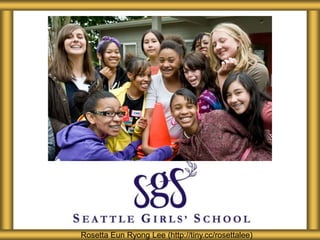
About Seattle Girls’ School
Rosetta Eun Ryong Lee (http://tiny.cc/rosettalee)
Courageous Conversations
in Our Schools and Lives
Rosetta Eun Ryong Lee (http://tiny.cc/rosettalee)
Fears and Anxieties that Keep Us
from Having Conversations
 Offending
 Losing Face
 Tokenism
 Professional Risk
 Bursting the Bubble
 Rocking the Boat
 Conflict
 Lack of “Authority”
Rosetta Eun Ryong Lee (http://tiny.cc/rosettalee)
Pitfalls and Obstacles that Keep Us
from Conversing Again
 Outbursts
 Silence
 Denial
 The Good Talk
 Teacher vs. Facilitator
 Personal Attacks
 The Quick Fix
 Leadership Oppression
Rosetta Eun Ryong Lee (http://tiny.cc/rosettalee)
Open Acknowledgment
Rosetta Eun Ryong Lee (http://tiny.cc/rosettalee)
Debunking Some Myths
Rosetta Eun Ryong Lee (http://tiny.cc/rosettalee)
 All or None
 Mistakes
 Apologies
 “Tonsils” Theory
 Vulnerability
Reflection:
What myths pose the
greatest challenges for
you in engaging
courageously in
conversations?
Rosetta Eun Ryong Lee (http://tiny.cc/rosettalee)
Define the Opportunity
Rosetta Eun Ryong Lee (http://tiny.cc/rosettalee)
Growth Mindset
Rosetta Eun Ryong Lee (http://tiny.cc/rosettalee)
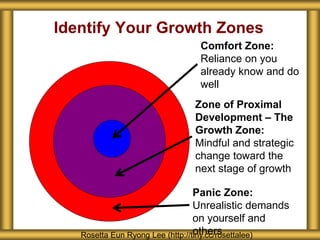
Identify Your Growth Zones
Rosetta Eun Ryong Lee (http://tiny.cc/rosettalee)
Comfort Zone:
Reliance on you
already know and do
well
Zone of Proximal
Development – The
Growth Zone:
Mindful and strategic
change toward the
next stage of growth
Panic Zone:
Unrealistic demands
on yourself and
others
Reflection:
What are some of your
growth zones? Are there
safe zones you want to
push yourself beyond?
Panic zones you might
want to pull back from?
Rosetta Eun Ryong Lee (http://tiny.cc/rosettalee)
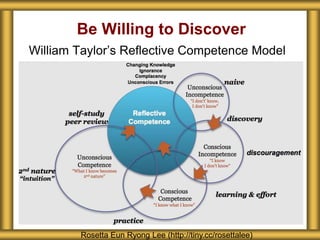
Be Willing to Discover
William Taylor’s Reflective Competence Model
Rosetta Eun Ryong Lee (http://tiny.cc/rosettalee)
Reflection:
What is a competence
you have developed
through mistakes,
humble curiosity, effort,
and practice?
Rosetta Eun Ryong Lee (http://tiny.cc/rosettalee)
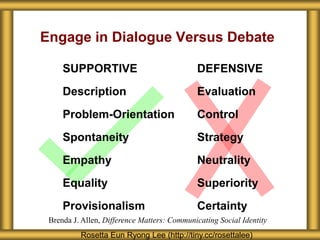
Engage in Dialogue Versus Debate
Brenda J. Allen, Difference Matters: Communicating Social Identity
SUPPORTIVE DEFENSIVE
Description Evaluation
Problem-Orientation Control
Spontaneity Strategy
Empathy Neutrality
Equality Superiority
Provisionalism Certainty
Rosetta Eun Ryong Lee (http://tiny.cc/rosettalee)
Reflection:
What is your primary
mode of engagement
(dialogue/debate,
supportive/defensive)?
How does your approach
serve you? What are
some challenges to this
approach?
Rosetta Eun Ryong Lee (http://tiny.cc/rosettalee)
So What? Now What?
Rosetta Eun Ryong Lee (http://tiny.cc/rosettalee)
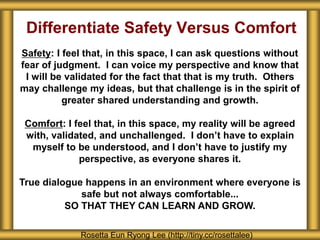
Differentiate Safety Versus Comfort
Safety: I feel that, in this space, I can ask questions without
fear of judgment. I can voice my perspective and know that
I will be validated for the fact that that is my truth. Others
may challenge my ideas, but that challenge is in the spirit of
greater shared understanding and growth.
Comfort: I feel that, in this space, my reality will be agreed
with, validated, and unchallenged. I don’t have to explain
myself to be understood, and I don’t have to justify my
perspective, as everyone shares it.
True dialogue happens in an environment where everyone is
safe but not always comfortable...
SO THAT THEY CAN LEARN AND GROW.
Rosetta Eun Ryong Lee (http://tiny.cc/rosettalee)
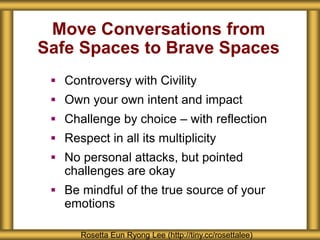
Move Conversations from
Safe Spaces to Brave Spaces
 Controversy with Civility
 Own your own intent and impact
 Challenge by choice – with reflection
 Respect in all its multiplicity
 No personal attacks, but pointed
challenges are okay
 Be mindful of the true source of your
emotions
Rosetta Eun Ryong Lee (http://tiny.cc/rosettalee)
Framing and Talking Points:
Different Occasions, Different Skills
Rosetta Eun Ryong Lee (http://tiny.cc/rosettalee)
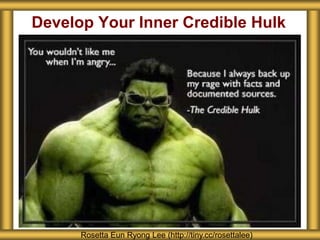
Develop Your Inner Credible Hulk
Rosetta Eun Ryong Lee (http://tiny.cc/rosettalee)
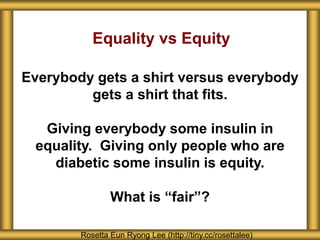
Equality vs Equity
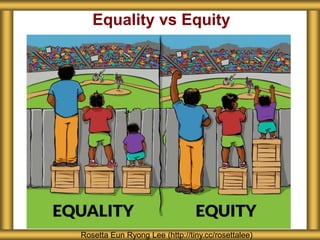
Everybody gets a shirt versus everybody
gets a shirt that fits.
Giving everybody some insulin in
equality. Giving only people who are
diabetic some insulin is equity.
What is “fair”?
Rosetta Eun Ryong Lee (http://tiny.cc/rosettalee)
Equality vs Equity
Rosetta Eun Ryong Lee (http://tiny.cc/rosettalee)
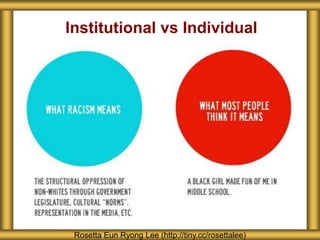
Institutional vs Individual
Rosetta Eun Ryong Lee (http://tiny.cc/rosettalee)
Correlation vs Causation
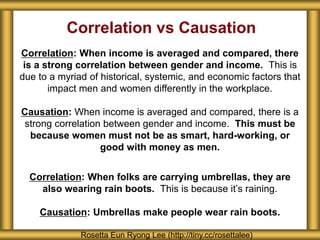
Correlation: When income is averaged and compared, there
is a strong correlation between gender and income. This is
due to a myriad of historical, systemic, and economic factors that
impact men and women differently in the workplace.
Causation: When income is averaged and compared, there is a
strong correlation between gender and income. This must be
because women must not be as smart, hard-working, or
good with money as men.
Correlation: When folks are carrying umbrellas, they are
also wearing rain boots. This is because it’s raining.
Causation: Umbrellas make people wear rain boots.
Rosetta Eun Ryong Lee (http://tiny.cc/rosettalee)
Where We’re From vs Where We’re Going
Rosetta Eun Ryong Lee (http://tiny.cc/rosettalee)
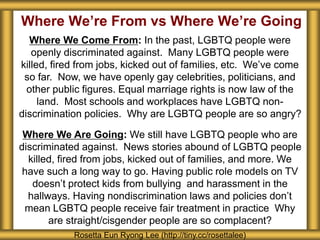
Where We Come From: In the past, LGBTQ people were
openly discriminated against. Many LGBTQ people were
killed, fired from jobs, kicked out of families, etc. We’ve come
so far. Now, we have openly gay celebrities, politicians, and
other public figures. Equal marriage rights is now law of the
land. Most schools and workplaces have LGBTQ non-
discrimination policies. Why are LGBTQ people are so angry?
Where We Are Going: We still have LGBTQ people who are
discriminated against. News stories abound of LGBTQ people
killed, fired from jobs, kicked out of families, and more. We
have such a long way to go. Having public role models on TV
doesn’t protect kids from bullying and harassment in the
hallways. Having nondiscrimination laws and policies don’t
mean LGBTQ people receive fair treatment in practice Why
are straight/cisgender people are so complacent?
Expert Opinion vs Personal Opinion
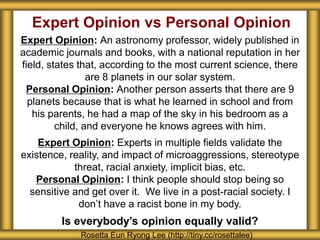
Expert Opinion: An astronomy professor, widely published in
academic journals and books, with a national reputation in her
field, states that, according to the most current science, there
are 8 planets in our solar system.
Personal Opinion: Another person asserts that there are 9
planets because that is what he learned in school and from
his parents, he had a map of the sky in his bedroom as a
child, and everyone he knows agrees with him.
Expert Opinion: Experts in multiple fields validate the
existence, reality, and impact of microaggressions, stereotype
threat, racial anxiety, implicit bias, etc.
Personal Opinion: I think people should stop being so
sensitive and get over it. We live in a post-racial society. I
don’t have a racist bone in my body.
Is everybody’s opinion equally valid?
Rosetta Eun Ryong Lee (http://tiny.cc/rosettalee)
Privilege
“Privilege exists when one group has
something of value that is denied to others
simply because of the groups they belong
to, rather than because of anything they’ve
done or failed to do.”
[as described by Peggy McIntosh and quoted by Allan Johnson]
Privilege is SYSTEMIC. It drives the
systems that dominate our societies.
Rosetta Eun Ryong Lee (http://tiny.cc/rosettalee)
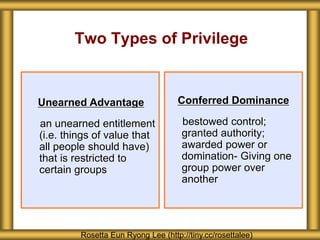
Two Types of Privilege
Rosetta Eun Ryong Lee (http://tiny.cc/rosettalee)
Unearned Advantage
an unearned entitlement
(i.e. things of value that
all people should have)
that is restricted to
certain groups
Conferred Dominance
bestowed control;
granted authority;
awarded power or
domination- Giving one
group power over
another
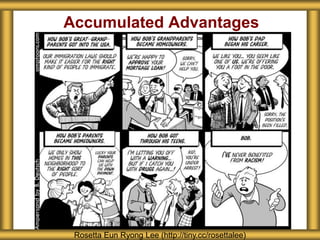
Accumulated Advantages
Rosetta Eun Ryong Lee (http://tiny.cc/rosettalee)
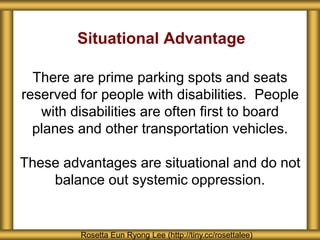
Situational Advantage
There are prime parking spots and seats
reserved for people with disabilities. People
with disabilities are often first to board
planes and other transportation vehicles.
These advantages are situational and do not
balance out systemic oppression.
Rosetta Eun Ryong Lee (http://tiny.cc/rosettalee)
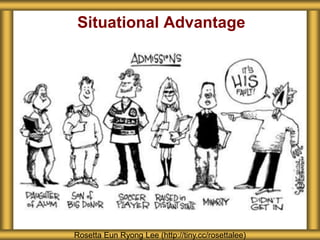
Situational Advantage
Rosetta Eun Ryong Lee (http://tiny.cc/rosettalee)
An Ally Is…
“a person who is a member of the dominant or
majority group who works to end oppression in
his or her personal and professional life
through support of, and as an advocate with
and for, the oppressed population”
Washington and Evans, Becoming an Ally
Rosetta Eun Ryong Lee (http://tiny.cc/rosettalee)
An Ally Is…
“Someone who doesn’t have to stand up for
someone else, who might even lose something
if they do, but they do it anyway because they
know it’s the right thing to do”
6th Grade Student
Rosetta Eun Ryong Lee (http://tiny.cc/rosettalee)
Savior Complex
 Centers on the “Helper” and not the “Helped”
 Centers on making the “Helper” feel good about
themselves
 Assumes that the “Helper” knows what is best for the
“Helped,” often without even hearing from the direct
experiences of the “Helped”
 Doesn’t acknowledge deep injustices, where the “Helper”
is privileged and the “Helped” are oppressed
 Doesn’t do anything to give power to the “Helped”
 Does not create sustainable change – once the “Helper”
stops doing what they are doing, so does the positive
change
Rosetta Eun Ryong Lee (http://tiny.cc/rosettalee)
Allyship and Solidarity
 Centers on the “Helped” and not the “Helper”
 Centers on the “Helper” fulfilling a societal responsibility
as the privileged
 Assumes that the “Helped” knows what is best for the
“Helped,” and that the job of the “Helper” is to assist the
“Helped” in meeting those needs
 Acknowledges deep societal injustices, where the
“Helper” and “Helped” are equal in dignity and unequal in
access through no fault or earning of each party
 Results in the “Helped” becoming more powerful
 Creates sustainable change where the “Helper” becomes
obsolete because the positive change continues with or
without them
Rosetta Eun Ryong Lee (http://tiny.cc/rosettalee)
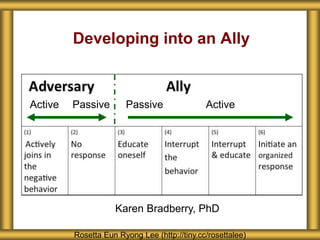
Developing into an Ally
Karen Bradberry, PhD
Active Passive Passive Active
Rosetta Eun Ryong Lee (http://tiny.cc/rosettalee)
Break
Rosetta Eun Ryong Lee (http://tiny.cc/rosettalee)
Navigating Microaggressions
Rosetta Eun Ryong Lee (http://tiny.cc/rosettalee)
What’s YOUR Ouch Moment?
Rosetta Eun Ryong Lee (http://tiny.cc/rosettalee)
What are those microaggressive moments
that weigh you down because they happen
frequently and the impacts accumulate?
Speaking From the Heart
Rosetta Eun Ryong Lee (http://tiny.cc/rosettalee)
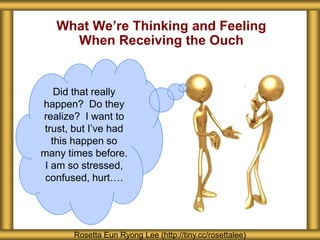
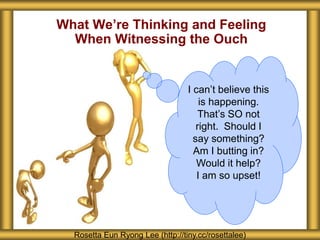
What We’re Thinking and Feeling
When Receiving the Ouch
Rosetta Eun Ryong Lee (http://tiny.cc/rosettalee)
Did that really
happen? Do they
realize? I want to
trust, but I’ve had
this happen so
many times before.
I am so stressed,
confused, hurt….
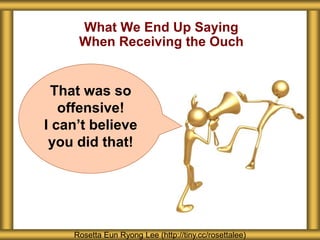
What We End Up Saying
When Receiving the Ouch
Rosetta Eun Ryong Lee (http://tiny.cc/rosettalee)
That was so
offensive!
I can’t believe
you did that!
Be A DEAR….
Rosetta Eun Ryong Lee (http://tiny.cc/rosettalee)
Self Advocacy Through the Ouch Moment
 Affirm the person or relationship
 Describe the behavior without judgment
 Explain the emotion/impact and your filters
 Assume positive intent
 Request or suggest different behavior
*** Key Points: timing, I statements, actions not
adjectives, inside feelings not outside feelings***
Rosetta Eun Ryong Lee (http://tiny.cc/rosettalee)
Self Advocacy Through the Ouch Moment:
Can I talk with you about something? I really
appreciate having you as a friend. I have so
much fun with you, and I can tell you anything.
Earlier today, when I got my math test back
and I got 98%, I heard you say, “Well of course
you got a 98% - you’re Asian!” I was pretty
hurt when I heard that. I work hard in all my
classes to get good grades, but so many
people assume it’s because of my race. It’s
sad that I don’t get to own my
accomplishments like everyone else. I’m
pretty sure you didn’t mean for me to feel that
way. Can I ask that you please don’t say
things like that anymore?
Rosetta Eun Ryong Lee (http://tiny.cc/rosettalee)
Practice Round:
Self Advocacy Through the Ouch Moment
 Affirm the person or relationship
 Describe the behavior without judgment
 Explain the emotion/impact and your filters
 Assume positive intent
 Request or suggest different behavior
*** Key Points: timing, I statements, actions not
adjectives, inside feelings not outside feelings***
Rosetta Eun Ryong Lee (http://tiny.cc/rosettalee)
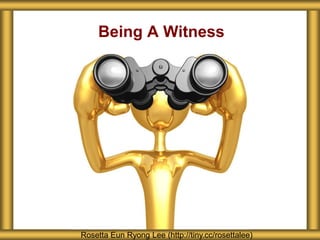
Being A Witness
Rosetta Eun Ryong Lee (http://tiny.cc/rosettalee)
What We’re Thinking and Feeling
When Witnessing the Ouch
Rosetta Eun Ryong Lee (http://tiny.cc/rosettalee)
I can’t believe this
is happening.
That’s SO not
right. Should I
say something?
Am I butting in?
Would it help?
I am so upset!
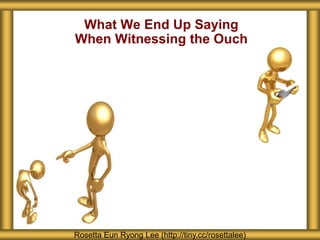
What We End Up Saying
When Witnessing the Ouch
Rosetta Eun Ryong Lee (http://tiny.cc/rosettalee)
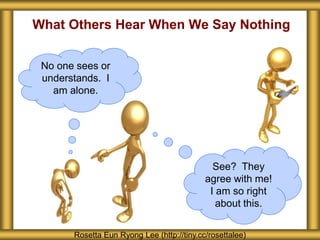
What Others Hear When We Say Nothing
Rosetta Eun Ryong Lee (http://tiny.cc/rosettalee)
See? They
agree with me!
I am so right
about this.
No one sees or
understands. I
am alone.
They were born
innocent…
Rosetta Eun Ryong Lee (http://tiny.cc/rosettalee)
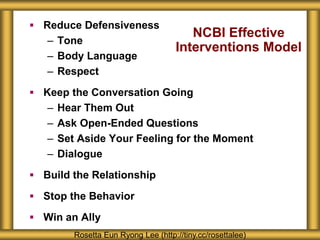
NCBI Effective
Interventions Model
 Reduce Defensiveness
– Tone
– Body Language
– Respect
 Keep the Conversation Going
– Hear Them Out
– Ask Open-Ended Questions
– Set Aside Your Feeling for the Moment
– Dialogue
 Build the Relationship
 Stop the Behavior
 Win an Ally
Rosetta Eun Ryong Lee (http://tiny.cc/rosettalee)
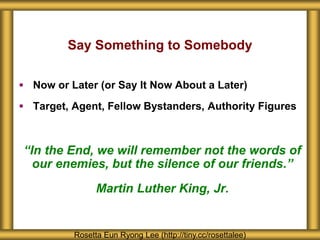
Say Something to Somebody
 Now or Later (or Say It Now About a Later)
 Target, Agent, Fellow Bystanders, Authority Figures
“In the End, we will remember not the words of
our enemies, but the silence of our friends.”
Martin Luther King, Jr.
Rosetta Eun Ryong Lee (http://tiny.cc/rosettalee)
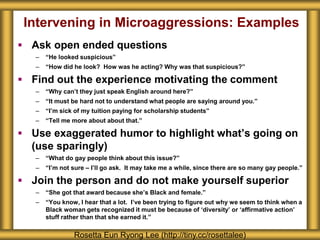
Intervening in Microaggressions: Examples
 Ask open ended questions
– “He looked suspicious”
– “How did he look? How was he acting? Why was that suspicious?”
 Find out the experience motivating the comment
– “Why can’t they just speak English around here?”
– “It must be hard not to understand what people are saying around you.”
– “I’m sick of my tuition paying for scholarship students”
– “Tell me more about about that.”
 Use exaggerated humor to highlight what’s going on
(use sparingly)
– “What do gay people think about this issue?”
– “I’m not sure – I’ll go ask. It may take me a while, since there are so many gay people.”
 Join the person and do not make yourself superior
– “She got that award because she’s Black and female.”
– “You know, I hear that a lot. I’ve been trying to figure out why we seem to think when a
Black woman gets recognized it must be because of ‘diversity’ or ‘affirmative action’
stuff rather than that she earned it.”
Rosetta Eun Ryong Lee (http://tiny.cc/rosettalee)
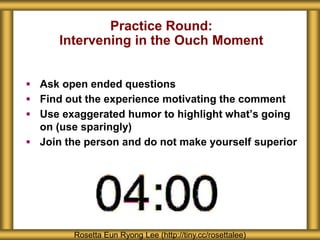
Practice Round:
Intervening in the Ouch Moment
 Ask open ended questions
 Find out the experience motivating the comment
 Use exaggerated humor to highlight what’s going
on (use sparingly)
 Join the person and do not make yourself superior
Rosetta Eun Ryong Lee (http://tiny.cc/rosettalee)
Listening to the Real Message
Rosetta Eun Ryong Lee (http://tiny.cc/rosettalee)
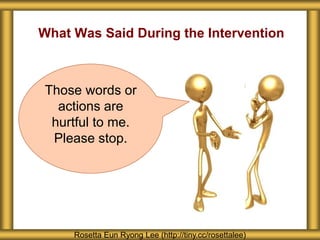
What Was Said During the Intervention
Rosetta Eun Ryong Lee (http://tiny.cc/rosettalee)
Those words or
actions are
hurtful to me.
Please stop.
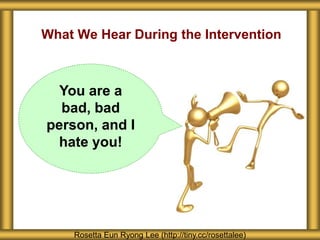
What We Hear During the Intervention
Rosetta Eun Ryong Lee (http://tiny.cc/rosettalee)
You are a
bad, bad
person, and I
hate you!
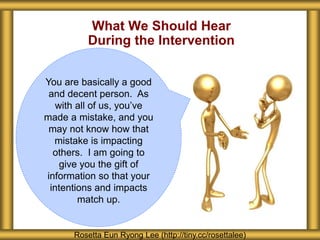
What We Should Hear
During the Intervention
Rosetta Eun Ryong Lee (http://tiny.cc/rosettalee)
You are basically a good
and decent person. As
with all of us, you’ve
made a mistake, and you
may not know how that
mistake is impacting
others. I am going to
give you the gift of
information so that your
intentions and impacts
match up.
It’s a gift…
Rosetta Eun Ryong Lee (http://tiny.cc/rosettalee)
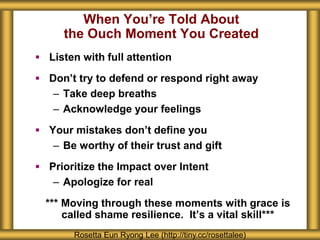
When You’re Told About
the Ouch Moment You Created
 Listen with full attention
 Don’t try to defend or respond right away
– Take deep breaths
– Acknowledge your feelings
 Your mistakes don’t define you
– Be worthy of their trust and gift
 Prioritize the Impact over Intent
– Apologize for real
*** Moving through these moments with grace is
called shame resilience. It’s a vital skill***
Rosetta Eun Ryong Lee (http://tiny.cc/rosettalee)
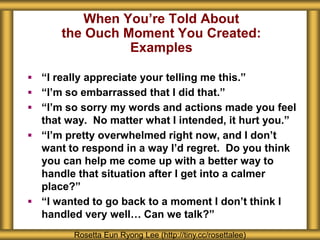
When You’re Told About
the Ouch Moment You Created:
Examples
Rosetta Eun Ryong Lee (http://tiny.cc/rosettalee)
 “I really appreciate your telling me this.”
 “I’m so embarrassed that I did that.”
 “I’m so sorry my words and actions made you feel
that way. No matter what I intended, it hurt you.”
 “I’m pretty overwhelmed right now, and I don’t
want to respond in a way I’d regret. Do you think
you can help me come up with a better way to
handle that situation after I get into a calmer
place?”
 “I wanted to go back to a moment I don’t think I
handled very well… Can we talk?”
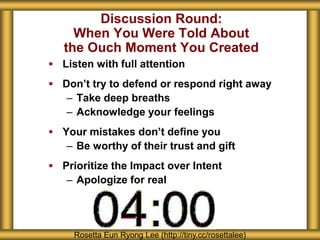
Discussion Round:
When You Were Told About
the Ouch Moment You Created
 Listen with full attention
 Don’t try to defend or respond right away
– Take deep breaths
– Acknowledge your feelings
 Your mistakes don’t define you
– Be worthy of their trust and gift
 Prioritize the Impact over Intent
– Apologize for real
Rosetta Eun Ryong Lee (http://tiny.cc/rosettalee)
Final Words of Advice:
Recognize Your Triggers
Rosetta Eun Ryong Lee (http://tiny.cc/rosettalee)
Find Your Bucket People
Rosetta Eun Ryong Lee (http://tiny.cc/rosettalee)
Practice Makes
Less Freeze-Ups
Rosetta Eun Ryong Lee (http://tiny.cc/rosettalee)
If You Messed Up and You Know It,
Don’t Wait for the Intervention –
Just Apologize
Rosetta Eun Ryong Lee (http://tiny.cc/rosettalee)
If You’re Really Sorry,
Work to Improve
Rosetta Eun Ryong Lee (http://tiny.cc/rosettalee)
Build Authentic Relationships
Rosetta Eun Ryong Lee (http://tiny.cc/rosettalee)
Inclusive Communities
Rosetta Eun Ryong Lee (http://tiny.cc/rosettalee)
Presenter Information
Rosetta Eun Ryong Lee
6th Faculty and
Professional Outreach
Seattle Girls’ School
2706 S Jackson Street
Seattle WA 98144
(206) 805-6562
rlee@seattlegirlsschool.org
http://tiny.cc/rosettalee
Rosetta Eun Ryong Lee (http://tiny.cc/rosettalee)
Resources
• Anti-Defamation League
• Brené Brown
• Cross Cultural Connections
(www.CulturesConnecting.com)
• National Coalition Building Institute
• The People’s Institute
• Stirfry Seminars
• Teaching Tolerance
• The Thiagi Group
Rosetta Eun Ryong Lee (http://tiny.cc/rosettalee)

Equity Exchange Facilitating Brave Space

  • 1.
    The Equity Exchange RosettaEun Ryong Lee Seattle Girls’ School Facilitating Brave Spaces Rosetta Eun Ryong Lee (http://tiny.cc/rosettalee)
  • 2.
    About Seattle Girls’School Rosetta Eun Ryong Lee (http://tiny.cc/rosettalee)
  • 3.
    Courageous Conversations in OurSchools and Lives Rosetta Eun Ryong Lee (http://tiny.cc/rosettalee)
  • 4.
    Fears and Anxietiesthat Keep Us from Having Conversations  Offending  Losing Face  Tokenism  Professional Risk  Bursting the Bubble  Rocking the Boat  Conflict  Lack of “Authority” Rosetta Eun Ryong Lee (http://tiny.cc/rosettalee)
  • 5.
    Pitfalls and Obstaclesthat Keep Us from Conversing Again  Outbursts  Silence  Denial  The Good Talk  Teacher vs. Facilitator  Personal Attacks  The Quick Fix  Leadership Oppression Rosetta Eun Ryong Lee (http://tiny.cc/rosettalee)
  • 6.
    Open Acknowledgment Rosetta EunRyong Lee (http://tiny.cc/rosettalee)
  • 7.
    Debunking Some Myths RosettaEun Ryong Lee (http://tiny.cc/rosettalee)  All or None  Mistakes  Apologies  “Tonsils” Theory  Vulnerability
  • 8.
    Reflection: What myths posethe greatest challenges for you in engaging courageously in conversations? Rosetta Eun Ryong Lee (http://tiny.cc/rosettalee)
  • 9.
    Define the Opportunity RosettaEun Ryong Lee (http://tiny.cc/rosettalee)
  • 10.
    Growth Mindset Rosetta EunRyong Lee (http://tiny.cc/rosettalee)
  • 11.
    Identify Your GrowthZones Rosetta Eun Ryong Lee (http://tiny.cc/rosettalee) Comfort Zone: Reliance on you already know and do well Zone of Proximal Development – The Growth Zone: Mindful and strategic change toward the next stage of growth Panic Zone: Unrealistic demands on yourself and others
  • 12.
    Reflection: What are someof your growth zones? Are there safe zones you want to push yourself beyond? Panic zones you might want to pull back from? Rosetta Eun Ryong Lee (http://tiny.cc/rosettalee)
  • 13.
    Be Willing toDiscover William Taylor’s Reflective Competence Model Rosetta Eun Ryong Lee (http://tiny.cc/rosettalee)
  • 14.
    Reflection: What is acompetence you have developed through mistakes, humble curiosity, effort, and practice? Rosetta Eun Ryong Lee (http://tiny.cc/rosettalee)
  • 15.
    Engage in DialogueVersus Debate Brenda J. Allen, Difference Matters: Communicating Social Identity SUPPORTIVE DEFENSIVE Description Evaluation Problem-Orientation Control Spontaneity Strategy Empathy Neutrality Equality Superiority Provisionalism Certainty Rosetta Eun Ryong Lee (http://tiny.cc/rosettalee)
  • 16.
    Reflection: What is yourprimary mode of engagement (dialogue/debate, supportive/defensive)? How does your approach serve you? What are some challenges to this approach? Rosetta Eun Ryong Lee (http://tiny.cc/rosettalee)
  • 17.
    So What? NowWhat? Rosetta Eun Ryong Lee (http://tiny.cc/rosettalee)
  • 18.
    Differentiate Safety VersusComfort Safety: I feel that, in this space, I can ask questions without fear of judgment. I can voice my perspective and know that I will be validated for the fact that that is my truth. Others may challenge my ideas, but that challenge is in the spirit of greater shared understanding and growth. Comfort: I feel that, in this space, my reality will be agreed with, validated, and unchallenged. I don’t have to explain myself to be understood, and I don’t have to justify my perspective, as everyone shares it. True dialogue happens in an environment where everyone is safe but not always comfortable... SO THAT THEY CAN LEARN AND GROW. Rosetta Eun Ryong Lee (http://tiny.cc/rosettalee)
  • 19.
    Move Conversations from SafeSpaces to Brave Spaces  Controversy with Civility  Own your own intent and impact  Challenge by choice – with reflection  Respect in all its multiplicity  No personal attacks, but pointed challenges are okay  Be mindful of the true source of your emotions Rosetta Eun Ryong Lee (http://tiny.cc/rosettalee)
  • 20.
    Framing and TalkingPoints: Different Occasions, Different Skills Rosetta Eun Ryong Lee (http://tiny.cc/rosettalee)
  • 21.
    Develop Your InnerCredible Hulk Rosetta Eun Ryong Lee (http://tiny.cc/rosettalee)
  • 22.
    Equality vs Equity Everybodygets a shirt versus everybody gets a shirt that fits. Giving everybody some insulin in equality. Giving only people who are diabetic some insulin is equity. What is “fair”? Rosetta Eun Ryong Lee (http://tiny.cc/rosettalee)
  • 23.
    Equality vs Equity RosettaEun Ryong Lee (http://tiny.cc/rosettalee)
  • 24.
    Institutional vs Individual RosettaEun Ryong Lee (http://tiny.cc/rosettalee)
  • 25.
    Correlation vs Causation Correlation:When income is averaged and compared, there is a strong correlation between gender and income. This is due to a myriad of historical, systemic, and economic factors that impact men and women differently in the workplace. Causation: When income is averaged and compared, there is a strong correlation between gender and income. This must be because women must not be as smart, hard-working, or good with money as men. Correlation: When folks are carrying umbrellas, they are also wearing rain boots. This is because it’s raining. Causation: Umbrellas make people wear rain boots. Rosetta Eun Ryong Lee (http://tiny.cc/rosettalee)
  • 26.
    Where We’re Fromvs Where We’re Going Rosetta Eun Ryong Lee (http://tiny.cc/rosettalee) Where We Come From: In the past, LGBTQ people were openly discriminated against. Many LGBTQ people were killed, fired from jobs, kicked out of families, etc. We’ve come so far. Now, we have openly gay celebrities, politicians, and other public figures. Equal marriage rights is now law of the land. Most schools and workplaces have LGBTQ non- discrimination policies. Why are LGBTQ people are so angry? Where We Are Going: We still have LGBTQ people who are discriminated against. News stories abound of LGBTQ people killed, fired from jobs, kicked out of families, and more. We have such a long way to go. Having public role models on TV doesn’t protect kids from bullying and harassment in the hallways. Having nondiscrimination laws and policies don’t mean LGBTQ people receive fair treatment in practice Why are straight/cisgender people are so complacent?
  • 27.
    Expert Opinion vsPersonal Opinion Expert Opinion: An astronomy professor, widely published in academic journals and books, with a national reputation in her field, states that, according to the most current science, there are 8 planets in our solar system. Personal Opinion: Another person asserts that there are 9 planets because that is what he learned in school and from his parents, he had a map of the sky in his bedroom as a child, and everyone he knows agrees with him. Expert Opinion: Experts in multiple fields validate the existence, reality, and impact of microaggressions, stereotype threat, racial anxiety, implicit bias, etc. Personal Opinion: I think people should stop being so sensitive and get over it. We live in a post-racial society. I don’t have a racist bone in my body. Is everybody’s opinion equally valid? Rosetta Eun Ryong Lee (http://tiny.cc/rosettalee)
  • 28.
    Privilege “Privilege exists whenone group has something of value that is denied to others simply because of the groups they belong to, rather than because of anything they’ve done or failed to do.” [as described by Peggy McIntosh and quoted by Allan Johnson] Privilege is SYSTEMIC. It drives the systems that dominate our societies. Rosetta Eun Ryong Lee (http://tiny.cc/rosettalee)
  • 29.
    Two Types ofPrivilege Rosetta Eun Ryong Lee (http://tiny.cc/rosettalee) Unearned Advantage an unearned entitlement (i.e. things of value that all people should have) that is restricted to certain groups Conferred Dominance bestowed control; granted authority; awarded power or domination- Giving one group power over another
  • 30.
    Accumulated Advantages Rosetta EunRyong Lee (http://tiny.cc/rosettalee)
  • 31.
    Situational Advantage There areprime parking spots and seats reserved for people with disabilities. People with disabilities are often first to board planes and other transportation vehicles. These advantages are situational and do not balance out systemic oppression. Rosetta Eun Ryong Lee (http://tiny.cc/rosettalee)
  • 32.
    Situational Advantage Rosetta EunRyong Lee (http://tiny.cc/rosettalee)
  • 33.
    An Ally Is… “aperson who is a member of the dominant or majority group who works to end oppression in his or her personal and professional life through support of, and as an advocate with and for, the oppressed population” Washington and Evans, Becoming an Ally Rosetta Eun Ryong Lee (http://tiny.cc/rosettalee)
  • 34.
    An Ally Is… “Someonewho doesn’t have to stand up for someone else, who might even lose something if they do, but they do it anyway because they know it’s the right thing to do” 6th Grade Student Rosetta Eun Ryong Lee (http://tiny.cc/rosettalee)
  • 35.
    Savior Complex  Centerson the “Helper” and not the “Helped”  Centers on making the “Helper” feel good about themselves  Assumes that the “Helper” knows what is best for the “Helped,” often without even hearing from the direct experiences of the “Helped”  Doesn’t acknowledge deep injustices, where the “Helper” is privileged and the “Helped” are oppressed  Doesn’t do anything to give power to the “Helped”  Does not create sustainable change – once the “Helper” stops doing what they are doing, so does the positive change Rosetta Eun Ryong Lee (http://tiny.cc/rosettalee)
  • 36.
    Allyship and Solidarity Centers on the “Helped” and not the “Helper”  Centers on the “Helper” fulfilling a societal responsibility as the privileged  Assumes that the “Helped” knows what is best for the “Helped,” and that the job of the “Helper” is to assist the “Helped” in meeting those needs  Acknowledges deep societal injustices, where the “Helper” and “Helped” are equal in dignity and unequal in access through no fault or earning of each party  Results in the “Helped” becoming more powerful  Creates sustainable change where the “Helper” becomes obsolete because the positive change continues with or without them Rosetta Eun Ryong Lee (http://tiny.cc/rosettalee)
  • 37.
    Developing into anAlly Karen Bradberry, PhD Active Passive Passive Active Rosetta Eun Ryong Lee (http://tiny.cc/rosettalee)
  • 38.
    Break Rosetta Eun RyongLee (http://tiny.cc/rosettalee)
  • 39.
    Navigating Microaggressions Rosetta EunRyong Lee (http://tiny.cc/rosettalee)
  • 40.
    What’s YOUR OuchMoment? Rosetta Eun Ryong Lee (http://tiny.cc/rosettalee) What are those microaggressive moments that weigh you down because they happen frequently and the impacts accumulate?
  • 41.
    Speaking From theHeart Rosetta Eun Ryong Lee (http://tiny.cc/rosettalee)
  • 42.
    What We’re Thinkingand Feeling When Receiving the Ouch Rosetta Eun Ryong Lee (http://tiny.cc/rosettalee) Did that really happen? Do they realize? I want to trust, but I’ve had this happen so many times before. I am so stressed, confused, hurt….
  • 43.
    What We EndUp Saying When Receiving the Ouch Rosetta Eun Ryong Lee (http://tiny.cc/rosettalee) That was so offensive! I can’t believe you did that!
  • 44.
    Be A DEAR…. RosettaEun Ryong Lee (http://tiny.cc/rosettalee)
  • 45.
    Self Advocacy Throughthe Ouch Moment  Affirm the person or relationship  Describe the behavior without judgment  Explain the emotion/impact and your filters  Assume positive intent  Request or suggest different behavior *** Key Points: timing, I statements, actions not adjectives, inside feelings not outside feelings*** Rosetta Eun Ryong Lee (http://tiny.cc/rosettalee)
  • 46.
    Self Advocacy Throughthe Ouch Moment: Can I talk with you about something? I really appreciate having you as a friend. I have so much fun with you, and I can tell you anything. Earlier today, when I got my math test back and I got 98%, I heard you say, “Well of course you got a 98% - you’re Asian!” I was pretty hurt when I heard that. I work hard in all my classes to get good grades, but so many people assume it’s because of my race. It’s sad that I don’t get to own my accomplishments like everyone else. I’m pretty sure you didn’t mean for me to feel that way. Can I ask that you please don’t say things like that anymore? Rosetta Eun Ryong Lee (http://tiny.cc/rosettalee)
  • 47.
    Practice Round: Self AdvocacyThrough the Ouch Moment  Affirm the person or relationship  Describe the behavior without judgment  Explain the emotion/impact and your filters  Assume positive intent  Request or suggest different behavior *** Key Points: timing, I statements, actions not adjectives, inside feelings not outside feelings*** Rosetta Eun Ryong Lee (http://tiny.cc/rosettalee)
  • 48.
    Being A Witness RosettaEun Ryong Lee (http://tiny.cc/rosettalee)
  • 49.
    What We’re Thinkingand Feeling When Witnessing the Ouch Rosetta Eun Ryong Lee (http://tiny.cc/rosettalee) I can’t believe this is happening. That’s SO not right. Should I say something? Am I butting in? Would it help? I am so upset!
  • 50.
    What We EndUp Saying When Witnessing the Ouch Rosetta Eun Ryong Lee (http://tiny.cc/rosettalee)
  • 51.
    What Others HearWhen We Say Nothing Rosetta Eun Ryong Lee (http://tiny.cc/rosettalee) See? They agree with me! I am so right about this. No one sees or understands. I am alone.
  • 52.
    They were born innocent… RosettaEun Ryong Lee (http://tiny.cc/rosettalee)
  • 53.
    NCBI Effective Interventions Model Reduce Defensiveness – Tone – Body Language – Respect  Keep the Conversation Going – Hear Them Out – Ask Open-Ended Questions – Set Aside Your Feeling for the Moment – Dialogue  Build the Relationship  Stop the Behavior  Win an Ally Rosetta Eun Ryong Lee (http://tiny.cc/rosettalee)
  • 54.
    Say Something toSomebody  Now or Later (or Say It Now About a Later)  Target, Agent, Fellow Bystanders, Authority Figures “In the End, we will remember not the words of our enemies, but the silence of our friends.” Martin Luther King, Jr. Rosetta Eun Ryong Lee (http://tiny.cc/rosettalee)
  • 55.
    Intervening in Microaggressions:Examples  Ask open ended questions – “He looked suspicious” – “How did he look? How was he acting? Why was that suspicious?”  Find out the experience motivating the comment – “Why can’t they just speak English around here?” – “It must be hard not to understand what people are saying around you.” – “I’m sick of my tuition paying for scholarship students” – “Tell me more about about that.”  Use exaggerated humor to highlight what’s going on (use sparingly) – “What do gay people think about this issue?” – “I’m not sure – I’ll go ask. It may take me a while, since there are so many gay people.”  Join the person and do not make yourself superior – “She got that award because she’s Black and female.” – “You know, I hear that a lot. I’ve been trying to figure out why we seem to think when a Black woman gets recognized it must be because of ‘diversity’ or ‘affirmative action’ stuff rather than that she earned it.” Rosetta Eun Ryong Lee (http://tiny.cc/rosettalee)
  • 56.
    Practice Round: Intervening inthe Ouch Moment  Ask open ended questions  Find out the experience motivating the comment  Use exaggerated humor to highlight what’s going on (use sparingly)  Join the person and do not make yourself superior Rosetta Eun Ryong Lee (http://tiny.cc/rosettalee)
  • 57.
    Listening to theReal Message Rosetta Eun Ryong Lee (http://tiny.cc/rosettalee)
  • 58.
    What Was SaidDuring the Intervention Rosetta Eun Ryong Lee (http://tiny.cc/rosettalee) Those words or actions are hurtful to me. Please stop.
  • 59.
    What We HearDuring the Intervention Rosetta Eun Ryong Lee (http://tiny.cc/rosettalee) You are a bad, bad person, and I hate you!
  • 60.
    What We ShouldHear During the Intervention Rosetta Eun Ryong Lee (http://tiny.cc/rosettalee) You are basically a good and decent person. As with all of us, you’ve made a mistake, and you may not know how that mistake is impacting others. I am going to give you the gift of information so that your intentions and impacts match up.
  • 61.
    It’s a gift… RosettaEun Ryong Lee (http://tiny.cc/rosettalee)
  • 62.
    When You’re ToldAbout the Ouch Moment You Created  Listen with full attention  Don’t try to defend or respond right away – Take deep breaths – Acknowledge your feelings  Your mistakes don’t define you – Be worthy of their trust and gift  Prioritize the Impact over Intent – Apologize for real *** Moving through these moments with grace is called shame resilience. It’s a vital skill*** Rosetta Eun Ryong Lee (http://tiny.cc/rosettalee)
  • 63.
    When You’re ToldAbout the Ouch Moment You Created: Examples Rosetta Eun Ryong Lee (http://tiny.cc/rosettalee)  “I really appreciate your telling me this.”  “I’m so embarrassed that I did that.”  “I’m so sorry my words and actions made you feel that way. No matter what I intended, it hurt you.”  “I’m pretty overwhelmed right now, and I don’t want to respond in a way I’d regret. Do you think you can help me come up with a better way to handle that situation after I get into a calmer place?”  “I wanted to go back to a moment I don’t think I handled very well… Can we talk?”
  • 64.
    Discussion Round: When YouWere Told About the Ouch Moment You Created  Listen with full attention  Don’t try to defend or respond right away – Take deep breaths – Acknowledge your feelings  Your mistakes don’t define you – Be worthy of their trust and gift  Prioritize the Impact over Intent – Apologize for real Rosetta Eun Ryong Lee (http://tiny.cc/rosettalee)
  • 65.
    Final Words ofAdvice: Recognize Your Triggers Rosetta Eun Ryong Lee (http://tiny.cc/rosettalee)
  • 66.
    Find Your BucketPeople Rosetta Eun Ryong Lee (http://tiny.cc/rosettalee)
  • 67.
    Practice Makes Less Freeze-Ups RosettaEun Ryong Lee (http://tiny.cc/rosettalee)
  • 68.
    If You MessedUp and You Know It, Don’t Wait for the Intervention – Just Apologize Rosetta Eun Ryong Lee (http://tiny.cc/rosettalee)
  • 69.
    If You’re ReallySorry, Work to Improve Rosetta Eun Ryong Lee (http://tiny.cc/rosettalee)
  • 70.
    Build Authentic Relationships RosettaEun Ryong Lee (http://tiny.cc/rosettalee)
  • 71.
    Inclusive Communities Rosetta EunRyong Lee (http://tiny.cc/rosettalee)
  • 72.
    Presenter Information Rosetta EunRyong Lee 6th Faculty and Professional Outreach Seattle Girls’ School 2706 S Jackson Street Seattle WA 98144 (206) 805-6562 rlee@seattlegirlsschool.org http://tiny.cc/rosettalee Rosetta Eun Ryong Lee (http://tiny.cc/rosettalee)
  • 73.
    Resources • Anti-Defamation League •Brené Brown • Cross Cultural Connections (www.CulturesConnecting.com) • National Coalition Building Institute • The People’s Institute • Stirfry Seminars • Teaching Tolerance • The Thiagi Group Rosetta Eun Ryong Lee (http://tiny.cc/rosettalee)