Equity-Driven Learning:
Crafting Noncredit Student Learning Outcomes
for California's Vision 2030
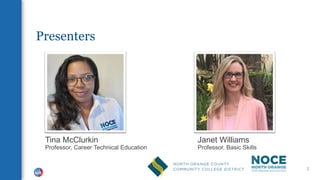
Presenters
Tina McClurkin
Professor, Career Technical Education
Janet Williams
Professor, Basic Skills
2
Equity Driven Learning & SLOs
 Define equity-driven learning
 Supporting equity-driven learning through well-written Student
Learning Outcomes (SLOs)
 Examine characteristics of well-written SLOs
 Practical strategies to incorporate processes to develop equity-driven
outcomes, close the feedback loop, and continuously improve student
learning opportunities.
3
Equity –Driven Learning
• An approach to education that prioritizes fairness, inclusivity, and
justice for all students, regardless of their background, identity, or
circumstances.
• Mindset
• Inclusive Environment
• Equity-focused teaching
4
What are the differences between noncredit
and credit SLOs?
• Responses
• None
• ??
• Psychmoter vs. cognitive
• Not too many differences?
• There shouldn’t be a difference between credit and noncredit SLOs.
• No differences for mirrored courses.
• There should be none.
• No difference
• None?
• No-difference
• Nothing
5
Answer: What are the differences between
noncredit and credit SLOs?
•There is no difference between noncredit
and credit SLOs.
6
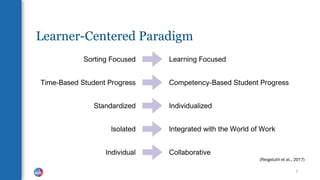
Learner-Centered Paradigm
7
(Reigeluth et al., 2017)
Equity-Driven Instruction & SLOs
• Well-written SLOs are essential to equity-driven Student Learning
Outcomes
• Criteria for Development
• Appropriate to Mission
• Need
• Curriculum Standards
• Compliance
(CCCCO, 2023)
8
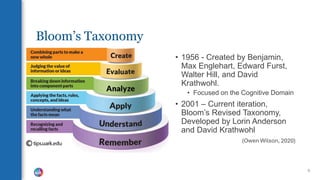
Bloom’s Taxonomy
• 1956 - Created by Benjamin,
Max Englehart, Edward Furst,
Walter Hill, and David
Krathwohl.
• Focused on the Cognitive Domain
• 2001 – Current iteration,
Bloom’s Revised Taxonomy,
Developed by Lorin Anderson
and David Krathwohl
(Owen Wilson, 2020)
9
Creating Equitable SLOs
A How-To
10
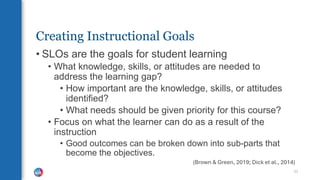
Creating Instructional Goals
• SLOs are the goals for student learning
• What knowledge, skills, or attitudes are needed to
address the learning gap?
• How important are the knowledge, skills, or attitudes
identified?
• What needs should be given priority for this course?
• Focus on what the learner can do as a result of the
instruction
• Good outcomes can be broken down into sub-parts that
become the objectives.
(Brown & Green, 2019; Dick et al., 2014)
11
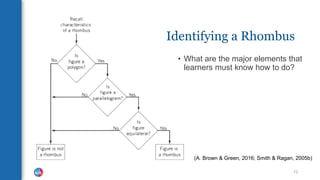
Identifying a Rhombus
• What are the major elements that
learners must know how to do?
(A. Brown & Green, 2016; Smith & Ragan, 2005b)
12
Other Considerations
• What skills or knowledge is required to accomplish the outcomes?
• Essential Prerequisites
• What are the relevant prerequisite skills that are part of the total skill and are
necessary for success?
• Supportive Prerequisites
• May make learning easier or faster but aren’t necessary for success
• Keep in mind that if you miss a skill, topic, or concept, then the learner
may not accomplish the outcomes.
• Not every skill needs to be taught.
• Those skills become the entry skills or knowledge that learners should have
when they begin the class.
• Don’t focus on learning or instructional strategies at this point
13
A. Brown & Green, 2016; Gange et al., 2004; Morrison et al., 2019)
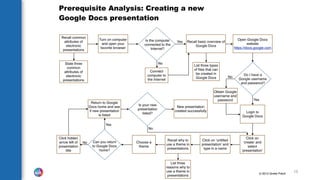
What prerequisite skills or knowledge does a
student need to create a Google Slide presentation?
• Responses
• Basic word processing
• Maybe use AI to help
• Logging onto the computer and using a browser
• How to copy and paste
• Also more basically what is a presentation supposed to be like?
• Internet access
• Outlining
• Basic keyboarding skills. Understand icons on slides to alter text, add images, etc.
• Find google suite top right “waffle”
• Use a computer, use internet, how to use Google slides, images?, email,
• How to log on to google
• How to use a computer
• Be able to log into Google.com
14
15
What About the Learner?
• Who is the target audience?
• Think about learners as they are
• What are they like, and what do they know?
• Avoid thinking about learners in terms of should
• Characteristics to keep in mind
• Gender, Ethnicity, & Racial Group
• Aptitudes
• Developmental State
• Prior Learning
• Types and Conditions of Learning
16
(Smith & Ragan, 2005a)
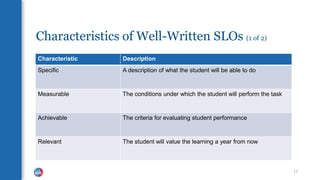
Characteristics of Well-Written SLOs (1 of 2)
17
Characteristic Description
Specific A description of what the student will be able to do
Measurable The conditions under which the student will perform the task
Achievable The criteria for evaluating student performance
Relevant The student will value the learning a year from now
Characteristics of Well-Written SLOs (2 0f 2)
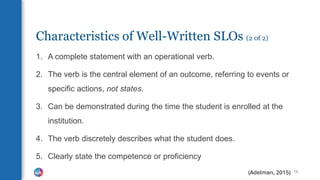
1. A complete statement with an operational verb.
2. The verb is the central element of an outcome, referring to events or
specific actions, not states.
3. Can be demonstrated during the time the student is enrolled at the
institution.
4. The verb discretely describes what the student does.
5. Clearly state the competence or proficiency
18
(Adelman, 2015)
SLO Habits to Break
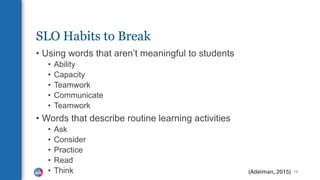
• Using words that aren’t meaningful to students
• Ability
• Capacity
• Teamwork
• Communicate
• Teamwork
• Words that describe routine learning activities
• Ask
• Consider
• Practice
• Read
• Think 19
(Adelman, 2015)
SLO Makeovers: Before
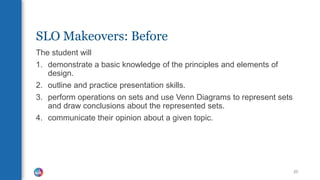
The student will
1. demonstrate a basic knowledge of the principles and elements of
design.
2. outline and practice presentation skills.
3. perform operations on sets and use Venn Diagrams to represent sets
and draw conclusions about the represented sets.
4. communicate their opinion about a given topic.
20
SLO Makeovers: After
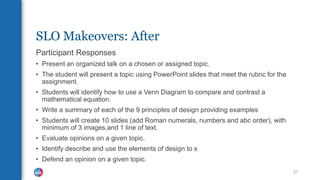
Participant Responses
• Present an organized talk on a chosen or assigned topic.
• The student will present a topic using PowerPoint slides that meet the rubric for the
assignment.
• Students will identify how to use a Venn Diagram to compare and contrast a
mathematical equation.
• Write a summary of each of the 9 principles of design providing examples
• Students will create 10 slides (add Roman numerals, numbers and abc order), with
minimum of 3 images,and 1 line of text.
• Evaluate opinions on a given topic.
• Identify describe and use the elements of design to x
• Defend an opinion on a given topic.
21
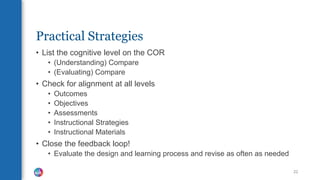
Practical Strategies
• List the cognitive level on the COR
• (Understanding) Compare
• (Evaluating) Compare
• Check for alignment at all levels
• Outcomes
• Objectives
• Assessments
• Instructional Strategies
• Instructional Materials
• Close the feedback loop!
• Evaluate the design and learning process and revise as often as needed
22
Questions and Discussion
23
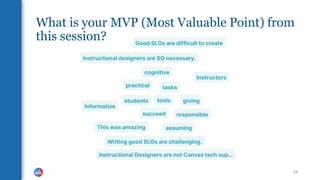
What is your MVP (Most Valuable Point) from
this session?
24
References (1 of 3)
Adelman, C. (2015). To Imagine a Verb: The Language and Syntax of Learning Outcomes Statements (No.
24). National Institute for Learning Outcomes Assessment.
Brown, A., & Green, D. L. C. (2016). Task analysis. In The essentials of instructional design: Connecting
fundamental principles with process and practice (3rd ed., pp. 59–71). Pearson.
Brown, A. H., & Green, T. D. (2019). Instructional Goals and Objectives. In The essentials of instructional
design (3rd ed., pp. 103–117). Routledge.
CCCCO. (2023). Program and Course Approval Handbook. {California Community College Chancellor’s
Office}. https://www.cccco.edu/-/media/CCCCO-Website/docs/curriculum/program-course-approval-
handbook-8th-edition.pdf
25
References (2 of 3)
Dick, W., Carey, L., & Carey, J. O. (2014). Identifying instructional goals using front-end analysis. In The
systematic design of instruction (8th ed., pp. 14–39). Pearson Education.
Gange, R. M., Wager, G. G., Golas, K. C., & Keller, J. M. (2004). Analysis of a learning task. In Principles of
instructional design (5th ed., pp. 151–171). Wadsworth, Cengage Learning.
Morrison, G. R., Ross, S. J., & Kalman, H. K. (2019). Task Analysis. In Designing effective instruction (8th ed.,
pp. 74–102). John Wiley & Sons.
Owen Wilson, L. (2020). Bloom’s taxonomy revised. Https://thesecondprinciple.com.
https://thesecondprinciple.com/essential-teaching-skills/blooms-taxonomy-revised/
26
References (3 of 3)
Pappas, C. (2013, January 4). The 60-Second Guide To Blooms Taxonomy. ELearning Industry.
https://elearningindustry.com/the-60-second-guide-to-blooms-taxonomy
Reigeluth, C. M., Beatty, B. J., & Myers, R. D. (Eds.). (2017). Instructional-design theories and models: The
learner-centered paradigm of education: Vol. IV. Routledge.
Shabatura, J. (2014). Using Bloom’s Taxonomy to Write Effective Learning Outcomes.
https://tips.uark.edu/using-blooms-taxonomy/
Smith, P. L., & Ragan, T. J. (2005a). Instructional analysis: Analyzing the learners. In Instructional Design (3rd
ed., pp. 57–74). Wiley Jossey-Bass Education.
Smith, P. L., & Ragan, T. J. (2005b). Instructional analysis: Analyzing the learning task. In Instructional design
(3rd ed., pp. 75–105). Jossey-Bass. 27
Let’s Stay in Touch!
Janet Williams
Janet.Williams@noce.edu
Tina McClurkin
tmcclurkin@noce.edu
28
Book Recommendation
This is the taxonomy book mentioned during the session.
Lambe, P. (2007). Organising knowledge: Taxonomies, knowledge, and
organisational effectiveness. Chandos Publishing (Oxford).
29

Equity-Driven Learning: Crafting Equitable SLOs

  • 1.
    Equity-Driven Learning: Crafting NoncreditStudent Learning Outcomes for California's Vision 2030
  • 2.
    Presenters Tina McClurkin Professor, CareerTechnical Education Janet Williams Professor, Basic Skills 2
  • 3.
    Equity Driven Learning& SLOs  Define equity-driven learning  Supporting equity-driven learning through well-written Student Learning Outcomes (SLOs)  Examine characteristics of well-written SLOs  Practical strategies to incorporate processes to develop equity-driven outcomes, close the feedback loop, and continuously improve student learning opportunities. 3
  • 4.
    Equity –Driven Learning •An approach to education that prioritizes fairness, inclusivity, and justice for all students, regardless of their background, identity, or circumstances. • Mindset • Inclusive Environment • Equity-focused teaching 4
  • 5.
    What are thedifferences between noncredit and credit SLOs? • Responses • None • ?? • Psychmoter vs. cognitive • Not too many differences? • There shouldn’t be a difference between credit and noncredit SLOs. • No differences for mirrored courses. • There should be none. • No difference • None? • No-difference • Nothing 5
  • 6.
    Answer: What arethe differences between noncredit and credit SLOs? •There is no difference between noncredit and credit SLOs. 6
  • 7.
  • 8.
    Equity-Driven Instruction &SLOs • Well-written SLOs are essential to equity-driven Student Learning Outcomes • Criteria for Development • Appropriate to Mission • Need • Curriculum Standards • Compliance (CCCCO, 2023) 8
  • 9.
    Bloom’s Taxonomy • 1956- Created by Benjamin, Max Englehart, Edward Furst, Walter Hill, and David Krathwohl. • Focused on the Cognitive Domain • 2001 – Current iteration, Bloom’s Revised Taxonomy, Developed by Lorin Anderson and David Krathwohl (Owen Wilson, 2020) 9
  • 10.
  • 11.
    Creating Instructional Goals •SLOs are the goals for student learning • What knowledge, skills, or attitudes are needed to address the learning gap? • How important are the knowledge, skills, or attitudes identified? • What needs should be given priority for this course? • Focus on what the learner can do as a result of the instruction • Good outcomes can be broken down into sub-parts that become the objectives. (Brown & Green, 2019; Dick et al., 2014) 11
  • 12.
    Identifying a Rhombus •What are the major elements that learners must know how to do? (A. Brown & Green, 2016; Smith & Ragan, 2005b) 12
  • 13.
    Other Considerations • Whatskills or knowledge is required to accomplish the outcomes? • Essential Prerequisites • What are the relevant prerequisite skills that are part of the total skill and are necessary for success? • Supportive Prerequisites • May make learning easier or faster but aren’t necessary for success • Keep in mind that if you miss a skill, topic, or concept, then the learner may not accomplish the outcomes. • Not every skill needs to be taught. • Those skills become the entry skills or knowledge that learners should have when they begin the class. • Don’t focus on learning or instructional strategies at this point 13 A. Brown & Green, 2016; Gange et al., 2004; Morrison et al., 2019)
  • 14.
    What prerequisite skillsor knowledge does a student need to create a Google Slide presentation? • Responses • Basic word processing • Maybe use AI to help • Logging onto the computer and using a browser • How to copy and paste • Also more basically what is a presentation supposed to be like? • Internet access • Outlining • Basic keyboarding skills. Understand icons on slides to alter text, add images, etc. • Find google suite top right “waffle” • Use a computer, use internet, how to use Google slides, images?, email, • How to log on to google • How to use a computer • Be able to log into Google.com 14
  • 15.
  • 16.
    What About theLearner? • Who is the target audience? • Think about learners as they are • What are they like, and what do they know? • Avoid thinking about learners in terms of should • Characteristics to keep in mind • Gender, Ethnicity, & Racial Group • Aptitudes • Developmental State • Prior Learning • Types and Conditions of Learning 16 (Smith & Ragan, 2005a)
  • 17.
    Characteristics of Well-WrittenSLOs (1 of 2) 17 Characteristic Description Specific A description of what the student will be able to do Measurable The conditions under which the student will perform the task Achievable The criteria for evaluating student performance Relevant The student will value the learning a year from now
  • 18.
    Characteristics of Well-WrittenSLOs (2 0f 2) 1. A complete statement with an operational verb. 2. The verb is the central element of an outcome, referring to events or specific actions, not states. 3. Can be demonstrated during the time the student is enrolled at the institution. 4. The verb discretely describes what the student does. 5. Clearly state the competence or proficiency 18 (Adelman, 2015)
  • 19.
    SLO Habits toBreak • Using words that aren’t meaningful to students • Ability • Capacity • Teamwork • Communicate • Teamwork • Words that describe routine learning activities • Ask • Consider • Practice • Read • Think 19 (Adelman, 2015)
  • 20.
    SLO Makeovers: Before Thestudent will 1. demonstrate a basic knowledge of the principles and elements of design. 2. outline and practice presentation skills. 3. perform operations on sets and use Venn Diagrams to represent sets and draw conclusions about the represented sets. 4. communicate their opinion about a given topic. 20
  • 21.
    SLO Makeovers: After ParticipantResponses • Present an organized talk on a chosen or assigned topic. • The student will present a topic using PowerPoint slides that meet the rubric for the assignment. • Students will identify how to use a Venn Diagram to compare and contrast a mathematical equation. • Write a summary of each of the 9 principles of design providing examples • Students will create 10 slides (add Roman numerals, numbers and abc order), with minimum of 3 images,and 1 line of text. • Evaluate opinions on a given topic. • Identify describe and use the elements of design to x • Defend an opinion on a given topic. 21
  • 22.
    Practical Strategies • Listthe cognitive level on the COR • (Understanding) Compare • (Evaluating) Compare • Check for alignment at all levels • Outcomes • Objectives • Assessments • Instructional Strategies • Instructional Materials • Close the feedback loop! • Evaluate the design and learning process and revise as often as needed 22
  • 23.
  • 24.
    What is yourMVP (Most Valuable Point) from this session? 24
  • 25.
    References (1 of3) Adelman, C. (2015). To Imagine a Verb: The Language and Syntax of Learning Outcomes Statements (No. 24). National Institute for Learning Outcomes Assessment. Brown, A., & Green, D. L. C. (2016). Task analysis. In The essentials of instructional design: Connecting fundamental principles with process and practice (3rd ed., pp. 59–71). Pearson. Brown, A. H., & Green, T. D. (2019). Instructional Goals and Objectives. In The essentials of instructional design (3rd ed., pp. 103–117). Routledge. CCCCO. (2023). Program and Course Approval Handbook. {California Community College Chancellor’s Office}. https://www.cccco.edu/-/media/CCCCO-Website/docs/curriculum/program-course-approval- handbook-8th-edition.pdf 25
  • 26.
    References (2 of3) Dick, W., Carey, L., & Carey, J. O. (2014). Identifying instructional goals using front-end analysis. In The systematic design of instruction (8th ed., pp. 14–39). Pearson Education. Gange, R. M., Wager, G. G., Golas, K. C., & Keller, J. M. (2004). Analysis of a learning task. In Principles of instructional design (5th ed., pp. 151–171). Wadsworth, Cengage Learning. Morrison, G. R., Ross, S. J., & Kalman, H. K. (2019). Task Analysis. In Designing effective instruction (8th ed., pp. 74–102). John Wiley & Sons. Owen Wilson, L. (2020). Bloom’s taxonomy revised. Https://thesecondprinciple.com. https://thesecondprinciple.com/essential-teaching-skills/blooms-taxonomy-revised/ 26
  • 27.
    References (3 of3) Pappas, C. (2013, January 4). The 60-Second Guide To Blooms Taxonomy. ELearning Industry. https://elearningindustry.com/the-60-second-guide-to-blooms-taxonomy Reigeluth, C. M., Beatty, B. J., & Myers, R. D. (Eds.). (2017). Instructional-design theories and models: The learner-centered paradigm of education: Vol. IV. Routledge. Shabatura, J. (2014). Using Bloom’s Taxonomy to Write Effective Learning Outcomes. https://tips.uark.edu/using-blooms-taxonomy/ Smith, P. L., & Ragan, T. J. (2005a). Instructional analysis: Analyzing the learners. In Instructional Design (3rd ed., pp. 57–74). Wiley Jossey-Bass Education. Smith, P. L., & Ragan, T. J. (2005b). Instructional analysis: Analyzing the learning task. In Instructional design (3rd ed., pp. 75–105). Jossey-Bass. 27
  • 28.
    Let’s Stay inTouch! Janet Williams Janet.Williams@noce.edu Tina McClurkin tmcclurkin@noce.edu 28
  • 29.
    Book Recommendation This isthe taxonomy book mentioned during the session. Lambe, P. (2007). Organising knowledge: Taxonomies, knowledge, and organisational effectiveness. Chandos Publishing (Oxford). 29