Equation and it's types and qauartic equation solving threeethods
1.
The Power ofEquations:
Understanding Mathematical
Equality
Welcome to our exploration of equations - the fundamental building blocks
of mathematics. Equations express the equality between two expressions,
bridging abstract concepts with real-world applications.
by Abbas Zaib
2.
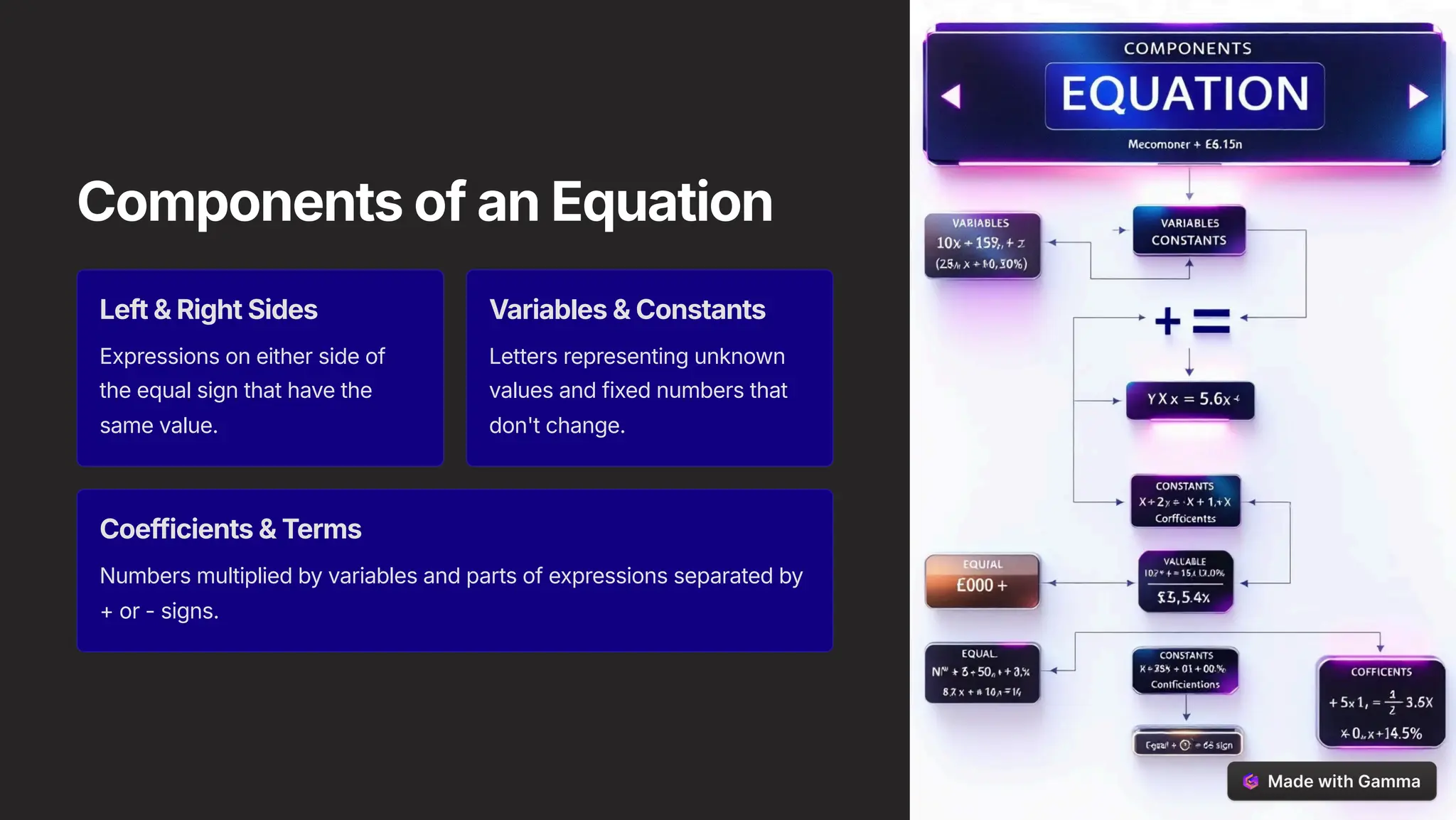
Components of anEquation
Left & Right Sides
Expressions on either side of
the equal sign that have the
same value.
Variables & Constants
Letters representing unknown
values and fixed numbers that
don't change.
Coefficients & Terms
Numbers multiplied by variables and parts of expressions separated by
+ or - signs.
3.
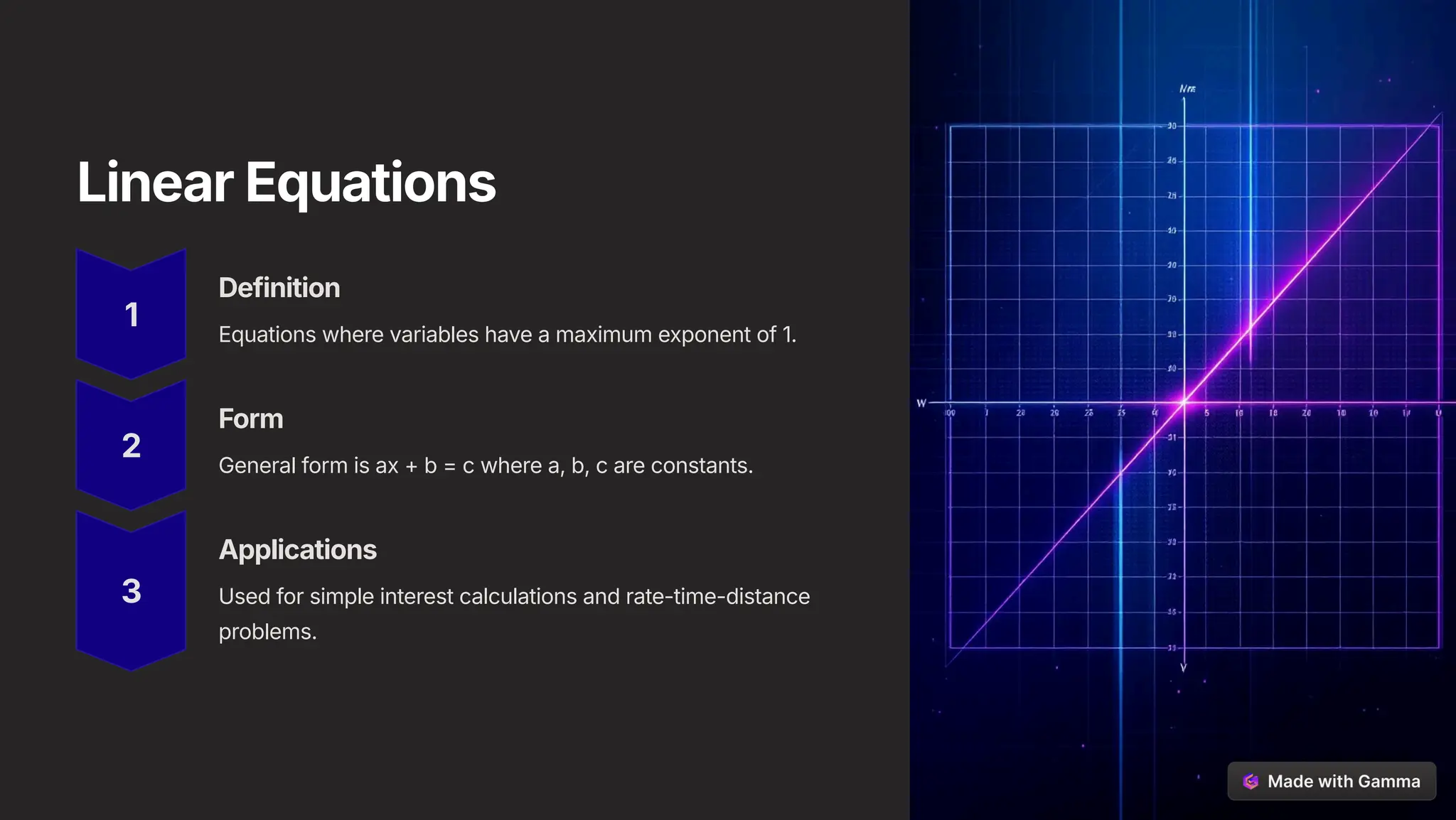
Linear Equations
1
Definition
Equations wherevariables have a maximum exponent of 1.
2
Form
General form is ax + b = c where a, b, c are constants.
3
Applications
Used for simple interest calculations and rate-time-distance
problems.
4.
Quadratic Equations
Parabolic Form
Highestexponent is 2,
creating a U-shaped
curve when graphed.
General Form
Written as ax² + bx + c
= 0 where a b 0.
Real Applications
Models projectile
motion and
optimization problems.
5.
Cubic Equations
1
Form
Expressed asax³ + bx² + cx + d = 0 where a b 0.
2 Behavior
Creates S-shaped curves with up to three roots.
3
Usage
Essential for volume calculations and complex
modeling.
6.
Higher-Degree Polynomial
Equations
Quartic (4thDegree)
Can have up to four real roots and complex wave-like graphs.
Quintic (5th Degree)
No general algebraic solution exists for all quintic equations.
Higher Orders
Increasingly complex behavior with each higher degree.
7.
Special Types ofEquations
Beyond polynomials lie rational, radical, exponential, logarithmic, and trigonometric equations. Each type has unique properties and
solution methods.
8.
Solving Quadratic Equations
1
23
4
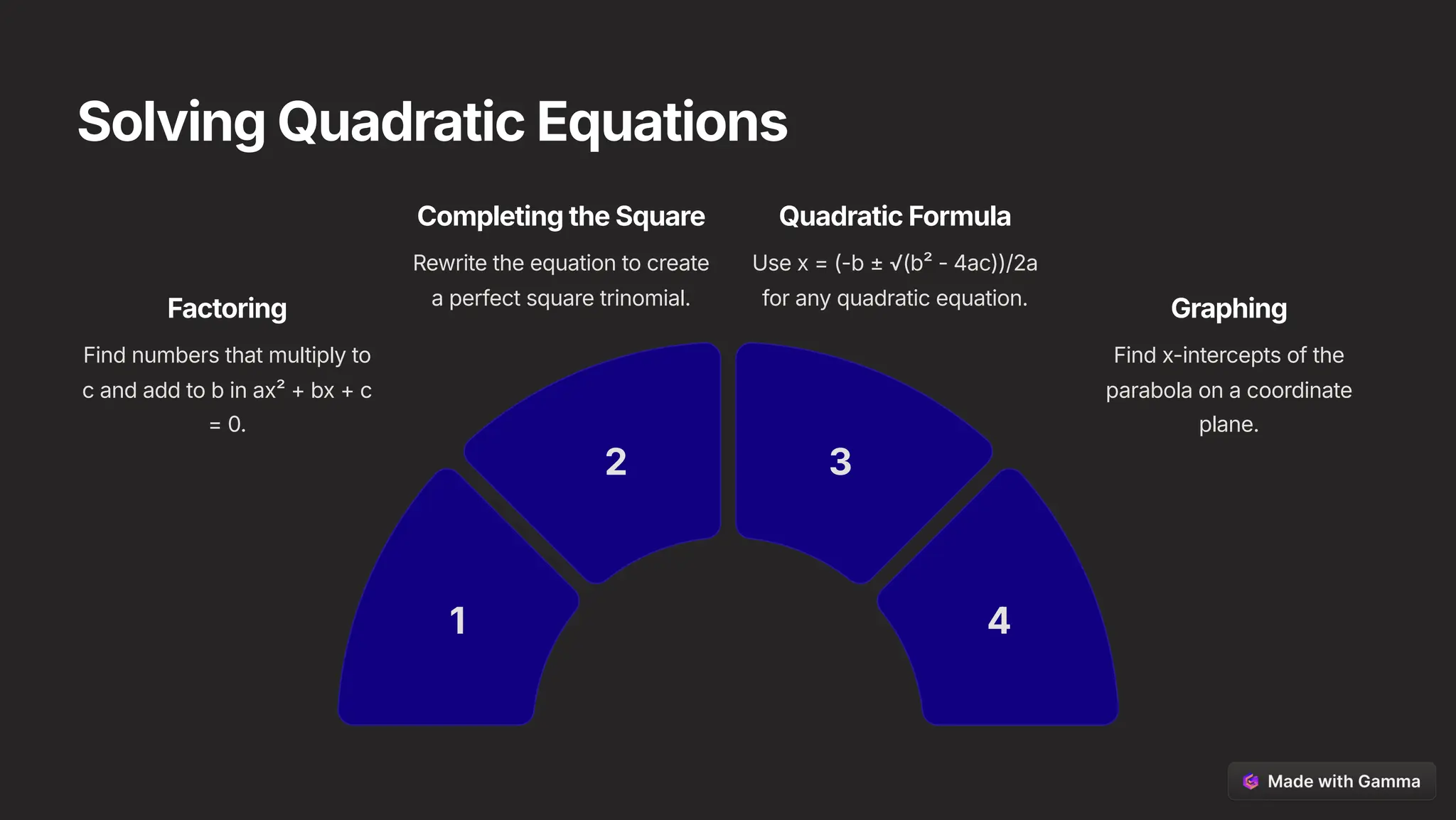
Factoring
Find numbers that multiply to
c and add to b in ax² + bx + c
= 0.
Completing the Square
Rewrite the equation to create
a perfect square trinomial.
Quadratic Formula
Use x = (-b ± :(b² - 4ac))/2a
for any quadratic equation.
Graphing
Find x-intercepts of the
parabola on a coordinate
plane.
9.
Quadratic Solution Methods:
Example
1
Factor
x²- 5x + 6 = 0 becomes (x-2)(x-3)
= 0, giving x = 2 or x = 3
2
Complete Square
x² - 5x + 6 = 0 becomes (x-5/2)² =
1/4, giving x = 2 or x = 3
3
Formula
Using x = (-b ± :(b² - 4ac))/2a
yields the same answers: x = 2 or x
= 3