EVOLVED PACKET SYSTEM (EPS)
Architecture & Attach Procedure
By
Anirudh Yadav
WHAT IS EPS ?
• Release 8 of 3GPP
• E-UTRAN (Radio N/W) + EPC (Core N/W) = EPS
• Flow of EPS architecture.
User  Radio N/W  Core N/W  IP N/W
(UE, e-nodeB) (E-UTRAN) (EPC) (IMS)
EPS ARCHITECTURE
Continued…..
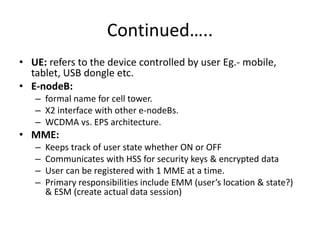
• UE: refers to the device controlled by user Eg.- mobile,
tablet, USB dongle etc.
• E-nodeB:
– formal name for cell tower.
– X2 interface with other e-nodeBs.
– WCDMA vs. EPS architecture.
• MME:
– Keeps track of user state whether ON or OFF
– Communicates with HSS for security keys & encrypted data
– User can be registered with 1 MME at a time.
– Primary responsibilities include EMM (user’s location & state?)
& ESM (create actual data session)
Continued….
• HSS:
– Similar to HLR
– Contains all encrypted data related to user.
– Acts as a database information storage node.
• S-GW:
– 1 UE can be served by 1 S-GW.
– MME tells it what P-GW to connect to.
– Handles user IP packets b/w e-nodeB & P-GW.
• PDN-GW:
– Known as PCEF, connected to PCRF, OCS (billing server)
– Controls amount of QoS dictating its services as a DICTATOR.
– Functionally an IP router.
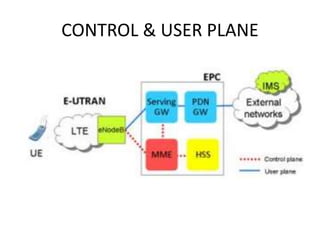
CONTROL & USER PLANE
ATTACH PROCEDURE
Continued….
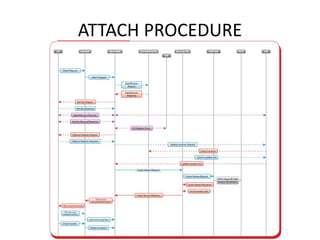
1. ATTACH REQUEST:
– UE wants to connect, sends an attach request to e-nodeB
– E-nodeB determines which MME to connect to.
2. AUTHENTICATION INFO REQUEST/RESPONSE
– MME queries the HSS for key information
– Pre-shared key concept
– MME asks e-nodeB what specific it wants to ask?
– Authentication successful.
3. UPDATE LOCATION REQUEST
– HSS declares specific MME for the UE
– In case of old MME it cancels it & update the location
register.
Continued….
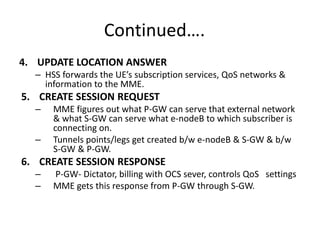
4. UPDATE LOCATION ANSWER
– HSS forwards the UE’s subscription services, QoS networks &
information to the MME.
5. CREATE SESSION REQUEST
– MME figures out what P-GW can serve that external network
& what S-GW can serve what e-nodeB to which subscriber is
connecting on.
– Tunnels points/legs get created b/w e-nodeB & S-GW & b/w
S-GW & P-GW.
6. CREATE SESSION RESPONSE
– P-GW- Dictator, billing with OCS sever, controls QoS settings
– MME gets this response from P-GW through S-GW.
Continued….
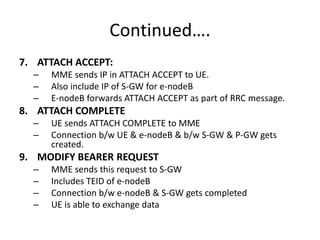
7. ATTACH ACCEPT:
– MME sends IP in ATTACH ACCEPT to UE.
– Also include IP of S-GW for e-nodeB
– E-nodeB forwards ATTACH ACCEPT as part of RRC message.
8. ATTACH COMPLETE
– UE sends ATTACH COMPLETE to MME
– Connection b/w UE & e-nodeB & b/w S-GW & P-GW gets
created.
9. MODIFY BEARER REQUEST
– MME sends this request to S-GW
– Includes TEID of e-nodeB
– Connection b/w e-nodeB & S-GW gets completed
– UE is able to exchange data
HISTORICAL CONTEXT
GPRS
• MS (Mobile sation)
• nodeB
• RNC
• SGSN
• GGSN
• HLR
EPS
• UE
• E-nodeB
• E-nodeB
• S-GW & MME
• P-GW
• HSS

EPS presentation

  • 1.
    EVOLVED PACKET SYSTEM(EPS) Architecture & Attach Procedure By Anirudh Yadav
  • 2.
    WHAT IS EPS? • Release 8 of 3GPP • E-UTRAN (Radio N/W) + EPC (Core N/W) = EPS • Flow of EPS architecture. User  Radio N/W  Core N/W  IP N/W (UE, e-nodeB) (E-UTRAN) (EPC) (IMS)
  • 3.
  • 4.
    Continued….. • UE: refersto the device controlled by user Eg.- mobile, tablet, USB dongle etc. • E-nodeB: – formal name for cell tower. – X2 interface with other e-nodeBs. – WCDMA vs. EPS architecture. • MME: – Keeps track of user state whether ON or OFF – Communicates with HSS for security keys & encrypted data – User can be registered with 1 MME at a time. – Primary responsibilities include EMM (user’s location & state?) & ESM (create actual data session)
  • 5.
    Continued…. • HSS: – Similarto HLR – Contains all encrypted data related to user. – Acts as a database information storage node. • S-GW: – 1 UE can be served by 1 S-GW. – MME tells it what P-GW to connect to. – Handles user IP packets b/w e-nodeB & P-GW. • PDN-GW: – Known as PCEF, connected to PCRF, OCS (billing server) – Controls amount of QoS dictating its services as a DICTATOR. – Functionally an IP router.
  • 6.
  • 7.
  • 8.
    Continued…. 1. ATTACH REQUEST: –UE wants to connect, sends an attach request to e-nodeB – E-nodeB determines which MME to connect to. 2. AUTHENTICATION INFO REQUEST/RESPONSE – MME queries the HSS for key information – Pre-shared key concept – MME asks e-nodeB what specific it wants to ask? – Authentication successful. 3. UPDATE LOCATION REQUEST – HSS declares specific MME for the UE – In case of old MME it cancels it & update the location register.
  • 9.
    Continued…. 4. UPDATE LOCATIONANSWER – HSS forwards the UE’s subscription services, QoS networks & information to the MME. 5. CREATE SESSION REQUEST – MME figures out what P-GW can serve that external network & what S-GW can serve what e-nodeB to which subscriber is connecting on. – Tunnels points/legs get created b/w e-nodeB & S-GW & b/w S-GW & P-GW. 6. CREATE SESSION RESPONSE – P-GW- Dictator, billing with OCS sever, controls QoS settings – MME gets this response from P-GW through S-GW.
  • 10.
    Continued…. 7. ATTACH ACCEPT: –MME sends IP in ATTACH ACCEPT to UE. – Also include IP of S-GW for e-nodeB – E-nodeB forwards ATTACH ACCEPT as part of RRC message. 8. ATTACH COMPLETE – UE sends ATTACH COMPLETE to MME – Connection b/w UE & e-nodeB & b/w S-GW & P-GW gets created. 9. MODIFY BEARER REQUEST – MME sends this request to S-GW – Includes TEID of e-nodeB – Connection b/w e-nodeB & S-GW gets completed – UE is able to exchange data
  • 11.
    HISTORICAL CONTEXT GPRS • MS(Mobile sation) • nodeB • RNC • SGSN • GGSN • HLR EPS • UE • E-nodeB • E-nodeB • S-GW & MME • P-GW • HSS