Reimpresión oficial de UpToDate
www.uptodate.com © 2024 UpToDate, Inc. y/o sus filiales. Todos los derechos reservados.
Epiglotitis (supraglotitis): características clínicas y diagnóstico
INTRODUCCIÓN
En este artículo se analizarán la patogenia, la etiología y las características clínicas de la epiglotitis (también llamada supraglotitis). El tratamiento y la prevención de la epiglotitis se analizan
por separado. (Véase "Epiglotitis (supraglotitis): tratamiento" ).
DEFINICIÓN
La epiglotitis es la inflamación de la epiglotis y las estructuras supraglóticas adyacentes, principalmente debido a una infección [ 1 ]. Sin tratamiento, la epiglotitis puede progresar hasta
convertirse en una obstrucción de las vías respiratorias potencialmente mortal. En la tabla ( tabla 1 ) se ofrece una descripción general rápida del reconocimiento y el tratamiento de la
epiglotitis en niños .
ANATOMÍA
La epiglotis forma la pared posterior del espacio valécular que se inserta en la base de la lengua ( figura 1 ). Está conectada por ligamentos al cartílago tiroides y al hueso hioides y
consiste en un cartílago delgado que está cubierto anteriormente por una capa epitelial escamosa estratificada. Esta capa escamosa también cubre el tercio superior de la superficie
posterior, donde se fusiona con el epitelio respiratorio que se extiende hacia la laringe. El epitelio y la lámina propia debajo están firmemente adheridos en la superficie posterior (laríngea) y
unidos de manera flexible en la superficie anterior (lingual). Esto crea un espacio potencial en la superficie lingual para que se acumule el líquido del edema.
PATOGENESIA
La epiglotitis es causada con mayor frecuencia por una infección, aunque la ingestión de cáusticos, la lesión térmica y el traumatismo local son etiologías no infecciosas importantes. La
epiglotitis infecciosa es una celulitis de la epiglotis, los pliegues ariepiglóticos y otros tejidos adyacentes. Es el resultado de una bacteriemia y/o una invasión directa de la capa epitelial por el
organismo patógeno [ 2,3 ]. La nasofaringe posterior es la fuente primaria de patógenos en la epiglotitis. El traumatismo microscópico de la superficie epitelial (p. ej., daño de la mucosa
durante una infección viral o de alimentos durante la deglución) puede ser un factor predisponente. Con menor frecuencia, las afecciones no infecciosas causan quemaduras locales o
equimosis de la epiglotis y las estructuras adyacentes.
Tanto en la etiología infecciosa como en la no infecciosa, la hinchazón de la epiglotis es resultado del edema y la acumulación de células inflamatorias en el espacio potencial entre la capa
epitelial escamosa y el cartílago epiglótico. La superficie lingual de la epiglotis y los tejidos periepiglóticos tienen abundantes redes de vasos linfáticos y sanguíneos que facilitan la
propagación de la infección y la posterior respuesta inflamatoria. Una vez que comienza la infección, la hinchazón progresa rápidamente hasta afectar toda la laringe supraglótica (incluidos
los pliegues ariepiglóticos y los aritenoides) [ 3,4 ]. Las regiones subglóticas generalmente no se ven afectadas; la hinchazón se detiene por el epitelio fuertemente unido a nivel de las
cuerdas vocales.
La hinchazón supraglótica reduce el calibre de las vías respiratorias superiores, lo que provoca un flujo de aire turbulento durante la inspiración (estridor) [ 3 ]. Otros mecanismos de
obstrucción del flujo de aire pueden incluir la curvatura posterior e inferior de la epiglotis (que actúa como una válvula de bola, obstruyendo el flujo de aire durante la inspiración pero
permitiendo la exhalación) y la aspiración de secreciones orofaríngeas [ 2,3 ].
La obstrucción de las vías respiratorias, que puede dar lugar a un paro cardiopulmonar, puede progresar rápidamente. Los signos de obstrucción grave de las vías respiratorias superiores
(p. ej., estridor/estertor, retracción intercostal y supraesternal, taquipnea y cianosis) pueden estar ausentes hasta una fase avanzada del proceso patológico, cuando la obstrucción de las
vías respiratorias es casi completa [ 5,6 ]. Se han notificado paros respiratorios extrahospitalarios debidos a una obstrucción aguda de las vías respiratorias, con resultado de muerte, en
niños y adultos [ 7,8 ].
ETIOLOGÍA
Infecciosa : la epiglotitis puede ser causada por varios patógenos bacterianos, virales y fúngicos ( tabla 2 ):
®
autor: Dr. Charles R Woods, doctor en medicina y máster
editores de sección: Dr. Glenn C. Isaacson, FAAP, Dr. Mark I. Neuman, máster en salud pública
editor adjunto: Dr. James F. Wiley, II, máster en Salud Pública
Todos los temas se actualizan a medida que hay nueva evidencia disponible y se completa nuestro proceso de revisión por pares .
Revisión de literatura actualizada hasta: julio de 2024.
Este tema se actualizó por última vez el 20 de diciembre de 2023.
Patógenos bacterianos – Los patógenos bacterianos son la etiología infecciosa identificada con mayor frecuencia para la epiglotitis. A pesar de la rápida disminución de la epiglotitis
infecciosa entre los niños inmunizados en la era posterior a la vacuna conjugada, Haemophilus influenzae tipo b (Hib) sigue siendo una etiología importante, principalmente en niños no
vacunados o inmunizados de forma incompleta. Además, según pequeñas series de casos, todavía se puede aislar Hib en niños y adultos completamente inmunizados [ 9-13 ].
●
Además de Hib, los aislamientos bacterianos de pacientes inmunocompetentes con epiglotitis también incluyen:
Staphylococcus aureus (incluidas las cepas resistentes a la meticilina [ 14-16 ])
•
Streptococcus pneumoniae [ 16,17 ]
•
Streptococcus pyogenes y otros estreptococos [ 16,18,19 ]
•
Neisseria meningitidis [ 16,20,21 ]
•
La epiglotitis necrosante puede complicar las infecciones de las vías respiratorias superiores y puede observarse en huéspedes inmunocomprometidos (incluidos los niños [ 28,38 ]) y,
raramente, en huéspedes inmunocompetentes [ 38,39 ].
No infecciosa : la epiglotitis puede acompañar a la inhalación de humo (consulte “Lesiones por inhalación de calor, humo o irritantes químicos” ). Por lo demás, la epiglotitis no infecciosa
suele ser poco frecuente. Los informes de casos y las series de casos describen la epiglotitis como complicación de las siguientes afecciones:
EPIDEMIOLOGÍA
Desde la introducción de las vacunas contra H. influenzae tipo b (Hib), la epiglotitis se ha convertido en una enfermedad observada principalmente en adultos con una incidencia anual
estimada de 0,6 a 1,9 casos por 100.000 [ 16,55 ] y una edad media general de 45 a 49 años [ 56,57 ] (véase 'Infecciosas' más arriba). La epiglotitis se ha asociado con una serie de
condiciones comórbidas, incluyendo hipertensión, diabetes mellitus, enfermedad renal terminal, abuso de sustancias y deficiencia inmunológica [ 58-64 ]. Además, el índice de masa
corporal (IMC) >25, diabetes mellitus, neumonía concurrente y presencia de un quiste epiglótico al ingreso parecen ser factores asociados con una mayor gravedad de la epiglotitis [ 65 ].
La incidencia anual de epiglotitis entre los niños ha disminuido drásticamente desde la introducción de las vacunas Hib, con una incidencia anual estimada de Hib tan baja como dos casos
por cada 10 millones de niños en poblaciones con altas tasas de inmunización [ 55,66-74 ]. Además, como Hib se ha convertido en una causa menos frecuente de epiglotitis en los niños, se
ha vuelto más común entre los niños en edad escolar y adolescentes que entre los niños en edad preescolar (<5 años de edad) [ 9,75 ].
PRESENTACIÓN CLÍNICA
Las características clínicas de la epiglotitis difieren según la edad, la gravedad y la etiología:
Aguda (fiebre y estridor) : la aparición abrupta y la progresión rápida (en cuestión de horas) de la obstrucción de las vías respiratorias superiores son características de la epiglotitis
bacteriana debida a Hib [ 6,76-80 ]. Esta presentación clásica de la epiglotitis por Hib es rara, pero aún puede ocurrir entre niños pequeños (<5 años de edad) en comunidades con un gran
número de pacientes no inmunizados. Las presentaciones agudas de epiglotitis con compromiso abrupto de las vías respiratorias también pueden ocurrir con (ver 'Etiología' arriba):
Los hallazgos clínicos de la epiglotitis aguda incluyen [ 6,58,81 ]:
Pasteurella multocida [ 16 ]
•
En el caso de los huéspedes inmunodeprimidos, además de las etiologías bacterianas mencionadas anteriormente, los aislamientos incluyen Pseudomonas aeruginosa , Serratia spp,
Enterobacter spp y flora anaeróbica.
Patógenos virales : las infecciones virales pueden causar epiglotitis o permitir una sobreinfección bacteriana en raras ocasiones. Los aislamientos notificados en pacientes con
epiglotitis incluyen:
●
Gripe, tipo a [ 22 ]
•
Gripe, tipo b [ 23 ]
•
Virus del herpes simple, tipos 1 y 2 [ 24-26 ]
•
Virus parainfluenza, tipo 3 [ 23 ]
•
Virus de Epstein-Barr [ 27 ]
•
Virus de inmunodeficiencia humana (VIH) [ 28 ]
•
SARS-CoV-2 [ 29-33 ]
•
Patógenos fúngicos – Las infecciones fúngicas ( especies de Candida e Histoplasma capsulatum ) como causa de epiglotitis son raras y parecen ocurrir principalmente en pacientes
inmunodeprimidos [ 34-36 ]. Se ha descrito un caso probable de epiglotitis por Candida en un niño aparentemente sano [ 37 ].
●
Traumatismos locales de las vías respiratorias como:
●
Lesión térmica por:
•
Ingestión de bebidas o alimentos calientes [ 40-43 ]
-
Uso de cigarrillos electrónicos [ 44 ] o inhalación de objetos calientes durante el consumo de drogas ilícitas como el crack o la cocaína [ 45 ]
-
Traumatismo directo sobre la epiglotis [ 46,47 ]
•
Ingestión o inhalación de cáusticos [ 47,48 ]
•
Enfermedad linfoproliferativa o enfermedad de injerto contra huésped después del trasplante de médula ósea o de órgano sólido [ 49-51 ]
●
Trastornos granulomatosos crónicos que incluyen poliangeítis, sarcoidosis, lupus eritematoso sistémico, policondritis recidivante y enfermedad relacionada con la inmunoglobulina G4
(IgG4) [ 52,53 ]
●
La afectación granulomatosa de las vías respiratorias supraglóticas, con características obstructivas progresivas de las vías respiratorias durante varios meses, se ha descrito como la
manifestación evidente inicial de la enfermedad de Crohn en un informe de caso [ 54 ].
Los niños pequeños (<5 años de edad) con epiglotitis por H. influenzae tipo b (Hib) pueden presentar dificultad respiratoria, ansiedad y la característica postura de "trípode" o "olfateo" (
imagen 1 y imagen 2 ) en la que asumen una posición sentada con el tronco inclinado hacia adelante, el cuello hiperextendido y el mentón empujado hacia adelante en un
esfuerzo por maximizar el diámetro de la vía aérea obstruida [ 6 ]. Pueden ser reacios a acostarse [ 2 ]. Sin embargo, la presentación puede ser sutil ( imagen 3 ). A menudo hay
babeo. La tos generalmente está ausente.
●
Los niños mayores, adolescentes y adultos con epiglotitis infecciosa o no infecciosa pueden presentar dolor de garganta intenso, disfagia y babeo; un examen orofaríngeo
relativamente normal y dificultad respiratoria mínima.
●
Infecciones por otros patógenos
●
Lesión térmica de las vías respiratorias superiores (por ejemplo, inhalación de humo, ingestión de bebidas calientes o inhalación de objetos calientes durante el consumo de drogas
ilícitas)
●
Ingestión o inhalación de cáusticos
●
Los pacientes con epiglotitis y obstrucción completa inminente de las vías respiratorias también pueden adoptar la postura del "trípode" ( imagen 1 ), una posición sentada con el tronco
inclinado hacia adelante, el cuello hiperextendido y el mentón empujado hacia adelante en un esfuerzo por maximizar el diámetro de las vías respiratorias obstruidas.
Los niños con epiglotitis generalmente no presentan ronquera ni tos, que son más características del crup. (Ver "Crup: características clínicas, evaluación y diagnóstico", sección sobre
'Presentación clínica' .)
La epiglotitis necrotizante ocurre raramente y se ha descrito en niños inmunocomprometidos e inmunocompetentes con una variedad de etiologías microbianas asociadas [ 82 ].
Subaguda (dolor de garganta intenso) : entre las poblaciones inmunizadas, la epiglotitis infecciosa es causada por otros patógenos bacterianos orofaríngeos y nasofaríngeos, incluidos S.
pneumoniae , S. pyogenes y otros estreptococos, S. aureus (incluidas las cepas resistentes a la meticilina) y H. influenzae no tipificable ; la epiglotitis por Hib es mucho menos común. Además,
se describen casos raros de epiglotitis viral y fúngica. (Véase "Infecciosa" más arriba).
Como resultado, predomina una presentación subaguda de epiglotitis infecciosa que consiste en [ 5,55,58,83,84 ]:
El estridor se presenta en una minoría de estos pacientes. Además, la obstrucción repentina de las vías respiratorias es mucho menos común, pero sigue siendo una posibilidad [ 56,85 ]. Por
lo tanto, la epiglotitis se ha convertido en una consideración importante en niños mayores, adolescentes y adultos que buscan atención médica por faringitis infecciosa aguda. (Véase
"Evaluación de la faringitis aguda en adultos" y "Evaluación del dolor de garganta en niños" ).
Las causas no infecciosas poco frecuentes de epiglotitis subaguda, que se observan predominantemente en pacientes inmunodeprimidos, incluyen la enfermedad linfoproliferativa, la
enfermedad de injerto contra huésped, la enfermedad granulomatosa crónica y la epiglotitis necrosante (véase “No infecciosas” más arriba) .
Manejo de la vía aérea
For patients with signs of impending complete airway obstruction, securing the airway is the focus of treatment as described in the rapid overview ( table 1). In these patients, airway
management necessarily precedes diagnostic evaluation [3]. (See "Epiglottitis (supraglottitis): Management" and "Technique of emergency endotracheal intubation in children" and
"Overview of advanced airway management in adults for emergency medicine and critical care".)
EXAMINATION
The approach to diagnosing epiglottitis, including which patients should undergo attempts at direct visualization, depend upon the patient's presentation and the clinician's suspicion for
epiglottitis ( algorithm 1).
Visualization of the epiglottis confirms the clinical diagnosis [13]; a soft-tissue lateral radiograph of the neck is an alternative approach that has reasonable sensitivity and specificity. (See
'Imaging' below.)
Signs of impending airway obstruction — There are rare reports of cardiorespiratory arrest in children with acute presentations of epiglottitis during attempts to visualize the epiglottis
[86]. These arrests have been attributed to functional airway obstruction (resulting from increased respiratory effort secondary to increased anxiety), aggravation of airway obstruction
caused by supine positioning, and/or laryngospasm.
Presumably, the patients who have arrested after visualization have had pre-existing, nearly complete obstruction. These patients would typically have fairly definitive signs of epiglottitis
(eg, severe respiratory distress, anxiety, "sniffing" position ( picture 2); signs of upper airway involvement, particularly stridor, drooling, or "tripod" posture ( picture 1); and no cough).
(See 'Acute (fever and stridor)' above.)
Emergency involvement of airway experts (eg, otolaryngologists and anesthesiologists with pediatric expertise) to evaluate and to secure the airway should occur prior to any attempts at
visualization in these patients. (See 'Diagnostic confirmation' below.)
Severe sore throat — In patients with sore throat and drooling in whom epiglottitis is a possibility but for whom other diagnoses are also likely ( table 3), cautious examination of the
throat is appropriate to determine the best management. These patients should have [87]:
The patient should be permitted to take a position of comfort in the upright position. Younger children may be held by the caregiver to reduce anxiety that could provoke increased
respiratory distress. If the child develops increased respiratory distress during the attempt to examine the throat, this effort should be discontinued.
Use of a head lamp permits better visualization of oropharyngeal structures and facilitates more precise and gentler placement of the tongue blade during examination. On examination of
the oral cavity and oropharynx in patients with epiglottitis, pooled secretions may be noted [3]. Occasionally, a swollen, red epiglottitis may be visible. The laryngotracheal complex may be
tender on neck palpation, particularly in the region of the hyoid bone [88-90].
Aspecto tóxico y malestar (agitación, inquietud, irritabilidad ( imagen 2 ))
●
Aparición repentina de fiebre alta (entre 38,8 y 40,0 °C)
●
Estridor
●
Babeando
●
Cambio en la voz (voz apagada, como de "papa caliente")
●
Dolor de garganta intenso y disfagia.
●
Dolor de garganta progresivo
●
Fiebre baja
●
Voz apagada ("patata caliente") o ronca
●
Dificultad para tragar
●
Babeando
●
Normal mental status
●
Absent or minimal of stridor
●
No or minimal increase in symptoms during agitation or exertion
●
No cyanosis
●
However, the oropharyngeal examination is normal in the majority of patients with epiglottitis [5,83,91]. When oropharyngeal examination fails to permit visualization of the epiglottis,
clinicians may proceed to either plain radiography or laryngoscopy. (See 'Diagnostic confirmation' below.)
Nasolaryngoscopy, plain radiography, or visualization during direct laryngoscopy under general anesthesia in the operating room is frequently necessary to confirm the diagnosis. (See
'Diagnosis' below.)
DIAGNOSIS
Clinical suspicion — Epiglottitis typically presents in one of two ways:
Diagnostic confirmation — The diagnostic approach to patients with suspected epiglottitis varies based upon clinical findings ( algorithm 1).
Visualization of the epiglottis — Maintenance of the airway is the mainstay of treatment in patients with suspected epiglottitis. In patients with signs of total or near-total upper airway
obstruction, airway control necessarily precedes diagnostic evaluation ( algorithm 2), and confirmation is made by direct visualization. (See "Epiglottitis (supraglottitis): Management".)
Visualization of the epiglottis without performing endotracheal intubation should only be attempted in a setting where the airway can be secured immediately if necessary (eg, the
emergency department, intensive care unit, or operating room) and, whenever possible, by the appropriate airway experts (eg, anesthesiology and otolaryngologist or airway expert with
similar expertise). Methods include fiberoptic nasolaryngoscopy and/or indirect laryngoscopy with a 70-degree endoscope [87,92,93].
Examination findings that confirm epiglottitis include inflammation and edema of the supraglottic structures (epiglottis, aryepiglottic folds, and arytenoid cartilages) ( picture 4 and
picture 5) [5]. The false vocal cords may also be involved [83]. Estimated airway obstruction of ≥50 percent is an indication for endotracheal intubation or establishment of a surgical
airway.
Imaging
Plain radiographs — Soft-tissue lateral neck radiographs can confirm the diagnosis of epiglottitis but are not necessary in many cases in which the likelihood of epiglottitis is
sufficiently low (eg, immunized children with a hoarse voice and characteristic cough of croup), such that no imaging is indicated, or high, in which case direct visualization during airway
management in the operating suite is preferred.
Radiographs are most helpful in the evaluation of patients in whom epiglottitis is a possibility, but other conditions are more likely ( table 3) [94] (see 'Differential diagnosis' below).
Diagnosis may also be confirmed by radiography if direct visualization appears unsafe or is unsuccessful. Radiographs should be deferred if they increase the patient's level of anxiety or will
delay definitive airway management [58,72]. If it is necessary for the patient with more than a low likelihood of epiglottitis to be transported to the radiology department (ie, if portable
radiographs cannot be obtained), the patient must be accompanied by personnel skilled with advanced airway management and with proper equipment and medications. (See 'Visualization
of the epiglottis' above.)
Radiographic features of epiglottitis include [2,95]:
Based upon case series in adults, lateral neck films are abnormal (generally showing the classic "thumb sign") in 77 to 88 percent of patients with epiglottitis [13,59]. False-negative
radiographic findings appear to be more common when patients have received prior oral antimicrobial therapy [97]. If radiographs are negative or equivocal, but clinical suspicion for
epiglottitis remains high, then the provider should proceed with visualization during airway management (patients with signs of severe upper airway obstruction) or fiberoptic
nasolaryngoscopy and/or indirect laryngoscopy in a setting where the airway can be secured immediately. (See 'Visualization of the epiglottis' above.)
Ultrasonography — Bedside ultrasound evaluation of the epiglottis in adults has been described, but its role in diagnosing epiglottitis is unclear [98,99]. The ultrasonographic
appearance of epiglottitis in adults has been described as an "alphabet P sign" formed by an acoustic shadow of the swollen epiglottis and hyoid bone at the level of the thyrohyoid
membrane when imaged in longitudinal orientation [98]. An evaluation of ultrasound in 15 adults with epiglottitis and 15 healthy controls found that an increased anteroposterior diameter
Progressive, severe sore throat over several days – Epiglottitis should be suspected in older children, adolescents, and adults in whom the severity of sore throat is out of proportion
to the findings on oropharyngeal examination, particularly if significant dysphagia and drooling are present [5]. These patients are appropriate candidates for confirmation by direct
visualization of the upper airway or soft-tissue radiograph of the lateral neck.
●
Abrupt onset of fever, stridor, and respiratory distress over 24 hours – Acute epiglottitis with severe airway obstruction should be suspected in patients, especially those who are
un- or under-immunized against H. influenzae type b (Hib), who present with the characteristic clinical features including:
●
"Tripod" position ( picture 1)
•
Anxiety ( picture 2)
•
Sore throat
•
Stridor
•
Drooling
•
Dysphagia
•
Severe respiratory distress
•
Because of the potential for rapid progression to complete airway obstruction, the threshold for suspicion of epiglottitis should be low. These patients should undergo definitive airway
management. Direct visualization should be avoided. Soft-tissue radiograph of the lateral neck (portable if possible) may be helpful, but necessary personnel and equipment to
manage an acute airway event must remain with the patient at all times during the imaging process. Furthermore, imaging should not delay definitive airway management.
An enlarged epiglottis protruding from the anterior wall of the hypopharynx (the "thumb sign", ( image 1 and image 2)). In adults with epiglottitis, the width of the epiglottis is
usually >8 mm [96].
●
Loss of the vallecular air space, a finding that may be underappreciated.
●
Thickened aryepiglottic folds ( image 2). In adults with epiglottitis, the width of the aryepiglottic folds is usually >7 mm [96].
●
Distended hypopharynx (nonspecific).
●
Straightening or reversal of the normal cervical lordosis (nonspecific).
●
of the epiglottis at either lateral edge may also discriminate between those with and without epiglottitis. The lower limit of the diameter in adults with epiglottitis was 3.6 versus 3.2 mm
upper limit in the controls [100]. No pediatric experience with ultrasound has as yet been reported.
Laboratory studies — Laboratory studies should not be performed in young children with imminent complete airway obstruction until the airway is secured because agitation caused by
pain may worsen respiratory distress and precipitate sudden respiratory arrest.
In older children, adolescents, and adults with suspected epiglottitis, laboratory evaluation includes:
Most patients with epiglottitis have an elevated white blood cell count [5], but this finding is nonspecific.
The yield of blood and epiglottal cultures is discussed below. (See 'Microbiology' below.)
The immunologic evaluation for a child who develops Hib epiglottitis or pneumococcal epiglottitis despite having been immunized is discussed separately. (See "Epiglottitis (supraglottitis):
Management", section on 'Additional evaluation'.)
Microbiology — The etiologic diagnosis is sometimes made by culture of a pathogenic organism from the blood or the surface of the epiglottis.
Blood and epiglottic cultures should be obtained after the airway is secure [6,88]. Swabbing the epiglottis is difficult, potentially dangerous, and contraindicated in patients who are not
intubated [72,101].
Epiglottal cultures are positive in 33 to 75 percent of patients with epiglottitis [83,84,101,102].
Blood cultures are positive in approximately 70 percent of children with epiglottitis caused by Hib [103]. In children immunized against Hib, the yield of blood cultures is likely lower. In adult
case series, the yield of blood cultures ranges from 0 to 17 percent [5].
DIFFERENTIAL DIAGNOSIS
Epiglottitis is an important consideration in older children, adolescents, and adults seeking care for sore throat as discussed separately. (See "Evaluation of acute pharyngitis in adults" and
"Evaluation of sore throat in children".)
The diagnostic approach ( algorithm 3) and emergency evaluation of acute upper airway obstruction in children are discussed separately. (See "Emergency evaluation of acute upper
airway obstruction in children".)
In young children (<5 years of age), the differential diagnosis of epiglottitis includes other causes of acute upper airway obstruction ( table 3):
Complete blood count with differential
●
Blood culture
●
In intubated patients, epiglottal culture
●
Croup – Epiglottitis is distinguished from croup by the absence of "barking" cough and the presence of anxiety and drooling. Children with croup generally are comfortable in the
supine position and have a normal-appearing epiglottis, when visualized, on examination. If obtained, lateral neck radiographs in patients with croup may demonstrate distention of
the hypopharynx during inspiration, subglottic haziness, and a normal epiglottis ( image 3). (See "Croup: Clinical features, evaluation, and diagnosis", section on 'Clinical
presentation'.)
●
Bacterial tracheitis – Bacterial tracheitis may be a complication of viral laryngotracheitis (croup) or a primary bacterial infection. Primary bacterial tracheitis may present with acute
onset of upper airway obstruction, fever, and toxic appearance, similar to epiglottitis. However, radiographs may demonstrate intraluminal membranes and irregularities of the tracheal
wall, as well as a normal epiglottis and supraglottic region ( image 4). Direct tracheoscopy may be necessary for diagnosis ( picture 6). (See "Bacterial tracheitis in children: Clinical
features and diagnosis", section on 'Clinical features'.)
●
Peritonsillar or retropharyngeal infection – Children with peritonsillar or retropharyngeal cellulitis/abscess, or other painful infections of the oropharynx, may present with drooling
and neck extension [104]. Children with these infections usually are not as toxic appearing or anxious as those with acute epiglottitis. Peritonsillar cellulitis or abscess is readily
identified on inspection of the oropharynx. For patients with a retropharyngeal abscess, a soft-tissue lateral neck radiograph may be helpful in confirming or excluding the presence of
epiglottitis. (See "Peritonsillar cellulitis and abscess" and "Retropharyngeal infections in children".)
●
Foreign bodies – Foreign bodies in the larynx or trachea can cause complete or partial airway obstruction that requires immediate treatment. Foreign bodies lodged in the upper
esophagus can cause tissue edema that compresses the airway, causing partial airway obstruction ( picture 7). Symptoms are likely to have an abrupt onset, and fever is absent. (See
"Emergency evaluation of acute upper airway obstruction in children", section on 'Foreign body' and "Foreign bodies of the esophagus and gastrointestinal tract in children".)
●
Angioedema (anaphylaxis or hereditary) – Allergic reaction or acute angioneurotic edema has rapid onset without antecedent cold symptoms or fever. The primary manifestations
are swelling of the lips and tongue, urticarial rash, dysphagia without hoarseness, and sometimes inspiratory stridor [105,106]. There may be a history of allergy or a previous attack.
(See "Anaphylaxis: Emergency treatment".)
●
Congenital anomalies and laryngeal papillomas – Congenital anomalies of the upper airway and laryngeal papillomas sometimes cause symptoms similar to those of epiglottitis.
However, these conditions have a chronic course and generally do not cause fever (unless symptoms are due to exacerbation of airway narrowing due to a concomitant viral infection).
(See "Congenital anomalies of the larynx".)
●
Diphtheria – The clinical presentation of diphtheria can be similar to that of epiglottitis. The onset of symptoms is typically gradual. Sore throat, malaise, and low-grade fever are the
most common presenting symptoms. A diphtheritic membrane (gray and sharply demarcated, ( picture 8)) may be present. Diphtheria is exceedingly rare in countries with high rates
of immunization for diphtheria, tetanus, and pertussis. (See "Epidemiology and pathophysiology of diphtheria" and "Group A streptococcal tonsillopharyngitis in children and
adolescents: Clinical features and diagnosis", section on 'Other bacterial infections'.)
●
Other causes of epiglottic enlargement – Other causes of epiglottic enlargement, such as neck radiation therapy, trauma, or thermal injury, generally can be elucidated by history
[40,107,108]. Laryngopyocele, an infectious complication of laryngoceles (which are uncommon, abnormal air sacs in the larynx), also may mimic epiglottitis both in clinical
presentation and on lateral neck radiographs [109].
●
Uvulitis – Patients with epiglottitis may also have uvulitis ( picture 9), although uvulitis can be caused by other oropharyngeal infections such as streptococcal pharyngitis [110-112].
●
SUMMARY AND RECOMMENDATIONS
Use of UpToDate is subject to the Terms of Use.
REFERENCES
1. Klein MR. Infections of the Oropharynx. Emerg Med Clin North Am 2019; 37:69.
2. Tovar Padua, LJ and Cherry JD. Croup (laryngitis, laryngotracheitis, spasmodic croup, laryngotracheobronchitis, bacterial tracheitis, and laryngotracheobronchopneumonitis) and epiglott
itis (supraglottitis). In: Feigin and Cherry's Textbook of Pediatric Infectious Diseases, 8th edition, Cherry JD, Harrison GJ, Kaplan SL, Steinbach WJ, Hotez PJ (Eds), Elsevier, Philadelphia 201
9. Vol 1, p.175.
3. Glomb NWS and Cruz AT. Infectious disease emergencies. In: Fleisher and Ludwig's Textbook of Pediatric Emergency Medicine, 7th ed, Shaw KN, Bachur RG (Eds), Wolters Kluwer, Philad
elphia 2016.
4. Sato S, Kuratomi Y, Inokuchi A. Pathological characteristics of the epiglottis relevant to acute epiglottitis. Auris Nasus Larynx 2012; 39:507.
5. Glynn F, Fenton JE. Diagnosis and management of supraglottitis (epiglottitis). Curr Infect Dis Rep 2008; 10:200.
6. Stroud RH, Friedman NR. An update on inflammatory disorders of the pediatric airway: epiglottitis, croup, and tracheitis. Am J Otolaryngol 2001; 22:268.
7. Schröder AS, Edler C, Sperhake JP. Sudden death from acute epiglottitis in a toddler. Forensic Sci Med Pathol 2018; 14:555.
8. Morton E, Prahlow JA. Death related to epiglottitis. Forensic Sci Med Pathol 2020; 16:177.
9. Shah RK, Roberson DW, Jones DT. Epiglottitis in the Hemophilus influenzae type B vaccine era: changing trends. Laryngoscope 2004; 114:557.
10. Tanner K, Fitzsimmons G, Carrol ED, et al. Haemophilus influenzae type b epiglottitis as a cause of acute upper airways obstruction in children. BMJ 2002; 325:1099.
11. Devlin B, Golchin K, Adair R. Paediatric airway emergencies in Northern Ireland, 1990-2003. J Laryngol Otol 2007; 121:659.
12. González Valdepeña H, Wald ER, Rose E, et al. Epiglottitis and Haemophilus influenzae immunization: the Pittsburgh experience--a five-year review. Pediatrics 1995; 96:424.
13. Solomon P, Weisbrod M, Irish JC, Gullane PJ. Adult epiglottitis: the Toronto Hospital experience. J Otolaryngol 1998; 27:332.
14. Somenek M, Le M, Walner DL. Membranous laryngitis in a child. Int J Pediatr Otorhinolaryngol 2010; 74:704.
15. Mazenq J, Retornaz K, Vialet R, Dubus JC. [Acute epiglottitis due to group A β-hemolytic streptococcus in a child]. Arch Pediatr 2015; 22:613.
16. Briem B, Thorvardsson O, Petersen H. Acute epiglottitis in Iceland 1983-2005. Auris Nasus Larynx 2009; 36:46.
17. Isakson M, Hugosson S. Acute epiglottitis: epidemiology and Streptococcus pneumoniae serotype distribution in adults. J Laryngol Otol 2011; 125:390.
18. Sivakumar S, Latifi SQ. Varicella with stridor: think group A streptococcal epiglottitis. J Paediatr Child Health 2008; 44:149.
19. Chroboczek T, Cour M, Hernu R, et al. Long-term outcome of critically ill adult patients with acute epiglottitis. PLoS One 2015; 10:e0125736.
20. Beltrami D, Guilcher P, Longchamp D, Crisinel PA. Meningococcal serogroup W135 epiglottitis in an adolescent patient. BMJ Case Rep 2018; 2018.
Definition – Epiglottitis (supraglottitis) refers to inflammation of the epiglottis and adjacent supraglottic structures. Without treatment, epiglottitis can progress to life-threatening
airway obstruction. A rapid overview of the recognition and management of epiglottitis is provided in the table ( table 1). (See 'Definition' above.)
●
Etiology – Since the introduction of vaccines against H. influenzae type b (Hib), epiglottitis has mostly become an adult disease that is caused by oro- and nasopharyngeal bacterial
pathogens other than Hib ( table 2). Immunocompromised patients may develop epiglottitis caused by opportunistic microorganisms. Hib epiglottitis remains a potential etiology in
unvaccinated or incompletely immunized children. (See 'Etiology' above.)
●
Clinical presentation:
●
Acute – Young children with Hib epiglottitis present with fever, stridor, drooling, respiratory distress, anxiety, and the characteristic "sniffing" posture ( picture 2), but the
presentation may be more subtle ( picture 3). (See 'Acute (fever and stridor)' above.)
•
Subacute – Older children, adolescents, and adults may present with a severe sore throat, dysphagia, drooling, and anterior neck pain but a relatively normal oropharyngeal
examination and mild respiratory distress. (See 'Subacute (severe sore throat)' above.)
•
Diagnostic approach – The diagnostic approach for patients with suspected epiglottitis is provided in the algorithm ( algorithm 1). For the patient with abrupt onset of fever, stridor,
and respiratory distress, airway management is the primary focus ( algorithm 2); the clinician should obtain emergency assistance from airway specialists (eg,
anesthesiologist/critical care specialist and an otolaryngologist) when possible. Visualization of the epiglottis during definitive airway management confirms the diagnosis. (See 'Clinical
suspicion' above and "Epiglottitis (supraglottitis): Management", section on 'Approach to airway management'.)
●
For the patient with sore throat and drooling in whom epiglottitis is a possibility but for whom other diagnoses are also likely ( table 3), cautious examination of the throat is
appropriate. Pooled secretions may be noted and, occasionally, a swollen, red epiglottitis may be visible. If the swollen epiglottis is not seen on routine oropharyngeal examination,
diagnosis of epiglottitis is confirmed by (see 'Visualization of the epiglottis' above and 'Imaging' above):
Fiberoptic nasolaryngoscopy or indirect laryngoscopy – Swelling and redness of the supraglottic structures (epiglottis, aryepiglottic folds, and arytenoid cartilages) ( picture 4 and
picture 5) on fiberoptic nasolaryngoscopy and/or indirect laryngoscopy with a 70-degree endoscope. Visualization of the epiglottis should occur in a setting where the airway can
be secured immediately if necessary. (See 'Diagnosis' above and 'Examination' above.)
•
Plain radiographs – In cases when visualization is not performed, soft-tissue lateral neck plain radiographs may be diagnostic (generally showing the classic "thumb sign" (
image 1 and image 2)). (See 'Plain radiographs' above.)
•
Plain radiography is most helpful in the evaluation of patients in whom epiglottitis is a possibility, but other conditions are more likely ( table 3) (see 'Differential diagnosis' above).
Diagnosis may also be confirmed by radiography if direct visualization appears unsafe or is unsuccessful. (See 'Imaging' above and 'Differential diagnosis' above.)
Although plain radiography can confirm the diagnosis of epiglottitis, it is not necessary in many cases in which the likelihood of epiglottitis is sufficiently low (eg, immunized children
with a hoarse voice and characteristic cough of croup), such that no imaging is indicated, or high, in which case direct visualization during airway management in the operating suite
is preferred.
21. Zarbock SD, DePriest KL, Koepp BM. A case report of serotype W135 Neisseria meningitidis epiglottitis in the United States and review of twelve adult cases of meningococcal
epiglottitis. IDCases 2018; 14:e00466.
22. OʼBryant SC, Lewis JD, Cruz AT, Mothner BA. Influenza A-Associated Epiglottitis and Compensatory Pursed Lip Breathing in an Infant. Pediatr Emerg Care 2019; 35:e213.
23. Grattan-Smith T, Forer M, Kilham H, Gillis J. Viral supraglottitis. J Pediatr 1987; 110:434.
24. Musharrafieh UM, Araj GF, Fuleihan NS. Viral supraglottitis in an adult: a case presentation and literature update. J Infect 1999; 39:157.
25. Bengualid V, Keesari S, Kandah V, et al. Supraglottitis due to herpes simplex virus type 1 in an adult. Clin Infect Dis 1996; 22:382.
26. Nadel S, Offit PA, Hodinka RL, et al. Upper airway obstruction in association with perinatally acquired herpes simplex virus infection. J Pediatr 1992; 120:127.
27. Slijepcevic A, Strigenz D, Wiet G, Elmaraghy CA. EBV epiglottitis: Primary supraglottic viral infection in a pediatric immunocompetent host. Int J Pediatr Otorhinolaryngol 2015; 79:1782.
28. Tebruegge M, Connell T, Kong K, et al. Necrotizing epiglottitis in an infant: an unusual first presentation of human immunodeficiency virus infection. Pediatr Infect Dis J 2009; 28:164.
29. Fondaw A, Arshad M, Batool S, et al. COVID-19 infection presenting with acute epiglottitis. J Surg Case Rep 2020; 2020:rjaa280.
30. Cordial P, Le T, Neuenschwander J. Acute epiglottitis in a COVID-19 positive patient. Am J Emerg Med 2022; 51:427.e1.
31. Smith C, Mobarakai O, Sahra S, et al. Case report: Epiglottitis in the setting of COVID-19. IDCases 2021; 24:e01116.
32. Emberey J, Velala SS, Marshall B, et al. Acute Epiglottitis Due to COVID-19 Infection. Eur J Case Rep Intern Med 2021; 8:002280.
33. Renner A, Lamminmäki S, Ilmarinen T, et al. Acute epiglottitis after COVID-19 infection. Clin Case Rep 2021; 9:e04419.
34. Walsh TJ, Gray WC. Candida epiglottitis in immunocompromised patients. Chest 1987; 91:482.
35. Myer CM 3rd. Candida epiglottitis: clinical implications. Am J Otolaryngol 1997; 18:428.
36. Abou Zahr A, Saad Aldin E, Yunyongying P. Histoplasma epiglottitis in a patient with Crohn's disease maintained on infliximab, prednisone, and azathioprine. Int J Infect Dis 2013;
17:e650.
37. Beil EP, Sole DP. A Rare Case of Candida Epiglottitis in an Immunocompetent Child. Pediatr Emerg Care 2019; 35:e26.
38. Richardson C, Muthukrishnan PT, Hamill C, et al. Necrotizing epiglottitis treated with early surgical debridement: A case report. Am J Otolaryngol 2018; 39:785.
39. Ahmed JJ, Constable JD, Kamani T, De M. Multipathogenic necrotising supraglottitis in an immunocompetent patient. BMJ Case Rep 2017; 2017.
40. Harjacek M, Kornberg AE, Yates EW, Montgomery P. Thermal epiglottitis after swallowing hot tea. Pediatr Emerg Care 1992; 8:342.
41. Kulick RM, Selbst SM, Baker MD, Woodward GA. Thermal epiglottitis after swallowing hot beverages. Pediatrics 1988; 81:441.
42. Lai SH, Wong KS, Liao SL, Chou YH. Non-infectious epiglottitis in children: two cases report. Int J Pediatr Otorhinolaryngol 2000; 55:57.
43. Inaguma Y, Matsui S, Kusumoto M, et al. Thermal epiglottitis: Acute airway obstruction caused by ingestion of hot food. Pediatr Int 2019; 61:927.
44. Bozzella MJ, Magyar M, DeBiasi RL, Ferrer K. Epiglottitis Associated With Intermittent E-cigarette Use: The Vagaries of Vaping Toxicity. Pediatrics 2020; 145.
45. Mayo-Smith MF, Spinale J. Thermal epiglottitis in adults: a new complication of illicit drug use. J Emerg Med 1997; 15:483.
46. Kavanagh KR, Batti JS. Traumatic epiglottitis after foreign body ingestion. Int J Pediatr Otorhinolaryngol 2008; 72:901.
47. Parsons DS, Smith RB, Mair EA, Dlabal LJ. Unique case presentations of acute epiglottic swelling and a protocol for acute airway compromise. Laryngoscope 1996; 106:1287.
48. Clausen JO, Nielsen TL, Fogh A. Admission to Danish hospitals after suspected ingestion of corrosives. A nationwide survey (1984-1988) comprising children aged 0-14 years. Dan Med
Bull 1994; 41:234.
49. Rosbe KW, Perez-Atayde AR, Roberson DW, Kenna M. Pathology forum: quiz case 1. Diagnosis: posttransplant lymphoproliferative disease (PTLD) of the epiglottis. Arch Otolaryngol Head
Neck Surg 2000; 126:1153; discussion 1157.
50. de Diego JI, Prim MP, Hardisson D, et al. Graft-vs-host disease as a cause of enlargement of the epiglottis in an immunocompromised child. Arch Otolaryngol Head Neck Surg 2001;
127:439.
51. Duignan S, O'Marcaigh A, Russell J, et al. Post-transplant lymphoproliferative disorder presenting as supraglottitis following pediatric heart transplantation treated with EBV-specific
cytotoxic T-lymphocytes. J Heart Lung Transplant 2022; 41:708.
52. Aono Y, Imokawa S, Uto T, et al. Granulomatosis with polyangiitis involving the epiglottis. Respirol Case Rep 2017; 5:e00226.
53. Kovacs A, Haran S, Paddle P. Chronic non-granulomatous supraglottitis of a male adolescent and its successful management with azathioprine. BMJ Case Rep 2019; 12.
54. Colevas SM, Gietman BT, Cook SM, Kille TL. Granulomatous Inflammation Causing Severe Supraglottic Edema and Airway Obstruction in a Pediatric Patient. Ear Nose Throat J 2022;
101:NP375.
55. Guldfred LA, Lyhne D, Becker BC. Acute epiglottitis: epidemiology, clinical presentation, management and outcome. J Laryngol Otol 2008; 122:818.
56. Hanna J, Brauer PR, Berson E, Mehra S. Adult epiglottitis: Trends and predictors of mortality in over 30 thousand cases from 2007 to 2014. Laryngoscope 2019; 129:1107.
57. Shah RK, Stocks C. Epiglottitis in the United States: national trends, variances, prognosis, and management. Laryngoscope 2010; 120:1256.
58. Mayo-Smith MF, Spinale JW, Donskey CJ, et al. Acute epiglottitis. An 18-year experience in Rhode Island. Chest 1995; 108:1640.
59. Ng HL, Sin LM, Li MF, et al. Acute epiglottitis in adults: a retrospective review of 106 patients in Hong Kong. Emerg Med J 2008; 25:253.
60. Chang YL, Lo SH, Wang PC, Shu YH. Adult acute epiglottitis: experiences in a Taiwanese setting. Otolaryngol Head Neck Surg 2005; 132:689.
61. Wolf M, Strauss B, Kronenberg J, Leventon G. Conservative management of adult epiglottitis. Laryngoscope 1990; 100:183.
62. Park KW, Darvish A, Lowenstein E. Airway management for adult patients with acute epiglottitis: a 12-year experience at an academic medical center (1984-1995). Anesthesiology 1998;
88:254.
63. Tsai YT, Huang EI, Chang GH, et al. Risk of acute epiglottitis in patients with preexisting diabetes mellitus: A population-based case-control study. PLoS One 2018; 13:e0199036.
64. Tsai YT, Tsai MS, Hsu CM, et al. End-stage renal disease as a risk factor for epiglottitis: a population-based cohort study in Taiwan. BMJ Open 2020; 10:e038683.
65. Suzuki S, Yasunaga H, Matsui H, et al. Factors associated with severe epiglottitis in adults: Analysis of a Japanese inpatient database. Laryngoscope 2015; 125:2072.
66. Centers for Disease Control and Prevention (CDC). Progress toward elimination of Haemophilus influenzae type b invasive disease among infants and children--United States, 1998-2000.
MMWR Morb Mortal Wkly Rep 2002; 51:234.
67. Garpenholt O, Hugosson S, Fredlund H, et al. Epiglottitis in Sweden before and after introduction of vaccination against Haemophilus influenzae type b. Pediatr Infect Dis J 1999; 18:490.
68. Garner D, Weston V. Effectiveness of vaccination for Haemophilus influenzae type b. Lancet 2003; 361:395.
69. McVernon J, Slack MP, Ramsay ME. Changes in the epidemiology of epiglottitis following introduction of Haemophilus influenzae type b (Hib) conjugate vaccines in England: a
comparison of two data sources. Epidemiol Infect 2006; 134:570.
70. Senior BA, Radkowski D, MacArthur C, et al. Changing patterns in pediatric supraglottitis: a multi-institutional review, 1980 to 1992. Laryngoscope 1994; 104:1314.
71. Wood N, Menzies R, McIntyre P. Epiglottitis in Sydney before and after the introduction of vaccination against Haemophilus influenzae type b disease. Intern Med J 2005; 35:530.
72. Nakamura H, Tanaka H, Matsuda A, et al. Acute epiglottitis: a review of 80 patients. J Laryngol Otol 2001; 115:31.
73. Butler DF, Myers AL. Changing Epidemiology of Haemophilus influenzae in Children. Infect Dis Clin North Am 2018; 32:119.
74. Allen M, Meraj TS, Oska S, et al. Acute epiglottitis: Analysis of U.S. mortality trends from 1979 to 2017. Am J Otolaryngol 2021; 42:102882.
75. Gorelick MH, Baker MD. Epiglottitis in children, 1979 through 1992. Effects of Haemophilus influenzae type b immunization. Arch Pediatr Adolesc Med 1994; 148:47.
76. BERENBERG W, KEVY S. Acute epiglottitis in childhood; a serious emergency, readily recognized at the bedside. N Engl J Med 1958; 258:870.
77. Losek JD, Dewitz-Zink BA, Melzer-Lange M, Havens PL. Epiglottitis: comparison of signs and symptoms in children less than 2 years old and older. Ann Emerg Med 1990; 19:55.
78. RABE EF. Infectious croup; Hemophilus influenzae type B croup. Pediatrics 1948; 2:559.
79. Johnson GK, Sullivan JL, Bishop LA. Acute epiglottitis. Review of 55 cases and suggested protocol. Arch Otolaryngol 1974; 100:333.
80. Battaglia JD, Lockhart CH. Management of acute epiglottitis by nasotracheal intubation. Am J Dis Child 1975; 129:334.
81. Tibballs J, Watson T. Symptoms and signs differentiating croup and epiglottitis. J Paediatr Child Health 2011; 47:77.
82. Villemure-Poliquin N, Chénard-Roy J, Lachance S, et al. Necrotizing epiglottitis with necrotizing fasciitis in a child: A case report and review of literature. Int J Pediatr Otorhinolaryngol
2020; 138:110385.
83. Frantz TD, Rasgon BM, Quesenberry CP Jr. Acute epiglottitis in adults. Analysis of 129 cases. JAMA 1994; 272:1358.
84. Hébert PC, Ducic Y, Boisvert D, Lamothe A. Adult epiglottitis in a Canadian setting. Laryngoscope 1998; 108:64.
85. Bellis M, Herath J, Pollanen MS. Sudden Death Due to Acute Epiglottitis in Adults: A Retrospective Review of 11 Postmortem Cases. Am J Forensic Med Pathol 2016; 37:275.
86. Oropharyngeal examination for suspected epiglottitis. Am J Dis Child 1988; 142:1261.
87. Damm M, Eckel HE, Jungehülsing M, Roth B. Management of acute inflammatory childhood stridor. Otolaryngol Head Neck Surg 1999; 121:633.
88. Sobol SE, Zapata S. Epiglottitis and croup. Otolaryngol Clin North Am 2008; 41:551.
89. Carey MJ. Epiglottitis in adults. Am J Emerg Med 1996; 14:421.
90. Ehara H. Tenderness over the hyoid bone can indicate epiglottitis in adults. J Am Board Fam Med 2006; 19:517.
91. Madhotra D, Fenton JE, Makura ZG, et al. Airway intervention in adult supraglottitis. Ir J Med Sci 2004; 173:197.
92. Vauthy PA, Reddy R. Acute upper airway obstruction in infants and children. Evaluation by the fiberoptic bronchoscope. Ann Otol Rhinol Laryngol 1980; 89:417.
93. Damm M, Eckel HE, Jungehülsing M, Roth B. Airway endoscopy in the interdisciplinary management of acute epiglottitis. Int J Pediatr Otorhinolaryngol 1996; 38:41.
94. Ragosta KG, Orr R, Detweiler MJ. Revisiting epiglottitis: a protocol--the value of lateral neck radiographs. J Am Osteopath Assoc 1997; 97:227.
95. Ducic Y, Hébert PC, MacLachlan L, et al. Description and evaluation of the vallecula sign: a new radiologic sign in the diagnosis of adult epiglottitis. Ann Emerg Med 1997; 30:1.
96. Schumaker HM, Doris PE, Birnbaum G. Radiographic parameters in adult epiglottitis. Ann Emerg Med 1984; 13:588.
97. Lee SH, Yun SJ, Kim DH, et al. Do we need a change in ED diagnostic strategy for adult acute epiglottitis? Am J Emerg Med 2017; 35:1519.
98. Hung TY, Li S, Chen PS, et al. Bedside ultrasonography as a safe and effective tool to diagnose acute epiglottitis. Am J Emerg Med 2011; 29:359.e1.
99. Werner SL, Jones RA, Emerman CL. Sonographic assessment of the epiglottis. Acad Emerg Med 2004; 11:1358.
100. Ko DR, Chung YE, Park I, et al. Use of bedside sonography for diagnosing acute epiglottitis in the emergency department: a preliminary study. J Ultrasound Med 2012; 31:19.
101. Hafidh MA, Sheahan P, Keogh I, Walsh RM. Acute epiglottitis in adults: a recent experience with 10 cases. J Laryngol Otol 2006; 120:310.
102. Chan KO, Pang YT, Tan KK. Acute epiglottitis in the tropics: is it an adult disease? J Laryngol Otol 2001; 115:715.
103. McEwan J, Giridharan W, Clarke RW, Shears P. Paediatric acute epiglottitis: not a disappearing entity. Int J Pediatr Otorhinolaryngol 2003; 67:317.
104. Lee SS, Schwartz RH, Bahadori RS. Retropharyngeal abscess: epiglottitis of the new millennium. J Pediatr 2001; 138:435.
105. Cherry JD. Clinical practice. Croup. N Engl J Med 2008; 358:384.
106. Bjornson CL, Johnson DW. Croup. Lancet 2008; 371:329.
107. Yen K, Flanary V, Estel C, et al. Traumatic epiglottitis. Pediatr Emerg Care 2003; 19:27.
108. Kabbani M, Goodwin SR. Traumatic epiglottis following blind finger sweep to remove a pharyngeal foreign body. Clin Pediatr (Phila) 1995; 34:495.
109. Li SF, Siegel B, Hidalgo I, et al. Laryngopyocoele: an unusual cause of a sore throat. Am J Emerg Med 2012; 30:1655.e1.
110. Rapkin RH. Simultaneous uvulitis and epiglottitis. JAMA 1980; 243:1843.
111. McNamara R, Koobatian T. Simultaneous uvulitis and epiglottitis in adults. Am J Emerg Med 1997; 15:161.
112. Jerrard DA, Olshaker J. Simultaneous uvulitis and epiglottitis without fever or leukocytosis. Am J Emerg Med 1996; 14:551.
Topic 6080 Version 27.0
GRAPHICS
Acute epiglottitis (supraglottitis): Rapid overview of emergency management
Clinical findings
Fever and stridor with marked retractions, tachypnea, and labored breathing
Anxious, restless, and/or toxic appearance
Refusing to lie down, "sniffing" or "tripod" posture
Muffled, "hot potato" voice or aphonia
Severe sore throat with normal posterior pharynx
Anterior neck pain at the level of the hyoid
Unimmunized or incompletely immunized patient
Immediate airway management
Preparation and airway assessment
Get emergency assistance from airway specialists (anesthesiologist/critical care specialist and otolaryngologist)
Prepare to manage the airway (assemble personnel, medications, and equipment)
Do not try to visualize the epiglottis (tongue blade or any other instrument)
In young children, do not perform invasive procedures (eg, IV placement, phlebotomy, or any other painful or frightening intervention) until after airway management
Sudden deterioration with complete airway obstruction
Attempt bag-valve mask ventilation with 100% oxygen:
Unable to oxygenate (pulse oximetry lower than high 80s or falling): Attempt endotracheal intubation by RSI with second provider ready to establish a surgical airway (eg, surgical or, in children,
needle cricothyrotomy) if RSI fails*
Able to oxygenate (pulse oximetry high 80s and steady or improving): Endotracheal intubation by the most capable provider, preferably in the operating room with an otolaryngologist present
Airway maintained
Administer supplemental, humidified oxygen
Keep the patient in an upright position of comfort (a child on a stretcher in the caregiver's lap)
Keep the patient in a setting where the airway can be rapidly managed with capable personnel and specialized airway equipment constantly available
Do not image patients with severe respiratory distress in whom it will delay definitive airway management
Otherwise, soft-tissue radiograph of the lateral neck (portable if possible) may be helpful; personnel and equipment to manage the airway must remain with the patient at all times during imaging
Radiographic findings of epiglottitis:
Enlarged epiglottis ("thumb" sign)
Thickened aryepiglottic folds
Loss of vallecular air space
Distended hypopharynx
Ensure endotracheal intubation in the operating room with an otolaryngologist present
After airway is secured
Obtain surface cultures from the epiglottis
Obtain blood cultures
Administer IV antimicrobial therapy (refer to UpToDate content on management of epiglottitis)
IV: intravenous; RSI: rapid sequence intubation.
* Needle cricothyroidotomy may be performed on children of any age. The pediatric age at which one can safely perform a surgical cricothyrotomy on a child is not well established, and recommendations
vary from 5 to 12 years old. Surgical cricothyrotomy is best performed in children in whom external landmarks of the neck (eg, the cricothyroid membrane) are easily palpable. Refer to UpToDate topics on
needle cricothyroidotomy with percutaneous transtracheal ventilation and emergency surgical cricothyroidotomy (cricothyrotomy). Do not attempt placement of a supraglottic airway device (eg, laryngeal
mask airway) because these devices are not effective in patients with acute upper airway obstruction or distorted airway anatomy.
¶ Refer to UpToDate content on management of acute epiglottitis and management of the failed airway.
Δ Highest concentration and mode of delivery that does not cause agitation; 100% humidified oxygen by a non-rebreathing face mask or similar delivery device preferred.
Graphic 80169 Version 14.0
¶
Δ
Anatomy of the supraglottic larynx
Graphic 74538 Version 2.0
Infectious causes of epiglottitis (supraglottitis)
Bacterial causes
Haemophilus influenzae type B (Hib)
H. influenzae types A and F, and nontypeable strains
Haemophilus parinfluenzae
Streptococcus pneumoniae
Staphylococcus aureus (methicillin susceptible and methicillin resistant)
Beta-hemolytic streptococci: Groups A, B, C, F, G
Pasteurella multocida
Moraxella catarrhalis
Klebsiella pneumoniae
Neisseria meningitidis and other Neisseria species
Escherichia coli
Enterobacter cloacae
Pseudomonas aeruginosa*
Viral causes
Herpes simplex virus type 1
Varicella zoster virus
Parainfluenza virus type 3
Influenza B viruses
Epstein-Barr virus
SARS-CoV-2
HIV
Fungal causes
Candida albicans*
SARS-CoV-2: severe acute respiratory syndrome coronavirus 2; HIV: human immunodeficiency virus.
* Candidal and pseudomonal epiglottitis usually occur in immunocompromised patients.
¶ Epiglottitis may result from bacterial superinfection.
Graphic 54481 Version 8.0
¶
Epiglottitis: Tripod posture
This child's "tripod" positioning (trunk leaning forward, neck hyperextended, chin thrust forward) is caused by epiglottitis and represents the patient's attempt to maximize the patency of a significantly
obstructed upper airway. Also, note the child's toxic appearance.
Tripod positioning may also be seen in other causes of respiratory distress, such as severe asthma.
Reproduced with permission from: M Douglas Baker, MD.
Graphic 79826 Version 3.0
Child with classic presentation of acute epiglottitis
This 4-year-old girl has epiglottitis caused by Haemophilus influenzae type b.
(A) She prefers to sit and appears anxious.
(B) The child assumes the characteristic sniffing position to maximize the patency of her airway.
Reproduced with permission from: Fleisher GR, Ludwig W, Baskin MN. Atlas of Pediatric Emergency Medicine, Lippincott Williams & Wilkins, Philadelphia 2004. Copyright © 2004 Lippincott Williams & Wilkins.
Graphic 76538 Version 6.0
Child with less severe presentation of acute epiglottitis
Although not widely appreciated, epiglottitis caused by Haemophilus influenzae type b varies widely along the spectrum of severity. This one-year-old infant appears mildly anxious but looks much less toxic
than patients with the "classic" presentation.
Reproduced with permission from: Fleisher GR, Ludwig W, Baskin MN. Atlas of Pediatric Emergency Medicine, Lippincott Williams & Wilkins, Philadelphia 2004. Copyright © 2004 Lippincott Williams & Wilkins.
Graphic 69055 Version 4.0
Diagnostic approach to patients with suspected epiglottitis in the emergency department
* In populations with high rates of immunization to Hemophilus influenzae, type B, epiglottitis most commonly occurs in adults.
¶ Refer to UpToDate content on the evaluation of acute pharyngitis (sore throat).
Δ When clinical suspicion is high, soft tissue lateral neck radiograph can establish the diagnosis of epiglottitis but cannot definitively rule it out.
Graphic 90183 Version 8.0
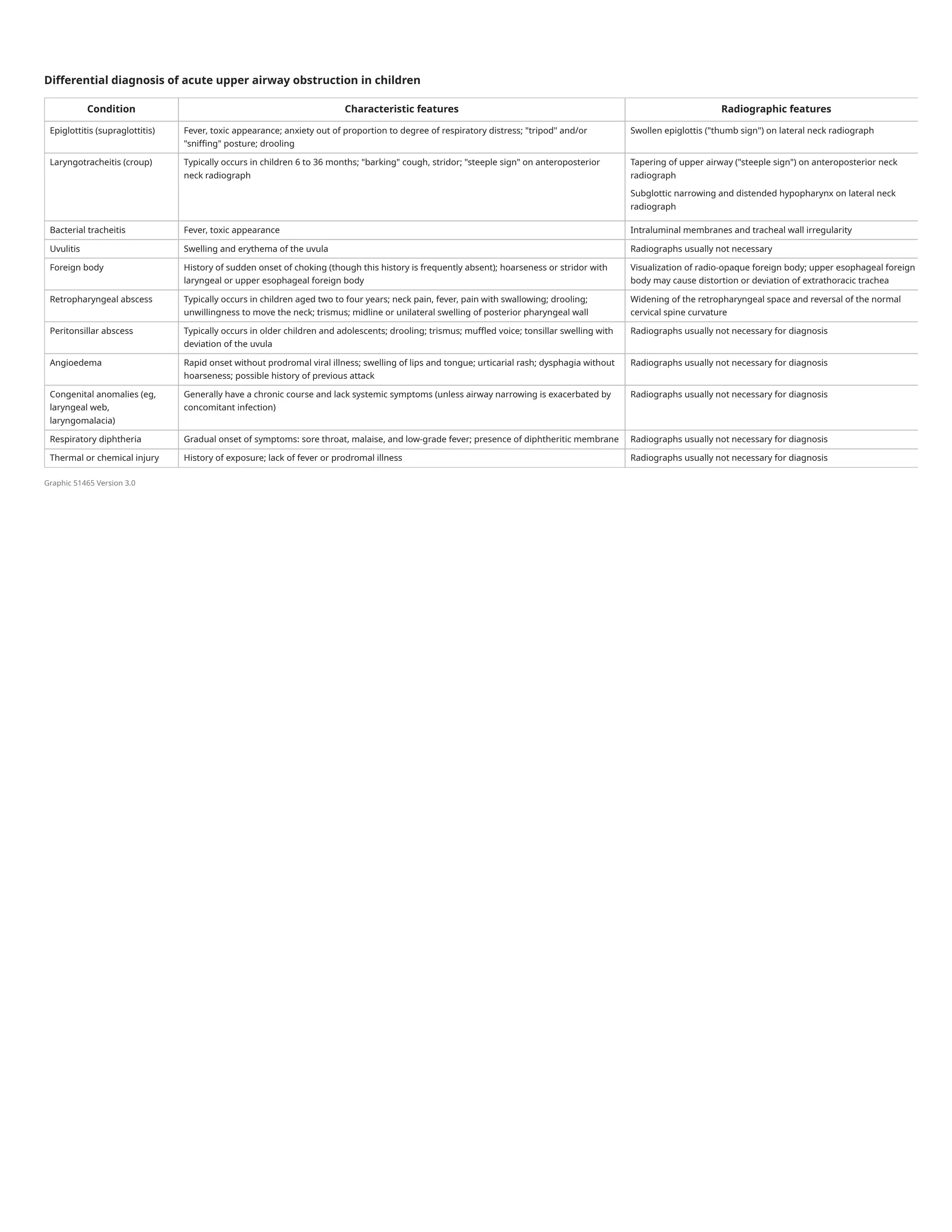
Differential diagnosis of acute upper airway obstruction in children
Condition Characteristic features Radiographic features
Epiglottitis (supraglottitis) Fever, toxic appearance; anxiety out of proportion to degree of respiratory distress; "tripod" and/or
"sniffing" posture; drooling
Swollen epiglottis ("thumb sign") on lateral neck radiograph
Laryngotracheitis (croup) Typically occurs in children 6 to 36 months; "barking" cough, stridor; "steeple sign" on anteroposterior
neck radiograph
Tapering of upper airway ("steeple sign") on anteroposterior neck
radiograph
Subglottic narrowing and distended hypopharynx on lateral neck
radiograph
Bacterial tracheitis Fever, toxic appearance Intraluminal membranes and tracheal wall irregularity
Uvulitis Swelling and erythema of the uvula Radiographs usually not necessary
Foreign body History of sudden onset of choking (though this history is frequently absent); hoarseness or stridor with
laryngeal or upper esophageal foreign body
Visualization of radio-opaque foreign body; upper esophageal foreign
body may cause distortion or deviation of extrathoracic trachea
Retropharyngeal abscess Typically occurs in children aged two to four years; neck pain, fever, pain with swallowing; drooling;
unwillingness to move the neck; trismus; midline or unilateral swelling of posterior pharyngeal wall
Widening of the retropharyngeal space and reversal of the normal
cervical spine curvature
Peritonsillar abscess Typically occurs in older children and adolescents; drooling; trismus; muffled voice; tonsillar swelling with
deviation of the uvula
Radiographs usually not necessary for diagnosis
Angioedema Rapid onset without prodromal viral illness; swelling of lips and tongue; urticarial rash; dysphagia without
hoarseness; possible history of previous attack
Radiographs usually not necessary for diagnosis
Congenital anomalies (eg,
laryngeal web,
laryngomalacia)
Generally have a chronic course and lack systemic symptoms (unless airway narrowing is exacerbated by
concomitant infection)
Radiographs usually not necessary for diagnosis
Respiratory diphtheria Gradual onset of symptoms: sore throat, malaise, and low-grade fever; presence of diphtheritic membrane Radiographs usually not necessary for diagnosis
Thermal or chemical injury History of exposure; lack of fever or prodromal illness Radiographs usually not necessary for diagnosis
Graphic 51465 Version 3.0
Initial airway management for patients with epiglottitis
RSI: rapid sequence intubation.
* Until the airway is secured in young children (6 years of age or younger), avoid intravenous access, unnecessary physical examination (oropharyngeal or laryngeal examination with a tongue blade or other
instruments), and diagnostic tests (eg, phlebotomy or epiglottic cultures) which may provoke anxiety or crying with abrupt airway obstruction.
¶ The approach to endotracheal intubation in older children with ≤50% obstruction is on a "case by case" basis depending on the full clinical picture, degree of estimated airway obstruction, and availability of
pediatric intensive care capability to safely observe unintubated children.
Δ Supraglottic airway use is contraindicated in patients with severe hypopharyngeal pathology, such as epiglottitis. Refer to UpToDate topics on rapid sequence intubation in children.
◊ Refer to UpToDate topics on needle and surgical cricothyrotomy.
§ Children with epiglottitis should receive ongoing care in a pediatric intensive care unit.
Graphic 112297 Version 4.0
Normal epiglottis and acute epiglottitis
(A) Normal epiglottis.
(B) Characteristic erythematous, edematous epiglottis of acute epiglottitis.
Courtesy of Glenn C Isaacson, MD, FAAP, FACS.
Graphic 74563 Version 3.0
Epiglottitis: Direct visualization
A swollen, cherry-red epiglottis with an endotracheal tube passing posteriorly.
Reproduced with permission from: Fleisher GR, MD, Ludwig W, MD, Baskin MN, MD. Atlas of Pediatric Emergency Medicine. Philadelphia: Lippincott Williams & Wilkins, 2004. Copyright ©2004 Lippincott Williams & Wilkins.
Graphic 59738 Version 2.0
Epiglottitis: Lateral neck radiograph
(A) A normal epiglottis on a lateral neck radiograph, with the structures illustrated in panel B. Epiglottitis is similarly depicted radiographically (C, D).
Reproduced with permission from: Fleisher GR, Ludwig W, Baskin MN. Atlas of Pediatric Emergency Medicine. Philadelphia: Lippincott Williams & Wilkins, 2004. Copyright © 2004 Lippincott Williams & Wilkins.
Graphic 67312 Version 5.0
Epiglottitis: Lateral radiograph
Lateral neck radiograph demonstrating swollen epiglottis (arrow) and aryepiglottic folds (asterisks) in a child with epiglottitis due to Haemophilus influenzae type b. The swollen epiglottis is often called a
"thumb sign."
Courtesy of Evelyn Y Anthony, MD, Wake Forest University School of Medicine.
Graphic 67878 Version 7.0
Diagnostic approach to upper airway obstruction in children
* The following findings suggest upper airway obstruction:
Inspiratory stridor, wheezing, or stertor
Suprasternal or supraclavicular retractions
Prolonged inspiratory phase
Oral mucosa or tongue swelling
Drooling
Dysphagia
Positions of comfort to help maintain airway patency in patients with severe obstruction:
"Sniffing" position (neck is mildly flexed and head is mildly extended)
Tripod position (leaning forward while bracing on the arms with neck hyperextended and chin thrust forward)
¶ Given the risk of sudden decompensation, patients with significant laryngotracheal injury, thermal or chemical epiglottitis, or symptomatic upper airway obstruction warrant emergency consultation with
an anesthesiologist or pediatric intensivist and an otolaryngologist to help secure the airway.
Graphic 54996 Version 4.0
Lateral neck radiograph of a child with croup
Lateral neck radiograph showing subglottic narrowing (arrow) and distended hypopharynx (arrowheads) consistent with acute laryngotracheitis.
Courtesy of Joe Black, Diagnostic Imaging, Texas Children's Hospital.
Graphic 64727 Version 4.0
Bacterial tracheitis: Lateral neck radiograph
Lateral neck radiograph showing intraluminal membranes and tracheal wall irregularity consistent with bacterial tracheitis.
Courtesy of R Paul Guillerman, MD, Department of Radiology, Baylor College of Medicine.
Graphic 80331 Version 6.0
Bacterial tracheitis: Tracheobronchoscopy
Note the adherent mucopurulent membranes within the trachea.
Courtesy of Glenn C Isaacson, MD, FAAP.
Graphic 55364 Version 5.0
Esophageal foreign body with tracheal compression
The picture shows a bronchoscopic view of the trachea in a child with narrowing due to compression caused by an impacted coin in the esophagus.
Courtesy of Glenn C Isaacson, MD, FAAP.
Graphic 131744 Version 1.0
Diphtheritic membrane
Membrana diftérica que se extiende desde la úvula hasta la pared faríngea y edema de cuello en una paciente femenina de 47 años.
Reproducido con autorización de: Kadirova R, Kartoglu HU, Strebel PM. Características clínicas y tratamiento de 676 casos de difteria hospitalizados, República Kirguisa, 1995. J Infect Dis 2000; 181:S110. Copyright © 2000 University of Chicago Press.
Gráfico 51058 Versión 3.0
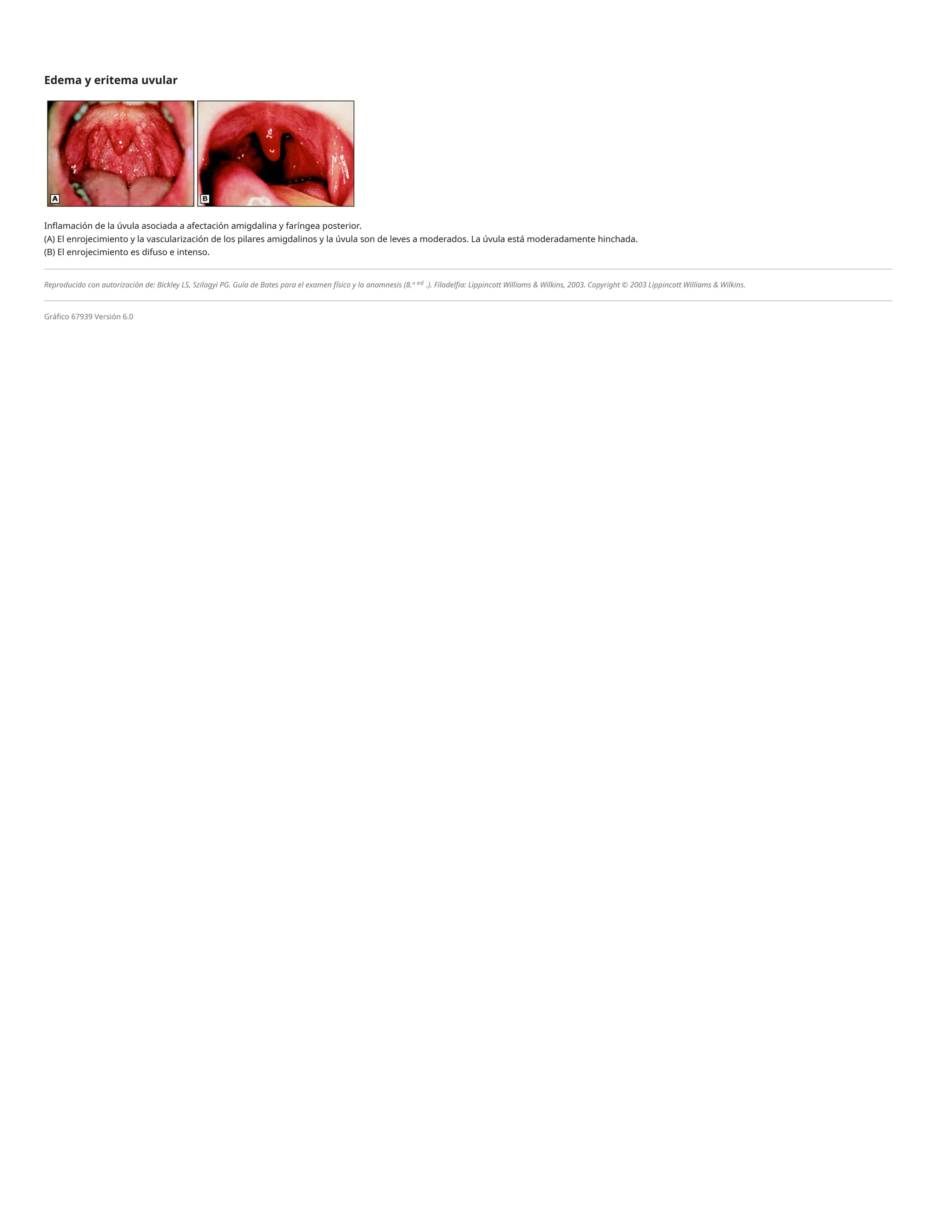
Edema y eritema uvular
Inflamación de la úvula asociada a afectación amigdalina y faríngea posterior.
(A) El enrojecimiento y la vascularización de los pilares amigdalinos y la úvula son de leves a moderados. La úvula está moderadamente hinchada.
(B) El enrojecimiento es difuso e intenso.
Reproducido con autorización de: Bickley LS, Szilagyi PG. Guía de Bates para el examen físico y la anamnesis (8.ª .). Filadelfia: Lippincott Williams & Wilkins, 2003. Copyright © 2003 Lippincott Williams & Wilkins.
Gráfico 67939 Versión 6.0
ed
Divulgaciones de los colaboradores
Charles R Woods, MD, MS No hay relaciones financieras relevantes con empresas no elegibles para divulgar. Glenn C Isaacson, MD, FAAP No hay relaciones financieras relevantes con empresas no elegibles
para divulgar. Mark I Neuman, MD, MPH No hay relaciones financieras relevantes con empresas no elegibles para divulgar. James F Wiley, II, MD, MPH No hay relaciones financieras relevantes con
empresas no elegibles para divulgar.
El grupo editorial revisa las declaraciones de los colaboradores para detectar posibles conflictos de intereses. Cuando se detectan, se abordan mediante un proceso de revisión de varios niveles y mediante la
exigencia de que se proporcionen referencias para respaldar el contenido. Todos los autores deben proporcionar contenido debidamente referenciado y cumplir con los estándares de evidencia de UpToDate.
Política de conflicto de intereses

Epiglotitis (supraglotitis) características clínicas y diagnóstico - UpToDate.pdf

  • 1.
    Reimpresión oficial deUpToDate www.uptodate.com © 2024 UpToDate, Inc. y/o sus filiales. Todos los derechos reservados. Epiglotitis (supraglotitis): características clínicas y diagnóstico INTRODUCCIÓN En este artículo se analizarán la patogenia, la etiología y las características clínicas de la epiglotitis (también llamada supraglotitis). El tratamiento y la prevención de la epiglotitis se analizan por separado. (Véase "Epiglotitis (supraglotitis): tratamiento" ). DEFINICIÓN La epiglotitis es la inflamación de la epiglotis y las estructuras supraglóticas adyacentes, principalmente debido a una infección [ 1 ]. Sin tratamiento, la epiglotitis puede progresar hasta convertirse en una obstrucción de las vías respiratorias potencialmente mortal. En la tabla ( tabla 1 ) se ofrece una descripción general rápida del reconocimiento y el tratamiento de la epiglotitis en niños . ANATOMÍA La epiglotis forma la pared posterior del espacio valécular que se inserta en la base de la lengua ( figura 1 ). Está conectada por ligamentos al cartílago tiroides y al hueso hioides y consiste en un cartílago delgado que está cubierto anteriormente por una capa epitelial escamosa estratificada. Esta capa escamosa también cubre el tercio superior de la superficie posterior, donde se fusiona con el epitelio respiratorio que se extiende hacia la laringe. El epitelio y la lámina propia debajo están firmemente adheridos en la superficie posterior (laríngea) y unidos de manera flexible en la superficie anterior (lingual). Esto crea un espacio potencial en la superficie lingual para que se acumule el líquido del edema. PATOGENESIA La epiglotitis es causada con mayor frecuencia por una infección, aunque la ingestión de cáusticos, la lesión térmica y el traumatismo local son etiologías no infecciosas importantes. La epiglotitis infecciosa es una celulitis de la epiglotis, los pliegues ariepiglóticos y otros tejidos adyacentes. Es el resultado de una bacteriemia y/o una invasión directa de la capa epitelial por el organismo patógeno [ 2,3 ]. La nasofaringe posterior es la fuente primaria de patógenos en la epiglotitis. El traumatismo microscópico de la superficie epitelial (p. ej., daño de la mucosa durante una infección viral o de alimentos durante la deglución) puede ser un factor predisponente. Con menor frecuencia, las afecciones no infecciosas causan quemaduras locales o equimosis de la epiglotis y las estructuras adyacentes. Tanto en la etiología infecciosa como en la no infecciosa, la hinchazón de la epiglotis es resultado del edema y la acumulación de células inflamatorias en el espacio potencial entre la capa epitelial escamosa y el cartílago epiglótico. La superficie lingual de la epiglotis y los tejidos periepiglóticos tienen abundantes redes de vasos linfáticos y sanguíneos que facilitan la propagación de la infección y la posterior respuesta inflamatoria. Una vez que comienza la infección, la hinchazón progresa rápidamente hasta afectar toda la laringe supraglótica (incluidos los pliegues ariepiglóticos y los aritenoides) [ 3,4 ]. Las regiones subglóticas generalmente no se ven afectadas; la hinchazón se detiene por el epitelio fuertemente unido a nivel de las cuerdas vocales. La hinchazón supraglótica reduce el calibre de las vías respiratorias superiores, lo que provoca un flujo de aire turbulento durante la inspiración (estridor) [ 3 ]. Otros mecanismos de obstrucción del flujo de aire pueden incluir la curvatura posterior e inferior de la epiglotis (que actúa como una válvula de bola, obstruyendo el flujo de aire durante la inspiración pero permitiendo la exhalación) y la aspiración de secreciones orofaríngeas [ 2,3 ]. La obstrucción de las vías respiratorias, que puede dar lugar a un paro cardiopulmonar, puede progresar rápidamente. Los signos de obstrucción grave de las vías respiratorias superiores (p. ej., estridor/estertor, retracción intercostal y supraesternal, taquipnea y cianosis) pueden estar ausentes hasta una fase avanzada del proceso patológico, cuando la obstrucción de las vías respiratorias es casi completa [ 5,6 ]. Se han notificado paros respiratorios extrahospitalarios debidos a una obstrucción aguda de las vías respiratorias, con resultado de muerte, en niños y adultos [ 7,8 ]. ETIOLOGÍA Infecciosa : la epiglotitis puede ser causada por varios patógenos bacterianos, virales y fúngicos ( tabla 2 ): ® autor: Dr. Charles R Woods, doctor en medicina y máster editores de sección: Dr. Glenn C. Isaacson, FAAP, Dr. Mark I. Neuman, máster en salud pública editor adjunto: Dr. James F. Wiley, II, máster en Salud Pública Todos los temas se actualizan a medida que hay nueva evidencia disponible y se completa nuestro proceso de revisión por pares . Revisión de literatura actualizada hasta: julio de 2024. Este tema se actualizó por última vez el 20 de diciembre de 2023. Patógenos bacterianos – Los patógenos bacterianos son la etiología infecciosa identificada con mayor frecuencia para la epiglotitis. A pesar de la rápida disminución de la epiglotitis infecciosa entre los niños inmunizados en la era posterior a la vacuna conjugada, Haemophilus influenzae tipo b (Hib) sigue siendo una etiología importante, principalmente en niños no vacunados o inmunizados de forma incompleta. Además, según pequeñas series de casos, todavía se puede aislar Hib en niños y adultos completamente inmunizados [ 9-13 ]. ● Además de Hib, los aislamientos bacterianos de pacientes inmunocompetentes con epiglotitis también incluyen: Staphylococcus aureus (incluidas las cepas resistentes a la meticilina [ 14-16 ]) • Streptococcus pneumoniae [ 16,17 ] • Streptococcus pyogenes y otros estreptococos [ 16,18,19 ] • Neisseria meningitidis [ 16,20,21 ] •
  • 2.
    La epiglotitis necrosantepuede complicar las infecciones de las vías respiratorias superiores y puede observarse en huéspedes inmunocomprometidos (incluidos los niños [ 28,38 ]) y, raramente, en huéspedes inmunocompetentes [ 38,39 ]. No infecciosa : la epiglotitis puede acompañar a la inhalación de humo (consulte “Lesiones por inhalación de calor, humo o irritantes químicos” ). Por lo demás, la epiglotitis no infecciosa suele ser poco frecuente. Los informes de casos y las series de casos describen la epiglotitis como complicación de las siguientes afecciones: EPIDEMIOLOGÍA Desde la introducción de las vacunas contra H. influenzae tipo b (Hib), la epiglotitis se ha convertido en una enfermedad observada principalmente en adultos con una incidencia anual estimada de 0,6 a 1,9 casos por 100.000 [ 16,55 ] y una edad media general de 45 a 49 años [ 56,57 ] (véase 'Infecciosas' más arriba). La epiglotitis se ha asociado con una serie de condiciones comórbidas, incluyendo hipertensión, diabetes mellitus, enfermedad renal terminal, abuso de sustancias y deficiencia inmunológica [ 58-64 ]. Además, el índice de masa corporal (IMC) >25, diabetes mellitus, neumonía concurrente y presencia de un quiste epiglótico al ingreso parecen ser factores asociados con una mayor gravedad de la epiglotitis [ 65 ]. La incidencia anual de epiglotitis entre los niños ha disminuido drásticamente desde la introducción de las vacunas Hib, con una incidencia anual estimada de Hib tan baja como dos casos por cada 10 millones de niños en poblaciones con altas tasas de inmunización [ 55,66-74 ]. Además, como Hib se ha convertido en una causa menos frecuente de epiglotitis en los niños, se ha vuelto más común entre los niños en edad escolar y adolescentes que entre los niños en edad preescolar (<5 años de edad) [ 9,75 ]. PRESENTACIÓN CLÍNICA Las características clínicas de la epiglotitis difieren según la edad, la gravedad y la etiología: Aguda (fiebre y estridor) : la aparición abrupta y la progresión rápida (en cuestión de horas) de la obstrucción de las vías respiratorias superiores son características de la epiglotitis bacteriana debida a Hib [ 6,76-80 ]. Esta presentación clásica de la epiglotitis por Hib es rara, pero aún puede ocurrir entre niños pequeños (<5 años de edad) en comunidades con un gran número de pacientes no inmunizados. Las presentaciones agudas de epiglotitis con compromiso abrupto de las vías respiratorias también pueden ocurrir con (ver 'Etiología' arriba): Los hallazgos clínicos de la epiglotitis aguda incluyen [ 6,58,81 ]: Pasteurella multocida [ 16 ] • En el caso de los huéspedes inmunodeprimidos, además de las etiologías bacterianas mencionadas anteriormente, los aislamientos incluyen Pseudomonas aeruginosa , Serratia spp, Enterobacter spp y flora anaeróbica. Patógenos virales : las infecciones virales pueden causar epiglotitis o permitir una sobreinfección bacteriana en raras ocasiones. Los aislamientos notificados en pacientes con epiglotitis incluyen: ● Gripe, tipo a [ 22 ] • Gripe, tipo b [ 23 ] • Virus del herpes simple, tipos 1 y 2 [ 24-26 ] • Virus parainfluenza, tipo 3 [ 23 ] • Virus de Epstein-Barr [ 27 ] • Virus de inmunodeficiencia humana (VIH) [ 28 ] • SARS-CoV-2 [ 29-33 ] • Patógenos fúngicos – Las infecciones fúngicas ( especies de Candida e Histoplasma capsulatum ) como causa de epiglotitis son raras y parecen ocurrir principalmente en pacientes inmunodeprimidos [ 34-36 ]. Se ha descrito un caso probable de epiglotitis por Candida en un niño aparentemente sano [ 37 ]. ● Traumatismos locales de las vías respiratorias como: ● Lesión térmica por: • Ingestión de bebidas o alimentos calientes [ 40-43 ] - Uso de cigarrillos electrónicos [ 44 ] o inhalación de objetos calientes durante el consumo de drogas ilícitas como el crack o la cocaína [ 45 ] - Traumatismo directo sobre la epiglotis [ 46,47 ] • Ingestión o inhalación de cáusticos [ 47,48 ] • Enfermedad linfoproliferativa o enfermedad de injerto contra huésped después del trasplante de médula ósea o de órgano sólido [ 49-51 ] ● Trastornos granulomatosos crónicos que incluyen poliangeítis, sarcoidosis, lupus eritematoso sistémico, policondritis recidivante y enfermedad relacionada con la inmunoglobulina G4 (IgG4) [ 52,53 ] ● La afectación granulomatosa de las vías respiratorias supraglóticas, con características obstructivas progresivas de las vías respiratorias durante varios meses, se ha descrito como la manifestación evidente inicial de la enfermedad de Crohn en un informe de caso [ 54 ]. Los niños pequeños (<5 años de edad) con epiglotitis por H. influenzae tipo b (Hib) pueden presentar dificultad respiratoria, ansiedad y la característica postura de "trípode" o "olfateo" ( imagen 1 y imagen 2 ) en la que asumen una posición sentada con el tronco inclinado hacia adelante, el cuello hiperextendido y el mentón empujado hacia adelante en un esfuerzo por maximizar el diámetro de la vía aérea obstruida [ 6 ]. Pueden ser reacios a acostarse [ 2 ]. Sin embargo, la presentación puede ser sutil ( imagen 3 ). A menudo hay babeo. La tos generalmente está ausente. ● Los niños mayores, adolescentes y adultos con epiglotitis infecciosa o no infecciosa pueden presentar dolor de garganta intenso, disfagia y babeo; un examen orofaríngeo relativamente normal y dificultad respiratoria mínima. ● Infecciones por otros patógenos ● Lesión térmica de las vías respiratorias superiores (por ejemplo, inhalación de humo, ingestión de bebidas calientes o inhalación de objetos calientes durante el consumo de drogas ilícitas) ● Ingestión o inhalación de cáusticos ●
  • 3.
    Los pacientes conepiglotitis y obstrucción completa inminente de las vías respiratorias también pueden adoptar la postura del "trípode" ( imagen 1 ), una posición sentada con el tronco inclinado hacia adelante, el cuello hiperextendido y el mentón empujado hacia adelante en un esfuerzo por maximizar el diámetro de las vías respiratorias obstruidas. Los niños con epiglotitis generalmente no presentan ronquera ni tos, que son más características del crup. (Ver "Crup: características clínicas, evaluación y diagnóstico", sección sobre 'Presentación clínica' .) La epiglotitis necrotizante ocurre raramente y se ha descrito en niños inmunocomprometidos e inmunocompetentes con una variedad de etiologías microbianas asociadas [ 82 ]. Subaguda (dolor de garganta intenso) : entre las poblaciones inmunizadas, la epiglotitis infecciosa es causada por otros patógenos bacterianos orofaríngeos y nasofaríngeos, incluidos S. pneumoniae , S. pyogenes y otros estreptococos, S. aureus (incluidas las cepas resistentes a la meticilina) y H. influenzae no tipificable ; la epiglotitis por Hib es mucho menos común. Además, se describen casos raros de epiglotitis viral y fúngica. (Véase "Infecciosa" más arriba). Como resultado, predomina una presentación subaguda de epiglotitis infecciosa que consiste en [ 5,55,58,83,84 ]: El estridor se presenta en una minoría de estos pacientes. Además, la obstrucción repentina de las vías respiratorias es mucho menos común, pero sigue siendo una posibilidad [ 56,85 ]. Por lo tanto, la epiglotitis se ha convertido en una consideración importante en niños mayores, adolescentes y adultos que buscan atención médica por faringitis infecciosa aguda. (Véase "Evaluación de la faringitis aguda en adultos" y "Evaluación del dolor de garganta en niños" ). Las causas no infecciosas poco frecuentes de epiglotitis subaguda, que se observan predominantemente en pacientes inmunodeprimidos, incluyen la enfermedad linfoproliferativa, la enfermedad de injerto contra huésped, la enfermedad granulomatosa crónica y la epiglotitis necrosante (véase “No infecciosas” más arriba) . Manejo de la vía aérea For patients with signs of impending complete airway obstruction, securing the airway is the focus of treatment as described in the rapid overview ( table 1). In these patients, airway management necessarily precedes diagnostic evaluation [3]. (See "Epiglottitis (supraglottitis): Management" and "Technique of emergency endotracheal intubation in children" and "Overview of advanced airway management in adults for emergency medicine and critical care".) EXAMINATION The approach to diagnosing epiglottitis, including which patients should undergo attempts at direct visualization, depend upon the patient's presentation and the clinician's suspicion for epiglottitis ( algorithm 1). Visualization of the epiglottis confirms the clinical diagnosis [13]; a soft-tissue lateral radiograph of the neck is an alternative approach that has reasonable sensitivity and specificity. (See 'Imaging' below.) Signs of impending airway obstruction — There are rare reports of cardiorespiratory arrest in children with acute presentations of epiglottitis during attempts to visualize the epiglottis [86]. These arrests have been attributed to functional airway obstruction (resulting from increased respiratory effort secondary to increased anxiety), aggravation of airway obstruction caused by supine positioning, and/or laryngospasm. Presumably, the patients who have arrested after visualization have had pre-existing, nearly complete obstruction. These patients would typically have fairly definitive signs of epiglottitis (eg, severe respiratory distress, anxiety, "sniffing" position ( picture 2); signs of upper airway involvement, particularly stridor, drooling, or "tripod" posture ( picture 1); and no cough). (See 'Acute (fever and stridor)' above.) Emergency involvement of airway experts (eg, otolaryngologists and anesthesiologists with pediatric expertise) to evaluate and to secure the airway should occur prior to any attempts at visualization in these patients. (See 'Diagnostic confirmation' below.) Severe sore throat — In patients with sore throat and drooling in whom epiglottitis is a possibility but for whom other diagnoses are also likely ( table 3), cautious examination of the throat is appropriate to determine the best management. These patients should have [87]: The patient should be permitted to take a position of comfort in the upright position. Younger children may be held by the caregiver to reduce anxiety that could provoke increased respiratory distress. If the child develops increased respiratory distress during the attempt to examine the throat, this effort should be discontinued. Use of a head lamp permits better visualization of oropharyngeal structures and facilitates more precise and gentler placement of the tongue blade during examination. On examination of the oral cavity and oropharynx in patients with epiglottitis, pooled secretions may be noted [3]. Occasionally, a swollen, red epiglottitis may be visible. The laryngotracheal complex may be tender on neck palpation, particularly in the region of the hyoid bone [88-90]. Aspecto tóxico y malestar (agitación, inquietud, irritabilidad ( imagen 2 )) ● Aparición repentina de fiebre alta (entre 38,8 y 40,0 °C) ● Estridor ● Babeando ● Cambio en la voz (voz apagada, como de "papa caliente") ● Dolor de garganta intenso y disfagia. ● Dolor de garganta progresivo ● Fiebre baja ● Voz apagada ("patata caliente") o ronca ● Dificultad para tragar ● Babeando ● Normal mental status ● Absent or minimal of stridor ● No or minimal increase in symptoms during agitation or exertion ● No cyanosis ●
  • 4.
    However, the oropharyngealexamination is normal in the majority of patients with epiglottitis [5,83,91]. When oropharyngeal examination fails to permit visualization of the epiglottis, clinicians may proceed to either plain radiography or laryngoscopy. (See 'Diagnostic confirmation' below.) Nasolaryngoscopy, plain radiography, or visualization during direct laryngoscopy under general anesthesia in the operating room is frequently necessary to confirm the diagnosis. (See 'Diagnosis' below.) DIAGNOSIS Clinical suspicion — Epiglottitis typically presents in one of two ways: Diagnostic confirmation — The diagnostic approach to patients with suspected epiglottitis varies based upon clinical findings ( algorithm 1). Visualization of the epiglottis — Maintenance of the airway is the mainstay of treatment in patients with suspected epiglottitis. In patients with signs of total or near-total upper airway obstruction, airway control necessarily precedes diagnostic evaluation ( algorithm 2), and confirmation is made by direct visualization. (See "Epiglottitis (supraglottitis): Management".) Visualization of the epiglottis without performing endotracheal intubation should only be attempted in a setting where the airway can be secured immediately if necessary (eg, the emergency department, intensive care unit, or operating room) and, whenever possible, by the appropriate airway experts (eg, anesthesiology and otolaryngologist or airway expert with similar expertise). Methods include fiberoptic nasolaryngoscopy and/or indirect laryngoscopy with a 70-degree endoscope [87,92,93]. Examination findings that confirm epiglottitis include inflammation and edema of the supraglottic structures (epiglottis, aryepiglottic folds, and arytenoid cartilages) ( picture 4 and picture 5) [5]. The false vocal cords may also be involved [83]. Estimated airway obstruction of ≥50 percent is an indication for endotracheal intubation or establishment of a surgical airway. Imaging Plain radiographs — Soft-tissue lateral neck radiographs can confirm the diagnosis of epiglottitis but are not necessary in many cases in which the likelihood of epiglottitis is sufficiently low (eg, immunized children with a hoarse voice and characteristic cough of croup), such that no imaging is indicated, or high, in which case direct visualization during airway management in the operating suite is preferred. Radiographs are most helpful in the evaluation of patients in whom epiglottitis is a possibility, but other conditions are more likely ( table 3) [94] (see 'Differential diagnosis' below). Diagnosis may also be confirmed by radiography if direct visualization appears unsafe or is unsuccessful. Radiographs should be deferred if they increase the patient's level of anxiety or will delay definitive airway management [58,72]. If it is necessary for the patient with more than a low likelihood of epiglottitis to be transported to the radiology department (ie, if portable radiographs cannot be obtained), the patient must be accompanied by personnel skilled with advanced airway management and with proper equipment and medications. (See 'Visualization of the epiglottis' above.) Radiographic features of epiglottitis include [2,95]: Based upon case series in adults, lateral neck films are abnormal (generally showing the classic "thumb sign") in 77 to 88 percent of patients with epiglottitis [13,59]. False-negative radiographic findings appear to be more common when patients have received prior oral antimicrobial therapy [97]. If radiographs are negative or equivocal, but clinical suspicion for epiglottitis remains high, then the provider should proceed with visualization during airway management (patients with signs of severe upper airway obstruction) or fiberoptic nasolaryngoscopy and/or indirect laryngoscopy in a setting where the airway can be secured immediately. (See 'Visualization of the epiglottis' above.) Ultrasonography — Bedside ultrasound evaluation of the epiglottis in adults has been described, but its role in diagnosing epiglottitis is unclear [98,99]. The ultrasonographic appearance of epiglottitis in adults has been described as an "alphabet P sign" formed by an acoustic shadow of the swollen epiglottis and hyoid bone at the level of the thyrohyoid membrane when imaged in longitudinal orientation [98]. An evaluation of ultrasound in 15 adults with epiglottitis and 15 healthy controls found that an increased anteroposterior diameter Progressive, severe sore throat over several days – Epiglottitis should be suspected in older children, adolescents, and adults in whom the severity of sore throat is out of proportion to the findings on oropharyngeal examination, particularly if significant dysphagia and drooling are present [5]. These patients are appropriate candidates for confirmation by direct visualization of the upper airway or soft-tissue radiograph of the lateral neck. ● Abrupt onset of fever, stridor, and respiratory distress over 24 hours – Acute epiglottitis with severe airway obstruction should be suspected in patients, especially those who are un- or under-immunized against H. influenzae type b (Hib), who present with the characteristic clinical features including: ● "Tripod" position ( picture 1) • Anxiety ( picture 2) • Sore throat • Stridor • Drooling • Dysphagia • Severe respiratory distress • Because of the potential for rapid progression to complete airway obstruction, the threshold for suspicion of epiglottitis should be low. These patients should undergo definitive airway management. Direct visualization should be avoided. Soft-tissue radiograph of the lateral neck (portable if possible) may be helpful, but necessary personnel and equipment to manage an acute airway event must remain with the patient at all times during the imaging process. Furthermore, imaging should not delay definitive airway management. An enlarged epiglottis protruding from the anterior wall of the hypopharynx (the "thumb sign", ( image 1 and image 2)). In adults with epiglottitis, the width of the epiglottis is usually >8 mm [96]. ● Loss of the vallecular air space, a finding that may be underappreciated. ● Thickened aryepiglottic folds ( image 2). In adults with epiglottitis, the width of the aryepiglottic folds is usually >7 mm [96]. ● Distended hypopharynx (nonspecific). ● Straightening or reversal of the normal cervical lordosis (nonspecific). ●
  • 5.
    of the epiglottisat either lateral edge may also discriminate between those with and without epiglottitis. The lower limit of the diameter in adults with epiglottitis was 3.6 versus 3.2 mm upper limit in the controls [100]. No pediatric experience with ultrasound has as yet been reported. Laboratory studies — Laboratory studies should not be performed in young children with imminent complete airway obstruction until the airway is secured because agitation caused by pain may worsen respiratory distress and precipitate sudden respiratory arrest. In older children, adolescents, and adults with suspected epiglottitis, laboratory evaluation includes: Most patients with epiglottitis have an elevated white blood cell count [5], but this finding is nonspecific. The yield of blood and epiglottal cultures is discussed below. (See 'Microbiology' below.) The immunologic evaluation for a child who develops Hib epiglottitis or pneumococcal epiglottitis despite having been immunized is discussed separately. (See "Epiglottitis (supraglottitis): Management", section on 'Additional evaluation'.) Microbiology — The etiologic diagnosis is sometimes made by culture of a pathogenic organism from the blood or the surface of the epiglottis. Blood and epiglottic cultures should be obtained after the airway is secure [6,88]. Swabbing the epiglottis is difficult, potentially dangerous, and contraindicated in patients who are not intubated [72,101]. Epiglottal cultures are positive in 33 to 75 percent of patients with epiglottitis [83,84,101,102]. Blood cultures are positive in approximately 70 percent of children with epiglottitis caused by Hib [103]. In children immunized against Hib, the yield of blood cultures is likely lower. In adult case series, the yield of blood cultures ranges from 0 to 17 percent [5]. DIFFERENTIAL DIAGNOSIS Epiglottitis is an important consideration in older children, adolescents, and adults seeking care for sore throat as discussed separately. (See "Evaluation of acute pharyngitis in adults" and "Evaluation of sore throat in children".) The diagnostic approach ( algorithm 3) and emergency evaluation of acute upper airway obstruction in children are discussed separately. (See "Emergency evaluation of acute upper airway obstruction in children".) In young children (<5 years of age), the differential diagnosis of epiglottitis includes other causes of acute upper airway obstruction ( table 3): Complete blood count with differential ● Blood culture ● In intubated patients, epiglottal culture ● Croup – Epiglottitis is distinguished from croup by the absence of "barking" cough and the presence of anxiety and drooling. Children with croup generally are comfortable in the supine position and have a normal-appearing epiglottis, when visualized, on examination. If obtained, lateral neck radiographs in patients with croup may demonstrate distention of the hypopharynx during inspiration, subglottic haziness, and a normal epiglottis ( image 3). (See "Croup: Clinical features, evaluation, and diagnosis", section on 'Clinical presentation'.) ● Bacterial tracheitis – Bacterial tracheitis may be a complication of viral laryngotracheitis (croup) or a primary bacterial infection. Primary bacterial tracheitis may present with acute onset of upper airway obstruction, fever, and toxic appearance, similar to epiglottitis. However, radiographs may demonstrate intraluminal membranes and irregularities of the tracheal wall, as well as a normal epiglottis and supraglottic region ( image 4). Direct tracheoscopy may be necessary for diagnosis ( picture 6). (See "Bacterial tracheitis in children: Clinical features and diagnosis", section on 'Clinical features'.) ● Peritonsillar or retropharyngeal infection – Children with peritonsillar or retropharyngeal cellulitis/abscess, or other painful infections of the oropharynx, may present with drooling and neck extension [104]. Children with these infections usually are not as toxic appearing or anxious as those with acute epiglottitis. Peritonsillar cellulitis or abscess is readily identified on inspection of the oropharynx. For patients with a retropharyngeal abscess, a soft-tissue lateral neck radiograph may be helpful in confirming or excluding the presence of epiglottitis. (See "Peritonsillar cellulitis and abscess" and "Retropharyngeal infections in children".) ● Foreign bodies – Foreign bodies in the larynx or trachea can cause complete or partial airway obstruction that requires immediate treatment. Foreign bodies lodged in the upper esophagus can cause tissue edema that compresses the airway, causing partial airway obstruction ( picture 7). Symptoms are likely to have an abrupt onset, and fever is absent. (See "Emergency evaluation of acute upper airway obstruction in children", section on 'Foreign body' and "Foreign bodies of the esophagus and gastrointestinal tract in children".) ● Angioedema (anaphylaxis or hereditary) – Allergic reaction or acute angioneurotic edema has rapid onset without antecedent cold symptoms or fever. The primary manifestations are swelling of the lips and tongue, urticarial rash, dysphagia without hoarseness, and sometimes inspiratory stridor [105,106]. There may be a history of allergy or a previous attack. (See "Anaphylaxis: Emergency treatment".) ● Congenital anomalies and laryngeal papillomas – Congenital anomalies of the upper airway and laryngeal papillomas sometimes cause symptoms similar to those of epiglottitis. However, these conditions have a chronic course and generally do not cause fever (unless symptoms are due to exacerbation of airway narrowing due to a concomitant viral infection). (See "Congenital anomalies of the larynx".) ● Diphtheria – The clinical presentation of diphtheria can be similar to that of epiglottitis. The onset of symptoms is typically gradual. Sore throat, malaise, and low-grade fever are the most common presenting symptoms. A diphtheritic membrane (gray and sharply demarcated, ( picture 8)) may be present. Diphtheria is exceedingly rare in countries with high rates of immunization for diphtheria, tetanus, and pertussis. (See "Epidemiology and pathophysiology of diphtheria" and "Group A streptococcal tonsillopharyngitis in children and adolescents: Clinical features and diagnosis", section on 'Other bacterial infections'.) ● Other causes of epiglottic enlargement – Other causes of epiglottic enlargement, such as neck radiation therapy, trauma, or thermal injury, generally can be elucidated by history [40,107,108]. Laryngopyocele, an infectious complication of laryngoceles (which are uncommon, abnormal air sacs in the larynx), also may mimic epiglottitis both in clinical presentation and on lateral neck radiographs [109]. ● Uvulitis – Patients with epiglottitis may also have uvulitis ( picture 9), although uvulitis can be caused by other oropharyngeal infections such as streptococcal pharyngitis [110-112]. ●
  • 6.
    SUMMARY AND RECOMMENDATIONS Useof UpToDate is subject to the Terms of Use. REFERENCES 1. Klein MR. Infections of the Oropharynx. Emerg Med Clin North Am 2019; 37:69. 2. Tovar Padua, LJ and Cherry JD. Croup (laryngitis, laryngotracheitis, spasmodic croup, laryngotracheobronchitis, bacterial tracheitis, and laryngotracheobronchopneumonitis) and epiglott itis (supraglottitis). In: Feigin and Cherry's Textbook of Pediatric Infectious Diseases, 8th edition, Cherry JD, Harrison GJ, Kaplan SL, Steinbach WJ, Hotez PJ (Eds), Elsevier, Philadelphia 201 9. Vol 1, p.175. 3. Glomb NWS and Cruz AT. Infectious disease emergencies. In: Fleisher and Ludwig's Textbook of Pediatric Emergency Medicine, 7th ed, Shaw KN, Bachur RG (Eds), Wolters Kluwer, Philad elphia 2016. 4. Sato S, Kuratomi Y, Inokuchi A. Pathological characteristics of the epiglottis relevant to acute epiglottitis. Auris Nasus Larynx 2012; 39:507. 5. Glynn F, Fenton JE. Diagnosis and management of supraglottitis (epiglottitis). Curr Infect Dis Rep 2008; 10:200. 6. Stroud RH, Friedman NR. An update on inflammatory disorders of the pediatric airway: epiglottitis, croup, and tracheitis. Am J Otolaryngol 2001; 22:268. 7. Schröder AS, Edler C, Sperhake JP. Sudden death from acute epiglottitis in a toddler. Forensic Sci Med Pathol 2018; 14:555. 8. Morton E, Prahlow JA. Death related to epiglottitis. Forensic Sci Med Pathol 2020; 16:177. 9. Shah RK, Roberson DW, Jones DT. Epiglottitis in the Hemophilus influenzae type B vaccine era: changing trends. Laryngoscope 2004; 114:557. 10. Tanner K, Fitzsimmons G, Carrol ED, et al. Haemophilus influenzae type b epiglottitis as a cause of acute upper airways obstruction in children. BMJ 2002; 325:1099. 11. Devlin B, Golchin K, Adair R. Paediatric airway emergencies in Northern Ireland, 1990-2003. J Laryngol Otol 2007; 121:659. 12. González Valdepeña H, Wald ER, Rose E, et al. Epiglottitis and Haemophilus influenzae immunization: the Pittsburgh experience--a five-year review. Pediatrics 1995; 96:424. 13. Solomon P, Weisbrod M, Irish JC, Gullane PJ. Adult epiglottitis: the Toronto Hospital experience. J Otolaryngol 1998; 27:332. 14. Somenek M, Le M, Walner DL. Membranous laryngitis in a child. Int J Pediatr Otorhinolaryngol 2010; 74:704. 15. Mazenq J, Retornaz K, Vialet R, Dubus JC. [Acute epiglottitis due to group A β-hemolytic streptococcus in a child]. Arch Pediatr 2015; 22:613. 16. Briem B, Thorvardsson O, Petersen H. Acute epiglottitis in Iceland 1983-2005. Auris Nasus Larynx 2009; 36:46. 17. Isakson M, Hugosson S. Acute epiglottitis: epidemiology and Streptococcus pneumoniae serotype distribution in adults. J Laryngol Otol 2011; 125:390. 18. Sivakumar S, Latifi SQ. Varicella with stridor: think group A streptococcal epiglottitis. J Paediatr Child Health 2008; 44:149. 19. Chroboczek T, Cour M, Hernu R, et al. Long-term outcome of critically ill adult patients with acute epiglottitis. PLoS One 2015; 10:e0125736. 20. Beltrami D, Guilcher P, Longchamp D, Crisinel PA. Meningococcal serogroup W135 epiglottitis in an adolescent patient. BMJ Case Rep 2018; 2018. Definition – Epiglottitis (supraglottitis) refers to inflammation of the epiglottis and adjacent supraglottic structures. Without treatment, epiglottitis can progress to life-threatening airway obstruction. A rapid overview of the recognition and management of epiglottitis is provided in the table ( table 1). (See 'Definition' above.) ● Etiology – Since the introduction of vaccines against H. influenzae type b (Hib), epiglottitis has mostly become an adult disease that is caused by oro- and nasopharyngeal bacterial pathogens other than Hib ( table 2). Immunocompromised patients may develop epiglottitis caused by opportunistic microorganisms. Hib epiglottitis remains a potential etiology in unvaccinated or incompletely immunized children. (See 'Etiology' above.) ● Clinical presentation: ● Acute – Young children with Hib epiglottitis present with fever, stridor, drooling, respiratory distress, anxiety, and the characteristic "sniffing" posture ( picture 2), but the presentation may be more subtle ( picture 3). (See 'Acute (fever and stridor)' above.) • Subacute – Older children, adolescents, and adults may present with a severe sore throat, dysphagia, drooling, and anterior neck pain but a relatively normal oropharyngeal examination and mild respiratory distress. (See 'Subacute (severe sore throat)' above.) • Diagnostic approach – The diagnostic approach for patients with suspected epiglottitis is provided in the algorithm ( algorithm 1). For the patient with abrupt onset of fever, stridor, and respiratory distress, airway management is the primary focus ( algorithm 2); the clinician should obtain emergency assistance from airway specialists (eg, anesthesiologist/critical care specialist and an otolaryngologist) when possible. Visualization of the epiglottis during definitive airway management confirms the diagnosis. (See 'Clinical suspicion' above and "Epiglottitis (supraglottitis): Management", section on 'Approach to airway management'.) ● For the patient with sore throat and drooling in whom epiglottitis is a possibility but for whom other diagnoses are also likely ( table 3), cautious examination of the throat is appropriate. Pooled secretions may be noted and, occasionally, a swollen, red epiglottitis may be visible. If the swollen epiglottis is not seen on routine oropharyngeal examination, diagnosis of epiglottitis is confirmed by (see 'Visualization of the epiglottis' above and 'Imaging' above): Fiberoptic nasolaryngoscopy or indirect laryngoscopy – Swelling and redness of the supraglottic structures (epiglottis, aryepiglottic folds, and arytenoid cartilages) ( picture 4 and picture 5) on fiberoptic nasolaryngoscopy and/or indirect laryngoscopy with a 70-degree endoscope. Visualization of the epiglottis should occur in a setting where the airway can be secured immediately if necessary. (See 'Diagnosis' above and 'Examination' above.) • Plain radiographs – In cases when visualization is not performed, soft-tissue lateral neck plain radiographs may be diagnostic (generally showing the classic "thumb sign" ( image 1 and image 2)). (See 'Plain radiographs' above.) • Plain radiography is most helpful in the evaluation of patients in whom epiglottitis is a possibility, but other conditions are more likely ( table 3) (see 'Differential diagnosis' above). Diagnosis may also be confirmed by radiography if direct visualization appears unsafe or is unsuccessful. (See 'Imaging' above and 'Differential diagnosis' above.) Although plain radiography can confirm the diagnosis of epiglottitis, it is not necessary in many cases in which the likelihood of epiglottitis is sufficiently low (eg, immunized children with a hoarse voice and characteristic cough of croup), such that no imaging is indicated, or high, in which case direct visualization during airway management in the operating suite is preferred.
  • 7.
    21. Zarbock SD,DePriest KL, Koepp BM. A case report of serotype W135 Neisseria meningitidis epiglottitis in the United States and review of twelve adult cases of meningococcal epiglottitis. IDCases 2018; 14:e00466. 22. OʼBryant SC, Lewis JD, Cruz AT, Mothner BA. Influenza A-Associated Epiglottitis and Compensatory Pursed Lip Breathing in an Infant. Pediatr Emerg Care 2019; 35:e213. 23. Grattan-Smith T, Forer M, Kilham H, Gillis J. Viral supraglottitis. J Pediatr 1987; 110:434. 24. Musharrafieh UM, Araj GF, Fuleihan NS. Viral supraglottitis in an adult: a case presentation and literature update. J Infect 1999; 39:157. 25. Bengualid V, Keesari S, Kandah V, et al. Supraglottitis due to herpes simplex virus type 1 in an adult. Clin Infect Dis 1996; 22:382. 26. Nadel S, Offit PA, Hodinka RL, et al. Upper airway obstruction in association with perinatally acquired herpes simplex virus infection. J Pediatr 1992; 120:127. 27. Slijepcevic A, Strigenz D, Wiet G, Elmaraghy CA. EBV epiglottitis: Primary supraglottic viral infection in a pediatric immunocompetent host. Int J Pediatr Otorhinolaryngol 2015; 79:1782. 28. Tebruegge M, Connell T, Kong K, et al. Necrotizing epiglottitis in an infant: an unusual first presentation of human immunodeficiency virus infection. Pediatr Infect Dis J 2009; 28:164. 29. Fondaw A, Arshad M, Batool S, et al. COVID-19 infection presenting with acute epiglottitis. J Surg Case Rep 2020; 2020:rjaa280. 30. Cordial P, Le T, Neuenschwander J. Acute epiglottitis in a COVID-19 positive patient. Am J Emerg Med 2022; 51:427.e1. 31. Smith C, Mobarakai O, Sahra S, et al. Case report: Epiglottitis in the setting of COVID-19. IDCases 2021; 24:e01116. 32. Emberey J, Velala SS, Marshall B, et al. Acute Epiglottitis Due to COVID-19 Infection. Eur J Case Rep Intern Med 2021; 8:002280. 33. Renner A, Lamminmäki S, Ilmarinen T, et al. Acute epiglottitis after COVID-19 infection. Clin Case Rep 2021; 9:e04419. 34. Walsh TJ, Gray WC. Candida epiglottitis in immunocompromised patients. Chest 1987; 91:482. 35. Myer CM 3rd. Candida epiglottitis: clinical implications. Am J Otolaryngol 1997; 18:428. 36. Abou Zahr A, Saad Aldin E, Yunyongying P. Histoplasma epiglottitis in a patient with Crohn's disease maintained on infliximab, prednisone, and azathioprine. Int J Infect Dis 2013; 17:e650. 37. Beil EP, Sole DP. A Rare Case of Candida Epiglottitis in an Immunocompetent Child. Pediatr Emerg Care 2019; 35:e26. 38. Richardson C, Muthukrishnan PT, Hamill C, et al. Necrotizing epiglottitis treated with early surgical debridement: A case report. Am J Otolaryngol 2018; 39:785. 39. Ahmed JJ, Constable JD, Kamani T, De M. Multipathogenic necrotising supraglottitis in an immunocompetent patient. BMJ Case Rep 2017; 2017. 40. Harjacek M, Kornberg AE, Yates EW, Montgomery P. Thermal epiglottitis after swallowing hot tea. Pediatr Emerg Care 1992; 8:342. 41. Kulick RM, Selbst SM, Baker MD, Woodward GA. Thermal epiglottitis after swallowing hot beverages. Pediatrics 1988; 81:441. 42. Lai SH, Wong KS, Liao SL, Chou YH. Non-infectious epiglottitis in children: two cases report. Int J Pediatr Otorhinolaryngol 2000; 55:57. 43. Inaguma Y, Matsui S, Kusumoto M, et al. Thermal epiglottitis: Acute airway obstruction caused by ingestion of hot food. Pediatr Int 2019; 61:927. 44. Bozzella MJ, Magyar M, DeBiasi RL, Ferrer K. Epiglottitis Associated With Intermittent E-cigarette Use: The Vagaries of Vaping Toxicity. Pediatrics 2020; 145. 45. Mayo-Smith MF, Spinale J. Thermal epiglottitis in adults: a new complication of illicit drug use. J Emerg Med 1997; 15:483. 46. Kavanagh KR, Batti JS. Traumatic epiglottitis after foreign body ingestion. Int J Pediatr Otorhinolaryngol 2008; 72:901. 47. Parsons DS, Smith RB, Mair EA, Dlabal LJ. Unique case presentations of acute epiglottic swelling and a protocol for acute airway compromise. Laryngoscope 1996; 106:1287. 48. Clausen JO, Nielsen TL, Fogh A. Admission to Danish hospitals after suspected ingestion of corrosives. A nationwide survey (1984-1988) comprising children aged 0-14 years. Dan Med Bull 1994; 41:234. 49. Rosbe KW, Perez-Atayde AR, Roberson DW, Kenna M. Pathology forum: quiz case 1. Diagnosis: posttransplant lymphoproliferative disease (PTLD) of the epiglottis. Arch Otolaryngol Head Neck Surg 2000; 126:1153; discussion 1157. 50. de Diego JI, Prim MP, Hardisson D, et al. Graft-vs-host disease as a cause of enlargement of the epiglottis in an immunocompromised child. Arch Otolaryngol Head Neck Surg 2001; 127:439. 51. Duignan S, O'Marcaigh A, Russell J, et al. Post-transplant lymphoproliferative disorder presenting as supraglottitis following pediatric heart transplantation treated with EBV-specific cytotoxic T-lymphocytes. J Heart Lung Transplant 2022; 41:708. 52. Aono Y, Imokawa S, Uto T, et al. Granulomatosis with polyangiitis involving the epiglottis. Respirol Case Rep 2017; 5:e00226. 53. Kovacs A, Haran S, Paddle P. Chronic non-granulomatous supraglottitis of a male adolescent and its successful management with azathioprine. BMJ Case Rep 2019; 12. 54. Colevas SM, Gietman BT, Cook SM, Kille TL. Granulomatous Inflammation Causing Severe Supraglottic Edema and Airway Obstruction in a Pediatric Patient. Ear Nose Throat J 2022; 101:NP375. 55. Guldfred LA, Lyhne D, Becker BC. Acute epiglottitis: epidemiology, clinical presentation, management and outcome. J Laryngol Otol 2008; 122:818. 56. Hanna J, Brauer PR, Berson E, Mehra S. Adult epiglottitis: Trends and predictors of mortality in over 30 thousand cases from 2007 to 2014. Laryngoscope 2019; 129:1107. 57. Shah RK, Stocks C. Epiglottitis in the United States: national trends, variances, prognosis, and management. Laryngoscope 2010; 120:1256. 58. Mayo-Smith MF, Spinale JW, Donskey CJ, et al. Acute epiglottitis. An 18-year experience in Rhode Island. Chest 1995; 108:1640. 59. Ng HL, Sin LM, Li MF, et al. Acute epiglottitis in adults: a retrospective review of 106 patients in Hong Kong. Emerg Med J 2008; 25:253. 60. Chang YL, Lo SH, Wang PC, Shu YH. Adult acute epiglottitis: experiences in a Taiwanese setting. Otolaryngol Head Neck Surg 2005; 132:689. 61. Wolf M, Strauss B, Kronenberg J, Leventon G. Conservative management of adult epiglottitis. Laryngoscope 1990; 100:183. 62. Park KW, Darvish A, Lowenstein E. Airway management for adult patients with acute epiglottitis: a 12-year experience at an academic medical center (1984-1995). Anesthesiology 1998; 88:254. 63. Tsai YT, Huang EI, Chang GH, et al. Risk of acute epiglottitis in patients with preexisting diabetes mellitus: A population-based case-control study. PLoS One 2018; 13:e0199036. 64. Tsai YT, Tsai MS, Hsu CM, et al. End-stage renal disease as a risk factor for epiglottitis: a population-based cohort study in Taiwan. BMJ Open 2020; 10:e038683. 65. Suzuki S, Yasunaga H, Matsui H, et al. Factors associated with severe epiglottitis in adults: Analysis of a Japanese inpatient database. Laryngoscope 2015; 125:2072. 66. Centers for Disease Control and Prevention (CDC). Progress toward elimination of Haemophilus influenzae type b invasive disease among infants and children--United States, 1998-2000. MMWR Morb Mortal Wkly Rep 2002; 51:234. 67. Garpenholt O, Hugosson S, Fredlund H, et al. Epiglottitis in Sweden before and after introduction of vaccination against Haemophilus influenzae type b. Pediatr Infect Dis J 1999; 18:490. 68. Garner D, Weston V. Effectiveness of vaccination for Haemophilus influenzae type b. Lancet 2003; 361:395.
  • 8.
    69. McVernon J,Slack MP, Ramsay ME. Changes in the epidemiology of epiglottitis following introduction of Haemophilus influenzae type b (Hib) conjugate vaccines in England: a comparison of two data sources. Epidemiol Infect 2006; 134:570. 70. Senior BA, Radkowski D, MacArthur C, et al. Changing patterns in pediatric supraglottitis: a multi-institutional review, 1980 to 1992. Laryngoscope 1994; 104:1314. 71. Wood N, Menzies R, McIntyre P. Epiglottitis in Sydney before and after the introduction of vaccination against Haemophilus influenzae type b disease. Intern Med J 2005; 35:530. 72. Nakamura H, Tanaka H, Matsuda A, et al. Acute epiglottitis: a review of 80 patients. J Laryngol Otol 2001; 115:31. 73. Butler DF, Myers AL. Changing Epidemiology of Haemophilus influenzae in Children. Infect Dis Clin North Am 2018; 32:119. 74. Allen M, Meraj TS, Oska S, et al. Acute epiglottitis: Analysis of U.S. mortality trends from 1979 to 2017. Am J Otolaryngol 2021; 42:102882. 75. Gorelick MH, Baker MD. Epiglottitis in children, 1979 through 1992. Effects of Haemophilus influenzae type b immunization. Arch Pediatr Adolesc Med 1994; 148:47. 76. BERENBERG W, KEVY S. Acute epiglottitis in childhood; a serious emergency, readily recognized at the bedside. N Engl J Med 1958; 258:870. 77. Losek JD, Dewitz-Zink BA, Melzer-Lange M, Havens PL. Epiglottitis: comparison of signs and symptoms in children less than 2 years old and older. Ann Emerg Med 1990; 19:55. 78. RABE EF. Infectious croup; Hemophilus influenzae type B croup. Pediatrics 1948; 2:559. 79. Johnson GK, Sullivan JL, Bishop LA. Acute epiglottitis. Review of 55 cases and suggested protocol. Arch Otolaryngol 1974; 100:333. 80. Battaglia JD, Lockhart CH. Management of acute epiglottitis by nasotracheal intubation. Am J Dis Child 1975; 129:334. 81. Tibballs J, Watson T. Symptoms and signs differentiating croup and epiglottitis. J Paediatr Child Health 2011; 47:77. 82. Villemure-Poliquin N, Chénard-Roy J, Lachance S, et al. Necrotizing epiglottitis with necrotizing fasciitis in a child: A case report and review of literature. Int J Pediatr Otorhinolaryngol 2020; 138:110385. 83. Frantz TD, Rasgon BM, Quesenberry CP Jr. Acute epiglottitis in adults. Analysis of 129 cases. JAMA 1994; 272:1358. 84. Hébert PC, Ducic Y, Boisvert D, Lamothe A. Adult epiglottitis in a Canadian setting. Laryngoscope 1998; 108:64. 85. Bellis M, Herath J, Pollanen MS. Sudden Death Due to Acute Epiglottitis in Adults: A Retrospective Review of 11 Postmortem Cases. Am J Forensic Med Pathol 2016; 37:275. 86. Oropharyngeal examination for suspected epiglottitis. Am J Dis Child 1988; 142:1261. 87. Damm M, Eckel HE, Jungehülsing M, Roth B. Management of acute inflammatory childhood stridor. Otolaryngol Head Neck Surg 1999; 121:633. 88. Sobol SE, Zapata S. Epiglottitis and croup. Otolaryngol Clin North Am 2008; 41:551. 89. Carey MJ. Epiglottitis in adults. Am J Emerg Med 1996; 14:421. 90. Ehara H. Tenderness over the hyoid bone can indicate epiglottitis in adults. J Am Board Fam Med 2006; 19:517. 91. Madhotra D, Fenton JE, Makura ZG, et al. Airway intervention in adult supraglottitis. Ir J Med Sci 2004; 173:197. 92. Vauthy PA, Reddy R. Acute upper airway obstruction in infants and children. Evaluation by the fiberoptic bronchoscope. Ann Otol Rhinol Laryngol 1980; 89:417. 93. Damm M, Eckel HE, Jungehülsing M, Roth B. Airway endoscopy in the interdisciplinary management of acute epiglottitis. Int J Pediatr Otorhinolaryngol 1996; 38:41. 94. Ragosta KG, Orr R, Detweiler MJ. Revisiting epiglottitis: a protocol--the value of lateral neck radiographs. J Am Osteopath Assoc 1997; 97:227. 95. Ducic Y, Hébert PC, MacLachlan L, et al. Description and evaluation of the vallecula sign: a new radiologic sign in the diagnosis of adult epiglottitis. Ann Emerg Med 1997; 30:1. 96. Schumaker HM, Doris PE, Birnbaum G. Radiographic parameters in adult epiglottitis. Ann Emerg Med 1984; 13:588. 97. Lee SH, Yun SJ, Kim DH, et al. Do we need a change in ED diagnostic strategy for adult acute epiglottitis? Am J Emerg Med 2017; 35:1519. 98. Hung TY, Li S, Chen PS, et al. Bedside ultrasonography as a safe and effective tool to diagnose acute epiglottitis. Am J Emerg Med 2011; 29:359.e1. 99. Werner SL, Jones RA, Emerman CL. Sonographic assessment of the epiglottis. Acad Emerg Med 2004; 11:1358. 100. Ko DR, Chung YE, Park I, et al. Use of bedside sonography for diagnosing acute epiglottitis in the emergency department: a preliminary study. J Ultrasound Med 2012; 31:19. 101. Hafidh MA, Sheahan P, Keogh I, Walsh RM. Acute epiglottitis in adults: a recent experience with 10 cases. J Laryngol Otol 2006; 120:310. 102. Chan KO, Pang YT, Tan KK. Acute epiglottitis in the tropics: is it an adult disease? J Laryngol Otol 2001; 115:715. 103. McEwan J, Giridharan W, Clarke RW, Shears P. Paediatric acute epiglottitis: not a disappearing entity. Int J Pediatr Otorhinolaryngol 2003; 67:317. 104. Lee SS, Schwartz RH, Bahadori RS. Retropharyngeal abscess: epiglottitis of the new millennium. J Pediatr 2001; 138:435. 105. Cherry JD. Clinical practice. Croup. N Engl J Med 2008; 358:384. 106. Bjornson CL, Johnson DW. Croup. Lancet 2008; 371:329. 107. Yen K, Flanary V, Estel C, et al. Traumatic epiglottitis. Pediatr Emerg Care 2003; 19:27. 108. Kabbani M, Goodwin SR. Traumatic epiglottis following blind finger sweep to remove a pharyngeal foreign body. Clin Pediatr (Phila) 1995; 34:495. 109. Li SF, Siegel B, Hidalgo I, et al. Laryngopyocoele: an unusual cause of a sore throat. Am J Emerg Med 2012; 30:1655.e1. 110. Rapkin RH. Simultaneous uvulitis and epiglottitis. JAMA 1980; 243:1843. 111. McNamara R, Koobatian T. Simultaneous uvulitis and epiglottitis in adults. Am J Emerg Med 1997; 15:161. 112. Jerrard DA, Olshaker J. Simultaneous uvulitis and epiglottitis without fever or leukocytosis. Am J Emerg Med 1996; 14:551. Topic 6080 Version 27.0
  • 9.
    GRAPHICS Acute epiglottitis (supraglottitis):Rapid overview of emergency management Clinical findings Fever and stridor with marked retractions, tachypnea, and labored breathing Anxious, restless, and/or toxic appearance Refusing to lie down, "sniffing" or "tripod" posture Muffled, "hot potato" voice or aphonia Severe sore throat with normal posterior pharynx Anterior neck pain at the level of the hyoid Unimmunized or incompletely immunized patient Immediate airway management Preparation and airway assessment Get emergency assistance from airway specialists (anesthesiologist/critical care specialist and otolaryngologist) Prepare to manage the airway (assemble personnel, medications, and equipment) Do not try to visualize the epiglottis (tongue blade or any other instrument) In young children, do not perform invasive procedures (eg, IV placement, phlebotomy, or any other painful or frightening intervention) until after airway management Sudden deterioration with complete airway obstruction Attempt bag-valve mask ventilation with 100% oxygen: Unable to oxygenate (pulse oximetry lower than high 80s or falling): Attempt endotracheal intubation by RSI with second provider ready to establish a surgical airway (eg, surgical or, in children, needle cricothyrotomy) if RSI fails* Able to oxygenate (pulse oximetry high 80s and steady or improving): Endotracheal intubation by the most capable provider, preferably in the operating room with an otolaryngologist present Airway maintained Administer supplemental, humidified oxygen Keep the patient in an upright position of comfort (a child on a stretcher in the caregiver's lap) Keep the patient in a setting where the airway can be rapidly managed with capable personnel and specialized airway equipment constantly available Do not image patients with severe respiratory distress in whom it will delay definitive airway management Otherwise, soft-tissue radiograph of the lateral neck (portable if possible) may be helpful; personnel and equipment to manage the airway must remain with the patient at all times during imaging Radiographic findings of epiglottitis: Enlarged epiglottis ("thumb" sign) Thickened aryepiglottic folds Loss of vallecular air space Distended hypopharynx Ensure endotracheal intubation in the operating room with an otolaryngologist present After airway is secured Obtain surface cultures from the epiglottis Obtain blood cultures Administer IV antimicrobial therapy (refer to UpToDate content on management of epiglottitis) IV: intravenous; RSI: rapid sequence intubation. * Needle cricothyroidotomy may be performed on children of any age. The pediatric age at which one can safely perform a surgical cricothyrotomy on a child is not well established, and recommendations vary from 5 to 12 years old. Surgical cricothyrotomy is best performed in children in whom external landmarks of the neck (eg, the cricothyroid membrane) are easily palpable. Refer to UpToDate topics on needle cricothyroidotomy with percutaneous transtracheal ventilation and emergency surgical cricothyroidotomy (cricothyrotomy). Do not attempt placement of a supraglottic airway device (eg, laryngeal mask airway) because these devices are not effective in patients with acute upper airway obstruction or distorted airway anatomy. ¶ Refer to UpToDate content on management of acute epiglottitis and management of the failed airway. Δ Highest concentration and mode of delivery that does not cause agitation; 100% humidified oxygen by a non-rebreathing face mask or similar delivery device preferred. Graphic 80169 Version 14.0 ¶ Δ
  • 10.
    Anatomy of thesupraglottic larynx Graphic 74538 Version 2.0
  • 11.
    Infectious causes ofepiglottitis (supraglottitis) Bacterial causes Haemophilus influenzae type B (Hib) H. influenzae types A and F, and nontypeable strains Haemophilus parinfluenzae Streptococcus pneumoniae Staphylococcus aureus (methicillin susceptible and methicillin resistant) Beta-hemolytic streptococci: Groups A, B, C, F, G Pasteurella multocida Moraxella catarrhalis Klebsiella pneumoniae Neisseria meningitidis and other Neisseria species Escherichia coli Enterobacter cloacae Pseudomonas aeruginosa* Viral causes Herpes simplex virus type 1 Varicella zoster virus Parainfluenza virus type 3 Influenza B viruses Epstein-Barr virus SARS-CoV-2 HIV Fungal causes Candida albicans* SARS-CoV-2: severe acute respiratory syndrome coronavirus 2; HIV: human immunodeficiency virus. * Candidal and pseudomonal epiglottitis usually occur in immunocompromised patients. ¶ Epiglottitis may result from bacterial superinfection. Graphic 54481 Version 8.0 ¶
  • 12.
    Epiglottitis: Tripod posture Thischild's "tripod" positioning (trunk leaning forward, neck hyperextended, chin thrust forward) is caused by epiglottitis and represents the patient's attempt to maximize the patency of a significantly obstructed upper airway. Also, note the child's toxic appearance. Tripod positioning may also be seen in other causes of respiratory distress, such as severe asthma. Reproduced with permission from: M Douglas Baker, MD. Graphic 79826 Version 3.0
  • 13.
    Child with classicpresentation of acute epiglottitis This 4-year-old girl has epiglottitis caused by Haemophilus influenzae type b. (A) She prefers to sit and appears anxious. (B) The child assumes the characteristic sniffing position to maximize the patency of her airway. Reproduced with permission from: Fleisher GR, Ludwig W, Baskin MN. Atlas of Pediatric Emergency Medicine, Lippincott Williams & Wilkins, Philadelphia 2004. Copyright © 2004 Lippincott Williams & Wilkins. Graphic 76538 Version 6.0
  • 14.
    Child with lesssevere presentation of acute epiglottitis Although not widely appreciated, epiglottitis caused by Haemophilus influenzae type b varies widely along the spectrum of severity. This one-year-old infant appears mildly anxious but looks much less toxic than patients with the "classic" presentation. Reproduced with permission from: Fleisher GR, Ludwig W, Baskin MN. Atlas of Pediatric Emergency Medicine, Lippincott Williams & Wilkins, Philadelphia 2004. Copyright © 2004 Lippincott Williams & Wilkins. Graphic 69055 Version 4.0
  • 15.
    Diagnostic approach topatients with suspected epiglottitis in the emergency department * In populations with high rates of immunization to Hemophilus influenzae, type B, epiglottitis most commonly occurs in adults. ¶ Refer to UpToDate content on the evaluation of acute pharyngitis (sore throat). Δ When clinical suspicion is high, soft tissue lateral neck radiograph can establish the diagnosis of epiglottitis but cannot definitively rule it out. Graphic 90183 Version 8.0
  • 16.
    Differential diagnosis ofacute upper airway obstruction in children Condition Characteristic features Radiographic features Epiglottitis (supraglottitis) Fever, toxic appearance; anxiety out of proportion to degree of respiratory distress; "tripod" and/or "sniffing" posture; drooling Swollen epiglottis ("thumb sign") on lateral neck radiograph Laryngotracheitis (croup) Typically occurs in children 6 to 36 months; "barking" cough, stridor; "steeple sign" on anteroposterior neck radiograph Tapering of upper airway ("steeple sign") on anteroposterior neck radiograph Subglottic narrowing and distended hypopharynx on lateral neck radiograph Bacterial tracheitis Fever, toxic appearance Intraluminal membranes and tracheal wall irregularity Uvulitis Swelling and erythema of the uvula Radiographs usually not necessary Foreign body History of sudden onset of choking (though this history is frequently absent); hoarseness or stridor with laryngeal or upper esophageal foreign body Visualization of radio-opaque foreign body; upper esophageal foreign body may cause distortion or deviation of extrathoracic trachea Retropharyngeal abscess Typically occurs in children aged two to four years; neck pain, fever, pain with swallowing; drooling; unwillingness to move the neck; trismus; midline or unilateral swelling of posterior pharyngeal wall Widening of the retropharyngeal space and reversal of the normal cervical spine curvature Peritonsillar abscess Typically occurs in older children and adolescents; drooling; trismus; muffled voice; tonsillar swelling with deviation of the uvula Radiographs usually not necessary for diagnosis Angioedema Rapid onset without prodromal viral illness; swelling of lips and tongue; urticarial rash; dysphagia without hoarseness; possible history of previous attack Radiographs usually not necessary for diagnosis Congenital anomalies (eg, laryngeal web, laryngomalacia) Generally have a chronic course and lack systemic symptoms (unless airway narrowing is exacerbated by concomitant infection) Radiographs usually not necessary for diagnosis Respiratory diphtheria Gradual onset of symptoms: sore throat, malaise, and low-grade fever; presence of diphtheritic membrane Radiographs usually not necessary for diagnosis Thermal or chemical injury History of exposure; lack of fever or prodromal illness Radiographs usually not necessary for diagnosis Graphic 51465 Version 3.0
  • 17.
    Initial airway managementfor patients with epiglottitis RSI: rapid sequence intubation. * Until the airway is secured in young children (6 years of age or younger), avoid intravenous access, unnecessary physical examination (oropharyngeal or laryngeal examination with a tongue blade or other instruments), and diagnostic tests (eg, phlebotomy or epiglottic cultures) which may provoke anxiety or crying with abrupt airway obstruction. ¶ The approach to endotracheal intubation in older children with ≤50% obstruction is on a "case by case" basis depending on the full clinical picture, degree of estimated airway obstruction, and availability of pediatric intensive care capability to safely observe unintubated children. Δ Supraglottic airway use is contraindicated in patients with severe hypopharyngeal pathology, such as epiglottitis. Refer to UpToDate topics on rapid sequence intubation in children. ◊ Refer to UpToDate topics on needle and surgical cricothyrotomy. § Children with epiglottitis should receive ongoing care in a pediatric intensive care unit. Graphic 112297 Version 4.0
  • 18.
    Normal epiglottis andacute epiglottitis (A) Normal epiglottis. (B) Characteristic erythematous, edematous epiglottis of acute epiglottitis. Courtesy of Glenn C Isaacson, MD, FAAP, FACS. Graphic 74563 Version 3.0
  • 19.
    Epiglottitis: Direct visualization Aswollen, cherry-red epiglottis with an endotracheal tube passing posteriorly. Reproduced with permission from: Fleisher GR, MD, Ludwig W, MD, Baskin MN, MD. Atlas of Pediatric Emergency Medicine. Philadelphia: Lippincott Williams & Wilkins, 2004. Copyright ©2004 Lippincott Williams & Wilkins. Graphic 59738 Version 2.0
  • 20.
    Epiglottitis: Lateral neckradiograph (A) A normal epiglottis on a lateral neck radiograph, with the structures illustrated in panel B. Epiglottitis is similarly depicted radiographically (C, D). Reproduced with permission from: Fleisher GR, Ludwig W, Baskin MN. Atlas of Pediatric Emergency Medicine. Philadelphia: Lippincott Williams & Wilkins, 2004. Copyright © 2004 Lippincott Williams & Wilkins. Graphic 67312 Version 5.0
  • 21.
    Epiglottitis: Lateral radiograph Lateralneck radiograph demonstrating swollen epiglottis (arrow) and aryepiglottic folds (asterisks) in a child with epiglottitis due to Haemophilus influenzae type b. The swollen epiglottis is often called a "thumb sign." Courtesy of Evelyn Y Anthony, MD, Wake Forest University School of Medicine. Graphic 67878 Version 7.0
  • 22.
    Diagnostic approach toupper airway obstruction in children * The following findings suggest upper airway obstruction: Inspiratory stridor, wheezing, or stertor Suprasternal or supraclavicular retractions Prolonged inspiratory phase Oral mucosa or tongue swelling Drooling Dysphagia Positions of comfort to help maintain airway patency in patients with severe obstruction: "Sniffing" position (neck is mildly flexed and head is mildly extended) Tripod position (leaning forward while bracing on the arms with neck hyperextended and chin thrust forward) ¶ Given the risk of sudden decompensation, patients with significant laryngotracheal injury, thermal or chemical epiglottitis, or symptomatic upper airway obstruction warrant emergency consultation with an anesthesiologist or pediatric intensivist and an otolaryngologist to help secure the airway. Graphic 54996 Version 4.0
  • 23.
    Lateral neck radiographof a child with croup Lateral neck radiograph showing subglottic narrowing (arrow) and distended hypopharynx (arrowheads) consistent with acute laryngotracheitis. Courtesy of Joe Black, Diagnostic Imaging, Texas Children's Hospital. Graphic 64727 Version 4.0
  • 24.
    Bacterial tracheitis: Lateralneck radiograph Lateral neck radiograph showing intraluminal membranes and tracheal wall irregularity consistent with bacterial tracheitis. Courtesy of R Paul Guillerman, MD, Department of Radiology, Baylor College of Medicine. Graphic 80331 Version 6.0
  • 25.
    Bacterial tracheitis: Tracheobronchoscopy Notethe adherent mucopurulent membranes within the trachea. Courtesy of Glenn C Isaacson, MD, FAAP. Graphic 55364 Version 5.0
  • 26.
    Esophageal foreign bodywith tracheal compression The picture shows a bronchoscopic view of the trachea in a child with narrowing due to compression caused by an impacted coin in the esophagus. Courtesy of Glenn C Isaacson, MD, FAAP. Graphic 131744 Version 1.0
  • 27.
    Diphtheritic membrane Membrana diftéricaque se extiende desde la úvula hasta la pared faríngea y edema de cuello en una paciente femenina de 47 años. Reproducido con autorización de: Kadirova R, Kartoglu HU, Strebel PM. Características clínicas y tratamiento de 676 casos de difteria hospitalizados, República Kirguisa, 1995. J Infect Dis 2000; 181:S110. Copyright © 2000 University of Chicago Press. Gráfico 51058 Versión 3.0
  • 28.
    Edema y eritemauvular Inflamación de la úvula asociada a afectación amigdalina y faríngea posterior. (A) El enrojecimiento y la vascularización de los pilares amigdalinos y la úvula son de leves a moderados. La úvula está moderadamente hinchada. (B) El enrojecimiento es difuso e intenso. Reproducido con autorización de: Bickley LS, Szilagyi PG. Guía de Bates para el examen físico y la anamnesis (8.ª .). Filadelfia: Lippincott Williams & Wilkins, 2003. Copyright © 2003 Lippincott Williams & Wilkins. Gráfico 67939 Versión 6.0 ed
  • 29.
    Divulgaciones de loscolaboradores Charles R Woods, MD, MS No hay relaciones financieras relevantes con empresas no elegibles para divulgar. Glenn C Isaacson, MD, FAAP No hay relaciones financieras relevantes con empresas no elegibles para divulgar. Mark I Neuman, MD, MPH No hay relaciones financieras relevantes con empresas no elegibles para divulgar. James F Wiley, II, MD, MPH No hay relaciones financieras relevantes con empresas no elegibles para divulgar. El grupo editorial revisa las declaraciones de los colaboradores para detectar posibles conflictos de intereses. Cuando se detectan, se abordan mediante un proceso de revisión de varios niveles y mediante la exigencia de que se proporcionen referencias para respaldar el contenido. Todos los autores deben proporcionar contenido debidamente referenciado y cumplir con los estándares de evidencia de UpToDate. Política de conflicto de intereses