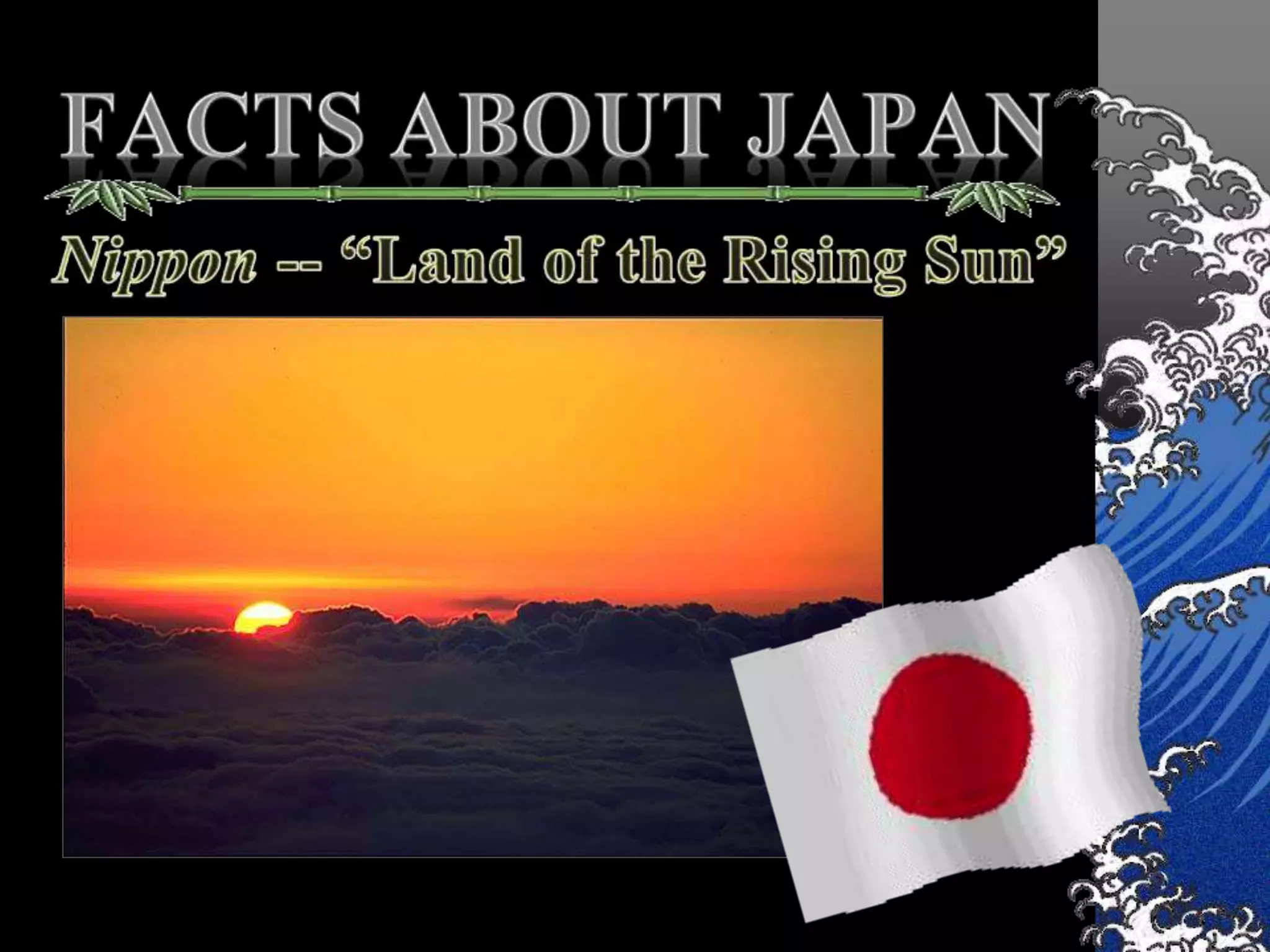
Japan known now as a developed country,
which is famous because of its inventions,
companies and arts. Here we are going to
reveal some Japanese cultures, and some of
their heritage that have a great effect on their
culture.
Japanese Literature is one of the major bodies of
Oriental Literature. It is less voluminous than
Chinese Literature but comparable to Arabic,
Persian and Indian Literature. It covers the period
from the fifth century A.D to the present.
Poems and odes to the Gods were composed
in the early Japanese Language before the art
of writing was known in Japan. Only
fragments of this Literature have survived, but
these are thought to have been extensive.
During the first centuries of writing in Japan,
the spoken language and written language
were identical.
 In written form from at least the 8th century AD
to the present.
 One of the oldest and richest national
literatures. Since the late 1800s, Japanese
writings have become increasingly familiar
abroad.
 Genres such as haiku verse, nō drama, and the
Japanese novel have had a substantial impact on
literature in many parts of the world.
• Nara Period include Kojiki (712: a partly
mythological, partly accurate history of Japan)
•Nihonshoki (720: a chronicle with a slightly more
solid foundation in historical records than the
Kojiki), and Man'yōshū (759: a poetry anthology).
• The language used in the works of this period
differs significantly from later periods in both its
grammar and phonology. Even in this early era,
significant dialectal differences within Japanese are
apparent.
 historically residents of parts of Hokkaido (the
Northern island of Japan) the Kuril Islands,
and Sakhalin
 the remnants of a Stone Age Asiatic people
who lived in Japan until the islands were
invaded by Mongoloid people
 had no system of writing, no political
organization beyond their small village, no
domesticated farm animals or system of
agriculture, and no bronze, or iron metal work
of their own
 Their life was unaffected by civilization until
the Japanese took over
 1920s and 1930s they tried to record the
Ainu tradition
 (1940),Ainu adults spoke both Japanese and
their native language, but Ainu children spoke
only Japanese
 (1955), fewer than 20 Ainu in all of Hokkaido
could speak their native language fluently
 Ainu people tend to have light skin, a stout
frame, deep-set eyes with a European shape,
and thick, wavy hair
 Full-blooded Ainu may have even had blue
eyes or brown hair
 Recorded by John Batchelor (English
Missionary) between 1880-1888
 the dialect is apparently that of the Saru
Ainu
 The epic was recorded as it was sung in the
form of a first person narrative
 The epic was delivered to the Asiatic Society
of Japan on December 4, 1889
 The original text and Batchelor's English
prose translation were published in April,
1890, in vol. 18, part 1 of the Transactions of
the Asiatic Society of Japan
 The main interest of the story lies in the
hero's battles against a whole series of
enemies:
(1) the Pestilence Deities (Pa-kor-kamui);
(2) the six warriors of Kanepet, six warriors of
Shirarpet, and Etu-rachichi, and the twelve
"younger sisters" of the warriors of Kanepet
and Shirarpet;
(3) Shipish-unkur (The younger sister of Shipish-
un-kur casts her lot in with the hero and
becomes his wife at the conclusion of the
epic);
(4) the man and woman living at Terke-santa,
Hopuni-santa;
(5) the inhabitants of the land of Chirinnai ;
(6) the kuruise, a horde of fabulous insect-like
monsters;
(7) the "bad weather demon" {shiri wen nitne)
and his younger sister.
 Nameless Narrator: main character
 Older Sister: she saves and rears the
narrator
 Kamui-otopush: narrator's older brother
 Dangling Nose: evil Repunkur warrior
 Shipish-un-kur: heroic ruler of Shipish
 Shipish-un-mat: heroic sister of Shipish-un-
kur; ally of narrator
Note:
Repunkur are people of the sea.
Okhotsk are people who lived on the northern
coast of Hokkaido.
Yaunkur are people of the land.
*all major characters are members of nobility.
 Northern coast of Hokkiado
 Shinutapka-homeland of the epic hero
 Island of Karapto
 Shipish
 Between 10th and 16th century when Yaunkur
(people of the land defeated the Okhotsk
(the Repunkur) in a series of wars.
Chapter 1
Two clans
 Yaunkur-people of the land
 Repunkur- people of the sea
 Narrator(the hero) is a Yaunkur but was raised
by a Repunkur whom he calls Older Sister
Chapter 1-part 2
 After learning about the death of his parents the
Hero sets out on a journey.
 He saves his brother from a famous Reunkur
Warrior, Dangling Nose.
Chapter 2
 Dangling Nose has revealed that the Hero’s
brother was to be received by the Shipish King
as a trophy.
 The Hero challenges the King, and uses the
King’s sister as a MeatShield.
 In the battle between the Shipish King, the
Hero’s Older Sister fails and is sent to be
reborn
The Beautiful End
 Older Sister is reborn and reunited with the
Hero
 Older Brother marries Older sister
 The Hero marries Shipish-Un-Mat, the Shipish
King’s sister
 Everyone leaves happily ever after
 Surprise
 Magic
 Mystery
 Wars
 Battles
 Death
 Separation of the soul to human body
 Sword--regaining of peace
 Mountains—(abode of Gods) shows that Gods
and Human are different creators.
 Rumbling sound—Although we cannot see God,
we are sure that they are always there.
 Dagger--wrath
 Armor—protection from danger
Classicism
 The use of first person narrative
 Strives for balance – Complete in Nature
 To value intellect
>Men and women are equal since they have both
great power and skills
 To value edification
>Encourages society to do good things.
>Telling the truth is always better than lying.
 Practice decorum
 Even if the hero belongs to the enemies of the
Older sister, she still took care of him.
 Defending the weak.
 Repaying good things done to you.
 To search for the universal
 Everyone needs to prove his worth through
acquiring fame and excellence.
 Love for family will always win over fame,
excellence or trophy.
 Knowing your strengths and limitations will
help you succeed.
 Acceptance of destiny.
 Defend the weak.
 Brotherly love.
 Love for family.
 Love for country men.
 Great beauty is nothing without courage,
strength and skill.
 Do good and good things will happen to you,
too.
 Think before you act.
 Saru Ainu language
 Use of simile
 Use of native idiomatic expression
 Batchelor's translation is rather like a prose
paraphrase, and some troublesome details
have been omitted or re-phrased
Serious Purpose (Avenge the death of the hero’s
parents)
Setting is in the distant past (10th century-16th
century)
Heroic and Supernatural Characters (involvement
of gods and divine creatures)
Composed of a Prologue, Body and Epilogue.
Contains Heroic Boastings
“after that I said:—"Look here, Shipish man, what sort of
bravery did you say you had? Repeat what you said before, for I
desire to hear. Why was the good Curly-head taken and tied up
to the great pine tree? It was to avenge him that I fought against
the people of Kanepet and Shirarapet as well as against
the Eturachichi, of Pon moshiri. Now, as this war is raging, I
have come to test the bravery of the Shipish men. I will hear no
words of peace, even if you speak them. We must measure our
swords, for even if we kill one another, we shall be better off
after death. Now, come, do your very best against me."
Contains Heroic Boastings
“after that I said:—"Look here, Shipish man, what sort of
bravery did you say you had? Repeat what you said before, for I
desire to hear. Why was the good Curly-head taken and tied up
to the great pine tree? It was to avenge him that I fought against
the people of Kanepet and Shirarapet as well as against
the Eturachichi, of Pon moshiri. Now, as this war is raging, I
have come to test the bravery of the Shipish men. I will hear no
words of peace, even if you speak them. We must measure our
swords, for even if we kill one another, we shall be better off
after death. Now, come, do your very best against me."
Contains of Simile
“After this we flew about to and fro in the roof of the house
like birds; till at last this brave lord, having evident wrath
upon his face, spake in an angry and scolding manner and
said:—"As you, my bad younger sister, prophesied in order
to discourage me I will first slay you, you evil creature!“
“Let me down, for though I am as worthless as an old mat,
I desire to join you and will help you in the fight."
Intellectual Value
Men and women are equal since they have both great
power and skills.
The hero is a human being, but he possesses godlike
qualities that even those who are supposed to be Gods are
not certain that he is human
Spiritual Value
 They accept death as integral part of life, and they know
that those who lead good lives will be reborn after death;
those who do not will remain dead
Emotional Value
After hearing the death of his parents, the hero’s heart
overflowed with rage, and he still forced himself to be
polite to his older sister but he still avenge the death of his
parents.
Permanence and Universality
 Great beauty is nothing without courage,
strength and skill. ( We always say that beauty lies
within, thus outside beauty will always be accompanied by
inside beauty)
 Do good and good things will happen to you, too.
(If you do good things, someone will repay it.)
 Think before you act. (When the Hero heard about the
death of his brother he controlled himself in killing his
older sister who belonged to the Yaunkur, an enemy.)
Love for family will always be stronger than love
for fame and excellence.
Equality.(That even if the Hero and the Older Sister came
from the different race or group they still treat each other well)
さようなら

Epic of Kotan Utunnai

  • 4.
    Japan known nowas a developed country, which is famous because of its inventions, companies and arts. Here we are going to reveal some Japanese cultures, and some of their heritage that have a great effect on their culture.
  • 5.
    Japanese Literature isone of the major bodies of Oriental Literature. It is less voluminous than Chinese Literature but comparable to Arabic, Persian and Indian Literature. It covers the period from the fifth century A.D to the present.
  • 6.
    Poems and odesto the Gods were composed in the early Japanese Language before the art of writing was known in Japan. Only fragments of this Literature have survived, but these are thought to have been extensive. During the first centuries of writing in Japan, the spoken language and written language were identical.
  • 7.
     In writtenform from at least the 8th century AD to the present.  One of the oldest and richest national literatures. Since the late 1800s, Japanese writings have become increasingly familiar abroad.  Genres such as haiku verse, nō drama, and the Japanese novel have had a substantial impact on literature in many parts of the world.
  • 8.
    • Nara Periodinclude Kojiki (712: a partly mythological, partly accurate history of Japan) •Nihonshoki (720: a chronicle with a slightly more solid foundation in historical records than the Kojiki), and Man'yōshū (759: a poetry anthology). • The language used in the works of this period differs significantly from later periods in both its grammar and phonology. Even in this early era, significant dialectal differences within Japanese are apparent.
  • 11.
     historically residentsof parts of Hokkaido (the Northern island of Japan) the Kuril Islands, and Sakhalin  the remnants of a Stone Age Asiatic people who lived in Japan until the islands were invaded by Mongoloid people
  • 12.
     had nosystem of writing, no political organization beyond their small village, no domesticated farm animals or system of agriculture, and no bronze, or iron metal work of their own  Their life was unaffected by civilization until the Japanese took over  1920s and 1930s they tried to record the Ainu tradition
  • 13.
     (1940),Ainu adultsspoke both Japanese and their native language, but Ainu children spoke only Japanese  (1955), fewer than 20 Ainu in all of Hokkaido could speak their native language fluently  Ainu people tend to have light skin, a stout frame, deep-set eyes with a European shape, and thick, wavy hair  Full-blooded Ainu may have even had blue eyes or brown hair
  • 15.
     Recorded byJohn Batchelor (English Missionary) between 1880-1888  the dialect is apparently that of the Saru Ainu  The epic was recorded as it was sung in the form of a first person narrative  The epic was delivered to the Asiatic Society of Japan on December 4, 1889
  • 16.
     The originaltext and Batchelor's English prose translation were published in April, 1890, in vol. 18, part 1 of the Transactions of the Asiatic Society of Japan
  • 17.
     The maininterest of the story lies in the hero's battles against a whole series of enemies: (1) the Pestilence Deities (Pa-kor-kamui); (2) the six warriors of Kanepet, six warriors of Shirarpet, and Etu-rachichi, and the twelve "younger sisters" of the warriors of Kanepet and Shirarpet;
  • 18.
    (3) Shipish-unkur (Theyounger sister of Shipish- un-kur casts her lot in with the hero and becomes his wife at the conclusion of the epic); (4) the man and woman living at Terke-santa, Hopuni-santa;
  • 19.
    (5) the inhabitantsof the land of Chirinnai ; (6) the kuruise, a horde of fabulous insect-like monsters; (7) the "bad weather demon" {shiri wen nitne) and his younger sister.
  • 21.
     Nameless Narrator:main character  Older Sister: she saves and rears the narrator  Kamui-otopush: narrator's older brother  Dangling Nose: evil Repunkur warrior  Shipish-un-kur: heroic ruler of Shipish
  • 22.
     Shipish-un-mat: heroicsister of Shipish-un- kur; ally of narrator Note: Repunkur are people of the sea. Okhotsk are people who lived on the northern coast of Hokkaido. Yaunkur are people of the land. *all major characters are members of nobility.
  • 23.
     Northern coastof Hokkiado  Shinutapka-homeland of the epic hero  Island of Karapto  Shipish  Between 10th and 16th century when Yaunkur (people of the land defeated the Okhotsk (the Repunkur) in a series of wars.
  • 25.
    Chapter 1 Two clans Yaunkur-people of the land  Repunkur- people of the sea  Narrator(the hero) is a Yaunkur but was raised by a Repunkur whom he calls Older Sister
  • 26.
    Chapter 1-part 2 After learning about the death of his parents the Hero sets out on a journey.  He saves his brother from a famous Reunkur Warrior, Dangling Nose.
  • 28.
    Chapter 2  DanglingNose has revealed that the Hero’s brother was to be received by the Shipish King as a trophy.  The Hero challenges the King, and uses the King’s sister as a MeatShield.  In the battle between the Shipish King, the Hero’s Older Sister fails and is sent to be reborn
  • 30.
    The Beautiful End Older Sister is reborn and reunited with the Hero  Older Brother marries Older sister  The Hero marries Shipish-Un-Mat, the Shipish King’s sister  Everyone leaves happily ever after
  • 31.
     Surprise  Magic Mystery  Wars  Battles  Death  Separation of the soul to human body
  • 32.
     Sword--regaining ofpeace  Mountains—(abode of Gods) shows that Gods and Human are different creators.  Rumbling sound—Although we cannot see God, we are sure that they are always there.  Dagger--wrath  Armor—protection from danger
  • 33.
    Classicism  The useof first person narrative  Strives for balance – Complete in Nature  To value intellect >Men and women are equal since they have both great power and skills  To value edification >Encourages society to do good things. >Telling the truth is always better than lying.
  • 34.
     Practice decorum Even if the hero belongs to the enemies of the Older sister, she still took care of him.  Defending the weak.  Repaying good things done to you.  To search for the universal  Everyone needs to prove his worth through acquiring fame and excellence.  Love for family will always win over fame, excellence or trophy.
  • 35.
     Knowing yourstrengths and limitations will help you succeed.  Acceptance of destiny.  Defend the weak.  Brotherly love.  Love for family.
  • 36.
     Love forcountry men.  Great beauty is nothing without courage, strength and skill.  Do good and good things will happen to you, too.  Think before you act.
  • 37.
     Saru Ainulanguage  Use of simile  Use of native idiomatic expression  Batchelor's translation is rather like a prose paraphrase, and some troublesome details have been omitted or re-phrased
  • 38.
    Serious Purpose (Avengethe death of the hero’s parents) Setting is in the distant past (10th century-16th century) Heroic and Supernatural Characters (involvement of gods and divine creatures) Composed of a Prologue, Body and Epilogue.
  • 39.
    Contains Heroic Boastings “afterthat I said:—"Look here, Shipish man, what sort of bravery did you say you had? Repeat what you said before, for I desire to hear. Why was the good Curly-head taken and tied up to the great pine tree? It was to avenge him that I fought against the people of Kanepet and Shirarapet as well as against the Eturachichi, of Pon moshiri. Now, as this war is raging, I have come to test the bravery of the Shipish men. I will hear no words of peace, even if you speak them. We must measure our swords, for even if we kill one another, we shall be better off after death. Now, come, do your very best against me."
  • 40.
    Contains Heroic Boastings “afterthat I said:—"Look here, Shipish man, what sort of bravery did you say you had? Repeat what you said before, for I desire to hear. Why was the good Curly-head taken and tied up to the great pine tree? It was to avenge him that I fought against the people of Kanepet and Shirarapet as well as against the Eturachichi, of Pon moshiri. Now, as this war is raging, I have come to test the bravery of the Shipish men. I will hear no words of peace, even if you speak them. We must measure our swords, for even if we kill one another, we shall be better off after death. Now, come, do your very best against me."
  • 41.
    Contains of Simile “Afterthis we flew about to and fro in the roof of the house like birds; till at last this brave lord, having evident wrath upon his face, spake in an angry and scolding manner and said:—"As you, my bad younger sister, prophesied in order to discourage me I will first slay you, you evil creature!“ “Let me down, for though I am as worthless as an old mat, I desire to join you and will help you in the fight."
  • 42.
    Intellectual Value Men andwomen are equal since they have both great power and skills. The hero is a human being, but he possesses godlike qualities that even those who are supposed to be Gods are not certain that he is human
  • 43.
    Spiritual Value  Theyaccept death as integral part of life, and they know that those who lead good lives will be reborn after death; those who do not will remain dead Emotional Value After hearing the death of his parents, the hero’s heart overflowed with rage, and he still forced himself to be polite to his older sister but he still avenge the death of his parents.
  • 44.
    Permanence and Universality Great beauty is nothing without courage, strength and skill. ( We always say that beauty lies within, thus outside beauty will always be accompanied by inside beauty)  Do good and good things will happen to you, too. (If you do good things, someone will repay it.)
  • 45.
     Think beforeyou act. (When the Hero heard about the death of his brother he controlled himself in killing his older sister who belonged to the Yaunkur, an enemy.) Love for family will always be stronger than love for fame and excellence. Equality.(That even if the Hero and the Older Sister came from the different race or group they still treat each other well)
  • 47.